"If you had one last breath - what would you say? If you had one hour to use your limbs before you would lose the use of them forever - would you sit there on the couch? If you knew that you wouldn't see tomorrow who would you make amends with? If you knew you had only an hour left on this earth - what would be so pressing that you just had to do it, say it, or see it? Well there is something that I can guarantee - that one day you will have one day, one hour and one breath left. Just make sure that before that day that you have said, done and experienced everything that you dream of doing now. Do it now - that is what today is for. So pick up the phone and call an old friend that you have fallen out of touch with. Get out and run a mile and use your body and sweat. Seek out someone in your life to say you're sorry to. Seek someone In your life that you need to thank. Seek someone in your life that you need to express your feelings of love to. Then when that day comes you will be ok with it all."
- John A. Passaro
"If you were going to die soon and had only one phone call you could make,
who would you call and what would you say? And why are you waiting?"
"Along forgotten mountain roads, beyond the noise of crowded cities and rushing lives, there is a quieter world - a world where rivers whisper through the valleys, fog drifts between pine trees, campfires glow under endless skies, and tired souls slowly learn how to breathe again. Where 'The Soul Rests In The Mountains' is a peaceful surreal AI music film about wandering hearts, forest silence, old hiking trails, rainy mornings in tents, tiny campfires, distant owls, soft rivers, and the quiet beauty hidden inside nature. Here, backpacks carry more than supplies. They carry memories. Healing. Freedom. And the small pieces of ourselves we forgot somewhere along the way. Mountains rise above sleeping valleys. Morning mist moves slowly through the trees. Boots dry beside the fire. Coffee steams quietly at sunrise. Birds sing through cold forest air. And every little moment feels alive again. This film was made for those who dream about forests, peaceful roads, cold rivers, soft campfire nights, handmade memories, and the feeling of disappearing into nature for a little while. This is not a story you need to solve. It is a place to rest. A place to breathe slowly. A place to remember what peace feels like."
"Some things get clearer with age. Other things just get louder. “Common Sense Ain’t That Common” is Delta blues wrapped in dry humor and hard-earned observation. Raw resonator guitar, patient and grounded. Harmonica drifting between irony and truth. Blues for those who’ve watched the world long enough. Because noise is everywhere… But sense? That’s another story."
"Martin Armstrong delivers a stark warning about rising tensions between Israel and Iran - and the possibility of a much broader Middle East conflict. He discusses Netanyahu, shifting alliances involving Turkey, Saudi Arabia, and Pakistan, capital flows out of Israel, and the growing geopolitical risks surrounding nuclear weapons. Could the Middle East be heading toward a dangerous new war? Martin Armstrong explains what he’s watching - and why investors should pay attention. Watch until the end for his full analysis."
"Companies are going bankrupt, and a lot of them were bought by private equity first. In this video the people on the inside tell what happened, in their own words: vendors who were never paid, small business owners who lost everything, staff at a store in the middle of a bankruptcy, and nurses and dentists watching private equity take over. Private equity firms buy companies with borrowed money and load the debt onto the business. Then come the cuts, the cheaper supplies and the higher prices. When sales drop, the payments keep coming, and the company files. The firm moves on. The workers, the suppliers and the towns are left with the damage.
What this video covers: • A Painted Tree vendor left stranded when the company went bankrupt .• A small business owner forced to file after four years of building. • A multi-million dollar retail store that ended in Chapter 7 and let its staff go. • A Neiman Marcus employee's exit interview during the bankruptcy. • Private equity buying hospitals, stripping them, and closing them. • Private equity taking over dental offices and pushing overcharging. • Why one owner dissolved his business during bankruptcy. • What this wave of corporate bankruptcies means for working families. Every clip is a real person, filmed on their own phone, in their own words. Nothing here is staged. Do you work for a company owned by private equity? Tell us what changed below."
"Douglas is a Retired U.S. Army Colonel and decorated combat veteran. He offers a stark assessment that the Middle East conflict is fundamentally a Jewish war with no vital strategic interest for the United States, describing it as already regional and increasingly merging with other global flashpoints."
The Collapse Narrative Keeps Missing the Real Russia'
by Larry C. Johnson
"I am back in Moscow for the first time in ten months, and the first thing that strikes you is the distance between the city in front of you and the city as it is described five thousand miles away. Moscow and St. Petersburg are thriving, modern, and - this is the word I keep reaching for - vibrant. The streets are clean and safe. They are not lined with the homeless or the begging. In two weeks I saw exactly one man asking for money, on a stoop in St. Petersburg, and he stood out precisely because he was such a rarity. Set that against New York, Philadelphia, Washington, Atlanta - name any major American city - and the contrast is not marginal. It is an order of magnitude.
I start with the streets because they are the simplest test of the claim the West has been pushing for three years: i.e., that Russia is an economy on the edge, its people pulling their cash out, its cities sliding toward crisis. That story does not survive contact with the pavement.
Vladimir Putin is not paying me to post a sunny story. I am reporting what I see and what I hear from ordinary Russians going about their lives - and what I see is an economy that, sanctions and all, is doing better than the Western economies it is measured against. The shelves are full. The restaurants are full. People are working, spending, building. There is none of the visible distress the West insists is just around the corner. Ask the people who actually live here and you will not find a nation bracing for collapse. You will find one that has absorbed everything the West could throw at it and kept moving.
That is the part the Western press cannot bring itself to say. For three years it has forecast a Russian financial crisis that never arrives, and the reason it never arrives is visible from any café window on Nevsky Prospekt in St. Petersburg or Tverskaya Street in Moscow. There is no bank run here, no ruble in freefall. The sanctions were supposed to break this country. They did not. Compare the mood on these streets to the anxiety in London or the decay in America’s great cities, and the question is not whether Russia is surviving the sanctions. The question is why the West ever assumed it would not.
Dinner with Lavrov: A week ago Monday I had dinner with Foreign Minister Sergei Lavrov and Deputy Foreign Minister Sergei Ryabkov. I was in the company of John Mearsheimer, Judge Andrew Napolitano, and Alastair Crooke. The dinner was informal and genuinely candid, and Lavrov answered questions directly - and anyone who has sat with Mearsheimer knows he does not ask soft ones. I came away with two clear impressions.
The first is that Russia’s negotiating position toward the West has not moved an inch since Putin addressed his foreign ministry on June 14, 2024. In that speech he made the terms explicit, and they are the terms still on the table: the West must recognize Donetsk, Luhansk, Zaporizhia, and Kherson, along with Crimea, as permanent Russian territory. These former Ukrainian oblasts are not going back. In Moscow that is treated not as an opening bid but as a settled fact. Beyond it, Russia is building buffer zones through its advances in Sumy, Kharkiv, and Dnipropetrovsk. Those territories could, in time, be incorporated as well - though officials frame that as something that would follow a vote or plebiscite rather than a foregone conclusion. It is not formally on the menu. But it is, in my read, very much in the cards.
The second impression is that the space for a negotiated settlement is extremely narrow - narrower than Western capitals want to admit - because Russia is simply not willing to make the concessions the West requires, and does not believe it has to. My own assessment, after listening to how officials here talk, is that the war effort will not stop until Odessa and Kyiv are firmly under Russian control. I hold that as a judgment, not a certainty. But nothing I heard this week moved me off it.
What “root causes” actually means: Putin talks constantly about the “root causes” of the conflict having to be addressed, and Americans are rarely told what the phrase means. So I asked directly, in a conversation in Moscow with Alexander Babakov, a Duma member and a senior figure in the International Unity Club.
The simplest way to translate it for my fellow citizens is this: the American project of pulling Ukraine into NATO’s orbit and using it as a battering ram against Russia has to end. Not be paused - ended. There will be no more tolerance of NATO activity in Ukraine, and Ukraine’s foreign and military policy has to be severed from that Western embrace for good. From Moscow’s chair, that is the non-negotiable core, and everything else is detail.
It helps to remember how old this really is. Ukraine joined NATO’s Partnership for Peace in 1994, and from that point the Western military relationship with Kyiv grew steadily, whatever the absence of a formal membership card. The Yavoriv military base in western Ukraine became a recurring venue for Western exercises through the 1990s and, from 2015, hosted a standing US-led training mission. Over the years Ukraine became one of the most frequent hosts of NATO exercises of any country outside the alliance - drills whose scenarios never named Russia as the adversary but left no doubt, from their structure, who the target was. By Trump’s first term these were running to several a year, some with a submarine component that had nothing to do with chasing pirates. Through all of it, Moscow’s read is that Putin showed a patience the West mistook for weakness.
You do not have to accept every element of that account to grasp its force. This is the realist reading of the war - the one Mearsheimer has argued about as well as it can be argued - and it is the frame through which the men I dined with see the entire conflict. It is contested in Washington, obviously. But you cannot understand why the Russian position is so immovable unless you understand that in Moscow it is not seen as aggression at all, but as the closing of a wound the West spent thirty years opening.
The view from here: The war is not what occupies the average Russian. It is still, in daily life, a “special military operation,” and the streets of the two great cities carry on as if it were happening on another continent - which, from Moscow, it nearly is. That gap between the fixed, maximalist position of the state and the near-normalcy of civilian life is itself the story: a country settled enough at home to wait, and convinced enough of its terms not to bend.
What the officers told me: I spoke this week with three Russian military men, retired and serving - Colonel Eduard Basurin, retired; General Evgeny Buzhinsky, retired; and, on active duty, Lieutenant General Apti Alaudinov, the commander of the Akhmat special forces. Different men, different vantage points, and one message held across all of them: Russia is not going to attack Europe. It has no military designs on Europe, none, and no intention of starting that fight.
What Russia does see, they told me, is a Europe preparing to attack it - and not merely in the rhetoric coming out of the mouths of leaders like Germany’s Chancellor Merz and the British prime minister, though Moscow takes that rhetoric seriously enough. It is the concrete steps behind the words: the weapons systems, the missiles specifically, being built to be used against Russian territory. The officers were blunt about where that leads. If those activities continue, Russia will have no alternative but to deal with the threat, and the prospect of a war with Europe becomes real. That is not an imaginary danger conjured to frighten anyone. It is how these professionals read the trajectory. Russia is not looking for the fight. But it is neither deaf nor blind to what is being prepared against it.
They also confirmed something I had already sensed on my own: Russia has entered a decisive new phase in the war with Ukraine, a deliberate push to bring it to a faster end than anyone previously anticipated. For the first four years, Russia fought to hold down its own casualties. That is why it did not throw mass formations against fixed positions, where the losses would have been severe, but relied instead on small-unit tactics. That restraint is over. The new phase closes Ukraine’s Black Sea coast to trade in both directions, subjects logistics hubs in Kyiv and other cities - western Ukraine especially - to sustained targeting, and steps up ground advances all along the line of contact. This is a considered shift by the Russian general staff, and it is already paying off: the moves to encircle Sloviansk and Kramatorsk, and key gains in Zaporizhzhia. My own read is that by the end of November, Donetsk will once again be wholly under Russian control, and Zaporizhzhia - a major industrial city and regional capital on the Dnipro - will be under direct threat of occupation.
A vibrant democracy on its own terms: The Russian people go to the polls this Sunday, and I will be there to observe it. There are at least five parties are contesting seats in the Duma. Russia is not the monolith it is made out to be. It is, despite the Western caricature, a vibrant democracy - one built according to Russian culture and Russian ideals rather than a copy of anyone else’s, and it is long past time the West set aside its prejudice and took Russia as it actually is. This is not a regime run by international communists, whatever the popular meme of the 1960s and 1970s held. It is now, deservedly, the fourth-largest economy in the world by purchasing power parity, innovative in its technology and richly endowed with resources.
That is my update for now. I will be back with further insights as my journey continues."
"People are eating at McDonald's less, and the reason is simple: prices got too high. McDonald's was the cheap meal working families counted on. In this video customers and employees show what a McDonald's run looks like now, in their own words. A Big Mac meal for $17.99. A $3 bundle that turned into a $5 bundle. Fries and a pie for seven dollars. Smaller portions, deals that keep changing, and an app you have to download before you get a decent price. Inside the restaurant, staff are cut and kiosks go in, so the few workers left run the whole rush on their own. What this video covers: • A $17.99 Big Mac meal • McDonald's pricing that feels like a landmine • Kiosks that round your total up, and being forced onto the kiosk • A Happy Meal and a frappe cup that shrank • Refunds denied because the store was understaffed • Injury restrictions ignored by the store • People who stopped buying McDonald's and compared it to cooking at home. Every clip is a real person, filmed on their own phone, in their own words. Nothing here is staged. When the cheapest meal in town becomes a luxury, it tells you a lot about this economy. What do you think? Tell us below."
"Diesel prices just hit all-time highs and oil executives say the GREAT fuel crisis is already here. Here’s what it means for your wallet. The fuel crisis is no longer a warning - 10% of global refineries are offline from Middle East and Russia-Ukraine wars, US refineries are maxed at 98%, and oil prices are back above $100 after strikes on Iranian tankers. Moody’s reports US households have paid an extra $1,760 since the conflict began, with over $121 billion in extra energy costs. In this video we break down why 58 diesel prices and gas prices rising are forcing Americans to stop driving, bike to work, carpool, and even quit jobs over commute costs, why 60 fuel supply through the Strait of Hormuz and the East-West pipeline is at risk, why heating oil could jump 30% this winter, and what $6 gas would do to cars, insurance, food prices, and the cost of living .What would YOU do if gas hit $6 a gallon? What do you keep your heat at in winter? Let me know in the comments below."
The Fed just raised rates for the first time since 2023 - and your credit card, HELOC, and new loans just got more expensive. In this video I break down the September fed rate hike in plain English: why the Fed voted 12-0 to hike to 3.75%-4%, why inflation stuck at 3.4% forced their hand, and the $1,700 per-household hit from oil, rates and war spending. You'll learn exactly how fast credit card payments rise, why HELOCs are next, why only new auto loans cost more, how mortgage rates 2026 follow the 10-year Treasury, why savings pay more but slower, and how tighter business credit hits jobs. This is essential personal finance news for anyone navigating today's economy."
"I’m going to have to start using the term “Trumpflation” more often since Trump keeps denying any of the current inflation is his fault. His tariff wars, he always claimed, couldn’t possibly cause inflation. Then when they did cause some, he removed tariffs where the inflation, such as beef, was too scorching hot. His real war with Iran couldn’t be causing it either. So, yesterday he claimed that none of the present inflation was coming from the war with Iran and blamed it all on Zelensky attacking Russia. (Who is, of course, helping Trump out in getting that inflation up with so much successfully and deeply crippling bombing of Russian refineries. (See the headline below on the MASSIVE impact that is having on fuel inside of Russia. It reads and looks in photos like the seventies in America, which is likely where we headed in the months ahead.)
Today, Team Trump dropped back to blaming all the fuel price increases and the derivative increases to other products on Biden. So, I want to make sure the blame rests solidly where it should. That’s why, though there are a number of stories in the news today about the Iran war in general, I’m going to focus today just on the impacts the war is having on prices of oil and fuel. The most critical news comes from Chevron’s CEO who put out a stark warning that we have hit a major inflection point in the pain we will be feeling from fuel prices.
Mike Wirth [the CEO] told an Austin energy conference that the mechanisms cushioning the market have largely played out and the system no longer has the slack it had when this started. Asked where prices go, he said he wished he could point to a reason things would ease and could not. Commercial stocks worldwide have been draining for six months, strategic reserves are near the end of what they can give, and last week’s pipeline strike stranded an estimated 2.5 million barrels a day.
Diesel hit a record $6.23, gas is back to $4.32. Everything I’ve read has said the pipeline carries from 4-7-million per day, but maybe it was only running at low capacity already before the Houthis blew up the pumping station, so Wirth is talking about the remaining flow that got taken out. That would make sense due to all the other damage to oil infrastructure in Saudi Arabia, including particularly major damage done to the world’s largest refinery that feeds in at the other end of the pipeline, which was bombed by the Iraqis with drones not too long ago.
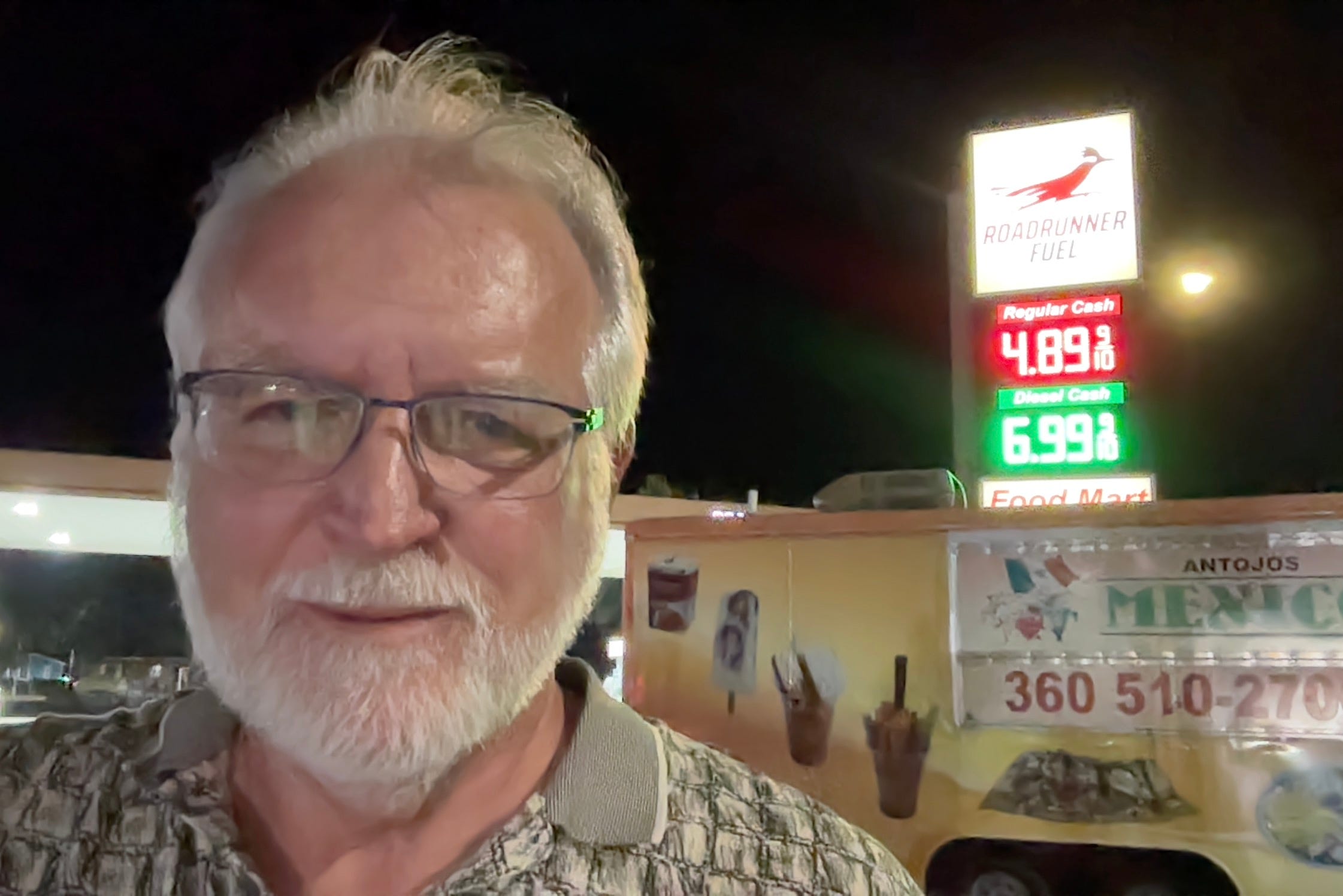
So, the buffers holding fuel prices down are pretty well exhausted, and Wirth is saying that means the fuel crisis has arrived… but he’s not saying, “We’ve now hit the peak.” He’s warning that the eye wall of this hurricane hasn’t even made landfall yet. We are now in the outer bands of this full-force move up in the price of everything because the buffers are finally gone. For me, that looks like this tonight at one of the fuel stations nearest where I live in a semi-rural area of Washington State:
That’s the cash price for diesel. They add ten cents at the pump if you are paying with debit or credit. The highest prices ever seen for diesel, and RoadRunner isn’t even top-tier fuel around here.
Back when I was first claiming this war was going to cause huge fuel inflation this summer, a few folks did not think so. Well, it’s still summer; and, as I warned back then, when we saw this time hit, that would only be the start of the trouble that is coming. We haven’t even seen much sign of the fuel shortages popping up yet, but I am going to lay out for you now how we’ve reached this juncture where shortages do appear and prices climb even faster.
Two more things worth knowing. Wirth said he hasn’t spoken to Trump since August 3, when the president publicly told oil companies to bring prices down NOW. And in March the CEOs of Exxon, Chevron and ConocoPhillips warned this administration that a long closure of Hormuz would produce exactly this diesel shortfall.
We do remember that warning, reported here because I knew it was one we’d want to keep an eye on… as in I was certain we would get there. Unsurprisingly, the Trump administration’s response to Wirth was the usual round of lies: Interior Secretary Doug Burgum told reporters in Houston to make sure the word “temporary” appears in their coverage, and argued prices would have been this high under Biden anyway.
The White House is betting on Venezuelan production and new refining capacity, both of which take years. He should have used the word “transitory.” It has more panache now that the Fed leaned so heavily on it when giving all of its false assurances that this inflation would go away on its own. We now know they could never fully beat it down with a club, so now we have all the new inflation piling in on top. So, if he used that word, we probably could agree with him and say, “Yes, this inflation is transitory… per the Fed’s revised definition.”
And, of course, there is that typical baby-style blame it all on Biden that we get from Trump between his diaper changes. He never has the manly guts to own any damage he creates. That’s a sure sign of a baby.
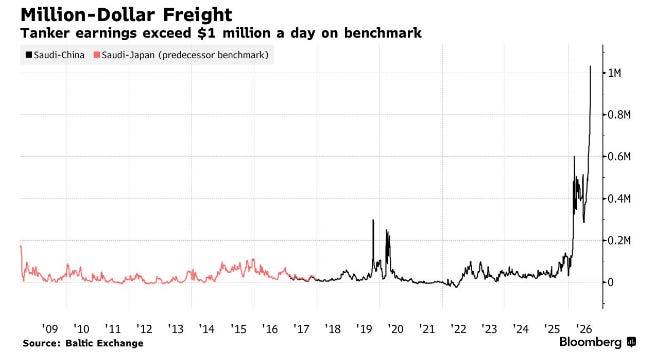
A bright glint of Trumpflation: If you want to see just a little piece of what is going to be driving up the price of fuel more in the near future, but its a very sharp piece, look at this report that just came in about the cost of hiring a supertanker. You may recall I reported yesterday that tanker costs had soared to an all-time record of $800,000 per day! Well look at where they reached today:
Over a million dollars PER DAY! Higher than what were the highest tanker rates in history just yesterday BY FAR. “Yeah, some of us will risk our lives to get that oil through Trump’s safe corridor for you, but it’ll cost you some serious hazard pay.”
As far as the east is from the west: Right now going from east to west in Saudi Arabia is an almost impossible distance for oil unless you want to take it one tiny little tank truck at a time through the scorching desert. So, because of that successful shutoff of the east-west pipeline that I recapped in the Deeper Dive on Saturday when giving an update on how bad the damage was, the Saudis are already terminating oil shipments that had been scheduled. Saudi Arabia has informed European customers that some late-September crude shipments are being cancelled following the closure of the East-West pipeline.
This is not a minor disruption. The pipeline has been carrying 4–5 million barrels per day (approx 4–5% of global oil supply) and has become a critical alternative route while shipping through the Strait of Hormuz remains severely disrupted.
Europeans are paying the equivalent of between US$9 and $11 per US gallon for diesel. Well, you can be sure that went up with today’s announcement on tanker costs! That is a cost that gets tagged onto the prices of WTI and Brent. Crude prices have been holding since the pipeline shut down at a global price of around $105/bbl for WTI and$108 for Brent. But when you don’t get any delivered to your neck of the woods, you’re probably going to pay a hefty premium to squeeze delivery out of somewhere else so you can keep refining. The price of WTI—because the US has a lot of it, making it is the market many are turning to—has now nearly caught up with North Sea Brent, even though it is not as useful for making diesel so usually sells for around ten bucks less a barrel; but refineries are squeezing diesel out wherever they can.
In fact, the latest news I have on that refinery that shut down due to power failure in Illinois is that it appears the power failure came from running their section of the electrical grid too hot for too long by refining at maximum capacity, though the cause has not been nailed down for certain, and the repairs are still ongoing. If that’s the correct diagnosis, the all-out squeeze just created a hot friction point.
Of course, Europe is somewhat the cause of its own problems, too, due to its very liberal policies restricting oil production and refining. However, don’t think this stays contained to Europe. As Europe reaches to other sources to make up what was just taken away by Saudi Arabia (thanks to the Houthis), they will reach for your source. That means you get to compete. It’s a global market.
Beyond a diesel shortage in the West, Europeans are also dealing with low natural gas stockpiles heading into the Northern Hemisphere winter, with prices reaching their highest level since December 2022.
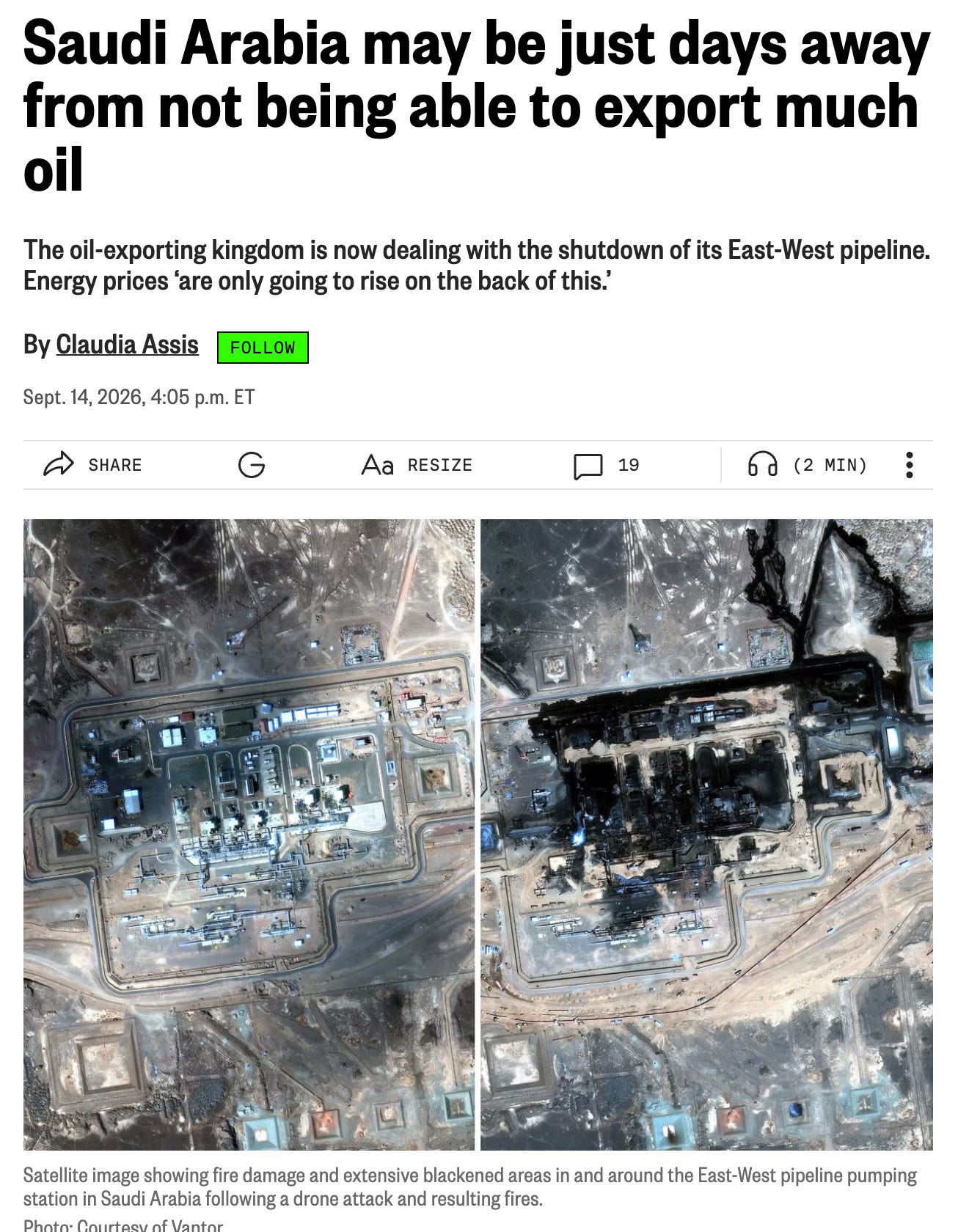
The damage is done: Here is the pumping station before and after the attack as was shown in that Deeper Dive very shortly after the satellite imagery was made available, though it is all over the news now:
Pretty well burned to a crisp. There are several more photos in the article in the headlines below. Of course Trump’s energy secretary said the big conduit across the desert will be back up and running in a 4-5 weeks. Nah, I don’t think that’s something you snap together in a few weeks. It may take that long just to do the demolition and cleanup … if they RUSH. And don’t you think replacement parts and major pumps might be starting to get a little hard to come by in the Middle East? These guys routinely spout nonsense off the tops of their heads. They make it up as they go. If you think I’m wrong, please wait until next month to tell me when they get the pipeline back to fully operational.
Of course, harvest season is here in the northern hemisphere right as diesel is running out and prices are going trough the roof, so you can guess what that is going to do to your food prices this fall and winter, and clearly that will be worse for people in Europe.
Here’s a video I’ll post for everyone that summarizes the war action I covered in my Deeper Dive back on Saturday, comparing their sweeping takeover of West Yemen for importance to the Vietnam Tet Offensive:
Full screen recommended.
The escalation trap: All of this is part of the Iran Plan, which is to say the “escalation trap” I laid out two Deeper Dives back. Those who read that Deeper Dive can now see how the parts are coming together one step at a time, constantly turning up the heat in the Middle East without tripping Trump into full-on war because he really wants out. Last week brought a major tightening of the screws with the wipeout of this pipeline and seizure of full control over the Bab al-Mandeb (Gate of Tears).
The overall goal of that plan is stated in another article below: Iran’s leaders were never going to passively submit to slow strangulation. Facing Donald Trump’s blockade of their ports and the near-total loss of their oil exports, the regime is now striking back across the Middle East, aiming to inflict enough damage to force America to relent. Having locked down Hormuz pretty well, it looks like Iran is doing a darn good job of locking down the other side of Saudi Arabia as phase two of the Iran Plan: "Iran is now doing everything possible to wreck this alternative, which is why the Houthis have strengthened their hold on the choke point, where they have positioned Iranian-supplied anti-ship missiles."
Finally, we have a report from the Congressional Budget Office that says, yes, the Iran war most certainly is driving up Trumpflation. Well, they don’t call it by that name, of course, but they do make clear that his war in now spilling over into the prices of many other things, blaming more than 40% of current inflation on the Trump-Iran War. So, I’m just going to call it as it is. Thank you, Donald Trump for you inflation.
If there remains anyone who is not inclined to blame Trump and his ill-advised war yet, let’s see how they feel in the cold of winter. Maybe that’ll turn the heat up a little on Trump when the heat goes off for many others or, at least, gets turned down to where they can see their breath at the kitchen table. (Note: Some sources say the Houthis made this attack on the east-west pipeline. Some say Iraq. The Saudis, last I read, believed it was the Houthis. The fog of war.)
As a footnote, I’m noticing most of the stories in the news about the Trump-Iran War still have not caught up to the map of Houthi conquests I presented in my Deeper Dive for paying subscribers, showing the full swath of regions they took over in Yemen like a landslide.
I saw one other person commenting on another site about how hard that information is to find in the mainstream news, making him wonder as I was also wondering whether some of the information is being shut out. It’s also possible, of course, that I got false information since I had only one original source, as I noted at the time made me a little less than fully confident; but I don’t think so. I think it will prove over time the Houthis have taken that full region, unless the Saudis, who are now fighting back with more intensity than they showed earlier, reclaim some of it.
One of the stunning things of that victory that made it for the Houthis what Biden did for the Taliban, was that the Saudi forces left much of their heavy artillery behind when they fled so quickly. So, the Houthis captured some great war plunder that they are now putting to use in round two, better armed, thanks to Saudi Arabia leaving its American-built equipment behind.
Anyway, there are lots of headlines below now covering events of the full past week of the war for the first time, just stopping a little short in their boundaries of what has been taken over by the Houthis from what I presented. Those headlines, even if you don’t read the articles behind them, will give you a good picture of the growing troubles that are coming that will cause significant additional upward pressure on crude oil and fuel prices and then the price of everything."
The killer is supply and demand. Less oil is getting on a boat and going to Rotterdam, so that takes it off the market. The Strategic Petroleum Reserve is nearing levels that some have said risk damaging the storage infrastructure itself, but it’s in Louisiana and Texas, so they’re used to the smell of oil in the morning. Smells like . . . money.
But what people miss is that it’s a finely tuned industry. It’s not like there are extra wells sitting around, waiting to produce. And, after Ukraine sent all those flying lawnmowers covered in C4 into refineries in Russia, that stung. It ended up taking out millions of barrels of capacity versus their peak refining capacity. That’s less bubbling crude being turned into diesel.
We have an oil tank. And its level is dropping. Even when the oil comes back, we still need to figure out how to mash it into diesel, which won’t happen overnight. What does that leave?
Demand destruction. Those are fancy words, but the short version is that the solution to high oil prices is high oil prices. Yes, I used to drink gasoline like it was milk back in the day, because despite trillions of dollars being spent to find it, drill it, pump it, pipeline it, smash the dead dinosaur molecules around so the T. Rex bones don’t get stuck in the bottom of my gas tank, gas was cheaper than bottled water. Was. Now it’s expensive, so people will stop drinking gasoline and diesel. And they’ll stop driving. And they’ll stop idling their cars so they use less of that wonderful fuel.
As we’ve discussed before, the poorer nations will be hit first, and hit hardest. For me, it means, well, nothing as far as my fuel purchases. I drive about four miles a day on the average day, so add the three and carry the two... that’s about 120 miles a month. At $4.50 a gallon and 20 miles per gallon, that’s, dang, complicated. It’s too complicated to figure out. You’d have to use multiplication or some other tool of the Devil.
As gas. Not as the economy, and it’s an isolated view. But the cost of fuel is a tax that hits every physical object that is moved in space to be bought and sold. I know that now that if I want steak, because it’s steak and who doesn’t want steak, it will now cost more. It costs more to get food to the cattle, move the cattle, convince the cattle politely to disassemble themselves into Wilder-sized portions, and move their soon-to-be-grilled-ribeyes to my house.
If that gets too expensive, maybe I’ll have chicken. But for the person who can already only afford chicken, I think they have to move to something like mouse. The short version is that demand destruction means people don’t buy as much of whatever demand is being destroyed because they can’t afford it. Demand destruction is just a fancy way of saying, “you’re all getting poorer, so learn to catch raccoon”.
There’s other positive news!10 of 11 postwar (World War II, not the Franco-Prussian War) recessions were produced by... oil price highs that exceeded the three-year high. Which is right where we are. This didn’t happen in 2022, because everyone just decided to print money so we could build all the data centers we can eat instead of having a recession, so in my mind we just kicked the can down the road a bit. Money printing is magic! Do you think they’ll stop now?
No. But what about oil. We make and export oil now. Surely, John Wilder, that will save us! No, it won’t. I mean, sure, it’s nice that roughnecks will be getting some more hours in down in Texas, but that doesn’t help much when you’re a farmer trying to harvest the crop with diesel that’s now twice as expensive as you planned on. On balance, my money is still on this increase in oil prices resulting in not only demand destruction but salary deconstruction.
Salary deconstruction? Oh, nevermind that. It’s just a fancy name for people getting fired, or not getting hired. Raises will be down right at the time that people will be feeling more costs, and it will be harder to get a job. In the 1970s we had stagflation. I wish this would be Epsteinflation, because at least then we’d never see it.
No, this will be Zendayaflation, because even though no one wants Zendaya, Zendaya is everywhere and in everything. Like the inflation we’re starting to see, small, mean looking, but you know that it’s going to grow and resemble a linebacker.
Poitou, France - "‘America lost its way after 9/11,’ says Gerald Baker in the London Times. The wars in Afghanistan and Iraq cost more than 7,000 American lives, hundreds of thousands of civilian ones and trillions of dollars, turning that surplus into a debt now above $40trn. Seeing the world’s sole superpower flounder for a decade against roadside bombs and Soviet-era rifles wrecked American self-esteem and drained Washington’s international authority. But the deeper damage was to Americans’ faith in their government and in themselves.
All over the media, commentators strove to make sense of recent developments...to explain the dramatic change in America’s place in the firmament of great nations. Typical of these assessments is the idea that the US ‘took the wrong path’...or was ‘blinded’ by the need for revenge...or that the emotional shock led to ‘chaos and insanity’ among Americans and their leaders. Daniel Larison: "The ‘War on Terror’ was a Failure." "The U.S. has spent the last two and a half decades dealing out death and destruction across two continents with remarkably little to show for the effort. All true. All beside the point.
All assume the US was headed somewhere else. It got on a train, bound for glory and ended up in Gary, Indiana. What a disappointment! But what if it had been aiming for dereliction all along? And what if neither grief, nor insanity, nor the stupidity of any particular administration led it thither? America did not lose its way. It found it. It was already doomed by its fake money system.
Nor is Donald Trump totally responsible for the latest reversals. He is just another in a procession of lunkheads - from Bush, to Obama, to Biden...and Trump. The latest one didn’t change direction; he just pushed down on the accelerator and enjoyed his reflection in the window as the train sped by. But watch out, Casey Jones; there’s trouble on the tracks ahead. Reuters: "Oil rises above $108 as attacks, pipeline outage deepen Saudi supply concerns."
On the evidence, the War on Terror seems to be going worse than ever. Iran controls the Strait of Hormuz. The Houthis seem to be gaining control of the Red Sea. And Iraqi militias are taking aim at the Saudi Pipeline. They seem to be cornering the world oil market in ways not covered by the finance textbooks. They do not ‘take delivery.’ They just make sure no one else can.
AP: "Houthis seize two Red Sea strategic islands."
AP, AFP, Reuters: "Baghdad confirms attack on Saudi pipeline came from Iraq." "Saudi Arabia has said it will not retaliate and wants Iraq to “take the necessary measures.” Baghdad is under pressure from the United States to rein in Iran-backed militias."
Meanwhile, WLOS: "Diesel prices hit historic high at over $6 a gallon on average nationwide." GasBuddy: "While ‘terrorists’ drive up oil prices, speculators do the job on interest rates. MarketWatch: "10-year Treasury yield hits 5% as oil prices jump and Fed meeting looms." Traders are betting against the ‘house,’ and winning. The Pentagon cannot control ‘terrorists.’ Scott Bessent can’t control the bond market. Even with the largest economy in the world at their fingertips, neither can control the price of diesel fuel.
Diesel is what delivers the stuff. The highways are full of trucks. And the trucks burn diesel fuel. Raise the cost of diesel and the price of the stuff the trucks deliver also goes up. Likewise, the cost of capital is the diesel fuel of finance. Everything depends on it. Raise the price and all the stuff capital buys becomes more expensive too. But there is nothing surprising about this...except perhaps in the details from the oilfields. Stuff becomes more expensive as the feds lose their grip. Gamblers switch from buying the empire’s paper (primarily US Treasury bonds)...to selling it.
Which brings us to the real heart of the ‘decline of the Empire’ story. America’s 21st century blunders were not quirky detours. They were the logical, and probably inevitable, coaling stations along the way. The Bubble Empire is, after all, essentially a massive inflation story. New money enters the economy when it is borrowed. So, each new dollar of debt is equal to an extra dollar of ‘money supply.’ Debt is the empire’s real fuel…its real currency.
Total US public and private debt in 1971 was about $2 trillion...and GDP was about half that much. So, for every dollar of debt there was 50 cents of output supporting it. Now, debt is as much as 4.5 times GDP. That difference - 2.5 times GDP or as much as $75 trillion - is a measure of the Bubble Empire. It is also a measure of how much fake ‘wealth’ could disappear when the bubble pops. But remember, real wealth doesn’t evaporate. The house is still there...so is the factory...and the sausage. The ‘stuff’ survives; the ‘paper’ burns.
"The Doomsday Scenario You Aren't Supposed to Talk About"
"The reason why they are so haphazardly pursuing AI is stranger than fiction This is a very long video where I talk about every aspect of existential risks pertinent to the AGI/ASI risks. Sit back and have a muse with me."
"The American Way of Life... More War, More Misery"
"Gerald Celente dives into the latest issue of the Trends Journal, exposing the political, economic, and geopolitical forces driving America deeper into an era of endless war and mounting hardship. As military spending surges, global tensions escalate, and economic pressures intensify, Celente examines who benefits from perpetual war and who pays the price. From Washington's foreign policy agenda to the impact on inflation, debt, declining living standards, and global instability, this episode connects the dots between government priorities and the growing struggles of We the People.The Trends Journal is a weekly magazine analyzing global current events forming future trends. Our mission is to present Facts and Truth over fear and propaganda to help subscribers prepare for What's Next in these increasingly turbulent times."
"Everyone Is Losing Interest In Everything, And It's a Sign That..."
"More and more Americans are losing interest in everything: going out, hobbies, friendships, even their own goals. In this video they explain why, in their own words, and it keeps coming back to the same three things: money, work and stress. A normal week now looks like this: drive to work, work, drive home, completely exhausted. Saturday is chores, Sunday you are already dreading Monday. Meanwhile rent, groceries, gas and insurance keep climbing and the paycheck stays where it was. So the fun stuff goes first: the dinner out, the hobby, the trip. What this video covers: • People who simply stopped caring about going out. • Being trapped in the "success machine." • Not feeling fulfilled in any area of life. • Burned out and done with social media. • Work, home, repeat, with no money and no motivation. • What happens to an economy that runs on people wanting more.
Every clip is a real person, filmed on their own phone, in their own words. Nothing here is staged. Losing interest in spending is understandable. Losing interest in the people around you is where it gets dangerous. Have you felt this? Tell us below.
“Massive stars, abrasive winds, mountains of dust, and energetic light sculpt one of the largest and most picturesque regions of star formation in the Local Group of Galaxies. Known as N11, the region is visible on the upper right of many images of its home galaxy, the Milky Way neighbor known as the Large Magellanic Clouds (LMC).
The above image was taken for scientific purposes by the Hubble Space Telescope and reprocessed for artistry by an amateur to win the Hubble’s Hidden Treasures competition. Although the section imaged above is known as NGC 1763, the entire N11 emission nebula is second in LMC size only to 30 Doradus. Studying the stars in N11 has shown that it actually houses three successive generations of star formation. Compact globules of dark dust housing emerging young stars are also visible around the image.”
"Every gray hair is another sunrise someone else never got to see. “Aging Is a Privilege” is a heartfelt, reflective Delta King’s Blues tune about gratitude, resilience, and embracing the years with quiet pride. It’s a reminder that growing older isn’t something to fear—it’s a gift not everyone receives. A warm, slow-rolling acoustic guitar carries the melody like an old friend walking beside you through memories and milestones. The harmonica breathes with gentle soul, echoing the joy, heartbreak, and wisdom collected over a lifetime. The groove stays steady and comforting, built for peaceful evenings, front-porch reflections, and thankful hearts. This is blues that celebrates every season of life. For those who understand that every wrinkle, every scar, and every silver hair is proof of a life fully lived. Getting older isn’t losing your youth… it’s earning another chance to see tomorrow."
"We are born into the certitude of our eventual death. Every once in a while, something - perhaps an encounter with a robin’s egg, perhaps a poem - staggers us with the awful, awe-filled wonder of aliveness, the sheer luck of it against the overwhelming cosmic odds of nonexistence. But alloyed with the awe is always the half-conscious grief that one day the light of consciousness will be extinguished. It is a heavy gift to hold, this doomed delirium of aliveness. It is also a buoyant gladness, if we are limber enough to stretch into the cosmic perspective that does not come naturally to us small, Earth-bound bipeds corticed with tender self-importance.
Consider this. For each of us, one thing is true: Had any one variable been ever so subtly different - had your parents mated on a different day or at a different altitude, had the early universe cooled a fraction of a second faster after the Big Bang, you would not exist as the particular constellation of atoms configuring the particular consciousness that makes you you. Because chance plays such dice with the universe, and because the die dictates that the vast majority of energy and matter never had the luck of cohering into this doomed delirium of aliveness, it is, in some profound and practical sense, a staggering privilege to die - one that betokens the privilege of having lived. To lament death, then, is to lament our luck, for any negation of the possibility of death is a negation of the improbable miracle of life, a wish for there to be nothing to do the dying - nothing to have partaken of the beautiful, bittersweet temporality of aliveness.
It is easier to bend the intuitive mind into this correct but counterintuitive perspective while walking in a cemetery at the height of summer. Doing this very thing while thinking these very thoughts, I was reminded of a passage from one of the most lucid and lens-clearing books written this side of Darwin - "Unweaving the Rainbow: Science, Delusion and the Appetite for Wonder" (public library) by the visionary and often controversial (which is the social fate of every visionary) British evolutionary biologist Richard Dawkins.
"We are going to die, and that makes us the lucky ones. Most people are never going to die because they are never going to be born. The potential people who could have been here in my place but who will in fact never see the light of day outnumber the sand grains of Arabia. Certainly those unborn ghosts include greater poets than Keats, scientists greater than Newton. We know this because the set of possible people allowed by our DNA so massively exceeds the set of actual people. In the teeth of these stupefying odds it is you and I, in our ordinariness, that are here. We privileged few, who won the lottery of birth against all odds, how dare we whine at our inevitable return to that prior state from which the vast majority have never stirred?"
"Men fear thought as they fear nothing else on earth, more than ruin, more even than death. Thought is subversive and revolutionary, destructive and terrible, thought is merciless to privilege, established institutions, and comfortable habit. Thought looks into the pit of hell and is not afraid. Thought is great and swift and free, the light of the world, and the chief glory of man."
- Bertrand Russell
"Five percent of the people think;
ten percent of the people think they think;
and the other eighty-five percent would rather die than think."
"In ancient Rome, interregnum was the term given to the period between stable governments when anything untoward might occur, and sometimes did – civil unrest, warfare between warlords, power vacuums and, finally, succession wars. But eventually the dust would settle and the victors, whoever they might be, would at some point restabilise the empire, often with a new map, showing the latest lines of geographic possession.
In 1929, the Italian Antonio Gramsci was in a fascist prison, writing about what he considered to be a new interregnum – a Europe that was tearing itself apart. He anticipated civil unrest, war between nations and repeated changes in the lines of geographic possession. At that time, he was attributed as saying, "The old world is dying and the new world struggles to be born. Now is the time of monsters."
And, of course, looking back from our vantage point in the twenty-first century, we have no difficulty in confirming that he was correct in his prognosis. The world war that followed brought forward the worst traits in mankind. The sociopaths of the world came centre-stage. By the time the dust had settled, tens of millions were dead.
What we do have difficulty with is recognizing that the same pattern is again with us. National leaders and their advisors are spoiling for war, building up weaponry, creating senseless proxy wars in other nations’ backyards and playing a dangerous game of "chicken" with other major powers.
This will not end well. It never does. Once the shoving-match has begun, it only escalates. At some point, whether it’s the false-flag assassination of an Archduke, as in World War I, or the false flag attack on Germany by Poland, as in World War II, we can always count on some excuse being created to justify diving headlong into war.
It’s also true that, when empires get into economic trouble that’s too far gone for any viable solution, a trick that’s always employed by political leaders to keep the citizens from removing them from their seats of power, is to start a war. A people will, if they believe their homeland is in peril, accept the "temporary" removal of their freedoms. Even in the United States, the famed "Land of the Free," political leaders have routinely imprisoned dissidents in times of warfare. People tend to get behind their leaders in wartime, no matter how undeserved that loyalty might be.
And so, now is the time of monsters, as Mr. Gramsci rightly stated. A time of uncertainty, when countries are in turmoil and would-be leaders are jostling for power with existing leaders. An interregnum.
Troubled times tend to bring out all the crazies – all the sociopathic-types that would find it hard to succeed in stable, prosperous times. In such times, the average person becomes worried that things are not going to turn out well. That’s perfectly understandable. Unfortunately, most people lack both the imagination and the courage to cope with how the times are impacting their lives. They instead rely on others to provide a torch that might help them escape from the darkness.
Not surprising then, that every snake-oil salesman in town sees an opportunity to offer big promises – promises that he has neither the ability nor the inclination to fulfill. At such times, the people of a country tend to become polarized, placing their faith in one political party or another, hoping that their party will "make the bad stuff go away."
In the US we see, on the liberal side, promises for "free health care for all," a guaranteed basic income, housing for those who cannot afford it, and an endless stream of promises that, if the government were to implement them all, they will not be able to pay for them, even with 100% taxation from those who presently pay tax.
On the conservative side, we see promises such as "Make America Great Again," with tax rebates that do not rejuvenate the economy, breaks for firms that have expatriated, but do not fool them into returning, claims to cut budgets, only to increase them, and promises to eliminate debt, only to expand it.
To be sure, the problem begins at the top. But it doesn’t end there. It sifts down to the proletariat, who, unable to come up with constructive solutions, create their own monsters, trashing the shops and burning the cars of people who had no hand in creating the problem. But surely this is just a one-off phase, in which the best and brightest are temporarily pushed offstage, but will soon return, yes? Well, unfortunately, no. Historically, a period such as this one is followed by one of increased madness. Historically, the next step is societal breakdown. Riots, secessions and revolutions become commonplace, accompanied by economic collapse.
Out of these events come the worst monsters of all. It’s in the wake of such developments that the people of any country then turn away from those that made the empty promises and toward those who promise revenge against an ill-defined group who are characterized as having caused the problems. That’s when the Robespierres, the Lenins, the Hitlers – the greatest monsters – are swept into power. They invariably deliver the same message – that they’ll seek out the aristocracy, the gentry, the patricians, and strip them of their positions and possessions.
Invariably the way that this shakes out is not that the average man rises up, taking his "fair share" of the spoils. Instead, the leaders take the spoils and the proletariat are reduced to an equality of poverty. Our friend Mr. Gramsci found himself imprisoned by Benito Mussolini and died from illnesses incurred in prison. Unfortunately, his approach was to complain, but remain, as his country deteriorated around him. This proved, for him, to be the worst of choices. And, so it is today."