StatCounter

Friday, August 28, 2026

John Wilder, "Top 15 Everyday Acts That Used To Be Normal And Now Count As Counter-Revolutionary.

"Top 15 Everyday Acts That Used To Be Normal And Now Count 
As Counter-Revolutionary. Number 8 Will Make Your Spleen Explode!"
by John Wilder

"Number 1: Telling a child “no”. Children are not small adults. Children’s feelings, for the most part, don’t matter. We don’t let children drive, buy booze, select their own menu, or make life altering choices. “No” is a complete sentence, and learning limits is required since no child is born with discipline: that has to be learned. And, that over time with enough discipline and effort, no can be turned into yes. Corollary: letting kids lose is important for similar reasons, because life is complex enough that they will lose. Plus, I love to see them cry when I crush them in chess.

Number 2: Demanding that visitors and new arrivals to our country follow our norms, not their own. When I visit a friend’s house, do I walk to his fridge, open up a beer, impregnated his wife, and then demand to be given the remote control so I can watch what I want instead? No, unless my friend is a GloboLeftist. They don’t seem to mind. And they don’t seem to mind it when foreigners do exactly that when visiting or invading our country. Moslem women should feel shame when wearing their desert clothes in the United States, and Mexicans should be embarrassed that they don’t speak English.

Number 3: Not pretending that fat women are attractive. Yes, some people are fat. Exactly zero of them are healthy, and exactly zero of them are more than a 3 out of 10. I bring women as the rule, because no one has ever pretended that fat men are attractive. It’s just (my guess) the feminine desire to reduce mating competition by telling their fat friends to “never change, you’re lovely as you are” so they can have a better chance at banging Chad.

Number 4: Not letting your son quit. Quitting is an addictive drug, because once a kid quits and sees no immediate repercussion in his life, it’s setting the stage for a lifetime of quitting. And no one likes a quitter, except my doctor when it comes to me drinking. And I keep telling him, if I’m a quitter, that will make me a hypocrite. I’d tell you more but...I’m throwing “son” out here in rule 4, but you could (I suppose) put in a daughter, but don’t try to sell me on suffrage for women. That ship sailed over the horizon after they started celebrating murder moms.

Number 5: Looking down on “consumers”. “Consumers” should be shunned. There is no virtue in purchasing. As Mojo Nixon musically noted: You can’t buy cool. You also can’t buy virtue.

Number 6: Expecting young women and men to marry and have children. This is their job. If young women want to wreck society by having lazy girl jobs, they won’t like it so much when they’re cold, catted, chardonnayed, and unChaded. This will revert, because if it doesn’t civilization will collapse. My solution is to drop the drinking age to 18 and encourage illicit keggers in forests. You know, for the kids.

Number 7: Keeping your word, especially when it is painful. Keeping my word is important to me, because the biggest pains in my life came from when people didn’t keep their word. And me, if I promise to do the dishes, I promise, I’ll do the dishes. There is no need to remind me every six months.

Number 7: Understanding that legality and morality are not the same thing. When the entire basis of a society is based on the exact letter of a law, you end up with infinity Indians scamming airports to get wheelchairs to jump the line or “buying” a punchbowl from Costco©, using it for the party, and returning it when the party is over. These are people without honor. This failure is not the complete explanation of why India is like it is, but it’s part of the explanation.

Number 9: Acting like the country you live in was built by your ancestors and owed to their descendants. A female lawyer in New York who wants to tell me that a “refugee” from Kheezewhizistan is just as American as my family, who have been here since before the Revolutionary War, is lying. She’s trying to give away something that’s not hers to give, and we’re not mad enough about it.

Number 10: Saying, “I don’t know.” I’ve observed that the best leaders with the strongest sense of self are unafraid to ask people to explain things, and to admit when they don’t know something. I’ve also observed that people who know everything invariably don’t. TrUSt tHe sCieNce!

Number 11: Thinking that honor, bravery, and integrity should be the norm. They should be the norm. There’s a reason they started making fun of Boy Scouts©, then infiltrating them, then destroying them. The Boy Scouts™ was a wonderful force to create good men, which is the last thing the GloboLeftElite want. So they killed it.

Number 12: Thinking as much about responsibility as liberty. Responsibility is the brother of keeping your word. It’s keeping promises you haven’t even made. It’s investment. Liberty is easy. Responsibility is hard.

Number 13: Teaching children that, yes, they will be judged by their table manners. It’s true. They don’t have to use them every moment, but they have to know them.

Number 14: Admitting when you were wrong without explanation. This is similar to number 10, but a step farther. It goes beyond ignorance into error. People who personalize and defend their errors are evil. Maybe even Evil.

Number 15: Incorrectly numbering a list."

"Living in a World of Ongoing Shortages: Structural Collapse and the End of Abundance"

"Living in a World of Ongoing Shortages: Structural Collapse 
and the End of Abundance - Why Stockpiling Food Represents 
the Only Rational Investment When the SHTF"
by Madge Waggy

"The fluorescent hum of a grocery store at 6 AM carries a different pitch now. You can hear it if you listen—the way the ballasts vibrate against half-empty shelving units, creating an acoustic signature of absence where abundance once resonated. I stood in aisle four of a regional chain in Ohio last month, watching a stocker named Marcus place twelve cans of generic black beans on a shelf designed to hold two hundred. He spaced them carefully, front-facing, creating an optical illusion of plenty. Three years ago, this would have been a routine restocking. Today, it was theater.

Marcus knew. His hands moved with the resignation of someone who has seen the delivery schedules, who knows that the truck due Tuesday isn’t coming, who understands that “supply chain issues” has become a permanent euphemism for a fundamental restructuring of how goods move through the world.

You have felt this shift, even if you haven’t named it. The substitution of brands you never considered buying because your usual choice vanished six months ago and never returned. The creeping expansion of delivery windows—next day became three days became two weeks. The quiet removal of product lines, the shrinking package sizes, the prices that climb with weekly regularity while wages stagnate in their ancient tracks.

We are witnessing the end of an aberration. For seventy years, Americans inhabited an economic anomaly unprecedented in human history: the expectation that any material desire could be satisfied within hours, that shelves would remain perpetually replenished, that the distance between wanting and having would collapse to near-zero. This expectation was never natural. It was constructed from cheap petroleum, globalized manufacturing, debt-fueled consumption, and a just-in-time logistics system so optimized that it eliminated every buffer, every redundancy, every margin of safety in pursuit of efficiency.

That system is breaking. Not temporarily. Not cyclically. The fractures you see in your local supermarket are surface manifestations of tectonic shifts in manufacturing capacity, labor availability, energy costs, and monetary stability. The shortages will not resolve because they are not accidents. They are the new equilibrium emerging from the collision of demographic decline, resource depletion, geopolitical fragmentation, and the long-term consequences of monetary policies that treated money as a limitless resource while ignoring that it represents claims on finite actual goods.

You need to understand what comes next. Not as an academic exercise, but as a survival imperative. The families who navigate the coming decade successfully will be those who recognized the transition early and adjusted their strategies accordingly. They will be the ones who understood that in a world of contracting supply, the best investment is not financial instruments denominated in depreciating currency, but tangible reserves of the necessities that sustain life.
Where the Breakage Originates: Before you can adapt, you must see the machinery clearly. The supply chain was never a chain. It was a complex web of interdependencies so fragile that a single factory closure in Malaysia could idle an assembly line in Detroit six weeks later. When COVID lockdowns rippled across the globe in 2020, they didn’t merely pause production—they destroyed capacity in ways that do not heal within quarterly earnings cycles.

Manufacturing requires institutional knowledge embedded in skilled workers who spent years learning processes that cannot be transferred through manuals. When those workers were furloughed, when they found other employment or relocated or died, the knowledge left with them. Restarting semiconductor fabrication in Taiwan after a drought-induced shutdown isn’t like flipping a switch. It requires recalibrating chemical processes that take months to stabilize, rehiring technicians who have scattered to competitors or industries, rebuilding supplier relationships with small manufacturers who went bankrupt during the interruption.

• Semiconductor fabrication has concentrated in Taiwan and South Korea to such a degree that a single geopolitical incident or natural disaster will halt global automotive production for eighteen months or longer. When Taiwanese chipmakers reduced output during the 2021 drought, American factories idled and dealer lots emptied. Those shortages persist because capacity cannot expand fast enough to meet demand that has only grown as vehicles incorporate more computing power.

• Agricultural labor in the United States depends on undocumented workers and temporary visas that political gridlock prevents from expanding. During the 2022 harvest, California saw twenty-two percent of tomato crops rot in fields while sauce prices jumped thirty-four percent in supermarkets. The disconnect widens each season as immigration restrictions tighten against labor needs that domestic workers will not fill at wages farmers can afford to pay.

• Container shipping operates through an oligopoly of nine carriers controlling eighty-five percent of global capacity. These companies discovered during the pandemic that reducing sailings maintains pricing power more effectively than competing for volume. A standard container that cost $3,500 to ship from Shanghai to Los Angeles in 2019 now costs $11,000, and those costs pass directly to consumers as permanent price increases rather than temporary spikes.

• Just-in-time manufacturing eliminated warehouse inventory in favor of precisely timed deliveries. When timing fails, as it has consistently since 2020, there is no buffer. British supermarkets ran out of carbonated beverages in 2021 not from sugar shortages, but from lack of industrial CO2 production facilities that had shut down for maintenance and never restarted due to energy cost spikes.

These failures cascade. A shortage of computer chips prevents manufacturing of farm equipment, which reduces agricultural yields, which increases food prices, which drives inflation that forces the Federal Reserve to raise interest rates, which makes housing unaffordable, which reduces consumer spending, which triggers layoffs. The system is coupled tightly enough that perturbations in one sector propagate rapidly through others.

The Inflation That Will Not Recede: You have been told that current inflation is transitory, a temporary adjustment to pandemic disruptions that will resolve as the economy normalizes. This reassurance serves the interests of those who benefit from your continued participation in debt-fueled consumption. It does not reflect the monetary reality.

The United States expanded its money supply by forty percent between 2020 and 2022 through quantitative easing, stimulus packages, and COVID relief bills that contained hundreds of billions in unrelated spending. This money was not created through production of new goods. It was conjured into existence as digital entries in Federal Reserve accounts, then used to purchase government bonds that funded direct payments to households and businesses. The result is exactly what monetary theory predicts: more dollars chasing the same or fewer goods, with the inevitable consequence that each dollar commands less purchasing power.

Historical precedent is unambiguous about what happens next. When Argentina expanded its money supply to fund social programs in the 1980s, inflation reached 5,000 percent annually and the currency collapsed. When Zimbabwe printed money to pay government debts in the 2000s, hyperflation destroyed savings and redistributed wealth to those holding foreign currency or tangible assets. When Venezuela’s monetary authorities refused to acknowledge fiscal constraints, the bolivar became worthless and citizens resorted to barter, foreign currencies, and gold for daily transactions.

The United States is not Argentina or Zimbabwe or Venezuela. Its currency enjoys reserve status, its debts are denominated in its own currency, its economy is more diversified. But the physics of monetary expansion apply universally. The inflation you are experiencing—six to eight percent officially, likely higher for the goods that constitute daily necessities—will not recede to pre-2020 levels. Prices will not return to 2019 baselines. The best-case scenario involves stabilization at higher levels; the worst-case involves acceleration that forces currency reforms and wipes out savings.

Consider what this means practically. If you hold $50,000 in a savings account earning 0.5% interest while inflation runs at 7%, you lose $3,250 in purchasing power annually. Over five years, that “safe” savings has lost nearly a third of its value. Meanwhile, the same $50,000 invested in non-perishable food at 2021 prices, consumed at 2024 prices, has effectively returned twenty to thirty percent in avoided costs, tax-free, immune to banking crises, usable even if the financial system seizes.

The wealthy understand this. They are purchasing farmland, precious metals, art, wine, any asset that retains value when currencies depreciate. They are not keeping their wealth in cash or bonds. The middle class, meanwhile, clings to savings accounts and retirement portfolios denominated in dollars, watching their purchasing power evaporate while financial advisors offer platitudes about staying the course.

The Specific Absences: Generalities obscure the granular reality of daily life in a shortage economy. You need to understand the specific vectors through which scarcity will enter your experience.

Computer chips have become the chokepoint of modern civilization. Not merely for smartphones and laptops, but for automobiles, medical equipment, industrial controls, agricultural machinery, defense systems. A modern vehicle contains between 1,500 and 3,000 semiconductors controlling everything from power windows to anti-lock brakes to engine management. When chip shortages idled automotive plants in 2021 and 2022, the used car market exploded into a speculative bubble where vehicles appreciated like vintage wine. Rental car companies, which had sold off fleets during the pandemic to generate cash, found they could not replace them, leading to $400 daily rental rates and travelers stranded at airports.

The housing market has detached from wage fundamentals in ways that suggest permanent structural change. Lumber prices spiked 300% in 2021, then settled at a new baseline 150% above pre-pandemic levels. Copper, steel, concrete—all have seen similar permanent repricing. The starter home, that entry point to middle-class stability that previous generations accessed in their twenties, has become a luxury item accessible only to the affluent or the deeply indebted. Meanwhile, the shortage of construction labor—aging workforce, immigration restrictions, young people avoiding trades—means that even if materials stabilize, the capacity to build does not.

Food security is eroding through multiple channels simultaneously. Fertilizer costs have doubled or tripled as natural gas prices increase (natural gas is the primary feedstock for nitrogen fertilizers). This will reduce yields in the 2024 and 2025 growing seasons as farmers cut application rates or switch to less fertilizer-intensive crops. The Mississippi River drought in 2022 reduced barge traffic that moves sixty percent of U.S. grain exports, forcing expensive shifts to rail and truck transport that permanently increase food costs. Bird flu has eliminated millions of laying hens, driving egg prices to levels that may not fully recede even when flocks rebuild. Drought in the Southwest is reducing cattle herds to levels not seen in decades, which means beef prices will remain elevated for years even if rainfall returns, because rebuilding herds takes half a decade.

Labor shortages pervade every sector. The trucking industry lacks 80,000 drivers and faces demographic collapse as the average age of drivers approaches fifty. Nurses have burned out in unprecedented numbers during the pandemic, leaving hospitals understaffed and increasing wait times for emergency care. Teachers are leaving the profession faster than replacements can be trained. These are not temporary dislocations that will resolve with higher wages; they reflect fundamental mismatches between the conditions of these jobs and the preferences of younger workers who prioritize flexibility and work-life balance over the incomes that once attracted their parents.

The Human Cost of Monetary Collapse: Abstract economic indicators translate into concrete suffering with a velocity that surprises those who have never experienced systemic failure. You will not see the suffering immediately because it begins invisibly, in the substitutions and postponements that families make to maintain appearances.

The middle-class family that once bought organic produce now buys conventional. The family that bought conventional now buys frozen. The family that bought frozen now buys canned. The family that bought canned now relies on food banks. Each step down the nutritional ladder happens quietly, privately, with shame preventing public acknowledgment until the degradation becomes visible in health outcomes—anemia, obesity from calorie-dense nutrient-poor foods, developmental issues in children whose protein intake has been compromised.

Retirees on fixed incomes face impossible arithmetic. Social Security adjustments lag inflation by months or years. A monthly check that covered rent, utilities, and groceries in 2020 now covers only rent and utilities, leaving nothing for food or medicine. Seniors are re-entering the workforce in their seventies and eighties, competing with teenagers for entry-level positions, because their savings have evaporated and their pensions, if they exist, have not kept pace with the cost of living.

The psychological toll is harder to quantify but no less real. Chronic financial stress produces cortisol levels that impair immune function, disrupt sleep, and increase cardiovascular disease. Relationships fracture under the pressure of economic precarity. The constant low-grade panic of not knowing whether you can afford next month’s bills, the shame of watching your children wear shoes with holes because new ones are twenty dollars more than last year, the despair of realizing that the future you were promised was a mirage—these accumulate into a collective trauma that will mark this generation as deeply as the Depression marked our grandparents.
Why Your Pantry Is the Only Bank That Won’t Fail: Let me be direct about what this means for your financial strategy. The institutions you have been taught to trust for security—banks, brokerage accounts, government bonds, pension funds—are all denominated in dollars that are losing value daily. They are not stores of wealth. They are melting ice sculptures, impressive in form but disappearing in substance.

Your pantry, stocked with six months of rice and beans and canned goods, is appreciating in value at the rate of inflation. The $500 you spent on food storage in 2021 now represents $650 in replacement costs. That is a thirty percent return, tax-free, accessible even if the banking system freezes, the stock market crashes, or the government imposes capital controls. No other investment in your portfolio has performed similarly with comparable risk.

This is not about bunkers and conspiracy theories. It is about recognizing that the grocery store maintains three days of inventory on average. That the trucking industry is losing drivers faster than it can replace them. That fertilizer shortages will reduce next year’s harvest. That when these factors converge—and they are converging—the last-minute rush will clear whatever remains on the shelves within hours.

The immigrant grandmother who keeps six months of rice in airtight containers understands something that the cryptocurrency speculator has forgotten: you cannot eat Bitcoin. You cannot barter Ethereum for antibiotics when the pharmacy is out of stock. Tangible goods—calories, clean water, medicine, tools, fuel—are the only wealth that matters when abstract systems fail. The grandmother remembers hunger from her childhood or her mother’s stories. She does not need convincing that abundance is temporary. She has already adjusted to a reality that many Americans are still denying.

Skills That Outlast Supplies: Possessions matter, but capabilities matter more. The coming years will sort people ruthlessly based on practical competence, their ability to manipulate the physical world rather than navigate digital abstractions. Can you mend a torn garment, or do you toss it and order another that may not arrive? Can you diagnose why your car will not start, or are you helpless without a tow truck and a mechanic’s schedule opening three weeks hence? Can you grow a tomato from seed, preserve vegetables without refrigeration, repair a leaking pipe, sharpen a blade, raise livestock, forage for wild edibles?

These skills were universal three generations ago. They have become niche hobbies, “homesteading” or “prepping,” ghettoized into subcultures while the mainstream outsourced all competence to specialists and apps. That outsourcing functioned in an expanding economy with functional supply chains. It becomes lethal when the specialists cannot get parts, when the apps require connectivity that fails, when the supply chains that fed the specialists themselves begin to fray.

Take automotive maintenance. Modern vehicles are rolling computers, increasingly designed to prevent owner intervention through proprietary software and specialized tools. But the vehicles that keep running when dealerships cannot get parts are older models—pre-2010, pre-2000 even—mechanical rather than electronic, repairable with basic hand tools and generic components. The person who knows how to rebuild a carburetor, adjust points and condensers, replace wheel bearings, fabricate simple brackets—these skills transform from nostalgic anachronisms into genuine economic advantages when the supply of new vehicles dries up and the used market becomes unaffordable.

Food preservation operates similarly. The art of canning, dehydrating, fermenting, smoking, salting—these are not aesthetic lifestyle choices. They are methods of converting seasonal abundance into year-round security, of buffering against supply interruptions, of reducing dependence on refrigerated supply chains that require constant electricity. A pressure canner and the knowledge to use it safely is worth more than a cryptocurrency wallet when the grocery store shelves are empty.

Medical knowledge becomes currency when systems overload. The person who knows how to suture a wound, set a simple fracture, identify infection signs, manage chronic conditions without immediate pharmaceutical access—these capabilities become invaluable when emergency rooms are overwhelmed and pharmacies run short. Wilderness first aid courses, long dismissed as irrelevant to urban life, suddenly seem like essential education when calling an ambulance means waiting hours for a response that may not come.

The Network That Saves You: Individual preparation has limits. You cannot stand watch twenty-four hours a day. You cannot possess every skill. You cannot store every possible medicine or tool or component you might need. Solitary survival is a fantasy that ignores the fundamental reality of human existence: we are interdependent by nature, and our survival has always depended on networks of mutual aid.

The coming difficulties will favor those who have cultivated real community—not social media networks of acquaintances, but physical, local, trusted relationships with people who possess complementary skills and resources. The elderly widow with the well and the root cellar. The young couple with the garden and the woodworking tools. The mechanic with the machine shop. The nurse with the medical supplies. The veteran with the security training.

These networks do not form overnight. They require time, reciprocity, repeated interactions that build trust. You cannot show up during a crisis and expect to be welcomed into a community you have ignored for years. The preparation must include social capital, invested consistently before it is needed.

Argentina’s 2001 collapse provides a concrete model. Neighborhoods developed sophisticated trading systems—trueque clubs—where goods and services circulated without pesos. Communities organized communal kitchens and resource-sharing networks that kept people fed when the formal economy ceased to function. These were not government programs. They were organic responses to systemic failure, made possible by pre-existing social fabric.

Your preparation should include becoming known in your immediate area. Not as the “prepper” with the bunker, but as the reliable neighbor, the person who helps, who shares, who possesses skills others need. When scarcity intensifies, reputation becomes currency. The person who hoards visibly, who refuses to participate in mutual aid, who treats neighbors as threats rather than assets—they may survive the first wave of crisis, but they will not survive the isolation that follows.

What This Looks Like in Practice: Enough theory. Here is what this looks like week by week, month by month, as you convert anxiety into action and vulnerability into resilience.

Start with water. Not the cases of bottled water that disappear first during emergencies, but sustainable access. Store the recommended gallon per person per day for two weeks minimum, but also invest in filtration—gravity-fed ceramic filters, chemical treatments, knowledge of local water sources. When municipal systems fail, whether from infrastructure decay or energy shortages, water becomes the immediate crisis that kills within days. Address it first.

Food requires systematic approach, not panic buying. Calculate actual consumption—how much rice, beans, oil, salt, sugar, coffee, tea, spices does your household use monthly? Triple it. Store what you eat, eat what you store, rotate constantly to prevent waste. Focus on caloric density and storage stability: white rice, dried beans, honey, salt, hard cheeses waxed for preservation, cured meats, root vegetables in proper storage, fermented foods. Learn to cook from scratch, because prepared foods require packaging, preservatives, and supply chains that may falter.

Energy independence begins with reduction. Lower your needs before you try to meet them. Insulation, weatherization, efficient appliances, LED lighting—these multiply the effectiveness of any power source you maintain. Then add resilience: solar panels with battery backup, propane stores for cooking, firewood if you have means to burn it safely, hand-cranked or solar chargers for essential devices. The goal is not off-grid self-sufficiency, but the ability to bridge gaps when the grid falters.

Medical preparation includes obtaining and learning to use basic supplies: sutures, antibiotics (fish antibiotics are identical to human and available without prescription), tourniquets, chest seals, blood pressure cuffs, stethoscopes, reference manuals. Maintain your health now—dental work, vision correction, management of chronic conditions—because these services will become unavailable or unaffordable precisely when you need them most.

Security is the uncomfortable reality we must address without glorifying. When resources contract, crime expands. The person visibly hoarding becomes a target. Operational security—keeping your preparations discreet, varying routines, maintaining awareness of your environment—is as important as the preparations themselves. Physical security measures need not be elaborate: solid doors, good locks, motion-sensing lights, community watch arrangements, and the willingness to leave confrontation-avoiding spaces if necessary.

Skills acquisition happens alongside material preparation. Take the welding class. Learn to sew. Study permaculture. Practice marksmanship if you are so inclined, but also practice de-escalation and conflict resolution, because the person who avoids fights often survives longer than the person who wins them.

Reading the Signs Before the Broadcast: How will you know when preparation transitions from prudent to urgent? The signals are already present, but they will intensify. Watch for bank runs or “bail-ins” where deposits are confiscated to save institutions. Watch for sudden currency reforms—new dollars, digital currencies, expiration dates on savings. Watch for rationing systems, price controls that create black markets, military logistics being deployed for civilian distribution. Watch for the wealthy moving assets overseas, for politicians buying rural property, for corporate executives suddenly resigning to “spend time with family.”

These are the tells of impending rupture. The people with access to information act before the information becomes public. When you see them scrambling, you should have already scrambled.

More proximate signs: empty shelves that stay empty for weeks rather than days. Multi-day power outages that are not promptly restored. Water quality advisories that become chronic. Police response times that stretch into hours or days. Emergency room closures. School meal programs that cannot source food. These are the fractures widening into breaks.

The time to prepare is before these signs become daily reality. Once the crisis is acknowledged by the mainstream, the resources you need—generators, water filters, stored food, medical supplies—will be unavailable at any price, or available only through black markets at predatory markups.

The Long Descent: We are not facing a singular catastrophe but a process—a long descent from the energy-intensive, globally-integrated, debt-fueled peak of industrial civilization toward something simpler, more local, more constrained. This is not apocalypse. It is transformation, painful and protracted, unfolding across decades rather than days.

The Roman Empire did not collapse in a year. It frayed, regionalized, lost capabilities it once took for granted. The British Empire receded gradually, leaving former colonies to find their own footing. The Soviet Union dissolved not with nuclear fire but with empty shelves and ethnic fragmentation. These precedents suggest that collapse is less an event than an environment, a new normal that settles over years of crisis punctuated by moments of acute danger.

Your preparation must account for duration. Not a two-week emergency but a multi-year adjustment. Not a temporary disruption but a permanent shift in what is available, what is affordable, what is possible. The food stores must last through seasons, not just weekends. The skills must sustain across years of reduced opportunity. The community must endure through conflicts and shortages and grief.

This is the reality that denial prevents us from addressing. We want to believe in return to normal, in the “temporary” nature of current difficulties, in the capacity of technology or policy to restore abundance. These beliefs are comforting, and they may even be partially true in limited domains. But they are not the operating assumptions that will keep you fed, housed, healthy, and secure through the turbulence ahead.

Your Move: The shelves are thinning. The prices are climbing. The promises are wearing thin. You have been warned, not by conspiracy theorists in bunkers, but by the quiet accumulation of data points, by the behavior of systems under stress, by the visible strain in the eyes of people who move goods for a living and see what is coming down the pipeline.

You can ignore this. Most will. They will continue assuming that someone—the government, the corporations, the market—will fix what is broken and restore what is lost. They will be disappointed, and then they will be desperate.

Or you can act. Methodically, quietly, without panic but without delay. Convert the abstraction of economic anxiety into the concrete of stored food and acquired skills. Build the network of mutual aid that transforms individual preparation into community resilience. Adjust your expectations downward while building your capabilities upward.

The title of this piece suggested that stockpiling food might be your best investment when everything hits the fan. That was understatement. It is your best investment now, before the situation becomes critical, while prices are merely elevated rather than astronomical, while supplies are merely strained rather than unavailable. The return on stored calories when currencies falter is incalculable. The value of knowing how to provide for yourself when systems fail is beyond pricing.

Your neighbor’s pantry—well-stocked, well-organized, supplemented by skills and community connections—is worth more than a Wall Street portfolio in the world taking shape outside your window. Build that pantry. Become that neighbor. The time for pretending abundance is permanent has passed. The time for securing sufficiency is here.

Do not wait for the broadcast interruption, the emergency alert, the official declaration of crisis. By then, you are already behind. Start tonight. Start with a list, a plan, a first purchase, a first lesson. The future belongs to those who saw it coming and prepared accordingly. See it now."

Adventures With Danno, "Extreme Sale Prices At Meijer"

Full screen recommended.
Adventures With Danno, 8/28/26
"Extreme Sale Prices At Meijer"
Comments here:

"Alert! Doomsday Radio Screaming! Planes Airborne; Russia Preps Escalation"

Full screen recommended.
Canadian Prepper, 8/27/26
"Alert! Doomsday Radio Screaming!
 Planes Airborne; Russia Preps Escalation"
Comments here:

Thursday, August 27, 2026

"The Evening the Whole Town Came Outside"

Full screen recommended.
Three-Quarter Town,
"The Evening the Whole Town Came Outside"

Blind Willie Blues, "A Flicker in the Field"

Blind Willie Blues, "A Flicker in the Field"
“A Flicker in the Field” is a deep, vintage Gospel Blues song about loneliness, brokenness, and holding onto faith when the darkness feels endless. With a slow, soulful blues groove, aching male vocals, warm vintage guitar, mournful piano, and a prayerful atmosphere, this song tells the story of a wounded soul searching for one small sign of hope in the middle of an empty field. When everything feels lost, sometimes faith is nothing more than a tiny flicker in the distance - but that little light can be enough to keep us walking. For every broken heart, every lonely night, and every soul still whispering a prayer."

Native American Elder, "Why Letting Go Is the Last Great Lesson of Life"

Full screen recommended.
Native American Elder,
"Why Letting Go Is the Last Great Lesson of Life"
"Native American Elder Explains Why Letting Go Is the Last Great Lesson of Life" explores the timeless psychology of acceptance, emotional healing, inner peace, and personal transformation. Discover how releasing attachment to the past, resentment, fear, and unrealistic expectations can unlock a calmer, stronger, and more meaningful life. This inspiring speech blends ancient wisdom with modern psychology and mindset shift principles to help you overcome emotional pain, reduce stress, and embrace lasting happiness. If you're seeking emotional resilience, self-growth, mental clarity, or spiritual wisdom, this video offers life-changing insights that can transform the way you think and live. Watch until the end to uncover the most powerful lesson that can bring true freedom and peace."

Musical Interlude: Yanni, "To The One Who Knows", "You Only Live Once"

Full screen recommended.
Yanni, "To The One Who Knows",
"You Only Live Once"

"A Look to the Heavens"

“Why isn't this ant a big sphere? Planetary nebula Mz3 is being cast off by a star similar to our Sun that is, surely, round. Why then would the gas that is streaming away create an ant-shaped nebula that is distinctly not round?
Clues might include the high 1000-kilometer per second speed of the expelled gas, the light-year long length of the structure, and the magnetism of the star visible above at the nebula's center. One possible answer is that Mz3 is hiding a second, dimmer star that orbits close in to the bright star. A competing hypothesis holds that the central star's own spin and magnetic field are channeling the gas. Since the central star appears to be so similar to our own Sun, astronomers hope that increased understanding of the history of this giant space ant can provide useful insight into the likely future of our own Sun and Earth.”

Chet Raymo, “The Silence”

“The Silence”
by Chet Raymo

“The hiding places of my power
Seem open; I approach, and then they close;
I see by glimpses now; when age comes on,
May scarcely see at all, and I would give,
While yet we may, as far as words can give,
A substance and a life to what I feel…”

“These few lines from Wordsworth’s “The Prelude” leapt off the page at me. They capture well enough what my life has become. All those years of teaching, of writing in the Boston Globe, were years of sharing public knowledge, knowledge that had been vetted by the scientific community. The work was not about me. The teacher was me, the writer was me, but what I taught and wrote was reliable, consensus knowledge of the world. A student in my classes or a reader of my newspaper columns would have been hard pressed to know my politics or my religion or the nature of the questions that came in the darkest hours of the night. And that is the way it should have been; that was my homage to objectivity.

Those were valuable years, years of building up a sturdy polder in the sea of mystery, a place to stand with a firmness of foot. And now, in retirement, with time on my hands- and on my mind- I find myself more inclined to explore what Wordsworth called “the hiding places of my power.” I approach. They close. I touch with my hand the surface of the pond that Pat wrote about the other day; my hand comes out of the depths to meet me. I see by glimpses. It is, I suppose, a kind of forgetting. With the forgetting comes a certain freshness. My fingertip touches the surface of the world from above and from below, and concentric circles spread outwards, rippling, like a soundless sound, and I struggle, in words, as best I can, to give a substance and a life to what I feel.

This does not mean, I trust, that I am going soft, finding supernaturalist religion or getting all New Age squishy as “age comes on.” I keep my feet planted on solid fact and read my weekly “Science” and “Nature” along with my Wordsworth. No, it is rather a simple freedom to explore the hiding places, attending to private particulars as opposed to public universals, listening for the small voice that whispers from the nooks and crannies of yet unassimilated reality.

There is a passage in “The Prelude” where a young Boy (the poet?), standing in evening air by the glimmering lake, makes a mimic hooting with his hands to his mouth and the owls answer. Twooo-twooo. And the reply. Twooo-twooo. Then, unaccountably, the answers cease. And in the silence the boy becomes more keenly aware than ever of water, rocks, and woods, and mountain torrents, “that uncertain heaven, received into the bosom of the steady lake.” Thoreau has something similar. He rejoiced in owls; their hoot, he said, was a sound well suited to swamps and twilight woods. The interval between the hoots was a deepened silence, suggesting, to Thoreau, “a vast and undeveloped nature which men have not recognized.” It is that that I now attend: the deepened silence between the hoots.”
o

"Edward Gibbon: On The Seven Key Indicators Of Civilizational Decline"

"Edward Gibbon: On The Seven Key 
Indicators Of Civilizational Decline"
By Kaisar

"Most modern historians are weak. But there is one who stands out above the rest. I can think of no post-Enlightenment historian who better captured why civilizations wither and die than Edward Gibbon. His 1788 work "The Decline and Fall of the Roman Empire" describes the process of collapse well, using Rome as the example. I highly recommend this read, even if using the abridged versions.

Here is a brief summary: "The Decline and Fall of the Roman Empire" is a monumental work by Edward Gibbon, published in six volumes between 1776 and 1788. Gibbon’s magnum opus provides a comprehensive historical account of the decline and collapse of the Roman Empire, spanning from the height of its power to its eventual fragmentation and fall. The work is considered a masterpiece of historical literature and a key text in the study of the Roman Empire.

Gibbon begins with the reign of Marcus Aurelius in the second century AD and traces the history of the Roman Empire through its various phases, ultimately concluding with the fall of Constantinople in 1453. You can take his causes of decline from the fall of Rome and apply it to every major national collapse since then. We can summarize these causes into seven key categories:

Internal Decay: Gibbon argues that internal decay played a crucial role in Rome’s decline. This included moral decadence, corruption, and a loss of civic virtue among the ruling class.
Military Challenges: The Roman military, once a formidable force, faced challenges such as overextension, external invasions, and reliance on mercenaries, contributing to its decline.
Economic Issues: Economic factors, including heavy taxation, inflation, and a reliance on slave labor, are highlighted by Gibbon as contributing to the empire’s decline.
Religious Factors: Gibbon explores the role of religion in the decline, emphasizing the rise of Christianity and its impact on the traditional Roman values and institutions. This created a breakdown from the original tradition, and a splintering within the foundational values of the state.
Barbarian Invasions: External pressures from barbarian invasions, particularly by Germanic and Hunnic tribes, are obviously identified as significant contributors to the fall of the Western Roman Empire.
Administrative Inefficiency: Gibbon critiques the Roman administrative system, pointing to bureaucratic inefficiency, corruption, and a lack of responsiveness to emerging challenges.
Division of the Empire: The division of the Roman Empire into East and West is seen as a weakening factor, with the Western Roman Empire eventually succumbing to various pressures while the Eastern Roman Empire (Byzantine Empire) persisted for several more centuries.

Any of those sound familiar? I have written on each one of these regarding the current American system:
Internal Decay: America Is Babylon
Administrative Inefficiency: Bureaucracy Will Destroy Us

If you didn’t know I was talking about Rome when you read the first list, you’d probably think this article was about the United States. Even the division piece – we don’t have an outright division yet, but the foundation is there, just as it was for Rome.

Remember: this work was written around 1788. When you read the above seven points, you would think it’s a critique of the current American state. But nope, this was Rome circa pre-collapse. It’s a great work, if you can stomach the sheer amount of content included. Those seven key indicators of decline are helpful to recognize; to properly discern the signs of the times. The lessons the book provides are phenomenal for extrapolating to future collapses. And pensively, to our own current condition."

Freely download "The Decline and Fall
 of the Roman Empire" here:

The Poet: Theodore Roethke, “The Geranium”

“The Geranium”

“When I put her out, once, by the garbage pail,
She looked so limp and bedraggled,
So foolish and trusting, like a sick poodle,
Or a wizened aster in late September,
I brought her back in again
For a new routine -
Vitamins, water, and whatever
Sustenance seemed sensible
At the time: she’d lived
So long on gin, bobbie pins, half-smoked cigars, dead beer,
Her shriveled petals falling
On the faded carpet, the stale
Steak grease stuck to her fuzzy leaves.
(Dried-out, she creaked like a tulip.)
The things she endured!
The dumb dames shrieking half the night
Or the two of us, alone, both seedy,
Me breathing booze at her,
She leaning out of her pot toward the window.
Near the end, she seemed almost to hear me -
And that was scary -
So when that snuffling cretin of a maid
Threw her, pot and all, into the trash-can,
I said nothing.
But I sacked the presumptuous hag the next week,
I was that lonely.”

- Theodore Roethke

"Go Down Swinging..."

"We lose those battles as often as we succeed. The key, though, win or lose, is to never fail. And the only way to fail is not to fight. So fight until you can't fight anymore. Never let go. Never give up. Never run. Never surrender. Fight the good fight, you fight even when it seems inevitable you're about to go down swinging." 
- "Amelia Shepherd", "Grey's Anatomy"
o
The sons - in the dungeon - think they hear Henry approach to kill them.
Richard: "He's here! He'll get no satisfaction out of me!
 He isn't going to see me beg!"
Geoffrey: "Why, you chivalric fool - as if the way one fell down mattered!"
Richard: "When the fall is all there is, it matters.”

- James Goldman, "The Lion In Winter"

"It May Be Necessary..."

"You may encounter many defeats, but you must 
not be defeated. In fact, it may be necessary to
 encounter the defeats, so you can know who you are, 
what you can rise from, how you can still come out of it."
- Maya Angelou

The Daily "Near You?"

Fairmont, Minnesota, USA. Thanks for stopping by!

Adventures With Danno, "Shocking Prices At Walmart!"

Full screen recommended.
Adventures With Danno, 8/27/26
"Shocking Prices At Walmart!"
Comments here:
o
Full screen recommended.
Fired Carl, 8/27/26
"Kroger Just Got Caught... 
Americans Knew Something Was Wrong"
"Kroger has been facing growing questions about its business practices… and many Americans are wondering if there’s more going on behind rising prices, store closures, and aggressive cost-cutting. In this video, we break down what has been happening at Kroger, why customers and employees have been raising concerns, and which details about the company’s strategy often stay out of the spotlight. From pricing controversies and automation to delivery changes, layoffs, and employee experiences - here’s what Kroger’s recent decisions reveal about the future of one of America’s biggest grocery chains."
Comments here:

Dan, I Allegedly, "The Consumer Just Quit Spending"

Full screen recommended.
Dan, I Allegedly, 8/27/26
"The Consumer Just Quit Spending"
"The American consumer is pulling back, and major retailers are warning that discretionary spending is under serious pressure. Dick’s Sporting Goods just reported disappointing results, sending its stock sharply lower, while Foot Locker sales fell 3.6%. At the same time, consumers are cutting back on athletic apparel, sporting equipment and other purchases they can postpone. The message from retailers is becoming increasingly clear: Americans are changing the way they spend money. Home Depot and Lowe’s are seeing another side of the same economic shift. Consumers are still buying and repairing things, but they are postponing major home improvement and remodeling projects and choosing smaller do-it-yourself repairs instead. From sporting goods and fitness clothing to home improvement and big-ticket purchases, the economy is showing signs of a consumer who is becoming increasingly cautious, selective and financially stretched. This is iAllegedly, covering the economy, consumer spending, retail, personal finance and the warning signs you need to know."
Comments here:

"Americans Film Their Grocery Receipts And Nobody Can Afford A Full Cart"

Full screen recommended.
Epic Economist, 8/27/26
"Americans Film Their Grocery Receipts 
And Nobody Can Afford A Full Cart"
"The weekly shop used to be the boring part of the budget. It is now the part that decides whether the rest of the month works. Sixteen American shoppers filmed their own carts and their own totals. A woman works out that she is $85.26 from being overdrawn and asks how anyone buys two weeks of groceries with that. A mother feeds herself and her daughter for a week on $35. Another sets a $40 weekly budget and films whether it holds. One family adds up three stores in a single day - $169.73, $215.69, $153.54 - and lands on a total over $538. A man asks people to guess what his cart cost and the guesses come in low. A woman films the moment her food stamps are wiped from the card. Two others film the walk into the food pantry, one of them saying she had nothing left to lose. None of them are experts. None of them are reading a script. They are standing at a till or sitting in a car park with a receipt in their hand, and the total does not match the money that is there.

If you have started putting things back on the shelf, or doing sums in the aisle, you are not disorganized and you are not overspending. That is genuinely where food prices have landed for a great many households, and it has happened fast enough that budgets built a year ago no longer hold. A few things are worth looking at. Food pantries are not means-tested in most places and do not ask what you earn - the people in this video who used one all say the same thing about how ordinary it was. Check whether your state has expanded SNAP eligibility, because the thresholds moved and a lot of working households now qualify who did not before. Many supermarkets mark down meat and bread on a predictable schedule; ask a member of staff what time. And if a relative has offered to pick up a shop, let them."
Comments here:

Bill Bonner, "America’s Yard Sale"

Bison crossing a road in Yellowstone National Park
"America’s Yard Sale"
by Bill Bonner

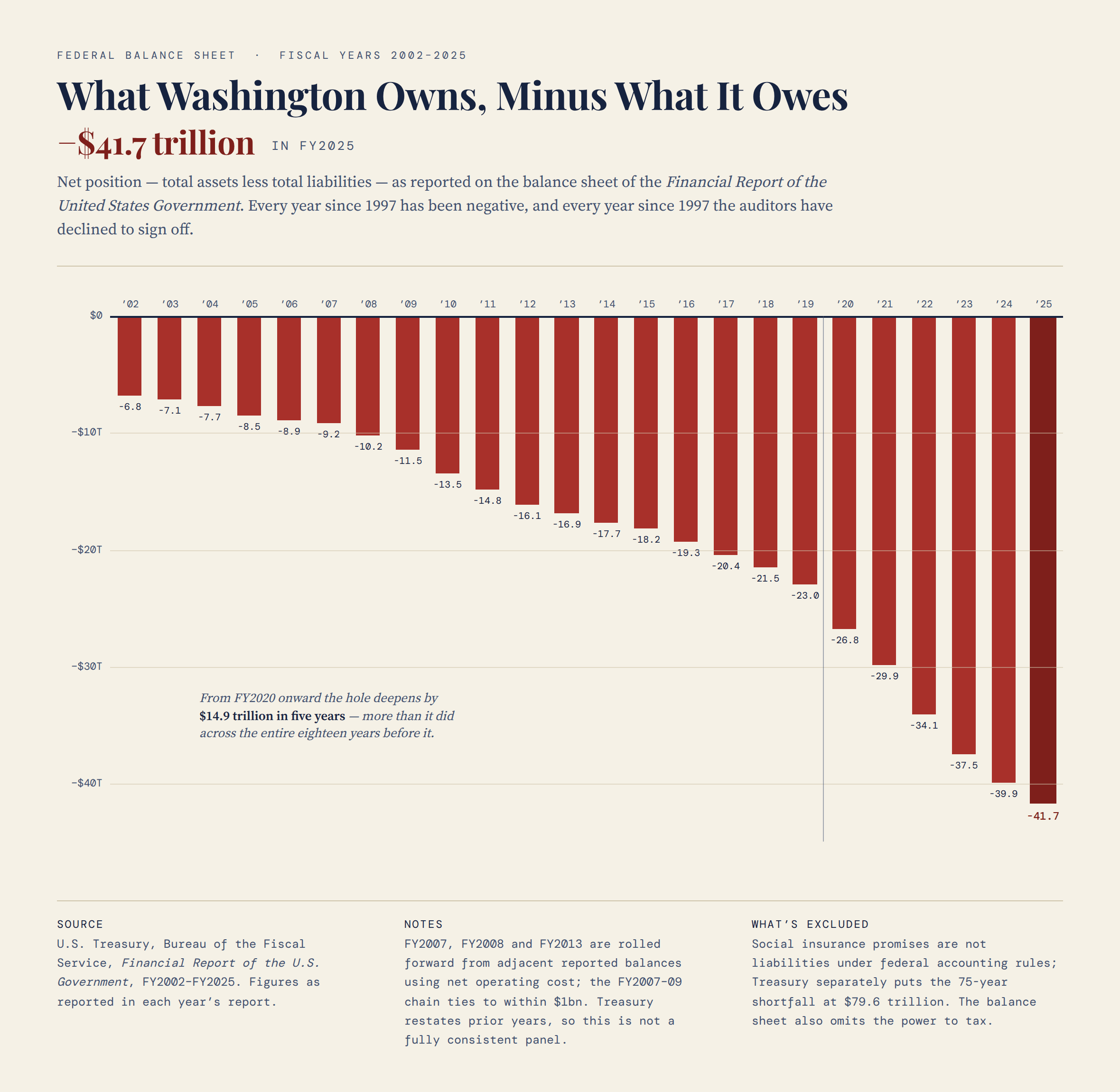
Poitou, France - "Dan sent an intriguing thought. What if US bonds were not ‘certificates of guaranteed confiscation’ after all? What if America’s credit was well secured...by trillions of dollars’ worth of real assets? Dan: "Yesterday a guy I follow and respect said the $40 trillion in debt is secured by America’s massive (not quite infinite) natural resources...land, water, food, energy that sits on public lands ostensibly ‘owned’ by the American people. His implication was that these public assets more than balance out the $40 trillion in debt. We’re good for it!"

The thought comes up from time to time. What’s Yellowstone worth? NASA? Millions of acres of prairie? The Washington Monument? Cape Canaveral? Are they worth enough to cover a $40 trillion in debt...along with $15 trillion more in pension and prostate operations for federal employees...not even to mention the trillions more in ‘mandatory’ spending in line behind them?

But many of America’s most precious assets never show up on the balance sheet. Gold, for example. The feds carry their gold on the books at $42 an ounce. It’s actually worth more than 100 times as much. That alone would bring in about $1.2 trillion at auction...enough to fund the government for about two months.

Then, there is land. The feds own 640 million acres - more than a quarter of the entire US landmass. What it is worth is anyone’s guess...since dumping that much property onto the market would surely crash prices. And even if you could sell it for an average of $100 an acre (think of all that desert and uninhabitable wilderness), it would still only net you $64 billion, again, enough to keep the feds going for three days.

And here is where we’re beginning to see the vast gap between reality and fantasy. An acre of Alaskan forest is real...it has a real value, based on where it is and how it could be used. But the debt numbers are fantastical, wisps in the wind, unimaginable, unfathomable, and unmanageable. When you look at them hard, you see that no plausible combination of real things can measure up.

Proponents of the ‘the feds are good for it’ hypothesis turn to the near-mythical ‘resources’ under federal land - oil, gas, coal, minerals etc. They claim they are worth as much as $200 trillion - far beyond what the feds owe. Hurrah, they say. Problem solved.

But look again. Oil may sell for $100 a barrel, delivered to the refinery. But it may cost more than $100 to deliver it. That’s why most of the world’s oil ‘reserves’ remain in reserve, until the price rises enough to make them viable.

The Cato Institute had a go at better numbers. Its Randal O’Toole did the math and came up with as much as $2 trillion worth of energy resources, along with less than $2 trillion more for the land itself. Of course, the feds have much more in assets. The General Accounting Office says they have $2 trillion in (mostly) student loans, $1.4 trillion in buildings and equipment, $1.2 trillion in cash (last year) and military hardware worth about half a trillion more.
Click image for larger size.
There really is no way the feds are ever going to auction off the nation’s treasures. Who in Congress would vote to sell Yellowstone, for example?

But let’s imagine that the sale would go on. Picture the excitement when the Pentagon holds its first lawn sale. Israelis, Iranians, Chinese - what a marvelous collection of eager buyers. They would kick the tires on jeeps...climb up on the half-tracks...and try out the rocket-launchers to make sure they were in working order. And then, after the buyers had gone home - laden with F-35s and huge tracts of empty land in Wyoming and Montana (one of which included an ICBM silo!) - the feds could count their money.

Damn! Selling everything, even the Lincoln Memorial, would bring in less than $15 trillion, and probably much less. After all, how many of those student loans are actually collectible? No matter, the ‘going-out-of-business’ sale might bring in enough to retire a third of the national debt. But wait. Deficits add about $2 trillion to the debt each year. Within six or seven years, the debt would be back to where it was...

And then, having sold its buildings, land and other assets, the feds would have turned themselves from proud owners to grudging tenants...and instead of receiving lease payments, grazing fees, timber rights, and royalties, they would get nothing. The feds would still be in business...and still losing money...but without a pot to you-know-what in."

"How It Really Is"


"Two Things Are Infinite..."

"The Lighter Side Of Dating, Mating, And Civilizational Collapse'

"The Lighter Side Of Dating,
Mating, And Civilizational Collapse'
by John Wilder

"Even thirty years ago, finding a spouse was as easy as grabbing a beer at a kegger. You met. Maybe at school, maybe at church, maybe at work, maybe some friends introduced you. Hell, maybe at the kegger. It was a straightforward and reliable process, and it was also often sweaty and fun.

Even before my time, though, it was even easier. Take it back to the 1800s, and men brought home the bacon, women kept the hearth warm, and together they built a life, maybe a farm, maybe a picket fence. Often, people would meet and spend their whole lives in the same location. The process wasn’t perfect, but it worked for thousands of years.

Fast-forward to 2026, and the mating market is a dumpster fire. A constant source of conversation is the baby bust, describing how women aren’t reproducing enough children to keep society going. Part of the reason for that is that cultural shifts and technological disruptions have turned love from carnal creativity in the backseat of a Camaro™ to the swipe of a finger on the smooth glass of a screen protector. The result? A generation of lonely hearts, spinsters, and guys who’ve decided sweatpants and beer are a better deal than chasing women who don’t even see them as people. Culture and tech crashed the human mating economy, and why it’s tearing the family, the atom of society, to shreds.

For thousands of years, societies kept a lid on female promiscuity, not because of some patriarchal conspiracy (okay maybe it was, we’re still meeting Thursday night, right guys?), but because it worked.

People who tear down traditions often don’t realize exactly what they’re destroying until it’s gone, and then it’s too late because the fragile fabric that it was supporting has collapsed. It’s sort of like playing Jenga™ with retarded monkeys on crack, but I won’t speak any more about how I know that.

Tradition knew what science later confirmed: high rates of female promiscuity correlate with lower marriage rates and higher divorce rates. Skanky women are horrible for society. A 2020 study from the Institute for Family Studies found that women with more sexual partners before marriage are less likely to stay married. They graph waivers after the big increase in marrying a woman who has had more than one sex partner to a big drop at around four sex partners (for some reason). If you can’t get a virgin, four seems to be the lucky number. But if you’re the 167th guy to tap into that action?

The chances of you being “the one” are nearly zero, yet in 2026 she still wants a ring worth six months of blood, sweat and tears and a house and she brings...you being number 167. Back when shame was a thing, women faced social pressure to be selective, and men had a reason to step up for a low-mileage woman. Now? Shame is as outdated as a Marvel™ movie. Women are free to “explore” and “find themselves” and “live their best life” all while banging a neverending stream of potential Prince Charmings.

Then there’s money. Historically, men were the breadwinners, or at least the leaders in the grind in the family business or farm, with Ma raising the kids and churning the butter while Pa tamed the back 40. Women relied on men for financial stability, and men relied on women to keep the home and raise the children.

Enter the modern workforce: women now make up nearly half of U.S. workers and 90% of the human resources department everywhere. That leads to the dilemma of the Stunning and Brave woman: she wants a man who makes more than her, yet demands equal pay. A 2023 Pew Research study found 55% of women prefer a partner with higher income (and 45% of women are liars). That’s fine, but men’s wages have stagnated since the 1970s while women’s have risen. The math doesn’t add up.

Worse, the government has stepped in as Husband 2.0. Welfare programs, from food stamps to housing subsidies, act like a sugar daddy for single women, especially mothers. In 2022, over 40% of single-mother households received some form of public assistance. Why marry a man when Uncle Sugar’s got your back and they can still bang all the men they want and don’t have to listen to any man?

Women on welfare aren’t wives anymore; they’re concubines of the state, trading solemn vows for EBT and government cheese. The family, once the bedrock of civilization, is now a casualty of games and prizes fueled by promiscuity and feminism. But I repeat myself.

And that’s not even factoring in divorce-rape where unhaaaaapppy or bored women can hit the eject button and blow up the marriage with no real consequences except getting to keep the house, kids, cash and getting a free ticket to ride on the Chad carousel.

That’s bad enough. It’s actually worse than Madonna’s herpes. If culture cracked the mating market, technology crushed it like a python on a peanut. Enter Tinder®, Bumble®, and the swipe-right revolution. Women, all women, are hypergamous. They want the very best mate they can find. Society used to keep them in check through societal pressure. Oh, and soon enough they would have run out of random men to pleasure. Now the apps give them a digital buffet of Chads, Brads, and Thads. Is anyone named Thaddeus nowadays? I digress.

A 2021 study showed women on dating apps rate 80% of men as “below average” in attractiveness, while men rate women more realistically on a bell curve. The result? A 5 or 6 woman swipes right on a 10. Call him Prince Charming the Senator’s son, complete with abs and a hedge fund, who might bang her once but won’t stick around for breakfast or be seen in public with her, let alone hang a ring on her.

She walks away thinking, “He was the one, I could get him to marry me,” and now every guy who doesn’t match up to Prince Charming is... settling. Yes. Settling, even though Prince Charming doesn’t remember her and only picked her up because it was a Tuesday, and was just taking his father’s deathbed advice: “go ugly, early” and picked her up just for amusement. Spinsterhood beckons, with a side of cat and wine memes.

Men aren’t entirely innocent bystanders here, either. Faced with an endless parade of women chasing the top 10% of guys, many men have thrown in the towel. Why grind for a better job, hit the gym, or learn to dress like you didn’t just roll out of a laundry basket?

A 2024 survey found 30% of men aged 18-29 have given up on dating entirely, opting for porn, video games, or “monk mode.” They’re not wrong to notice the game is rigged against traditional one-for-one sorting. Now, Chad gets his choice, and, if they’re lucky, the might get the attention of a slagged-out woman who is still pining for Chad – a widow for a man that was only in her life for a night.

This isn’t just about lonely Friday nights. This is about the death of the family. Men want decent looks, monogamy, and a partner who’s kind - basic stuff. “She can’t read but she’s faithful and hasn’t had sex with Baltimore” has become a passing grade for many. Women want the whole package: money, status, looks, protection, and a guy who’s basically a football start with a corner office. Wait. Tom Brady didn’t work out for his wife. Neil Armstrong’s wife became unhaaaapppy. What chance does the average guy have?

Marriage rates are at historic lows, being down 60% since 1960. Divorce rates hover around 40%. Kids grow up in fractured homes or none at all, with single-parent households now at 30% nationwide and rising. The family, the core unit, the atom that glues society together, is being eroded by individualism on steroids. I could write a book about this topic, but you get the idea.

So how do we dig out of this mess? Start with culture. Bring back shame. The scarlet-letter kind. Encourage women to value loyalty over chasing Chad, and men to step up instead of checking out. That starts with incentives, because I don’t think anyone has any shame left.

Let’s rethink current incentives. Have a kid and no husband? Tough luck. No child support, no state support. Same thing with divorce. No fun and prizes for that, and if you’re at-fault, you lose the kids. Sure, tax breaks for married couples or policies that don’t make Uncle Sugar a better bet than a husband are nice, but we don’t need a nudge, we need a nuke.

Will the norm come back? It has to. Two more generations of this, and civilization will cease to exist. Perhaps G. Michael Hopf (LINK) got the old quote wrong and it should go more like this:
Bad times create strong men,
Strong men create good times,
Good times make women skanky,
Skanky women create bad times.

Don’t worry, nothing’s depending on this. I mean, nothing other than the fate of civilization."