

Click image for larger size.
"The Triumph of Death" by Pieter Brueghel, 1562.
Luciferian Lucre Friars"
by Joel Bowman
“If you gain, you gain all; if you lose, you lose nothing.”
~ Blaise Pascal, "Pensées" (1623–1662)
Buenos Aires, Argentina - "In his unfinished Pensées, the 17th-century French philosopher Blaise Pascal argued that it was better to throw in with the true believers, if only as a kind of theological hedge: the cost of doing so was finite, he reasoned, while the potential payoff was eternal. To our merely earthbound knowledge, the author of the eponymous wager has thus far declined to enlighten us as to the outcome of his famous stake. What that says about the odds for (or against) the rest of us, we do not pretend to possess any special insights, one way or the other.
Pascal’s posthumous silence on the matter notwithstanding, many are those who have invoked his logic, or some version of it, in defense of what are sometimes called “asymmetrical” bets... the kind where one stands to gain everything, for example, at the cost of losing nothing. Alas, as with most things that are too good to be true, there lurks a devilish detail in Pascal’s cosmic flyer, one that alters the ante in a rather non-trivial manner. More on all that anon. But first, a brief word on the extinction of our entire species, much in the news of late…
Featherless Confessions: What is it about the apocalypse, demonstrably among the least common events in all human history, that so animates the public imagination? Is life on our pale blue dot really so banal... so utterly predictable... so bereft of awe and wonder of every imaginable kind... that we must constantly conjure events of never-before-witnessed improbability so as to set the whole thing on a frightful knife-edge?
One does not wish to sound like a fattened Thanksgiving turkey in the dying hours before T-Day, having blithely extrapolated the trajectory of his good fortunes beyond the morrow’s football game. But at some point the question must be asked: would knowing the end is nigh really change his behavior? And, if so, why not adopt those good gobble-gobble habits anyway, absent the glint of the kitchen cleaver?After all, if a Turkey’s soul is truly worthy of passing through the Poultry Gates, surely its salvation does not hinge on an eleventh-hour recantation on the baking tray?
But let us return to the all-too human world – or the End of the World – for the rest of us featherless bipeds. Indeed, few subjects excite our darkest fears quite like a good ol’ Armageddon narrative. Behold, a smattering of hyperventilating headlines from the past few days alone...
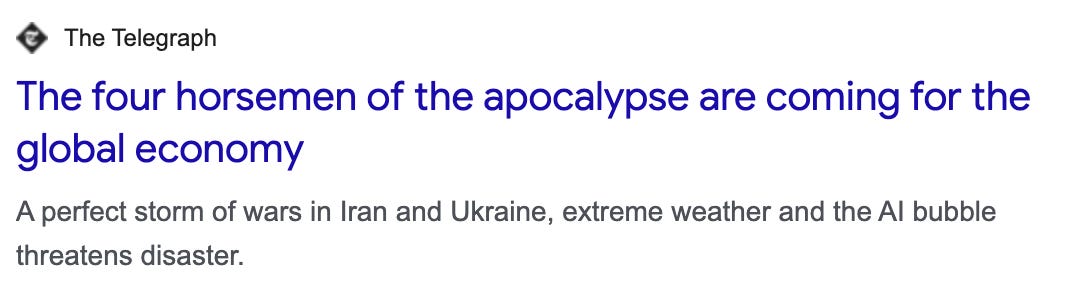

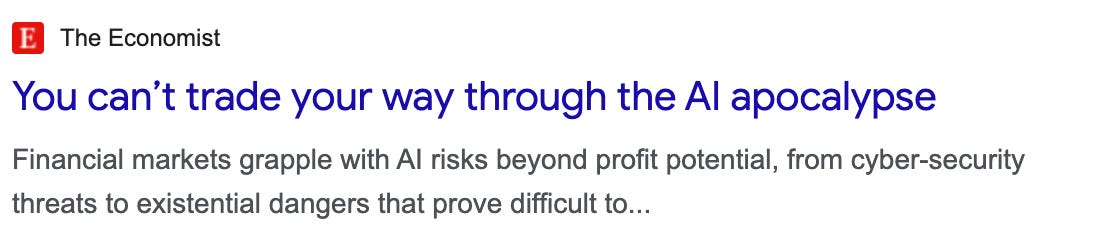
Tetzel’s Pretzels: From extra terrestrial invasions to annihilating climatic events to long-prophesied supernatural raptures, doomsayers have for centuries repackaged our deepest anxieties and sold them back to us in the form of indulgences, deathbed endowments, chantry foundations and various other forms of our “essential liberty.”
We’ve been here before, of course, only in reverse. In the space of a few short decades, we’ve gone from “the coming Ice Age” to “ice-free winters”... Malthusian famine to an obesity crisis... Peak Oil to Just Stop Oil... the Population Bomb to Population Collapse... the millennium bug to the millennial generation...The common existential threat, it seems, is the underlying species that insists on inventing (and reinventing) common existential threats.
Alas, panic-ridden bedwetters are no more a thing of the past than are the cynical opportunists who seek to exploit them. Too often have we been warned “The end is nigh!”... only to arise the following morning and discover Helios once again astride his golden chariot, charting a course across the cerulean sky.
But amidst all the panic mongering, how is one to spot a genuine fraud from a garden variety mental defective? One clue: follow the money. That such scaremongering seers are seldom averse to accepting payment in worldly currency ought to raise a skeptical eyebrow. It was that wily rascal Johann Tetzel, an early 16th Century church salesman, who used to tempt and terrify congregants of the medieval Catholic Church with his catchy refrain: “As soon as the coin in the coffer rings, the soul from purgatory springs.”
The Papal Pockets: In his humble role as the Grand Commissioner for indulgences in Germany, Tetzel used his position to flog heavenly pardons to a stupefied and terminally credulous peasantry. Readers will be shocked to learn the vast sums he raised by claiming to rescue burning grandmothers from the flames of purgatory did not, in fact, go to local churches as promised but instead were divvied up between what he clearly viewed as more “needy” causes...
That is, half the loot was funneled to the papal pockets of Pope Leo X, who was at the time fast running out of coin to fund his ultimate Vatican vanity project: the complete restoration and luxury furnishing of the spectacularly immodest St. Peter’s Basilica...
While the other half went to bail out Cardinal Albert of Brandenburg, the Archbishop of Mainz, who had himself coughed up an enormous bribe to the pope for a special dispensation that would allow him to hold multiple holy offices at once. Lacking the cash up front, Albert took out a massive loan from Jacob Fugger, a wealthy merchant of the day who was essentially Europe’s Bankster in Chief. The Pope even expressly allowed Albert to hire Tetzel to sell indulgences to the public explicitly so he could divert his half of the profits to repay his loan to the Fugger bank.
Money men... power mongers... well connected elites... Luciferian lucre friars... all peddling end of days narratives to dupe well-meaning believers into ponying up their hard-earned in the here and now. Nothing new under this sun, dear reader. Quam necopinatum! (Latin for "How unexpected!" or "What a surprise!") We’ll have more on Apocalypse, Never!, the myths of modern day doomers, and an addendum to Pascal’s wager, next time. Stay tuned for more Notes From the End of the World...'
o
Freely download "Pensées", by Blaise Pascal, here:

No comments:
Post a Comment