StatCounter

Thursday, October 1, 2026

“Yet…”
by Chet Raymo

“My suspicion is that the universe is not only queerer than we suppose,
but queerer than we can suppose.”
- J. B. S. Haldane

“Legend has it that after reciting his official recantation, kneeling on the floor of the Holy Office in Rome before assembled officials of the Inquisition, Galileo whispered, “And yet it moves.” To save his life, or at least to avoid some dank dungeon and perhaps torture, the old man had publicly denied that he ever believed or taught that the Earth orbits the Sun, rather than the other way around. The public recantation was real enough. Whether Galileo whispered the private qualification we’ll never know. It makes a lovely story. In any case, he was allowed to go back to Florence under house arrest and in the final years of his life invented (I will dare to assert) mathematical physics.

And yet it moves. The Earth goes spinning around the Sun with its sister planets. The Sun whirls with its neighboring stars around the center of the Milky Way Galaxy. The Milky Way drifts with its attendant galaxies toward the Andromeda cluster. The Milky Way Galaxy, the Great Andromeda Galaxy, and their lesser galactic companions, the so-called Local Group, dance somewhere near the outer edge of the Local Supercluster of galaxies. Which are but the tiniest swarm of galaxies in the whole outward-racing shebang.

It moves. Oh, yes, it moves, and Galileo didn’t know the half of it. His inquisitors didn’t know any of it, but they thought they knew all of it. And their descendants still claim infallibility. But let me not beat up on the dogmatists. We should all whisper to ourselves now and then, “And yet, and yet.” Our descendants may be surprised at our own naivety. Wholly new paradigms may be required before we understand the origin of the universe or the mysteries of biological development and consciousness. Such a little word, “yet.” Maybe the most significant word in our vocabulary.”

"The Little Things That Make Life Beautiful"

Full screen recommended.
"The Little Things That Make Life Beautiful"

Native American Elder, "Why Being the Oldest Child Made Him Grown Before His Time"

Full screen recommended.
Native American Elder,
"Why Being the Oldest Child Made 
Him Grown Before His Time"
As the eldest of 7, so very familiar...

The Daily "Near You?"

Oaxaca, Mexico. Thanks for stopping by!

Walt Whitman, "Animals"

"Animals"

"I think I could turn and live with animals, they
are so placid and self contain’d;
I stand and look at them long and long,
They do not sweat and whine about their condition;
They do not lie awake in the dark and weep for their sins;
They do not make me sick discussing their duty to God;
Not one is dissatisfied - not one is demented with
the mania of owning things;
Not one kneels to another, nor to his kind that
lived thousands of years ago;
Not one is respectable or industrious over the whole earth."

- Walt Whitman

"Death in the Afternoon"

"Death in the Afternoon"
by Joel Bowman

"To be immortal is commonplace; except for man, 
all creatures are immortal, for they are ignorant of death; 
what is divine, terrible, incomprehensible, is to know that one is mortal."
~ Jorge Luis Borges

"Everything is illuminated against its opposite; truth against fallacy; light against darkness; life against death. And who would have it any other way, even if they could? What would life on this mortal coil be, for instance, without the eternity of its terminally mysterious counterpoint?

If there exists a perfect setting for these and associated meditations, it must surely be the magnificent Recoleta Cemetery, located right here in Buenos Aires. On any given weekend, this sacred resting place for thousands of the city’s most famous – and infamous – people is found to be one of the liveliest places in town. Notable interments include a who’s-who list of Argentine writers, painters, poets, musicians, scientists and luminaries from other noble fields of interest. And, because nothing, including death, is beyond the law of equilibrium, a handful of politicians also rot underfoot.

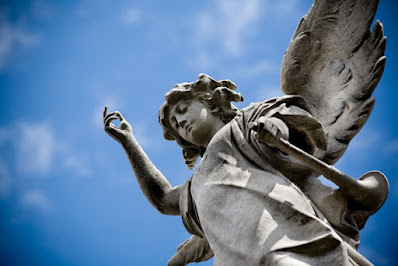
Tourists pour in to adorn Maria Eva Duarte de PerĂ³n’s grave with flowers, for instance, bypassing the resting place of a Nobel Prize-winning chemist and a dozen honest writers to do so. Other, temporary attendees pose with Colgate smiles to have their picture taken beside weeping cement angels, frozen, as they are, in a state of perpetual sorrow. Young boys give the “peace” symbol next to the generals’ tombs whose armies laid to waste to tens of thousands of men, not much older than they, the bodies of whom are long forgotten, their makeshift graves unmarked.

Nowhere does irony live a fuller life than in a cemetery. Walking among the deceased, reading bookend dates on the bronze plaques, one is reminded of the finite nature of all things; organisms, currencies, political regimes, class structures. When the cemetery was constructed, back in 1822, it must have been a good ride from the exclusive barrios of San Telmo and Montserrat. The rich probably wouldn’t have been caught dead around the grounds of the Monks of the Order of the Recoletos, nor near the shabby, patchwork graveyard that was built there the same year the group disbanded.

Half a century later - and with Argentina still reeling from the War of the Triple Alliance and its own, subsequent civil war - a yellow fever epidemic tore through the capital city. Its wealthier, southern quarters were among the worst hit areas. Death toll estimates range from thirteen to twenty-five thousand. The clase alta packed up and moved north, largely into and around the Recoleta barrio. As such, the marbled vaults came to be populated with members of this same aristocracia, who, though they escaped the fever, came to rest here eventually just the same.

Today, you could buy an entire building in San Telmo for the same price as some of the finely appointed homes in Recoleta. An entire block in Montserrat might go for half that much.

And so it goes. People die…cities and empires crumble to the ground…and time, indifferent to the fleeting anguishes and triumphs of men, presses on.

At the turn of the 20th century, Argentina was ranked as the 8th most prosperous nation on earth. Only Belgium, Switzerland, Britain and a handful of former English colonies - including the United States – were more favorably positioned, economically. In 1913, Argentina’s bustling, cosmopolitan capital, Buenos Aires, had the thirteenth highest per capita telephone penetration rate in the world. Her per capita income was, around this time, 50% higher than in Italy, almost twice that of Japan and five times greater than its northern neighbor, Brazil. Argentina’s industry churned out quality textiles and leading edge, refrigerated shipping containers carried her prized beef, first introduced in 1536 by the Spanish Conquistadors, from the fertile plains of the pampas to the farthest reaches of the known world.

As the century wore on, protectionist policies at home and increased competition from the export-led, post-WWII economies – particularly from Japan and Italy – undermined Argentina’s international advantage. From 1900 through to the beginning of the new millennium, Argentina’s real GDP per person grew at a rate of 1.88% per year. Brazil outpaced her handily, clocking a 2.39% annualized growth rate. Japan, starting with a real GDP per person of just over $1,500 (2006 dollars) at the turn of the twentieth century, grew an average of 2.76% per year. By the middle of last decade, Japan’s real GDP per person had doubled that of Argentina. By 2020, it was more than quadruple.

The phenomenon is so conspicuous, the local Argentines even have a joke for it. “There are four types of countries in the world,” they lament. “First world. Third world. Japan, where nobody can figure out how they did so much with so little. And Argentina, where nobody can figure out how we did so little with so much.”

War, currency debasement, civil unrest, military rule and the catalyzing agent of political aspiration, harbored by the equally corrupt and inept, all conspired to stultify this once-proud nation’s potential. The great Argentine poet and essayist, Jorge Luis Borges, described one such retarding factor with characteristic flare and wit: “The Falklands thing was a fight between two bald men over a comb.”

On a comfortable Sunday afternoon in late February, an elderly group of well-dressed gentlemen met at their favorite restaurant, right by the gate to the Recoleta Cemetery, for lunch. They took a table outside, one in the shade and with a view of the passing foot traffic. The waiters, having brought the regulars the same thing, more or less, every Sunday for as long as they could remember, immediately set about filling their table. There was bife de lomo and chorizo sausages, mozzarella and buffalo tomatoes and papas fritas by the pile. Rich, Argentine Malbecs and Cabernets flowed freely and the merriment of the group soon became infectious. They flirted with the pretty waitresses and joked with patrons at the nearby tables.

After more than a few bottles, one of the gentlemen got chatting with an Australian editor of no particular importance. “I am a judge here,” he eventually told the younger man. “My friends and I have seen it all in this city…riots, economic crises, war, people’s entire life savings wiped out overnight.”

One of his friends lent over and placed a knowing hand on the judge’s shoulder. “Today, we enjoy the moment,” he said to his lifelong friend, before adding, one long finger pointed over the cemetery wall, “because tomorrow…ha ha…well, you know our next stop old man.” And the table erupted in laughter, as the sun set over the angel’s heads in the background.

Cheers,"

"The Flu Isn't The Only Illness We Need To Watch This Winter"

Full screen recommended.
Snyder Reports,10/1/26
"The Flu Isn't The Only Illness 
We Need To Watch This Winter"
"Health officials are extremely concerned heading into fall and winter 2026. Flu has already arrived early, COVID is rising, and hospitals warn they could be overwhelmed. In this update we break down the measles outbreak 2026 in Pennsylvania - 5th measles-related death, 943 confirmed cases across 39 counties, 176 hospitalized - and why national cumulative cases have jumped from 283 in 2024 to 2,287 in 2025 to 3,659 in 2026. We also cover the flu season 2026 early start in Washington state, rising COVID cases, and the critical confusion between food poisoning vs stomach flu vs true influenza. You'll learn the difference in onset times, why fever + body aches + dry cough means flu not food poisoning, the full threat list for this winter including RSV, strep, rhinovirus, pertussis and HMPV, and why NOAA's warmer El Nino outlook could make spread worse. What it means for you and your family, and how to prepare now."
Comments here:

"Psalm 49: You Can’t Take It With You"

Full screen recommended.
Slow Delta Blues, 
"Psalm 49: You Can’t Take It With You"
o
“All the money you make will never buy back your soul. ”
- Bob Dylan

"Out of Time"

"Out of Time"
by Edward Curtin

“If sleep is the apogee of physical relaxation, boredom is the apogee of mental relaxation. Boredom is the dream bird that hatches the egg of experience. A rustling in the leaves drives him away.” - Walter Benjamin “The Storyteller,” 1936

"Today’s rustlers are stealing the silence needed to allow stories to percolate in our minds. They are noisy speedsters, gunning down the highway of regret, constantly pushing us to abandon any sense of living deliberately and relaxed for the bait of faster internet speed and 24/7 lives in which no one is ever “off.” Like our machines, we are barely sleeping in “sleep mode” and always ready for a fast wake-up to jump into action before our use-by-date is up. Run as fast as you can. Vamoose. You can be sure that those who send and receive the most cell phone messages and emails have not heard from themselves in a long time.

Walter Benjamin was a German-Jewish writer who knew that doing nothing and reposing into boredom was the secret to creativity and wisdom. He knew that silence was an endangered species whose extinction would eradicate boredom. He knew, of course, with WW I and then Hitler’s rise to power in Germany, that the times were out of joint.

“Contrary to many interpretations of Nazism, which tend to view it as a reactionary movement,” writes Modris Eksteins in "Rites of Spring: The Great War and the Birth of the Modern Age," “as, in the words of Thomas Mann, an ‘explosion of antiquarianism,’ intent on turning Germany into a pastoral folk community of thatched cottages and happy peasants, the general thrust of the movement, despite archaisms, was futuristic.”

As with its lightning fast warfare – Blitzkrieg – and emphasis on “breaking out” to the future – Aufbruch – it was technocratic and progressive, with an emphasis on speed. Its romantic visions of returning to a conservative past were pure propaganda, used to fool Germans into thinking the country was on its way back while it was hurtling forward to a nihilistic, mechanized future based on violence, nationalism, and demagoguery. Its future was futuristic.

What Benjamin didn’t and couldn’t know was that sound sleep, silence, and tranquility would, with the rise of digital technology, cell phones, and the internet, become very rare as speed and a general mood of constant emergency would dominate people’s subconscious lives; that permanent busyness would become the norm; that technique and machines, in the service of creating the machine mind, would come to dominate societies, no matter what the political rhetoric.

Wendell Berry’s 1968 poem, "The Peace of Wild Things," seems quaint these days:

"When despair for the world grows in me
and I wake in the night at the least sound
in fear of what my life and my children’s lives may be,
I go and lie down where the wood drake
rests in his beauty on the water, and the great heron feeds.
I come into the peace of wild things
who do not tax their lives with forethought
of grief. I come into the presence of still water.
And I feel above me the day-blind stars
waiting with their light. For a time
I rest in the grace of the world, and am free."

Berry is now an old man, a farmer-poet, a naturalist, a prodigious writer who has written all his work on a manual typewriter. He is a slow man; out of step with today’s speed time and being 91 years-old is nearing the end of his life as the world frantically races on faster and faster.

Hustler or idler, getting things done or leaving things undone? For myself, such a choice may be a bit extreme. But I know that I’m not going to read "The Tao Te Ching" for wisdom since the Tao doesn’t reside in books. Nor does sapience depend on a podcast or an encounter with God depend on reading the holy books. I don’t need any more studies or conferences on social issues whose truths have been long apparent.

How many details are necessary to grasp the obvious once you are acquainted with the principle? “It is so hard to forget what is worse than useless to remember,” said Thoreau in his essay “Life Without Principle.” Few were listening then and fewer now.

The modern view of time asserts it is an objective measurement; it ticks away and for everyone ends in death. So fight the clock; fight death. Hurry, hurry! Run, Rabbit, run. The clock is running out. But despite this view that clock time measures one’s journey toward death, I have experienced another dimension of time that is “timeless.” I am sure you have, also. It is timeless and exists alongside clock time. It is rooted in love and takes different forms – God, sex, art, moments playing basketball, and human solidarity against evil forces being a few.

This variation in the experience of time is also natural. Clocks “tell us” one thing, but our experience of time tells us another. Even now here in New England as winter comes on, our experience of time is slowing down as nature goes dormant until the spring. Then time speeds up for us as over one night in spring the vegetation grows exponentially. We wake up and feel our hearts beating faster and a spring in our step. Excitement pulses through our veins. All the while throughout the seasons, the clocks – now mostly digital – click their sad numbers so monotonously as if they are telling us something.

I am considering starting a movement to create “do nothing days” by announcing the movement has started and immediately bowing out to do exactly nothing. Things have gotten so bad these days that if you ask a retired person how they are doing, they will proudly tell you they keep very busy, as if that is a badge of honor. Any thought of the contemplative life is an anathematic kiss of death.

At the risk of boring you and putting you to sleep and not to hatch the egg of experience, I will tell you a weird story appropriate to our most weird times. That it occurred on the night between Halloween and All Saints Day, Nov. 1, and on the weekend when eidolons and spooky images of death perambulate the streets and byways of our imaginations, might be significant if you believe in conspiracy theories and all that way-out nonsense. I can attest to its factual nature only, not to its significance. Doing so could leave egg on my face.

On this recent Halloween night, my wife and I went to sleep at our usual early hour. In the morning when we awoke, the ugly little digital clock on the table by the window read 5 A.M. So we got up, this being our normal waking time. As we passed another room, we noticed that the clock in that room said the same. But when we got downstairs, we saw that a numbers of clocks reported it was 4 A.M. We checked all the clocks in the house and four said it was 4 A.M. and four plus the telephone said 5 A.M. Naturally we were confused. Daylight Savings Time was not scheduled to end until the following day and then the clocks were to be set back an hour, not forward, and yet four of ours jumped forward, as if to tell us to hurry up, time’s running away and we’re late, we’re late for an important date. Like Alice in Wonderland, we wondered if we had gone mad, and these lines popped to mind: “‘Have I gone mad?’ ‘I am afraid so, you are entirely bonkers. but I will tell you a secret… all the best people are.‘”

There was no technological answer for this strange occurrence. Were we “losing time” or “maintaining time” or “conquering time” or was some comedian sending us a message that despite clocks we had no control over time, that it was a mystery, as we are, that the line between then and now and tomorrow, between life and death, dreams and reality is so thin as to be ghostly? Despite this spooky reminder that we all live “out of time,” my wife synchronized all the clocks to pretend she was reasserting control and was not too bonkers. I decided to do nothing."

"How It Really Is"


Bill Bonner, "What Went Wrong?"

"What Went Wrong?"
by Bill Bonner

Ardmore, Ireland - "This is the story that economic historians will tell…to explain ‘what went wrong.’ Democrats vs. Republicans...good guys vs. bad guys...red vs. blue...Iran vs. the US...Orioles vs. Yankees - if only it were so simple, with the sheep on one side and the wolves on the other! But it’s the deeper patterns that count. The Primary Trend...the rise and fall of empires...the Deep State...the debasement of the dollar...and the approaching senility of American democracy.

As outlined in these posts, ‘western’ governments are becoming desperate. They’re no longer able to spend...or to inflate...with the old jolly sans soucis of that glorious period of falling interest rates, 1980 - 2020. So, taxpayers are wondering -  what exactly are they getting for their money?

Four wars in the Middle East, for example. And what is there to show for it? Higher gas prices! And trillions spent to protect people against the inevitable challenges of life - illness, unemployment, old age, etc. But if it is just an insurance program, couldn’t they get a better deal from a solvent, private insurer...who couldn’t change the terms when it suited him?

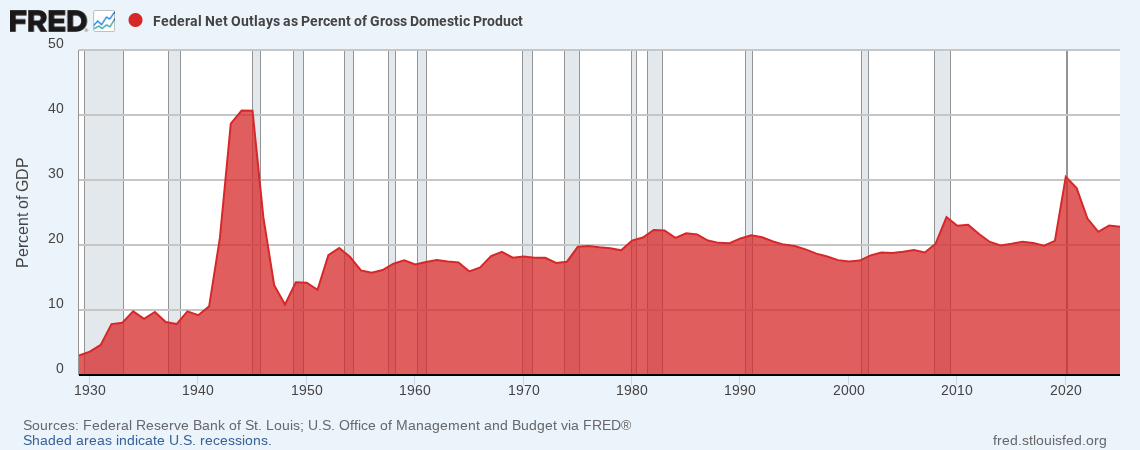
As Milton Friedman pointed out, the real cost of government is the amount it spends...not the tax rate. Republican governments have applauded tax cuts, while the overall cost of government still rose. The federal government alone collects about 17% of GDP in tax receipts. But it spends about 23%. The difference is added, year after year, to the nation’s tab. Now the feds have so much debt that creditors are wary of lending more. As the debt pile continues to grow...the cost of it goes up even faster (with rising interest rates).

Austria, Belgium, Germany, Denmark - all spend about 50% of GDP. France is nearly 60%. The US total looks like a bargain; including state and local spending, the total comes to only 37% of GDP. But look carefully. Add in the costs of medical care and university education, which are included in the European totals, and the total goes well over half of GDP. We notice too that when you add up all the tax bills - business, personal, state and local - they often come to more than 50% of income.
Click image for larger size.
With these high levels of spending have come high levels of debt. And with higher interest rates have come much higher costs of carrying it. But instead of cutting back on spending and deficits, simply lean harder on the two things that have gotten them where they are.

Here’s the UK, promising more social services. Al Jazeera: "‘New path’: UK’s Burnham promises huge expansion of public services. UK prime minister tells his first Labour Party conference ‘fundamental rethink’ needed to set Britain on right course."

The Trump team, meanwhile, offers to beef up the military. Time: "How National Security Became Central to Trump’s D.C. Construction Projects." "President Donald Trump announced Sunday that his proposed “triumphal arch” - which is planned for Memorial Circle near the Virginia end of Arlington Memorial Bridge in Washington, D.C. - will serve as a military complex with drones, ammunition storage, and sniper facilities."

Those are the two choices. Guns or Butter. Mr. Trump doesn’t bother to disguise the deal. Re-elect Republicans and voters will get both -- a $5,000 check from an over-drawn account…and a big new Pentagon of $1.5 trillion.

But the real trouble is right in front of us - money. The feds can promise more ‘defense’ than we need...and more ‘social’ spending than we can afford. But they can’t deliver. They’re out of money. And paying bills with fake money no longer works as it once did. Because rising interest rates add new debits just as fast as the feds can add new credits.

Already, the pin has been pulled. By 2030, the grenade will blow up. Rising rates will push the total interest charge up to around $3 trillion. That’s when all Hell breaks loose (if not before). Because it will take almost all America’s savings just to keep up. This will mean one of two things: either interest rates will have to go up much higher to attract new savings...or, the US will have to go back to the printing press. Inflate or Die? Either way, you’re going to want a black arm band and some lilies."

"When the Refineries Stop, These States Go Dark First - All 50 Ranked by Days of Fuel"

Full screen recommended.
"When the Refineries Stop, These States Go Dark First -
 All 50 Ranked by Days of Fuel"
"The United States has only about 130 oil refineries left, and roughly half of them sit on one hurricane-battered stretch of the Gulf Coast. From there, a handful of long pipelines feed the rest of the country. One of them, the Colonial Pipeline, supplies about 45% of the fuel burned on the entire East Coast. In May 2021, a single ransomware attack shut it down for about 6 days, and roughly 71% of Charlotte's stations and 87% of Washington, D.C.'s ran dry, with 17 states plus D.C. under emergency. Most states hold only a few days of fuel, and there is no national reserve of gasoline or diesel to save them. 

This video ranks all 50 states by how long they last when the fuel stops, and the order isn't the one you'd expect. In this video, we talk about what actually happens when America's refineries and pipelines stop, and which states run out first, including why crude oil isn't usable fuel, the roughly 130 refineries left and why half the country's capacity is on the Gulf Coast, the Colonial Pipeline and the 2021 shutdown, why the Strategic Petroleum Reserve can't fill your tank, diesel as the keystone that runs trucking, farming, generators and water pumps, the states that go dark first versus the ones that hold longest, why panic buying empties the pumps early, why trucks can't replace a pipeline, and how a fuel outage becomes a water and food outage within days."
Comments here:

Adventures With Danno, "My Massive Shopping Vlog at Kroger!"

Full screen recommended.
Adventures With Danno, 10/1/26
"My Massive Shopping Vlog at Kroger!"
Comments here:

'The Light at The End of the Tunnel – It’s Not All Doom & Gloom"

'The Light at The End of the Tunnel – 
It’s Not All Doom & Gloom"
by Martin Armstrong

“Governments, if they endure, always tend increasingly toward aristocratic forms. No government in history has been known to evade this pattern. And as the aristocracy develops, government tends more and more to act exclusively in the interests of the ruling class – whether that class be hereditary royalty, oligarchs of financial empires, or entrenched bureaucracy.”
― Frank Herbert, "Children of Dune"

Excerpt: "Many people have asked how bad it will get. Will there be civil war and blood in the streets? I do not see a revolution in the United States in the sense that one side is all-powerful and seeks to eradicate its opponent. The risk that the United States will break up, as in Canada and Europe, does not imply outright civil war. The break will likely come first, and it will form along the lines of the LEFT vs. the RIGHT.

The good news is that the fall of the West is inevitable since no political state lasts forever. However, this time it is different, for it is not people rising up against tyranny that produces the blood in the streets as in the American and French Revolutions. Here we are dealing with the facade of Republican forms of government worldwide that have become unresponsive to the people, but are economically crumbling from within at their very foundations.

This is the Sovereign Debt Crisis. The fall of the West can be largely silent, much like the fall of the Soviet Union. As I have said many times, Russia collapsed all by itself because COMMUNISM was not economically sustainable. Here in the West, rising “progressive” movements are also undermining the economy; like the USSR, they are economically inefficient.

A USSR-style collapse of the United States, a sudden, negotiated dissolution of the entire federal union into separate successor states, without a civil war, is highly unlikely without a Sovereign Default. The key is the government’s ability to muster forces against the people. That requires the fiscal capability that becomes nonexistent in the middle of a Sovereign Debt Default. Therefore, a non-violent collapse is not theoretically impossible. The historical conditions that allowed the Soviet Union to dissolve peacefully are largely absent in the American context, and most scholarly assessments point toward either continued institutional decay or a violent rupture rather than a clean “velvet divorce.”
Full, most highly recommended article is here:

"How the Iran Conflict Opened a New Threat to the Global Monetary System"

"How the Iran Conflict Opened a New 
Threat to the Global Monetary System"
by Milan Adams

Excerpt: "Midnight fell differently on February 28, 2026. Across trading floors from Singapore to Chicago, monitors flickered with data streams that would soon curdle into panic. At 0400 hours Tehran time, American B-2 Spirit bombers and Israeli F-35I Adir fighters crossed into Iranian airspace, unleashing Operation Epic Fury. Nine hundred strikes in twelve hours. Ali Khamenei, Supreme Leader of the Islamic Republic, perished in the initial bombardment, his body recovered from the rubble of a command bunker beneath Tehran’s northern suburbs. Markets had anticipated conflict. They had not anticipated decapitation.

Brent crude, trading at $72.48 per barrel at market close on February 27, surged past $120 within seventy-two hours. By March 19, Dubai crude reached $166 per barrel, an all-time record. California gasoline exceeded $5 per gallon.

Kristalina Georgieva, Managing Director of the International Monetary Fund, stood before cameras in Washington on April 9, 2026. “All roads now lead to higher prices and slower growth,” she declared. Her institution had just slashed global growth projections to 3.1 percent, down from 3.4 percent anticipated before the first missiles launched. “Had it not been for this shock, we would have been upgrading global growth.” Instead, the Fund warned of a “severe scenario” where global growth collapses to 2.0 percent, brushing against the technical definition of worldwide recession - a threshold breached only four times since the Second World War. “This would mean a close call for a global recession,” the World Economic Outlook stated.

Donald Trump, returned to the presidency for a second non-consecutive term, addressed the nation from the Oval Office on August 20, 2026. “Any country that allows its financial institutions, businesses, airports, or government entities to provide any type of lifeline to Iran will itself face tremendous economic consequences,” he warned, announcing what he termed “the toughest sanctions in history.” Earlier, he had posted an image on social media showing the Strait of Hormuz crudely labeled as “New US Territory,” a digital annexation that sent tremors through diplomatic channels. His administration’s Operation Economic Fury sought to complete what Operation Epic Fury had begun. “To the ordinary soldiers supporting this regime,” Trump addressed Iranian conscripts directly, “as more and more of your paychecks stop or are supposedly just delayed, ask whether your commanders are leading your country to triumph or to ruin.”

Jerome Powell, in his final months as Federal Reserve Chair, confronted the economic paradox that would define 2026. At a Harvard forum on March 30, he admitted the central bank’s predicament with uncharacteristic candor. “Nobody knows,” he stated, referring to the war’s ultimate economic impact, while acknowledging that “you can be confident that an inflationary shock will fade, but have very little idea how long it will take.” The Fed’s March 18 decision to hold interest rates steady - projecting only a single rate cut for the year despite inflation spiking to 3.3 percent - represented a capitulation to uncertainty. Powell’s institution projected higher inflation, steady unemployment, and minimal monetary relief.

Nouriel Roubini, the economist whose prescient warnings preceded the 2008 financial collapse, offered scenarios in May 2026 that chilled institutional investors. “Oil prices could spike past $200 a barrel in the worst-case scenario,” he predicted, describing a return to “1970s stagflation.” Mohamed El-Erian, former Pimco chief and now Chief Economic Advisor at Allianz, tweeted his assessment of the IMF’s April report: “Reading between the lines, the message of today’s IMF flagship report is sobering: Virtually every challenge facing the global economy is poised to intensify due to the fallout of the Middle East War.”

The World Bank’s June 11, 2026 Global Economic Prospects report confirmed these apprehensions. Global growth would slow to 2.5 percent in 2026, the weakest expansion since the COVID-19 pandemic. For developing and emerging markets, the forecast plummeted to 3.6 percent. Iran’s economy contracted by 6.1 percent, with the Bank noting that “real GDP is projected to contract by 6.4 percent in 2026, reflecting the collapse in tourism, weaker consumption, disrupted supply chains, heightened insecurity, and prolonged displacement.” Qatar and Kuwait faced potential GDP contractions of 14 percent. The Institute for Economics and Peace calculated that a resumption of full-scale hostilities would deliver a $2.2 trillion hit to the world economy.

Beneath these statistics lies a more troubling reality. Global debt reached $348 trillion in 2025, according to the Institute of International Finance, expanding by nearly $29 trillion in that single year. By mid-2026, estimates placed the figure above $365 trillion. This edifice of obligation, constructed during fifteen years of central bank suppression of interest rates, now faces a refinancing crisis as monetary authorities maintain elevated borrowing costs to combat inflation. The OECD’s Global Debt Report 2026 warned of “increasing pressures from sustained fiscal deficits, rising interest costs and investment needs, a structural decline in long-term demand, and growing refinancing risks as the maturity of issuance shortens.”
Full, highly recommended article is here:

"You Know..."

"You know, I've been around the ruling class all my life, and I've
been quite aware of their total contempt for the people of the country.”
- Gore Vidal

“As societies grow decadent, the language grows decadent, too. Words are used to disguise, not to illuminate, action: you liberate a city by destroying it. Words are to confuse, so that at election time people will solemnly vote against their own interests.”
- Gore Vidal

"Iraq: 23 Years of War, Lies and Defeat"

Photo credit: Reuters
"Iraq: 23 Years of War, Lies and Defeat"
by Redacted

"The U.S. military has left Iraq after a 23-year military invasion. The Pentagon says that these troops will relocate to other Middle East bases to assist in the ongoing war with Iran. Why was the U.S. in Iraq in the first place? The Bush administration invaded in March 2003, claiming Saddam Hussein possessed weapons of mass destruction and warning that his government could provide them to terrorists. Administration officials also repeatedly invoked the trauma of September 11, encouraging a public perception that Iraq was connected to al-Qaeda and the attacks.

The central case for war collapsed. U.S. investigators found no active stockpiles of the weapons used to justify the invasion, and subsequent inquiries found no operational partnership between Saddam Hussein and al-Qaeda. Although American forces quickly overthrew Saddam, his sudden exit from power created the perfect conditions for ISIS.

U.S. war hawks will say that the U.S. and Israel destroyed ISIS but the truth is that Iran was integral in combatting ISIS, particularly Qassem Soleimani, commander of the Quds Force, who the Trump administration assassinated in 2020.

It was a failed and bloody mission that accomplished nothing. And now, as troops withdraw, Shiite militias are claiming victory the same way the Taliban reclaimed Afghanistan when the U.S. military withdrew in 2021. This withdrawal should serve as a reminder that the war in Iraq was based on a lie and reinforce our conviction that the war in Iran is too. How many lives must be lost before another humiliating withdrawal?"

"During an episode of 60 Minutes, journalist Lesley Stahl asked Secretary of State Madeleine Albright about reports that 500,000 Iraqi children had died - surpassing the child death toll at Hiroshima - as a result of U.S.-led economic sanctions following the Gulf War. Stahl asked, "Is the price worth it?"  Albright replied, "I think this is a very hard choice, but the price - we think the price is worth it."
And this is who and what we are, America, 
a horrifying and unspeakable disgrace...
- CP

"This Is What A Catastrophic Bond Crisis Looks Like – All Of A Sudden, U.S. Treasury Bonds Are Starting To Trade Like Memecoins"

by Michael Snyder

"U.S. Treasury bonds are supposed to be among the most stable financial instruments in the entire global financial system. When they begin to trade like memecoins, that is a very clear indication that the next major financial crisis has arrived. U.S. Treasury Secretary Scott Bessent insisted that he would be able to keep bond yields under control. Obviously that did not happen. Now we have a gigantic mess on our hands, and it is going to affect every man, woman and child in this country.

When bond yields soar, so do mortgage rates. The national average for a 30 year fixed mortgage has risen to a whopping 7.54 percent. Do you understand what this is going to do to the housing market? Good luck if you want to buy a home. Good luck if you want to sell a home. And if you have an adjustable rate mortgage, you should be bracing for a lot of pain. Credit card rates and auto loan rates are going to go up too. The era of “easy borrow, easy spend” is coming to a crashing halt. This will directly impact all of us.

Needless to say, it is going to be a lot more expensive for the federal government to borrow money too. We are already spending way over a trillions dollars a year just on interest on the national debt, and so there is no way that we can afford for bond yields to spike. But it is happening anyway.

Banks and financial institutions all over the nation are holding gobs and gobs of U.S. Treasuries. They were supposed to be extremely safe investments. But when bond yields soar to crazy levels, bond prices crash. As a result, banks and financial institutions from coast to coast now have balance sheets that look like horror movies.

Is your bank at risk of failing? You might want to look into that. The stage is also being set for a derivatives meltdown of epic proportions. If bond yields continue to skyrocket, we are going to see things happen in the derivatives marketplace that we have never seen before. I am talking about the type of scenario where analysts are using words like “nuclear” and “apocalypse” to describe what is occurring. Are you starting to understand what is at stake? We desperately, desperately need bond yields to stop rising. But that isn’t likely to happen, is it?

According to the Wall Street Journal, 10 year U.S. Treasures and 30 year U.S. Treasuries both rose to “their highest levels since 2002” yesterday…Today is the final day of a quarter that’s been marked by a relentless selloff in government bonds. The rout has driven U.S. Treasury yields - which move inversely to prices - to multidecade highs. Both the 10- and 30-year Treasury yields settled yesterday at their highest levels since 2002.

In 2002, the federal government was 6 trillion dollars in debt. Today, the federal government is 40 trillion dollars in debt. Big difference. Today, things got even worse. Just a little while ago, the yield on 10 year U.S. Treasuries hit 5.302 percent…
To most Americans, this means absolutely nothing, because they don’t understand all of the stuff that I just shared with you above. Of course it isn’t just 10 year U.S. Treasuries that have begun to trade like memecoins. The charts for 20 year U.S. Treasuries and 30 year U.S. Treasuries look like they were pulled out of a video game…
This is not supposed to happen. Ever. The really bad news is that bond yields have been spiking all over the world. Today was no different…
Many people see green and they think that must be a good sign. But as those bond yields go up, bond prices are collapsing. In France, the yield on 10 year bonds just rose to the highest level since 2008…

France’s messy politics are spooking the bond markets. On September 29th yields on ten-year bonds rose to 4.8%, their highest level since 2008. The surge in borrowing costs has pushed the spread between French ten-year bonds and German Bunds up by 44 basis points in September, to 122 points—the highest level for 14 years. France now pays more to borrow than Greece and Italy, once the euro zone’s most worrisome members. It is increasingly looking like the currency area’s biggest problem, and things could get worse.

Italy is also becoming an absolutely enormous problem. Simultaneously, Europe is on the verge of a major financial meltdown, Japan is on the verge of a major financial meltdown, and the U.S. is on the verge of a major financial meltdown. Which area of the world will spiral out of control first?

As borrowing costs rise and the global energy crisis intensifies, we are going to want to watch for signs that economic activity is slowing down. For example, a lot of trucking companies in the U.S. are starting to file for bankruptcy…More than a dozen American trucking companies have filed for bankruptcy in the past month, according to an industry news report. Some 16 firms, accounting for more than 250 jobs, have filed for Chapter 7 or Chapter 11 proceedings, FreightWaves reported earlier this month.

Diesel prices, the lifeblood of the trucking industry, hit a record average of $6.53 a gallon on September 22 amid the impact of President Donald Trump’s war with Iran. Diesel has increased $2.76 over the past year, according to motor club AAA. The performance of the trucking industry often tells us where the economy as a whole is headed.

Without a doubt, the outlook for the months ahead is not promising at all. We are facing a global energy crisis, a global fertilizer crisis, a global food crisis, a Super El Niño and World War III all at the same time. Meanwhile, we continue to get hammered by one major natural disaster after another. There are so many elements of “the perfect storm” that we are currently experiencing, and this storm is only going to get more intense as we move forward."

Wednesday, September 30, 2026

Adventures With Danno, "Empty Shelves Everywhere... This Ain't Good"

Adventures With Danno, 9/30/26
"Empty Shelves Everywhere... This Ain't Good"
Comments here:

Canadian Prepper, "Alert! Trump Goes Full AntiChrist! Big Tech Takeover, WW3"

Full screen recommended.
Canadian Prepper, 9/30/26
"Alert! Trump Goes Full AntiChrist! Big Tech Takeover, WW3"
Comments here:

Musical Interlude: Soothing Relaxation, "Beautiful Relaxing Music for Stress Relief"

Full screen recommended.
Soothing Relaxation,
 "Beautiful Relaxing Music for Stress Relief"
"Beautiful relaxing music for stress relief, composed by Peder B. Helland. This instrumental music ("The Hidden Valley") works well as sleep music, ambient study music, meditation music or relaxation music."
Magnificent...

"A Look to the Heavens"

"Colorful NGC 1579 resembles the better known Trifid Nebula, but lies much farther north in planet Earth's sky, in the heroic constellation Perseus. About 2,100 light-years away and 3 light-years across, NGC 1579 is, like the Trifid, a study in contrasting blue and red colors, with dark dust lanes prominent in the nebula's central regions.
In both, dust reflects starlight to produce beautiful blue reflection nebulae. But unlike the Trifid, in NGC 1579 the reddish glow is not emission from clouds of glowing hydrogen gas excited by ultraviolet light from a nearby hot star. Instead, the dust in NGC 1579 drastically diminishes, reddens, and scatters the light from an embedded, extremely young, massive star, itself a strong emitter of the characteristic red hydrogen alpha light."
o
"In this galaxy, there's a mathematical probability of three billion Earth-type planets. And in all of the universe, 2 trillion galaxies like this. And in all of that... and perhaps more, only one of each of us."  - "Dr. Leonard McCoy"

"Kingdom of Eternal Enchantment"

Full screen recommended.
"Kingdom of Eternal Enchantment"
"Step into a breathtaking underwater fantasy kingdom where glowing coral forests, pearl-covered palaces, crystal waters, enchanted flowers, and mystical sea creatures come together in a world beyond imagination. Let this magical journey carry you through ancient underwater kingdoms, luminous gardens, celestial palaces, hidden villages, sparkling rivers, enchanted forests, and peaceful ocean realms filled with wonder and beauty."

"Where The Soul Rests In The Mountains"

Full screen recommended.
"Where The Soul Rests In The Mountains"
"Along forgotten mountain roads, beyond the noise of crowded cities and rushing lives, there is a quieter world - a world where rivers whisper through the valleys, fog drifts between pine trees, campfires glow under endless skies, and tired souls slowly learn how to breathe again. Where The Soul Rests In The Mountains is a peaceful surreal AI music film about wandering hearts, forest silence, old hiking trails, rainy mornings in tents, tiny campfires, distant owls, soft rivers, and the quiet beauty hidden inside nature. Here, backpacks carry more than supplies. They carry memories. Healing. Freedom. And the small pieces of ourselves we forgot somewhere along the way. Mountains rise above sleeping valleys. Morning mist moves slowly through the trees. Boots dry beside the fire. Coffee steams quietly at sunrise. Birds sing through cold forest air. And every little moment feels alive again. This film was made for those who dream about forests, peaceful roads, cold rivers, soft campfire nights, handmade memories, and the feeling of disappearing into nature for a little while. This is not a story you need to solve. It is a place to rest. A place to breathe slowly. A place to remember what peace feels like."

Delta King's Blues, "Thank God, I Ain’t Young Anymore"

Full screen recommended.
Delta King's Blues,
"Thank God, I Ain’t Young Anymore"
"Youth had speed… but age brought peace. “Thank God, I Ain’t Young Anymore” is a wise, easy-rolling Delta King’s Blues tune about surviving foolish years, learning life the hard way, and finally appreciating the calm that comes with age. A relaxed, road-worn acoustic guitar carries the groove like a man who’s got nothing left to prove. The harmonica blows smooth and knowing, full of lessons only time can teach. The rhythm stays slow and comfortable, built for folks who traded chaos for clarity. This is blues about gratitude for the years behind you. For people who don’t miss being reckless - because wisdom feels a whole lot better. I lost a little speed… but gained a whole lotta peace."

Native American Elder, "Here's Why I Trust Animals More Than People"

Full screen recommended.
Native American Elder,
"Here's Why I Trust Animals More Than People"

"The End of History"

"The End of History"
A somewhat exaggerated obituary...
by Joel Bowman

“History is a cyclic poem written by time upon the memories of man.”
~ Percy Bysshe Shelley (1792-1822)

"Remember when history ended, dear reader? The year was 1992. "Under the Bridge" and "Tears in Heaven" were playing on the FM radio. The Cold War, which had promised such a “Bang!” had ended with barely a whimper. And American philosopher, Francis Fukuyama, had just published a daring book: "The End of History and the Last Man."

In light of the great Soviet collapse, Mr. Fukuyama was of the opinion that The West had not simply triumphed over The Rest, but that the world had finally reached “the end point of mankind’s ideological evolution and the universalization of Western liberal democracy as the final form of human government.”

In other words, whatever was to be done in the fickle and turbulent realm of politics had, by the grand old year 1992, already been done. Here is Mr. Fukuyama, joining a long line of intellectuals (including Marx) to have become ensnared in the labyrinth of Hegel’s dialectical materialism: “Both Hegel and Marx believed that the evolution of human societies was not open-ended, but would end when mankind had achieved a form of society that satisfied its deepest and most fundamental longings. Both thinkers thus posited an "end of history": for Hegel this was the liberal state, while for Marx it was a communist society. This did not mean that the natural cycle of birth, life, and death would end, that important events would no longer happen, or that newspapers reporting them would cease to be published. It meant, rather, that there would be no further progress in the development of underlying principles and institutions, because all of the really big questions had been settled.” ~ Francis Fukuyama

But a curious thing happened on the way to the end of history; namely... history did not end. The political pendulum did not come to a full stop. Stubbornly, insolently, it kept right on a-swingin’...

Time and Again: Indeed, the ‘90s were a time of great political upheaval and experimentation, not all of it leading to the holy grail of western liberal democracy, as imagined by Mr. Fukuyama.

In the power vacuum created by the collapse of the Soviet Empire, Gorbachev’s perestroika (a program of political and economic “restructuring”) delivered the Russian people from the brutality of communism… into the unloving embrace of a corrupted oligarchy…and then to a kind of faux democracy that has seen the same man at the helm for a quarter of a century. (After this year’s election, Vladimir Putin became the longest-serving Russian leader since Joseph Stalin, who ruled the Soviet Union from 1929 to 1953.)

As for the Americans, co-belligerents in the aforementioned ideological conflict, they continued their own long march…headlong toward a special brand of political circuses and economic madness. In a country where any boy, girl or two-spirit animal might grow up to be president, the nation that enthusiastically sent its soldiers abroad to “make the world safe for democracy” offered up a Bush, followed by a Clinton (twice), followed by another Bush (twice), then very nearly another Clinton. Two decades of political power, held in the hands of two dynastic families.

Meanwhile, beneath fierce power struggles at the executive level, America’s vast and menacing security state – about which General Eisenhower famously warned in his farewell address in ‘61, at the height of the Cold War – continued its inexorable mission creep into the lives and private affairs of the good citizens of The Republic.

The Scourge of War: Neither the defeated Soviets nor the victorious Americans appeared willing to take the path Fukuyama had so carefully laid out for them. The End of History would have to wait...

Ah, but what about Europe, some venture to ask? Indeed, Mr. Fukuyama himself preferred the transnational euro-model to the comparatively unipolar American offering. Might not the “post-historic” world manifest itself over on the continent, where a common “Esperanto” currency – in the form of the euro – would facilitate free trade and citizens of all backgrounds, creeds and cultures would walk arm in arm from the Seine to the Danube, the Bay of Biscay to the shores of the Black Sea?

“I believe that the European Union more accurately reflects what the world will look like at the end of history than the contemporary United States,” declared Fukuyama at the time, in brave defense of his curious, end-of-days timeline. The EU’s attempt to transcend sovereignty and traditional power politics by establishing a transnational rule of law is much more in line with a ‘post-historical’ world than the Americans’ continuing belief in God, national sovereignty, and their military.”

Alas, not unlike the Ruskies and the Yankees before them, the Europeans would go on to disappoint Mr. Fukuyama, too. After a relatively sanguine start to the new millennium, the Eurozone spent most of the ensuing two decades descending gradually into first economic, then political, and now widespread cultural disaster. Today, protests from one end of the continent to the other – Finland to Greece, the Netherlands to France, Poland to Ireland and plenty more between – underscore real discord between neighbors in the great eurocrat utopia. Not to mention the scourge of war, which threatens to drag the entire continent, if not the whole western world, into yet another great conflagration.

Under the Bridge: And so, almost a quarter of a century after Mr. Fukuyama stopped the clock on History, it plods along regardless. Evidently, something about the political spirit of mankind just doesn’t want to sit still. In the year 2024, the world is faced with a plethora of political challenges, for which many of the seeds were sown in the dimming twilight of the last century.

That is to say, the ideological struggle continues against the backdrop of protests, uprisings, springs, occupations, revolutions and, over the weekend, here in the United States of America, attempted assassinations. (How close the Republic was to having its own Franz Ferdinand moment, we may never know...)

When Mr. Fukuyama stopped the clocks back in 1992, America’s debt clock was just ticking past $3 trillion. As we type these very words, that figure is over $40 trillion. According to the latest estimates by the Congressional Budget Office, it is set to top $56 trillion within the next decade. And the rate of increase is only accelerating…

In its report last month, the CBO revised its estimate of the budget deficit for 2026 to $2.0 trillion  - about 6 percent of GDP.

The debt is growing at a much faster rate than real economic output. Interest rate costs to service the debt, now  $1,017 trillion, and will rise to $1.7 trillion by 2034, when it will become the single largest line item on the federal budget.

Which brings us back to the lessons of history…Will the United States have to go “Full Argentina” before the pendulum swings back the other way, to sanity, fiscal responsibility and limited government? Or is the die cast? We wait to see…Of course, Mr. Fukuyama is not alone in wondering how all this ends. Only, if history has taught us anything, it doesn’t. The show, as always, goes on."

The Daily "Near You?"

Pensacola, Florida, USA. Thanks for stopping by!

Gerald Celente, "All Hell Will Break Lose..."

Gerald Celente, 9/30/26
"All Hell Will Break Lose..."
Comments here:

Jeremiah Babe, "Welcome To The Real World, You're On Your Own"

Full screen recommended.
Jeremiah Babe,9/30/26
"Welcome To The Real World, You're On Your Own"
Comments here:

"How Are Things Going, Joe?"

“You go up to a man, and you say, “How are things going, Joe?” and he says, “Oh fine, fine… couldn’t be better.” And you look into his eyes, and you see things really couldn’t be much worse. When you get right down to it, everybody’s having a perfectly lousy time of it, and I mean everybody. And the hell of it is, nothing seems to help much.”
- Kurt Vonnegut