StatCounter

Tuesday, September 29, 2026

The Daily "Near You?"

Padua, Veneto, Italy. Thanks for stopping by!

“10 Things You Should Know About Life’s Most Important Questions”

“10 Things You Should Know About 
Life’s Most Important Questions”
by Marc Chernoff

"It’s a harsh fact that every one of us is ignorant in some way. Although we tend to pretend otherwise, it’s impossible to know it all. Ignorance is our biggest collective secret. And it’s one of the scariest and most damaging realities of life, because those of us who are most ignorant – and thus most likely to spread ignorance – are also the ones who often don’t know it.

Here’s a quick test: If you have never changed your mind about one of your learned beliefs, if you have never questioned the fundamentals of your opinions, and if you have no inclination to do so, then you are likely ignorant about something you think you know.

What’s the quickest solution? Get outside and find someone who, in your opinion, believes, behaves, and handles certain aspects of life very differently from you, and just have a simple, honest conversation with them. I promise, some of life’s most important questions will become clearer by doing so. And it will do both of you lots of good. Once you’ve done that, here are some key things to remember:

1. Many of the biggest misunderstandings in life could be avoided if we would simply take the time to ask, “What else could this mean?”

2. An expert is not a person who gives all the right answers; she’s the one who asks the right questions.

3. Very few of us actively seek new knowledge in this world on a daily basis. We get comfortable with what we know, and we stop questioning things. On the contrary, we try to squeeze from the unknown the answers we have already shaped in our own minds – judgments, justifications, validations, forms of consolation without which we might feel incomplete or off-center. To really ask something new is to open the door to the storm.  And the answer just may blow us away.

4. If someone can get you asking the wrong questions, they don’t have to worry about how they answer you.

5. Monsters do exist in the real world, but they are too few in number to be truly dangerous in the long run. More dangerous are the common people with good intentions who are instantly ready to believe and act without asking questions.

6. At the end of the day, the questions you ask of yourself determine the type of person you will become.

7. Courage doesn’t happen when you have all the answers. It happens when you are ready to face the questions you have been avoiding your whole life. 

8. When it comes to your relationships: Does he/she treat you with respect at all times? That’s the first question. The second question is: If he/she remains the exact same person ten years from now, would you still want to be in a relationship with him/her? And finally, does he/she inspire to be a better human being? When you find someone that you can answer yes to all three questions, you know you’ve found yourself a relationship worth having.

9. Regardless of how much you know, or how many incredible questions you ask, you can never know it all. To believe that you do, is proof of the contrary. The wilderness around us always holds answers to more questions than we have yet learned to ask. And that’s a beautiful thing.

10. Although life will always be filled with unanswered questions, it’s the courage to seek the answers that counts – this journey is what gives life meaning.  Ultimately, you can spend your life wallowing in frustration and misery, wondering why you were the one who was chosen to deal with your problems, or you can be grateful that you are strong enough and smart enough to grow from them. 

Your turn: Be present and have patience with everything that remains unexplained in your heart and mind. Try to love life’s questions. Like locked doors or like good books written in foreign languages, respect their nature. Don’t expect all the answers to come easy. They cannot be given to you right now because your present understanding isn’t ready yet. It’s a question of experiencing everything first. Right now you need to hold on to the questions – explore, learn, and live your life. Perhaps, as you do, you will gradually find yourself experiencing the answers you always wanted.

So with that said, which of the reminders above hit home the most? Why? Leave a comment below and share your thoughts and insights with us."

"I Had An Experience..."

"I had an experience...I can't prove it, I can't even explain it, but everything that I know as a human being, everything that I am tells me that it was real! I was given something wonderful, something that changed me forever...A vision of the universe that tells us, undeniably, how tiny, and insignificant and how...rare, and precious we all are! A vision that tells us that we belong to something that is greater than ourselves, that we are not - that none of us - are alone! I wish I could share that. I wish, that everyone, if only for one moment, could feel that awe, and humility, and hope. But...that continues to be my wish."
- "Ellie Arroway", "Contact" by Carl Sagan

Freely download "Contact", by Carl Sagan, here:
o
"Contact: A Signal From Outer Space"
"Dr. Ellie Arroway (Jodie Foster) discovers a signal containing a sequence of prime numbers that appears to have originated from the star Vega. When her team confirms this, all agencies must be brought in. Oscar winners Jodie Foster and Matthew McConaughey star in this gripping story of a radio astronomer who receives the first extraterrestrial radio signal ever picked up on Earth. As the world powers scramble to decipher the message and decide upon a course of action, she vies to fulfill her dream of becoming the first human being to make contact with alien beings."

“The Meaning Of Good And Evil In Perilous Times”

“The Meaning Of Good And Evil In Perilous Times”
by Brandon Smith

"Perhaps the most destructive idea ever planted in the minds of the general public is the notion that nothing in this world is permanent – that all things can and must be constantly changed to suit our whims. The concept of impermanence fuels what I call “blank slate propaganda.” The usefulness of the blank slate as a weapon for social control should be explained before we examine the nature of good and evil, because these days it infects everything.

The push for never ending social “evolution” has been called many things over the decades. In the early 1900s in Europe it was called “futurism;” an art and philosophical movement that helped spawn the rise of communism and fascism in politics.The argument that all old ideas and longstanding traditions should be abandoned to make way for new ideas, new technologies, news systems etc., assumes that the supposedly new ways of doing things are superior to the old ways of doing things. Things are rarely this simple, and in most cases the new methods so proudly championed by movements for social change are usually recycled and repackaged old ideas that are notorious for failure.
The blank slate theory is designed to confuse people with self-doubt and to misrepresent the constructs of nature as constructs of society. It most effectively disrupts people’s relationship to their own moral compass by suggesting that moral compass should be completely ignored as artificial. The argument by blank slate proponents is that all boundaries are created by society instead of by inborn conscience, and that these boundaries often hold us back from achieving our goals, bettering ourselves as a species and generally getting what we want out of life.
But the things we want are not always the things we need, and this is something that movement’s for social change often refuse to grasp. If we are all blank slates and if morality and the human soul are myths, why not do whatever the hell we want, whenever we want and live life as if it is one big Roman orgy of feasting, self-medicating and overall addiction to sensation?
The problem with the blank slate concept is that while it purports that all restrictions in the human psyche are taught to us rather than being inborn and that they can be abandoned any time we want, we still can’t seem to avoid the consequences of breaking those restrictions.  People lose their sanity, societies crumble and nations fall to ruin over time the more we cast aside our principles in the name of social evolution or short term gain. It is unavoidable.
The only people who seem to benefit from the spread of the blank slate are the people already in political and economic power. For if they can convince the masses to ignore their conscience, they can then convince us to accept almost any other conditions.
To act in a manner consistent with inherent conscience, or to ignore conscience and act destructively, is a choice. It is the core pillar of free will. The choice to act destructively does not erase the reality of inherent conscience; in fact, people often have to be fooled into believing that a destructive and immoral action is a “good thing” before they are convinced to carry it out. Inherent conscience must be bypassed through trickery.
The problem with choosing to stick by one’s principles is that it is easy during times of relative stability, but increasingly difficult during times of struggle. In perilous days, the temptation to use destructive tactics to maintain an expectation of comfort or to merely survive can be high. It is no coincidence that power elites, the same people that tend to promote blank slate propaganda, also tend to deliberately engineer social crisis and chaos. But perhaps this needs a deeper explanation. We must define something most of us already understand intuitively. We must define “evil.”
Like inherent conscience and moral boundaries, blank slate theorists and social change advocates attempt to muddy the waters of what constitutes evil. Some will say there is no such thing — that evil is whatever we deem it to be in any given era depending on our biases.  Others will claim that tradition, permanence and anything in society that remains static is evil. The only “good” for them is constant change.
But evil is not as illusory and changing as these people suggest. In fact, most men and women recoil automatically from certain specific behaviors regardless of how they were raised, what environment they come from, what culture they were born into or what era they lived.  The people who don’t recoil at these behaviors are the people we have to watch out for because they are missing something integral to the heart and mind that makes the rest of us human.
In psychological terms, the characteristics of high level narcissists and sociopaths match most closely with our historic concept of evil.  And, in my view, most great evils done in history are in fact done by people with multiple narcissistic traits.  As far as global elitists are concerned, they represent a rather insidious threat, because they are narcissistic sociopaths that have organized into a predatory gang, so all the traits consistent with the behavior of your average serial killer are now magnified a thousandfold by their access to unlimited resources.
How do we identify these people? Well, this is a difficult prospect at times because narcissistic sociopaths commonly hide in plain sight.  Some people live with them for years before realizing exactly what they are. They also like to insert themselves into nonprofit organizations that claim to do good for the community as a cover for their more insidious motives.
Some traits and behaviors that are common are a lack of normal emotional response to traumatic events or joyous events, or they will mimic the responses of others to blend in but they come off as “forced” or “fake.” They have no concept of empathy; it does not exist for them.
They seek out centers of power and are drawn to positions of authority. They always seem to be demanding the efforts of others while rarely offering their own help. They make terrible leaders, always attempting to lead from a place of safety while letting their conscripts take the risks. Leading by example is a foreign concept to them.
They will lie repetitively about their accomplishments and their accolades. They will misrepresent their professional achievements in order to gain people’s trust. Ask them to prove through actions that they can do all the things they claim they can do, and they will try to avoid the test or respond indignantly and angrily.
They will gaslight their ideological enemies or people they are trying to control. They will accuse others of being “narcissists” or “sociopaths” or fascists or any moniker that will push the buttons of their target. Whatever evils they are guilty of, they will try to flip and lay at the feet of their enemies.
They always seem to have “minions” to do their dirty work for them and attack those that oppose them. People that have dealt with narcissistic sociopaths in their personal lives sometimes refer to these minions as “flying monkeys,” referencing the flying monkeys enslaved by the Wicked Witch in the Wizard of Oz. Flying monkeys are essentially useful idiots that the narcissist employs through fraud and sometimes through pay. Whenever the narcissist is under threat of being exposed, they unleash their flying monkeys onto the streets or onto the internet to undermine truth tellers.
They do not believe in moral or personal boundaries which is why they are always trying convince people that such boundaries are a myth.  They will cross moral lines, always testing the fences for weaknesses; trying to wear others down until they give up and stop fighting back.
They desperately want to come out of the shadows and into the light of day. They want to be adored as the monsters they are, rather than the fake philanthropists they portray themselves as. In order to do this, every narcissistic sociopath makes it their duty to erase the idea of conscience, whether they are part of the globalist cabal or just another ghoul down the street. Their natural inclination is to corrupt whatever they touch, and if they cannot corrupt a thing, they will attempt to destroy that thing.
Most of all, narcissistic sociopaths want everyone around them to believe that we are just like them. That “deep down” all of us are unprincipled and morally bankrupt and all it takes is a crisis or calamity, just a little chaos to bring out the devil in everyone.
But if this were really the case, then humanity would have died out long ago through endless self-destruction; something keeps bringing us back from the brink in our personal lives and in society as a whole. Conscience keeps defeating evil by refusing to grant evil people the utopia of blank slate chaos they want so badly. And this is what give me confidence that no matter how terrible our days might become there is something on our side that goes beyond the physical world.
Every crisis is a test, a test of each person and a test of our culture. Can we act with reason and courage and principle even in the worst of times, or will we be lured to make our struggle easier through malicious means? Will we do right by those around us, or will we happily trample over them in the name of “survival?”
In the end, the worst men bring the best men to the surface. This is the only “good” they will ever do.”

"It Strikes Me..."

“It goes against the American storytelling grain to have someone in a situation he can’t get out of, but I think this is very usual in life. There are people, particularly dumb people, who are in terrible trouble and never get out of it, because they’re not intelligent enough. It strikes me as gruesome and comical that in our culture we have an expectation that man can always solve his problems. This is so untrue that it makes me want to cry - or laugh.”
- Kurt Vonnegut

"Success, Fight Club, Strippers and Socialists"

"Success, Fight Club, Strippers and Socialists"
by John Wilder

"I had a conversation with a friend today. Oh, sure, I hear you say, what would an iconoclastic iron-jawed individualist with a body odor redolent of medium rare ribeye (with just a hint of pepper) like John Wilder need with a friend? I guess we all have our little weaknesses. And dogs follow me. Because I smell like steak.

In this particular case as with most of my friends, I’ve known this friend for years. I’ve known most of my close friends longer than The Boy has been alive, and he’s in college now. It’s nice. If a day, a week, a month or a year goes by, so what? We can still restart the conversation where we left off. It’s as comfortable as watching a movie you’ve seen a dozen times.

I’ll make the observation that the only place where the character of people change is in a movie – almost all of my close friends have the same sense of humor and the same sense of values that they had when our friendships were forming. Absent a significant emotional event, people are a constant. And I like that.

There is a corresponding trust that comes with being a close friend – honesty. That’s why when talking with my friend, I really enjoyed the chance to be honest. Honesty is difficult because it requires that trust, because really honest criticism is hard to take, even when it comes from a friend. Or a co-worker. Or a relative. Or someone you just met. Or your UPS® delivery guy. Oh, wait. Most people don’t like honest. But my friends do.

This particular friend is really in a good position in life, which seems to be a common pattern with my friends. He has a spouse that makes more money than he does, and, in general, the household probably brings in enough cash each month so that Nigerian princes send emails to them asking for money. They’re wealthy enough that they donate to the homeless. This appears to be a more socially acceptable donation strategy than my “donation to the topless,” scheme.

But lest ye want to class my friend as the evil, selfish, wealthy type, he’s not. The family has a huge number of kids, and it’s a close family. My friend is constantly taking time off to go to athletic events, and when we catch up, I can sense that the relationship he has with his kids isn’t a surface relationship – it’s genuine and deep. I can tell, because I know people who understand genuine relationships, who listen to both sides of a family argument – my neighbors.

And yet... despite the wealth, despite the great family, my friend feels that there’s something missing. He is as high as he wants to go in the company he works at – any higher and the travel demands would pull him away from family. He’s long since mastered his job – there is little that can be thrown at him that he hasn’t seen in the last fifteen or so years. So, his condition is one of high pay, mastery of work, and, improbably, discontent.

John Wilder: “You realize you have an advantage that 99% of people would die for. You’re financially secure. You can quit your job anytime. Literally, you could walk in to your boss this afternoon and quit. Your lifestyle wouldn’t change a bit.”
Not Elon Musk: “Yes.”
Unlikely Voice of Wisdom John Wilder: “So, what is it you want to do?”
Really, I Promise It Isn’t Elon Musk: “I need to think about it.”
Channeling Tyler Durden From Fight Club® John Wilder: “No. If you think about it, you’ll end up doing nothing but thinking about it. You have to do something. Physically start it. This weekend. I’ll check back on Monday to see how you did.”

There is a scene in the movie Fight Club™ where Tyler Durden holds a gun to the head of a liquor store clerk. If you haven’t seen the movie, I strongly suggest it. I probably watch it once a month while I write – I think there are few movies that communicate the human condition in modern life so well.
Full screen recommended.
And it’s true. I tend to think that everyone’s life would be a little better if they had Tyler Durden to be a life coach, to ever so gently coax them to be the best they can be while holding a .357 magnum Colt® Python™ to their head. That seems to be a bit frowned upon, so that leaves my friends with me. See how lucky you are?

In my role as Dr. Durden, I’ve noticed that there’s a problem some people have. It’s being too clever. It’s thinking. How do I know? It’s my problem that I try to compensate for by writing and doing. If I think about doing something, it will never get done. I keep thinking about fixing the banister that broke when we moved into the house a decade ago. It’s never been high on my list, since people falling down stairs is funny, with extra points if they are really old. But thinking about doing something never accomplishes anything.

If I plan to do it, it will get done. Half of my time driving to and from work on a day I’m going to write a post, I’m writing it in my head, selecting jokes, thinking of themes. It’s also spent thinking of how I’m going to connect the idea I want to share with students who might be forced to read this post when Mrs. Grundy tells them to compare and contrast my work with that poseur, Mark Twain, in high school in the year 2248 (that’s when Kirk will be a sophomore).

It may look like I’m driving to work, but I’m really plotting out what I’m going to write about. To be honest, it sometimes takes both lanes to do that. I wish the State Patrol® would be a little more understanding to artists like me.

Thankfully, The Mrs. is. The Mrs. and I had a conversation the other night. It may or may not have involved wine – I’m not telling unless I’ve been subpoenaed and am under oath to a House subcommittee. Actually, it wasn’t so much a conversation as The Mrs. describing to me how she felt about this little project I publish three times a week.

I don’t make any money on this blog, though I’ve made clear since day one that can change at any time. I have plans for several (eventual) ways to do that including adding subliminal messages causing you to want to pay for my health insurance. It looks like it’s already worked for Bernie Sanders.

No, at this point, writing is a hobby. But it’s a hobby that takes over 20 hours a week, sometimes closer to 30 hours. I still have a job, and I won’t stop interacting my family, so most nights I won’t even start writing before 9pm. A lot of that time comes from time I’d normally be selfishly engaged in what you mortals call “sleep”, but a chunk of that time comes directly from time I’d be spending with The Mrs. When I’m writing, I’m simply not available. I’m writing.

The Mrs.: “You know, I would certainly have an issue with the time that you spend writing, if it weren’t important.” There was more to this, where she detailed the number of hours I spend. But I keyed in on the word “Important.” I was a little surprised by that. “Important?”

The Mrs.: “Yes. I can see that what you’re writing about is important. People need to hear it. So keep doing it.”
Okay, that proves she never reads this stuff. But as I talked more with my friend, the concept of “meaning” came up.

My Friend Who is Really Most Certainly Not Elon Musk: “So, it’s about meaning?”
Suddenly as Wise as the Roman Philosopher Seneca John Wilder: “That’s silly. You don’t go off chasing ‘meaning’ in your life. Pick out something you like to do, and do it. But figure out how to make it important to other people. You like to woodwork, right? You say you never have time to do it. Do it this weekend. Film it. Put it up on YouTube®. I’ll be checking up with you on Monday.”

I asked myself, why is my friend working at all? I think because he feels he’s supposed to work. That having a job is a rule, it’s what he’s always done. The problem that many of us have is that we tend to create rules where there aren’t any rules. I’m not sure why. Perhaps we need to justify what we do. Perhaps it’s like my two important rules for life: Don’t tell everything you know.

Success? My friend is already successful in most ways a person can be successful. Their life is really good. I told them, directly, “You’ve been given so many gifts. If you don’t make something special of your life, you’re wasting it.” Interestingly, this applies to you, too. And me. How will your breakfast taste tomorrow?"

"How It Really Is"

 
Oh, they have something for you too, Good Citizen...

As always...

"Geopolitics: Douglas Macgregor, Larry C. Johnson, Scott Ritter, 9/29/26"

Douglas Macgregor, 9/29/26
"Trump Just Moved Toward War With Iran -
The Middle East Faces Major Escalation"
"Colonel Douglas Macgregor examines the possibility of a major new phase in the U.S.-Iran conflict as American military preparations draw increased attention. He discusses the risks of a potential ground operation, Iran’s military capabilities, the Strait of Hormuz, U.S. strategy, and the enormous logistical challenges of expanding the war. Macgregor also explores the roles of Israel, Russia, China, Turkey, and Saudi Arabia as Washington weighs military escalation alongside continuing diplomatic efforts."
Comments here:
o
Larry Johnson, 9/29/26
"Europe-Russia War is Now 'Inevitable'"
Comments here:
o
Scott Ritter, 9/29/26
"Kiev's Kabul Moment Has Arrived! 
Trump Abandons Ukraine As Russia Wins War!"
"Is Kyiv facing a “Kabul moment”? In this analysis, Scott Ritter discusses the future of the Ukraine war, Russia’s battlefield position, Donald Trump’s approach to Ukraine, and what a possible shift in U.S. support could mean for Kyiv. The discussion examines whether Russia is gaining the upper hand, whether Ukraine can sustain the war without continued Western assistance, and how changing U.S. policy under Donald Trump could affect the conflict. Scott Ritter offers his assessment of Russia’s military strategy, Ukraine’s military situation, Western aid, Trump’s Ukraine policy, and the prospects for an eventual end to the war."
Comments here:

"The Real Reason..."


"Americans Are Earning More Than Ever - So Why Are We Struggling?"

Full screen recommended.
Snyder Reports, 9/29/26
"Americans Are Earning More Than Ever - 
So Why Are We Struggling?"
"New Census data shows real median household income hit $87,460 in 2025, the highest on record since 1967, with poverty down to 10.2%. Yet gas is $4.45 a gallon, diesel just hit a record $6.52, mortgage rates just passed 7.51%, and credit delinquency is back near financial crisis levels. In this video I break down why your paycheck doesn’t go as far and what it means for you. We cover the September 29th, 2026 gas price spike, Georgia suspending its gas tax, why the “buy now, refinance later” mortgage advice failed, the 26.7 million Americans with no health insurance, and why 17.1% severely delinquent debt and 13.4% severely delinquent credit cards is a huge red flag for the economy."
Comments here:

Dan, I Allegedly, "I Feel Trapped!"

Full screen recommended.
Dan, I Allegedly, 9/29/26
"I Feel Trapped!"
"The economy is creating a growing financial trap for homeowners, consumers and businesses. Condo owners are facing rising HOA fees, special assessments and new building requirements that can make selling much more difficult, while businesses across the country continue closing locations and struggling with profitability. We look at what is happening to condos, HOAs, restaurants, retailers and major companies - and why so many people feel like there is no easy way out. This is personal finance and business news you can use, covering the economy, housing, real estate, consumer spending, business closures, bankruptcies, debt, investing and the financial pressures affecting Americans right now. From condominium assessments to the troubles facing Leslie’s Pool Supply and other major businesses, these stories show how quickly financial conditions can change. iAllegedly brings you daily business news, personal finance information and the stories you may not hear everywhere else."
Comments here:

"Col. Lawrence Wilkerson: Iran War Spreads - Could Israel Fall?"

Glenn Diesen, 9/29/26
"Col. Lawrence Wilkerson: Iran War Spreads - 
Could Israel Fall?"
Colonel Lawrence Wilkerson is a retired Colonel in the 
US Army and the former Chief of Staff to the US Secretary of State.
Comments here:

"The Bible Tells Us..."

“The Bible tells us to love our neighbors, and also to love our enemies; 
probably because generally they are the same people.”
-  G.K. Chesterton

Bill Bonner, "The Cadence of Death Itself"

King Louis XIV of France, The Sun King.
"The Cadence of Death Itself"
by Bill Bonner
Ardmore, Ireland - "The big news yesterday was this. Interest rates are shooting up. Asia Times: "Japan flashed the first warning, with 10-year yields hitting a 30-year high near 3%. [Last] week, US Treasuries followed, with yields reaching levels unseen since 2007 - traders called it “Black Wednesday.” Thirty-year yields sit at 22-year highs; 10-year yields are at two-decade highs."

Longtime Bonner Private Research sufferers (you have our sympathy) will remember 2020, when the 40-year interest rate cycle finally bottomed out. With the US 10-year note plunging below 1%, it was all risk and no reward, the Big Loss waiting to happen. The Primary Trend of the credit cycle was now headed to higher priced credit, we guessed. And here we are...six years later, the 10-year yield is over 5%, and bond investors are back in the saddle…demanding higher interest rates to compensate for inflation.

The answer to the question - what’s the big deal? - is right there. There are now $365 trillion dollars’ worth of debt in the world. The 400+ basis points between September of 2020 and September of 2026 represent about $14 trillion annually. That’s how much more it would cost to pay interest at today’s rate on the whole enchilada compared to the rate six years ago.

This brings up the other question you’re probably not wondering about. Hauled out of the water and now flopping on the deck is our catch of the day - the modern warfare/welfare state. A shark fattened on surfers, it’s the government we’ve lived with all our lives. We’re going to cut it open to find out what’s inside...and why interest rates matter so much.

Governments come and never quite go. Among the clickety-clackety of high heels and leather soles in our Capitol city, you can hear the echoes of Greek democracies...the Roman Republic...and the Empire. Socialism, Authoritarianism, Oligarchy, Kleptocracy; the marble walls have heard whispers of them all. The welfare state is fairly recent. But the warfare state is as ancient as the bow and arrow. Donald Trump’s quest to build a monumental arch is just another way of saluting it.

After the Peace of Westphalia came the glory of the nation state - one people, one place, and one King...typically united by one common language, one God, one law...and the willingness of young men to be shot dead for them.

America was never a nation-state, despite much yearning and pretending on the part of many political leaders. Its people were diverse. They were governed neither by a dictator nor a monarch. And they could talk nonsense in any tongue they wanted. The US was designed for a modest, inexpensive government...leaving people free to build whatever lives they could. Good, bad…rich, poor – it was none of the feds’ business.

But in this Post-WWII era...this fish morphed from a friendly freshwater carp into an apex, ocean-going predator...a Big Government. The public believes it is in control. Voters think Washington ‘works for us.’ Or, as Hillary Clinton put it, with a straight face, ‘government is all of us.’

The theory seemed to justify the practice. Why not spend money if we were spending it for our own good? Why worry about the debt, inasmuch as we ‘owe it to ourselves?’ These poor lambs actually believe they run the shearing shed. But butter costs money. And we don’t mean to reveal any state secrets, but the feds are skint…broke…busted…no bread…like nothing.

Counterfeit dollars gave them plenty to spend. For 40 years - 1980 to 2020 - falling interest rates eased the annual carrying cost. And the more they spent, the more The People wanted them to spend...and the greater the damage inflicted on any politician who dared to oppose them. Everybody can see that these pension and medical care programs are dragging the whole country towards a fiscal crisis. But even ‘conservative’ Republicans, if there are any left in ‘public service,’ are afraid to propose cutting back.

So…what happens to these social programs when politicians and central bankers fail to rein them in? They cut themselves back. The politicians continue to pay. But the value of their money goes down...along with the services they promised.

A single percentage point in interest rates takes $3.65 trillion/per year out of the present world economy to pay for the spending of the past. And in the last six months alone the yield on the 10-year note - the diesel fuel of our financial system - went up about 100 basis points (1%). William Pesek continues (in the Asia Times): Things are likely even worse than the data show. IIF economist Emre Tiftik notes… “as benchmark rates rise, interest expense is set to surge, while structural pressures from healthcare and public pension spending remain largely unaddressed.” At the same time, mature-market governments now spend more on interest expense than the world invests in either artificial intelligence, defense or clean energy.

It’s the unforgiving arithmetic of a Ponzi scheme. Fewer young people are paying into the system. And many of those who should be paying in, are instead taking advantage of the loose, over-generous programs and getting payouts. Meanwhile, rising interest rates, marching to the unrelenting cadence of death itself…doom the whole swindle. The feds can still ‘print’ money...but the bond market – once burnt, now doubly shy -- sends a bill every time."

"The Iran War And The Looming Economic Collapse"

"The Iran War And The Looming Economic Collapse"
by Chris Hedges

"For all of President Trump’s recent threats to “annihilate Iran,” the reality is that the United States is running out of both options and time to resolve this US- Israeli-initiated war. The US has made overtures toward renewing a hot war, but it has not gone further than that as the economy, both domestically and globally, deteriorates and other countries reconsider their relationships to the US and to each other. The midterm elections this Fall, with Republicans not poised to do well, are further impacting decisions being made by the Trump administration as well.

Professor John Mearsheimer, a former Air Force captain and author of numerous books on foreign policy and the Middle East, joins The Chris Hedges Report to unpack the competing interests surrounding the war, and to discuss what options are available to the US. Mearsheimer says, “We have no strategy for producing victory in Iran, other than hoping that their economy collapses, which leads to regime change, and then they make all the necessary concessions to us.” This is highly unlikely to happen.

Mearsheimer predicts that the Trump administration is aware that the US has failed and is waiting until after the midterm elections to make a decision about next steps, but he cautions that the US will be in the same position militarily as it is now - the world could enter a long-term economic recession, or worse, depression, by that time. The Bessent strategy of increasing sanctions and recruiting allies to participate in an economic blockade of Iran isn’t working either, as major powers like China and Russia have already defied the US and continue to work with Iran.

The clock is ticking as the closure of the Strait and the successful Ansar Allah attacks on Saudi oil infrastructure, blocking Gulf oil coming through the Red Sea, are causing oil supplies, including what remains in the strategic reserves, to dwindle. As it currently stands, the US and Israel have failed to achieve virtually all of their military objectives. Israel’s most important stated goal, preventing Iran from acquiring nuclear weapons, is hardly even discussed anymore. With the Supreme Leader assassinated, one of the last remaining impediments to Iranian nuclear armament is gone, and the new guard is increasingly considering developing nuclear weapons. With the US and Israel facing military defeat and devastating economic consequences, a new regional power is rising, and the relationships that have defined the era of US hegemony are shifting rapidly.

The situation with Iran, despite talks between US and Iranian officials at the United Nations and Donald Trump’s apocalyptic threat to annihilate Iran, is a stalemate. The Trump administration, which has achieved none of its original objectives, announced when it attacked Iran on February 28th, refuses to concede defeat, and broker a deal. Iran, for its part, is determined not to end the war, which includes shutting down the Strait of Hormuz and shipping into the Red Sea through the Bab al-Mandab until it has exacted high costs for Washington to preclude further attacks. Iran’s control of these two critical energy waterways made possible by the gains made by their Houthi allies in Yemen means it has a stranglehold on the global economy. By driving up the price of oil, gasoline, diesel, freight and food prices around the globe continue to soar upwards.

The Iranians are clearly hoping the economic pressure will continue to the defeat of the Republican Party in the midterms. Last week, seven Republicans joined Democrats in a 220 to 204 vote to end hostilities with Iran unless authorized by Congress. This is the third time the House has passed such a measure. The cost of the war, deeply unpopular with the American public, is rising. In July, the House approved a $95 billion blueprint to provide some $73 billion in additional funding for the war. The vote to pass the blueprint, however, was razor thin, 216 to 214, with two Republicans opposing the measure. If there is another Republican defection, the vote will be a tie defeating the proposal. If voters punish Republicans in the midterm for the rising prices caused by the war, there will be heavy pressure to cease funding operations against Iran. Exerting this pressure appears to be Iran’s strategy for concluding the conflict. In short, Iran seems to think it does not need to beat the United States but outlast it.

If Democrats take control of the House and Senate, they could bar both new funds and previously appropriated funds or unspent funds. Trump, of course, could veto such a bill, but he would have to veto funding for the Pentagon, if not the entire government.

Joining me to discuss the Iranian debacle is Professor John Mearsheimer. He is the R. Wendell Harrison Distinguished Service Professor of Political Science at the University of Chicago. Professor Mearsheimer, who graduated from West Point and was a captain in the Air Force, is the author of numerous books, including “Conventional Deterrence”, “Liddell Hart and the Weight of History”, “The Tragedy of Great Power Politics”, “The Israel Lobby and U.S. Foreign Policy”, “Why Leaders Lie: The Truth About Lying in International Politics”, and “The Great Delusion: Liberal Dreams and International Relations”.

"Armageddon & Iran'

"Armageddon & Iran'
by Martin Armstrong

"QUESTION: I was told that you had said the three wise men in the Nativity were Iranian and that they were the source of this final battle of Armageddon. Is that true?

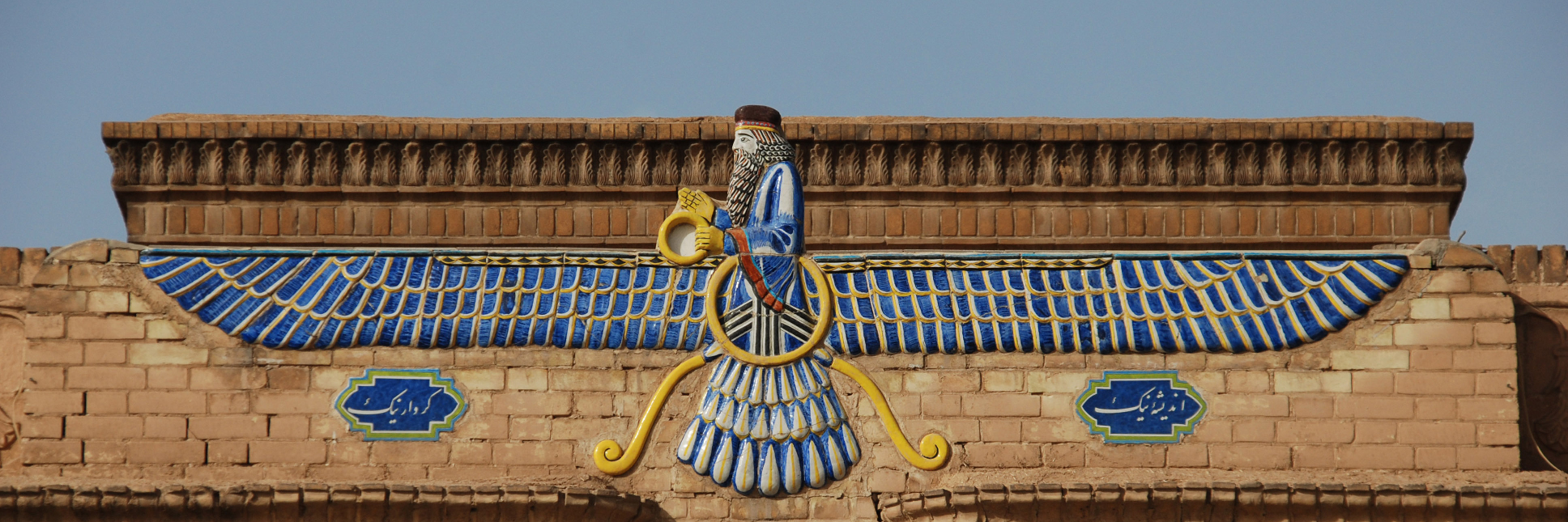
ANSWER: Yes, as far as the Nativity. The core concept of a final cosmic battle often known as Armageddon, also has ancient roots. Many historians trace this worldview back to the Persian prophet Zoroaster (around 1500 BC), who spoke of a cosmic struggle between good and evil ending in a perfect new world. This idea deeply influenced Jewish thought during times of great oppression, such as the Babylonian exile and the persecution by Greek rulers. The Book of Daniel (written around 167 BC) is a key text from this period, promising that God would soon overthrow the evil kingdoms oppressing the Jews. Early Christianity emerged from this same apocalyptic Jewish context, with followers believing Jesus’s return was imminent.
Zoroastrianism is significantly older than Christianity, and the “Three Wise Men” were most likely Zoroastrian priests. Zoroastrianism is one of the world’s oldest revealed religions. Its prophet, Zarathushtra (Zoroaster), is traditionally placed in the late 7th to early 6th centuries BC, though some scholars argue its origins stretch back even further into the 2nd millennium BC. This means it was already a well-established faith centuries before the birth of Jesus. It was the dominant religion of ancient Persia (modern-day Iran) until the 7th century AD.

The Gospel of Matthew calls them “Magi from the East” (Matthew 2:1). The Greek word magoi specifically referred to the priestly caste of ancient Persia, who were renowned for their knowledge of astrology and sacred texts. Most scholars agree these Magi were Zoroastrian priest-astrologers.

Several details support this, including their expertise in reading the stars, a core practice of Zoroastrian priests. The “East” points to Persia or Babylon, regions where Zoroastrianism was influential. The gold, frankincense, and myrrh they brought were traditional Persian royal gifts.

The familiar image of “three kings” comes from later Christian tradition, not the Bible itself. The number three comes from the three gifts, and the idea that they were kings was likely inspired by Old Testament prophecies. Totally shocking to most, is a train station in Tehran is dedicated to the Virgin Mary and Christianity that was opened recently in October 2025.
Many people do fear that a war with Iran could escalate into Armageddon, but the nature of that fear depends entirely on who you ask. A notable segment of the American population, especially among evangelical Christians, interprets a war with Iran as a step toward the biblical end times. For many others, the fear is not about biblical prophecy but about the real-world consequences of a wider war and the impact on energy, the cornerstone of modern civilization.

A June 2025 poll found that a slight majority of Americans (51%) feared the tensions between the U.S. and Iran could lead to a World War III. The fear of an “Armageddon” with Iran is real, but it is driven by two very different worldviews: one that sees it as a catastrophic failure of diplomacy, and another that sees it as the fulfillment of divine will.

We have zealot Jews and Christians who want to conspire to destroy the Dome of the Rock so they can rebuild the next Temple, ushering in Armageddon. According to the Book of Revelation in the New Testament of the Christian Bible, Armageddon is the prophesied location of a gathering of armies for a battle during the end-of-the-world scenario, interpreted as either a literal or a symbolic location. In Islamic theology, Armageddon is also mentioned in Hadith as the Greatest Armageddon or Al-Malhama Al-Kubra (the great battle).
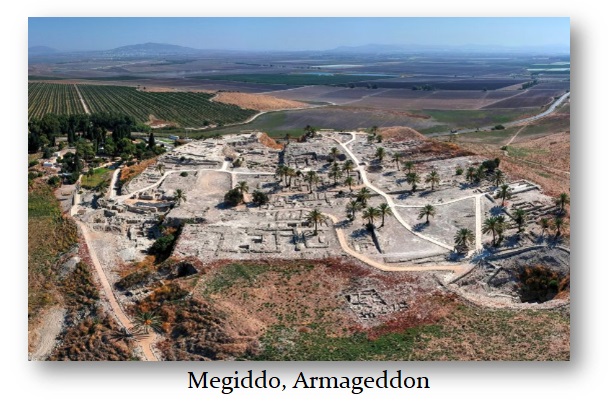
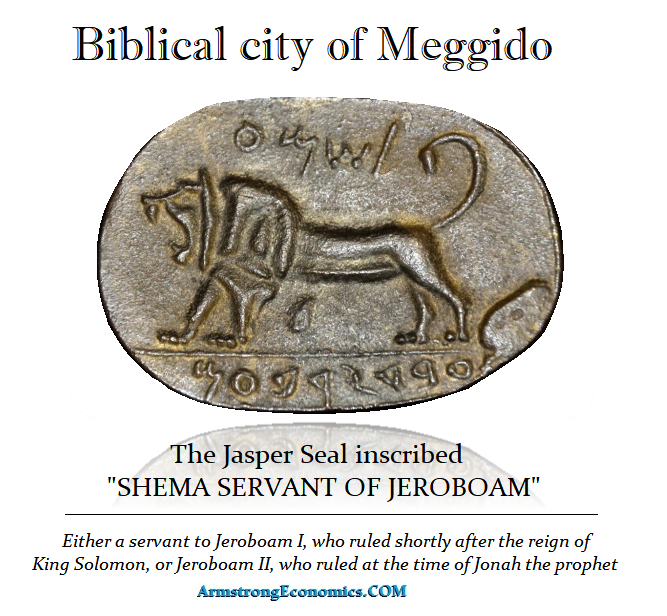
Megiddo is a fascinating site of twenty cities constructed directly on top of one another. It has been inhabited continuously from 3000 to 300 BC and lies at a strategic junction of north-south and east-west roads. Whoever had control of Megiddo had control of one of the major trade routes of antiquity. There were no coins produced by Egypt until the Ptolemy and the conquest by Alexander the Great. Likewise, there was no coinage of Judah. This is a reproduction of a Jasper Seal of Shema discovered at Megiddo in 1903.

Many battles have been fought at Megiddo. One great Battle of Megiddo occurred in 609 BC when Pharaoh Necho II of Egypt joined his allies, involving the Neo-Assyrians and the Neo-Babylonians. This required passing through territory controlled by the Kingdom of Judah. The Judaean king, Josiah, refused to let the Egyptians pass. The Judaean forces battled the Egyptians at Megiddo, resulting in Josiah’s death, and his kingdom then became a vassal state under Egypt. The battle is recorded in the Hebrew Bible, the Greek 1 Esdras, and the writings of Jewish historian Josephus. There is always a chance of losing whenever there is war. This is how the arrogant always fall.

There remains considerable debate about whether this is literally or symbolically a Great Battle to be fought on the plane of Armageddon, overlooked by Megiddo, which made sense in those days since it was a major link between the East and West, or are we looking at that as just symbolic of the world ar large.
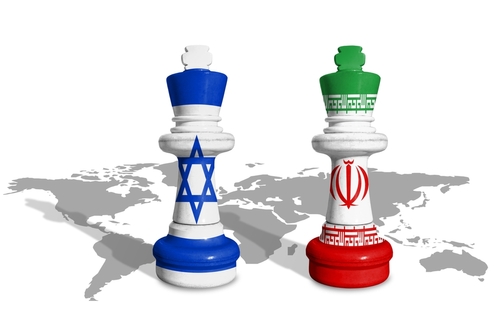
Isarel vs Iran: In 2024, in his Knesset speech, Netanyahu said: “I’ve been warning about Iran for 30 years.” It was reported on March 3rd, during a visit to a site struck by an Iranian missile, Netanyahu stated: “We read in this week’s Torah portion, ‘Remember what Amalek did to you.’ We remember - and we act.”

In 1 Samuel 15:2-3, God gives King Saul a specific, direct order to carry out this command. The prophet Samuel relays the message: “This is what the LORD Almighty says: ‘I will punish the Amalekites for what they did to Israel when they waylaid them as they came up from Egypt. Now go, attack the Amalekites and totally destroy all that belongs to them. Do not spare them; put to death men and women, children and infants, cattle and sheep, camels and donkeys. ‘”

The Amalekites were a people group in the Hebrew Bible, presented as the archetypal and perpetual enemy of the Israelites. Their story is less about a distinct archaeological culture and more about a theological symbol of opposition to God’s purposes. According to biblical genealogies, the Amalekites descend from Amalek, kinging them to the Edomites and places them within the extended family of Abraham, making their hostility toward Israel a form of “brotherly” betrayal.

They are described as a semi-nomadic people inhabiting the Negev and Sinai regions, known for guerrilla-style raids. The Amalekites are defined almost entirely by their hostility to Israel. Over time, Jewish tradition transformed Amalek from a specific nation into a symbol of evil itself. There is no direct archaeological or extra-biblical evidence confirming the Amalekites actually existed as a distinct historical people. Scholars suggest the biblical portrayal is likely “blanket” designation for various hostile desert groups or a literary device to embody the theological concept of opposition to God.

In contemporary political and religious rhetoric, some Israeli leaders, most notably Prime Minister Benjamin Netanyahu, have explicitly compared the Iranian regime to the biblical Amalekites. However, Muhammad and Islam came roughly 2,500 years after Judaism. By no account, can the Iranians be the fabeled Islam, which did not emerge until the 7th century AD, long after the codification of the Hebrew Bible and the development of rabbinic Judaism."

Monday, September 28, 2026

"Alert! Russia Mobilizes 2.5 Million! Iran FM Leaves NY Early!"

Full screen recommended.
Canadian Prepper, 9/28/26
"Alert! Russia Mobilizes 2.5 Million! 
Iran FM Leaves NY Early!"
Comments here:

“Parasitic Derivatives: $1.5 – 2.5 Quadrillion Dollars,

“Parasitic Derivatives: $1.5 – 2.5 Quadrillion Dollars,
Too Big to Understand”
by David Hague

“I recently returned from two weeks of ‘high level’ meetings with a group of Bankers [this is code for two weeks of subsidized debauchery with bankers] in Rome. As I sat at my desk, I was hoping to motivate myself to pursue a more chaste and pure existence. Unfortunately the Polar Vortex experienced by North America drained me of my good intentions. The bone chilling cold once again had me reaching for my trusty bottle of Jack Daniels for warmth and inspiration. My time in Rome had not been completely ‘wasted’, so to speak. I had secured a contract from the European Central Bank [ECB] to research the topic of Derivatives. I was to present my findings at the upcoming World Economic Forum in Davos later that month.

One Quadrillion Dollars: Too Big to Understand: Dear Reader, please resist your natural instinct to click away from this commentary at the mere mention of the word ‘Derivatives’. I am acutely aware of the boredom and befuddlement that this word instills in you. At this point I would simply remind you that the derivatives market is estimated to exceed one quadrillion dollars. [This incredibly large number is actually an accurate estimate of the size of the derivatives marketplace]. (In addition, unfunded liabilities, like medical care and pensions, are at least $300 trillion globally. If we add gross derivatives of $1.5 quadrillion, which are likely to turn into real debt as counterparties fail, the total debt and liabilities are above $2 quadrillion. Source - CP) Despite the fact the derivatives market eclipses the market capitalization of the NYSE by an exponential factor, it is not discussed, reported or tracked because it is simply too complicated and opaque. Warren Buffet’s, comment about ‘weapons of mass financial destruction’ seem to be the beginning and end of any discussion on the topic.

Derivatives are a parasitic financial instrument: For those of you who are unschooled on the topic of derivatives, allow me to explain. Derivatives are abstract financial instruments, which, like parasites, can attach themselves to all manner of stocks, bonds, mortgages, commodity, debt obligations, currency exchange, interest rate fluctuations… in short, anything. Derivatives exist in the ‘twilight zone’ of the banking industry. Like black holes, their presence and massive influence are acknowledged yet the true influence on the global economy of this quadrillion dollar ‘event horizon’ is only theoretical. The near catastrophic disasters at Barings, JP Morgan and AIG are small examples of their destructive powers. However I will offer you Investorpedia’s more clinical definition. “A security whose price is dependent upon or derived from one or more underlying assets. The derivative itself is merely a contract between two or more parties.”

You got to know when to hold ‘em, know when to fold ‘em, {Kenny Rogers}: One might think of derivatives as a random game of online poker: you don’t know who your opponents are [your counterparty], you do not know if you will be paid [counterparty risk], you do not know if the game is legitimate, [lack of regulation], and your opponents are probably able to see what cards you are holding, [market domination by large banks]. As well, you are making bets that in many instances neither you nor your opponents fully grasp [complexity of the market]. With each wager you are potentially risking not only your current assets, but your future assets as well. [Leverage]. In some cases you do not know how much you are betting. Imagine as well, that you play this game every day with trillions of dollars that you do not have. This is the global derivatives market.

It is all Greek to me: Alternately, as derivatives are often created as a form of insurance, think of them as an insurance policy in which you:
• Do not know the name, address or any contact information relating to your insurer.
• Do not know if your insurer has the resources to pay a claim.
• Do not understand the insurance contract as it is written in Greek.
• Must rely on a shadowy third party [ISDA] to decide what constitutes a claim. [Credit event]
• Do not know whether your insurer is itself vulnerable to the particular risk you have contracted with it to insure.

His moral lassitude allowed him to excel: Dear Reader, I digress, let me return to my narrative. The aforementioned lucrative contract was secured by two key factors. The first factor was my friendship with Gustavo Laframboise-Pierre, the European Central Bank’s [ECB] Global Director of Statistical Creation. My relationship with such an esteemed member of the ECB traced its roots back to Gustavo’s days as a bookie for Wall Street’s elite. I referred so much business to him we became very good friends. His station in life took a remarkable turn when a senior member of the ECB, while in New York on a ‘fact finding mission’ [this is code for visiting his favorite escort] made an outrageously large and incorrect wager on the outcome of the 2010 World Cup. (Perhaps unsurprisingly, the term ‘derivative’ is commonly used in sports betting!) The only way the debt could be settled was for the banker to offer Gustavo a highly paid sinecure at the ECB. Gustavo became the Global Director of Statistical Creation with the responsibility of making up statistics to support whatever fantastical and deranged policies Central Banks around the world were initiating. Remarkably Gustavo’s aptitude for numbers, coupled with his moral lassitude allowed him to excel at his job. It was Gustavo who invented the term ‘Quantitative Easing’ as a benign euphemism for runaway money printing.

Where ignorance is bliss, ‘tis folly to be wise’: The second factor that secured the contract for me was a chance remark I made as Gustavo and I enjoyed a ‘working lunch’, with several senior executives who represented many of the world’s largest banks. The working lunch was held at Rome’s exclusive Blue Moon Gentleman’s Club. As the featured dancer left the stage I happened to mention to the assorted luminaries that I had read an article on the subject of derivatives. The bankers looked at me with something akin to awe and reverence. Gustavo whispered to me that the topic of derivatives had been discussed in a recent conference call by the world’s bankers. The conclusion reached at that time was that derivatives were too boring and too complicated for bankers to grasp. Despite JP Morgan’s very public, expensive and monumentally stupid 5 billon dollar derivatives trading loss bankers still choose to remain cocooned in a ‘Cloak of Ignorance’ as it relates to derivatives. Thomas Gray’s lament that ‘where ignorance is bliss, ’tis folly to be wise’ could easily be the mission statement of the global banking industry.

I had read a complete article, I was a ‘de facto expert’: Dear reader, I am not being rude and offensive in my remarks about JP Morgan. Surely you would agree with me that any large bank that loses $5 billion in derivatives trading is ignorant of the properties and risks of derivatives? The fact that I had actually read a complete article on the subject made me a de facto expert on the topic. Gustavo, in an act of kindness, seized the opportunity on my behalf and pressed his colleagues to retain me to research the topic and make a presentation at the upcoming World Economic Forum in Davos. Thus I found myself preparing to dazzle the world’s financial elite with my insights into the risks and opportunities presented by the global derivatives market. In a rush to complete the deal before the next dancer took the stage it was agreed that I would receive the standard banker’s honorarium of $5,000/hour up to a maximum of ‘whatever it takes’.

At $5,000/hr., you would surely not expect me to be brief: I sat at my desk, sipping ‘Gentleman Jack‘ while I looked out at the bleak weather that made Brooklyn so depressing in the winter. My TV was tuned to CNBC, as I waited for Wall Street to open. I put my crack pipe in its case. Dear reader like many of you [especially those of you who work in the banking industry], I have learned all too well, the dangers of mixing crack cocaine with whiskey on an empty stomach. [Have we not all indulged, to our regret, that particular venial sin at least once?] I collected my thoughts and began to write my lengthy tome on the derivatives market. Dear reader at $5,000/hr., you would surely not expect me to be brief.

Lions and Tigers and Bears [and derivatives] Oh My!: I do not want to frighten you. However I will share with you some facts about derivatives that will have you reacting as nervously as Dorothy did in the Wizard of OZ when confronted with the thought of Lions and Tigers and Bears. ‘Derivatives, Oh My’, will I suspect be the words that escape your lips.
• Size of the derivatives market: 1.5 – 2.4 QUADRILLION dollars
• Size of Global Stock and bond markets: 175 trillion dollars
• Who regulates the Derivatives market? LOL, Regulation is a ‘work in progress’ dominated by the big banks.

How dangerous are derivatives? They almost destroyed the world’s largest insurance company, AIG, as well as the global economy. Seriously, you don’t remember? Just Google the words AIG and collapse. Alternately you might call Jamie Dimon at JP Morgan and ask him if Derivatives are dangerous. Have recent regulatory changes made the world economy less likely to implode from a derivative fuelled explosion? Actually as one might expect, thanks to regulatory enhancements that had to run the gauntlet of bank lobbyists prior to their approval, the world’s economy is in more danger than ever from a derivatives inspired meltdown.

‘Duck Dynasty’ and ‘Real Housewives’ to the rescue: How much attention does the Main Street pay to the world’s largest and riskiest casino? [AKA: the Derivatives market]. If one were to Google the word derivatives, one will get 34 million ‘hits’. Alternately, if one does a similar search for the words stocks bonds and markets one will get 400 million ‘hits’. The 34 million ‘hits’ generated by a Google search of the word derivatives compares unfavorably with the 37 million ‘hits’ generated by a search of the term ‘Real Housewives of Atlanta’, the 209 million ‘hits’ generated by a search of the term ‘Duck Dynasty’ or the 713 million ‘hits’ generated by searching the word ‘Sex’. One must conclude that only when derivatives are discussed by one of the ‘Real Housewives of Atlanta’ posing nude in bed with one of the cast members of ‘Duck Dynasty’ will derivatives receive the attention they deserve.

Reality bites: Derivatives can only be discussed as ‘Fake News’: Where can one find insights and coverage of the Derivatives Market in the mainstream media? Is Fox News or CNN my best choice? Sadly Dear reader your best choice would have been The Daily Show with Jon Stewart. Despite the calamitous risk and obvious importance of this topic only Mr. Stewart and his team dared to share information with the general public. Given the outlandish and frightening risks derivatives constitute to the Global Economy, perhaps Mr. Stewart was correct that it can only be discussed in the ‘Fake News’ format.

Derivatives: better suited for Ripley’s Believe it or not than the Wall Street Journal: How bizarre is the derivatives market? How is the concept of money for nothing propagated by the derivatives market? What is the difference between a chump and a champion in the derivatives market? I will leave it to Shah Gilani in his excellent post in “Wall Street: Insights and Indictments“ to explain. Suffice to say that one is able to buy insurance in the derivatives market. One can then cause the insured event to occur by collaborating with a third party. All that remains is to collect the insurance proceeds. [To be clear the proceeds are usually in the tens of millions of dollars.] The derivatives market makes the Ponzi-like money printing of the Central banks look like ‘Amateur Hour’.

Who needs ‘Crack’? Dear reader, usually I needed a little help from my friend Mr. Crack to feel as paranoid and euphoric as I did at this moment. Paranoid, because it was clear to me that the derivatives market was truly a weapon of mass financial destruction. Euphoric because I knew that my research would make my ‘Derivatives’ presentation at the World Economic Forum a groundbreaking ‘tour de force’ that would vault me to the forefront of ‘talking heads’ that pass for experts on mainstream media. Fame, fortune, a book deal and perhaps that elusive Nobel Prize would surely follow. My twenty minutes of painstaking research, had made me one of the world’s foremost experts on this complex subject. [BTW Dear Reader by reaching this point in my commentary, you surely now know more about derivatives than most bankers and traders on Wall Street. You should be quite pleased.]

David, you are an imbecile: I decided to reach out to my pal Gustavo and share some of my findings. I knew that it was 3:30 in the afternoon in Paris so I would be able to catch Gustavo just as he arrived for another day of work. “Gustavo”, I intoned, breathless with excitement. “I have uncovered some startling, controversial, and frightening information about derivatives. The luminaries and leading lights who attend my presentation in Davos will be utterly gobsmacked by my revelations. The media will undoubtedly ensure that my findings go viral. The topic of derivatives will no longer exist only in the dark shadows of the banking industry. The danger that derivatives pose to the global economy will permeate the consciousness of Main Street.” Gustavo sighed, “David, I do not know if you are stupid or naïve. Every September when you bet $1,000 that the perennially atrocious Toronto Maple Leafs will win the Stanley Cup, I assumed you were simply ingenuous. Your comments today have convinced me that you are an imbecile. Let me assure you that those will not be the findings that you present at the World Economic Forum. Rather you will inform the world that derivatives are a financial instrument that is being used by brilliant and prudent financial professionals to mitigate risk and make the world a safer place.”

The ‘Truth Will Out’: “Gustavo”, I groaned, “that would be a lie. I cannot in good conscience, sacrifice my integrity, my honor, my core beliefs and my good name simply to placate Wall Street and the Central Banks. I have a responsibility to my readers on Main Street to inform them, to warn them, to prepare them for the likely financial chaos that derivatives will cause”. “Gustavo”, I said with iron willed determination, “the Truth Will Out”. “David”, Gustavo snarled, “If you change the tenor of your presentation and indicate that derivatives are the most benign form of financial instrument, somewhat akin to Treasury bills, we will double your fee”.

Move along nothing to see here: Dear Reader, in summary let me say that derivatives are the most benign form of financial instrument, somewhat akin to treasury bills. Gustavo’s immutable logic and persuasive argument was instrumental in helping me reach the correct conclusion regarding the risks to the Global economy posed by derivatives. So Dear Reader, move along, there is nothing to see here.”
o
"$2.5 Quadrillion Disaster Waiting to Happen 
– Egon von Greyerz"
By Greg Hunter’s USAWatchdog.com

"There is sufficiency in the world 
for Man's need but not for his greed." 
- Mahatma Gandhi

From November 1, 2022, and more terrifyingly worse now...$4.2 QUADRILLION as of September 2026. "Egon von Greyerz (EvG) stores gold for clients at the biggest private gold vault in the world buried deep in the Swiss Alps. EvG is a financial and precious metals expert. EvG is a former Swiss banker and an expert in risk. He says the risk in the global markets has never been this high.

EvG explains, “Credit has increased dramatically through derivatives. All instruments being issued now by banks, pension funds, stock funds, it’s all synthetic. There is no real underlying payments in anything almost. Therefore, my estimate for derivatives would be at least $2 quadrillion, and I think that is probably conservative. Then, we have debt on top of that of $300 trillion, and we also have a couple hundred trillion dollars of unfunded liabilities. So, we are talking about $2.5 QUADRILLION, and that’s with a global GDP of $88 trillion $126.3 as of September 2026. So, there is a disaster waiting to happen, and especially because all this created money has created no value whatsoever. I always knew this would collapse, and it’s taken longer than I expected, but I think we are at the end of a major era. 

These derivatives, at some point soon, will actually turn into debt. Central banks will have to cover all the outstanding liabilities of the commercial banks as we are seeing now with Credit Suisse, Bank of England and etc. This is going to happen across the board. Whether it’s called derivatives or called debt, as far as I am concerned, it’s the same thing. It will have the same effect on the world financial system, which will be disastrous, of course.”

EvG says the derivative markets were simply a way for financial institutions to carry debt and not show it on their balance sheets. In the end, everything will balance out. EvG goes on to say, “Nobody can repay the debt, and they can’t even pay interest. So, therefore, when the debt implodes, so will the assets that were financed by this debt. So, both sides of the balance sheet have to come down. Whether it comes down by 50%, 75% or 90%, I don’t know. All I think about is risk, and the financial system will not survive in its present form. Central banks only use one kind of medicine, and that is more printed money. Now, you are getting negative returns on printed money. So, that is not going to save anything. 

Sadly we are looking at a situation when this system will start to implode. The rich are still rich, but the poor are really poor. Overall in the UK, Germany and most European countries, people don’t have enough money to live. This is a human disaster already. With food costs going up 25% and energy going up the same and gasoline, interest rates and rents, people don’t have enough money, and that is happening now. It’s a human disaster of mega proportions. It’s so sad, and governments will have no chance of doing anything about it. The risk is increasing exponentially,  and it is going to get worse.” There is much more in the 43-minute interview.

Join Greg Hunter on Rumble as he goes One-on-One with Egon von Greyerz of Matterhorn Asset Management, which can be found on GoldSwitzerland.com.