StatCounter

Monday, July 13, 2026

Bill Bonner, "The Filter Stretches Like the Waistband"

"The Filter Stretches Like the Waistband"
by Bill Bonner
Youghal, Ireland - "We have it on the very best authority that old men are not the same as young men. We have observed the melancholy fact in our own person. Where once we bounded up and down the stairs with the airy unconcern of a mountain goat, we now cling to the handrail. Whatever a man’s particular weakness in his early years, time makes it worse. The fellow with poor lungs at 20 can scarcely draw a breath at 80. He of the “bad knees” at 30 will be hobbling by 70, cursing the stairs he once ignored.

We offer no proof of this. It is mere observation, wholly unblessed by science. Yet a modest curve of belly at 30 ripens, with the seasons, into a magnificent paunch by 60. And the thinning thatch at 35 has decamped altogether by 55.

The same grim law governs the personality. The man idle in his youth is very nearly furniture in retirement. If he is a grouch at 25, he grows grouchier with every page of the calendar. And if he inclines by nature toward mythomania, vulgarity, or plain pig-headed stupidity - presidential timber, in other words - why, he is fairly certain to be insufferable by the time he draws his pension. Time, in short, distills our infirmities like oak-aged whiskey; then, the strong drink dissolves the inhibitions.

A friend of ours suffered a stroke in his 70s. He remained hale enough in body, but his family took to barring him from public view, for his internal censor had packed its bags and gone. In a restaurant he might inform the waitress, with perfect and disarming candor, “I love your tits.” It was an honest remark. The lady may even have been gratified by it. But it was definitely “inappropriate.”

We raise the matter because we find ourself brooding upon our beloved POTUS. Some say he is just ‘too old’ to have the weight of the world on his shoulders. But the man has always tended toward the louche; his own mother, we are told, prophesied that he would prove a “disaster” as a politician. He returned for his second term in January of 2026 older, perhaps a shade meaner, and girded with even less restraint than he flaunted in the first. He instantly rechristened the Gulf of Mexico and Mount Denali. He rattled the allies by threatening to annex Greenland, to bolt from NATO, and to file Canada away as the 51st star on the flag.

Jolly moments, these - mostly harmless, and very nearly charming, in the way they broadcast the President’s freewheeling, open-mic, icon-smashing joie de bully. But they whispered, too, that the worms in the Trump brain were on the turn; the internal censor had stopped working.

POTUS may imagine Gaza as a Las Vegas show town, for example. With uncounted bodies still beneath the rubble, it may be ‘inappropriate’ to say so. But, with the censor out of town, the brassy Manhattan developer went right ahead. The Mirror describes the video shared by the White House: "It’s complete with a “TRUMP GAZA” hotel, a 40ft tall statue of the man himself looking remarkably svelte, and - blink and you’ll miss them - a pair of bikini babes with long black beards…and it culminates with an image of Trump and Benjamin Netanyahu laying next to each other on sun loungers."

The press, predictably, has filed these eruptions under “unhinged.” But they are nothing of the sort. They are merely the naughty thoughts that go rattling through every skull on earth, which the rest of us have the ordinary good sense to strain out before they reach the open air.

Even Mr. Trump was once dimly aware of the editing apparatus, back when it still half-functioned. Concerning his rival Chris Christie: “Don’t call him a fat pig. You can’t do that.” That was August of 2023. By November of 2025 the filter had rotted clean through. Jake Tapper reports: After a woman reporter asked about President Trump’s name being raised in emails sent by convicted sex offender Jeffrey Epstein, Trump snaps at her: “Quiet, piggy!” Another reporter put a simple question about releasing the Epstein files - “Why not just do it now?” To which the President replied: “It’s not the question that I mind. It’s your attitude. I think you are a terrible reporter. It’s the way you ask these questions.”

But it is in his assault upon Iran - with ordnance and with adjectives alike - that the filter appears to have given way most spectacularly. Mother Jones reports that Trump threatened...
“Blasting Iran into oblivion” and “back to the Stone Ages!!!” He said he would blow up bridges and civilian power plants, which experts in military law said could constitute a war crime. And on Easter morning, he wrote on his social media account: “Open the F - in’ Strait, you crazy bastards, or you’ll be living in Hell.”

Trump signed the death warrant of Iran’s leader - but woe unto the Republic should some Iranian dare contemplate the reciprocal courtesy upon him. CNBC: "Trump threatens to ‘decimate’ Iran if it tries to kill him..." And then this dispatch, yesterday, from the Independent:
Trump threatens to ‘take over’ Iran if Tehran closes the Strait of Hormuz in profanity filled tirade."

A fortnight ago the President pronounced Iran’s rulers “nice people to deal with” and “very rational people.” But last week: “I don’t want to deal with them anymore. They’re scum. You know what scum is? They’re scum. They’re sick people. They’re led by sick people.”

That may indeed be an honest sentiment. But it hardly seems the choicest thing to bellow in public when one is negotiating the end of a war one started oneself. The censor, alas, is off playing golf - and does not appear to be coming back."

Dan, I Allegedly, "Spying and Tracking All of Us"

Full screen recommended.
Dan, I Allegedly, 7/13/26
"Spying and Tracking All of Us"
"Have you ever wondered how much your car really knows about you? In today's video, I break down the growing world of vehicle surveillance, dealership-installed GPS trackers, connected car technology, automatic license plate readers, and the personal data being collected every time you drive. We'll discuss a viral story involving a truck buyer who discovered a hidden tracking device after purchasing his vehicle, along with questions surrounding vehicle monitoring systems, driving data, and where that information may end up. We'll also look at privacy concerns involving connected services, data brokers, and why so many Americans are questioning who really owns the information generated by their vehicles. We'll also explore automatic license plate readers, free crime-mapping tools like SpotCrime, and the balance between public safety and personal privacy. As technology becomes more integrated into our daily lives, it's more important than ever to understand what information is being collected, who has access to it, and what choices consumers have. Let me know in the comments: How much privacy are you willing to give up for convenience and security?"
Comments here:

"Economic Market Snapshot 7/13/26"

"Economic Market Snapshot 7/13/26"

Down the rabbit hole of psychopathic greed and insanity...
Only the consequences are real - to you!
"It's a Big Club, and you ain't in it. 
You and I are not in the Big Club."
- George Carlin
o
Market Data Center, Live Updates:
Financial Stress Index

"The OFR Financial Stress Index (OFR FSI) is a daily market-based snapshot of stress in global financial markets. It is constructed from 33 financial market variables, such as yield spreads, valuation measures, and interest rates. The OFR FSI is positive when stress levels are above average, and negative when stress levels are below average. The OFR FSI incorporates five categories of indicators: creditequity valuationfunding, safe assets and volatility. The FSI shows stress contributions by three regions: United Statesother advanced economies, and emerging markets."
Job cuts and much more.
Commentary, highly recommended:
"The more I see of the monied classes,
the better I understand the guillotine."
- George Bernard Shaw
Oh yeah... beyond words. Any I know anyway...
And now... The End Game...
o

"Alert! Russian Doomsday Planes Head to Iran, Hormuz Closed, Lindsay Grahams Death Conspiracy!"

Canadian Prepper, 7/12/26
"Alert! Russian Doomsday Planes Head to Iran, 
Hormuz Closed, Lindsay Grahams Death Conspiracy!"
Comments here:

Sunday, July 12, 2026

"Can We Really Trust Our Feelings?"

"Can We Really Trust Our Feelings?"
by Todd Hayen

"Sure, as long as we are conscious of their true origins. And even if not, sometimes we can trust, other times no. Feelings are odd things. They can come out of nowhere, or they can be highly circumstantial - like the rush of extreme fear when a bear jumps aggressively from behind a tree. They can also be mysterious “gut feelings.”

Usually, we have some awareness of their unconscious underpinnings. We sense whether a feeling is a solid “gut” instinct, something “creepy,” or simply “good” - as in, “I just liked that guy; there was something about him that made me feel comfortable and trusting.”

But…and it’s a big “but,” we know we have to be careful. The guy or gal who sweeps us off our feet on a first date needs further scrutiny. We have all fallen into that pit, haven’t we? It is a deep, dark chasm, and usually very difficult to climb out of. Did you ever wonder why, back in the day, marriage engagements often lasted what seemed an eternity? There were many social and cultural underpinnings, but one major reason was simply to get past the “swept off your feet” syndrome - to make what was largely unconscious, conscious.

So, what’s the big deal? If our impressions of things and people rely too heavily on feelings - especially when we are not conscious of their origins - we can end up in serious trouble. Most of the time, it doesn’t really matter what our feelings are about other people. We see an actor we like or meet someone in the grocery store we immediately dislike. Actors don’t matter much in our daily lives; their entire craft is built on creating impressions based on unsubstantiated feelings.

Most strangers we encounter don’t matter much either. But people like our lawyer, our doctor, or our lover, do. With the exception of the latter, we usually have some objective basis for our assessments - what are their credentials? What is their reputation? Has the state licensed them? (As I clear my throat on that one.) We may still have a gut feeling, which remains important given their role in our lives, but we temper the emotional response with at least some objective evaluation.

We run into an odd situation with politicians. They are (or most people think they are) important, yet their persona and presentation are wholly geared toward generating a “feeling” with voters choosing among options. More often than not, they want that feeling to outweigh any objective facts. A lot of effort goes into this charade. Intellectually, many people may agree it’s a game, but most still fall for the ruse.

I see this often with celebrities, too. People worship movie stars or sports figures regardless of whether they are decent human beings. They reach worship status quickly. Sports stars at least have to have a exceptional physical skill. And oddly enough, most totally untalented actors seldom become celebrities. Hating these types (actors and athletes) is less common, but when someone is set up for hate for whatever reason, it flows effortlessly.

Guess who I am going to use as an example of this sort of hate? Donald J. Trump, of course. He is probably the most hated man in modern times next to Adolf Hitler (we could cite others like Joseph Stalin, Pol Pot, or Saddam Hussein, but Trump is the most current). Was he set up for hate? Absolutely, although not entirely. He can be rather despicable at times, making it easy to dislike him. Add a little media salt to his own formula, and you have one of the juiciest targets for hate projection imaginable.

To start with, Trump does not have a conventionally likable personality. He comes across as arrogant, impulsive, boastful, and low on agreeableness and emotional stability - traits like rudeness, grandiosity, and a lack of empathy that many find off-putting. He is blunt, disruptive, and often vulgar in a way that violates traditional political norms. Not much there for broad appeal.

Yet some of these brazen attributes are exactly what his supporters adore. His maverick, no-nonsense approach - telling it like he sees it with little filter, rejecting political correctness, and fighting the establishment - resonates deeply. Supporters value his authenticity, pragmatism, and willingness to shake up the system rather than play the polished insider game. What critics call arrogance or bullying, fans see as strength, decisiveness, and refreshing honesty. Which set of attributes do you think make a better leader? Sadly, the ugly ones probably do.

What about the “real” good and bad things? Haters rarely focus on substantive presidential shortcomings. Instead, they attack his personality: he’s mean, ugly, makes fun of people, has weird hair, is fat, and has an ugly mouth.

They label him a misogynist, a racist, and a felon. Defenders note that many accusations stem from selective outrage, legal warfare perceived as political persecution, or misrepresentations of his record on issues like criminal justice reform (First Step Act), opportunity zones for minority communities, and strong support from diverse groups in elections.

Supporters argue his blunt style gets twisted into “-isms” while ignoring policy outcomes or context. Of course, as of this writing, Trump haters probably have more substantive reasons to hate him, but at the beginning of the hate campaign, not as much. The point I am making about “feelings” is not confined to the Trump phenomenon.

Many of the Trump haters adore figures like Biden, Harris, Obama, or (for Canadians) Carney. Why? For mostly the same superficial reasons - personality, looks, media framing - rather than deep substance. They were told to love these figures and hate Trump (and his team). Although personality and appearance play a role, the press drives most of it. Most people don’t look beyond that.

So, they treat politicians like movie stars or sports figures. Their gut tells them one thing, looks and personality another, and the press fills in the rest. Then they retreat into echo chambers where their bias is confirmed endlessly by social media, friends, family, the dog - and maybe a cat or two (cats are primarily liberal).

Feelings have their place. A strong gut instinct can protect us or guide us toward what feels right. But when it comes to high-stakes decisions - especially about leaders who shape laws, economies, and societies - we owe it to ourselves to dig deeper. Scrutinize records, policies, and results alongside the vibe. Conscious awareness of where our feelings come from turns raw emotion into informed judgment. Without that, we’re just another audience member swept up in the performance.

As I revisit this concept in our modern time, the divide feels even starker. The “feeling-based” politics hasn’t faded; if anything, it has intensified. Trump remains a lightning rod - loved or loathed largely on emotional and media-primed grounds rather than calm analysis (although that has changed a bit since the Iran conflict). The lesson holds: question the origins of your feelings, especially when the stakes are this high. Let’s all continue to stay sharp by balancing heart and head."

"US Food Supply Enters Crisis, Millions Aren't Ready"

Full screen recommended.
Snyder Reports, 7/12/26
"US Food Supply Enters Crisis,
 Millions Aren't Ready"
Comments here:

Jeremiah Babe, "RIP Warhawk Lindsey Graham; Los Angeles Vendors Selling Food On Sidewalks"

Jeremiah Babe, 7/12/26
"RIP Warhawk Lindsey Graham; 
Los Angeles Vendors Selling Food On Sidewalks"
Comments here:

Joel Bowman, "A Mountain of Debt"

"A Mountain of Debt"
by Joel Bowman

“An exact knowledge of the past as an aid to the interpretation of the future...”
~ Thucydides, from his "History of the Peloponnesian War"

Buenos Aires, Argentina - "A time for peace, a time for war… a time of plenty, a time of few… a time for courage, a time for patience… What a time to be alive, dear reader! Standing on the brink of history, we are daily amazed as the world turns beneath our very feet.

In the newspapers we read reports of breathtaking technological marvels… alongside tales of war and waste. We see an age of unparalleled material abundance… on top of profound spiritual and philosophical emptiness. We learn of a future unfolding that is beyond our comprehension… even as we discover how little we know of our own past.

Take the recent story around the Herculaneum scrolls, for example, the only intact library to survive from the ancient Greco-Roman world. From The Smithsonian Magazine: "Scientists Have Deciphered the Surviving Fragments of a 2,000-Year-Old Philosophical Treatise Frozen in Time by Mount Vesuvius’ Eruption. The papyrus manuscript was part of a vast library preserved by volcanic ash. Now, the remaining passages - which examine ethics, knowledge and human nature - are accessible for the first time since 79 C.E.

Researchers working on the so-called Vesuvius Challenge used a combination of high-resolution scanning, sophisticated “virtual unwrapping” algorithms, and AI trained to detect tiny surface changes caused by ancient ink to access these texts, previously lost to time.

The library contains over 600 scrolls, potentially including missing works of stoic philosopher Chrysippus, lost dialogues by Aristotle, plus histories, plays and countless other treasures. It is not lost on us that the further we reach into the future – through technologies unimaginable barely a generation ago – the further we are able to gaze into the past. And yet, even as mankind labors meticulously to uncover lessons from ancient times… he is quick to forget those read to him just yesterday.

An Eruption of Debt: Witness the malignant creep of socialism in New York City, formerly the “capitalism capital” of the world. Notice the growing appetite for the State to “manage” whole industries – from grocery stores to A.I. to air conditioners and plenty besides – because, if nothing else, governments have proven themselves spectacularly competent at driving innovation, generating value and stewarding capital. (Ahem…)

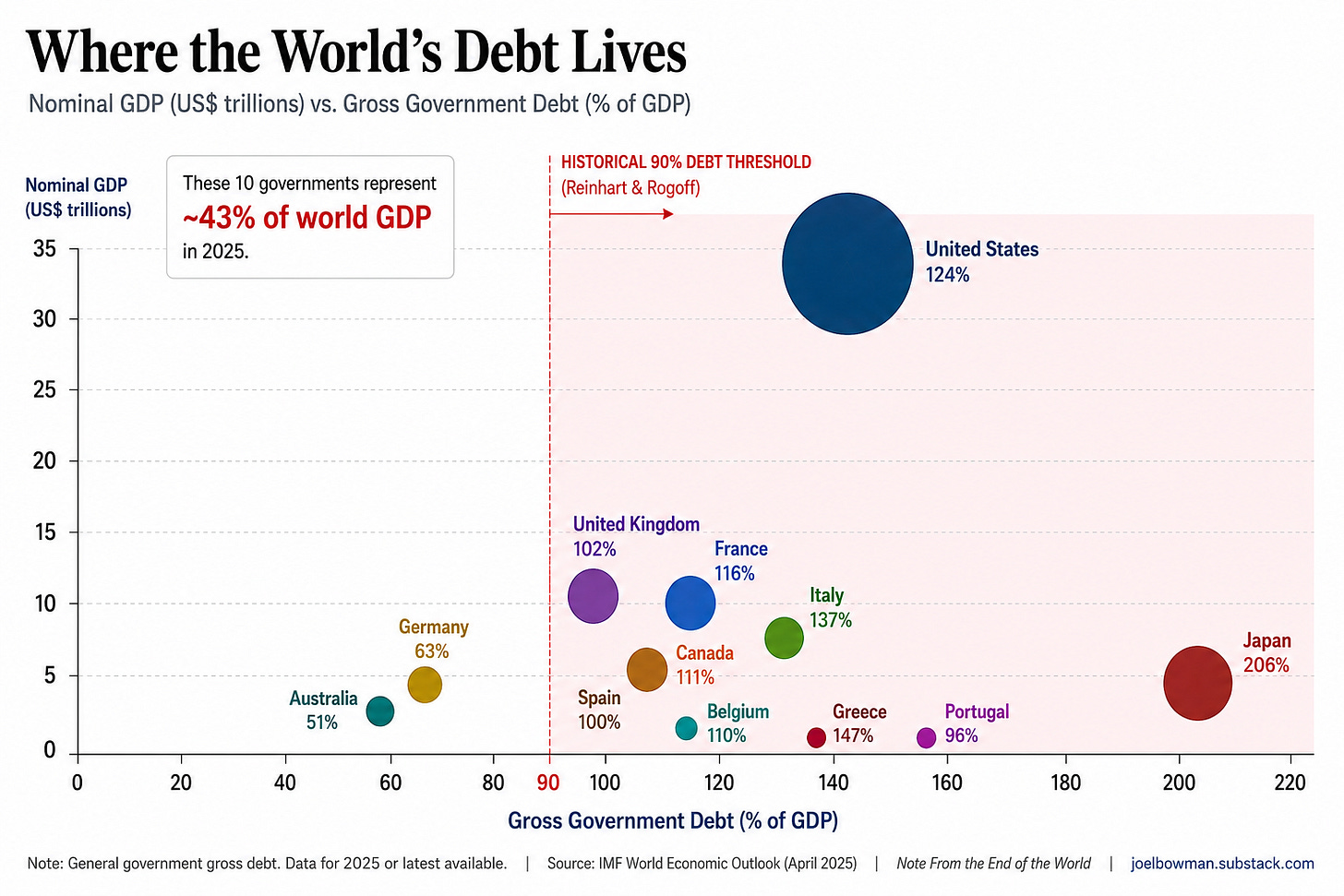
Why, just take a look at the balance sheets of those very same nation states. Today, the ten most indebted nations on the planet account for 43% of the worlds entire GDP. Every single one of them – Japan, Greece, Italy, the USA, France, Canada Belgium, the UK, Spain and Portugal – carry debt-to-GDP ratios above 90%, the level economists used to consider the “danger zone.”
Click image for larger size.
One wonders, when future generations return to this corner of the universe, fresh and recharged from their interstellar vacations, what they will uncover from our primitive texts and primeval communications. Will they look at our collective store of knowledge with awe and wonder… or pity and shame? Have your say in the comments, below…"

Musical Interlude: Mario Frangoulis and Justin Hayward, "Nights in White Satin"

Full screen recommended.
Mario Frangoulis and Justin Hayward, 
"Nights in White Satin"

"A Look to the Heavens"

“Far beyond the local group of galaxies lies NGC 3621, some 22 million light-years away. Found in the multi-headed southern constellation Hydra, the winding spiral arms of this gorgeous island universe are loaded with luminous young star clusters and dark dust lanes. Still, for earthbound astronomers NGC 3621 is not just another pretty face-on spiral galaxy. Some of its brighter stars have been used as standard candles to establish important estimates of extragalactic distances and the scale of the Universe.
This beautiful image of NGC 3621 traces the loose spiral arms far from the galaxy's brighter central regions that span some 100,000 light-years. Spiky foreground stars in our own Milky Way Galaxy and even more distant background galaxies are scattered across the colorful skyscape.”
"The Earth"
"What can I tell her over breakfast when she says
her son suffers from madness, and because there
is no mental health, he has ended up in jail,
and she is relieved, because at least he might
be safe there or he might get to see the doctor.
We are eating egg-white omelets; we are counting
carbs. We are buttoning ourselves in our clean dresses
and high-heeled shoes in order to bring home the bacon,
doing what we need to do and “It is what it is.”
Her granddaughter and daughter are living with her
in the one bedroom. Nights, the daughter lounges by
the pool, looking at her phone, while she teaches the child
to plant seeds in a flower bed she feels bad she does not own.
She tells she cried in the car coming here; she did not know
me then. She thought we would be talking to each other
the whole time about what we are selling, what
the other might buy, but somehow we left that behind
over the toast with the tiny pots of strawberry jam.
Who can explain all this luxury, all this despair?
Or how we all hold our secret shames so close
and gloss our lips with “Cinnamon Fire” as if that were
some legitimate form of protection. Cinnamon Fire!
She just turned fifty. I tell her wait ten years - you
won’t know more, but you will get closer to forgiving,
because it is all happening on a wheel that spin
so fast. Why not stop to look at the pink flowers
you’ve planted with your granddaughter? Why not feel
your bare toes in the good wet earth? We play with the crusts
on our plates. The waitress takes the coffee away. We
are strangers again, each carrying our lonely fear
our children won’t find their way, wishing for them
some inner logic - sacred trust of earth and self, that exists
for each of us so far within, so far under the skin, we
can’t even begin to say what it is made of; it merely is,
poised between love and grief: the blue space we call wonder,
which is merely the dew on the grass, the shadow the sun
makes as it rolls over the vast skin of the Earth."
- Sheila Black

"The Gentle Rhythm of Today"; "A Very Old Town"

Full screen recommended.
Gengu AI, "The Gentle Rhythm of Today," 
"A Very Old Town"
"AI was the tool. The story came from human feeling. If this film gave you
 a quiet breath, a memory, or a moment of peace, thank you for being here."

Native Elder, "Why Happiness Was Easier 40 Years Ago"

Full screen recommended.
Native Elder,
"Why Happiness Was Easier 40 Years Ago"

"I Can’t Afford Gas Anymore, So I’m Running on Guinness"

Full screen recommended.
Delta King's Blues,
"I Can’t Afford Gas Anymore, 
So I’m Running on Guinness"
"Gas tank’s empty… but the spirit’s still got fuel. “I Can’t Afford Gas Anymore, So I’m Running on Guinness” is a cheeky, hard-times Delta King’s Blues tune about rising costs, broke pockets, and finding humor in whatever keeps you moving. A bouncy, rough-edged acoustic guitar kicks up a back-porch groove like a man laughing through bad luck. The harmonica staggers and smiles, half buzzed, half brilliant. The rhythm rolls loose and easy, built for folks who ain’t got much - but still got attitude. This is blues that laughs at being broke. For anyone who’s ever made it through tough times with a grin and a cheap drink. If I can’t fill the tank… I’ll fill the glass."

The Daily "Near You?"

Grangeville, Idaho, USA. Thanks for stopping by!

Free Download: Olaf Stapledon, "Sirius: A Fantasy of Love and Discord"

"But what a universe, anyhow! No use blaming human-beings for what they were. Everything was made so that it had to torture something else. Sirius himself was no exception, of course. Made that way! Nothing was responsible for being by nature predatory on other things, dog on rabbit and Argentine beef, man on nearly everything, bugs and microbes on man, and of course man himself on man. (Nothing but man was really cruel, vindictive, except perhaps the loathly cat). Everything desperately struggling to keep its nose above water for a few breaths before its strength inevitably failed and down it went, pressed under by something else. And beyond, those brainless, handless idiotic stars, lazing away so importantly for nothing. 

Here and there some speck of a planet dominated by some half-awake intelligence like humanity. And here and there on such planets, one or two poor little spirits waking up and wondering what in the hell everything was for, what it was all about, what they could make of themselves; and glimpsing in a muddled way what their potentiality was, and feebly trying to express it, but always failing, always missing fire, and very often feeling themselves breaking up as he himself was doing. Just now and then they might feel the real thing, in some creative work, or in sweet community with another little spirit, or with others. Just now and then they seemed somehow to create or to be gathered up into something lovelier than their individual selves, something which demanded their selves sacrifice and yet have their selves new life. But how precariously, torturingly; and only just for a flicker of time! Their whole life-time would only be a flicker in the whole of titanic time. Even when all the worlds have frozen or exploded, and all the suns gone dead and cold therewill still be time. Oh God, what for?"
 - Olaf Stapledon, "Sirius: A Fantasy of Love and Discord"
Freely download "Sirius: A Fantasy of Love and Discord",
by Olaf Stapledon, here:

The Poet: John O’Donohue, “In These Times”

“In These Times”

“In these times when anger
Is turned into anxiety,
And someone has stolen
The horizons and mountains,
Our small emperors on parade
Never expect our indifference
To disturb their nakedness.
They keep their heads down,
And their eyes gleam with reflection
From aluminum economic ground,
The media wraps everything
In a cellophane of sound,
And the ghost surface of the virtual
Overlays the breathing earth.
The industry of distraction
Makes us forget
That we live in a universe.
We have become converts
To the religion of stress
And its deity of progress;
That we may have courage
To turn aside from it all
And come to kneel down before the poor,
To discover what we must do,
How to turn anxiety
Back into anger,
How to find our way home.”

~ John O’Donohue,
from “To Bless the Space Between Us”
“Do not lose heart. We were made for these times.”
– Clarissa Pinkola Estes

"Time: It’s The Only Thing You Have"

"Time: It’s The Only Thing You Have"
by John Wilder

"Time. Of things that have long fascinated me, time is at the top of the list. Even when I was a little kid, time fascinated me. The idea that time, of all of the physical parameters of the world there was the one that we couldn’t control. Humanity has mastered the power of the atom, at least partially. We haven’t tamed fusion, but we can create it, and have several fewer islands in the Pacific because of it.

Humanity has dammed the largest of rivers, giving us power. We have used technology to shrink the world. The first recorded circumnavigation of the world took 1082 days. Magellan didn’t quite make the whole trip, but he still gets the credit on a technicality. Now? The International Space Station does an orbit in 90 minutes or so at 17,150 miles per hour, which is nearly as fast as Haitians are entering Texas.

Humanity has conquered the riddle of steel – we’ve made steel buildings that reach upwards into the sky to please Crom. We have conquered climate – people live at the South Pole in perfect comfort, as well as managing to live in Houston without melting into puddles of sweat.

We can see at night. We can talk, nearly instantly, with people a continent away. My phone buzzes every time there is motion outside my front door – it’s like having a superpower of sensing where and when there is activity at a distance. Another superpower is being able to access obscure facts anywhere on the planet that can reach a cell signal.

But time remains fixed. It flows only one way. And it is the most subjective of our senses. Even Pugsley notices it: “This summer was so short!” He’s in high school. That’s when the transition from the endless summers of childhood begin to transform into the fleeting, never-ending carousel of years that is adulthood. I’ve long felt that I understood why this was. Let me give it a shot.

For a newborn, the second day it’s outside and breathing is 50% of its entire life. For a six-year-old, half of their life is three years – much more. It’s not a big percentage, but it’s much smaller than 50%. For a sixteen-year-old, half their life is eight years. If you’re forty – half your life is twenty years. 1/8 versus 1/20? It’s amazingly different. We don’t perceive life as a line. We’re living inside of it – we compare our lives to the only thing we have . . . our lives. Each day you live is smaller than the last.

But that’s not everything. As we age, novelty decreases. When we’re young, experiences and knowledge are coming at us so quickly that we are presented with novel (new and unique) information daily. New words. New thoughts. New ideas. That’s why babies keep falling for that stupid “got your nose” thing. They don’t realize that I can reattach it. Over time, though, novelty decreases, as does the percentage of your life that each day represents. Ever drive a new route somewhere? When I do it, I have to focus my attention. It seems like it takes longer because I’m having to deal with novelty.

I’ve had my “new” laptop nearly seven years. I had my old laptop for longer than that, yet my “new” laptop still seems like it’s temporary.

There are only so many routes I can drive to work, so much novelty that I can find in a daily drive. Even a commute of an hour begins to fade into a brief moment in time if it’s the same commute, day after day.

Work is similar. Over time, we gain experience. Experience shows us how to fix problems (and sometimes how not to fix them). But that experience of taking a solution and modifying it to fix the next problem isn’t as hard as fixing the first problem.

The fact that each day is a smaller portion of my life, combined with the fact that as I get older, the possibility that I see something new dims. I’ve solved a bunch of problems in my life. Finding a new one is... difficult. Life goes faster, day by day for me. Every endless summer day of youth is in my rearview mirror.

And yet... Each day is still 24 hours. I can still use each day and live it with all of the gusto of a 10-year-old fishing for trout after building a tree fort, playing with his dog, and building a model of a Phantom F-4 to dogfight with the MiG 21-PF already hanging from the ceiling. Even though those 24 hours seem shorter now than at any time in my life, they are relentless in their exact sameness. I get to choose how I spend those moments in my life. I get to choose what I want to produce, and how hard I work to make it happen.

Humanity may never have the ability to crack time – it appears that even today, outside of sands falling from an hourglass, we can only describe time as a fundamental entity, something we measure against. Does the flow of time vary? Certainly. But only if we’re moving at large fractions of the speed of light or are caught in a huge gravity well, but let’s leave your mother out of this.

I have come to the conclusion that I will likely never understand what, exactly, time is, outside of this: Time is all we have – it is what makes up life. We measure our lives in it, because no man can buy an extra hour of life. We have the hours we have. The only difference is what we do with that time.

I mentioned in a previous post that I often get by on scant hours of sleep. That’s because I have more things that I want to do in my life than I can fit in a day that’s less than 20 or 22 hours some days. I choose to try to do more, to try to make use of this time, because each moment is a gift.

Maybe I can settle for that definition of time: a gift. Each moment is a gift. Don’t beg for more, or live in fear of losing them. Just make each moment count. Perhaps that’s the secret and precious nature of time. It is the one thing we should never waste, and never wish away."
The Alan Parsons Project, "Time"

"You Can’t Have It All"

Emily Levine, January 2019.
"You Can’t Have It All"
by Maria Popova

Death is our friend precisely because it brings us into absolute and passionate presence with all that is here, that is natural, that is love,” Rilke wrote in contemplating the most difficult and rewarding existential art: befriending our own finitude. I have been sitting with Rilke, awash in the tidal waves of sorrow and love, in the wake of losing my beloved friend Emily Levine (October 23, 1944 - February 3, 2019) - philosopher, comedian, universe-builder, beautiful soul - who made me fall in love with poetry long ago and without whom there would be no "Universe in Verse" and no "Figuring." (Emily rightfully occupies the first line of the book’s acknowledgements.)

Ever since her terminal diagnosis in 2016, and up until just three weeks before her death, I had been taking Emily for what we came to call our “poetry retreats” - brief periodic respites by the ocean, where we would spend unhurried time in the company of a few other beloved women, reading poetry, cooking, conversing, and just being - with our joys, with our sorrows, with one another. Emily - the most erudite and intellectually voracious person I have ever known, introduced us to classics, many of which she knew by heart: Whitman, Eliot, Yeats, Plath, Rilke. But there was one contemporary poem she especially loved and read for us often: “You Can’t Have It All” by Barbara Ras, from her exquisite and exquisitely titled 1998 poetry collection "Bite Every Sorrow" (public library).

Now that Emily has returned her stardust to the universe she so cherished, and all the words seem too small to fill the void, poetry stands as the only mode of remembrance that can give shape and space to the amorphous largeness of feeling that is grief. In this sweetly lo-fi recording from one of our gatherings, punctuated by the sound of the ocean and the rustle of page-turning, Emily reads the poem that she, in the deepest sense, lived out and modeled for the rest of us with her largehearted life. 

"You Can't Have It All"

"But you can have the fig tree and its fat leaves like clown hands
gloved with green. You can have the touch of a single eleven-year-old finger
on your cheek, waking you at one a.m. to say the hamster is back.
You can have the purr of the cat and the soulful look
of the black dog, the look that says, If I could I would bite
every sorrow until it fled, and when it is August,
you can have August and abundantly so. You can have love,
though often it will be mysterious, like the white foam
that bubbles up at the top of the bean pot over the red kidneys
until you realize foam’s twin is blood.
You can have the skin at the center between a man’s legs,
so solid, so doll-like. You can have the life of the mind,
glowing occasionally in priestly vestments, never admitting pettiness,
never stooping to bribe the sullen guard who’ll tell you
all roads narrow at the border.
You can speak a foreign language, sometimes,
and it can mean something. You can visit the marker on the grave
where your father wept openly. You can’t bring back the dead,
but you can have the words forgive and forget hold hands
as if they meant to spend a lifetime together. And you can be grateful
for makeup, the way it kisses your face, half spice, half amnesia, grateful
for Mozart, his many notes racing one another towards joy, for towels
sucking up the drops on your clean skin, and for deeper thirsts,
for passion fruit, for saliva. You can have the dream,
the dream of Egypt, the horses of Egypt and you riding in the hot sand.
You can have your grandfather sitting on the side of your bed,
at least for a while, you can have clouds and letters, the leaping
of distances, and Indian food with yellow sauce like sunrise.
You can’t count on grace to pick you out of a crowd
but here is your friend to teach you how to high jump,
how to throw yourself over the bar, backwards,
until you learn about love, about sweet surrender,
and here are periwinkles, buses that kneel, farms in the mind
as real as Africa. And when adulthood fails you,
you can still summon the memory of the black swan on the pond
of your childhood, the rye bread with peanut butter and bananas
your grandmother gave you while the rest of the family slept.
There is the voice you can still summon at will, like your mother’s,
it will always whisper, you can’t have it all,
but there is this."

Complement with Emily’s splendid reading of “On the Fifth Day” by Jane Hirshfield, who often graced our poetry retreats with her Buddhist benediction of a presence, then revisit Mary Oliver - one of Emily’s favorite poets, whom she outlived by seventeen days - on the measure of a life well lived and how to live with maximal aliveness."

"How It Really Is"


Adventures With Danno, "We Buy Stuff At Walmart"

Full screen recommended.
Adventures With Danno, 7/12/26
"We Buy Stuff At Walmart"
Comments here:

"We Tested Ground Beef From Walmart, Costco, Kroger & 8 Stores, These Failed"

Full screen recommended.
In Plain Bite, 7/12/26
"We Tested Ground Beef From 
Walmart, Costco, Kroger & 8 Stores, These Failed"
"For years, food companies have used misleading labels, shrinking portions, fake health claims, and pricing tricks to quietly take more of your money. Most people never notice. We tested ground beef from 11 grocery chains… and eight of them failed a test that just became federal law. Most people assume grocery stores are basically the same when it comes to something as simple as ground beef. Familiar packaging, familiar prices, and millions of families cooking the exact same tray every week. But when you start comparing the label, the sourcing, and how each store actually handles the meat before it reaches the case, some very surprising differences begin to appear. And in more than a few cases, what customers believe they're buying… isn't exactly what's in the package. Some of these grocery chains are trusted by millions of families every single week. But once you start looking at how the beef is ground, where it actually comes from, and what a brand-new federal labeling rule requires them to prove, the differences become impossible to ignore. 

A few of the results may surprise even longtime shoppers. In this video, you'll discover: Which grocery chains are actually delivering honest, traceable ground beef, which ones are quietly failing a brand-new federal labeling standard, the surprising three-question test you can run on any package tonight, and what to watch for before your next trip to the meat case. The most surprising part? One of the biggest names in American retail proved it can trace beef almost to the ranch gate - and then chose exactly who gets that honesty and who doesn't."
Comments here:

"People Are Noticing Something at Grocery Stores… And It Confirms Everything"

Full screen recommended.
Across The States, 7/12/26
"People Are Noticing Something at Grocery Stores… 
And It Confirms Everything"
"Your grocery store isn't just changing - it's quietly transforming right in front of you. Rising food prices are only one piece of a much bigger story. From AI-powered surveillance and self-checkout to smart shopping carts, shrinkflation, and customer data collection, today's supermarkets operate very differently than they did just a few years ago. Here's the thing… many shoppers notice higher prices but miss the technology working behind the scenes. This video explores how retailers are using artificial intelligence, behavioral analytics, loyalty programs, and automation to reduce costs, prevent theft, and reshape the shopping experience. What most people don't realize is that every trip through the aisles can generate valuable insights that help stores predict demand, optimize inventory, and personalize promotions. We also discuss why stores feel less personal, why products are being locked behind glass, and what these changes could mean for the future of grocery shopping. Watch until the end for a complete breakdown of one of the biggest transformations happening in modern retail today."
Comments here:

"Everyone's About To Run Out Of Fuel In 1-2 Weeks"

Bob Moriarity, 7/12/26
"Everyone's About To Run Out Of Fuel In 1-2 Weeks"
Comments here:

Dan, I Allegedly, "America's Biggest Brands Are Selling for Pennies"

Full screen recommended.
Dan, I Allegedly, 7/12/26
"America's Biggest Brands Are Selling for Pennies"
"For decades, these companies were household names, but today many of America's most recognizable brands are being sold for a fraction of what they were once worth. In this video, I break down the shocking sale of Hot Dog on a Stick for just $8 million and explain why bankruptcy sales, distressed assets, and corporate restructurings are creating opportunities that few people are talking about. We'll also look at brands like Stein Mart, RadioShack, Pier 1 Imports, Dressbarn, Linens 'n Things, and more to see why investors are buying struggling companies instead of starting from scratch. Is this a warning sign for the economy, or the opportunity of a lifetime? Let me know in the comments what business you would buy if the price was right. Don't forget to like, subscribe, and share this video with someone who loves business, investing, and economic news."
Comments here: