StatCounter

Wednesday, October 7, 2026

"Snyder Reports, 10/7/26"

Full screen recommended.
Snyder Reports, 10/7/26
"Why Trump's New Fuel Order Won't Save You Money"'
"Trump signed an executive order on diesel prices and gas prices - but it won't make fuel cheaper yet. Here's why using red diesel in your truck could still cost you a $1,000 fine, why the tax is only deferred to 2027, and what it means for food, shipping, and winter heating bills. In this video I break down what the trump executive order actually does, the 5-day Treasury review, why the fuel industry is warning truck stops not to sell red diesel, record-low global oil stockpiles, soaring heating oil prices with winter bills up 21%, the diesel export ban debate, and why 16 trucking companies just filed for bankruptcy. What you get: the truth about the 24.4 cents per gallon claim, state penalties, refinery problems, and what to prepare for through December.

Snyder Reports covers the news that actually affects your wallet and your day-to-day life - Social Security and Medicare changes, congressional action, stock and economic moves, stimulus updates, retirement planning, real estate, and emergency preparedness. If you want to know what's coming before it hits your bank account, subscribe and turn on notifications - we publish daily."
Comments here:
o
Full screen recommended.
Snyder Reports, 10/7/26
"No One Can Afford A Home - 
Mortgage Applications Collapse to 1980s Lows"
"30-year mortgage rates just hit 7.49% - the highest in nearly 3 years. Mortgage applications are collapsing to levels we haven't seen since the 1980s. In this update I break down what today's rate spike means for homebuyers, homeowners, and anyone waiting for affordability to return in 2027. Purchase applications are down 15% year-over-year, refinance mortgage volume is down 56% year-over-year, and Fannie Mae now forecasts rates stuck around 6.7% through 2027."
Comments here:
o
Full screen recommended.
Snyder Reports, 10/7/26
"Is Your Cash Becoming Obsolete? 
The New Law You Need to Watch"
"This could be the end of cash transactions as we know it. The House and Senate just passed the Common Sense Act, which creates a cash rounding framework for merchants and formally phases out the penny. Cash totals would round up or down to the nearest nickel - cash only. In this video I break down what the bill actually does, why some cash purchases will cost a few cents more and some will cost less, why the Mint stopped making pennies, and why the nickel is now on the chopping block. A nickel costs 13.8 cents to make, the metal price is up, and the Treasury can now explore a cheaper zinc-core composition plus procedures for discontinuing coins in the future. I’ll also answer the big question: are your pennies and nickels now more valuable, should you keep them, and what banks really want - a move toward digital and what some call the end of cash. Plus my personal take on keeping a small $40 to $50 nickel stash and what not to rush to do at the bank. What is that one thing YOU are collecting right now? Cars, Pokemon cards, coins? Let me know in the comments."
Comments here:

Adventures With Danno, "Price Increases Everywhere... This Is Getting Crazy"

Adventures With Danno, 10/7/26
"Price Increases Everywhere... This Is Getting Crazy"
Comments here:

Dan, i Allegedly, "McDonald’s Is Headed To Lawsuit City"

Full screen recommended.
Dan, i Allegedly, 10/7/26
"McDonald’s Is Headed To Lawsuit City"
"McDonald’s has now been hit with a proposed nationwide class-action lawsuit over its AI-powered pricing system, and this is the story I warned you about in my first McDonald’s AI pricing video. The lawsuit alleges that McDonald’s used a centralized pricing system, machine-learning technology and nonpublic franchise data to coordinate menu prices across thousands of restaurants. The case raises major questions about McDonald’s AI pricing, franchise pricing, antitrust law, algorithmic price fixing, customer data and the cost of your Big Mac, Quarter Pounder and other menu items."
Comments here:

"Carl Sagan's Final Warning: He Wrote This Knowing He Was Dying"

Full screen recommended.
"Carl Sagan's Final Warning: 
He Wrote This Knowing He Was Dying"
"In 1995, dying of bone marrow disease, Carl Sagan made a choice. He didn't write a memoir. He wrote a manual. A manual on how to think, for people who would never meet him. The book is called "The Demon-Haunted World." It came out months before his death. And what he described in those pages is, with a precision that's genuinely unsettling, the world you're living in right now: a civilization where almost nobody understands the things that determine their lives, where certainty matters more than truth, and where the most important phrase in the English language - "I don't know" - has nearly disappeared from public conversation. In this video I'll tell you what Sagan saw before anyone else, why the second half of the book is a gift almost nobody has opened, and the one question that, if you ask it of yourself for a single day, will change you."
 Freely download "The Demon-Haunted World: 
Science as a Candle in the Dark", by Carl Sagan, here:

John Wilder, "Collapse, You’re Soaking In It"

"Collapse, You’re Soaking In It"
by John Wilder
“Out of these windows we will view the collapse of financial history. 
 One step closer to economic equilibrium.” 
– "Fight Club"

"I’m old, so an explanation is probably due for the post title, since the last time this commercial aired, it was only 11 years after Kurt Cobain’s midlife crisis. Which he had when he was 13. Anyway... there was a thing called doing dishes, and those dishes were commonly done by women rather than machines, and women often went to places called beauty salons to have their nails done. Why?

So that their hands looked better for their husbands so when they presented him with a martini at the end of a hard day wearing a tie and a suit, well, they might get some attention after they fed him. Anyway, these women watched commercials, one commercial for Palmolive® showed a woman, Madge, soaking her customer’s hands in DISHWASHING DETERGENT to make them softer. She told the woman, who was now terrified of having dry claws that would make her man desert her, that she should relax because, unlike the others, this detergent could cure cancer. “You’re soaking in it!” was the memorable line from Madge.
Again, Palmolive© stopped doing showing this commercial in 1992, which is when women decided that dry claws and dishes were so 1966, and instead they didn’t need no man, since they could either divorce rape him, take money from Uncle Sugar, or keep him from seeing his kids.

Hey, what about all three? I kid. Why stop at three? Now they want all the jobs, too. But it’s actually also a bullet point in the destruction of the family. The first is to remove all dependency on a husband. The primary drive for a woman is to accumulate resources and many throughout history don’t care who their husband frolics with, as long as her resources aren’t in jeopardy.

Why did women fight so hard for the welfare state? Why did women fight so hard for alimony? Why did women fight so hard for free childcare to be away from their children? Why is the program named “Women, Infants and Children” a benefit program?
Because, silly, they’ve kept a constant lobby on this forever, and politicians don’t want to make women angry. I mean, doesn’t looking at your enraged, yelling wife and saying, “Calm down” work for you guys as well as it does for me? We’ve reached the point in 2026, where don’t need a man, nor a baby, so they can go on forever sipping mimosas on the beach until they die alone and childless while being cared for by a Nigerian nursing home employee that will eventually suffocate them in the night. You’ve come a long way, ladies!

Let’s switch gears: What about France? I’m sorry. Forgot my audience: وات أباوت فرانس؟ But, what about Canada? Oops. व्हाट अबाउट कैनेडा? There, that’s better. In England, you need to know both, I guess, plus be fine with the police confining you to quarters so that the illegal aliens enriching immigrants can come ashore into government-paid housing and benefits that even British citizens can’t get.

I know, I know, we’re being enriched by immigration, that same enrichment that was somehow going to make the United States a better place than the superpower it was, the one that could put men on the Moon with a historical low(!) of only 5.4% immigrants, legal and illegal. To be fair, the 5.4% included a bunch of Germans, of which Wernher von Braun was probably the most important one.

Thankfully now we’re limping along with at least 15% foreigners (legal and illegal) and perhaps as many as 30% by some estimates on our shores. They are driving up home prices, competing for jobs against the native population, and, generally, proving that assimilation isn’t really a thing they’re interested in and that they’d rather restrict the rights of actual American than stop shooting each other.

I’ve been watching the collapse of France accelerate. There appears to be nothing to stop it. A family in Le Mans beaten while their home is looted? It’ll be fine. Murders, setting firemen in fire? Why not? It’s in the job title, right? Top it off with the A.I. industry. Oracle® has data center debt that’s now trading at (thank you Ed Zitron!) $0.85 per dollar. Yes. They sold dollars to people who now are willing to trade them for $0.85. It looks like the model to make money on this sort of accounting is to do it in volume, I guess. If I trade enough dollars for $0.85 and do it long enough, I’ll be rich, right?

The economy in the United States appears to be stuck between Scylla and Charybdis, with the A.I. bubble being Scylla, the economic melt-up from the Iran-Russia war being Charybdis, and Heather Locklear as a special guest star.

We’re at a point where things are starting to look like they’re at a breaking point. People, normal people, not like you and me, are looking at the current state of feminism and absolute state of feminists doing anything possible to avoid responsibility for the outcomes of their decisions. I mean, why should women be called sluts just because someone noticed them sleeping with a fraternity and the Fifth Fleet on the same weekend?

Normal people are also looking at France and saying, “Hey, maybe importing millions of third-world men who hate us might not be a good idea.” They’re also asking the question that I asked decades ago: Since the French don’t have guns, but would this be the thing to keep them in their hands if they did? Something tells me that their current invaders are far worse than the 7th Panzer Division in 1940. At least Rommel didn’t burn Paris. And at least some of the French fought back against the Germans.

Normies are also waking up to the idea that maybe, just maybe, that a business that depends on users that mostly don’t pay anything for it might not ever be profitable. Huh. I wonder where they’re getting the nearly $1 trillion they’ve committed to spend on data processing alone in the next three years. Nah. It’ll be fine. Worry about the collapse of society? Why? You’re soaking in it."

Bill Bonner, "Springtime For Flimflam"

St George slays the dragon.
"Springtime For Flimflam"
by Bill Bonner

"I used to have this girlfriend known as Elsie,
With whom I shared four sordid rooms in Chelsea.
She wasn’t what you’d call a blushing flower,
As a matter of fact, she rented by the hour.

The day she died the neighbors came to snicker:
“Well, that’s what comes from too much pills and liquor”
But when I saw her laid out like a queen
She was the happiest corpse I’d ever seen."
- "Cabaret"

Ardmore, Ireland - "Willkommen, bienvenue, welcome...to Weimar, America. For two weeks, we’ve been wrestling - like St. George armed with his lance - with the great inflation/deflation dragon. We’re pretty sure we have it pinned now...or else it has us pinned! In a nutshell, the more you inflate...the cheaper things get in real terms. Recall that at the peak of Germany’s hyperinflation delirium of 1923 an American tourist could buy 4.2 trillion marks with just one gold-backed dollar. Everything was available to him at a deep discount. Literary Hub:

"Newspapers published shocking depictions of their [foreigners’] luxurious lives—“glitzy parties, feasts, masquerades, balls, dance parties,” at which the lady guests ostentatiously displayed their cheaply purchased pearls and furs. Humiliated, journalists wrote about how the foreigners gorged themselves at copiously laden tables, got drunk on the most expensive champagne and then availed themselves of the newly unemployed shorthand typists, now known as “currency girls.”

The US will try to ‘inflate away’ its outsized debt, just like Germany did. Inflation is always the scalawag politician’s first choice. It’s a tax increase he doesn’t need to vote for. But tidy, controlled, post-WWII-inflation won’t work. Because the feds add to the debt faster than moderate inflation can erase it. At this year’s 3.4% inflation, the real value of federal debt went down by $1.36 trillion. But...Reason reports:

"Fiscal year 2026 ended last week, and while official figures aren’t out yet, it looks like the federal government spent $2 trillion more than it took in. The federal government hasn’t balanced its books in 25 years, a $2 trillion deficit adds to already staggering national debt and looming disaster."

Inflation at two to three times the Fed’s target is now expected. Despite Kevin Warsh’s stated intentions, they will let it ‘run hot’ to burn up some of the nation’s trash pile of unpaid bills. But investors are not fools. Or, at least they are not fools all the time. Yahoo! Finance: "Perhaps the biggest story in the markets over the past month has been the meteoric run-up in US Treasury yields, putting increasing pressure on the US economy. But the challenge is not just in the US - the global bond complex remains deep in a sell-off as governments stare down surging energy prices, booming deficits, a shifting US tariff regime, and economic growth running hot despite a number of headwinds."

And here’s the Wall Street Journal looking at how this trend is playing out in France: "A dangerous financial spiral. The global surge in interest rates has exposed the country, once considered an oasis of relative stability in Europe’s financial markets, as one of the continent’s weakest links. France now pays more to borrow than former crisis hot spots like Greece and Italy. Its government is running a budget deficit surpassed only by the United States among its peers. “France has been this free rider in Europe for years, if not decades. It has gotten away with fiscal murder,” said Kevin Thozet, a portfolio adviser at the French asset manager Carmignac. “It worked as long as people were not noticing. Now people have started to notice.”

Like April in Paris, there is the ‘good’ season for inflation...a springtime for the feds’ flimflam, when the green shoots of inflation help lower the real value of debt. Later, there’s the bitter winter season...when the economy turns brown and shrivels up, as inflation raises the cost of borrowing faster than it shrinks what is owed. It is at this stage that the only kind of inflation that will still ‘work’ is the kind Americans don’t expect, have never seen, and have no antibodies to protect themselves against -  hyperinflation.

That is the big picture. At best it is a fair guess, a medium confidence hunch, about what will happen over the next ten years. If correct, hyperinflation will be accompanied by the usual disastrous foreign and domestic policies, designed to distract the public from the financial wreck at home and keep the dollars headed to the enforcers. Expect bread and circuses, with the circuses louder and the bread pricier than ever before. You can expect a crash in the stock market, too, taking the Dow down to our ‘buy’ signal, at five ounces to the 30 Dow stocks. Stocks – along with pills, booze, and ‘currency girls’ -- will be a bargain...thoroughly deflated by inflation, even if their nominal prices are out of this world.

So, willkommen!? Berlin in 1923. Violence, chaos, riots, crime and decadence. The world had never before seen so much funny money…while so many people were left poor and hungry. But that was just the beginning of the misery hyperinflation caused. Goebbels’ right-wing activists declared war on the left-wing activists – the Roter Frontkampferbund. You know who won."

Tuesday, October 6, 2026

"Alert! US Govt.: 'Leave Russia Now"; WHO Warns Of 2nd Case Of Plague? WW3 Madness!"

Full screen recommended.
Canadian Prepper, 10/6/26
"Alert! US Govt.: 'Leave Russia Now"; 
WHO Warns Of 2nd Case Of Plague? WW3 Madness!"
Comments here:

"Families Lost Their Food Stamps, Now They're Out Of Food Before Payday"

Full screen recommended.
Epic Economist, 10/6/26
"Families Lost Their Food Stamps, 
Now They're Out Of Food Before Payday"
"Families are running out of food before payday, and the fridge is empty days before the next check comes in. In this video, parents show what that looks like from the inside: a $1,100 monthly EBT balance that dropped to zero with four kids, $1,000 in food stamps stolen off a card, two hours in a food bank line for five cans and a small bag of rice, a single-income family of four left with $0 after bills until the next paycheck, a mom of six who eats once a day so the kids can eat, and a laid-off 48-year-old heading to a food pantry for the first time. We look at why the money runs out before the month does, what happens when SNAP benefits get cut or skimmed, and how to keep a household fed cheaply until payday."
Comments here:

"Snyder Reports, 10/6/26"

Full screen recommended.
Snyder Reports, 10/6/26
"Trump Just Changed The Rules On Diesel Fuel - 
Here’s What Happens Next"
"Trump just signed an executive order on diesel prices - and it could cut costs by 24.4 cents per gallon. But it won't lower gas prices, and it won't work instantly. In this video I break down what the red-dyed diesel order actually does, who saves money (truckers, farmers, off-road drivers), why the IRS penalty waiver through the end of 2026 matters, and why experts warn about potential shortages. With national diesel at $6.31 and regular gas at $4.36 as of October 6, 2026, even a 64-cent combined federal + state saving still leaves us far above last year's $3.67. You'll learn the difference between normal diesel and red-dye diesel, how the 24.4 cent federal tax deferral works, what happens next year when the tax comes due, and why Goldman says refinery limits could keep diesel high through 2027."
Comments here:
o
Full screen recommended.
Snyder Reports, 10/6/26
"The Financial Breaking Point Is Here: 
Why You Can’t Pay Your Bills"
"In this video we break down what people are actually doing to survive: the $30,000 credit card balance one person rolled into a personal loan, the house refinanced at 7.5% to kill 24% card debt, and the viral advice telling people to stop paying their bills entirely the moment bankruptcy crosses their mind. Then we look at what the numbers say — over 13 million utility disconnections in 2025, one in six Americans behind on their bills, and a property tax increase counties postponed for years and are now collecting all at once. Most people never connect the last piece: the reason your mortgage felt manageable when you bought the house and doesn't today. That's at 7:13."
Comments here:
o
Full screen recommended.
Snyder Reports, 10/6/26
"Americans Are Running Out Of Things To Cut Back On"
"Americans have cut everything - and now they're cutting food, medicine and insurance just to survive. New data shows grocery spending down 2% as cost of living crisis forces families to buy less. In this video I break down why inflation 2026 is hitting necessities, from $3.99 soup and $105 dinners to SNAP benefit changes, rising property taxes, and why Chipotle is now cheaper than cooking at home. Plus real stories - including a friend who sold his 2022 Ford Explorer to buy a 2012 van just to afford groceries - and what people are cutting to stay afloat, from health insurance to car insurance to heat."
Comments here:

"Politicians Are Arrogant Low-Life Pieces of Sh*t Who Steal Your Money and Tell You What to Do!"

Very strong language alert!
Gerald Celente, 10/6/26
"Politicians Are Arrogant Low-Life Pieces of Sh*t 
Who Steal Your Money and Tell You What to Do!"
"From politicians stealing your money while driving nations deeper into debt and decline, to the escalating dangers of the Iran War, Gerald Celente exposes the trends the mainstream media misses. He also analyzes today's stock market action, what rising oil prices signal for the global economy, and where investors should be looking as geopolitical tensions intensify. As governments spend, borrow, and wage war with no end in sight, the costs are being passed on to the people through inflation, taxes, and economic uncertainty. Tune in as Gerald cuts through the hype, connects the dots between politics, markets, and global conflict, and reveals what these fast-moving trends mean for your future. " 
Comments here:

Adventures With Danno, "I Don't Even Know How To Begin"

Adventures With Danno, 10/6/26
"I Don't Even Know How To Begin"
Comments here:

Jeremiah Babe, "The Endgame has Started, You've Been Warned; Japan About To Nuke The Global Economy"

Jeremiah Babe, 10/6/26
"The Endgame has Started, You've Been Warned;
Japan About To Nuke The Global Economy"
Comments here:

Musical Interlude: 2002, "Greater Than The Sum"

Full screen recommended.
2002, "Greater Than The Sum"

"A Look to the Heavens"

“Stars are sometimes born in the midst of chaos. About 3 million years ago in the nearby galaxy M33, a large cloud of gas spawned dense internal knots which gravitationally collapsed to form stars. NGC 604 was so large, however, it could form enough stars to make a globular cluster. 
Many young stars from this cloud are visible in the above image from the Hubble Space Telescope, along with what is left of the initial gas cloud. Some stars were so massive they have already evolved and exploded in a supernova. The brightest stars that are left emit light so energetic that they create one of the largest clouds of ionized hydrogen gas known, comparable to the Tarantula Nebula in our Milky Way's close neighbor, the Large Magellanic Cloud.”

Chet Raymo, “Mortal Soul: The Great Silence”

“Mortal Soul: The Great Silence”
by Chet Raymo

“If there is one word that should not be uttered, it is the name of – no, I will not say it. Any name diminishes. In the face of whatever it is that is most mysterious, most holy, we are properly silent. It is appropriate, I think, to praise the creation, to make a joyful noise of thanksgiving for the sensate world. But praising the Creator is another thing altogether. When we make a big racket on His behalf we are more than likely addressing an idol in our own image. What was it that Pico Iyer said? “Silence is the tribute that we pay to holiness; we slip off words when we enter a sacred place, just as we slip off shoes.” The God of the mystics whispers sweet nothings, as lovers do.

In a diary entry for “M.”, near the end of his too-short life, Thomas Merton wrote: “I cannot have enough of the hours of silence when nothing happens. When the clouds go by. When the trees say nothing. When the birds sing. I am completely addicted to the realization that just being there is enough.” The natural world was for Merton the primary revelation. He listened. He felt a presence in his heart, an awareness of the ineffable Mystery that permeates creation. It was this that drew him to the mystical tradition of Christianity, especially to the Celtic tradition of creation spirituality. It was this that attracted him to Zen.

There come now and then, perhaps more frequently in late life than previously, those moments of being (as Virginia Woolf called them) when creation grabs us by the shoulders and gives us such a shake that it rattles our teeth, when love for the world simply knocks us flat. At those moments everything we have learned about the world – the invaluable and reliable knowledge of science- seems a pale intimation of what is. In Virginia Woolf’s novel “The Waves”, the elderly Bernard says: “How tired I am of stories, how tired I am of phrases that come down beautifully with all their feet on the ground! Also, how I distrust neat designs of life that are drawn upon half sheets of notepaper. I begin to long for some little language such as lovers use, broken words, inarticulate words, like the shuffling of feet on the pavement.”

In moments of soul-stirring epiphany, it is reassuring to feel beneath our feet a floor of reliable knowledge, the safe and sure edifice of empirical learning so painstakingly constructed by the likes of Aristarchus, Galileo, Darwin and Schrodinger. But at the same time we are humbled by our ignorance, and more ready than ever to say “I don’t know,” to enter at last the great silence. Erwin Chargaff, who contributed mightily to our understanding of DNA, wrote: “It is the sense of mystery that, in my opinion, drives the true scientist; the same blind force, blindly seeing, deafly hearing, unconsciously remembering, that drives the larva into the butterfly. If the scientist has not experienced, at least a few times in his life, this cold shudder down his spine, this confrontation with an immense invisible face whose breath moves him to tears, he is not a scientist.”

The whole thrust of the mystical tradition, the whole thrust of science, is toward the great silence- an awareness of our ignorance and a willingness to say “I don’t know.” A lifetime of learning brings one at last to the face of mystery. We live in a universe of more than 2 trillion galaxies. Perhaps the number of galaxies is infinite. And the universe is silent. Achingly, terrifyingly silent. Or, rather, the universe speaks a little language such as lovers use, broken words, inarticulate words, like the shuffling of feet on the pavement.”

"The Last Train to a Kingdom Hidden Between the Clouds and the Stars"

Full screen recommended.
"The Last Train to a Kingdom Hidden
 Between the Clouds and the Stars"
"Step aboard a golden train and drift beyond the clouds into a peaceful kingdom of pearl palaces, glowing waterfalls, crystal gardens, and endless skies. This dreamlike violin ambient journey is created for deep sleep, relaxation, meditation, stress relief, peaceful studying, and quiet moments before bed. Soft violin melodies, gentle ambient textures, distant piano, airy pads, and calming fantasy soundscapes create a warm, magical atmosphere where the outside world can slowly fade away. Imagine the last celestial train carrying you across floating islands, shimmering bridges, and golden clouds toward a place where time moves slowly and every forgotten dream still lives."

"While I Was Growing Up, You Were Growing Older"

Full screen recommended.
"While I Was Growing Up, You Were Growing Older"
"An original song about a daughter returning to the memories of her mother - and finally understanding how  much love was hidden inside the ordinary moments she once took for granted."

Native American Elder, 'Why Everything Changes When You Expect Nothing From Anyone"

Full screen recommended.
Native American Elder,
'Why Everything Changes When You 
Expect Nothing From Anyone"

Delta King's Blues, "Pain Ain't Gonna Stop Me"

Full screen recommended.
Delta King's Blues, "Pain Ain't Gonna Stop Me"
"The aches got louder… but so did my determination. “Pain Ain’t Gonna Stop Me” is a powerful, resilient Delta King’s Blues anthem about pushing forward through hard times, worn-out bones, and every challenge life throws your way. A gritty, determined acoustic guitar drives the groove like boots marching through mud without turning back.The harmonica cries bold and defiant, carrying the spirit of someone who refuses to surrender to the years. The rhythm rolls slow but relentless, built for folks who know that strength isn’t about feeling no pain - it’s about moving anyway. This is blues for fighters. For people who wake up sore, tired, and weathered… yet still get up and face another day. Pain may ride beside me… but it sure ain’t driving."

"A Much Needed, Get-Away-From-It-All Musical Interlude: Jennifer Warnes, "Joan Of Arc"

Full screen recommended.
Jennifer Warnes, "Joan Of Arc"
"I have long adored this song written by the late Leonard Cohen, and performed impeccably by Jennifer Warnes. This is the performance at "Night of the Proms" in Antwerp in 1992. I have edited the audio from the Famous Blue Raincoat 20th Anniversary edition."
o
Full screen recommended.
Leonard Cohen, "Joan Of Arc"

The Daily "Near You?"

Pretoria, Gauteng, South Africa. Thanks for stopping by!

"This 4-Step Path Formula Inspired by Nietzsche Can Determine Most of Your Life"

"This 4-Step Path Formula Inspired by 
Nietzsche Can Determine Most of Your Life"
by Thomas Oppong

"Friedrich Nietzsche, one of the most influential and controversial thinkers of the 19th century, dared to gaze into the abyss of existence. He strongly opposed the “herd mentality.” He thought religion, morality, and systemic values and beliefs prevented people from reaching their full potential. Nietzsche wrote extensively about his approach to life in Thus Spoke Zarathustra, Beyond Good and Evil, and The Genealogy of Morality. His challenge to humanity? Transcend your limitations and become the Übermensch, the ultimate human being.

Nietzsche thought the only way to become the very best version of yourself is to shatter the shackles of mediocrity. Forge your own epic destiny. “Do you want to have an easy life? Then always stay with the herd and lose yourself in the herd.” - Friedrich Nietzsche

But how does one become an Übermensch? What steps can you take to unleash the badass within? Before we get to that, let’s break down Nietzsche’s superhuman concept.

What is the Übermensch? The Übermensch is not a superhero or a god. It is an ideal, a way of being characterised by strength, independence, and a will to power. The Übermensch is not afraid of hardship or suffering, for they see these things as opportunities for growth. The conventions of society do not bind them, for they forge their path. And they are not content with mediocrity, for they strive to achieve greatness in all that they do. “You must be ready to burn yourself in your own flame; how could you rise anew if you have not first become ashes? -  Friedrich Nietzsche

How does one become an Übermensch? It’s a life path of self-discovery and self-creation. If you are called to the path of the Übermensch, there are no easy answers. Übermensch requires you to challenge everything you think you know about yourself and the world. If you are willing to put in the work, the rewards are beyond measure.

Step 1: Make peace with “amor fati”: “My formula for human greatness is amor fati: that one wants nothing to be different, not in the future, not in the past, not for all eternity. Not only to endure what is necessary, still less to conceal it - all idealism is falseness in the face of necessity - , but to love it…” - Friedrich Nietzsche

The first step on the path to Übermensch-hood is to cultivate an amor fati. This Latin phrase means “love of fate.” The Übermensch accepts everything that happens to them, good or bad: the glorious sunrises and the winter cold, the whispered joys and the deafening sorrows. It’s the Übermensch’s secret weapon, transforming every experience, no matter how challenging, into fuel for epic growth.

Amor fati is not about resignation or passivity. It doesn’t mean ignoring pain or pretending it doesn’t exist. Or passively accept whatever life throws your way. It’s about acknowledging it, feeling it fully, and then choosing to rise above it. It’s the full embrace of life, knowing that every difficulty and setback is an opportunity to learn, grow, and become something more. It’s about actively choosing to affirm everything that happens to you, good or bad. Nietzsche believed that suffering is inevitable but also an opportunity for growth.

Think Viktor Frankl, the author of "Man’s Search For Meaning." He survived the horrors of Auschwitz and found meaning in the darkest depths of human suffering. It’s a testament to the power of amor fati, of finding the light even in the abyss. He famously said, “Everything can be taken from a man but one thing: the last of the human freedoms  -  to choose one’s attitude in any given set of circumstances, to choose one’s own way.”

When you embrace your challenges, you develop the strength and resilience to overcome them. You become the master of your destiny, no longer a victim of circumstance. When faced with difficulties, ask yourself, “What can I learn from this? How can I grow from this?”

Step 2: Confront your shadow: Becoming an Übermensch is a treacherous climb. One of the most formidable obstacles you’ll face is your own shadow. In Jungian psychology, the shadow is the repressed and unacceptable aspects of ourselves - our hidden desires, fears, and impulses. It’s the darkness we tuck away that whispers insecurities and holds us back. They can be internal, like self-doubt or external, like the pressure to conform to the expectations of others. But the Übermensch knows that the shadow is not something to be feared but rather something to be integrated.

Ignoring the shadow is a recipe for stagnation. To truly ascend to Übermensch heights, we must confront it head-on, not with fear but with unflinching courage. Denial is futile. Instead, observe your thoughts, feelings, and behaviours. Notice the patterns, the triggers that unleash your inner demons  -  envy, rage, jealousy. Don’t judge, just observe.

Get into your past, into experiences that might have shaped your shadow’s contours. Were you ridiculed? Abandoned? Abused? Understanding the roots of your darkness offers valuable insight and compassion. Once you know your shadows, accept them, not with resignation, but with understanding. Acceptance is the key to disarming the shadow’s power.

Channel your anger into passion, envy into ambition, and fear into caution. Transform your shadow from a monster to a powerful ally. As Nietzsche wrote, “The man who does not value himself cannot be valued.” The darkness can become the fertile ground for self-discovery and transformation. Think of it this way: the Übermensch isn’t someone without darkness but someone who has mastered their darkness.

Step 3: Become who you must be: “Call me whatever you like; I am who I must be.” 
- Friedrich Nietzsche

The Übermensch does not conform to the herd mentality. They do not conform to the expectations of others. Instead, they create their own values based on their unique experiences and perspectives. Creating your life code is a deliberate process of crafting principles that fuel your ascent to greatness. It’s the bedrock of your Übermensch self. What do you value most in life?

Your deep values are beyond what is expected of you. The first step is questioning everything - the expectations thrust upon you, the ideals deemed “normal.” Analyze them, dissect their origins, and see if they resonate with your inner compass.

Go into the depths of your being. Who are you, stripped bare of external definitions? What ignites your soul? What brings you a sense of awe and purpose? Explore your passions, your fears, your strengths, and weaknesses. Introspection informs the foundation of your values.

Once you know your values, you can live with integrity and authenticity. The Übermensch is not content with living a small life. They set goals that are so big that they seem impossible. But the Übermensch knows that anything is possible if you are willing to work for it. Immerse yourself in the words and lives of those who dared to forge their paths. Philosophers like Nietzsche, artists like Van Gogh, and scientists like Marie Curie offer valuable insights into their struggles and triumphs.

Step 4: Channel your will to power: “The higher we soar, the smaller we appear to those who cannot fly,” Nietzsche said. Once values clear, the Übermensch is free to create themself anew. This is where the will to power comes into play, the driving force that propels us towards our highest potential.

The will to power is the driving force of the Übermensch. It’s the relentless pursuit of self-improvement and self-actualization - the desire to become the best version of yourself, physically, mentally, and spiritually. It’s about mastering yourself and pushing your limits.

Every setback is a chance to refine your skills, strengthen your resolve, and emerge stronger. It’s the alchemic process where the Will to Power shines brightest. Nietzsche reminds us that “the highest good is not to overcome others, but to overcome oneself.” The Übermensch is not defined by their victories over others but by their victories over themself.

The Übermensch isn’t just a doer but a creator. Channel your Will to Power into shaping your own life and your work. Don’t be afraid to experiment, to break boundaries, and to express yourself. As you learn and grow, your goals, your methods, and your understanding of self will transform. Embrace this fluidity, and never stop striving to become the best version of yourself. No one can build your bridge for you

“Nobody can build the bridge for you to walk across the river of life, no one but you yourself alone. There are, to be sure, countless paths and bridges and demi-gods which would carry you across this river, but only at the cost of yourself; you would pawn yourself and lose. There is in the world only one way, on which nobody can go, except you: where does it lead? Do not ask, go along with it.” - Friedrich Nietzsche

The final step to becoming the Übermensch is to live meaning, transforming the mundane into the extraordinary. Nietzsche encouraged us to “dance through life” to find joy and meaning in the very act of being. “And those who were seen dancing were thought to be insane by those who could not hear the music,” he wrote. The Übermensch does not wait for life to happen; they create it. They are the artists of their own destiny, leaving behind a masterpiece. But the path to becoming the Übermensch is not for the faint of heart. It is long and full of setbacks.

But the rewards are immeasurable for those willing to take up the hammer. “No price is too high to pay for the privilege of owning yourself,” says Nietzsche. Before you go, remember: becoming the Übermensch is a marathon, not a sprint. It’s a lifelong   way of life that is constantly evolving."

"Mental Apocalypse: The Age of Filth – Carl Jung Saw It Coming"

Full screen recommended.
Mind In Revolt,
"Mental Apocalypse: The Age of Filth –
Carl Jung Saw It Coming"
"What if the real apocalypse isn’t outside us, but within us? In this video, we dive into Carl Jung’s prophetic warnings about the “age of filth” - a time when humanity would drown in distractions, illusions, and emptiness, while the soul withers in silence. Jung foresaw a mental apocalypse: the collapse of meaning, the rise of mass conformity, and the eruption of the repressed shadow into chaos and despair. Yet within this crisis lies an opportunity. By facing our inner darkness, reconnecting with archetypes, and awakening to the Self, Jung believed we could transform the apocalypse into a revelation - a rebirth of consciousness."
Comments here:

"Blood in the Air: The Secret History of How Military Scientists at Fort Detrick Spent Thirty Years Teaching Ebola to Kill Through the Lungs"

"Blood in the Air: The Secret History of How Military Scientists at 
Fort Detrick Spent Thirty Years Teaching Ebola to Kill Through the Lungs"
by Milan Adams

Excerpt: "Late October in northern Virginia carries a specific quality of light, thin and metallic, as if the sun itself has begun to withdraw from the coming winter. On the morning of October 30, 1989, this light fell across the loading dock of a commercial building on the outskirts of Reston, Virginia, where a freight truck from John F. Kennedy International Airport had arrived after driving through the night. The building belonged to Hazelton Research Products, a company that imported nonhuman primates for American scientific laboratories, and the truck carried one hundred wooden crates from the Philippines, each containing crab-eating macaques captured from the forests of Mindanao, transported by air through Amsterdam, and finally to this anonymous address where they would spend thirty days in quarantine before being sold to researchers across the country.

The macaques that emerged from those crates on that Monday morning could not have known that they had already been exposed to something lethal during their journey, that a virus had traveled with them across three continents, that their destination was not merely another cage but a historical moment that would change how humanity understood one of the most feared pathogens on earth. They were simply animals, frightened, dehydrated, huddled in corners of crates that smelled of urine and fear. Workers in blue coveralls moved them into a holding room designated with the letter F, a space with concrete floors, stainless steel cages stacked five high, and a ventilation system that connected to adjacent rooms through ductwork that would soon become evidence in an epidemiological mystery.

Within seventy-two hours, the first deaths occurred. Not the gradual decline of illness that veterinarians recognize, but sudden collapse. A macaque found in the morning hanging from the cage bars, motionless, blood crusted around its nostrils. Another discovered in the corner of its cage, having hemorrhaged from its rectum through the night. By November 7, when Hazelton’s staff began documenting the pattern, they noted symptoms that defied their experience: epistaxis, hematemesis, bloody diarrhea, and most disturbingly, blood that refused to clot when drawn for testing, remaining liquid in collection tubes where it should have gelled within minutes of contact with air.

Thomas Geisbert, a twenty-seven-year-old civilian researcher employed at the United States Army Medical Research Institute of Infectious Diseases in Frederick, Maryland, received a phone call on November 13. Geisbert was completing his doctoral dissertation in microbiology while working full-time at USAMRIID’s electron microscopy unit, and he had developed a reputation for skill in identifying filoviruses - the family that includes Ebola and Marburg - from tissue samples. The call came from Peter Jahrling, a senior USAMRIID virologist who had been contacted by Hazelton’s veterinary staff. Something unusual was killing monkeys in Reston. Could Geisbert examine samples?

The tissue arrived that afternoon. Geisbert processed them through the negative-staining protocol he had perfected, applying phosphotungstic acid to viral particles and examining them under transmission electron microscopy at 50,000x magnification. What he saw in the darkroom that evening, developing the photographic plates by hand, stopped his breath. Filamentous particles, some straight, some curved into the distinctive shepherd’s crook shape that characterizes filoviruses. Ebola, or perhaps Marburg. In Virginia. In monkeys. In a commercial quarantine facility with connections to the international primate trade.

By November 28, when Geisbert’s identification was confirmed by additional testing at USAMRIID and the Centers for Disease Control and Prevention, the situation had deteriorated. Mortality in Room F had exceeded fifty percent, and more disturbingly, animals in adjacent rooms - Room H, Room J - were showing signs of illness despite never having shared cages with infected monkeys, never having touched contaminated blood, never having been handled by the same staff without protective equipment. The only connection between these animals was air. The ventilation system that maintained negative pressure and filtered exhaust air nonetheless recirculated portions of the supply air between rooms, and viral particles small enough to remain suspended had traveled through ductwork, establishing infection in new hosts through the respiratory route.

Colonel David Huxsoll, commander of USAMRIID, faced a decision. The building in Reston was not a military facility. It was a commercial operation in a suburban office park thirty miles from Washington, D.C. Yet the threat required military containment protocols. On December 7, 1989, Huxsoll authorized Operation Reston - the military takeover of a civilian facility. Soldiers in protective gear joined civilian veterinarians. Two hundred macaques were euthanized over three days. Some received lethal injection of sodium pentobarbital. Others were placed in carbon dioxide chambers. Their bodies were triple-bagged in plastic biohazard pouches, loaded into military vehicles with refrigerated cargo compartments, and transported to Fort Detrick where they were incinerated at 1,800 degrees Fahrenheit, temperatures sufficient to destroy viral RNA."
Full, highly recommended article is here:

"Pneumonic Plague Outbreak in Siberia?"

"Pneumonic Plague Outbreak in Siberia?"
by John Leake

"Reports claim that Russian lab worker may have caused community transmission of deadly pulmonary variant of Yersinia pestis.

For centuries the word “plague” (la peste in French, la peste in Italian, die Pest in German) instantly truck terror in the hearts of everyone. The worst outbreak of the plague, also called the “Black Death,” in history was in 1347. It is now believed to have originated in the Chuy Valley of Kazakhstan and spread along trade routes before reaching Europe by way of rodents such as black rats infesting baggage trains and ships. The rodents were infested with fleas that acted as as vectors for the Yersinia pestis bacterium. The rats and fleas quickly infested ports, trading centers, and overcrowded medieval towns and cities with poor sanitation.

Major European outbreaks occurred between 1347 and 1353, killing an estimated 25–60% of the population in affected regions. The Great Plague of Marseille in 1720 was the last major epidemic in Western Europe, while Russia recorded the Russian plague of 1770–1772 in Moscow.

The cessation of outbreaks in the 20th century is largely attributed to improved urban sanitation. San Francisco experienced a minor outbreak in 1907-08. The last (minor) outbreak in Europe was in 1945 in Taranto, Italy at the close of World War II.

What are we to make of recent reports of the death of a laboratory technician at the Irkutsk Anti-Plague Research Institute in Shelekhov, near Irkutsk? Local and independent Russian outlets identified her as 28-year-old Darya (or Daria) Shipilova. She was hospitalized on or about 29 September with severe pneumonia, placed on a ventilator, and died on October 2. Nearly 200 contacts were placed under medical observation, hospital wards were quarantined, and regional officials spoke of anti-epidemic measures. A U.S. State Department official said Washington was monitoring reports of a fatal case of suspected pneumonic plague.

According to the official Russian account provided by the Rospotrebnadzor (federal consumer-health agency) the victim was diagnosed with “pneumonia of unknown aetiology” and that expanded testing did not detect microorganisms linked to her work. It also denied that a laboratory accident involving pathogenic organisms had taken place.

Unofficial accounts, including from the regional outlet People of Baikal, said she told staff she had broken a test tube of live bacteria around 25 September. The head of neighboring Buryatia said she had died “possibly from the plague,” while denying any outbreak in his republic. Some reports also mentioned a field trip near the Mongolian border, so the source of infection - and if it was indeed plague - remains disputed.

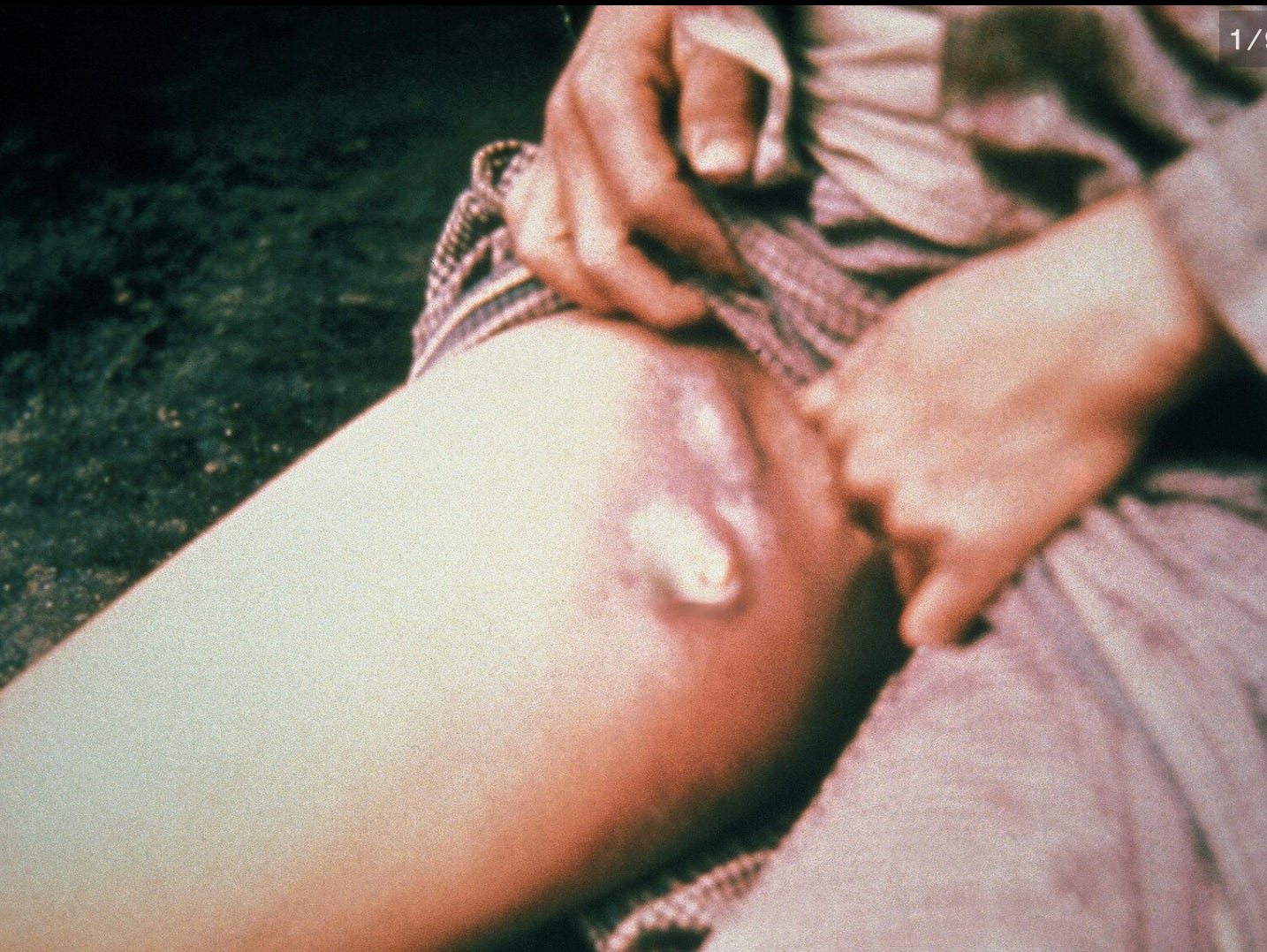
Here it is important to understand the distinction between the endemic reservoir of plague - also known as Bubonic plague (from boubon, Greek for “groin” or “swollen lymph node).
Swollen groin lymph node from bubonic plauge.

The Endemic Reservoir (Bubonic): The disease naturally circulates permanently in wild rodent populations, particularly marmots and ground squirrels, across the steppes of Mongolia and Russian border regions like Altai, Tuva, and Buryatia. When humans contract it directly from these animals (via flea bites or handling meat) it typically manifests as bubonic plague.

The Pneumonic Form: Pneumonic plague - the highly lethal lung infection that spreads person-to-person through respiratory droplets - is not independently endemic. Instead, pneumonic plague occurs secondary to a bubonic infection when the bacteria spreads to the lungs, or during sudden localized outbreaks or laboratory accidents.

Irkutsk Anti-Plague Research Institute in Shelekhov claims it is in the business of studying plague in a region where the bacterium is endemic. Naturally one wonders - as one should wonder about all biosecurity labs operating in the world - if the true purpose of the lab is to conduct bioweapons research.

Japan, the Soviet Union, and the United States have all weaponized the plague bacterium in the past, though these programs were ostensibly terminated by the Bioweapons Convention that went into force in 1975.

Pneumonic plague is known to cause person to person spread, but with far less efficiency than the spread of viral respiratory infections such as the common cold, flu, and COVID-19. Once the bacteria reach the lungs, they can be expelled in respiratory droplets when the patient coughs or breathes closely with others. Inhalation of these droplets can produce primary pneumonic plague in a new host, often within a few days, and that form can then transmit onward the same way.

Bubonic plague does not readily pass from person to person unless it progresses to the lungs. Untreated pneumonic plague is frequently fatal, but antibiotics are effective if given early. According to the latest reports, a plague outbreak in Shelekhov has not been officially confirmed, and authorities say the regional situation remains stable. The incident occurs at a time when the West appears to be spoiling for war with Russia, so reporting from both sides is likely contaminated with propaganda.

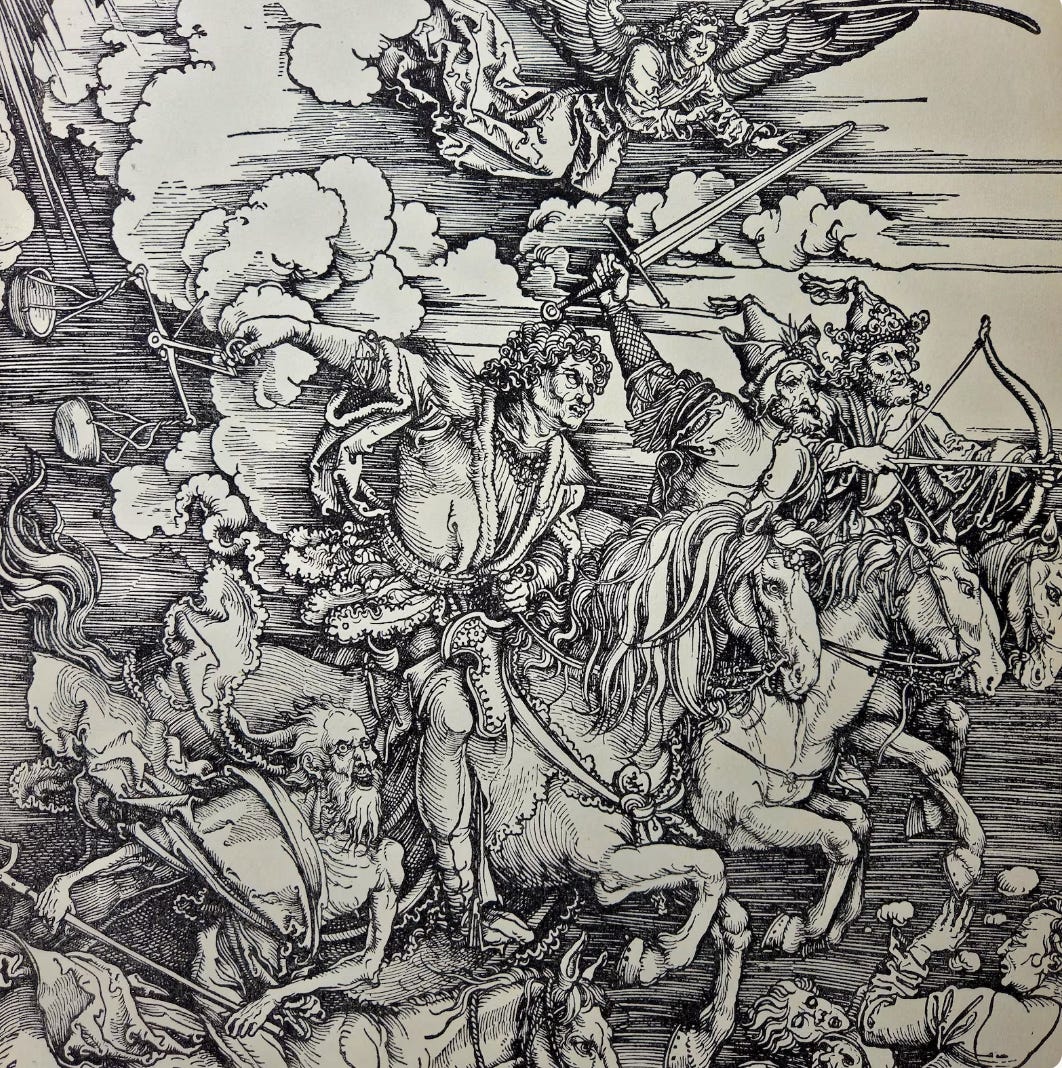
Nowadays I often think about Albrecht Duerer’s 1498 woodcut depicting the Four Horsemen of the Apocalypse.
The painting depicts the passage from the Book of Revelation (6:1–8):
"And I saw, and behold, a white horse, and its rider had a bow; and a crown was given to him, and he went out conquering and to conquer. When he opened the second seal, I heard the second living creature say, 'Come!' And out came another horse, bright red; its rider was permitted to take peace from the earth, so that men should slay one another; and he was given a great sword. When he opened the third seal, I heard the third living creature say, 'Come!' And I saw, and behold, a black horse, and its rider had a balance in his hand; ... When he opened the fourth seal, I heard the voice of the fourth living creature say, 'Come!' And I saw, and behold, a pale horse, and its rider's name was Death, and Hades followed him; and they were given great power over a fourth of the earth; to kill with sword and with famine and with pestilence and by wild beasts of the earth."
o
Full screen recommended.
Redacted, 10/6/26
"Don't Panic! The Russian Plague Story Is Meant 
To Scare You, featuring Dr. Robert Malone"
"A strange story unfolded in Russia after a 28-year-old employee of an anti-plague research institute in Siberia died from what was described as pneumonia of unknown origin. This event triggered international headlines suggesting a pneumonic plague outbreak, mass quarantines, and a potential lab leak. However, Russian health authorities stated that testing did not identify any microorganisms related to the woman's work, and the epidemiological situation was stable. This raises questions about the narrative's origin."
Comments here:

"How It Really Is"


Adventures With Danno, "Stocking Up At Sam's Club!"

Full screen recommended.
Adventures With Danno, 10/6/26
"Stocking Up At Sam's Club!"
Comments here:

"The Chinese Banking Collapse Has Started"; "The Worst Nightmare Is Here"

Full screen recommended.
Dan, I Allegedly, 10/6/26
"The Chinese Banking Collapse Has Started"
"Is China on the verge of an economic collapse? China has eliminated hundreds of banks as Beijing moves to consolidate its banking system, while serious problems continue to develop in China's property market, local government debt, bad loans and banking profitability. In this iAllegedly report, 670 banking institutions have disappeared, China's struggling rural banks, the property boom and ghost cities, government debt, weakening credit and the billions of dollars being used to strengthen major Chinese financial institutions. Is this simply banking consolidation -  or is China trying to contain a much bigger financial problem? What happens in China could matter to the entire global economy, including American businesses, consumers, manufacturers, banks and investors.

China's economy is deeply connected to global manufacturing and supply chains, and financial problems involving Chinese banks, property developers and local governments could create consequences far beyond China's borders. Dan breaks down the warning signs, explains why the banking system matters, examines the connection between property values, debt and credit, and asks the bigger question: is China's economic crisis already underway?"
Comments here:
o
"The Worst Nightmare Is Here - 
US Job Market Collapses as Inflation Is Rising"
Comments here:

Bill Bonner, "An End to US Debt"

"An End to US Debt"
by Bill Bonner

Ardmore, Ireland - "Want to know where the US is headed? Want a peek at the future? Here it is: more inflation. More than you expect. We depend on rising interest rates and the ‘bond vigilantes’ to ride herd on inflation. Instead, they will drive up the real costs of moderate inflation…leaving hyperinflation as the likely outcome. Our WWII debt was disarmed by inflation. Slow and steady, like termites eating through untreated wood, it cut about two-thirds of the real value of the debt by the 1970s. People hardly noticed. Why not make it ‘work’ for us again?

And you might think — or POTUS might believe — that we could stomach a few years of 10% inflation and thereby wipe out a big piece of all the US national debt. Smooth. Reliable. 10% annual price increases. Wouldn’t it be worth it? Forget it.

Inflation, like a traffic accident or a mugging, only really ‘works’ when you don’t see it coming. Otherwise, lenders and consumers take a different route home. They buy before prices rise...and demand higher interest rates to protect themselves from future losses. The higher interest rates add to the carrying cost of debt, chill the economy and lower the feds’ tax receipts – making inflation much less effective.

Inflation has to be a surprise. When the surprise disappears, the authorities either stop inflating...or they go ‘full Weimar’ into hyperinflation. And the ‘bond vigilantes,’ those heroes who pressure the feds to keep inflation under control, may actually make hyperinflation more likely than you think. Suppose Scott Bessent and Kevin Warsh held a joint press conference, maybe on Halloween or April 1st. Imagine that they announced ‘An End to the US Debt...we’re going to let inflation run at 10% per year until we get this monkey off our backs.’

What would people do? Would they roll down their windows and put their purses where they could be easily snatched? Would they sit contentedly, perhaps holding hands, as the feds take away their retirement money? What would landlords do; offer 10-year leases at today’s rates? How about publishers? Would they offer subscribers a chance to ‘lock in’ today’s price for the next ten years?

And the bond vigilantes? What would they do? They’d dump their Treasury debt...demanding interest of 15% or 20% to offset the inflation losses they see coming. But if the feds had to pay so much more in interest - even more than they gained from their ‘inflation tax’ - the grift wouldn’t work at all. The whole point is to allow the feds to spend more money. But once people expect more inflation, the actual spending power of the government goes down, not up. In effect, when the ‘bond vigilantes’ are in the saddle, inflation no longer ‘works.’ The point is obvious. When you drive through a bad neighborhood, you roll up your windows and lock your doors. You don’t let yourself get robbed - not if you can help it.

Even without an official announcement, people can read the handwriting on the wall. As long as the federal government is running $2 trillion deficits, it might as well post its destination like a cross-town bus. No need to spell it out. The federal debt pile gets bigger. Interest rates go up. Inflation too.

Argentina was faced with the choice two years ago. Its annual inflation rate had soared over 250%. It looked like it might soon go into hyperinflation. Voters knew what that would be like. They recalled 1989-1990, when the inflation rate went to 2,600%. They didn’t want to do that again.

Americans have not been exposed to hyperinflation. They have no memory of it and no immune defenses against it. So, it doesn’t take a genius to see where this leads. Members of Congress may fondly recall those glory years - 1980-2020, when they could borrow and print at will...as interest rates steadily went down. Almost none of them understands why inflation no longer works...or remembers an episode of hyperinflation. In America, it is almost unthinkable. And you certainly won’t win an election by thinking about it. Besides, rising prices can still be blamed on other people. Cuts to welfare or the Pentagon cannot.

Here’s what will happen. The feds will allow inflation to ‘run hot.’ Interest rates will go up. They’ll add fuel (more deficits!)...and let it burn even hotter. And then, consumers will anticipate higher rates of inflation. It will be as if the feds had stood on the Capitol steps and announced their intention to destroy the dollar completely. Households will want to get rid of it like a hot potato - sending the inflation rate even higher. Investors will pull their money out of bonds, out of the dollar and out of the country. Where, when, or how - exactly - it earns its ‘hyper’ prefix, we can’t say. But it will be a big surprise to us all."

Delta King's Blues, "Forty Years for This Sh*t"

Full screen recommended.
Delta King's Blues,
"Forty Years for This Sh*t"
"Forty years of work, bills, stress, and showing up - and this is what you get? This gritty *Delta King’s Blues* tune is a humorous look at aging, working hard, and wondering where all those years went. Raw acoustic guitar and soulful harmonica bring a rough, honest blues feel - full of frustration, humor, and hard-earned wisdom. Forty years later, I’m still wondering what the hell happened."