

"Time To Be Someplace Else"
by Bill Bonner
Dublin, Ireland - "This morning, we will give a speech to an International Living group here in Dublin. We will tell them what we told you - sharing our story about getting beaten by police in a Paris riot. “It was a good time to be someplace else,” we will conclude. What follows is a much-abbreviated version of what we will say next.
Imagine that you were living out in one of the western counties of Ireland...a poor tenant farmer, barely scraping by, with a spade and a hog, like millions of others. And then, one year, 1845, your potato crop comes up green and promising...only to wilt suddenly. In just a matter of days, the plants died.
You would get through that year as best you could - eating the pig and pawning your only coat - and look forward to next year’s crop. And once again, the plants came up out of the ground as usual but blacken and die. And now, you have nothing. Even the few farthings in the jar over the fireplace have been spent. The thing to do was to get out...as soon as possible. About 1.5 million people starved to death or died of the kinds of diseases - like sharks after shipwrecked sailors - that follow hunger. Another million left the country. Which were better off?
That was a natural disaster. But man has caused plenty of disasters, too - intentional famines, wars, mass murders, genocides, religious massacres. One of the worst of the sort in history occurred during our lifetimes. In Cambodia. The leader was a man named Pol Pot who had learned Marxist theory. Guess where? Yes, in Paris, where he went on a scholarship.
Once in power, Pol Pot tried to create a real workers’ paradise. Which meant levelling the population. If you had any wealth...or ever read a book...or even wore glasses, Heaven help you; you were considered a class enemy and eliminated. The city slickers were herded out to the country where they could be purified by hard work and fresh air on a collective farm. It was an ambitious application of theory to real-life ...and ended up by killing a third of the entire population, who were either murdered, or died from overwork, starvation, or disease.
The corner of the Boul’ Mich and the Boulevard St. Germain was not the best place to be when riots broke out in Paris in 1969. Ireland was not the place to be a farmer in the mid-19th century. Cambodia was not the place to be in the 1970s. Where is not the place to be now?
At our financial publishing group - Bonner Private Research - our main goal is to protect against the Big Loss. It’s what happens when your money, like potatoes in a field with Phytophthora infestans, is in the wrong place at the wrong time.
We’ve all seen the videos of Paris burning. Maybe the Big Loss will come from there? But today you can buy the leading French stocks in the CAC 40 for just two ounces of gold. Looking at it historically, the last time the CAC 40 sank to the two-ounces-of-gold level was in 1970. From there, it went down for the next six years to under one ounce of gold. Investors may have been so depressed they were ready to jump off the Eiffel Tower...but if they held on for another 20 years, they would have made a 1,000% profit - in real, gold terms.
That’s how the system is meant to work. You get in when the risk of the Big Loss is low. And you stick with it until you make the big gain. In our approach, in the US, we buy the Dow at five ounces of gold, or less. We sell when we get stopped out over 15 ounces. But that leaves us with long, lonely periods while we’re waiting for the Dow to go down again.
What to do? Should we buy into the French market, at only two ounces of gold for the CAC 40? Maybe. French stocks may not go up, but they don’t look like they will hand you the Big Loss either.
Over the long term, in theory as well as practice, it’s not gold...or silver...or futures...or AI or options...or any other trick, technique or investment genius that adds to wealth. It’s profit-making enterprises. They take raw materials and labor and use them to create products that are worth more than the costs that went into them. That difference is profit. The world then has something it didn’t have before; it is a richer place. The feds take some of it in taxes. The managers squander a fair portion of it, as they always do...and the rest goes to the people who own the company.
We want to own those companies...profit making companies...not resource and capital consumers. Companies like Philip Morris (now Altria) - which, by some reckonings has created more wealth for shareholders than any other company in America. But wait...how do we know which companies will be successful...and which will bite the dust?
We don’t. Individual companies can go ‘to the moon’...or they can go broke. We mortals can never know for sure which will be which. Buy the wrong one and you will take the Big Loss. Instead, we buy ‘the market’...using the Dow as a proxy. The 30 Dow stocks are very unlikely to go broke...all of them at once. So, we avoid the risk of the Big Loss in a single company. And we buy only when ‘the market’ is cheap - in gold terms.
Markets go up and down. And they tend to go up and down for long stretches of time. They get very cheap. And then they become very expensive. That’s the only piece of the market action we want to own - when they are going from cheap to expensive, not the other way around. And we measure it in gold.
Nominal prices don’t tell you if you’re making money or not making it. In the 1970s, for instance, stock prices went up - in dollars, but in gold terms, they went down. So, we wait for the market to go down in gold terms...and then we can buy without worrying too much about the Big Loss. Someone else has already taken it for us.
But let’s go back to the key question. Where is the Big Loss most likely to come from today?
The general rule is that the pricier an investment is...in terms of its real-world earnings...the greater the risk that it could give investors a Big Loss. By that measure, AI-related stocks are an unexploded grenade. They have a market value of tens of trillions, but relatively little in real earnings, so far.
More broadly, the biggest risk to US investors is probably the US itself. Officially, the dollar from 1971 is worth only about 13 cents today. But they changed the way they calculated it in the ‘90s so it wouldn’t look so bad. The real value of the dollar today is probably only about three cents, compared to one from 50 years ago.
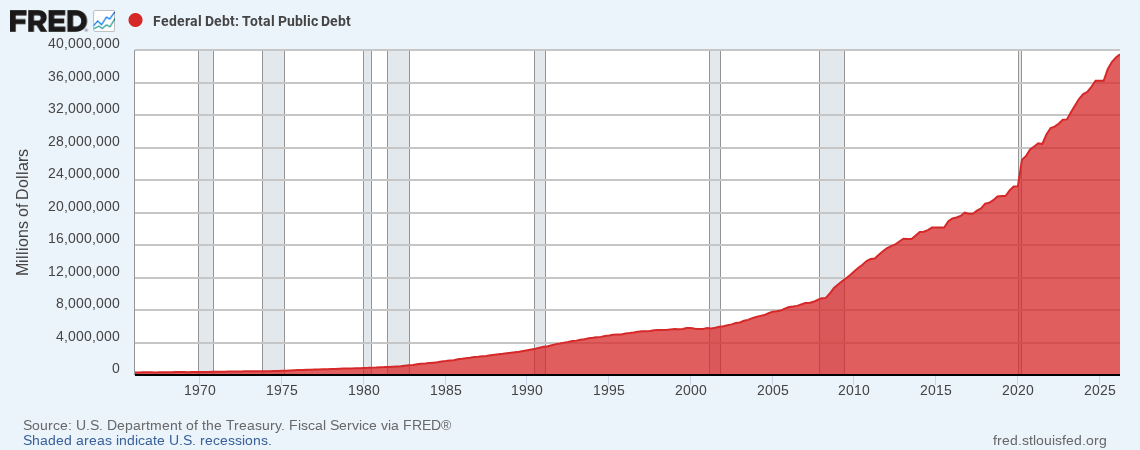
And now, it appears that pretty much everyone is ready for more of the same…more inflation. The US is running deficits of 6% of GDP. That’s two or three times faster than the economy is growing. The feds are going to have to do something. Debt can’t grow faster than GDP for very much longer. Either they let inflation run hot. Or they default by suddenly devaluing the dollar. Our guess is that they will do both. And it won’t be the first time.
Most likely, the feds will simply ‘print’ money to cover the $2 trillion-a-year deficits. And they will also have to refinance about $11 trillion of existing debt, over the next twelve months. But when you have to print so much money, the bond markets - that is to say, the people who lend money to the federal government - get very nervous. They see the feds’ IOUs becoming substantially less valuable in the future. So, they - the bond vigilantes - demand higher interest rates to protect themselves.
Higher interest rates are a death sentence to debtors. They have to pay more and more to refinance their loans. And the biggest debtor of all is the federal government. So, when they ‘print’ to cover their deficits, the feds can end up paying more in interest than they printed. In other words, they end up worse off.
Yes, this is a very different kind of arithmetic. When you owe fairly little...and better yet, when interest rates are falling...you can ‘print’ a little extra money...and inflate the money supply by, say, the Fed’s 2% target. Nobody gets too upset about it...even though you are stealing from savers year-in and year-out. But when you have $40 trillion in debt...and interest rates are rising...it’s a whole different ball game. The Fed no longer controls the debt; the debt controls the Fed.
And it just gets worse and worse. The feds print. Interest rates go up. And they have to print more. The gains they get from printing money are largely erased by the bond market. And here’s the punchline. The only way the feds can get ahead is by printing more than the bond market expects.
Inflation only really works as an ambush. Otherwise, investors and consumers take a different route home. The authorities need new tricks...new traps. And what they end up with - what almost no American is prepared for...or can even imagine -- is hyperinflation. The velocity of money speeds up like a NASCAR racer...and the rate of price increases comes even faster than the new money.
And here’s the other part of that surprise. Big price increases increase the demand for big wads of cash. In the early stages, moneyprinting CAUSES inflation…later, inflation takes the lead, and the feds NEED to ‘print’ money to keep up with rising prices. When prices double, the consumer needs twice as much money to stay even.
None of this is new. Other countries had their PhDs just as we do. Many of them went to the same schools - Harvard, Yale, the London School of Economics. They were all smart. They all had studied the same theories. But when inflation got revved up, they couldn’t control it. One of our partners in Sao Paulo told us what it was like: “Dad would come home from his job. He was paid in cash, every day. We’d take the money and rush over to the supermarket to buy everything we could before they marked the prices up. Nobody wanted to hold cash overnight, because everything would be more expensive the next day.”
Americans are prepared for steady, docile, housebroken inflation - 2%...maybe even 4% or 5%. They are not prepared for runaway prices. So, that is what they might get. And, much worse than people expect, it will also crash the stock market...if not in nominal terms, almost certainly in gold terms.
But there’s good news, too. The coming hyperinflation will cause millions of people to take a Big Loss. So will the crash of the stock market. But - if we’re able to stay on the sidewalk...and not get beaten up by the police or the rioters - we could have the opportunity of a lifetime...to buy real companies at the cheapest real prices we’ll ever see."

No comments:
Post a Comment