

"March, 5: Everything Must Go"
By No1
"Hegseth said eight weeks yesterday. Today he said a hundred days. That’s September. Four days became four weeks became eight weeks became a hundred days. At this rate the Pentagon will be asking for “whatever it takes” before the ink dries on the next headline. (oh wait, Draghi’s lawyer is calling)
Tehran took the heaviest bombardment yet. Again. I know I wrote that sentence yesterday too. Strikes across residential neighbourhoods, police stations, a hospital in Bushehr where footage shows newborns being evacuated. The IDF claims 113 waves across western and central Iran. 5,000 airstrikes. 1,600 sorties. Iranian state media puts the death toll at 1,045.
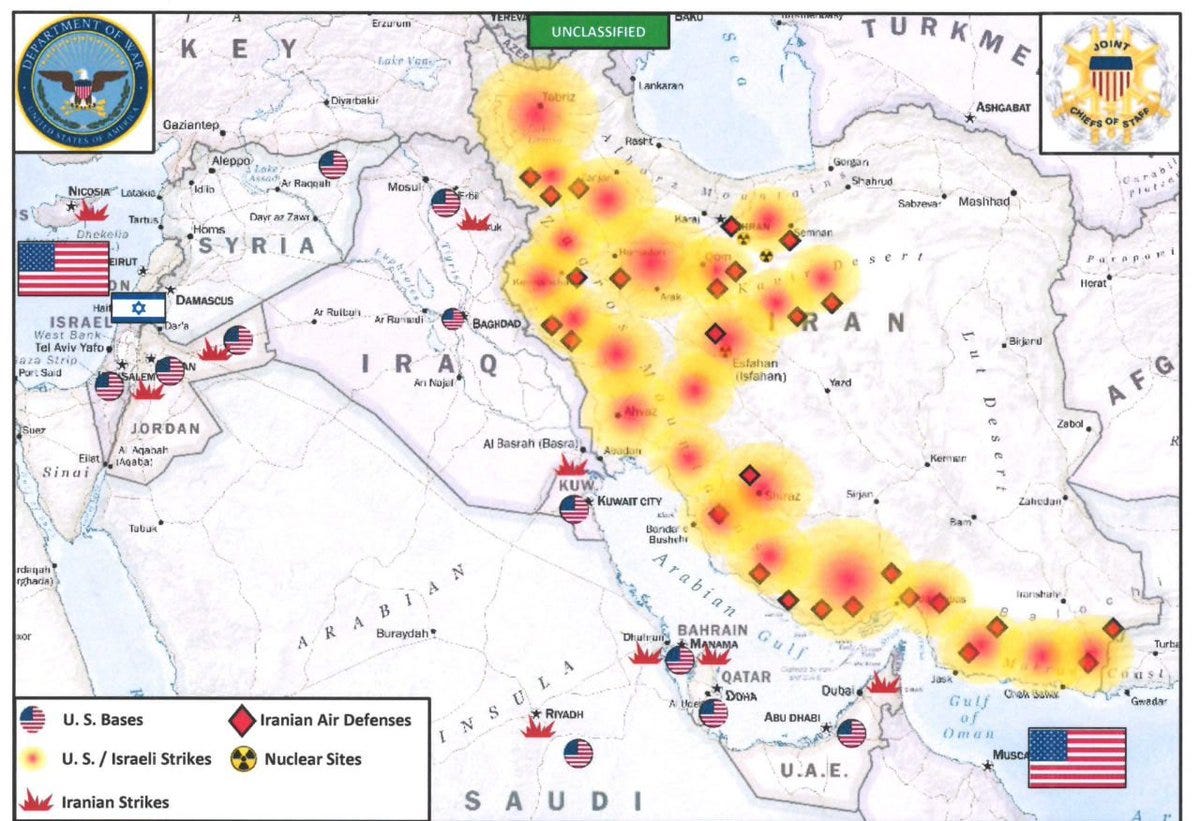
Click image for larger size.
That’s roughly one dead Iranian for every five airstrikes. Either Iran’s air defense is doing more work than anyone’s admitting, or most of these “precision strikes” are hitting empty buildings. And paintings. Let’s not forget the paintings.
On the Israeli side, we effectively have an information blackout. CNN admitted on air - on camera - that the Israeli government doesn’t allow them to show it. A CNN reporter. Saying the censors won’t let her report the war. Israeli military censorship laws make it nearly impossible to independently verify anything. Bahrain is arresting people for filming missile impacts. The only country in this conflict with a functioning free press is... Iran?
I need that drink again.
The IRGC announced wave 20 of ballistic launches today. Twenty. And for the first time, incoming ballistic missiles hit the centre of Tel Aviv without sirens going off. Read that again. No sirens. I’ve been tracking the radar destruction campaign since day one. Today it stopped being a data point and started being people who didn’t get to run for shelter. The sensor network I’ve been writing about is now degraded to the point where missiles are arriving unannounced. That’s the practical consequence of $3.4 billion in ground-based sensors turned to scrap.
Kill the radars. Shoot down the drones. Then bring the heavy stuff. And boy, did the heavy stuff arrive! A Khorramshahr missile launched at Tel Aviv today. 1.5-ton warhead. First confirmed combat use. For context, most of what Iran’s been firing carries 500 to 750 kilos. This is a city-killer that showed up on day six, precisely when the defense network is Swiss cheese. Plus cluster warheads. Plus missiles with multiple independent warheads. Ten separate attacks on Tel Aviv today. Between 2:30 AM and 11 PM. The escalation ladder the IRGC telegraphed on day one - “what comes next are systems you have never seen” - is being climbed one rung at a time.
Yesterday I wrote about the B-52s coming out, and I said I wasn’t sure whether that meant the precision munition cupboard was getting bare or Iranian air defence was degraded enough for the old bombers to fly. Today I have an answer. It’s neither. Or rather - it’s both, but not in the way Hegseth wants you to believe.
The B-52s are carrying standoff cruise missiles. Lobbing them from hundreds of kilometres out. You don’t do that if you own the airspace. You do that because you don’t trust the air defence environment enough to fly your slow, fat bomber anywhere near the target. Nothing says “total air superiority” quite like refusing to enter the airspace you claim to control.
And yet. The IDF says 113 waves of strikes. “Complete control of Iranian skies”. My take? The F-35s are doing smash-and-grab runs. Pop in from over the Caspian Sea, the Gulf or Iraqi airspace, drop ordnance, get out before Iranian air defense can lock on. Not loitering. Not “unrestricted”. Fast in, fast out. If Iranian air defenses were truly gone, you’d fly a B-52 overhead with gravity bombs at a fraction of the cost. You wouldn’t need a cruise missile from 500km out. That they do tells you the gap between the PR and the pilot.
The Yak-130 shootdown from yesterday also makes sense in this context. Iran sent a training jet - a training jet - against F-35s. Not to win. To force coalition aircraft to manoeuvre, burn fuel, reveal approach corridors. A human sensor, basically. Expendable. The same logic as with the drones, just with a pilot inside.
Meanwhile, two Iranian Su-24 bombers flew at 80 feet (that’s 24 metres for those believing in the metric system) over the Persian Gulf - practically skimming the water - and got within two minutes of Al-Udeid before Qatar shot them down. That’s not ‘air superiority’. That’s an environment where both sides are losing aircraft and neither controls anything. And they are reducing attack frequency. “Declining weapon stocks”. That leaked today.
Day six. Rationing. I wrote about the stealth-to-standoff-to-gravity-bomb progression yesterday. Today we can add a new step: rationing. This ties into the deployment of the HELIOS laser weapon - a directed energy system everyone’s been promising for decades. A 60-kilowatt beam on a single destroyer somewhere off the Iranian coast. Sounds impressive. But let’s run the numbers.
HELIOS effective range is about 5 miles (8 km). A Shahed drone does 500 km/h. That gives the laser a roughly 36 seconds of reaction time. For one drone. On one ship. In perfect weather. Doesn’t work against ballistic missiles. Doesn’t work in rain, dust, or fog. And the IRGC is launching thousands of drones from launch sites across a country three times the size of France.
The maths haven’t changed. They’ve just gotten more desperate. The US deployed HELIOS in early February - weeks before the war - which means they knew the interceptor cupboard was going to run bare and this was the Hail Mary. That they’re showcasing it to Congress now tells you that the conventional magazine is in real trouble.
Two more F-15Es down. Maybe three. CENTCOM denies it. Naturally. The IRGC says their air defenses brought one down over southwestern Iran. Both crew ejected. Helicopters flew into Iran to extract them. That extraction - deep inside enemy territory, on the record - is an extraordinary admission all by itself. You don’t send rescue choppers into a country whose air defenses supposedly don’t exist.
Then today: Iran published a video. An actual video. Jet. Boom. Iraqi sources say it happened over Iraqi airspace - not even over Iran. Basra police dispatched units to find the pilot. Both crew apparently recovered with light injuries. That’s five F-15Es gone in under a week. Three to the Kuwaiti friendly fire (turns out it was a Kuwaiti F/A-18 that launched three missiles at three US jets). Two to whatever CENTCOM wants to pretend didn’t happen despite the video evidence.
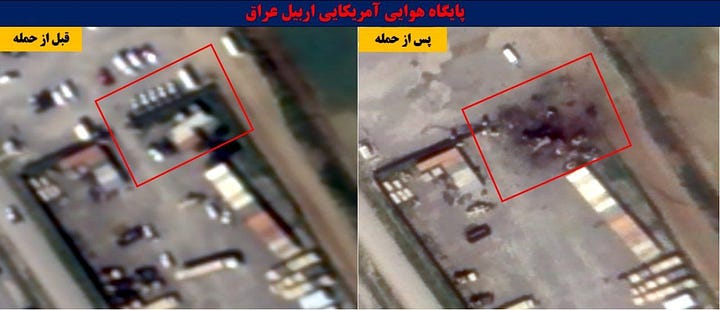
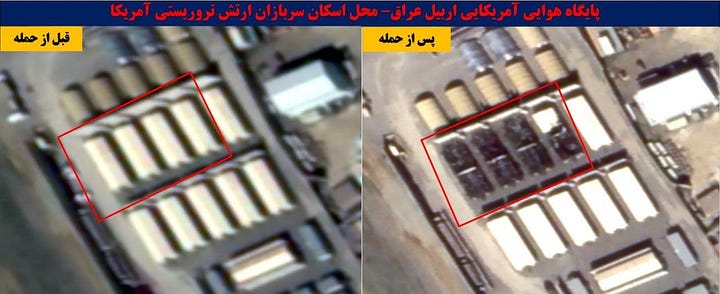
Iranian state media is releasing satellite imagery faster than Western sources. That’s new. Somebody is feeding them pictures, and the resolution is better than what the OSINT community has access to. I wonder who has lots of satellites and a strategic interest in Iran surviving this war?
A suicide drone - not a Shahed - struck Nakhchivan International Airport in Azerbaijan. Another one near a school. Two civilians hurt. Baku is obviously furious. Aliyev ordered retaliatory measures. Iran denied it. Instantly. I had the same reaction as with the Cyprus drone. Same smell. Different country.
Nakhchivan is a landlocked exclave. No US bases. No military infrastructure. No obvious Iranian interest. An empty airport and a school don’t match the infrastructure that Iran has been targeting all week - radars, refineries, naval bases, air defenses. This is not the same targeting doctrine.
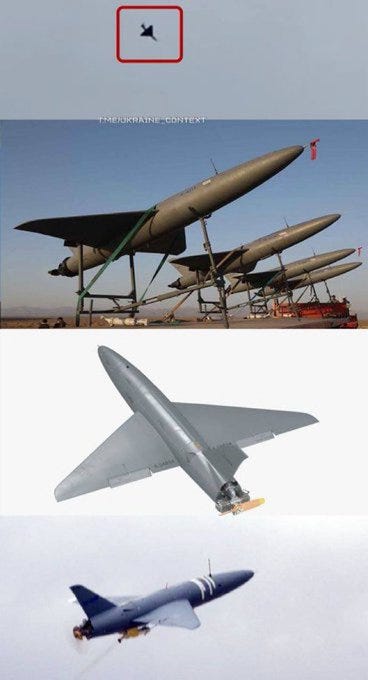
The drone doesn’t look Iranian-made. So whose was it? Same question, same framework: cui bono? Iran gains nothing from opening another front with Azerbaijan. The US and Israel could gain a northern axis of pressure, potential access to Azerbaijani airspace, and a narrative that Iran is “lashing out wildly” at innocent neighbors. Just like the Cyprus drone conveniently arrived at the exact moment London had to decide whether to allow its bases for offensive operations.
One false flag incident is a coincidence. Two is a pattern. I’ll keep watching.
Bahrain’s main refinery is on fire. BAPCO. 267,000 barrels a day. Iranian missiles punched through despite Bahrain claiming to have intercepted 75 missiles and 123 drones in the same wave - the highest single-day figure for any Gulf state. The refinery burns anyway. This is the first confirmed direct Iranian hit on Gulf energy infrastructure. Ras Tanura on day three was disputed. BAPCO isn’t. Video from multiple angles. Locals watching and filming. (Before getting arrested for filming, because Bahrain adopted the Israeli censorship playbook.)
Bahrain produces less than 0.2% of global oil. But Iran doesn’t care about Bahrain’s barrels. This is a proof of concept aimed at every insurance underwriter on the planet. If BAPCO burns, Ras Tanura can burn. Abqaiq can burn. Fujairah can burn. The message isn’t about Bahrain. The message is about the next refinery, and the one after that.
China is in talks with Iran for safe passage of Chinese tankers through Hormuz. If that works, the strait isn’t really closed. It’s selectively open. Open for friends. Closed for everyone else. A patron-based maritime system where passage depends on whose flag you fly. Freedom of navigation, RIP.
Here’s the fun part though: Iran’s regular military says the strait is open. The IRGC says it’s closed. Internal disagreement? Or the most elegant good-cop-bad-cop in maritime history? The regular military keeps the door cracked for China. The IRGC keeps everyone else out. My thoughts? I think they’re reading from the same script.
An oil tanker got hit 30 nautical miles off Kuwait. Not near Hormuz. Inside the Gulf. Northern waters. Then three more vessels in 24 hours - the Gold Oak, Libra Trader, a container ship called Safeen Prestige that’s now on fire, and the MSC Grace. Sea-borne kamikaze drones. A new vector. One day after they torpedoed the IRIS Dena. “You sank our warship returning from a peace exercise. We’ll burn your tankers in your own waters”. Tit for tat, except the tats are getting bigger.
South Korea has nine days of LNG left. Nine. A lawmaker said it in parliament. The government replied: “doesn’t matter”. Japan has 254 days. South Korea has nine. That’s why KOSPI is the most violent major market in the world right now - crashing 12%, rallying 12%, crashing again. An industrial economy running on fumes, watching its energy lifeline close in real time. LNG shipping rates up 750% in a week.
And nobody’s talking about water. The UAE runs at 1,533% water stress. Saudi Arabia at 974%. Kuwait gets 90% of its drinking water from desalination plants. Plants that run on power. Power that runs on the same energy infrastructure Iran just proved it can hit. If targeting shifts from military bases to desalination plants, the humanitarian timeline isn’t weeks. It’s days. These countries have strategic petroleum reserves. They do not have strategic water reserves. There is no emergency water OPEC to call.
Almost 30% of global ammonia production and half of all urea are at risk or directly involved in this conflict. That’s fertiliser. That’s food. For everyone. American corn farmers, Brazilian soy growers, Indian wheat fields - they all depend on Gulf-sourced inputs that aren’t moving. Planting season doesn’t wait for ceasefires. Miss the window, and it doesn’t matter if Hormuz reopens in June. The crop that wasn’t planted doesn’t grow retroactively.
Brent at $82.55. Nasdaq flat, S&P flat, gold down 1%, silver the same. All with the strait closed, Qatar’s LNG gone, four tankers burning, and a refinery on fire. Given the scale of what’s actually happening, the dials are still reading “meh” when they should be reading “systemic crisis”. I can’t believe people aren’t pricing this in!? So the only possible explanation is that someone keeps putting their thumb on the scale.
Iran’s foreign minister went on NBC today. The exchange was remarkable. Asked if Russia and China are actively helping Iran in this war: “They have always helped us”. The journalist pressed: “Does that mean yes”? Araghchi smiled: “I’m not going to disclose details in the midst of a war”. Then, on whether Iran wants a ceasefire: “The war will continue. We see no reason why we should negotiate with the US”.
Trump called Kurdish leaders on day one. Barzani. Talabani. Told them to pick a side - America or Iran. Offered “extensive American air support”. The Washington Post reported Kurdish officials were told point blank: choose.
The wife of the Iraqi President, herself a senior figure in Talabani’s party, responded publicly: “After what happened to us in Syria, we refuse to be used as pawns by global powers again”. Thousands of Kurdish fighters reportedly crossed the border into western Iran anyway - but the political leadership is publicly distancing itself. The proxy playbook requires willing proxies. These ones remember what happened last time.
A hundred days. That’s the timeline now. A hundred days of this… Still devolving..."

No comments:
Post a Comment