StatCounter

Friday, March 6, 2026

"Emergency Update: You Have Only 14 Days Before Global Oil Supply Collapses"

A terrifying must-view!
Full screen recommended.
Money Over History, 3/6/26
"Emergency Update: You Have Only 
14 Days Before Global Oil Supply Collapses"
"Emergency update: the world could be heading toward a major oil supply crisis within the next 14 days. As tensions rise across the Middle East, critical oil infrastructure and global energy routes are under threat. Analysts warn that if production stops or shipping through the Strait of Hormuz is disrupted, the global oil supply chain could face a serious shock."
Comments here:

Thursday, March 5, 2026

"Iran Launches Massive Missile Attack on $20B U.S. Aircraft Carrier - Samson Option"

Full screen recommended.
Money Over History, 3/5/26
"Iran Launches Massive Missile Attack
 on $20B U.S. Aircraft Carrier - Samson Option"
"Iran has launched a massive missile attack toward a $20 billion U.S. aircraft carrier, triggering a major response from the United States Navy and raising serious concerns about escalating tensions in the Middle East. Aircraft carriers are the most powerful naval weapons on Earth, carrying over 5,000 personnel and more than 60 aircraft, making them the centerpiece of U.S. military power projection. The reported missile launch from Iran has sparked global attention, as analysts debate the implications for regional security, naval warfare, and the balance of power in the Persian Gulf."
Comments here:

Gerald Celente, "Escalating Iran War Will Bring Hell On Earth"

Strong language alert!
Gerald Celente, 3/5/26
"Escalating Iran War Will Bring Hell On Earth"
"The Trends Journal is a weekly magazine analyzing global current events forming future trends. Our mission is to present Facts and Truth over fear and propaganda to help subscribers prepare for What’s Next in these increasingly turbulent times."
Comments here:

"March, 5: Everything Must Go"

"March, 5: Everything Must Go"
By No1

"Hegseth said eight weeks yesterday. Today he said a hundred days. That’s September. Four days became four weeks became eight weeks became a hundred days. At this rate the Pentagon will be asking for “whatever it takes” before the ink dries on the next headline. (oh wait, Draghi’s lawyer is calling)

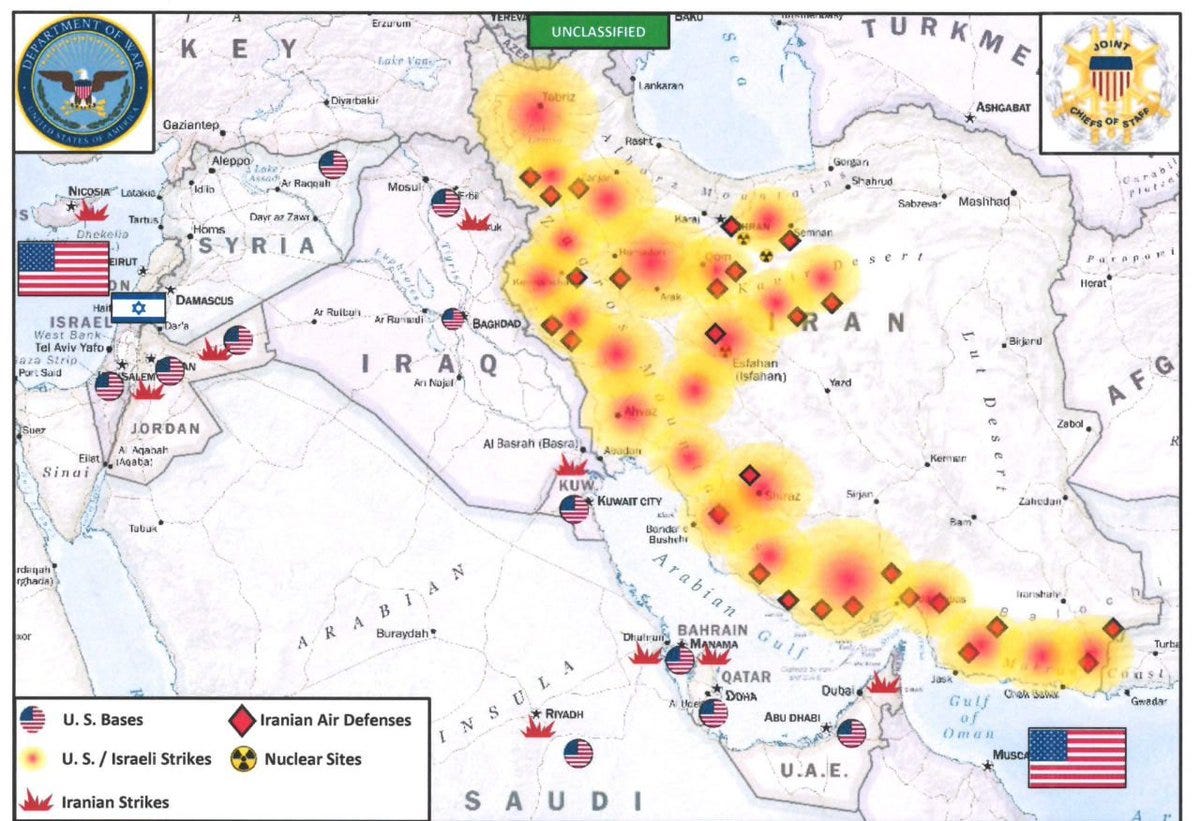
Tehran took the heaviest bombardment yet. Again. I know I wrote that sentence yesterday too. Strikes across residential neighbourhoods, police stations, a hospital in Bushehr where footage shows newborns being evacuated. The IDF claims 113 waves across western and central Iran. 5,000 airstrikes. 1,600 sorties. Iranian state media puts the death toll at 1,045.
Click image for larger size.
That’s roughly one dead Iranian for every five airstrikes. Either Iran’s air defense is doing more work than anyone’s admitting, or most of these “precision strikes” are hitting empty buildings. And paintings. Let’s not forget the paintings.

On the Israeli side, we effectively have an information blackout. CNN admitted on air - on camera - that the Israeli government doesn’t allow them to show it. A CNN reporter. Saying the censors won’t let her report the war. Israeli military censorship laws make it nearly impossible to independently verify anything. Bahrain is arresting people for filming missile impacts. The only country in this conflict with a functioning free press is... Iran?

I need that drink again.

The IRGC announced wave 20 of ballistic launches today. Twenty. And for the first time, incoming ballistic missiles hit the centre of Tel Aviv without sirens going off. Read that again. No sirens. I’ve been tracking the radar destruction campaign since day one. Today it stopped being a data point and started being people who didn’t get to run for shelter. The sensor network I’ve been writing about is now degraded to the point where missiles are arriving unannounced. That’s the practical consequence of $3.4 billion in ground-based sensors turned to scrap.

Kill the radars. Shoot down the drones. Then bring the heavy stuff. And boy, did the heavy stuff arrive! A Khorramshahr missile launched at Tel Aviv today. 1.5-ton warhead. First confirmed combat use. For context, most of what Iran’s been firing carries 500 to 750 kilos. This is a city-killer that showed up on day six, precisely when the defense network is Swiss cheese. Plus cluster warheads. Plus missiles with multiple independent warheads. Ten separate attacks on Tel Aviv today. Between 2:30 AM and 11 PM. The escalation ladder the IRGC telegraphed on day one - “what comes next are systems you have never seen” - is being climbed one rung at a time.

Yesterday I wrote about the B-52s coming out, and I said I wasn’t sure whether that meant the precision munition cupboard was getting bare or Iranian air defence was degraded enough for the old bombers to fly. Today I have an answer. It’s neither. Or rather - it’s both, but not in the way Hegseth wants you to believe.

The B-52s are carrying standoff cruise missiles. Lobbing them from hundreds of kilometres out. You don’t do that if you own the airspace. You do that because you don’t trust the air defence environment enough to fly your slow, fat bomber anywhere near the target. Nothing says “total air superiority” quite like refusing to enter the airspace you claim to control.

And yet. The IDF says 113 waves of strikes. “Complete control of Iranian skies”. My take? The F-35s are doing smash-and-grab runs. Pop in from over the Caspian Sea, the Gulf or Iraqi airspace, drop ordnance, get out before Iranian air defense can lock on. Not loitering. Not “unrestricted”. Fast in, fast out. If Iranian air defenses were truly gone, you’d fly a B-52 overhead with gravity bombs at a fraction of the cost. You wouldn’t need a cruise missile from 500km out. That they do tells you the gap between the PR and the pilot.

The Yak-130 shootdown from yesterday also makes sense in this context. Iran sent a training jet - a training jet - against F-35s. Not to win. To force coalition aircraft to manoeuvre, burn fuel, reveal approach corridors. A human sensor, basically. Expendable. The same logic as with the drones, just with a pilot inside.

Meanwhile, two Iranian Su-24 bombers flew at 80 feet (that’s 24 metres for those believing in the metric system) over the Persian Gulf - practically skimming the water - and got within two minutes of Al-Udeid before Qatar shot them down. That’s not ‘air superiority’. That’s an environment where both sides are losing aircraft and neither controls anything. And they are reducing attack frequency. “Declining weapon stocks”. That leaked today.

Day six. Rationing. I wrote about the stealth-to-standoff-to-gravity-bomb progression yesterday. Today we can add a new step: rationing. This ties into the deployment of the HELIOS laser weapon - a directed energy system everyone’s been promising for decades. A 60-kilowatt beam on a single destroyer somewhere off the Iranian coast. Sounds impressive. But let’s run the numbers.

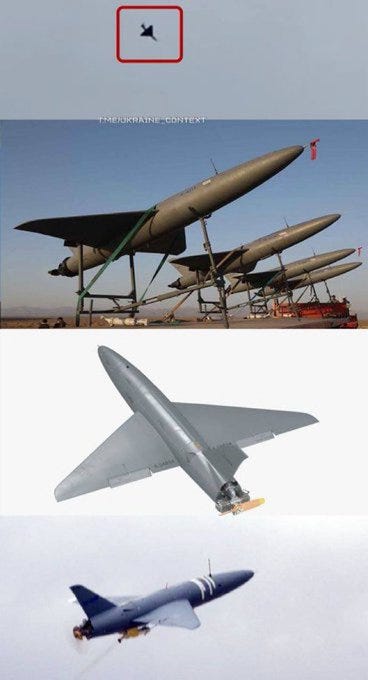
HELIOS effective range is about 5 miles (8 km). A Shahed drone does 500 km/h. That gives the laser a roughly 36 seconds of reaction time. For one drone. On one ship. In perfect weather. Doesn’t work against ballistic missiles. Doesn’t work in rain, dust, or fog. And the IRGC is launching thousands of drones from launch sites across a country three times the size of France.

The maths haven’t changed. They’ve just gotten more desperate. The US deployed HELIOS in early February - weeks before the war - which means they knew the interceptor cupboard was going to run bare and this was the Hail Mary. That they’re showcasing it to Congress now tells you that the conventional magazine is in real trouble.

Two more F-15Es down. Maybe three. CENTCOM denies it. Naturally. The IRGC says their air defenses brought one down over southwestern Iran. Both crew ejected. Helicopters flew into Iran to extract them. That extraction - deep inside enemy territory, on the record - is an extraordinary admission all by itself. You don’t send rescue choppers into a country whose air defenses supposedly don’t exist.

Then today: Iran published a video. An actual video. Jet. Boom. Iraqi sources say it happened over Iraqi airspace - not even over Iran. Basra police dispatched units to find the pilot. Both crew apparently recovered with light injuries. That’s five F-15Es gone in under a week. Three to the Kuwaiti friendly fire (turns out it was a Kuwaiti F/A-18 that launched three missiles at three US jets). Two to whatever CENTCOM wants to pretend didn’t happen despite the video evidence.

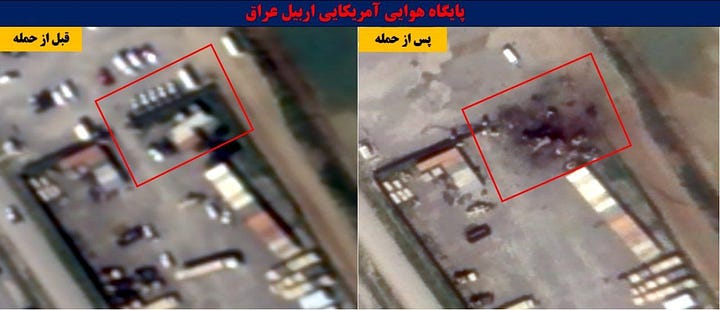
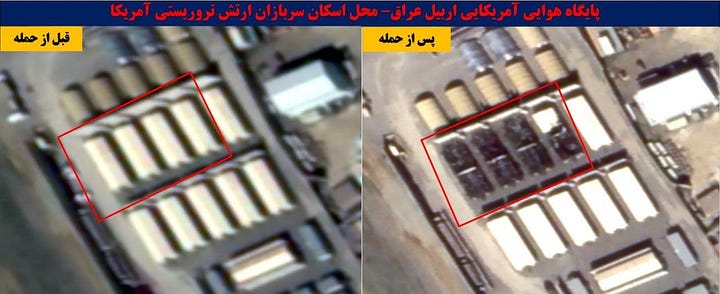
Iranian state media is releasing satellite imagery faster than Western sources. That’s new. Somebody is feeding them pictures, and the resolution is better than what the OSINT community has access to. I wonder who has lots of satellites and a strategic interest in Iran surviving this war?

A suicide drone - not a Shahed - struck Nakhchivan International Airport in Azerbaijan. Another one near a school. Two civilians hurt. Baku is obviously furious. Aliyev ordered retaliatory measures. Iran denied it. Instantly. I had the same reaction as with the Cyprus drone. Same smell. Different country.

Nakhchivan is a landlocked exclave. No US bases. No military infrastructure. No obvious Iranian interest. An empty airport and a school don’t match the infrastructure that Iran has been targeting all week - radars, refineries, naval bases, air defenses. This is not the same targeting doctrine.
The drone doesn’t look Iranian-made. So whose was it? Same question, same framework: cui bono? Iran gains nothing from opening another front with Azerbaijan. The US and Israel could gain a northern axis of pressure, potential access to Azerbaijani airspace, and a narrative that Iran is “lashing out wildly” at innocent neighbors. Just like the Cyprus drone conveniently arrived at the exact moment London had to decide whether to allow its bases for offensive operations.

One false flag incident is a coincidence. Two is a pattern. I’ll keep watching.

Bahrain’s main refinery is on fire. BAPCO. 267,000 barrels a day. Iranian missiles punched through despite Bahrain claiming to have intercepted 75 missiles and 123 drones in the same wave - the highest single-day figure for any Gulf state. The refinery burns anyway. This is the first confirmed direct Iranian hit on Gulf energy infrastructure. Ras Tanura on day three was disputed. BAPCO isn’t. Video from multiple angles. Locals watching and filming. (Before getting arrested for filming, because Bahrain adopted the Israeli censorship playbook.)

Bahrain produces less than 0.2% of global oil. But Iran doesn’t care about Bahrain’s barrels. This is a proof of concept aimed at every insurance underwriter on the planet. If BAPCO burns, Ras Tanura can burn. Abqaiq can burn. Fujairah can burn. The message isn’t about Bahrain. The message is about the next refinery, and the one after that.

China is in talks with Iran for safe passage of Chinese tankers through Hormuz. If that works, the strait isn’t really closed. It’s selectively open. Open for friends. Closed for everyone else. A patron-based maritime system where passage depends on whose flag you fly. Freedom of navigation, RIP.

Here’s the fun part though: Iran’s regular military says the strait is open. The IRGC says it’s closed. Internal disagreement? Or the most elegant good-cop-bad-cop in maritime history? The regular military keeps the door cracked for China. The IRGC keeps everyone else out. My thoughts? I think they’re reading from the same script.

An oil tanker got hit 30 nautical miles off Kuwait. Not near Hormuz. Inside the Gulf. Northern waters. Then three more vessels in 24 hours - the Gold Oak, Libra Trader, a container ship called Safeen Prestige that’s now on fire, and the MSC Grace. Sea-borne kamikaze drones. A new vector. One day after they torpedoed the IRIS Dena. “You sank our warship returning from a peace exercise. We’ll burn your tankers in your own waters”. Tit for tat, except the tats are getting bigger.

South Korea has nine days of LNG left. Nine. A lawmaker said it in parliament. The government replied: “doesn’t matter”. Japan has 254 days. South Korea has nine. That’s why KOSPI is the most violent major market in the world right now - crashing 12%, rallying 12%, crashing again. An industrial economy running on fumes, watching its energy lifeline close in real time. LNG shipping rates up 750% in a week.

And nobody’s talking about water. The UAE runs at 1,533% water stress. Saudi Arabia at 974%. Kuwait gets 90% of its drinking water from desalination plants. Plants that run on power. Power that runs on the same energy infrastructure Iran just proved it can hit. If targeting shifts from military bases to desalination plants, the humanitarian timeline isn’t weeks. It’s days. These countries have strategic petroleum reserves. They do not have strategic water reserves. There is no emergency water OPEC to call.

Almost 30% of global ammonia production and half of all urea are at risk or directly involved in this conflict. That’s fertiliser. That’s food. For everyone. American corn farmers, Brazilian soy growers, Indian wheat fields - they all depend on Gulf-sourced inputs that aren’t moving. Planting season doesn’t wait for ceasefires. Miss the window, and it doesn’t matter if Hormuz reopens in June. The crop that wasn’t planted doesn’t grow retroactively.

Brent at $82.55. Nasdaq flat, S&P flat, gold down 1%, silver the same. All with the strait closed, Qatar’s LNG gone, four tankers burning, and a refinery on fire. Given the scale of what’s actually happening, the dials are still reading “meh” when they should be reading “systemic crisis”. I can’t believe people aren’t pricing this in!? So the only possible explanation is that someone keeps putting their thumb on the scale.

Iran’s foreign minister went on NBC today. The exchange was remarkable. Asked if Russia and China are actively helping Iran in this war: “They have always helped us”. The journalist pressed: “Does that mean yes”? Araghchi smiled: “I’m not going to disclose details in the midst of a war”. Then, on whether Iran wants a ceasefire: “The war will continue. We see no reason why we should negotiate with the US”.

Trump called Kurdish leaders on day one. Barzani. Talabani. Told them to pick a side - America or Iran. Offered “extensive American air support”. The Washington Post reported Kurdish officials were told point blank: choose.

The wife of the Iraqi President, herself a senior figure in Talabani’s party, responded publicly: “After what happened to us in Syria, we refuse to be used as pawns by global powers again”. Thousands of Kurdish fighters reportedly crossed the border into western Iran anyway - but the political leadership is publicly distancing itself. The proxy playbook requires willing proxies. These ones remember what happened last time.

A hundred days. That’s the timeline now. A hundred days of this… Still devolving..."

Musical Interlude: The Civil Wars, "Kingdom Come"

Full screen recommended.
The Civil Wars, "Kingdom Come"

Musical Interlude: Moby, "Love Of Strings"

Full screen recommended.
Moby, "Love Of Strings"

Life, magnificent Life...

"A Look to the Heavens"

“Here is one of the largest objects that anyone will ever see on the sky. Each of these fuzzy blobs is a galaxy, together making up the Perseus Cluster, one of the closest clusters of galaxies. The cluster is seen through a foreground of faint stars in our own Milky Way Galaxy.
Near the cluster center, roughly 250 million light-years away, is the cluster's dominant galaxy NGC 1275, seen above as a large galaxy on the image left. A prodigious source of x-rays and radio emission, NGC 1275 accretes matter as gas and galaxies fall into it. The Perseus Cluster of Galaxies, also cataloged as Abell 426, is part of the Pisces-Perseus supercluster spanning over 15 degrees and containing over 1,000 galaxies. At the distance of NGC 1275, this view covers about 15 million light-years.”

"A Message from the Hopi Elders"

"A Message from the Hopi Elders"

"You have been telling the people that this is the Eleventh Hour.
Now you must go back and tell the people that this is The Hour.
Here are the things that must be considered:
Where are you living?
What are you doing?
What are your relationships?
Are you in right relation?
Where is your water?
It is time to speak your Truth.
Create your community.
Be good to each other.
And do not look outside yourself for the leader.
This could be a good time!

There is a river flowing now very fast.
It is so great and swift, that there are those who will be afraid.
They will try to hold on to the shore.
They will feel they are being torn apart and will suffer greatly.
Know the river has its destination.
The elders say we must let go of the shore, push off into the middle of the river,
keep our eyes open, and our heads above the water.
And I say, see who is in there with you and celebrate.
At this time in history, we are to take nothing personal. Least of all, ourselves.
For the moment that we do, our spiritual growth and journey comes to a halt.

The time of the lone wolf is over. Gather yourselves!
Banish the word "struggle" from your attitude and your vocabulary.
All that we do now must be done in a sacred manner and in celebration.
We are the ones we have been waiting for!"

- Oraibi, Arizona, Hopi Nation

Free Download: "The Essential Rumi"

"All day I think about it, then at night I say it. Where did I come from, and what am I supposed to be doing? I have no idea. My soul is from elsewhere, I'm sure of that, and I intend to end up there. Who looks out with my eyes? What is the soul? I cannot stop asking. If I could taste one sip of an answer, I could break out of this prison for drunks. I didn't come here of my own accord, and I can't leave that way. Whoever brought me here, will have to take me home."
- Rumi, "The Tavern," Ch. 1:, p. 2, from "The Essential Rumi"

Freely download "The Essential Rumi" here:
https://littlethingsaboutmeeh.files.wordpress.com/

"There Are Times..."

"The image that comes to mind is a boxing ring. There are times when you just want that bell to ring, but you're the one who's losing. The one who's winning doesn't have that feeling. Do you have the energy and strength to face life? Life can ask more of you than you are willing to give. And then you say, 'Life is not something that should have been. I'm not going to play the game. I'm going to meditate. I'm going to call "out". There are three positions possible. One is the up-to-it, and facing the game and playing through. The second is saying, "Absolutely not. I don't want to stay in this dogfight." That's the absolute out. The third position is the one that says, "This is mixed of good and evil. I'm on the side of the good. I accept the world with corrections. And may the world be the way I like it. And it's good for me and my friends." There are the only three positions."
- Joseph Campbell

"The Donkey and the Meaning of Eternity: Nobel-Winning Spanish Poet Juan Ramón Jiménez’s Love Letter to Life"

"The Donkey and the Meaning of Eternity: Nobel-Winning
 Spanish Poet Juan Ramón Jiménez’s Love Letter to Life"
by Maria Popova

Excerpt: "Beneath our anxious quickenings, beneath our fanged fears, beneath the rusted armors of conviction, tenderness is what we long for - tenderness to salve our bruising contact with reality, to warm us awake from the frozen stupor of near-living. Tenderness is what permeates Platero and I (public library) by the Nobel-winning Spanish poet Juan Ramón Jiménez (December 23, 1881–May 29, 1958) - part love letter to his beloved donkey, part journal of ecstatic delight in nature and humanity, part fairy tale for the lonely.

Living in his birthplace of Moguer - a small town in rural Andalusia - Jiménez began composing this uncommon posy of prose poems in 1907. Although it spans less than a year in his life with Platero, it took him a decade to publish it. At its heart is a simple truth: What and whom we love is a lens to focus our love of life itself.

The tenderness with which Jiménez regards Platero - whom he addresses by name over and over, like an incantation of love - is the tenderness of living with wonder and fragility. He celebrates Platero’s “big gleaming eyes, of a gentle firmness, in which the sun shines”; he reverences him as “friend to the old man and the child, to the stream and the butterfly, to the sun and the dog, to the flower and the moon, patient and pensive, melancholy and lovable, the Marcus Aurelius of the meadows.” He beckons him: “Come with me. I’ll teach you the flowers and the stars.”

And so he does: "Look, Platero, so many roses are falling everywhere: blue, pink, white, colorless roses… You’d think the sky was crumbling into roses… You’d think that from the seven galleries of Paradise roses were being thrown onto the earth… Platero, it seems, while the Angelus is ringing, that this life of ours is losing its everyday strength, and that a different strength from within, loftier, more constant, and purer, is causing everything, as if in fountain jets of grace… Your eyes, which you can’t see, Platero, and which you are mildly raising skyward, are two beautiful roses."

Together, poet and donkey traverse the Andalusian countryside in a state of rapturous harmony with each other and the living world: "Through the low-lying roads of summer, draped with tender honeysuckle, how sweetly we go! I read, or sing, or recite poetry to the sky. Platero nibbles the sparse grass of the shady banks, the dusty blossoms of the mallows, the yellow sorrel. He halts more than he walks. I let him.
[…]
Every so often Platero stops eating and looks at me. Every so often I stop reading and look at Platero."

There are echoes of Whitman in Jiménez’s exultations: "Before us are the fields, already green. Facing the immense, clear sky, of a blazing indigo, my eyes - so far from my ears! - open nobly, welcoming in its calm that indescribable placidity, that harmonious, divine serenity which dwells in the limitlessness of the horizon."

This longing for the infinite accompanies the young man and the old donkey as they cross the hills and valleys on their daily pilgrimages: "The evening extends beyond its normal limits, and the hour, infected with eternity, is infinite, peaceful, unfathomable."

Again and again, Platero’s presence magnifies the poet’s relishing of beauty, deepens his contact with the eternal: "I remain in ecstasy before the twilight. Platero, his black eyes scarlet with sunset, walks gently to a puddle of crimson, pink, and violet waters; he softly immerses his lips into the mirrors, which seem to liquefy as he touches them."

Punctuating these ecstasies are the inevitable spells of melancholy stemming from the fact that the price of being awake to life is being also awake to mortality. Aware that this enchanted life with his beloved Platero is only for the time being, Jiménez reaches into the sorrow of the future to consecrate it with joy: "Platero. I shall bury you at the foot of the large, round pine in the orchard at La Piña, which you like so much. You will remain alongside cheerful, serene life. The little boys will play and the little girls will sew beside you on their little low chairs. You will get to hear the verses that the solitude will inspire in me. You’ll hear the older girls singing when they wash clothes in the orange grove, and the sound of the waterwheel will be a joy and a solace to your eternal peace. And all year long the goldfinches, greenfinches, and vireos, in the perennial freshness of the treetop, will create for you a small musical ceiling between your tranquil slumber and Moguer’s infinite, ever-blue sky."
Full, wonderful article is here:

"I Went to Most Popular Park in Moscow: VDNKh"

Meanwhile, in a sane, civilized society...
Full screen recommended.
Travelling With Russell, 9/5/25
"I Went to Most Popular Park in Moscow: VDNKh"
"On the last day of Summer, what do you do in Russia? Take a walk around the World Famous VDNKh Park in Moscow, Russia. First opened in 1935, VDNKh serves to highlight the Exhibition of Achievements of the National Economy. The Soviet name VDNKh is an acronym meaning 'the Exhibition of the Achievements of the National Economy.'"
Comments here:

"Reality Avoidance"

"Reality Avoidance"
by Morris Berman

"It’s quite amazing how the news is endlessly about filler, which is what I call it. Very little of this has anything to do with reality, which the Mainstream Media and the American people avoid like the plague. What then is real?

1. The empire is in decline; every day, life here gets a little bit worse; all our institutions are corrupt to varying degrees; and there is no turning this situation around.

2. A crucial factor in this decline and irreversibility is the low level of intelligence of the American people. Americans are not only dumb; they are positively antagonistic toward the life of the mind.

3. Relations of power and money determine practically everything. The 3 wealthiest Americans own as much as the bottom 50% of the population, and this tendency will get worse over time.

4. The value system of the country, and its citizens, is fundamentally wrong-headed. It amounts to little more than hustling, selfishness, narcissism, and a blatant disregard for anyone but oneself. There is a kind of cruelty, or violence, deep in the American soul; many foreign observers and writers have commented on this. Americans are bitter, depressed, and angry, and the country offers very little by way of community or empathy.

5. Along with this is the support of meaningless wars and imperial adventures on the part of most of the population. That we drone-murder unarmed civilians on a weekly basis is barely on the radar screen of the American mind. In essence, the nation has evolved into a genocidal war machine run by a plutocracy and cheered on by mindless millions.

Most Americans hide from these depressing, even horrific, realities by what passes for ‘the news’, but also by means of alcohol, opioids, TV, cellphones, suicide, prescription drugs, workaholism, and spectator sports, to name but a few. This stuffing of the Void is probably our primary activity. In a word, we are eating ourselves alive, and only a tiny fraction of the population recognizes this."

"The Worst and the Stupidest?"

"The Worst and the Stupidest?"
by Victor Davis Hanson

"Elites have always been ambiguous about the muscular classes who replace their tires, paint their homes, and cook their food. And the masses who tend to them likewise have been ambivalent about those who hire them: appreciative of the work and pay, but also either a bit envious of those with seemingly unlimited resources or turned off by perceived superciliousness arising from their status and affluence.

Yet the divide has grown far wider in the 21st century. Globalization fueled the separation in a number of ways. One, outsourcing and offshoring eroded the rust-belt interior, while enriching the two coasts. The former lost good-paying jobs, while the latter found new markets in investment, tech, insurance, law, media, academia, entertainment, sports, and the arts making them billions rather than mere millions.

So, the problem was one of both geography and class. Half the country looked to Asia and Europe for profits and indeed cultural “diversity,” while the other half stuck with tradition, values, and custom - as they became poorer.

The elite found in the truly poor - neglecting their old union-member, blue-collar Democratic base - an outlet for their guilt, noblesse oblige, condescension at a safe distance, call it what you will. The poor if kept distant were fetishized, while the middle class was demonized for lacking the taste of the professional classes, and romance of the far distant underclass.

Second, race became increasingly divorced from class - a phenomenon largely birthed by guilty, wealthy, white elites and privileged, diverse professionals. For the white bicoastal elite, it became a mark of their progressive fides to champion woke racialism that empowered the non-white of their own affluent class, while projecting their own discomfort with and fears of the nonwhite poor onto the middle class as supposed “racists,” despite the latter’s more frequently living among, marrying within, and associating with the “other.”

The net result was more privilege for the elite and wealthy nonwhites, more neglect of the inner-city needy, and more disdain for the supposedly illiberal clingers, dregs, deplorables, chumps, and irredeemables.

The results of these contortions were surreal. The twentysomething who coded a video game that went viral globally became a master of the universe, while the brilliant carpenter or electrical contractor was seen as hopelessly trapped in a world of muscular stasis. Oprah and LeBron James were victims. So were the likes of Ibram X. Kendi, Ilhan Omar, and the Obamas, while the struggling Ohio truck driver, the sergeant on the frontline in Afghanistan, and Indiana plant worker became their oppressors. Or so the progressive bicoastal elite instructed us.

Globalization and its geography, along with the end of ecumenical class concerns, certainly widened the ancient mass-elite divide. But there was a third catalyst that explained the mutual animosity in the pre-Trump years. The masses increasingly could not see any reason for elite status other than expertise in navigating the system for lucrative compensation.

An Incompetent Elite: In short, money and education certification were no longer synonymous with any sense of competency or expertise. Just the opposite often became true. Those who thought up some of the most destructive, crackpot, and dangerous policies in American history were precisely those who were degreed and well-off and careful to ensure they were never subject to the destructive consequences of their own pernicious ideologies.

The masses of homeless in our streets were a consequence of various therapeutic bromides antithetical to the ancient, sound notions of mental hospitals. The new theories ignored the responsibilities of nuclear families to take care of their own, and the assumption that hard-drug use was not a legitimate personal-choice, but rather a catastrophe for all of society.

From universities also came critical race theory and critical legal theory, which were enshrined throughout our institutions. The bizarre idea that “good” racism was justified as a get-even-response to “bad” racism, resonated as ahistorical, illogical, and plain, old-fashioned race-based hatred.

The masses never understood why their children should attend colleges where obsessions with superficial appearances were celebrated as “diversity,” graduation ceremonies matter-of-factly were segregated by race, dorms that were racially exclusive were lauded as “theme houses,” Jim-Crow-style set-aside zones were rebranded “safe spaces,” and racial quotas were merely “affirmative action.”

Ancient notions such as that punishment deters crime were laughed at by the degreed who gave us the current big-city district attorneys. Their experiments with decriminalizing violent acts, defunding the police, and delegitimizing incarceration led to a Lord of the Flies-style anarchy in our major cities. Note well, those with advanced or professional degrees who dreamed all this up did not often live in defunded police zones, did not have homeless people on their lawns, and found ways for their children to navigate around racial quotes in elite college admissions.

So, the credentialed lost their marginal reputations for competency. Were we really to believe 50 former intelligence heads and experts who claimed Hunter Biden’s laptop was “Russian disinformation”? Even if they were not simply biased, did any of them have the competence to determine what the laptop was?

Or were we to take seriously the expertise of “17 Nobel Prize winners” who swore Biden’s “Build Back Better” debacle would not be inflationary as the country went into 9 percent plus inflation? Did we really believe our retired four-stars that Trump was a Nazi, a Mussolini, and someone to be removed from office “the sooner the better”?

Or were we to trust the 1,200 “health care professionals” who assured us that, medically speaking, while the rest of society was locked down it was injurious for the health of people of color to follow curfews and mask mandates instead of thronging en masse in street protests?

Middle Class Competence: On the operational level, the elite proved even more suspect. Militarily, the middle classes in the armed forces proved as lethal as ever, despite being demonized as racists and white supremacists. But their generals, diplomats and politicians proved so often incompetent in translating their tactical victories in the Middle East and elsewhere into strategic success or even mere advantage.

Nationally, the failure of the elite that transcends politics is even more manifest. The country is $37.3 trillion in debt. No one has the courage to simply stop printing money. The border is nonexistent, downtown America is a No Man’s Land, and our air travel is a circus - and not an “expert” can be found willing or able to fix things. 

The universities are turning out mediocre graduates without the skills or knowledge of a generation ago, but certainly with both greater debt and arrogance.

Our bureaucratic fixers can only regulate, stop, retard, slow-down, or destroy freeways, dams, reservoirs, aqueducts, ports, and refineries - and yet never seem to give up their own driving, enjoyment of stored water, or buying of imported goods.

Is it easier to topple than to sculpt a statue? A generation from now, in the emperor has no clothes fashion, someone may innocently conclude that most “research” in the social sciences and humanities of our age is as unreliable as it is unreadable, or that the frequent copy-cat Hollywood remakes of old films were far worse than the originals. Yet this lack of competence and taste among the elite is not shared to the same degree in a decline of middle-class standards.

Homes are built better than they were in the 1970s. Cars are better assembled than in the 1960s. The electrician, the plumber, and the roofer are as good or better than ever. The soldier stuck in the messy labyrinth of Baghdad or on patrol in the wilds of Afghanistan was every bit as brave and perhaps far more lethal than his Korean War or World War II counterpart.

How does this translate to the American people? They navigate around the detritus of the elite, avoiding big-city downtown USA. They are skipping movies at theaters. They are passing on watching professional sports. They don’t watch the network news. They think the CDC, NIAID, and NIH are incompetent - and fear their incompetence can prove deadly.

Millions increasingly doubt their children should enroll in either a four-year college or the military, and they assume the FBI, CIA, and Justice Department are as likely to monitor Americans as they are unlikely to find and arrest those engaged in terrorism or espionage.

When the elite peddles its current civil-war or secession porn - projecting onto the middle classes their own fantasies of a red/blue violent confrontation, or their own desires to see a California or New York detached from Mississippi and Wyoming - they have no idea that America’s recent failures are their own failures.

The reason why the United States begs Russia, Iran, Venezuela, and Saudi Arabia to pump more oil is not because of lazy frackers in Texas or incompetent rig hands in North Dakota, but because of utterly incompetent diplomats, green zealots, and ideological “scientists.”

Had the views of majors and colonels in Afghanistan rather than their superiors in the Pentagon and White House prevailed, there would have been no mass flight or humiliation in Kabul.

Crime is out of control not because we have either sadistic or incompetent police forces but sinister DAs, and mostly failed, limited academics who fabricated their policies.

Current universities produce more bad books, bad teaching, bad ideas, and badly educated students, not because the janitors are on strike, the maintenance people can’t fix the toilets, or the landscapers cannot keep the shrubbery alive, but because their academics and administrators have hidden their own incompetence and lack of academic rigor and teaching expertise behind the veil of woke censoriousness.

The Naked Emperors’ Furious Search for Fig Leaves: The war between blue and red and mass versus elite is really grounded in the reality that those who feel they were the deserved winners of globalization and who are the sole enlightened on matters of social, economic, political, and military policy have no record of recent success, but a long litany of utter failure.

They have become furious that the rest of the country sees through these naked emperors. Note Merrick Garland’s sanctimonious defense of the supposed professionalism of the Justice Department and FBI hierarchies - while even as he pontificated, they were in the very process of leaking and planting sensational “nuclear secrets” narratives to an obsequious media to justify the indefensible political fishing expedition at a former president’s home.

The masses increasingly view the elites’ money, their ZIP codes, their degrees and certificates, and their titles not just with indifference, but with the disdain they now have earned on their own merits. And that pushback has made millions of our worst and stupidest quite mad."

The Daily "Near You?"

Columbia, Tennessee, USA. Thanks for stopping by!

Dan, I Allegedly, "Big Brother Is Coming to Work - Business Fraud is Done!"

Full screen recommended.
Dan, I Allegedly 3/5/26
"Big Brother Is Coming to Work - 
Business Fraud is Done!"
"Artificial intelligence and surveillance cameras are changing the workplace faster than most people realize. Major insurance companies are now requiring behavioral monitoring systems on job sites, and the impact is huge. Workers’ compensation claims that once flooded the system are suddenly dropping by more than 90%. From construction sites in New York to workplaces across the country, businesses are using AI monitoring, safety analytics, and behavioral cameras to track activity and prevent fraudulent workers comp claims before they happen. But this raises bigger questions about the future of work. Are we entering a world where every employee is monitored by AI? Is this the end of fake injury lawsuits and workplace fraud, or the beginning of a “Big Brother” system where workers are watched constantly? In today’s video on i Allegedly, Dan breaks down the latest business news, workplace trends, failing restaurants, economic warning signs, and what this new technology means for employees, businesses, and the economy going forward."
Comments here:

"Middle East May Be Worse Than Anything Ever Seen in History!"

Col. Doug Macgregor, 3/5/26
"Middle East May Be Worse
 Than Anything Ever Seen in History!"
Comments here:
o
Judge Napolitano - Judging Freedom. 3/5/26
"Col. Lawrence Wilkerson: 
Trump’s War: What Washington Doesn’t See"
Comments here:
o
A Must-view!
Full screen recommended.
Danny Haiphong, 3/5/26
"Iran & Hezbollah's Missiles Slam Israel, Trump Panics - 
Larry Johnson & Col. Lawrence Wilkerson
Former CIA analyst Larry Johnson and Col. Lawrence Wilkerson REACT to Trump and Israel's war on Iran going fully regional as Hezbollah has entered the field and is coordinating massive missile and drone strikes on Israel with Iran. Trump administration panic is reaching fever pitch as a race against dwindling ammunition and defenses meets Iran's furious retaliation. 
Comments here:

Bill Bonner, "Rules of Engagement"

"Rules of Engagement"
by Bill Bonner

Youghal, Ireland - “How ye been keepin?” a neighbor greeted us. “Not too bad. And you?” “Not bad at all...it’s been raining almost every day since November. In the Bible it says it rained for 40 days and 40 nights. We beat that record handily.” “I noticed that Mick had not added a single stone to that wall he was working on in October.” “Nooo...but after so much rain...the flowers will be magnificent.”

That is how it works. It takes a rainy day to produce a beautiful one. And the gist of our dot-connecting today: you may need an umbrella. Poor Iran. It needs more than an umbrella. Bombs from America falling on its leaders. Missiles from Israel coming down on its people. And now, the earth beneath its feet seems to have turned against it. MorningOverview: "Powerful earthquake rocks Iran as US and Israeli strikes keep falling." God must not like them.

And then, we were just settling down to watch the war in Iran when...boom...another one shows up. The New York Times: "U.S. Opens Military Action in Ecuador Against ‘Terrorist Organizations’." U.S. Special Forces soldiers are advising and supporting Ecuadorian commandos on raids across the country against suspected drug shipment facilities and other drug-related sites. We’ll have to take them one at a time.

Both wars, however, are the products of one man’s ambitions. Many readers think we spend too much time criticizing POTUS. But he is the man of the hour...the day...the year...and perhaps, the 21st century. Failing to understand Trump is a little like writing about the Decline and Fall of Rome without mentioning Caesar. Or surveying the 17th century and ignoring Cromwell...or the 19th without Napoleon...or the 20th without that fellow with the mustache.

All of them were the Big Men of their time. And whatever they thought they were doing…they played important historical roles that shaped the future. Commentators might have saluted Caesar after he crossed the Rubicon and expected him to reign over Rome for many years ahead. In 1812, they might have applauded Bonaparte’s victories at Marengo and Austerlitz…and predicted ever greater victories to come in Russia. They could have remarked at how the Nazis ‘made the trains run on time’….and looked forward to their getting the rest of Europe running correctly.

And now, Donald Trump thinks he is making deals that will add to America’s (and his own) glory. Alas, the history books may describe a very different outcome. Our job is to try to figure out what it is.

What readers might take as criticism of Trump is really our own unrepentant catastrophism on display. Our guess - based on the dots we’ve connected so far - is that the future is going to be marked by inflation, chaos, bankruptcy, war…and higher nominal interest rates. Life may be poorer and more brutal. It’s not Donald Trump’s fault. He’s just helping us get there.

Take the war on Iran, for example. Pete Hegseth said on Monday that the Pentagon didn’t need no stinkin’ “stupid rules of engagement…unlike so many of our traditional allies who wring their hands and clutch their pearls, hemming and hawing about the use of force.”

The rules of engagement are the ones that tell you you’re not supposed to murder prisoners, attack civilians, or initiate force, among other things. They are not foolproof...as Hegseth demonstrates. But largely in response to the disaster brought on by the man with the mustache, ‘rules’ were meant to nudge the world a little further in the ‘civilized’ direction. You stick with the rules, trusting your adversary to do the same.

It rained down hard in WWII. Even then, the Nazis generally respected the ‘rules of engagement’ on the Western Front. Atrocities were the exception, not the rule. As far as we know, they made no serious attempt to murder Churchill or Roosevelt. On the Eastern Front, meanwhile, murdering prisoners and civilians was much more common; both sides gave as good as they got.

Killing the Ayatollah, contrary to the rules of engagement, may have been a good way to make a deal. Or may not. But since our goal is to protect ourselves against the Big Loss, it set off alarms. Ina Hassan: ‘The assassination of Ayatollah Khamenei is the single greatest strategic blunder in modern history. By killing him, the US and Israel didn’t just eliminate a leader, they fulfilled a 1,460-year-old prophecy and created a martyr whose shadow will haunt the West for decades.’ Whether that is true, or not...we have no way of knowing. But since Iran posed very little threat to Americans prior to the war, we can only assume that it poses a greater one now.

Looking on the bright side, after six long years, WWII came to an end. Then, the flowers came out...soldiers put down their guns and took up their hammers and briefcases...the ‘rules of engagement’ were elaborated…and most people in the West enjoyed a period of (relative) peace and prosperity that lasted for the next 81 years. And now...another sunny season may be on the way...but, in the meantime, it may be wise to keep an umbrella handy."

Adventures With Danno, "Items at Kroger Everyone Should Be Buying Right Now!"

Full screen recommended.
Adventures With Danno, 3/5/26
"Items at Kroger Everyone 
Should Be Buying Right Now!"
Comments here:

"How It Really Is"

Strong language alert!
Full screen recommended.
"The Most Honest Three Minutes In Television History"
Comments here:

"3 Out Of 167"

167 dead school girls. Here’s 3 of them. Burn the image in your mind. 
May Iran repay the debt a thousand fold.
Author: Stucky

Famine Incoming? About One-Fourth Of All Globally Traded Nitrogen Fertilizer Normally Travels Through The Strait Of Hormuz"

by Michael Snyder

"If the war with Iran persists for an extended period of time, a lot of people could literally starve. Approximately half of all global food production is dependent on the use of fertilizer. Without fertilizer, crop yields would drop precipitously and there wouldn’t be anywhere near enough food for everyone. Even now, hundreds of millions of people are going to bed hungry every night, and there are severe food shortages in quite a few African nations. This is a trend that I have been closely monitoring for quite some time. We are at a very serious tipping point, and approximately one-fourth of all globally traded nitrogen fertilizer normally travels through the Strait of Hormuz. If we can’t get that fertilizer into the hands of those that need it, we are going to have a major crisis on our hands.

At this moment, traffic through the Strait of Hormuz has essentially been paralyzed…At least 200 ships, including oil and liquefied natural gas tankers as well as cargo ships, remained at anchor in open waters off the coast of major Gulf producers including Iraq, Saudi Arabia and Qatar, according to Reuters estimates based on ship-tracking data from the MarineTraffic platform. Hundreds of other vessels remained outside Hormuz unable to reach ports, shipping data showed. The waterway is a key artery for around a fifth of the world’s oil and LNG supply.

Hardly anything is getting through, and it is likely to remain that way for quite a while, because the Iranians have already damaged a significant number of commercial vessels
This is something that is not getting nearly enough attention from the mainstream media. The latest vessel that was hit by Iran was a Malta-flagged container ship known as the Safeen Prestige…"A container ship was struck by a projectile while transiting the Strait of Hormuz north of Oman, maritime security agencies said. The United Kingdom Maritime Trade Operations (UKMTO), an agency linked to the U.K. military that monitors commercial shipping, said the vessel was sailing eastbound when it was hit by an unknown projectile just above the water line. The strike caused a fire in the ship’s engine room, UKMTO said, adding that no environmental impact had been reported. Maritime security agency Vanguard Tech identified the vessel as the Malta-flagged container ship Safeen Prestige."

We have literally never seen anything like this before. For now, the 2nd largest shipping company in the world has suspended all cargo bookings for the region…
Obviously the price of oil has gone up, and I believe that it will go even higher. But what this is going to mean for global food production could be of even greater importance.

Farmers all over the western hemisphere are getting ready to plant, and it is being reported that “close to one-quarter of globally traded nitrogen fertilizer” normally travels through the Strait of Hormuz…"Forbes’ Robert Rapier reported that “globally, about 180 million metric tons of nitrogen fertilizers are consumed each year (measured in nutrient terms). Of that, roughly 55–60 million metric tons of urea move through international seaborne trade annually. The Middle East accounts for approximately 40–50% of that traded volume. “And nearly all of those exports must transit the Strait of Hormuz,” Rapier reported. “In other words, close to one-quarter of globally traded nitrogen fertilizer—and a meaningful share of total global nitrogen production - moves through that single maritime chokepoint that is now threatened by war.”

Fertilizer prices were already exceptionally high even before this war erupted. Now there is going to be a scramble for whatever supplies are available, and prices are going to go even higher. One industry insider says that the timing of this war “literally could not be worse”…"The timing of the conflict “literally could not be worse” for the industry, Josh Linville, vice president for fertilizers at brokerage StoneX Group, said by email. “There is never a good time for war, but this couldn’t be much worse.”

I honestly don’t know how this is going to be fixed. If farmers don’t get enough fertilizer, global food production could decline substantially in 2026…"Roughly half of global food production depends on fertilizers. Without them, crop yields would fall sharply, placing the delicate balance of global food security at risk. Their industrial production rests largely on the Haber–Bosch process, devised by Fritz Haber and subsequently industrialized by Carl Bosch, which combines nitrogen drawn from the air with hydrogen (today sourced mainly from natural gas) to synthesize ammonia."

Ammonia is the indispensable feedstock for a wide range of nitrogen-based fertilizers, including urea, the most widely used chemical fertilizer in the world. According to an analysis by Rabobank, a significant share of the urea passing through the Strait of Hormuz comes from Qatar and Iran, accounting for an estimated 5 million tonnes annually, while the United Arab Emirates and Saudi Arabia contribute a further 2 million tons each year.

We really are in unprecedented territory. The farmers that are able to get their hands on sufficient supplies of fertilizer certainly are going to pay a lot more for it, because prices are already skyrocketing…"Prices for granular urea in Egypt have surged by $60 a metric ton since the effective closure of the Strait of Hormuz, and buyers are already looking for other suppliers in North Africa and Southeast Asia, Bloomberg Green Markets reported.

Meanwhile in New Orleans, the price of March barges for urea - the most widely used nitrogen fertilizer and one crucial to corn fields - were $60 to $80 higher on Monday compared with Friday prices, and there is “potentially hundreds of dollars per ton increases in the coming days,” said Taylor Eastman, a fertilizer trader at Andersons Inc."

Meanwhile, the closure of the Strait of Hormuz is also driving up natural gas prices in Europe and elsewhere…"A prolonged surge in natural gas prices triggered by the ongoing war in the Middle East risks denting European growth and hitting some Asian economies hard, analysts have warned. Global gas prices have soared this week amid fears of a lengthy disruption to energy flows through the Strait of Hormuz - a key shipping route running between Oman and Iran that handles about one-fifth of global LNG trade - as the Iran conflict escalates. Dutch Title Transfer Facility (TTF) futures, Europe’s benchmark gas contract, rose 35% on Tuesday to more than 60 euros ($69.64) per megawatt-hour. On the week, prices are around 76% higher."

Qatar is normally one of the largest producers in the region. But now they have shut down production for at least a month and they have declared force majeure on shipments of liquified natural gas…"QatarEnergy just declared Force Majeure. Three words that mean: we cannot deliver, and legally, we do not have to. This is no longer a supply disruption. This is a contract collapse. Force Majeure is not a precaution. It is a formal legal declaration that an unforeseeable event beyond QatarEnergy’s control has made fulfillment impossible. Every affected buyer just had their contract voided. The gas they were counting on is gone, and they have no legal recourse to get it back."

82% of Qatar’s LNG goes to Asia. China relies on Qatar for 30% of its LNG imports. India 42 to 52%. South Korea 14 to 19%. Taiwan 25%. Japan is already rationing to spot markets. Asian benchmark prices jumped 39% the day production stopped. We have never seen a supply shock of this magnitude.

If this war keeps going for an extended period of time, this is just the beginning. Here in the western world, food prices are likely to keep rising at a brisk pace. But in impoverished nations around the globe, things will be far worse. If this war does not end soon, large numbers of people could end up dead as a result of the horrifying famine that is now looming."