StatCounter

Monday, August 3, 2026

"Don Corleone Trump"

"Don Corleone Trump"
by Chris Hedges

"I visited Donald Trump’s Taj Mahal Casino in Atlantic City the day before it closed, in October, 2016. The casino had two huge white gates flanked by 2-ton white, cast-stone elephants. Its entrance was topped by an array of 70 turquoise and teal fiberglass minarets and a dozen gold-tipped domes. A neon sign with red and gold lettering read: “Trump Taj Mahal Casino and Resort.” A lighted fountain in front of the glass casino doors was decorated with two rows of six white-and-gold urns.

Taj Mahal, the casino owned by Donald Trump in Atlantic City, USA. 

The Trump Taj Mahal, New Jersey’s tallest building and the world’s largest casino, cost $1.2 billion to build. The opulent suites, when they opened, were named after historical personalities - Alexander the Great, Michelangelo, Napoleon and Cleopatra. The suites cost around $10,000 per day. Trump, whose name and image were plastered throughout the casino, employed his familiar hyperbole to call it the “eighth wonder of the world.” The casino operators were instructed to answer incoming calls with the words: “Thank you for calling the Trump Taj Mahal, where wonders never cease.” The waitresses wore “harem girl” outfits.

The casino went through bankruptcy five times. Trump is doing to the country what he did to the Taj Mahal. His administration is operating well beyond its means with a budget of $7.4 trillion for fiscal year 2026, against projected revenue of just $5.6 trillion. Trump’s idiocy has embroiled the United States in an endless and unwinnable war with Iran, which may tank the global economy. He is set to cut health coverage for 15 million people, along with food assistance and other basic needs programs. He has terminated the jobs of thousands of government employees. He has shut down USAID, the U.S. Institute of Peace and the Kennedy Center. He gutted Voice of America and vows to close the Department of Education. He withdrew from the World Health Organization and the Paris Climate Agreement (twice). He continued the suspension of funding for the U.N. Relief and Works Agency for Palestinian Refugees in the Near East (UNRWA), which had begun under the Biden administration. He canceled thousands of U.S.-funded international development projects. He erased government datasets and climate-related web pages. He slashed the budgets for renewable energy initiatives while revoking federal carbon and pollution regulations.

His scorched earth policies, which are dynamiting the foundations of the republic, are accompanied by a culture of corruption and deceit that is unmatched in American history.

Trump, whose officials face accusations of insider trading and whose family has made more than $1.4 billion from crypto-related ventures since taking office, shamelessly profits from the fusion of unregulated cryptocurrency-based prediction markets and politics pioneered by gambling apps, such as Polymarket.

Donald Trump Jr.’s venture capital firm, 1789 Capital, is a major investor in Polymarket, where he sits on the advisory board. He has an estimated net worth of $400 million. He also serves as a strategic advisor at Kalshi, which gave him equity in the company worth some $300,000 - now estimated to be worth millions. Kalshi recently announced it will allow users to bet on whether the FDA will approve individual drugs as “safe and effective.”

Trump’s Truth Social is developing a prediction market called Truth Predict. His administration sued Connecticut, Arizona and Illinois in an attempt to block these states from regulating prediction markets. Truth Social also launched a $100,000 per month service offering quicker access to Trump’s market manipulating posts - a thinly disguised version of insider trading.

The White House, replicating the mob-style shakedowns of Atlantic City’s casino culture, demands huge payouts from corporations and billionaires in exchange for political favors and deregulation. The Wall Street Journal writes that Trump has amassed a slush fund of $800 million for pet projects, including his ballroom, presidential library, super PACs and political issue committees. Trump’s chief fundraiser, Meredith O’Rourke, nicknamed “The princess of darkness,” collects the payoffs with the blunt pitch “The boss wants this money.”

The nonnegotiable demand is lifted from the playbook of Nicodemo “Little Nicky” Scarfo, the head of the Bruno-Scarfo crime family, whose extortion racket collected millions from Atlantic City construction firms, businesses, bars, restaurants, unions – which saw their health and welfare funds looted – and casinos. And, just like the mob, once is never enough for the Trump crime syndicate. It always comes back for more.

Trump, who like most mobsters is accompanied by a much younger goomah - his latest being his executive assistant Natalie Harp - has a long history of mob-like retribution. He issued executive orders targeting law firms that previously employed attorneys who investigated him. The firms lost security clearances and access to federal courthouses. Scrambling to placate Trump, they sheepishly succumbed to his demands.

When I arrived at Trump’s casino, the 22-space tour bus terminal was empty. Most of the 12 restaurants in the casino were closed. The casino’s arena, seating 5,500 people, had shut its doors. The Trump Taj Mahal, like our republic, was about to die. “When I walked inside the Taj, glittering Austrian crystal chandeliers, which cost $14 million each, dangled over the softly lit interior,” I wrote in America: The Farewell Tour. “Many were missing strings of beads. The walls were covered with mirrors. I looked out at rows of gaming tables, blackjack tables, roulette wheels, and three thousand slot machines that twinkled with colored lights. The slot machines emitted beeps, hums, and dings of various pitches. They stretched over an area the size of three football fields. The gambling floor was almost empty. The dealers stood in front of vacant, felt-covered tables. Most of the gamblers who slumped in the cushioned chairs in front of the slot machines were elderly and haggard. They robotically pulled down levers or pushed square buttons. They stared blankly at the spinning screens in front of them. One slot machine generates between $200 and $300 a day for the casino. The dedicated gamblers are given courtesy drinks. Housekeepers occasionally enter rooms to discover the corpses of elderly men or women who spent hours drinking more alcohol than their bodies could absorb. It is not uncommon for slot players to wet and soil themselves.”

“The seventeen computerized check-in desks near the entrance were empty,” I continued. “A lone clerk stood behind the long counter facing empty rope lines. Toilets in the bathrooms, adorned with Carrera marble, were covered with plastic bags and had signs reading ‘Out of Order.’ I walked along the soiled and worn carpet through long, deserted, and poorly lit corridors on the upper floors. Semicircular beige wall sconces, some of which enclosed burned-out bulbs, were placed every few feet on either side of the hall. The sconces were dirty and cracked. The ceiling had brown water spots. The air smelled of mold. Three quarters of the 1,250 rooms had been mothballed. The casino felt like a ghost ship.”

Gambling, like Trump’s sham university and his $TRUMP memecoin, is about selling escapist fantasies. It is about preying on people’s despair. The spinning reels on the slot machines, for example, are an illusion. They do not slowly run out of momentum. They are programmed to appear that way. Computer chips determine the outcome the moment the button is pushed or the lever pulled. Virtual reel mapping ensures that a jackpot symbol appears above or below the payline. The player has the impression of almost winning, spurring the gambler to bet more money.

Trump from his earliest days as a real estate developer was enmeshed with the mob, including his cutthroat lawyer Roy Cohen. Cohen represented Anthony “Fat Tony” Salerno, the boss of the Genovese crime family, and Carmine Galante from the Bananno crime family. Trump was schooled by Cohen and others in the art of extortion, blackmail, threats and graft. He has, throughout his career, surrounded himself with mobsters, grifters and sycophants.

Joseph Weichselbaum, a three-time-convicted felon who was eventually imprisoned for trafficking marijuana and cocaine, managed Trump’s helicopter fleet. The helicopters ferried high rollers to and from Trump casinos. These high rollers could get anything they desired, from sex with escorts to cocaine. Weichselbaum’s easy access to drugs was probably an asset. When Weichselbaum was awaiting sentencing, Trump wrote to the judge that he was “a credit to the community.” The trafficker received a three-year sentence, although he served only 18 months. The couriers who physically delivered the drugs for Weichselbaum got up to 20 years. When he was released from prison, Weichselbaum moved into Trump Tower with his girlfriend.

Trump’s casino opened in 1990 with a concert by Michael Jackson. It was an extravaganza built with $820 million of unsustainable debt, including the issuing of $675 million in junk bonds at a 14 percent interest rate. Marvin B. Roffman, a casino analyst at the Philadelphia investment firm Janney Montgomery Scott, told The Wall Street Journal that the Taj Mahal would need to make $1.3 million per day to meet its interest payments. No casino had ever brought in that much money.

“The Taj was doomed from the start,” I wrote. “Trump soon had to service interest rates of $95 million a year. He was able to get new loans for a while and then went bust. It was a brief and giddy moment of insane excess. But it was good for his outsized brand, even if it showed an atrocious lack of business sense. Trump had borrowed money at high interest rates and lied about the rates to regulators. Trump dumped the losses on stock and bondholders, who were fleeced for more than $1.5 billion. Numerous local contractors and suppliers, never paid by Trump, went bankrupt.”

Trump made out like a bandit. He put up little of his own money. He shifted personal debts to the casino and collected millions of dollars in salary, bonuses and other payments. His casino employees collectively lost millions of dollars in retirement savings, along with their jobs. His business debts were off-loaded on his investors.

Trump owned three casinos in Atlantic City and one in Gary, Indiana. The Trump Plaza and the Trump Taj Mahal casinos were shut down. The Trump Marina, his third casino, was sold to Texas billionaire Tilman Fertitta. Fertitta, currently Trump’s ambassador to Italy, renamed it The Golden Nugget. Trump’s casino in Indiana, a 340-foot vessel called the Trump Princess, declared bankruptcy in 2004. All failed because of Trump’s insatiable greed and mismanagement.

Trump is doing to the nation what he did to the Taj Mahal. He is harvesting and extorting the organizations he oversees for personal profit, while the rest of us are left bereft amid the ruins."

Bill Bonner, "Knock the Temple Down"

Click image for larger size.
"Knock the Temple Down"
by Bill Bonner

"Trump has accumulated 35% of America’s 
national debt SINCE 1776... Let that sink in..."
- "The Rest is Politics: US"

Poitou, France - "The drama over the weekend came when thousands of Moroccans surged into a Spanish enclave on the African coast. But what sense did it make? They still couldn’t get to Europe. And Ceuta is a tiny Spanish city. There was nothing for them to eat...and nowhere for them to sleep. So, they surged back home. Forbes: "Most Migrants Who Crossed Into Ceuta Have Returned To Morocco - As Death Toll Rises To 34."

Why did this happen? Whispered on the internet: it was an Israeli operation...perhaps ‘the dumbest psyop of all time,’ writes Mike Whitney, intended to embarrass the Spanish government. Immigration control was Donald Trump’s strong suit. The Democrats had bungled it, he thundered. Americans overwhelmingly wanted the borders controlled in a sensible, hospitable way. But POTUS seems to have bungled the immigration issue too. More tomorrow.

So many people criticize Trump’s handling of the economy and foreign affairs, there is no point in us piling on. Besides, we have no criticism to offer. He is the ignorant rascal he always was. But if anyone was suited to do the gods’ work, it was POTUS 47. The gods will tolerate neither a vacuum nor a monopoly. Occasionally, they send forth a man like Donald Trump to fill a hole...or to make one.

Donald Trump is single-handedly doing what the Russians, Iranians, North Koreans, Chinese, Democrats, Communists, Terrorists, Clintons, Bushes (though Bush II made significant strides), Covid - and the whole ‘Axis of Evil’ - couldn’t do. He is letting the air out of the US empire bubble, deflating its near-monopoly on global power.

At the beginning of his first term, in 2017, if he wanted to make America great again, he had to re-instate the policies that made it great in the first place. Free speech, free trade, free people...free from foreign mischief...free from crushing taxes...free from deficits...free from war...free from funny money. Maybe he knew it was a lost cause. Maybe he intended to knock the temple down. Or, maybe he just charged ahead without giving the matter much thought.

In any case, instead of vetoing excess spending, he put on his DOGE-and-pony show...pretending to cut programs and fire people, but ultimately accomplishing nothing. Tariffs were always a bad idea. Still, a modest, sober tariff program might have raised a little money without doing much harm. Instead, his ‘reciprocal’ tariffs were whimsical, outrageous...on-again, off-again, with little rhyme or reason. Instead of the ‘peace president’ he promised to be, he partnered with the most bloodthirsty warmonger in the world...and attacked Iran, with no plausible gain for the US.

And instead of surrounding himself with able counselors who could help guide him to sensible policies, he brought a confederacy of dunces into the White House, few of whom had any idea what they were doing. And he put a prize blockhead - Pete Hegseth - in the most delicate and important post, in charge of a $1 trillion national war machine.

It all happened so fast...and so unexpectedly. Commentators were stunned into silence. Mouths open in disbelief, they were left on the curb, as the bus moved on. As soon as they had drawn the measure of one woebegone devil...there were two more in the pen, pawing the ground and snorting to be unleashed.

It didn’t seem to make sense. Critics kept referring to Trump as a conservative, but he was acting like a bomb thrower - attacking all the familiar institutions and protocols of American government. He was supposed to be a consummate deal-maker...but he couldn’t seem to make a deal with anyone. No deal to end the Ukraine war. No deal to reduce imports. No deal to cut spending and deficits. No deal with NATO. No deal with Greenland. And no deal with Iran, even after threatening to eliminate its entire civilization if it didn’t at least pretend to come to terms.

Even on small matters, Team Trump proved remarkably inept. You’d think a developer could make a pool repair. But no...the New York Times: "Charges Dropped in Reflecting Pool Case as Prosecutors Say Work Was ‘Botched.’ A former Olympian will not face trial after federal prosecutors acknowledged that the Trump administration’s claims of vandalism were false."

By our count, the US was already headed down in 2016. Turning it around - with a national debt of $20 trillion at the time - would have been tough. But Mr. Trump might have been able to do it. With his cult-like following among Republicans, he might have been the only human being who could have given Americans a substantial period of peace and prosperity.

Determined use of the veto power could have cut the deficits. A single call could have stopped the slaughter in Gaza, just as Eisenhower stopped Israel’s attack on Egypt in 1956. And an honest speech could have put a majority of Americans on his side. Instead...he alienated, insulted and appalled nearly everyone. Europeans. Canadians. Latin Americans. Muslims. Chinese. And US voters too! YouGov:

"Americans’ approval of Donald Trump’s job performance continues to decline, according to the July 25 - 27 Economist / YouGov Poll. 34% of U.S. adult citizens strongly or somewhat approve of Trump’s job performance, tied for a record low for either Trump term, while a record 62% disapprove. That’s a net job approval of -28, also a record low."

And now, with $40 trillion in debt, of which the fattest slab was added by Trump himself, the last opportunity to fold up the imperial tent with neither violence nor bankruptcy - that is, by choice rather than by catastrophe - is gone forever."

Sunday, August 2, 2026

Canadian Prepper, "Why We're Probably F*&KED!"

Full screen recommended.
Canadian Prepper, 8/2/26
"Why We're Probably F*&KED!"
Comments here:

Musical Interlude: Vangelis, "Alpha"

Vangelis, "Alpha"
This song always suggested the March of Mankind through the ages, having the "aspirations of angels and the instincts of beasts", as Sir Arthur Conan Doyle so aptly described us, and as Pascal said of us, "What sort of freak then is man! How novel, how monstrous, how chaotic, how paradoxical, how prodigious! Judge of all things, feeble earthworm, repository of truth, sink of doubt and error, glory and refuse of the universe! Who will unravel such a tangle?" Despite ourselves, Mankind marches relentlessly on, to our unknown destiny... - CP
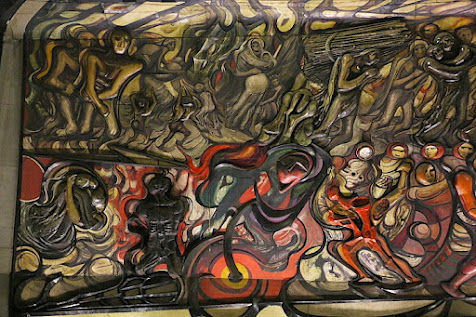
David Alfaro Siqueiros's mural, 
"The March of Humanity on Earth and Toward the Cosmos"

"A Look to the Heavens"

"This pretty field of view spans over 2 degrees or 4 full moons on the sky, filled with stars toward the constellation Taurus, the Bull. Above and right of center in the frame you can spot the faint fuzzy reddish appearance of Messier 1 (M1), also known as the Crab Nebula. M1 is the first object in 18th century comet hunter Charles Messier's famous catalog of things which are definitely not comets.
Click image for larger size.
Made from image data captured this October 11, there is a comet in the picture though. Below center and left lies the faint greenish coma and dusty tail of periodic comet 67P Churyumov-Gerasimenko, also known as Rosetta's comet. In the 21st century, it became the final resting place of robots from planet Earth. Rosetta's comet is now returning to the inner solar system, sweeping toward its next perihelion or closest approach to the Sun, on November 2. Too faint to be seen by eye alone, the comet's next perigee or closest approach to Earth will be November 12."

"The Road We Never Took"

Full screen recommended
"The Road We Never Took"
"Welcome to Gengu AI – your ultimate destination for AI-generated music and next-generation sound experiences. This channel is dedicated to creating unique, high-quality tracks powered by artificial intelligence, blending creativity and technology to deliver music that feels fresh, emotional, and immersive. AI was the tool. The story came from human feeling. If this film gave you a quiet breath, a memory, or a moment of peace, thank you for being here."

Native Elder, "5 Signs Your Soul Is Tired and Not Your Body"

Full screen recommended.
Native Elder,
"5 Signs Your Soul Is Tired and Not Your Body"
"'5 Signs Your Soul Is Tired and Not Your Body' explores the hidden psychological and emotional signs of deep inner exhaustion that sleep alone cannot fix. Through timeless Native American wisdom, this powerful mindset shift reveals how emotional burnout, chronic stress, spiritual fatigue, and unresolved emotions quietly drain your energy. Learn how to recognize these five life-changing signs, restore your inner peace, and reconnect with your authentic self. If you've been feeling empty, unmotivated, or emotionally exhausted, this speech offers practical insights for healing, personal growth, emotional resilience, and mental clarity. Watch until the end to discover how ancient wisdom and modern psychology work together to transform your mindset and help you live with greater purpose.This speech teaches that true exhaustion often begins in the soul, not the body. By recognizing emotional and spiritual fatigue, you can heal from within, regain inner peace, develop emotional resilience, and create a healthier mindset for lasting happiness."

"Bad Decisions Make Good Stories"

Full screen recommended.
Delta King's Blues,
"Bad Decisions Make Good Stories"
"The smartest choices built my life… but the dumb ones sure made the best stories. “Bad Decisions Make Good Stories” is a rowdy, grin-filled Delta King’s Blues tune about wild nights, questionable ideas, and the unforgettable memories that somehow become funnier with every passing year. A foot-stompin’, back-porch acoustic guitar drives the groove like an old pickup headed toward trouble with a full tank and no real plan. The harmonica laughs through every smoky bend, sounding like it’s heard every outrageous tale - and probably started a few of them. The rhythm rolls loose and lively, built for old friends, cold drinks, and stories that begin with, "You ain't gonna believe this..." This is blues for everyone who survived their younger years. For those who know that while wisdom comes with age, the best campfire stories usually come from doing something you probably shouldn’t have. I’ve got a few regrets… but I’ve got a whole lot more stories worth telling, sometimes the wrong turn makes the best memory."

The Daily "Near You?"

South Jordan, Utah, USA. Thanks for stopping by!

The Poet: Langston Hughes, "Life is Fine "

"Life is Fine"

"I went down to the river,
I set down on the bank.
I tried to think but couldn't,
So I jumped in and sank.
I came up once and hollered!
I came up twice and cried!
If that water hadn't a-been so cold
I might've sunk and died.
But it was Cold in that water! It was cold!

I took the elevator
Sixteen floors above the ground.
I thought about my baby,
And thought I would jump down.
I stood there and I hollered!
I stood there and I cried!
If it hadn't a-been so high
I might've jumped and died.
But it was High up there! It was high!

So since I'm still here livin',
I guess I will live on.
I could've died for love -
But for livin' I was born.
Though you may hear me holler,
And you may see me cry -
I'll be dogged, sweet baby,
If you gonna see me die.

Life is fine! Fine as wine! Life is fine!"

- Langston Hughes

"Death and How to Be More Alive: Carl Jung on Immortality and the Rebirth of Middle Age"


"Death and How to Be More Alive:
 Carl Jung on Immortality and the Rebirth of Middle Age"
by Maria Popova

"Once, I spent a year walking Brooklyn’s historic Green-Wood Cemetery daily, winding between the marble tombs engulfed by tree-roots and emblazoned with the surnames of the dead, each followed by a full stop to demarcate the terminus of life. It hovers there, so sure of itself, this punctuational emblem of an irrevocable end. And yet the surety of science about what happens when we die, like the surety of religion, is only speculative, for it is conceived by the living. Whitman - who often walked Green-Wood - knew this when he wrote that “to die is different from what any one supposed, and luckier.” Over and over we have mistaken our suppositions for sureties when both intellectual honesty and spiritual courage demand we concede that death is not a period but a question mark.Available as a print.

Carl Jung (July 26, 1875–June 6, 1961) was only twenty and newly enrolled in medical school when he came to see death as a way of understanding life: His father, who had died six weeks earlier, appeared to him in a dream, announcing that he would be returning home after a holiday. Struck by how real the dream felt, Jung began devising a psychological cosmogony of death that would take him half a lifetime to formulate, its crux best articulated in his 1929 commentary on "The Secret of the Golden Flower: A Chinese Book of Life": "Death is psychologically as important as birth and, like it, is an integral part of life… For, seen in correct psychological perspective, death is not an end but a goal."

Five years later, Jung developed these ideas in his most intellectually elegant essay, titled “Death and the Soul” and included in Jenny Yates’s altogether magnificent anthology Jung on Death and Immortality (public library). Developing the idea that “life strives towards a goal and is determined by an aim,” he wrote: "The question of the meaning and worth of life never becomes more urgent or more agonizing than when we see the final breath leave a body which a moment before was living.
[…]
Life is an energy-process. Like every energy-process, it is in principle irreversible and is therefore directed towards a goal. That goal is a state of rest. In the long run everything that happens is, as it were, no more than the initial disturbance of a perpetual state of rest which forever attempts to re-establish itself."

This perspective, Jung realized, is not one our consciousness readily takes, for it requires a counterintuitive understanding of the substance we are made of - time. It was his encounter with Einstein - the two dined together in the early days of relativity - that allowed Jung to violate his own creaturely intuitions in order to conceive of death not as the endpoint of a line across the Euclidean space of being but as a curve following the curvature of spacetime itself: eternity as a field in which all directions are relative. Einstein’s great revelation was that space and time are one, that spacetime tells matter how to move and matter ballasted by gravity tells spacetime how to bend. At the heart of Jung’s conception is the intimation that consciousness bends spacetime one way and we call it life, bends it another and we call it death, while the energy that does the bending remains inexorable. The question of where life goes when it goes, like the question of where love goes when it goes, may be a question not of termination but of transmutation.

Jung captured this idea in his response to a pastor who recounted having had a conversation with his brother at the time of his death, even though they were separated by a continent: "It is very probable that only what we call consciousness is contained in space and time, and that the rest of the psyche, the unconscious, exists in a state of relative spacelessness and timelessness. For the psyche this means a relative eternality and a relative non-separation from other psyches, or a oneness with them."

Recognizing that “no one knows what ‘psyche’ is, and one knows just as little how far into nature ‘psyche’ extends,” he observed: "It would seem to be more in accord with the collective psyche of humanity to regard death as the fulfillment of life’s meaning and as its goal in the truest sense, instead of a mere meaningless cessation. Anyone who cherishes a rationalistic opinion on this score has isolated himself psychologically and stands opposed to his own basic human nature."

Just as Jung was finishing “The Soul and Death,” his sister died. He coped by writing a psychological analysis of "The Tibetan Book of the Dead "- an ancient instruction for shedding karmic illusions, which Jung likened to psychological complexes, drawing a parallel between the Buddhist notion of enlightenment and the aim of psychiatry: withdrawing our psychological projections in order to see clearly. Our conception of death, he argued, is a projection of our own hopes and fears - the core complexes that govern our lives - lensed through our creaturely intuitions about space and time, intuitions that have regularly misled us about the realities of nature, from the shape of the Earth to the centricity of the Solar System.

Jung collided with his own creaturely intuitions when, in the fourth winter of the world’s deadliest war, he had a near-death experience himself: His heart stopped, then, miraculously, restarted. In the wake of the heart attack he wasn’t meant to survive, he wrote in a letter: "What happens after death is so unspeakably glorious that our imagination and our feelings do not suffice to form even an approximate conception of it… The dissolution of our time-bound form in eternity brings no loss of meaning."

A year later, he was still thinking about it, about the “glimpse behind the veil” it had afforded him, writing in another letter: "Whatever you do, if you do it sincerely, will eventually become the bridge to your wholeness, a good ship that carries you through the darkness of your second birth, which seems to be death to the outside."

Central to his thinking was the concept of synchronicity - the meaningful alignment of two events in space and time - which he had co-invented with his onetime patient Wolfgang Pauli shortly after the physicist was awarded the Nobel Prize. Decades later, in a letter penned as he himself was approaching death, Jung would insist that we must not rule out “the possibility that there is an existence outside time which runs parallel with existence inside time,” intimating that life is simply the alignment of consciousness and time, but the unconscious could exist on another temporal plane. Beneath the seeming self-contradiction - there are no parallels in curved spacetime - was Jung’s insistence that curves, not parallels, are the best way to understand death by understanding life. A century and a half after the forgotten visionary Elizabeth Peabody offered her abiding wisdom on middle age and the art of self-renewal, and half a century before Ursula K. Le Guin penned her magnificent meditation on menopause as rebirth, Jung wrote in “Death and the Soul”:

The curve of life is like the parabola of a projectile which, disturbed from its initial state of rest, rises and then returns to a state of repose. The psychological curve of life, however, refuses to conform to this law of nature… From the middle of life onward, only he remains vitally alive who is ready to die with life. For in the secret hour of life’s midday the parabola is reversed, death is born. The second half of life does not signify ascent, unfolding, increase, exuberance, but death, since the end is its goal. The negation of life’s fulfillment is synonymous with the refusal to accept its ending. Both mean not wanting to live, and not wanting to live is identical with not wanting to die. Waxing and waning make one curve.

Couple with Annie Dillard on how to bear your mortality, then let this spare, stunning poem teach you how to live and how to die."

"Just For One Day"

"Just For One Day"
by Paul Rosenberg

'Most people fail to appreciate the fresh opportunity that each day brings them. Their programming requires them to snort derisively at any positive description of humanity. After all, the systems of this world are built upon the assumption that mankind is weak, stupid, and generally inadequate to a moral existence. As a result, most people have become addicted to bad news.

Nonetheless every day is a fresh start, a situation created by nature itself. So, please consider this: What if, just once, you got out of bed and imagined that you were a fresh being in the universe? And more than that, a good, creative, potent being. What if you imagined yourself free of obligations and intimidations, charting a fresh course? What if you looked at your life as if it were beginning anew?

Is it an intolerable thought that you should put aside your well-groomed fears, wake up to a blank slate, and hold that position for just one day? And if we can’t allow ourselves this one productive entertainment, what has happened to us?

You Don’t Actually Suck: Our opinions of ourselves are usually out of touch with reality. To prove that, you need only to slow down, clear your mind, and answer a few questions:

Can you remember a moment from your childhood when someone was notably kind or loving toward you? You have at least one, yes? So, in detail, what was it like and how did you feel?

Can you remember a time you stood up for someone who was being unfairly insulted or abused? What exactly did you do, and how did it make you feel?

Can you remember a time when you did something because it was right, even though you knew you’d suffer for it? How did it feel to push through the fear and do it?

Have you ever done something out of nothing but simple, honest benevolence? How did that feel?

Did you answer these questions? Did you relive the experiences a little? You see, you don’t actually suck. You’ve merely been made to believe so… by people and systems who profit from your bad opinion of yourself.

What’s Life For? You are alive, and this life you possess doesn’t have a preset direction; it’s you who choose where to direct it. Our lives have the meaning we give them, and we give them meaning through exercises of will.

You have immense capabilities, but only you can choose to use them. If you spend your entire life reacting to darkness and threat, you’ll never learn to be a potent being. Instead, you’ll stay in a tight little shell, talking about everything bad that happens in the world and seeking more and more bad news because it justifies your shell. Does that sound like a good way to spend a life?

When? Ever? So, when do we pull away from the carnival of bad news? When do we lift up our eyes and consider the radical possibility that we have good things in us? When do we consider our virtues and abilities… and start using them as a first choice?

For most people the answer is “never.” Not once in a complete human lifetime. And that’s tragic. In fact, it’s premature death. Most people aren’t specifically choosing this of course – it’s a choice thrust upon them – but it ends with them never living by their own light. Instead, they find a “doesn’t hurt too badly” groove and plod along until they tip into a grave.

But what if we picked a day and chose to live as if we were wonderful? If you’re so deeply terrified that that will lead to doom, make it your day off or a vacation day. Get up and spend that day as if you were a luminous being. Flatly pretend if you must, but do it for a day. Is that really so evil a concept that you can’t allow it to exist? So, when is it that we choose to wake up and be wonderful, just for one day?

Pick One: Every tomorrow is a new day and a new chance to be wonderful. So pick a day and wake up to a blank slate. Turn away from the knee-jerk objections that ram their way into your mind; they can have the other 364 days. Try being wonderful. Pull out your calendar, pick a month and day, circle it, and then do it. You might like it."

Joel Bowman, "Under Leaden Skies"

“Está plomizo” – leaden skies over Argentina’s congreso building.
"Under Leaden Skies"
by Joel Bowman

"Qué noche llena de hastío y de frío!
El viento trae un extraño lamento..."
(“What a night, full of weariness and cold!
The wind carries a strange lament...”)
~ Garúa, by Aníbal Troilo y Enrique Cadícamo (1943)

Buenos Aires, Argentina - "It’s a rainy ol’ day down here in the Paris of the South; “está plomizo,” as the locals say (lit. “it is leaden”), a perfect description for the heavy skies overhead. Strolling the deserted streets on our morning walk, the puddles reflecting the slate gray heavens above, we began reckoning on the way thoughts and speech interact and even influence one another. (Readers not in thrall to the abstract are kindly invited to skip ahead a couple hundred words...)

There’s a long history to this field of study, giving rise to theories from linguistic determinism to linguistic relativity and, on the other end of the spectrum, language of thought (LOTH). Our own mere musings are not nearly so clear or polished, but we offer a few crude examples nevertheless, if only as food for thought...

Take the Spanish verb for “to earn,” (ganar). It is the same as the verb for “to gain,” but also for “to win.” What does it mean when “earning” a wage is the same as “winning” one? Might this speak to a kind of zero-sum default setting in the ear of the Spanish language speaker? In other words, if one person “earns/wins” something, doesn’t it then stand to reason that another has “lost” that something?

And if trade is thereby reduced to “winning” and “losing,” how might one explain the concept of mutually beneficial exchange... where both voluntary parties to a trade gain from the exercise, a classic “win-win” situation? The idea exists, surely, but is it linguistically non-intuitive?

Then, to take it a step further, does this make Spanish speakers more susceptible to, say, the seductive whisperings of Marxist economic philosophy, where the world is viewed through winners and losers in a never-ending class struggle – oppressor vs. oppressed, master vs. slave, bourgeoisie vs. proletariat?

Then there’s the verb for “to wait” (esperar), which is the same as “to hope.” Does this mean Spanish speakers are inherently more inclined to optimism... or cynicism? Is waiting for the bus really a wishful event? On the other hand, what does it mean to hope your spouse returns from the shop? In English, the verb “to wait” is generally considered neutral... unlike, say “to dread” or “to long,” which have their own particular connotations. And then there’s the noun for wife (esposa)... which is also the Spanish word for handcuffs (las espossas). Hmm... best leave that one for another Note.

But enough of our rainy day ruminations. (Too much caffeine, clearly... or not enough malbec.) Let us return, rather, to our task at hand... Free Markets, Free Minds and Free People... In this week’s note we offered some thoughts from the German pastor Dietrich Bonhoeffer on stupidity as one of evil’s greatest tools."
"Dietrich Bonhoeffer on Idiots"

"How It Really Is"

"I'd been in hairier situations than this one. Actually, it's sort of depressing, thinking how many times I'd been in them. But if experience had taught me anything, it was this: No matter how screwed up things are, they can get a whole lot worse."
- Jim Butcher
"Dig your way out", they said...

"People Are Reaching Their Breaking Point at the Grocery Store"

Full screen recommended.
The Unfolded State, 8/2/26
"People Are Reaching Their
 Breaking Point at the Grocery Store"
"Grocery prices in America may be rising more slowly, but millions of shoppers still feel trapped at the checkout. Why do official inflation figures sound encouraging while ordinary grocery bills continue to feel impossible? This video examines why slower food inflation has not brought relief to many households. Using real shopping experiences alongside data from the Bureau of Labor Statistics, USDA, and the Federal Reserve, it explains why a national average can differ sharply from one family's receipt. Beef prices, fresh vegetable costs, expired promotions, package sizes, and regional shopping options can all reshape the final bill. It also looks beyond grocery prices to the wider cost of living crisis. Rent, credit card debt, transportation, limited emergency savings, and food insecurity determine how much pressure a household can absorb. The video checks a viral Instacart comparison, explores whether eating out is really cheaper than cooking, and explains where each food dollar goes. Rather than treating every shopper as equally affected, the analysis separates individual stories from national evidence and shows why lower income households, older adults, large families, and single income shoppers often face the hardest choices."
Comments here:

Dan, I Allegedly, "Your Car Isn't Yours... And Soon Nothing Will Be"

Full screen recommended.
Dan, I Allegedly, 8/2/26
"Your Car Isn't Yours... And Soon Nothing Will Be"
"Americans are being hit with subscription fees everywhere they turn, and now it's happening to products you thought you already owned. From cars that charge monthly for features like heated seats and extra horsepower to refrigerators charging for ice makers, smart TVs charging for wallpapers, garage door access, printer ink, and even dating apps costing hundreds of dollars a month, the subscription economy is exploding. Companies are finding new ways to monetize everyday life, and consumers are paying the price. In today's I Allegedly, we break down how this growing trend affects your finances, your freedom, and your future. We also discuss bank branch closures, rising diesel prices, inflation, the true cost of modern living, and why owning something outright is becoming a thing of the past. Is this the future of consumer spending - or have corporations gone too far? Watch the entire video and tell me what subscription you refuse to pay for."
Comments here:

"Trump Orders Aircraft Carriers Into Hormuz, Iran Goes On Full Combat Alert"

 
Col. Lawrence Wilkerson, 8/2/26
"Trump Orders Aircraft Carriers Into Hormuz,
 Iran Goes On Full Combat Alert"
Comments here:
o
Col. Doug Macgregor, 8/2/26
"Total War Has Begun - The Gulf Explodes, 
America Braces For The Worst"
Comments here:

"Dr. Steve Hanke: Trump's Iran Strategy Is "Insanity" - Oil Crisis, Inflation Spike & Recession"

"Dr. Steve Hanke: Trump's Iran Strategy Is "Insanity" - 
Oil Crisis, Inflation Spike & Recession"
Comments here:
Dr. Steve Hanke is a prominent American economist, Professor of Applied Economics at Johns Hopkins University, and Distinguished Senior Scholar at the Mises Institute. Follow Dr. Hanke on X: https://x.com/steve_hanke

"World War III Is Suddenly Emerging Out of Trump's Quagmire"

"World War III Is Suddenly 
Emerging Out of Trump's Quagmire"
by David Haggith

"You've not heard me make a claim like that before as I am not one to jump on the WWIII bandwagon every time the US incites more war; but this week all the chemistry of the Iran war changed. According to what CBS News reported on Friday, the US and Israel are going to significantly intensify the Iran War this weekend with planned bombings of Iran’s energy infrastructure. Trump has indicated this will be the harshest bombing campaign to date against Iran’s infrastructure. However, that is barely the beginning of this detailed account of the sudden moves toward WWIII in the Middle East.

Of course, Trump has promised a greatly intensified war like that many times, specifically saying he’ll blow up all of Iran’s energy infrastructure and end their civilization, and then he’s chickened out just as many times on the supposed basis that Iran was dying to make a deal, which Iran never appears to be dying to make. He appears to do that as a way of trying to cajole Iran into making a deal, but it never works, and Iran has been telling him and the US since long before this war that pressuring them to make a deal with military threats never will result in a deal. So far, they have been right about that, too.

Iran has already warned that, if the US and/or Israel go after its electrical plants or its bridges, as both have often threatened, then Iran will go much more seriously after Arab refineries and other oil infrastructure. That is clearly more than a threat because they already have. Through their proxies they did some of their most significant damage against Saudi Arabia’s refineries and port facilities this past week, knocking the largest plant in the world out of production for repairs.

Axios says Trump is still considering the attacks to be made within days, but hasn’t given the final go so far … but that was the early story. According to CHX, there was discussion about trying to conclude the strikes before financial markets open Monday, out of concern for how the bombings will affect the US and global economy, though no firm endpoint was locked in. That’s the piece most relevant to whether Trump will order the attack… he is trying to compress a strike on Iranian energy infrastructure into a weekend window specifically to get ahead of the oil-price and market reaction - which is an implicit admission of how severe they expect the energy-market fallout to be.

The proposed attack was discussed at a Cabinet meeting that Trump held Friday at Camp David… and CBS wasn’t alone - CBS News and the Wall Street Journal first reported the potential strikes, with the WSJ framing it as Trump having ordered strikes to force Iran to “surrender,” and Trump saying at the Cabinet meeting “We’ll be hitting them very hard… at some point they’ll say we just can’t take it anymore.” So the CBS energy-infrastructure reporting is corroborated by WSJ and Axios - this isn’t single-sourced. (“Trump Mulls Strikes on Iran’s Oil and Power Infrastructure” by Larry Johnson)

Here is a snapshot, giving some additional details about what CBS wrote: U.S., Israel preparing to bombard energy-related targets in Iran, sources say "Washington - The United States and Israel are planning what would be one of the harshest bombing campaigns to date against energy infrastructure targets in Iran, multiple sources told CBS News, with strikes possible throughout the weekend. There was some discussion about trying to conclude by the time financial markets open Monday because of concern about how the bombings will affect the U.S. and global economy, but an end point wasn’t locked in….

A joint operation would mark Israel’s return to combat operations which it had halted during the U.S.-brokered truce. Iran has not hit Israel since the memorandum of understanding fell apart and the U.S. restarted combat operations in early July. An Israeli official told CBS News: “Israel is unaware of a decision to restart full military operations, nor has been requested of Israel to join any military actions against Iran.” “I think we just want to win,” [Trump] told the press when asked about reviving diplomacy."

Energy infrastructure including power plants and refineries would likely be targeted, two of the sources said….When Mr. Trump and Israeli Prime Minister Benjamin Netanyahu met earlier this week, Netanyahu briefed him on three options for the war, including military strikes focused on land resupply routes, a senior Israeli official said. Netanyahu also met with Defense Secretary Hegseth. The U.S. has already struck bridges in this conflict that were dual-use - used by the military and civilians - a U.S. official said.

There were high-level U.S. discussions Friday about cutting electricity across Tehran, but no decision had been made as of Friday afternoon The US President also added: “We’re going to be hitting them very hard because it’s our turn to hit them. They know it’s coming.” (“Donald Trump to launch new strike on Iran ‘this weekend’ as WW3 fears soar”)

There are some discrepancies in the report, but it does fit almost seamlessly with numerous other reports that emerged earlier in the week, which I’ll now go over to show how the whole week appeared to be marching in the direction of a re-intensified war that is suddenly taking on the actual characteristics in the Middle East of World War I, though we should never trust Trump too much on these threats because he backs off almost as often as he makes them, wishing to keep believing he can threaten Iran into a deal. Some of the reports in The Daily Doom today will lay out that particular folly and why it will never work as well as how the president, himself, sounds like he is coming to the end of his rope with plans that have not brought anything that looks to anyone like victory.

Iran rejects Trump’s ceasefire: The worsening situation this week started when Iran flat-out rejected Trump’s latest ceasefire request - the pleading for a deal that came AFTER the MoU fell all apart - even though Trump had just claimed a few more times Iran was dying to negotiate. It would appear they were dying to die, not to negotiate, because they intensified their fighting considerably in order to swat off Trump’s new ceasefire proposal with a harsh backhand to make it clear they absolutely will not have anything more to do with Trump, as they have already stated. Now, they said it with actions!

One report preferred to cast the situation we devolved into this past week as “Trump is panicking as Iran has rejected Donald Trump’s ceasefire… Trump was begging for a ceasefire. Iran said "absolutely not.”

"Operation Isolation: Leaked FEMA Documents Reveal the ‘Lone Wolf’ Survival Protocol Was Engineered to Ensure Mass Casualties During Collapse - The $340,000 Death Trap They Don’t Want You to Understand"

"Operation Isolation: Leaked FEMA Documents Reveal the ‘Lone Wolf’ 
Survival Protocol Was Engineered to Ensure Mass Casualties During Collapse -
The $340,000 Death Trap They Don’t Want You to Understand"
by Milan Adams

"There exists, in the architecture of human delusion, a particular cognitive trap so seductive that even the intelligent, the disciplined, and the otherwise rational succumb to its geometry. It is the fantasy of the homo silens - he silent man who watches the conflagration from behind reinforced glass, untouched by the thermal bloom of societal dissolution. If you have spent the preceding decade fortifying this fantasy - converting liquid assets into ammunition, transforming relationships into operational liabilities, and mapping escape routes that lead only deeper into isolation - then what follows will function not merely as correction, but as an autopsy of your future self.

You have committed the fatal error. Not an error of execution - your beans are probably well-rotated, your ballistics chart is likely accurate - but an error of epistemological foundation. You have mistaken the symptom of collapse for its essence. You believe you are preparing for the absence of electricity, the failure of supply chains, the devaluation of currency. You are not. You are preparing for the reversion of human organization to its primordial grammar, and that grammar is syntactically collective. The solitary pronoun has no conjugation in the language of survival.

The timeline you carry in your imagination - a narrative arc from “event” to “aftermath” mediated by individual competence - contains an eighteen-month lacuna of unacknowledged dependencies. That interregnum, between the cessation of institutional function and the reconstitution of informal economies, is where the hermetic strategy reveals itself as anomic disintegration accelerated. It is where you will discover that your fortress functions not as a redoubt, but as a waiting room for extinction.

The Phenomenology of Isolation Failure: The preparatory literature - the forums and field manuals and subscription-based intelligence briefings - commits a sin of omission that borders on the criminal. They elide the transition from “societal function” to “individual sovereignty,” as though the intermediate phase were merely a speed bump rather than a chasm of ontological security collapse. They speak of “bugging out” as though the destination were geographical rather than relational.

When systems undergo catastrophic dehiscence - and I speak not of transient inconveniences like regional blackouts or temporary currency fluctuations, but of the total ablation of normative infrastructure - the primary casualty is not electricity or supply chains or fiat valuation. The primary casualty is the architecture of trust. Your neighbor no longer possesses epistemic certainty regarding the continuity of his livelihood. The proprietor of the last operational fuel depot cannot verify the provenance of the next resupply convoy. The physician three blocks distant operates without pharmaceutical continuity protocols, without malpractice insurance, without the institutional backing that once granted her the authority to heal. In this environment of cascading unknowability, no amount of individual stockpiling substitutes for the verification mechanisms of collective intelligence.

I have engaged in extensive ethnographic correspondence with survivors of Argentina’s 2001 corralito, when the middle class discovered overnight that their bank deposits had been transmuted into theoretical constructs. I have spoken with Bosnian civilians who endured the 1992-1995 siege of Sarajevo, who watched the veneer of Yugoslav modernity peel back to reveal the ancient substrate of ethnic territoriality. I have documented the experiences of Venezuelan professionals who navigated the salto of 2017-2019, when calorie availability became the only relevant economic indicator. The phenomenology is invariant across these disparate cultural and temporal contexts: during months six through eighteen of acute crisis, the only viable currency is social capital - reciprocal obligation networks, skill complementarity, and the mutual enforcement of property rights through reputation rather than force.

Precious metals remain inert in safes. Isolated redoubts become tombs. The reciprocity decay that defines the early crisis phase renders individual accumulation not merely useless, but actively dangerous - an attractor for the desperate, the predatory, and the organized. Solitary survivalism does not fail because of insufficient ammunition or inadequate caloric reserves. It fails because it attempts to operate in a vacuum, and human biology abhors vacuum even more absolutely than physics.

The Triadic Constraints of Lone Survival: Let us operationalize the critique. Imagine the scenario with specificity: the electrical grid has undergone irreversible cascade failure following a coordinated cyber-physical attack on SCADA infrastructure. Commercial distribution has ceased for seventy-two days. The pharmacological supply chain has evaporated. Your neighbor—a Type I diabetic with a twelve-year-old daughter - possesses a degrading cache of insulin that will become chemically inactive within weeks. You, in your isolation, possess the mechanical expertise to repair his compromised generator, which would power the refrigeration unit that preserves his daughter’s life-extending medication.

You approach his perimeter as an emissary of barter. But you have spent the preceding months, perhaps years, establishing yourself as the hermetic “prepared one” - the specter who watches from fortified windows, who declined participation in the neighborhood association, who refused the street barbecue, who treated every interaction as potential operational compromise. You have been practicing pathological hypervigilance under the guise of security consciousness.

He does not see a trading partner. He sees a threat. He sees accumulated resource asymmetry wearing human skin. He sees the embodiment of the social fracture that has left his daughter vulnerable. The deal dies before you speak, because you have already spoken volumes through your absence.

The solitary strategy encounters three structural impossibilities in the early crisis phase, none of which receive adequate treatment in the survivalist canon because they cannot be solved through procurement.

First: The Security Paradox. Defensive architecture requires temporal continuity - sleep cycles, maintenance windows, medical convalescence, psychological decompression. A single individual cannot maintain 360-degree security posture indefinitely. The mathematics of vigilance are inexorable: twenty-four hours divided by one guardian equals eventual catastrophic failure. You will sleep. You will fall ill. You will require surgical intervention, dental care, or simply the temporary absence of consciousness that sleep demands. During these intervals, your perimeter becomes theoretical. Your fortress will be penetrated not through tactical inferiority, but through biological necessity. The predator need only wait for your amygdala to exhaust itself.

Second: The Competence Ceiling. The fantasy of the homo universalis - the self-sufficient polymath capable of trauma surgery, agricultural microbiology, mechanical engineering, tactical communications, psychological counseling, and veterinary medicine - persists only in the absence of honest skill assessment. Civilization emerged precisely because no human possesses the full stack of survival competences. Specialization is not a luxury; it is the substrate of collective endurance. Without skill complementarity, your minor injury becomes your terminal event. Your crop failure becomes your famine. Your mechanical ignorance becomes your darkness. The isolated prepper operates under the delusion that YouTube tutorials and field manuals constitute embodied knowledge. They do not. Expertise requires the corrective feedback of community - the nurse who notices your sutures are septic, the neighbor who recognizes your irrigation error, the child who spots what you have become too habituated to see.

Third: The Trust Deficit. In the absence of institutional verification - without notaries, without credit histories, without the state’s monopoly on violence to enforce contracts - trust cascade failure becomes the default social modality. Your hermeticism during the preparatory phase - your refusal to participate in neighborhood mutual aid agreements, your opacity regarding capabilities and inventories, your transformation of neighbors into potential threats - has established you as ontologically other. You have conducted the psychological work of dehumanizing your community for years, and you cannot reverse that ledger when the crisis demands collaboration. When you emerge seeking trade, you encounter not potential partners, but adversaries who have already categorized you as resource-rich and relationally poor. You are the walking wallet in a world where wallets are being emptied.

The Somatic Marker of Error: I am acquainted, through the strange network of preparedness culture, with a systems engineer in the Pacific Northwest - let us call him Marcus - who invested eleven years and approximately $340,000 in the construction of a subterranean habitat. The specifications were impressive: HEPA filtration rated for biological agents, hydroponic agriculture capable of sustaining four adults indefinitely, armored ingress protocols with ballistic resistance to .50 caliber, Faraday cage shielding for sensitive electronics, and a library of technical manuals that would shame a municipal reference collection.

Marcus possesses sufficient caloric reserves for four years, assuming no crop supplementation. He possesses sufficient ammunition to repel platoon-level incursions. He possesses sufficient isolation to ensure that no human being within five miles knows his legal name, his medical history, or his blood type.

When I inquired regarding his social capital erosion metrics - specifically, how many individuals would verify his existence if he failed to emerge for thirty days, how many would assume his absence meant death rather than successful concealment, how many would advocate for his interests in collective decision-making regarding local resource distribution -he responded with silence. Then deflection. Then hostility. He had optimized for survival while neglecting the predicate of social being. He had constructed a life-support system for a consciousness that would, within months of isolation, undergo the psychological fracturing that solitary confinement produces in even the resilient.

The mathematics are pitiless. That $340,000, allocated toward community fortification - collective water purification infrastructure, distributed medical training, cooperative agricultural land acquisition, the establishment of communication protocols and mutual defense agreements - would have purchased not merely survival, but flourishing within a network of mutual obligation. Instead, it purchased a sarcophagus with air conditioning and MREs. Marcus has spent eleven years preparing to die alone, and he will likely succeed in that preparation.

The Diagnostic Audit: This weekend, conduct the following exercise with unsparing honesty. Traverse your domicile and interrogate each artifact of preparation - each canned good, each round of ammunition, each medical supply - with the question: Does this object increase my integration with the local social topology, or does it increase my isolation from it? Does your food cache make you a potential node of distribution, or a target? Does your medical knowledge position you as a healer, or merely as a consumer of limited resources? Then convene with your affinity group - if you possess one - and draft a six-month continuity protocol predicated upon the following hierarchy of social capital development:

1. Interdependence Architecture. Catalog explicitly who owes you obligation, and whom you owe. Map the skill gaps in your collective. Identify the single points of failure. If one member holds all medical knowledge, you have not created redundancy; you have created fragility.

2. Skill Transparency. Conduct an honest audit of what you can teach versus what you must learn. The competent surgeon who cannot garden is as vulnerable as the master gardener with appendicitis. Eliminate the fantasy of self-sufficiency by embracing the reality of distributed competence.

3. Resource Visibility. Practice controlled disclosure of surplus to establish reputation as a node of generosity rather than accumulation. This is not operational compromise; it is the construction of the reciprocity networks that will define your access to resources you cannot produce yourself.

4. Defensive Collectivization. Design rotational security protocols that allow for biological necessity - sleep, illness, injury. Individual vigilance is a myth; collective vigilance is a technology.

5. Medical Redundancy. Distribute knowledge, not just supplies. Ensure that three people can perform basic trauma care, not just one. Ensure that pharmaceutical caches are geographically distributed, not concentrated in vulnerable single points.

6. Psychological Resilience Networks. Construct mechanisms for narrative continuity - the prevention of ontological security collapse through continued storytelling, ritual, education of children, and the maintenance of identity beyond mere survival.

Do not advance to procurement of additional isolated assets until each of these six domains exhibits structural integrity. If you maintain dependent minors, multiply the social network requirements by coefficient 2.5; children require not only caloric intake but the ontological security of continued community belonging, educational formation, and the modeling of non-traumatized social interaction.

The Liminal Utility of Isolation: I stated initially that I do not disparage preparation. I maintain this position, with the qualification that utility is temporally bounded and context-dependent. Isolation possesses genuine, if narrow, application.

During the acute phase of crisis - weeks one through four - hermeticism provides protection against the initial pathological hypervigilance of the unprepared, who will seek to expropriate rather than cooperate. The solitary redoubt functions as a breather, a temporary cyst within the social body, protecting vulnerable resources while the initial wave of panic-buying and violent redistribution exhausts itself.

However, by month eighteen, the landscape has stratified irrevocably. The atomized have perished - through violence, through accident, through the thousand failures that isolation guarantees - or been subsumed by predatory associations that offer protection in exchange for total submission. The networked have established micro-polities of mutual aid, informal economies of reciprocity, and the institutional memory of cooperation. At this juncture, the hermetic individual - assuming he has survived the interregnum - possesses no reputation capital, no trust history, no entry vector into the new economic formations. He is a man without a shadow in a world where shadows authenticate substance.

The isolated cache becomes valuable only when the trust cascade failure has been repaired - when new institutional verification mechanisms emerge, when the anomic disintegration has stabilized into new, brutal equilibria. But you must survive the interregnum to access that value. And the arithmetic of biology, psychology, and sociology is clear: you cannot survive alone.

The Commodities of Early Collapse: If you wish to comprehend what actually circulates during the social capital erosion phase, examine the ethnographic records of prior collapses with anthropological precision. Beirut 1982, when the cosmopolitan veneer dissolved into sectarian territoriality. New Orleans 2005, when the institutional failure lasted only days but the trust cascade failure lasted months. Puerto Rico 2017, when the colonial dependency revealed its structural fragility. The inventory of actual value remains remarkably consistent across cultural and temporal boundaries:

Information continuity - who controls what territory, where safety exists, who can be trusted with vulnerability, where resources can be accessed without predation. In the absence of mass media, the human network becomes the only broadcast system.

Skill liquidity - the ability to translate competence into obligation, to transform knowledge into the currency of reciprocity. The dentist who will extract an infected molar in exchange for security escort to the water source. The mechanic who will repair the irrigation pump in exchange for agricultural surplus.

Pharmaceutical access - particularly antibiotics, insulin, psychiatric stabilization medications, and anesthetic agents. These cannot be stockpiled indefinitely, and their production requires industrial infrastructure that will not exist in the early crisis phase. Access comes only through relationship.

Mechanical restoration - the repair of water pumping infrastructure, electrical generation at micro-scale, transportation modalities. These require not just tools, but the distributed knowledge of how to apply them.

Narrative coherence - the maintenance of identity, purpose, and historical continuity amid ontological security collapse. The ability to tell stories that explain the suffering, that provide temporal orientation toward a future, that prevent the psychological fragmentation of anomic existence.

Reproductive security - the protection of children, the continuation of educational formation, the transmission of values and skills across generations. The child who knows only survival is not a survivor; they are a predator waiting to happen.

Notice the absence of precious metals, cryptocurrency, and isolated firepower from this inventory. These become relevant only after the reciprocity decay has been arrested, after the new informal institutions have emerged to validate their storage of value. In the early phase, they are dead weight - attractors for violence, markers of the unintegrated, the socially dead.

The Thanatotic Recognition: I am not advocating paranoia. I am advocating epistemic honesty - the courage to examine your preparation not as fantasy fulfillment but as operational reality.

Examine the social topology surrounding you with anthropological detachment. Are your neighbors exhibiting the pre-collapse indicators of anomic disintegration - the withdrawal from civic participation, the proliferation of zero-sum cognitive frameworks, the substitution of digital performance for embodied community? Or does your locality possess the cultural memory of mutual aid, the institutional habits of cooperation, the trust infrastructure that precedes crisis?

Attend to these signals with the same rigor you apply to ammunition specifications. Because every systemic failure - electromagnetic pulse, financial decoherence, kinetic conflict, ecological disruption - carries a secondary vector more lethal than the primary event: the aggregation of the unprepared. And the unprepared, when aggregated in sufficient quantity and deprived of social capital, do not merely suffer; they become pathological hypervigilance incarnate, seeking resource redistribution through force because they possess no other currency.

You may possess the perfect bunker. You may possess the optimal caliber for terminal ballistics. You may possess the hermetic seal that keeps the world at bay. But the wrong neighbors - meaning those who do not know you, trust you, or owe you - will excavate you from it. The wrong community - meaning the absence of community - will excavate you from your own mind.

I believed, for years, that I had transcended these vulnerabilities through individual competence—through the accumulation of skills and supplies that would render me independent of the fragile systems surrounding me. Then I encountered The Final Survival Plan by Frank Greene, and recognized that I had been operating within an epistemological bubble - one that privileged hardware over social capital, isolation over integration, the fantasy of sovereignty over the reality of interdependence. Greene’s synthesis of actual survival ethnography - drawn from decades of field contact with populations who have navigated genuine collapse in Bosnia, Argentina, Syria, and the post-Soviet space - provides the corrective framework that the prepper community desperately requires. This is not theoretical construction; it is operational archaeology, excavating the practices that actually permitted survival, as opposed to the fantasies that permit marketing.

The question is not whether you have sufficient ammunition to hold your perimeter. The question is whether you have sufficient belonging to survive the trust cascade failure that defines the true crisis. The question is whether you are preparing to live, or merely preparing to die with more equipment. The bunker is not a strategy. It is a postponement. And postponement, in the face of systemic collapse, is merely a slower form of surrender."

"The Survival Manual for the Apocalypse That’s Already Started: Five Witnesses from the Shadows Reveal the Hidden Truth About Civilization’s Collapse"


"The Survival Manual for the Apocalypse That’s 
Already Started: Five Witnesses from the Shadows 
Reveal the Hidden Truth About Civilization’s Collapse"
by Madge Waggy

Excerpt: "The architecture of modern civilization rests upon foundations far more fragile than the polished marble facades of our institutions would suggest, and beneath the veneer of perpetual progress and technological omnipotence lies a precarious house of cards sustained only by the collective faith of billions who have never witnessed the true face of systemic collapse. History does not whisper its warnings gently; it screams them through the charred remnants of fallen empires, the hollow eyes of survivors wandering through streets that once hummed with commerce and community, the silence that descends when the grid fails and the illusion of permanence shatters like glass beneath a hammer. We stand now at a precipice that few dare to acknowledge openly, surrounded by experts who have witnessed the unthinkable and returned with knowledge that the comfortable classes would rather dismiss as paranoia than confront as prophecy.

The following pages contain the warnings and tactical wisdom of individuals who have survived what most consider unthinkable: a former U.S. Army Intelligence officer who has spent decades analyzing systemic vulnerabilities; an Argentine survivor of the 2001 economic collapse who witnessed currency destruction and societal fragmentation firsthand; a Bosnian war survivor who endured a year of urban siege and complete infrastructure failure; a scientist and economic analyst who predicted the 2008 housing collapse years in advance; and a former Special Operations veteran who has applied combat-tested tactics to civilian survival scenarios. Their warnings converge on a single terrifying consensus: the collapse is not a matter of if, but when, and the window for preparation grows narrower with each passing month of unsustainable debt accumulation, energy depletion, geopolitical escalation, and social fragmentation."
Full, most highly recommended article is here:
Hat tip to The Burning Platform for this material!

Saturday, August 1, 2026

"Israel Will Pay Price If Trump Makes Good On Threat To Ramp Up War"

Full screen recommended.
Larry Johnson, 8/1/26
"Israel Will Pay Price If Trump Makes
 Good On Threat To Ramp Up War"
Comments here: