

"A Messy Divorce"
by Joel Bowman
“The first lesson of economics is scarcity: there is never
enough of anything to fully satisfy all those who want it.
The first lesson of politics is to disregard the first lesson of economics.”
~ Thomas Sowell, Is "Reality Optional? And Other Essays" (1993)
Buenos Aires, Argentina - "Today, we bow a tiny violin for the world’s know-it-all caste. We refer to the conspicuous do-gooders who deign to walk amongst us... the unctuous meddlers... the self-assured planners... and all those to whom Doubt is as strange as Truth is to a congressman or Temperance to a poet.
You know them as St. Greta Thunberg and Anthony “The Science” Fauci and NYC’s Zohran Momdaddy, all in the news of late, all untroubled by a quiver of qualm. They are the professed “elites”... the humble thought leaders and celebrity activists... the unerring redistributors, with their thumbs firmly on Heaven’s scales. Forever standing sentry on the “right side of history,” as they never tire of reminding us, they grasp the next Great Cause even before it has been manufactured.
Whether discovering new strands of social injustice... or ensuring the planet is moderated to the optimum temperature... or planning the next global pandemic (coming to a 15-minute city near you)... these unyielding specimens are already hard on the task.
But spare a thought, merciful reader, for their pitiable lot; forced by unexamined certitude to inhabit a world free of surprise, their entire life’s journey foretold them by their own blinding brilliance, with nary an unforeseen consequence or a second thought to disturb their somnambulant earthly wanderings... How dull their lives must be!
A Messy Divorce: Down here at the End of the World, meanwhile, far from the high plains of automatic credence, we are sometimes surprised thrice-over before lunchtime! We recall, for instance, almost choking on a particularly fat-bottomed Malbec the day we realized (surely later than most) that economics and politics were never really in love at all... but merely enjoyed a “marriage of convenience.” “It’s nothing personal,” Adult World Reality gently consoled us, “they simply want different things in life.”
Reexamining the relationship in the sober light of day, we came to recognize it for what it was: a shotgun charade from the get go, facilitated by politicians to sell elections to voters who yearn desperately to believe in a Happily Ever After fairytale. In the end, “the dismal science” and “the art of the possible” are no more suited for marital bliss than were Henry VIII and Anne Boleyn.
Economics, for its part, is concerned with understanding the production of wealth. Its origins. Its formation. And the conditions that best enable it to flourish. Politics, meanwhile, focuses not on the multiplication of wealth... nor even on its division per se, as is sometimes sheepishly suggested by its pseudo-apologists and roguish practitioners...but rather on who gets to decide.
The former deals in the currency of value, in other words, the latter in the currency of power. One aims at discovering some fundamental truth about the world, the other revels in its ability to hide, obfuscate, and otherwise manipulate the story to its own ends. In the final count, the proper domain of economics is objective reality. The (might we say) improper domain of politics, meanwhile, is subjective reality. Not what is true in other words... but how it is perceived.
Depth vs Perception: When Zohran Mamdani stands in front of a government grocery store to sell taxpayer-subsidized food at 30% below its established market value, for example, he is not trafficking in any economics grounded in reality. In fact, he is not dealing in economics at all. To believe otherwise would be simply to fall for the ruse.
He is, rather, conscripting the language of economics as a pretext to construct a carefully crafted narrative, one hashed out within focus groups and teams of social media consultants and career political operatives, none of whom have the slightest interest in supply and demand dynamics or allocative inefficiency or price wedges or anything even remotely related to microeconomics.
In truth, Mamdani is there to tell a story about power, about perceived injustice, about victimhood and evil capitalists and oppressed minorities and crying babies and two-spirit Sudanese amputees who just can’t seem to catch a break.
No serious adult human with an I.Q. above room temperature (celsius) believes that price controls actually work in the real world. Not the people who own and operate supermarkets, who deal in the immovable reality of their daily economics. And certainly not the millions of people who flee countries that routinely impose such controls, the invariable results of which are a surprise only to those who insist on conceptualizing the world in crayon thought bubbles.
So when Mamdani speaks of free buses and taxing the rich and government grocery stores... when Alexandria Occasional-Cortex yaps on about student loan forgiveness or minimum wages... and when Comrade Sanders shakes his fist at the clouds and insists “millionaires billionaires should not exist”...
... these fellow travelers are not transacting in economics, even if the language inadvertently creeps into their scripted messaging and mindless sloganeering. Theirs is an overtly political message and, as such, is often as antithetical to economics as astrology is to astronomy, or Jimmy Kimmel is to comedy. (See, we do read your comments!)
Invisible Hands: But how and when did these distinct domains become so confused, so frequently entangled in the minds of so many? The key takeaway here lies in the sharply divergent interests of the economist and the politician. Put simply, they’re playing entirely different games and, as such, are motivated by largely opposing incentives.
The politician does not “win” when he proves he can run a successful grocery store. Victory to him does not arrive in the form of a balanced state or federal budget. Nor does he count his achievements when he delivers, one by one, on the fairytale promises he made during his campaign. Rather, his victories are measured by the election results. His reward is the power he accrues while in office. That this power is won at the direct expense of the citizens/subjects over whom he reigns ought to be proof enough that his interests do not align with We, The People. But how did it all come to this, a state of affairs where no good deed goes unpunished... and no bad policy unrewarded? Stay tuned for your next Notes From the End of the World..."
P.S. On a scale of 1-10, how surprised are you to learn that, among American readers, trust in the mainstream media just reached another all time low? Here’s the ugly graph, from the latest Gallup poll:
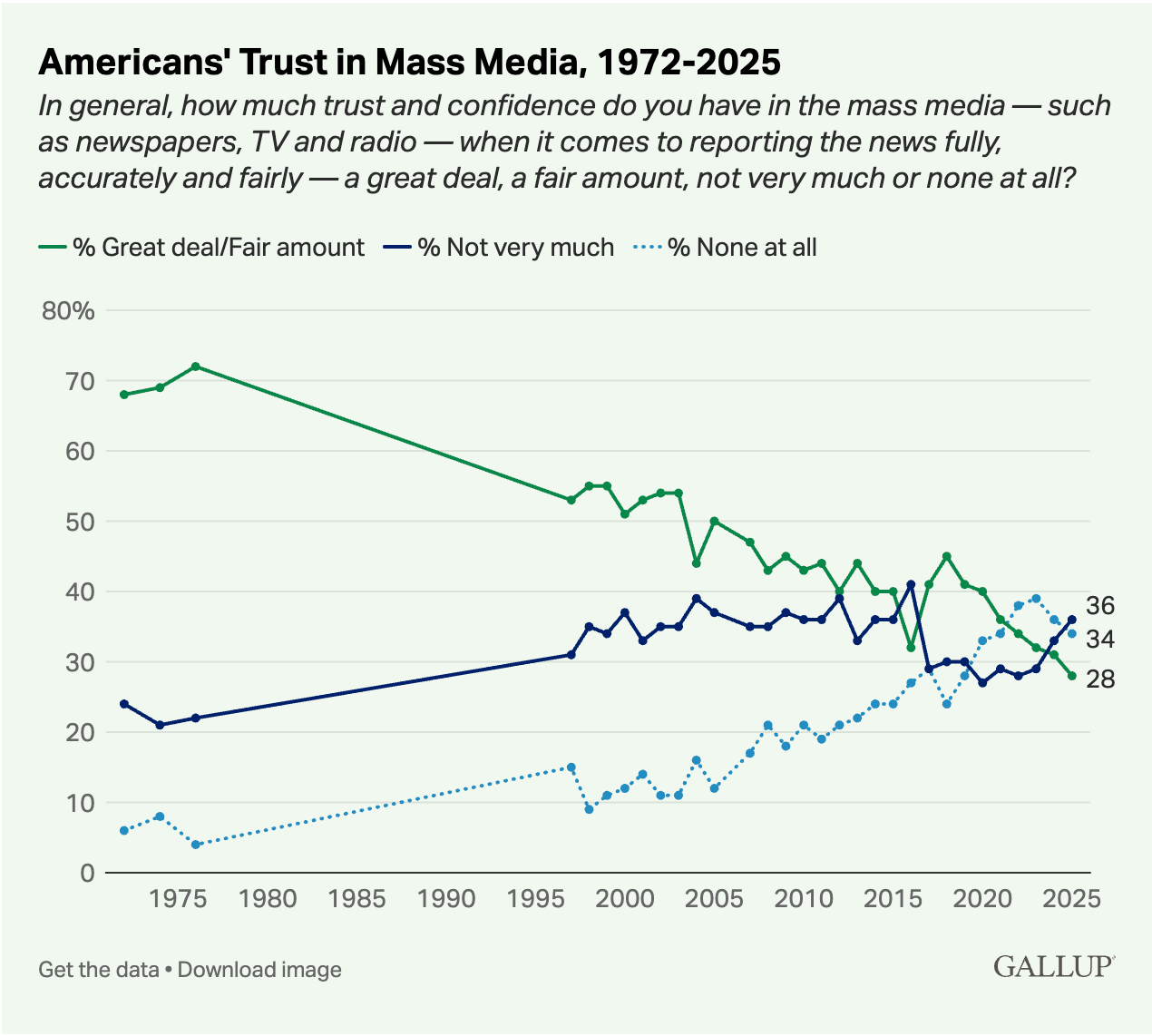
As you can see, those who responded to the question “How much do you trust the mass media?” with either “Not very much” (36%) or “None at all” (34%) now account for over two-thirds of all respondents. A mere 28% of people said they had a fair or great deal of trust in their once-hallowed fourth estate. (And just remember, these people walk among us…) The truth is, the mainstream outlets do a lot of work earning and thoroughly deserving your distrust... and with their tenuous relationship to the truth, it’s little wonder the legacy media is in tatters."

No comments:
Post a Comment