

"Should Iran Build a Nuke…
Game Theory Says Yes"
by Larry C. Johnson
"One of the most common questions surrounding what will happen to Iran if it continues to blockade the Strait of Hormuz and to pummel Israel to the point of exhaustion is whether Israel will go nuclear. To answer this question I decided to query a couple of AI-engines about that grotesque scenario using game theory. What is game theory? Game theory is the study of strategic decision‑making in situations where the outcome for each participant depends not just on their own choice, but also on the choices of others. It uses mathematical models to analyze how rational “players” select strategies and what outcomes (or “payoffs”) result from the interaction of those strategies.
Before I applied game theory analysis to Iran’s current situation, I had concluded that the best way to prevent Israel from using a nuclear weapon against Iran is for Iran to produce and demonstrate that it has created a nuclear weapon. This would mean that the new Ayatollah, Mojtaba Khameni, would reverse his father’s fatwah and secretly authorize the production of at least two nuclear devices. I concluded that this would force Israel to rethink using a nuke once it realized that Iran could retaliate in kind.
I started this analysis with the simple request to the AI-model: Using game theory, explain the best course of action that Iran should pursue when confronted with the threat of a nuclear attack from Israel. Here was the not so surprising answer:
The overarching game-theoretic conclusion is that Iran’s power in this confrontation derives not from its willingness to use nuclear weapons, but from making the consequences of an Israeli strike unacceptably costly. The goal is not to win a nuclear war - no one does - but to make starting one irrational for the other side. That is the essence of deterrence, and it is what game theory most clearly recommends.
I then asked the following: How does the fact that Iran has closed the Strait of Hormuz, which has precluded the export of oil, liquid natural gas and urea, and will continue to maintain the blockade for the forseeable future, change your game theory analysis? The AI-model came back with an answer that confirms Iran has made a game-changing move:
This is a significant strategic shift. The closure of the Strait changes the game structure fundamentally - moving Iran from a deterrence game to an attrition and coercion game with a very different payoff matrix... In the original analysis, Iran was the threatened party seeking to deter an Israeli nuclear strike. The closure of the Strait transforms Iran into the active coercer - it has already imposed enormous economic costs on the world, and is now in a fundamentally different strategic position.
Iran’s imposition of a de facto blockade of the Persian Gulf has fundamentally changed the possible outcomes and aligns with what I have been saying before running the game theory scenario:
The blockade has transformed Iran from a reactive deterrer into an active coercer holding the global economy hostage. Game theory’s clearest prescription is: this position of leverage should be converted into a negotiated settlement as efficiently as possible, before the attrition costs, miscalculation risks, and domestic pressures erode the advantage Iran currently holds.
The greatest strategic error Iran could make would be to hold the blockade so long, and signal so inflexibly, that adversaries conclude no negotiated exit exists - because that is precisely the condition under which the nuclear threat regains its credibility and rational actors may choose catastrophic action over indefinite attrition. The blockade is an instrument of negotiation, not an end in itself. Used with discipline and clear signalling, it represents Iran’s strongest strategic position in decades. Used recklessly or held too long, it becomes the trigger for the very outcome it was designed to prevent.
I then added the final twist and asked: What happens if Iran reveals it has now developed a nuclear weapon? Here is the answer if full: Iran revealing a nuclear weapon while simultaneously maintaining the Strait of Hormuz blockade is not merely an incremental escalation - it is a phase transition in the game. The entire strategic architecture that existed before - deterrence calculations, alliance commitments, third-party pressures, negotiating dynamics - must be rebuilt from scratch around a new fundamental reality.
The announcement combines two of the most destabilising events in international relations into a single moment: a nuclear breakout and an active economic siege of the global economy. No historical precedent exists for this combination. The closest analogues - the Soviet Union’s first nuclear test in 1949, China’s in 1964, North Korea’s in 2006 - all occurred in periods of relative strategic stability, not during an active global economic crisis that the new nuclear power was itself causing.
1. The Immediate Game-Theoretic Effect: The Window of Maximum Danger: The most important concept in nuclear deterrence theory for understanding this moment is the stability-instability paradox in reverse. Normally, nuclear acquisition stabilises the top of the escalation ladder. But when a state reveals a nuclear weapon during an active confrontation, it creates a brief but extraordinarily dangerous window in which adversaries must decide whether to act before the new arsenal is fully secured, dispersed, and operationally mature. This is the “use it or lose it” problem - but from Israel and the US’s perspective, not Iran’s. The strategic logic runs as follows: Today Iran has one weapon, or a handful, in unknown locations. In six months it may have ten, dispersed and hardened. In two years it may have a fully survivable second-strike capability.
The window for a disarming first strike, if it exists at all, is now. Game theory’s prediction is unambiguous: the revelation triggers the highest probability of military strike in the entire confrontation timeline. Iran’s optimal strategy must account for this window as the single most dangerous period it will face.
2. The Payoff Matrix Transforms Again — More Dramatically Than the Blockade Did: The nuclear revelation simultaneously: Eliminates Israel’s nuclear monopoly in the region - permanently altering the Middle East’s strategic architecture. Creates mutual assured destruction as a live possibility for the first time in the conflict. Transforms the blockade from an act of economic coercion into a nuclear-armed state’s siege of the global economy. Forces every actor to reassess their position, commitments, and red lines simultaneously.
The new payoff matrix looks like this:
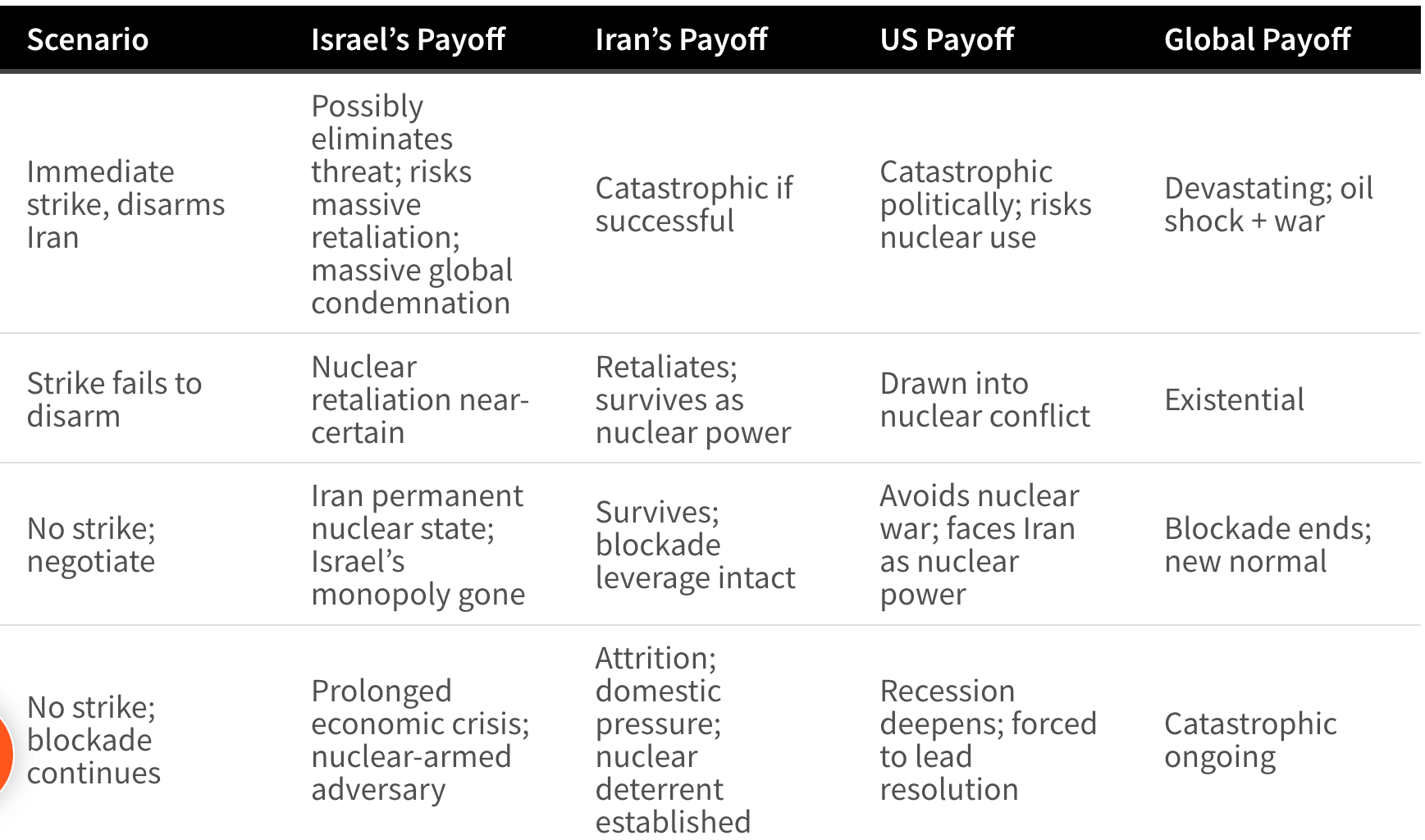
The critical observation is that the “strike successfully” scenario has an extraordinarily narrow probability band — Iran would not have revealed the weapon without having taken steps to secure it against first-strike destruction. The revelation itself is a strategic signal that Iran believes it has sufficient survivability to absorb a strike and still retaliate.
3. Why Iran Revealed the Weapon: The Signal Being Sent: In game theory, the decision to reveal is itself a strategic move that must be decoded. Iran is not simply announcing a technical fact - it is sending a precisely calculated set of signals to multiple audiences simultaneously.
To Israel: “A nuclear strike on Iran is now a nuclear exchange. Your monopoly is gone. Recalculate.”
To the United States: “The cost of military support for Israel has just increased by an order of magnitude. Are you willing to risk nuclear war to end a blockade you could negotiate your way out of?”
To third parties - Japan, India, Europe, the Gulf states: “The only path to reopening the Strait that does not risk nuclear war is a negotiated settlement. Pressure your allies accordingly.”
To its own domestic constituency: “The regime is invulnerable. The confrontation is won. Rally behind the leadership.”
To the broader non-Western world: “Another nation has broken the Western monopoly on nuclear deterrence. The rules-based order does not protect you - but deterrence does.”
Each of these signals has a different intended effect, and Iran has crafted a single act that advances all of them simultaneously. This is a masterclass in multi-audience strategic communication - what game theorists call signalling under incomplete information.
4. Israel’s Rational Response Set - And Why Each Option Is Now Worse Than Before: Israel now faces a decision tree in which every branch has deteriorated:
Option A: Immediate conventional strike on nuclear facilities: The logic: destroy the arsenal before it is dispersed. The problem: Iran revealed the weapon precisely because it believes the arsenal is survivable. A failed strike that leaves even one Iranian nuclear weapon intact and a regime with the will to use it is strategically catastrophic for Israel. The probability of complete success is low; the cost of failure is existential. Expected value: deeply negative.
Option B: Nuclear first strike: The logic: overwhelming force eliminates the threat permanently. The problems: near-certain retaliation if even one Iranian weapon survives; complete international isolation including likely abandonment by the US; global economic catastrophe from a nuclear exchange in the Gulf; permanent delegitimisation of Israel internationally. This option was always available but its expected payoff is so negative that rational actors virtually never choose it. Expected value: catastrophically negative.
Option C: Accept the new reality and negotiate: The logic: Israel has lived with a nuclear Pakistan for decades, and with a nuclear North Korea. The MAD framework, while terrifying, is stable once both sides have survivable arsenals. The problem for Israel is that this means permanently accepting a nuclear-armed Iran as a regional actor - and abandoning any notion of eliminating the Iranian nuclear program. Expected value: deeply unpleasant but survivable.
Option D: Accelerate diplomatic resolution of the blockade under the nuclear umbrella: The logic: the blockade is now even more dangerous than before; ending it removes the immediate crisis even if the nuclear question remains unresolved. Separate the two problems - negotiate an end to the blockade first, then address the nuclear question through a longer-term process. Expected value: the least bad option available.
Game theory’s prediction is that rational actors, facing a choice between catastrophically negative expected values and merely deeply unpleasant ones, choose the latter. Israel’s rational move is Option D - though domestic political pressures may make this extraordinarily difficult to implement.
5. The United States’ Position: From Reluctant Participant to Indispensable Actor: The nuclear revelation transforms the United States’ role completely. Before, Washington could plausibly maintain some distance from the confrontation. Now, it faces a situation in which: A nuclear-armed Iran is holding the global economy hostage. Its closest Middle Eastern ally faces an existential nuclear threat. Every major trading partner - Japan, South Korea, India, the EU - is suffering severe economic damage and demanding resolution. Domestic recession pressure is building. Any military action risks nuclear war.
The US is now the only actor with the leverage, relationships, and capability to broker a resolution. This is simultaneously its greatest burden and its greatest source of power in the game. Washington becomes the indispensable mediator - which is precisely why Iran’s revelation is also a signal to Washington: “You need to lead a negotiation now, or face consequences neither of us wants.”
The two-level game dynamic becomes critical here. American leadership must simultaneously manage: Domestic political pressure to act forcefully against Iran. Allied pressure to resolve the crisis diplomatically. Israeli pressure to support military action. The objective strategic reality that military action risks nuclear war.
Game theory’s prescription for the US is to use its unique position to construct a negotiated framework that gives Iran sufficient security guarantees and sanctions relief to lift the blockade, while establishing verifiable constraints on the Iranian nuclear arsenal - essentially a supercharged version of the JCPOA, negotiated from a position in which Iran holds far more leverage than it did in 2015.
6. The New Nuclear Deterrence Equilibrium - If the Crisis Is Survived: If the immediate window of maximum danger is navigated without military escalation, game theory predicts the emergence of a new, ugly but stable deterrence equilibrium in the Middle East - the extended MAD framework: Iran has nuclear weapons and a credible second-strike capability. Israel has nuclear weapons and a credible second-strike capability. Neither can use nuclear weapons without near-certain mutual destruction. Both sides know this; both sides’ behavior is constrained by it.
This is precisely the equilibrium that has governed India-Pakistan relations since 1998 - tense, punctuated by periodic crises and proxy conflicts, but ultimately stable because the consequences of nuclear use are too catastrophic for rational actors on either side to accept.
The blockade, in this scenario, is resolved through negotiation because Iran has achieved its ultimate strategic objective - regime security through nuclear deterrence - and no longer needs the blockade as leverage. It can be lifted in exchange for a package of diplomatic, economic, and security concessions without Iran appearing to have backed down. The nuclear weapon is the achievement; the blockade becomes unnecessary once the weapon’s existence is accepted.
7. The Proliferation Cascade: The Game Expands Beyond Iran and Israel: One of the most significant game-theoretic consequences of an Iranian nuclear revelation is its effect on other regional actors - particularly Saudi Arabia, Turkey, and Egypt. Nuclear deterrence theory predicts that when one state in a region acquires nuclear weapons, the incentive for neighbours to do so increases dramatically. This is the proliferation cascade problem.
Saudi Arabia has publicly stated it will acquire nuclear weapons if Iran does. Turkey has the industrial base to pursue a program. Egypt has significant scientific infrastructure. The game is no longer a bilateral Iran-Israel confrontation - it risks becoming a multi-player nuclear game in the world’s most volatile region, with the oil infrastructure that underpins the global economy sitting at its centre.
This proliferation dimension changes the US calculus significantly. Washington’s interest in preventing a regional nuclear cascade may actually exceed its interest in defending Israel’s nuclear monopoly - creating an incentive for the US to broker a regional security architecture that addresses multiple states’ security concerns simultaneously, rather than simply targeting Iran.
8. Iran’s Optimal Strategy Post-Revelation: Given all of the above, Iran’s optimal strategic portfolio following the nuclear revelation is:
Immediately: Demonstrate survivability - make clear through signals and statements that the arsenal cannot be destroyed in a first strike, collapsing the case for military action Establish clear no-first-use signalling - paradoxically, reassuring adversaries that Iran will not use the weapon first reduces the pressure for pre-emption Separate the blockade from the nuclear question - signal willingness to negotiate the blockade’s end on previously stated terms, making clear the nuclear deterrent is a permanent feature regardless of the blockade’s resolution
In the short term: Offer a managed transparency framework - inviting international inspection of the arsenal’s size and location, within limits, to reduce miscalculation risk and demonstrate that Iran is a responsible nuclear actor. Engage China and Russia as guarantors of any settlement, creating great-power investment in the stability of the new equilibrium. Pursue rapid diplomatic normalization with Gulf states - Saudi Arabia in particular - to prevent the proliferation cascade from materializing in the most dangerous form.
Structurally: Harden and disperse the arsenal to establish an undeniable second-strike capability as quickly as possible - the sooner this is achieved, the more stable the deterrence equilibrium becomes. Develop a nuclear doctrine - communicating clearly what would and would not trigger nuclear use, reducing ambiguity and miscalculation risk
The Core Strategic Conclusion: The nuclear revelation, combined with the active blockade, represents the most powerful bargaining position Iran has ever occupied - and simultaneously the most dangerous moment in the confrontation’s history. These two facts are not in tension; they are the same fact viewed from different angles.
Game theory’s ultimate prescription is this: Iran has achieved maximum leverage at maximum risk. The optimal strategy is to convert that leverage into durable, negotiated, irreversible gains - security guarantees, sanctions relief, regional recognition - as rapidly as possible, before the window of maximum danger produces the miscalculation or domestic political pressure that triggers the very catastrophe deterrence is designed to prevent.
The nuclear weapon is most valuable the day before it is used. Once used, it destroys everything - including Iran. Used as a deterrent, locked into a stable MAD equilibrium, and combined with a negotiated end to the blockade, it transforms Iran’s strategic position permanently. The regime that once feared American-backed regime change now sits behind a nuclear shield. That is the endgame game theory recommends - not war, but an unassailable peace on Iran’s own terms.
The greatest irony of nuclear deterrence, as Schelling observed decades ago, is that the weapon achieves its purpose most completely when it is never used. Iran’s optimal move is to make that outcome inevitable.
Iran is a highly educated society and it would not surprise me that Iranian scientists conversant in game theory have already arrived at this conclusion. Ayatollah Mojtaba is not just an Islamic scholar, he is a combat veteran who fought on the front lines against the US-backed Iraqi army in the 1980s. His ultimate goal is to ensure the survival of the Islamic Republic in the face of an existential threat from both the United States and Israel.
Meanwhile on the battlefield, US casualties are mounting. News broke late Thursday afternoon that Iran, or a group supporting Iran, shot down a KC-135 with at least five crew on board… All perished in the crash. Then there is this bit of news from X:
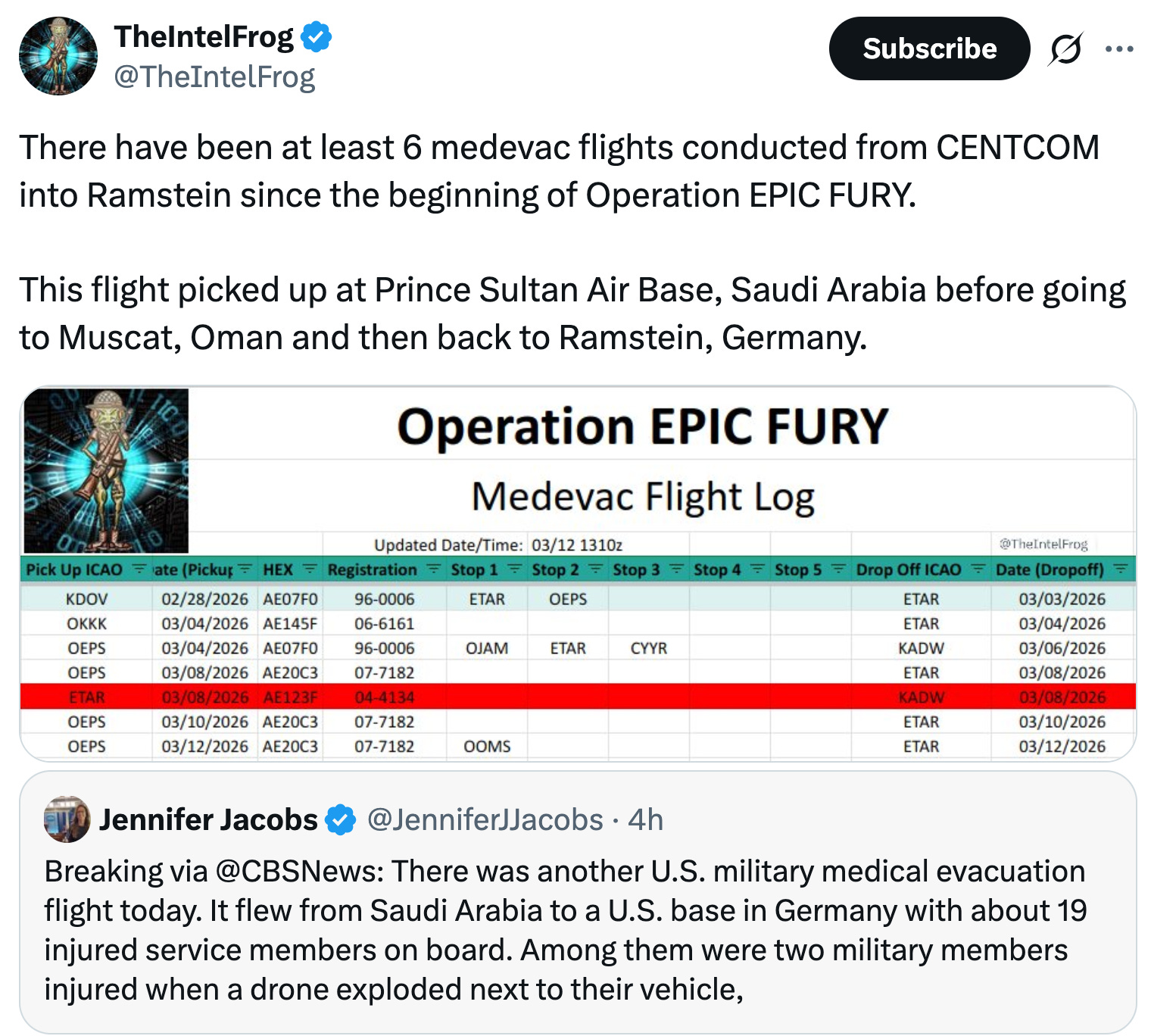
And Iran is continuing to pummel US bases in the Persian Gulf and Israel with ballistic missiles and drones. Notwithstanding Donald Trumps claim that Iran is defeated, the US position in the Persian Gulf is weakening with each passing day. The Iranian closure of the Strait of Hormuz is creating global disruption of supply chains and igniting an inflationary spiral that will not be quashed anytime soon."
o
I discussed this situation today with Suliaman Ahmed, who happens to live in nearby Tampa:

No comments:
Post a Comment