StatCounter

Sunday, July 19, 2026

"The Fragile Species: A Forgotten Masterpiece of Perspective on How to Live with Our Human Nature"

"The Fragile Species: A Forgotten Masterpiece of 
Perspective on How to Live with Our Human Nature"
by Maria Popova

"When Earth first erupted with color, flowers took over so suddenly and completely that, two hundred million years later, the baffled Darwin called this blooming conquest an “abominable mystery.” When earthlings first realized that our Milky Way is not the cosmic whole but one galactic particle of the whole - one of unfathomably many galaxies, each abloom with billions of stars orbited by other worlds - the universe suddenly appeared “so brutal and alive it seemed to comprehend us back.” When it became clear that a mysterious substance is holding each galaxy together, keeping each world’s orbit a perfect corolla around the stigma of its star, we gave that substance a name befitting an abominable mystery: dark matter.

Along the way, we - thinking, feeling, meaning-hungry creatures - kept trying to make beauty of the truths we found, composing poems about flowers and poems about dark matter as we composed our equations and our theories.

Reality’s ability to continually baffle us with what we don’t yet know, and our willingness to continually plumb the unknown for new truth and beauty, even as it baffles and terrifies us, is the loveliest thing about being alive. Being alive together, as members of this boundlessly inquisitive and imaginative species, is the loveliest thing about being human.

That is what Lewis Thomas (November 25, 1913–December 3, 1993) - a scientist, poet, and perhaps my favorite writer about the native poetics of reality - explores throughout his altogether exquisite final essay collection, "The Fragile Species" (public library).

In the opening essay, originally delivered as a talk in 1987 for the fiftieth reunion of his Harvard Medical School class, Thomas reflects on the splendid bafflements of science since he and his classmates parted ways in the prime of their lives half a century earlier. With his signature winking genius, he writes: "I cannot count the number of new items of ignorance I’ve picked up in fifty years; the list is simply too long. Instead, I have prepared another kind of list, shorter, more personally humbling, of some things I think I might have been learning more about if I hadn’t been so puzzled all those years by medicine itself. There are matters that I assume most other people my age comprehend nicely, and I never got round to studying.

The Federal Reserve System is at the top of my list. I’ve never known what it was or what it did or how it did it, and what is more I don’t want to be told. The same goes for the stock market, and for the bond market, and the word processor (one of which I actually possess and am baffled by), and the internal combustion engine, and the universe, black holes, galactic mirrors, those other universes, and space-time. Most of all, space-time. I cannot get ahold of it."

With so fetching a wink, Thomas turns to the real object of his meditation: our native inability to comprehend how the same processes that begot these remote abstractions also begot the fleshy, feeling concreteness of us. There is something incredibly lovely about Thomas’s warm humor - here is man of extraordinary intellect, scientific erudition, and uncommon human sensitivity, inviting the rest of us, far more ordinary and modestly lettered, to join him in his gladsome bafflement at the seeming miracle of life:

"I even have troubles of my own with evolutionary biology. Not first principles, mind you, not the big picture, mostly just the details. I understand about randomness and chance, and election, and adaptation, and all that, and I now know better than to talk, ever, about progress in evolution, never mind purpose. My problems come when I think about the earliest form of known life, those indisputable bacterial cells in rocks 3.7 billion years old, our Ur-grandparents for sure, then nothing but bacteria for the next two and one-half billion years, and now the chestnut tree in my backyard, my Abyssinian cat Jeoffry, the almost-but-not-quite free-living microbes living in all our cells disguised as mitochondria, and, just by the way, our marvelous, still-immature, dangerous selves, brainy enough to menace all nature unless distracted by music."

Leaning on his training as an etymologist - that is, an evolutionary biologist for the living organism of language - Thomas adds: "We need a better word than chance, even pure chance, or that succession of events, while still evading any notion of progress. But to go all the way from a clone of archaebacteria, in just 3.7 billion years, to the B-Minor Mass and the Late Quartets, deserves a better technical term for the record than randomness.

I like the word stochastic better, because of its lineage in our language. The first root was stegh, meaning a pointed stake in the Indo-European of 30,000 years ago. Stegh moved into Greek as stokhos, meaning a target for archers, and then later on, in our language, targets being what they are and aiming arrows being as fallible as it is, stokhos was adapted to signify aiming and missing, pure chance, randomness, and thus stochastic. On that philosophical basis, then, I’m glad to accept all of evolution in a swoop, but I’m still puzzled by it."

With great subtlety and sensitivity, Thomas then pirouettes to observe that this stochastic miracle of life across time exists only because death too exists. A generation before Richard Dawkins made his poetic point about the luckiness of death and an epoch after the grief-stricken Darwin, having lost his most beloved child, found personal solace in the scientific fact that the death of the individual is what fine-tunes evolution to ensure the survival of the species - “there is grandeur in this view of life,” Darwin wrote - Thomas dismantles the central logical fallacy beneath our species’ fantasies of immortality, be they retro-religious or techno-futuristic.

With an eye to various speculative proposals - which have grown all the more various and more unsoundly speculative in the decades since - about hacking the entropy that frays at all matter in order to attain long-term preservation of information systems, including the information system of us, Thomas considers the inherent syllogism of such hopes: "If it had been arranged that way, we’d all still be alive forever but, in the nature of things, we would still be those same archaebacteria born 3.7 billion years ago, unable to make molecular errors, deprived of taking chances, and therefore never blundering into brains. That is, if we could be immortal, we could not exist; if we were already perfect, we could not exist. It is only because we are mortal and imperfect, you and I and Dickinson and Darwin, that the sum of us, the galaxy of humanity drifting through impartial stars, goes on."

Although he had art on his mind, Van Gogh was contouring a deep scientific truth, a truth both existential and evolutionary, when he observed how inspired mistakes propel us forward. With his pliant logic and playful love of the human condition, Thomas considers the reflexive conclusion to which this awareness might lead the inattentive: "Nature is an immense mechanism, operating itself in accordance with the laws of physics. We, and our brains, are working parts of the machinery, having made our appearance here and having our existence because of the operation of those laws, set in place on what we like to see as the pinnacle by the beneficent operation of chance and quantum mechanics. Pure luck, indeterminate and intentionless, all the way."

But this, of course, is Lewis Thomas. And this, therefore, is not a case for vacuous materialism. This is Lewis Thomas, who often makes the deepest point by caricaturing its shallow opposite: "This view takes us a long distance toward understanding our place in nature, but not quite the full distance. We are still stuck with the problem of consciousness, and because of this not-quite-settled matter, we are stuck as well with the incessant questions with which our consciousness continues to plague us and disturb our sleep (for which also, by the way, we do not have a good explanation). Questions like: Are we the only creatures on the whole planet with real consciousness? Why is being being; why not nonbeing? Why should there be something, instead of nothing? How do you organize a life, or a society, in accordance with physical laws that forbid purpose, causality, morality, and progress, especially when you have to do so with brains that stand alive with these very notions? Where’s the fun in it?"

In another essay from the book, in a passage from which the entire book borrows its title, Thomas writes at the peak of the Cold War and its menacing specter of nuclear catastrophe, which has since only changed costume as the ecological catastrophe menacing our own time: "This is a very big place, and I do not know how it works, or how I fit in. I am a member of a fragile species, still new to the earth, the youngest creatures of any scale, here only a few moments as evolutionary time is measured, a juvenile species, a child of a species. We are only tentatively set in place, error-prone, at risk of fumbling, in real danger at the moment of leaving behind only a thin layer of our fossils, radioactive at that."

In a passage of extraordinary prescience, precisely in the context of our present ecological precariousness and what its only solution might be, Thomas adds as he considers our place in the family of life: "We are different, to be sure, but not so much because of our brains as because of our discomfiture, mostly with each other. All the other parts of the earth’s life seem to get along, to fit in with each other, to accommodate, even to concede when the stakes are high. They live off each other, devour each other, scramble for ecological niches, but always within set limits, with something like restraint. It is a rough world, by some of our standards, but not the winner-take-all game that it seemed to us awhile back. If we look over our shoulders as far as we can see, all the way past trillions of other species to those fossil stromatolites built by enormous communities of collaborating microorganisms, we can see no evidence of meanness or vandalism in nature. It is, on balance, an equable, generally amiable place, good-natured as we say.

We are the anomalies for the moment, the self-conscious children at the edge of the crowd, unsure of our place, tending to grabbiness… But we are not as bad a lot as some of us say… At our worst, we may be going through the early stages of a species’ adolescence, and everyone remembers what that is like. Growing up is hard times for an individual but sustained torment for a whole species, especially as brainy and nervous as ours. If we can last it out, get through the phase…. we might find ourselves off and running again."

What might save us from ourselves, Thomas intimates, is not our maturity but our mutuality: We are more compulsively social, more interdependent and more inextricably attached to each other than any of the celebrated social insects… One human trait, urging us on by our nature, is the drive to be useful, perhaps the most fundamental of all our biological necessities. We make mistakes with it, get it wrong, confuse it with self-regard, even try to fake it, but it is there in our genes, needing only a better set of definitions for usefulness than we have yet agreed on."

Complement this fragment of "The Fragile Species" - which remains one of the finest, most fiercely humanistic and scientifically perspectival books I have ever read - with philosopher Martha Nussbaum on how to live with our human fragility and the forgotten visionary William Vogt, writing half a century before his ideas shaped the modern environmental movement, on our interdependence resilience, then revisit Lewis Thomas on our wiring for mutuality and his science-rooted existential meditation on the medusa and the snail - still the subtlest, sanest thing I have read about the eternal mystery of the self."

"Ten Commandments For Living From Philosopher Bertrand Russell"

"Ten Commandments For Living From
Philosopher Bertrand Russell"

"The Ten Commandments that, as a teacher, I should wish to promulgate, might be set forth as follows:

1. Do not feel absolutely certain of anything.
2. Do not think it worthwhile to proceed by concealing evidence, for the evidence is sure to come to light.
3. Never try to discourage thinking for you are sure to succeed.
4. When you meet with opposition, even if it should be from your husband or your children, endeavor to overcome it by argument and not by authority, for a victory dependent upon authority is unreal and illusory.
5. Have no respect for the authority of others, for there are always contrary authorities to be found.
6. Do not use power to suppress opinions you think pernicious, for if you do the opinions will suppress you.
7. Do not fear to be eccentric in opinion, for every opinion now accepted was once eccentric.
8. Find more pleasure in intelligent dissent than in passive agreement, for, if you value intelligence as you should, the former implies a deeper agreement than the latter.
9. Be scrupulously truthful, even if the truth is inconvenient, for it is more inconvenient when you try to conceal it.
10. Do not feel envious of the happiness of those who live in a fool’s paradise, for only a fool will think that it is happiness."

"Three Passions" 

 "Three passions have governed my life:
The longings for love, the search for knowledge,
And unbearable pity for the suffering of humankind.
Love brings ecstasy and relieves loneliness.
In the union of love I have seen
In a mystic miniature the prefiguring vision
Of the heavens that saints and poets have imagined.
With equal passion I have sought knowledge.
I have wished to understand the hearts of people.
I have wished to know why the stars shine.
Love and knowledge led upwards to the heavens,
But always pity brought me back to earth;
Cries of pain reverberated in my heart,
Of children in famine, of victims tortured,
And of old people left helpless.
I long to alleviate the evil, but I cannot,
And I too suffer.
This has been my life; I found it worth living." 

- Bertrand Russell

"How It Really Is"


"The Worst and the Stupidest?"

"The Worst and the Stupidest?"
by Victor Davis Hanson

"Elites have always been ambiguous about the muscular classes who replace their tires, paint their homes, and cook their food. And the masses who tend to them likewise have been ambivalent about those who hire them: appreciative of the work and pay, but also either a bit envious of those with seemingly unlimited resources or turned off by perceived superciliousness arising from their status and affluence.

Yet the divide has grown far wider in the 21st century. Globalization fueled the separation in a number of ways. One, outsourcing and offshoring eroded the rust-belt interior, while enriching the two coasts. The former lost good-paying jobs, while the latter found new markets in investment, tech, insurance, law, media, academia, entertainment, sports, and the arts making them billions rather than mere millions.

So, the problem was one of both geography and class. Half the country looked to Asia and Europe for profits and indeed cultural “diversity,” while the other half stuck with tradition, values, and custom - as they became poorer.

The elite found in the truly poor - neglecting their old union-member, blue-collar Democratic base - an outlet for their guilt, noblesse oblige, condescension at a safe distance, call it what you will. The poor if kept distant were fetishized, while the middle class was demonized for lacking the taste of the professional classes, and romance of the far distant underclass.

Second, race became increasingly divorced from class - a phenomenon largely birthed by guilty, wealthy, white elites and privileged, diverse professionals. For the white bicoastal elite, it became a mark of their progressive fides to champion woke racialism that empowered the non-white of their own affluent class, while projecting their own discomfort with and fears of the nonwhite poor onto the middle class as supposed “racists,” despite the latter’s more frequently living among, marrying within, and associating with the “other.”

The net result was more privilege for the elite and wealthy nonwhites, more neglect of the inner-city needy, and more disdain for the supposedly illiberal clingers, dregs, deplorables, chumps, and irredeemables.

The results of these contortions were surreal. The twentysomething who coded a video game that went viral globally became a master of the universe, while the brilliant carpenter or electrical contractor was seen as hopelessly trapped in a world of muscular stasis. Oprah and LeBron James were victims. So were the likes of Ibram X. Kendi, Ilhan Omar, and the Obamas, while the struggling Ohio truck driver, the sergeant on the frontline in Afghanistan, and Indiana plant worker became their oppressors. Or so the progressive bicoastal elite instructed us.

Globalization and its geography, along with the end of ecumenical class concerns, certainly widened the ancient mass-elite divide. But there was a third catalyst that explained the mutual animosity in the pre-Trump years. The masses increasingly could not see any reason for elite status other than expertise in navigating the system for lucrative compensation.

An Incompetent Elite: In short, money and education certification were no longer synonymous with any sense of competency or expertise. Just the opposite often became true. Those who thought up some of the most destructive, crackpot, and dangerous policies in American history were precisely those who were degreed and well-off and careful to ensure they were never subject to the destructive consequences of their own pernicious ideologies.

The masses of homeless in our streets were a consequence of various therapeutic bromides antithetical to the ancient, sound notions of mental hospitals. The new theories ignored the responsibilities of nuclear families to take care of their own, and the assumption that hard-drug use was not a legitimate personal-choice, but rather a catastrophe for all of society.

From universities also came critical race theory and critical legal theory, which were enshrined throughout our institutions. The bizarre idea that “good” racism was justified as a get-even-response to “bad” racism, resonated as ahistorical, illogical, and plain, old-fashioned race-based hatred.

The masses never understood why their children should attend colleges where obsessions with superficial appearances were celebrated as “diversity,” graduation ceremonies matter-of-factly were segregated by race, dorms that were racially exclusive were lauded as “theme houses,” Jim-Crow-style set-aside zones were rebranded “safe spaces,” and racial quotas were merely “affirmative action.”

Ancient notions such as that punishment deters crime were laughed at by the degreed who gave us the current big-city district attorneys. Their experiments with decriminalizing violent acts, defunding the police, and delegitimizing incarceration led to a Lord of the Flies-style anarchy in our major cities. Note well, those with advanced or professional degrees who dreamed all this up did not often live in defunded police zones, did not have homeless people on their lawns, and found ways for their children to navigate around racial quotes in elite college admissions.

So, the credentialed lost their marginal reputations for competency. Were we really to believe 50 former intelligence heads and experts who claimed Hunter Biden’s laptop was “Russian disinformation”? Even if they were not simply biased, did any of them have the competence to determine what the laptop was?

Or were we to take seriously the expertise of “17 Nobel Prize winners” who swore Biden’s “Build Back Better” debacle would not be inflationary as the country went into 9 percent plus inflation? Did we really believe our retired four-stars that Trump was a Nazi, a Mussolini, and someone to be removed from office “the sooner the better”?

Or were we to trust the 1,200 “health care professionals” who assured us that, medically speaking, while the rest of society was locked down it was injurious for the health of people of color to follow curfews and mask mandates instead of thronging en masse in street protests?

Middle Class Competence: On the operational level, the elite proved even more suspect. Militarily, the middle classes in the armed forces proved as lethal as ever, despite being demonized as racists and white supremacists. But their generals, diplomats and politicians proved so often incompetent in translating their tactical victories in the Middle East and elsewhere into strategic success or even mere advantage.

Nationally, the failure of the elite that transcends politics is even more manifest. The country is $39.3 trillion in debt. No one has the courage to simply stop printing money. The border is nonexistent, downtown America is a No Man’s Land, and our air travel is a circus - and not an “expert” can be found willing or able to fix things. 

The universities are turning out mediocre graduates without the skills or knowledge of a generation ago, but certainly with both greater debt and arrogance.

Our bureaucratic fixers can only regulate, stop, retard, slow-down, or destroy freeways, dams, reservoirs, aqueducts, ports, and refineries - and yet never seem to give up their own driving, enjoyment of stored water, or buying of imported goods.

Is it easier to topple than to sculpt a statue? A generation from now, in the emperor has no clothes fashion, someone may innocently conclude that most “research” in the social sciences and humanities of our age is as unreliable as it is unreadable, or that the frequent copy-cat Hollywood remakes of old films were far worse than the originals. Yet this lack of competence and taste among the elite is not shared to the same degree in a decline of middle-class standards.

Homes are built better than they were in the 1970s. Cars are better assembled than in the 1960s. The electrician, the plumber, and the roofer are as good or better than ever. The soldier stuck in the messy labyrinth of Baghdad or on patrol in the wilds of Afghanistan was every bit as brave and perhaps far more lethal than his Korean War or World War II counterpart.

How does this translate to the American people? They navigate around the detritus of the elite, avoiding big-city downtown USA. They are skipping movies at theaters. They are passing on watching professional sports. They don’t watch the network news. They think the CDC, NIAID, and NIH are incompetent - and fear their incompetence can prove deadly.

Millions increasingly doubt their children should enroll in either a four-year college or the military, and they assume the FBI, CIA, and Justice Department are as likely to monitor Americans as they are unlikely to find and arrest those engaged in terrorism or espionage.

When the elite peddles its current civil-war or secession porn - projecting onto the middle classes their own fantasies of a red/blue violent confrontation, or their own desires to see a California or New York detached from Mississippi and Wyoming - they have no idea that America’s recent failures are their own failures.

The reason why the United States begs Russia, Iran, Venezuela, and Saudi Arabia to pump more oil is not because of lazy frackers in Texas or incompetent rig hands in North Dakota, but because of utterly incompetent diplomats, green zealots, and ideological “scientists.”

Had the views of majors and colonels in Afghanistan rather than their superiors in the Pentagon and White House prevailed, there would have been no mass flight or humiliation in Kabul.

Crime is out of control not because we have either sadistic or incompetent police forces but sinister DAs, and mostly failed, limited academics who fabricated their policies.

Current universities produce more bad books, bad teaching, bad ideas, and badly educated students, not because the janitors are on strike, the maintenance people can’t fix the toilets, or the landscapers cannot keep the shrubbery alive, but because their academics and administrators have hidden their own incompetence and lack of academic rigor and teaching expertise behind the veil of woke censoriousness.

The Naked Emperors’ Furious Search for Fig Leaves: The war between blue and red and mass versus elite is really grounded in the reality that those who feel they were the deserved winners of globalization and who are the sole enlightened on matters of social, economic, political, and military policy have no record of recent success, but a long litany of utter failure.

They have become furious that the rest of the country sees through these naked emperors. Note Merrick Garland’s sanctimonious defense of the supposed professionalism of the Justice Department and FBI hierarchies - while even as he pontificated, they were in the very process of leaking and planting sensational “nuclear secrets” narratives to an obsequious media to justify the indefensible political fishing expedition at a former president’s home.

The masses increasingly view the elites’ money, their ZIP codes, their degrees and certificates, and their titles not just with indifference, but with the disdain they now have earned on their own merits. And that pushback has made millions of our worst and stupidest quite mad."

"People Are Living Above Their Means & Going Broke Like It’s Normal"

Full screen recommended.
The Unfolded States, 7/19/26
"People Are Living Above Their Means & 
Going Broke Like It’s Normal"
"Living above your means no longer looks reckless because debt, monthly payments, and constant spending have become part of everyday life. Many people appear financially successful while one unexpected bill could push their entire budget onto a credit card. This video examines how financial stress develops long before someone misses a payment or files for bankruptcy. We explore why rising housing costs, expensive transportation, insurance premiums, and medical expenses leave many American households with little room for emergencies. The problem is not always low income or irresponsible behavior. It is often the shrinking distance between earnings and committed monthly expenses. You will also learn how social media comparison, lifestyle creep, Buy Now Pay Later plans, automatic subscriptions, and credit card debt can make an unstable financial life appear completely normal. Using recent Federal Reserve, Census Bureau, and consumer spending data, the video explains why being approved for a purchase is different from comfortably affording it, and why financial stability depends on the money remaining after every payment clears."
Comments here:

"CDC Warning Grows As Foodborne Illness Continues To Spread"

Full screen recommended.
Snyder Reports, 7/19/26
"CDC Warning Grows As Foodborne
 Illness Continues To Spread"
Comments here:
o
Wicked Prepared, 7/19/26
"What They Aren’t Telling You 
About This Parasite Outbreak"
"The 2026 Cyclospora outbreak has now spread to 34 states with nearly 2000 confirmed cases - and the CDC just announced they've identified the source... well... possibly. How does this affect preppers? Does this have anything to do with food security? You bet! In this video I'm covering what the CDC found, which produce is still at risk, what "triple washed" actually means for this parasite, and the steps that go beyond standard food safety advice that you need to take right now."
Comments here:

Adventures With Danno, "This Has Gotten So Bad"

Adventures With Danno, 7/19/26
"This Has Gotten So Bad"
Comments here:

"The Eclipse of the Soul"

"The Eclipse of the Soul"
by Todd Hayen

"Humanity is unravelling. In the span of just a few generations - scarcely a century - we have witnessed a precipitous decline in the quality of our shared life. What was once a world of craft, connection, and quiet moral coherence has given way to machine-made uniformity, moral drift, environmental squalor, widespread addiction, and a pervasive spiritual emptiness.

The symptoms are everywhere: drugs flooding communities, garbage choking landscapes, ethics treated as quaint relics, families dissolving, and relationships reduced to transactions. Many sense the rot but struggle to name its root. The cause, at bottom, is simple yet profound: we have ceased to value what is real. We have traded conscious relationship with soul for mere stuff.

This is not merely nostalgia for a romanticized past. For most of human history, daily life was saturated with human presence and intention. A child’s hobby horse was not ordered from a warehouse but carved by hand - perhaps by a parent or village craftsman. Houses rose under the skilled hands of bricklayers, carpenters, and masons who brought years of embodied knowledge and personal care to their work.

These creations carried something especially potent: the energy of focused attention, love of craft, and a sense of participation in a larger story. Even primitive shelters - the thatched huts of early communities - were built in the context of kinship, mutual reliance, and a felt connection to the living world. Soul flowed visibly through the making.

In truth, all material objects in God’s universe possess soul - they are part of one unified, living matrix. Yet humans more readily access and recognize this soul through direct connection with nature - especially other living beings, but also in the broader natural world of plants, sunsets, rivers, and even ancient rocks. Within our human realm, objects crafted by hand from these natural materials carry a particularly potent resonance of soul. These handcrafted objects act as bridges, carrying the imprint of both divine creation and human soul.

Technology has accelerated a process underway for over a hundred years. Machines now dominate production. Efficiency and scale have triumphed, delivering abundance and uniformity. While these objects are not devoid of soul, they often lack the intimate human touch that makes the divine presence more immediately accessible to us. Most people no longer notice the difference, yet something vital has diminished.

A mass-produced chair may function identically to a handcrafted rocking chair, but it carries less of the concentrated human heart and artistry that helps us feel the deeper energy. We sit in it without the subtle, unconscious nourishment that comes from knowing another soul consciously poured itself into the making. Our non-material heart - our deeper self - goes partially hungry.

This materialist shift reflects a deeper philosophical error. We have embraced a worldview that sees the universe as an arbitrary product of blind cause and effect. Without belief in an intentional creation—whether framed as God, a meaningful cosmos, or a purposeful intelligence—life collapses into mere biology: bodies consuming resources, competing, and reproducing until they expire. Meaning, purpose, and transcendence become illusions or evolutionary byproducts at best. In such a cosmos, the tangible and measurable naturally take precedence. Money, possessions, status, and pleasure become the measures of a successful life. The invisible dimensions - love, fidelity, compassion, beauty, moral courage - lose their claim on us.

The consequences cascade outward. If life is fundamentally material, then family and relationship lose their sacred weight. They become optional arrangements valued only insofar as they deliver convenience or pleasure. Yet these bonds are precisely where soul most notably dwells: in the unseen realities of commitment, regard, receptivity, and shared suffering.

When we prioritize the physical over the relational, we erode the very ground of meaning. A life oriented toward being good, caring for others, and mitigating suffering feels pointless when the highest good is material acquisition. Without belief in something bigger than the physical world (like God, a meaningful universe, or a higher purpose), people stop feeling a deep reason to be ethical or moral. Why sacrifice for the neighbour, the stranger, or future generations if nothing ultimately matters beyond the physical self and its appetites?

The further we drift from conscious relationship with soul-infused creation and connection, the more fragmented we become. Community dissolves into materialist narcissism. Work loses its dignity as vocation and becomes mere labour. Art, architecture, and everyday objects grow uglier and more disposable. We surround ourselves with artifacts that make the soul harder to feel and wonder why we feel empty.

The soul, undernourished, begins to express its neglect through shadow: addiction, despair, cruelty, and nihilism. As Jungian thought reminds us, what is unconscious does not disappear - it erupts.

At its core, this diagnosis aligns with a profound spiritual principle, often rendered as: Nothing real can be threatened. Nothing unreal exists. This is a core teaching from "A Course in Miracles" (ACIM), a spiritual text published in 1976. It was dictated to psychologist Helen Schucman, who claimed it came as an inner voice from Jesus. The line summarizes the Course’s central idea: only what is of God/love/spirit is truly real and eternal; everything else (fear, ego, the material world) is illusion.

The materialist project, for all its glittering achievements, is built on the unreal - the illusion that meaning is secondary, that soul is superstition, and that love and purpose are mere byproducts of matter. These unreal foundations cannot sustain a flourishing culture. They are threatened by their own hollowness, and they threaten us in turn.

Reversing this eclipse does not require rejecting technology or returning to pre-modern hardship. It demands a revaluation of values. We must consciously restore our awareness of the soul present in all things, while giving special attention to those avenues—nature and human craft - through which we most readily feel God’s living presence.

This begins in small acts: choosing the handmade when possible, spending time in nature, investing deeply in family and community, orienting our purpose toward service and soul-making, and reclaiming a sense of the sacred in the created world. It continues through cultural renewal: supporting artists, artisans, and builders who infuse their work with presence; educating toward wisdom rather than mere utility; and cultivating the inner life through reflection, dream, relationship, and ethical practice.

Humanity does not fall apart from external forces alone. It disintegrates when we forget who we are—embodied souls navigating a meaningful cosmos, not mere consumers in a machine-made void. The mass-produced chair may rock the same, but the handcrafted one more readily carries the living imprint of another heart and, through it, the divine. Only one feeds what truly endures. The choice before us remains: Will we value the real, or continue building our world from the unreal? The soul of mankind hangs in the balance."

Saturday, July 18, 2026

"Iran Obliterating U.S. Bases, KIA Cover Up Just Got Exposed!"

Larry C. Johnson, 7/18/26
"Iran Obliterating U.S. Bases, 
KIA Cover Up Just Got Exposed!"
Comments here:

Jeremiah Babe, "Alert! The War Will Bankrupt The U.S."

Jeremiah Babe, 7/18/26
"Alert! The War Will Bankrupt The U.S."
Comments here:

Col Douglas Macgregor, "Pentagon LyingHell Break Loose as U.S. Soldiers in Critical Conditions"

Full screen recommended.
Col. Douglas Macgregor, 7/18/26
"Pentagon Lying, Hell Break Loose 
as U.S. Soldiers in Critical Conditions"
Comments here:

Musical Interlude: Josh Groban, "Remember When It Rained"

Full screen recommended.
Josh Groban, "Remember When It Rained"

"A Look to the Heavens"

"This fantastic skyscape lies near the edge of NGC 2174 a star forming region about 6,400 light-years away in the nebula-rich constellation of Orion. It follows mountainous clouds of gas and dust carved by winds and radiation from the region's newborn stars, now found scattered in open star clusters embedded around the center of NGC 2174, off the top of the frame.
Though star formation continues within these dusty cosmic clouds they will likely be dispersed by the energetic newborn stars within a few million years. Recorded at infrared wavelengths by the Hubble Space Telescope in 2014, the interstellar scene spans about 6 light-years. Scheduled for launch in 2021, the James Webb Space Telescope is optimized for exploring the Universe at infrared wavelengths."

"He Tended His Flock Every Dawn… Until the Last One"

Full screen recommended.
"He Tended His Flock Every Dawn…
 Until the Last One"
"He had never counted the years. He counted the sheep. Every dusk, he would walk the same hillside path - staff in hand, lantern swinging at his side - calling each one home by name. Not one ever got lost. Not one was ever left behind. For forty years, the village fell asleep to the sound of his gentle voice echoing off the stone walls. Nobody ever thought to ask how long he could keep walking that hill. Until one evening, the hill was quiet. And the flock waited by the gate, alone. An original frontier folk storytelling song - composed, written, and imagined by a human artist who believed that the most faithful people in the world are often the quietest. This song is part of the Cotton Villages series: cinematic storytelling songs set in cozy fantasy worlds, frontier folk landscapes, and heartwarming village tales. Every track is an original narrative - a small life, fully told in music and image."

"When Life Hurts – Watch This and Keep Going"

Full screen recommended.
"When Life Hurts – Watch This and Keep Going"
"There are moments in life when the pain feels unbearable. When everything seems to fall apart. When you feel alone… broken… exhausted. This video is for those moments. “When Life Hurts” is a powerful motivational speech designed to remind you that pain is not the end of your story - it’s the beginning of your transformation. Hard times don’t last. But strong people do. If you're going through heartbreak, failure, depression, rejection, or setbacks - don’t quit. The struggle you’re facing today is building the strength you’ll need tomorrow. Use the pain. Grow from it."

"My Past Won’t Shut Up"

Full screen recommended.
Delta King's Blues,
"My Past Won’t Shut Up"
"Some nights get quiet… but your memories don’t. “My Past Won’t Shut Up” is a haunting Delta King’s Blues tune about old mistakes, old love, and echoes that refuse to fade. A dark, brooding acoustic guitar circles the same chords like thoughts that won’t let you rest. The harmonica cries long and low, sounding like a voice drifting through a half-lit room. The groove moves slow and heavy, built for late hours when the past pulls up a chair. This is blues for unfinished business. For people who learned the lesson… but still hear the reminder. Time moves on - memory don’t."

Native Elder, "The Truth About Coincidences"

Full screen recommended.
Native Elder, 
"The Truth About Coincidences"

The Poet: Theodore Roethke, "In a Dark Time"

"In a Dark Time"

"In a dark time, the eye begins to see,
I meet my shadow in the deepening shade;
I hear my echo in the echoing wood-
A lord of nature weeping to a tree.
I live between the heron and the wren,
Beasts of the hill and serpents of the den.

What’s madness but nobility of soul
At odds with circumstance? The day’s on fire!
I know the purity of pure despair,
My shadow pinned against a sweating wall.
That place among the rocks- is it a cave,
Or winding path? The edge is what I have.

A steady storm of correspondences!
A night flowing with birds, a ragged moon,
And in broad day the midnight come again!
A man goes far to find out what he is-
Death of the self in a long, tearless night,
All natural shapes blazing unnatural light.

Dark, dark my light, and darker my desire.
My soul, like some heat-maddened summer fly,
Keeps buzzing at the sill. Which I is I?
A fallen man, I climb out of my fear.
The mind enters itself, and God the mind,
And one is One, free in the tearing wind."

- Theodore Roethke

The Daily "Near You?"

Oklahoma City, Oklahoma, USA. Thanks for stopping by!

"2 U.S. Soldiers Killed By Iran"

"2 U.S. Soldiers Killed By Iran"
Comments here:

"Trump's Pickett's Charge"

"Trump's Pickett's Charge"
by Matt Bracken

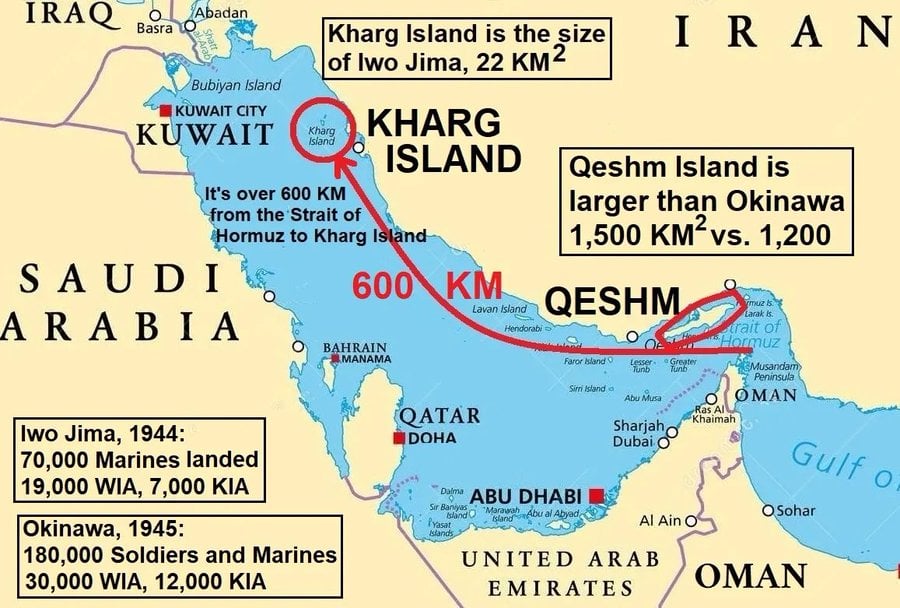
"Some folks are seriously discussing a “ground operation” in Iran, and Kharg or Qeshm Islands seem to be their preferred targets. This sounds plausible in the abstract, but when you dig into the nuts and bolts, it looks to me like a suicide mission for the troops to be landed. I hope that wiser heads prevail, and refuse to plan or conduct a new Pickett’s Charge, Alamo, or Custer’s Last Stand.

First, let’s look at how the Soldiers or Marines would be delivered to Qeshm Island. Our Osprey tilt-rotors have double the range and speed of helicopters, so IMHO they will be the go-to first option. I’ll discuss dropping Soldiers by parachute later. And just rule out bringing our amphibious ships loaded with Marines close enough to disgorge their ACVs, Amphibious Combat Vehicles, with their max speed of 6 knots through the water, and max range through the water of 12 nautical miles. The ships would be sitting ducks while offloading ACVs and landing craft.

“A Marine amphibious assault, likely hitting Qeshm Island before Kharg, because Kharg sits too deep in the Persian Gulf to be the first move.” A Marine amphibious assault with WHAT? Helicopters and tilt-rotors, lift by painfully slow lift, from distant ships? Forget about bringing amphibious ships within boat and ACV launching range of Qeshm, much less Kharg.

Do the math, run the numbers, count the troops, planes, helicopters and tilt-rotors. The idea of invading Queshm is insane. Okinawa was not in artillery range of Japan. Custer faced better odds at Little Big Horn.
A Qeshm Island beach:
Typical Qeshm Island terrain. This is what you can see from above. You can’t see the tunnel complexes.
“Inside Qeshm Island, Iran’s underground ‘missile city’”

"You Are My Brother..."

“You are my brother, but why are you quarreling with me? Why do you invade my country and try to subjugate me for the sake of pleasing those who are seeking glory and authority? Why do you leave your wife and children and follow Death to the distant land for the sake of those who buy glory with your blood, and high honor with your mother's tears?

Is it an honor for a man to kill his brother man? If you deem it an honor, let it be an act of worship, and erect a temple to Cain who slew his brother Abel.

Is self-preservation the first law of Nature? Why, then, does Greed urge you to self-sacrifice in order only to achieve his aim in hurting your brothers? Beware, my brother, of the leader who says, "Love of existence obliges us to deprive the people of their rights!" I say unto you but this: protecting others' rights is the noblest and most beautiful human act; if my existence requires that I kill others, then death is more honorable to me, and if I cannot find someone to kill me for the protection of my honor, I will not hesitate to take my life by my own hands for the sake of Eternity before Eternity comes.

Selfishness, my brother, is the cause of blind superiority, and superiority creates clanship, and clanship creates authority which leads to discord and subjugation.

The soul believes in the power of knowledge and justice over dark ignorance; it denies the authority that supplies the swords to defend and strengthen ignorance and oppression - that authority which destroyed Babylon and shook the foundation of Jerusalem and left Rome in ruins. It is that which made people call criminals great men; made writers respect their names; made historians relate the stories of their inhumanity in manner of praise.

The only authority I obey is the knowledge of guarding and acquiescing in the Natural Law of Justice.

What justice does authority display when it kills the killer? When it imprisons the robber? When it descends on a neighborhood country and slays its people? What does justice think of the authority under which a killer punishes the one who kills, and a thief sentences the one who steals?

You are my brother, and I love you; and Love is justice with its full intensity and dignity. If justice did not support my love for you, regardless of your tribe and community, I would be a deceiver concealing the ugliness of selfishness behind the outer garment of pure love.”

- Kahlil Gibran

"The Cry of Their Mothers..."

"Humanity is the spirit of the Supreme Being on earth, and that humanity is standing amidst ruins, hiding its nakedness behind tattered rags, shedding tears upon hollow cheeks, and calling for its children with pitiful voice. But the children are busy singing their clan's anthem; they are busy sharpening the swords and cannot hear the cry of their mothers."
- Kahlil Gibran
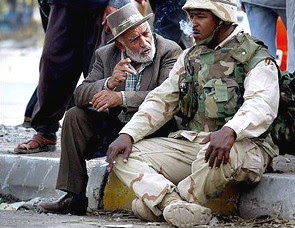
U.S. Navy Hospital Corpsman HM1 Richard Barnett, assigned to the 1st Marine Division, holds an Iraqi child in central Iraq in this March 29, 2003 file photo. Confused front line crossfire ripped apart an Iraqi family after local soldiers appeared to force civilians towards positions held by U.S. Marines.

“My heart broke on its shame and sorrow. I suddenly knew how much crying there was in me, and how little love. I knew, at last, how lonely I was. But I couldn’t respond. My culture had taught me all the wrong things well. So I lay completely still, and gave no reaction at all. But the soul has no culture. The soul has no nations. The soul has no color or accent or way of life. The soul is forever. The soul is one. And when the heart has its moment of truth and sorrow, the soul can’t be stilled. I clenched my teeth against the stars. I closed my eyes. I surrendered to sleep. One of the reasons why we crave love, and seek it so desperately, is that love is the only cure for loneliness, and shame, and sorrow. But some feelings sink so deep into the heart that only loneliness can help you find them again. Some truths about yourself are so painful that only shame can help you live with them. And some things are just so sad that only your soul can do the crying for you.”
- Gregory David Roberts, "Shantaram"

"How It Really Is"

Hey! They've got something big for you, too, Good Citizen!
Same as it always was, same as it always will be...

"You Won't Believe the Amount of Insanity Hitting the U.S. This August"

Full screen recommended.
Finance Economist, 7/18/26
"You Won't Believe the Amount of
 Insanity Hitting the U.S. This August"
"You won't believe the amount of insanity hitting the U.S. this August. Oil executives just warned the White House that petroleum inventories are at "tank bottom." Exxon's senior VP warned Brent crude could hit $150 to $160 per barrel. Gas is at $4.26 and climbing. The IEA confirms 10.5 million barrels per day of Gulf production is offline and demand exceeds supply by 1.78 million barrels per day. The personal savings rate collapsed to 2.6 percent, the lowest since before COVID. Twenty-nine percent of Americans are financing groceries on installment plans. The New York Fed warned last week that nearly half of all businesses have more tariff price increases planned. The $5 trillion debt ceiling raise from the OBBBA will be burned through in just two years. Hurricane season peaks in August while the grid is already under extreme stress. Texas came within 4 minutes of total grid collapse in 2021. The first official data on healthcare coverage losses and SNAP cuts is expected this summer. The CBO projects 5 million will lose insurance. And Congress goes on recess in August with nobody in Washington to manage any of it. Seven converging pressures in one month on a consumer who has $170 a month left in savings."
Comments here:

Adventures With Danno, "Shocking Prices At Sam's Club"

Full screen recommended.
Adventures With Danno, 7/18/26
"Shocking Prices At Sam's Club"
Comments here:
o
Meanwhile, in a sane, civilzed society...
Full screen recommended.
Travelling with Russell ,11/8/25
"I Went To Russia's Newest 
Discount Supermarket: Chizhik"
"What does the newest supermarket in Russia look like in 2026? Join me as I visit a brand new supermarket in Moscow, Russia. Chizhik Supermarket is a new chain store that has just opened its 3,000th store in only 5 years of trading."
Comments here:

"Walmart Just Got Caught... And Everyone Knew Something Was Wrong"

The Unfolded States, 7/18/26
"Walmart Just Got Caught... 
And Everyone Knew Something Was Wrong"
"Walmart meat overcharging concerns exploded after packaged ham was found weighing far less than the amount printed on its label. One package labeled at four point nine three pounds registered only one point eight three pounds on a Walmart store scale, raising serious questions about grocery price accuracy. This video examines the mislabeled meat at Walmart case, including the repeated three point one pound discrepancies found across several Kentucky Legend ham packages. We calculate how much customers could have overpaid, review how store employees responded, and separate confirmed evidence from claims that remain unproven. 

We also examine Kentucky Legend’s explanation, Walmart’s refund response, previous weighted grocery settlements, and the control gap between supplier labeling and retailer oversight. The evidence confirms an incorrect package weight problem, but it does not prove a deliberate nationwide scheme. More importantly, the case shows how supplier errors can reach store shelves when packaged meat labeling controls fail. You will also learn how shoppers can document suspicious weights, request verification, preserve receipts, and report unresolved discrepancies to local weights and measures authorities. Subscribe for more evidence based consumer investigations, and share your opinion below. Who should verify the weight before a product is sold, the supplier, Walmart, or both?"
Comments here: