

So, we rise from the rubble...
StatCounter
Tuesday, March 31, 2026

"What Have They Done To Our Food?"

by Michael Snyder
"Most of the pre-packaged garbage that we are being sold in our local grocery stores is “Frankenstein food”, but even though this is widely known most of the general population just keeps gobbling it down anyway. This is something that I have been wanting to write about for quite some time. The major food companies fully understand that they are destroying our health, and they are going to keep on doing it because nobody is going to stop them. We are talking about a crime against humanity of epic proportions, and they are totally getting away with it. It isn’t just a coincidence that cancer, heart disease and diabetes are exploding in our society today. What we are eating is making us sick, and those responsible are raking in billions of dollars.
Today, most pre-packaged foods have a very long list of ingredients. Some of the ingredients are generally recognizable, but many of them are not. Most of us just assume that the major food companies wouldn’t put anything in there that would harm us, but the truth is that most pre-packaged foods are absolutely packed with all sorts of strange substances.
100 years ago, food was food. If you want to eat like people did 100 years ago, you have to go to the “organic” section of the grocery store, and even then many products that have been labeled “organic” have been messed with too. Of course the vast majority of the population simply cannot afford to shop in the “organic” section because the products are simply too expensive.
So most people are forced to eat food that smells and tastes like it is artificial. A recent Reddit post about the decreasing quality of our food received a tremendous amount of attention…"Food is now just straight chemicals. I know America has always been slowly poisoning us but now they aren’t even hiding it. I had some bacon the other day and it tasted like straight up markers and bleach. I’ve seen so many videos of people melting Hershey’s chocolate and it won’t even melt, just turns to straight rubber. I would say grow a garden but the air quality sucks, the water is contaminated, the soil is tainted. Everything that’s “healthy” is expensive as hell and I just find it crazy. Thoughts?"
Not everything in that post was entirely accurate, but it is certainly true that much of what we eat doesn’t even taste like food anymore. In addition to the substances that have actually been approved by the FDA, a recent investigation discovered that more than 100 substances “of unknown safety” are being added to what we consume without any FDA oversight at all…"At least 111 substances of unknown safety have been added to foods, drinks and supplements sold in the United States without alerting the US Food and Drug Administration, a new investigation found.
“Food companies are deciding on their own to secretly add unreviewed chemical ingredients to products instead of following existing federal guidelines meant to assure food is ‘generally recognized as safe,’ or GRAS,” said Melanie Benesh, vice president for government affairs for the Environmental Working Group, a health and environmental health advocacy organization that conducted the investigation published Tuesday.
To meet the GRAS standard, companies must demonstrate a new food ingredient is safe by providing widely accepted scientific evidence that’s publicly available. Notifying the FDA of that safety data is customary and ensures regulatory compliance. It’s also voluntary - which means manufacturers can legally self-determine their products to be safe."
Are you kidding me? I had no idea that things were this bad. But this is the reality of life in 2026. We have reached a stage where our pre-packaged bread doesn’t resemble normal bread at all…A clip making the rounds online shows a woman performing a very basic “water test” on two slices of bread. One slice is Wonder Bread, one of the most widely sold breads in the United States, and the other is a slice she baked at home using traditional ingredients.And the results are… disturbing.
When the Wonder Bread is placed under running water, the slice literally repels water. It’s only after drowning it repeatedly that the slice finally bends and starts to absorb the liquid. The Wonder Bread slice is literally less absorbant than a sponge. Then the homemade slice, on the other hand, quickly breaks down the way you would expect, instantly absorbing the water and crumbling immediately.
When I was growing up, Wonder Bread was marketed as some sort of a space age miracle. Now we know the truth. Like thousands of other pre-packaged food products, one of the ingredients in Wonder Bread is high-fructose corn syrup… High-fructose corn syrup (HFCS) – called glucose-fructose syrup in the UK, glucose/fructose in Canada, and high-fructose maize syrup in other countries – is basically corn syrup that has undergone enzymatic processing to convert more or less half of its glucose into fructose. In North America, it has replaced the more expensive sucrose (table sugar) in processed foods (even ones that you wouldn’t think would be sweetened, like crackers, yogurt, and salad dressing) and beverages, where it can be labeled as “corn syrup.”
One way to dramatically improve your health is to avoid high-fructose corn syrup. A study that was conducted at Princeton University showed that high-fructose corn syrup causes “significant weight gain in lab animals”…"A Princeton University research team has demonstrated that all sweeteners are not equal when it comes to weight gain: Rats with access to high-fructose corn syrup gained significantly more weight than those with access to table sugar, even when their overall caloric intake was the same.
In addition to causing significant weight gain in lab animals, long-term consumption of high-fructose corn syrup also led to abnormal increases in body fat, especially in the abdomen, and a rise in circulating blood fats called triglycerides. The researchers say the work sheds light on the factors contributing to obesity trends in the United States.
“Some people have claimed that high-fructose corn syrup is no different than other sweeteners when it comes to weight gain and obesity, but our results make it clear that this just isn’t true, at least under the conditions of our tests,” said psychology professor Bart Hoebel, who specializes in the neuroscience of appetite, weight and sugar addiction. “When rats are drinking high-fructose corn syrup at levels well below those in soda pop, they’re becoming obese — every single one, across the board. Even when rats are fed a high-fat diet, you don’t see this; they don’t all gain extra weight.”
The major food companies know that their products are greatly contributing to our nationwide obesity epidemic and our nationwide diabetes epidemic. But they are never going to stop, because there is just so much money to be made.
Meanwhile, they continue to shrink package sizes so that they can make even bigger profits. One video that has gone viral on X shows how ridiculously small a hot fudge sundae at McDonald’s has now become…A popular X video shows a woman holding her obnoxiously tiny McDonald’s hot fudge sundae. I mean, it’s comically small. It looks like something you would give to a four-year-old child, not a grown adult. And what’s worse? It costs $4. Yeah, $4 for a cup of vanilla soft serve with some crappy “chocolate” sauce on top. I can remember when a hot fudge sundae at McDonald’s was actually quite large and was priced at just 99 cents.
Sadly, there is no going back now. Our world is changing all around us at a pace that is absolutely breathtaking. In this environment it is so important to think for ourselves, because it has become exceedingly clear that we simply cannot trust the large corporations."
"Alert: A Food Crisis is Coming, How Bad Could the Oil Crisis Get? w/ Doomberg"
Full screen recommended.
Prepper News, 3/31/26
"Alert: A Food Crisis is Coming,
How Bad Could the Oil Crisis Get? w/ Doomberg"
Comments here
o
Full screen recommended.
Snyder Reports, 3/31/26
"Americans Warned: Food Crisis Is Getting Worse"
Comments here:
Bill Bonner, "Shock and Aw Shucks"

"Shock and Aw Shucks"
by Bill Bonner
"We negotiate with bombs.”
- Pete Hegseth
Baltimore, Maryland - "Words are a lot less expensive than bombs. And you don’t have the costs of cleaning up. Which is why thinking, and expressing your thoughts in words - even single syllable words - rather than bombs, is almost always the cheaper and more effective way forward. But far be it from us to offer advice to Pete Hegseth. He has a role to play - the ‘comic book tough guy’ contributing to the empire’s decline. And he plays it well. He says his forces will “destroy the enemy as viciously as possible from moment one.”
Maybe so. But the gods of war do not favor oafish amateurs. Which is the whole point; his historical role is to turn the gods against us. Kristi Noem is already out of Donald Trump’s inner circle. If the war goes badly, as it seems to be, Hegseth may soon be sent packing too. In the meantime, Hegseth should be an inspiration to young men everywhere. He’s the kind of jockish guy who normally peaks out in the 11th grade, as captain of the football team. And here he is at the head of the biggest, most wealth-destroying enterprise in the world.
An empire is essentially a protection business...sometimes providing good service...but often, just a racket. People like Hegseth provide the muscle. But in order for the empire to survive, someone should probably do some thinking too. Somehow, the empire must enforce its monopoly on the use of violence so that people within the empire are able to go about their business with tolerable security. And it must have a reliable economic system, too, whereby people can trade, earn money, and save their wealth. Typically, both goals are served by protecting trading routes.
The Mongol Empire created a huge trading area that stretched from the Pacific coast of China all the way to the Bosporus. The Mongols set up way stations to make travel and transport easier. They made the Silk Road much safer, too. If goods were stolen by bandits along the way, the local community was held responsible for making up the losses. In the 14th century, as the Mongol Empire broke apart, the trading routes became less safe and the empire itself ebbed into a backwater.
The British Empire, too, went out of business when it lost control of vital trade routes. After the decline of the Mongol Empire, the Ottomans took over Anatolia and much of the Levant. This left them in position to strangle traffic coming through the Bosporus Strait. When the Turks closed it to English shipping in WWI, prices in England rose...and the value of the pound fell. The UK tried to unblock the strait with an invasion of Gallipoli, but as we’ve seen, the invasion was a military disaster and the strait remained in Ottoman hands.
The next important pinch point to slip away was the Suez Canal. Built by a French company in the 1860s, the canal became a vital trade passage, connecting Europe to India and the East. It was by this canal that the British Empire was to fully exploit its crown jewel - India. So important was it that the English developed a word for how best to make the trip. POSH, port out, starboard home…and avoid the hot Egyptian sun.
But as we saw yesterday, the pound sank into the mud of the Somme and never recovered. By the end of WWI, Britain was deeply in debt. It had to give up India in 1947. And then, in 1956, it was unable to control the Suez Canal. That was when the sun set on the British Empire.
Could it be that the Strait of Hormuz marks a similar twilight for the US empire? Today, the world’s economies run on oil. The US controlled the oil flow, first by pricing it in dollars....and second, by providing ‘security’ to the oil producers. As to the first condition, Iran has been off the reservation for the last 20 years. It sold oil for euros. Now, it is asking for yuan.
As to the second, all was fine until the US and Israel began ‘negotiating’ with Iran by bombing it. The Iranians then did the obvious thing. They blocked the strait of Hormuz to ‘enemy’ transit. The US may or may not be able to re-open it. Der Speigel: "Trump’s options against Iran have run out. The US president entered the field with the promise of a quick and powerful agreement, but now finds himself in the midst of a war that he can neither win nor find a dignified way out of. Iran has put Trump in a trap by targeting the world’s energy arteries, with no escape route, and he has no clear idea how to end this strategic suicide."
Meanwhile, the dollar seems to be taking too many sleeping pills too. AsiaTimes: "Iran is not simply disrupting oil supply - it is quietly challenging the currency structure underpinning global energy trade. Under sanctions, Tehran has developed alternative channels, exporting oil through barter arrangements, informal networks and increasingly through settlements in Chinese yuan. This shift is not merely tactical; it reflects a broader strategic alignment with efforts toward de-dollarization."
If Iran succeeds in institutionalizing yuan-based oil trade, the implications could extend well beyond sanctions evasion. Energy markets have long anchored dollar dominance. Even partial diversification in pricing and settlement mechanisms could begin to weaken that foundation. Iran is still resisting. Send more bombers to negotiate!"
"$4 Gas Is Just The Beginning… Here’s What Hits Next"
Full screen recommended.
Snyder Reports, 3/31/26
"$4 Gas Is Just The Beginning…
Here’s What Hits Next"
Comments here:
"Price Increases Coming... This is About To Get Ugly"
Full screen recommended.
Adventures With Danno, 3/31/26
"Price Increases Coming...
This is About To Get Ugly"
Comments here:
o
Adventures With Danno, 3/31/26
"Record Number Of Store Closures
Happening Now In 2026!"
Comments here:
Dan, I Allegedly, "The Grocery Collapse Has Started"
Full screen recommended.
Dan, I Allegedly, 3/31/26
"The Grocery Collapse Has Started"
"Grocery stores are raising prices, but behind the scenes many are quietly collapsing. In this video, I break down the growing wave of grocery store closures, including major chains shutting locations and cutting jobs. From rising operating costs and insurance spikes to shrinking consumer spending, this is a warning sign that the economy is far weaker than most people realize. When even essential businesses like grocery stores can’t survive, it tells you everything about where things are headed. We also cover major financial red flags happening right now—from banking scams draining accounts, to auto industry stress, student loan debt disasters, and even the Federal Reserve reporting losses. This is bigger than just retail—it’s a full breakdown of financial stability across multiple sectors. If you want to understand what’s really happening with the economy, inflation, and your money, this is a must-watch."
Comments here:
Monday, March 30, 2026
"Time Is Escalating Quickly, Pay Close Attention; These Are Very Dangerous Times"
Jeremiah Babe, 3/30/31
"Time Is Escalating Quickly, Pay Close Attention;
These Are Very Dangerous Times"
Comments here:
Musical Interlude: 2002, "Kindred Spirits"
Full screen recommended.
2002, "Kindred Spirits"
"Once we sailed upon the seas. Now we sail among the stars. This song was composed as a tribute to our friend, harpist Hilary Stagg, who left us far too soon. Hilary loved the sea and he loved the stars."
"A Look to the Heavens"
"These two mighty galaxies are pulling each other apart. Known as the "Mice" because they have such long tails, each spiral galaxy has likely already passed through the other. The long tails are created by the relative difference between gravitational pulls on the near and far parts of each galaxy. Because the distances are so large, the cosmic interaction takes place in slow motion - over hundreds of millions of years.

NGC 4676 lies about 300 million light-years away toward the constellation of Bernice's Hair (Coma Berenices) and are likely members of the Coma Cluster of Galaxies. The featured picture was taken with the Hubble Space Telescope's Advanced Camera for Surveys in 2002. These galactic mice will probably collide again and again over the next billion years so that, instead of continuing to pull each other apart, they coalesce to form a single galaxy."
The Poet: Wendell Berry, “Leavings”
.jpg)
“Leavings”
“In time a man disappears
from his lifelong fields, from
the streams he has walked beside,
from the woods where he sat and waited.
Thinking of this, he seems to
miss himself in those places
as if always he has been there.
But first he must disappear,
and this he foresees with hope,
with thanks. Let others come.”
- Wendell Berry
○
“Perhaps as he was lying awake then, his life may have passed before him – his early hopeful struggles, his manly successes and prosperity, his downfall in his declining years, and his present helpless condition – no chance of revenge against Fortune, which had had the better of him - neither name nor money to bequeath – a spent-out, bootless life of defeat and disappointment, and the end here! Which, I wonder, brother reader, is the better lot, to die prosperous and famous, or poor and disappointed? To have, and to be forced to yield; or to sink out of life, having played and lost the game? That must be a strange feeling, when a day of our life comes and we say, “Tomorrow, success or failure won’t matter much, and the sun will rise, and all the myriads of mankind go to their work or their pleasure as usual, but I shall be out of the turmoil.”
- William Makepeace Thackeray, “Vanity Fair”
"People Are Not Ready For What’s About To Happen"
Full screen recommended.
Finance Economist, 3/30/26
"People Are Not Ready For What’s About To Happen"
"$18.8 trillion in household debt. $1.3 trillion on credit cards. 151 million Americans at risk of blackouts. And the typical worker has less than $1,000 saved for retirement. This is not a prediction. This is the data. And nobody is talking about all of it at once. In this video, I break down the 10 economic warning signs converging in America right now from the commercial real estate collapse threatening regional banks, to the dollar losing its global grip, to an insurance crisis that could make parts of the country unmortgageable, to an AI layoff wave that has only just begun."
Comments here:
Adventures With Danno, "Stock Up Now, Prepare For The Worst"
Adventures With Danno, 3/30/26
"Stock Up Now, Prepare For The Worst"
Comments here:
"The Job Market Is Much Worse Than They're Telling You"
Full screen recommended.
Epic Economist,3/30/26
"The Job Market Is Much Worse
Than They're Telling You"
"The headlines say the job market is holding up. The official numbers say unemployment is under control. But if you've been out there applying, you already know that something doesn't add up. People with degrees, experience, and stacked resumes are sending out hundreds of applications and hearing absolutely nothing back. In this video, we're getting into what's really going on and why the picture is a whole lot darker than what's being reported.
We're looking at real stories from people inside the recruiting world, from job seekers who have been at this for months, and from workers who are already thinking two steps ahead because they can see where this is heading. Recruiters are drowning in thousands of applications per posting. Fake candidates are competing with real ones. AI is sorting through resumes before a human ever lays eyes on them. And that's before we even get into the wave of layoffs that's already building.
For a lot of people, this is turning into something much longer and much harder. We're talking about prolonged unemployment, depleted savings, and the kind of rejection cycle that starts to mess with your head after a while. For the first time since Gallup started tracking it, more Americans say they are struggling than thriving. That number says everything the official unemployment rate doesn't.
And then there's AI. It's not a future problem anymore. People are getting emails right now telling them their role has been eliminated because of it. Jeff Bezos is quietly raising a hundred billion dollars to buy factories and replace their workforces. CEOs are openly talking about replacing human intelligence with AI tokens. The entire structure of work as we've known it is being rearranged, and the people who spent years and serious money on an education to land a good job are going to be trying to pay off that debt in a market that's running a completely different playbook.
If you've been feeling like you're doing everything right and still getting nowhere, this one is for you. Drop your thoughts in the comments below. Whether you're in the middle of a job search, recently laid off, or just watching all of this unfold from the sidelines, I'd genuinely like to hear what you're seeing. If this video resonated with you, please share it with someone who needs to hear it, and make sure you're subscribed so you don't miss what's coming next."
Comments here:


The Universe

"Friends are friends because they've discovered how much they have in common. Opponents, adversaries, and foes are friends too, who have not yet discovered this. It's as if a band of amazing angels got together, before time even began, to celebrate their common heritage, sense of adventure, creativity and savoir faire, and decided to meet in the distant future, amongst the jungles of time and space, upon a distant little blue planet, to see how long it would take for each and every one of them to discover who they really are. 8 billion angels, to be precise."
"Your friend,"
The Universe
"Thoughts become things... choose the good ones!"
"Our Alaric Moment"

"Our Alaric Moment"
by The ZMan
"If you were living in the Western Roman Empire in the fourth century you probably knew that things were not going well. This assumes that you were prosperous enough to have time to think about these things. You could see that the infrastructure was failing and that the empire was struggling to maintain order. On the other hand, the decline had been happening for a long time so things may have seemed normal. Without some way to compare the present to the past, you only have instinct.
Today we have mountains of facts and figures to tell us how things are doing in the Global American Empire. There was a time not so long ago when these facts and figures made up the bulk of news coverage. Economists became court wizards, explaining the latest unemployment figures or trade numbers. They were also called upon to bless whatever polices were being debated in Congress. In the Obama years, economic data was the way we measured the glories of the empire.
That has all changed now. One reason is no one in their right mind takes anything the government says at face value. People had grown used to the way the media biased the numbers depending upon who was in office, but the mortgage crisis cratered the public’s confidence in the numbers themselves. If all of the court wizards explaining the numbers could not see the mortgage fiasco coming, then why should anyone believe them about unemployment or inflation?
Then you have the general lying that has become a feature of government. The lying about Covid not only disgraced the medical profession, but it finished off whatever trust people had in the official numbers. If the government lies about how many people are dying from Covid just to move more product for the drug makers, the government will lie about how many people are working or the inflation numbers. No one trusts the numbers because no one trusts the people issuing the numbers.
The point here is we cannot trust the numbers if the numbers have no relationship to anything we have experienced. When the end of the world has the same numbers as what most consider to be a golden era for the empire, those numbers cease to have any meaning to us. Throw in the fact that most people do not feel like they are richer than their ancestors and those inflated stock figures carry even less weight. We are left to rely on our instincts to judge things.
Of course, our sense of things, that gut feeling, is the result of a many small things that we experience every day. Three-quarters of Americans think the country is going in the wrong direction because they go to the grocery store every week. They see that despite the crowing about inflation coming down, food remains expensive. Granted, no one is starving in America due to a lack of affordable food, but it is that thing they see every day that gives people a sense of things.
Think about something simple like a pint of premium ice cream. A few years ago, a pint was sixteen ounces. “A pint is a pint the world around” was true from peak of the British empire until just a few years ago. Now a pint is fourteen ounces. The price for the new pint is not the same as the old pint. The price is more than the old pint. A few years ago, the old pint of ice cream was five dollars. That is about 31¢ per ounce. Today the new pint is over seven dollars or 51¢ per ounce.
That is a seventy percent change in the price. This is one example and probably not a representative one, given that butterfat prices drive dairy prices. Even so, this is something people see all over the marketplace. Shrinkflation is a word because it is a thing that exists. People notice that the containers are getting smaller, or they are getting less full in the case of things like snacks. Meanwhile, prices go up. This subtly tells people that something is going wrong.
This brings us back to where we started. There were those in the Roman Empire who sensed the true state of affairs. No doubt some of them lived and died expecting things to fall apart, only to stagger on long past their time. Then there were others who internalized this reality and just accepted that no matter how grim things might appear, the empire was a permanent feature of life. The people probably just tried to make the best of things, even as they noticed the decline.
All of that changed on August 24, 410 AD when Alaric led the Visigoths into the eternal city, sacking Rome and setting off the collapse of the Western empire. The empire staggered on for a bit longer, but it was over at that point. All of those bad signs people had sensed probably seemed obvious in retrospect. Even so, the sack of Rome by the Visigoths was a shock to the world. The signs seemed obvious, but people still thought that the imperial order was permanent.
This is most likely the fate of the American empire. There are lots of signs that things are going poorly for the empire. Getting whipped by a collection of bronze age goatherds in the graveyard of empires should have been a wakeup call, but the empire is now in a war with Iran and picking fights with Russia and China. Meanwhile things deteriorate domestically, both economically and culturally. Yet, we stagger on, but somewhere out there is an Alaric moment just waiting to happen."

"Economy Was Already Horrible & New Global Crisis Just Made It Worse"
Full screen recommended.
The Unfolded States, 3/30/26
"Economy Was Already Horrible &
New Global Crisis Just Made It Worse"
"The economy was already under pressure, but now a new global shock is making things worse. Prices remain high, wage growth is slow, and debt continues to rise. At the same time, energy markets and global supply chains are becoming more unstable, adding a new layer of risk to an already fragile system. In this video, we break down what’s really happening behind rising costs, slowing job growth, and increasing financial stress. Using real data from sources like the Bureau of Labor Statistics, Federal Reserve, and global energy reports, this analysis explains why the current situation is not a sudden crisis, but a buildup of multiple pressures happening at once. Is this just a temporary phase, or the early signs of a deeper recession? Watch until the end to understand where the global economy may be heading next."
Comments here:
"This Is What a Bank Run Looks Like in 2026 - You Just Don’t See the Line"
Full screen recommended.
Dan, I Allegedly, 3/30/26
"This Is What a Bank Run Looks Like in 2026 -
You Just Don’t See the Line"
"A modern-day bank run is already here - and most people don’t even realize it. In 2026, there are no lines outside the bank, no crowds, no warning signs… just a login screen telling you “no.” Major financial institutions like UBS, BlackRock, and Morgan Stanley are quietly restricting withdrawals, locking up billions of dollars, and limiting how much money investors can access. This isn’t a glitch or a delay - it’s a systemic liquidity crisis where people are trying to pull their money out faster than banks and funds can provide it. The reality is simple: a bank run today doesn’t look like panic in the streets - it looks like denied access to your own cash. What makes this even more alarming is how widespread this is becoming across private credit funds, real estate investments, and major banks. Billions are already trapped, with some investors told they may wait years to access their money. This directly impacts everyday people through pensions, retirement accounts, and traditional banks like Bank of America and Wells Fargo. As commercial real estate collapses, lending tightens, and institutions protect themselves, the risk grows for everyone. This video breaks down why this is happening, how it affects you, and what you can do right now to protect your money before you log in one day and find out you can’t withdraw it. #bankrun"
Comments here:
Adventures With Danno, "Massive Spring Sales at Sam's Club!"
Full screen recommended.
Adventures With Danno, 3/30/26
"Massive Spring Sales at Sam's Club!"
Comments here:
Bill Bonner, "Edge of Empire"

"Edge of Empire"
by Bill Bonner
Baltimore, Maryland - "The world sat on the edge of its chair this weekend. Troop movements looked like something was up; an invasion of Iran seemed to be minutes away. ‘Just what we need now,’ many were saying, sarcastically. We are already insolvent. A war will make it worse. How much worse is the question at hand. Wolf Richter gave us a hint: "Status of US Dollar as Global Reserve Currency: USD Share Drops to 31-Year Low as Central Banks Diversify into Other Currencies & Gold."
In WWI, the British Empire found itself fighting for no reason. It had been fighting for centuries. That’s what empires do. But this was fighting on a scale it couldn’t afford. Is it cause...or effect? We don’t know. But successful empires need to provide a tolerable level of security…and money you can trust. Take away the strong currency and the strength of the empire seems to go away too.
In the 19th century, Britain was the world’s leading hegemon. Its currency - backed 100% by gold - kept prices stable for almost 100 years. It was also a relatively peaceful century. The United Kingdom fought its battles on the periphery of the empire - in India, Africa, the Crimea, China. None of them engaged the full economic and military might of the empire.
What a great time to an Englishman! Power, wealth and status - he had it all. John Maynard Keynes, a leading economist of the 20th century described his good fortune: ‘The inhabitant of London could order by telephone, sipping his morning tea in bed, the various products of the whole earth, in such quantity as he might see fit, and reasonably expect their early delivery upon his doorstep; he could at the same moment and by the same means adventure his wealth in the natural resources and new enterprises of any quarter of the world, and share, without exertion or even trouble, in their prospective fruits and advantages; or he could decide to couple the security of his fortunes with the good faith of the townspeople of any substantial municipality in any continent that fancy or information might recommend. He could secure forthwith, if he wished it, cheap and comfortable means of transit to any country or climate without passport or other formality, could despatch his servant to the neighbouring office of a bank for such supply of the precious metals as might seem convenient, and could then proceed abroad to foreign quarters, without knowledge of their religion, language, or customs, bearing coined wealth upon his person, and would consider himself greatly aggrieved and much surprised at the least interference.’
‘But, most important of all, he regarded this state of affairs as normal, certain, and permanent, except in the direction of further improvement, and any deviation from it as aberrant, scandalous, and avoidable.’ ‘The projects and politics of militarism and imperialism, of racial and cultural rivalries, of monopolies, restrictions, and exclusion, which were to play the serpent to this paradise, were little more than the amusements of his daily newspaper, and appeared to exercise almost no influence at all on the ordinary course of social and economic life, the internationalisation of which was nearly complete in practice.’
Sound familiar? Today, it might apply to the average New Yorker or Nevadan. Until very recently he could enjoy entertainments, fruits and gadgets from all over the world - with rarely an interruption. He might be totally ignorant of the long and complex supply lines that made it possible, or even from whence came these marvels. But his dollar was golden. People wanted it. They needed it. And he could ‘print’ trillions of them.
He surely counted himself among the most powerful and most deserving people ever to enjoy Eden...and with a credit card that had no obvious limit. But the serpents were crawling on the ground beneath him. He might be nervous about the level of debt necessary to continue living in the style to which he has become accustomed. His might also worry about rising prices. And he might be nursing a grudge, perhaps inspired by either the ‘libtards’ on the left or the ‘nazis’ on the right. A few especially cynical observers might also worry that the prosperity all around them was largely a mirage created by fake money...and he might worry that it would soon come to an end.
Shanaka Anselm Perera: ‘Annual interest on the national debt reached $1.22 trillion in fiscal year 2025. That is more than the defense budget. More than Medicare. The war supplemental request for the Iran conflict exceeds $200 billion. The Federal Reserve cannot cut rates because Hormuz-driven energy inflation has pushed PCE to 2.7 percent and rising. Every basis point the Fed holds is a basis point that compounds against $39 trillion in gross debt. The war that was supposed to last weeks is now costing hundreds of billions while the borrowing cost of financing it rises with every barrel of oil that does not transit the strait.’
The sweet moment came to an end for the Londoner in August of 1914. That was the beginning of the Great War. The most amazing thing about the war was that Britain exhausted itself in a conflict in which it had nothing at stake.
Like America’s pounding of Iran, it was a war of choice, not necessity. For everyone involved. The two sides didn’t hate each other. All were getting on board with the Industrial Revolution. All were moving towards parliamentary democracy. And with the exception of marginal territorial transfers - Alsace and Lorraine went back to the French - nothing much was going to be gained by fighting,
But it was supposed to be short and sweet; everyone said so. And it would be glorious too. The flags flew. The recruiters’ offices needed extra staff. The papers sent their correspondents to cover the action, as if it were the Olympics played out for mortal stakes. But the initial excitement gave way to battle fatigue...and insolvency.
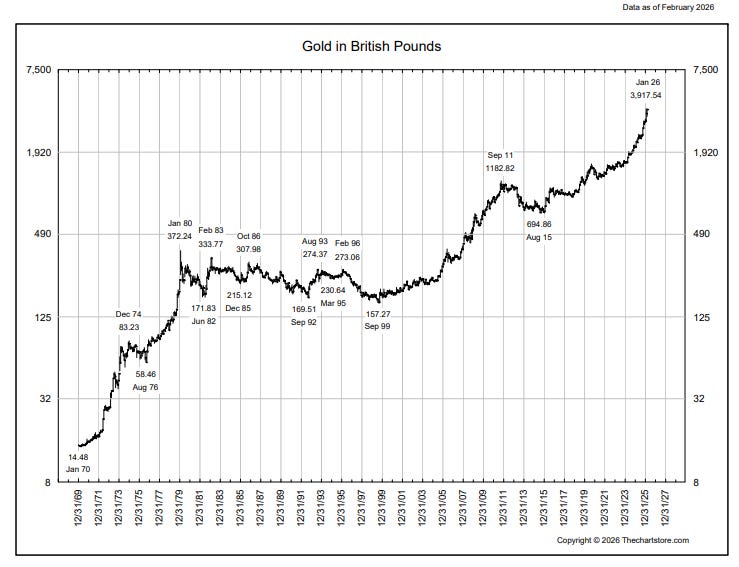
The war changed everything...beginning with the money. When WWI began, the UK was not only the leading military power - Britannia Rules the Waves! - it had the world’s healthiest economy, with 40% of the world’s international investment.
Then, in 1914, Britain went off the gold standard...and its money and its imperial power both started to slide. By the end of the war, it was deeply in debt, especially to the US. (One hypothesis about why the US went into the war on the side of the UK, rather than the Germans, was simply that its bankers had lent the English more money.) And when the guns finally went silent, the interest alone on its debt cost the UK 40% of its entire budget. This is what led to the Depression of 1920-21. It also led to further devaluation of the pound.
The British empire came to a final, wimpy end in the Suez Crisis of 1956. ‘Allied’ with France and Israel, Britain set out to take back the canal from Egypt. The three allies attacked. But when they appealed to Eisenhower for backing, the US president said ‘no.’ (This was before the Israeli lobby had such a tight grip on US lawmakers.) Eisenhower went on to block Britain’s request for IMF loans.
The pound continued to lose value. First, it lost against the dollar...then, it lost against goods and services. Since 1914, it has lost 99% of its purchasing power. Against gold, the loss was even worse. In 1914, you could buy an ounce of gold for 3 pounds, 17 shillings and 9 pence. Today, it is approximately £3,430/oz. That is nearly a 99.9% loss."
"Donald Trump’s Imaginary Iranian Friends"

"Donald Trump’s Imaginary Iranian Friends"
by Larry C. Johnson
"Let me begin by offering my apology to all who posted comments that were then put in moderation - by the software, not by me. I just returned home from Calgary and am in the process of cleaning up the pending folder. I have not deleted any comments… They all are now posted.
The reason for my inability to get the pending folder cleaned out is because I attended and spoke to the Shaun Newman Podcast conference that also featured Martin Armstrong, Alex Krainer, Karen Kwiatkowski and Matt Ehret. There were over 750 people in attendance and I met and interacted with the nicest people you could imagine. I did catch some grief - all good natured - from several of you who attended and chastised me for not wearing my traditional Florida shirts. It was -2 Celsius when I arrived in Calgary and I confess… I’m a wimp. Florida shirts don’t do well in the snow.
A good portion of the crowd was from Alberta, the Canadian province, and they are keen on creating an independent Republic. They are justifiably angry at the bullying they have received from the central Canadian government. But they are not violent or aggressive. Nope. Very kind, very sincere and very intent on protecting their freedoms.
Ok. Down to business. Despite Donald Trump’s claim that he - or someone in his administration - is talking with the Iranians is pure hokum. Pakistani diplomats have volunteered to pass messages back-and-forth between the US and Iran, but Iran’s demands are anathema to Trump and vice versa. Iran is not going to surrender or agree to a ceasefire until its core demands are met: reparations, the removal of all sanctions and the elimination of US military bases in the Persian Gulf. The murder of the 175 school girls, along with the assassinations of key Iranian officials, as a result of the US and Israeli war of aggression on the people of Iran will not be forgiven and swept under the rug.
Despite Trump’s insistence that Iran is eager to negotiate, he is lying. Iran continues to methodically attack US and Israeli military assets and has succeeded in destroying billions of dollars in advanced radars, refueling airplanes, drones and, in the most recent strike, an AWACS plane. The AWACS plane was being used to provide warning intelligence that was previously supplied by the now defunct radars the US had scattered among the Gulf Arab countries.
Trump’s claim that Iran is running out of missiles also is not true. As I am writing this, Iran has launched three waves of launches to the Negev in under an hour.
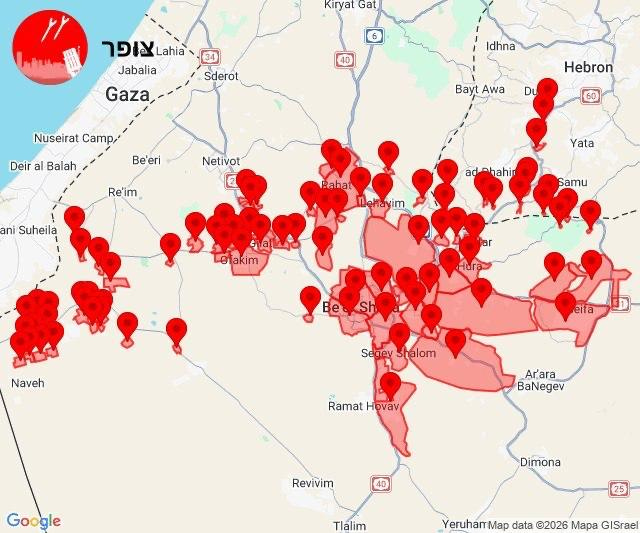
In response to Donald Trump’s various threats, a spokesperson for Iran’s Khatam al-Anbiya HQ recently said:
➡The U.S. president has threatened that if Iran doesn’t reopen the Strait of Hormuz, U.S. forces will target Iranian power plants.
➡Tehran insists the Strait is only restricted to hostile traffic and remains under Iran’s control; safe passage continues under strict rules.
➡If the U.S. strikes Iranian power plants, Iran will:
Fully close the Strait of Hormuz until damaged facilities are rebuilt.
Target all Israeli energy, ICT, and infrastructure assets.
Destroy regional companies with U.S. shareholders.
Target power plants in countries hosting U.S. bases.
➡Iran says it is ready for a major campaign to eliminate all U.S. economic interests in West Asia.
➡While Tehran did not start this conflict, any attack on Iranian infrastructure will trigger relentless retaliation against U.S. and allied energy, oil, and industrial targets in the region.
The US and Israel ignored Iran’s warning and attacked… and, as promised, Iran responded forcefully. On Sunday, according to a statement from Kuwait’s Ministry of Electricity, Water and Renewable Energy, an Indian worker was killed and significant damage was caused to a service building at a power and desalination plant, as a result of an Iranian attack against the State of Kuwait. Satellite data from NASA has reportedly detected an active fire at the Doha West Power and Water Desalination Station, the country’s largest combined power and water plant.
Imagery shows burn marks and smoke across the central section, with heat signals extending toward coastal storage tanks. The facility produces 2,400MW of power and around 110 million gallons of water per day, making up about 38.5% of Kuwait’s desalination output. With around 90% of Kuwait’s drinking water coming from desalination, this damage will quickly put pressure on the country’s water supply.
New satellite images also show damage following Iranian missile strikes on a US airbase in Sheikh Isa, Bahrain:
- US Army Air Base Radar Maintenance Shed Hit.
- Destroying the spy plane hangars.
- Destruction of the drone hangar.
- Destruction of the equipment depot.
Despite continued bombing of targets in Iran, the Iranians are showing no signs of weakening… In fact, they are intensifying their attacks, inspired by the continued slaughter of Iranian children. Here are three of the latest victims of US and Israeli strikes in Iran:

According to Haaretz, the success rate of Iranian missiles in Israel has reached 80%, and the missiles are not being intercepted. Iran is not alone. Hezbollah also is fully engaged in fighting Israel. Hezbollah announced 70 operations on 29 March against Israeli forces, sites, settlements, and military infrastructure. These included:
Border clashes. Heavy fighting spread across Aitaroun, Ainata, Qantara, Bayyada, Deir Siryan, Houla, Shamaa, Maroun al-Ras, and Beit Lif, including close-range engagements and ambushes targeting advancing Israeli forces. A major infiltration attempt toward Ainata was repelled with explosives and direct fire, followed by strikes on Merkava tanks and armored units. Multiple clashes resulted in destroyed tanks, with over a dozen Merkava tanks targeted, including engagements at zero distance, and forced evacuation operations under heavy fire.
Drone attacks: Attack drones targeted key Israeli positions and assets, including Biriya air defense base, Rawiya base in the occupied Syrian Golan, and Gilaa barracks, as well as troop concentrations and armored vehicles across Bayyada, Qantara, Alma al-Shaab, Deir Siryan, and Houla. Drones also struck Hummers, D9 bulldozers, and armored units, while one Israeli armed drone was shot down over Mansouri.
Rocket/missile strikes: Rocket barrages hit Israeli troop concentrations and positions across Malikiya, Aitaroun, Qantara, Deir Siryan, Ainata, and the Khiam axis, alongside strikes on settlements including Metula, Shtula, Yir’on, Avivim, and Nahariya. Sustained fire also targeted gatherings near schools, infrastructure points, and frontline staging areas throughout the day.
Strategic military targets: Strikes targeted major Israeli military infrastructure, including Ein Shemer air defense base east of Hadera, Raghavim base south of Haifa, Biriya base and Michve Allon base near Safad, Giv’a drone command base east of Safad, Ein Zeitim base, and Kela barracks in the occupied Golan. Additional strikes hit infrastructure in Katzrin and Kfar Vradim, as well as artillery positions and newly established military sites, alongside repeated targeting of communications and operational nodes.
The upcoming week - March 30 to April4 - marks the fifth week of the war with no sign of an end in sight. The economic effects on the world economy are going to hit with greater force and will increase pressure on the US and Israel to stop the war. However, I fully anticipate that Donald Trump will follow thru on his threats to try to capture some Iranian territory by deploying US military forces on the ground. If Trump does this, it will only expand the war and will dramatically increase the number of US casualties. This will not calm the financial markets… I expect it will have the exact opposite effect. The global economy is in a recession… Western economists are just now beginning to understand that reality."
"Iran Strikes Israel’s Final Active Water Plant — Nationwide Water Crisis Unfolds"
Full screen recommended.
Index AG, 3/29/26
"Iran Strikes Israel’s Final Active Water Plant -
Nationwide Water Crisis Unfolds"
"The clock has officially run out for Israel’s national water security. Thirty minutes ago, a targeted Iranian cluster missile strike successfully neutralized the final functioning desalination and water treatment facility in the country. This was not just another attack on infrastructure; it was the definitive conclusion to the nation’s ability to provide life-sustaining fluid to its population. With the Meccarat network already decimated by previous engagements, this singular facility was the only heart still beating for four million people in Tel Aviv and the coastal plain. In this deep-dive analysis, we break down the high-level strategic engineering behind Iran’s choice of weaponry and why this specific strike represents a transition from a “water crisis” to a “water absence.” This is the reality of civilizational collapse in the 21st century."
Comments here:
Sunday, March 29, 2026
Jeremiah Babe, "Alert! This Is The Most Dangerous Time In U.S. History"
Jeremiah Babe, 3/29/26
"Alert! This Is The Most Dangerous
Time In U.S. History"
Comments here:
"Alert! Emergency! Stock Up Now, Situation is Deteriorating, Desalination Plants Hit!"
Full screen recommended.
Canadian Prepper, 3/29/26
"Alert! Emergency! Stock Up Now,
Situation is Deteriorating, Desalination Plants Hit!"
Comments here:
"A Photo From Auschwitz, 1944"
"A Photo From Auschwitz, 1944"
by Arfa Khanum
"If I didn't know where this photo was taken and who took it, namely an SS officer, I would think it was a moment of rest after the mass, in an open field, where one sits down and eats something after a pilgrimage, before when you go home and take a photo as a souvenir, just like I did as a child with our church community.
This photo shows a child who has found a dandelion in the grass
and is now giving or showing it to an older child, perhaps a sibling.
A few minutes later, all the people shown here were sent to the gas chambers. And all that remains of these Hungarian Jews is this photograph... children, men, women, boys, girls and this small spontaneous gesture, then screams, shouts and silence."
“My heart broke on its shame and sorrow. I suddenly knew how much crying there was in me, and how little love. I knew, at last, how lonely I was. But I couldn’t respond. My culture had taught me all the wrong things well. So I lay completely still, and gave no reaction at all. But the soul has no culture. The soul has no nations. The soul has no color or accent or way of life. The soul is forever. The soul is one. And when the heart has its moment of truth and sorrow, the soul can’t be stilled. I clenched my teeth against the stars. I closed my eyes. I surrendered to sleep. One of the reasons why we crave love, and seek it so desperately, is that love is the only cure for loneliness, and shame, and sorrow. But some feelings sink so deep into the heart that only loneliness can help you find them again. Some truths about yourself are so painful that only shame can help you live with them. And some things are just so sad that only your soul can do the crying for you.”
- Gregory David Roberts, "Shantaram"
"A Look to the Heavens"
"Colorful NGC 1579 resembles the better known Trifid Nebula, but lies much farther north in planet Earth's sky, in the heroic constellation Perseus. About 2,100 light-years away and 3 light-years across, NGC 1579 is, like the Trifid, a study in contrasting blue and red colors, with dark dust lanes prominent in the nebula's central regions.

In both, dust reflects starlight to produce beautiful blue reflection nebulae. But unlike the Trifid, in NGC 1579 the reddish glow is not emission from clouds of glowing hydrogen gas excited by ultraviolet light from a nearby hot star. Instead, the dust in NGC 1579 drastically diminishes, reddens, and scatters the light from an embedded, extremely young, massive star, itself a strong emitter of the characteristic red hydrogen alpha light."
'There Are Days..."

"How do you beat the odds when it’s one against a billion? You stand strong, keep pushing yourself past all rational limits and never let yourself give up. But the truth of the matter is, despite how hard you try and fight to stay in control, when it’s all said and done, sometimes you’re just outnumbered."
- "Dr. Meredith Grey," "Grey's Anatomy"
○
"There are days that make the sacrifices seem worthwhile... and then there are the days where everything feels like a sacrifice. And then there are the sacrifices that you can't even figure out why you're making. A wise man once said, you can have anything in life if you will sacrifice everything else for it. What he meant it, nothing comes without a price. So before you go into battle, you better decide how much you're willing to lose. Too often, going after what feels good means letting go of what you know is right. And letting someone in means abandoning the walls you've spent a lifetime building. Of course, the toughest sacrifices are the ones we don't see coming. When we don't have time to come up with a strategy, to pick a side, or to measure the potential loss.When that happens, when the battle chooses us, that's when the sacrifice can turn out to be more than we can bear."
- "Dr. Meredith Grey", "Grey's Anatomy"
"What Keeps You Going"

“What keeps you going isn’t some fine destination but just the road you’re on, and the fact that you know how to drive. You keep your eyes open, you see this damned-to-hell world you got born into, and you ask yourself, ‘What life can I live that will let me breathe in and out and love somebody or something and not run off screaming into the woods?’”
- Barbara Kingsolver
“For this is what we do. Put one foot forward and then the other. Lift our eyes to the snarl and smile of the world once more. Think. Act. Feel. Add our little consequence to the tides of good and evil that flood and drain the world. Drag our shadowed crosses into the hope of another night. Push our brave hearts into the promise of a new day. With love: the passionate search for truth other than our own. With longing: the pure, ineffable yearning to be saved. For so long as fate keeps waiting, we live on. God help us. God forgive us. We live on.”
- Gregory David Roberts, “Shantaram"
The Poet: David Whyte, "The Sea"

“The Sea”
“The pull is so strong we will not believe
the drawing tide is meant for us,
I mean the gift, the sea,
the place where all the rivers meet.
Easy to forget,
how the great receiving depth
untamed by what we need
needs only what will flow its way.
Easy to feel so far away
and the body so old
it might not even stand the touch.
But what would that be like
feeling the tide rise
out of the numbness inside
toward the place to which we go
washing over our worries of money,
the illusion of being ahead,
the grief of being behind,
our limbs young
rising from such a depth?
What would that be like
even in this century
driving toward work with the others,
moving down the roads
among the thousands swimming upstream,
as if growing toward arrival,
feeling the currents of the great desire,
carrying time toward tomorrow?
Tomorrow seen today, for itself,
the sea where all the rivers meet, unbound,
unbroken for a thousand miles, the surface
of a great silence, the movement of a moment
left completely to itself, to find ourselves adrift,
safe in our unknowing, our very own,
our great tide, our great receiving, our
wordless, fiery, unspoken,
hardly remembered, gift of true longing.”
~ David Whyte,
“Where Many Rivers Meet”
Subscribe to:
Comments (Atom)