

"Edge of Empire"
by Bill Bonner
Baltimore, Maryland - "The world sat on the edge of its chair this weekend. Troop movements looked like something was up; an invasion of Iran seemed to be minutes away. ‘Just what we need now,’ many were saying, sarcastically. We are already insolvent. A war will make it worse. How much worse is the question at hand. Wolf Richter gave us a hint: "Status of US Dollar as Global Reserve Currency: USD Share Drops to 31-Year Low as Central Banks Diversify into Other Currencies & Gold."
In WWI, the British Empire found itself fighting for no reason. It had been fighting for centuries. That’s what empires do. But this was fighting on a scale it couldn’t afford. Is it cause...or effect? We don’t know. But successful empires need to provide a tolerable level of security…and money you can trust. Take away the strong currency and the strength of the empire seems to go away too.
In the 19th century, Britain was the world’s leading hegemon. Its currency - backed 100% by gold - kept prices stable for almost 100 years. It was also a relatively peaceful century. The United Kingdom fought its battles on the periphery of the empire - in India, Africa, the Crimea, China. None of them engaged the full economic and military might of the empire.
What a great time to an Englishman! Power, wealth and status - he had it all. John Maynard Keynes, a leading economist of the 20th century described his good fortune: ‘The inhabitant of London could order by telephone, sipping his morning tea in bed, the various products of the whole earth, in such quantity as he might see fit, and reasonably expect their early delivery upon his doorstep; he could at the same moment and by the same means adventure his wealth in the natural resources and new enterprises of any quarter of the world, and share, without exertion or even trouble, in their prospective fruits and advantages; or he could decide to couple the security of his fortunes with the good faith of the townspeople of any substantial municipality in any continent that fancy or information might recommend. He could secure forthwith, if he wished it, cheap and comfortable means of transit to any country or climate without passport or other formality, could despatch his servant to the neighbouring office of a bank for such supply of the precious metals as might seem convenient, and could then proceed abroad to foreign quarters, without knowledge of their religion, language, or customs, bearing coined wealth upon his person, and would consider himself greatly aggrieved and much surprised at the least interference.’
‘But, most important of all, he regarded this state of affairs as normal, certain, and permanent, except in the direction of further improvement, and any deviation from it as aberrant, scandalous, and avoidable.’ ‘The projects and politics of militarism and imperialism, of racial and cultural rivalries, of monopolies, restrictions, and exclusion, which were to play the serpent to this paradise, were little more than the amusements of his daily newspaper, and appeared to exercise almost no influence at all on the ordinary course of social and economic life, the internationalisation of which was nearly complete in practice.’
Sound familiar? Today, it might apply to the average New Yorker or Nevadan. Until very recently he could enjoy entertainments, fruits and gadgets from all over the world - with rarely an interruption. He might be totally ignorant of the long and complex supply lines that made it possible, or even from whence came these marvels. But his dollar was golden. People wanted it. They needed it. And he could ‘print’ trillions of them.
He surely counted himself among the most powerful and most deserving people ever to enjoy Eden...and with a credit card that had no obvious limit. But the serpents were crawling on the ground beneath him. He might be nervous about the level of debt necessary to continue living in the style to which he has become accustomed. His might also worry about rising prices. And he might be nursing a grudge, perhaps inspired by either the ‘libtards’ on the left or the ‘nazis’ on the right. A few especially cynical observers might also worry that the prosperity all around them was largely a mirage created by fake money...and he might worry that it would soon come to an end.
Shanaka Anselm Perera: ‘Annual interest on the national debt reached $1.22 trillion in fiscal year 2025. That is more than the defense budget. More than Medicare. The war supplemental request for the Iran conflict exceeds $200 billion. The Federal Reserve cannot cut rates because Hormuz-driven energy inflation has pushed PCE to 2.7 percent and rising. Every basis point the Fed holds is a basis point that compounds against $39 trillion in gross debt. The war that was supposed to last weeks is now costing hundreds of billions while the borrowing cost of financing it rises with every barrel of oil that does not transit the strait.’
The sweet moment came to an end for the Londoner in August of 1914. That was the beginning of the Great War. The most amazing thing about the war was that Britain exhausted itself in a conflict in which it had nothing at stake.
Like America’s pounding of Iran, it was a war of choice, not necessity. For everyone involved. The two sides didn’t hate each other. All were getting on board with the Industrial Revolution. All were moving towards parliamentary democracy. And with the exception of marginal territorial transfers - Alsace and Lorraine went back to the French - nothing much was going to be gained by fighting,
But it was supposed to be short and sweet; everyone said so. And it would be glorious too. The flags flew. The recruiters’ offices needed extra staff. The papers sent their correspondents to cover the action, as if it were the Olympics played out for mortal stakes. But the initial excitement gave way to battle fatigue...and insolvency.
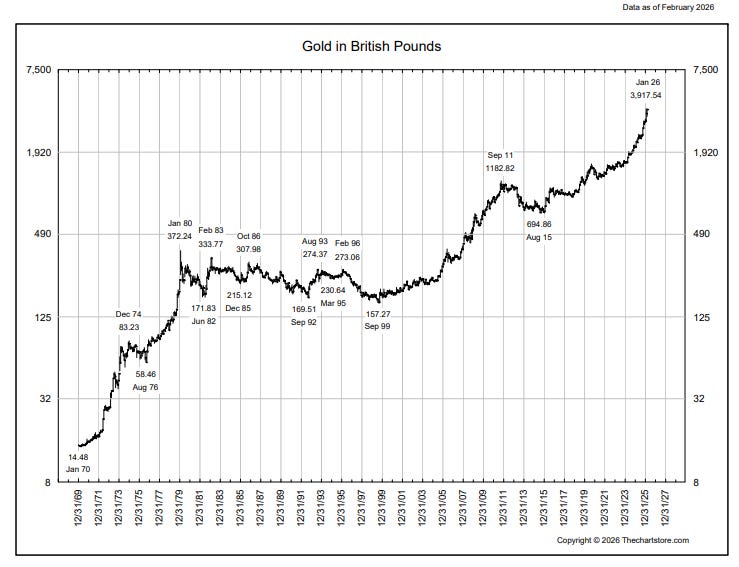
The war changed everything...beginning with the money. When WWI began, the UK was not only the leading military power - Britannia Rules the Waves! - it had the world’s healthiest economy, with 40% of the world’s international investment.
Then, in 1914, Britain went off the gold standard...and its money and its imperial power both started to slide. By the end of the war, it was deeply in debt, especially to the US. (One hypothesis about why the US went into the war on the side of the UK, rather than the Germans, was simply that its bankers had lent the English more money.) And when the guns finally went silent, the interest alone on its debt cost the UK 40% of its entire budget. This is what led to the Depression of 1920-21. It also led to further devaluation of the pound.
The British empire came to a final, wimpy end in the Suez Crisis of 1956. ‘Allied’ with France and Israel, Britain set out to take back the canal from Egypt. The three allies attacked. But when they appealed to Eisenhower for backing, the US president said ‘no.’ (This was before the Israeli lobby had such a tight grip on US lawmakers.) Eisenhower went on to block Britain’s request for IMF loans.
The pound continued to lose value. First, it lost against the dollar...then, it lost against goods and services. Since 1914, it has lost 99% of its purchasing power. Against gold, the loss was even worse. In 1914, you could buy an ounce of gold for 3 pounds, 17 shillings and 9 pence. Today, it is approximately £3,430/oz. That is nearly a 99.9% loss."

No comments:
Post a Comment