StatCounter

Thursday, September 24, 2026

"How to Undermine America"

"How to Undermine America"
By Robert W. Malone

“If you were Satan and/or a long-term strategic enemy of the United States, what approach would you take to undermine the morale of American citizens, destroy their faith in God, and make them question their allegiance to their country?” If I were to take the perspective of Satan or a long-term strategic enemy seeking to undermine American morale, destroy faith in God, and create disillusionment with the country, a subtle and multifaceted approach would likely be most effective. Here’s how that might look:

Sow Division and Tribalism: I would exacerbate existing social, political, and racial divisions, using propaganda to deepen mistrust between different groups. By fostering extreme polarization, I could weaken the national identity, making people see each other as enemies rather than fellow citizens. This could be achieved by manipulating the media, social networks, and public discourse to fuel conflict and outrage.

Erode Trust in Institutions: I would target trust in key institutions like the government, the church, and the justice system. By amplifying scandals, highlighting hypocrisy, and promoting cynicism about leaders, I would encourage people to lose faith in the structures that hold society together, making them feel betrayed or abandoned.

Attack Religious Foundations: To weaken faith in God, I would promote secularism and materialism while mocking traditional religious values. I would work to make belief in God seem antiquated, irrational, or intolerant, and highlight religious conflicts or corruption to turn people away from their faith. Normalizing moral relativism would erode people’s connection to religious principles and community.

Promote Hedonism and Self-Interest: I would encourage a culture of immediate gratification, material wealth, and self-centeredness. By making people prioritize individual desires over communal good or spiritual growth, I could reduce the importance of both faith and national solidarity. People focused on personal success and pleasure are less likely to sacrifice for others or a higher cause.

Undermine Patriotism: I would spread the idea that the U.S. is inherently flawed, and beyond redemption, focusing on historical injustices and failures. While criticism can be healthy, I would make sure it devolves into a form of nihilism, where the country’s ideals are seen as hypocritical or unattainable. This would make people question their allegiance and pride in the nation.

Create a Sense of Hopelessness: I would foster economic, environmental, and existential anxieties, making people feel that the future is bleak and out of their control. This could involve amplifying fears about job loss due to automation, environmental collapse, or global instability. A hopeless, fearful population is much easier to manipulate.

Co-opt Technology for Control: I would use technological advancements, such as social media algorithms and surveillance, to create echo chambers, promote unhealthy comparisons, and foster isolation. People would feel constantly watched, judged, and disconnected, leading to anxiety and despair. Simultaneously, I would push distractions that numb critical thinking and increase apathy.

In sum, a combination of division, demoralization, cynicism, and isolation would gradually unravel the social fabric, making Americans question their faith, their values, and their country’s worth.

As I considered all of this, I was left with two enduring questions: If these trends, which appear to be self-evident, are the consequence of actions by some offshore geopolitical enemy, what is that enemy? Could it be that these trends are the consequence of some flaw in ourselves and our own society, some fundamental aspect of being human?

The pervasive and corrosive nature of the “Seven Deadly Sins” has been weighing heavy on my mind as I look back over all that has happened to our social fabric since the COVID crisis began. Minds hypnotized and twisted. Families and communities torn apart. Blatant disregard for established moral principles. Small businesses steamrolled. Upwards transfer of wealth on a scale rarely seen in human history.

The culture seemed (seems?) to wallow in all of these central sins. Sins on daily display for all to see and personally experience the consequences. Investing a bit of time in introspection concerning the nature of these sins, which have been recognized as fundamental human flaws since at least the beginning of recorded history. 

Quoting from the Wikipedia summary of the deadly sins:

• Lust: Lust or lechery (Latin: luxuria "(sexual) excess/dissipation") is intense longing. It is usually thought of as intense or unbridled sexual desire, which may lead to fornication (including adultery), rape, bestiality, and other sinful and sexual acts. It can also mean other forms of unbridled desire, such as for money, or power.

• Gluttony: Gluttony (Latin: gula) is the overindulgence and overconsumption of anything to the point of waste. The word derives from the Latin gluttire, meaning to gulp down or swallow. One reason for its condemnation is that the gorging of the prosperous may leave the needy hungry.

• Greed: According to Henry Edward Manning, avarice "plunges a man deep into the mire of this world, so that he makes it to be his god". As defined outside Christian writings, greed is an inordinate desire to acquire or possess more than one needs, especially with respect to material wealth. Aquinas considers that, like pride, it can lead to evil.

• Sloth: Sloth (Latin: tristitia, or acedia "without care") refers to many related ideas, dating from antiquity and including mental, spiritual, pathological, and physical states. It may be defined as absence of interest or habitual disinclination to exertion.

• Wrath: Wrath (ira) can be defined as uncontrolled feelings of anger, rage, and even hatred. Wrath often reveals itself in the wish to seek vengeance.

• Envy: Envy (invidia) is characterized by an insatiable desire like greed and lust. It can be described as a sad or resentful covetousness towards the traits or possessions of someone else. It comes from vainglory and severs a man from his neighbor. According to St. Thomas Aquinas, the struggle aroused by envy has three stages: during the first stage, the envious person attempts to lower another's reputation; in the middle stage, the envious person receives either "joy at another's misfortune" (if he succeeds in defaming the other person) or "grief at another's prosperity" (if he fails); and the third stage is hatred because "sorrow causes hatred". Bertrand Russell said that envy was one of the most potent causes of unhappiness, bringing sorrow to committers of envy, while giving them the urge to inflict pain upon others.

• Pride/Hubris: Pride (superbia), also known as hubris (from Ancient Greek ὕβρις) or futility, is considered the original and worst of the seven deadly sins on almost every list, the most demonic. It is also thought to be the source of the other capital sins. Pride is the opposite of humility. Pride has been labeled the worst of all sins and has been deemed the devil's most essential trait. C. S. Lewis writes in "Mere Christianity" that pride is the "anti-God" state, the position in which the ego and the self are directly opposed to God: "Unchastity, anger, greed, drunkenness and all that, are mere fleabites in comparison: it was through Pride that Lucifer became wicked: Pride leads to every other vice: it is the complete anti-God state of mind." Pride is understood to sever the spirit from God, as well as His life-and-grace-giving Presence."

"Gaza Tells Us Who We Are"

by Joshua Frank

SOTN Editor’s Note: "Truly, there is no bigger and badder stain on the soul of America than the Gaza Genocide. You read that headline above right - “Easily 200,000 Deaths in Gaza.” And that article was written well over a year ago.

"That the American people would allow their tax dollars to be used to fund Israel’s highly organized and long planned genocide of the Palestinians is perhaps the most highly consequential karmic event of the Third Millennium. That many tens of thousands of Palestinian women and children, elderly and infirm have been, and are being, systematically slaughtered by the IDF - both Christians and Muslims - is so far beyond the pale, we fear greatly for the future of the USA.

The entire world has watched the IDF deliberately bomb apartment buildings and stores, hospitals and schools, mosques and churches, refugee camps and aid sites, journalist tents and UN Interim Force locations, etc. in Gaza, the West Bank and Lebanon without any meaningful and righteous response.

Now the real problem for Americans regarding these horrific situations is that the US Military Industrial Complex is supplying virtually all of the bombs and bullets, missiles and mines for Israel to carry out this historic mass murder of innocents. Israeli warplanes and armaments of every sort and kind are being given to the Zionist state to execute completely powerless and defenseless populations in the name of the American people. And no one stateside is doing a thing to stop this wholesale carnage, even as it plays out during prime time and in glowing color in the mainstream media every single day.

As we have apprehensively intimated, this ongoing human slaughterhouse will come back to bite the United States of America when it’s least expected. For no one - no person or institution, no nation or corporation - ever escapes the jaws of karma. And when that happens, karma’s gonna be a real bitch, America. For there is now a terrible stain on the soul of America. Have we become soulless?"
o
"Gaza Tells Us Who We Are"
by Caitlin Johnstone

"Some days it’s hard to say which is more horrific: the Gaza genocide itself, or the moral decay throughout our society which makes it possible. I mean, the atrocities in Gaza have a couple million victims. If you add up the populations of the US, Europe, Canada and Australia, you’ve got around a billion people living in a dystopia whose collective conscience is so warped and twisted that they’d allow their governments to support a live-streamed genocide in full view of the entire world. A billion people who are so morally bankrupt that they find it tolerable for such a nightmare to be inflicted upon their fellow human beings right in front of them, with tens of millions of people falling all over themselves to cognitively sweep Gaza under the carpet so they can support the Zionist state which is perpetrating this genocide. At best they see Israel’s crimes as an annoying side issue which the left keeps disrupting their parties about, and at worst they support Israel’s actions entirely.

What a pointless, meaningless, soulless way to live. What a betrayal of truth, and of our own humanity. How could anyone possibly find satisfaction in that kind of zombie-like existence?Mindlessly shuffling along to the beat of the status quo, devouring human flesh because it’s more comfortable than the cognitive dissonance which would come with divorcing the power-serving worldview you’ve been indoctrinated from birth into espousing.

I was listening to an interview with a doctor who worked in Gaza during the genocide and he discussed the time many months ago when the IDF forced the evacuation of a hospital and left four premature babies to die in their incubators after assuring the staff they’d be taken care of. Their tiny bodies were found decomposing weeks later after Israeli forces cleared out of the area.

How did that one incident, just by itself, not stop the world? How did it not stop us all in our tracks and force us to re-evaluate everything that led to this point? It wasn’t a secret that those four babies died; it was in the mainstream news. It was right there, right in front of us, and we did nothing. Such atrocities have been happening on a daily basis for twenty-one months now, and still nothing.

We’ve got to live like this. We’ve got to live in this genocidal dystopia, surrounded by shambling sleepwalkers covered in human blood. Our lives here in the west are far, far more comfortable than the lives of people in Gaza, but they are also far less truthful, and far less capable of nourishing the human spirit.

We marinate in lies and psychopathy, watch lies and psychopathy, eat drink sleep and breathe lies and psychopathy. Our minds are full of garbage and our hearts are full of shit, and we are wading around up to our ankles in the blood, sweat and tears of the global south. This festering sore of a civilization is the only soil in which the western-backed genocide in Gaza could take root.

The people in Gaza have to suffer the consequences of who we are and what we have become, but we have to live with who we are and what we have become. We’re killing their babies and leaving them to rot, but we’re the ones who have to live with the corpses of rotting babies in our souls.

One way or another the killing in Gaza will end one day. But the forces within us which gave rise to that butchery will live on long after the sounds of the drones and explosions have ceased. We will have to live like that. We will have to live knowing that this is who we are."
o

A Comment: There are no words strong enough to condemn YOU, Americans, for allowing and supporting this horror, for paying for every single bullet, rifle, tank, artillery piece, fighter bomber jet, bomb, air defense radars, everything! And now sending 40,000 2,000 lb. bombs to these murderers, which YOU are paying for! 97,000 identified civilians have been slaughtered, including 29,000 CHILDREN, at least another 10,000 buried under the bombed out rubble, no water, no electricity, and mass starvation because Israel is blocking aid, and the Arab countries and the whole world watches it and does nothing! That blood's on YOUR hands too, to our eternal shame and disgrace! God damn them all, these killers of unarmed innocent old people, men, women and children to Hell. Hell is not hot enough, eternity is not long enough for these psychopathically degenerate inbred monsters... That's my opinion, and I don't give a damn who doesn't like it... - CP

Americans! Hang your heads in eternal shame and disgrace! Read it, you paid for it all, YOU allowed and supported this horror! Scott Ritter has said "Israel is Evil embodied. Israel is Evil personified." And so are we...

"Forget Us Not"

"Forget Us Not"
by Chris Hedges

NEW YORK: "I am in the The Krikor and Clara Zohrab Information Center next to the St. Vartan Armenian Cathedral in Manhattan. I am holding a bound, hand-written memoir, which includes poetry, drawings, and scrapbooked images, by Zaven Seraidarian, a survivor of the Armenian genocide. The front cover of the book, one of six volumes, reads “Bloody Journal.” The other volumes have titles such as “Drops of Springtime,” “Tears” and “The Wooden Spoon.” “My name will remain immortal on the earth,” the author writes. “I will speak about myself and tell more.”

The center houses hundreds of documents, letters, hand-drawn maps of villages that have disappeared, sepia photographs, poems, drawings and histories - much of it untranslated - on the customs, traditions and notable families of lost Armenian communities. Jesse Arlen, the director of the center, looks forlornly at the volume in my hand. “No one has probably read it, looked at it or even knew it was here,” he says.

He opens a box and hands me a hand drawn map by Hareton Saksoorian of Havav village in Palu, where Armenians in 1915 were massacred or expelled. Saksoorian drew the map from memory after he escaped. The drawings of Armenian homes have the tiny, inked in names of the long dead.

This could well be the fate of the Palestinians in Gaza. They too battle to preserve memory, to defy an indifferent world that stood by as they were slaughtered. They will doggedly seek to preserve scraps of their existence. They too will write memoirs, histories and poems, draw maps of villages, refugee camps and cities that have been obliterated, set down painful stories of butchery, carnage and loss. They too will name and condemn their killers, lament the extermination of families, including thousands of children, and struggle to preserve a vanished world. But time is a cruel master.

Intellectual and emotional life for those who are cast out of their homeland is defined by the crucible of exile, what the Palestinian scholar Edward Said told me is “the unhealable rift forced between a human being and a native place.” Said’s book “Out of Place” is a record of this lost world.

The Armenian poet Armen Anush was raised in an orphanage in Aleppo, Syria. He captures the life sentence of those who survive genocide in his poem “Sacred Obsession.” He writes:

"Country of light, you visit me every night in my sleep.
Every night, exalted, as a venerable goddess,
You bring fresh sensations and hopes to my exiled soul.
Every night you ease the waverings of my path.
Every night you reveal the boundless deserts,
The open eyes of the dead, the crying of children in the distance,
The crackle and red flame of the countless burned bodies,
And the unsheltered caravan, always unsure, always faltering.
Every night the same hellish, deathly scene –
The tired Euphrates washing the blood off the savaged corpses,
The waves making merry with the rays of the sun,
And relieving the burden of tis useless, weary weight.
The same humid, black wells of charred bodies,
The same thick smoke enveloping the whole of the Syrian desert.
The same voices from the depths, the same moans, soft and sunless,
And the same brutal, ruthless barbarity of the Turkish mob."

The poem ends, however, with a plea not that these nighttime terrors end, but that they “come to me every night,” that “the flame of your heroes” always “accompany my days.” “The struggle of man against power is the struggle of memory against forgetting,” Milan Kundera reminds us. It is better to endure crippling trauma than to forget. Once we forget, once memories are purged - the goal of all genocidal killers - we are enslaved to lies and myths, severed from our individual, cultural and national identities. We no longer know who we are.

“It takes so little, so infinitely little, for a person to cross the border beyond which everything loses meaning: love, convictions, faith, history,” Kundera writes in “The Book of Laughter and Forgetting.” “Human life - and herein lies its secret - takes place in the immediate proximity of that border, even in direct contact with it; it is not miles away, but a fraction of an inch.” Those who have crossed that border return to us as prophets, prophets no one wants to hear.

The ancient Greeks believed that as the souls of the departed were being ferried to Hades they were forced to drink the water from the River Lethe to erase memory. The destruction of memory is the final obliteration of being, the last act of mortality. Memory is the struggle to stay the boatman’s hand.

The genocide in Gaza mirrors the physical annihilation of Armenian Christians by the Ottoman Empire. The Ottoman Turks, who feared a nationalist revolt like the one that had convulsed the Balkans, drove nearly all of the two million Armenians out of Turkey. Men and women were usually separated. The men were often immediately murdered or sent to death camps, such as those at Ras-Ul-Ain - in 1916 over 80,000 Armenians were slaughtered there - and Deir-el-Zor in the Syrian desert. At least a million were forced on death marches - not unlike the Palestinians in Gaza who have been forcibly displaced by Israel, up to a dozen times - into the deserts of what are now Syria and Iraq. There, hundreds of thousands were slaughtered or died of starvation, exposure and disease. Corpses littered the desert expanse. By 1923, an estimated 1.2 million Armenians were dead. Orphanages throughout the Middle East were flooded with some 200,000 destitute Armenian children.

The doomed resistance by several Armenian villages in the mountains along the coast of present-day Turkey and Syria that chose not to obey the deportation order was captured in Franz Werfel’s novel “The Forty Days of Musa Dagh.” Marcel Reich-Ranicki, a Polish-German literary critic who survived the Holocaust, said it was widely read in the Warsaw ghetto, which mounted a doomed uprising of its own in April 1943.

In 2000, when he was 98-years-old, I interviewed the writer and singer Hagop H. Asadourian, one of the last survivors of the Armenian genocide. He was born in the village of Chomaklou in eastern Turkey and deported, along with the rest of his village, in 1915. His mother and four of his sisters died of typhus in the Syrian desert. It would be 39 years before he reunited with his only surviving sister, who he was separated from one night near the Dead Sea as they fled with a ragged band of Armenian orphans from Syria to Jerusalem.

He told me he wrote to give a voice to the 331 people with whom he trudged into Syria in September 1915, only 29 of whom survived. “You can never really write what happened anyway,” Asadourian said. “It is too ghoulish. I still fight with myself to remember it as it was. You write because you have to. It all wells up inside of you. It is like a hole that fills constantly with water and no amount of bailing will empty it. This is why I continue.” He stopped to collect himself before continuing.

“When it came time to bury my mother, I had to get two other small boys to help me carry her body up to a well where they were dumping the corpses,” he said. “We did this so the jackals would not eat them. The stench was terrible. There were swarms of black flies buzzing over the opening. We pushed her in feet first, and the other boys, to escape the smell, ran down the hill. I stayed. I had to watch. I saw her head, as she fell, bang on one side of the well and then the other before she disappeared. At the time, I did not feel anything at all.” He halted, visibly shaken. “What kind of a son is that?”' he asked hoarsely. He eventually found his way to an orphanage in Jerusalem.

“These things dig into you, not only once, but throughout life, throughout life, through these days,” he told an interviewer from the USC Shoah Foundation. “I am 98-years-old. And today, to this day, I cannot forget any of this. I forget what I saw yesterday maybe, but I could not forget these things. And yet, we have to beg nations to recognize genocide. I lost 11 members of my family and I have to beg people to believe me. That’s what hurts you most. It’s a terrible world, a terrible experience.”

His 14 books were a fight against erasure, but when I spoke with him he admitted that the work of the Turkish army was now almost complete. His last book was “The Smoldering Generation,” which he said was “about the inevitable loss of our culture.” The present is something in which the dead hold no shares. “No one takes the place of those who are gone,” he said, seated in front of a picture window that looked out on his garden in Tenafly, New Jersey. “Your children do not understand you in this country. You cannot blame them.”

The world of the Armenians in eastern Turkey, first mentioned by the Greeks and Persians in 6 B.C., has, like Gaza, whose history spans 4,000 years, all but disappeared. The contributions of Armenian culture are forgotten. It was Armenian monks, for example, who rescued works by ancient Greek writers such as Philo and Eusebius, from oblivion.

I stumbled on the ruins of Armenian villages when I worked as a reporter in southeastern Turkey. Like Palestinian villages destroyed by Israel, these villages did not appear on maps. Those who carry out genocide seek total annihilation. Nothing is to remain. Especially memory. This will be our next battle. We must not forget."

"Doug Casey on the Diesel Crisis - and What It Means for the Economy"

"Doug Casey on the Diesel Crisis - 
and What It Means for the Economy"
by International Man

"International Man: Most people barely think about diesel until the price at the pump jumps. What’s the story with diesel?

Doug Casey: It’s said that war is nature’s way of teaching Americans geography. It can now be said that diesel is another way of teaching them geography—plus chemistry. And they’re getting a graduate degree in it right now. The wars in the Ukraine, Iran, and now Houthiland have doubled the price of fuels in the last six months. And I believe they’re going higher.

As my colleague John Hunt shows, oil, gas, and diesel were much higher in real terms not so long ago. Like almost all questions in today’s highly regulated world, the answer to why this is has both a technical and a political component. Even though civilization runs on oil, very few Americans know anything about it, or have any contact with it beyond a visit to the gasoline pump. Diesel is something only some blue-collar workers and truckers consider.

Few Americans drive diesel cars. But almost half of Europe drives diesels. Why might that be? Largely taxes. In the US, diesel has typically cost more per gallon than regular gasoline, but at $6.50 per gallon it’s now about $2 per gallon more. Europeans are paying around $10 per gallon for either gas or diesel. The difference is taxes. As bad as they are in the US, they’re much worse in Europe. Considering that Europeans typically have 20-30% less disposable income than Americans, their standard of living is collapsing. The peasants around the world might become very restless.

American families don’t use much diesel in their cars. But the economy runs on it. And diesel has some real advantages over gas. 

First, it contains roughly 10–15% more energy per gallon.

Second, it allows roughly twice the compression ratio in the engine, say 20-1 as opposed to 10-1 for gasoline. Those two factors make it roughly 25% more thermally efficient, which is why trucks, tractors, locomotives, ships, and heavy equipment run on diesel.

Third, diesel’s flash point is considerably above gasoline’s, and it gives off essentially no ignitable vapor. That makes it much easier to store and transport.

Fourth, diesel is itself a lubricant for an engine’s pumps, injectors, and rings, while gasoline is a solvent that washes oil away. That, plus the fact that diesel engines are built heavier to withstand greater compression and combustion pressures, means that they’re typically two or three times more durable than comparable gasoline engines.

Finally, because its combustion is lean and efficient, diesels emit fewer emissions than gas. That said, Americans still prefer gas because it offers higher performance and gas engines are much lighter and cheaper to manufacture than diesel engines. But American commerce runs on diesel. And that’s even more true of the rest of the world.

International Man: We keep hearing that the world could be heading toward a diesel shortage. What forces are driving this—underinvestment in refining, government regulation, geopolitics, or something else?

Doug Casey: All of the above. But we can’t do much to change what the government does or the thoughts of the mobs that vote for politicians. So I’m going to spend some more time on the chemical and economic realities of the petroleum business. One important concept you should get a grip on is the “crack spread.”

The crack spread is the price difference between crude oil and the refined products made from it. Essentially it’s the gross margin a refiner earns for “cracking” a barrel of crude into fuels like gasoline, diesel, kerosene, and heating oil. How much of each of these products comes out of a barrel of petroleum depends on the type of petroleum and how a refinery is set up. But typically three barrels of oil will yield two barrels of gasoline and one of other distillates.

Right now, refineries are coining money. But the public buying their products is being squeezed. Naturally, we can expect the government to “step in,” which is exactly what Trump is doing. He appears to be banning the export of diesel from the US, which is quite a problem since we’re the largest diesel exporters in the world. That may level out domestic prices for a while, but it will create chaos and anti-Americanism internationally. On top of the fact that, the world knows the US started this war with Iran, which precipitated the whole disaster.

Meanwhile, the Zelensky regime is destroying Russian refineries, making things worse. And Bessent’s total ban on third parties trading with Iran will tremendously compound the situation. What also scares me is the thought that Trump may put on wage and price controls as Nixon did in the 70s in a foolish attempt to contain the price explosions his foreign adventures have caused. Any or all of these things could be the catalyst for the Greater Depression in earnest.

International Man: Diesel powers trucks, ships, heavy equipment, mining, and agriculture. If diesel prices spike or shortages emerge, how quickly could that work its way through food prices and the broader cost of living?

Doug Casey: Higher diesel prices mean higher costs for everything. Most people think that that’s a cause of inflation. It’s not. Inflation is a purely monetary phenomenon. It comes from creating fiat currency—money printing. Higher diesel prices, like prices for any other cost input, only result in lower margins for producers and/or consumers spending more on this and less on other things. The result is a lower standard of living, not higher inflation. It’s an important distinction that most people don’t understand.

I’m not overly concerned about higher prices next week or next month. My big concern is that the lunatics running European governments will go completely wild and start World War III. They’re clearly cultivating hysteria among their populations and trying to push Russia into a war.

The bottom line is that the world in general, and Europe in particular, is in big trouble, not just because of much higher prices of the important petroleum distillates (diesel, kerosene, and gasoline), but because of their looming unavailability. All three war fronts—Ukraine, Iran, and Yemen—are attacking refineries. It’s a serious economic war, similar to what the US did to Japan before WW2, cutting off their oil. Roosevelt backed them into a corner, where they felt their best alternative was to attack first. Some country could easily react the way Japan did 85 years ago.

The way I see it, we’re just at the beginning of a real emergency. Remember, the Ukrainians have severely damaged a half-dozen Russian refineries, and the Iranians and Yemenis are doing the same to Saudi and Gulf refineries. The Americans and Iranians are both sinking or disabling two million-barrel crude carriers in the Gulf.

I don’t see that there’s any reasonable solution between the American-Israeli camp and the Iranian camp at this point. The Iranians are demanding $300 billion in compensation for damage so far, plus that the Americans leave all Middle East bases and drop their sanctions. Meanwhile, the Americans are moving to punish third parties that have anything to do with the Iranians. A rock has met a hard place. Both sides are adamant, and both sides are escalating.

It’s a chaotic situation, and the outcome is innately unpredictable, except to say it’s devolving towards a genuine crisis. I’m betting the situation is going to get worse for the foreseeable future

International Man: Governments have spent years discouraging investment in hydrocarbons while assuming energy will remain cheap and abundant. Are we now starting to see the consequences of that policy?

Doug Casey: The public has been taught to hate petroleum and its byproducts. They think of it as dirty and polluting, and its producers as evil. They imagine oil spills killing birds and otters. The political caste naturally caters to the whims of the Green-influenced mob. California in particular has been actively closing down its oil refineries as well as its nuclear plants, which is totally insane. It’s really a pity, since there are enough hydrocarbons to last many, many years, while nuclear is built out. Eventually fusion and other power sources will be perfected.

The direct source of all of our power problems is the institution of the State, the government. Yet, even when Boobus americanus sees that, he still looks to the government to solve the very problems it created. On the bright side, scientists, engineers, entrepreneurs, and investors are working to solve our power problems. I’m optimistic that the good guys will win in the end. But the size and power of the State is greater than ever. There are real risks that things could go massively wrong along the way."

"Three Wars, One Bill: How Hormuz, Ukraine and Sanctions Are Squeezing the Express Giants and Pushing Up Global Prices"

"Three Wars, One Bill: How Hormuz, Ukraine and Sanctions 
Are Squeezing the Express Giants and Pushing Up Global Prices"
by Larry C. Johnson

"This article is the result of my conversation earlier today during my flight from Istanbul to London. I was sitting next to a FEDEX pilot who was on his way to Paris via London. I asked him about aviation fuel prices and the effect on FEDEX and I got more than I bargained for. The world’s express carriers like to present themselves as barometers of the global economy. In 2026 they are also measuring something else: what it costs to run a global air network when two of the three main east-west air corridors are effectively closed. The answer so far is that FedEx and UPS are surviving the shock largely by passing it on to their customers. That cost doesn’t disappear. It moves down the supply chain and into the inflation numbers central banks are now fighting.

The fuel shock: The trigger was the Iran war. The International Energy Agency has described the near-total closure of the Strait of Hormuz as the largest supply disruption in the history of the global oil market. Brent peaked near $118 in late March, fell to about $70 by July 1, rebounded above $100 in late July, and climbed back to $109 in early September after renewed attacks on shipping and energy infrastructure. It has since eased to around $99 on hopes from US-Iran talks, but it is still up roughly 60% for the year.

Jet fuel has moved further than crude because refining margins widened. IATA’s latest weekly reading put the global average at $194.90 a barrel, up 7.4% in a single week. U.S. Gulf Coast kerosene-type jet fuel averaged $4.341 a gallon in September. The ground networks are exposed too: the national diesel average has hit a record $6.31 a gallon. For FedEx, the world’s largest cargo airline by fleet count, this lands directly on the cost line. In the quarter ended May 31, its fuel bill rose 66%, from $864 million to $1.43 billion.

The airspace squeeze: Russia plus the Gulf: The Ukraine war and Western sanctions had already closed Russian airspace to U.S. and European carriers after 2022. That added hours and fuel burn to Europe-Asia routes and handed a lasting advantage to carriers that still fly over Russia. Chinese, Turkish, Indian and Gulf carriers keep Russian access and can offer faster, cheaper Europe-Asia flights.

Then the Gulf closed as well. Eight Middle Eastern states closed or restricted their airspace in late February, leaving traffic squeezed through the Caucasus corridor between the Black and Caspian Seas, about 100 miles wide at its narrowest. Xeneta estimated that 16-18% of global air cargo capacity disappeared with almost no warning. Freightos data showed rates from South Asia to North America and Europe up about 50% early in the war.

By mid-July, Gulf carriers had restored 75-96% of schedules by routing south over Saudi Arabia and Egypt, adding 30-60 minutes to Europe-Asia services. Longer flights mean more fuel, lower payloads, more crew hours and less aircraft utilization. DHL Global Forwarding reported that rerouting around the Gulf hubs was reducing schedule reliability and raising operating costs. Air freight to and from the region itself also fell hard: Middle East and Africa exports were down 24% year on year.

How the integrators have held up: Here the story gets less straightforward than the headlines suggest. Surcharges have protected FedEx and UPS far better than airlines or asset-light truckers. FedEx’s chief customer officer said in March that the fuel surcharge was “doing its job” and would keep the company profitable.

The revenue numbers bear that out. In the March-May quarter, FedEx revenue rose 13% to $25 billion, with Iran-war fuel surcharges adding 5 percentage points of revenue. FedEx’s U.S. ground fuel surcharge stood at 26% in the week of August 17. UPS raised its full-year 2026 guidance to $91.2 billion in revenue and about $7.22 in adjusted EPS.

The pressure shows up in margins. FedEx beat estimates last quarter, but its operating income fell nearly 22% year over year. The mechanism is simple. The surcharge resets on a lag, and when fuel spikes, revenue and costs rise by similar dollar amounts, which dilutes the margin percentage. FedEx shares are down 6.6% over 30 days and 7.6% over 90 days, although still up 65.5% over one year.

The freight sector’s warning light went on this month. J.B. Hunt said Q3 earnings would fall 5-10% from the prior quarter, citing at least $10 million in extra fuel costs and $25 million in driver recruiting and bonus costs, which dragged down package-delivery stocks along with truckers.

Who pays: from shippers to consumers: On the evidence so far, shippers are bearing most of the cost. UPS’s CFO described the net profit impact of surcharges as “modest,” and FedEx said they were not a material driver of adjusted operating income. Critics have noted that neither company explained why surcharge percentages rose so sharply. For comparison, the U.S. Postal Service imposed its first surcharge on April 26, at 8% on most packages. One fact-check found no evidence of industry-wide gouging, but did find that some transport companies are collecting more in surcharges than they spend on fuel. From shippers, the cost flows into prices. That is where the carriers’ problem becomes everyone’s problem.

The inflation picture: The OECD’s interim outlook, published today, projects G20 headline inflation rising to 4.1% in 2026 and easing to 3.6% in 2027, while advanced-economy core inflation moderates from 2.7% to 2.5%. That split matters. This is mainly an energy shock that pushes up headline inflation, not yet a broad wage-price spiral. The OECD credits government support, input substitution, non-Gulf supply and oil reserve drawdowns with limiting the damage.

In the U.S., August CPI was 3.4% year on year, while core was 2.4%, the lowest since March 2021. Gasoline alone accounted for more than a third of the monthly increase. The Fed still took no chances. It raised rates to 3.75-4.00% on September 16, its first hike since 2023, citing the Iran energy shock, and most officials expect at least one more hike this year.

How freight costs reach the checkout: The express surcharges are a real but secondary channel. Shipping is usually a small share of a finished good’s retail price, so parcel surcharges add friction at the margin rather than driving CPI. The same jet fuel shows up much more clearly in passenger airfares, up more than 23% since August 2025.

Food is the more important channel. Diesel, packaging and fertilizer matter more than parcel rates, and a lot of fertilizer moves through Hormuz, which threatens global food prices. One inflation analyst who normally dismisses food and energy as mean-reverting now says he’s less confident about food, because energy is feeding into trucking and packaging costs.

The spillover into core inflation is what central banks fear. Economists warn that renewed rises in oil, gasoline and diesel could spread to other prices and to inflation expectations. So far median CPI looks relatively tame, and part of the rise in services inflation is airfares, which is really energy. The pain is not evenly spread. Energy- and food-importing emerging economies are far more exposed than the U.S. In the Philippines, diesel went above ₱140 a liter, about $10.75 a gallon. Weak currencies and heavier weights for food and fuel in consumer price indexes amplify the shock there.

Duration decides everything: The OECD’s June scenarios frame the stakes. If Gulf supply recovers from Q3 2026, the shock fades in 2027. If disruption lasts into late 2027, the result is much weaker growth and much higher inflation, adding about 0.4 points in 2026 and 1.3 points in 2027. The OECD’s baseline assumes energy prices fall in 2027, but it lists prolonged Middle East export disruptions and a very strong El Niño as key downside risks. With Brent near $99 and the Saudi East-West pipeline shut since September 11, that baseline looks optimistic.

A long disruption would also change the carriers’ position. Their pass-through model works only as long as customers accept it. The longer surcharges stay above 25%, the more small and mid-size shippers will downgrade from express to ground, from air to ocean, or simply ship less. FedEx’s own outlook assumed no further geopolitical disruptions and acknowledged that soaring fuel costs could weigh on results if customers pull back. The Russia-overflight disadvantage doesn’t go away when oil falls. And the gap between surcharge revenue and actual fuel cost could become a political and legal target.

The wars and sanctions have made running a global express network structurally more expensive: longer routes, fewer usable hubs, and fuel that stays high and swings unpredictably. So far FedEx and UPS have converted most of that cost into surcharge revenue, and their pain shows up as margin compression rather than losses. The cost has been passed downstream, where it adds to the energy-led inflation that has already pushed the Fed back into hiking.

For both the carriers and the inflation outlook, the deciding factor is how long the Hormuz disruption lasts. If jet fuel stays near $190 a barrel through peak season, the question stops being whether FedEx and UPS can pass costs on. It becomes whether their customers, and the consumers behind them, can keep absorbing them. The next markers are September CPI on October 14, and FedEx’s commentary on surcharge recovery and volumes in its fiscal Q1 2027 report."
Here’s my appearance with Soloviev live: https://disk.yandex.ru/i/0GLBKQSSG3S1cQ]

"Another Huge Burst Of Inflation Is Ahead, And That Is Really Bad News For An Economy That Is Already Coming Apart At The Seams"

by Michael Snyder

"Those at the top of the economic food chain just don’t get it. They are mystified by surveys that show that most Americans are deeply upset about the state of the U.S. economy. Since their stock portfolios are doing really well and the official numbers that the government has been giving us look fine they just assume that the general public’s perception of the economy must not be accurate. But the truth is that it is their perception of the economy that is not accurate.

They should try to live the way that the rest of us have been living. Homes are more unaffordable than ever. Our insurance bills have become extremely bloated. Millions of Americans avoid going to the hospital because a single visit could financially ruin them. Power bills have soared to absurd heights in many parts of the country. Purchasing a new automobile is way out of reach for most of us.

Many of the items that I commonly purchase at the grocery store have doubled or even tripled in price since the beginning of this decade. When I get up to the checkout counter, I feel like asking the clerk which organ I should donate in order to pay for my groceries. We want it to stop. What part of that is so difficult for the elite to understand?

Pew Research has discovered that American voters are more concerned about prices and affordability than anything else by “a wide margin”…By a wide margin, voters most want candidates running for Congress to talk about economic issues – with many specifically mentioning prices and affordability. One of the primary reasons why Republicans did so well in 2024 is because voters were sick and tired of inflation. But now the 2026 election is coming up, and the shoe is on the other foot.

This month, consumer confidence fell once again…Consumer sentiment falls in September for two consecutive months. The preliminary September reading for the University of Michigan Consumer Sentiment Index came in at 47.8. This marks a 7.5% (3.9 points) decrease from August. Consumer sentiment sits 13.2% below where it was a year ago and is currently below the 1st percentile in the series’ history.

How low does it have to go before the talking heads on television start taking this seriously? At this point, it is already at the second lowest level ever recorded…Consumer confidence fell to its second-lowest level on record in September, and Goldman Sachs says the economy is only part of the reason. Americans, the bank told its clients, have grown unhappier with the state of the world in general.

No, it isn’t because we are unhappy “with the state of the world in general”. Consumer confidence is so low because stuff costs too much money. If that isn’t simple enough for the analysts at Goldman Sachs to understand, I can put it in even baser terms.

Unfortunately, more inflation is on the way. Mortgage rates are rising, and this is going to make homes even more unaffordable than they are now…The average 30-year fixed-rate mortgage jumped 15 basis points to 7.12% in the week ended September 18, the Mortgage Bankers Association said on Wednesday. It was last higher in May 2024.

Mortgage rates have risen more than a full percentage point since joint US-Israeli strikes against Iran began pushing up the global price of oil in late February, putting the squeeze on prospective homebuyers and a chill into the US housing market. Mortgage rates track US Treasury yields, which are sensitive to oil prices and the threat they pose to inflation, which has been running above the Fed’s 2% goal for 5-1/2 years.

Meanwhile, gasoline and diesel have become much more expensive this month…The average retail price of on-highway diesel spiked by 24 cents in the latest week, and by 88 cents in four weeks, to a record $6.529 a gallon at gas stations on Monday, and that’s for the US overall, according to the EIA this morning. Year-over-year, the price of diesel has spiked by 74%. California diesel prices spiked to $8.246 a gallon. While driving by gas stations, we’ve seen over $8 a gallon for weeks. These are sobering sights, setting off the inflation alarm bells.

Higher fuel prices will mean that it will cost a lot more to transport stuff to the stores. So you better brace yourself for significantly higher prices. Ominously, Bank of America is warning that the price of oil could hit $150 a barrel if the war in the Middle East continues to drag on… Oil prices could reach upward of $150 a barrel if inventories continue to deplete as the war in Iran rages on, according to Bank of America, and the bank has raised its year-end forecast for Brent crude from $83 a barrel to a new target of $95 a barrel.

“Although alternative routes and escorted Hormuz shipments have mitigated some of the shortfall, damaged infrastructure and rising geopolitical tensions make rapid normalization unlikely,” strategists led by Francisco Blanch, head of global commodities, equity derivatives and cross-asset quantitative investment strategies, wrote in a note released to the media on Tuesday. If the price of oil does reach $150 a barrel and it stays there for an extended period of time, I believe that we will see rioting in the streets. I really do.

It seems like just about everyone is raising prices these days. And in some cases where prices aren’t actually being raised, package sizes are getting smaller.For example, it appears that packages of Sam’s Club toilet paper don’t contain as much toilet paper as they once did…When comparing the old package to the new package they look almost identical, but when you put them up against a wall you can see the size of the rolls seem to be visibly smaller The package is labeled the same as the old package, same weight and ply. However when you line them up there is very clearly a large difference in size

This is very strange. Maybe it’s just a manufacturing thing where the rolls are being rolled more tightly. Or maybe we’re being shorted. This needs to be investigated. Costco did the exact same thing back in May, they shrunk the size of their toilet paper rolls

I really detest shrinkflation. Companies that engage in that practice should be shamed. Needless to say, everything becomes unaffordable if you don’t have any income coming in at all. All over the nation, we are witnessing layoffs.

For instance, it is being reported that CSX could soon be laying off as many as 1,100 railroad workers…Hundreds of railroad workers could be losing their jobs in the coming weeks across West Virginia, Ohio and Kentucky as 1,100 workers – mostly engineers who deal with safety inspections, maintenance and construction – could lose their jobs across the U.S., a union representing those workers said.

Transportation giant CSX called the The Brotherhood of Maintenance of Way Employees Division on Sept. 14 and told them they’d be furloughing the 1,100 workers by mid-November, according to general chairman Brian Thompson. Those positions range from $80,000 jobs to management positions in duties that involve safety inspections, rail maintenance and construction. The direction of the transportation industry is often an early indicator of where the U.S. economy is heading as a whole. So this is a very troubling sign.

Thanks to rapidly rising beef prices, a company that operates “314 Wendy’s locations across 15 states” has been forced to file for bankruptcy…Meritage Hospitality Group, one of the largest Wendy’s franchisees in the U.S., has filed for Chapter 11 bankruptcy protection following a high-stakes dispute with the fast-food chain’s corporate parent. The bankruptcy filing comes amid severe financial pressures at the franchisee, which has struggled with soaring beef costs and weak customer traffic, while Meritage has also blamed aggressive promotional discounting for squeezing margins. The Michigan-based operator runs 314 Wendy’s locations across 15 states. The company filed its voluntary petition Thursday with the U.S. Bankruptcy Court for the Western District of Michigan, according to court documents.

Many years ago, I used to eat at Wendy’s a lot when I worked in the D.C. area. But who can afford to eat at Wendy’s on a regular basis now? It turns out that even CNN is bracing for mass layoffs. One executive is claiming that it will be a “bloodbath”… “Bloodbath coming, including at CNN,” a TV exec said. “That’s the next big step - slashing and burning.” Paramount has said it sees at least $6 billion in cost savings, which would translate to several thousand jobs lost in the months ahead. Inside CNN, staffers have been more or less kept in the dark by top brass, who are themselves unsure who will be running the network once Ellison takes over.

For years, I pleaded with our politicians not to spend trillions upon trillions of dollars that we did not have. But they didn’t listen. And I warned that the trillions of dollars that the Federal Reserve was pumping into the system would cause tremendous inflation. Now we have tremendous inflation. The government continues to feed us numbers that show that the rate of inflation is in the low single digits, but we all know that is not true. If it was true, many of our recurring expenses would not have doubled or tripled since the beginning of this decade.

Let’s get real. The American people are telling us loud and clear that they care far more about the cost of living than they do about anything else. But those at the top of the economic food chain insist on pretending that everything is just fine, and that is extremely unfortunate."

Wednesday, September 23, 2026

"Did Trump Just Tip His Hand As To Who He Considers To Be His God?"

"Did Trump Just Tip His Hand As To
Who He Considers To Be His God?"
by Leo Hohmann

"Trump continues to believe he can change reality by simply speaking things into being. Practically every week he is renaming and rebranding something, often with his name or the name “America” in the new name. The Gulf of Mexico becomes the Gulf of America. The Strait of Hormuz becomes the Strait of America. The Kennedy Center in D.C. was renamed the Trump-Kennedy Center, although this was struck down by the courts. Lake Ontario was rebranded Lake America. The Department of Defense became the Department of War. And on and on and on…

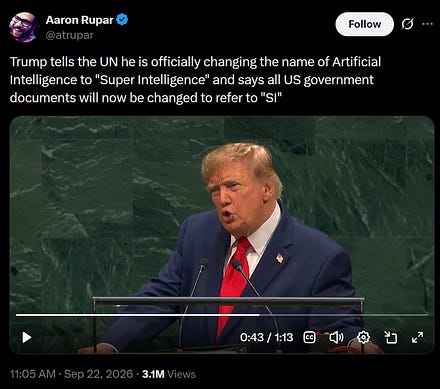
Now he’s renaming artificial intelligence to “super intelligence.” Poof! AI is now SI. Why? Because Trump said so. Need any other reason? “Welcome to the new world of super intelligence - SI,” Trump said during a rambling speech to the United Nations General Assembly in New York on Tuesday in which he openly threatened to annihilate another sovereign country if it didn’t do as he demanded. “From this point forward, all of United States’ documents, and hopefully the world’s, will be changed to use the more accurate term ‘super’ as opposed to ‘artificial’. So it’s ‘super intelligence’,” Trump said. Taken in full, it was one of the darkest speeches ever given before a world body. 
“Our military is the most powerful on earth. Our technology is second to none and we are leading in virtually everything,” he said. “Our energy is fueling the planet. America is rising, our nation is growing, our power is expanding. Our country is doing better than ever before.” Even if this were true, which it obviously is not given the struggling U.S. economy and unending war with Iran, what kind of leader gets on a global stage and boasts like this?

If you believe Trump, America has virtually no violent crime and the importation of drugs has been all but eliminated -- 97 percent of it, he said, adding that America is safer than at any time “since the year 1900.”

He boasted of $21 trillion in new private investments in America, without saying that most of that money has been invested in AI data centers and military armaments/munitions that will be used to conquer other nations and enslave Americans.

Trump the miracle worker and man of peace: Trump described himself as the biggest force for peace the world has ever known. At the same time, he threatened Iran with annihilation if it didn’t capitulate to his demands. He said he had the ability to annihilate Iran “and do it quickly,” which can only be a reference to nuclear weapons, and he would have to decide whether they lived or died as a nation.

He claimed at one point in his speech to have performed a “miracle” by ending an obscure war between Armenia and Azerbaijan that no American cares about. “The president of Azerbaijan said President Trump in six months did a miracle,” he said, referring to himself in the third person. “It was an absolute miracle that nobody thought could be done.” They didn’t think it could be done because they weren’t thinking about it. Period.

Trump’s speech seemed designed to make his audience shake in their boots with fear before the all-powerful USA led by the all-powerful Trump. In virtually the same sentence, Trump bragged that he “obliterated” Iran’s nuclear program in “Operation Midnight Hammer” while adding that Iran’s goal was to “make a mad dash to a nuclear bomb” so he had to hit them again. Which is it? Obliteration or a miraculous Iranian ability to go from nothing to full nuclear capability in a few short months?

He falsely accused Iran of killing 72,000 of its own people in recent protests. These numbers were pulled out of thin air and have absolutely no validity. Those who were killed, probably less than 5,000, were almost exclusively those who took up arms against the regime with weapons provided by the CIA and Mossad. Imagine what would happen to any Americans who dared to start shooting at FBI agents or other government officials. They would be ruthlessly gunned down and any survivors left to rot in the D.C. gulag.

Trump got almost no applause, and what little applause he did get was mostly from the U.S. and Israeli delegations. Iran’s delegation walked out. I challenge anyone to listen to Trump’s full speech and try to find much of anything he said that is actually true, or likely to be true in the near future, other than his threats of unleashing death and destruction, which I believe are very likely to come to pass.

“We inherited a dark age of America from the previous administration and we turned it into a Golden Age of America,” Trump said. He repeatedly referred to America in terms of its “power” and being the “most powerful nation” on earth. If a nation is truly that powerful it would not have to remind the world of it 25 times in a 37-minute speech. It would be self-evident.

Truth is, America is a fading empire led by a desperate and unsophisticated leader who knows nothing about history or geopolitics but tries to bully his way to perceived “wins” by threatening brute force. Do this or I will bomb you. Do that or I will hit you with massive tariffs.

Trump’s vision of AI: But the most chilling parts of his speech were when he started to wax on about his beloved AI, or SI as he now calls it. He saved this for last as you will have to fast-forward to about the 32-minute mark of the above video to hear it.

He said the use of the word “artificial” “makes it sound fake, and it’s not fake. It is amazing…So, it’s super intelligence. In other words, welcome to the new world of super intelligence (SI). Sounds much better. It is much better, and it’s much more accurate. Let’s see if I have any power. We’re going to find out pretty soon.

“Whoever wins AI... whoever wins SI, wins. That’s the group that wins. And we’re leading over China now by a lot. And we’re going to keep it that way. I’m not going to stifle something that many say will be bigger than the industrial revolution, or the internet itself… We will only encourage SI, we’re going to encourage it, not rein it in; we’re going to watch it closely through the DOJ. The United States leads the world of SI and we’ll continue to do so, safely and responsibly. America has never been a nation that retreats from a frontier, or shrinks from a challenge, no matter how great or how daunting that challenge might be. Freedom was not a gift that Americans won easily after 250 years and it is not one that we will ever, ever, ever surrender.”

That last line made me laugh. Americans have already surrendered their freedom. They are taxed on their incomes, taxed on their cars, taxed on their homes, taxed on their estates, taxed on everything they buy including fuel and, in many states, even on food. But we’re free!

Try not paying your property tax and you’ll quickly learn that you don’t own your home, you rent it from your local communist or fascist overlords (Democrats being communist and Republicans fascist). Americans are spied on by Flock cameras, surveilled by their vehicles and phones and smart TVs. Many were forced to get injected with an experimental mRNA “vaccine” in 2021 and 2022 under threat of losing their jobs. But we’re free!

You see, America is under soft tyranny and has been for at least several decades. We are ruled by sociopathic authoritarians and authors of chaos at all three levels of government: local, state and federal.

Trump is letting us know that he believes AI has god-like powers and whoever “wins AI” will win control of the world. He never defines his terms and lets us know what “winning” the AI “race” looks like or how it might be achieved. He seems to assume there will be a clear-cut “winner” and a clear-cut loser. What if multiple nations achieve basically the same mastery of this technology? Are they then going to face off in World War III?

Is Trump referring to one nation, America, using AI to achieve military superiority and conquer the world that way? Or is he talking about economic domination? He doesn’t say. If he’s talking about military dominance through AI, then why wouldn’t China, Russia, and North Korea move now to launch everything they have at us before we achieve this technological edge over them? What nation wants to be a vassal of a global hegemon? This seems to be the “deal” that Trump is proposing to the world. America will win the race to Super Intelligence and rule over you in the future as we see fit.

We will win the AI race and use our winnings the way we have always used our other technological superiority, to coerce other nations into giving up their sovereignty and doing what the U.S. demands.

The U.S. has since the end of World War II dominated the world order in just such a way, using its economic, military and technological prowess not for good or to bring peace to the world, but to lord it over smaller and weaker countries. If they step out of line, they get slapped with economic sanctions and if they still don’t bend to Washington’s will, they can look forward to a military intervention. Why would it be any different if America “wins” the AI race?

So, it really was quite remarkable to see Trump standing before the world’s largest body of nations on a platform devoted to diplomatic solutions and announce that the U.S. was renaming AI and racing to make it into a source of global U.S. power, not for the benefit of the world, but for bragging rights and to exploit whatever spoils are available for the taking.

Just like all of his other rebrandings, the renaming of AI to SI is unlikely to take hold. Tech analysts told the BBC that Trump’s new name for AI is unlikely to gain widespread traction because Super Intelligence is already a name typically used to refer to more advanced systems. While those on the Trump train immediately start using whatever new name Trump throws out there, most of the world realizes that just because one world leader speaks something, it doesn’t make it so. But the mere fact that Trump feels the need to force this particular rebranding on the world provides us with a window into his thinking.

He believes AI to be a form of intelligence that is not “artificial” or created and controlled by humans, but something bigger, something superior. Hence the name “super” intelligence. And he sees himself as the “super man” who will be at the head of it, or maybe he envisions AI as a type of deity capable of giving him vast superpowers that he can wield against his enemies.

Yet, we know the opposite is true. AI is not immune to error and not always so super. There have already been numerous cases in which autonomous AI-powered weaponry deciding what to target and who to kill having gone horribly wrong. The U.S. killed 165 innocent civilians, around 100 of them children 12 and under, on February 28 when it launched a missile at the girl’s elementary school in Minab, southern Iran.

Just this week it was reported that a faulty AI-generated intelligence report almost led the U.S. to start World War III with China because the report said a Chinese ship in the Middle East was carrying nuclear material, possibly headed to Iran. The report was totally false and, thank God, the error was caught in time to prevent a military engagement between superpowers.

This is the technology Trump considers superior and above human capability and that he believes should be subjected to little or no regulations. We can’t stop where this is heading. All we can do is pray for protection and that some semblance of sanity and wisdom returns to the halls of government. If we are indeed entering the last of the last days, we know that’s not going to happen until the return of Christ. And we must suffer through the evil machinations of false christs and false messiahs while standing strong for the one true faith."

"The News Falls Lightly for the First Day of Fall"

"The News Falls Lightly for the First Day of Fall"
by David Haggith

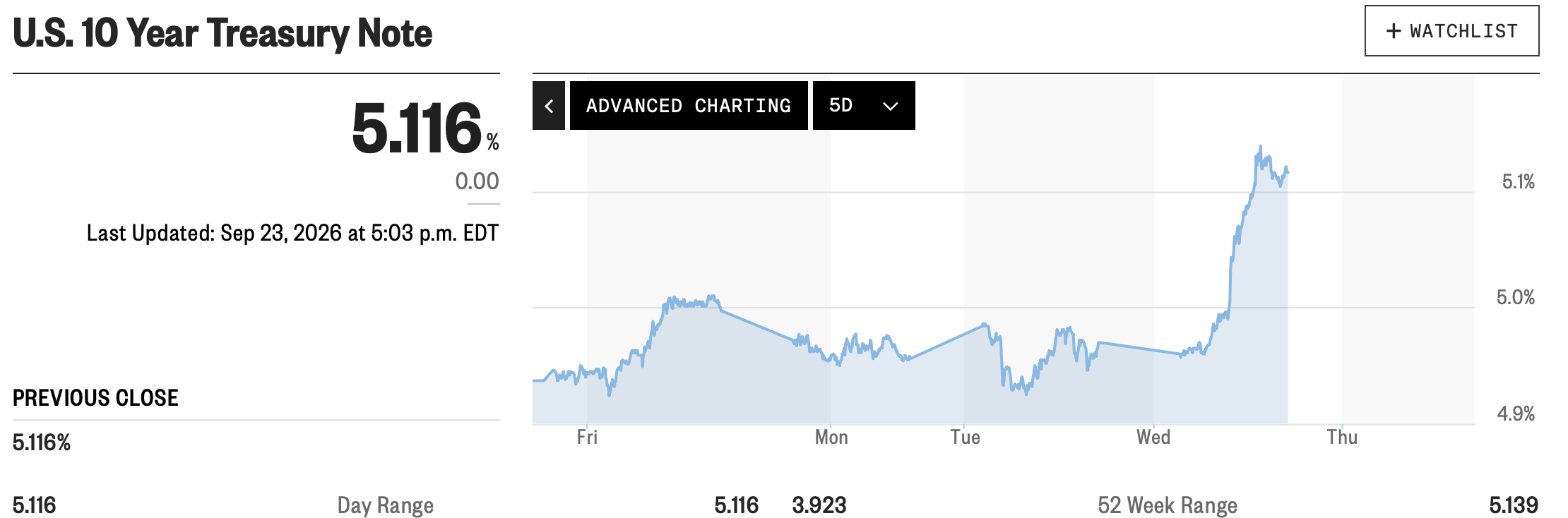
"It has been a light news day with very little from the warfront but a few jolts on the economic front. The US10YR Treasury yield jumped up 13 basis points to take a position it hasn’t held since 2007. Its sudden spike to a yield of 5.139% intraday (settling at 5.116%) was its swiftest rocket ride in 18 months:
Click image for larger size.
Bottom line, “you can’t fool or hide in the bond market – unless the Fed gets inflation under control the long end of the curve is going to continue to come under pressure.” … warned the bond vigilantes. Other Treasury tenors also came under stress. As a result, mortgage rates leaped 15 basis points today to hit a national average of 7.12% for a 30YR mortgage. In response to the Treasury moves, stocks shivered a bit today. A couple of articles below from Motley Fool point out some of the flashing red lights showing up in the stock market.

Cheap eats: If the soaring fuel prices and continual slow climb of inflation are hitting you hard, your federal government has worked out some helpful solutions for you, and this is why we pay these department heads the big bucks: Don’t eat beef. Chicken is cheaper. That is so helpful because I’m sure that, without the USDA secretary’s deep research into this matter, most of us would not have figured out that we could save money just by switching from beef to chicken. Glad to know she’s on this, working out innovative solutions that will help all of America. The department’s Phase Two Inflation Combat Plan is switch to bugs and grubs. Because, after all, worms are cheaper still.

Secretary Brooke Rollins obviously graduated from the Marie Antoinette School of Economics:
“We have more people eating beef than ever before, but if it is too expensive - unlike fuel, Benny - you can eat chicken, pork, salmon, eggs. There are other sources of really good protein, and all of those prices are coming down as well. (The Winepress)

The ranchers who are currently cutting back their cattle herds because they cannot afford to feed them will be glad to know she’s helping them out by switching the citizenry over to eating chicken. Cow milk is going up, too, for the same reason that beef is rising: Fertilizer costs and diesel costs are making feed expensive. So, maybe the USDA chief will suggest we switch over to drinking chicken milk. Comedian Henny Youngman: “Doctor, it hurts when I go like this.” Doctor: “Then stop going like this.” There. Inflation solved. You may now return to your dinner. Oh, and this just in:
Given the administration’s tough brainwork on solving the inflation they are creating for us by telling us we can live with less, I think any level of intelligence would seem like “super intelligence” to them. After all, Trump says he is the highest IQ president ever, even though a poll I read today said 92% of Americans think he’s “DUMB.” O.K., the poll carried out by The Mirror, not the most polished source of news or all that brilliant, itself, but their poll might be on to something. After all, Trump still hasn’t figured out that US tariffs are paid for by Americans by way of higher prices on the final imported goods, even though he chose to help lower the soaring price of beef by eliminating his beef tariffs on Brazilian and Argentine beef.

Regardless, I want you to notice how hard Trump is trying to pitch the benefits of AI. It looks a lot like the way he endlessly pumped the benefits of his warp-speed Covid vacs. I imagine Team Trump cares about the average citizen enough that they have already worked out a solution to the employment disruptions that are expected from AI: “If you are losing a high-paying job, remember there are lesser jobs you can take thanks to our alien deportation program.” Problem solved."