StatCounter

Wednesday, September 16, 2026

"Trumpflation: The Aftermath of the Houthi 'Tet Offensive'”

"Trumpflation: 
The Aftermath of the Houthi 'Tet Offensive'”
by David Haggith

"I’m going to have to start using the term “Trumpflation” more often since Trump keeps denying any of the current inflation is his fault. His tariff wars, he always claimed, couldn’t possibly cause inflation. Then when they did cause some, he removed tariffs where the inflation, such as beef, was too scorching hot. His real war with Iran couldn’t be causing it either. So, yesterday he claimed that none of the present inflation was coming from the war with Iran and blamed it all on Zelensky attacking Russia. (Who is, of course, helping Trump out in getting that inflation up with so much successfully and deeply crippling bombing of Russian refineries. (See the headline below on the MASSIVE impact that is having on fuel inside of Russia. It reads and looks in photos like the seventies in America, which is likely where we headed in the months ahead.)

Today, Team Trump dropped back to blaming all the fuel price increases and the derivative increases to other products on Biden. So, I want to make sure the blame rests solidly where it should. That’s why, though there are a number of stories in the news today about the Iran war in general, I’m going to focus today just on the impacts the war is having on prices of oil and fuel. The most critical news comes from Chevron’s CEO who put out a stark warning that we have hit a major inflection point in the pain we will be feeling from fuel prices.

Mike Wirth [the CEO] told an Austin energy conference that the mechanisms cushioning the market have largely played out and the system no longer has the slack it had when this started. Asked where prices go, he said he wished he could point to a reason things would ease and could not. Commercial stocks worldwide have been draining for six months, strategic reserves are near the end of what they can give, and last week’s pipeline strike stranded an estimated 2.5 million barrels a day.

Diesel hit a record $6.23, gas is back to $4.32. Everything I’ve read has said the pipeline carries from 4-7-million per day, but maybe it was only running at low capacity already before the Houthis blew up the pumping station, so Wirth is talking about the remaining flow that got taken out. That would make sense due to all the other damage to oil infrastructure in Saudi Arabia, including particularly major damage done to the world’s largest refinery that feeds in at the other end of the pipeline, which was bombed by the Iraqis with drones not too long ago.

So, the buffers holding fuel prices down are pretty well exhausted, and Wirth is saying that means the fuel crisis has arrived… but he’s not saying, “We’ve now hit the peak.” He’s warning that the eye wall of this hurricane hasn’t even made landfall yet. We are now in the outer bands of this full-force move up in the price of everything because the buffers are finally gone. For me, that looks like this tonight at one of the fuel stations nearest where I live in a semi-rural area of Washington State:
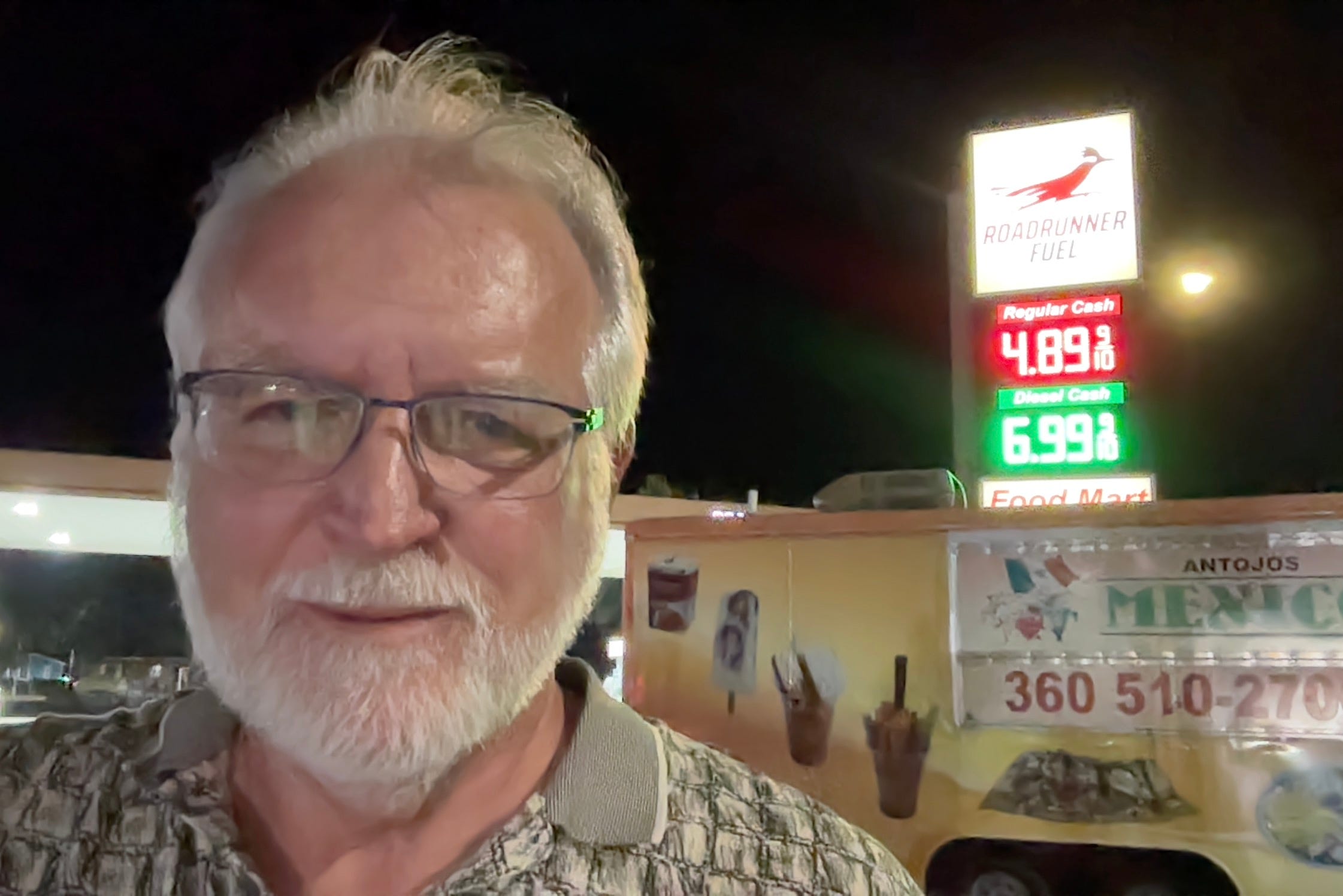
That’s the cash price for diesel. They add ten cents at the pump if you are paying with debit or credit. The highest prices ever seen for diesel, and RoadRunner isn’t even top-tier fuel around here.

Back when I was first claiming this war was going to cause huge fuel inflation this summer, a few folks did not think so. Well, it’s still summer; and, as I warned back then, when we saw this time hit, that would only be the start of the trouble that is coming. We haven’t even seen much sign of the fuel shortages popping up yet, but I am going to lay out for you now how we’ve reached this juncture where shortages do appear and prices climb even faster.


Two more things worth knowing. Wirth said he hasn’t spoken to Trump since August 3, when the president publicly told oil companies to bring prices down NOW. And in March the CEOs of Exxon, Chevron and ConocoPhillips warned this administration that a long closure of Hormuz would produce exactly this diesel shortfall.

We do remember that warning, reported here because I knew it was one we’d want to keep an eye on… as in I was certain we would get there. Unsurprisingly, the Trump administration’s response to Wirth was the usual round of lies: Interior Secretary Doug Burgum told reporters in Houston to make sure the word “temporary” appears in their coverage, and argued prices would have been this high under Biden anyway.

The White House is betting on Venezuelan production and new refining capacity, both of which take years. He should have used the word “transitory.” It has more panache now that the Fed leaned so heavily on it when giving all of its false assurances that this inflation would go away on its own. We now know they could never fully beat it down with a club, so now we have all the new inflation piling in on top. So, if he used that word, we probably could agree with him and say, “Yes, this inflation is transitory… per the Fed’s revised definition.”

And, of course, there is that typical baby-style blame it all on Biden that we get from Trump between his diaper changes. He never has the manly guts to own any damage he creates. That’s a sure sign of a baby.

The president, as already reported, is making millions off of his oil stocks since day three of this war, as reported in The Daily Doom. So, he’s just grandstanding when he barks at oil companies and tells them, “Bring prices down NOW!” Here’s the headline: "Trump’s oil investments have gained millions during Iran war as his accounts keep trading."

A bright glint of Trumpflation: If you want to see just a little piece of what is going to be driving up the price of fuel more in the near future, but its a very sharp piece, look at this report that just came in about the cost of hiring a supertanker. You may recall I reported yesterday that tanker costs had soared to an all-time record of $800,000 per day! Well look at where they reached today:
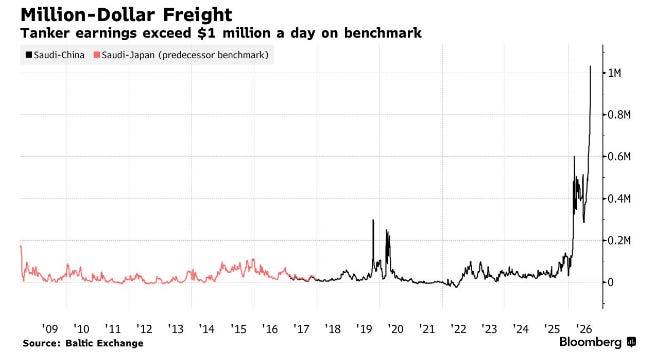
Over a million dollars PER DAY! Higher than what were the highest tanker rates in history just yesterday BY FAR. “Yeah, some of us will risk our lives to get that oil through Trump’s safe corridor for you, but it’ll cost you some serious hazard pay.”

As far as the east is from the west: Right now going from east to west in Saudi Arabia is an almost impossible distance for oil unless you want to take it one tiny little tank truck at a time through the scorching desert. So, because of that successful shutoff of the east-west pipeline that I recapped in the Deeper Dive on Saturday when giving an update on how bad the damage was, the Saudis are already terminating oil shipments that had been scheduled. Saudi Arabia has informed European customers that some late-September crude shipments are being cancelled following the closure of the East-West pipeline.

This is not a minor disruption. The pipeline has been carrying 4–5 million barrels per day (approx 4–5% of global oil supply) and has become a critical alternative route while shipping through the Strait of Hormuz remains severely disrupted.

Europeans are paying the equivalent of between US$9 and $11 per US gallon for diesel. Well, you can be sure that went up with today’s announcement on tanker costs! That is a cost that gets tagged onto the prices of WTI and Brent. Crude prices have been holding since the pipeline shut down at a global price of around $105/bbl for WTI and$108 for Brent. But when you don’t get any delivered to your neck of the woods, you’re probably going to pay a hefty premium to squeeze delivery out of somewhere else so you can keep refining. The price of WTI—because the US has a lot of it, making it is the market many are turning to—has now nearly caught up with North Sea Brent, even though it is not as useful for making diesel so usually sells for around ten bucks less a barrel; but refineries are squeezing diesel out wherever they can.

In fact, the latest news I have on that refinery that shut down due to power failure in Illinois is that it appears the power failure came from running their section of the electrical grid too hot for too long by refining at maximum capacity, though the cause has not been nailed down for certain, and the repairs are still ongoing. If that’s the correct diagnosis, the all-out squeeze just created a hot friction point.

Of course, Europe is somewhat the cause of its own problems, too, due to its very liberal policies restricting oil production and refining. However, don’t think this stays contained to Europe. As Europe reaches to other sources to make up what was just taken away by Saudi Arabia (thanks to the Houthis), they will reach for your source. That means you get to compete. It’s a global market.

Beyond a diesel shortage in the West, Europeans are also dealing with low natural gas stockpiles heading into the Northern Hemisphere winter, with prices reaching their highest level since December 2022.

The damage is done: Here is the pumping station before and after the attack as was shown in that Deeper Dive very shortly after the satellite imagery was made available, though it is all over the news now:
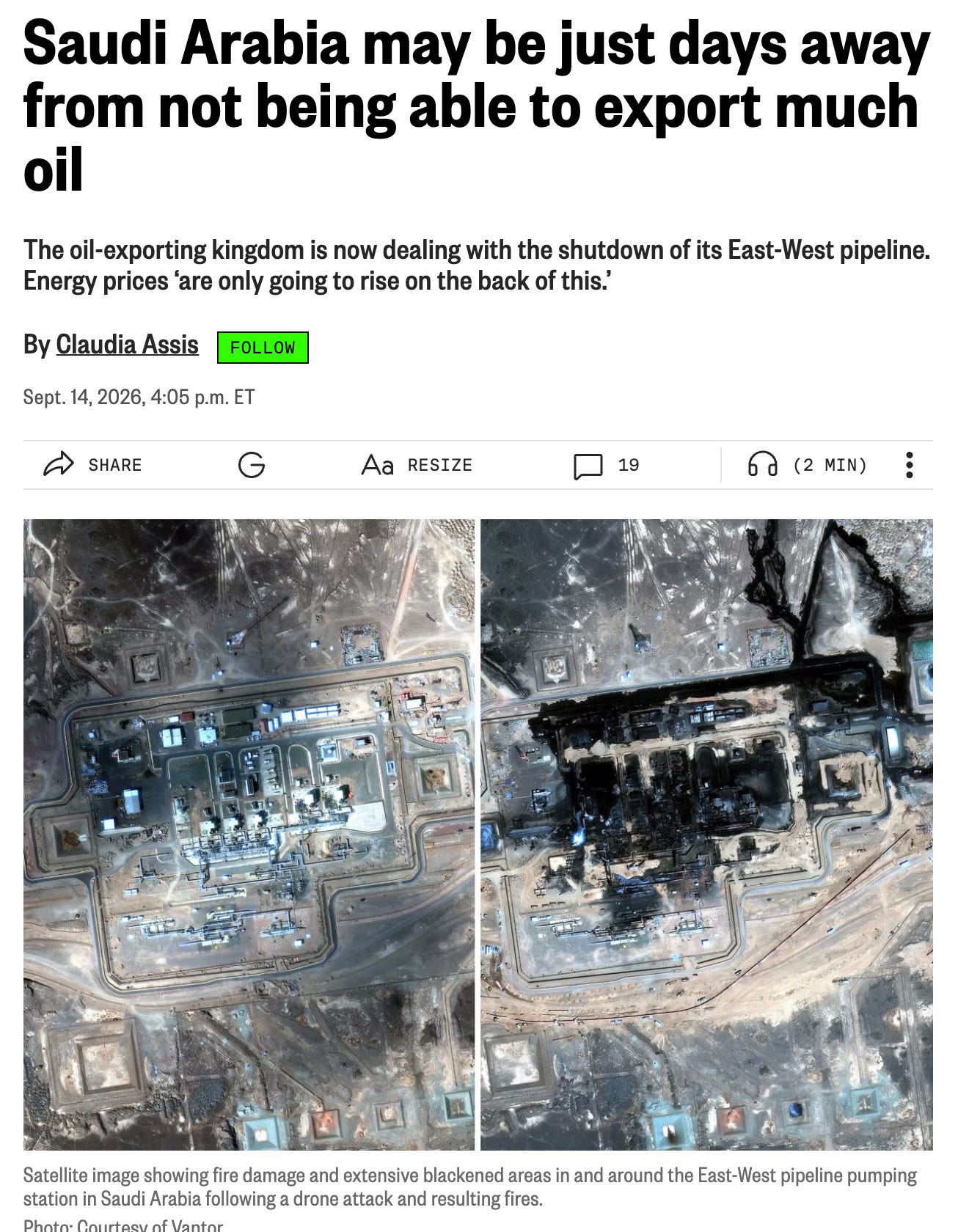
Pretty well burned to a crisp. There are several more photos in the article in the headlines below. Of course Trump’s energy secretary said the big conduit across the desert will be back up and running in a 4-5 weeks. Nah, I don’t think that’s something you snap together in a few weeks. It may take that long just to do the demolition and cleanup … if they RUSH. And don’t you think replacement parts and major pumps might be starting to get a little hard to come by in the Middle East? These guys routinely spout nonsense off the tops of their heads. They make it up as they go. If you think I’m wrong, please wait until next month to tell me when they get the pipeline back to fully operational.

Of course, harvest season is here in the northern hemisphere right as diesel is running out and prices are going trough the roof, so you can guess what that is going to do to your food prices this fall and winter, and clearly that will be worse for people in Europe.

Here’s a video I’ll post for everyone that summarizes the war action I covered in my Deeper Dive back on Saturday, comparing their sweeping takeover of West Yemen for importance to the Vietnam Tet Offensive:
Full screen recommended.
The escalation trap: All of this is part of the Iran Plan, which is to say the “escalation trap” I laid out two Deeper Dives back. Those who read that Deeper Dive can now see how the parts are coming together one step at a time, constantly turning up the heat in the Middle East without tripping Trump into full-on war because he really wants out. Last week brought a major tightening of the screws with the wipeout of this pipeline and seizure of full control over the Bab al-Mandeb (Gate of Tears).

The overall goal of that plan is stated in another article below: Iran’s leaders were never going to passively submit to slow strangulation. Facing Donald Trump’s blockade of their ports and the near-total loss of their oil exports, the regime is now striking back across the Middle East, aiming to inflict enough damage to force America to relent. Having locked down Hormuz pretty well, it looks like Iran is doing a darn good job of locking down the other side of Saudi Arabia as phase two of the Iran Plan: "Iran is now doing everything possible to wreck this alternative, which is why the Houthis have strengthened their hold on the choke point, where they have positioned Iranian-supplied anti-ship missiles."

Finally, we have a report from the Congressional Budget Office that says, yes, the Iran war most certainly is driving up Trumpflation. Well, they don’t call it by that name, of course, but they do make clear that his war in now spilling over into the prices of many other things, blaming more than 40% of current inflation on the Trump-Iran War. So, I’m just going to call it as it is. Thank you, Donald Trump for you inflation.

If there remains anyone who is not inclined to blame Trump and his ill-advised war yet, let’s see how they feel in the cold of winter. Maybe that’ll turn the heat up a little on Trump when the heat goes off for many others or, at least, gets turned down to where they can see their breath at the kitchen table. (Note: Some sources say the Houthis made this attack on the east-west pipeline. Some say Iraq. The Saudis, last I read, believed it was the Houthis. The fog of war.)

As a footnote, I’m noticing most of the stories in the news about the Trump-Iran War still have not caught up to the map of Houthi conquests I presented in my Deeper Dive for paying subscribers, showing the full swath of regions they took over in Yemen like a landslide.

I saw one other person commenting on another site about how hard that information is to find in the mainstream news, making him wonder as I was also wondering whether some of the information is being shut out. It’s also possible, of course, that I got false information since I had only one original source, as I noted at the time made me a little less than fully confident; but I don’t think so. I think it will prove over time the Houthis have taken that full region, unless the Saudis, who are now fighting back with more intensity than they showed earlier, reclaim some of it.

One of the stunning things of that victory that made it for the Houthis what Biden did for the Taliban, was that the Saudi forces left much of their heavy artillery behind when they fled so quickly. So, the Houthis captured some great war plunder that they are now putting to use in round two, better armed, thanks to Saudi Arabia leaving its American-built equipment behind.

Anyway, there are lots of headlines below now covering events of the full past week of the war for the first time, just stopping a little short in their boundaries of what has been taken over by the Houthis from what I presented. Those headlines, even if you don’t read the articles behind them, will give you a good picture of the growing troubles that are coming that will cause significant additional upward pressure on crude oil and fuel prices and then the price of everything."

John Wilder, "Oil, Oil, Toil And Trouble, Plus? Raccoons."

"Oil, Oil, Toil And Trouble, Plus? Raccoons."
by John Wilder

"Arguably, the biggest machine humanity ever built is the hydrocarbon industry. Annually over half of a trillion dollars are spent exploring for it. Oh, sure, that’s what a Big Mac© will cost in 2036, but right now I wouldn’t turn it down. That’s just finding and getting it out of the ground. All in, with pipelines, ships, rail cars, and refineries, it costs about $1.2 trillion a year. Well, that was last year. This year it will be more.

The killer is supply and demand. Less oil is getting on a boat and going to Rotterdam, so that takes it off the market. The Strategic Petroleum Reserve is nearing levels that some have said risk damaging the storage infrastructure itself, but it’s in Louisiana and Texas, so they’re used to the smell of oil in the morning. Smells like . . . money.

But what people miss is that it’s a finely tuned industry. It’s not like there are extra wells sitting around, waiting to produce. And, after Ukraine sent all those flying lawnmowers covered in C4 into refineries in Russia, that stung. It ended up taking out millions of barrels of capacity versus their peak refining capacity. That’s less bubbling crude being turned into diesel.

Thankfully, we also have Gulf War VII, Part 58, so that the oil produced is actually even lower than the capacity of the refineries. The IEA© (That stands for International House of Pancakes®, but in French, I think?) is guessing that things are rapidly falling apart when it comes to the amount of oil available and the fuel we can make out of it.

We have an oil tank. And its level is dropping. Even when the oil comes back, we still need to figure out how to mash it into diesel, which won’t happen overnight. What does that leave?

Demand destruction. Those are fancy words, but the short version is that the solution to high oil prices is high oil prices. Yes, I used to drink gasoline like it was milk back in the day, because despite trillions of dollars being spent to find it, drill it, pump it, pipeline it, smash the dead dinosaur molecules around so the T. Rex bones don’t get stuck in the bottom of my gas tank, gas was cheaper than bottled water. Was. Now it’s expensive, so people will stop drinking gasoline and diesel. And they’ll stop driving. And they’ll stop idling their cars so they use less of that wonderful fuel.

As we’ve discussed before, the poorer nations will be hit first, and hit hardest. For me, it means, well, nothing as far as my fuel purchases. I drive about four miles a day on the average day, so add the three and carry the two... that’s about 120 miles a month. At $4.50 a gallon and 20 miles per gallon, that’s, dang, complicated. It’s too complicated to figure out. You’d have to use multiplication or some other tool of the Devil.

As gas. Not as the economy, and it’s an isolated view. But the cost of fuel is a tax that hits every physical object that is moved in space to be bought and sold. I know that now that if I want steak, because it’s steak and who doesn’t want steak, it will now cost more. It costs more to get food to the cattle, move the cattle, convince the cattle politely to disassemble themselves into Wilder-sized portions, and move their soon-to-be-grilled-ribeyes to my house.

If that gets too expensive, maybe I’ll have chicken. But for the person who can already only afford chicken, I think they have to move to something like mouse. The short version is that demand destruction means people don’t buy as much of whatever demand is being destroyed because they can’t afford it. Demand destruction is just a fancy way of saying, “you’re all getting poorer, so learn to catch raccoon”.

There’s other positive news!10 of 11 postwar (World War II, not the Franco-Prussian War) recessions were produced by... oil price highs that exceeded the three-year high. Which is right where we are. This didn’t happen in 2022, because everyone just decided to print money so we could build all the data centers we can eat instead of having a recession, so in my mind we just kicked the can down the road a bit. Money printing is magic! Do you think they’ll stop now?

No. But what about oil. We make and export oil now. Surely, John Wilder, that will save us! No, it won’t. I mean, sure, it’s nice that roughnecks will be getting some more hours in down in Texas, but that doesn’t help much when you’re a farmer trying to harvest the crop with diesel that’s now twice as expensive as you planned on. On balance, my money is still on this increase in oil prices resulting in not only demand destruction but salary deconstruction.

Salary deconstruction? Oh, nevermind that. It’s just a fancy name for people getting fired, or not getting hired. Raises will be down right at the time that people will be feeling more costs, and it will be harder to get a job. In the 1970s we had stagflation. I wish this would be Epsteinflation, because at least then we’d never see it.

No, this will be Zendayaflation, because even though no one wants Zendaya, Zendaya is everywhere and in everything. Like the inflation we’re starting to see, small, mean looking, but you know that it’s going to grow and resemble a linebacker.
How do you get $1.2 trillion? Just jam up the world’s biggest machine, and then create ones and zeros so we can spend them faster. The downside of that Big Mac© that costs only $1.2 trillion? You don’t get any fries. And the burger isn’t exactly made of beef."

Bill Bonner, "Trouble Behind, Trouble Ahead"

"Trouble Behind, Trouble Ahead"
by Bill Bonner

Poitou, France - "‘America lost its way after 9/11,’ says Gerald Baker in the London Times. The wars in Afghanistan and Iraq cost more than 7,000 American lives, hundreds of thousands of civilian ones and trillions of dollars, turning that surplus into a debt now above $40trn. Seeing the world’s sole superpower flounder for a decade against roadside bombs and Soviet-era rifles wrecked American self-esteem and drained Washington’s international authority. But the deeper damage was to Americans’ faith in their government and in themselves.

All over the media, commentators strove to make sense of recent developments...to explain the dramatic change in America’s place in the firmament of great nations. Typical of these assessments is the idea that the US ‘took the wrong path’...or was ‘blinded’ by the need for revenge...or that the emotional shock led to ‘chaos and insanity’ among Americans and their leaders. Daniel Larison: "The ‘War on Terror’ was a Failure." "The U.S. has spent the last two and a half decades dealing out death and destruction across two continents with remarkably little to show for the effort. All true. All beside the point.

All assume the US was headed somewhere else. It got on a train, bound for glory and ended up in Gary, Indiana. What a disappointment! But what if it had been aiming for dereliction all along? And what if neither grief, nor insanity, nor the stupidity of any particular administration led it thither? America did not lose its way. It found it. It was already doomed by its fake money system.

Nor is Donald Trump totally responsible for the latest reversals. He is just another in a procession of lunkheads - from Bush, to Obama, to Biden...and Trump. The latest one didn’t change direction; he just pushed down on the accelerator and enjoyed his reflection in the window as the train sped by. But watch out, Casey Jones; there’s trouble on the tracks ahead. Reuters: "Oil rises above $108 as attacks, pipeline outage deepen Saudi supply concerns."

On the evidence, the War on Terror seems to be going worse than ever. Iran controls the Strait of Hormuz. The Houthis seem to be gaining control of the Red Sea. And Iraqi militias are taking aim at the Saudi Pipeline. They seem to be cornering the world oil market in ways not covered by the finance textbooks. They do not ‘take delivery.’ They just make sure no one else can.

AP: "Houthis seize two Red Sea strategic islands."
AP, AFP, Reuters: "Baghdad confirms attack on Saudi pipeline came from Iraq." "Saudi Arabia has said it will not retaliate and wants Iraq to “take the necessary measures.” Baghdad is under pressure from the United States to rein in Iran-backed militias."

Meanwhile, WLOS: "Diesel prices hit historic high at over $6 a gallon on average nationwide." GasBuddy: "While ‘terrorists’ drive up oil prices, speculators do the job on interest rates. MarketWatch: "10-year Treasury yield hits 5% as oil prices jump and Fed meeting looms." Traders are betting against the ‘house,’ and winning. The Pentagon cannot control ‘terrorists.’ Scott Bessent can’t control the bond market. Even with the largest economy in the world at their fingertips, neither can control the price of diesel fuel.

Diesel is what delivers the stuff. The highways are full of trucks. And the trucks burn diesel fuel. Raise the cost of diesel and the price of the stuff the trucks deliver also goes up. Likewise, the cost of capital is the diesel fuel of finance. Everything depends on it. Raise the price and all the stuff capital buys becomes more expensive too. But there is nothing surprising about this...except perhaps in the details from the oilfields. Stuff becomes more expensive as the feds lose their grip. Gamblers switch from buying the empire’s paper (primarily US Treasury bonds)...to selling it.

Which brings us to the real heart of the ‘decline of the Empire’ story. America’s 21st century blunders were not quirky detours. They were the logical, and probably inevitable, coaling stations along the way. The Bubble Empire is, after all, essentially a massive inflation story. New money enters the economy when it is borrowed. So, each new dollar of debt is equal to an extra dollar of ‘money supply.’ Debt is the empire’s real fuel…its real currency.

Total US public and private debt in 1971 was about $2 trillion...and GDP was about half that much. So, for every dollar of debt there was 50 cents of output supporting it. Now, debt is as much as 4.5 times GDP. That difference - 2.5 times GDP or as much as $75 trillion - is a measure of the Bubble Empire. It is also a measure of how much fake ‘wealth’ could disappear when the bubble pops. But remember, real wealth doesn’t evaporate. The house is still there...so is the factory...and the sausage. The ‘stuff’ survives; the ‘paper’ burns.

Tuesday, September 15, 2026

"The Doomsday Scenario You Aren't Supposed to Talk About"

Full screen recommended.
Canadian Prepper, 9/15/26
"The Doomsday Scenario You Aren't Supposed to Talk About"
"The reason why they are so haphazardly pursuing AI is stranger than fiction This is a very long video where I talk about every aspect of existential risks pertinent to the AGI/ASI risks. Sit back and have a muse with me."
Comments here:

Gerald Celente, "The American Way of Life... More War, More Misery"

Strong language alert!
Gerald Celente, 9/15/26
"The American Way of Life... More War, More Misery"
"Gerald Celente dives into the latest issue of the Trends Journal, exposing the political, economic, and geopolitical forces driving America deeper into an era of endless war and mounting hardship. As military spending surges, global tensions escalate, and economic pressures intensify, Celente examines who benefits from perpetual war and who pays the price. From Washington's foreign policy agenda to the impact on inflation, debt, declining living standards, and global instability, this episode connects the dots between government priorities and the growing struggles of We the People.The Trends Journal is a weekly magazine analyzing global current events forming future trends. Our mission is to present Facts and Truth over fear and propaganda to help subscribers prepare for What's Next in these increasingly turbulent times."
Comments here:

"Everyone Is Losing Interest In Everything, And It's a Sign That..."

Full screen recommended.
Epic Economist, 9/15/26
"Everyone Is Losing Interest In Everything, And It's a Sign That..."
"More and more Americans are losing interest in everything: going out, hobbies, friendships, even their own goals. In this video they explain why, in their own words, and it keeps coming back to the same three things: money, work and stress. A normal week now looks like this: drive to work, work, drive home, completely exhausted. Saturday is chores, Sunday you are already dreading Monday. Meanwhile rent, groceries, gas and insurance keep climbing and the paycheck stays where it was. So the fun stuff goes first: the dinner out, the hobby, the trip. What this video covers: • People who simply stopped caring about going out. • Being trapped in the "success machine." • Not feeling fulfilled in any area of life. • Burned out and done with social media. • Work, home, repeat, with no money and no motivation. • What happens to an economy that runs on people wanting more.

 Every clip is a real person, filmed on their own phone, in their own words. Nothing here is staged. Losing interest in spending is understandable. Losing interest in the people around you is where it gets dangerous. Have you felt this? Tell us below.
Comments here:

"The Fuel Crisis Has Arrived; 'Weekend At Bernies' Starring Mitch McConnell"

Jeremiah Babe, 9/15/26
"The Fuel Crisis Has Arrived;
 'Weekend At Bernies' Starring Mitch McConnell"
Comments here:

"Letters to the Sky: Love Doesn't Fade, It Burns Brighter"

Full screen recommended.
"Letters to the Sky:
 Love Doesn't Fade, It Burns Brighter"

Musical Interlude: 2002, "Believe"

Full screen recommended.
2002, "Believe"

"A Look to the Heavens"

“Massive stars, abrasive winds, mountains of dust, and energetic light sculpt one of the largest and most picturesque regions of star formation in the Local Group of Galaxies. Known as N11, the region is visible on the upper right of many images of its home galaxy, the Milky Way neighbor known as the Large Magellanic Clouds (LMC).
The above image was taken for scientific purposes by the Hubble Space Telescope and reprocessed for artistry by an amateur to win the Hubble’s Hidden Treasures competition. Although the section imaged above is known as NGC 1763, the entire N11 emission nebula is second in LMC size only to 30 Doradus. Studying the stars in N11 has shown that it actually houses three successive generations of star formation. Compact globules of dark dust housing emerging young stars are also visible around the image.”

"When the Soul Sees the Truth and Can't Unsee It"

"When the Soul Sees the Truth and Can't Unsee It"
Comments here:

"5 Signs You're Not Losing Your Mind - You're Waking Up"

Full screen recommended.
Native American Elder,
"5 Signs You're Not Losing Your Mind - You're Waking Up"

"Aging Is a Privilege"

Full screen recommended.
Delta King's Blues, "Aging Is a Privilege"
"Every gray hair is another sunrise someone else never got to see. “Aging Is a Privilege” is a heartfelt, reflective Delta King’s Blues tune about gratitude, resilience, and embracing the years with quiet pride. It’s a reminder that growing older isn’t something to fear—it’s a gift not everyone receives. A warm, slow-rolling acoustic guitar carries the melody like an old friend walking beside you through memories and milestones. The harmonica breathes with gentle soul, echoing the joy, heartbreak, and wisdom collected over a lifetime. The groove stays steady and comforting, built for peaceful evenings, front-porch reflections, and thankful hearts. This is blues that celebrates every season of life. For those who understand that every wrinkle, every scar, and every silver hair is proof of a life fully lived. Getting older isn’t losing your youth… it’s earning another chance to see tomorrow."

The Daily "Near You?"

New Braunfels, Texas, USA. Thanks for stopping by!

"Now Is No Time..."


"Richard Dawkins on the Luckiness of Death"

"Richard Dawkins on the Luckiness of Death"
by Maria Popova

"We are born into the certitude of our eventual death. Every once in a while, something - perhaps an encounter with a robin’s egg, perhaps a poem - staggers us with the awful, awe-filled wonder of aliveness, the sheer luck of it against the overwhelming cosmic odds of nonexistence. But alloyed with the awe is always the half-conscious grief that one day the light of consciousness will be extinguished. It is a heavy gift to hold, this doomed delirium of aliveness. It is also a buoyant gladness, if we are limber enough to stretch into the cosmic perspective that does not come naturally to us small, Earth-bound bipeds corticed with tender self-importance.

Consider this. For each of us, one thing is true: Had any one variable been ever so subtly different - had your parents mated on a different day or at a different altitude, had the early universe cooled a fraction of a second faster after the Big Bang, you would not exist as the particular constellation of atoms configuring the particular consciousness that makes you you. Because chance plays such dice with the universe, and because the die dictates that the vast majority of energy and matter never had the luck of cohering into this doomed delirium of aliveness, it is, in some profound and practical sense, a staggering privilege to die - one that betokens the privilege of having lived. To lament death, then, is to lament our luck, for any negation of the possibility of death is a negation of the improbable miracle of life, a wish for there to be nothing to do the dying - nothing to have partaken of the beautiful, bittersweet temporality of aliveness.

It is easier to bend the intuitive mind into this correct but counterintuitive perspective while walking in a cemetery at the height of summer. Doing this very thing while thinking these very thoughts, I was reminded of a passage from one of the most lucid and lens-clearing books written this side of Darwin - "Unweaving the Rainbow: Science, Delusion and the Appetite for Wonder" (public library) by the visionary and often controversial (which is the social fate of every visionary) British evolutionary biologist Richard Dawkins.


"We are going to die, and that makes us the lucky ones. Most people are never going to die because they are never going to be born. The potential people who could have been here in my place but who will in fact never see the light of day outnumber the sand grains of Arabia. Certainly those unborn ghosts include greater poets than Keats, scientists greater than Newton. We know this because the set of possible people allowed by our DNA so massively exceeds the set of actual people. In the teeth of these stupefying odds it is you and I, in our ordinariness, that are here. We privileged few, who won the lottery of birth against all odds, how dare we whine at our inevitable return to that prior state from which the vast majority have never stirred?"

Complement with astronomer and poet Rebecca Elson’s exquisite “Antidotes to Fear of Death,” Nick Cave on grief as a portal to aliveness, and Christopher Hitchens on how to live with our mortality, then revisit the science of how alive you really are, examined through the curious lens of trees and Alan Turing."
o
o

"Thought..."

"Men fear thought as they fear nothing else on earth, more than ruin, more even than death. Thought is subversive and revolutionary, destructive and terrible, thought is merciless to privilege, established institutions, and comfortable habit. Thought looks into the pit of hell and is not afraid. Thought is great and swift and free, the light of the world, and the chief glory of man."
- Bertrand Russell

"Five percent of the people think;
ten percent of the people think they think;
and the other eighty-five percent would rather die than think."
- Thomas A. Edison.

"Now Is the Time of Monsters"

"Now Is the Time of Monsters"
by Jeff Thomas

"In ancient Rome, interregnum was the term given to the period between stable governments when anything untoward might occur, and sometimes did – civil unrest, warfare between warlords, power vacuums and, finally, succession wars. But eventually the dust would settle and the victors, whoever they might be, would at some point restabilise the empire, often with a new map, showing the latest lines of geographic possession.

In 1929, the Italian Antonio Gramsci was in a fascist prison, writing about what he considered to be a new interregnum – a Europe that was tearing itself apart. He anticipated civil unrest, war between nations and repeated changes in the lines of geographic possession. At that time, he was attributed as saying, "The old world is dying and the new world struggles to be born. Now is the time of monsters."

And, of course, looking back from our vantage point in the twenty-first century, we have no difficulty in confirming that he was correct in his prognosis. The world war that followed brought forward the worst traits in mankind. The sociopaths of the world came centre-stage. By the time the dust had settled, tens of millions were dead.

What we do have difficulty with is recognizing that the same pattern is again with us. National leaders and their advisors are spoiling for war, building up weaponry, creating senseless proxy wars in other nations’ backyards and playing a dangerous game of "chicken" with other major powers.

This will not end well. It never does. Once the shoving-match has begun, it only escalates. At some point, whether it’s the false-flag assassination of an Archduke, as in World War I, or the false flag attack on Germany by Poland, as in World War II, we can always count on some excuse being created to justify diving headlong into war.

It’s also true that, when empires get into economic trouble that’s too far gone for any viable solution, a trick that’s always employed by political leaders to keep the citizens from removing them from their seats of power, is to start a war. A people will, if they believe their homeland is in peril, accept the "temporary" removal of their freedoms. Even in the United States, the famed "Land of the Free," political leaders have routinely imprisoned dissidents in times of warfare. People tend to get behind their leaders in wartime, no matter how undeserved that loyalty might be.

And so, now is the time of monsters, as Mr. Gramsci rightly stated. A time of uncertainty, when countries are in turmoil and would-be leaders are jostling for power with existing leaders. An interregnum.

Troubled times tend to bring out all the crazies – all the sociopathic-types that would find it hard to succeed in stable, prosperous times. In such times, the average person becomes worried that things are not going to turn out well. That’s perfectly understandable. Unfortunately, most people lack both the imagination and the courage to cope with how the times are impacting their lives. They instead rely on others to provide a torch that might help them escape from the darkness.

Not surprising then, that every snake-oil salesman in town sees an opportunity to offer big promises – promises that he has neither the ability nor the inclination to fulfill. At such times, the people of a country tend to become polarized, placing their faith in one political party or another, hoping that their party will "make the bad stuff go away."

In the US we see, on the liberal side, promises for "free health care for all," a guaranteed basic income, housing for those who cannot afford it, and an endless stream of promises that, if the government were to implement them all, they will not be able to pay for them, even with 100% taxation from those who presently pay tax.

On the conservative side, we see promises such as "Make America Great Again," with tax rebates that do not rejuvenate the economy, breaks for firms that have expatriated, but do not fool them into returning, claims to cut budgets, only to increase them, and promises to eliminate debt, only to expand it.

To be sure, the problem begins at the top. But it doesn’t end there. It sifts down to the proletariat, who, unable to come up with constructive solutions, create their own monsters, trashing the shops and burning the cars of people who had no hand in creating the problem. But surely this is just a one-off phase, in which the best and brightest are temporarily pushed offstage, but will soon return, yes? Well, unfortunately, no. Historically, a period such as this one is followed by one of increased madness. Historically, the next step is societal breakdown. Riots, secessions and revolutions become commonplace, accompanied by economic collapse.

Out of these events come the worst monsters of all. It’s in the wake of such developments that the people of any country then turn away from those that made the empty promises and toward those who promise revenge against an ill-defined group who are characterized as having caused the problems. That’s when the Robespierres, the Lenins, the Hitlers – the greatest monsters – are swept into power. They invariably deliver the same message – that they’ll seek out the aristocracy, the gentry, the patricians, and strip them of their positions and possessions.

Invariably the way that this shakes out is not that the average man rises up, taking his "fair share" of the spoils. Instead, the leaders take the spoils and the proletariat are reduced to an equality of poverty. Our friend Mr. Gramsci found himself imprisoned by Benito Mussolini and died from illnesses incurred in prison. Unfortunately, his approach was to complain, but remain, as his country deteriorated around him. This proved, for him, to be the worst of choices. And, so it is today."
"This is Hell, cleverly disguised just 
enough to keep us from escaping."
- Jean-Paul Sartre

"Hell is empty, and all the devils are here."
- William Shakespeare

"How It Really Is"

"Sam's Club Is Dying, Registers Are Out Of Business, Miles Of Lines & Abandoned Checkouts"

Full screen recommended.
Epic Economist, 9/15/26
"Sam's Club Is Dying, Registers Are Out Of Business,
 Miles Of Lines & Abandoned Checkouts"
"Sam's Club members pay a fee just to walk in the door. Now they scan their own groceries, wait in lines that never move, fight for refunds, and in one Arizona store, there is not a single register left. This video is what members and employees are saying about it, in their own words. A store used to pay someone to take your money. Now more and more of them want you to do that job yourself, for free, and they call it convenience. Self-checkout does not save a company the price of a machine. It saves the price of a person, year after year, and that saving does not show up as a lower price on the shelf. In a membership store it goes one step further: the member pays to get in, and then works the register for free once inside.

What this video covers: • A Sam's Club in Tempe, Arizona with no registers at all, where everything goes through the app • Scan & Go charging one shopper four times for the same order • Cafe registers being removed too • One-way gas pumps and long lines • Pizza shrinkflation, expired food, and an employee talking about moldy products • Refunds denied for missing items, and a $120 refund that never came back • One cashier, an endless line, and angry members • A membership downgrade denied, and a member banned over a fruit tasting • What an app-only checkout really means for workers and for your data.

 Every clip is a real person, filmed on their own phone, in their own words. Nothing here is staged. The cashier is one of the most common jobs in America, and it is the job this model is designed to remove. When it works for one company, every competitor sees the same numbers. And a checkout run through an app is a record of what you bought, when, and in what order, tied to your name. The old register forgot you the moment you walked away. The new one remembers everything."
Comments here:

"Even The Mainstream Media Is Admitting That “The Great Fuel Crisis” Is Here"

by Michael Snyder

"For months, we were told that this moment was approaching. At first a lot of people didn’t want to believe it, and those that were sounding the alarm were mocked. But now even the mainstream media is being forced to admit the truth. When the war with Iran began, the world was sitting on vast stockpiles of oil that we could chew through to keep the global economy operating normally. Unfortunately, those stockpiles have rapidly dissipated and the conflicts on the other side of the planet are intensifying. As a result, we now find ourselves in unprecedented territory.

The world is using a lot more oil than it is currently producing. So something has got to give. For over six months we have been running through our reserves, and at this stage the mainstream media is openly telling us that a tipping point has arrived. The following comes from a Wall Street Journal article entitled “Oil executives say the great fuel crisis is here”…American oil executives warned for months that the prolonged closure of the Strait of Hormuz was bound to cause a fuel crisis. Now, they say it is here.

Commercial fuel stocks around the world have been depleting for more than six months, and strategic crude reserves can’t be tapped much further. Attacks last week shut down a crucial crude pipeline in Saudi Arabia that bypassed the Strait, stranding at least 2.5 million barrels a day from an already tight global oil market, analysts estimate. “All these mechanisms helped to mitigate the price and supply risk,” Chevron Chief Executive Mike Wirth said Friday at an energy conference in Austin, Texas. “Those have largely now played out, and we don’t have nearly the buffers in the system that we did when it began.”

Those oil executives are right. It is here. Thanks to recent developments, energy industry insiders now fear that the conflict in the Middle East “risks spinning out of control”…"Veteran energy advisers say that with no resolution to the Iran war in sight, the situation risks spinning out of control. Diesel prices have soared to a record $6.23 a gallon and gasoline prices, which slipped below $4 a gallon this summer, have rebounded to $4.32. Some energy analysts say they have been fielding investor questions about when consumers pinched by the high prices will start pulling back on new purchases."

For months, we were told that a deal to end the war with Iran was imminent. That kept markets stable for a long time. But now reality is catching up with us in a major way. On Tuesday, average prices for both gas and diesel in the United States increased yet again…
Just look at those numbers. A year ago, the average price for a gallon of diesel in the United States was just $3.68. Last month, it was sitting at $5.43. Now it is up to $6.26. Of course we should consider ourselves to be fortunate, because Europeans are paying between 9 and 11 dollars per gallon…
Unfortunately, this is just the beginning, because global oil supplies are about to get even tighter. It is becoming apparent that the damage to Saudi Arabia’s East-West pipeline is more extensive than we were originally told…Saudi Arabia’s oil problem just multiplied. What looked like a single Houthi hit on the East-West pipeline is now looking like a coordinated hammering of the whole system. Fresh satellite imagery shows Pump Station 9 badly damaged, with Pump Station 8 possibly hit too, both feeding the same artery that carries crude clear across the country to the Red Sea. Take out one pump station and you have a headache. Take out two on the same line and you have a pipeline that could sit largely dead for 3-5 weeks, maybe longer.

Yes, the Saudis could feverishly work to repair the damage that has been done. But then the Houthis could just strike the exact same locations again. On Tuesday, the Houthis hit the Yanbu Aramco Sinopec Refining Company, and for now all activity at the Yanbu export terminal has been suspended…

Oil loadings seemed to have stopped at Saudi Arabia’s main Red Sea port Tuesday as a major refinery there reportedly burned after an attack. Shipping industry sources told Reuters on Tuesday that loadings at the Yanbu export terminal had been suspended, four days after a drone attack shut the East-West Pipeline that feeds it, the outlet reported. Earlier Tuesday, an attack struck the Yanbu Aramco Sinopec Refining Company, known as YASREF, according to a post from the Hormuz Letter account on X. The post cited footage it said showed a fire at the site and NASA satellite heat detections inside the refinery.

This is a major economic disaster for Saudi Arabia. And it is going to turn into a major economic disaster for Europe too, because the Saudis have reportedly told refiners in Europe that they will not be receiving the shipments that they were expecting… Europe’s energy supply outlook is deteriorating after Reuters reported Tuesday that Saudi Arabia had notified some European refiners that their September-loading crude cargoes would be canceled following the shutdown of its critical East-West pipeline after a drone attack. Beyond a diesel shortage in the West, Europeans are also dealing with low natural gas stockpiles heading into the Northern Hemisphere winter, with prices reaching their highest level since December 2022.

What will Europe do? One source is claiming that there will be no more Saudi oil for Europe until at least November… Saudi Aramco has cancelled all of its September European crude oil allocations and is scrapping every cargo slated for late-September loading onward, with a European lifter saying no Saudi oil cargoes at all until November, per initial reports citing oil trading firm Onyx and market sources. That takes the world’s largest exporter out of the European market for the rest of September and all of October, a de facto force majeure on Saudi crude to Europe from the 3rd largest energy producer in the world.

If you live in Europe, I would go fill up your vehicles immediately, because nothing quite like this has happened to Europe before. Meanwhile, the Ukrainians just hit another Russian refinery after President Trump specifically asked them not to do so… President Volodymyr Zelenskyy said on X that Ukrainian forces struck the Syzran refinery in Russia’s Samara region, about 75 miles west of Samara and 466 miles southeast of Moscow. The strike comes days after President Trump urged Ukraine to halt attacks on Russian refineries, as average US retail diesel prices jumped above $6 a gallon and alarming disruptions to global refining capacity threaten fuel supplies ahead of the Northern Hemisphere winter.

Needless to say, all of this bad news has pushed oil prices even higher…Crude oil prices rose Tuesday as traders awaited updates on how long Saudi Arabia’s critical East-West pipeline will be closed. Brent crude futures, the international benchmark, were up 2.6% to $108.48 per barrel by 11:06 a.m. ET. U.S. West Texas Intermediate traded 3.2% higher to $104.65. Prices have surged around 20% this month as fighting has sharply escalated in the Persian Gulf.

The good news is that we still have oil left in the Strategic Petroleum Reserve. The bad news is that the SPR has now fallen to the lowest level that we have seen since 1982…"The U.S. Strategic Petroleum Reserve held 285.4 million barrels after inventories fell by about 1.2 million barrels in the latest week, according to Department of Energy data. The stockpile reached its lowest level since November 1982 as the government continued a planned release of crude oil from the emergency reserve."

If we drain the salt caverns where that oil is stored too low, we risk causing permanent damage. There are some experts that are arguing that we have already crossed that threshold. And federal law places restrictions on non-emergency drawdowns once we get down to 252.4 million barrels. In other nations, there is simply no buffer left.

The global economy really is facing a nightmare scenario, and investors are starting to get really nervous. On Tuesday, the yield on 10 year U.S. Treasuries hit the highest level in 19 years…"The benchmark 10-year Treasury yield climbed to its highest levels in 19 years on Tuesday as oil prices surge from the Iran conflict and expectations grow that the Federal Reserve will raise interest rates on Wednesday. The rate milestone could ripple through the economy as the 10-year yield is a benchmark for consumers loans and corporate funding. The 10-year yield was last up more than 3 basis points to 4.996%. Earlier in the session, it scaled to 5.041%, the highest since July 2007. One basis point equals 0.01 percentage point, and yields and prices move in opposite directions."

To me, it appears that extensive efforts are being made to defend the 5 percent level. If we ultimately reach 5.25 percent, that could be really bad news, because historically we have witnessed tremendous market disruptions once we cross that mark… Treasury yields are closing in on an inflection point where, historically, stocks and bonds have reinforced losses in one another. That points to a regime shift of higher bond and stock volatility and wider credit spreads.

Lines in the sand are often a little too neat for reality, but when it comes to Treasuries there has been a stark change in regime when 10-year yields go much above 5.25%. After that point, the risks to bond volatility and hence stock vol and credit spreads markedly increase. With 10-year yields rising above 5% this week the first question is: will they keep going? Yields may look stretched, rising to levels not seen since 2007 just today, but Treasuries are not yet oversold. Incorporating returns on capital and looking at prices, they are only back to their long-term mean on an annual growth basis.

We are dangerously close to the edge, and it won’t take much to set off a major financial meltdown. All over social media, people are talking about this now. They may not understand all of the specifics, but they can feel that something is coming. We live in such perilous times, and I have a feeling that a tremendous amount of insanity is just around the corner."

"Trump’s War On Iran Is Crashing Entire U.S.-Dominated Petro Dollar System

"Trump’s War On Iran Is Crashing Entire U.S.-Dominated 
Petro Dollar System; It Will Be Replaced With Globalist Sustainable
 Development Based On U.N. Agenda 2030 And Surveillance State"
by Leo Hohmann

"It looks like the globalists who have for years been calling for sharp restrictions on energy usage, getting it down to more “sustainable” levels, are going to finally get their wish. And it’s a “conservative” Republican president who is going to hand it to them on a silver platter.

They want us off our land, in much smaller apartment homes, driving smaller electric cars or riding bicycles, using less air-conditioning and less energy in all aspects of life. The famous mantra of the globalist World Economic Forum has been “you will own nothing and be happy” under their so-called great digital reset. They’ve also argued for a much smaller global population.

Their dream is close at hand as the entire house of cards is getting ready to implode. The fundamental transformation to a fully controlled digitalized society is being driven on battlefields with unnecessary wars, and in the global oil and gas markets, making energy basically unaffordable for average working stiffs like us. And it’s all thanks to Donald Trump’s foolish moves thinking he could destroy Iran, topple its government and steal its oil. His bravado and outsized ego prevented him from acknowledging that Iran gets a vote in that scenario. And they had a plan to spread the economic pain worldwide.

Not only has Trump lost bigly in his gamble to take down Iran, but now his aggression has led to Iran’s allies in Yemen, the Houthis, going on a rampage and taking over all of western Yemen along the vital Red Sea coastline, allowing them to control the Bab el Mandeb Strait. The Houthis also bombed a key oil pipeline in Saudi Arabia that had been allowing 5 percent of the global oil supply to evade the dangers of the war-ravaged Strait of Hormuz in the Persian Gulf.

U.S. Energy Secretary Christopher Wright has tried to downplay the significance of the pipeline’s destruction, saying the Saudis are able to promptly rebuild it and get it back online in a few weeks. Here’s what David Haggith, who publishes the Daily Doom on Substack, posted on the topic: "Into the now rapidly spiraling energy crisis, U.S. Secretary of Energy, Chris Wright, attempted to speak some calm into markets. He seems to specialize in saying stupid things. This time he indicated the total shutdown of the east-west pipeline was not a huge concern because the Saudis plan to have the pipeline fully “running very soon.” Since he is always saying empty stuff like that, it would appear the energy secretary’s brain doesn’t have the energy to run a lightbulb."

With the Houthis having seized full control of western end of Yemen, which was generally under Saudi military control until this Friday, the Houthis have gained a lot more missile firing platforms and drone-launching areas along the Saudi border that are now uninhibited, at least locally, by the Saudis from stopping them. The Saudis even fled so fast, Biden style, that they left some valuable equipment behind.

So, it is not hard to figure out what the Houthi game plan will be for that major pipeline, making me think the energy secretary cannot be this dumb, so he must just be another Team Trump liar. With the pipeline totally dead, both parties will wait until the Saudis spend a lot of money and time getting the pumping station back online and until the oil starts flowing again. Then they will immediately blow it all back up, leaving another big mess of spilled and burned oil all over the totally destroyed equipment. Each time, the Saudis will have to clean up the big, charred oil spill before they can even start to rebuild.

The other major risk here is that other countries will enter the war on the side of Saudi Arabia, notably Pakistan and Turkey, which recently signed a mutual defense pact with the Saudis declaring an attack on one country amounts to an attack on all three. This is the first big test of that alliance. The Saudis are also asking Egypt to enter the war on their behalf.

The oil markets responded predictably to all this Trump-caused chaos. In a matter of days, Brent crude has gone from $90 a barrel to $109 a barrel. At this rate, we could see $150 a barrel by the end of this year. That would mean gasoline prices of $7 to $8 a gallon, and diesel prices of $10 to $12 a gallon. You think food prices are high now? Wait till we have $10 a gallon diesel. Since jet fuel is a derivative of diesel, the airline industry will also be devastated.

Trump will likely declare an “energy emergency” and implement draconian new rules limiting Americans’ ability to purchase fuel for their cars and homes. And if protests get out of hand, he may declare martial law, possibly canceling elections, or postponing the results of the elections from taking effect after suggesting they were “rigged” by China, Russia or Iran. Costco, a major bulk-sale retailer, has already responded by announcing a rationing plan for motor oil, limiting customers to two cans each. Watch for other major retailers to follow suit.

The bigger story is this: The U.S. petro dollar and the empire it propped up is in freefall, right before our eyes, and it’s going uncovered by the media. Americans have no idea how much economic pain is coming their way as a result of Trump’s destructive wars, both military and economic wars, none of which America is prepared to fight and win.

Trump has managed to kill the petro dollar by stupidly starting an illegal and unwinnable war against Iran, allowing it to spread throughout the Middle East, and failing to protect U.S. allies in the region. The entire reason countries like Saudi Arabia decided to sell their oil exclusively in dollars was because they had a protection agreement with the Americans. You build your bases here on Saudi soil and we will sell our oil in your currency, then reinvest the profits in U.S. Treasuries to fund your debt.

In six months, Trump has managed to shatter that entire understanding. The spending party that led to a $40 trillion U.S. national debt is about to come crashing down. I predicted it last year when I started referring to Donald Trump as “The Destroyer,” because he is functioning as a destroyer of nations and the destroyer of the post-World War II U.S.-led rules-based order.

Not that that order was any good, but the system it’s going to be replaced with, a technocracy based on total surveillance and total government control, powered by 6G and AI data centers, is going to be far worse. The AI surveillance cameras on every corner will be the eyes of the oppressive beast system; the data centers will be the brains.

When reporters question Trump about his disastrous policies, he shifts the blame to others. This past weekend, he blamed the diesel shortage on Ukraine bombing Russian oil refineries. Overlooked is the fact that Zelensky has been bombing Russian refineries since June using American technology and American intelligence – Trump allowed it, had no problem with it. Now that diesel is in short supply and the national average price has shot up to around $6.50 a gallon, a fact that is going to cause rampant inflation in the price of all shipped goods, including food, Trump is suddenly acting like it’s a revelation that Ukraine is bombing Russian oil facilities.

While that has been a minor contributing factor in the diesel crisis, the far bigger cause has been Trump’s Iran war, which led directly and predictably to the disruption of oil through the Strait of Hormuz and the Bab el Mandeb Strait. He is shifting the blame from himself to Zelensky when in fact he is responsible for both wars raging out of control.

At the same time, Trump has drawn down the U.S. Strategic Petroleum Reserves from around 400 million barrels of oil when he took office to around 275 million barrels today.

Saudi Arabia has been betrayed by Trump and the Americans. Saudi leader Muhammed Bin Salman reportedly called Trump over the weekend begging for Trump to bomb the Houthis and stop them from attacking Saudi oil assets. For whatever reason, Trump refused.

Why would the Saudis renew any contracts with the U.S. to keep American military bases in their country? Instead of protection, those bases have made them a target. And don’t think the other Arab states in the Gulf aren’t taking notes. The U.S. has been exposed as either too weak to fulfill its commitments, or unwilling to fulfill them. Either way, Iran is going to emerge from this war as the unchallenged hegemon of the Middle East, along with Israel. Those two regional hegemons will at some point have to settle their own business. And countries like Saudi Arabia will now be incentivized to get their own nuclear weapons as that might be the only way to deter aggression from outside enemies.

The larger issue here goes beyond Trump and his destructive foreign policy. The bigger question is, how did we get a system in place in America that allowed a monster like Trump to get voted into office, not once, but twice? At the rate he is going, we will not only see America lose its empire, we might lose our country. We could end up with uncontrolled homelessness and poverty and a middle class that is totally wiped out of existence. All thanks to Trump and his obsession with waging an illegal, unconstitutional and unwinnable war against Iran that never had any connection to any legitimate American national-security interest.

As Trump gets more desperate to somehow spin this colossal loss into a sellable win, chances are great that he will dig himself a deeper hole that becomes increasingly impossible to dig himself out of. At that point, I would say the possibility of a major ground war and/or even a nuclear strike on Iran go up substantially.

Pray for peace while preparing for war. The battlefield in America may be more economic than military but the ravages could be just as devastating."