StatCounter

Monday, May 25, 2026

Chet Raymo, “A Few Words Inspired By The Tomato Plant”

“A Few Words Inspired By The Tomato Plant”
by Chet Raymo

"Mostly we think of life in terms of individuals - this person, this tomato plant, this frog, this oak tree, this gnat. And we talk about birth and death as the beginning and ending of life. But there is another sense in which life is just one thing, whose beginning is lost in the depths of time and whose end is not in sight. Life in this sense embodies itself in matter, temporarily, as a tomato or a frog, puts on matter and puts off matter as we might don or doff clothes. By this account, I am an ephemeral conglomeration of atoms that life is using to perpetuate itself.

But what is this thing called life? It cannot exist except as embodied form, but it maintains a continuity independent of any particular embodiment. It is a strange enduring wave that stirs the material world into purposeful and directed avenues. With Johannes Kepler we might call it the facultas formatrix of nature, the formative faculty, but giving something a name doesn't explain it. Whatever life is - in the unitary, enduring sense - it would be surprising if it only existed here on Earth. If I were a betting man I would bet that life is as pervasive as matter itself, or energy. Matter, energy and complexification. We have lots left to learn.

But let's be cautious. There are lots of folks out there with half-baked biocentric theories of the universe. Someone once chided the philosopher W. V. O. Quine with a quote from Shakespeare: “There are more things in heaven and earth than are dreamt of in your philosophy.” To which Quine is said to have responded: “Possibly, but my concern is that there not be more things in my philosophy than are in heaven and earth.”

"Everything Is Fine Until It Isn't - What Happens When They Lose Control"

Jeremiah Babe, 5/25/26
"Everything Is Fine Until It Isn't - 
What Happens When They Lose Control"
Comments here:

"Americans Have Never Felt This Bad About The U.S. Economy In The Entire History Of Our Country"

by Michael Snyder

"For much of the nation, it feels like we are in a permanent economic crisis with no end in sight. I have been documenting our long-term economic decline for years, and now we have reached a point where Americans have literally never felt this bad about the state of the U.S. economy. Considering everything that we have been through over the last several decades, that is saying a lot. So how will the American people be feeling if economic conditions continue to deteriorate? We might want to be thinking about that, because all of the long-term trends are taking us in the wrong direction very rapidly.

The University of Michigan has been tracking consumer sentiment for more than 70 years. On Friday, we learned that the University of Michigan’s index of consumer sentiment has fallen to the lowest level ever recorded…American attitudes just hit a milestone of sorts. On Friday, the University of Michigan reported that its index of consumer sentiment fell to the lowest level ever recorded in 70-odd years of surveys.

Sentiment was already low at the start of this year, but it fell sharply after the Iran war began at the end of February and sent gas prices sharply higher. Until this year, the previous lowest level was in June 2022, when inflation was running at the highest level in decades. Friday’s sentiment reading was 10% below even that number. “Prices remain extremely high, labor markets have unambiguously weakened in the last four years, and now we’re in the middle of a war,” said Joanne Hsu, director of consumer surveys for the University of Michigan. “I don’t think the fact that we’re lower than June 2022 should come as a surprise to anyone.”

At this stage, nobody can deny what is happening. Those at the very top of the economic pyramid are still thriving, but just about everyone else is really hurting. Since the 1970s, there have been many periods of great economic turmoil, but even during those times Americans felt better about the economy than they do right now…

"Indeed, households are feeling worse about their personal finances and the broader state of the economy than they did during the Great Inflation of the 1970s, when the cost of groceries doubled and the government was forced to ration gasoline; the Volcker shock, from 1979 to 1982, when the average interest rate on 30-year mortgages hit 18.6 percent and the country went into devastating back-to-back recessions; the early months of the coronavirus pandemic, when 200,000 firms collapsed, the unemployment rate flirted with 15 percent, and essentials such as infant formula became impossible to find; and the Great Recession, when the stock market lost half its value, the banking system teetered on the brink of implosion, and lenders foreclosed on 6 million homes."

Read that paragraph again and let it really sink in. Even during our darkest economic moments, Americans always had hope that things would eventually turn around. Unfortunately, that is no longer true. According to one financial expert, consumers are now “entrenched in financial stress”… "Americans “are entrenched in financial stress,” Bruce McClary, senior vice president of membership and media relations at NFCC says - the result of elevated prices on top of near-historic highs of consumer debt on credit cards and auto loans.

The nonprofit organization, which provides education and solutions for individuals struggling with their finances, especially debt management, reported a “significant surge” in consumers reaching out for credit counseling, which could be a warning sign for the broader economy, NFCC says. While it’s encouraging to see individuals seeking help before they have run out of options and can’t pay their bills at all, the widespread struggle could be evidence of the overall consumer economy’s health declining, the organization says."

Financial stress has become a permanent part of most of our lives. Our seemingly endless cost of living crisis is getting even worse, and consumers are drowning in an ocean of debt. As prices go up and up, our standard of living is steadily going down.

One recent survey asked Americans if they have reduced spending in certain areas or not, and the results were absolutely shocking…dining out: 54 percent say yes, while 44 percent say no;

o entertainment or leisure activities like going to movies, shows, or sporting events: 49 percent say yes, while 47 percent say no;
o vacation plans: 48 percent say yes, while 49 percent say no;
o grocery shopping: 43 percent say yes, while 56 percent say no;
o driving: 36 percent say yes, while 60 percent say no.

When close to half the country is reducing spending in multiple areas, that is really bad news for the economy. In the past, when the economy has started to waver our politicians in Washington have intervened by borrowing and spending more money. Borrowing and spending money that we do not have provides a short-term economic boost, but it also creates a long-term economic problem.

Now we are trapped in a nightmarish debt spiral, and so any short-term help that our politicians in Washington will be able to provide moving forward will be very limited…"The national debt held by the public, about $31 trillion, is now the size of the U.S. economy, up from 39 percent of the economy in 2008 and 79 percent in 2019. For most of the country’s history, the fact that the economy’s growth rate surpassed the interest rate on the debt enabled us to keep paying our bills.

But as my colleagues and I show in a policy brief for the Stanford Institute of Economic Policy Research, the fiscal outlook today is much more challenging. We concluded that the combination of higher deficits and climbing interest rates raises the risk that borrowing will become more expensive and will push government debt levels to climb relentlessly. This is a debt spiral.

The math is simple and unforgiving. Say both your annual income and your debt equal $100. Suppose you face a 2 percent interest rate but you get a 4 percent raise. You’ll have no problem paying your creditor their $2 in interest from your $4 in added income. But if you swap those rates around, every year puts you further in the hole."

It took decades of incredibly bad decisions to get us into this hole. Sadly, there is no easy way out. What this means is that a tremendous amount of pain is ahead. If you think that economic conditions are bad now, just wait until you see what is coming. We tried to defy the laws of economics for a long time, but now economic reality is catching up with us in a major way."

"Native American Elder Breaks Down Why Loyalty Disappeared From America"

Full screen recommended.
"Native American Elder Breaks Down Why
 Loyalty Disappeared From America"
Comments here:

The Daily "Near You?"

Argyle, Texas, USA. Thanks for stopping by!

"Albert Camus On Suicide, Absurdity, And The Meaning Of Life"

"Albert Camus On Suicide, Absurdity, 
And The Meaning Of Life"
by Scotty Hendricks

"Albert Camus was a Franco-Algerian writer who preferred not to be called a philosopher. He is often associated with the existentialist school of thought, though he preferred to be considered separately from it. His life and way of thinking are rather different from most philosophers and even the existentialists he is grouped with. His ideas on how to live our lives and deal with existence are bold and often less than comforting. Despite this, he can give us insights into how to cope with our existential dread and offers us some suggestions on how to live our meaningless lives.

On suicide: “There is only one really serious philosophical problem, and that is suicide,” so claims Camus in his essay "The Myth of Sisyphus." By starting with the question of whether life is worth living, Camus places the problem of how we are to live our lives squarely in the center of his thought.

For many people, a life without meaning is not a life worth living. Camus understands this and tackles the problem head-on. He concludes that suicide is of little use to us, as there can be no more meaning in death than in life, and turns to questions of what makes life worth living. When it comes to what meaning we might find, however, he is of little help.

The meaning of life: Camus makes a rather bold claim on the meaning of life: there isn’t one and we can’t make one either. He argues that it is impossible for us to find a satisfying answer to the question of the meaning of life, and any attempt to impose a meaning on the universe will end in disaster, as whatever meaning we pick will be sent up later. He further denies that science, philosophy, society, or religion could ever create a meaning of life that would be immune to the problem of absurdity.

The absurd: Camus’ entire philosophy is based on the idea of the absurd. Humans have a drive to find meaning in things and where it doesn’t exist we usually try to create it. However, as the universe is cold and indifferent to this quest for meaning we will always be faced with absurd situations where our attempts to find meaning fail. Our lives are meaningless and will remain so.

However, Camus doesn’t see this meaninglessness as bad. He explains that to understand that life is absurd is the first step to being fully alive. While the problem of living in a world devoid of meaning is a big one, it is one to be solved like any other.

What makes life worth living then? Across his body of work, he praises sunshine, women, the beach, kissing, dancing, and good food. He loved sports and was a champion soccer player in his youth. He took great enjoyment in the little things and encourages us to do so as well. Just because life is meaningless doesn’t mean it can’t be enjoyable! Indeed, the meaninglessness is just a background fact, like gravity, that must be reckoned with.
The absurd hero

Camus critiqued those who try to endure the meaninglessness of life by imposing meaning on it. While that can bring us comfort, those systems of meaning are, themselves, doomed to failure over the long run. The universe remains indifferent to us, random events happen, and we will again face meaninglessness. He points out that Kierkegaard, for example, understood that life was absurd but fled toward God rather than embracing the fact. The French existentialists also did this in a secularized way which is why Camus didn’t identify with them.

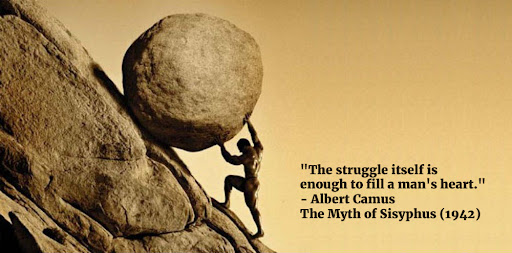
Camus tells us that the answer is to embrace the meaninglessness. The person who can truly know that life is absurd and get through it with a smile is an Absurd Hero. Camus was a real-life example and he sighted the literary examples of Don Juan and Sisyphus for us to look to. “We must imagine Sisyphus happy,” he tells us, for the absurd hero is able to carry out a life as meaningless as eternally rolling a boulder up a hill and finding enjoyment in it anyway.

He also encourages us to reject the idea of an afterlife because it is not only unlikely but also because an attempt to live in such a way as to assure you get into the next life detracts from this one. Trying to justify this life by pointing to the next one is just another way to deny the meaninglessness of life, no matter how you phrase it.

So, what should I do today? Camus recommends that you: get outside, enjoy the sunshine, go for a walk by the beach, play some football, have lunch at a café with a friend, refuse to give into despair and embrace the meaninglessness of existence by choosing to carry on with what you enjoy doing despite the lack of meaning to your actions.

Can we find a meaning in life that satisfies our need for one? Camus says no, but that this needn’t be a problem. We are still living here and now and have every ability to enjoy ourselves. Life is worth living and should be embraced as it is. While it is difficult to face meaninglessness without retreating into the loving arms of religion, science, society, or even producing meaning ourselves, Camus encourages us to bravely face the absurd with a smile on our faces."

“A Life Worth Living: Albert Camus on Our Search for Meaning and Why Happiness Is Our Moral Obligation”

“A Life Worth Living: Albert Camus on Our Search for
Meaning and Why Happiness Is Our Moral Obligation
by Maria Popova

“To decide whether life is worth living is to answer the fundamental question of philosophy,” Albert Camus (November 7, 1913–January 4, 1960) wrote in his 119-page philosophical essay “The Myth of Sisyphus” in 1942. “There is but one truly serious philosophical problem, and that is suicide. Judging whether life is or is not worth living amounts to answering the fundamental question of philosophy. All the rest – whether or not the world has three dimensions, whether the mind has nine or twelve categories – comes afterwards. These are games; one must first answer. And if it is true, as Nietzsche claims, that a philosopher, to deserve our respect, must preach by example, you can appreciate the importance of that reply, for it will precede the definitive act. These are facts the heart can feel; yet they call for careful study before they become clear to the intellect. Everything else… is child’s play; we must first of all answer the question.” 

One of the most famous opening lines of the twentieth century captures one of humanity’s most enduring philosophical challenges – the impulse at the heart of Seneca’s meditations on life and Montaigne’s timeless essays and Maya Angelou’s reflections, and a wealth of human inquiry in between. But Camus, the second-youngest recipient of the Nobel Prize in Literature after Rudyard Kipling, addressed it with unparalleled courage of conviction and insight into the irreconcilable longings of the human spirit.

In the beautifully titled and beautifully written “A Life Worth Living: Albert Camus and the Quest for Meaning” (public library), historian Robert Zaretsky considers Camus’s lifelong quest to shed light on the absurd condition, his “yearning for a meaning or a unity to our lives,” and its timeless yet increasingly timely legacy: If the question abides, it is because it is more than a matter of historical or biographical interest. Our pursuit of meaning, and the consequences should we come up empty-handed, are matters of eternal immediacy.

Camus pursues the perennial prey of philosophy – the questions of who we are, where and whether we can find meaning, and what we can truly know about ourselves and the world – less with the intention of capturing them than continuing the chase.”

Reflecting on the parallels between Camus and Montaigne, Zaretsky finds in this ongoing chase one crucial difference of dispositions: “Camus achieves with the Myth what the philosopher Maurice Merleau-Ponty claimed for Montaigne’s Essays: it places “a consciousness astonished at itself at the core of human existence.”

For Camus, however, this astonishment results from our confrontation with a world that refuses to surrender meaning. It occurs when our need for meaning shatters against the indifference, immovable and absolute, of the world. As a result, absurdity is not an autonomous state; it does not exist in the world, but is instead exhaled from the abyss that divides us from a mute world.”

Camus himself captured this with extraordinary elegance when he wrote in “The Myth of Sisyphus”: “This world in itself is not reasonable, that is all that can be said. But what is absurd is the confrontation of this irrational and wild longing for clarity whose call echoes in the human heart. The absurd depends as much on man as on the world. For the moment it is all that links them together.”

To discern these echoes amid the silence of the world, Zaretsky suggests, was at the heart of Camus’s tussle with the absurd: “We must not cease in our exploration, Camus affirms, if only to hear more sharply the silence of the world. In effect, silence sounds out when human beings enter the equation. If “silences must make themselves heard,” it is because those who can hear inevitably demand it. And if the silence persists, where are we to find meaning?”

This search for meaning was not only the lens through which Camus examined every dimension of life, from the existential to the immediate, but also what he saw as our greatest source of agency. In one particularly prescient diary entry from November of 1940, as WWII was gathering momentum, he writes: “Understand this: we can despair of the meaning of life in general, but not of the particular forms that it takes; we can despair of existence, for we have no power over it, but not of history, where the individual can do everything. It is individuals who are killing us today. Why should not individuals manage to give the world peace? We must simply begin without thinking of such grandiose aims.”

For Camus, the question of meaning was closely related to that of happiness - something he explored with great insight in his notebooks. Zaretsky writes: “Camus observed that absurdity might ambush us on a street corner or a sun-blasted beach. But so, too, do beauty and the happiness that attends it. All too often, we know we are happy only when we no longer are.”

Perhaps most importantly, Camus issued a clarion call of dissent in a culture that often conflates happiness with laziness and championed the idea that happiness is nothing less than a moral obligation. A few months before his death, Camus appeared on the TV show Gros Plan. Dressed in a trench coat, he flashed his mischievous boyish smile and proclaimed into the camera: “Today, happiness has become an eccentric activity. The proof is that we tend to hide from others when we practice it. As far as I’m concerned, I tend to think that one needs to be strong and happy in order to help those who are unfortunate.”

This wasn’t a case of Camus arriving at some mythic epiphany in his old age – the cultivation of happiness and the eradication of its obstacles was his most persistent lens on meaning. More than two decades earlier, he had contemplated “the demand for happiness and the patient quest for it” in his journal, capturing with elegant simplicity the essence of the meaningful life – an ability to live with presence despite the knowledge that we are impermanent: ”We must” be happy with our friends, in harmony with the world, and earn our happiness by following a path which nevertheless leads to death.”

But his most piercing point integrates the questions of happiness and meaning into the eternal quest to find ourselves and live our truth: ”It is not so easy to become what one is, to rediscover one’s deepest measure.”
Freely download “The Myth of Sisyphus,” by  Albert Camus, here:

"The War Within"

"The War Within"
by Benjamin Bartee

"I fantasized in elaborate detail about killing myself today, an occurrence far more common than I would prefer. This obsessive-compulsive demon has a hold of me, whether literal or figurative. I don’t mean OCD in the colloquial sense that people use it to describe an anal-retentive need for paintings to be straight on the wall or tax records neatly filed.

I mean OCD in the sense of a demon, literal or figurative, hijacking my mind and running it into a wall with nonstop, invasive, recurring, unwanted obsessive thoughts from dawn until dusk, with never anything close to a resolution, followed by soul-crushing, ritualistic compulsions in a vain attempt to exorcise the demon. Since I was ten years old, every waking moment has been spent with this monster. Sometimes it’s quieter than other times, but there are no vacations. I am a prisoner in an invisible prison.

No volume or variety of self-medication - and I’ve tried them all, short of renouncing the world and relocating to a monastery on a Himalayan mountaintop - have thus far yielded any lasting relief. To this demon I attribute years of substance abuse - including a hellish alcohol and Xanax addiction that took years of effort to overcome - and various other coping mechanisms in a desperate attempt at escape, but which have only extended and enhanced the misery.

I remember vividly - the most vivid memory I have, perhaps - like it was yesterday the moment it got ahold of me. The most striking aspect of its onset is that it came apparently apropos of nothing. At ten years old, circa 1997, I sat watching "2001: A Space Odyssey" on the television in the living room. The day was overcast; a drizzle fell outside all around the Georgia pine trees right outside the window. Then it came over me in a flash: existential dread; something was very wrong. I felt sure that tragedy was imminent. But the damnedest thing was that there was no environmental stimulus to cause it.

This was my first panic attack, but I lacked the knowledge or vernacular to understand what was happening. It was far from the last. Maybe if someone had been there with me to nip it in the bud, I might have foregone a lot of pain. But they weren’t, and it festered.

Does writing this down make me weak? Am I supposed to figure this shit out on my own in a closet like old times? It certainly gives ammunition to my enemies. C’est la vie. I want nothing more than to vanquish it, but at times, like today, I come to the end of my rope. A poet or a philosopher or someone once observed that “irony is the song of the bird that has come to love its cage.” I know the tune - and if you read Armageddon Prose you’ve seen it sung - but I don’t want to sing it anymore. It’s a rotten, dead-end hymnal.

Among such many attempts in vain to fix this, I’ve talked to a Ukrainian psychoanalytic therapist located in Lviv for a while now, whom I digitally met by way of a tangential connection to my wife. While I’ve gained some insights, it hasn’t helped much, which I don’t necessarily fault her for. Anyway, my wife once asked me not to talk about it with her parents - which I wouldn’t have anyway, as I would wish them to believe they’ve given their only daughter over to competent hands - because, in Slavic culture, talking to a shrink is considered a mark of shame.

A guy in her village killed himself a few years ago over some psychological/spiritual affliction, and as a consequence, he was buried in the corner of the cemetery - a tainted soul, even in death. It’s healthy to socially disincentivize self-indulgent navel-gazing and suicide to some extent, which I respect. But that no one got to him before he took the ultimate trip is a tragedy. Is there a point to all of this suffering, or at least a merciful end to it that doesn’t involve the end of everything? I hope so. What I hope to get out of sharing this intensely personal albatross with you, I surely don’t know - but not pity, a drug as poisonous as fentanyl. Perhaps it’s to feel a little less alone in this prison. Maybe someone can relate. Maybe you. Here’s hoping I summon some better answers in 2026."

“The lust for comfort, that stealthy thing that enters the
 house a guest, and then becomes a host, and then a master.”
- Khalil Gibran

"The time is eight-something a.m. The date doesn’t matter; every day is Groundhog Day, only with small, nearly imperceptible glitches in the matrix. I, naked primate with a soft underbelly and fallible spirit, stand in the shower, again, eyes fixated in low-grade terror on the shower knob at thigh level. Not an ounce of water has escaped the nozzle, yet I’ve memorized the shock of the cold and that’s transmuted by some alchemy I don’t understand into physical sensation.

I am Pavlov’s dog. If I cave in and step out - which I have done in the past and might again at some point - the rest of the day will be in my mind an uphill battle, having already surrendered once before a thousand more small surrenderings to follow. If, on the other hand, I soldier through, it’s more or less downhill from here.

There will be, for sure, other small defeats throughout the day - doomscrolling X for cheap dopamine when I swore it off for the thousandth time, for instance - but I will have already won a small victory to offset them.

So I turn the knob. The water hits my skin, and it’s instant shock. The muscles tense. Panic. The impulse to flight is almost overwhelming, only restrained by mental resistance against all natural urges. I’ve been here enough times to understand that hyperventilating doesn’t do anything to help, so I breathe long and deep.

A daily tango:
Devil: You were so comfortable in that bed. Just crawl back in and call it a day.
Angel: What kind of a man are you? Your grandfather died on some beach in Anzio fighting the blackshirts under machine gun fire!
Devil: Don’t turn that handle.
Angel: Turn the handle.
Devil: You don’t want to turn that handle.
Angel: Turn the handle, you f*cking pussy.
Devil: Get out and let’s have a cold beer. It’s getting hotter every day.
Angel: After nearly ten years without the drink? Maybe what you want in the moment and what you really want are two different things.
Devil: Now that we’re here staring at a shower knob, it’s probably as good a time as any to revisit that suicidal ideation from a while back. This - all this inner turmoil - could all be over once and for all.
Angel: There’s got to be something worthwhile here.
Devil: You want this. Every day is another battle in a lonely war that no one else ever witnesses, much less cares about - a war you’ll never win. You’re nobody’s hero, not even your own. Give up the ghost.
Angel: You are Sisyphus, and you will have the cold shock proteins if it’s the only victory you achieve all day. The summit isn’t the goal; the pushing of the rock is. And you know that."
                                                - https://armageddonprose.substack.com/

Delta Blues Brother, "Faith Looks Different After Pain"

Delta Blues Brother, "Faith Looks Different After Pain"
"Anybody can talk about faith when life is easy. But pain changes belief. It strips away performance. Ego. Easy answers. And what remains afterward… is usually something quieter. Something real. “Faith Looks Different After Pain” is a spiritual Delta blues meditation about suffering, grace, survival, and the kind of belief that only forms after life humbles you. The resonator guitar moves slow and weathered, like footsteps leaving an old church after midnight rain. The harmonica breathes softly through the silence like a tired prayer nobody else hears. The groove stays intimate, grounded, deeply human… like an old soul learning how to trust life again after heartbreak. This ain’t blues about religion. It’s blues about what survives after suffering.  Sometimes pain destroys faith."

"How It Really Is"


"Everyone Is Preparing for What’s Coming to America This Summer"

Full screen recommended.
The Unfolded States, 5/24/26
"Everyone Is Preparing for 
What’s Coming to America This Summer"
"More Americans are quietly preparing for a difficult summer. Grocery bills keep rising, fuel prices are becoming unstable again, and businesses across the country are warning about higher transportation and supply costs. From truck drivers and small business owners to ordinary families shopping at Costco and Walmart, people are starting to change how they spend, save, and prepare for the months ahead. This video breaks down the real economic pressures driving that anxiety. We look at rising diesel costs, global shipping tensions, trucking slowdowns, grocery inflation, and why so many households suddenly feel less confident about financial stability in the American economy. Instead of sensational predictions, this documentary focuses on the real world impact of inflation, supply chain pressure, and growing uncertainty across the United States. 

Sources referenced throughout the video include data and reporting from the USDA, Bureau of Labor Statistics, Energy Information Administration, NFIB small business surveys, and public logistics industry reports. This video is created for educational commentary and economic analysis surrounding inflation, fuel prices, consumer behavior, and the ongoing supply chain crisis."
Comments here:

Dan, I Allegedly, "Home Depot Issues 'Mother of All Crashes' Warning"

Full screen recommended.
Dan, I Allegedly, 5/24/26
"Home Depot Issues
'Mother of All Crashes' Warning"
Comments here:
o
Full screen recommended.
World Affairs In Context, 5/24/26
"The $22 Trillion Shock - 
The Biggest Bubble in America Is Exploding"
Comments here:

"Iran Beats the Snot out of Trump: TACO KING Gets Nothing for Ending War He Started"

"Iran Beats the Snot out of Trump: 
TACO KING Gets Nothing for Ending War He Started"
by David Haggith

"Of course, the interminably-teased deal isn’t done yet, but if it turns out anything like what has been indicated, then the biggest LOSER is Donald Trump as he runs from his own war. If the deal that Republicans are ranting about is the deal, Trump will now walk around with the scarlet letter “L” on his forehead, and he will be the one who put it there.

The old-world, warmongering, Neocon Republicans are furious with him, and the new-world, civil-war-mongering, MAGAcon Republicans haven’t really got anything better to say about the deal being tossed around as an achievement out of a war they never wanted in the first place. Almost everyone in America will be furious down the road when they finally figure out the enormous price they will be paying for years because of another war the United States lost to a weaker foe that, according to JD Vance and Tulsi Gabbard, it never needed to enter.

Even according to Trump, the need to stop Iran from getting a nuclear weapon was completely accomplished last summer, unless we are supposed to believe in a different Trump than that one, who even boasted that he deserved the Nobel Peace Prize for saving the world from a nuclear Iran. This year’s Trump now claims he started his new Iran war in order to end Iran’s nuclear program again, after having already proclaimed victory for “completely obliterating” Iran’s nuclear program in a one-day war last year. That’s insane.

His efforts to re-obliterate Iran’s nuclear program now end with Iran richer down the road if the deal goes through as presented so far. Mostly the new deal as represented so far leaves Iran globally empowered by proving it can stand up to anything the US throws at it, short of the United States’ own nuclear bombs. The old regime is still in place. The uranium is still in place, albeit entombed under ground for now. The thing most notably not in place are the decades-old sanctions that will now be lifted by the rumored deal, even though the terror-sponsoring Islamic Caliphate still waves its flag over the Middle East.

The other “hyuge” winner, as the Donald would say - ”a bigger winner than the world has ever seen before; there is nothing like it”—is the US military industrial complex. The billionaires of military commerce now get to spend years enriching themselves as they gorge at the taxpayer trough by rearming the US for its next imperial adventure. The billionaires are smiling wider than anyone has ever seen before.

The high costs of war: The biggest losers are average Americans, now saddled with more government debt than they have ever seen before as the national debt during this war and as result of this war finally soared, as reported here, to a level only matched by the end of World War II. That’s by a measure that compares the scale of the debt to the scale of the US economy. The interest all Americans owe on that debt also skyrocketed because of Iran’s retaliatory oil blockade, which is shattering the global economy with lightning bolts of longterm inflation.

Average Americans will lose for years to come by paying higher gasoline and diesel prices than they have ever paid before due to all the damaged oil infrastructure. In fact, oil experts in one article today, say that, if the deal is signed this Memorial Day, tankers will still be very slow to start shipping through Hormuz. Experts warn that the fuel crisis will likely worsen in the near future as global crude oil stockpiles rapidly deplete….

U.S. President Donald Trump announced Saturday via Truth Social that an agreement had been “largely negotiated, subject to finalization between the United States of America, the Islamic Republic of Iran, and the various other Countries…” The deal will reportedly include a 60-day ceasefire extension and a reopening of the Hormuz Strait, a U.S. official told Axios…

Even if the warring nations sign the agreement, energy markets will still be reeling for months after the weeks-long war… Experts have indicated that gas prices will remain above $4 per gallon until tangible progress is made on reaching an agreement [as in more than a 60-day ceasefire]….

The research firm ClearView Energy Partners also warned that clearing the waterway “could take weeks to months.” Details of the deal shared by officials with Axios indicate that Iranians will be expected to clear all mines and tolls laid in the waterway as part of the agreement. Meanwhile, “repairing damaged facilities, restoring pre-war output levels, and restocking depleted inventories could take multiple calendar quarters to years,” the firm added in a client note Sunday….

By the time all of that works itself through - even if a 60-day extension of a mere ceasefire v. treaty goes through today - the global economic damage will be massive. Gas prices may see a short-term drop from the current lofty levels as a big relief hits speculators over the Strait of Hormuz being re-opened if this deal happens; but the reality of oil remaining lower in production for 2-3 years will seep back in like a slimy black tide soon enough, keeping prices higher than they were before the war.

Americans will lose for the rest of their lives as inflation soars due to higher energy prices for all businesses in the entire world and due to huge shipping delays for oil and its many by-products, which are major resources for industry because many prices, once escalated, won’t go all the way back down. They rarely do. The rise in prices of all those ingredients and higher interest rates for businesses conglomerate as additional inflation pressures over and above the inflation that was finally starting to come through from the Trump Tariffs.

America’s losses: America’s respect among former allies has been trashed by America going it alone in this war, against its allies’ expressed deep reservations, while the chicken-TACO king had the audacity to keep demanding they pony up by helping fight the war they didn’t want in the first place. That’s ridiculous. America’s regard by allies has been ravaged by a president so imperial in his madness that he has even repeatedly announced his delusional intentions of conquest over former allies like Canada and parts of Denmark! These are the people he goes to for help with his war.

America will be loathed by people all over the world for the extreme calamity all nations will face over the next few years in the form of shortages, diminished businesses, and higher prices. That rage and loathing will expand over time as the economic punishment continues month after dragging month. Everyone on earth will experience this loss because of the Trump-Israel-Iran War along with the Taco king’s endlessly vacillating trade wars with our former trade partners, both of which in the end accomplished no actual objective whatsoever.

America’s military might has been diminished in the eyes of all, not because it failed to wreck a lot of damage - Lord knows it did plenty of that - but because it couldn’t make the briefly decapitated former Persian empire even blink. It is clear the vain and vacuous Trump expected a quick and easy victory like the one he won in Venezuela because he wasn’t wise enough to discern the vast differences between a middling South American, failed communist state that never had any military power in the first place and a former empire that once dominated the Middle East, which has lusted after the dream of reclaiming its position over the region and has armed itself with modern weapons or carnage that strike far deeper wounds than the scimitars of old.

No, this war for the chicken-TACO king is the biggest loss of his life, but it is a loss for all of America in glory and economic strength and a lifestyle made rougher and harder to hold onto than it was before the war. The carnage of tariffs as taxes on Americans that other nations never paid as promised by the president, now being handed down from businesses to consumers, along with the financial burden of rearming the nation for its next conflict, should it ever actually need to defend itself, rather than fight ill-conceived wars for Israel, the cost of the president’s new golden dome (now perhaps more needed than ever as we have fewer allies and hotter enemies, and the debt for fighting this latest war with the higher interest rates it has imposed … all will weigh down on Americans for years to come.

MAGA loses: So, IF there is anyone who still believes MAGA was ever really going to happen (which would be the remnant of people who never believed me when I warned in 2017 that Trump was a Trojan horse), genuflect to your TACO king all you want, but you’ll be paying for this for the rest of your lives, as will everyone in the world! That is likely to settle in for you over the long haul as a vague and misplaced discontent, seeking something to blame - anything -other than the obvious because the obvious requires admitting you were sorely mistaken in order to move on from the mistake and learn from it.

You may doubt me on that eventuality now because the inflation has only just begun to heat up, but come back here after a year of scorching inflation and try to tell me how your scorched Earth is actually better because of another ill-guided American imperial war, started unilaterally by a demented, wrecking-ball of a president who already assured you last summer he had “decimated” Iran’s ability to launch a nuclear attack, meaning this war accomplished nothing that, by the presidents own words, was not already accomplished.

I’m speaking only to those who still believe, not to those who had high hopes but who like MTG, Tuckered Carlson, Joe Rogan, Nicholas Fuentes, et al., have come out of their Trump Derangement Syndrome to realize the dreams of MAGA were never going to actually happen under self-centered, rich egoist like Trump and that it was NOT the rest of the world that was deranged for not believing in Trump but they who were deranged for being sucked in by this narcissistic billionaire was never on the side of average Americans. Trump was and always is on Trump’s side only. Trump was just exploiting their rage to gain power!

It’s time to break the denial. Yet, many will continue to believe Trump is their savior even after this massive betrayal at extraordinary expense by the man who promised them he would end America’s imperial wars. I’m sure many will still believe MAGA is really going to happen. Let anyone who does, prove their continuing belief in this president is justified by telling me now how their world is better today because of the Trump Tariffs.

To any who still malinger in the Trump cult after all of these assaults on their trust and fidelity, tell me: Did you see the promised big expansion of better-paying jobs for Americans from his tariff wars? Are you enjoying the higher inflation that started arriving due to those tariffs before the latest war began? How about the new inflation that is rising at warp speed, as the president was once fond of saying about his vaccine?

Speaking of that, let’s look back at Trump 1.0: Are you happy about the vaccines he delivered to be tested on the entire world all at once (because a full global TEST is always prudent). Are you pleased with the way he achieved that speed by permanently shielding the makers of those vaccines from any law suits over their reckless pursuits? Can you point to the completed wall that was going to be so easy to finish ahead of schedule because he said he is a man who is “a builder”? It’s what he does, he said. Can you tell me how Mexico paid for it? If you suggest they paid tariffs through price adjustments on their products, I can argue you down definitively on that!

Tell us how you are thrilled with how Obamacare still hasn’t been rescinded and how no plan that is “better so much better, just you wait and see” has ever been proposed by a Republican anywhere to replace it. Tell me how you love seeing a third of the White House in rubble as the prefect symbol of this warmongering, wrecking ball of a president and how your life will be made better by a giant ballroom for billionaires that you are now being asked to help fund.

Tell me how all the chaos and conflict of a divisive president has actually made your life more prosperous and peaceful and your enjoyment of your extended family deeper and richer. Tell me why you enjoy life in an enriched America now more than before. Is it just that your bloodlust for big fights, fostered by years of reality TV, gets endless entertainment in the modern equivalent of the Roman coliseum? Trump does put up good Roman fights to keep the masses entertained as he dines at Mar-a-Lago, eating cake with billionaires.

Tell me how you love seeing him make billions of dollars more than those pikers Hunter and his dad #NoMoJoe ever dreamed of making off the presidency. Explain to me why you thought it was outrageous for the Bidens, yet you turn the blind eye of denial to the Trumps when they do it at levels that that are repeatedly a hundred times greater than the Biden's exploits by any objective observation. Is that you are impressed with the scale of their exploitations?

Explain to me how this raging, chaotic, TACO King, who starts wars all over the world then turns tail and runs, after raining longterm economic destruction on the world, is less demented and safer than that the old fart who shook hands with curtains and spoke to the dead during public speeches and teetered off his bicycle. Tell me how all the kings men are doing less to prop up King Trump than the Dumocrats did to prop up old Bernie for a weekend or two.

Tell me all of that as you watch the chicken TACO king drag his bad leg, pudge out, and rant as wildly as the word salad of ol’ Joe’s worst days. Tell me how much more physically and mentally fit Trump is than his predecessor, having started this term at the same age creaky old Joe hit when he started his term. Tell me how he is less cranky than bilious Biden. Tell me how he, as Redactor-in-Chief of all the Epstain Pedo Files, who was often photographed cavorting with the young girls, is less creepy than old Uncle Joe or less dangerous. Explain to me why it is more righteous for you to continue to support this creep, who lied and said he was barely in the Epstein files, whose name we now know to be in there tens of thousands of times, than it was for Dems to endlessly cover for creepy Uncle Joe as he sniffed the hair of little girls. Explain why one unproven but obvious pedo is better than another!

Or just explain to me how this war looked out for America first and how America is greater because of it! Will you excuse his huge losses here and great betrayal of campaign promises and your trust like you have excused every other Trump failing? Is all of this what you voted for? You foisted Trump upon all of us, and we’ll all pay for that for a long time, but if you can admit it was a mistake, I can forgive you because that is hard for any of us to do! However, if you keep defending it …

Let’s hope this enormous blunder of a war finally busts the denial about what Trump really is. He is certainly much closer to the Antichrist than the real christ some compare him to. I fear my hope that the remainder of MAGA will wake up at last is naive, given how one reader busted my chops a week go for saying in a previous article the president had won nothing with this war. According to that reader, I was a victim of TDS because Trump had accomplished something no other president had ever done (at warp speed I guess) by using this war to bring an end to Iran’s nuclear program!

“How so?” I asked, when Trump said he already ended that problem last summer? Which time was he lying? Why did we need to end something already ended last summer? How is it more ended now when the uranium still remains buried in the ground where it was last left, and the new plan says the US and Iran will continue to do nothing but talk about the uranium that remains for the next sixty days? How is that more definitively resolved? Iran has played the lets-talk-about-it game for decades now. How has this war changed the nuclear equation one iota when Iran’s nuclear stockpile hasn’t changed a bit and all of its reactors are still running? All of that seems so obvious that it boggles my mind that I even have to say it.

The proof of that view being wrong is as large as multiple nuclear reactors, still blowing steam into the skies of the Middle East! So, in that case, just tell me how it is that this war left Iran’s NUCLEAR program even more decimated than it was before and how it changed the regime one iota, or stop endlessly blowing your own steam and hot air into the skies.

It’s long past time to ditch the cult of Orange jesus (big, fat “O,” small “j” intentional), the mad emperor who, IF he was appointed by God, as he has often claimed by quoting his prophets of false profits, he was clearly appointed to be God’s wrecking ball for America, now besotted as it is. It was not to make America great. Since Trump is more AntiChrist than Christlike, guess who he is setting the stage for.

The wrecking of America is clear now that its economy lies is rubble under tariffs and massive war debts and loss of old allies and the oncoming flames of certain inflation, hazed in its fading delusions of grandeur, and totally swamped by the military industrial complex that has made and is set to keep making more money than those warmongers have ever seen before! People are telling me there’s nothing like it!

There has been so much winning now that Trump stopped the war in Ukraine on day one, as he vainly promised would easily be done! There is so much winning now that he has stopped starting so many new wars America didn’t need! There is so much winning over former allies as he wages, at least, a war of words against many of them. Meanwhile the Peace President, as he likes to call himself, is now locked and loaded for Cuba!

So much winning of a kind that makes it easy to understand why he joked in his State of the Union Address that people keep telling him to “Stop winning so much! We can’t handle so much winning.” We now know by clear demonstration it is because winning like this last major victory over Iran might undo a formerly great nation, but that nation isn’t Iran! Just so much winning!

Trump retorted this morning in a rage post that those criticizing the rumored deal don’t know what they are talking about because it has not been finalized and because he would never sign a bad deal. Well, maybe so. The problem is that, once it is finalized, it will be too late to talk about it. So, the time to hold his feet to the fire for a good deal that means anything at all is now or never.

Trump, himself, is responsible for creating the rumor of an imminent deal, which he has pounded several times in the last three days; and he ought to have a enough junior-league wisdom by now to KNOW that, if you don’t provide any details, others will try to fill in the vacuum about the deal as best they can. If you don’t want that, don’t get ahead of yourself by announcing an “imminent” deal that isn’t done! Trump, because he loves negative energy, likes to light the press on fire by tantalizing them and then criticize them for burning up.

And if this is just another no-deal deal as Iran counterclaims this morning and as recent Trump history says is most likely, then we should get hot over more fake jawboning of the markets from the Liar-in-Chief about a deal he claims Iran is dying to make that Iran is not even trying to make at all. I’ve already said Iran is fine with inflicting more pain than the Donald can stand for longer. The longterm economic and political damage to the US is accumulating rapidly, just as Iran hopes, so time is not on Trump’s side, especially as he has already stopped adding damage to Iran.

Turning over a new leaf: So, as we celebrate Memorial Day, let’s do it by, at least, pausing to remember how great it used to feel to live in America before Trump ever came on the scene with all of his chaos and conflicts and the cultic insanity that surrounds him, as well as before the imposed, ugly, 1984-style interlude we got to have under the Lunatic Left as they propped up creepy candidate Joe and before Joe’s Covid tyranny and the Great Gender Genocide of America’s youth and the indecency of co-ed bathrooms and all other such madness.

Let’s pause and reflect on what a more rational America once felt like before ALL of this civil war, even with all its lying politicians who, at least, behaved in a more civil manner back then as people like Tip O’Neil and Ronald Reagan struggled for compromises before enjoying dinner together. It was far from perfect, but it sure beat this hell on scorched earth. Both parties need to end their divide-and-conquer approach to America and start serving the CENTER of America again, instead of their own lunatic fringes. Instead of leaving the center without a home, go back to leaving the lunatics without a home.

Better still, let’s end the two-party/uniparty system that has for the last twenty years put party over country by starting a third centrist party. I’ll take a Reagan or Clinton as president any day over a Trump or a Biden, both catering as they have to the fringes of America and leaving the rational center far behind. The few remaining moderates among Republicans need to join with the few remaining moderates among Democrats and with 30% of Americans who independents and maybe the Libertarians and develop a plank for their party that …

Pledges to curb the military industrial complex by never again starting a preemptive war, never again starting a war to achieve regime change, never starting another drug war, never starting or enjoining any war that is not purely for the defense of America or its allies, working toward freezing NATO expansion and working toward eliminating nuclear and chemical weapons through treaties around the globe in a Reaganesque, verifiable manner, and mandating by law that neither the CIA nor any other government agency can work in such manner either. [Why we would ever believe those who make such pledges, though, I don’t know.]

Pledges balanced budgets that pay for every government expense as we go, except in times of constitutional, congressionally declared defensive war. Pledge, in fact, to set a course for gradual pay-down of the debt, as started to happen under Gingrich and Clinton.

Reforms the Fed by completely removing its jobs mandate to reduce it to the single purpose and power of maintaining the dollar for a symmetrical 0% inflation rate, meaning, if we creep above that, then we have to go below it for a similar amount of time.

Pledges to fully respect and abide by the constitution and particularly its Bill of Rights, letting everyone believe as they want, speak and write as they want, so long as they don’t cause harm to any individual with false statements or release of truly and rightfully private information.

Abolish the Patriot Act of the George W. Bush era with all of its fake FISA protections in order to truly protect privacy as the constitution envisioned and to underscore strict constitutional government.

That is a starter list, but it should not evolve into a wish list, or it is sure to fail from the get go. Nothing should be added to the list to please the fringes. It should all aim for the center (the core) of American politics by which I mean it should focus on solely areas of common consent and common sense as the limits of government, not using the power of government to force social change in EITHER direction, conservative or liberal. In essence, stick to mere constitutional government.

If anything on my short list doesn’t fit that center of common consensus, it should be removed and remain out of the Constitutional Party’s objectives. Let such matters that are outside of the Constitution and centrist consent win over the public heart by debate and persuasion in hopes the greater truth prevails over time, not by political force.

That’s probably all a naive hope, but you have to offer something positive… once in awhile. A civil war is not going to heal America or make it great again. Both sides lose in a civil war. Take some lessons from the history of civil wars. Neither are the two parties who have turned American into such a divisive mess going to heal it - not unless they can each seriously reform themselves toward the center and reclaim civility in recognition that the present ways in which they have moved apart have been a gross failure for America. No one is happier living here than they were forty years ago, flawed as that time was."


Bill Bonner, "An Almost Miraculous Way"

"An Almost Miraculous Way"
by Bill Bonner

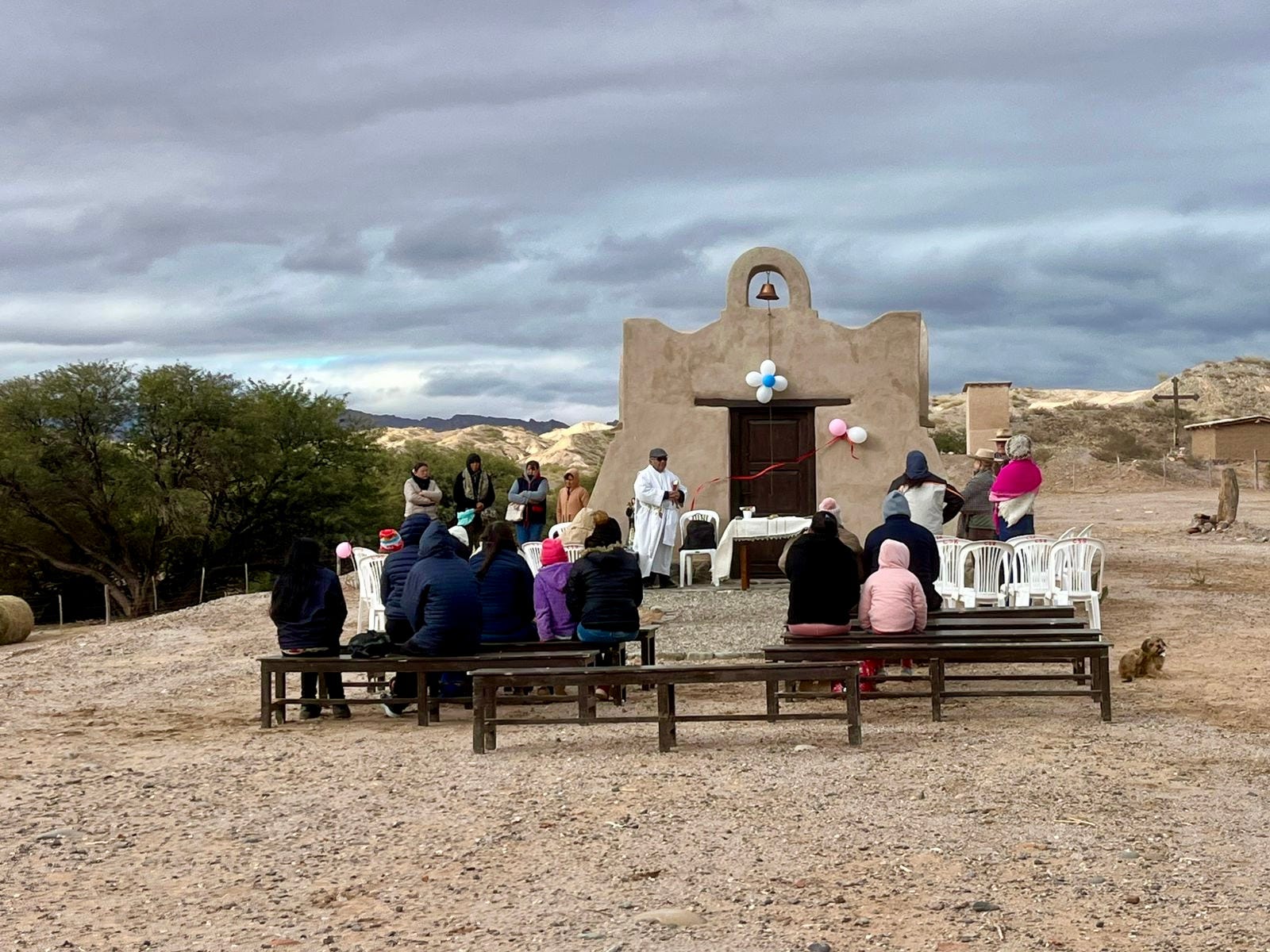
San Martin, Argentina - "Our local padre came over to bless the new chapel. The wind blew cold and hard across the yard. The local people gathered outside, bundled up in winter coats and caps, to celebrate its sanctification.

Life on the farm goes on, much as before. “No one has ever made any money in the Calchaqui Valley.” The words of our lawyer echo through the fields and deserts...and squat in our brain.

He’s not exactly right. There are many small subsistence farms where people have lived for generations. They grow corn, wheat, apples, onions - almost anything and everything. But the scale is too small to be of much commercial interest. And when local farmers try to do anything on a larger scale, they run out of water...or simply can’t compete with the larger farms of the ‘pampa.’ Argentina has some of the richest farmland in the world. Down on the flat land emanating out from Buenos Aires, there are millions of acres producing some of the finest beef and best crops you’ll find anywhere.

But a productive farm...and an attractive farm...are less and less likely to be the same farm. Productive farms do not have quaint stone fences, old barns, graceful houses, or small fields separated by irrigation ditches lined with flowers. Instead, they are all business - with flat fields stretching far onto the horizon, and everything charming or picturesque cleared away. Efficiency rules!

On a very modest level, we saw the change in modern agriculture in France. When we arrived in the ‘90s, our farm was still operated more or less as it always had been. Stone barns with clay tile roofs held old equipment...cows...and square bales of hay. (We recalled how, as a teenager, our summer jobs often included tossing those bales onto a trailer, to be stacked in a barn.)

Now, the cows shelter in a vast metal structure with solar panels on the roof. And the old workers - who had been born on the farm and knew its secrets - retired. They were replaced by younger employees who do their work ‘by the book’ - following the exigencies of French labor law and environmental protection rules. They arrive in the morning and leave in the evening. And the old square bales of hay have been replaced by large, round bales. No one tosses these bales of hay onto a trailer; they are much too heavy. Instead, they are manipulated by a special tractor with an extendable arm - a ‘manitou’ - and stocked under a tin roof.

Here in the Calchaqui Valley, too, we arrived twenty years ago...and found a farm that was so picturesque we couldn’t resist. The locals plowed with mules...and cut hay with a horse-drawn sickle bar, ricking up the hay with pitchforks in stacks down by the river. We introduced tractors, a backhoe, and other ‘modern’ equipment. The new ways of doing business improved output. But they increased our costs...and we are still not able to compete with ‘pampas’-based producers.

Twenty years have gone by. And we’ve now passed the baton onto our daughter and son-in-law. They are young and full of energy...and believe they can make the ranch marginally profitable. Their plan is to keep it as ‘authentic’ as possible and invite a few tourists to share it. Will that work? We’ll see.

In the meantime, it is still extremely picturesque. Last week, our local padre came over to bless the new chapel. The wind blew cold and hard across the yard. The local people gathered outside, bundled up in winter coats and caps, to celebrate its sanctification. It is a ‘family chapel,’ too small for more than a handful of people.
The chapel was a project that we undertook a couple of years ago. A professional builder, a huge man with a huge drinking problem, set up the stone foundation. We took it from there, laying up the walls in adobe blocks.

For the cross above the altar, we cut wine bottles in half, taped two bottom halves together with duct tape...and embedded them in the adobe - a technique we learned 40 years ago from the Earthship builders of Taos, New Mexico…This was done on the east-facing wall so that in the morning, it lights up in an almost miraculous way, with the sun beaming through the green glass of the Malbec bottles.

But the genius of the chapel was the roof. Large, old barrel staves - imported from France at least 50 years ago - were used to form up a cupola. The barrel staves were then covered by cane stalks...and the whole of it plastered on the outside with mud. It looked a little sloppy when we left it, but the aforementioned professional builder came along after us and cleaned it up.

People - all related in some way to the farm or its workers - came from across the river for the ceremony. A red ribbon had been dangled in front of the door, to be cut by the ‘duenos’ - us. And a table was set up in front as a makeshift altar.

Padre Walter takes care of several parishes. He explained that he couldn’t stay long. So, he set to work as soon as the people were assembled, many of them riding over in the back of our farm trucks. There is no bridge across the river. But the water is low enough so that you can drive across...if you know what you’re doing. (On Saturday, a neighbor got stuck and had to be pulled out with a tractor.)

It was freezing cold. And our hat kept blowing off. Still Padre Walter, a compact man with a warm smile, continued at a lively pace until the ‘host’ had been received by all those who wanted it.

While the priest was thus occupied, two riders bounced on their horses up the lane next to the cattle enclosure. They wore their broad-brimmed hats and chaps and turned left at the corral, not paying any particular attention to the Mass on the hill next to them. After a few minutes - between the time for the Apostles’ Creed and the General Confession - they came back, driving three cows in front of them. We bowed our heads and crossed ourselves. For these were the cows we had given to the community for their annual ‘Fiesta Patronal.’ They were on their way across the river to be butchered on Saturday. RIP.

The Mass completed, people filed into the chapel to admire it...
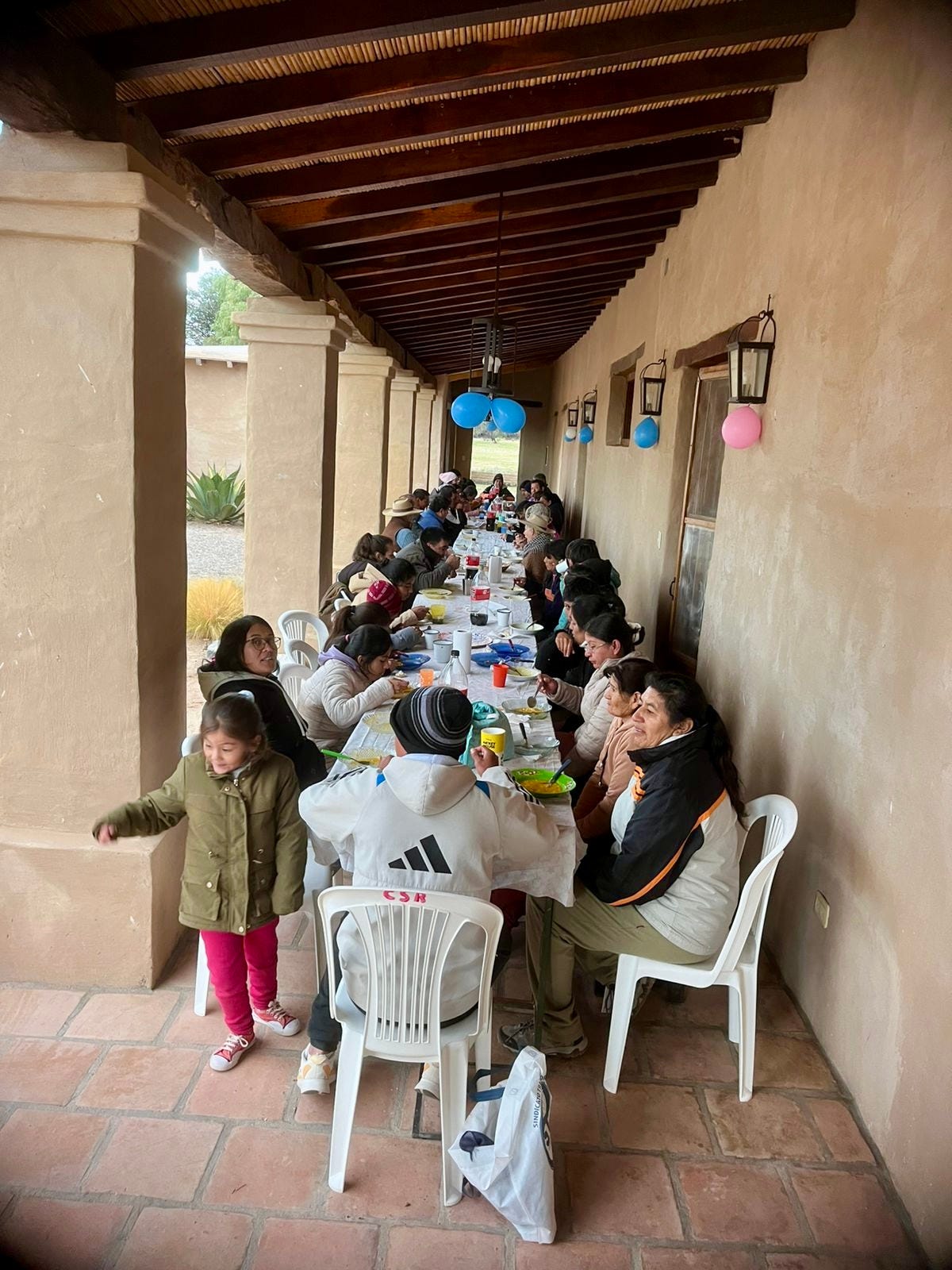
And then came down the hill where a feast of ‘locro’ and Coca-cola had been prepared. Long tables, set on trestles, had been set up on the veranda. The group gradually found seats on the benches beside them. The soup was served out of a huge cauldron, used exclusively for these ceremonies, while a lively chatter kept participants engaged.

Typically, the ‘distinguished’ guests - local landowners, priests, and government officials - are seated together in the middle of the assembly. On this occasion, the priest had to run off for another event, leaving us in the company of just one other notable - the owner of the adjacent farm, who had also been born in the house we now call our own.

He, too, recalled an earlier period. “No comparison,” he said. “My father was a real pioneer here...in the 1950s. He was the first to bring in tractors and other machinery. He made a new road, now abandoned, that made it possible to go all the way to Salta [the capital of the province] without crossing the river. And for a while, we did well. But we were selling beef locally. And pimiento. And onions….But then, they built the big highways down to Buenos Aires. And when they developed the refrigerated trucks, the beef from the pampas took over.

Our friend did not go into detail, but he described a long, and maybe sad, story in which the big farms were sold...and sold again...sinking to a price level they could justify.

But the question now is whether they can justify - commercially - any price at all. Most of the farms in the valley seem to be operating with ‘skeletal’ crews. Unnecessary expenses are cut. Fields and fences are left to take care of themselves. Cattle herds grow smaller.

“Thank God for the cattle,” says our neighbor, tested and perhaps worn down by more than 70 years in the valley. “Prices for beef are high. [They went up after Milei eliminated the ban on exports. Previous socialist governments had outlawed selling Argentina’s best product - beef - abroad, in order to keep domestic prices low.] Everything else is terrible. The best we can do is to sell a few animals...and keep expenses to a minimum.”

“It used to be a much harder life here,” his wife added, a good-looking blond woman in her ‘60s. “I came here as an 18-year-old bride. And I was a city girl. I couldn’t even understand what the local people were saying. We had no electricity. And no telephone. We lived with fires in the chimney and kerosene lamps.

“You know, Pedro, Inez’s father?” We did. He is a really old-timer, who is half blind and walks unsteadily with a cane. He almost died during the Covid lockdown. We were able to get him medical supplies, but what he really needed was a doctor. And none could be found. But he survived somehow, and now wears a black beret to keep his head warm...and a wool suit whenever he goes out.

“He has the gift...he doesn’t do it anymore, but he used to be able to look at you and tell you things about your future. I went to see him after my second child was born. We wanted to have a big family and, after two boys, I was hoping for a girl. But he looked at me and said sadly that I would only have three children.

I didn’t believe him. And after my third child - he was a boy too - I came back from the city to be with my husband at the farm. But a day or two later, I started bleeding. Heavily. There was no telephone. And no one to call. No doctor. No clinic anywhere nearby. And I was fainting. Ramon [her husband] picked me up and put me in the truck and drove five hours to the city. I was only half alive when I got there. But there they saved my life. And Pedro was right; I couldn’t have more children.”

The wind died down. The clouds parted. On a signal from our son-in-law, everyone got up and began to clear away the dishes. One by one, the 30-or-so guests said their good-byes. Some shook hands. Some hugged. Some kissed. Children presented a cheek for us to kiss. The workers hands were as hard as iron. The women were no strangers to hard work either. Teeth may have been missing. But warm smiles were everywhere."