

"An Almost Miraculous Way"
by Bill Bonner
San Martin, Argentina - "Our local padre came over to bless the new chapel. The wind blew cold and hard across the yard. The local people gathered outside, bundled up in winter coats and caps, to celebrate its sanctification.
Life on the farm goes on, much as before. “No one has ever made any money in the Calchaqui Valley.” The words of our lawyer echo through the fields and deserts...and squat in our brain.
He’s not exactly right. There are many small subsistence farms where people have lived for generations. They grow corn, wheat, apples, onions - almost anything and everything. But the scale is too small to be of much commercial interest. And when local farmers try to do anything on a larger scale, they run out of water...or simply can’t compete with the larger farms of the ‘pampa.’ Argentina has some of the richest farmland in the world. Down on the flat land emanating out from Buenos Aires, there are millions of acres producing some of the finest beef and best crops you’ll find anywhere.
But a productive farm...and an attractive farm...are less and less likely to be the same farm. Productive farms do not have quaint stone fences, old barns, graceful houses, or small fields separated by irrigation ditches lined with flowers. Instead, they are all business - with flat fields stretching far onto the horizon, and everything charming or picturesque cleared away. Efficiency rules!
On a very modest level, we saw the change in modern agriculture in France. When we arrived in the ‘90s, our farm was still operated more or less as it always had been. Stone barns with clay tile roofs held old equipment...cows...and square bales of hay. (We recalled how, as a teenager, our summer jobs often included tossing those bales onto a trailer, to be stacked in a barn.)
Now, the cows shelter in a vast metal structure with solar panels on the roof. And the old workers - who had been born on the farm and knew its secrets - retired. They were replaced by younger employees who do their work ‘by the book’ - following the exigencies of French labor law and environmental protection rules. They arrive in the morning and leave in the evening. And the old square bales of hay have been replaced by large, round bales. No one tosses these bales of hay onto a trailer; they are much too heavy. Instead, they are manipulated by a special tractor with an extendable arm - a ‘manitou’ - and stocked under a tin roof.
Here in the Calchaqui Valley, too, we arrived twenty years ago...and found a farm that was so picturesque we couldn’t resist. The locals plowed with mules...and cut hay with a horse-drawn sickle bar, ricking up the hay with pitchforks in stacks down by the river. We introduced tractors, a backhoe, and other ‘modern’ equipment. The new ways of doing business improved output. But they increased our costs...and we are still not able to compete with ‘pampas’-based producers.
Twenty years have gone by. And we’ve now passed the baton onto our daughter and son-in-law. They are young and full of energy...and believe they can make the ranch marginally profitable. Their plan is to keep it as ‘authentic’ as possible and invite a few tourists to share it. Will that work? We’ll see.
In the meantime, it is still extremely picturesque. Last week, our local padre came over to bless the new chapel. The wind blew cold and hard across the yard. The local people gathered outside, bundled up in winter coats and caps, to celebrate its sanctification. It is a ‘family chapel,’ too small for more than a handful of people.
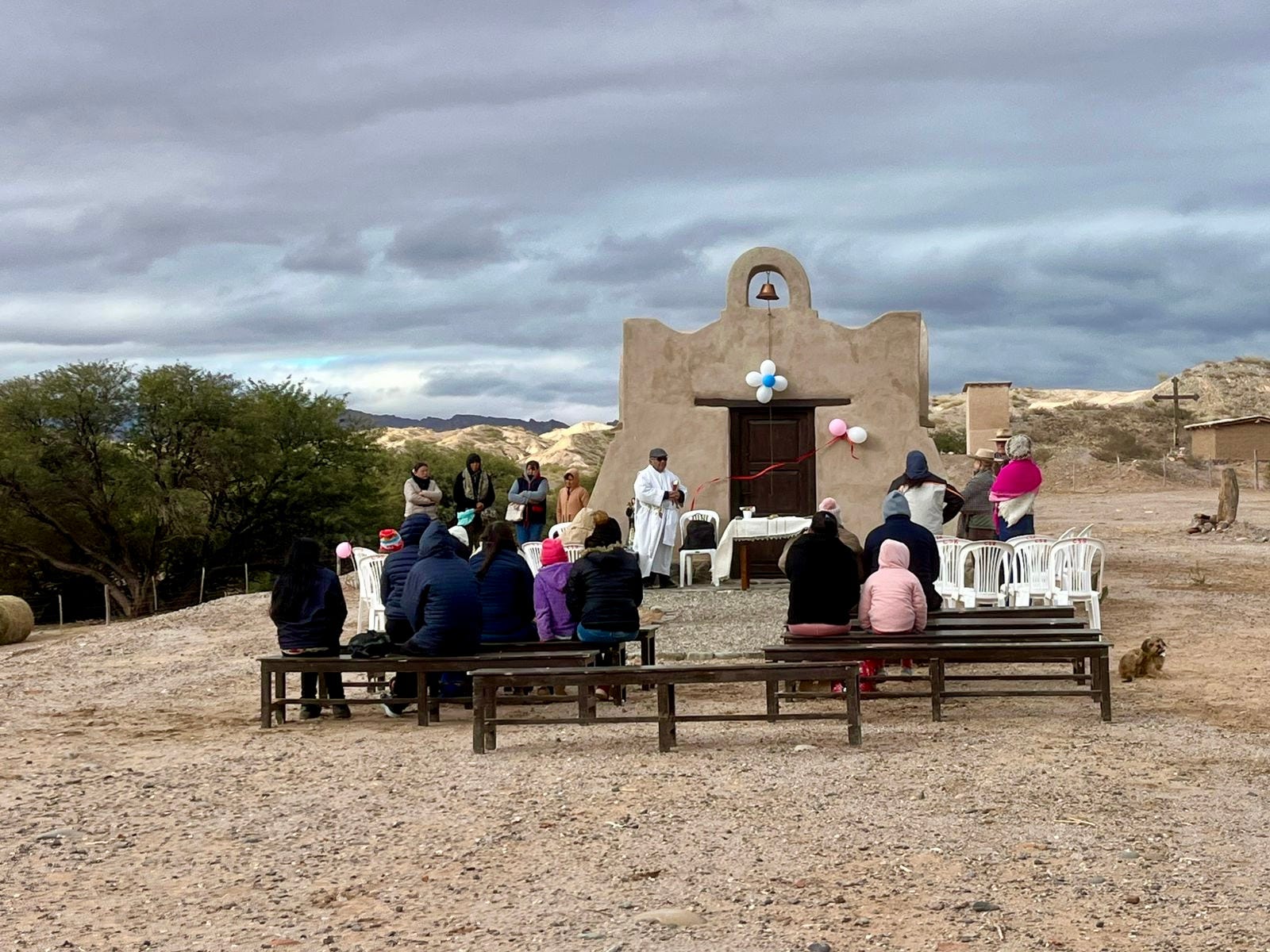
The chapel was a project that we undertook a couple of years ago. A professional builder, a huge man with a huge drinking problem, set up the stone foundation. We took it from there, laying up the walls in adobe blocks.
For the cross above the altar, we cut wine bottles in half, taped two bottom halves together with duct tape...and embedded them in the adobe - a technique we learned 40 years ago from the Earthship builders of Taos, New Mexico…This was done on the east-facing wall so that in the morning, it lights up in an almost miraculous way, with the sun beaming through the green glass of the Malbec bottles.
But the genius of the chapel was the roof. Large, old barrel staves - imported from France at least 50 years ago - were used to form up a cupola. The barrel staves were then covered by cane stalks...and the whole of it plastered on the outside with mud. It looked a little sloppy when we left it, but the aforementioned professional builder came along after us and cleaned it up.
People - all related in some way to the farm or its workers - came from across the river for the ceremony. A red ribbon had been dangled in front of the door, to be cut by the ‘duenos’ - us. And a table was set up in front as a makeshift altar.
Padre Walter takes care of several parishes. He explained that he couldn’t stay long. So, he set to work as soon as the people were assembled, many of them riding over in the back of our farm trucks. There is no bridge across the river. But the water is low enough so that you can drive across...if you know what you’re doing. (On Saturday, a neighbor got stuck and had to be pulled out with a tractor.)
It was freezing cold. And our hat kept blowing off. Still Padre Walter, a compact man with a warm smile, continued at a lively pace until the ‘host’ had been received by all those who wanted it.
While the priest was thus occupied, two riders bounced on their horses up the lane next to the cattle enclosure. They wore their broad-brimmed hats and chaps and turned left at the corral, not paying any particular attention to the Mass on the hill next to them. After a few minutes - between the time for the Apostles’ Creed and the General Confession - they came back, driving three cows in front of them. We bowed our heads and crossed ourselves. For these were the cows we had given to the community for their annual ‘Fiesta Patronal.’ They were on their way across the river to be butchered on Saturday. RIP.
The Mass completed, people filed into the chapel to admire it...
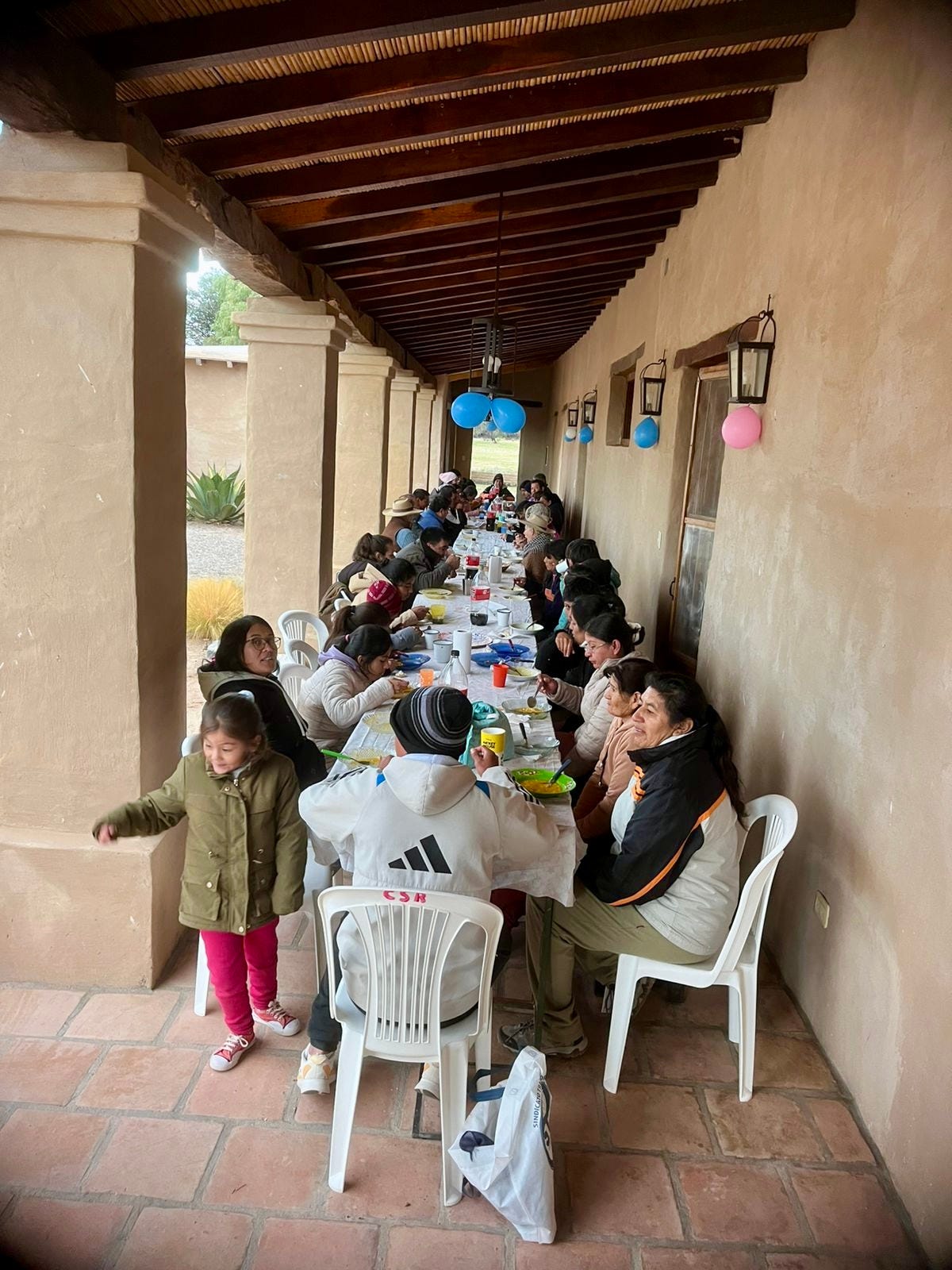
And then came down the hill where a feast of ‘locro’ and Coca-cola had been prepared. Long tables, set on trestles, had been set up on the veranda. The group gradually found seats on the benches beside them. The soup was served out of a huge cauldron, used exclusively for these ceremonies, while a lively chatter kept participants engaged.
Typically, the ‘distinguished’ guests - local landowners, priests, and government officials - are seated together in the middle of the assembly. On this occasion, the priest had to run off for another event, leaving us in the company of just one other notable - the owner of the adjacent farm, who had also been born in the house we now call our own.
He, too, recalled an earlier period. “No comparison,” he said. “My father was a real pioneer here...in the 1950s. He was the first to bring in tractors and other machinery. He made a new road, now abandoned, that made it possible to go all the way to Salta [the capital of the province] without crossing the river. And for a while, we did well. But we were selling beef locally. And pimiento. And onions….But then, they built the big highways down to Buenos Aires. And when they developed the refrigerated trucks, the beef from the pampas took over.
Our friend did not go into detail, but he described a long, and maybe sad, story in which the big farms were sold...and sold again...sinking to a price level they could justify.
But the question now is whether they can justify - commercially - any price at all. Most of the farms in the valley seem to be operating with ‘skeletal’ crews. Unnecessary expenses are cut. Fields and fences are left to take care of themselves. Cattle herds grow smaller.
“Thank God for the cattle,” says our neighbor, tested and perhaps worn down by more than 70 years in the valley. “Prices for beef are high. [They went up after Milei eliminated the ban on exports. Previous socialist governments had outlawed selling Argentina’s best product - beef - abroad, in order to keep domestic prices low.] Everything else is terrible. The best we can do is to sell a few animals...and keep expenses to a minimum.”
“It used to be a much harder life here,” his wife added, a good-looking blond woman in her ‘60s. “I came here as an 18-year-old bride. And I was a city girl. I couldn’t even understand what the local people were saying. We had no electricity. And no telephone. We lived with fires in the chimney and kerosene lamps.
“You know, Pedro, Inez’s father?” We did. He is a really old-timer, who is half blind and walks unsteadily with a cane. He almost died during the Covid lockdown. We were able to get him medical supplies, but what he really needed was a doctor. And none could be found. But he survived somehow, and now wears a black beret to keep his head warm...and a wool suit whenever he goes out.
“He has the gift...he doesn’t do it anymore, but he used to be able to look at you and tell you things about your future. I went to see him after my second child was born. We wanted to have a big family and, after two boys, I was hoping for a girl. But he looked at me and said sadly that I would only have three children.
I didn’t believe him. And after my third child - he was a boy too - I came back from the city to be with my husband at the farm. But a day or two later, I started bleeding. Heavily. There was no telephone. And no one to call. No doctor. No clinic anywhere nearby. And I was fainting. Ramon [her husband] picked me up and put me in the truck and drove five hours to the city. I was only half alive when I got there. But there they saved my life. And Pedro was right; I couldn’t have more children.”
The wind died down. The clouds parted. On a signal from our son-in-law, everyone got up and began to clear away the dishes. One by one, the 30-or-so guests said their good-byes. Some shook hands. Some hugged. Some kissed. Children presented a cheek for us to kiss. The workers hands were as hard as iron. The women were no strangers to hard work either. Teeth may have been missing. But warm smiles were everywhere."

No comments:
Post a Comment