StatCounter

Thursday, March 12, 2026

"The 2026 Calendar Is Precisely Identical To The 1914 Calendar (The Year World War I Began)"

by Michael Snyder

"History doesn’t always repeat itself, but it often rhymes. When fighting erupted in Europe in 1914, it wasn’t initially considered to be that big of a deal. Many dismissed the conflict as yet another minor European war, and at first most of the rest of the world stayed out of it. It was only later that it came to be known as World War I. Today, there is lots of speculation that World War III “could be coming”, but of course the truth is that we are already in the middle of it. Just like during the early days of World War I, most people won’t fully understand the significance of what they are currently experiencing until later. Interestingly, it turns out that the 2026 calendar is precisely identical to the 1914 calendar…

Every now and then, the calendar quietly repeats itself. Basically, it is a mathematical coincidence that rarely captures any attention – until history gives it a chilling context and this time, it is a super chilly one!

The 2026 calendar is exactly the same as that of 1914 – the year that witnessed the first world war. And as tensions escalate between Iran and Israel – with US also being involved, the similarity has also sparked online theories, speculations and uneasy conversations about how history could somehow repeat itself. Isn’t that wild?

The reason why the calendars for those two years are exactly the same is because they both started on a Thursday and neither one of them is a leap year… Going by the calculations, both 1914 and 2026 share identical structures because neither year is a leap year and both begin on a Thursday. This alignment means that every date tends to fall on the same day of the week in both years. For instance, both January 1, 1914 and January 1, 2026, fall on a Thursday. Now, this creates a perfect mirror of dates and weeks throughout the entire year. Mathematically speaking, such coincidences occur periodically in the Gregorian calendar. But because 1914 is so closely tied to one of the most devastating conflicts in human history, the resemblance has led to panic.

As 2026 approached, many of us were warning that it would be a truly historic year. According to Axios, at least 20 different nations are already militarily involved in the chaotic war that has erupted in the Middle East… Ten days into President Trump’s Iran campaign, the war has gone global. At least 20 countries are now militarily involved — shooting, shielding or quietly supplying — while a widening energy shock punishes nations far from the front lines.

We were told that this would be a quick war. But the regime in Iran remains in power, they continue to strike targets all over the Middle East, and traffic through the Strait of Hormuz continues to be paralyzed. Just within the past 24 hours, Iranian forces have hit 3 more cargo vessels…Three vessels off Iran’s coast have been struck by projectiles, the United Kingdom Maritime Trade Operations center said on Wednesday, the latest in a flurry of incidents reported in or near the Strait of Hormuz.

One of the ships reported it had been struck 11 nautical miles north of Oman in the Strait of Hormuz, causing a fire onboard and forcing the crew to evacuate, the UKMTO said, without identifying the vessels.Two other incidents were also reported on Wednesday morning, with one vessel struck by a projectile about 50 nautical miles northwest of Dubai, United Arab Emirates, and another sustaining damage off the coast of the UAE.

One of the vessels that was attacked was a Thailand-flagged ship that “had ignored IRGC warnings and tried to transit the Strait of Hormuz”… Iran’s Islamic Revolutionary Guard Corps claimed responsibility for an attack earlier Wednesday on the Thailand-flagged bulk carrier Mayuree Naree off the coast of Oman, saying the vessel had ignored IRGC warnings and tried to transit the Strait of Hormuz. The United Kingdom Maritime Trade Operations center, run by the British military, said earlier that the vessel was hit by a projectile about 10 nautical miles off Oman’s coast in the strait.

The Iranians are not messing around. Pretty much the only vessels that are being allowed through are Iranian tankers that are taking oil to China… Iran has continued to send large amounts of crude oil via the Strait of Hormuz to China even as the war between U.S.-Israel and Iran has jeopardized broader supplies through the critical waterway.Iran has sent at least 11.7 million barrels of crude oil through the Strait of Hormuz since the war began on Feb. 28, all of which were headed to China, Samir Madani, co-founder of TankerTrackers.com, told CNBC on Tuesday.

In addition to striking cargo vessels, the Iranians also just attacked Dubai International Airport…Iran attacked commercial ships on Wednesday across the Persian Gulf and targeted Dubai International Airport, escalating a campaign of squeezing the oil-rich region as global energy concerns mounted and American and Israeli airstrikes pounded the Islamic Republic. Two Iranian drones hit near Dubai International Airport, home to the long-haul carrier Emirates and the world’s busiest for international travel. Four people were wounded but flights continued, the Dubai Media Office said. This represents a major escalation, because Dubai International Airport is one of the most important airports in the world.

If that wasn’t bad enough, the Iranians are also warning that they will soon be targeting banks and financial institutions throughout the region…Iran’s joint military command announced it would start targeting banks and financial institutions in the Middle East. That would put at risk particularly Dubai, in the United Arab Emirates, which is home to many international financial institutions, as well as Saudi Arabia and the island kingdom of Bahrain.

This wasn’t supposed to happen. But it is happening. In response to the Iranian threat, many western banks in the Middle East are evacuating their offices…Western banks in Dubai have evacuated staff from their offices amid a warning from Iran that it will target US and Israeli economic centres across the Middle East. British bank Standard Chartered, US multinational Citi and two other companies told employees to leave their offices in the Dubai International Financial Centre (DIFC) and in Oud Metha on Wednesday. London-based Standard Chartered has ​a large presence in the United Arab Emirates ⁠and offices, including in the DIFC, a financial hub home to large international ​banks and law firms.

Western politicians continue to insist that everything is just fine. And they are trying to do all that they can to keep the price of oil down. On Wednesday, the IEA announced a coordinated release of 400 million barrels of oil from strategic oil reserves…The International Energy Agency on Wednesday agreed to release 400 million barrels of oil to address the supply disruption triggered by the Iran war, the largest such action in the organization’s history. The IEA did not set out a timeline for when the stocks would hit the market. It said that the reserves would be released over a time frame that is appropriate to the circumstances of each of its 32 member countries.

IEA members are primarily advanced economies in Europe, North America and northeast Asia. The organization is tasked with maintaining global energy security. It was founded in 1974 in response to the oil embargo imposed by Arab producers over U.S. support for Israel during the 1973 Arab-Israeli war.

This will provide some temporary relief. But if this war persists for an extended period of time, it won’t be nearly enough. The Iranians continue to insist that they will be able to push the price of oil up to $200 a barrel…Iran’s military promised even higher gas prices. “Get ready for oil to be $200 a barrel, because the oil price depends on regional security, which you have destabilized,” Ebrahim Zolfaqari, a spokesperson for Iran’s military command, said in comments quoted by Reuters. We shall see if they are able to achieve that goal or not.

At this moment, it does not appear that the war will be ending any time soon, and the CEO of Aramco is warning that a major disaster is looming… Amin Nasser, the CEO of Aramco, said: ‘While we have faced disruptions in the past, this one by far is the biggest crisis the region’s oil and gas industry has faced.’ He admitted that while his firm, the world’s single biggest exporter of oil, was meeting most of its customers’ needs for now, this was only possible by tapping into storage facilities outside the Gulf. Nasser said that these stores cannot be used for ‘an extended period of time, but for the time being, we are capitalizing on it.’

Everyone needs to brace themselves for much higher energy prices. But it isn’t just an energy crisis that we are now facing… But oil is far from the only product for which the world economy is heavily dependent on the shallow, narrow waterway which connects Persian Gulf ports with the rest of the world. From the metals market to agriculture and autos, a de facto closure of the strait would ripple through business sectors and both the U.S. and world economy.

I am particularly concerned about the massive disruption that is happening to global fertilizer markets. Vast amount of nitrogen fertilizer are stuck in the Middle East, and fertilizer prices are going absolutely nuts at an immensely critical time for farmers throughout the northern hemisphere…The grocery store could be impacted, Pelli said. “Fertilizer represents one of the biggest downstream risks. Roughly one-third of global fertilizer trade transits the Strait of Hormuz, including large volumes of nitrogen exports,” he said.

New Orleans fertilizer hub urea prices have already risen from $475/metric ton to $680/metric ton. “Not great timing for the planting window in the Midwest for soy and corn,” said Darrell Fletcher, managing director of commodities at Ohio-based Bannockburn Global Forex, a foreign exchange and risk management firm.

Let’s hope that the war ends soon. But I don’t think that is going to happen. World War III kind of snuck up on a lot of people, but now it is here. The death and destruction that we have witnessed so far is just the tip of the iceberg, and the entire world will be absolutely shocked by the apocalyptic events that are still ahead."

“Before the Leaves Fall From the Trees”

“Before the Leaves Fall From the Trees”
by Simon Black

"The morning of June 28, 1914 began like any other normal day. It was a Sunday, so a lot of people went to church. Others prepared large meals for family gatherings, played with their children, or thumbed through the Sunday papers.

At that point, tensions had been high in Europe for several years; the continent was bitterly divided by a series of complex diplomatic and military alliances, and small wars had recently broken out. Italy and the Ottoman Empire went to war in 1912 in a limited, 13-month conflict. And the First Balkan War was waged in early 1913. Overall, though, the continent clung to a delicate peace. And hardly anyone expected that most of the next three decades would be filled with chaos, poverty, and destruction. And then it happened.

That Sunday afternoon, the heir to the Austro-Hungarian Empire was assassinated during an official visit to Sarajevo. And the world changed forever. Five weeks later the entire continent was at war with itself. But even still, most of the ‘experts’ thought it would be a simple, speedy conflict. Germany’s emperor, Kaiser Wilhelm II, famously told his troops who were being shipped off to the front line in August 1914, “You will be home before the leaves fall from the trees...” It took four years and an estimated 68 million casualties to bring the war to a close. But that was only the prelude.

Following (and even during) World War I, a series of bloody revolutionary movements took hold in Europe, including in Russia, Greece, Spain, Turkey, and Ireland. Then came the Spanish flu, which claimed the lives of tens of millions of people. Later, Germany sunk into one of the worst episodes of hyperinflation in human history.

Communism began rapidly spreading across the world almost as quickly as the Spanish flu, often through violent fanatics who engaged in murder and arson in order to intimidate their opponents; this became known as the ‘Red Scare’ in the United States.

Of course there were some good years during the 1920s when people generally felt prosperous and happy; but it all came crashing down at the end of the decade when a severe economic depression strangled the entire world. It lasted for more than ten years, during which time the world was once again brought to an even more destructive war that didn’t end until atomic weapons obliterated the civilian populations of two Japanese cities.

Again – go back to June 1914. Who would have thought that the next 30+ years would play out so destructively? Even for the people who did predict that Europe would go to war in 1914, most leaders thought it would be over quickly. And almost no one expected it would spawn decades of chaos.

Today we’re obviously living in different times and under different circumstances. But we may be standing at a similar precipice as in 1914, staring at enormous trends that could shape our lives for years to come. 

We now know without a doubt, for example, how governments will respond the next time they feel there’s a threat to public health. They’ll say, “We’re listening to the scientists.” Really? The same scientists who told people they couldn’t go to work, school, or church, but it was perfectly fine for peaceful protesters to pack together like sardines without wearing masks because they’re apparently protected from the virus by their own righteousness? The same scientists who wanted to lock everyone down to prevent Covid, but are happy to accept skyrocketing rates of cancer, depression, suicide, heart disease, and domestic abuse as a result of those very lockdowns and so-called "vaccines'?

The public health consequences from this pandemic and "vaccine" will reverberate for years to come. And that doesn’t even begin to take the economic consequences into consideration. Western governments have taken on trillions of dollars in new debt this year and central banks have printed trillions more. Even with all that stimulus, however, there are still hundreds of millions of people worldwide who lost their jobs, and countless businesses that have closed.

Future generations who haven’t even been born yet will spend their entire working lives paying interest on the debts that are being accumulated today. The long-term consequences of all this are incalculable.

And then there are the social trends – the rise of neo-Marxism that’s sweeping the world so fast. It’s the Red Scare of the 21st century. They despise talented, successful people. They believe it’s greedy for you to keep a healthy portion of what you earn, but it’s not greedy for them to take it from you and spend it on themselves.

Many of the people in this movement, of course, are violent fanatics who routinely engage in arson, assault, and vandalism. Same for the social justice warriors who are just as quick to violence and intimidation; plus they’ve already commandeered the decision-making of some of the largest, most powerful companies in the world. You can’t even watch a football game or a TV commercial anymore without some commentary on oppression and victimization. And any intellectual dissent is met with intimidation or censorship.

In fact the largest consumer technology companies in the world have become our censors. We’re not allowed to share scientific information that doesn’t conform to the Chinese-controlled World Health Organization’s guidance. And news articles that don’t match their ideology are blocked.

Let’s not kid ourselves – these trends are not going away any time soon. It’s great to be optimistic, hope for the best, and enjoy the good years as they come. But it makes sense to at least be prepared for the possibility that we could be at the very beginning of a period of enormous instability that may last a very long time."
"The Guns of August" 
"In this landmark, Pulitzer Prize–winning account, renowned historian Barbara W. Tuchman re-creates the first month of World War I: thirty days in the summer of 1914 that determined the course of the conflict, the century, and ultimately our present world. Beginning with the funeral of Edward VII, Tuchman traces each step that led to the inevitable clash. And inevitable it was, with all sides plotting their war for a generation. Dizzyingly comprehensive and spectacularly portrayed with her famous talent for evoking the characters of the war’s key players."
Freely download here:
“It is history that teaches us to hope. It is well that war is 
so terrible, otherwise we should grow too fond of it.”
- Robert E. Lee

But we've learned nothing from history, nothing at all, 
and our fondness, no, love of war, has only improved the weapons...

Adventures With Danno, "Items at Kroger Everyone Should Be Buying Right Now!"

Full screen recommended.
Adventures With Danno, 3/12/26
"Items at Kroger Everyone Should Be Buying Right Now!"
Comments here:

"How It Really Is"

o
“The tragedy of modern war is that the young men die fighting 
each other - instead of their real enemies back home in the capitals.”
- Edward Abbey

"Day 12 Of Whatever The Hell This Is"

"Day 12 Of Whatever The Hell This Is"
by NO1

"Twelve days ago, Iran fired in response to being bombed. They fired again in response to the next bombing. And the one after that. The principle: You bomb us, we bomb you. Always escalating, yes, but still inside a framework. Reciprocal. Proportional. A war with rules. That ended today.

The IRGC announced that Tehran’s policy of “reciprocal hits” is over. From now on? Continuous strikes. Not in response to anything. Not after a trigger. Continuously. The framework isn’t suspended. It’s been dissolved. Col. Ali Razmjou, speaking for Khatam al-Anbiya – the joint command running all of Iran’s armed forces – issued three declarations that should raise every US commander’s hackles: “We will never allow even a single liter of oil to pass through the Strait of Hormuz for the benefit of America, the Zionists, or their partners. Any vessel or oil shipment will be a legitimate target for us. You should prepare for $200 per barrel.” That’s it. That’s the new doctrine.

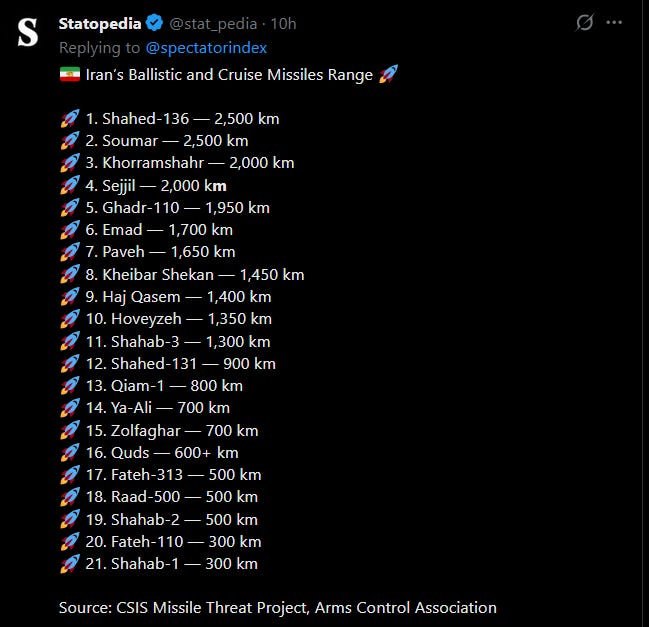
Wave 37 launched in the opening minutes of March 11 under the name “Laylat al-Qadr” – the Night of Power in Islamic tradition, the night the Quran was first revealed. The targets: a US base in Erbil, the 5th Fleet headquarters in Bahrain, and Beer Yakov southeast of Tel Aviv. Kheibar Shekan, Ghadr multi-warheads, Khorramshahr. The IRGC said it would last at least three hours. Geroman, tracking in real time, noted what I’ve been watching for days: no interceptions reported.

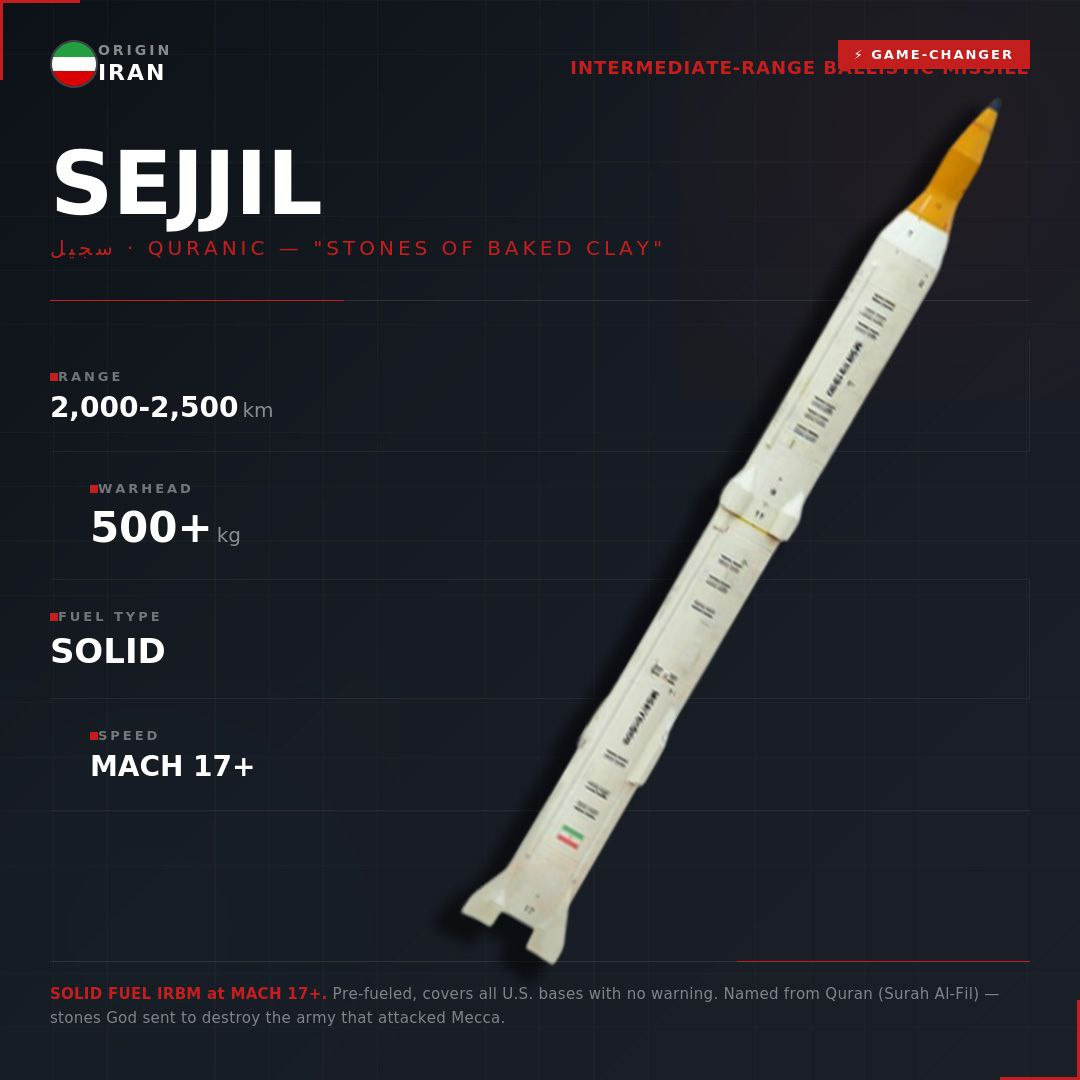
Iran also confirmed that the Sejjil now sits in its active combat inventory. It’s Iran’s longest-range solid-fuel ballistic missile, and the “solid fuel” distinction is more important than it sounds. Liquid-fuelled missiles require a fuelling window before launch – a window where satellites spot the preparation, where intercept options exist, where someone can theoretically make a phone call. The Sejjil has no fuelling window. It rolls out pre-loaded. It fires. Range: 2,000 to 2,500 kilometres, covering every US base in the region and extending into southern Europe’s southern tier. Speed: Mach 17 at terminal phase. The intercept window at that velocity is measured in seconds.
The missile is named after the stones from Surah Al-Fil – the ones God rained down to annihilate the army that marched war elephants toward Mecca. Iran’s engineers spent fifteen years building it and went quiet on the programme for a decade while it matured. They held it back until now. The sensor holes that have been accumulating since day one aren’t shrinking. They’re getting bigger.
Running casualty total: Iran 1,255 dead, 12,000 injured. Lebanon 634 dead. Israel 13 dead (erhm), roughly 2,000 injured. Iraq: 15 dead. Kuwait: 6 dead. And a footnote that deserves more than a footnote: a US preliminary investigation confirmed the Minab school was struck because outdated DIA intelligence had the building listed as part of a nearby naval base. Old maps, 168 dead children. Trump told the cameras it was Iran.

“Practically nothing left to target” – Trump’s framing to Axios – is not a bomb damage assessment. It’s a narrative. The off-ramp in construction. “We bombed everything, we won, there is nothing left to destroy, therefore it is over”. Someone forgot to tell Khatam al-Anbiya. They sent out wave 37 and ran out of numbers – or patience – and will switch to fire-at-will in the morning.

Senator Murphy came out of a classified briefing calling it “a disaster of epic proportions” and “a 10-day debacle”. He went further: “Israel made us do it. Netanyahu decided he wanted to attack and convinced Trump to join him”. Rand Paul warned of disastrous midterms and called the spending “fiscally irresponsible”. But then, No1 listens to Rand. Kalshi impeachment odds: 72%. All-time high.

Yesterday I wrote ‘infrastructure for infrastructure, barrel for barrel.’ Today they hit a bank. Not the vault – the servers. A missile hit Bank Sepah’s data infrastructure in Tehran. Iranians woke up to locked accounts, dead websites, offline channels. The official explanation? “Central Bank technical upgrade”. Scheduled maintenance, courtesy of the IAF.

The IRGC’s response: Khatam al-Anbiya declared all US and Israeli-linked economic centres and banks in the Gulf legitimate military targets. Citizens advised to stay one kilometre from any US or Israeli financial institution. In Dubai, Manama, and Kuwait City, that radius covers half the city. The named targets: Google, Microsoft, Palantir, IBM, Nvidia. Regional offices. Commercial infrastructure. Citibank is evacuating its Dubai office. Qisas. An eye for an eye. A bank for a bank.

The Thai-flagged bulk carrier Mayuree Naree attempted to cross the Strait of Hormuz today. Thailand is not at war with Iran. No US bases. No role in Operation Emazing Failure. The IRGC had announced – clearly, repeatedly, in multiple languages – that ships bound for US/Israeli/allied destinations cannot pass. The Mayuree Naree tried anyway. Struck 18 kilometres north of Oman. Twenty crew rescued. Three still on board. Maersk now has ten container ships trapped inside the Persian Gulf. Cannot get out. The CEO told media it will take a week to ten days to resume operations after a ceasefire. There is no ceasefire.

Meanwhile Reuters confirmed that the US Navy has refused near-daily escort requests from the shipping industry since day one – risk of Iranian attack “too high”. The most powerful navy in human history cannot safely escort a single tanker through a 33-kilometre strait.

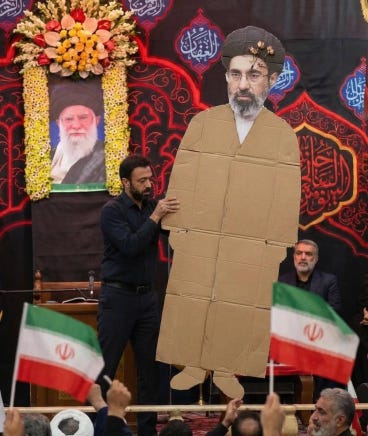
In Tehran, hundreds of thousands gathered in Revolution Square for Mojtaba Khamenei’s allegiance rally. Explosions were audible on the live broadcast. The cameras kept rolling. Iranian state television did not cut the feed. The crowd chanted louder.
The “supreme leader” in attendance was a life-size cardboard cutout. Trump showed Fox News his own cardboard Ayatollah in the Oval Office the same day. Arts and crafts at the highest level. Whether Mojtaba Khamenei is keeping a deliberate low profile or whether the new leadership is genuinely a figurehead while the IRGC runs the war on autopilot, I have no idea. What I can say: nobody has seen him, nobody has heard him, and the IRGC is pledging allegiance to an absence while doubling the heavy payload. Paranoid, or managing perceptions? Probably both. Either way, the launches keep going.

Yesterday I covered the THAAD systems pulled from South Korea. Today Kim Jong Un saw the gap and launched a nuclear-capable cruise missile from his brand new destroyer. Father-daughter bonding. Seoul was reportedly “upset”. One imagines.

Qatar told its entire population to stay indoors today. The Ministry of Interior issued a national emergency alert to every phone in the country: stay inside, close windows, stay away from exposed areas, prepare for falling debris. A “serious security threat” from aerial interceptions. The nation hosting the largest US base in the Middle East, that exports 20% of the planet’s LNG, issued a shelter-in-place to seven million people.

Ras Laffan has been dark for nine days. Zero tankers departed since March 2. The longest export outage in the facility’s history. Nine days of silence from the terminal that was supposed to free Europe from Russian gas. After what felt like seventeen emergency summits, four acronyms, and a press release in six languages, the IEA’s 32 member countries unanimously released 400 million barrels from the strategic reserves – the largest emergency release in history. They’d like a round of applause. It will cover approximately four to five days of global consumption. The Hormuz disruption has already removed an estimated 450 million barrels from circulation.
Energy Secretary Wright also tried to help by claiming a tanker had transited under Navy escort. Oil dropped 8% in eight minutes, then clawed back even faster when the post was deleted and Iran’s Parliament Speaker screenshotted it with the caption “Maybe on PlayStation!” – the intern took the fall, but the broader point is that someone, somewhere, keeps needing the dials to read “open for business”.

Meanwhile, Iran is exporting more oil than before the war started. No traffic jams when you are the traffic warden. The WSJ confirmed it: 2.1 million barrels per day, up 100,000 from pre-war levels. Every barrel going to China.

On silver: the drain data is getting serious enough that I’ll dedicate a separate article to it. The short version – weekly vault withdrawals in the week of March 2-6 hit 705 metric tons, against 214 the week before. SFE run rate: 29 working days. COMEX: 66 days. At current pace, all liquid free float across the major exchanges is gone by June. Shanghai is paying a $13 premium over London and still can’t pull physical metal west. More on this soon. Shanghai silver at $100.76. COMEX at $85.60.

The Houthis, who have been a near-daily fixture of this war, have reportedly gone off-grid in the last 48 hours. No out-of-office reply. As one source noted it in passing: “something is afoot”. I don’t know what. But it’s worth watching. The dials still read “everything is fine”. The (now ex-) intern disagrees. Still devolving…"

"Donald Trump’s War on Iran is Turning into a Debacle"

"Donald Trump’s War on Iran is Turning into a Debacle"
by Larry C. Johnson

"The image above tells you why Donald Trump is in political trouble over his decision to launch a war on Iran. Previous presidents have understood that you must rally public support before sending US troops and planes overseas to attack another country, or else you risk political isolation and blame if the war goes awry. And the war with Iran is going badly for the US, despite the nightly cheer-leading broadcast round-the-clock on Fox News.

The Trump administration genuinely believed that the decapitation attack on 28 February would rally the Iranian people to rise up and overthrow the Islamic Republic. Trump ignored the contrary warnings from General Caine, the Chairman of the Joint Chiefs of Staff, and the National Intelligence Council (NIC). Trump apparently never considered the possibility that Iran would blockade the the Strait of Hormuz and shutdown the flow of oil, liquid natural gas and nitrogen fertilizer from the Persian Gulf. As I discussed in my last article - Choke Point: The Global Economic Consequences of The Persian Gulf Shutdown - Iran’s shuttering of the Persian Gulf has sent in motion some profound economic shocks that are going to cause a global recession and, if sustained for more than a month, a global depression.

Although the US is supposedly not dependent on oil from the Persian Gulf, gas prices are rising dramatically across the 50 states. When I filled my tank on Sunday, the price of gas had surged by .50 cents from what I paid six days earlier. I checked again today (Wednesday) and the price had moved up an additional .15 cents. The increase cost of fuel is going to hit the entire economy as truckers and airlines and farmers have to spend more to keep their machines running. Those costs will be passed on to the consumers. This is going to create a double whammy - not just in the US, but around the world - of rising prices and diminished economic growth. At some point, the price of oil and LNG will start to tick down but only because the recession that is going to hit most economies around the globe will reduce demand.

The picture is equally bleak and troubled on the military front. Despite wreaking massive damage inside Iran, the US and Israeli militaries have failed to knockout Iran’s ballistic and cruise missile forces as well as its drones. The US Department of War has conceded that Iran defied the expectations of the US military as the Iranians launched devastating counter attacks.

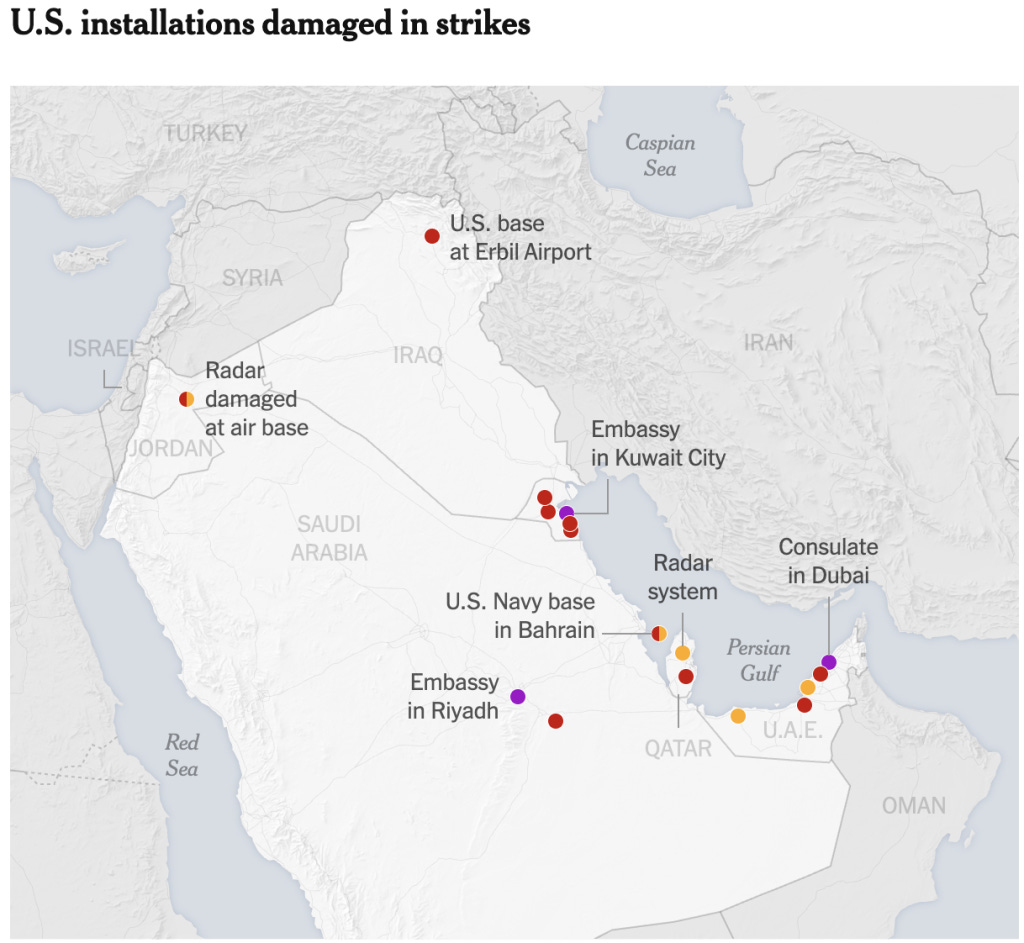
The New York Times published an interactive feature on March 11, 2026 that analyzes damage to US military and related sites in the Middle East amid the ongoing US-Israel war with Iran. It uses high-resolution commercial satellite imagery (from sources like Airbus DS and Planet Labs), verified social media videos, and official statements from US officials and Iranian state media to document at least 17 damaged US sites (including bases hosting US forces, air defense infrastructure, and diplomatic facilities). The analysis is current as of March 10, 2026, and highlights Iran’s retaliatory strikes - thousands of missiles and drones - launched in response to the U.S.-Israeli assault on Iran that began around late February 2026.
Iran’s attacks began shortly after the conflict’s start (e.g., February 28 onward) and targeted 13 sites in Kuwait, Qatar, Bahrain, Saudi Arabia, UAE, Jordan, and Iraq:

Kuwait: Multiple strikes on Ali Al Salem Air Base (March 1), Camp Arifjan (March 4), Shuaiba port (March 2, killing six U.S. service members with partial roof collapse visible in satellite images), and Camp Buehring (March 5, drone explosion near sports facilities with no casualties).

Bahrain: U.S. Navy 5th Fleet HQ struck (February 28/March 1), including damage to a communications radome shown in verified video.

Saudi Arabia: Prince Sultan Air Base (March 1), with one U.S. service member killed.

Qatar: Al Udeid Air Base (March 9) and Umm Dahal radar site (damage to AN/FPS-132 radar).

UAE: Al Dhafra Air Base (March 3), Jebel Ali port (March 1), Al Ruwais (near THAAD unit), and Al Sader facilities.

Jordan: Muwaffaq Salti Air Base (March 4), with severe damage to air defense sensors.

Iraq: Erbil Airport (March 1).

Other: Strikes reached as far as Turkey (NATO intercepted missiles aimed at Incirlik Air Base on March 4, which Iran denied). Some bases (e.g., Al Udeid, Ali Al Salem, Al Dhafra) were hit multiple times. Diplomatic targets included the U.S. consulate in Dubai and embassies in Kuwait City, Riyadh, and Baghdad (rocket attack on March 8, no casualties confirmed).

While US CENTCOM continues to insist that Iran has done little damage, the reality is that Iran has crippled the ability of the US to launch and sustain combat operations from the bases and installations listed above.

There are several reports that Trump has tried to re-open talks with Iran in hopes of securing a cease-fire or a staged victory withdrawal. Iran is having none of that and will continue to attack US installations and Israel no matter what Trump decides to do."
o
Danny Davis and I discussed the state of the war with Iran:
Full screen recommended.
"Iran War: Trump's Lost Control 
With fmr CIA Analyst Larry Johnson"

Wednesday, March 11, 2026

"Why America is Losing the War With Iran (w/John Mearsheimer)"

"Why America is Losing the War With Iran 
(w/John Mearsheimer)"
The Chris Hedges Report, 3/11/26

"As the U.S.-Israel and Iran War enters its second week, American and Israeli strategy becomes increasingly opaque, while Iran’s resolve hardens. Professor John Mearsheimer, a renowned voice in international politics, joins host Chris Hedges again on this episode of The Chris Hedges Report to spell out what can be expected from the conflict.

Mearsheimer chronicles everything that is known about the war so far, from Benjamin Netanyahu’s victory in convincing an American president to finally launch this long-awaited attack on Iran to the reluctance within Trump’s own cabinet to go through with it. Mearsheimer also spells out the major implications this conflict has on the whole of the world economy; with Iran closing the Strait of Hormuz, countries in East Asia such as South Korea and Japan as well as the whole of Europe will suffer.

“You could have a worldwide depression. You could have something less than that, like a worldwide recession, that would have huge consequences for people all over the planet, especially in developing countries, less so in developed countries. But even in developed countries, it’s quite clear that the importance of oil for running the international economy simply can’t be underestimated,” Mearsheimer tells Hedges."
Comments here:

"Alert! Middle East Is On Fire! WW3! Tankers Hit, Trump Panics!"

Prepper News 3/11/26
"Alert! Middle East Is On Fire! WW3! 
Tankers Hit, Trump Panics!"
Comments here:

"The Price Of Everything Is Going Up, Reckless Spending Comes With A Cost"

Jeremiah Babe, 3/11/26
"The Price Of Everything Is Going Up, 
Reckless Spending Comes With A Cost"
Comments here:

"Millions Of Americans Will Struggle, Food Prices Rising Again"

Full screen recommended.
Snyder Reports, 3/11/26
"Millions Of Americans Will Struggle, 
Food Prices Rising Again"
Comments here:

"Iran Drops Gigantic 2 Ton Warhead Missiles on Tel Aviv; Entire City Wiped Out"

Full screen recommended.
OPTM, 3/11/26
"Iran Drops Gigantic 2 Ton Warhead Missiles on Tel Aviv; 
Entire City Wiped Out"
Comments here:

Musical Interlude: Poco, "Rose Of Cimarron"

Poco, "Rose Of Cimarron"
 

"A Look to the Heavens"

“While drifting through the cosmos, a magnificent interstellar dust cloud became sculpted by stellar winds and radiation to assume a recognizable shape. Fittingly named the Horsehead Nebula, it is embedded in the vast and complex Orion Nebula (M42). A potentially rewarding but difficult object to view personally with a small telescope, the above gorgeously detailed image was recently taken in infrared light by the orbiting Hubble Space Telescope in honor of the 23rd anniversary of Hubble's launch. 
The dark molecular cloud, roughly 1,500 light years distant, is cataloged as Barnard 33 and is seen above primarily because it is backlit by the nearby massive star Sigma Orionis. The Horsehead Nebula will slowly shift its apparent shape over the next few million years and will eventually be destroyed by the high energy starlight.”

"Perhaps..."

"Perhaps they are not stars, but rather openings in 
heaven where the love of our lost ones pours through
 and shines down upon us to let us know they are happy."
~ An Eskimo saying.

'US-Israel-Iran War, 3/11/26"

Glenn Diesen, 3/11/26
"Scott Ritter: Trump Calls
 Putin for Iran War Off-Ramp"
Comments here:
o
Judge Napolitano - Judging Freedom, 3/11/26
"Pepe Escobar : Iran’s New Leader 
and a Changing Oil Order"
Comments here:
o
Full screen recommended.
Danny Haiphong, 3/11/26
"Pepe Escobar: Iran's Deadly Missile Strike 
Stuns Israel, Trump Losing the War"
Comments here:

"Doug Casey on the Cost of the Iran War - and Why It Will Fuel Inflation"

"Doug Casey on the Cost of the Iran War - 
and Why It Will Fuel Inflation"
by International Man

"International Man: The war with Iran is dominating the headlines, but what most people aren’t considering is the economics of warfare and what it means in the bigger picture. When a $35,000 Iranian drone can force the US or Israel to fire interceptors costing millions, what does that say about the economics of modern war, and who really benefits in a conflict defined by that kind of asymmetry?

Doug Casey: War has always been about economics. That’s even truer today because of the huge discrepancy between what the First World can afford and what the Third World can. I believe Iran is using what Muhammad Ali called the rope-a-dope. You mostly just absorb your opponent's blows. He tires himself out, and then you counterattack. The Iranians' rope-a-dope is to let the US and Israel deplete their supplies of ultra-expensive missiles and interceptors before counterattacking in size.

The US is in the habit of building fantastically expensive, complicated weapons that were originally intended to confront peer adversaries like the Soviet Union or China. That can make sense when you consider that a US soldier costs about a million dollars, all in, to train and support. But a Third World teenager costs about nothing. Each of them is like an AI-directed cruise missile, but there are millions of them. It’s the same equation with missiles and drones.

Wars like this, and this war in particular, might bring down the US through simple bankruptcy. Most Americans are unaware that Trump has already dropped bombs in 10 different countries just in the last year. It’s expensive, and it makes enemies.

The US is no longer like G.I. Joe in World War II, passing out nylons and chocolates to make friends. The answer from the Third World will be "Two, three, many Vietnams", pinpricking the giant to death over decades. The US has been using ultra-expensive planes and missiles to blow up huts in the desert. It had to back off from fighting the Houthis, who aren’t even a nation-state. The US approach to warfare is unseemly, stupid, uneconomic, and unsustainable. You might think that Trump would consider closing its 850 provocative foreign bases and concentrate on safeguarding the geographical US. But that’s not how declining bankrupt empires are wired…

International Man: The Pentagon’s preliminary estimate is that the war will cost roughly $1 billion per day, but some analysts say missile defense alone could be costing several billion daily. How much higher do you think the real cost of a US-Iran war would be once you include indirect costs, delayed effects, stockpile depletion, and the broader economic distortions?

Doug Casey: To keep this in perspective, realize that World War II, which was an all-out fight for survival and lasted almost four years for the US, supposedly only cost $275 billion. Those were hard dollars, perhaps $4 trillion in today’s currency. The comparison helps keep expenses in perspective. Now, nobody even knows the direct costs of wars. Forget about the indirect costs. It’s said that the misadventure in Afghanistan cost $2.3 to $4 trillion, fighting against primitive people armed mostly with AK-47s. The Iraq War cost over $2 trillion. Neither adventure benefited the US in any way whatsoever that I can determine.

But in the case of Iran, the US is now hunting truly dangerous big game. There are lots of possible outcomes, but few are beneficial to the US. Trump has foolishly demanded unconditional surrender, which is an unusual concept for an undeclared war. It’s hard to walk back a demand for unconditional surrender. In other words, it appears Trump has blown the opportunity to say we taught them a lesson, back off, and declare victory - like he did when supposedly destroying their nuclear facilities in June. He’s made it an existential fight for the Iranian regime, with elements of religious war. Which is especially dangerous in a region full of true believers. My guess is that costs will spin out of control.

International Man: How long do you expect the Iran war to last? How do you think it will play out and eventually end? What about international law?

Doug Casey: The US has gotten into the habit of imposing its will on pipsqueak countries over the last 80 years. But Iran is different. The attack on Iran was completely unprovoked, a total war of choice. Their mantra of "Death to America" is understandable in light of US policies in the region. It’s criminal to launch a surprise attack in reaction to nothing more than harsh words. Terrorism? There’s been none on the part of Iran itself, despite the US propaganda.

What Iran’s done is support the Lebanese Hezbollah, the Palestinian Hamas, and the Yemeni Houthis in their wars against Israel. I’m no fan of the Iranian regime; the world would be better off without them. But everyone in the Muslim world is either a declared or covert enemy of Israel. That’s a pity. But as Washington and Adams said, we should be a friend to all, and an ally to none. Worse, the US and Israel launched their attack in the middle of negotiations, which is dishonorable. Despicable, actually.

We’re looking at the overturning of traditional international law. But let’s recognize that international law has never been more than a pleasant fiction. It’s a make-believe world between politicians. Even though each party is often a liar with bad intent, it helps if you want to give the other guy the benefit of the doubt. Politics is Machiavellian, and understandings between governments are easily disregarded. International law is mainly used to make a war of aggression seem righteous.

Here’s an analogy. Look at the world of international law as a sleazy nightclub with 200 customers. Some are going to be raucous, some will be quiet; some are friendly, some are aggressive; some smart, some stupid. There will always be a few gangbangers who don’t like each other, some townies who hate the preppies, some junkies, a couple of ex-cons, and a few psychos. And there’s no cop to keep order. The world is just like that bar. No written rules, just some vague understandings. And lots of misunderstandings. Like in any bar, customers size each other up, deciding who to drink with, who’s looking for trouble, or, if you’re a bad actor, who you can beat up and roll.

The US used to be the toughest customer in the saloon of international law, buying friends with free drinks. But he’s turned into a mean drunk who’s overdrawn his tab. The other customers who used to tolerate his eccentricities have started to dislike, disrespect, and resent him. It will probably end up like an altercation in Deadwood’s Gem Saloon.

Forget about the concept of international law. It exists only as a veneer, the way politeness does in a frontier bar. The sham is being exposed by the unprovoked surprise US/Israeli attack on Iran.

International Man: Washington can’t fund a long conflict like this out of current tax revenues, so it has to be financed through debt. With foreign buyers like China and Japan stepping back, will the Fed become the buyer of last resort, and is that when the money printing really begins?

Doug Casey: The world has watched the US engage in promiscuous deficit spending for the last 80 years. Serious questions started coming up in the 1960s, with the Vietnam War, resulting in the dollar devaluation and the default on gold redemption in 1971. Since the early 1980s, the major export of the US ceased to be aircraft, computers, and soybeans. The main US export now is about a trillion fiat dollars every year. Interest on its debt is the largest line item in US spending, after armaments.

In addition to financing all the new spending, the government has to roll over about $10 trillion in old debt that’s coming due this year. The Federal Reserve is the only realistic buyer for all that. They’ll have to print dollars to finance the debt. We’re approaching the endgame from several points of view.

International Man: You’ve often said war is the health of the state and a destroyer of capital. In a conflict with Iran, why do you think the result is likely to be more inflation, more currency debasement, and a stronger case for hard assets like gold, energy, and commodities?

Doug Casey: The only way the US can finance this war is by printing money. That always results in higher prices. And higher interest rates as well. Predicting the direction of interest rates is risky, but you’ll recall that they dropped from the 15-18% level in the early 1980s to close to zero by 2022. My guess is that we’ve entered a new cycle, taking us to new all-time highs in interest rates. It won’t take 40 years to get there this time. Meanwhile, commodity prices are at all-time lows relative to other assets. The smart play is to sell the dollar, especially long-term bonds, and go long commodities of every type."

The Daily "Near You?"

Orland Park, Illinois, USA. Thanks for stopping by!

“The Immutable Laws of Nature, and Murphy’s Other 15 Laws”

“The Immutable Laws of Nature, and Murphy’s Other 15 Laws”
by Peter McKenzie-Brown

“The Immutable Laws of Nature”

• Law of Mechanical Repair: After your hands become coated with grease, your nose will begin to itch and you’ll have to pee.
• Law of Gravity: Any tool, nut, bolt, screw, when dropped, will roll to the least accessible place.
• Law of Probability: The probability of being watched is directly proportional to the stupidity of your act.
• Law of Random Numbers: If you dial a wrong number, you never get a busy signal; someone always answers.
• Law of Variable Motion: If you change traffic lanes or checkout queues, the one you were in will always move faster than the one you are in now.
• Law of the Bath: When the body is fully immersed in water, the telephone will ring.
• Law of Close Encounters: The probability of meeting someone you know increases exponentially when you are alongside someone you don’t want to be seen with.
• Law of the Damned Thing: When you try to prove to someone that a machine or device won’t work, it will.
• Law of Biomechanics: The severity of the itch is inversely proportional to the reach.
• Law of the Spectator: At any theatrical, musical or sporting event, the people whose seats are furthest from the aisle always arrive last. They are the ones who will leave their seats several times to go for food, for beer, or to the toilet and who leave before the end of the performance or game. Those who occupy the aisle seats come early, never move once, have long gangly legs or big bellies and stay seated beyond the end of the performance. The aisle people also are very surly folk.
• Law of Coffee: As soon as you sit down to a cup of hot coffee, your partner will ask you to do something which will last until the coffee is cold.
• Murphy’s Law of Lockers: When only 2 people are in a locker room, they will have adjacent lockers.
• Law of Plane Surfaces: The chance that a slice of marmalade toast will land face down on a floor is directly correlated to the newness and cost of the carpet or rug.
• Law of Logical Argument: Anything is possible when you don’t know what you are talking about.
• Law of Physical Appearance: If clothes fit, they’re ugly.
• Law of Public Speaking: A closed mouth gathers no feet
• Law of Commercial Marketing: As soon as you find a product that you really like, it will cease production or the store will stop selling it.
• Law of Psychosomatic Medicine: If you don’t feel well, make an appointment to see to the doctor and by  the time you get there, you’ll feel better. If you don’t make an appointment you’ll stay sick.

“Murphy’s Other 15 Laws”

1. Light travels faster than sound. This is why some people appear bright until you hear them speak.
2. A fine is a tax for doing wrong. A tax is a fine for doing well.
3. He who laughs last, thinks slowest.
4. A day without sunshine is like, well, night.
5. Change is inevitable, except from a vending machine.
6. Those who live by the sword get shot by those who don’t.
7. Nothing is foolproof to a sufficiently talented fool.
8. The 50-50-90 rule: Anytime you have a 50-50 chance of getting something right, there’s a 90% probability you’ll get it wrong.
9. It is said that if you line up all the cars in the world end-to-end, someone would be stupid enough to try to pass them.
10. If the shoe fits, get another one just like it.
11. The things that come to those who wait, may be the things left by those who got there first.
12. Give a man a fish and he will eat for a day. Teach a man to fish and he will sit in a boat all day drinking beer.
13. Flashlight: A case for holding dead batteries.
14. God gave you toes as a device for finding furniture in the dark.
15. When you go into court, you are putting yourself in the hands of twelve people who weren’t smart enough to get out of jury duty.”

"Asking For Trouble..."

“We’ve all heard the warnings and we’ve ignored them. We push our luck. We roll the dice. It’s human nature. When we’re told not to touch something we usually do even if we know better. Maybe because deep down, we’re just asking for trouble.”
- “Meredith Grey”, “Gray’s Anatomy”

“The Last Night of the World”

“The Last Night of the World”
Originally published in the February 1951 issue of "Esquire."
by Ray Bradbury

“What would you do if you knew this was the last night of the world?”
“What would I do; you mean, seriously?”
“Yes, seriously.”
“I don’t know – I hadn’t thought.” She turned the handle of the silver coffeepot toward him and placed the two cups in their saucers. He poured some coffee. In the background, the two small girls were playing blocks on the parlor rug in the light of the green hurricane lamps. There was an easy, clean aroma of brewed coffee in the evening air.
“Well, better start thinking about it,” he said.
“You don’t mean it?” said his wife.
He nodded.
“A war?”
He shook his head.
“Not the hydrogen or atom bomb?”
“No.”
“Or germ warfare?”
“None of those at all,” he said, stirring his coffee slowly and staring into its black depths. “But just the closing of a book, let’s say.”
“I don’t think I understand.”
“No, nor do I really. It’s jut a feeling; sometimes it frightens me, sometimes I’m not frightened at all – but peaceful.” He glanced in at the girls and their yellow hair shining in the bright lamplight, and lowered his voice. “I didn’t say anything to you. It first happened about four nights ago.”
“What?”
“A dream I had. I dreamt that it was all going to be over and a voice said it was; not any kind of voice I can remember, but a voice anyway, and it said things would stop here on Earth. I didn’t think too much about it when I awoke the next morning, but then I went to work and the feeling as with me all day. I caught Stan Willis looking out the window in the middle of the afternoon and I said, ‘Penny for your thoughts, Stan,’ and he said, ‘I had a dream last night,’ and before he even told me the dream, I knew what it was. I could have told him, but he told me and I listened to him.”
“It was the same dream?”
“Yes. I told Stan I had dreamed it, too. He didn’t seem surprised. He relaxed, in fact. Then we started walking through offices, for the hell of it. It wasn’t planned. We didn’t say, let’s walk around. We just walked on our own, and everywhere we saw people looking at their desks or their hands or out the windows and not seeing what was in front of their eyes. I talked to a few of them; so did Stan.”
“And all of them had dreamed?”
“All of them. The same dream, with no difference.”
“Do you believe in the dream?”
“Yes. I’ve never been more certain.”
“And when will it stop? The world, I mean.”
“Sometime during the night for us, and then, as the night goes on around the world, those advancing portions will go, too. It’ll take twenty-four hours for it all to go.”
They sat awhile not touching their coffee. Then they lifted it slowly and drank, looking at each other.
“Do we deserve this?” she said.
“It’s not a matter of deserving, it’s just that things didn’t work out. I notice you didn’t even argue about this. Why not?”
“I guess I have a reason,” she said.
“The same reason everyone at the office had?”
She nodded. “I didn’t want to say anything. It happened last night. And the women on the block are talking about it, just among themselves.” She picked up the evening paper and held it toward him. “There’s nothing in the news about it.”
“No, everyone knows, so what’s the need?” He took the paper and sat back in his chair, looking at the girls and then at her. “Are you afraid?”
“No. Not even for the children. I always thought I would be frightened to death, but I’m not.”
“Where’s that spirit of self-preservation the scientists talk about so much?”
“I don’t know. You don’t get too excited when you feel things are logical. This is logical. Nothing else but this could have happened from the way we’ve lived.”
“We haven’t been too bad, have we?”
“No, nor enormously good. I suppose that’s the trouble. We haven’t been very much of anything except us, while a big part of the world was busy being lots of quite awful things.”
The girls were laughing in the parlor as they waved their hands and tumbled down their house of blocks.
“I always imagined people would be screaming in the streets at a time like this.”
“I guess not. You don’t scream about the real thing.”
“Do you know, I won’t miss anything but you and the girls. I never liked cities or autos or factories or my work or anything except you three. I won’t miss a thing except my family and perhaps the change in the weather and a glass of cool water when the weather’s hot, or the luxury of sleeping. Just little things, really. How can we sit here and talk this way?”
“Because there’s nothing else to do.”
“That’s it, of course, for if there were, we’d be doing it. I suppose this is the first time in the history of the world that everyone has really known just what they were going to be doing during the last night.”
“I wonder what everyone else will do now, this evening, for the next few hours.”
“Go to a show, listen to the radio, watch the TV, play cards, put the children to bed, get to bed themselves, like always.”
“In a way that’s something to be proud of – like always.”
“We’re not all bad.”
They sat a moment and then he poured more coffee. “Why do you suppose it’s tonight?”
“Because.”
“Why not some night in the past ten years of in the last century, or five centuries ago or ten?”
“Maybe it’s because it was never February 30, 1951, ever before in history, and now it is and that’s it, because this date means more than any other date ever meant and because it’s the year when things are as they are all over the world and that’s why it’s the end.”
“There are bombers on their course both ways across the ocean tonight that’ll never see land again.”
“That’s part of the reason why.”
“Well,” he said. “What shall it be? Wash the dishes?”
They washed the dishes carefully and stacked them away with especial neatness. At eight-thirty the girls were put to bed and kissed good night and the little lights by their beds turned on and the door left a trifle open.
“I wonder,” said the husband, coming out and looking back, standing there with his pipe for a moment.”
“What?”
“If the door should be shut all the way or if it should be left just a little ajar so we can hear them if they call.”
“I wonder if the children know – if anyone mentioned anything to them?”
“No, of course not. They’d have asked us about it.”
They sat and read the papers and talked and listened to some radio music and then sat together by the fireplace looking at the charcoal embers as the clock struck ten-thirty and eleven and eleven-thirty. They thought of all the other people in the world who had spent their evening, each in their own special way.
“Well,” he said at last. He kissed his wife for a long time.
“We’ve been good for each other, anyway.”
“Do you want to cry?” he asked.
“I don’t think so.”
They went through the house and turned out the lights and locked the doors, and went into the bedroom and stood in the night cool darkness undressing. She took the spread from the bed and folded it carefully over a chair, as always, and pushed back the covers. “The sheets are so cool and clean and nice,” she said.
“I’m tired.”
“We’re both tired.”
They got into bed and lay back.
“Wait a moment,” she said.
He heard her get up and go out into the back of the house, and then he heard the soft shuffling of a swinging door. A moment later she was back. “I left the water running in the kitchen,” she said. “I turned the faucet off.”
Something about this was so funny that he had to laugh. She laughed with him, knowing what it was that she had done that was so funny. They stopped laughing at last and lay in their cool night bed, their hands clasped, their heads together.
“Good night,” he said, after a moment.
“Good night,” she said, adding softly, “dear…”