StatCounter

Thursday, March 12, 2026

"Donald Trump’s War on Iran is Turning into a Debacle"

"Donald Trump’s War on Iran is Turning into a Debacle"
by Larry C. Johnson

"The image above tells you why Donald Trump is in political trouble over his decision to launch a war on Iran. Previous presidents have understood that you must rally public support before sending US troops and planes overseas to attack another country, or else you risk political isolation and blame if the war goes awry. And the war with Iran is going badly for the US, despite the nightly cheer-leading broadcast round-the-clock on Fox News.

The Trump administration genuinely believed that the decapitation attack on 28 February would rally the Iranian people to rise up and overthrow the Islamic Republic. Trump ignored the contrary warnings from General Caine, the Chairman of the Joint Chiefs of Staff, and the National Intelligence Council (NIC). Trump apparently never considered the possibility that Iran would blockade the the Strait of Hormuz and shutdown the flow of oil, liquid natural gas and nitrogen fertilizer from the Persian Gulf. As I discussed in my last article - Choke Point: The Global Economic Consequences of The Persian Gulf Shutdown - Iran’s shuttering of the Persian Gulf has sent in motion some profound economic shocks that are going to cause a global recession and, if sustained for more than a month, a global depression.

Although the US is supposedly not dependent on oil from the Persian Gulf, gas prices are rising dramatically across the 50 states. When I filled my tank on Sunday, the price of gas had surged by .50 cents from what I paid six days earlier. I checked again today (Wednesday) and the price had moved up an additional .15 cents. The increase cost of fuel is going to hit the entire economy as truckers and airlines and farmers have to spend more to keep their machines running. Those costs will be passed on to the consumers. This is going to create a double whammy - not just in the US, but around the world - of rising prices and diminished economic growth. At some point, the price of oil and LNG will start to tick down but only because the recession that is going to hit most economies around the globe will reduce demand.

The picture is equally bleak and troubled on the military front. Despite wreaking massive damage inside Iran, the US and Israeli militaries have failed to knockout Iran’s ballistic and cruise missile forces as well as its drones. The US Department of War has conceded that Iran defied the expectations of the US military as the Iranians launched devastating counter attacks.

The New York Times published an interactive feature on March 11, 2026 that analyzes damage to US military and related sites in the Middle East amid the ongoing US-Israel war with Iran. It uses high-resolution commercial satellite imagery (from sources like Airbus DS and Planet Labs), verified social media videos, and official statements from US officials and Iranian state media to document at least 17 damaged US sites (including bases hosting US forces, air defense infrastructure, and diplomatic facilities). The analysis is current as of March 10, 2026, and highlights Iran’s retaliatory strikes - thousands of missiles and drones - launched in response to the U.S.-Israeli assault on Iran that began around late February 2026.
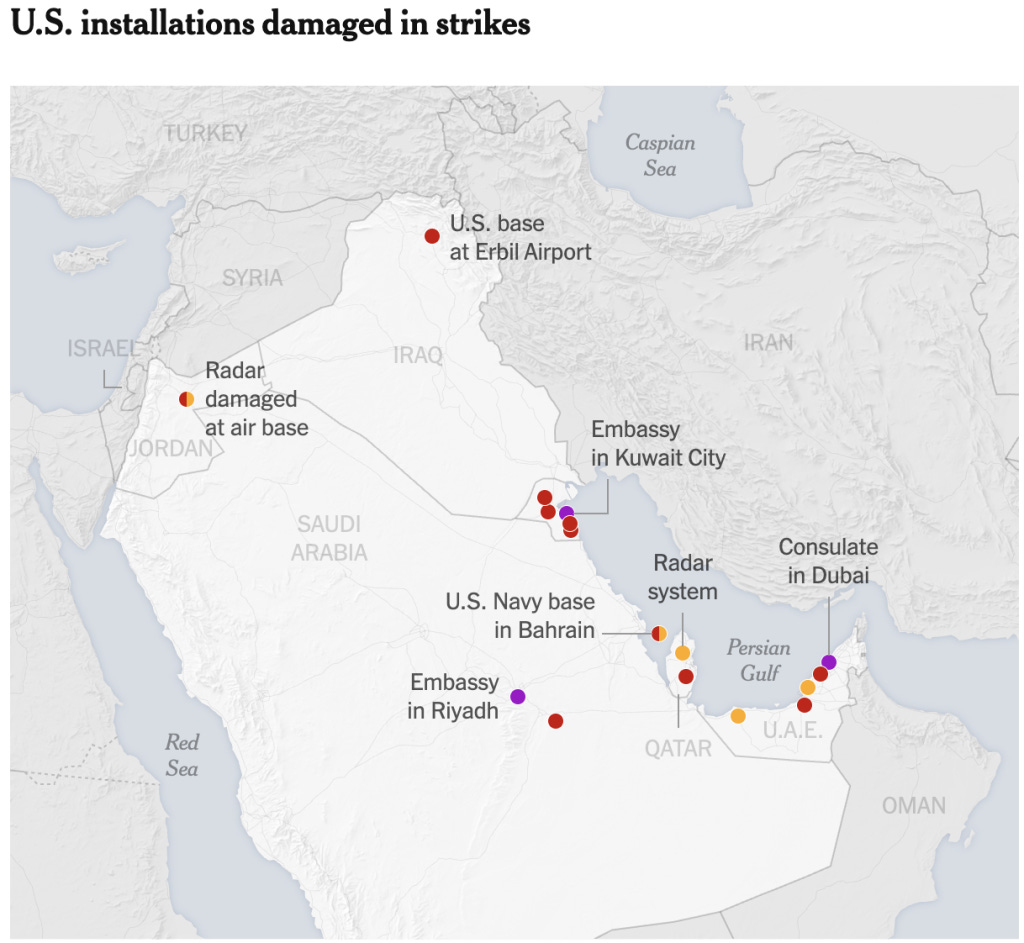
Iran’s attacks began shortly after the conflict’s start (e.g., February 28 onward) and targeted 13 sites in Kuwait, Qatar, Bahrain, Saudi Arabia, UAE, Jordan, and Iraq:

Kuwait: Multiple strikes on Ali Al Salem Air Base (March 1), Camp Arifjan (March 4), Shuaiba port (March 2, killing six U.S. service members with partial roof collapse visible in satellite images), and Camp Buehring (March 5, drone explosion near sports facilities with no casualties).

Bahrain: U.S. Navy 5th Fleet HQ struck (February 28/March 1), including damage to a communications radome shown in verified video.

Saudi Arabia: Prince Sultan Air Base (March 1), with one U.S. service member killed.

Qatar: Al Udeid Air Base (March 9) and Umm Dahal radar site (damage to AN/FPS-132 radar).

UAE: Al Dhafra Air Base (March 3), Jebel Ali port (March 1), Al Ruwais (near THAAD unit), and Al Sader facilities.

Jordan: Muwaffaq Salti Air Base (March 4), with severe damage to air defense sensors.

Iraq: Erbil Airport (March 1).

Other: Strikes reached as far as Turkey (NATO intercepted missiles aimed at Incirlik Air Base on March 4, which Iran denied). Some bases (e.g., Al Udeid, Ali Al Salem, Al Dhafra) were hit multiple times. Diplomatic targets included the U.S. consulate in Dubai and embassies in Kuwait City, Riyadh, and Baghdad (rocket attack on March 8, no casualties confirmed).

While US CENTCOM continues to insist that Iran has done little damage, the reality is that Iran has crippled the ability of the US to launch and sustain combat operations from the bases and installations listed above.

There are several reports that Trump has tried to re-open talks with Iran in hopes of securing a cease-fire or a staged victory withdrawal. Iran is having none of that and will continue to attack US installations and Israel no matter what Trump decides to do."
o
Danny Davis and I discussed the state of the war with Iran:
Full screen recommended.
"Iran War: Trump's Lost Control 
With fmr CIA Analyst Larry Johnson"

Wednesday, March 11, 2026

"Why America is Losing the War With Iran (w/John Mearsheimer)"

"Why America is Losing the War With Iran 
(w/John Mearsheimer)"
The Chris Hedges Report, 3/11/26

"As the U.S.-Israel and Iran War enters its second week, American and Israeli strategy becomes increasingly opaque, while Iran’s resolve hardens. Professor John Mearsheimer, a renowned voice in international politics, joins host Chris Hedges again on this episode of The Chris Hedges Report to spell out what can be expected from the conflict.

Mearsheimer chronicles everything that is known about the war so far, from Benjamin Netanyahu’s victory in convincing an American president to finally launch this long-awaited attack on Iran to the reluctance within Trump’s own cabinet to go through with it. Mearsheimer also spells out the major implications this conflict has on the whole of the world economy; with Iran closing the Strait of Hormuz, countries in East Asia such as South Korea and Japan as well as the whole of Europe will suffer.

“You could have a worldwide depression. You could have something less than that, like a worldwide recession, that would have huge consequences for people all over the planet, especially in developing countries, less so in developed countries. But even in developed countries, it’s quite clear that the importance of oil for running the international economy simply can’t be underestimated,” Mearsheimer tells Hedges."
Comments here:

"Alert! Middle East Is On Fire! WW3! Tankers Hit, Trump Panics!"

Prepper News 3/11/26
"Alert! Middle East Is On Fire! WW3! 
Tankers Hit, Trump Panics!"
Comments here:

"The Price Of Everything Is Going Up, Reckless Spending Comes With A Cost"

Jeremiah Babe, 3/11/26
"The Price Of Everything Is Going Up, 
Reckless Spending Comes With A Cost"
Comments here:

"Millions Of Americans Will Struggle, Food Prices Rising Again"

Full screen recommended.
Snyder Reports, 3/11/26
"Millions Of Americans Will Struggle, 
Food Prices Rising Again"
Comments here:

"Iran Drops Gigantic 2 Ton Warhead Missiles on Tel Aviv; Entire City Wiped Out"

Full screen recommended.
OPTM, 3/11/26
"Iran Drops Gigantic 2 Ton Warhead Missiles on Tel Aviv; 
Entire City Wiped Out"
Comments here:

Musical Interlude: Poco, "Rose Of Cimarron"

Poco, "Rose Of Cimarron"
 

"A Look to the Heavens"

“While drifting through the cosmos, a magnificent interstellar dust cloud became sculpted by stellar winds and radiation to assume a recognizable shape. Fittingly named the Horsehead Nebula, it is embedded in the vast and complex Orion Nebula (M42). A potentially rewarding but difficult object to view personally with a small telescope, the above gorgeously detailed image was recently taken in infrared light by the orbiting Hubble Space Telescope in honor of the 23rd anniversary of Hubble's launch. 
The dark molecular cloud, roughly 1,500 light years distant, is cataloged as Barnard 33 and is seen above primarily because it is backlit by the nearby massive star Sigma Orionis. The Horsehead Nebula will slowly shift its apparent shape over the next few million years and will eventually be destroyed by the high energy starlight.”

"Perhaps..."

"Perhaps they are not stars, but rather openings in 
heaven where the love of our lost ones pours through
 and shines down upon us to let us know they are happy."
~ An Eskimo saying.

'US-Israel-Iran War, 3/11/26"

Glenn Diesen, 3/11/26
"Scott Ritter: Trump Calls
 Putin for Iran War Off-Ramp"
Comments here:
o
Judge Napolitano - Judging Freedom, 3/11/26
"Pepe Escobar : Iran’s New Leader 
and a Changing Oil Order"
Comments here:
o
Full screen recommended.
Danny Haiphong, 3/11/26
"Pepe Escobar: Iran's Deadly Missile Strike 
Stuns Israel, Trump Losing the War"
Comments here:

"Doug Casey on the Cost of the Iran War - and Why It Will Fuel Inflation"

"Doug Casey on the Cost of the Iran War - 
and Why It Will Fuel Inflation"
by International Man

"International Man: The war with Iran is dominating the headlines, but what most people aren’t considering is the economics of warfare and what it means in the bigger picture. When a $35,000 Iranian drone can force the US or Israel to fire interceptors costing millions, what does that say about the economics of modern war, and who really benefits in a conflict defined by that kind of asymmetry?

Doug Casey: War has always been about economics. That’s even truer today because of the huge discrepancy between what the First World can afford and what the Third World can. I believe Iran is using what Muhammad Ali called the rope-a-dope. You mostly just absorb your opponent's blows. He tires himself out, and then you counterattack. The Iranians' rope-a-dope is to let the US and Israel deplete their supplies of ultra-expensive missiles and interceptors before counterattacking in size.

The US is in the habit of building fantastically expensive, complicated weapons that were originally intended to confront peer adversaries like the Soviet Union or China. That can make sense when you consider that a US soldier costs about a million dollars, all in, to train and support. But a Third World teenager costs about nothing. Each of them is like an AI-directed cruise missile, but there are millions of them. It’s the same equation with missiles and drones.

Wars like this, and this war in particular, might bring down the US through simple bankruptcy. Most Americans are unaware that Trump has already dropped bombs in 10 different countries just in the last year. It’s expensive, and it makes enemies.

The US is no longer like G.I. Joe in World War II, passing out nylons and chocolates to make friends. The answer from the Third World will be "Two, three, many Vietnams", pinpricking the giant to death over decades. The US has been using ultra-expensive planes and missiles to blow up huts in the desert. It had to back off from fighting the Houthis, who aren’t even a nation-state. The US approach to warfare is unseemly, stupid, uneconomic, and unsustainable. You might think that Trump would consider closing its 850 provocative foreign bases and concentrate on safeguarding the geographical US. But that’s not how declining bankrupt empires are wired…

International Man: The Pentagon’s preliminary estimate is that the war will cost roughly $1 billion per day, but some analysts say missile defense alone could be costing several billion daily. How much higher do you think the real cost of a US-Iran war would be once you include indirect costs, delayed effects, stockpile depletion, and the broader economic distortions?

Doug Casey: To keep this in perspective, realize that World War II, which was an all-out fight for survival and lasted almost four years for the US, supposedly only cost $275 billion. Those were hard dollars, perhaps $4 trillion in today’s currency. The comparison helps keep expenses in perspective. Now, nobody even knows the direct costs of wars. Forget about the indirect costs. It’s said that the misadventure in Afghanistan cost $2.3 to $4 trillion, fighting against primitive people armed mostly with AK-47s. The Iraq War cost over $2 trillion. Neither adventure benefited the US in any way whatsoever that I can determine.

But in the case of Iran, the US is now hunting truly dangerous big game. There are lots of possible outcomes, but few are beneficial to the US. Trump has foolishly demanded unconditional surrender, which is an unusual concept for an undeclared war. It’s hard to walk back a demand for unconditional surrender. In other words, it appears Trump has blown the opportunity to say we taught them a lesson, back off, and declare victory - like he did when supposedly destroying their nuclear facilities in June. He’s made it an existential fight for the Iranian regime, with elements of religious war. Which is especially dangerous in a region full of true believers. My guess is that costs will spin out of control.

International Man: How long do you expect the Iran war to last? How do you think it will play out and eventually end? What about international law?

Doug Casey: The US has gotten into the habit of imposing its will on pipsqueak countries over the last 80 years. But Iran is different. The attack on Iran was completely unprovoked, a total war of choice. Their mantra of "Death to America" is understandable in light of US policies in the region. It’s criminal to launch a surprise attack in reaction to nothing more than harsh words. Terrorism? There’s been none on the part of Iran itself, despite the US propaganda.

What Iran’s done is support the Lebanese Hezbollah, the Palestinian Hamas, and the Yemeni Houthis in their wars against Israel. I’m no fan of the Iranian regime; the world would be better off without them. But everyone in the Muslim world is either a declared or covert enemy of Israel. That’s a pity. But as Washington and Adams said, we should be a friend to all, and an ally to none. Worse, the US and Israel launched their attack in the middle of negotiations, which is dishonorable. Despicable, actually.

We’re looking at the overturning of traditional international law. But let’s recognize that international law has never been more than a pleasant fiction. It’s a make-believe world between politicians. Even though each party is often a liar with bad intent, it helps if you want to give the other guy the benefit of the doubt. Politics is Machiavellian, and understandings between governments are easily disregarded. International law is mainly used to make a war of aggression seem righteous.

Here’s an analogy. Look at the world of international law as a sleazy nightclub with 200 customers. Some are going to be raucous, some will be quiet; some are friendly, some are aggressive; some smart, some stupid. There will always be a few gangbangers who don’t like each other, some townies who hate the preppies, some junkies, a couple of ex-cons, and a few psychos. And there’s no cop to keep order. The world is just like that bar. No written rules, just some vague understandings. And lots of misunderstandings. Like in any bar, customers size each other up, deciding who to drink with, who’s looking for trouble, or, if you’re a bad actor, who you can beat up and roll.

The US used to be the toughest customer in the saloon of international law, buying friends with free drinks. But he’s turned into a mean drunk who’s overdrawn his tab. The other customers who used to tolerate his eccentricities have started to dislike, disrespect, and resent him. It will probably end up like an altercation in Deadwood’s Gem Saloon.

Forget about the concept of international law. It exists only as a veneer, the way politeness does in a frontier bar. The sham is being exposed by the unprovoked surprise US/Israeli attack on Iran.

International Man: Washington can’t fund a long conflict like this out of current tax revenues, so it has to be financed through debt. With foreign buyers like China and Japan stepping back, will the Fed become the buyer of last resort, and is that when the money printing really begins?

Doug Casey: The world has watched the US engage in promiscuous deficit spending for the last 80 years. Serious questions started coming up in the 1960s, with the Vietnam War, resulting in the dollar devaluation and the default on gold redemption in 1971. Since the early 1980s, the major export of the US ceased to be aircraft, computers, and soybeans. The main US export now is about a trillion fiat dollars every year. Interest on its debt is the largest line item in US spending, after armaments.

In addition to financing all the new spending, the government has to roll over about $10 trillion in old debt that’s coming due this year. The Federal Reserve is the only realistic buyer for all that. They’ll have to print dollars to finance the debt. We’re approaching the endgame from several points of view.

International Man: You’ve often said war is the health of the state and a destroyer of capital. In a conflict with Iran, why do you think the result is likely to be more inflation, more currency debasement, and a stronger case for hard assets like gold, energy, and commodities?

Doug Casey: The only way the US can finance this war is by printing money. That always results in higher prices. And higher interest rates as well. Predicting the direction of interest rates is risky, but you’ll recall that they dropped from the 15-18% level in the early 1980s to close to zero by 2022. My guess is that we’ve entered a new cycle, taking us to new all-time highs in interest rates. It won’t take 40 years to get there this time. Meanwhile, commodity prices are at all-time lows relative to other assets. The smart play is to sell the dollar, especially long-term bonds, and go long commodities of every type."

The Daily "Near You?"

Orland Park, Illinois, USA. Thanks for stopping by!

“The Immutable Laws of Nature, and Murphy’s Other 15 Laws”

“The Immutable Laws of Nature, and Murphy’s Other 15 Laws”
by Peter McKenzie-Brown

“The Immutable Laws of Nature”

• Law of Mechanical Repair: After your hands become coated with grease, your nose will begin to itch and you’ll have to pee.
• Law of Gravity: Any tool, nut, bolt, screw, when dropped, will roll to the least accessible place.
• Law of Probability: The probability of being watched is directly proportional to the stupidity of your act.
• Law of Random Numbers: If you dial a wrong number, you never get a busy signal; someone always answers.
• Law of Variable Motion: If you change traffic lanes or checkout queues, the one you were in will always move faster than the one you are in now.
• Law of the Bath: When the body is fully immersed in water, the telephone will ring.
• Law of Close Encounters: The probability of meeting someone you know increases exponentially when you are alongside someone you don’t want to be seen with.
• Law of the Damned Thing: When you try to prove to someone that a machine or device won’t work, it will.
• Law of Biomechanics: The severity of the itch is inversely proportional to the reach.
• Law of the Spectator: At any theatrical, musical or sporting event, the people whose seats are furthest from the aisle always arrive last. They are the ones who will leave their seats several times to go for food, for beer, or to the toilet and who leave before the end of the performance or game. Those who occupy the aisle seats come early, never move once, have long gangly legs or big bellies and stay seated beyond the end of the performance. The aisle people also are very surly folk.
• Law of Coffee: As soon as you sit down to a cup of hot coffee, your partner will ask you to do something which will last until the coffee is cold.
• Murphy’s Law of Lockers: When only 2 people are in a locker room, they will have adjacent lockers.
• Law of Plane Surfaces: The chance that a slice of marmalade toast will land face down on a floor is directly correlated to the newness and cost of the carpet or rug.
• Law of Logical Argument: Anything is possible when you don’t know what you are talking about.
• Law of Physical Appearance: If clothes fit, they’re ugly.
• Law of Public Speaking: A closed mouth gathers no feet
• Law of Commercial Marketing: As soon as you find a product that you really like, it will cease production or the store will stop selling it.
• Law of Psychosomatic Medicine: If you don’t feel well, make an appointment to see to the doctor and by  the time you get there, you’ll feel better. If you don’t make an appointment you’ll stay sick.

“Murphy’s Other 15 Laws”

1. Light travels faster than sound. This is why some people appear bright until you hear them speak.
2. A fine is a tax for doing wrong. A tax is a fine for doing well.
3. He who laughs last, thinks slowest.
4. A day without sunshine is like, well, night.
5. Change is inevitable, except from a vending machine.
6. Those who live by the sword get shot by those who don’t.
7. Nothing is foolproof to a sufficiently talented fool.
8. The 50-50-90 rule: Anytime you have a 50-50 chance of getting something right, there’s a 90% probability you’ll get it wrong.
9. It is said that if you line up all the cars in the world end-to-end, someone would be stupid enough to try to pass them.
10. If the shoe fits, get another one just like it.
11. The things that come to those who wait, may be the things left by those who got there first.
12. Give a man a fish and he will eat for a day. Teach a man to fish and he will sit in a boat all day drinking beer.
13. Flashlight: A case for holding dead batteries.
14. God gave you toes as a device for finding furniture in the dark.
15. When you go into court, you are putting yourself in the hands of twelve people who weren’t smart enough to get out of jury duty.”

"Asking For Trouble..."

“We’ve all heard the warnings and we’ve ignored them. We push our luck. We roll the dice. It’s human nature. When we’re told not to touch something we usually do even if we know better. Maybe because deep down, we’re just asking for trouble.”
- “Meredith Grey”, “Gray’s Anatomy”

“The Last Night of the World”

“The Last Night of the World”
Originally published in the February 1951 issue of "Esquire."
by Ray Bradbury

“What would you do if you knew this was the last night of the world?”
“What would I do; you mean, seriously?”
“Yes, seriously.”
“I don’t know – I hadn’t thought.” She turned the handle of the silver coffeepot toward him and placed the two cups in their saucers. He poured some coffee. In the background, the two small girls were playing blocks on the parlor rug in the light of the green hurricane lamps. There was an easy, clean aroma of brewed coffee in the evening air.
“Well, better start thinking about it,” he said.
“You don’t mean it?” said his wife.
He nodded.
“A war?”
He shook his head.
“Not the hydrogen or atom bomb?”
“No.”
“Or germ warfare?”
“None of those at all,” he said, stirring his coffee slowly and staring into its black depths. “But just the closing of a book, let’s say.”
“I don’t think I understand.”
“No, nor do I really. It’s jut a feeling; sometimes it frightens me, sometimes I’m not frightened at all – but peaceful.” He glanced in at the girls and their yellow hair shining in the bright lamplight, and lowered his voice. “I didn’t say anything to you. It first happened about four nights ago.”
“What?”
“A dream I had. I dreamt that it was all going to be over and a voice said it was; not any kind of voice I can remember, but a voice anyway, and it said things would stop here on Earth. I didn’t think too much about it when I awoke the next morning, but then I went to work and the feeling as with me all day. I caught Stan Willis looking out the window in the middle of the afternoon and I said, ‘Penny for your thoughts, Stan,’ and he said, ‘I had a dream last night,’ and before he even told me the dream, I knew what it was. I could have told him, but he told me and I listened to him.”
“It was the same dream?”
“Yes. I told Stan I had dreamed it, too. He didn’t seem surprised. He relaxed, in fact. Then we started walking through offices, for the hell of it. It wasn’t planned. We didn’t say, let’s walk around. We just walked on our own, and everywhere we saw people looking at their desks or their hands or out the windows and not seeing what was in front of their eyes. I talked to a few of them; so did Stan.”
“And all of them had dreamed?”
“All of them. The same dream, with no difference.”
“Do you believe in the dream?”
“Yes. I’ve never been more certain.”
“And when will it stop? The world, I mean.”
“Sometime during the night for us, and then, as the night goes on around the world, those advancing portions will go, too. It’ll take twenty-four hours for it all to go.”
They sat awhile not touching their coffee. Then they lifted it slowly and drank, looking at each other.
“Do we deserve this?” she said.
“It’s not a matter of deserving, it’s just that things didn’t work out. I notice you didn’t even argue about this. Why not?”
“I guess I have a reason,” she said.
“The same reason everyone at the office had?”
She nodded. “I didn’t want to say anything. It happened last night. And the women on the block are talking about it, just among themselves.” She picked up the evening paper and held it toward him. “There’s nothing in the news about it.”
“No, everyone knows, so what’s the need?” He took the paper and sat back in his chair, looking at the girls and then at her. “Are you afraid?”
“No. Not even for the children. I always thought I would be frightened to death, but I’m not.”
“Where’s that spirit of self-preservation the scientists talk about so much?”
“I don’t know. You don’t get too excited when you feel things are logical. This is logical. Nothing else but this could have happened from the way we’ve lived.”
“We haven’t been too bad, have we?”
“No, nor enormously good. I suppose that’s the trouble. We haven’t been very much of anything except us, while a big part of the world was busy being lots of quite awful things.”
The girls were laughing in the parlor as they waved their hands and tumbled down their house of blocks.
“I always imagined people would be screaming in the streets at a time like this.”
“I guess not. You don’t scream about the real thing.”
“Do you know, I won’t miss anything but you and the girls. I never liked cities or autos or factories or my work or anything except you three. I won’t miss a thing except my family and perhaps the change in the weather and a glass of cool water when the weather’s hot, or the luxury of sleeping. Just little things, really. How can we sit here and talk this way?”
“Because there’s nothing else to do.”
“That’s it, of course, for if there were, we’d be doing it. I suppose this is the first time in the history of the world that everyone has really known just what they were going to be doing during the last night.”
“I wonder what everyone else will do now, this evening, for the next few hours.”
“Go to a show, listen to the radio, watch the TV, play cards, put the children to bed, get to bed themselves, like always.”
“In a way that’s something to be proud of – like always.”
“We’re not all bad.”
They sat a moment and then he poured more coffee. “Why do you suppose it’s tonight?”
“Because.”
“Why not some night in the past ten years of in the last century, or five centuries ago or ten?”
“Maybe it’s because it was never February 30, 1951, ever before in history, and now it is and that’s it, because this date means more than any other date ever meant and because it’s the year when things are as they are all over the world and that’s why it’s the end.”
“There are bombers on their course both ways across the ocean tonight that’ll never see land again.”
“That’s part of the reason why.”
“Well,” he said. “What shall it be? Wash the dishes?”
They washed the dishes carefully and stacked them away with especial neatness. At eight-thirty the girls were put to bed and kissed good night and the little lights by their beds turned on and the door left a trifle open.
“I wonder,” said the husband, coming out and looking back, standing there with his pipe for a moment.”
“What?”
“If the door should be shut all the way or if it should be left just a little ajar so we can hear them if they call.”
“I wonder if the children know – if anyone mentioned anything to them?”
“No, of course not. They’d have asked us about it.”
They sat and read the papers and talked and listened to some radio music and then sat together by the fireplace looking at the charcoal embers as the clock struck ten-thirty and eleven and eleven-thirty. They thought of all the other people in the world who had spent their evening, each in their own special way.
“Well,” he said at last. He kissed his wife for a long time.
“We’ve been good for each other, anyway.”
“Do you want to cry?” he asked.
“I don’t think so.”
They went through the house and turned out the lights and locked the doors, and went into the bedroom and stood in the night cool darkness undressing. She took the spread from the bed and folded it carefully over a chair, as always, and pushed back the covers. “The sheets are so cool and clean and nice,” she said.
“I’m tired.”
“We’re both tired.”
They got into bed and lay back.
“Wait a moment,” she said.
He heard her get up and go out into the back of the house, and then he heard the soft shuffling of a swinging door. A moment later she was back. “I left the water running in the kitchen,” she said. “I turned the faucet off.”
Something about this was so funny that he had to laugh. She laughed with him, knowing what it was that she had done that was so funny. They stopped laughing at last and lay in their cool night bed, their hands clasped, their heads together.
“Good night,” he said, after a moment.
“Good night,” she said, adding softly, “dear…”

The Poet: Mary Oliver, "Coming Home"

"Coming Home"

"When we are driving in the dark,
on the long road to Provincetown,
when we are weary,
when the buildings and the scrub pines lose their familiar look,
I imagine us rising from the speeding car.
I imagine us seeing everything from another place -
the top of one of the pale dunes, or the deep and nameless
fields of the sea.
And what we see is a world that cannot cherish us,
but which we cherish.
And what we see is our life moving like that
along the dark edges of everything,
headlights sweeping the blackness,
believing in a thousand fragile and unprovable things.
Looking out for sorrow,
slowing down for happiness,
making all the right turns
right down to the thumping barriers to the sea,
the swirling waves,
the narrow streets, the houses,
the past, the future,
the doorway that belongs
to you and me."

- Mary Oliver

"How It Really Is"


Dan, I Allegedly, "The Business Collapse Has Started - Time is Up!"

Full screen recommended.
Dan, I Allegedly, 3/11/26
"The Business Collapse Has Started - Time is Up!"
"America’s economic warning signs are everywhere and time is up. A massive water shortage in Corpus Christi, Texas could disrupt refinery operations at one of the most important energy ports in the world. Refineries require enormous amounts of water to process gasoline and fuel, and if the drought continues it could impact fuel production, shipping, and global energy markets. Local officials knew about this problem for years and did nothing - and now businesses and consumers may pay the price.

At the same time, major companies are fleeing states with excessive regulation and lawsuits. Exxon is considering leaving New Jersey after 144 years, while companies like Tesla, Oracle, and Hewlett-Packard have already moved to Texas. Meanwhile the auto industry is unraveling: Porsche is taking a $4 billion EV loss, Volkswagen is slashing jobs, and manufacturers like Yamaha are leaving California. From energy shortages to corporate migration and auto industry failures, the economic cracks across America are getting impossible to ignore." 
Comments here:

"A Strategic Dissertation"

"A Strategic Dissertation"
by NO1

"The Greatest President of All Times has spoken. The war is over. He told us himself. Right there on Truth Social. Subliminal messaging at its finest: “There will be no deal with Iran except UNCONDITIONAL SURRENDER! After that, and the selection of a GREAT & ACCEPTABLE Leader(s), we, and many of our wonderful and very brave allies and partners, will work tirelessly to bring Iran back from the brink of destruction, making it economically bigger, better, and stronger than ever before. IRAN WILL HAVE A GREAT FUTURE. MAKE IRAN GREAT AGAIN (MIGA!)”

Read it again. UNCONDITIONAL SURRENDER - confirmed. Selection of acceptable new leaders - the US will assist. Economic reconstruction - funded. IRAN WILL HAVE A GREAT FUTURE - guaranteed. MIGA. The man announced America’s unconditional surrender on social media and no one seems to have grasped that. Everyone mistakenly took it for a threat.

Which brings me to a classified briefing I received this morning from the NASR Task Force - the Near-term Assessment of Strategic Realities. I implore you not to share this briefing with anyone, especially not with CENTCOM. They have enough on their plate. Apparently the situation has deteriorated to the point where they are crowdsourcing exit strategies from bloggers around the globe. The goal: find Trump an off-ramp, quickly, preferably one that looks like a victory. And that can be captured in 4 words, capitalized.

1. China brokers it: The only party with leverage over both sides simultaneously. Iran’s largest customer. America’s largest creditor. The only ships currently moving through Hormuz are flying the Chinese flag - vessels literally painting “CHINA OWNER & CREW” on their transponders like a maritime hall pass. Chinese reconnaissance satellites are feeding Tehran real-time targeting data on US naval movements. Chinese banks hold $800 billion in US Treasuries. Beijing has a hand in every pocket in this conflict and everyone knows it and nobody says it out loud.

Beijing has been quiet for two weeks. Not meditating. That’s a patience with a very clear endgame. Every day this war continues, China becomes more and more indispensable to everyone involved. When both sides finally want out, there is only one phone number that gets answered on the first ring. China writes the terms, hosts the ceremony, pockets the Middle East. Both sides receive slightly different agreements in different languages. Neither audience reads the other’s copy. Everyone goes home claiming victory.

What China gets in return goes unannounced. It always does. Which is how you know it’s significant. Taiwanese defence commitments quietly adjusted. South Korean THAAD deployment quietly frozen. Pacific naval exercises quietly reduced. None of it announced as concessions. All of it visible in retrospect.

2. The Gulf states do the maths: Bahrain’s Shia majority was cheering Iranian missiles on day four. Kuwait moved its air force planes to a Saudi base rather than park them next to American aircraft. A blast radius calculation, not a logistics preference. Dubai’s billionaire Khalaf Al Habtoor went on camera asking “who gave you the right to drag our region into war with Iran?” Nobody answered.

The Gulf states joined this coalition because they were promised American air defences would protect them. The THAAD fleet is gone. The radar network is permanent scrap because China banned the rare earth materials needed to rebuild it. The promise was protection. The delivery is rubble and a decade-long procurement problem.

The US 5th Fleet is headquartered in a country where a significant portion of the population would prefer it to leave. That is not a sustainable long-term arrangement, and the Bahraini royal family knows it.

At some point one Gulf state formally asks the US to leave. Iran stops shooting at them within hours. It cascades from there. The war becomes logistically impossible without a parking spot. Not a defeat - a landlord dispute. The most expensive eviction in history, caused by the tenant getting the building bombed.

3. Economic gravity: $1.43 billion per day. Of which Congress hasn’t authorized a single dollar. Thirteen force majeures across seven countries. Five years of Tomahawks consumed in three days. South Korea has only a few days of LNG left. Bangladesh rationing fuel at the pump. British Airways cancelling Abu Dhabi flights for the rest of the year. The same voters who elected the Chosen One because eggs cost too much are watching eggs cost more because his war closed the strait that moves the oil that makes the fertilizer that grows the corn that feeds the chicken.

It’s a supply chain. Everything connects to everything. Except the exit strategy, which appears to be disconnected from reality entirely. The war ends not with a ceasefire but with a margin call. Iran doesn’t need to win the military engagement. It just needs Washington’s credit card to decline. Forty-five years of sanctions built a pain tolerance the Pentagon simply cannot match - it’s infrastructure at this point, baked into how the country functions.

4. OPEC+ declares war on the war: Every producer ceases exports until hostilities end. “You want $200 oil? Keep shooting. You want $80? Stop”. Iran gets a seat at the table as a fellow producer, not a defeated enemy. You don’t surrender to your cartel colleagues - you negotiate quotas. MBS chairs the talks, wearing a thobe and a smirk, having recently discovered that the American defence umbrella is more of a parasol. In a hurricane. With holes. Washington gets invited to observe. Behind a rope. At its own client state’s table.

5. The quiet drawdown: A back-channel arrangement - Oman, probably, they’ve been doing this thankless job for decades and the FM was describing a diplomatic breakthrough less than 48 hours before the first bomb fell - produces some nominal Iranian commitment on enrichment that Iran was going to make anyway. Because Fordow is empty. The enriched uranium moved before June. JD Vance acknowledged it. Rafael Grossi said it publicly. The casus belli was destroyed before the war started, which is fine, because the casus belli was never really the point.

Trump posts: “IRAN HAS SURRENDERED. TOTAL AND COMPLETE VICTORY”. Iran’s parliament speaker: “We were never fighting them seriously”. Two different agreements in two different languages for two different audiences who will never compare notes. The quiet part is the substance. The loud part is Truth Social. Both are real. Neither is the full story.

6. Unconditional surrender: Hormuz stays closed. Oil hits $200. The S&P craters. Three Gulf states expel US forces. South Korea and Japan join the Chinese safe-passage system because days of LNG reserves tends to clarify your geopolitical priorities.

The Great Pumpkin goes on Truth Social. "TREMENDOUS DEAL WITH IRAN. THE BEST DEAL EVER MADE. MAYBE THE BEST DEAL IN HISTORY. Iran has agreed to STOP SHOOTING (they were running out anyway!) in exchange for some VERY SMALL concessions that FAKE NEWS will exaggerate. Sanctions? We didn’t need them. Never worked. I always said that. Hormuz? OPEN. Oil? FLOWING. I personally negotiated with the NEW leader of Iran (very smart man, great genes, reminds me of myself honestly) and he agreed that AMERICA IS GREAT. That’s all I needed to hear. MISSION ACCOMPLISHED. MIGA!”

The “very small concessions”: full sanctions relief, withdrawal from all Gulf bases, nuclear programe recognized, $400 billion reconstruction, formal apology, Palestinian statehood. Everything on Iran’s list. Plus two items Iran hadn’t even asked for, because the negotiating team accidentally conceded them while trying to find the bathroom in the Iranian foreign ministry.

Fox runs “The Art of the Deal: How Trump Outsmarted Iran”. Hannity uses the word “masterful” eleven times in four minutes. A new personal best. Araghchi posts: “We accept America’s unconditional surrender”. Nobody’s sure if he’s joking. Including Araghchi.

7. Israel ceases to exist: Not in a mushroom cloud. In an actuarial table. Hezbollah takes the north. The settlements that evacuated in 2024, again in 2025, don’t come back a third time. Fool me three times and I’m moving to Berlin. Palestine gets recognised by Europe. Recognition cascades. A single-state solution arrives not through negotiation but through the collapse of the entity that kept refusing it. Israel doesn’t end with a bang. It ends when the young leave, the old die. The operation to prevent Iran from threatening Israel’s existence ends by threatening Israel’s existence. Karma, it turns out, carries a big stick.

8. The Gulf monarchies fall: Bahrain first. Saudi Arabia next - not a revolution, a palace call. MBS tells the White House he’ll be pricing in renminbi from now on. The petrodollar doesn’t die in a confrontation. It dies on hold with Beijing. The regime change is happening. Just not in the country they planned it for.

9. America wins unconditionally - the discombobulator: Would be intellectually dishonest not to include this. It requires: actual air superiority (not the version where they’re too scared to enter the airspace they claim to control), destroying air defenses that are still operational, finding underground missile cities built inside mountains, and neutralizing an army of about half a million, across terrain that makes Afghanistan look like a putting green, against 90 million people whose national hobby is not surrendering and whose CV includes repelling invaders continuously since Alexander the Great.

Then regime change that sticks. In a country that just unified around a martyred Supreme Leader and a replacement chosen over Zoom because the last meeting room had a sudden case of cruise missile. The backup candidate is Reza Pahlavi. 45 years in Maryland. He is to Iranian leadership what a museum sword is to warfare.

Then you hold it. Iraq had 26 million people. America brought 200,000 troops. Stayed twenty years. Two trillion dollars. Still thinking about what it achieved. I’m sure everything will be fine.

10. Bay of Bandar Abbas: The Marines go in. Last country to invade Iran: Iraq, 1980. Eight years war. A million dead. Iraq shares a border. America’s supply chain runs through the very strait it’s invading through. That’s like robbing a bank through the vault door while the vault door is on fire and the bank is shooting at you and you parked in a tow-away zone. There are midterms in November. Yep, everything will work out fine.

11. The War of 1812 ending: Both sides just... stop. No treaty. No terms. The missiles thin out. The carriers drift away like teenagers leaving a party that peaked two hours ago. Historians argue about who won. They never stop. The Wikipedia page gets locked for “persistent edit wars”. Normal filed for bankruptcy three strait closures ago.

12. Both sides run out of real things to hit USrael bombed every painting of an airplane in the Middle East. CENTCOM’s highlight reel is a PowerPoint of flaming plywood. The war degenerates into competitive art destruction. Iran expands targeting doctrine. A traffic light in Bahrain that once directed a convoy. A weather station in Qatar because technically weather data aids military operations - and technically so does oxygen, but they’re saving that for week four. CENTCOM retaliates with a library containing books about missile physics. Also cookbooks. The cookbooks are collateral. The Venice Biennale awards both sides the Golden Lion. A gallery in Basel offers to represent both. Commission: 15%.

13. The paperwork kills it: A federal judge in Delaware orders an environmental impact assessment for every cruise missile. 4,000 filings. Public comment period: thirty days each. Ninety-nine percent submitted by bots, one percent by one retired schoolteacher in Ohio writing STOP THE WAR in increasingly creative fonts. By week three she is doing calligraphy. The court formally acknowledges her dedication.

Iran files an amicus brief. 600 pages. Farsi footnotes. Cites the Quran, the Geneva Conventions, and a 2019 Trump tweet that directly contradicts the government’s legal position. The government argues it was sarcasm. The court requests original context. The original context is a toilet selfie. The government withdraws the argument. The war enters discovery. In 2043, a paralegal finds the injunction misfiled under “miscellaneous”. The war is declared over. Both sides appeal.

14. Force majeure on the war itself: CENTCOM declares it. “Due to circumstances beyond our control - specifically, the enemy fighting back - we are unable to fulfill our contractual obligation to achieve victory at this time. Delivery of regime change has been postponed to Q4 2027”. Iran counterclaims. Arbitrators award $4.7 trillion in lost oil revenue, payable in physical gold, delivered to Tehran. COMEX declares force majeure.

15. The Very Stable Genius buys Iran: He tried Greenland. He tried the Panama Canal. He looked at Canada in a way that made Canada uncomfortable. The man has a type.

Iran counter-offers: $2 trillion, Hormuz access rights, physical gold delivered to Tehran. The Dealmaker haggles. “One trillion. Final offer”. Iran says two. He says one point five. Iran says two. He says “DEAL!” before anyone explains he just agreed to two. Jared nods. Jared always nods. COMEX declares force majeure. Again.

16. Paula White negotiates the peace: “Hamandah, Akka, Ataraka, Tedda... I DECLARE this war OVER in the NAME of JESUS! Angels are being dispatched from Africa RIGHT NOW! ANGELIC REINFORCEMENT!” The ceasefire is signed three hours later because both delegations would rather end a war than sit through another session. Hormuz reopens. The angels return to Africa. Paula White gets a Netflix special. Horror in Iran. Comedy everywhere else. Emmy winner. She thanks the angels.

The Great One posts: “PEACE ACHIEVED THROUGH FAITH. MIGA!” Markets rally eight percent. Every version ends in the same world. Radar network gone and irreplaceable. Gulf security architecture permanently reconfigured. China holding Hormuz by consent. The petrodollar dying. The real question was never how the war ends. Trump already told us. Unconditional surrender. Iran great again. He just got the direction wrong."

Bill Bonner, "Out of Whack"

Oliver Cromwell at the Battle of Dunbar, 
during the Third English Civil War
"Out of Whack"
by Bill Bonner

“All of the people that died through the roadside bombs.
Died and are right now walking around with no legs.”
- Donald Trump

Youghal, Ireland - "Let us take another look at the hypothesis at the center of our big picture outlook: the big men of history may have a conscious plan and purpose...but many also have an historical role that is much more important. It came to mind as we read this headline from Harici: "Economists Richard Wolff and Michael Hudson considered the US military intervention in Iran as a desperate geopolitical move that tried to slow the fall of the empire."

Like us, they look at US policy decisions in the light of a failing empire. No longer flexible and dynamic, a geriatric empire seeks ways to protect itself...to hold on to what it’s got...and to keep its status and its wealth as long as possible. And with such a large arsenal at hand, it begins to ask: is there any annoyance that can’t be eliminated by whacking someone?

Don’t like a foreign nation’s emigration policies? Whack it with tariffs. Don’t like the way they deal with the drug cartels? Whack it with sanctions. Don’t like the way they refuse to surrender their national sovereignty? Whack them with bombs and missiles.

But these efforts do not ‘slow the fall of empire.’ They speed it up. All of this whacking makes enemies and costs money. Fortune: "‘This cannot be sustainable’: The US borrowed $50 billion a week for the past five months, the CBO says."

And by shifting the economy to whacking...rather than producing things people want and need...real, useful output goes down. And then, the empire economy is soon ‘out of whack’ altogether, as inflation, debt and monetary crises undermine real economic activity and weaken the empire’s ability to defend itself. The Supreme Leader may well imagine that he is Making America Great Again. And maybe he is, but he might also be a dupe of History...whose actual role is very different.

Oliver Cromwell, in 17th century England, was a competent cavalry officer. He led the Protestant roundheads in their battles with the Royalist cavaliers. And it was he who signed the order by which Charles I was beheaded. Cromwell thought he was doing God’s work. His conscious goal may have been to rid England of Royalists. But he was seduced by power and began to act like royalty himself. Others began to address him as “Your Highness.” And as Lord Protector, he was paid a salary that even Trump might envy - about $20 million in today’s terms.

The English were appalled by his cruelty...and shaken by the chaos and disorder that he caused. He inadvertently laid the foundation for the return of King Charles II and the establishment of England’s constitutional monarchy. In 1658, Cromwell died of natural causes. But the Thames’ was already flowing with new water. In 1659, Cromwell’s body was dug up and beheaded.

Napoleon Bonaparte, similarly talented at war...and similarly at the service of a new Republican government, whupped the Austrians...the Spanish...the Prussians – even the Egyptians. And then, enchanted by his own genius and enthrall to his own audacity, he decided to take on Russia.

And here it is worth remembering one of the grand masters of military strategy, a man who figured out how to win wars by not fighting battles. In 1812, Barclay de Tolly, a Baltic German, was in command of the Tsar’s largest army. Instead of meeting Bonaparte in battle, he chose to retreat. He scorched the earth in front of the Grande Armee and drew it deeper and deeper into Russian territory. By the time Napoleon realized the fix he was in, it was too late. Russia was easy to get into; it would prove disastrously difficult to get out. He lost around 300,000 of his soldiers - to cold, hunger, disease, and Russian armies.

Whatever Napoleon thought he was doing, his historical role was to return the French aristocracy to power, while he battled rats on St. Helena island. Instead of founding a new Europe based on military victories, his defeat began a long period of unprecedented peace and prosperity.

There are many other examples. Woodrow Wilson grandly claimed to be making the world ‘safe for democracy.’ But largely as a consequence of his meddling, the world became much less safe and much less democratic. Russia, Germany and Italy all turned to Big Man rule….and war.

And now, Donald Trump may believe he is trying to get a better deal for himself and his fellow Americans. Or maybe not. But, if he is able to complete his term, his historical role, we believe, will be to bring US imperial power down to more modest levels."