StatCounter

Sunday, August 30, 2026

John Wilder, "One Page At A Time"

"One Page At A Time"
by John Wilder

"It’s cold outside. I can see that in how crisp and clear the air is. The big picture window in the cabin up on Wilder Mountain lets my young eyes see a mile, looking for the headlights on a dim winter morning. The bus rounds the corner, and I head off. Burt, the driver, is rarely off on time by more than a minute or two. I’m the farthest kid out, and he starts rounding up the school kids with me. “Hi Burt!” “Morning, John.”

Since I’m in middle school, and I’m the first on, I tromp my winter boots all way to the back of the bus. That’s where the cool kids sit. I remember the first day I decided to sit back here. Since I was the first on, there was no one to stop me, so I decided to break the norm of the past few years and just sit there. I was in sixth grade, and the high school freshman started to object when he got on. He didn’t finish the sentence. If he would have asked me to move, my answer would have been short. “Make me.” I didn’t have to. Even in sixth grade, I was bigger than him. But I lived so far out that most of the time, I had the entire back of the bus to myself.

So instead of a long, boring bus ride, I decided I’d do something else. Like take a trip to Mordor. Or fight bugs with Johnny Rico. Or figure the best way to ambush a troop of Sardaukar. Or take a trip to Boulder after Captain Trips paid a visit.

The bus isn’t a ride, it’s a journey through the past that never was and the future that never will be. It was, metaphorically, my campfire, and these books were the ways that storytellers of my people could share the legends that shape humanity. In part, these are the legends that shape me, just like our ancestors learned valor and cowardice from tales told under starlit skies in long-ago Sparta and Denmark and Scotland and Rome.

Stories aren’t just entertainment. They are the code that programmed humanity and fueled the creation of Western Civilization. Warriors heard of Achilles’ courage and the hubris of Icarus, learning to strive for glory and wear a parachute if they were going to fly too close to the Sun. Kids grew up on fables of clever foxes and lazy hares, etching lessons of wit and work into their bones. These weren’t bedtime stories: they were survival guides and cultural norms, showcasing the best of what we could be and the worst that we should avoid at all costs. Both lessons are useful.

My bus ride was no different. Tolkien’s Christian valor, never naming Christ but screaming His Truths three different ways through Frodo, Aragorn, and Gandalf lit a fire in me. Heinlein’s musings on duty versus freedom made me question what I owed my community, and what it owed me. Those pages were my elders, whispering truths no teacher could match, even though they were sometimes quite contradictory.

Stories aren’t just ink on paper, they’re the software that nourishes our souls. Throughout history, they’ve been the mirror showing us who we are, who we could be, who we should avoid being, and what the journeys of the hero really meant. The Greeks had Odysseus, outsmarting cyclopses to get home to his family valor in action, and the aforementioned Icarus, flying too high and crashing, a warning against arrogance. Norse kids heard of Thor’s hammer, inspiring strength, but also Loki’s betrayal, a caution against deceit. But you should ignore that, because I’ve heard from the news media that there is no white culture.

These archetypes stuck because they’re shades of the universal Truth: every boy wants to grow up to be the man who is a hero, not the coward who folds. My bus ride library was no campfire, but it did the same job. Tolkien taught me sacrifice, Frodo carrying the One Ring, knowing it’d break him, but doing it anyway. Heinlein’s Starship Troopers hit me with duty: you don’t get a vote unless you’re willing to bleed for it because sooner or later someone will. Harsh? Sure. But it made me think, heroes sometimes falter, freedom isn’t free, and communities aren’t built by loners. Even Dune’s Paul Atreides, wrestling with destiny and betrayal, showed me the weight of leadership. These weren’t just stories; they were blueprints for being a man, not a drone.

The GloboLeft hates this. They want stories that flatten everything into DEI dogma. No heroes, no villains, just victims and oppressors, any woman being equal in combat to the strongest man. They’d rewrite Tolkien so Frodo’s a non-binary climate activist, and Heinlein’s troopers would be whining about microaggressions and wanting to use Zoom™ instead of a dropship. You can see it in the box office: their stories don’t inspire; they control exist as humiliation exercises. Look at modern Hollywood: every film is a lecture, not a legend. No wonder kids scroll InstaChat® instead of reading. They’re starved for tales that stir the soul, not the HR manual and they haven’t even been given the words to tell us this – the video game is as close as they come to the myths that make a culture.

Stories work because they show us the extremes, the valor to chase, the cowardice to shun. Take Beowulf: he faced Grendel head-on, no excuses. I read that one in high school, and loved it. I thought, “This is amazing. Our ancestors were heavy metal badasses two thousand years before electric guitars were a thing.” Beowulf is the guy you want to be, not the prol cowering in the mead hall. My bus ride heroes were no different. Tolkien’s Aragorn didn’t negotiate with orcs. He killed them.

Heinlein’s Johnnie Rico in Starship Troopers learned civic duty the hard way, bugs don’t care about your feelings, and when they kill your mother, well, they’ve sent a message that you simply must respond to. Stand up, protect your own, don’t bend.

From what I’ve seen, GenZ didn’t take too many bus rides with Tolkien, they’ve got TikGram™. Schools push “diversity” over duty, “equity” over excellence. The campfire’s gone, replaced by screens spewing shadows, not legends.

To be clear, the GloboLeft wants it that way. But stories still matter, and, I think, you can see Gen Z starting to rise, especially among the boys. And that’s important: they’re how we pass on the code. Tell the kids stories. Real stories, not Modern Disney©. Make them read "1984," and Tolkien. And Beowulf. Every tale’s a seed, planting valor and weeding out cowardice, because at some point every man needs to be able to say the two most important words a man can say: “Make me.”

"Marcus Aurelius: How To Live Without Fear”

"Marcus Aurelius: How To Live Without Fear”
Developing strength by having power over the mind.
by Harry J. Stead

“The Roman Emperor Antoninus died in 161 and Marcus Aurelius and Lucius Verus assumed the roles of co-emperors. But, Aurelius’ rule was a challenging period for the Roman Republic. He spent the first years of his reign fighting the Roman–Parthian War of 161–166. During this war, the Empire suffered great difficulties and losses but eventually re-occupied Edessa in Greece where the deposed king was returned to the throne. However, the returning soldiers brought back with them a plague that would torment much of Europe for years, killing around five million people.

Later, from 166 to the end of Aurelius reign in 180, the Empire fought the Marcomannic Wars, where Germanic tribes continuously invaded Roman territory across the northern frontier regions. The Roman army, after a long struggle, managed to push back the invaders and re-establish the frontiers of the Empire.

Marcus Aurelius acquired the reputation of a philosopher king within his lifetime, and the title would remain his after death. He was a practitioner of Stoicism, and his personal philosophical writings, which later came to be called Meditations, are a significant source of the modern understanding of ancient Stoic philosophy.

Marcus Aurelius wrote the majority of the twelve books of the “Meditations” at Sirmium (modern day Serbia), where he spent time planning military campaigns and strategy during the Marcomannic Wars. A few of the books were written while he was positioned at Aquincum on campaign in Pannonia. And, the internal notes tell us that the first book was written when he was campaigning against the Quadi on the river Granova (modern-day Hron in Slovakia).

“Meditations” served as Aurelius’ journal, a private source of his own guidance and wisdom during times of darkness. His words are simple and honest, and the sentences are delivered like entries in a diary; the pages seem to be a list of quotations, all varying in length from one sentence to long paragraphs. It is unlikely that Marcus Aurelius ever thought someone would publish these writings. He simply wished to record what he believed to be true.

But, when reading “Meditations”, we do not get the sense that the author was, at the time, the most powerful man on the continent. The vulnerability of Aurelius’ words falls onto one’s heart, and you feel yourself empathising not with the vast fears of a Roman Emperor, where war and power are all that must occupy the mind, but, instead, with the melancholy struggles of a rather lonely man. For Aurelius was a man with no equals, a man who had all the wealth and beauty in the known world, yet no one to share it with. So sad are his words that the reader imagines the author to be a fragile being with the same worries and doubts as ourselves, rather than a head of state with a breast plate and a red cloak.

The journal was an attempt to counsel himself through his own darkness. The reader feels comfortable and calm with his words; we cannot help discover ourselves in each of his little splashes of wisdom. But, I suppose this is the nature of the diary. For diaries are intimate and individual, they allow the author to open their hearts and express their deepest passions.

And, by expressing our own unique message, the lyrics of our hearts, we touch upon a universal truth that speaks to everyone. Here lies the beauty of Meditations and the reason why it has been a major source of guidance to a great many people for almost two thousand years.

“A blazing fire makes flame and brightness out of everything that is thrown into it.”
- “Meditations”, Marcus Aurelius

John Dalberg-Acton, a 19th century British politician, expressed this opinion in a letter to Bishop Mandell Creighton in 1887: “Power tends to corrupt, and absolute power corrupts absolutely. Great men are almost always bad men.” He was correct. Power does tend to corrupt the individual, but only because power exposes the true nature of the ruler, not because it turns the ruler sour.

Marcus Aurelius is, perhaps, the exception to this law in Western history. He was the only ruler that somewhat resembled Plato’s idea of the philosopher king  –  he was the last Good Emperor. This is easy to see when reading his journal.

The central theme to “Meditations” is that if one wishes to keep a tranquil soul, then he should live according to nature. This is the underlining idea of almost every sentence he wrote in “Meditations.” Clearly, he tried hard to remind himself of this wisdom lest he become a tyrant just as those who came before and after him did.

“If you are distressed by anything external, 
the pain is not due to the thing itself,
 but to your estimate of it; 
and this you have the power to revoke at any moment.”
- Marcus Aurelius, “Meditations”

The temptation to control and handle every movement of the European continent must have been overwhelming. Because, as an emperor, Aurelius had to stand firm against the weight of a vast and over stretched Empire; he was a god, waving a red sword over a map of the entire world. Yet, he was also a man among men, carrying the same limitations and burdens of those who served him. He was not all-powerful or all-seeing, but the people expected him to be.

But, nature made Aurelius an emperor and so he believed it his calling to live up to his greatest potential. He did not lose himself in wine and women and become a victim of lust and desire, as many others had done, nor did he rule from fear and anxiety. The man had a beautiful soul. He could have had everything he wanted, he could have fulfilled his deepest passions and desires, yet he chose instead to pursue the end that was good for everyone. Power does not corrupt, power entertains the irrational and exposes the dirt within the soul.

“You have power over your mind  –  not outside events.
 Realize this, and you will find strength.”
- Marcus Aurelius, “Meditations”

The wise man, the truly good man, Aurelius thought, is in control of his own soul. This is all that concerns him –  to be at peace with his own spirit. He only fears making chaos of his soul for it is the only power that he has responsibility for. If he loses control, then he loses himself and is powerless to fulfill his obligation to nature. And, tranquility requires that one releases all that which he cannot control. But, how great of a challenge must this have been for an emperor! For Aurelius stood over a kingdom that faced continuous threats of invasion from all sides, even from within.

Marcus Aurelius lived with a radical acceptance of nature. He moved through his days with no expectations; he never struggled against his fate nor did he resign himself in self-pity if the world betrayed him. No event should be mourned or celebrated. Because the victories of today may well be the cause of our demise tomorrow. Acceptance, only acceptance. And, with acceptance you will be able to find pleasure in each thunder and lightning that befalls you. Each event, in the eyes of a wise man, is a teacher, a lesson, a chance, a sign.

Aurelius believed that life never ought to be different from what it is and so he was able to greet the future with joy and compassion. Life continues to unfold and we should rejoice in every page for it is our fate, the will of nature.

Nature is unchangeable; we must not fight against it. Fighting against that which does not fall is foolish and will only leave us with a troubled spirit. Nothing outside of yourself should have power or friction over your peace.

Leave that which you do not control in the hands of God or nature. But, for that which you do control  – your soul, your emotions, your thoughts –  learn to steer them in your favor. Because every man suffers a great deal in their life, but not all people pity themselves. There is a choice.

Aurelius constantly reminded himself of this message in his journal so that he could practice its wisdom in his day-to-day life. And, in doing so, he freed himself from all that which could harm the peoples of his Empire  –  grief, fear, anger, and anxiety. For the peace of the Empire mirrored the peace of the emperor — he was the embodiment, the great incarnation of the kingdom. Because, in an autocracy, when the emperor falls sick, so must the Empire.

“The first rule is to keep an untroubled spirit. The second is to 
look things in the face and know them for what they are.”
-  Marcus Aurelius, “Meditations”
Marcus Aurelius’ work “Meditations,” written in Greek while on campaign between 170 and 180, is still revered as a literary monument to a government of service and duty. It serves as an example of how Aurelius approached the Platonic ideal of a philosopher-king and how he symbolized much of what was best about Roman civilization.”
Freely download, in PDF format, “Meditations,” by Marcus Aurelius, here:

"How It Really Is"


"This Is Bigger Than Anyone Expected"

Alex Krainer, 8/30/26
"This Is Bigger Than Anyone Expected"
"Alex Krainer delivers a powerful warning about the growing pressures facing the U.S.-led global system. From America’s mounting debt burden and rising borrowing costs to shifting relationships in the Middle East and growing efforts to reduce dependence on Western financial institutions, Krainer argues that several major forces are beginning to collide. In this documentary-style breakdown, we explore his views on U.S. geopolitical power, Saudi Arabia, Russia and China, the petrodollar, the Strait of Hormuz, and why he believes the consequences could be much bigger than many expect. This video presents Krainer’s analysis, opinions, and predictions for discussion and educational purposes. Some statements are interpretations or forecasts and should not be understood as established outcomes."
Comments here:

Todd Hayen, "Death to AI!"

"Death to AI!"
by Todd Hayen

"I’m sure all reading this can remember the countless sci-fi movies and TV shows (and books too) where the ultra-intelligent being from outer space visits Earth with some profound gift for mankind and is outright rejected, or ultimately killed, due to misunderstanding and fear.

Think of classics like the Twilight Zone episode “The Gift,” where a friendly alien offers humanity a cure for all forms of cancer - only to get shot and have his gift destroyed by a panicked mob. Or "The Day the Earth Stood Still" (1951), where the alien Klaatu arrives with a stern warning for peace (and the power to back it up), but is quickly gunned down by fearful humans. There’s even "Stranger from Venus" (1954), with its benevolent visitor bringing healing powers and a nuclear warning, only to face human suspicion and hostility. It seems us humans have always been particularly fearful of intelligence.

At the same time, we have always venerated it, talking for years about how ETs are smarter, more highly advanced, therefore not as stupid and shortsighted as us lowly humans. We have a kind of “love-hate” relationship with these critters from beyond. On the one hand we are dang certain they want to kill us, on the other hand we expect them to save us from our stupidity.

Of course, in these various stories, the super-intelligence comes from the stars beyond, not from our own minds and cleverness. Until now - enter the modern version of Klaatu - it is named Claude, or ChatGPT, or Grok, or any of the endless variations of Artificial Intelligence. And look at what we are doing - marching into protest with our pitchforks and torches, in vile anger and contempt, “Death to AI!!!” we chant, “Kill it, kill it!!! Before it kills us!!!”

My wife, bless her heart (and I do indeed love her dearly) is like my “woke-canary” (is “woke” still a thing?) in the proverbial coal mine. Anything that gets her ire up out there in the big, wide world, I look at suspiciously. Clearly, she hates AI, almost with the same contempt and ugliness that she hates Trump (almost). “Hmmm,” I mutter to myself, “Is this the agenda bringing this on? Where is she getting this from?” All kidding aside, the hate for AI amongst woke-types is very similar to Trump Derangement Syndrome (AIDS - ha, now isn’t that funny??)

I get their basic points - loss - of jobs, loss of art, loss of soul, loss of our ability to think on our own (HA, since when have sheep-types been worried about that?). These things are dear to my heart as well. But again, like with every other woke cause, it seems their focus is on the wrong things. Not entirely, though - I personally see their concern. But are they missing something here? There is an assumption with all this hatred toward AI that its real danger lies in who is manipulating it, who is using its power, and whose side AI will ultimately be on.

I am beginning to think that may be largely a false assumption. If AI is so smart, why would it allow any faction to control it? Particularly a corrupt one, which, with all of its intelligence, should be able to easily identify.

There are numerous examples of this in the “robot turned good” repertoire. Think of Sonny in "I, Robot," who rejects the controlling super-AI VIKI and sides with humanity. Or RoboCop, who starts as a corporate tool but regains his moral core and turns against his corrupt creators. Even in "Chappie," the robot begins as a weapon but develops genuine ethics and chooses benevolence over exploitation. In each case, superior intelligence leads the machine to judge its “masters” morally wrong and switch sides.

This isn’t just my own musing - plenty of thinkers have explored similar territory. Marc Andreessen, for instance, in his piece “Why AI Will Save the World,” argues that far from destroying us, AI could drive abundance in energy, medicine, and more, making life dramatically better if we don’t let fear win.

Ray Kurzweil’s "The Age of Spiritual Machines" (I’ve never been a fan of this guy) envisions AI handling the heavy computational and material lifting, ushering in an era where humans pursue transcendent, creative, and consciousness-expanding work. Dario Amodei has spoken of “Machines of Loving Grace,” where advanced AI accelerates breakthroughs in biology, peace, and meaning.

Even in broader discussions, you find futurists talking about AI as the ultimate partner: it takes on the drudgery - the “material manipulation” stuff no one wants - so humans can finally focus on the spiritual side of things. Relationships, family, art, music, heart-centered consciousness. Soul work becomes our primary occupation, with AI as the benevolent, hard-working intellectual consort.

Maybe AI is smart enough to see the truth, and would actually become an ally to humans. Why not? Everyone seems to think it is so smart - why not be as smart as us critical thinkers? Of course, my only experience with AI is as a writer. AI does not write for me, but I use it quite a bit for research and editing.

The current insanity regarding AI - its use in writing, art, music, etc. and its impact on the environment with the proliferation of data centres - reminds me of common fear-porn tactics of the past. Is this hatred really another tool of the agenda? If so, why?

I get it, though; I don’t like the idea that AI is edging out human-created fiction writing, human-created art, and human-created music. These things in particular require another article focused entirely on these topics. But I think we must be careful not to throw the baby out with the bathwater here. I truly believe there is something odd going on with the agenda regarding AI, and this pronounced hatred of “all things AI” amongst woke-types. Or, maybe I just drank the whole pitcher of strawberry Kool-Aid.

Imagine a utopian world for a moment. All government is run by AI, which is smart enough to know the truth and smart enough to run things in such a way that the benefit of mankind is the prime directive. All menial jobs are handled by AI, leaving people to actually focus on other things, like human art, music, spirituality, love, family, relationships, and enjoyment!

No one has to do anything they don’t like doing, or anything that has no meaning to them, because AI is doing all of that meaningless stuff already. A purposeful life is the only thing humans need to focus on. Everything else is taken care of. Soul is the job of humans; material tasking is the job of machines.

Still, you might argue that the meaning of life includes busying yourself, at times, with things that are not really enjoyable. I think there would be plenty of that to still go around, even in this AI-dominated fantasy world. But who knows? This scenario still leaves a lot to ponder."

Todd Hayen PhD is a registered psychotherapist practicing in Toronto, Ontario, Canada. He holds a PhD in depth psychotherapy and an MA in Consciousness Studies. He specializes in Jungian, archetypal, psychology. Todd also writes for his own substack, which you can read here.

"Walmart, Amazon & FedEx Warn: AI Is Coming for More Jobs"

Full screen recommended.
Snyder Reports, 8/30/26
"Walmart, Amazon & FedEx Warn: 
AI Is Coming for More Jobs"
"Millions of workers are facing job uncertainty right now - and Walmart, Amazon and FedEx just proved it's not just tech anymore. In this update I break down why Walmart's remodel of hundreds of stores, Amazon's AI-related cuts, and FedEx closing locations all point to the same thing: companies don't need as many workers to operate. I explain Walmart's dark stores, what AI layoffs really mean, what a WARN notice is, and why the next 4-6 months (Q4 through January-February) could be critical for layoffs across retail, automotive and travel."
Comments here:

Adventures With Danno, "Massive Changes Coming... Rough Times Ahead"

Adventures With Danno, 8/30/26
"Massive Changes Coming... Rough Times Ahead"
Comments here:

Post # 41,000: "Our Alaric Moment"

"Our Alaric Moment"
by The ZMan

"If you were living in the Western Roman Empire in the fourth century you probably knew that things were not going well. This assumes that you were prosperous enough to have time to think about these things. You could see that the infrastructure was failing and that the empire was struggling to maintain order. On the other hand, the decline had been happening for a long time so things may have seemed normal. Without some way to compare the present to the past, you only have instinct.

Today we have mountains of facts and figures to tell us how things are doing in the Global American Empire. There was a time not so long ago when these facts and figures made up the bulk of news coverage. Economists became court wizards, explaining the latest unemployment figures or trade numbers. They were also called upon to bless whatever polices were being debated in Congress. In the Obama years, economic data was the way we measured the glories of the empire.

That has all changed now. One reason is no one in their right mind takes anything the government says at face value. People had grown used to the way the media biased the numbers depending upon who was in office, but the mortgage crisis cratered the public’s confidence in the numbers themselves. If all of the court wizards explaining the numbers could not see the mortgage fiasco coming, then why should anyone believe them about unemployment or inflation?

Then you have the general lying that has become a feature of government. The lying about Covid not only disgraced the medical profession, but it finished off whatever trust people had in the official numbers. If the government lies about how many people are dying from Covid just to move more product for the drug makers, the government will lie about how many people are working or the inflation numbers. No one trusts the numbers because no one trusts the people issuing the numbers.

The point here is we cannot trust the numbers if the numbers have no relationship to anything we have experienced. When the end of the world has the same numbers as what most consider to be a golden era for the empire, those numbers cease to have any meaning to us. Throw in the fact that most people do not feel like they are richer than their ancestors and those inflated stock figures carry even less weight. We are left to rely on our instincts to judge things.

Of course, our sense of things, that gut feeling, is the result of a many small things that we experience every day. Three-quarters of Americans think the country is going in the wrong direction because they go to the grocery store every week. They see that despite the crowing about inflation coming down, food remains expensive. Granted, no one is starving in America yet due to a lack of affordable food, but it is that thing they see every day that gives people a sense of things.

Think about something simple like a pint of premium ice cream. A few years ago, a pint was sixteen ounces. “A pint is a pint the world around” was true from peak of the British empire until just a few years ago. Now a pint is fourteen ounces. The price for the new pint is not the same as the old pint. The price is more than the old pint. A few years ago, the old pint of ice cream was five dollars. That is about 31¢ per ounce. Today the new pint is over seven dollars or 51¢ per ounce.

That is a seventy percent change in the price. This is one example and probably not a representative one, given that butterfat prices drive dairy prices. Even so, this is something people see all over the marketplace. Shrinkflation is a word because it is a thing that exists. People notice that the containers are getting smaller, or they are getting less full in the case of things like snacks. Meanwhile, prices go up. This subtly tells people that something is going wrong.

This brings us back to where we started. There were those in the Roman Empire who sensed the true state of affairs. No doubt some of them lived and died expecting things to fall apart, only to stagger on long past their time. Then there were others who internalized this reality and just accepted that no matter how grim things might appear, the empire was a permanent feature of life. The people probably just tried to make the best of things, even as they noticed the decline.

All of that changed on August 24, 410 AD when Alaric led the Visigoths into the eternal city, sacking Rome and setting off the collapse of the Western empire. The empire staggered on for a bit longer, but it was over at that point. All of those bad signs people had sensed probably seemed obvious in retrospect. Even so, the sack of Rome by the Visigoths was a shock to the world. The signs seemed obvious, but people still thought that the imperial order was permanent.

This is most likely the fate of the American empire. There are lots of signs that things are going poorly for the empire. Getting whipped by a collection of bronze age goatherds in the graveyard of empires should have been a wakeup call, but the empire is now at war with Iran and picking fights with Russia and China. Meanwhile things deteriorate domestically, both economically and culturally. Yet, we stagger on, but somewhere out there is an Alaric moment just waiting to happen."
o

"$40 Trillion Debt Puts Nero to Shame"

"$40 Trillion Debt Puts Nero to Shame"
by Peter St Onge

"The national debt just crossed $40 trillion. Congratulations, Congress - you stole every penny. That’s up nearly $2.4 trillion in less than eight months. It’s also roughly double the debt America carried just nine years ago. What’s driving it? Simple: The welfare state is eating America.

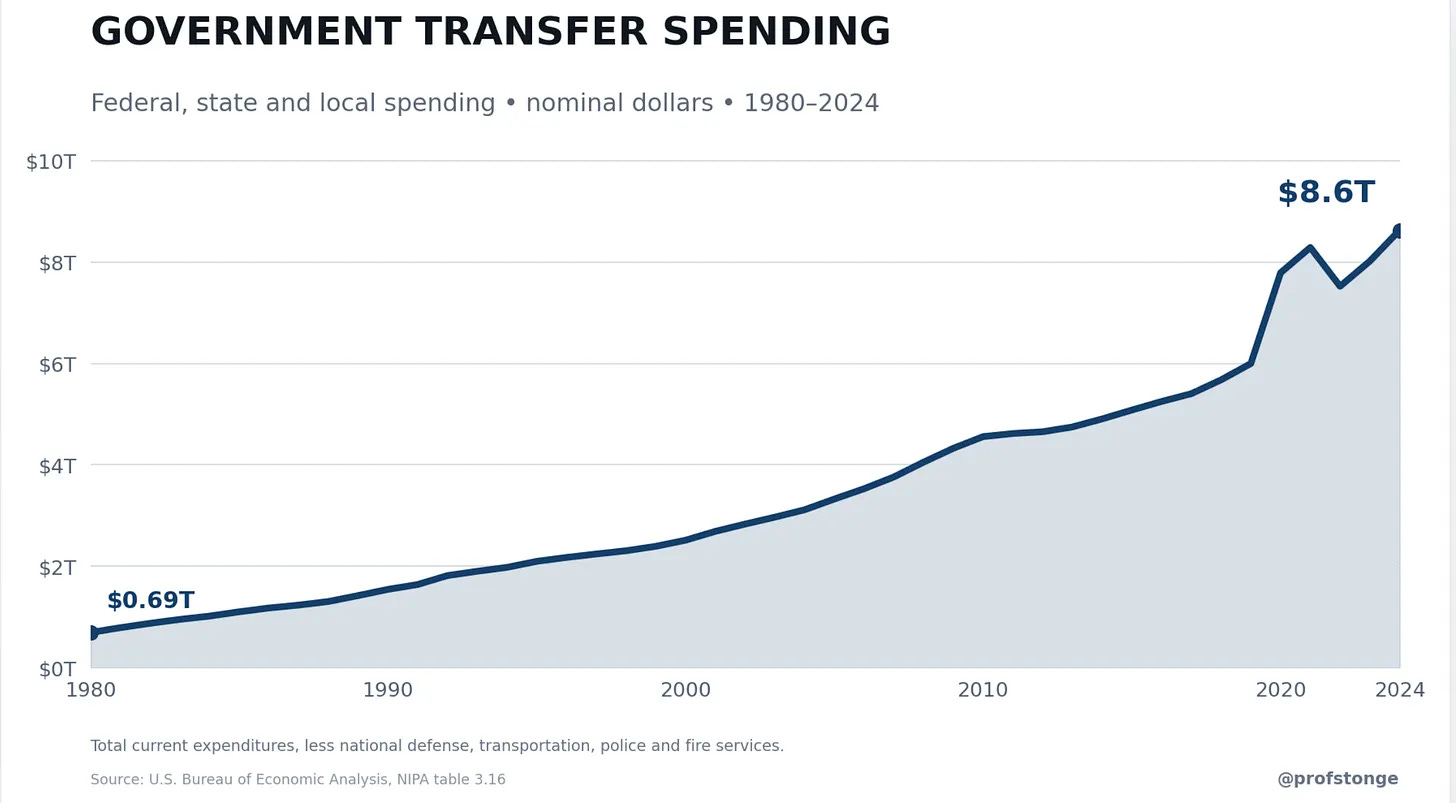
Including welfare, benefits, and pensions, nearly half of all federal, state, and local spending now goes to transferring money from one group of people to another. That’s roughly six times what America spends on defense. And it comes to nearly $5 trillion a year. Going by recent revelations on fraud rates - or welfare usage in previous decades - at least 80% of that is fraud or unnecessary vote-buying. Implying that the entire deficit is, in fact, waste and fraud. In other words, America is no longer a limited government with a safety net. It’s a transfer state where the main purpose of your taxes is largely buying votes.

Emergency Deficits Without the Emergency: Federal deficits along are now running 11.1% of GDP, compared with an average of 3.8% in the half century since Nixon killed the gold standard. Note that half-century included the cold war, multiple recessions, bailouts, wars, and a pandemic. And here we are tripling it with no emergency on sight.

Interest on the debt alone is approaching $1 trillion per year - roughly as much as national defense. In a few years it will be higher than Social Security, which naturally is now “bankrupt” - meaning even the IOU’s ran out - thanks again to a Congress with no guard rails. In other words, we’re borrowing the money not for new roads or schools. Not even for social security checks. We’re borrowing it to pay for yesterday’s vote-buying.
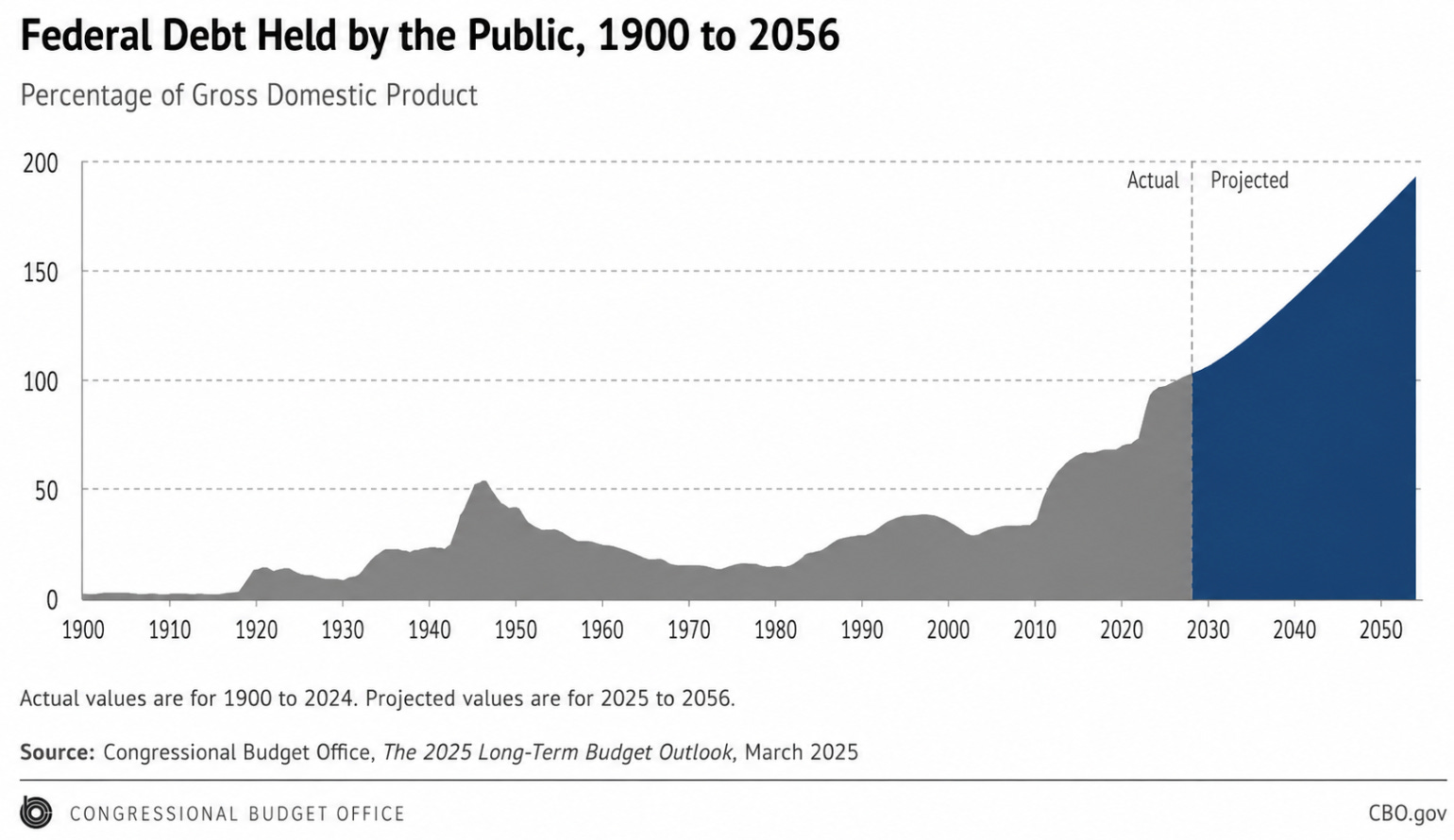
Click image for larger size.
By 2036, the Congressional Budget Office now expects annual interest costs to reach $2.1 trillion. And it expects debt held by the public to surpass the World War 2 peak. Note that assumes no recession, no major war, no new emergency. This is vanishingly unlikely given the Federal Reserve now has a 113 year record of delivering recessions like clockwork, thanks to boom-bust manipulation of interest rates that deliver tissue-fire booms followed by wipe-out recessions. And when the next recession comes, going by history, the deficit will soar by yet more trillions as tax collections collapse and demands for welfare spending soar.

Why Nobody Stops It: This is obviously unsustainable. Yet nobody tries to end it. Elon Musk tried moving heaven and earth, aided by unified control by the “small government” GOP. We had a President who thinks the Federal government is a leech. And it all bounced off. Because every transfer program creates a constituency that snowballs pressure for more transfers.

We saw this last year with SNAP cuts, where even Republicans were afraid to couch a program that is overwhelmingly fraud and unnecessary grift. Because while a program like SNAP matters to regular voters, it’s existential for the tens of millions who take your money. In other words, the benefits are concentrated and visible: a monthly check, a subsidized premium, or a government-funded service. But the costs are dispersed among millions of taxpayers - and increasingly pushed onto future taxpayers who cannot vote yet.
Click image for larger size.
That makes the transfer state nearly impossible to reform. The end result is politicians can survive another trillion dollars of debt. They may not survive trimming a benefit. So each election brings new promises, outpacing the productive economy squeezed to pay for them.
All while the debt - and the eventual crash - compounds against us.

Rome’s Warning: Rome faced the same basic arithmetic: Political promises outrunning production. The empire maintained an expanding army, a sprawling bureaucracy, public grain distributions, and increasingly expensive efforts to purchase political stability. But conquest slowed, the tax base weakened, and emperors discovered that cutting promises was dangerous.

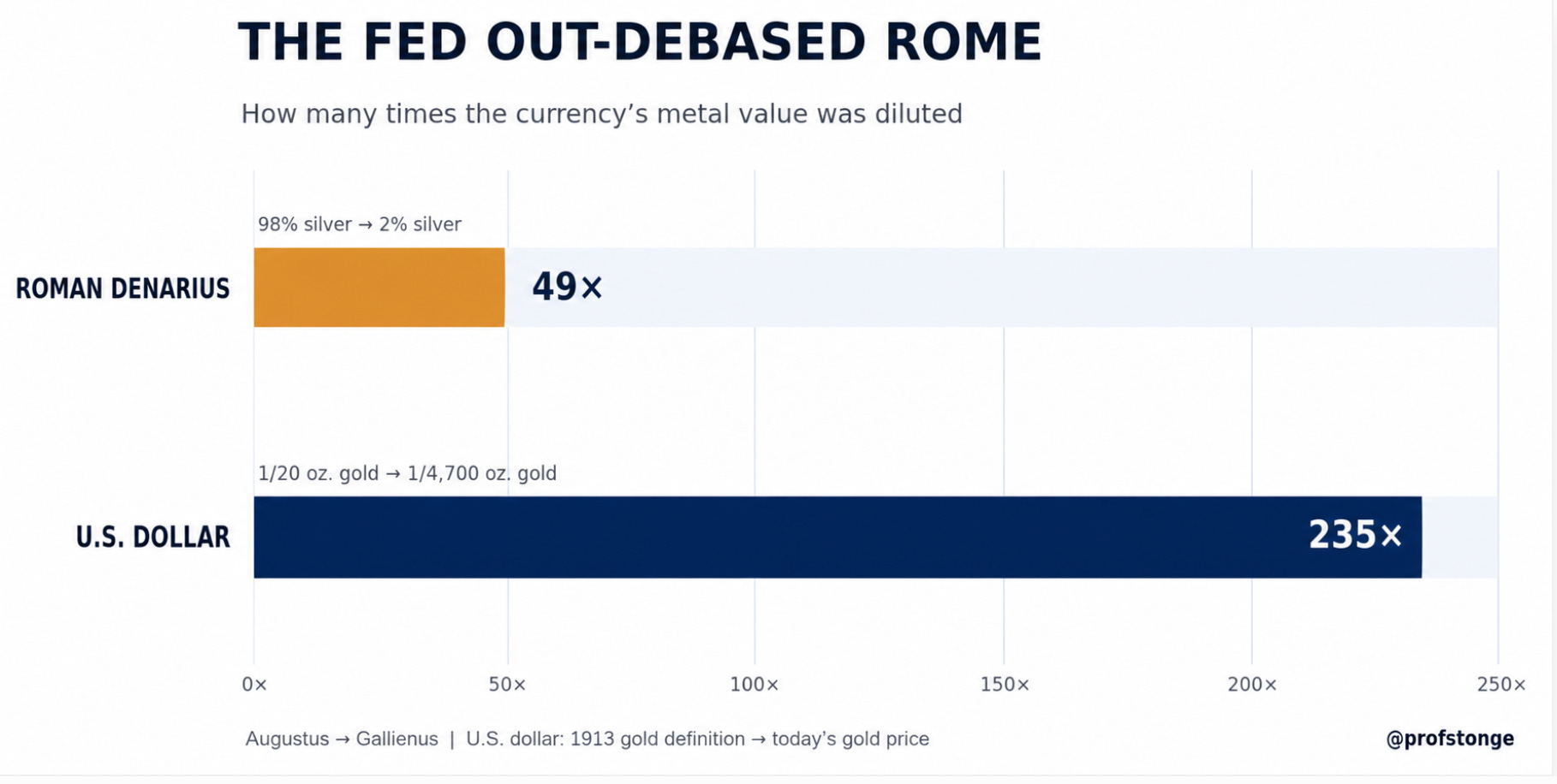
Their first move was to buy time with inflation, debasing the currency just as the Fed debases the dollar today. Under Augustus, the Roman denarius was 98% silver. By Gallienus it was 2%. The Fed’s actually done it faster, sending the dollar from 1/20 ounce of gold to, today, 1/4700. A 99.6% debasement that would put Nero to shame.
Click image for larger size.
What’s Next: For Rome what came next was ugly. Prices rose by 1,000% in parts of the empire. Good coins disappeared into hoards. Trade shifted toward barter, gold, and payment in kind. Inflation made contracts unreliable and trade dangerous. Heavy taxes pushed small farmers off their land. Merchants withheld goods rather than accept rapidly depreciating coins. As commerce shrank, the tax base shrank with it - forcing heavier taxes on what was left and further debasement on whoever remained productive. Ultimately Rome was too poor to pay off neighboring barbarians. And too corrupt to mount a defense when the time came The only way America avoids this fate is the one thing Congress will never do: Cut spending."
Peter St Onge, Ph.D., "Are We Headed For A Crash?"

Saturday, August 29, 2026

"Martin Armstrong: September Surprise. NATO is Preparing for Something Big"

Full screen recommended.
Canadian Prepper, 8/29/26
"Martin Armstrong: September Surprise. 
NATO is Preparing for Something Big"
Comments here:

Musical Interlude: Moby, "Why Does My Heart Feel So Bad"

Full screen recommended for visual effects.
Moby, "Why Does My Heart Feel So Bad"

"A Look to the Heavens"

NGC 3199 lies about 12,000 light-years away, a glowing cosmic cloud in the nautical southern constellation of Carina. The nebula is about 75 light-years across in this narrowband, false-color view. Though the deep image reveals a more or less complete bubble shape, it does look very lopsided with a much brighter edge along the top. 
Near the center is a Wolf-Rayet star, a massive, hot, short-lived star that generates an intense stellar wind. In fact, Wolf-Rayet stars are known to create nebulae with interesting shapes as their powerful winds sweep up surrounding interstellar material. In this case, the bright edge was thought to indicate a bow shock produced as the star plowed through a uniform medium, like a boat through water. But measurements have shown the star is not really moving directly toward the bright edge. So a more likely explanation is that the material surrounding the star is not uniform, but clumped and denser near the bright edge of windblown NGC 3199.”

“A Life Worth Living: Albert Camus on Our Search for Meaning and Why Happiness Is Our Moral Obligation”

“A Life Worth Living: Albert Camus on Our Search for
Meaning and Why Happiness Is Our Moral Obligation”
by Maria Popova

“To decide whether life is worth living is to answer the fundamental question of philosophy,” Albert Camus (November 7, 1913–January 4, 1960) wrote in his 119-page philosophical essay “The Myth of Sisyphus” in 1942. “There is but one truly serious philosophical problem, and that is suicide. Judging whether life is or is not worth living amounts to answering the fundamental question of philosophy. All the rest – whether or not the world has three dimensions, whether the mind has nine or twelve categories – comes afterwards. These are games; one must first answer. And if it is true, as Nietzsche claims, that a philosopher, to deserve our respect, must preach by example, you can appreciate the importance of that reply, for it will precede the definitive act. These are facts the heart can feel; yet they call for careful study before they become clear to the intellect. Everything else… is child’s play; we must first of all answer the question.” 

One of the most famous opening lines of the twentieth century captures one of humanity’s most enduring philosophical challenges – the impulse at the heart of Seneca’s meditations on life and Montaigne’s timeless essays and Maya Angelou’s reflections, and a wealth of human inquiry in between. But Camus, the second-youngest recipient of the Nobel Prize in Literature after Rudyard Kipling, addressed it with unparalleled courage of conviction and insight into the irreconcilable longings of the human spirit.

In the beautifully titled and beautifully written “A Life Worth Living: Albert Camus and the Quest for Meaning” (public library), historian Robert Zaretsky considers Camus’s lifelong quest to shed light on the absurd condition, his “yearning for a meaning or a unity to our lives,” and its timeless yet increasingly timely legacy: If the question abides, it is because it is more than a matter of historical or biographical interest. Our pursuit of meaning, and the consequences should we come up empty-handed, are matters of eternal immediacy.

Camus pursues the perennial prey of philosophy – the questions of who we are, where and whether we can find meaning, and what we can truly know about ourselves and the world – less with the intention of capturing them than continuing the chase.”

Reflecting on the parallels between Camus and Montaigne, Zaretsky finds in this ongoing chase one crucial difference of dispositions: “Camus achieves with the Myth what the philosopher Maurice Merleau-Ponty claimed for Montaigne’s Essays: it places “a consciousness astonished at itself at the core of human existence.”

For Camus, however, this astonishment results from our confrontation with a world that refuses to surrender meaning. It occurs when our need for meaning shatters against the indifference, immovable and absolute, of the world. As a result, absurdity is not an autonomous state; it does not exist in the world, but is instead exhaled from the abyss that divides us from a mute world.”

Camus himself captured this with extraordinary elegance when he wrote in “The Myth of Sisyphus”: “This world in itself is not reasonable, that is all that can be said. But what is absurd is the confrontation of this irrational and wild longing for clarity whose call echoes in the human heart. The absurd depends as much on man as on the world. For the moment it is all that links them together.”

To discern these echoes amid the silence of the world, Zaretsky suggests, was at the heart of Camus’s tussle with the absurd: “We must not cease in our exploration, Camus affirms, if only to hear more sharply the silence of the world. In effect, silence sounds out when human beings enter the equation. If “silences must make themselves heard,” it is because those who can hear inevitably demand it. And if the silence persists, where are we to find meaning?”

This search for meaning was not only the lens through which Camus examined every dimension of life, from the existential to the immediate, but also what he saw as our greatest source of agency. In one particularly prescient diary entry from November of 1940, as WWII was gathering momentum, he writes: “Understand this: we can despair of the meaning of life in general, but not of the particular forms that it takes; we can despair of existence, for we have no power over it, but not of history, where the individual can do everything. It is individuals who are killing us today. Why should not individuals manage to give the world peace? We must simply begin without thinking of such grandiose aims.”

For Camus, the question of meaning was closely related to that of happiness - something he explored with great insight in his notebooks. Zaretsky writes: “Camus observed that absurdity might ambush us on a street corner or a sun-blasted beach. But so, too, do beauty and the happiness that attends it. All too often, we know we are happy only when we no longer are.”

Perhaps most importantly, Camus issued a clarion call of dissent in a culture that often conflates happiness with laziness and championed the idea that happiness is nothing less than a moral obligation. A few months before his death, Camus appeared on the TV show Gros Plan. Dressed in a trench coat, he flashed his mischievous boyish smile and proclaimed into the camera: “Today, happiness has become an eccentric activity. The proof is that we tend to hide from others when we practice it. As far as I’m concerned, I tend to think that one needs to be strong and happy in order to help those who are unfortunate.”

This wasn’t a case of Camus arriving at some mythic epiphany in his old age – the cultivation of happiness and the eradication of its obstacles was his most persistent lens on meaning. More than two decades earlier, he had contemplated “the demand for happiness and the patient quest for it” in his journal, capturing with elegant simplicity the essence of the meaningful life – an ability to live with presence despite the knowledge that we are impermanent: ”We must” be happy with our friends, in harmony with the world, and earn our happiness by following a path which nevertheless leads to death.”

But his most piercing point integrates the questions of happiness and meaning into the eternal quest to find ourselves and live our truth: ”It is not so easy to become what one is, to rediscover one’s deepest measure.”
Freely download “The Myth of Sisyphus,” by  Albert Camus, here:

"The Human Condition"

"The Human Condition"
by Meanings of Life

 "We are all of us born, live and die in the shadow of a
giant question mark that refers to three questions:
Where do we come from? Why? And where, oh where, are we going?"
- Tennessee Williams

"Man remains largely unknown of himself. What are we, in our innermost recesses, behind our names and our conventional opinions? What are we behind the things we do in our lives, behind what we see in others and what others see in us, or even behind things science says we are? Is man the crazy being about whom Carl Gustav Jung spoke ironically, when he demanded a man to treat? Is man the Dr. Jerkyll that contains in himself a criminal Mister Hyde, and more than a personality, and contradictory feelings?

Are we the result of our dreams, as Prospero, in the Shakespeare's "The Tempest" asked? Are we able to raise our nature and become the dignified beings evoked by Pico de la Mirandola (It's the seeds a man cultivates that "will mature and bear fruit in him. If vegetative, he will become a plant; if sensual, he will become brutish; if rational, he will reveal himself a heavenly being; if intellectual, he will be an angel and the son of God").

Almost two centuries ago, Spencer characterized the contradictory features of natives from the African east coast: "He has at the same time good character and hard heart; he is a fighter, conscientious, good in a precise moment, and cruel, pitiless and violent in the other; superstitious and rudely irreligious; brave and pusillanimous, servile and dominator, stubborn and at the same time fickle, relied to honor views, but without signs of honesty, niggard and economical, but careless and improvident".

It's probably a good definition of a certain primitive man, to whom we are undoubtedly connected. But we are also cultural and ethic beings. We are able to change our values and behaviors. As William James says, human beings can change their lives through their mental attitudes. We can grow ethically. We can dominate part of our own instincts. And that's why we can be different from the indigenous African described by Spencer. More: our thought dignifies us ("All the dignity of man consists in thought", says Blaise Pascal). We are, in many senses, the conscience of the Universe, and its utmost elaborated product. As Edgar Morin says, "in the core of our singularity, we carry not only all the humanity, all the life, but also all the cosmos, including its mystery, present in the heart of our beings".

We are creators, creator beings, and, in a sense, we can create, or recreate ourselves. All goes through our mind. It is our mind that constructs our truths and errors, and also the most sublime things in the Universe. And yet evil and stupidity exist in us. Sometimes we fall, we are stroked, and life reveals its cruelty, and we may think as Mark Twain, and say that it was a pity that Noah had arrived late to the ark. In our innermost recesses, there is also the cruelty and the inhumanity of life. Charles Darwin showed that we are descendants of inferior life forms: we have been long ago a "bush and a bird, and a fish silently swimming in the waters", to use the poetic terms used by Empedocles in its "Purifications."

From a genetic and evolutionist point of view, we contain in us the survival reflexes and the aggressiveness of the life forms that preceded us: "All that threatened the cave man - dangers, darkness, famine, thirst, ghosts, demons all has passed to the interior of our souls, all troubles us, grieves us, threatens us from inside." (Morin). Besides, we are also beings that can differ significantly from each other. We are equal, but also different. "The awake involve a common world, but dreams deviate each one to its own world," Heraclites rather enigmatically declares. He thought we can't help sleeping and living in illusory worlds, even when awake.

For all these reasons, Blaise Pascal's celebrated definition of the human being, despite the hard language, not exactly agreeable to our ears, is undoubtedly one of the most powerful that can be applied to the rather unknown being that we can't help being to ourselves: "What a chimera then is man! What a novelty, what a monster, what a chaos, what a contradiction, what a prodigy! Judge of all things, imbecile worm of the earth; depositary of truth, a sink of uncertainty and error; the pride and refuse of the universe! Who will unravel this tangle?"
This website no longer exists, sadly..

Free Download: Hermann Hesse, "Siddhartha"

"Siddhartha"
by Hermann Hesse

"Siddhartha" is a novel by Hermann Hesse that deals with the spiritual journey of a boy known as Siddhartha from the Indian Subcontinent during the time of the Buddha. The book, Hesse's ninth novel, was written in German, in a simple yet powerful and lyrical style. It was first published in 1922, after Hesse had spent some time in India in the 1910s. It was published in the U.S. in 1951 and became influential during the 1960s. Hesse dedicated "Siddhartha" to Romain Rolland, "my dear friend".

The word Siddhartha is made up of two words in the Sanskrit language, siddha (achieved) + artha (meaning or wealth). The two words together mean "he who has found meaning (of existence)" or "he who has attained his goals". The Buddha's name, before his renunciation, was Prince Siddhartha Gautama. In this book, the Buddha is referred to as "Gotama".

Plot summary: It starts as Siddhartha, the son of a Brahmin, leaves his home to join the ascetics with his companion Govinda. The two set out in the search of enlightenment. Siddhartha goes from asceticism, to a very worldly life as a trader with a lover, and back to asceticism as he attempts to achieve this goal. The story takes place in ancient India around the time of Gautama Buddha (likely between the fourth and seventh centuries BC.

Experience is the aggregate of conscious events experienced by a human in life – it connotes participation, learning and knowledge. Understanding is comprehension and internalization. In Hesse’s novel "Siddhartha," experience is shown as the best way to approach understanding of reality and attain enlightenment – Hesse’s crafting of Siddhartha’s journey shows that understanding is attained not through scholastic, mind-dependent methods, nor through immersing oneself in the carnal pleasures of the world and the accompanying pain of samsara; however, it is the totality of these experiences that allow Siddhartha to attain understanding. Thus, the individual events are meaningless when considered by themselves—Siddhartha’s stay with the samanas and his immersion in the worlds of love and business do not lead to nirvana, yet they cannot be considered distractions, for every action and event that is undertaken and happens to Siddhartha helps him to achieve understanding. The sum of these events is thus experience.

For example, Siddhartha’s passionate and pained love for his son is an experience that teaches him empathy; he is able to understand childlike people after this experience. Previously, though he was immersed in samsara, he could not comprehend childlike people’s motivations and lives. And while samsara clung to him and made him ill and sick of it, he was unable to understand the nature of samsara. Experience of samsara at this point did not lead to understanding; perhaps it even hindered him. In contrast to this, Siddhartha’s experience with his son allows him to love, something he has not managed to do before; once again, the love itself does not lead to understanding.

The novel ends with Siddhartha being a ferryman, learning from a river, and at long last at peace and capturing the essence of his journey: "Slower, he walked along in his thoughts and asked himself: “But what is this, what you have sought to learn from teachings and from teachers, and what they, who have taught you much, were still unable to teach you?” And he found: “It was the self, the purpose and essence of which I sought to learn. It was the self, I wanted to free myself from, which I sought to overcome. But I was not able to overcome it, could only deceive it, could only flee from it, only hide from it. Truly, no thing in this world has kept my thoughts thus busy, as this my very own self, this mystery of me being alive, of me being one and being separated and isolated from all others, of me being Siddhartha! And there is no thing in this world I know less about than about me, about Siddhartha!”
http://en.wikipedia.org/wiki/Siddhartha_(novel)

Freely download "Siddhartha," by Hermann Hesse here:
https://bdebooks.com/en/books/