StatCounter

Tuesday, July 14, 2026

"Energy World War"

"Energy World War"
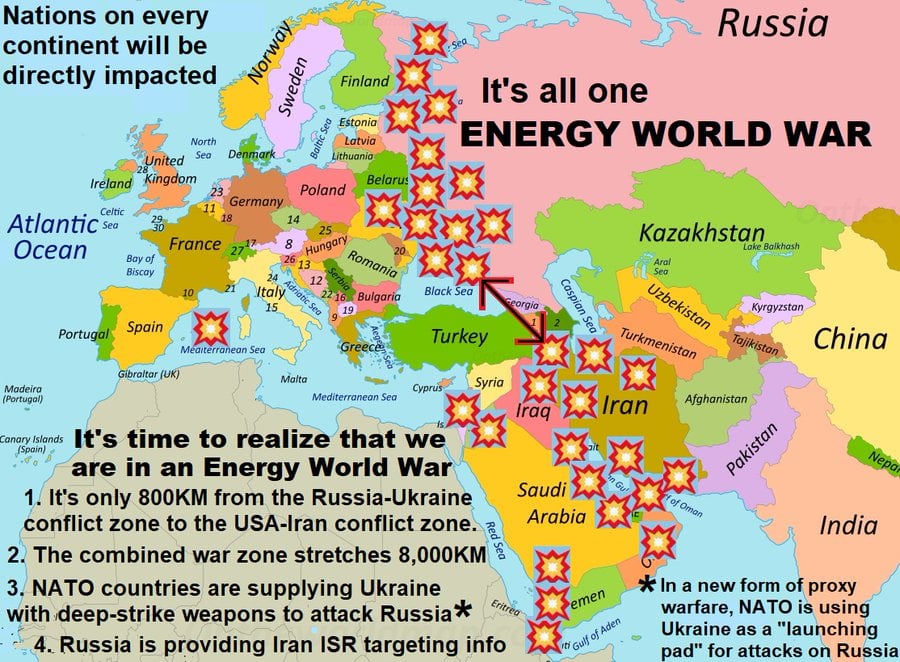
"It’s time to realize that we are in an Energy World War, so I just put together this new war map. I wrote a Substack titled “The Great Energy World War” about this last April, and it has aged well. https://steelcutter.substack.com/p/the-great-energy-world-war

The asterisked text in the bottom right is critical. We are entering a new and extremely dangerous era of proxy warfare, where principal antagonists use a compliant vassal state as a launching pad to strike their enemies with missiles and drones.

A vassal state like Ukraine serves as a cutout or fig leaf to avoid a direct kinetic conflict between the principals. This fig leaf is wearing thin, as Russia is openly threatening the NATO nations providing deep-strike missiles and drones to Ukraine with direct attack. Russia is also “returning the favor” by providing Iran with ISR support, allowing Iranian missiles and drones to rapidly attack mobile U.S. military targets in the Persian Gulf region.

It’s only a matter of time until a U.S. Navy warship is struck by an Iranian missile and sunk. In comparative historical terms, it’s 1914, on the eve of world war. In 2026, the current Energy World War may exploded into a Kinetic World War.

Do Trump and our other national leaders understand that they are juggling flaming torches in a gunpowder factory on roller skates? Do they understand the global downside risk of escalating this war of choice?
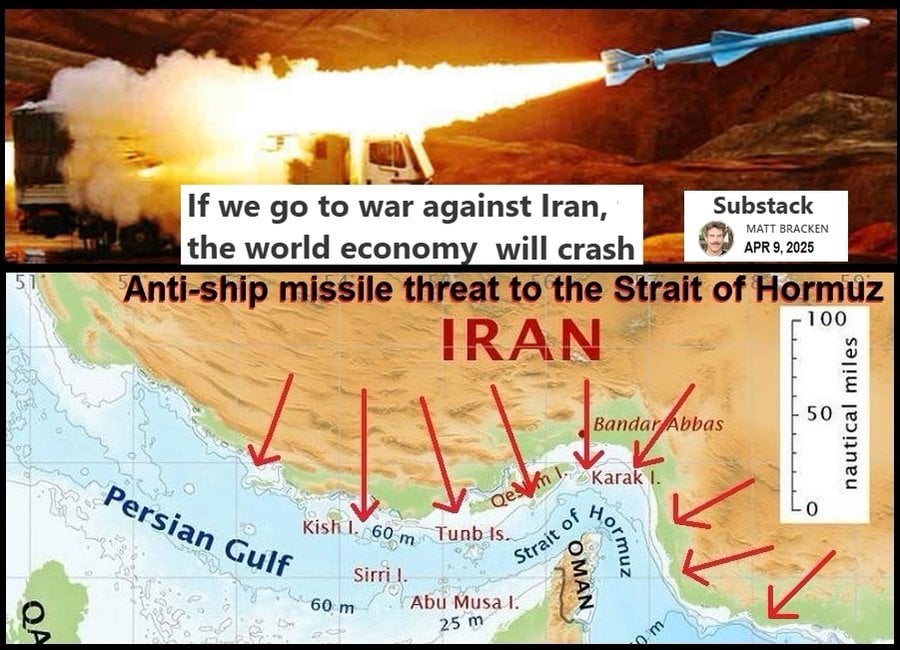
Another free Substack I wrote last year before the so-called 12-Day War: “If we go to war against Iran, the world economy will crash” - https://steelcutter.substack.com/p/if-we-go-to-
o
Hat tip to "The Burning Platform" for this material.

"Breaking: Inflation Drops Again... But A New Threat Is Emerging"

Full screen recommended.
Snyder Reports, 7/14/26
"Breaking: Inflation Drops Again... 
But A New Threat Is Emerging"
Comments here:

Dan, I Allegedly, "Third Bank Failure of 2026"

Full screen recommended.
Dan, I Allegedly, 7/14/26
"Third Bank Failure of 2026"
"The first bank failures of 2026 are sending another warning to consumers, and now the third U.S. bank has officially been shut down. In today's video I explain why Kentland Federal Savings & Loan failed after more than 100 years in business, why this wasn't a traditional bank run, and how rising interest rates, commercial real estate losses, lower loan demand, and higher compliance costs are putting pressure on community banks across America. We also discuss why regulators believe hundreds of smaller banks continue to face similar economic challenges.

We also cover FDIC insurance, whether your deposits are actually safe, the growing consolidation of the banking industry, the future of community banks and credit unions, and why consumers should know the financial condition of the institutions holding their money. If you follow banking news, personal finance, the economy, recession trends, commercial real estate, interest rates, and financial preparedness, this video explains why another bank failure matters and what it could mean for the months ahead."
Comments here:

Bill Bonner, "The Behavior of Analog Animals"

"The Behavior of Analog Animals"
by Bill Bonner

Youghal, Ireland - "“Another scorcher!” A neighbor drove up yesterday with an alarming report. “And this heat wave is not going to let up. It’s supposed to go on for all of next week.” We’ve become accustomed to life in Ireland. It rains most of the year. But for just a few weeks in the summertime, the sun shines...and the heat rises. “There’s nothing like an Irish summer,” he explained. “The weather can be gorgeous. But sometimes it gets so hot you can barely work.”

Down at the beach, near Ardmore, there is rarely anyone there at all. You drive down a one-lane road, with weeds and wildflowers bursting out from both sides. At its end, is a parking area for two or three cars along with a sign telling you to watch for rip tides…don’t litter, etc. There is even a box of children’s toys, to be used and returned. But this past weekend, people tried to escape the heat by jumping in the water. Traffic was so heavy you’d think Jesus Himself was doing full immersion baptism in the surf. Our grandson from Florida: “The water was freezing cold. No one would swim in water like that at home. But it was great...very invigorating.”

Over on the continent, the heat was not invigorating, but deathly. Japan Times: "European countries reported more than 10,000 excess deaths during the record-breaking heat wave that engulfed the west of the continent in late June, official data showed. The vast majority of deaths - more than 9,000 - were among people ages 65 and above, according to data published by EuroMOMO, a network backed by the European Centre for Disease Prevention and Control and the World Health Organization." The worst of the heat has passed. But temperatures are still in the ‘90s in Paris.

Back in Ireland, we were getting into the local ‘heat wave’ mentality. We humans are analog animals, not digital. There is ‘hot weather’ on the Finnish coast as well as in the Amazon jungle, but they are not the same. And every village may have its idiot. But the idiot from Chevy Chase may be very different from the one from West Baltimore.

The idiots from Chevy Chase, an upscale Washington, DC suburb, like numbers, some more than others. They look at them and search for someone to blame. Is the temperature a degree higher than it used to be? Do White people earn more than Black people? Do men earn more than women? When the numbers don’t measure up, the improvers look for solutions.

Many of them think the world is heating up...because we humans use too much fossil fuel. Al Jazeera: "Scientists attribute the unprecedented temperatures to human-caused climate change, which has warmed the planet by about 1.4°C above pre-industrial levels, making extreme heat events more frequent and intense. Research indicates that a heatwave of this magnitude would have been virtually impossible 50 years ago, and similar events in the past, such as in 1976 or 2003, would have been significantly cooler."

Who’s responsible? The New York Post: "A Paris politician blamed Americans and US air conditioning for the record-breaking heat wave in Europe that has resulted in more than 1,300 excess deaths. After US tourists mocked France over the lack of air conditioning across the country amid 104-degree temperatures, Audrey Pulvar, deputy mayor of Paris for international relations, claimed the situation was partly America’s fault."

Yesterday was too nice a day to worry about it. Instead, our neighbor graciously offered to take us on a road-trip up to visit an agricultural college. The aforementioned grandson is thinking of becoming a farmer. The outing might help him decide, we reasoned. The drive - more than five hours in all - was stunning...along peaceful rivers, up over the Knockmealdown mountains, through the meadows and farmland of Tipperary. The views were exceptional.

“You should’ve seen this a couple weeks ago,” our driver told us we went through the mountain pass. “These rhododendron bushes – they’re an invasive species, you know – were in full bloom. It was gorgeous.”

“But wait,” we said to our host as we neared the end of the expedition. “Where are all the poor people?” “We’ve covered a lot of ground...through little towns...up and down hills...through one-lane roadways. Wages in Ireland are only about $5,000 per month. In the US, they’re over $6,000. So, a lot of people must earn a lot less. How come we haven’t seen any poor people? No junked cars. No rusty refrigerators. No tumble-down houses or derelict yards. No trash on the sides of the road. No unkempt houses...or even yards. What gives?”

“This is not Mississippi,” came the answer. “People in farming areas are generally prosperous. You might see some poverty in the cities, but rarely in the countryside. But it’s nothing like the US. Here in Ireland, people are taken care of. We don’t have a huge military budget. So, the government’s money is spent on social services. And most of us have confidence in the government to spend our money wisely.”

That explanation was reasonable, but not sufficient. We countered: “In the US, the feds can spend all the money they want. People would still throw trash out the window and live in derelict houses.” “Maybe it’s a cultural difference,” our neighbor pursued the question. “We’d be embarrassed to have a trashy lawn.”

It’s all ‘cultural,’ isn’t it? All relative. All specific to places, times, and people. The rhododendron bloomed last month, not this month. People here pick up trash; they’d be ashamed of a junky yard. And people all over Ireland are complaining about the heat while the temperature barely gets over 75 degrees."

"Why the United States is Fighting a War in the Strait of Hormuz It Cannot Win"

"Why the United States is Fighting a War 
in the Strait of Hormuz It Cannot Win"
by Larry C. Johnson

"The United States, according to Donald Trump’s letter to Congress, has started a new war with Iran. Apparently no one told the Orange Man that the US does not have enough weapons in its arsenal to pursue a campaign that lasts longer than a month.

Let’s start with some basics. The HIMARS is not a missile or rocket… It is a launcher. It has been reported that missiles fired from HIMARS hit the Iranian coast the last three days, i.e., Saturday, Sunday and Monday. There are three types of missiles/rockets that can be fired from the HIMARS:

PrSM (Precision Strike Missile) - its newer successor to ATACMS. The maximum range is 500+ km in its baseline Increment 1 form. It was deliberately designed to exceed 499 km, the old floor imposed by the INF Treaty before that treaty lapsed in 2019, and open-source estimates put its effective reach at roughly 500–600 km. Later increments are intended to extend it further, but the fielded version is the 500+ km baseline.

GMLRS (Guided Multiple Launch Rocket System) - precision rockets. The baseline GMLRS Unitary and GMLRS Alternative Warhead both have a range of about 70 kilometers (roughly 45 miles). The newer GMLRS Extended-Range (GMLRS-ER) roughly doubles that, reaching targets up to 150 kilometers away.

ATACMS (Army Tactical Missile System) - longer-range ballistic missiles. The maximumrange is approximately 300 km. The early cluster-munition variants (M39) were shorter — around 165 km - but the GPS-aided unitary variants (M39A1, M48, M57) all reach out to about 300 km, which has been the program’s ceiling throughout its service life.

The only two possible missiles that could have been used are the ATACMs and the PrSM. Let me explain why. Measured as a straight-line (great-circle) crossing from Bahrain over to the Iranian coast, the distance depends on the bearing you take, since the Gulf widens as you go northwest:

Bahrain roughly due north to Bushehr: ~309 km
Shortest crossing (Bahrain to the nearest Iranian shore, around the Kangan/South Pars area): ~234 km
Bahrain to Asaluyeh: ~244 km

In other words, the ATACM would fall short of Bushehr but could hit parts of the coast to the south of Bushehr. That leaves the PrSM as the only missile with the capability of striking targets along the Iranian coast of the Persian Gulf. But here is the problem confronting Trump: There are limited supplies of ATACMs and PrSMs.

ATACMS - There were 3,700–4,000 produced over the program’s life, with Defense Express estimating more than 2,500 in US inventory in various conditions at the end of 2024, and about 900 exported. The Pentagon is not buying any more ATACMS and is phasing it out in favor of the PrSM. I do not know how many have been fired since the start of Operation Epic Fury, but some sources claim a substantial number.

PrSM - This is the newest and has the smallest inventory, since it only recently entered service and made its combat debut in Epic Fury. There is no legacy stockpile; the number in hand is whatever has been delivered against early contracts. Contracts dating to 2023 call for 335 missiles by 2029, phased as 54 in 2026, 208 in 2028, and 73 in 2029. In other words, the US had less than 60 available at the start of Epic Fury in February.

There are also potential shortages, though not as dire, with the Tomahawk cruise missile and the JASSMs. During the five weeks of Epic Fury - before the ceasefire was declared in early April - the US fired 850 Tomahawks, which represented about 25% of the entire inventory. 400 were fired in the first 72 hours alone (~10%). That puts remaining stocks in the low-3,000s. Not a problem, right?

Wrong. Tomahawk output averaged about 86 per year over the past decade and had fallen to lows of 68 in FY23, 34 in FY24, and a planned 22 in FY25 - while, as was observed during Epic Fury hundreds were expended in three days. FY26 procurement was only 57–58 missiles. The response is a February 4, 2026 RTX framework agreement targeting 1,000+ per year over seven years, and a FY27 Navy request for 785 Tomahawks (~$3 billion), a roughly 1,200% jump. But because each missile takes 18–24 months to build, replacing the 1,000+ expended in the Iran war is a multiyear project. Making matters worse, the Tomahawk requires 18 rare-earth minerals that are controlled by the Chinese.

The situation for the JASSM is even worse. The most operationally relevant figure is for the JASSM-ER (AGM-158B), the extended-range stealth variant that’s been the workhorse. Its prewar global inventory stood at roughly 2,300 units. Operation Epic Fury drew that down hard: more than 1,000 expended since February 28, 2026, leaving an estimated 425 JASSM-ER remaining worldwide as of April 2026.

The same structural problem we have seen across every system applies here: even after expansion, planned production tops out around 1,000 missiles per year - roughly 19 per week - against a wartime consumption rate that analysts estimated at 500–800 JASSM-type missiles per week during high-intensity strikes on layered air defenses. That’s the mismatch that took JASSM-ER down to a few hundred rounds in about a month, and replenishment runs over multiple fiscal years. It too is vulnerable to the rare-earth supply chain.

CENTCOM claims that its objective in using force against Iran in the Strait of Hormuz is to degrade Iran’s ability to attack commercial shipping, employing precision munitions against Iranian coastal defense systems, missile and drone sites, and maritime capabilities. Here’s the next problem… Iran is firing from more than 1,000 locations along the 171-mile coast stretching from Bandar e Lengeh in the north to Sirik in the south. If CENTCOM could destroy all missile and drone sites along the coast, it still leaves untouched the missile and drone launch sites in the interior of Iran that can reach the Strait. In other words, the US does not have enough Tomahawk and JASSMs in inventory to degrade Iran’s ability to attack non-compliant ships in the Strait of Hormuz.

I also want you to focus on the fact that Iran has a much easier task in retaliating against the US attacks. The US is carrying out air and missile operations from less than 10 bases - i.e. two in Jordan, one in Kuwait, one in Bahrain, one in Qatar, one in the UAE and one in Oman. All Iran has to do every time it is attacked is to pummel those same seven bases repeatedly until they are no longer capable of supporting US military operations. Instead of trying to hit 1,000 targets - many which are protected by caves or underground sites - Iran only has to focus on the limited number of bases hosting US forces and operations. This is why Trump’s latest war is doomed to failure."

Monday, July 13, 2026

"Alert! This Is A Very Bad Signal! Iran War Is Exploding! Nuclear Target: Mount Pickaxe"

Full screen recommended.
Canadian Prepper, 7/13/26
"Alert! This Is A Very Bad Signal! Iran War Is Exploding! 
Nuclear Target: Mount Pickaxe"
Comments here:

Musical Interlude: 2002,"When I See You Again"

Full screen recommended.
2002,"When I See You Again"

"A Look to the Heavens"

“Separated by about 14 degrees (28 Full Moons) in planet Earth's sky, spiral galaxies M31 at left, and M33 are both large members of the Local Group, along with our own Milky Way galaxy. This narrow- and wide-angle, multi-camera composite finds details of spiral structure in both, while the massive neighboring galaxies seem to be balanced in starry fields either side of bright Mirach, beta star in the constellation Andromeda. Mirach is just 200 light-years from the Sun. But M31, the Andromeda Galaxy, is really 2.5 million light-years distant and M33, the Triangulum Galaxy, is also about 3 million light years away.
Although they look far apart, M31 and M33 are engaged in a gravitational struggle. In fact, radio astronomers have found indications of a bridge of neutral hydrogen gas that could connect the two, evidence of a closer encounter in the past. Based on measurements, gravitational simulations currently predict that the Milky Way, M31, and M33 will all undergo mutual close encounters and potentially mergers, billions of years in the future.”
o
"Everything passes away - suffering, pain, blood, hunger, pestilence. The sword will pass away too, but the stars will still remain when the shadows of our presence and our deeds have vanished from the earth. There is no man who does not know that. Why, then, will we not turn our eyes towards the stars? Why?"
- Mikhail Bulgakov, "The White Guard"

"Whispers of the Golden Fields"

Full screen recommended.
Gengu AI, "Whispers of the Golden Fields"
"AI was the tool. The story came from human feeling. If this film gave you
 a quiet breath, a memory, or a moment of peace, thank you for being here."

Native Elder, "Why Something Feels Wrong With the World"

Full screen recommended.
Native Elder,
"Why Something Feels Wrong With the World"

"I Remember When a Dollar Meant Something"

Full screen recommended.
Delta King's Blues,
"I Remember When a Dollar Meant Something"
"Used to be a dollar could fill your tank, your belly, or your night… now it barely buys a memory. “I Remember When a Dollar Meant Something” is a reflective, truth-soaked Delta King’s Blues tune about changing times, rising costs, and the quiet nostalgia for days when a little went a long way. A slow, dusty acoustic guitar walks the line like an old man counting coins at a corner store. The harmonica sighs low and thoughtful, echoing simpler days and cheaper living. The groove stays steady and unhurried, built for front porch thinking and looking back without rushing. This is blues about value - not just money, but moments. For folks who remember when life felt affordable… and somehow richer. It ain’t just the dollar that changed… it’s the world around it."

"What's He To Do Then?"

"You've seed how things goes in the world o' men. You've knowed men to be low-down and mean. You've seed ol' Death at his tricks... Ever' man wants life to be a fine thing, and a easy. 'Tis fine, boy, powerful fine, but 'tain't easy. Life knocks a man down and he gits up and it knocks him down agin. I've been uneasy all my life... I've wanted life to be easy for you. Easier'n 'twas for me. A man's heart aches, seein' his young uns face the world. Knowin' they got to get their guts tore out, the way his was tore. I wanted to spare you, long as I could. I wanted you to frolic with your yearlin'. I knowed the lonesomeness he eased for you. But ever' man's lonesome. What's he to do then? What's he to do when he gits knocked down? Why, take it for his share and go on.”
- Marjorie Kinnan Rawlings
"When I hear somebody sigh, 'Life is hard,' 
I am always tempted to ask, 'Compared to what?'"
- Sydney J. Harris

The Daily "Near You?"

Tofino, British Columbia, Canada. Thanks for stopping by!

"Our Natural Predators"

Samson slaying the lion.
"Our Natural Predators"
by Paul Rosenberg

"Nearly every creature upon this planet has one or more natural predators: creatures that prey upon them. Humans are a striking exception; even though we’re bereft of natural weapons – claws, ripping teeth and so on – we easily protect ourselves from even large predators. There are the occasional “bear in the woods” stories, but those come when we leave our constructed environments. The reason we’re so able to keep ourselves safe is simply that we can think. Humans have, since long before recorded history, figured out how to master wild animals. And so we have no natural predators… or at least none of the usual type.

Our Predators Are Intellectual Predators: In case anyone is pounding a desk, screaming “war,” don’t worry, I’ll get to that in a minute. Humans are not destroyed by claws and teeth, they are destroyed by ideas. In fact, they are highly vulnerable to ideas. In particular they are suckers for authority, for idols and for promises of free stuff.

We see these vulnerabilities from one end of human history to another. Here’s just a brief explanation: Authority: A large number of humans will obey a well-presented authority without critique. The doctor in a white lab coat, the politician wearing a fine suit and podium, the monarch with a crown and a retinue… people turn off their minds when confronted with them and simply comply. The fact that so many order-givers play up their authority proves the point: they wouldn’t take pains to create such images if they didn’t work. 

People will also reflexively defend authority, if for no other reason than they’ve already obeyed it and they don’t want to look stupid.Idols: Humans find psychological comfort in holding to a great and powerful entity. It makes them feel safe. If you frighten people, then supply them with a powerful figure (Mussolini makes a nice example) and they’ll line right up. It’s no accident that the communists made giant images of Lenin, Stalin, Mao and the others: It works. Free stuff: From the plunder of enemies to robbing the rich to technical incarnations of the same principle, humans are easy marks for this scam. We’ve all watched it in action, and so I won’t elaborate further.

Okay, Now I’ll Do War: War begins with the people. Genghis Khan didn’t make his own arrows, after all. No warlord is solely blamable for his slaughters. Warfare rests upon the complicity of normal people. Those people must be manipulated, in one way or another, to supply the materials and bodies required for war. (Crime can be an individual venture, of course.)

No war-seller, so far as I know, has clarified this better than Nazi boss Hermann Göring. Note from this passage that he and his Nazi brethren didn’t use bullets and swords to make people service their war machine, they used ideas:

"Why, of course, the people don’t want war. Why would some poor slob on a farm want to risk his life in a war when the best that he can get out of it is to come back to his farm in one piece. Naturally, the common people don’t want war; neither in Russia nor in England nor in America, nor for that matter in Germany. That is understood. But, after all, it is the leaders of the country who determine the policy and it is always a simple matter to drag the people along, whether it is a democracy or a fascist dictatorship or a Parliament or a Communist dictatorship.The people can always be brought to the bidding of the leaders. That is easy. All you have to do is tell them they are being attacked and denounce the pacifists for lack of patriotism and exposing the country to danger. It works the same way in any country." And Göring was right that it’s the same in any country: Our entire species is vulnerable to this type of predation.

The Way Forward: Our first step forward, as the AA people rightly say, is to admit we have a problem. And we do have a problem. It’s fixable, but so long as we refuse to acknowledge it, it will remain. We’ve already covered the basic vulnerabilities above, but our habit of chaining one thought to another, as if each were purely and unquestionably correct, is another major issue. Author Ben Hecht explained this very well, when he commented upon people who were, “unable to think, except in homage to other thoughts.”

Hecht was right, and stacking one concept upon another, and then on another, leads easily into gross errors, unless each of those thoughts are perfect, complete and ideally expressed… which they never are. Still, stacking thoughts up in this way (ever deviating from precision) yields the comfort and confidence – and the justification – of having thought.

The bottom line here is that our predators use words and emotions to make us do their will. They are, in illustrative terms, vampires, sucking our will from us. They convince us, through emotional pressures and devious logic – by using our vulnerabilities – that it’s right for them to collect our sacrifices, that failure to obey them will bring us shame, that comfort and safety require our immediate obedience, and that being restricted is the only way to be safe. All of that is predation.

Again, if we are to stop being abused, the first step is to realize… to accept… that we have a problem. We must recognize that we have vulnerabilities; then we must forgive ourselves for them. After that it’s straightforward and not terribly hard." For more, see "The Twilight of Authority."

"Remember: Your Mission Isn’t Done"

"Remember: Your Mission Isn’t Done"
by John Wilder

"One winter, while hunting elk up on Wilder Mountain, we had, well, an issue. We were about fifteen or twenty miles in from the nearest pavement, and headed home. It was overcast. It was lazily spitting snow, with a breeze that was slowly picking up. Looking to the west, where there should be a resplendent sunset, the sky was dark, heavy, and pendulous with brooding storm clouds that blotted out even a hint of the winter Sun.

That was when the problem hit. Pa Wilder, while driving over a “road” that was little more than a common path cut by four-wheel-drive vehicles over the course of decades of hunting and firewood gathering, drove over a small branch that had fallen in the road. Not a problem, right? Well, it was a problem. In this case, the branch had the stem of a broken off limb, sticking straight up. Pa drove the GMC Jimmy® right over that sharp shard of limb. In the span of a dozen or so feet, we had lost not one, but two tires. It penetrated the center of each tire, poking a hole the size of a half-dollar coin in each.

Amazingly, we had lost another tire already that day, already. We now had a four-wheel drive with five tires and three flats. In winter. As a blizzard approached and night was setting in. And all of this was in country where it could easily hit -40°F as night descended.

I bring this up to say that we had a mission. Our mission at that point in time was to get home. There were several challenges, and I’m pretty sure if most people were in the backcountry as a blizzard was descending that the last person they would choose would be a 12-year-old boy to be a guy on the team. Which is sad.

Children can have missions. Children can face danger. Children can do important things. We forget that because we’re in a society that doesn’t give children important things to do, mostly. Midshipmen in the Royal Navy were as young as 14. To be clear: Midshipmen in the Royal Navy were 14. A midshipman is an officer. If you were unaware, the Royal Navy wasn’t a social club, and often those boys fought in wars. As officers. So we forgot that boys can be given real, substantial responsibility. But there’s also the chance that we forget something else: that each of us is on a mission. And each of us has a role to play.

We currently are in a place where freedom is an increasingly precious and rare commodity. It’s not just in the United States – Trump may have said, “Make America Great Again” but down under they seem to be following the “Make Australia A Prison Again” plan. And Canada? I love our Canadabros that come by regularly (Canada is the second-largest readership here), but Canada seems to be determined to become the Soviet Above the 49th Parallel. 

It seems like in this day and age we all have a mission. Just like 12 isn’t too young, 80 isn’t too old. Frankly, we need all hands on deck. The size of the mission is the largest on the North American continent since 1774. I almost wrote that the idea was to preserve the Constitution and the Republic. Seriously, I’d love nothing more than to write that.

I’d love for that to happen. I’d love for us to come together. I’d settle for the laws to look like they did 90 years ago. Heck, even 70 years ago. That would be preferable to today. A reversion, sadly, is impossible. Whatever will come from tomorrow will not look like the past. It may be a shadow. The Holy Roman Emperors weren’t Roman. And the Holy Roman Empire wasn’t the Roman Empire. Or it may be something entirely different. I think it will be entirely different.

And that’s where you come in. Yes, you. You have a mission to create a new nation here. It won’t look like what we have today – it simply cannot, since we have created a situation that is at the far end of stability. I assure you, you play a part. The initial conditions of what happens are crucial to the final outcome. If George Washington had wanted to be King? If Thomas Jefferson had been a Martian Terminator Robot like the one that keeps triggering my motion detector lights at night even though the sheriff won’t believe me?

Things would be entirely different. And you are important. Your actions in the next decade are critical to the creation of what will come after. Do we want a nation that will be based on slavery, control, and that eternal boot stamping on a human face? I’d vote no. If you’re a regular here, I’m betting that’s your vote, too.

If so, let me shout as loudly as I can: You Are Not Done. This is Not Over. What is it that you can do to create a world where freedom beats slavery? What can you do to create a world where children can run free from the indoctrination of an all-powerful, all-regulating state?

There’s a lot. Our nation was, thankfully, built on the consent of the governed. Most things that local government provides, we want. To quote Python, Monty: "But apart from the sanitation, the medicine, education, wine, public order, irrigation, roads, the fresh-water system, and public health, what have the Romans ever done for us?"

To be clear: the Federal government does very little to make anything in the list above better, and often does a lot to make them worse. Except for the interstate highways. Those are actually pretty cool.

But I will tell you – you are the seed of the future of this country. You are the seed of the future of this continent. You are the seed of the future of this world. It doesn’t matter how old you are. The time is coming, and coming quickly where great injustices will be attempted. And you are the seed to make what comes after better for humanity. Would the world rather live in 1950’s America or 1930’s U.S.S.R.?

The choice is stark. Your mission is clear. How will you act to make your county, your state, your country one where free men can walk? It’s up to you.

Back to the mountain. For me, it was a game. That’s the advantage of being 12. Pa Wilder and my older brother (also named John due to a typographical error) and I wheeled the tires so we had two good ones in front. We locked in the hubs on the four-wheel drive.

I don’t know if you’ve ever tried to drive up a mountain path in a car with only two tires in a snowstorm as it got darker every minute. It doesn’t work very well. The flat back wheels couldn’t push the Jimmy® up the hill. That’s where I came in. It was my job to take the winch cable, run up the hill, and loop the cable up the base of a tree. Pa would then use the combination of the winch and the two front tires to pull the Jimmy© up. Tree by tree, cable length by cable length, we worked pretty flawlessly as a team to get the Jimmy™ to the top of the hill. Thankfully, for the most part it was downhill from there. Although Pa was driving on the rims, we got it home.

Was there danger? Certainly, there always is. We had snow, so we had water. Ma would have called the Sheriff not too long after dusk, and even though the mountains were a labyrinth of roads, people had seen us. We also had matches, hatchets, wool blankets, gasoline, and a mountain’s worth of firewood to keep us warm. But we also had a mission. Each of us served our purpose, and we got home.

Pa was a bit raw about having to buy two new rims and three new tires for a day’s worth of not seeing any elk, though. For the record, I never saw a single elk when hunting with Pa. I’m telling you, that man knew how to hunt. Finding? Sometimes I think he just wanted a good drive in the woods and hike with his boys, teaching them about living. Teaching them about missions, and the part that they play, whether they know it or not.

In this life, we all have a mission, and we all play a part in it. I can assure you that your part is not done, because you’re above ground, breathing, and reading this. I hate to repeat something so trite, but in this case, it’s true: you are not done. This is not over. And the whole world depends...on you. It’s up to you. You will create the future.

So, go do it."

"All Predictions for the Iran War Are Perfectly on Track for the Year"

"All Predictions for the Iran War
 Are Perfectly on Track for the Year"
by David Haggith

"Surprise, surprise, the Strait of Hormuz blockade is now fully back on by both sides, and oil has now followed the full path I said it would. First, it plummeted when the strait briefly reopened, as I said you could expect on the basis that foolish speculators would all heave a huge sigh of relief that the worst was behind us. Of course, the worst would prove to be nowhere near behind us; so, I also said oil prices would soon shoot right back up when reality set in. Ta da!

Reality has set in. Iran, as I’ve always said, is not desperate to make a deal with the Don, as he keeps lying and saying they are. (So, I keep calling out his lies and haven’t had to apologize for being wrong about that yet.) I’ve said from the beginning that Iran is making this a war of attrition. That means it knows time is on its side. That is how attrition works. So, any time Iran can buy itself some temporary freedom at no cost from bombs and missiles while keeping the strait almost fully closed for oil shipping out to the West, which is exactly what it did, it will be happy with that stall tactic because attrition takes time. And that such cost-free deals are offered by Trump shows who is really itching to make a deal. We even paid Iran to make that deal by freeing up some of their sanctioned money to help them rearm. The longer the strait is blocked for West-bound oil, the deeper the pain for the US and its former allies.

So, oil is back to Brent Crude running over $80/bbl and WTI over $75. Everything has returned to where it was before the failed and always ill-destined ceasefire, and the oil speculators have been proven stupid again—especially the analysts who started to predict oil at $60/bbl and even lower! They chose to bet on the least probable outcome, but the most probable outcome has now played out.

I’ve posted an excellent video below by Chris Martenson which explains why the oil crisis, for the very reasons I’ve been arguing all long, is far worse than most people seem to think. I recommend watching it to get a confirming point of view if you have any doubt because Monday’s full Daily Doom article, headlines and all, is available to everyone for free. So, soak that up while you can.

Stocks are falling because stock traders also lined up on the wrong side of reality. Indices still look like they have put in the triple top that I declared a couple of weeks ago. Nothing has undermined that prediction. Meanwhile, prices for electricity produced from natural gas have now hit a 17-year high. So, inflation is certainly headed where I have been warning that you will certainly see it go. There are no surprises here whatsoever, except to the fools who place their bets based on their wishes, versus clearly probable outcomes. For them, there are sad surprises, and there will be many more … for them. The wise reader chooses to educate him or herself and not just read what he or she wants to believe, based on political stripes, financial wishes, etc..

War reignites as promised: The Iran War has now “dramatically reignited” with Iran having attacked six US allies in the region over the course of the weekend. There is no sign that Iran is jumping to make a deal as Trump declared when he announced the ceasefire was over, though saying negotiations would continue, albeit under fire. So, the lies from the White House are endless for those who want to believe them. Or you can read here and even support truth-telling.

The flareups are getting worse each day since Trump and Iran both declared the ceasefire had failed with the latest flareup having started because Iran blew up a good part of a container ship that was using the US-approved shipping lane along the Oman coast, which Iran has strictly disapproved. It was a case of Iran asserting that it controls the strait and telling the US in both word and deed that it has to get out of where it doesn’t belong because the strait, as far as Iran is concerned, is fully under Iran’s control for good now.

That was one of the vague points in the Memorandum of Understanding that created the totally failed ceasefire. It was one of the lines along which I predicted the ceasefire was virtually guaranteed to fail because both sides had clearly drafted that line to allow it to mean whatever either side wanted it to mean. That tactic might get parties to sign on, but it doesn’t bode well for success because the truth will out about how each side interprets the deal. So, when you get to negotiating that line, that’s the fault line upon which the whole deal cracks up.

The Cyprus–flagged container ship sustained heavy damage after it was targeted on Saturday, US Central Command said on X. A civilian crew member was still missing after the ‘blatant’ attack, which forced the ship to stop its journey, authorities said. ‘Iran was provided yet another opportunity to demonstrate adherence to the Memorandum of Understanding after being held accountable for earlier attacks on commercial vessels but has again failed,’ US Central Command added.

Iran was actually given another opportunity to show what its interpretation of the extremely vague MoU means. That interpretation was always obvious as the way Iran was looking at the MoU … for anyone grounded in reality, which is why you read The Daily Doom—to get your truth straight up. It’s the interpretation I have said all along you can be certain Iran is operating by but one that will never stand with the US, which assured the demise of the MoU over time … and not that much time.

The US retaliated by striking another 140 Iranian targets to supposedly curb Iran’s ability to make the kinds of attacks it just successfully made. The US has said that many times, but the curbing doesn’t seem to hold past the day on which it was asserted by the US. Dramatic video posted by US Central Command showed the overnight strikes as US forces struck about 140 Iranian military targets with munitions launched by aircraft, drones and vessels.

It came after Secretary of War Pete Hegseth vowed revenge for the Iranian strike and said: ‘Iran made a poor choice. Now they pay.’ So, they paid, and so did the US with more if its sites all over the Persian Gulf bombed and stricken by missiles and with oil completing its initial trip back up to the higher prices that this war created, which hurts the US far more than Iran. Those prices will, of course, go higher still, as I have promised after the SPR runs dry and a few gas stations here or there in the US start running out of diesel.

Iran has targeted US naval supply lines in a wave of airstrikes that have brought the interim peace deal to the brink of collapse. Iran’s Revolutionary Guard Corps claimed to have destroyed several key US facilities across the Gulf, including a refueling station for American aircraft carriers at the Port of Duqm, Oman…. The strikes were the most extensive wave of attacks since fighting restarted this week.

Stategic Petroleum Retreat: Speaking of the SPR, an article in The Daily Doom’s headline section today says that the US may have less time coming from the Strategic Petroleum Reserve than the government thought because the extensive pumping beyond any depths the SPR has ever been brought down to is resulting in mechanical failures that mean the SPR may not be able to yield up all of its stored treasure, or will have to do so at a diminished, therefore less effective, rate.

Frequent drawdowns, wear-and-tear and a lack of investments are straining the reserve, according to experts. The 60 Gulf Coast salt caverns that make up the stocks can’t be drawn from or refilled at the rate at which they were designed, federal researchers found. Equipment failures have bedeviled the reserve’s managers. At one point, a well broke and caused the loss of hundreds of thousands of barrels of crude.

The upshot: President Trump or a future administration might not be able to rely on the massive oil buffer like others have in the past - even as the prolonged U.S.-Iran war all but ensures continued volatility in energy markets. The deeper you get into the reserve, the harder it is to pump the oil up all the way, so the more antiquated equipment finally fails.

Here is what this all comes down to: you can believe the news your government wants to tell you. You can believe the news that stock analysts and oil-market analysts want to tell you. You can believe everything the mainstream financial press tells you. Or you can believe the news as it is told to you before it actually happens right here on The Daily Doom, which has—for a simple, objective fact—scarcely missed a prediction yet, even though what is said here often runs opposite of what all those other sources are saying, which is why I bother to say it!

There is no sense in just telling you what everyone else is already telling you. So, I focus on the interpretations that are different from most of what you are hearing. (Where my interpretations are the same, there is just not as much reason to say them.) You have to decide if you want to be one of the people who is willing to pay just a little to get the truth before it hits you or one who wants to go along for the free ride that the mainstream media is willing to give. I’ll tell you what’s unpopular, but it will also prove to be what is true. Of course, some people have already made that choice, and they are better off for it; and I am, too, because they chose to support truth-telling."

"Our Alaric Moment"

"Our Alaric Moment"
by The ZMan

"If you were living in the Western Roman Empire in the fourth century you probably knew that things were not going well. This assumes that you were prosperous enough to have time to think about these things. You could see that the infrastructure was failing and that the empire was struggling to maintain order. On the other hand, the decline had been happening for a long time so things may have seemed normal. Without some way to compare the present to the past, you only have instinct.

Today we have mountains of facts and figures to tell us how things are doing in the Global American Empire. There was a time not so long ago when these facts and figures made up the bulk of news coverage. Economists became court wizards, explaining the latest unemployment figures or trade numbers. They were also called upon to bless whatever polices were being debated in Congress. In the Obama years, economic data was the way we measured the glories of the empire.

That has all changed now. One reason is no one in their right mind takes anything the government says at face value. People had grown used to the way the media biased the numbers depending upon who was in office, but the mortgage crisis cratered the public’s confidence in the numbers themselves. If all of the court wizards explaining the numbers could not see the mortgage fiasco coming, then why should anyone believe them about unemployment or inflation?

Then you have the general lying that has become a feature of government. The lying about Covid not only disgraced the medical profession, but it finished off whatever trust people had in the official numbers. If the government lies about how many people are dying from Covid just to move more product for the drug makers, the government will lie about how many people are working or the inflation numbers. No one trusts the numbers because no one trusts the people issuing the numbers.

The point here is we cannot trust the numbers if the numbers have no relationship to anything we have experienced. When the end of the world has the same numbers as what most consider to be a golden era for the empire, those numbers cease to have any meaning to us. Throw in the fact that most people do not feel like they are richer than their ancestors and those inflated stock figures carry even less weight. We are left to rely on our instincts to judge things.

Of course, our sense of things, that gut feeling, is the result of a many small things that we experience every day. Three-quarters of Americans think the country is going in the wrong direction because they go to the grocery store every week. They see that despite the crowing about inflation coming down, food remains expensive. Granted, no one is starving in America yet due to a lack of affordable food, but it is that thing they see every day that gives people a sense of things.

Think about something simple like a pint of premium ice cream. A few years ago, a pint was sixteen ounces. “A pint is a pint the world around” was true from peak of the British empire until just a few years ago. Now a pint is fourteen ounces. The price for the new pint is not the same as the old pint. The price is more than the old pint. A few years ago, the old pint of ice cream was five dollars. That is about 31¢ per ounce. Today the new pint is over seven dollars or 51¢ per ounce.

That is a seventy percent change in the price. This is one example and probably not a representative one, given that butterfat prices drive dairy prices. Even so, this is something people see all over the marketplace. Shrinkflation is a word because it is a thing that exists. People notice that the containers are getting smaller, or they are getting less full in the case of things like snacks. Meanwhile, prices go up. This subtly tells people that something is going wrong.

This brings us back to where we started. There were those in the Roman Empire who sensed the true state of affairs. No doubt some of them lived and died expecting things to fall apart, only to stagger on long past their time. Then there were others who internalized this reality and just accepted that no matter how grim things might appear, the empire was a permanent feature of life. The people probably just tried to make the best of things, even as they noticed the decline.

All of that changed on August 24, 410 AD when Alaric led the Visigoths into the eternal city, sacking Rome and setting off the collapse of the Western empire. The empire staggered on for a bit longer, but it was over at that point. All of those bad signs people had sensed probably seemed obvious in retrospect. Even so, the sack of Rome by the Visigoths was a shock to the world. The signs seemed obvious, but people still thought that the imperial order was permanent.

This is most likely the fate of the American empire. There are lots of signs that things are going poorly for the empire. Getting whipped by a collection of bronze age goatherds in the graveyard of empires should have been a wakeup call, but the empire is now at war with Iran and picking fights with Russia and China. Meanwhile things deteriorate domestically, both economically and culturally. Yet, we stagger on, but somewhere out there is an Alaric moment just waiting to happen."
o

"How It Really Is"


"There Is Going To Be An All-Out Fight For Control Of The Strait Of Hormuz, And The Implications Are Staggering"

by Michael Snyder

"There will be no negotiations over the Strait of Hormuz. There will only be fighting. The U.S. and Iran will now engage in an all-out war for control of the Strait of Hormuz, and the consequences will be felt by every man, woman and child on the entire planet. Traffic through the Strait will be paralyzed for the foreseeable future, and there will be a severe worldwide energy supply crunch as a result. Since neither side intends to surrender, the only way that the crisis ends is for one side to achieve military victory. The U.S. military cannot take out the Iranian missiles and drones that are threatening commercial traffic through the Strait from the air. If that was possible, it would have been done already. To fully eliminate the threat of Iranian missiles and drones, it would require either boots on the ground or nuclear war, and both of those options are unthinkable. So unless a negotiated solution somehow materializes out of thin air, we have got a giant mess on our hands that has no easy solution.

On Friday, President Trump gave the Iranians a 24 hour ultimatum. The Iranians were told that they must declare the Strait of Hormuz to be completely open and they must stop attacking commercial ships. In response, the Iranians rejected that ultimatum, they severely damaged a commercial vessel, and now they have declared the Strait of Hormuz to be closed… “Due to recent hostile actions by the US forces, passage through the Strait of Hormuz is currently unfeasible,” Iran’s Persian Gulf Strait Authority declared in a social media post Monday.

“As soon as stability and calm are restored, all applications will be reviewed in accordance with the scheduled timeline, and the permitting process will resume,” the PGSA added, reminding vessels that in Iran’s view, “the sole means of obtaining a passage permit” to transit the strait is through its website. The PGSA was created by Iran during the war and Tehran insists that all commercial vessels wishing to transit the waterway seek permission via the agency and then use a northern route, close to Iran’s coast.

Once the Iranians rejected Trump’s ultimatum, it will inevitable that there would be military action, and over the weekend U.S. Central Command hit Iran really hard…US forces decimated Iran’s drone and missile sites in their latest efforts to keep the Strait of Hormuz secure for transiting cargo ships. US Central Command announced late Sunday night that American troops completed a new wave of ‘offensive strikes,’ hitting dozens of targets ‘to degrade Iran’s ability to continue attacking international shipping flowing through the Strait of Hormuz.’

‘The Strait of Hormuz is a vital maritime corridor for global trade,’ Central Command said. ‘Iran does not control it.’ Iran responded by launching retaliatory strikes and insisting, ‘The Strait of Hormuz is our territory.’ We are being told that U.S. Central Command struck approximately 140 targets inside Iran.

Of course the Iranians were going to strike back, and it is being reported that they targeted U.S. bases in Kuwait, Bahrain, Jordan and Oman…US Central Command revealed US forces unleashed air-delivered munitions on dozens of Iranian air-defense systems, coastal radar systems, missile launch sites, and drone capabilities, bringing the weekend total to about 140 targets. This move aimed to degrade the IRGC’s ability to threaten commercial shipping in the Hormuz chokepoint, which it has done over the past week.

Iran responded with attacks on US-linked facilities in Kuwait, Bahrain, Jordan, and Oman, while also claiming it intercepted two vessels using what it called an “illegal route” through Hormuz. A large pillar of smoke was seen rising from the U.S. Navy’s 5th Fleet Headquarters in Bahrain.

There is no turning back now, and Trump just escalated matters by reinstating the naval blockade on all Iranian ports… “We are reinstating the THE IRANIAN BLOCKADE, so named because it is only stopping Iran’s ships or customers from entering or leaving. All other countries will have fair and open use of the Strait,” Trump said in a post on his social media platform.

But that wasn’t all that Trump said. In an absolutely shocking post on his Truth Social Account, Trump also announced that everyone else will be charged a rate of 20 percent on all cargo shipped to pass through the Strait of Hormuz…
We have never seen anything even remotely close to this before. Trump told Fox News that the U.S. will get paid “a lot of money” for guarding the Strait… President Trump said Monday, speaking with Fox News, that the U.S. would not only take control of the Strait of Hormuz, but that other countries – which he did not name but he implied were the Persian Gulf energy producers – would pay the U.S. for securing it.

“We’ll become the guardian of the strait. Maybe we’ll call it ‘the Guardian Angel of the Strait,’ and we should be reimbursed for that. When we do that, we’re going to be reimbursed, because the other nations are very wealthy; they’re on our side, and we can’t be expected to do that for nothing,” Mr. Trump said in the phone interview.

He claimed the U.S. had “guarded the strait for 50 years, more, and we never got paid for it,” saying other nations “made all the money … We guarded it for nothing, and now we’re going to guard it. We’re going to get paid for guarding it, a lot of money.” To guard commercial traffic going through the Strait, the U.S. will have to take out the underground missile cities where Iran is hiding their missiles and drones from our airstrikes. That would take boots on the ground, and supposedly that was an option that was not even being considered.

Until the threat of Iranian missiles and drones is eliminated, very little traffic will be getting through the Strait of Hormuz. On Sunday, just 14 commercial vessels passed through the Strait… Ship traffic has fallen steeply in the Strait of Hormuz over the last week, after Iranian attacks on commercial vessels sparked renewed fighting between Washington and Tehran. Fourteen ships transited Hormuz on Sunday, four of which were crude oil tankers, a decline of about 60% compared to the 37 vessels that crossed the same day last week, according to data from the trade intelligence firm Kpler.

Before the war, approximately 120 to 130 commercial vessels would pass through the Strait each day. The flow of oil, natural gas, fertilizer and other essential commodities will be seriously interrupted until this crisis is over. And that could be a while, because the fighting with Iran threatens to spark a major regional conflict.

In fact, it appears that Saudi Arabia just bombed Sanaa International Airport in Yemen… The Iran-backed Houthis in Yemen accuse Saudi Arabia of carrying out airstrikes at Sanaa Airport in the capital. “In a blatant and unjust aggression, the criminal Saudi enemy carried out a number of airstrikes targeting Sanaa International Airport, thereby ending the period of de-escalation and bearing responsibility for the consequences of its aggression,” Houthi military spokesperson Yahya Saree says in a statement. “We affirm that this aggression will not go unanswered or unpunished,” he adds.

The Houthis have pledged to retaliate, and that could potentially include strikes on Saudi oil facilities
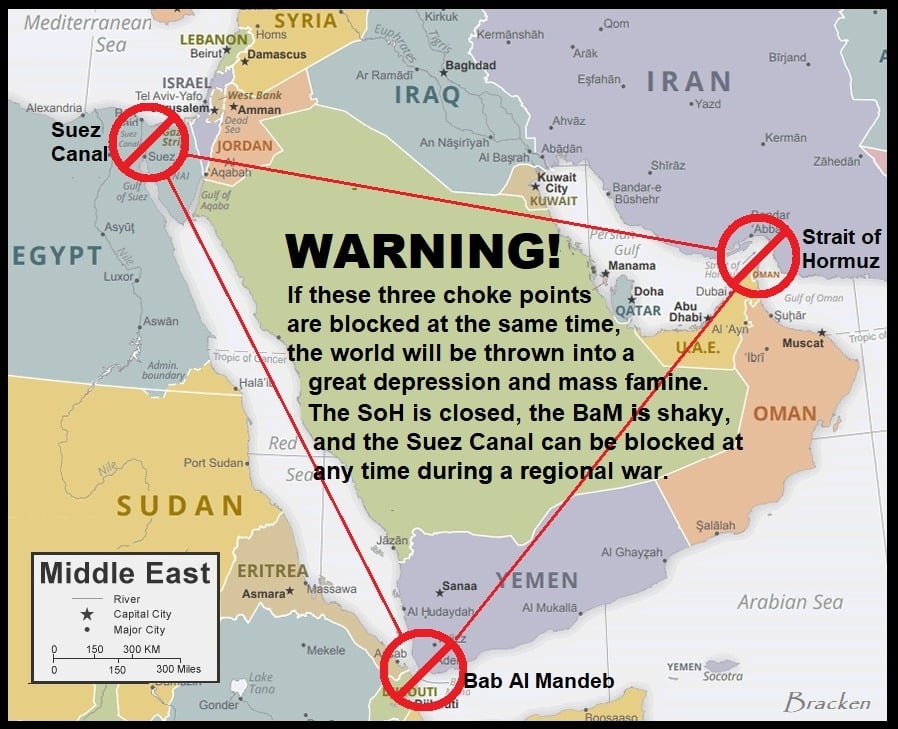
The Houthis are also threatening to completely shut down the Bab al-Mandab Strait
We could potentially be just hours away from all-out war between Saudi Arabia and Yemen. That would certainly begin another frightening new chapter in the crisis in the Middle East.

I kept warning my readers that there wasn’t going to be peace in the Middle East, and now that is becoming obvious to everyone. Meanwhile, the U.S. political establishment is dealing with the sudden death of U.S. Senator Lindsey Graham.

Apparently he was planning to seek medical attention shortly before he died…A person who spoke with Graham shortly afterward said the senator complained that he was feeling unwell. When the person urged him to seek medical attention immediately, Graham said he would do so Sunday morning after his scheduled appearance on NBC’s “Meet the Press.” Graham then joked: “I can’t die now. I still need to do the Russia sanctions, get Iran sorted out and do Israeli-Saudi normalization.” He passed away several hours later.

There is a lot of speculation that a foreign power may have been involved in Graham’s death. If that could be proven, it would change everything. For now, we are being told that his heart was the cause of his death…US Senator Lindsey Graham’s preliminary cause of death has been divulged following an investigation by the DC Medical Examiner. Per a statement issued by Graham’s office just before 5:00pm EST on Sunday, ‘Aortic Dissection due to Arteriosclerotic Cardiovascular Disease,’ was the cause of his ‘sudden’ passing.

‘The death certificate will be PENDING until all the toxicological and microscopic testing are finalized, and at that point the death certificate will be updated to reflect the cause of death and appropriately classify the manner of death,’ Graham’s spokesperson added in the statement.

We live at a time when absolutely crazy things are happening nearly every day. For a long time, most people in the western world were able to ignore global events because they weren’t being directly affected by them. But now we have reached a stage where everyone is going to be deeply affected by the stunning events that are occurring on the other side of the globe. The pace of change is about to go into overdrive, and so I would encourage you to hold on tight as we plunge into an abyss of uncertainty."
o
Full screen recommended.
Scott Ritter, 7/13/26
"US Control of Hormuz Strait Impossible!"
o
"We are so freakin' doomed!" - The Mogambo Guru