StatCounter

Thursday, May 14, 2026

Chet Raymo, “A Sense Of Place”

“A Sense Of Place”
by Chet Raymo

“It would be hard to find two writers more different than Eudora Welty and Edward Abbey. Welty was a Pulitzer Prize-winning author of stories and novels who lived all her life in Jackson, Mississippi, in the house in which she was born, the beloved spinster aunt of American letters. Abbey was a hard-drinking, butt-kicking nature writer and conservationist best known for his books on the American Southwest. Both writers are favorites of mine. Both were great champions of place. I always wondered what it would have been like if they got together. As far as I know, that never happened. But let’s imagine a conversation. I have taken extracts from Welty’s essay “Some Notes on River Country” (1944) and from Abbey’s essay “The Great American Desert (1977) and interleaved them.

“This little chain of lost towns between Vicksburg and Natchez.”

“This desert, all deserts, any deserts.”

“On the shady stream banks hang lady’s eardrops, fruits and flowers dangling pale jade. The passionflower puts its tendrils where it can, its strange flowers of lilac rays with their little white towers shining out, or its fruit, the maypop, hanging.”

“Oily growths like the poison ivy – oh yes, indeed – that flourish in sinister profusion on the dank walls above the quicksand down those corridors of gloom and labyrinthine monotony that men call canyons.”

“All creepers with trumpets and panicles of scarlet and yellow cling to the treetops. There is a vine that grows to great heights, with heart-shaped leaves as big and soft as summer hats.”

“Everything in the desert either stings, stabs, stinks, or sticks. You will find the flora here as venomous, hooked, barbed, thorny, prickly, needled, saw-toothed, hairy, stickered, mean, bitter, sharp, wiry and fierce as the animals.”

“Too pretty for any harsh fate, with its great mossy trees and old camellias.”

“Something about the desert inclines all living things to harshness and acerbity.”

“The clatter of hoofs and the bellow of boats have gone. The Old Natchez Trace has sunk out of use. The river has gone away and left the landings. But life does not forsake any place.”

“In the Sonoran Desert, Phoenix will get you if the sun, snakes, bugs, and arthropods don’t. In the Mojave Desert, it’s Las Vegas. Up north in the Great Basin Desert, your heart will break, seeing the strip mines open up and the power plants rise…”

“The Negro Baptist church, weathered black with a snow-white door, has red hens in the yard. The old galleried stores are boarded up. The missing houses were burned – they were empty, and the little row of Negro inhabitants have carried them off for firewood.”

“…the highway builders, land developers, weapons testers, power producers, clear cutters, oil drillers, dam beavers, subdividers.”

“Eventually you see people, of course. Women have little errands, and the old men play checkers at a table in the front of the one open store. And the people’s faces are good.”

“Californicating.”

“To go there, you start west from Port Gibson. Postmen would arrive here blowing their horns like Gabriel, after riding three hundred wilderness miles from Tennessee.”

“Why go into the desert? Really, why do it? That sun, roaring at you all day long. The fetid, tepid, vapid little water holes full of cannibal beetles, spotted toads, horsehair worms, liver flukes. Why go there?”

“I have felt many times there is a sense of place as powerful as if it were visible and walking and could touch me. A place that ever was lived in is like a fire that never goes out. Sometimes it gives out glory, sometimes its little light must be sought out to be seen.”

“Why the desert, when you could be camping by a stream of pure Rocky Mountain spring water. We have centipedes, millipedes, tarantulas, black widows, brown recluses, Gila monsters, the deadly poisonous coral snakes, and the giant hairy desert scorpions. Plus an immense variety of near-infinite number of ants, midges, gnats, bloodsucking flies, and blood-guzzling mosquitoes.”

“Much beauty has gone, many little things of life. To light up the night there are no mansions, no celebrations. Wild birds fly now at the level where people on boat deck once were strolling and talking.”

“In the American Southwest, only the wilderness is worth saving.”

“There is a sense of place there, to keep life from being extinguished, like a cup of the hands to hold a flame.”

“A friend and I took a walk up beyond Coconino County, Arizona. I found an arrow sign, pointed to the north. Nothing of any unusual interest that I could see – only the familiar sun-blasted sandstone, a few scrubby clumps of blackbush and prickly pear, a few acres of nothing where only a lizard could graze. I studied the scene with care. But there was nothing out there. Nothing at all. Nothing but the desert. Nothing but the silent world.”

“Perhaps it is the sense of place that gives us the belief that passionate things, in some essence, endure.”

“In my case, it was love at first sight. The kind of love that makes a man selfish, possessive, irritable…”

“New life will be built upon these things.”

“…an unrequited and excessive love.”

“It is this.”

“That’s why.”

"Helpless People"

"Helpless People"

“Almost all Americans have had an intense school experience which occupied their entire youth, an experience during which they were drilled thoroughly in the culture and economy of the well-schooled greater society, in which individuals have been rendered helpless to do much of anything except watch television or punch buttons on a keypad.

Before you begin to blame the childish for being that way and join the chorus of those defending the general imprisonment of adults and the schooling by force of children because there isn’t any other way to handle the mob, you want to at least consider the possibility that we’ve been trained in childishness and helplessness for a reason. And that reason is that helpless people are easy to manage.

Helpless people can be counted upon to act as their own jailers because they are so inadequate to complex reality they are afraid of new experience. They’re like animals whose spirits have been broken. Helpless people take orders well, they don’t have minds of their own, they are predictable, they won’t surprise corporations or governments with resistance to the newest product craze, the newest genetic patent - or by armed revolution. Helpless people can be counted on to despise independent citizens and hence they act as a fifth column in opposition to social change in the direction of personal sovereignty.”

"Judge Napolitano - Judging Freedom, 5/14/26"

Judge Napolitano - Judging Freedom, 5/14/26
"COL. Lawrence Wilkerson: Checkmate in Iran"
Comments here:

"Richard Wolff & Michael Hudson: America’s Grip Is Gone – Here’s What Iran, Russia & China Did"

Full screen recommended.
"Richard Wolff & Michael Hudson: America’s Grip Is Gone – 
Here’s What Iran, Russia & China Did"
Comments here:

"Trump’s Iranian Nightmare"

"Trump’s Iranian Nightmare"
by Chris Hedges

"America’s newest quagmire in the Middle East is like its old quagmires in the Middle East. It is based, as were the wars in Afghanistan and Iraq, on a gross misreading of our adversaries, a catastrophic failure to understand the limits of imperial power and no discernable strategy. It swells the profits of the war industry, wasting billions of public funds, alienates our allies and erodes the global power and prestige of the United States.

Dying empires, governed by the corrupt and the incompetent, are blinded by militarism and hubris. They are unable to read the world around them. They stumble into self-defeating cul-de-sacs - as we did in Iraq, Afghanistan and earlier in Vietnam - where military adventurism accelerates self-inflicted wounds. The war on Iran is one more chapter in our precipitous and ultimately fatal decline.

Tehran’s 10-point temporary ceasefire proposal - brokered by Pakistani mediators and presented to the U.S. 40 days after war against Iran had begun - is tantamount to surrender terms. It demands the end of U.S. and Israeli attacks, including in Lebanon. It calls for the removal of U.S. military bases and installations from the region. It solidifies Iran’s control over the Strait of Hormuz. It refuses to abandon uranium enrichment. It calls for the end to sanctions and termination of anti-Iranian resolutions by the United Nations Security Council and International Atomic Energy Agency. It also requires release of frozen assets - estimated at $100 billion - and reparations for the U.S. and Israeli attacks. This is too bitter a humiliation for the U.S. and Israel to accept.

Within hours of the Iranian proposal, Israel - determined to sabotage any agreement - launched a devastating air attack against Lebanon. The attack, which was carried out over 10 minutes, included the bombing of central Beirut. It involved 50 fighter jets and 108 airstrikes that dropped around 160 bombs, killing 350 people and wounding 1,000 others. The lightning and unprovoked massacre, known as “Black Wednesday,” is a potent reminder that Israel has no intention of allowing this war to end. With the U.S. not ready to admit defeat, and Israel’s bloodlust, we are in for a very rough ride.

Iran submitted an updated proposal last week, which Trump said is “totally unacceptable.” But Iran, with its stranglehold over the Strait of Hormuz, can afford to wait. The longer it maintains its blockade over shipping - roughly 20 percent of the world’s oil and liquified natural gas flows through the Strait of Hormuz - the more global economic pain it inflicts.

There is no good outcome for the U.S. The Trump administration’s obstinacy and Israel’s determination to resume attacks on Iran ensures that the global economy will barrel towards a global depression. The World Bank projects a 31 percent increase in the cost of nitrogen fertilizers which are produced in the Gulf and transit through the Strait of Hormuz this year if the war continues. This ensures a huge rise in food costs. Shortages are already shutting down global manufacturing and production. The fragile, interdependent global supply chains are seizing up. This economic ecosystem, as Iran has shown, is easy to destroy. It will be very hard to piece back together.

Iran suffered devastating blows to its civilian infrastructure and economy - including residential areas, schools, health centers, police stations, churches and synagogues and energy, desalinization plants, steel and pharmaceutical facilities - as well as its military assets, including parts of its navy, air force and missile launch capabilities. It endured “decapitation strikes” against its senior political and military leaders at the start of the war, which included the assassinations of the Supreme Leader of the Islamic Revolution, Ayatollah Ali Khamenei, the secretary of Iran’s Defence Council, Ali Shamkhani, and the chief of staff of Iran’s armed forces, Abdolrahim Mousavi, among others. None of the U.S. and Israeli objectives, however, have been met.

The new Iranian leadership - centered around the Islamic Revolutionary Guard Corps (IRGC) - is more defiant and intransigent than the previous leadership. Iran maintains control over the Strait of Hormuz. It charges as much as $2 million for every oil tanker passing through it. These tariffs - which Iran introduced as part of its demand for war reparations - must be paid in Chinese currency, part of an attempt by Iran, China and Russia to break the hegemony of the U.S. dollar. Iran also retains significant missile and drone stockpiles and enriched uranium, which it has warned it will increase to 90 percent purity if attacked again.

Iran is the clear winner of Operation Epic Fury. Trump is the clear loser. The dilemma is that Trump’s penchant for inventing his own reality means he is unlikely to acknowledge his blunder and negotiate a way out of the debacle he created. Trump, without Congressional approval, has already squandered at least $29 billion on the war according to the Pentagon, although analysis by Stephen Semler of Popular Information places the figure closer to $72 billion.

The human cost is already high. U.S. and Israeli strikes have killed more than 3,300 Iranian civilians, including at least 221 children. Over three million Iranians have been displaced, along with over one million Lebanese from Israel’s ongoing bombardment and ethnic cleansing of southern Lebanon. There are, at the same time, over two million displaced Palestinians from the genocide in Gaza and another 1,100 killed and 40,000 displaced Palestinians in the occupied West Bank.

Fuel shortages and supply disruptions are crippling countries in Asia, with Thailand facing panic buying and rationing at some petrol stations. Vietnam and South Korea are scrambling to secure alternative crude and fuel supplies. Japan, which relies on the Persian Gulf for roughly 95 percent of its crude oil imports, has had to dip twice into its strategic reserves since the war started in February.

The rise in price of liquefied petroleum means cooking fuel prices have increased by about seven percent for domestic use in India, but have skyrocketed by around 76 percent in the commercial sector. This has resulted in production cuts and job losses in the garment and textile sector in India, as well as in Bangladesh and Cambodia.

There are shortages of helium, aluminum and naphtha, also transited through the Strait of Hormuz. These shortages have seen production declines, including among microchip manufacturers, construction firms and the plastic packaging sector. Steel mills in India and automakers in Japan have cut production. Tens of thousands of workers across the globe have already lost their jobs.

Asian airlines, along with many on the European continent - including those from Germany, Turkey and Greece - are loading extra fuel at their airports, cutting flights and raising surcharges with the doubling of the price of jet fuel. The United Arab Emirates - one of the world’s richest states with sovereign wealth funds that total more than $2 trillion - has asked the U.S. for a “Wartime Financial Lifeline” in the wake of missile-damaged gas fields and a halt to shipping in the Strait of Hormuz, according to the Wall Street Journal.

Millions of people, especially in Asia and Africa, are at risk of falling into dire poverty because of the war, according to the United Nations Development Program.

The U.S., which is a net exporter of oil and natural gas, has been relatively insulated from the global shock, although gasoline prices have risen by around 40 percent to more than $1.20 a gallon. The average U.S. diesel price has increased by nearly 50 percent, surpassing $5.60 a gallon. But it is only a matter of time before the breakdown of the global economy ravages the U.S. The Trump administration is pushing us towards a global depression with all of the social and political instability that comes with a catastrophic financial crisis.

Trump is desperate. He spews out expletive-laden threats to Iran on social media, writing “Open the Fuckin’ Strait [of Hormuz], you crazy bastards.” He also posts Artificial Intelligence generated images showing the U.S. military obliterating the Iranian military. He has threatened to bomb Iranians “back to the stone age where they belong,” and lambasts his critics as traitors:

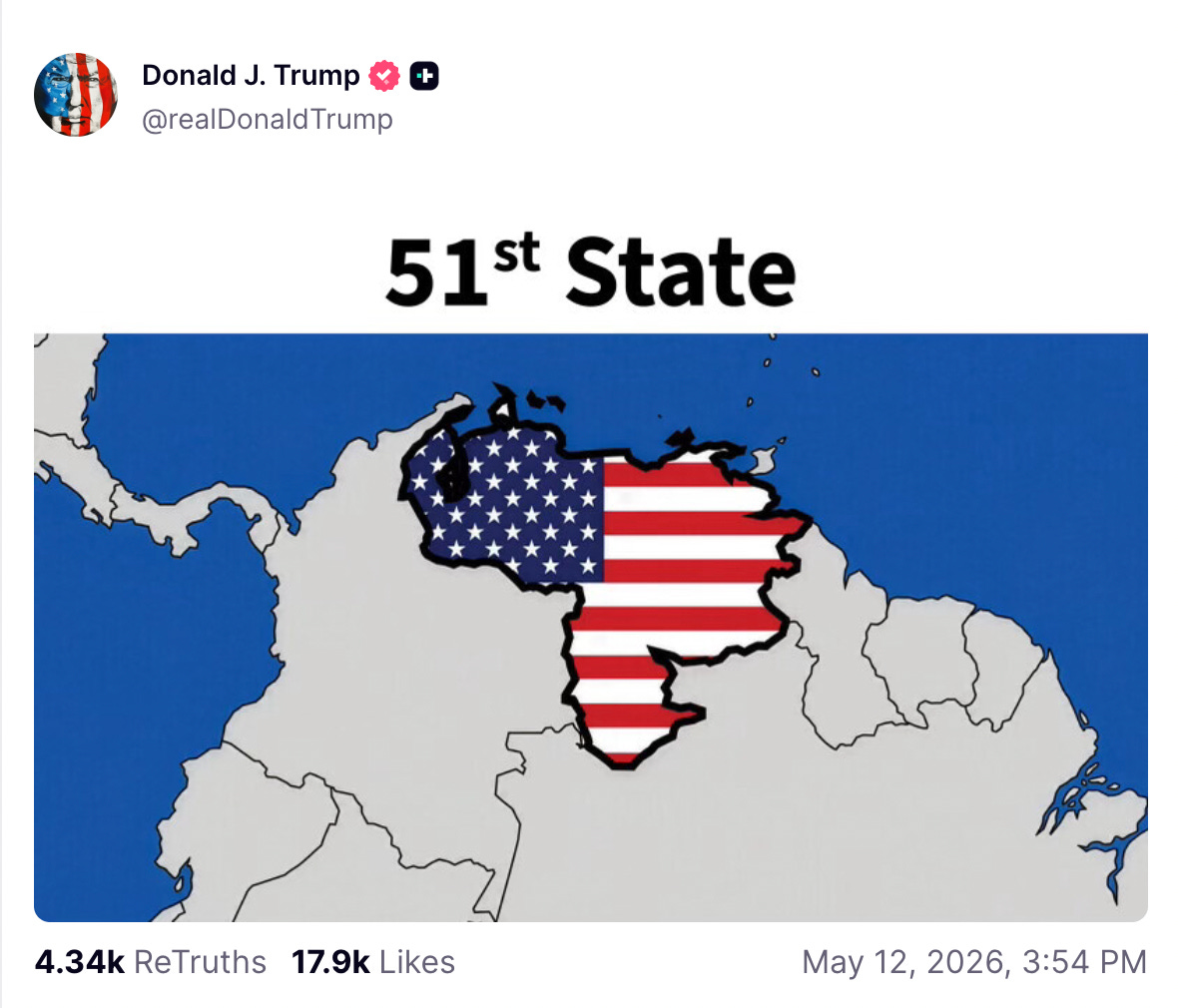
“When the Fake News says that the Iranian enemy is doing well, Militarily, against us, it’s virtual TREASON in that it is such a false, and even preposterous, statement.” He declared on Truth Social, “They are aiding and abetting the enemy!” This screed was followed by an image of a map with Venezuela overlaid with the U.S. flag. The caption read: “51st State.”
Before leaving for China, Trump claimed: “We have Iran very much under control… We’re either going to make a deal or they’re going to be decimated. One way or the other, we win.” The rants are pathetic and unhinged. But they are also ominous.

The U.S. is building up troop levels in the region. It has deployed the Tripoli Amphibious Ready Group with the 31st Marine Expeditionary Unit - composed of about 3,500 sailors and Marines - in addition to transport and strike fighter aircraft and assault and tactical assets. It has deployed the Boxer Amphibious Ready Group along with about 2,500 Marines from the 11th Marine Expeditionary Unit equipped with F-35B Lightning II Stealth Fighters, MV-22B Osprey, tilt rotors and attack helicopters. The U.S. has also sent around 2,000 paratroopers to the Persian Gulf and is reportedly considering augmenting these forces with an additional 10,000 troops.

A resumption of the bombing, coupled with even a limited ground assault, would ensure a long and costly war. It will fulfill Israel’s objective - which seeks to bomb Iran into a failed state - but will be another mortal blow to the U.S. empire.

A ground assault on Kharg Island - which lies 16 miles off Iran’s coast and serves as the country’s main oil storage and export terminal, processing around 90 percent of the country’s oil exports - would send seismic shock waves through the global economy. And if U.S. troops attempt to seize Iranian territory, Iran will deploy its arsenal of anti-ship cruise missiles, ballistic missiles, underwater drones and mines, making any occupation deadly.

We are in serious trouble. The management of the conflict is far beyond the capabilities of the buffoons within the Trump administration. They prefer global misery and carnage to defeat. By the time they face the inevitable, they will have left mounds of corpses in their wake. The tragedy is not that the empire is dying. The tragedy is that the empire is bringing so many innocents down with it."

The Daily "Near You?"

Lawrenceville, Georgia, USA. Thanks for stopping by!

Delta King's Blues, "My Give A Damn Is Broken"

Full screen recommended.
Delta King's Blues, "My Give A Damn Is Broken"
“My Give a Damn Is Broken” is a bold, no-apologies Delta King’s Blues tune about burnout, letting go, and finally finding peace in not sweating the small stuff. A gritty, laid-back acoustic guitar grooves like a man who stopped rushing years ago. The harmonica blows loose and carefree, with a shrug in every note. The rhythm rolls slow and easy, built for folks who’ve run out of patience - and don’t plan on restocking. This is blues with attitude and freedom. For anyone who hit that point where worry just ain’t worth it anymore."

The Poet: Robinson Jeffers, "We Are Those People"

"We Are Those People"

"I have abhorred the wars and despised the liars,
laughed at the frightened
And forecast victory; never one moment's doubt.
But now not far, over the backs of some crawling years, the next
Great war's column of dust and fire writhes
Up the sides of the sky: it becomes clear that we too may suffer
What others have, the brutal horror of defeat -
Or if not in the next, then in the next - therefore watch Germany
And read the future. We wish, of course, that our women
Would die like biting rats in the cellars,
our men like wolves on the mountain:
It will not be so. Our men will curse, cringe, obey;
Our women uncover themselves to the grinning victors
for bits of chocolate."

- Robinson Jeffers

"Few Really Ask..."

“Very few beings really seek knowledge in this world – few really ask. On the contrary, they try to wring from the unknown the answers they have already shaped in their own minds – justifications, confirmations, forms of consolation without which they can’t go on. To really ask is to open the door to a whirlwind. The answer may annihilate the question and the questioner.”
- Anne Rice, “The Vampire Lestat”

"Just Look At Us..."

"Just look at us. Everything is backwards; everything is upside down. Doctors destroy health, lawyers destroy justice, universities destroy knowledge, governments destroy freedom, the major media destroy information and religions destroy spirituality"
- Michael Ellner
"Archimedes said, "Give me a fulcrum and I will move the Earth"; but there isn't one. It is like betting on the future of the human race - I might wish to lay a bet that the human race would destroy itself by the year 3000, but there is nowhere to place the bet. On the contrary, I am involved in the world and must try to see that it does not blow itself to pieces. I once had a terrible argument with Margaret Mead. She was holding forth one evening on the absolute horror of the atomic bomb, and how everybody should spring into action and abolish it, but she was getting so furious about it that I said to her: "You scare me because I think you are the kind of person who will push the button in order to get rid of the other people who were going to push it first." So she told me that I had no love for my future generations, that I had no responsibility for my children, and that I was a phony swami who believed in retreating from facts. But I maintained my position.

As Robert Oppenheimer said a short while before he died, "It is perfectly obvious that the whole world is going to hell. The only possible chance that it might not is that we do not attempt to prevent it from doing so." You see, many of the troubles going on in the world right now are being supervised by people with very good intentions whose attempts are to keep things in order, to clean things up, to forbid this, and to prevent that. The more we try to put everything to rights, the more we make fantastic messes. Maybe that is the way it has got to be. Maybe I should not say anything at all about the folly of trying to put things to right but simply, on the principle of Blake, let the fool persist in his folly so that he will become wise."
- Alan Watts

“Hustled Through Life”

“Hustled Through Life”
by Paul Rosenberg

“Most people, sad to say, are too rushed, frightened, and confused to think about what they really want out of life. They are hustled through school, forced into long-term decisions before they’re ready to face them, then held to those decisions by fear and shame. They choose from a limited set of options, and they know that change will be punished. Eventually they get old and find time to think, but by then they can’t bear to question too deeply; that would jeopardize their self-worth, and they haven’t time to rebuild it.

For an intelligent, creative, and expansive species like ours, this rush to nowhere is among the greatest of evils. And yet it continues, mostly unquestioned. At no point in the usual Western life do we stop, take some serious time for ourselves, and think about the overall:

• What’s life about anyway? What’s the point of what we do?
• What’s the purpose of a career? Why should I care about it above everything else?
• Why should I glorify the existing system? Why should I agree to support it?
• Who paid for everything I learned in school?
• Should I have a family? If so, why? If not, why not?
• What do I think is fun? Does it really coincide with the beer ads on TV?
• What’s the purpose of being like everyone else? Why am I so afraid to be different?

We don’t address such questions. Rather, we’re pushed past them. Even in a church or synagogue – places where larger questions are supposed to be addressed – the person in the pulpit wants us to become and/or remain a member of the congregation; their job depends upon it. There are true ministers and rabbis, but for most it’s all too easy to push their audience into what’s convenient. As a result, we see little motivation in the modern West, save for the basest of motivators: things that match a line from the Bible that says, “Whose god is their belly.”

Mind you, I’m not against wealth, good food, or sex. I think those are fine things. They are not, however, the whole of life. We are much bigger than that. We ought not be limited to belly-level aspirations. But when we’re rushed, that’s all we’re able to see.

Status and Fear: The two big motivators we face in this rush through life – fear and status – are both negative. Fear is a manipulation technology; people who make you afraid are hacking your mind. They want you to ignore reason and obey them fast. I wish I could cover this in depth here, but we haven’t space. When we’re afraid, we make our worst choices. Put plainly, fear makes us stupid. But we encounter it on a daily basis… and it destroys us by inches.

Status is the compulsion to compare ourselves with others, and whether we’re looking for the ways we’re better than others or looking for our shortcomings, it is deeply destructive. It’s also irrational, but the advertising business would crash without it and advertisers currently own the collective eyeballs of humanity.

Fear and status are, in a broad sense, drugs, and if you had a choice between smoking pot every day or being on fear and status every day, I’d definitely recommend the pot.

Confusion: Let’s be clear on something: Nearly every adult in the West will agree that politicians are liars and thieves… and yet they obey them without question. Is there any possibility we’d do such things if we weren’t harried and confused? When we are confused, we pass over our own minds and their deliberations. There’s an old joke: “Who are you gonna believe, me or your lyin’ eyes?” But that’s precisely what confusion does to us, and under the pressures of confusion and authority, most people will ignore their own eyes.

Such things do not happen to people who are calm and confident. But the existing hierarchies of the West couldn’t function with a calm and confident populace; their operations require people to be frightened, confused, and blindly chasing status.

As a Result… As a result, most of us hurry through life, never knowing why. We live as others do, simply because that path is streamlined for us, exposing us to a minimal level of fear and shame. But that path does something else: It keeps us from experiencing ourselves. Seldom has this problem been put more succinctly than in this quote from Albert Einstein: “Small is the number of them who see with their own eyes and feel with their own hearts.”

Stop following the crowd. Turn your back on the popular script. Stop feeding at the same trough as everyone else. Break away and learn to see with your own eyes, to feel with your own heart. Don’t conform. Let people criticize you. Decide for yourself what your life will be about. Make it matter.”

"A Great Madness Sweeps The Land"

"A Great Madness Sweeps The Land"
by Charles Hugh Smith

‘In individuals, insanity is rare; but in groups, 
parties, nations and epochs, it is the rule.’
- Friedrich Nietzsche 

"A great madness sweeps the land. There are no limits on extremes in greed, credulity, convictions, inequality, bombast, recklessness, fraud, corruption, arrogance, hubris, pride, over-reach, self-righteousness and confidence in the rightness of one's opinions. Extremes only become more extreme even as the folly of previous extremes wearies rationality.

Imaginary sins are conjured out of thin air to convict the innocent while those guilty of the most egregious fraud and corruption are lauded as saviors.

The national mood is aggrieved and bitter. The luxuries of self-righteousness, indignation, entitlement and resentment have impoverished the national spirit. Bankrupted by these excesses, what little treasure remains is squandered on plots of petty revenge.

Blindness to the late hour is cheered as optimism, confidence in the false gods of technology is sanctified while doubters of the technocratic theocracy are crucified as irredeemable infidels.

Witch-hunts and show trials are the order of the day as those who cannot stomach the party line are obsessively purged, as healthy skepticism is condemned as a mortal sin by brittle true believers who secretly fear the failure of their cult.

Mired in a putrid sewer of suspected subversion and disloyalty to The One True Cause, heretics are everywhere to those caught up in the mass hysteria. In this choking atmosphere of toxic hubris, self-righteousness, indignation, entitlement and resentment, humility is for losers, prudence is for losers, caution is for losers, skeptical inquiry is for losers.

Completely untethered from cause and effect, those confident in the inevitability of a glorious future of unlimited expansion cling to past glory as proof of future glory, even as their hubris leads only to a treacherous path of decay and decline. As they stumble into the abyss, their final cries are of surprise that confidence alone is not enough.

Those who see the madness for what it is have only one escape: go to ground, fade from public view, become self-reliant and weather the coming storm in the nooks and crannies where cause and effect, skeptical inquiry, humility, prudence and thrift can still be nurtured."
o

Edward Curtin, "My Internal Exile"

"My Internal Exile"
by Edward Curtin

"Let me have war, say I; it exceeds peace as far as day does night: it’s spritely waking, audible, and full of vent. Peace is a very apoplexy, lethargy; mull’d, deaf, sleepy, insensible; a getter of more bastard children than war’s a destroyer of men.”
- Shakespeare, "Coriolanus"

"Long ago, but what seems like only yesterday, I didn’t go to the U.S. war against Vietnam but the war came to me. It was when my exile began. I am telling you this to try to shed some light on today’s wars and alarums since my tale is common for a small subset of Americans of my generation. We learned long ago that the USA was run by ruthless killers who reveled in war. Vietnam, the Phoenix Program, Cambodia, Indonesia, etc. Nothing was beyond them. We sensed that they would never stop and they haven’t. The genocide of Palestinians, the proxy war via Ukraine against Russia, the current bloodbath in Syria and Lebanon led by our ruthless terrorists – it is all nightmarish, malevolent, utterly evil, and conjures up hell on earth. And it will get worse in the future. The mainstream media claimed that the new savior of Syria is the terrorist “rebel” leader, Abu Mohammad al-Jolani, the founding leader of Al Qaeda in Syria, al-Nusra, and a former deputy to ISIS leader Abu Bakr al-Baghdadi.

While there is truth in the view that the world has always been a butcher’s bench with wars, hatred, and strife being a common theme, “always” is meaningless to me. For I have never lived in “always.”

I have lived since birth in the United States during a period of time when it has been the world’s number one butcher, starting with the nuclear bombings of Hiroshima and Nagasaki, then continuing waging non-stop wars, assassinating foreign and domestic leaders, including President Kennedy, executing coup d’états, supporting and arming ruthless dictators and terrorists, and creating an economy dependent on war.

All this has been sustained by lies and propaganda that most Americans have swallowed. It is a deeply ingrained Yankee doodle dandy ethos joined with American exceptionalism and a self-induced false innocence.

Just this as it did during the Vietnam war, The New York Times spewed out lies about the events in Syria, calling the U.S.-backed jihadist terrorists (Hayat Tahrir al-Sham/Al Qaeda, et al.) “rebels” and the overthrow of the Assad government a “civil war.” In doing so, the paper is just doing what it has always done as an organ for U.S. foreign policy, seemingly forgetting that it was the Obama administration that in 2012 launched Operation Timber Sycamore, a CIA program to, under the guise of a civil war, overthrow Syrian President Bashar al-Assad as part of a larger effort to undercut Iran and Russia for U.S./Israel/Turkey/NATO control of the region.

It is propaganda about a much larger war well underway, as the presence of Ukrainian forces in Syria and the usual Israeli bombing attest. Like a mountain ridge wildfire, the winds whip wildly now, and whether the fire spreads next to Iran or somewhere else, it is sure to spread.

To paraphrase Thoreau, there is no need to care for a myriad of instances and applications, the only thing you need is to be acquainted with the principle, which in this case is the long-standing demonic nature of U.S. foreign policy which is synchronous with waging perpetual war. Yet most people don’t want to go past such lying headlines that are repeated by all the mainstream media. They never did, except when the issues concerned them personally, as when there was a military draft.

Yes, government and media propaganda have contributed mightily to it, but so many of the country’s war crimes have been committed out in the open and accompanied by the public’s cheering and flag waving that propaganda is only part of the explanation. The will to believe and self-delusion are a large part of it. And people seem to like war, if it is far away and the cheerleaders are on this side of the water. It lends excitement to life like a real murder mystery, a sex scandal, or an approaching hurricane.

Furthermore, it provides roots for the national myth, the mythic home, the mythic womb, wherein one can root for the home team as one stands with tens of thousands of team people and sing along with the words “bombs bursting in air” while feeling a stirring of patriotic pride. This desire to be patriotically conventional, to support the national team in war and peace, is very powerful. Why else the creation of the mammoth bureaucracy called Homeland Security, the un-American word homeland taken straight from Hitler’s 1934 Nuremberg rally. Root, root, root for the home team.

I know the patriotic feeling. It left me back in 1967 when my exile began. For the most part, it has not been apparent to outside observers, for there are places difficult to reach, and the one within is the most distant. My youthful “normalcy” received its first body blow with JFK’s assassination in 1963. By 1967 I had joined the Marines and then declared myself a conscientious objector as I realized the evil my country was committing in Vietnam. I was on my way away.

In the years that followed, as Malcom X, MLK, Jr. and RFK, were assassinated and Johnson and Nixon lied and brutalized Vietnam, my understanding of history and politics deepened. Families and friends called me a communist for being a C.O. and opposing the war and a lying government. It was laughable but relentless.

Many years have elapsed, and the charges have risen and fallen as the years have gone by. For years now, the name of abuse is a “conspiracy” theorist or Russian sympathizer for daring to say that Russia Gate was a Democratic conspiracy and the war against Russia in Ukraine has been a U.S. project from the start. There is much more.

But my point about internal exile is that I had to adopt the motions of normalcy in everyday life – to create a pleasant persona – to get through the days. My teaching and writing continued as hard-hitting as before, but family, friends, academic colleagues, and acquaintances didn’t take my courses or read my writing, which they made sure to avoid.

These days, many more people have been forced to discover the twofold life where they can’t talk to the people in their lives about many issues – politics, wars, Covid, etc. Something has broken. Almost everything.

To accept the conclusion that the country is run by a bunch of ruthless warmongering imperialists is a step too far for most people. They must mean well or just make mistakes, for their hearts are in the right place, runs through so many minds. At least they assume that about the leaders they support.

A key way the endless wars roll on is the deadly political game of the lesser of two evils. If it is one’s political party waging the foreign wars, there are always many reasons to still find it better than the other party’s wars. “My leader may be a warmonger but he’s better than your warmonger” is the unspoken implication.

This neat trick is supported by a host of mitigating excuses to justify the delusion that one is for peace even as these wars occur non-stop throughout the decades as the Democratic and Republican leaders switch highchairs. Rather than dismiss the lot of them, the desire to feel that patriot heart-pump, however dim, and to reject the “extremist” conclusion that war is the life blood of the country, remains.

Throughout the sixty years of my adult life, the U.S. has been continuously waging wars, hot and cold, small and large, openly and secretly, all across the world, and its economy has increasingly become a military-industrial-national-security complex so vast and intricately linked to daily life that the country would collapse without it. Simply put: Beneath daily life lies a death cult, a river of blood. If that sounds too strong for you, give me another name for it.

It seems to me very clear that most Americans are today suffering from some sort of traumatic mental sickness, trying desperately to deny it in a multitude of ways. Scratch the surface of an everyday conversation or a greeting on the street and there’s the rolling of the eyes and the looks that say, “Let’s not go there, it’s all too crazy!” Something has broken, and people seem like walking desperadoes with the flag planted like a dagger in their hearts.

Even the alternative media, those writers with whom I share wishes for a peaceful world, have for a good while let their hopes trump realty by claiming the American empire is doomed, as is Israel and the neo-liberal, neo-con agenda. For many months now, I have noticed something amiss with these claims. Too much wishful thinking. Too little appreciation for the machinations of the CIA, M-16, Mossad, Turkish conspiracies. To think these devils would accept defeat without bringing the world down is naïve. I don’t relish saying all this. It is depressing. But I think it is true.

Some people who know me call me an extremist and claim I make no room for the middle ground. When it comes to U.S. war-waging, I say there is none. It is endless and integral to U.S. foreign policy no matter which party is in office. And the foreign policy is integral to the domestic policy. Without it, the country would be so different. Bush, Obama, Trump, Biden, Trump – to buy their lies is to be a fool.

To realize the difference between power and innocence is to come to understand the demonic nature of America’s Forever Wars. When in 2014 President Obama stood at West Point and said, “I believe in American exceptionalism with every fiber of my being,” he was revealing, consciously or not, a hard truth, just as when he received the Nobel Peace Prize and told the world he believed in war. But he smiled. For war is the lifeblood of this “exceptional” country. But if you keep repeating that, don’t expect smiles to come your way."
Full screen recommended.
James Blunt, "No Bravery"

"How It Really Is"


Dan, I Allegedly, "The Warnings Are Everywhere!"

Full screen recommended.
Dan, I Allegedly, 5/14/26
"The Warnings Are Everywhere!"
"The economy is flashing warning signs everywhere. In today’s video, Dan from i Allegedly breaks down the latest business news including the new Fed chairman, rising inflation, wholesale prices exploding higher, and why producer price index (PPI) numbers show that costs are still climbing fast. We also cover layoffs at major companies like GM, rising mortgage delinquencies, student loan debt problems, housing market weakness, insurance spikes, food inflation, and why many Americans are struggling to keep up with bills despite working harder than ever.

Donald Trump’s trip to Beijing, Federal Reserve interest rate cuts, AI job losses, global food shortages, and the rising cost of living are all adding pressure to consumers and businesses alike. This video covers personal finance, inflation, recession fears, real estate, layoffs, debt, food prices, and the overall direction of the U.S. economy in 2026. If you want honest economic analysis, business news, financial warning signs, and practical insights on preparing for what’s coming next, this episode of i Allegedly is for you."
Comments here:

"People Are Panicking, The USA Empire is Falling: Stage 5 Collapse"

Full screen recommended.
Finance Economist, 5/14/26
"People Are Panicking,
 The USA Empire is Falling: Stage 5 Collapse"

"Gallup released a poll conducted April 1-15 finding that 55 percent of Americans say their financial situation is getting worse, the highest at any point since 2001, higher than during the 2008 financial crisis or the pandemic. This is the fifth consecutive year the majority says their finances are worsening. Gallup's Economic Confidence Index dropped 11 points in a single month to negative 38. Sixty-two percent worry about not having enough for retirement. Sixty percent worry about covering medical costs. In 1950 the United States ranked 12th in life expectancy. It now ranks 46th. Behind Costa Rica. Behind Chile. Behind Slovenia. Maternal mortality is triple the OECD average. Infant mortality ranks worst among peer countries. Drug overdose deaths quadrupled since 1999. Youth suicide rates increased 57 percent. At least 717 companies filed for bankruptcy through November 2025, up 14 percent, including Spirit Airlines, Del Monte Foods, and Rite Aid. 

One in three Americans skipped a meal in the past year due to cost. Nearly half of adults under 30 delayed medical care. Credit card delinquencies climbed to the highest in almost a decade. Auto repossessions hit the highest since 2008. Family health premiums approaching $27,000 annually. Consumer sentiment at 47.6, the lowest in the 75-year history of the University of Michigan survey. People experiencing homelessness die nearly 30 years earlier than the average American. Over 150 rural hospitals closed since 2010. More than a third of U.S. counties are maternity care deserts. The Surgeon General declared loneliness a national epidemic. Every American feels it. The end is happening."
Comments here:

Adventures With Danno, "Shopping Deals at Kroger!"

Full screen recommended.
Adventures With Danno, 5/14/26
"Shopping Deals at Kroger!"
Comments here:

"People Don't Know What’s Coming Next - And They’re Scared!"

Full screen recommended.
"Finance Economist, 5/14/26"
"People Don't Know What’s Coming Next - 
And They’re Scared!"

"Right now 4,500 ships are stranded near the Strait of Hormuz unable to pass through. FedEx raised its fuel surcharge to 26.5 percent. Bank of America reported credit card spending at gas stations spiked 16.5 percent in March. Consumer prices rose 0.9 percent in March alone, triple February's pace. Costco and Sam's Club are reporting bulk-pack sellouts with restocking timelines measured in weeks not days. Freeze-dried emergency food kits that sat untouched for three years are selling out in 48 hours. Prescriptions are being filled ahead of schedule. Gas cans, generators, and water pallets are moving at pandemic-era rates. The University of Michigan Consumer Sentiment Index fell to 47.6 in April, the lowest reading in the entire 75-year history of the survey. Lower than the 2008 financial crisis, the pandemic, 1970s stagflation, or September 11th. The deterioration was across age, income, and political party. Diesel fuel is up 45 percent. Every product in America ships by truck. Every truck runs on diesel.

 A roofing contractor reported materials up 8 to 9 percent on April 18th with another 10 to 12 percent increase coming June 1st. A $10,000 roof last month costs $11,000 now and $13,000 by June. Approximately 80 percent of active pharmaceutical ingredients in American medications are manufactured overseas. Pain relievers, vitamins, antibiotics, and prescription medications are being pulled from pharmacy shelves as patients fill prescriptions weeks early. Ready.gov disaster supply guidance is being cited in Newsweek, Mirror US, and AOL coverage. Fortune covered the March 2026 toilet paper panic which has spread beyond the US to Japan. Median household income adjusted for inflation was no higher in 2024 than in 2019. Credit card delinquencies climbed to the highest in almost a decade. Auto repossessions hit the highest since the financial crisis. Americans are scared. Everyone is preparing."
Comments here:

"Shutup and Eat Your Chemicals"

"Shutup and Eat Your Chemicals"
by Paul Craig Roberts

"I have been thinking for some time about the disappearing quality of food. Consider restaurants. I remember when people went to restaurants to enjoy dishes that even good cooks could not prepare at home. Many mothers and grandmothers grew up with the adage that the way to a man’s heart was through his stomach. Children needed nutritional food in order to perform well in school and in sports. Home cooking served up good fried chicken, baked ham, spaghetti and meat balls, roast beef, pot roast, pork roast, butterbeans, lady peas, corn on the Cobb, and tomatoes. But if you wanted Chicken Kiev, Beef Wellington, Beef Stroganoff, Beef Burgundy, Sole Meunière, Pheasant Under Glass and desserts like baked Alaska and chocolate mousse, you went to a quality restaurant.

Quality restaurants did not jam the space with as many tables as could be accommodated. They left space so that you did not feel like you were sitting at the counter in a diner. Tables had tablecloths and dishes were served on china. Waiters would be in black tie. The clientele was not talking and laughing at the top of their voices, and you could actually have a conversation with your dinner companions. Those days are gone.

In more recent times I have dined at the best restaurants in New York, Washington, D.C., San Francisco, Cleveland, and none of the items mentioned above was on the menus. The menu I experienced at Claridges in London in the 1960s no longer exists at Claridges. The only survivor on Claridges’ dinner menu is sole meunière. Moreover, today the cost of afternoon tea at Claridges for one person is five times more than the bill for four for dinner including vintage port with which I was presented in 1963.

A year or two ago or less, I posted on my website menus from New York City’s famous restaurants at the turn of the 20th century. The extraordinary wide selection of dishes offered, 90% of which are not offered today even in 5-star French restaurants in Paris is astonishing. If you research my website you will find the menus. The prices are also astonishing. You could eat like a king for the price of a fast food takeout today. Of course, money was worth far more in those days. The American people were correct to oppose the creation of a central bank, but it was forced on them and destroyed the value of their money.

To return to my topic of quality food. Recently I purchased from Publix, where I grocery shop, an individual serving of strawberry short cake, a southern dessert that reminded me of my grandmother. It was an easy dessert to make and was always welcome. What was required was some flour, water or milk, cane sugar, sliced fresh strawberries, and whipped cream made by hand-whipping the cream from the top of non-pasteurized, non-homogenized milk, a product no longer available in stores.

Carried away by my expectation of enjoying a taste from the past, I did not read the ingredients listing on the Publix’s strawberry shortcake before I ate a combination of chemicals unknown to me. Here it is: Strawberry, sugar, water, bleached enriched flour (wheat flour, niacin,reduced iron, thiamine mononitrate, ribbon flavin, folic acid), egg white, hydrogenated vegetable oil (palm, palm kernel, coconut, &/or cottonseed), dextrose, soy oil, eggs, food starch-modified, milk, graham crumbs, (whole wheat graham flour, sugar, wheat flour, palm oil, palm kernel oil, honey, molasses, soy lecithin, sodium bicarbonate, salt, natural flavor, cream, leavening (sodium acid pyrophosphate, baking soda, monocalcium phosphate), wheat starch, sodium caseinate, food starch-modified (tapioca), propylene glycol mono-&diesters of fats & fatty acids, polysorbate 60, whey, gums (guar, xanthin, carbohydrate), salt, mono-&diglycerides, natural & artificial flavor, soy lecithin, sodium stearoyl lactylate, pectin, sorbitan monostearate, colors (red 40, yellow 5, lake beta carotene), citric, anhydrous, potassium sorbet (preservative), 010825 Contains milk, eggs, wheat, and soy.

Compare this endless list with the 5 ingredients my grandmother used. Note also that hardly any of the public have any idea what most of these ingredients are. And ask yourself why a preservative is needed for a product that has a shelf-life at Publix’s of two days.

I then turned to Publix’s in-store baked Italian five grain bread. The list of ingredients is almost as long. As the shelf-life is 2 days, I asked the manager of the in-store bakery the purpose of the long list of mainly unknown ingredients. He answered that the dough arrived mixed and that in-store they simply manufactured the product by baking the bread. I concluded that the preservatives, et. al., are for the shelf-life of the pre-mixed dough. The same for cake icing, whipped cream. They come in cans and the store assembles the products.

Compare this to the real bakeries that used to exist. A few still do. Such bakeries bake for the day’s sales based on sales experience. Most cakes were baked to order. Unless they used pre-mixed dough, which I doubt existed in those days, you could get a real product without nameless ingredients. Homes that baked their own bread needed only water, milk, or buttermilk, yeast, cane sugar or honey, salt, butter, and flour.

The centralization of food supply requires a long shelf-life, which requires ingredients that are not good for us. Avoiding spoilage becomes the goal, and feeding us chemicals is the way it is achieved. Moreover, food manufacturers come up with ever more ways to deceive us. For example, smaller pieces of expensive cuts of beef too small to market as steaks are today fused together with meat glue. An enzyme called Activa, fuses together the pieces and a steak is created. The problem is, as Dr. Russell Blaylock reports, that the process releases excitotoxins that raise the risk of gastroenteritis and that fuel cancer growth. Of course, the food industry lobby prevents the FDA from doing anything about it.

The further foods are produced from the users, the less the concern for the users. Other concerns become more important than the quality of the food. Moreover, localized food production is not subject to catastrophic failure as is a centralized one. Thought should be given to the dangers of centralized food production and distribution, but there is no money in it. Reliance on processed foods with additives is likely entrenched as at-home cooking seems to be an abandoned task."
o