

So, we rise from the rubble...
StatCounter
Thursday, May 14, 2026

Dan, I Allegedly, "The Warnings Are Everywhere!"
Full screen recommended.
Dan, I Allegedly, 5/14/26
"The Warnings Are Everywhere!"
"The economy is flashing warning signs everywhere. In today’s video, Dan from i Allegedly breaks down the latest business news including the new Fed chairman, rising inflation, wholesale prices exploding higher, and why producer price index (PPI) numbers show that costs are still climbing fast. We also cover layoffs at major companies like GM, rising mortgage delinquencies, student loan debt problems, housing market weakness, insurance spikes, food inflation, and why many Americans are struggling to keep up with bills despite working harder than ever.
Donald Trump’s trip to Beijing, Federal Reserve interest rate cuts, AI job losses, global food shortages, and the rising cost of living are all adding pressure to consumers and businesses alike. This video covers personal finance, inflation, recession fears, real estate, layoffs, debt, food prices, and the overall direction of the U.S. economy in 2026. If you want honest economic analysis, business news, financial warning signs, and practical insights on preparing for what’s coming next, this episode of i Allegedly is for you."
Comments here:
"People Are Panicking, The USA Empire is Falling: Stage 5 Collapse"
Full screen recommended.
Finance Economist, 5/14/26
"People Are Panicking,
The USA Empire is Falling: Stage 5 Collapse"
"Gallup released a poll conducted April 1-15 finding that 55 percent of Americans say their financial situation is getting worse, the highest at any point since 2001, higher than during the 2008 financial crisis or the pandemic. This is the fifth consecutive year the majority says their finances are worsening. Gallup's Economic Confidence Index dropped 11 points in a single month to negative 38. Sixty-two percent worry about not having enough for retirement. Sixty percent worry about covering medical costs. In 1950 the United States ranked 12th in life expectancy. It now ranks 46th. Behind Costa Rica. Behind Chile. Behind Slovenia. Maternal mortality is triple the OECD average. Infant mortality ranks worst among peer countries. Drug overdose deaths quadrupled since 1999. Youth suicide rates increased 57 percent. At least 717 companies filed for bankruptcy through November 2025, up 14 percent, including Spirit Airlines, Del Monte Foods, and Rite Aid.
One in three Americans skipped a meal in the past year due to cost. Nearly half of adults under 30 delayed medical care. Credit card delinquencies climbed to the highest in almost a decade. Auto repossessions hit the highest since 2008. Family health premiums approaching $27,000 annually. Consumer sentiment at 47.6, the lowest in the 75-year history of the University of Michigan survey. People experiencing homelessness die nearly 30 years earlier than the average American. Over 150 rural hospitals closed since 2010. More than a third of U.S. counties are maternity care deserts. The Surgeon General declared loneliness a national epidemic. Every American feels it. The end is happening."
Comments here:
Adventures With Danno, "Shopping Deals at Kroger!"
Full screen recommended.
Adventures With Danno, 5/14/26
"Shopping Deals at Kroger!"
Comments here:
"People Don't Know What’s Coming Next - And They’re Scared!"
Full screen recommended.
"Finance Economist, 5/14/26"
"People Don't Know What’s Coming Next -
And They’re Scared!"
"Right now 4,500 ships are stranded near the Strait of Hormuz unable to pass through. FedEx raised its fuel surcharge to 26.5 percent. Bank of America reported credit card spending at gas stations spiked 16.5 percent in March. Consumer prices rose 0.9 percent in March alone, triple February's pace. Costco and Sam's Club are reporting bulk-pack sellouts with restocking timelines measured in weeks not days. Freeze-dried emergency food kits that sat untouched for three years are selling out in 48 hours. Prescriptions are being filled ahead of schedule. Gas cans, generators, and water pallets are moving at pandemic-era rates. The University of Michigan Consumer Sentiment Index fell to 47.6 in April, the lowest reading in the entire 75-year history of the survey. Lower than the 2008 financial crisis, the pandemic, 1970s stagflation, or September 11th. The deterioration was across age, income, and political party. Diesel fuel is up 45 percent. Every product in America ships by truck. Every truck runs on diesel.
A roofing contractor reported materials up 8 to 9 percent on April 18th with another 10 to 12 percent increase coming June 1st. A $10,000 roof last month costs $11,000 now and $13,000 by June. Approximately 80 percent of active pharmaceutical ingredients in American medications are manufactured overseas. Pain relievers, vitamins, antibiotics, and prescription medications are being pulled from pharmacy shelves as patients fill prescriptions weeks early. Ready.gov disaster supply guidance is being cited in Newsweek, Mirror US, and AOL coverage. Fortune covered the March 2026 toilet paper panic which has spread beyond the US to Japan. Median household income adjusted for inflation was no higher in 2024 than in 2019. Credit card delinquencies climbed to the highest in almost a decade. Auto repossessions hit the highest since the financial crisis. Americans are scared. Everyone is preparing."
Comments here:
"Shutup and Eat Your Chemicals"

"Shutup and Eat Your Chemicals"
by Paul Craig Roberts
"I have been thinking for some time about the disappearing quality of food. Consider restaurants. I remember when people went to restaurants to enjoy dishes that even good cooks could not prepare at home. Many mothers and grandmothers grew up with the adage that the way to a man’s heart was through his stomach. Children needed nutritional food in order to perform well in school and in sports. Home cooking served up good fried chicken, baked ham, spaghetti and meat balls, roast beef, pot roast, pork roast, butterbeans, lady peas, corn on the Cobb, and tomatoes. But if you wanted Chicken Kiev, Beef Wellington, Beef Stroganoff, Beef Burgundy, Sole Meunière, Pheasant Under Glass and desserts like baked Alaska and chocolate mousse, you went to a quality restaurant.
Quality restaurants did not jam the space with as many tables as could be accommodated. They left space so that you did not feel like you were sitting at the counter in a diner. Tables had tablecloths and dishes were served on china. Waiters would be in black tie. The clientele was not talking and laughing at the top of their voices, and you could actually have a conversation with your dinner companions. Those days are gone.
In more recent times I have dined at the best restaurants in New York, Washington, D.C., San Francisco, Cleveland, and none of the items mentioned above was on the menus. The menu I experienced at Claridges in London in the 1960s no longer exists at Claridges. The only survivor on Claridges’ dinner menu is sole meunière. Moreover, today the cost of afternoon tea at Claridges for one person is five times more than the bill for four for dinner including vintage port with which I was presented in 1963.
A year or two ago or less, I posted on my website menus from New York City’s famous restaurants at the turn of the 20th century. The extraordinary wide selection of dishes offered, 90% of which are not offered today even in 5-star French restaurants in Paris is astonishing. If you research my website you will find the menus. The prices are also astonishing. You could eat like a king for the price of a fast food takeout today. Of course, money was worth far more in those days. The American people were correct to oppose the creation of a central bank, but it was forced on them and destroyed the value of their money.
To return to my topic of quality food. Recently I purchased from Publix, where I grocery shop, an individual serving of strawberry short cake, a southern dessert that reminded me of my grandmother. It was an easy dessert to make and was always welcome. What was required was some flour, water or milk, cane sugar, sliced fresh strawberries, and whipped cream made by hand-whipping the cream from the top of non-pasteurized, non-homogenized milk, a product no longer available in stores.
Carried away by my expectation of enjoying a taste from the past, I did not read the ingredients listing on the Publix’s strawberry shortcake before I ate a combination of chemicals unknown to me. Here it is: Strawberry, sugar, water, bleached enriched flour (wheat flour, niacin,reduced iron, thiamine mononitrate, ribbon flavin, folic acid), egg white, hydrogenated vegetable oil (palm, palm kernel, coconut, &/or cottonseed), dextrose, soy oil, eggs, food starch-modified, milk, graham crumbs, (whole wheat graham flour, sugar, wheat flour, palm oil, palm kernel oil, honey, molasses, soy lecithin, sodium bicarbonate, salt, natural flavor, cream, leavening (sodium acid pyrophosphate, baking soda, monocalcium phosphate), wheat starch, sodium caseinate, food starch-modified (tapioca), propylene glycol mono-&diesters of fats & fatty acids, polysorbate 60, whey, gums (guar, xanthin, carbohydrate), salt, mono-&diglycerides, natural & artificial flavor, soy lecithin, sodium stearoyl lactylate, pectin, sorbitan monostearate, colors (red 40, yellow 5, lake beta carotene), citric, anhydrous, potassium sorbet (preservative), 010825 Contains milk, eggs, wheat, and soy.
Compare this endless list with the 5 ingredients my grandmother used. Note also that hardly any of the public have any idea what most of these ingredients are. And ask yourself why a preservative is needed for a product that has a shelf-life at Publix’s of two days.
I then turned to Publix’s in-store baked Italian five grain bread. The list of ingredients is almost as long. As the shelf-life is 2 days, I asked the manager of the in-store bakery the purpose of the long list of mainly unknown ingredients. He answered that the dough arrived mixed and that in-store they simply manufactured the product by baking the bread. I concluded that the preservatives, et. al., are for the shelf-life of the pre-mixed dough. The same for cake icing, whipped cream. They come in cans and the store assembles the products.
Compare this to the real bakeries that used to exist. A few still do. Such bakeries bake for the day’s sales based on sales experience. Most cakes were baked to order. Unless they used pre-mixed dough, which I doubt existed in those days, you could get a real product without nameless ingredients. Homes that baked their own bread needed only water, milk, or buttermilk, yeast, cane sugar or honey, salt, butter, and flour.
The centralization of food supply requires a long shelf-life, which requires ingredients that are not good for us. Avoiding spoilage becomes the goal, and feeding us chemicals is the way it is achieved. Moreover, food manufacturers come up with ever more ways to deceive us. For example, smaller pieces of expensive cuts of beef too small to market as steaks are today fused together with meat glue. An enzyme called Activa, fuses together the pieces and a steak is created. The problem is, as Dr. Russell Blaylock reports, that the process releases excitotoxins that raise the risk of gastroenteritis and that fuel cancer growth. Of course, the food industry lobby prevents the FDA from doing anything about it.
The further foods are produced from the users, the less the concern for the users. Other concerns become more important than the quality of the food. Moreover, localized food production is not subject to catastrophic failure as is a centralized one. Thought should be given to the dangers of centralized food production and distribution, but there is no money in it. Reliance on processed foods with additives is likely entrenched as at-home cooking seems to be an abandoned task."
o
"The War With Iran Is Increasing Costs For U.S. Businesses, And The Price Hikes We Have Seen So Far Are Just The Beginning"

by Michael Snyder
"Many have argued that energy is the central pillar of our economy, because it requires energy for just about anything to get done in our modern world. It takes energy to make stuff, it takes energy to move stuff, and it even takes energy to entertain ourselves. The war with Iran has dramatically increased energy costs for businesses of all types, and those costs are starting to get passed along to consumers. As a result, our standard of living is going down. If the Strait of Hormuz is not reopened soon, the change in our standard of living will be the largest that any of us have ever experienced.
We live at a time when economic dissatisfaction is already at very alarming levels. In fact, a recent YouGov/Economist survey discovered that the number of Americans that believe that economic conditions are getting worse is nearly four times higher than the number of Americans that believe that economic conditions are improving…A new YouGov/Economist poll found that 59% say the economy is getting worse, while just 15% say it’s improving. More than two-thirds of Americans say the country feels “out of control.”
These depressing numbers are the result of many years of economic deterioration. At first, a lot of people out there wanted to deny that the U.S. economy was in decline, but now the truth is becoming apparent to everyone. Unfortunately, the crisis in the Middle East is threatening to make our economic problems a whole lot worse.
We are being told that the shocking inflation numbers that we just got are a result of “the war with Iran”… Wednesday’s Producer Price Index report showed the war with Iran is raising costs for US businesses at a rate not seen in nearly four years, increasing the likelihood that companies will pass on those higher costs to consumers.
PPI, a measure of wholesale inflation, increased in April to 6% on an annual basis from 4% in March, well exceeding economists’ expectations. On a monthly basis, the index increased 1.4%, according to data released Wednesday by the Bureau of Labor Statistics. That’s twice the pace that economists expected. It’s also the second-largest monthly gain dating back to the index’s inception in 2010.
A 15.6% increase in gas prices accounted for 40% of the increase in prices businesses paid last month. That only looks to be getting worse with oil prices yet to reach their peak levels and global inventories falling at a record pace, according to a report released Wednesday by the International Energy Agency.
Without a doubt, we could certainly survive a few months of this. But if the crisis in the Middle East drags on for many more months, we truly will be in unprecedented territory, because at some point there simply won’t be enough oil for everyone. Over the past couple of months, the global economy has been functioning fairly normally because we have been running through existing inventory levels and strategic reserves.
However, it we continue going down this road we could be facing “operational stress levels” by early next month…If the Middle East war doesn’t end quickly, the world - including the Group of 7 developed nations that have relied on their ample oil reserves - “will start facing scarcity,” warned Ipek Ozkardeskaya, an analyst at Swissquote. And analysts at J.P. Morgan recently said that developed countries’ commercial crude stocks could be close to operational stress levels by early June.
You see, the truth is that we are running an “oil deficit” right now. We are consuming far more than we are producing, and existing inventory levels and strategic reserves are being depleted. At this stage, total OPEC production is down over 30 percent from pre-war levels… OPEC production fell by 1.7 million bpd in April after output plunged by 7.9 million bpd in March. In total, production among OPEC members has dropped more than 30%, or 9.7 million bpd, during the war.
The update Wednesday from OPEC will likely be the last one to include data from the United Arab Emirates, which left the cartel on May 1. The total supply loss from the Gulf oil producers now exceeds a billion barrels with more than 14 million bpd shut down due to the Hormuz closure, according to the International Energy Agency’s latest update published Wednesday
Okay, so let’s assume for a moment that the Strait of Hormuz reopens tomorrow. OPEC production cannot fully return to pre-war levels because a lot of infrastructure has either been damaged or destroyed. It will literally take years for all of that infrastructure to be repaired or rebuilt.
Of course there is quite a bit of infrastructure that remains intact, but even if the Strait of Hormuz reopens tomorrow it would still take weeks for commercial traffic in the Persian Gulf to return to normal… Analysts at Morgan Stanley on Monday said that oil markets are in a “race against time,” as the combination of factors that have been in place to curb crude-price jolts will fray if the Strait of Hormuz stays closed through June. And once the conflict ends and tanker transit through the Strait of Hormuz resumes, it would still take weeks for flows to resume, and markets likely will still price in risk of potential additional disruptions.
Saudi Arabia’s state-controlled oil giant Saudi Aramco cautioned Monday that if the strait remains closed for weeks further, a market rebalance likely will extend into 2027 and “oil supply challenges” will continue.
Of course the Strait of Hormuz is not going to reopen tomorrow. Or the next day. Or the day after that. In fact, the Strait of Hormuz may remain closed for a very long time. The reason why global markets have not crashed yet is because most investors are anticipating that there will be a quick end to the war. But what if they are wrong?
When people start realizing that there isn’t going to be a quick fix, global markets will be shaken. And just like we witnessed during the early days of the last pandemic, there will be panic buying. Many Americans don’t realize this, but we have already seen this happen in some parts of the world… In scenes reminiscent of pandemic-era panic buying, South Koreans rushed to buy plastic rubbish bags after the Iran war led to the closure of the strait, disrupting global supply chains. Australians cleared the shelves of jerry cans as drivers and farmers vied to stock up on fuel in rural areas. Social media posts on possible shortages of condoms went viral in China last month.
In just a matter of weeks, shortages will start to become quite noticeable. Asia will be hit the hardest, because they are more dependent on commodities from the Middle East than anyone else. For example, a shortage of naphtha has already forced the largest snack producer in Japan to switch to black-and-white packaging… Japan’s biggest snack maker has been forced to use black-and-white packaging for some flagship products because of ink ingredient shortages caused by the strait of Hormuz blockade. Calbee, whose potato chip brands in particular are known for brightly coloured bag designs, said 14 of its products would switch to monochrome branding by the end of May.
Thousands upon thousands of supply chains are being threatened by this crisis. Most people in the western world have absolutely no idea what is really going on out there, and for the moment ignorance is bliss. But if the Strait of Hormuz stays closed for several more months, the entire world will clearly be feeling the pain of shortages and rapidly rising prices."
Wednesday, May 13, 2026
Canadian Prepper, "Alert! Get Out Of The Cities While You Still Can!"
Full screen recommended.
Canadian Prepper, 5/13/26
"Alert! Get Out Of The Cities While You Still Can!"
Comments here:
Canadian Prepper, "Trillions Are at Stake, Why the Iran War Won't End; Tactical Nuclear Use"
Full screen recommended.
Canadian Prepper, 5/13/26
"Trillions Are at Stake, Why the Iran War Won't End;
Tactical Nuclear Use"
Comments here:
Musical Interlude: Disturbed, "The Sound Of Silence"
Full screen recommended.
Disturbed, "The Sound Of Silence", Studio
Singer David Draiman
1.1 Billion views...
I've listened to this 100 times, there's "something" here,
it touches your soul, and if there are words for it I don't know them...
Full screen recommended.
Disturbed, "The Sound Of Silence", Live
160 million views...
"A Look to the Heavens"
"Sharp telescopic views of NGC 3628 show a puffy galactic disk divided by dark dust lanes. Of course, this deep portrait of the magnificent, edge-on spiral galaxy puts some astronomers in mind of its popular moniker, the Hamburger Galaxy. It also reveals a small galaxy nearby, likely a satellite of NGC 3628, and a faint but extensive tidal tail. The drawn out tail stretches for about 300,000 light-years, even beyond the right edge of the wide frame.

NGC 3628 shares its neighborhood in the local universe with two other large spirals M65 and M66 in a grouping otherwise known as the Leo Triplet. Gravitational interactions with its cosmic neighbors are likely responsible for creating the tidal tail, as well as the extended flare and warp of this spiral's disk. The tantalizing island universe itself is about 100,000 light-years across and 35 million light-years away in the northern springtime constellation Leo."
Chet Raymo, “We Are Such Stuff...”

by Chet Raymo
“Be not afeard; the isle is full of noises,
Sounds and sweet airs, that give delight, and hurt not.
Sometimes a thousand twangling instruments
Will hum about mine ears, and sometimes voices,
That, if I then had wak'd after long sleep,
Will make me sleep again.”
"Caliban is talking to Stephano and Trinculo in Shakespeare's “Tempest”, telling them not to be "afeard" of the mysterious place they find themselves, an island seemingly beset with magic, strangeness, ineffable presences. And you and I, and, yes, all of us, find ourselves inexplicably thrown up on this island that is the world, and we too, if we are attentive, hear the strange music, the sounds and sweet airs, that seems to come from nowhere and everywhere
No, I'm not talking about the usual ubiquitous clamor, the roar of internal combustion, the blare of the television, the beeping of mobile phones. I'm not talking about the Limbaughs and the Becks, the televangelists, the blathering politicians, the twitterers and bloggers (including this one). I'm not even talking about the exquisite music of Mozart, the poetry of Wordsworth, the theories of Einstein.
I'm talking about the sounds we hear in utter silence, in moments of repose, in the heart of darkness, when we are a little bit afraid, disoriented, off kilter. A strange music that comes from beyond our knowing, a felt meaning. You've heard it. I've heard it. You'd have to be deaf not to have heard it.
Where we differ is how we describe it. Mostly, we give its source a name. Angels. Fairies. Gods or demons. Yahweh. Allah. Father, Son and Holy Spirit. Nixies, E.T.s, shades and shadows. Naiads, dryads, Ariel and Puck. A host of invisible creatures who are, in one way or another, images of ourselves. And, in naming, we are a little less afraid.
And some of us are just content to listen, to take delight. Having woken to the inexplicable mystery of the world- the sounds and sweet airs that give delight and hurt not- we let the music lull us back into a sweet slumber, a kind of dreamless dream, a reverie. Does reverie share a deep root with reverence? I don't know.”
- http://blog.sciencemusings.com/

Jeremiah Babe, "Debt Is Going To Punish Americans, Get Ready For More Pain"
Full screen recommended.
Jeremiah Babe, 5/13/26
"Debt Is Going To Punish Americans,
Get Ready For More Pain"
Comments here:
Epic Economist, "America's Auto Industry Is Falling Apart - Here Is Why"
Full screen recommended.
Epic Economist, 5/13/26
"America's Auto Industry Is Falling Apart - Here Is Why"
"The American auto industry has quietly reached a breaking point - and almost nobody is talking about what's actually happening at every level of it. From dealership service bays sitting empty by the thousands to federal mandates that will turn every new car into a surveillance device, from ethanol fuel destroying older engines to parts for basic models simply disappearing - the industry that built this country is coming apart from every direction at once.
In this video, you'll hear from ten people across America describing what their work and their cars actually look like in 2026. A twenty-year master technician walking off the dealership floor for good. A young mechanic explaining the thirty-thousand-dollar tool investment a starter is expected to bring on day one. A cybersecurity expert walking through Section 24220 of the Infrastructure Act, which mandates AI cameras, eye tracking, and driver monitoring in every new car. A driver pointing out that the 15% ethanol federal fuel mandate is corroding fuel lines and gaskets in every pre-2010 vehicle on the road. A shop owner explaining why he can't find parts for a 1980s Chevrolet anymore. This isn't one problem. This is the entire industry collapsing in slow motion - workers walking out, new cars getting locked down, old cars getting killed off, the supply chain falling apart, and almost no national press coverage of any of it.
If you've got a mechanic or a car owner in your life - send them this video. Drop your story in the comments. The shop. The tools. The car you can't get parts for. Let people see they are not alone."
Comments here:
"Slightly Up From Slavery"

"Slightly Up From Slavery"
by Doug Casey
"To eliminate misunderstanding as to what taxes are, it is helpful to define the word "theft." One good definition is "the wrongful taking and carrying away of the personal goods of another." The definition does not go on to say, "unless you're the government."
There is no difference, in principle, between the State taking property and a street gang doing so, except that the State's theft is "legal" and its agents are immune from prosecution. Many people do not accept that analogy, because the government is widely viewed as being of, for, and by the people, even though it's also acknowledged as acting badly from time to time.
Suppose a mugger demanded your wallet, perhaps because he needed money to buy a new car and threatened you with violence if you weren't forthcoming. Everyone would call that a criminal act. Suppose, however, the mugger said he wanted the money to buy himself food. Would it still be theft? Suppose now that he said he wanted your wallet to feed another hungry person, not himself. Would it still be theft?
Now let's suppose that this mugger convinces most of his friends that it's okay for him to relieve you of your wallet. Would it still be theft? What if he convinces a majority of citizens? Principles stand on their own. Even if a criminal act is committed for a good purpose, or with the complicity of bystanders, (even if those people call themselves the government), it is still an act of criminal aggression.
It is important to establish an ethical viewpoint on the matter, even if it doesn't change your reaction to the mugger's (or the State's) demands. Just as it's usually unwise to resist a mugger, it's usually unwise to resist the government, which has a lot of force on its side.
That's not to say it's easy to swim against the tide. Every year at tax time promoters of big government haul out an assortment of nostrums to sedate the lambs as they are shorn. One of the worst is "Taxes are the price we pay for civilization," a statement of Supreme Court Justice Oliver Wendell Holmes. It is a splendid example of how, if a lie is big enough and is repeated often enough, it can come to be accepted.
Actually, the truth is almost exactly the opposite. As Mark Skousen, economist and author, has pointed out: "Taxation is the price we pay for failing to build a civilized society. The higher the tax level, the greater the failure. A centrally planned totalitarian state is a complete failure of civilization, while a totally voluntary society is its ultimate success."
;
Taxes are destroyers of civilization and society. They impoverish the average man. They support welfare programs that anchor the lower classes at the bottom of society. They underwrite a gigantic bureaucracy that serves only to raise costs and quash incentive. They pay for public works programs (once called "pork barrel projects," but now rechristened "infrastructure investment") that are usually ten times more costly than their privately financed counterparts, whether needed or not. They maintain programs that cause huge distortions in the economy (such as deposit insurance for banks). And they foster a climate of fear and dishonesty. The list of evils goes on. But the simple truth is that anything needed or wanted by society would be provided by profit-seeking entrepreneurs, if only the tax collector would retire.
Protesting against taxes because they're a costly or inefficient way of providing services, however, is in good measure futile. It's like saying that the mugger shouldn't rob you because there might be a better way for him to get what he wants.
How serious is the tax problem in the long run? I believe it will become less, not more serious, despite the government's increasingly high tax rates and draconian enforcement measures. The major long-term trend of society is toward decentralization and smaller-scale organizations. The US government will prove no more able to deal with a rapidly evolving economy than was the Soviet government. More and more Americans will see the government as meaningless and irrelevant, as serving no useful purpose.
READER Q&A
Question: Inflation has been roaring back unreported for decades. Why do you think half of America with 2 jobs can't put food on table?
Answer:
Nick Giambruno: Without a doubt, the culprit is the central banking and fiat currency system. Imagine working 9 to 5 for 50 years, only for the Federal Reserve to print 40% of the money supply and inflate away 20 years of your hard work. You don’t have to imagine - it actually happened during the Covid mass psychosis, when governments around the world indulged in a frenzy of currency debasement. In other words, if your after-tax wealth hasn’t increased by 40% since 2020, you aren’t keeping pace with the monetary debasement.
It’s no wonder an increasing number of people are struggling to make ends meet. It’s like running on a treadmill that only tilts steeper and speeds up. I have no doubt the Fed will soon engage in even more egregious currency debasement. It could amount to the largest wealth transfer in history, and you do not want to be on the wrong side of it. It’s also crucial to remember that central banks have nothing to do with the free market. They are, in fact, the antithesis of it.
In Karl Marx’s Communist Manifesto, central banking is the fifth plank. Meanwhile, the lying media portrays central bankers as selfless bureaucrats heroically trying to save the economy. It’s a load of BS. Central bankers are the enemies of the average person - the driving force behind currency debasement and the primary cause of the spiraling cost of living."
Delta King's Blues, "I’m Not Angry… I Just Don’t Have Energy for Nonsense Anymore"
Full screen recommended.
Delta King's Blues, "I’m Not Angry…
I Just Don’t Have Energy for Nonsense Anymore"
"The Plain Truth..."

“The plain truth is we are going to die. Here I am, a teeny spec surrounded by boundless space and time, arguing with the whole of creation, shaking my fist, sputtering, growing even eloquent at times, and then - poof! I am gone. Swept off once and for all. I think that is very, very funny.” - Charles Simic

"Alas..."

"Alas, regardless of their doom,
The little victims play!
No sense have they of ills to come,
Nor care beyond to-day..."
○

o
'One can fight evil but against stupidity one is helpless."
- Henry Miller
- Henry Miller
○

Oh, we so deserve what we get...
"Reality Avoidance"

"Reality Avoidance"
by Morris Berman
"It’s quite amazing how the news is endlessly about nonsense. Filler, is what I call it. Very little of this has anything to do with reality, which the Mainstream Media and the American people avoid like the plague. What then is real?
1. The empire is in decline; every day, life here gets a little bit worse; all our institutions are corrupt to varying degrees; and there is no turning this situation around.
2. A crucial factor in this decline and irreversibility is the low level of intelligence of the American people. Americans are not only dumb; they are positively antagonistic toward the life of the mind.
3. Relations of power and money determine practically everything. The 3 wealthiest Americans own as much as the bottom 50% of the population, and this tendency will get worse over time.
4. The value system of the country, and its citizens, is fundamentally wrong-headed. It amounts to little more than hustling, selfishness, narcissism, and a blatant disregard for anyone but oneself. There is a kind of cruelty, or violence, deep in the American soul; many foreign observers and writers have commented on this. Americans are bitter, depressed, and angry, and the country offers very little by way of community or empathy.
5. Along with this is the support of meaningless wars and imperial adventures on the part of most of the population. That we drone-murder unarmed civilians on a weekly basis is barely on the radar screen of the American mind. In essence, the nation has evolved into a genocidal war machine run by a plutocracy and cheered on by mindless millions.
Most Americans hide from these depressing, even horrific, realities by what passes for ‘the news’, but also by means of alcohol, opioids, TV, cellphones, suicide, prescription drugs, workaholism, and spectator sports, to name but a few. This stuffing of the Void is probably our primary activity. In a word, we are eating ourselves alive, and only a tiny fraction of the population recognizes this."
o
Read it and weep...

"Morris Berman On A Dumbed-down America"
by RoryLitwin
Excerpt: "I am sharing a passage from Morris Berman’s book from a few years ago, "The Twilight of American Culture." Berman has generously agreed to let me share this passage, which is about the deplorable state of ignorance of the American people. The facts and data in this passage are a bit old, but all signs suggest that things have gotten worse since then, not better. "The Twilight of American Culture," pp. 33-40.
Turning to Item (c),The collapse of American intelligence, we find a picture that is unambiguously bleak. The following data are going to seem invented; please be assured, they are not.
– Forty-two percent of American adults cannot locate Japan on a world map, and according to Garrison Keillor (National Public Radio, 22 March 1997,) another survey revealed that nearly 15 percent couldn’t locate the United States (!). Keillor remarked that this was like not being able to “grab your rear end with both hands,” and he suggested that we stop being so assiduous, on the eve of elections, about trying to get out the vote.
– A survey taken in October 1996 revealed that one in ten voters did not know who the Republican or Democratic nominees for president were. This is particularly sobering when one remembers that one of the questions traditionally asked in psychiatric wards as part of the test for sanity is “Who is the president of the United States?”
– Very few Americans understand the degree to which corporations have taken over their lives. But according to a poll taken by Time magazine, nearly 70 percent of them believe in the existence of angels; and another study turned up the fact that 50 percent believe in the presence of UFOs and space aliens on earth, while a Gallup poll (reported on CNN, 19 August 1997) revealed that 71 percent believe that the U.S. government is engaged in a cover-up about the subject. More than 30 percent believe they have made contact with the dead.
– A 1995 article in the New York Times reported the results of a survey that revealed that 40 percent of American adults (this could be upward of 70 million people) did not know that Germany was our enemy in World War II. A Roper survey conducted in 1996 revealed that 84 percent of American college seniors cannot understand a newspaper editorial in any newspaper, and a U.S. Department of Education survey of 22,000 students in 1995 revealed that 50 percent were unaware of the Cold War, and that 60 percent had no idea of how the United States came into existence.
– At one point in 1996, Jay Leno invited a number of high school students to be on his television program and asked them to complete famous quotations from major American documents, such as the Gettysburg address and the Declaration of Independence. Their response in each case was to stare at him blankly. As a kind of follow-up, on his show of 3 June 1999, Leno screened a video of interviews he had conducted a few days before at a university graduation ceremony. He did not identify the institution in question; he told his TV audience only that the students he had interviewed included graduate students as well as undergraduates. The group included men, women, and people of color. Leno posed eight questions, as follows:
1. Who designed the first American flag? Answers included Susan B. Anthony (born in 1820,) and “Betsy Ford.”
2. What were the Thirteen Colonies free from, after the American Revolution? One student said, “The East Coast.”
3. What was the Gettysburg Address? One student replied, “An address to Getty;” another said, “I don’t know the exact address.”
4. Who invented the lightbulb? Answers included Thomas Jefferson
5. What is three squared? One student said, “Twenty-seven;” another said, “Six.”
6. What is the boiling point of water? Answers included 115 degrees?
7. How long does it take the earth to rotate once on its axis? The two answers Leno received here were “Light years” (which is a measure of distance, not time,) and “Twenty-four axises [sic].”
8. How many moons does the earth have? The student questioned said she had taken astronomy a few years back and had gotten an A in the course but that she couldn’t remember the correct answer.
It is important to note that not a single student interviewed had the correct answer to any of these questions. Leno’s comment on this pathetic debacle says it all: “And the Chinese are stealing secrets from us?”
– A 1998 survey by the National Constitution Center revealed that only 41 percent of American teenagers can name the three branches of government, but 59 percent can name the Three Stooges. Only 2 percent can name the chief justice of the Supreme Court; 26 percent were unable to identify the vice president. In the early 1990s, the National Assessment of Education Progress reported that 50 percent of seventeen year olds could not express 9/100 as a percentage, and nearly 50 percent couldn’t place the Civil War in the correct half century–data that the San Antonio Express News characterized as evidence of the “steady lobotomizing” of American culture. In another study of seventeen year olds, only 4 percent could read a bus schedule, and only 12% could arrange six common fractions in order of size.
– Ignorance of the most elementary scientific facts on the part of American adults is nothing less than breathtaking. In a survey conducted for the National Science Foundation in October 1995, 56 percent of those polled said that electrons were larger than atoms; 63 percent stated that the earliest human beings lived at the same time as the dinosaurs (a chronological error of more than 60 million years;) 53 percent said that the earth revolved around the sun in either a day or a month (that is to say, only 47 percent understood that the correct answer is one year;) and 91 percent were unable to state what a molecule was. A random telephone survey of more than two thousand adults, conducted by Northern Illinois University, revealed that 21 percent believed that the sun revolved around the earth, with an additional 7 percent saying that they did not know which revolved around which.
– Of the 158 countries in the United Nations, the United States ranks forty-ninth in literacy. Roughly 60 percent of the adult population reads as much as one book a year, where book is defined to include Harlequin romances and self-help manuals. Something like 120 million adults are illiterate or read at no better than a fifth-grade level. Among readers age twenty-one to thirty-five, 67 percent regularly read a daily newspaper in 1965, as compared with 31 percent in 1998.
– In a telephone survey conducted in 1998, 12 percent of Americans, asked who the wife of the biblical Noah was, said “Joan of Arc” (reported on National Public Radio, 13 June 1998.)
– In 1997, as a hoax, the attorney general of the state of Missouri submitted a proposal to an international academic accrediting agency (not identified) to establish an institution he named Eastern Missouri Business College, which would grant Ph.D’s in marine biology and genetic engineering, as well as in business. The faculty would include, inter alia, Moe Howard, Jerome Howard, and Larry Fine–that is, The Three Stooges; and the proposed motto on the college seal, roughly translated from the Latin, was Education Is for the Birds. The response? Academic accreditation was granted."
Complete article is here. Read it and weep...
o
o
As the great Mogombo Guru said, "We're so freakin' doomed!"
And that's why...
"Professor David Gibbs: No Surrender and No Deal, WW3 and the Biggest Energy Crisis in History"
Full screen recommended.
Canadian Prepper, 5/13/26
"Professor David Gibbs: No Surrender and No Deal,
WW3 and the Biggest Energy Crisis in History"
Scott Ritter, "Iran Didn’t Break, It Adapted. Now Stronger Than Ever"
Scott Ritter, 5/13/26
"Iran Didn’t Break, It Adapted. Now Stronger Than Ever"
Comments here:

Col. Douglas Macgregor, "Start Preparing Now!"
Full screen recommended.
Col. Douglas Macgregor, 5/13/26
"Start Preparing Now!"
Comments here:
Full screen recommended.
Col. Douglas Macgregor, 5/13/26
"What's Coming Is Worse Than A Depression"
Comments here:
- https://www.youtube.com/
Prof. Jeffrey Sachs, "Global Economic Crisis: Start Preparing Yourself"
Full screen recommended.
Prof. Jeffrey Sachs, 5/13/26
"Global Economic Crisis: Start Preparing Yourself"
Comments here:
"Recession Ahead: Americans Shift to Survival Shopping!"
Full screen recommended.
Snyder Reports, 5/13/26
"Recession Ahead: Americans Shift to Survival Shopping!"
Comments here:
Dan, I Allegedly, "More Pain Is Coming!"
Full screen recommended.
Dan, I Allegedly, 5/13/26
"More Pain Is Coming!"
"America’s inflation crisis is getting worse and average families are feeling the pain everywhere they turn. In this breaking news update, Dan from i Allegedly covers rising gas prices, skyrocketing food costs, expensive utility bills, auto insurance increases, student loan problems, and the growing financial pressure crushing the middle class. Consumers are struggling to budget as inflation climbs again and everyday essentials become unaffordable. This video also breaks down the impact of retail store closures, restaurant shutdowns, rising debt, subscription fatigue, and the growing economic uncertainty facing millions of Americans. From California gas prices to grocery inflation and layoffs, this is a real-world look at how the economy is affecting ordinary people right now. Share your thoughts below and tell us what prices are exploding in your area."
Comments here:
o
Full screen recommended.
The Economic Ninja, 5/13/26
"The Wholesale Inflation Numbers
Show How Bad It Will Be This Summer"
Comments here:
"Americans Drown in Debt While Washington Pretends the Economy Is Strong"

"Americans Drown in Debt While
Washington Pretends the Economy Is Strong"
"Americans now owe roughly 1.3 trillion dollars in credit card debt, and the average household carrying balances owes more than $11,000. People are no longer using credit cards for luxury spending. They are using them to survive. A recent survey found that 42% of Americans believe they will carry credit card debt until they die. Think about what that means psychologically. Nearly half the country no longer sees debt as temporary. They see it as permanent. That is not a sign of prosperity. That is a sign of systemic economic decline.
This is exactly what happens when inflation outpaces wages for years while governments continue pretending the economy is healthy because stock indexes remain elevated. The average person does not live off the S&P 500. They live off monthly cash flow, and that cash flow has been destroyed by rising costs across every category, housing, food, insurance, transportation, and energy.
What is especially dangerous is that interest rates on many credit cards are now above 20%, with some consumers paying closer to 25–30% once penalties and fees are included. At those levels, debt compounds faster than many people can realistically pay it down. The system effectively traps consumers into permanent repayment cycles where they are covering interest rather than principal.
I have warned many times that once society shifts from productive borrowing into survival borrowing, the economy enters a completely different phase. Borrowing to build a business or buy productive assets creates future growth. Borrowing to buy groceries or pay utility bills simply delays the collapse temporarily while making the eventual outcome worse.
The broader numbers are staggering. Americans are simultaneously carrying roughly 1.7 trillion dollars in auto debt, over 12 trillion in mortgage debt, and trillions more in student loans and personal borrowing. Household debt across the board has reached historic highs.
This is why the middle class is disappearing. People are working simply to service debt obligations while the purchasing power of their income continues to decline. That creates enormous social frustration because the official narrative claims unemployment is low and the economy is expanding, yet people feel poorer every single year. Both things can technically exist at the same time if inflation and debt servicing consume real disposable income.
We are already seeing early signs of that stress emerge. Delinquencies on credit cards and auto loans have been rising sharply, especially among younger borrowers and lower-income households. Once defaults begin climbing broadly, banks tighten lending standards, which then reduces liquidity throughout the consumer economy.
The irony is that Washington itself is operating exactly the same way as the average overleveraged consumer. The federal government now runs trillion-dollar deficits routinely while interest payments on the national debt are approaching levels historically associated with sovereign debt crises. The population simply mirrors the behavior of the state.
This is why confidence becomes the key issue going forward. Once consumers lose faith in their financial future, spending patterns change. People stop planning long-term. They delay families, home purchases, investment, and entrepreneurship because survival overtakes expansion. That transition slowly erodes the entire economic structure from underneath.
Credit card debt at 1.3 trillion dollars is not just a statistic. It is evidence that millions of people can no longer maintain living standards through income alone."
Joel Bowman, "The Rapper and the Rolling Stone"

"The Rapper and the Rolling Stone"
Mamdani and Milei, a tale of two leaders...
by Joel Bowman
“But what can a poor boy do
Except to sing for a rock ’n’ roll band?”
~ The Rolling Stones, "Street Fighting Man" (1968)
Buenos Aires, Argentina - "Today, a few words on a subject about which your editor knows a great deal: ignorance. Ah, the pages we could fill with all that we do not know! The trick to not knowing, as the Father of Philosophy reminds us, is in not pretending you do. And it is here, at the very first hurdle, that most do-gooder politicians and government-knows-best meddlers come unstuck. Let us choose, as our exemplars of knowledge and ignorance, two members of the popular political cast hailing from opposite Ends of the Americas, both filed under the letter M: First up, the Mayor of New York City, Ayatollah Zohran Mamdani. And second, the President of Argentina, Señor Javier Milei.
The former, a political activist, campaign organizer and one-time hip hop rapper, believes he knows what voters need... and how to give it to ‘em, good and hard. The latter, a professional economist, vocal proponent of the Austrian School of Economics and former singer in a Rolling Stones cover band, is not so sure... On matters of substance, the two men could not be more different.
Class Warfare: On the one hand, Mamdani descends from a long line of prominent intellectual and cultural elites – his father is a fêted political theorist and anthropology professor; his mother is an acclaimed director and producer of “international art-house and crossover films.” (Claude says: “In the west, she is probably more recognizable within elite film and cultural circles.“ Yeah, we didn’t know either...)
Milei, on the other hand, traces his roots back to tierra áspera – his father was a bus driver, who later became a transport businessman; his mother was a homemaker. (Milei describes a strained or distant relationship with them both... at best.) Aside from their differences in musical taste and class background, and more germane to the beat of these Notes, the fast talker and the rock crooner diverge on matters of political preference, too.
When it comes to their respective approaches to government, Milei’s tool of choice is a giant motosierra, which he uses to cut the sprawling State down to size... while Mamdani arrives on the scene with a gym teacher’s whistle, ready to coordinate, calibrate, modulate and otherwise manage the economy into shape. Against the private sector, Mamdani raises his red pen... around the public sector, Milei traces a chalk outline.
More and Less: From the price of eggs at the local grocery store... to who owns and runs the store... who should be allowed to work there and what their hourly wage should be... where the eggs are to be farmed... under what conditions and with which chickens... and so on and so forth, down to the tiniest detail...there is scarcely an aspect of daily life over which our leading men would agree. On the face of it, their political domains are different, too.
Argentina is a country of 48 million people scattered across a vast and varied terrain of just over a million square miles. New York is a city of 8.5 million people, crammed into a land space of just over 300 square miles, meaning you could drop ~3,500 Big Apples into this fin del mundo and barely crack the crate.
And yet, with a nominal GDP of roughly $1.3 trillion, New York’s economy is almost double the size of Argentina’s, which weighs in at around about $700 billion (projected, 2026). That works out as a per capita difference of roughly fivefold. NYC’s GDP per capita is around $70k per person; Argentina is closer to $14k. (As readers can see, we’re using back of the envelope numbers here, assuming from the outset that statisticians are perhaps best qualified to challenge politicians in a contest of compulsive fibbers.)
But even allowing for the difference in their respective economies, it may come as a shock to some readers (and a painful one at that) to learn that government spending in New York City is more than six times per person what it is in Argentina...
And that’s without having to pony up for a military…national defense…navy…Social Security…Medicare…Medicaid…diplomacy…embassies…foreign consulates…border control…a space program…nuclear program…interstate infrastructure…federal courts...national debt servicing…federal disaster relief… the FBI, CIA, DEA, TSA…and all the other gaudy baubles and shiny trinkets typically shouldered by federal governments. So while the Argentine government spends $2,100 per person (adjusted) annually...spending in MamdaniLand comes in at $13,500 per person. What do New Yorkers get for their tax dollars?
Big Apples to Little Apples: Violent crime is roughly the same between the two locales, with the Big Apple experiencing slightly more homicides than Argentina, at 4- and 5- per 100k population, respectively. Shockingly, poverty is comparable, too, with official data from the city’s own NYCgov Poverty Measure showing between 23-26% of residents living in poverty, compared to 28% of the population here in Argentina, per the latest INDEC data. And that’s despite NYC residents having access to welfare, SNAP, subsidized housing, cash vouchers, Earned Income Tax Credit, school meals, shelters, etc.
Homelessness, meanwhile, is difficult to compare, although official data suggests NYC has a higher rate of unsheltered residents per capita, with official stats showing 0.06% of the population sleeping rough compared to 0.02% here in Argentina, even as NYC’s “right to shelter” laws ensure some 90,000-110,000 people find temporary shelter every night (and are therefore not counted in the above figure).
That’s a situation made all the more painful given that, at $81,000 each, NYC spends about six times more per homeless resident than Argentina’s entire annual GDP per capita... and almost 40 times Argentina’s total spending per resident each year. That’s up from “just” $28,000 per person in 2019... and roughly double what the city’s Department of Education spends each year per student, $42,000. And yet, the problem only seems to grow...
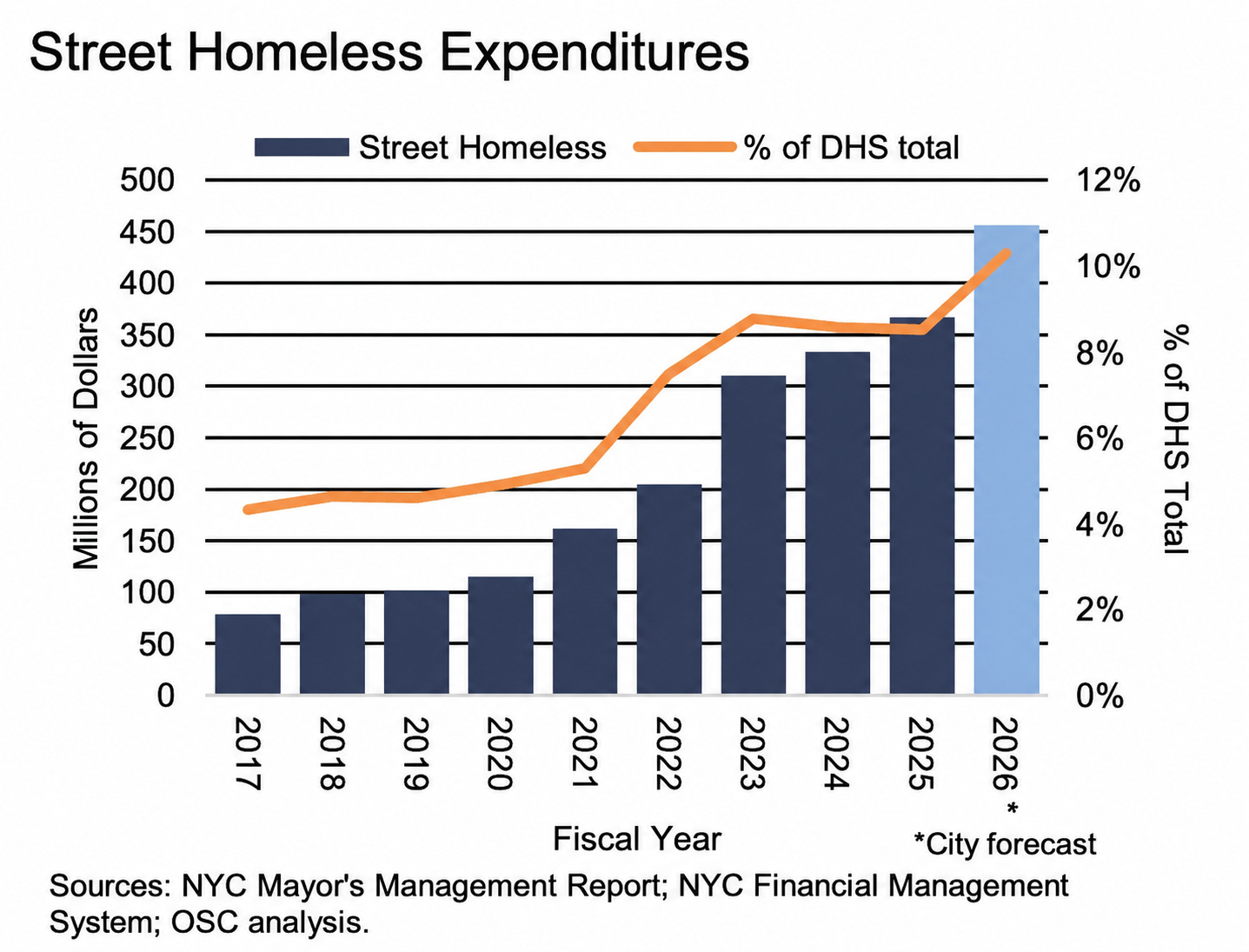
No surprises for guessing Mamdani’s solutions for the city’s Big 3 problems…
On homelessness: more public housing... more housing vouchers... more rental assistance... and a $1.8 billion government contract with the city’s hotels to serve as an emergency homeless housing system…
On crime: a new Department of Community Safety, expanded mental-health response teams, and a public safety plan estimated to cost the city $1.1 billion... (from a man who actively supported Defund the Police during the BLM riots)…
On poverty: universal childcare, free buses, city-owned grocery stores, rent freezes, higher minimum wages...and an endless catalogue of collectivist gimcrackery that Argentina just spent the past 75 years proving does not work. How, exactly, Mamdani proposes to pay for all these trinkets and freebies is up for debate, especially as the billionaire exodus (we mentioned in this Note) gathers pace.
And what about Sr. Milei? How have his free market policies been working down this End of the Americas? Is there any place left for a street fighting man? Stay tuned for more Notes From the End of the World..."
Subscribe to:
Posts (Atom)