"You've seed how things goes in the world o' men. You've knowed men to be low-down and mean. You've seed ol' Death at his tricks... Ever' man wants life to be a fine thing, and a easy. 'Tis fine, boy, powerful fine, but 'tain't easy. Life knocks a man down and he gits up and it knocks him down agin. I've been uneasy all my life... I've wanted life to be easy for you. Easier'n 'twas for me. A man's heart aches, seein' his young uns face the world. Knowin' they got to get their guts tore out, the way his was tore. I wanted to spare you, long as I could. I wanted you to frolic with your yearlin'. I knowed the lonesomeness he eased for you. But ever' man's lonesome. What's he to do then? What's he to do when he gits knocked down? Why, take it for his share and go on.”
"The old FedEx envelope was clever, a work of art even, optimistic and colorful, signifying speed and progress. What a beautiful contrast to the plainness of the U.S. Postal Service. For years, I can recall dropping off these treasures and paying maybe $10 to assure their delivery across the country, even the world. For me, it was a fabulous symbol of an improved life, living proof that progress was baked into the historical trajectory.
But a few days ago, the clerk at the FedEx office confirmed a different ethos. There was no doing business without a scan of my government-issued ID. I asked for confirmation: So if I did not have this, there is simply no way that I could send a package? Confirmed. Then came the envelope. It was the color of the brown bag I took to school when I was a kid. Serviceable, drab, dull. Also the new one is stamped with a big green marker: recyclable. There is no design, no art, certainly no beauty. It’s all gone.
Its main message is suffering. What happened to the old envelopes? They’ve been replaced, the clerk explained firmly, with no more detail. A recycle exhortation suggests shortage. We have to reuse everything because there just isn’t enough to go around. We must sacrifice. The color suggests privation. It’s an aesthetic of sadness and penance. Then of course the price tag came: $26 for delivery not tomorrow but in two days. So compared with some years ago, we pay 2½ times as much for service half as good as it was.
Don’t complain. It’s just the new way. It’s the new way of life. What happened to progress? It’s been replaced. The new path is flagellantism: in politics, culture, economics and everywhere.
The flagellants were a medieval movement of public penitents that roamed from town to town in garbs of woe, flogging themselves and begging as penance for pestilence and war. They were infused with a fiery, apocalyptic and millenarian passion that they could see terrible moral realities to which others were blinded. The theory was that plagues were being visited upon the Earth by God as punishment for sin. The answer was contrition, sorrow and acts of penance as a means of appeasement, in order to make the bad times go away.
It’s true that there were people who did so in private but that was not the main point. The central focus and purpose of the flagellant movement was to make one’s suffering public and conspicuous, an early version of the virtue signal. In the guise of personal sorrow, they were really about spreading guilt to others. They would show up at any public celebration with a message: Your happiness is causing our suffering. The more you party, the more we are forced to bear the burden of the need to be in pain for your sins. Your joy is prolonging the suffering of the world.
Flagellantry is most recognizable in the aesthetic. The first signs I recall seeing of this occurred immediately during the panic of March 2020 when it was proclaimed from on high that a terrible virus was visiting the U.S. Read on for the ugly details…
"Flagellantism: The New Political Ritual"
by Jeffrey Tucker
"No, you couldn’t see the virus, but it is highly dangerous, everywhere present, and should be avoided at all costs. You must wash constantly, douse yourself with sanitizer, cover your face, dress in drab color and be sad as much as possible. Fun things were banned: public gatherings, singing, house parties, weddings and all celebrations. This whole scene took on a political patina, as people were invited to think of the invisible virus as a symbol of a more tangible virus in the White House, an evil man who had invaded a holy space whose malice had leaked out in the culture and now threatened to poison everything.
The more you complied with mandatory misery, the more your work made a contribution to making the pestilence go away while we wait for the inoculation. That could take two forms: driving him from the White House or releasing the vaccine which everyone would accept.
Joseph Campbell was correct about the role of religious impulses in the human mind. They never go away. They just take on different forms according to the style of the times. Every single feature of traditional religion found a new expression in the COVID religion.
We had masking rituals that were rather complicated but learned and practiced quickly by multitudes: mask on while standing and mask off when sitting. We had sacramentals like social distancing and communion with vaccination. Our holy water became sanitizer and our prophets on Earth were government bureaucrats like Fauci.
Flagellantism did not disappear once the old president left and the new one came. Even after the pandemic ended, there were new signs that God was angry. There was the ever-present climate change which was a sign of Earth’s anger for being drilled and carved up for energy sources. And the bad country said to be responsible for the unwelcome invader of the White House - Russia - was now rampaging through the holy land of its neighbors.
In addition, the broader problem was capitalism itself, which gave us things like meat, gasoline, fur and other signs of evil. And what gave rise to capitalism? The answer should be obvious: imperialism, colonialism, racism and the existence of whiteness - each of which called for mass penance.
The pandemic unleashed it all. It was during this period that corporations decided that profitability alone required signs of suffering and hence the rise of ESG and DEI as new ways to assess economic value of corporate culture. And new practices were added to the list of the highly suspect: monogamy, heterosexuality and religious traditions such as Christianity and Orthodox Judaism that should now be regarded as deprecated, even as part of the underlying problem.
It was during this period when I found myself on an apartment hunt and observed a newly remodeled offering. I asked why the owner had not replaced the flooring. I was corrected: These are new floors. Impossible, I thought. They are gray and ghastly. That’s the new fashion, I was told. Looking it up, it was true. Gray flooring was being installed everywhere.
How does wood become gray? It dies. It starts to decay. It is swept away by rivers and floats around for years, alternatively soaked, baked by the sun and soaked again, until every bit of color is drained away. It becomes driftwood, a survivor of the elements and a symbol of the brutality of the cycle of life. Gray flooring is therefore the ideal symbol of the age of suffering, the proper material on which to move back and forth pondering the evils of the world.
In a world governed by flagellantism, ugly formlessness rises to replace aspirational art and imaginative creativity. This is why public art is so depressing and why even the clothing we can afford at the store all looks dreary and uniform. In this world, too, gender differences disappear as luxurious signs of decadence we can no longer afford.
Two other anecdotes. The overhead bins on the flight just now were largely empty, simply because most passengers chose the cheaper basic economy fare. This also requires they have no carry-on luggage and hence be forced to pay for checked luggage or travel with all their belongings in a backpack. We’ve gone from gigantic Louis Vuitton steamer trunks to stuffing things in pockets and hiding them from authorities.
Another case in point. I asked the man in the high-end shoe shop why none of the shoes had leather soles. Instead all shoes have these cushy rubber soles that seem weak and pathetic, and make no noise when one steps. “Everything has changed since COVID,” he said. “All shoes are house shoes now.”
I had no words and walked away, my entire thesis confirmed. Sure enough, all the data we have suggests the mighty triumph of flagellantism. Fertility is down dramatically. Life spans are shortening. People are sicker. Excess deaths are rising. We learn less, read less, write less, create less, love less.
Personal trauma is everywhere. The groceries are more expensive so we eat whatever we can, when we can, while hoping for breezes and whatever sunlight there is to provide just the essential energy we need to slog through another day.
Degrowth is the economic model of flagellantism, reducing consumption, embracing privation, acquiescing to austerity. We no longer declare recessions to be on their way because recession is the new way we live, the realization of the plan. The word “recession” implies a future of recovery, and that is not in the cards.
“Decolonization” is another watchword. It means feeling so guilty about the space you inhabit that your only moral action is to stay put and reflect on the sufferings of those you have displaced. You can of course say a prayer of supplication to them, so long as you never appropriate any aspect of their culture, since doing so would seem to affirm your rights as a human being.
You want joy, beauty, color, drama, adventure and love? It’s not gone entirely. Park yourself on a yoga mat on your gray floor and open your computer. Stream something on one of many streaming services you have been provided. Or become a gamer. There you will find what you seek. The experiences you seek you can only observe as an outsider looking in. It is not participatory. Social distancing never went away; it is how we live in a new age of unending penance.
So, you see, it’s not just about eating bugs. It’s about a whole theory and practice of life and salvation itself, a new religion to replace all the old ones. Cough up your government-issued ID, send your package if you must, think twice before complaining about anything on social media and figure out a way to channel your depression and despair into quiet humble gratitude and acquiescence. Don’t forget to recycle. The flagellants have taken over the world."
"In a scene from the 1975 film "Monty Python and the Holy Grail," a group of monks are depicted singing plainchant while on a procession through the streets of a medieval village. After chanting the first few lines of text, the monks abruptly hit themselves in the face and repeatedly do so during their procession. Although this scene was undoubtedly filmed for comedic purposes, and the movie, in general, propagates a number of historically questionable stereotypes of the Middle Ages, the act of monks singing while engaging in self-harm is historically sound. In fact, this scene reflects the practices of a group of traveling medieval flagellants who would whip themselves while singing songs of penance for the purpose of placating God."
“We are all alone, born alone, die alone, and - in spite of True Romance magazines - we shall all someday look back on our lives and see that, in spite of our company, we were alone the whole way. I do not say lonely - at least, not all the time - but essentially, and finally, alone. This is what makes your self-respect so important, and I don’t see how you can respect yourself if you must look in the hearts and minds of others for your happiness.”
"Scientists have detected strange electromagnetic pulses beneath the Antarctic ice, first theorized by Soviet physicists 60 years ago. What's really down there? Admiral Byrd's secret diary, a massive hole obscured on Google Earth, Russian scientists battling an unknown creature, UFO sightings, Nazi base theories, and an ice cube neutrino detector off-limits to civilians."
"The Artifacts That Should Not Exist: Experts Are Quietly
Raising Concerns About Artifacts That Do Not Fit Our History"
by Milan Adams
"There is a strange pattern in archaeology that no one officially talks about, yet anyone who spends enough time digging through old reports, forgotten journals, and obscure museum records will eventually notice it. Every few decades, somewhere in the world, an object is discovered that does not quite belong to the time it is found in. Not dramatically out of place in a way that screams impossibility, but subtly wrong in a way that makes experts uncomfortable. Too precise. Too advanced. Too refined. Too… early.
Individually, each discovery is easy to dismiss. A dating error. A misinterpretation. A hoax. Contamination of a site. The explanations are always reasonable when viewed in isolation. But when you start lining them up side by side, across continents and centuries, the pattern becomes harder to ignore. The same types of anomalies appear again and again, discovered by different people, in different places, in different eras, all pointing toward the same unsettling implication: there are objects in our historical record that do not fit the timeline we teach.
What makes this particularly unsettling is not the objects themselves, but the reaction they tend to provoke. These are not celebrated discoveries. They do not become the centerpieces of museums. They are rarely the subject of documentaries. They are mentioned briefly, cautiously, in academic literature, and then quietly fade into obscurity. Not because they were debunked, but because discussing them too openly creates questions that lead somewhere uncomfortable.
Questions about when certain knowledge really appeared. Questions about how advanced ancient people truly were. And eventually, questions about whether the story of human progress is as linear and straightforward as we have always assumed.
One of the most telling examples of this discomfort can be seen in the way certain discoveries are described. When historians encounter a normal artifact, the language is confident. Direct. Precise. But when they encounter something that challenges the framework, the wording becomes careful, almost defensive. Words like “anomalous,” “uncertain,” “unusual for its time,” begin to appear. The object is not denied, but it is linguistically softened, wrapped in layers of cautious phrasing until its implications no longer seem threatening. Because the real issue is not what these artifacts are. It is what they imply.
Over the past century, a quiet category of objects has accumulated in museum archives and academic footnotes. Objects that appear to skip entire stages of technological evolution. Objects that seem to appear fully formed, with no visible developmental history leading up to them. Objects that suggest that at certain moments in the past, people possessed knowledge that, according to our timeline, they should not have had yet.Devices of surprising mechanical complexity found in ancient shipwrecks, capable of tracking astronomical cycles with a precision that rivals early modern instruments.
Megalithic stone constructions in South America and elsewhere, where blocks weighing dozens of tons are cut and fitted together with a mathematical precision that modern engineers still struggle to replicate using only the tools those cultures supposedly had. Metallic or manufactured objects reportedly found embedded in geological formations far older than the civilizations that could have produced them, documented in 19th and early 20th century reports before quietly being dismissed as errors. Taken alone, each of these can be explained away. But taken together, they begin to suggest that something is missing from our understanding of the past.
Consider the mechanical device recovered from an ancient Mediterranean shipwreck in the early 1900s. At first it looked like a lump of corroded bronze. Only later did researchers realize it contained a complex system of interlocking gears. After decades of study, it became clear that this was a form of ancient astronomical calculator, capable of predicting celestial movements with astonishing accuracy. The official explanation today acknowledges its sophistication, but what is rarely emphasized is the absence of any evolutionary trail leading up to it. There are no simpler prototypes. No earlier versions. No gradual technological buildup that we can point to and say, “this is how they got there.” It appears in history fully realized, like a machine that had no childhood. That is what makes experts uneasy. Not that it exists, but that it exists without a clear lineage.
Full screen recommended.
A similar unease surrounds certain stone structures in the Andes. Tourists marvel at the perfectly cut stones, the seamless joints, the walls that have withstood centuries of earthquakes without collapsing. Guides explain that ancient builders used primitive tools and immense patience. But engineers who study the sites often admit, quietly, that the precision is difficult to explain. Some stones appear shaped in ways that suggest they were not simply chiseled, but manipulated while in a state we do not fully understand. Local legends speak of stones that could be made to “flow” or “soften.” Modern science dismisses these stories as myth, yet no one has conclusively demonstrated how the stones were shaped with the tools we believe were available. Again, the site is not hidden. It is famous. Photographed. Studied. But the deeper question is avoided: what technique was used here, and why do we not recognize it?
Then there are the stranger reports, the ones that rarely make it into modern discussions. Accounts from miners in the 1800s who claimed to find manufactured objects inside solid coal. Reports of metallic spheres discovered in ancient mineral deposits in South Africa. Nails allegedly found embedded in sandstone. These stories are usually dismissed immediately as hoaxes or misunderstandings, and perhaps many of them were. But what is striking is how often similar stories appear, told by people with no connection to one another, separated by geography and time, all describing the same unsettling detail: objects where they should not be.
The academic approach to these cases is consistent. Treat each one individually. Isolate it. Dismiss it. Never allow them to be viewed collectively as a pattern. Because if even one of them were genuine in its original context, it would imply something deeply destabilizing. Either our methods of dating geological layers are flawed, or human history is far older and more complex than we believe, or there were advanced cultures before recorded history that left almost no trace behind. Any of these possibilities would require rewriting history books across the world. And history, once established, is not easily rewritten.
This is where the discomfort becomes understandable. History is not just a record of the past. It is the foundation of education, national identity, academic authority, and entire scientific disciplines. To suggest that this foundation might be incomplete is not a small academic correction. It is a structural problem. It threatens credibility. And credibility is the currency of academia.
So the safer path is to keep these artifacts in a category that is neither fully accepted nor fully rejected. They are curiosities. Anomalies. Interesting footnotes. Never central pieces of the narrative. But the pattern remains. Across cultures that never had contact with each other, we find evidence of unexpectedly advanced astronomical knowledge. We find massive constructions that challenge our understanding of ancient engineering. We find myths from different continents describing lost knowledge, lost civilizations, and catastrophic collapses that forced humanity to start over from a primitive state.
These stories are treated as legend. But what if they are memory? Distorted by time, yes. Exaggerated, perhaps. But rooted in something real that has been slowly eroded by thousands of years of forgetting. Because the real danger of these artifacts is not that they are mysterious. It is that they suggest we may not be at the beginning of human progress. We may be somewhere in the middle of it. And if that is true, then the most unsettling question is no longer how these objects were made. It becomes: what happened to the people who knew how to make them?
The Quiet Disappearance of Evidence, Institutional Memory and Selective Attention: If the first layer of discomfort surrounding anomalous artifacts lies in their existence, the second lies in what happens after they are discovered. Contrary to popular imagination, these objects are rarely hidden in any dramatic or conspiratorial sense. They pass through official channels. They are documented, photographed, sometimes even displayed briefly. For a moment, they exist fully within the light of academic scrutiny. And then something more subtle occurs.
Attention shifts. Not abruptly, not suspiciously, but in a way that mirrors the natural rhythm of institutional research. Priorities evolve. Funding is redirected. New discoveries emerge that fit more comfortably within established frameworks, drawing focus away from those that do not. Over time, the anomalous becomes peripheral, and the peripheral becomes forgotten - not erased, but effectively removed from active discourse.
This process creates a form of selective memory, not enforced by any central authority, but produced organically by the structure of academia itself. Systems that depend on consistency tend to favor information that reinforces existing models. Data that introduces friction -especially unresolved friction - is gradually deprioritized, not because it is false, but because it is inconveniently incomplete.
What remains, decades later, is a scattered trail of references. A paper from the early 20th century noting an unusual metallic composition. A geological report mentioning an object embedded deeper than expected. A museum record describing an item that no longer appears in the public catalog. Each fragment, taken alone, is insignificant. Together, they form something more difficult to dismiss: a pattern of quiet disappearance.
It is important to emphasize that this does not require intentional suppression. It is, in many ways, more unsettling than that. It suggests that the system does not need to hide uncomfortable data - it simply needs to outlast it. Because attention is finite. And what is not actively discussed eventually ceases to exist in any meaningful sense.
Cartographies of the Unexplained: If one were to map these anomalies - not geographically alone, but temporally and typologically - a striking structure begins to emerge. The objects cluster, not randomly, but along faint lines of correlation that are rarely explored in mainstream analysis. What this simplified table suggests is not proof of a lost civilization or hidden technology, but something more structurally intriguing: repetition without continuity. The same categories of anomaly - precision, complexity, material inconsistency - appear across different regions and time periods without a clear evolutionary bridge connecting them.
In conventional models of technological development, innovation leaves traces. Early attempts, failed designs, gradual refinements. A progression that can be followed, even if imperfectly. But in these cases, that progression is either missing or incomplete. Instead, what we observe are punctuated appearances - moments where something unexpectedly advanced emerges, only to vanish from the developmental record.
If visualized as a map, the pattern would not resemble a steady expansion of knowledge, but a series of isolated peaks rising from an otherwise uneven landscape. Peaks that do not connect to one another in obvious ways, yet share underlying characteristics. This raises a question that is rarely addressed directly: are these truly isolated events, or are we only seeing fragments of a larger structure that has not survived intact? Because absence of evidence, in this context, does not necessarily imply absence of reality. It may simply reflect the limits of what has been preserved, discovered, or recognized. And if what we are seeing are fragments, then the full picture - whatever it once was - has been reduced to scattered signals, barely coherent, and easily ignored.
The Hypothesis of Interruption, Non-Linear Histories: The dominant model of human development is built on continuity. A gradual progression from simplicity to complexity, from primitive tools to advanced systems, from isolated knowledge to interconnected understanding. It is a model that works well because it aligns with most of the evidence we can clearly observe. But it is not the only model that fits the data.
There exists another possibility - one that is rarely formalized, but often implied in the margins of anomalous research. A model not of continuous growth, but of interrupted cycles. Periods of advancement followed by disruption, where knowledge is not steadily accumulated, but periodically lost. In such a framework, the anomalies cease to be anomalies. They become survivals.
Residual artifacts from phases of development that did not continue long enough to establish a visible lineage. Technologies that existed briefly, perhaps locally, perhaps more widely, before being erased by events that left little trace in the conventional archaeological record. This would explain why certain objects appear without precedent. Why techniques seem to emerge fully formed. Why myths from unrelated cultures describe similar narratives of collapse - floods, fires, darkness, the loss of knowledge, the need to begin again. Not as literal historical accounts, but as cultural echoes of real disruptions, filtered through memory and transformed over generations. In this model, history is not a straight line. It is a series of partial resets.
The Problem of Survival Bias: To understand how such a pattern could exist without dominating our current historical framework, one must consider a simple but powerful concept: survival bias. What we know about the past is not a complete record. It is a filtered one. Materials decay. Structures collapse. Knowledge stored in fragile mediums - organic matter, oral traditions - disappears far more easily than stone or metal. Catastrophic events, whether environmental or otherwise, do not erase everything equally. They select. They preserve some things while eliminating others.
If a period of advanced knowledge relied on systems that were not designed to endure - complex devices, perishable materials, localized infrastructure - then the likelihood of that knowledge surviving in recognizable form decreases dramatically over long timescales. What might remain are precisely the kinds of objects we now struggle to explain: unusually durable, structurally resilient, or accidentally preserved artifacts that outlasted the context that gave them meaning.
This creates a distorted picture. We do not see the system - only the fragments that survived its collapse. Imagine attempting to reconstruct modern civilization thousands of years in the future based solely on what is most likely to endure: a handful of engineered structures, scattered mechanical components, and incomplete records stripped of their context. The result would not resemble a coherent narrative. It would appear fragmented, inconsistent - perhaps even anomalous. Much like the record we are currently examining."
"The Revolutionary Spirit of Iran (w/Behrooz Ghamari)"
"The United States, in its recent war on Iran, has completely misread the Iranian people and failed to recognize the deep revolutionary spirit that pervades Iranian culture. Rather than inciting Iranian people against their government, the US-Israeli war on Iran has united the population. Rather than promoting democracy in Iran and empowering the people, US economic punishment and aggression have accomplished the opposite and have made life more difficult for most Iranians. Like Cuba, Iran is being targeted because it will not relinquish its sovereignty. As Chris Hedges explains, Iran is being punished for “its refusal to become a client state aligned with American interests in the region.”
In this episode, Hedges speaks with Professor Behrooz Ghamari-Tabrizi, the author of “The Long War on Iran: New Events, Old Questions” (OR Books, January 2026). Ghamari is currently a visiting scholar at the Center for Place, Culture and Politics at the CUNY Graduate Center in New York. In his book, Ghamari tackles the myths perpetuated by the United States to demonize Iran in order to justify the imposition of severe sanctions and to go to war on Iran twice in less than one year. He discusses the many reasons why the Islamic Republic does not trust the United States to negotiate in good faith.
Year zero in the current struggle, Ghamari explains, was 1953 when the United States and the United Kingdom conducted a successful coup of the democratically elected Prime Minister Mohammad Mossadegh. This led to the Iranian Revolution in 1979, described by Ghamari as “the largest, most populous revolution in world history [that] defeated the fifth largest military in the world at the time.” Following that, events such as the Eight Year War, in which the United States provided the tools for chemical warfare on Iranians by Iraq, and the betrayal of Iran by President Bush, calling it part of the Axis of Evil despite Iran playing an instrumental role with the US in defeating the Taliban in Afghanistan, have created the conditions for “ the transfer of collective revolutionary consciousness generation after generation.”
Ghamari discusses Iran’s support for the Axis of Resistance as a way to create a “Ring of Fire” around it, opportunities to struggle against US and Israeli imperialism outside of Iran’s borders with the hope of avoiding a war at home. He states that initially Iranians opposed the use of resources to support Palestinians, Hezbollah and the defense of Syria, but now they understand the utility. Iranians see themselves in these struggles, and that is why a popular movement has taken the streets night after night against US attacks.
The outcome of the current conflict is uncertain, but Ghamari theorizes, and Hedges agrees, that Iran has a strong hand to play and the best result would be a return to a lifting of the economic sanctions in return for limits on Iran’s nuclear enrichment efforts, as was agreed in the Joint Comprehensive Plan of Action in 2015. The wildcards are the United States and Israel, who may be unwilling to compromise and may resort to dropping nuclear bombs in desperation."
"Every single day that the Strait of Hormuz is closed, the damage that is being done to the global economy is getting even worse. But the full consequences of the global oil crisis that we are facing will not be felt for a while because nations all over the globe are still running through their strategic oil reserves. And the full consequences of the global fertilizer crisis that we are facing will not be felt until harvest season. So don’t judge the severity of this emergency by what we are experiencing at this moment, because the truth is that what we are experiencing at this moment is just the very small tip of a very large iceberg.
This week, it appears that more people out there are starting to understand that the Strait of Hormuz is not going to be reopened any time soon. On Wednesday, President Trump explained that he is not going to lift the U.S. naval blockade of Iranian ports until Iran agrees to give up their nuclear program… US President Donald Trump told Axios that he would keep Iran under a naval blockade until Tehran agreed to a deal addressing US concerns over its nuclear program. “The blockade is somewhat more effective than the bombing,” Trump was quoted as saying. “They are choking like a stuffed pig. And it is going to be worse for them. They can’t have a nuclear weapon.”
Trump said Iran wanted a deal to lift the blockade, but added he did not want to do so unless Tehran was prevented from obtaining a nuclear weapon. “They want to settle. They don’t want me to keep the blockade. I don’t want to [lift the blockade], because I don’t want them to have a nuclear weapon,” he said.
“It is forbidden to hold any negotiation on the right to enrich uranium. This issue falls outside the negotiation’s framework. This contradicts the position of the Supreme Leader and is forbidden from a jurisprudential standpoint.” Over and over again, Iran has steadfastly refused to even negotiate about their “right” to enrich uranium. But Trump seems to be convinced that if he just puts enough pressure on the Iranians they will eventually change their minds. We shall see.
The Iranians know that midterm elections are looming in the United States, and so the clock is ticking for Trump. If the Democrats take control of both houses of Congress, they would likely force Trump to end the blockade and leave Iran alone. So from an Iranian point of view, all they have to do is hold out until the end of the year and they win. Meanwhile, the global economy just continues to suffer.
Even if the Strait of Hormuz reopened tomorrow, it would still take up to 6 months to fully clear all of the mines that have been laid… It could take six months to fully clear the Strait of Hormuz of mines deployed by the Iranian military, and any such operation is unlikely to be carried out until the U.S. war with Iran ends, the Pentagon has informed Congress - an assessment that means the conflict’s economic impact could extend late into this year or beyond.
A senior Defense Department official shared the estimate, which has not been previously reported, during a classified briefing Tuesday for members of the House Armed Services Committee, said three officials familiar with the discussion. The timeline - met with frustration by Democrats and Republicans alike, two of these people said - is perhaps the clearest sign that gasoline and oil prices could remain elevated long after any peace deal is reached.
And it isn’t just a matter of restoring the flow of traffic through the Strait. Oil production in the Persian Gulf region is down 57 percent from pre-war levels. Thanks to damage that has already been done during this war, it will literally take years for production to return to 100 percent.
The head of the International Energy Agency is warning that we are facing “the greatest energy security crisis in history”… Fatih Birol, chief executive of the International Energy Agency, has called the ongoing closure of the Strait of Hormuz “the greatest energy security crisis in history”, insisting it is “more serious” than the previous energy shocks in 1973 (when some Arab states imposed an oil embargo on the West), 1979 (caused by the Iranian revolution) and 2022 (Ukraine) “put together”.
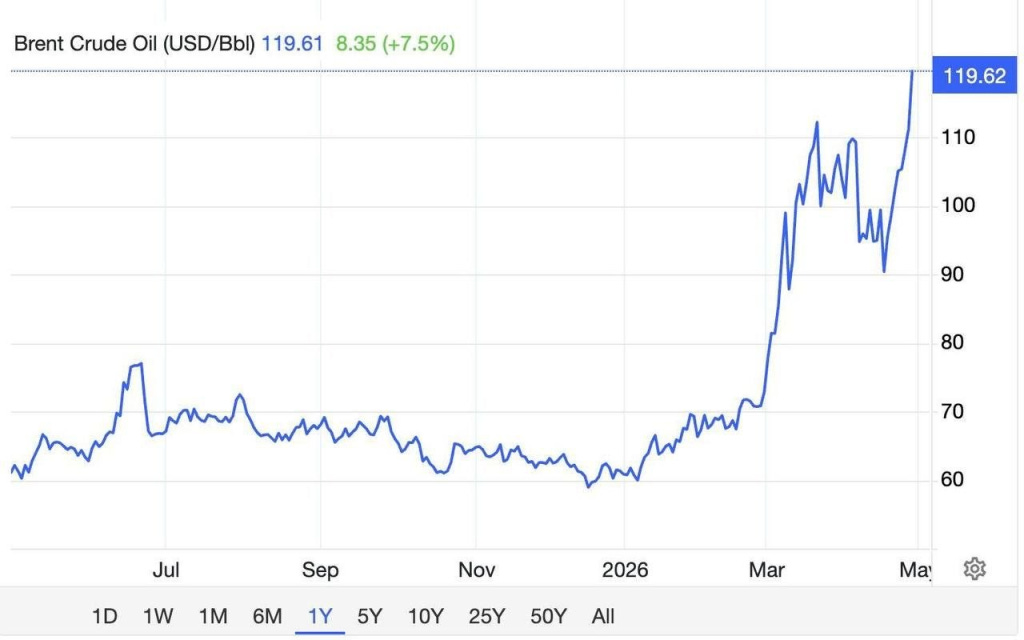
In a book that I authored during the early part of 2025, I discussed the fact that a great conflict in the Middle East would cause oil prices to rise dramatically. And that is precisely what has occurred. On Wednesday, oil prices rose to the highest levels that we have seen during this war so far… Oil prices jumped more than 6% on Wednesday, after President Donald Trump said he will maintain the U.S. naval blockade against Iran until they agreed to a nuclear deal. International benchmark Brent crude futures rose more than 6% to $118.33 per barrel by 12:10 p.m. ET, U.S. West Texas Intermediate futures also advanced more than 6% to $106.37 per barrel.
If the Strait of Hormuz remains closed, this will only be just the beginning. A lot of people are freaking out because the average price of a gallon of gasoline in the United States is now well above 4 dollars a gallon… U.S. gas prices have hit a fresh record since the start of the war with Iran, rising to an average nationwide of $4.23 per gallon Wednesday, according to the motor club AAA. The grim milestone comes as oil prices have surged higher over the past week amid a dual blockade by the U.S. and Iran of the Strait of Hormuz, the key chokepoint in the region for transiting crude and petroleum-based products out of the Persian Gulf. If people are freaking out now, what will they do when the price of gasoline goes much higher?
Meanwhile, we are also facing the worst global fertilizer crisis in history by a very wide margin…More than half of the Middle East’s urea output may have been lost since the start of the Iran conflict, which is continuing to disrupt fertilizer flows from the region and threatening global food inflation.
The effective closure of the Strait of Hormuz has choked shipments of urea, a key component in nitrogen fertilizers, leaving large volumes stranded in the Gulf and tightening supplies for farmers around the world. At the same time, Iranian drone attacks on nations including Qatar and Bahrain have damaged energy and industrial infrastructure, hindering production of the chemical itself.
That has forced urea manufacturers in the region to curb operations, with 55% to 60% of output potentially halted, according to consultancy CRU Group. Without sufficient supplies of nitrogen fertilizer, we can’t even come close to growing enough food to feed everyone on this planet. In other words, we really are facing a scenario in which large numbers of people in impoverished nations could end up starving.
At the same time, U.S. wheat farmers are facing the worst drought in the heartland of America since the Dust Bowl days of the 1930s… U.S. wheat futures rallied to the highest in nearly two years Tuesday, as drought in U.S. Plains wheat fields pressures yields while soaring fertilizer costs have caused farmers to trim planting of nutrient-intensive crops such as grains. CBOT wheat futures surged after the latest Crop Progress report from the U.S. Department of Agriculture said only 30% of the winter wheat crop is in good or excellent condition as of April 26.
The amount of winter wheat that gets harvested this year is going to be very disappointing. Looking ahead, it is being projected that the number of acres of wheat that U.S. farmers are planting in the spring will be the fewest “since record keeping began in 1919”… U.S. growers were poised to plant the fewest acres of wheat since record keeping began in 1919, as high costs for fertilizer, seeds, and equipment have made it difficult to turn a profit. Yes, this is really happening. If you think that the price of cookies is high now, you should brace yourself, because you haven’t seen anything yet.
In some areas of the country, conditions are so exceedingly dry that it just doesn’t make sense for farmers to try to grow anything. Dane Wigington is warning that we are heading into a “summer from hell”… What is going to happen when summer starts? Wigington says, “This is the summer from Hell that we are approaching right now. This will be like no other. The snow pack in the Colorado River watershed is almost nonexistent. The snowpack in the Sierra Nevada averages about 20%. In the Northern Sierra, it is about 5%. That’s 5% of normal. Why isn’t that headline everywhere? People have no idea what is coming. What will happen in the Southwest? We are going to find out soon. Right now, they are frantically discussing desalination facilities in the Gulf of California. That is idiocy and not going to save anything. It can’t be done in any time frame that matters.”
This isn’t a coincidence. Most of my regular readers already understand this. If you look at the latest U.S. Drought Monitor map, it looks like a horror show. There is no easy way out of this. It will take some time for the full consequences of this nightmare to arrive, but when they do our society will experience immense pain."
"The housing market is sending a massive warning signal right now - and most people are missing it. With over 53,000 real estate contracts canceled in a single month, buyers are backing out at record levels. This isn’t speculation - these are signed deals falling apart during escrow. In this video, I break down what’s really happening behind the scenes, why cancellations are surging, and what it means for home prices, inventory, and your ability to negotiate in today’s market. We’re also exposing the biggest myth in real estate right now - the so-called “housing shortage.” With hundreds of thousands more homes for sale than buyers, the power dynamic has shifted. If you’re thinking about buying, selling, or investing, you need to understand where the opportunities are and how to avoid costly mistakes. This is a buyer’s market - but only if you know how to play it."
"Let me start with the Saturday event which is being falsely labeled as an assassination attempt on President Trump. This was a breach of a security checkpoint. Although much of the media coverage has reported the man was carrying a shotgun, the video footage does not support that claim. Running full tilt and trying to fire a shotgun accurately is very difficult to do. I cannot tell if Cole, the alleged shooter, had his semi-automatic pistol in his hand.
What the grainy video footage show is a uniformed officer on the left side of the screen taking at least four shots at Cole. The image below shows a clearer picture of the shots fired by the uniformed officer. It appears that one of those shots hit the Secret Service agent in the vest. How Cole was apprehended, without suffering a single wound from the multiple shots fired, is astonishing. I have heard one report that he tripped and fell, which may explain how he was apprehended without being filled full of lead.
What about the officer or agent who caught a bullet in his body armor? It is possible that was caused by friendly fire and was not the result of Cole firing the pistol. I find it very odd that the Trump White House and the Trump supporters on social media immediately began posting the meme that this would not have happened in the Big Beautiful Ballroom that Trump is trying to build next to the White House. The only problem with that meme is that the failure to have a proper security checkpoint at the Hilton could also be replicated in the new ballroom that Trump wants to build.
Paul Mills told me yesterday that there is a video, completely unrelated to the Saturday escapade, where Cole is showing off his wheel chair invention… In the background is his Indian wife talking to the wife of JD Vance, who also is Indian. Does this explain why Cole gave Kash Patel a pass in his manifesto? A lot of questions need to be answered.
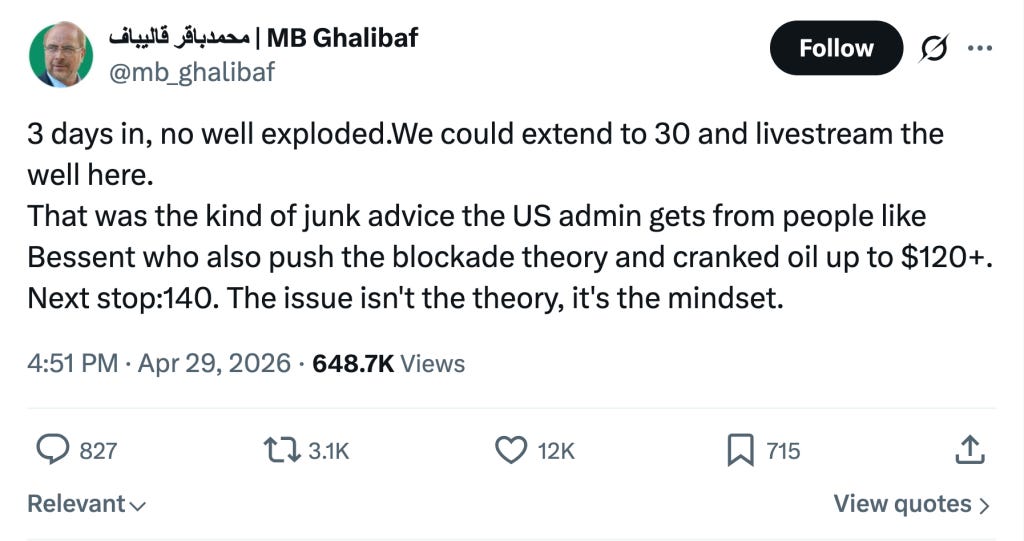
Now to Iran… Take a look at one of the recent social media posts from the Iranian Speaker of the Parliament, MB Ghalibaf:
محمدباقر قالیباف | MB Ghalibaf@mb_ghalibaf
3 days in, no well exploded.We could extend to 30 and livestream the well here. That was the kind of junk advice the US admin gets from people like Bessent who also push the blockade theory and cranked oil up to $120+. Next stop:140. The issue isn't the theory, it's the mindset.
Ghalibaf is ridiculing Scott Bessent’s wild claims that the blockade is going to destroy Iran’s ability to export oil. He clearly is not concerned and is mocking Bessent’s insistence that Iranian oil wells are on the verge of collapsing. Trump’s blockade is driving up the price of oil, as illustrated in the following chart:
US Navy ships are staying 200 miles offshore from the Iranian coast. If they try to move closer to the Iranian coast they will be vulnerable to missile and drone attacks. All Iran has to do is sail its tankers 50 miles offshore in order to bypass the US blockade, which appears to be what Iran is doing.
Reuters/Kpler data reported at least 6 ships crossed in the 24 hours covering April 29 (mostly dry bulk carriers and some through Iranian waters, including sanctioned vessels like the Vast Plus chemical tanker). Other tracking (e.g., Anadolu Agency/Windward) noted around 13–14 total transits in similar periods, far below the pre-war norm of 125–140 daily.
Iranian vessels dominate the limited traffic: Many (often about half in recent days) load at Iranian ports in defiance of the US blockade and use IRGC-designated routes. A Fars News Agency report (via Middle East Monitor) claimed 52 Iranian vessels (31 oil tankers + 21 cargo ships) breached the blockade in a 72-hour window ending around April 28. This suggests a notable number of Iranian-linked movements around that time, but no breakdown isolates April 29 alone.
While Western media continues to insist that Iran is suffering terrible economic privations, the opposite seems to be the case. Trump is under enormous pressure from this Zionist donors to renew attacks on Iran while General Caine and the Commander of Centcom are advising strongly against renewing the air war with Iran. I believe that the warhawks, especially Bibi Netanyahu, are insisting that Iran be attacked again and that Donald Trump will ultimately cave to their demands."
the people shouldn’t be afraid of the government.”
- Edward Snowden
“The freedom of a country can only be measured by its respect for the rights of its citizens, and it’s my conviction that these rights are in fact limitations of state power that define exactly where and when a government may not infringe into that domain of personal or individual freedoms that during the American Revolution was called “liberty” and during the Internet Revolution is called “privacy.” - Edward Snowden
"None of what is happening is an accident or happenstance. Everything that has happened since 2019 is part of their diabolical plan to impoverish, cull, and enslave you in a technological gulag, sold to the ignorant masses as technological advancement, improvement of our lives, and protection from whatever bogeyman they designate. They want to digitize and electrify your entire existence, so they can control you, milk you like cows, and slaughter you at a time of their choosing.
The financial system began to unravel in September 2019 and the ruling class needed to accelerate their Agenda 2030 Great Reset plan. The Fed balance sheet, which had surged from $1 trillion in 2008 to over $4 trillion after the Wall St./Fed created financial crisis, was being reduced slowly to $3.8 trillion, but that was too much for our decrepit debt dependent system, and the repo market froze up.
The Fed panicked and started printing again. Conveniently, Gates and the WEF tested their fake pandemic plan at Event 201 in October 2019. They worked out the kinks and rolled it out across the globe in January 2020. Maximum fear and the greatest PR campaign in history for the annual flu resulted in a global shutdown, allowing the Fed to increase their balance sheet to $9 trillion, a 140% increase in a matter of months. Meanwhile, the politicians did their part by driving the national debt from $23 trillion to its current level of $39 trillion, a 70% increase.
It now requires more and more new debt to service the old debt ($1.3 trillion per year of interest on the debt), so the Fed was only able to get their balance sheet to just below $7 trillion, before the system started to break again. They have begun increasing it once more. Nothing like an unnecessary war on behalf of Israel to drive the national debt to above $40 trillion and keep the printing presses humming. They know this empire of debt is unsustainable and in imminent danger of collapse, so they are accelerating the AI based technological prison phase of their plan.
Does anyone in their right mind believe the thousands of data centers they want to build are to benefit the average person? Of course not. These data centers will power your enslavement. And if you think one of the political parties will save you, then you aren’t paying attention. The uni-party is designed to screw you and benefit themselves. Electric cars to save the planet was, and still is, a ridiculous idea, unless those controlling the levers of power want an easy way to automatically keep you from traveling. Since the electric car boondoggle has petered out, both parties cooperated to install kill switches in all gas powered new cars starting in 2027. How exactly is that beneficial to the average person. They hate you and do not care what you think or want.
It is the same story with the CBDCs. How do they benefit the average person? They don’t. They will be able to track and tax every transaction you make. They will be able to create a profile based upon your spending. They will then use their AI tools to determine pre-crimes and arrest you in advance. If you make a social media post or comment offensive to the empire, your social credit score will be downgraded and you will be denied travel and grocery privileges. This is the techno-gulag these billionaire psychopaths in suits dream about. And they are accelerating these plans at breakneck speed. When they decide to pull the rug on this teetering financial system, the CBDCs will be the lifeline they offer.
Ed Dowd, former portfolio manager at BlackRock: The COVID vaccines “were designed to take care of a pension problem with the boomers, and then bring in 10 to 15 million younger, mostly male folks as replacement population.”
Ed Dowd’s suspicions about the Covid scamdemic are entirely accurate. It was the lynch pin of the depopulation phase of the Great Reset. With the average age of death during Covid of over 80 (from remdesivir and ventilators), they relieved the financial pressure from Social Security and Medicare. The Covid “vaccine” has been the more insidious method of depopulation. Some batches murdered their injectees immediately. Other batches are killing people through myocarditis and turbo cancers. It caused pregnant women to lose their babies. And it has reduced fertility rates across the board.
Replacing native white Americans with low IQ third world dregs is alive and well. Trump is not deporting the tens of millions of illegal invaders, like he promised. Young foreign males commit an inordinate amount of crime and these lowlifes accelerate the destruction and bankruptcy of our welfare system. Both parties cooperated to not pass the SAVE Act, meaning they want illegals to vote in our elections and do the bidding of those pulling the strings.
The billionaire overlords want chaos, economic suffering, and the destruction of the traditional family. And they appear to be winning. If the citizens of this country had a backbone, this KILL SWITCH moment would trigger our current day Boston Tea Party. But, I’m afraid we are too far gone, too soft, too sedated, too distracted, too cowardly, and too dumbed down to notice. So it goes."
"What does Russia's newest shopping mall look like in 2026? Join me at Kraski Mall in Moscow, Russia, to discover what a brand new shopping mall in Russia really looks like inside. How have sanctions affected Russian shopping centers?"
“While drifting through the cosmos, a magnificent interstellar dust cloud became sculpted by stellar winds and radiation to assume a recognizable shape. Fittingly named the Horsehead Nebula, it is embedded in the vast and complex Orion Nebula (M42). A potentially rewarding but difficult object to view personally with a small telescope, the below gorgeously detailed image was taken in infrared light by the orbiting Hubble Space Telescope.
The dark molecular cloud, roughly 1,500 light years distant, is cataloged as Barnard 33 and is seen above primarily because it is backlit by the nearby massive star Sigma Orionis. The Horsehead Nebula will slowly shift its apparent shape over the next few million years and will eventually be destroyed by the high energy starlight.”
“So, how do you beat the odds when it’s one against a billion? You’re just outnumbered. You stand strong, keep pushing yourself against all rational limits, and never give up. But the truth of the matter is, despite how hard you try and fight to stay in control, when it’s all said and done, sometimes you’re just outnumbered.”
- “Meredith”, “Gray’s Anatomy”
○
“In the movie “The Lion in Winter”, when the sons, in the dungeon, think they hear Henry coming down the stairs to kill them:
Richard: ”He’s here! He’ll get no satisfaction out of us! Don’t let him see you beg! Take it like a man!”
Geoffrey: “You chivalrous fool! As if the way one falls down matters!”
Richard: ”Well, when the fall is all that’s left, it matters a great deal.”
"A man came home from work late again, tired and irritated, to find his 5-year-old son waiting for him at the door. "Daddy, may I ask you a question? " "Yeah, sure, what is it?" replied the man. "Daddy, how much money do you make an hour?" "That's none of your business! What makes you ask such a thing? " the man said angrily. "I just want to know. Please tell me, how much do you make an hour? " pleaded the little boy. "If you must know, I make $20.00 an hour. " "Oh," the little boy replied, head bowed. Looking up, he said, "Daddy, may I borrow $10.00 please?"
The father was furious. "If the only reason you wanted to know how much money I make is just so you can borrow some to buy a silly toy or some other nonsense, then you march yourself straight to your room and go to bed. I work long, hard hours everyday and don't have time for such childish games. " The little boy quietly went to his room and shut the door. The man sat down and started to get even madder about the little boy's questioning. How dare he ask such questions only to get some money?
After an hour or so, the man had calmed down, and started to think he may have been a little hard on his son. Maybe there was something he really needed to buy with that $10.00, and he really didn't ask for money very often. The man went to the door of the little boy's room and opened the door. "Are you asleep son?" he asked. "No daddy, I'm awake," replied the boy. "I've been thinking, maybe I was too hard on you earlier, " said the man. "It's been a long day and I took my aggravation out on you. Here's that $10.00 you asked for."
The little boy sat straight up, beaming. "Oh, thank you daddy! " he yelled. Then, reaching under his pillow, he pulled out some more crumpled up bills. The man, seeing that the boy already had money, started to get angry again. The little boy slowly counted out his money, then looked up at the man. "Why did you want more money if you already had some? " the father grumbled. "Because I didn't have enough, but now I do, " the little boy replied. "Daddy, I have $20.00 now. Can I buy an hour of your time? "