StatCounter

Monday, April 20, 2026

Bill Bonner, "Your Money Is No Good Here"

Programmable money.
"Your Money Is No Good Here"
by Bill Bonner

"It is basically a way to keep you in an open-air prison."
- Catherine Austen Fitts

Baltimore, Maryland - "Over the weekend, the world’s attention was on the US/Israeli war against Iran...and Lebanon. Was it on, or off? The strait of Hormuz...open, or closed?While these things dominated the headlines...the feds quietly stitched more pieces onto their Frankensteinian new money system.

It reminded us of 1971. That was the fateful year that President Richard Nixon, aided and abetted by the top ‘conservative’ economist of the time, Milton Friedman, created the new, fake dollar...which has twisted the economy and added an excess of $80 trillion to America’s debt burden.

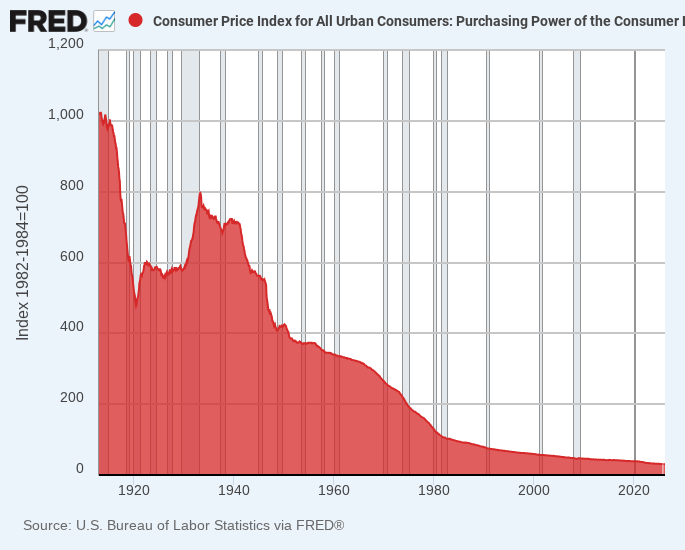
At the time, 55 years ago, only a few cranks and crackpots even noticed. The Nixon team disguised the major change with a minor one. It announced wage-price controls on the same evening; they were so preposterous that they absorbed almost all the media’s attention and were withdrawn soon after. But the new money is still here…now in its 55th year. We presume that the all-time high in bond yields - achieved in July 2020 - marked the beginning of the end. The dollar has lost 99% of its value (against gold) so far; now it will lose the rest.
CPI Index since 1913, 
Purchasing power of the US dollar in the average US city.
And now that this Funny Money Era (FME) approaches its denouement...what new monstrosity, hidden by the fog of war, slouches into Washington?

Already in place, in July 2025, was the “Genius Act” preparing stablecoins for entry into the mainstream financial system. And now comes this...MN Gordon: "On April 8, 2026, less than 10 days ago, while most people were distracted with bombs dropping on Iran, the U.S. Treasury, its Financial Crimes Enforcement Network (FinCEN), and the Office of Foreign Assets Control (OFAC) issued a joint proposed rule to implement provisions of the GENIUS Act. This rule formally integrates stablecoins into the Bank Secrecy Act (BSA).

According to Treasury Secretary, Scott Bessent, “This proposal will protect the U.S. financial system from national security threats without hindering American companies’ ability to forge ahead in the payment stablecoin ecosystem.”

What does this mean? We don’t know either. So, we turn back to Mr. Gordon: ‘This, in essence, establishes a permanent digital leash that can be used to control your behavior. As these regulations tighten, the wall between your private wealth and federal oversight disappears. Every transaction you make will be visible to a centralized authority.’

Nixon began the FME when he turned the real dollar (backed by gold) into a phony dollar (backed by nothing). Real money must not be subject to manipulation by its issuers. It must also be something you can hold, free and clear.

Imagine that you sell tomatoes and receive a gold coin in return. Transaction complete. You earned your money, now you can do with it as you please. Instead, imagine that there is an invisible code embedded in the coin...so that it can only be used to buy an EV or a MAGA hat! This is the next phase of the Funny Money Era. Not only is the money fake...the feds are aiming to use it to control you.

The feds have been attaching strings onto your money for years. Money Laundering provisions, ‘Know Your Customer’ rules, ‘suspicious activity’ reports...and now with the Genius Act and the new implementing regulations, your money will become ‘programmable’...with algorithms in the money itself that will dictate, automatically, what you can do with it.

At the international level, foreign firms earned dollars by selling products to Americans. Then, like trip wires to a land mine, they saw the strings attached. Their money could be seized or sanctioned...and they could be cut off from the world’s SWIFT money transfer system. That’s why foreign nations are looking for alternatives to the dollar system.

Probably the most visible single case is that of Francesca Albanese. The UN gave her the job of reporting on the treatment of Palestinians. Her report was critical of Israel. And now it is she who is mistreated. El Pais: Her visa was revoked...all her assets were frozen, including her bank account and her apartment in the United States, even though she now lives in Tunisia. In addition, she was placed on a blacklist that effectively cuts her off from the entire international banking system, as if she were a terrorist or a drug trafficker. Penalties were also established for any U.S. citizen who engages in financial or in-kind transactions with her - including, for example, her husband, who works at the World Bank, and her daughter. “In theory, they can’t even invite me for a coffee, because they could be fined up to $1 billion or face up to 20 years in prison...”

Only people with the ‘right’ opinions will be allowed to voice them. Otherwise, they could be cut off from their money. And the system will be managed, not by Congress, the courts or even the Fed…but by AI. So, when your back account is blocked and your credit card doesn’t work...you will try to find out why. What charges were filed? What court found you guilty? Who is responsible? “We’re sorry but the purchase you are attempting to make is not authorized,” will come the answer."

"Home Depot And Walmart Issue Stark Warning To U.S. Market"

Full screen recommended.
Michael Bordenaro, 4/20/26
"Home Depot And Walmart Issue 
Stark Warning To U.S. Market"
Comments here:

"The Funniest Post You’ll Ever Read About Society, Values, And Waffles"

"The Funniest Post You’ll Ever Read 
About Society, Values, And Waffles"
by John Wilder

"I’ve spent hours reviewing why the country I grew up in felt like it ran on autopilot: lawns were mowed, kids were in school, and front doors were unlocked at night and then turned into... this. The version I see in 2026 feels like it’s held together with duct tape, threats, with little or nothing shared. Friday, I wrote about how real personal change only happens when emotion rewires values from the inside. I think that same principle scales up to the societal level.

A highly functioning society doesn’t run on rules and cops. It runs on a shared vision and voluntary self-enforcement: you don’t have fist fights between naked people in Waffle House® at 3AM where I end up losing a shoe because that’s simply not done. When that vision fades, you get more rules, more monitors, more guys with badges and attitude. And the whole thing gets heavier, slower, and meaner. And less free. Let me tell you what doesn’t build a free, cohesive society.

First, someone making people comply. North Korea proves it works if your goal is terrified people who cry when the Dear Leader walks by and you don’t mind the occasional public execution for wearing the wrong socks. Compliance by force is easy. Loyalty? Not so much. People smile on the outside and cringe on the inside. That’s not a society. That’s just a prison with better choreography.

Second, someone with power monitoring me to make me comply. Remember 2020-2021? It wasn’t technically illegal to say no to the clotshot, but tell that to the people who lost their jobs, their airline seat, or couldn’t put their kids in school without it. A whole lot of people who would’ve skipped it folded under the overt pressure of “your papers, please.” Some complied, without believing. Big difference between that and the True Believers.

Third, someone moving society to monitor my behavior. The GloboLeftElite tried to turn the internet into one giant hall monitor. COVID was the big opportunity. Disagree on Twitter® about anything, (masks, origins, side effects) and poof, banned. The goal was simple: only the approved narrative gets to be broadcast. The goal was: brainwash the populace into one artificial shared vision by deleting every other idea.

But we didn’t need any of that garbage back when the country actually worked. Back then we had a shared set of values. Values kept lawns mowed without code enforcement officers. Values kept people showing up to work, paying their bills, and not stealing the neighbor’s Amazon® packages. Values were the invisible fence that let a free people stay free.

A huge part of the collapse is the deliberate feminization of society. Women are wonderful creatures. Their nurturing and care are the reason families exist and babies don’t die in the woods. But scale that instinct up to the level of national policy and it turns horrifying.

An illiterate military-age man crossing the border illegally triggers the exact same emotional circuit as a crying baby, especially in the spinster wine-aunt who never had kids. The illegal becomes a surrogate for the kid her barren womb never produced. Must help. Must clean it up. Must give it a chance.

And when it rapes or murders? Well, punishing it is so mean. It just needs more care. That same instinct created the victimhood hierarchy we see everywhere now. Who’s crying the loudest today? Which baby gets the most snacks, the most attention, the most special rules? The entire GloboLeft runs on sorting victims by volume.

The attempt to replace old values ran for decades through every TV show from M*A*S*H to Maude to Diff’rent Strokes to Golden Girls. Every single “very special episode” was a Trojan horse. Archie Bunker® would land a zinger, then spend the last two minutes being proven to be the world’s biggest idiot.

The message was clear: your grandparents’ values are dumb and mean. Here, try these shiny new ones instead. The replacement values, however, weren’t built on what is True, Beautiful, and Good. They were built on lies.

“There’s only one race, the human race.”
“They’re just like us!”
“This isn’t a nation, it’s a country built only on ideas, not on the posterity of the Founders.”
“Every idea is equally valuable.”
“Love is love.”

I could go on. The lies are finally becoming visible to the general public, the way they always do when reality shows up with receipts. What’s coming back are the old values, because those are the only ones that actually work at scale. Getting there won’t be easy. Societies don’t pivot on a dime. There will be stunning levels of violence, which is the pain that comes from feminists not understanding that foreigners aren’t the same thing as babies.

The emotional foundation of the country is shift. I think we will win, because we represent what’s True, Beautiful, and Good, and those that represent that will control the switch on the society that rises from the rubble. If the nation that follows is lucky, they will have the shared values that once made voluntary self-enforcement the norm and not the shattered “all against all” values of an India or a Haiti.

Rejecting Hollywood’s® propaganda, the GloboLeftist victim Olympics, must be replaced by the old, sturdy values, the ones rooted in family, work, truth, and a common language and culture. Importing millions who share none of that doesn’t enrich: it dilutes until the shared vision evaporates and only the cops remain.

I’m not naive. The GloboLeftElite won’t surrender the microphone quietly. The lies have been lucrative. But lies always collapse under their own weight. And that shoe I lost at Waffle House®? I’ve developed a solution: IHOP®."

"War: The Middle East 4/20/26"

Prof John Mearsheimer, Jeffrey Sachs, 4/20/26
"Dark Hour Arrives: Iran Will Destroy Israel – 
Major Cities Sink into Panic"
Comments here:
o
A Must-view!
Full screen recommended.
Professor Marandi Updates, 4/20/26
"If the U.S. Invades Iran - 
The 3 Guaranteed Outcomes Nobody Is Talking About"
"What happens if the United States launches a full ground invasion of Iran? In this high-stakes analysis, we break down why a conventional military victory might lead to a catastrophic strategic defeat. From the Strait of Hormuz chokepoint to the "system" Iran built to make American power meaningless, we explore the three guaranteed outcomes nobody is talking about. This video uncovers how a single decision could trigger a global economic collapse, activate a multi-front regional war, and reshape the world order in favor of America’s rivals. Featuring insights on asymmetric warfare, oil supply shocks, and the "strategic trap" waiting in the Middle East."
Comments here:
o
Canadian Prepper, 4/20/26
"Alert! Iran/USA Talks Collapsing; Historic Attack 
On Russia; STRATCOM Doomsday EAMs"
Comments here:
o
Dialogue Works, 4/20/26
"Larry Johnson: The Strait of Hormuz Just 
Became a Graveyard for US Dominance"
Comments here:

"Economic Market Snapshot 4/20/26"

"Economic Market Snapshot 4/20/26"

Down the rabbit hole of psychopathic greed and insanity...
Only the consequences are real - to you!
"It's a Big Club, and you ain't in it. 
You and I are not in the Big Club."
- George Carlin
o
Market Data Center, Live Updates:
Financial Stress Index

"The OFR Financial Stress Index (OFR FSI) is a daily market-based snapshot of stress in global financial markets. It is constructed from 33 financial market variables, such as yield spreads, valuation measures, and interest rates. The OFR FSI is positive when stress levels are above average, and negative when stress levels are below average. The OFR FSI incorporates five categories of indicators: creditequity valuationfunding, safe assets and volatility. The FSI shows stress contributions by three regions: United Statesother advanced economies, and emerging markets."
Job cuts and much more.
Commentary, highly recommended:
"The more I see of the monied classes,
the better I understand the guillotine."
- George Bernard Shaw
Oh yeah... beyond words. Any I know anyway...
And now... The End Game...
o

Sunday, April 19, 2026

Musical Interlude: 2002, "A Divine Encounter"

Full screen recommended.
2002, "A Divine Encounter"

"Carl Sagan: Does This One Photograph Prove Humanity Is Alone?"

"Carl Sagan: Does This One 
Photograph Prove Humanity Is Alone?"
"Discover the story of Carl Sagan’s "Pale Blue Dot" and how Voyager 1 changed our understanding of the cosmos forever. This documentary-style exploration dives into astronomy, space exploration, and the astrophysics of our 'lonely speck' in the universe."
Comments here:
o
Brian Greene Universe, 
"Something Was Here Before Us…
 And Scientists Are Horrified"
"What if humanity is not the first intelligent presence in the universe? What if something existed long before us… watching, evolving, or leaving behind traces we are only now beginning to understand? In this mind-expanding video inspired by the work of Brian Greene, we explore shocking scientific theories about the origins of the universe, hidden dimensions, and the possibility that unknown forms of intelligence may have existed before human civilization. From the mysteries of the Big Bang to the strange implications of string theory and multiverse concepts, modern physics is uncovering clues that challenge everything we think we know about existence. Could there be evidence hidden deep in space-time? Are we truly alone, or part of a much larger cosmic story?"
Comments here:

"A Look to the Heavens"

"This fantastic skyscape lies near the edge of NGC 2174 a star forming region about 6,400 light-years away in the nebula-rich constellation of Orion. It follows mountainous clouds of gas and dust carved by winds and radiation from the region's newborn stars, now found scattered in open star clusters embedded around the center of NGC 2174, off the top of the frame.
Though star formation continues within these dusty cosmic clouds they will likely be dispersed by the energetic newborn stars within a few million years. Recorded at infrared wavelengths by the Hubble Space Telescope in 2014, the interstellar scene spans about 6 light-years. Scheduled for launch in 2021, the James Webb Space Telescope is optimized for exploring the Universe at infrared wavelengths."
o
"In 2003, a SETI satellite, designed to remain operational until 2008, suddenly stopped transmitting three years earlier than expected.
The incident seemed destined to remain a simple technical glitch, until, after thirteen years of absolute silence, the signal returned. But the most disconcerting detail wasn't the reactivation itself: the new transmission came from a location estimated to be about ten light-years from Earth, as if the satellite had made a journey impossible for any human technology.

This gave rise to the boldest hypothesis: passage through a wormhole, a space-time tunnel capable of connecting extremely distant points in the universe in extremely short timeframes. In relativistic theory, a wormhole - or Einstein-Rosen bridge - is a hypothetical structure of space-time, a sort of gravitational tunnel that joins two distant ends through an extreme curvature of the cosmic fabric. In this model, matter could pass through the wormhole and reemerge on the other side, bypassing the distances separating stars and planetary systems.

This singularity, if it ever existed in a stable form, would represent a cosmic shortcut, a passage that defies the laws of classical physics and that, at least in theory, would allow an object to travel light-years in a relatively short time. The idea that an Earth satellite could have passed through such a phenomenon remains speculative, but the very concept of a wormhole continues to exert a profound fascination: a bridge between what we know and what still eludes our understanding, an invitation to imagine a universe far more complex and dynamic than it appears."

Chet Raymo, “When The Morning Stars Sing Together”

“When The Morning Stars Sing Together”
by Chet Raymo

“A Chinese proverb: A bird does not sing because it has an answer. It sings because it has a song. Which might be an acceptable epigraph for this blog. I can’t imagine anyone coming here looking for answers. Certainly, providing answers is the last thing on my mind. I would like to think you come for song.

We are, I think, by and large, a community who distrusts answers, at least answers that are vehemently held. We are made uncomfortable by stridency. By dogma. By the desire to proselytize. We wear our truths lightly, gaily, as a song bird wears its feathers. We are grateful to those who push back the clouds of ignorance and hold the reins of passion. With Blake, we sing their praises, a song we have spent a lifetime learning. We sing to celebrate. We sing because we have a song.”

"Alan Shore Closing Argument On The Abuses Of Government"

"Alan Shore Closing Argument On The Abuses Of Government"
"Epic closing argument from ABC's "Boston Legal" that illustrates the erosion of our Constitutional liberties and abusive government. This can no longer be defined as a Republican versus Democrat issue. Both parties are equally responsible, as are we, the electorate, for we continue to vote the same quality of politician(s) into office over and over."

Bill Bonner, "War and Money"

"War and Money"
Most issues don’t matter very much. Two of them matter a lot -
 war and money. The Constitution puts them in a special category - 
insisting that peoples’ representatives in Congress take charge.
by Bill Bonner

Baltimore, Maryland - "Cynicism is an attitude characterized by a general distrust of the motives of others. A cynic may have a general lack of faith or hope in people motivated by ambition, desire, greed, gratification, materialism, goals, and opinions that a cynic perceives as vain, unobtainable, or ultimately meaningless."  - Wikipedia

"Today, we add a word to the English vocabulary... and provide a step up for everyone trying to understand public policies. Cynicism questions the motives of others. Our new word, ‘cynicalism,’ is a way to avoid being harmed by them. In public life, people claim to improve the world. “Do this,” some say. “Do that,” say others. Cynicalism tells us what is really going on: whatever they are proposing won’t work... and the people suggesting it are frauds.

“Whatever they tell you to do,” a French friend quoted his father, an early cynicalist, “do the opposite.” In the father’s case, he was mayor of a small town in France in 1944. A German soldier had been shot nearby. The German officer told him to have all the people of the town assemble in the town square in the morning. “It was a death sentence,” our friend explained. “There were going to be reprisals. Maybe ten citizens would be killed. Maybe all of them. So, my father spread the word... and they all went and hid in the woods.”

Cynicalism can protect you in many different circumstances. For instance, a stock broker tells you he has found the ‘next Nvidia.’ Cynicism makes you wonder why he doesn’t keep it to himself. Cynicalism tells you to ‘just say no.’

But cynicalism is particularly valuable for evaluating public policies and their effects on your wealth. As Ronald Reagan used to say, the most dangerous phrase in the English language was: ‘I’m from the government and I’m here to help.’ Cynicalism tells you that whatever he’s promoting will be a scam and a failure.

Most issues don’t matter very much. But two of them matter a lot - war and money. That’s why the Constitution puts them in a special category - insisting that peoples’ representatives in Congress take charge. And in both cases, Congress has not only dropped the ball, but shredded it. We are now engaged in a major war... supplying material and intel. Most people are opposed to both of them; they’d rather see the money spent on hurricane relief.

But where’s Congress? Where was the discussion over how we would pay for the war? What are we fighting for? And is it worth it? Didn’t happen. Congress ducked. And how about the budget? It is obvious to even the biggest dimhead in Washington that you can’t continue to borrow, print and spend as much as you want... not without consequences. ‘The wars will make us safer,’ say the feds. ‘And the lower rates will make us richer.’ Cynicalism tells us not to believe them."

"Famine Is Coming"

by Qasem Al-Ali

"70% of American farmers can no longer afford the fertilizer they need. This isn’t a headline from a war zone. This is happening inside the United States. Right now. During planting season. This comes from an official survey by the American Farm Bureau Federation. 5,700+ farmers. All 50 states. Conducted April 3–11, 2026. Not an estimate. Not a projection. A snapshot of American agriculture in real time. Since Hormuz closed, fertilizer prices collapsed any sense of normalcy:
- Urea: +49%
- UAN: +38%
- NH3: +32%
- Farm diesel: +46%

Farmers don’t set these prices. They just pay them. The South is bleeding the most. 80% of Southern farmers can’t afford full fertilizer applications. Only 19% locked in prices before the season. Compare that to 67% in the Midwest who pre-booked.

Timing saved some. Geography punished others. 94% of farmers say their financial situation has gotten worse or stayed the same vs. last year. Only 6% improved. The farm economy isn’t struggling. It’s breaking.

Hormuz didn’t just close a shipping lane. It closed the margin between profit and loss for millions of American farmers. Less fertilizer = lower yields = less food. The grocery bill shock hasn’t arrived yet. It’s still growing in the field.

Oil has OPEC. Oil has futures markets. Oil has headlines. Food has nothing. No cartel to manage supply. No sovereign fund to absorb the shock. No prime-time coverage. When oil gets expensive, markets panic. When food gets expensive, the poor starve. That’s the difference nobody is talking about."
o
“Nine Meals from Anarchy”
by Jeff Thomas

“In 1906, Alfred Henry Lewis stated, “There are only nine meals between mankind and anarchy.” Since then, his observation has been echoed by people as disparate as Robert Heinlein and Leon Trotsky. The key here is that, unlike all other commodities, food is the one essential that cannot be postponed. If there were a shortage of, say, shoes, we could make do for months or even years. A shortage of gasoline would be worse, but we could survive it, through mass transport, or even walking, if necessary.

But food is different. If there were an interruption in the supply of food, fear would set in immediately. And, if the resumption of the food supply were uncertain, the fear would become pronounced. After only nine missed meals, it’s not unlikely that we’d panic and be prepared to commit a crime to acquire food. If we were to see our neighbor with a loaf of bread, and we owned a gun, we might well say, “I’m sorry, you’re a good neighbor and we’ve been friends for years, but my children haven’t eaten today – I have to have that bread – even if I have to shoot you.”

So, let’s have a closer look at the actual food distribution industry, compare it to the present direction of the economy and see whether there might be reason for concern.

The food industry typically operates on very small margins – often below 2%. Traditionally wholesalers and retailers have relied on a two-week turnaround of supply and anywhere up to a 30-day payment plan. But an increasing tightening of the economic system for the last eight years has resulted in a turnaround time of just three days for both supply and payment for many in the industry. This is a system that’s already under sever pressure, and has no further wiggle room should it take significant further hits.

If there were a month where significant inflation took place (say, 3%), all profits would be lost for the month, for both suppliers and retailers, but goods could still be replaced and sold for a higher price next month. But, if there were three or more consecutive months of inflation, the industry would be unable to bridge the gap, even if better conditions were expected to develop in future months. A failure to pay in full for several months would mean smaller orders by those who could not pay. That would mean fewer goods on the shelves. The longer the inflationary trend continued, the more quickly prices would rise to hopefully offset the inflation. And ever-fewer items on the shelves.

From Germany in 1922, to Argentina in 2000, to Venezuela in 2016, this has been the pattern, whenever inflation has become systemic, rather than sporadic. Each month, some stores close, beginning with those that are the most poorly-capitalized. In good economic times, this would mean more business for those stores that were still solvent, but, in an inflationary situation, they would be in no position to take on more unprofitable business. The result is that the volume of food on offer at retailers would decrease at a pace with the severity of the inflation.

However, the demand for food would not decrease by a single loaf of bread. Store closings would be felt most immediately in inner cities, when one closing would send customers to the next neighborhood, seeking food. The real danger would come when that store had also closed and both neighborhoods descended on a third store in yet another neighborhood. That’s when one loaf of bread for every three potential purchasers would become worth killing over. Virtually no one would long tolerate seeing his children go without food because others had “invaded” his local supermarket.

In addition to retailers, the entire industry would be impacted and, as retailers disappeared, so would suppliers, and so on, up the food chain. This would not occur in an orderly fashion, or in one specific area. The problem would be a national one. Closures would be all over the map, seemingly at random, affecting all areas. Food riots would take place, first in the inner cities, then spread to other communities. Buyers, fearful of shortages, would clean out the shelves.

Importantly, it’s the very unpredictability of food delivery that increases fear, creating panic and violence. And, again, none of the above is speculation; it’s an historical pattern – a reaction based upon human nature whenever systemic inflation occurs.

Then… unfortunately… the cavalry arrives. At that point it would be very likely that the central government would step in and issue controls to the food industry that served political needs, rather than business needs, greatly exacerbating the problem. Suppliers would be ordered to deliver to those neighborhoods where the riots were the worst, even if those retailers were unable to pay. This would increase the number of closings of suppliers. Along the way, truckers would begin to refuse to enter troubled neighborhoods and the military might well be brought in to force deliveries to take place.

So what would it take for the above to occur? Well, historically, it has always begun with excessive debt. We know that the debt level is now the highest it has ever been in world history. In addition, the stock and bond markets are in bubbles of historic proportions. They are most certainly popping.

With a crash in the markets, deflation always follows, as people try to unload assets to cover for their losses. The Federal Reserve (and other central banks) has stated that it will unquestionably print as much money as it takes to counter deflation. Unfortunately, inflation has a far greater effect on the price of commodities than assets. Therefore, the prices of commodities will rise dramatically, further squeezing the purchasing power of the consumer, thereby decreasing the likelihood that he will buy assets, even if they’re bargain-priced. Therefore, asset-holders will drop their prices repeatedly, as they become more desperate. The Fed then prints more to counter the deeper deflation and we enter a period when deflation and inflation are increasing concurrently.

Historically, when this point has been reached, no government has ever done the right thing. They have, instead, done the very opposite – keep printing. Food still exists, but retailers shut down because they cannot pay for goods. Suppliers shut down because they’re not receiving payments from retailers. Producers cut production because sales are plummeting.

In every country that has passed through such a period, the government has eventually gotten out of the way, and the free market has prevailed, re-energizing the industry and creating a return to normal. The question is not whether civilization will come to an end. (It will not.) The question is the liveability of a society that is experiencing a food crisis, as even the best of people are likely to panic and become a potential threat to anyone who is known to store a case of soup in his cellar.

Fear of starvation is fundamentally different from other fears of shortages. Even good people panic. In such times, it’s advantageous to be living in a rural setting, as far from the centre of panic as possible. It’s also advantageous to store food in advance that will last for several months, if necessary. However, even these measures are no guarantee, as, today, modern highways and efficient cars make it easy for anyone to travel quickly to where the goods are. The ideal is to be prepared to sit out the crisis in a country that will be less likely to be impacted by dramatic inflation – where the likelihood of a food crisis is low and basic safety is more assured.”

"Still Think Netanyahu is Winning in Iran? Watch This Before You Speak Again"

Full screen recommended.
OPTM, 4/19/26
"Still Think Netanyahu is Winning in Iran?
 Watch This Before You Speak Again"
Comments here:
o
Full screen recommended.
Colonel Douglas Macgregor, 4/19/26
"'Something Much Worse Than Iran Is Coming'" 
Comments here:
o
Full screen recommended.
Dialogue Works, 4/19/26
"Iran & US Prepare Massive
 Firing Power as Talks Going Nowhere" 
Comments here:

"Economic Collapse: People Are Canceling Summer Vacations Already"

Full screen recommended.
Snyder Reports, 4/19/26
"Economic Collapse: People Are
 Canceling Summer Vacations Already"
Comments here:
o
Full screen recommended.
Zac Rios, 4/19/26
"Disney Vacations Are Destroying
 People's Finances in 2026"
Comments here:

The Daily "Near You?"

Padova, Italy. Thanks for stopping by!

"Just What The Doctor Ordered!"

"The year is 1950. Your doctor lights a cigarette and tells you smoking is fine. He read it in a study. He is telling the truth about having read it. He does not know, or is not saying, that the study was funded by the tobacco industry.

The year is 1958. Your doctor tells you to eat less fat. The evidence is contested. The contestation is not in the public messaging. The food industry has been helpful in clarifying which findings deserve attention. Some researchers who published contradictory data have been quietly defunded. Ancel Keys is on the cover of Time magazine.

The year is 1962. Your doctor prescribes thalidomide to your pregnant wife for morning sickness. It has been approved. The FDA gave it the green light in Europe [JGM - factcheck, EU regulators did that]. Twelve thousand children will be born with severe limb malformations before anyone in an official capacity acknowledges the problem. The families are told the drug was safe. The drug was approved. Both of these things remain true.

The year is 1972. Your doctor prescribes Valium. Britain is in the grip of a benzodiazepine wave that will last two decades. The dependency risk is known internally. It is not shared. Your doctor is not lying to you. He was not told either.

The year is 1999. Your doctor prescribes Vioxx for your arthritis. It is newer than ibuprofen, well-tolerated, and Merck has a study showing it works. Merck also has internal data suggesting it roughly doubles the risk of heart attack. This data will not reach your doctor for four more years. Fifty thousand people are estimated to have died in the interim. Merck eventually settles for 4.85 billion dollars. No criminal charges are brought.

The year is 2002. Your doctor prescribes OxyContin. Purdue Pharma trained its sales representatives to tell doctors the addiction risk was less than one percent. That figure came from a letter, not a study. The letter was about patients with terminal cancer on short-term doses in hospital settings. Your doctor is a GP with a patient who has a bad back. Nobody draws a distinction. Nobody is required to.

The year is 2008. Your doctor checks your cholesterol. Your LDL is elevated. You are prescribed a statin. Nobody mentions that the number needed to treat for primary prevention is approximately 250. Nobody mentions that the muscle deterioration you'll notice over the next two years is listed as a rare side effect rather than a documented pattern affecting a meaningful percentage of patients. The trial that informed the prescription was funded by the manufacturer.

Now it is today. Your doctor has new guidelines. New studies. New consensus. He is confident. He has always been confident. The confidence has never been the problem.The confidence is, in fact, precisely the problem."

"Being Poor Ain't Cheap"

"Being Poor Ain't Cheap"
by Joshua Wilkey

"Poor people are cash cows. It makes no sense, really. One would think that poor people, by virtue of being poor, would not be profitable customers. However, for many large corporations that target the poor and working poor, there's big money to be made on the backs of those who have no money.
At Dollar General Store locations, customers can get cash back on their purchases. This is not novel. In fact, most all retailers these days offer this option. Soccer moms get cash back so they can have lunch money for their children. Restaurant patrons can get money back to leave a cash tip for their servers. I sometimes get cash back at the grocery store so I can buy Girl Scouts cookies on the way out. It's a simple process. Click "yes" when the little screen asks for cash back, tap the $20 icon, and the cashier hands you some bucks along with your receipt. We've all done it. For those who are poor and those of us who are not but who have limited retail options, however, there's often a sinister catch.

I noticed this a few years ago, first at Dollar Tree, then at Dollar General. There's a little asterisk after the standard "would you like cash back?" prompt. The footnote indicates that "a transaction fee may apply." The transaction fee is usually $1 no matter the amount of cash back. If one opts to get $10 cash back, one is charged a dollar. That's a ten percent fee, for a service that costs the retailer nothing. It's just another way for retailers like Dollar General to make a profit off of their customers, many of whom are very often living below the poverty line.

If an organic grocer or movie theater were charging a fee of this sort, I would likely be annoyed by it, but I wouldn't be so annoyed that I would write about it. However, the poorest members of our communities do not shop at Whole Foods, and they do not often get a chance to go see the latest blockbuster at the theater. They can afford neither. In fact, they likely do not have either organic grocers or first-run theaters in their neighborhoods. Instead, they have Dollar General. Dollar General's stores grow like kudzo in rural America. Even if there isn't a real grocery store in most tiny communities, there's probably a DG.

These ridiculous transaction fees are but one example of how corporations make billions of dollars by taking advantage of socioeconomically disadvantaged customers with few options. There are many other examples, though, and politicians continue to allow it at the expense of their poorest and most marginalized constituents.
Payday lending is one of the most sinister ways that large corporations exploit poor people. For those who are not familiar, payday lending goes something like this: People who are running short on money but who have a verified record of regular income (whether it be Social Security, SSI, payroll, etc.) are able to go to payday lenders and receive a cash loan to be repaid on payday. Often, borrowers are unable to repay their full loan balances and simply “roll over” their loan until a future payday, accruing all sorts of fees and additional interest. The annualized interest rate on these loans is often in the triple digits. Yes, that’s right. Sometimes the annual interest rate is over one hundred percent.

In defense of this practice, many payday lenders and their high-dollar lobbyists argue that they are simply offering a service to poor borrowers that said borrowers cannot obtain anywhere else. This is partially true. The poorest members of society have no access to traditional forms of credit. Some even lack access to checking accounts because of low credit scores or a history of financial missteps.

I know some people who make occasional use of payday lending because they genuinely have emergencies arise that they could not address without a short-term infusion of cash. I also know people, including members of my own family, who have been riding the high-interest payday loan merry-go-round for years, and who have paid thousands more back than they have borrowed yet still owe more. In debating the role of payday lending in our communities, it is essential that we take a nuanced approach. Some form of short-term credit is necessary for those mired in poverty. However, it is flat-out immoral that we regulate payday lending so loosely in many places that people end up feeling crushed under the weight of small high-interest loans that they have no hope of ever repaying. Taking out a $1,000 payday loan should not mean a person becomes tied to tens of thousands of dollars in debt.
Another egregious example of corporations exploiting the poor is rent-to-own retailing. Companies like Aaron’s and Rent-a-Center purport to offer a valuable service for the poor. Because those at the bottom of the socioeconomic spectrum are seldom able to save for big-ticket items like appliances or furniture, these retailers offer a pay-by-the-month scheme that often requires no credit check and no money down. The result is that customers pay as much as three times the retail price of the item, assuming they are able to make payments until the item is paid for. When they are not able to maintain the payments, the retailers simply show up to repossess the items.

Like payday lenders, rent-to-own retailers argue that they provide a valuable service to poor consumers. However, many observers, myself included, conclude that some rent-to-own practices are ethically questionable and tend to target vulnerable consumers who need immediate access to essentials like appliances and bedding. In many states, companies are not required to disclose the final price of the items. Instead, they simply tell customers the amount of the monthly or weekly payments. Because companies call the arrangement "rent-to-own," in many places they are not required to disclose the amount of "interest" customers will pay because it technically isn't interest. When consumers can no longer afford the payments and have to return the item, they often get no credit for payments they have made even if they have paid substantially more than the item is worth. Many customers never realize that they are paying as much as three times the retail price for their items. Those who do realize it likely have no choice apart from going without a bed or refrigerator.

In some instances, state attorneys general have successfully sued major rent-to-own retailers for violating usury and consumer protection laws. However, because these retailers are covered generally by state laws rather than by federal laws, there exists a hit-and-miss patchwork of regulations. Some consumers enjoy greater protections than others. The only determining factor is their location. Those states with more corporation-friendly attorneys general are unlikely to see any activity that might force retailers to behave more ethically toward their customers, because such enforcements will result in a drop in profitability for the retailers. Many major corporations spend good money to be sure that politicians protect their interests rather than the interests of consumers. Rent-to-own retailers and payday lenders are no exception. The poor, of course, can’t afford lobbyists or political contributions.

There are some who will argue that the free market, not the federal government, is the best solution to corporations that exploit the poor. However, those at the bottom of the socioeconomic spectrum, especially the rural poor, do not live in anything resembling a free market. Also, it is important that we label the behavior of rent-to-own companies and payday lenders as what it is: exploitation.

In the hills of Appalachia, poverty is often the rule rather than the exception. One of the most poverty-stricken ZIP codes in the United States is Manchester, Kentucky. Manchester is located in Clay County, which has a population of just over 20,000 people. According to the most recent US Census data available, the per-capita income average between 2011 and 2015 was just $13,802 (less than half the national average) and 46% of the population lives below the poverty line. In Manchester, Rent-a-Center is often the go-to option for poor people looking to buy appliances or furniture. The county has a Walmart, but the nearest discount appliance and furniture dealers are miles away, too far for many to drive. There are some locally-owned options, but few in Clay County are able to pay cash for major purchases given the high rate of poverty and the low rate of employment.

In addition to the rent-to-own retailers, Clay County also has no less than five payday lenders, but only two traditional banks. Conveniently, the primary shopping center in Manchester currently houses a Dollar General, a Rent-a-Center, and two payday lending branches, all within feet of one another.

In places like Manchester, rent-to-own and payday lending outfits thrive. They do so often to the detriment of the poor folks who frequent their businesses. Those promoting the so-called free market approach might argue that customers are not forced to do business with these types of companies. However, given their dire financial circumstances and lack of available options, poor people in Manchester have little choice. They are excluded from participating in the wider world of commerce, often because of forces beyond their own control.

Manchester is not a rare exception. Particularly in central Appalachia, rent-to-own retailers are often the only option for poor people, and payday lenders outnumber banks by large measure. In addition to being food deserts, many poverty-stricken communities are retail deserts. In the most isolated rural areas in Appalachia, Dollar General is one of the only available retail options. Within ten miles of our house in rural Jackson County, NC, there are four Dollar General stores, and our community isn't even particularly isolated. Dollar General is the closest store to our home, and my wife and I tend to shop there by default because it is either that or a ten minute drive to the closest grocery store, or worse, a twenty minute drive into town. While we have the resources to go to town any time we want, many of our neighbors do not. The folks in the trailer park down the road often walk to Dollar General because they have few other options. This does not seem much like a free market driven by competition. Therefore, "free market" solutions simply do not work here.

Dollar General is, I believe, fully aware of the demographics of their shoppers. They know that there are often few ATMs near their locations, and their customers often lack access to traditional banking anyway and end up paying fees of three or four dollars to access their money at ATMs. Especially for people who depend on Social Security or SSI for their income, access to money is an important issue. Dollar General and similar retailers, it seems, understand this. Their solution is not to offer a resource for their customers but to profit from their customers’ limited access to funds. It's cheaper than an ATM, but it's a fee more affluent shoppers never have to think about. While there is nothing illegal about this, it is certainly morally questionable.

That’s the thing about the so-called free market. It makes no accounting for moral right or wrong. That, free market proponents allege, is up to the consumers. Poor consumers, however, still need to eat. They still need ovens and beds. Consumer choice and self-advocacy is often, like so many forms of social or political action, a full-stomach endeavor. When one is hungry, one’s ability to be an activist is diminished. When poor people have no choice but to do business with the greedy companies who reap a hefty profit from their customers' lack of options, those drawing the short straw simply do what they must to survive. Surviving is what poor people do best, and it makes for a miserable life. I know, because I have been there.

When poor people have little option but to do business with discount retailers who charge cash-back fees, rent-to-own retailers who charge inflated prices, and payday lenders who mire their customers neck-deep in impossible-to-pay-back high-interest loans, they are even less likely to ever escape poverty. The stark reality is that poor people often pay substantially more for essentials – bedding, appliances, housing – than would those of us with means. If my wife and I needed a new washer, we'd shop around for the best deal and go buy it. In fact, we might even buy it from Amazon Prime and get free two-day shipping. When my mother, who lived her entire life in poverty, needed a new washer, she was forced to buy one from a rent-to-own outfit that charged her an outrageous delivery fee and hassled her every time she was even a few hours late on a payment. She probably ended up paying $2,000 for a $450 washer. The poor do not have access to Amazon Prime like the rest of us because they can't afford a hundred bucks a year to subscribe. They do not get free delivery and obscenely low prices. They get fleeced.

The limited options available to those in poverty are rarely considered by the political ideologues who are so prone to victim-blaming. These retailers, who are all too often protected by state and federal lawmakers from both parties, package their predatory tactics as opportunities. What they are really selling are tickets on yet another segment of the poverty train. The politicians who protect them should be deprived of options and see just how much more expensive it is to survive. They should be ashamed for protecting those who profit from poverty, and those of us who know about it and have the resources to fight back should be ashamed for letting it happen to our neighbors."