StatCounter

Thursday, April 24, 2025

"Death in the Afternoon"

"Death in the Afternoon"
by Joel Bowman

"To be immortal is commonplace; except for man, 
all creatures are immortal, for they are ignorant of death; 
what is divine, terrible, incomprehensible, is to know that one is mortal."
~ Jorge Luis Borges

"Everything is illuminated against its opposite; truth against fallacy; light against darkness; life against death. And who would have it any other way, even if they could? What would life on this mortal coil be, for instance, without the eternity of its terminally mysterious counterpoint?

If there exists a perfect setting for these and associated meditations, it must surely be the magnificent Recoleta Cemetery, located right here in Buenos Aires. On any given weekend, this sacred resting place for thousands of the city’s most famous – and infamous – people is found to be one of the liveliest places in town. Notable interments include a who’s-who list of Argentine writers, painters, poets, musicians, scientists and luminaries from other noble fields of interest. And, because nothing, including death, is beyond the law of equilibrium, a handful of politicians also rot underfoot.

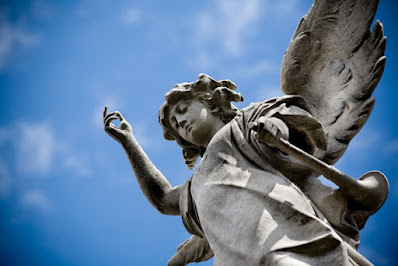
Tourists pour in to adorn Maria Eva Duarte de PerĂ³n’s grave with flowers, for instance, bypassing the resting place of a Nobel Prize-winning chemist and a dozen honest writers to do so. Other, temporary attendees pose with Colgate smiles to have their picture taken beside weeping cement angels, frozen, as they are, in a state of perpetual sorrow. Young boys give the “peace” symbol next to the generals’ tombs whose armies laid to waste to tens of thousands of men, not much older than they, the bodies of whom are long forgotten, their makeshift graves unmarked.

Nowhere does irony live a fuller life than in a cemetery. Walking among the deceased, reading bookend dates on the bronze plaques, one is reminded of the finite nature of all things; organisms, currencies, political regimes, class structures. When the cemetery was constructed, back in 1822, it must have been a good ride from the exclusive barrios of San Telmo and Montserrat. The rich probably wouldn’t have been caught dead around the grounds of the Monks of the Order of the Recoletos, nor near the shabby, patchwork graveyard that was built there the same year the group disbanded.

Half a century later - and with Argentina still reeling from the War of the Triple Alliance and its own, subsequent civil war - a yellow fever epidemic tore through the capital city. Its wealthier, southern quarters were among the worst hit areas. Death toll estimates range from thirteen to twenty-five thousand. The clase alta packed up and moved north, largely into and around the Recoleta barrio. As such, the marbled vaults came to be populated with members of this same aristocracia, who, though they escaped the fever, came to rest here eventually just the same.

Today, you could buy an entire building in San Telmo for the same price as some of the finely appointed homes in Recoleta. An entire block in Montserrat might go for half that much.

And so it goes. People die…cities and empires crumble to the ground…and time, indifferent to the fleeting anguishes and triumphs of men, presses on.

At the turn of the 20th century, Argentina was ranked as the 8th most prosperous nation on earth. Only Belgium, Switzerland, Britain and a handful of former English colonies - including the United States – were more favorably positioned, economically. In 1913, Argentina’s bustling, cosmopolitan capital, Buenos Aires, had the thirteenth highest per capita telephone penetration rate in the world. Her per capita income was, around this time, 50% higher than in Italy, almost twice that of Japan and five times greater than its northern neighbor, Brazil. Argentina’s industry churned out quality textiles and leading edge, refrigerated shipping containers carried her prized beef, first introduced in 1536 by the Spanish Conquistadors, from the fertile plains of the pampas to the farthest reaches of the known world.

As the century wore on, protectionist policies at home and increased competition from the export-led, post-WWII economies – particularly from Japan and Italy – undermined Argentina’s international advantage. From 1900 through to the beginning of the new millennium, Argentina’s real GDP per person grew at a rate of 1.88% per year. Brazil outpaced her handily, clocking a 2.39% annualized growth rate. Japan, starting with a real GDP per person of just over $1,500 (2006 dollars) at the turn of the twentieth century, grew an average of 2.76% per year. By the middle of last decade, Japan’s real GDP per person had doubled that of Argentina. By 2020, it was more than quadruple.

The phenomenon is so conspicuous, the local Argentines even have a joke for it. “There are four types of countries in the world,” they lament. “First world. Third world. Japan, where nobody can figure out how they did so much with so little. And Argentina, where nobody can figure out how we did so little with so much.”

War, currency debasement, civil unrest, military rule and the catalyzing agent of political aspiration, harbored by the equally corrupt and inept, all conspired to stultify this once-proud nation’s potential. The great Argentine poet and essayist, Jorge Luis Borges, described one such retarding factor with characteristic flare and wit: “The Falklands thing was a fight between two bald men over a comb.”

On a comfortable Sunday afternoon in late February, an elderly group of well-dressed gentlemen met at their favorite restaurant, right by the gate to the Recoleta Cemetery, for lunch. They took a table outside, one in the shade and with a view of the passing foot traffic. The waiters, having brought the regulars the same thing, more or less, every Sunday for as long as they could remember, immediately set about filling their table. There was bife de lomo and chorizo sausages, mozzarella and buffalo tomatoes and papas fritas by the pile. Rich, Argentine Malbecs and Cabernets flowed freely and the merriment of the group soon became infectious. They flirted with the pretty waitresses and joked with patrons at the nearby tables.

After more than a few bottles, one of the gentlemen got chatting with an Australian editor of no particular importance. “I am a judge here,” he eventually told the younger man. “My friends and I have seen it all in this city…riots, economic crises, war, people’s entire life savings wiped out overnight.”

One of his friends lent over and placed a knowing hand on the judge’s shoulder. “Today, we enjoy the moment,” he said to his lifelong friend, before adding, one long finger pointed over the cemetery wall, “because tomorrow…ha ha…well, you know our next stop old man.” And the table erupted in laughter, as the sun set over the angel’s heads in the background.

Cheers,"

"We're All Mad Here..."

"But I don't want to go among mad people," Alice remarked.
"Oh, you can't help that," said the cat. 
"We're all mad here. I'm mad. You're mad."
"How do you know I'm mad?" said Alice.
"You must be," said the cat, "Or you wouldn't have come here."
- Lewis Carroll,
"Alice's Adventures in Wonderland"

Oh, I know, I know, some days...lol

"Life; Reality"

"Life is not what you see, but what you've projected.
It's not what you've felt, but what you've decided.
It's not what you've experienced, but how you've remembered it.
It's not what you've forged, but what you've allowed.
And it's not who's appeared, but who you've summoned.
And this should serve you well until you find what you already have."
- The Universe

"Reality is what we take to be true.
What we take to be true is what we believe.
What we believe is based upon our perceptions.
What we perceive depends upon what we look for.
What we look for depends upon what we think.
What we think depends upon what we perceive.
What we perceive determines what we believe.
What we believe determines what we take to be true.
What we take to be true is our reality."
- Gary Zukav

The Daily "Near You?"

Gilmer, Texas, USA. Thanks for stopping by!

"I Can See It All Very Clearly..."

"There are a multitude of fuses affixed to dozens of powder-kegs and little kids with matches are on the loose. I don’t know which of the fuses will be lit and which powder-keg will blow, but someone is bound to do something stupid, and then all hell will break loose. It could happen at any time. One military miscue. One assassination. One violent act that stirs the world. And the dominoes will topple, setting off fireworks not seen on this planet since 1939 – 1945. I can see it all very clearly."
- Jim Quinn

"We Are Witnessing A Major Turning Point In The History Of Humanity"

"We Are Witnessing A Major 
Turning Point In The History Of Humanity"
by Michael Snyder

"This is the moment when humanity will choose between peace and global war. Sadly, it appears that our window of opportunity to choose peace is rapidly closing. Negotiations with Iran have not made much progress, and the Trump administration is warning that it is ready to “walk away” from negotiations to end the war in Ukraine if the Russians and the Ukrainians do not agree to the seven point deal that is now being proposed. We really have reached one of the most critical turning points in human history, but most people living in the western world do not seem to understand the importance of the drama that is playing out right in front of our eyes.

On Wednesday, Vice-President J.D. Vance said something that should chill all of us to the core…“We’ve issued a very explicit proposal to both the Russians and the Ukrainians, and it’s time for them to either say yes, or for the United States to walk away from this process,” Vance told reporters in India, where he is on a four-day visit. Vance spoke as envoys from Washington, Kyiv and European nations gathered for talks in the U.K. amid a new U.S. push to end Russia’s war in Ukraine.

“It’s now time, I think, to take, if not the final step, one of the final steps, which is, at a broad level, the party saying we’re going to stop the killing, we’re going to freeze the territorial lines at some level close to where they are today,” Vance added. “Now, of course, that means the Ukrainians and the Russians are both going to have to give up some of the territory they currently own.”

This ultimatum is very similar to an ultimatum that was issued by U.S. Secretary of State Marco Rubio last week. It is obvious that the Trump administration is quickly losing patience with the Russians and the Ukrainians, but U.S. officials are willing to take one last shot at a peace agreement. According to Axios, the following are five things that Russia would get from President Trump’s seven point peace plan…

1. “De jure” U.S. recognition of Russian control in Crimea.
2. “De-facto recognition” of the Russia’s occupation of nearly all of Luhansk oblast and the occupied portions of Donetsk, Kherson and Zaporizhzhia.
3. A promise that Ukraine will not become a member of NATO. The text notes that Ukraine could become part of the European Union.
4. The lifting of sanctions imposed since 2014.
5. Enhanced economic cooperation with the U.S., particularly in the energy and industrial sectors.

And the following are four things that Ukraine would get from President Trump’s seven point peace plan…
1. “A robust security guarantee” involving an ad hoc group of European countries and potentially also like-minded non-European countries. The document is vague in terms of how this peacekeeping operation would function and does not mention any U.S. participation.
2. The return of the small part of Kharkiv oblast Russia has occupied.
3. Unimpeded passage of the Dnieper River, which runs along the front line in parts of southern Ukraine.
4. Compensation and assistance for rebuilding, though the document does not say where the funding will come from.

The plan that the Trump administration is proposing is reasonable. I would highly encourage both sides to agree to the deal. Sadly, it appears that the Ukrainians are already rejecting it…"Ukraine will not legally recognize Russia’s occupation of Crimea under any circumstances, President Volodymyr Zelensky said during a briefing in Kyiv on April 22. “There is nothing to talk about. This violates our Constitution. This is our territory, the territory of the people of Ukraine,” Zelensky told reporters."

The statement comes amid reports that the recognition of Crimea as Russian territory is being considered as part of a U.S.-backed proposal to end the war in Ukraine. What in the world is he thinking? Ukraine is losing the war. If the war continues, Ukraine will steadily lose even more territory.

I can definitely understand why President Trump is fed up with this guy. After learning of these comments, this is what President Trump posted on his Truth Social account

"Ukrainian President, Volodymyr Zelenskyy, is boasting on the front page of The Wall Street Journal that, “Ukraine will not legally recognize the occupation of Crimea. There’s nothing to talk about here.” This statement is very harmful to the Peace Negotiations with Russia in that Crimea was lost years ago under the auspices of President Barack Hussein Obama, and is not even a point of discussion. Nobody is asking Zelenskyy to recognize Crimea as Russian Territory but, if he wants Crimea, why didn’t they fight for it eleven years ago when it was handed over to Russia without a shot being fired? The area also houses, for many years before “the Obama handover,” major Russian submarine bases. It’s inflammatory statements like Zelenskyy’s that makes it so difficult to settle this War. He has nothing to boast about! 

The situation for Ukraine is dire — He can have Peace or, he can fight for another three years before losing the whole Country. I have nothing to do with Russia, but have much to do with wanting to save, on average, five thousand Russian and Ukrainian soldiers a week, who are dying for no reason whatsoever. The statement made by Zelenskyy today will do nothing but prolong the “killing field,” and nobody wants that! We are very close to a Deal, but the man with “no cards to play” should now, finally, GET IT DONE. I look forward to being able to help Ukraine, and Russia, get out of this Complete and Total MESS, that would have never started if I were President!"

The Ukrainians clearly do not want to end the war. Of course the Russians do not exactly seem eager to accept what Trump is proposing either…"But spokesperson Dmitry Peskov on Tuesday said Russia was not aware of the plan’s terms, responding to a report by The Post about early details of a proposed arrangement. “The issue of the [Ukrainian] settlement is extremely complex, of course, so it is hardly possible to set some hard deadlines and try to rush the resolution of the conflict into a shortened timeframe,” he told Russian outlet VGTRK. “This would be an exercise in futility.”

If the Trump administration decides to “walk away” from negotiations, any chance at peace with Russia is probably dead. So what would happen then? Would we just let the Russians take as much of Ukraine as they want, or would we escalate matters? Of course if both sides choose to escalate matters, we know what will eventually happen.

Meanwhile, the Russians have just entered into a “strategic partnership” with Iran…"Russian President Vladimir Putin has signed a law ratifying a strategic partnership treaty with Iran, Russian state news agency RIA reported on Monday. The agreement is expected to strengthen military and diplomatic ties between Moscow and Tehran. As part of the agreement, the two countries agreed not to provide military assistance to any third party with which the other is in hot conflict, according to the Kyiv Independent."

This is a very troubling development, because the U.S. could be at war with Iran very soon. President Trump has repeatedly warned that if Iran does not make a deal there will be military action against Iran’s nuclear facilities. On Wednesday, Marco Rubio said that the Iranians would be allowed to have “a civilian nuclear program” but they will not be allowed to continue to enrich uranium under any circumstances…"US Secretary of State Marco Rubio said Wednesday that US President Donald Trump is determined to prevent Iran from attaining a nuclear weapon, and would prefer to do that by negotiations as opposed to military means. However, he said the US would be willing to see Tehran have a civilian nuclear program as long as they were not enriching uranium."

“We do not want a war,” Rubio told Bari Weiss on her Honestly podcast. “We do not want to see war. This is not a president that campaigned on starting wars. And as he said very clearly, Iran is not going to have a nuclear weapon, and he reserves every right to prevent that from happening, but he would prefer it not happen. He would prefer that there not be a need to resort to military force, either by us or anybody else. He would prefer that it’d be something that we can negotiate.”

The Iranians should take the deal that is being offered to them. But the Iranians have already clearly stated that enriching uranium is a red line for them. There is no way that they are going to stop doing it, and so that means that war is coming. Once the attacks on Iran’s underground nuclear facilities start, the Iranians will respond with tremendous force, and the Middle East will erupt in flames.

The Iranians have some “surprises” up their sleeves, but so do the Israelis. If cooler heads do not prevail, we are going to see tremendous death and destruction in the Middle East. And if we cannot find a way to achieve peace with the Russians, it is just a matter of time before a worst case scenario unfolds. This is our last best chance at peace, and we must not blow it."
"It would indeed be a tragedy if the history of the human
 race proved to be nothing more than the story of an
ape playing with a box of matches on a petrol dump." 
- David Ormsby-Gore

And humanity just never, ever learns from it all...

"Trinity’s Shadow"

"Trinity’s Shadow"
by Edward Curtin

"I sit here in the silence of the awakening dawn’s stillness stunned by the realization that I exist. I wonder why. It is my birthday. The first rays of the rising sun bleed crimson over the eastern hills as I imagine my birth. The house and my family sleep.

Someday I will die and I wonder why. This is the mystery I have been contemplating since I was young. That and the fact that I was born in a time of war and that when my parents and sisters were celebrating my first birthday, my country’s esteemed civilian and military leaders celebrated another birth: the detonation of the first atomic bomb code-named Trinity.

Trinity has shadowed my life, while the other Trinity has enkindled my days. Sick minds play sick word games as they inflict pain and death. They nicknamed this death bomb “the Gadget,” as if it were an innocent little toy. They took and blasphemed the Christian mystery of the Trinity as if they were mocking God, which they were. They thought they were gods. Now they are all dead gods, their fates sealed in their tombs.

Where are they now? Where are all their victims, the innocent dead of Hiroshima and Nagasaki? Where are the just and the unjust? Where are the living now, asleep or awake as Trinity’s progenitors in Washington, D.C. and the Pentagon prepare their doomsday machines for a rerun, the final first-strike run, the last lap in their race to annihilate all the living? Will they sing as they launch the missiles – “So long, farewell, auf Wiedersehen, good night?”

The wheel turns. We count the years. We wonder why.

Years ago I started my academic life by writing a thesis entitled “Dealing With Death or Death Dealing.” It was a study of the transformation of cultural symbol systems, death, and nuclear weapons. The last hundred years and more have brought a transformation and disintegration of the traditional religious symbol system – the sacred canopy – that once gave people comfort, meaning, and hope. Science, technology, and nuclear weapons have changed all that. Death has been socially relocated and we live under the nuclear umbrella, a sinister “safeguard” that is cold comfort. The ultimate power of death over all life has been transferred from God to men, those controlling the nuclear weapons. This subject has never left me. I suppose it has haunted me. It is not a jolly subject, but I think it has chosen me.

Was I born in a normal time? Is war time our normal time? It is. I was.

But to be born at a time and place when your country’s leaders were denouncing their German and Japanese enemies as savage war criminals while execrably emulating them and then outdoing them is something else again. With Operation Paperclip following World War II, the United States government secretly brought 1,600 or more Nazi war criminals into the U.S. to run our government’s military, intelligence, space, chemical, and biological warfare programs. We became Nazis. Lewis Mumford put it this way in "The Pentagon of Power":

"By the curious dialectic of history, Hitler’s enlargement and the refurbishment of the Nazi megamachine gave rise to the conditions for creating those counter-instruments that would conquer it and temporarily wreck it. In short, in the very act of dying the Nazis transmitted their disease to their American opponents; not only the methods of compulsive organization or physical destruction, but the moral corruption that made it feasible to employ those methods without stirring opposition."

There are always excuses for such moral corruption. When during WW II the U.S. firebombed almost all Japanese cities, Dresden and Cologne in Germany, and then dropped atomic bombs on Hiroshima and Nagasaki killing hundreds of thousands of innocent civilians in gratuitously savage attacks, these were justified and even celebrated as necessary to defeat evil enemies. Just as Nazi war criminals were welcomed into the U.S. government under the aegis of Allen Dulles who became the longest running CIA director and the key to JFK’s assassination and coverup, the diabolic war crimes of the U.S. were swept away as acts of a moral nation fighting a good war. What has followed are decades of U.S. war crimes from Korea through Vietnam and Iraq, etc. A very long list.

The English dramatist Harold Pinter, in his Nobel Address, put it bluntly: "It never happened. Nothing ever happened. Even while it was happening it wasn’t happening. It didn’t matter. It was of no interest. The crimes of the United States have been systematic, constant, vicious, remorseless, but very few people have actually talked about them. You have to hand it to America. It has exercised a quite clinical manipulation of power worldwide while masquerading as a force for universal good. It’s a brilliant, even witty, highly successful act of hypnosis."

Nothing could be truer. When in 2014 the U.S. engineered the coup in Ukraine (coups being an American specialty), it allied itself with neo-Nazi forces to oppose Russia. This alliance should have shocked no one; it is the American way. Back in the 1980s when the U.S. was supporting death squads in Central America, Ronald Reagan told the world that “The Contras are the moral equivalent of the Founding Fathers.” Now the Ukrainian president Zelensky is feted as a great hero, Biden telling him in an Oval Office visit that “it’s an honor to be by your side.” Such alliances are not anomalies but the crude reality of U. S. history.

But let me return to “Trinity,” the ultimate weapon of mass destruction since I was reading a recent article about it. Kai Bird, the coauthor of "American Prometheus: The Triumph and Tragedy of J. Robert Oppenheimer," the book that inspired the film "Oppenheimer" about J. Robert Oppenheimer, the scientist credited as “the father of the atomic bomb” and the man who named the first atomic bomb Trinity, has written an Op Ed piece in The New York Times titled, “The Tragedy of J. Robert Oppenheimer.” True in certain respects, this article is an example of how history can be slyly used to distort the present for political purposes. In typical NY Times fashion, Bird tells certain truths while concealing, distorting, and falsifying others.

I do not consider Oppenheimer a tragic figure, as does Bird. Complicated, yes; but he was essentially a hubristic scientist who lent his services to a demonic project, and afterwards, having let the cat out of the bag by creating the Bomb, guiltily urged the government that used it in massive war crimes to restrain itself in the future. Asking for such self-regulation is as absurd as asking the pharmaceutical or big tech industries to regulate themselves.

Bird rightly says that Oppenheimer did not regret his work inventing the atomic bomb, and he correctly points out the injustice of his being maligned and stripped of his security clearance in 1954 in a secret hearing by a vote of 2 to 1 of a security panel of The Atomic Energy Commission for having communist associations. “Celebrated in 1945 as the ‘father of the atomic bomb,’” Bird writes, “nine years later he would become the chief celebrity victim of the McCarthyite maelstrom.” A “victim,” I should add, who named names to save his own reputation.

But tucked within his article, Bird tells us: “Just look at what happened to our public health civil servants during the recent pandemic.” By which he means these officials like Anthony Fauci were maligned when they gave the public correct scientific information. This is absurd. Fauci – “attacks on me quite frankly are attacks on science” – and other government “civil servants” misinformed the public and lied over and over again, but Bird implies they too were tragic figures like Oppenheimer.

He writes: "We stand on the cusp of another technological revolution in which artificial intelligence will transform how we live and work, and yet we are not yet having the kind of informed civil discourse with its innovators that could help us to make wise policy decisions on its regulation. Our politicians need to listen more to technology innovators like Sam Altman and quantum physicists like Kip Thorne and Michio Kaku."

Here too he urges “us” to listen to the very people responsible for Artificial Intelligence, just as “we” should have listened to Oppenheimer after he brought us the atomic bomb. Implicit here is the belief that science just marches progressively on and there’s no stopping it, and when dangerous technologies emerge from scientists’ work, we should trust them to control them.

Nowhere does Bird suggest that scientists have a moral obligation before the fact to not pursue a certain line of research because of its grave possible consequences. Maybe he has never read Mary Shelley’s "Frankenstein", only written over two hundred years ago.

Finally, and most importantly, Bird begins his concluding paragraph with these words: "Today, Vladimir Putin’s not-so-veiled threats to deploy tactical nuclear weapons in the war in Ukraine are a stark reminder that we can never be complacent about living with nuclear weapons This is simply U.S. propaganda. The U.S. has provoked and fueled the war in Ukraine, broken all nuclear weapon treaties, surrounded Russia with military bases, stationed nuclear weapons in Europe, engaged in nuclear blackmail with its first strike policy and threats, etc. Putin has said in response that if – and only if – the very existence of the Russian state and land is threatened with extinction would the use of nuclear weapons be considered."

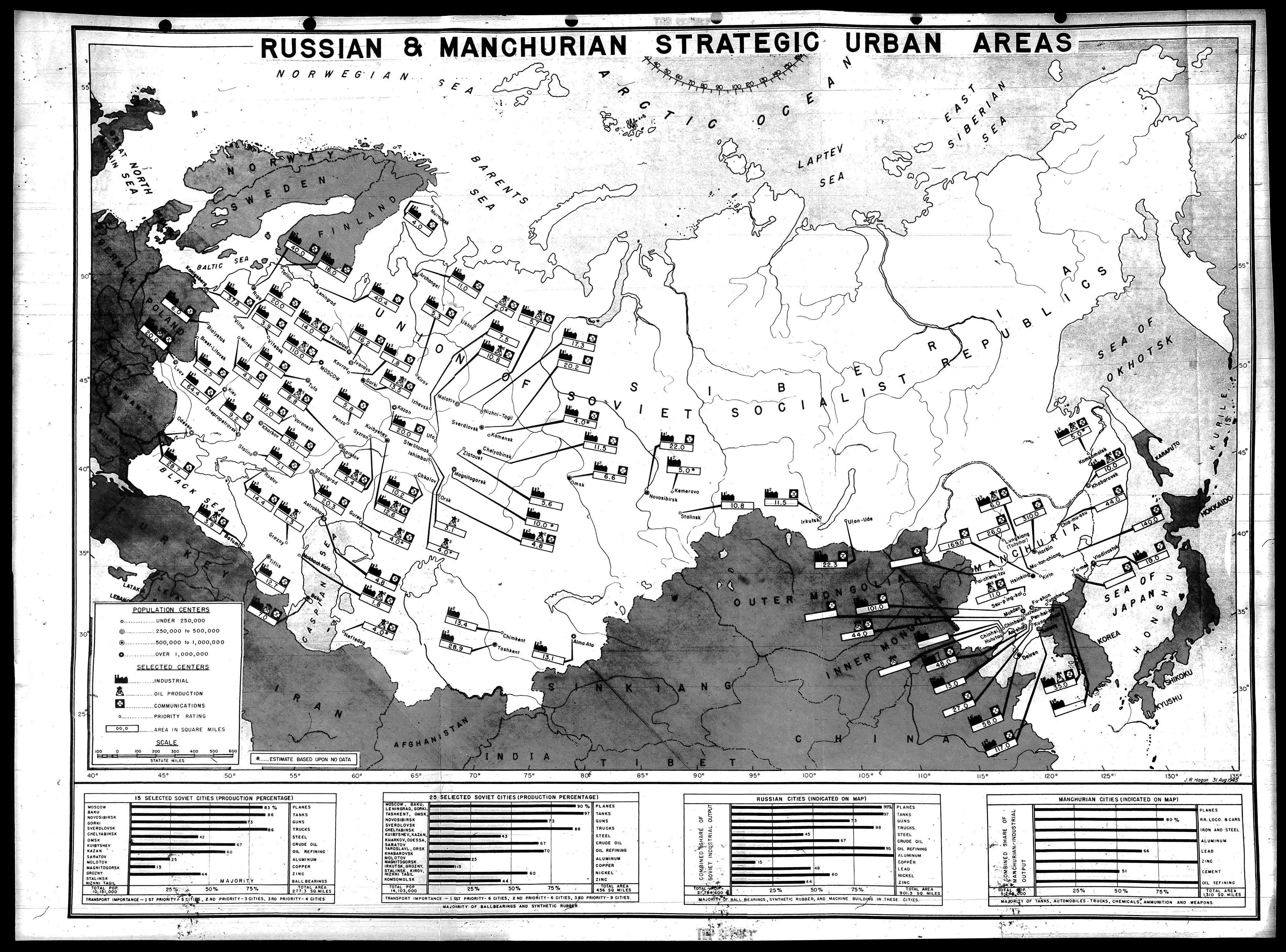
A little history is informative. “Barely six weeks after the Hiroshima-Nagsaki bombings,” Michel Chossudovsky tells us, “the US War Department [Pentagon] issued a blueprint (September 15, 1945) to ‘Wipe the Soviet Union off the Map’ (66 cities with 204 atomic bombs), when the US and the USSR were allies. This infamous project is confirmed by declassified documents.” (For further details see Chossudovsky, 2017)

Below is the image of the 66 cities of the Soviet Union which had been envisaged as targets by the US War Department. 


But back to Bird, who, in writing a piece about Oppenheimer’s “tragedy” and defending science, has also subtly defended a trinity of other matters: the government “science” on Covid, the transformative power coming from AI, and the U.S. propaganda about Russia and nuclear weapons. There is no mention of JFK’s call to abolish nuclear weapons. This is how the “paper of record” does its job.

I sit here now at the end of the day. Shadows are falling and I contemplate such trinities. I am stunned by the fact that we exist, but under a terrifying Shadow that many wish to ignore. Jung saw this shadow side as not just personal but social, and when it is ignored, the collective evils of modern societies can autonomously erupt. Bird argues that nuclear weapons are the result of a scientific quest that is unstoppable. He writes that Oppenheimer “understood that you cannot stop curious human beings from discovering the physical world around them [and then making nuclear bombs or designer babies].”

This is the ideology of progress that brooks no opposition since it is declared inevitable. It is a philosophy that believes there should be no limits to human knowledge, which would include the knowledge of good and evil, but which can then be ignored since it and all thought and beliefs are considered a priori to be relative. The modern premise that everything is relative is of course a contradiction since it is an absolute statement. Many share this philosophy of despair disguised as progress as it has crept into everything today. It is tragic, for if people accept it, we are doomed to follow a Faustian pact with the devil and all hell will follow. I think of Bob Dylan singing : 
"I just don’t see why I should even care,
          It’s not dark yet, but it’s gettin’ there..."             

But I do care, and I wonder why. As night comes on, I sit here and wonder."

"Two Voices..."

“At the approach of danger there are always two voices that speak with equal force in the heart of man: one very reasonably tells the man to consider the nature of the danger and the means of avoiding it; the other, even more reasonable, says that it is too painful and harassing to think of the danger, since it is not a man’s power to provide for everything and escape from the general march of events; and that it is therefore better to turn aside from the painful subject till it has come, and to think of what is pleasant. In solitude a man generally yields to the first voice; in society to the second.”
- Leo Tolstoy, “War and Peace”
A little light reading from Tolstoy… 
Freely download “War and Peace”, by Leo Tolstoy, here:
https://antilogicalism.com/
“All our mortal lives are set in danger and perplexity: one day to prosper,
and the next – who knows? When all is well, then look for rocks ahead.”
- Sophoclese, “Philoctetes”
Freely download “Seven Tragedies of Sophocles- Philoctetes” here:

"Such Great Heights"

"Bonaparte Before the Sphinx" by Jean-Léon Gérôme, 1886
"Such Great Heights"
by Joel Bowman

“From the heights of the Pyramids, forty centuries look down on us.”
~ Napoleon Bonaparte, in a speech to the 
Army of Egypt before the Battle of the Pyramids, 1798

Cairo, Egypt - "You reckon you’ve got problems? In terms of global power and influence, Egypt has been in a 2,500-year bear market. It was the year 525 BC when Cyrus the Great’s son and successor, Cambyses II, did what the Libyans, Nubians and Assyrians before him were unable to accomplish and conquered the “black land,” bringing it firmly under Persian control.

No doubt there were plenty of undulations and false dawns for the native Egyptians along the way... like when Petubastis III briefly retook the throne after revolting against the occupying Persians in 522-520 BC... but from the heights of the New Kingdom, ruled by iconic pharaohs like Hatshepsut, Akhenaten (and his slender-necked wife, Nefertiti), Tutankhamun and Ramesses II, through to the modern era, the once mighty Egyptian empire has been in relative decline.

That’s a long time wandering in the proverbial desert, watching as the conquering Greeks, Romans, Byzantines, Arabs, Ottoman Turks and even Napoleon’s Grande ArmĂ©e fought for control over these ancestral lands, including this very city, the “Gift of the Nile.”

These thoughts occurred to us this morning, while wandering the labyrinthine alleyways of the 14th century Khan el-Khalili bazaar. Seventeen years have passed since we were last in this strange land; an imperceptible blink in history’s eternal gaze. Much has changed in our own life over that period... and plenty, too, in the lives (and deaths) of the 22 million souls who call this city home. But what of the grander cycles, those beyond our control, about which we have lately been ruminating? When we left you on Tuesday, we were musing on Leo Tolstoy’s theory of history...

Historical Anarchy: Tolstoy, author of the momentous "War and Peace" and a self-described “spiritual anarchist,” explained the arc of history as similar to the course of a giant ship, stretching out across an enormous ocean of time. Whereas most historians favored placing human actors – take Napoleon, for example – in the mighty tugboat up front, pulling the hulking vessel through the swells, Tolstoy had the Little Corsican in the lifeboat abaft, tossed about by forces both beyond his control and indifferent to his plight.

Replacing the ship with the Grande Armée itself, the genius of Tolstoy's observation starts to take shape. When Napoleon first crossed the Niémen on his eastward march, he did so with 422,000 troops under his command. By the time he returned, lurching homeward from the opposite direction, his number had dwindled to barely 12,000...
Click Image for larger size.
Charles Minard's map of Napoleon's disastrous Russian campaign of 1812. The graphic is notable for its representation in two dimensions of six types of data: the number of Napoleon's troops; distance; temperature; the latitude and longitude; direction of travel; and location relative to specific dates.

Everything that could go wrong, seemed to do just that. But how? Tolstoy understood that no army this size could possibly fall under the direction of one man. Even if every last troop wanted to obey his general’s orders (doubtful, given the practice of "levĂ©e en masse" – mass conscription – popular at the time), the sheer logistical undertaking of command from on high rendered uniform obedience next to impossible. The problem with top-down organization, Tolstoy realized, was not only behavioral... but also informational.

Let us imagine for a moment that Napoleon has issued a directive for his cavalry to move into a position he considered, for whatever reason, advantageous. (This is a wildly oversimplified order, a fiction conscripted in service of a point that should soon become obvious.) At first blush, this might appear a reasonably basic request, especially given Napoleon's famed brilliance for military strategy and the Grande Armeé's (shall we posit?) unwavering discipline and dedication to its fearless leader.

Spontaneous Disorder: Alas, even this small order proves to be no easy task. To begin with, the cavalry is composed of both heavy and light divisions. In turn, each division may be further split into three subunits - the Carabiniers-Ă -Cheval (Horse Carabiniers), Dragoons (Mounted Infantry) and Cuirassiers in the former and the Hussars (Hussards), Chasseurs-Ă -Cheval (Mounted Hunters) and Lanciers (Lancers) in the latter.

That's a lot of moving parts, both human and equine, allowing plenty of room for error. Moreover, each of these divisions consists of numerous individual regiments... often made up of soldiers from different national and cultural backgrounds, including those from conquered lands who don't always share a common language. The Chasseurs-Ă -Cheval, for example, had 32 different regiments in 1811, six of which were composed of non-French-speaking Belgians, Swiss, Italians and Germans. Further complicating matters, each has its own chain of command... internal squabbles... politicking... alliances and petty jealousies.

Dispatches, such as our rudimentary "Cavalry proceed from A to B" hypothetical, were conveyed via horseback, usually by one of the brave Hussars. Provided our young individual is not wounded or captured en route... assuming he does not lose his nerve along the way... supposing his message is not in some other way compromised or corrupted... allowing that the intended recipient is still in one piece when he arrives... imagining a million other possible – perhaps even probable? – outcomes do not eventuate, the young fellow might be able to deliver his message... Just in time for the spontaneous order of events already in motion to have materially changed... along with his capricious general's all-too-human frame of mind...

If Napoleon, arguably one of history's greatest generals, cannot even get a timely message to his own front line... what then do we make of his supposedly pivotal role in the wars that bear his name? And yet, believing their research accurate, their knowledge beyond doubt or question and their understanding of events long since transpired unassailable, historians assign lynchpin importance to the directives of one mere mortal or another. A supposition stacked on an assumption built on a guess tied up in an imaginary fantasy... thus is history, as we “know” it, authored.

Imperfect Knowledge: The Grande Armeé also made use of homing pigeons and observation balloons. The reader is invited to imagine the manifold and unknowable variables that must have arisen using such crude communication technologies... Suffice to say, society is complex. Information - both its dissemination and reception - is often nonlinear. Perfect knowledge, and therefore central planning, is untenable.

Why is it important to understand these points? And what does it have to do with the theory at hand? For one thing, it helps disabuse us of the misapprehension that any one man or woman or governing committee is truly capable of directing the grand cycles of history. It relieves us of the strange but common urge to over-accredit historical agency to a Trump or a Biden or an Obama or, worse still, some mysterious man behind the curtain, pulling the levers and pushing the buttons.

For another, it hints at the flailing impotence inherent in all top-down command systems... as “leaders” of many a nation state have been at pains to demonstrate through a seemingly unending relay of consequences both unknowable and unintended.

And finally, it reminds us to consider what precious little we can control during this brief moment called life - our small, daily actions toward others - amidst the vanishing footsteps in the sand, which we all leave behind."

"How It Really Is"


Dan, I Allegedly, "Don’t Open That Email! Hackers Are Watching"

Full screen recommended.
Dan, I Allegedly, 4/24/25
"Don’t Open That Email! Hackers Are Watching"
"Hackers are watching, so don’t open that email! In today’s video on IAllegedly, I’m sharing critical updates from Google, Microsoft, and Facebook about a scary malware attack targeting Gmail users. These sophisticated phishing scams can bypass two-factor authentication, stealing your personal and financial data in seconds. I’ll break down how these fake subpoenas work, how hackers trick even the smartest users, and what you can do to protect yourself from these threats, including the dangers of Toad Malware for Android users.

Stay informed and take action to safeguard your email, bank accounts, and privacy. Please join our email list to stay updated, and don’t forget to hit that like button and subscribe to the channel! We have a Private Channel where you can support us and get exclusive content. Everyone, please be kind to each other - onward and upward. All the best, Dan."
Comments here:

"The CEOs of Walmart, Target, Home Depot Warn That Store Shelves All Over America Could Soon Be Empty"

Full screen recommended.
Epic Economist, 4/24/25
"The CEOs of Walmart, Target, Home Depot Warn
 That Store Shelves All Over America Could Soon Be Empty"

"If you If you are going to need anything made in China, I would buy it now while you still can. Many companies have already decided that it no longer makes any economic sense to import Chinese-made products into the United States because tariff rates are so high. As a result, there are certain things that will soon no longer be available to U.S. consumers. When I posted videos warning about “empty shelves” in the months ahead, some people thought that I was exaggerating. But of course the truth is that I was not exaggerating at all.

On Tuesday, the CEOs of Walmart, Target, Home Depot and Lowe’s specifically warned President Trump that store shelves all over the country could "soon be empty" during a meeting at the White House… What makes this meeting even more significant is that Walmart and Target are two of the biggest corporate donors to Trump’s inauguration, with Target alone contributing $1 million. Despite their financial support and close access, their warnings were stark and urgent—highlighting that even well-connected businesses can no longer operate normally under these new economic pressures."
Comments here:
o
Full screen recommended.
Market Gains, 4/24/25
"Amazon Has Fired Over 100,000 Workers as Recession Begins"
Comments here:

Adventures With Danno, "Shocking Prices At Kroger"

Full screen recommended.
Adventures With Danno, AM 4/24/25
"Shocking Prices At Kroger"
Comments here:

Bill Bonner, "Mission Accomplished"

"Mission Accomplished"
by Bill Bonner

Buenos Aires, Argentina - "What a glorious, gaudy, giddy war! While it lasted…We refer to the ‘Great Trade War’ started with horns blowing and flags waving by Donald J. Trump. All the thrill of battle with no dead bodies. All the righteous excitement of a Worthy National Cause, good vs. evil…right vs. wrong...and all we stood to lose was money.

It was billed as the trade war to end trade wars...with a Liberation Day that was to usher in a new Golden Era for the US. From now on, the playing field would be level... and we Americans would be winners again. We imagined the great victories - over China, Europe, Vietnam, who had been ‘ripping us off’ for decades.

And then there would be a victory parade, perhaps down Broadway in Gary, Indiana...POTUS could announce ‘mission accomplished’ on the deck of a cargo ship, idled off of Long Beach, and then hand out Trade War Service medals to Pete Navarro and Scott Bessent. (The military humor site, Duffel Blog, reports that the medals may be delayed because of Chinese retaliatory tariffs!)

Like all the best wars, America’s Trade War was intended to be short, sweet, and victorious. “Trade wars are easy to win,” said America’s leader. It was supposed to be only a few weeks before the enemy surrendered and the fentanyl, illegal immigrants, and cheap (unfair!) products stopped flooding over the border...with new factories popping up all over America.

But the trade war went bad, almost from the first day. The war aims were never clear. Drugs? Immigration? Manufacturing revival? Revenue raising? Were we trying to right wrongs... or get rich? What exactly were we trying to do?

At first, tariffs seemed like a goal in themselves. They would be ‘reciprocal’ - erasing many years of unfair, unbalanced trade. But hardly had the ships appeared on the horizon when the Liberation Day landings were aborted. A pause was announced, giving the enemy a chance to ‘negotiate.’ Maybe they could just buy more tanks and airplanes from US industries? And maybe we’d call off the war? They were lining up to kiss Donald Trump’s derriere, we were told; was that the goal? They had to do a deal, POTUS explained, in order to get access to US consumers.

But they already had access…and we already had deals in place with all of them. Was the idea to reduce the current trade-weighted tariff average of 2.2%...to 2.1%? “No,” said trade advisor Pete Navarro. Even if the tariffs went to zero, that wouldn’t stop the trade war. As near as we can tell the real goal was simply to bring trade under political control... with the ‘deals’ controlled by Donald Trump himself.

Apple, Nvidia, and other companies got the message. They lined up. Now it was Americans who were kissing the president’s duff. CNN: "It started with iPhones, which under Trump’s 145% China tariffs were set to more than double in price. But Apple CEO Tim Cook called the White House and soon secured a reprieve, the New York Times reports. Other businesses took note, and soon CEOs and lobbyists were scrambling to make their case for why their burning house also deserves some water.

On Monday, the CEOs of Walmart, Target, Lowe’s and Home Depot descended on the White House to discuss tariffs... scrambling to get the president’s attention. “There’s only one person that can really authorize that exemption and that’s the president,” a business representative with close ties to the Trump administration told Politico. “So if you’re not a company that can whisper in the president’s ear or make the trip to Mar-a-Lago and do it persuasively, then you’re sort of frozen out of the process for now.”

In his press conference on Tuesday, the president said he wasn’t going to play hardball with the Chinese. Instead, he was going to be ‘nice.’ Why? Because, while all of this puckering up was going on a disturbing new insight had reached the White House. Trade wars lead to falling stock prices. And prices only go back up when investors believe the trade war has been called off.

Trump insisted that he was ‘bringing China et al. to the bargaining table.’ But now it was actually Trump himself who needed a deal. The deal-maker had maneuvered himself into a losing position. The only way he can keep the stock market from collapsing is by abandoning his own trade war. The Wall Street Journal: “Another harsh reality is that China called Mr. Trump’s bluff and seems to have won this round.” In short, the war is over. Now Team Trump is making deals. Like the deal they negotiated with Canada and Mexico during his last term, trade will go on much as it did before. And - despite his blustery blah blah - it is Trump himself who will bend over and pucker up."

Gregory Mannarino, "Systemic Failure Rapidly Worsening; Expect Hyperinflation, Rationing"

Gregory Mannarino, AM 4/24/25
"Systemic Failure Rapidly Worsening; 
Expect Hyperinflation, Rationing"
Comments here:
“The system is debt-based, 
and it must expand... or die.”

"More Government Borrowing = Higher Interest Costs. Every year, the government must borrow more to stay afloat. That means more of our tax dollars go toward interest, not fixing roads, helping families, or building the future.

The Federal Reserve Must Step In. To keep rates low (and the system from cracking), the Fed buys government debt. This means more money-printing, aka debt monetization. What follows? INFLATION. Your dollar dies slowly in your pocket. What cost $100 five years ago now costs $125+. That’s not a coincidence, it’s engineered theft.

The Middle Class Gets GUTTED. Wages do not keep up with inflation. Essentials (housing, groceries, insurance, fuel) become luxuries. Home ownership, saving, and security vanish for the average family.

More Crises. Massive deficits mean the government has less room to respond to future recessions, disasters, or wars. When the next shock hits? They’ll respond with more printing.

The End Game: Currency Crisis. Hyperinflation, rationing, loss of reserve currency status. This is the final act of all empires addicted to debt. This is not accidental. It’s the consequence of decades of engineered dependency, greed, and monetary distortion. The middle class is the sacrificial fuel to keep the debt machine alive."

Wednesday, April 23, 2025

"China Didn't Defeat Trump, It Defeated America; The Ponzi Scheme Needs More Debt, FED Buying It All"

Jeremiah Babe, 4/23/25
"China Didn't Defeat Trump, It Defeated America; 
The Ponzi Scheme Needs More Debt, FED Buying It All"
Comments here:

Greg Hunter, "Depression Cycle Arrives in 2025 & 2026"

"Depression Cycle Arrives in 2025 & 2026"
by Greg Hunter’s USAWatchdog.com

"Renowned geopolitical and financial cycle expert Charles Nenner is not only predicting a big war cycle but a depression coming by the end of 2025 and into 2026. It’s not caused by the Trump tariffs; it’s just part of the cycle that Nenner follows. When does this big downturn start? Nenner explains, “In the next few months, and the end of this year will be a down year. 2026 will also be a down year. It’s going to be very serious. I wrote last year I expect the S&P to go down to 4,000. So, from 6,200 to 4,000 if you are in bad stocks, you could lose 50% of your money, and to get that back, you have to make 100% on what is left of your money. Then we can have a bounce and go lower again. If you look at the list of brokers, 99% are positive. They were talking about the S&P going to 6,800, and then they changed their minds when it came down.”

Nenner is predicting a down year for the stock market this year, but look out in 2026. Nenner says, “It will be much worse in 2026 because the cycles in 1928 and 1929 are in the same position as 2025 and 2026.”

Can it shoot through 4,000 on the S&P? Nenner says, “Most definitely, I think so, yeah, we expect a bounce from there before it goes down again.” Beyond that, Nenner has long called for a DOW at 5,000. It’s nearly 39,000 today. Nenner says, “I calculated it at 5,000, yes, and I have not calculated it for the S&P.”

That is pretty bearish, and before people pooh-pooh what Nenner is saying, listen to his logic on this subject. Nenner explains, “Let’s take one simple assumption. If there is a big war between China and Tiawan, do you think the market goes up? Do you think there is a chance of it – 50/50? So, there is a 50/50 chance only based on this idea the markets are not going to do well. Of course, China wants to take over Taiwan. There is no history that it does not belong to China. If US gets in a war with China, it will lose, US lost 15 out of 15 war games in simulated war with China.”

Nenner still likes gold for the long term and has been predicting it’s rise. On silver, Nenner says, “Silver is behind, but starting in May, we expect silver to start catching up - finally.” Nenner thinks interest rates are still in a long-term trend up, but there can be pullbacks. Nenner also thinks the US dollar is going to be okay and will not fall much more - for now. By the way, Nenner says he is up 40% so far in 2025. There is more in the 37-minute interview."

Join Greg Hunter on Rumble as he goes One-on-One with 
renowned cycle analyst and financial expert Charles Nenner: 

Musical Interlude: Deuter, "Endless Horizon"

Full screen recommended. 
Deuter, "Endless Horizon"
"I cannot paint
What then I was. The sounding cataract
Haunted me like a passion: the tall rock,
The mountain, and the deep and gloomy wood,
Their colors and their forms, were then to me
An appetite; a feeling and a love,
That had no need of a remoter charm,
By thought supplied, not any interest
Unborrowed from the eye.

That time is past,
And all its aching joys are now no more,
And all its dizzy raptures. Not for this
Faint I, nor mourn nor murmur: other gifts
Have followed; for such loss, I would believe,
Abundant recompense. 

For I have learned
To look on nature, not as in the hour
Of thoughtless youth; but hearing oftentimes
The still, sad music of humanity,
Nor harsh nor grating, though of ample power
To chasten and subdue." 

- William Wordsworth,
"Lines Written A Few Miles Above Tintern Abbey"

"A Look to the Heavens"

“Magnificent island universe NGC 2403 stands within the boundaries of the long-necked constellation Camelopardalis. Some 10 million light-years distant and about 50,000 light-years across, the spiral galaxy also seems to have more than its fair share of giant star forming HII regions, marked by the telltale reddish glow of atomic hydrogen gas. The giant HII regions are energized by clusters of hot, massive stars that explode as bright supernovae at the end of their short and furious lives.
A member of the M81 group of galaxies, NGC 2403 closely resembles another galaxy with an abundance of star forming regions that lies within our own local galaxy group, M33 the Triangulum Galaxy. Spiky in appearance, bright stars in this colorful galaxy portrait of NGC 2403 lie in the foreground, within our own Milky Way.”

"It's Human Nature..."

“We’ve all heard the warnings and we’ve ignored them. We push our luck. We roll the dice. It’s human nature. When we’re told not to touch something we usually do even if we know better. Maybe because deep down, we’re just asking for trouble.”
- “Meredith Grey”, “Gray’s Anatomy”

If so, we've certainly gotten all we want...

"Why Can't We Imagine Goodness?"

"Why Can't We Imagine Goodness?"
by Paul Rosenberg

"I well remember the first time someone told me they believed in the Calvinist doctrine of “the depravity of man.” It shocked me. To complain about human behavior I understood, but to condemn the entire human species as depraved... that was and remains obscene to me.

The sad truth, however, is that we've been swimming in a sea of secular Calvinism. The corporate bullhorns feed everyone they can a steady diet of the bad, the ugly, and if possible the bloody. Under their influence we would believe that all is darkness, that truth is illusion, that the human path is ever-downward, and that all professions of goodness are frauds. In other words, we are endlessly pushed to accept human depravity is an inescapable fact. The strategy has been terribly effective, but it is no less than obscene. And it’s false. Humans are amazing creatures: very often kind, gracious and loving creatures.

The Real Revolutionaries: I’ve used this passage from G.K. Chesterton’s "The Defendant" before, but it’s so important that I could use it once a month and feel fine about it: "Every one of the great revolutionists, from Isaiah to Shelly, have been optimists. They have been indignant, not about the badness of existence, but about the slowness of men in realizing its goodness. The popular image of a revolutionary is of someone railing against rulers and leading a mob against them to bring in a new political regime. Notwithstanding the ridiculous notion of politics saving us from politics, this has always been a fantasy."

The actual revolution of our time is not to bring anything down; it's seeing that we’ve outgrown a dark and manipulative public order; that it’s fit to be tossed aside like the worn-out tee-shirts of our youth. Real revolutionaries don’t want to take over an outmoded and abusive status quo, but to transcend it... to leave it behind and build better things. Behind such a belief, as Chesterton noted, stands a realization of the goodness of existence.

How Good Can We Get? Consider the millions of hours... billions of hours... wasted every year in outrage against the endless evils (nearly all of them embellished or simply imagined) that are pumped through television, radio and social media. Then please consider that the problems so terrifyingly portrayed are never really solved.

How silly is it to spend our time and treasure fighting within a system that can never allow its problems to be solved – if it solved the problems it would have no reason to exist – when we are quite able to improve ourselves with less time and energy? Consider this please, even though it’s a forbidden thought: We have no real idea of how good we can get, because we haven’t seriously focused on improving ourselves.

Or, said differently: Instead of endlessly imagining human evil, what if we started imagining human greatness? One is just as possible as the other, so why shouldn’t we take the bright path instead of the permanently dark path that’s proven not to work? And if it simply "feels too wierd," what has been done to us? And I will add that the progress we have seen in the world... science, medicine and the like... has mainly come from people who imagined better ways, better things, and better lives.

The radical and revolutionary belief that stands before us is this: That mankind is better than we’ve imagined... that human life can be satisfying and rewarding. All we have to do is disengage from the stream of darkness and start trying."
John Lennon, "Imagine"