StatCounter

Monday, November 16, 2026

“The Last Night of the World”

“The Last Night of the World”
Originally published in the February 1951 issue of "Esquire"
by Ray Bradbury

“What would you do if you knew this was the last night of the world?”
“What would I do; you mean, seriously?”
“Yes, seriously.”
“I don’t know – I hadn’t thought.” She turned the handle of the silver coffeepot toward him and placed the two cups in their saucers. He poured some coffee. In the background, the two small girls were playing blocks on the parlor rug in the light of the green hurricane lamps. There was an easy, clean aroma of brewed coffee in the evening air.
“Well, better start thinking about it,” he said.
“You don’t mean it?” said his wife.
He nodded.
“A war?”
He shook his head.
“Not the hydrogen or atom bomb?”
“No.”
“Or germ warfare?”
“None of those at all,” he said, stirring his coffee slowly and staring into its black depths. “But just the closing of a book, let’s say.”
“I don’t think I understand.”
“No, nor do I really. It’s jut a feeling; sometimes it frightens me, sometimes I’m not frightened at all – but peaceful.” He glanced in at the girls and their yellow hair shining in the bright lamplight, and lowered his voice. “I didn’t say anything to you. It first happened about four nights ago.”
“What?”
“A dream I had. I dreamt that it was all going to be over and a voice said it was; not any kind of voice I can remember, but a voice anyway, and it said things would stop here on Earth. I didn’t think too much about it when I awoke the next morning, but then I went to work and the feeling as with me all day. I caught Stan Willis looking out the window in the middle of the afternoon and I said, ‘Penny for your thoughts, Stan,’ and he said, ‘I had a dream last night,’ and before he even told me the dream, I knew what it was. I could have told him, but he told me and I listened to him.”
“It was the same dream?”
“Yes. I told Stan I had dreamed it, too. He didn’t seem surprised. He relaxed, in fact. Then we started walking through offices, for the hell of it. It wasn’t planned. We didn’t say, let’s walk around. We just walked on our own, and everywhere we saw people looking at their desks or their hands or out the windows and not seeing what was in front of their eyes. I talked to a few of them; so did Stan.”
“And all of them had dreamed?”
“All of them. The same dream, with no difference.”
“Do you believe in the dream?”
“Yes. I’ve never been more certain.”
“And when will it stop? The world, I mean.”
“Sometime during the night for us, and then, as the night goes on around the world, those advancing portions will go, too. It’ll take twenty-four hours for it all to go.”
They sat awhile not touching their coffee. Then they lifted it slowly and drank, looking at each other.
“Do we deserve this?” she said.
“It’s not a matter of deserving, it’s just that things didn’t work out. I notice you didn’t even argue about this. Why not?”
“I guess I have a reason,” she said.
“The same reason everyone at the office had?”
She nodded. “I didn’t want to say anything. It happened last night. And the women on the block are talking about it, just among themselves.” She picked up the evening paper and held it toward him. “There’s nothing in the news about it.”
“No, everyone knows, so what’s the need?” He took the paper and sat back in his chair, looking at the girls and then at her. “Are you afraid?”
“No. Not even for the children. I always thought I would be frightened to death, but I’m not.”
“Where’s that spirit of self-preservation the scientists talk about so much?”
“I don’t know. You don’t get too excited when you feel things are logical. This is logical. Nothing else but this could have happened from the way we’ve lived.”
“We haven’t been too bad, have we?”
“No, nor enormously good. I suppose that’s the trouble. We haven’t been very much of anything except us, while a big part of the world was busy being lots of quite awful things.”
The girls were laughing in the parlor as they waved their hands and tumbled down their house of blocks.
“I always imagined people would be screaming in the streets at a time like this.”
“I guess not. You don’t scream about the real thing.”
“Do you know, I won’t miss anything but you and the girls. I never liked cities or autos or factories or my work or anything except you three. I won’t miss a thing except my family and perhaps the change in the weather and a glass of cool water when the weather’s hot, or the luxury of sleeping. Just little things, really. How can we sit here and talk this way?”
“Because there’s nothing else to do.”
“That’s it, of course, for if there were, we’d be doing it. I suppose this is the first time in the history of the world that everyone has really known just what they were going to be doing during the last night.”
“I wonder what everyone else will do now, this evening, for the next few hours.”
“Go to a show, listen to the radio, watch the TV, play cards, put the children to bed, get to bed themselves, like always.”
“In a way that’s something to be proud of – like always.”
“We’re not all bad.”
They sat a moment and then he poured more coffee. “Why do you suppose it’s tonight?”
“Because.”
“Why not some night in the past ten years of in the last century, or five centuries ago or ten?”
“Maybe it’s because it was never February 29, 1951, ever before in history, and now it is and that’s it, because this date means more than any other date ever meant and because it’s the year when things are as they are all over the world and that’s why it’s the end.”
“There are bombers on their course both ways across the ocean tonight that’ll never see land again.”
“That’s part of the reason why.”
“Well,” he said. “What shall it be? Wash the dishes?”
They washed the dishes carefully and stacked them away with especial neatness. At eight-thirty the girls were put to bed and kissed good night and the little lights by their beds turned on and the door left a trifle open.
“I wonder,” said the husband, coming out and looking back, standing there with his pipe for a moment.”
“What?”
“If the door should be shut all the way or if it should be left just a little ajar so we can hear them if they call.”
“I wonder if the children know – if anyone mentioned anything to them?”
“No, of course not. They’d have asked us about it.”
They sat and read the papers and talked and listened to some radio music and then sat together by the fireplace looking at the charcoal embers as the clock struck ten-thirty and eleven and eleven-thirty. They thought of all the other people in the world who had spent their evening, each in their own special way.
“Well,” he said at last. He kissed his wife for a long time.
“We’ve been good for each other, anyway.”
“Do you want to cry?” he asked.
“I don’t think so.”
They went through the house and turned out the lights and locked the doors, and went into the bedroom and stood in the night cool darkness undressing. She took the spread from the bed and folded it carefully over a chair, as always, and pushed back the covers. “The sheets are so cool and clean and nice,” she said.
“I’m tired.”
“We’re both tired.”
They got into bed and lay back.
“Wait a moment,” she said.
He heard her get up and go out into the back of the house, and then he heard the soft shuffling of a swinging door. A moment later she was back. “I left the water running in the kitchen,” she said. “I turned the faucet off.”
Something about this was so funny that he had to laugh. She laughed with him, knowing what it was that she had done that was so funny. They stopped laughing at last and lay in their cool night bed, their hands clasped, their heads together.
“Good night,” he said, after a moment.
“Good night,” she said, adding softly, “dear…”

"What Might Have Been..."

“Space I can recover. Time, never.” 
-  Napoleon Bonaparte

“Lands can be reconquered, indeed in the course of a battle, a hill or a certain plain might trade hands several times. But missed opportunities? These can never be regained. Moments in time, in culture? They can never be re-made. One can never go back in time to prepare for what they should have prepared for, no one can ever get back critical seconds that were wasted out of fear or ego. Napoleon was brilliant at trading space for time: Sure, you can make these moves, provided you are giving me the time I need to drill my troops, or move them to where I want them to be. Yet in life, most of us are terrible at this. We trade an hour of our life here or afternoon there like it can be bought back with the few dollars we were paid for it. And it is only much, much later, as they are on their deathbeds or when they are looking back on what might have been, that many people realize the awful truth of this quote. Don’t do that. Embrace it now.”
- Ryan Holiday
○
And in secret moments of despair, 
Too late, too late...We think what might have been, 
should have been, and we let it slip away...
Chris De Burgh, 
"Carry Me (Like A Fire In Your Heart)"

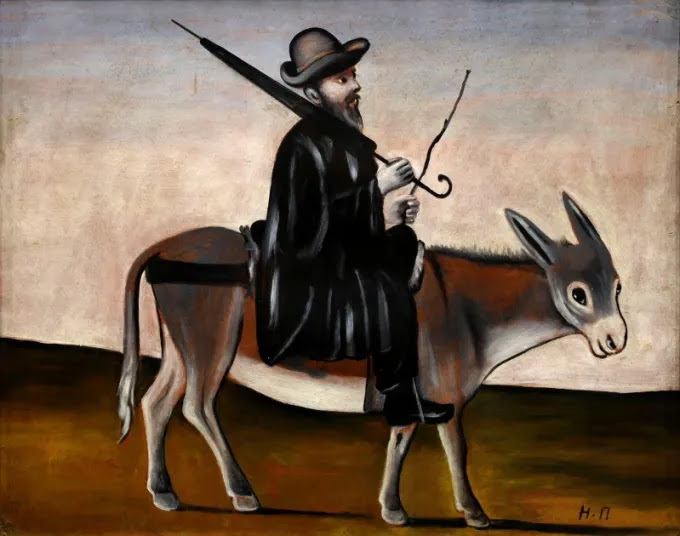
"The Donkey and the Meaning of Eternity"

"The Donkey and the Meaning of Eternity: Nobel-Winning
 Spanish Poet Juan Ramón Jiménez’s Love Letter to Life"
by Maria Popova

Excerpt: "Beneath our anxious quickenings, beneath our fanged fears, beneath the rusted armors of conviction, tenderness is what we long for - tenderness to salve our bruising contact with reality, to warm us awake from the frozen stupor of near-living. Tenderness is what permeates Platero and I (public library) by the Nobel-winning Spanish poet Juan Ramón Jiménez (December 23, 1881–May 29, 1958) - part love letter to his beloved donkey, part journal of ecstatic delight in nature and humanity, part fairy tale for the lonely.

Living in his birthplace of Moguer - a small town in rural Andalusia - Jiménez began composing this uncommon posy of prose poems in 1907. Although it spans less than a year in his life with Platero, it took him a decade to publish it. At its heart is a simple truth: What and whom we love is a lens to focus our love of life itself.

The tenderness with which Jiménez regards Platero - whom he addresses by name over and over, like an incantation of love - is the tenderness of living with wonder and fragility. He celebrates Platero’s “big gleaming eyes, of a gentle firmness, in which the sun shines”; he reverences him as “friend to the old man and the child, to the stream and the butterfly, to the sun and the dog, to the flower and the moon, patient and pensive, melancholy and lovable, the Marcus Aurelius of the meadows.” He beckons him: “Come with me. I’ll teach you the flowers and the stars.”

And so he does: "Look, Platero, so many roses are falling everywhere: blue, pink, white, colorless roses… You’d think the sky was crumbling into roses… You’d think that from the seven galleries of Paradise roses were being thrown onto the earth… Platero, it seems, while the Angelus is ringing, that this life of ours is losing its everyday strength, and that a different strength from within, loftier, more constant, and purer, is causing everything, as if in fountain jets of grace… Your eyes, which you can’t see, Platero, and which you are mildly raising skyward, are two beautiful roses."

Together, poet and donkey traverse the Andalusian countryside in a state of rapturous harmony with each other and the living world: "Through the low-lying roads of summer, draped with tender honeysuckle, how sweetly we go! I read, or sing, or recite poetry to the sky. Platero nibbles the sparse grass of the shady banks, the dusty blossoms of the mallows, the yellow sorrel. He halts more than he walks. I let him.
[…]
Every so often Platero stops eating and looks at me. Every so often I stop reading and look at Platero."

There are echoes of Whitman in Jiménez’s exultations: "Before us are the fields, already green. Facing the immense, clear sky, of a blazing indigo, my eyes - so far from my ears! - open nobly, welcoming in its calm that indescribable placidity, that harmonious, divine serenity which dwells in the limitlessness of the horizon."

This longing for the infinite accompanies the young man and the old donkey as they cross the hills and valleys on their daily pilgrimages: "The evening extends beyond its normal limits, and the hour, infected with eternity, is infinite, peaceful, unfathomable."

Again and again, Platero’s presence magnifies the poet’s relishing of beauty, deepens his contact with the eternal: "I remain in ecstasy before the twilight. Platero, his black eyes scarlet with sunset, walks gently to a puddle of crimson, pink, and violet waters; he softly immerses his lips into the mirrors, which seem to liquefy as he touches them."

Punctuating these ecstasies are the inevitable spells of melancholy stemming from the fact that the price of being awake to life is being also awake to mortality. Aware that this enchanted life with his beloved Platero is only for the time being, Jiménez reaches into the sorrow of the future to consecrate it with joy: "Platero. I shall bury you at the foot of the large, round pine in the orchard at La Piña, which you like so much. You will remain alongside cheerful, serene life. The little boys will play and the little girls will sew beside you on their little low chairs. You will get to hear the verses that the solitude will inspire in me. You’ll hear the older girls singing when they wash clothes in the orange grove, and the sound of the waterwheel will be a joy and a solace to your eternal peace. And all year long the goldfinches, greenfinches, and vireos, in the perennial freshness of the treetop, will create for you a small musical ceiling between your tranquil slumber and Moguer’s infinite, ever-blue sky."
Full, wonderful article is here:

"I Wish You Enough"

"I Wish You Enough"
by Bob Perks

"I never really thought that I'd spend as much time in airports as I do. I don't know why. I always wanted to be famous and that would mean lots of travel. But I'm not famous, yet I do see more than my share of airports. I love them and I hate them. I love them because of the people I get to watch. But they are also the same reason why I hate airports. It all comes down to "hello" and "goodbye." I must have mentioned this a few times while writing my stories for you.

I have great difficulties with saying goodbye. Even as I write this I am experiencing that pounding sensation in my heart. If I am watching such a scene in a movie I am affected so much that I need to sit up and take a few deep breaths. So when faced with a challenge in my life I have been known to go to our local airport and watch people say goodbye. I figure nothing that is happening to me at the time could be as bad as having to say goodbye. Watching people cling to each other, crying, and holding each other in that last embrace makes me appreciate what I have even more. Seeing them finally pull apart, extending their arms until the tips of their fingers are the last to let go, is an image that stays forefront in my mind throughout the day.

On one of my recent business trips, when I arrived at the counter to check in, the woman said, "How are you today?" I replied, "I am missing my wife already and I haven't even said goodbye." She then looked at my ticket and began to ask, "How long will you... Oh, my God. You will only be gone three days!" We all laughed. My problem was I still had to say goodbye. But I learn from goodbye moments, too.

Recently I overheard a father and daughter in their last moments together. They had announced her departure and standing near the security gate, they hugged and he said, "I love you. I wish you enough." She in turn said, "Daddy, our life together has been more than enough. Your love is all I ever needed. I wish you enough, too, Daddy." They kissed and she left. He walked over toward the window where I was seated. Standing there I could see he wanted and needed to cry. I tried not to intrude on his privacy, but he welcomed me in by asking, "Did you ever say goodbye to someone knowing it would be forever?" "Yes, I have," I replied. Saying that brought back memories I had of expressing my love and appreciation for all my Dad had done for me. Recognizing that his days were limited, I took the time to tell him face to face how much he meant to me. So I knew what this man was experiencing.

"Forgive me for asking, but why is this a forever goodbye?" I asked. "I am old and she lives much too far away. I have challenges ahead and the reality is, the next trip back would be for my funeral," he said. "When you were saying goodbye I heard you say, 'I wish you enough.' May I ask what that means?" He began to smile. "That's a wish that has been handed down from other generations. My parents used to say it to everyone." He paused for a moment and looking up as if trying to remember it in detail, he smiled even more. "When we said 'I wish you enough,' we were wanting the other person to have a life filled with just enough good things to sustain them," he continued and then turning toward me he shared the following as if he were reciting it from memory...

"I wish you enough sun to keep your attitude bright.
I wish you enough rain to appreciate the sun more.
I wish you enough happiness to keep your spirit alive.
I wish you enough pain so that the smallest joys in life appear much bigger.
I wish you enough gain to satisfy your wanting.
I wish you enough loss to appreciate all that you possess.
I wish enough "Hello's" to get you through the final "Goodbye."

He then began to sob and walked away. My friends, I wish you enough!"

"Truth..."


The Delta Old Lantern, "The Wind Knows My Regrets"

Full screen recommended.
"The Wind Knows My Regrets"
"Welcome to The Delta Old Lantern - a home for deep Delta Blues, Southern Gothic storytelling, old soul music, and timeless blues wisdom. Here you’ll find dark Delta Blues inspired by dusty backroads, front porch memories, aging souls, quiet struggles, and the changing world around us. Every song carries the spirit of old acoustic blues, slide guitar echoes, worn-out roads, and stories carved by time.The Delta Old Lantern creates atmospheric blues music for listeners who appreciate raw emotion, old-world storytelling, lonely highways, weathered hearts, and the beauty found in growing older. These songs are inspired by the spirit of classic Delta Blues legends while bringing a modern cinematic sound for today’s listeners. This is music for old souls, late-night thinkers, weary travelers, and anyone who still believes stories matter."

"How It Really Is"

"I'd been in hairier situations than this one. Actually, it's sort of depressing, thinking how many times I'd been in them. But if experience had taught me anything, it was this: No matter how screwed up things are, they can get a whole lot worse."
- Jim Butcher
○
Problems? "Dig your way out..." they said.

Dan, I Allegedly, "The Restaurant Industry is Eating Itself Alive"

Full screen recommended.
Dan, I Allegedly, 11/16/26
"The Restaurant Industry is Eating Itself Alive"
"The restaurant industry is facing a financial storm, and consumers are paying the price. More than 300 restaurants have closed in Los Angeles in 2026 alone, while restaurant operating expenses have increased dramatically. Rising labor costs, commercial rent, insurance, food prices, and utilities are making it increasingly difficult for independent restaurants to survive. But customers are fed up, too. Smaller portions, higher menu prices, declining service, automatic 20% tips, surprise service charges, and even a $6 takeout container are pushing people to their breaking point. Is the restaurant industry pricing its own customers out of business? We look at the business economics, consumer spending, personal finance, and what this means for America's economy. Plus, protecting your wealth with gold and silver in an increasingly uncertain financial environment."
Comments here:

"Snyder Reports, 11/16/26"

Full screen recommended.
Snyder Reports, 11/16/26
"Why Governments Recommend A 72 Hour Stockpile"
"Why are governments around the world telling citizens to stockpile for at least 72 hours? In this video, I break down what the UK, Australia, and the United States are actually warning about - and why experts say most Americans have a dangerous misconception about how fast government help can arrive. When water, power, and food supplies stop, FEMA and the military can't mobilize in minutes or hours. It takes days to get people and resources on the ground, and rural towns and smaller cities will wait longer than major hubs like Los Angeles, Seattle, and New York. We also cover the Pentagon's 90-day self-sufficient base plan, the reported 2,500-missile stockpile threat, and why many experts believe a cyberattack on the power grid is the most likely scenario to face. What you'll learn: Why 72 hours is the minimum, not the goal; why 2 weeks is the ultimate preparedness target; what to have for water, food, heat, and backup power; why major cities get help first - and what that means if you live elsewhere Do yourself and your family a favor: prepare now. At least 3 days as a base, 2 weeks if you can."
Comments here:

"Americans Are Borrowing to Survive as Credit Card Debt Hits $1.29 Trillion"

'Americans Are Borrowing to Survive
 as Credit Card Debt Hits $1.29 Trillion"
by Martin Armstrong

Americans are now carrying a record $1.29 trillion in credit card debt, and Washington continues to tell everyone that the economy is doing just fine. The Federal Reserve Bank of New York reported that credit card balances increased another $22 billion during the third quarter of 2026, bringing the annual increase to $52 billion. Total household debt has reached $19.1 trillion, an increase of approximately $5 trillion since the end of 2019. These are staggering figures. The political establishment celebrates consumer spending as evidence of economic strength, but nobody seems particularly interested in asking how Americans are financing that spending. When people are forced to borrow to maintain their standard of living, that is hardly a sign of prosperity.

The inflation created during the COVID lockdowns permanently raised the cost of living. Politicians continue discussing inflation as though a lower monthly CPI reading means prices have returned to where they were in 2020. That is complete nonsense. Inflation is cumulative. A family paying substantially more for groceries, insurance, housing, electricity, and transportation does not suddenly recover its purchasing power because the annual inflation rate declines. Prices remain elevated, and every additional increase compounds the damage. Wages may rise in nominal terms, but that means very little when the cost of maintaining the same household continues to consume a larger portion of income.

The credit card figures reveal the growing divide between Americans who own assets and those who depend upon wages. People holding substantial investments, property, and financial assets have been better positioned to absorb rising prices. The average worker cannot simply sell appreciated stocks to cover the grocery bill. They are confronting higher rents, insurance premiums, utility bills, and borrowing costs while trying to maintain the same standard of living they had before the pandemic. Credit cards have become a financial bridge for households whose incomes cannot comfortably cover their expenses. That bridge becomes increasingly expensive when balances are carried from one month to the next.

According to TransUnion, the average credit card balance per borrower reached approximately $6,678 in the third quarter. The Federal Reserve’s consumer credit data showed that the average interest rate on credit card accounts actually assessed interest was above 22% earlier this year. Consider what that means for a household carrying a $10,000 balance. At 22% interest, the annual interest expense alone would be approximately $2,200 if that balance remained outstanding, before fees or additional purchases. The banks collect interest while the borrower struggles to reduce the principal. A household may continue making payments for years without making meaningful progress toward eliminating the debt.

The New York Fed also reported that 5% of all outstanding household debt was in some stage of delinquency during the third quarter, up from 4.7% in the previous quarter. The annualized rate at which credit card balances transitioned into serious delinquency, meaning at least 90 days past due, was 6.87%. That was slightly better than the 7.05% recorded a year earlier, but it remains a troubling level of financial distress. The headline improvement conceals a much more serious problem among lower-income borrowers. Americans living in the poorest neighborhoods are falling behind at more than twice the rate of those in the wealthiest communities. The people least able to absorb higher prices are increasingly the ones paying the highest financial penalty.

The economy can appear relatively strong in aggregate while millions of households are deteriorating financially. The wealthy continue spending because their asset portfolios provide a cushion. Middle- and lower-income families increasingly rely upon credit, payment plans, and whatever savings remain. Retail sales may continue rising in dollar terms, but that does not necessarily mean consumers are purchasing more goods. Part of the increase reflects the higher prices being charged for the same necessities. The government looks at nominal spending and declares victory while the household balance sheet tells an entirely different story.

The broader household debt figures demonstrate how exposed Americans have become. Mortgage balances reached approximately $13.4 trillion in the third quarter, while auto loan balances climbed to $1.73 trillion and student loan debt stood at $1.66 trillion. Home equity lines of credit increased by $23 billion to $481 billion, the largest quarterly increase since 2005. That does not mean every borrower is in financial distress, but it demonstrates how extensively households depend upon credit. The New York Fed also reported that approximately 62,000 individuals had new foreclosure notations on their credit reports during the quarter. These developments deserve far more attention than the political arguments over whether the economy should be described as strong or weak.

The Federal Reserve cannot solve this problem by simply manipulating short-term interest rates. I have explained countless times that the Fed does not control the entire structure of borrowing costs, nor can it reverse years of accumulated inflation. Credit card rates reflect bank funding costs, credit risk, operating expenses, and lender margins. Even if the Fed cuts its policy rate, a family paying more than 20% on revolving debt will not suddenly see that burden disappear. The government created an enormous inflationary shock through its pandemic policies, and households are still paying for the consequences years later.

The $1.29 trillion in credit card debt should serve as a warning about the condition of the American consumer. We are watching the consequences of years of inflation, excessive government spending, and an economy increasingly divided between those who own assets and those who must borrow to survive. Washington can continue pointing to nominal spending figures and declaring that everything is wonderful. The banks can continue collecting interest, and politicians can promise that another policy adjustment will provide relief. But debt is not income, and borrowing is not prosperity. Eventually, the bills come due, and the people who can least afford the consequences will be the first to suffer."

Bill Bonner, "Honey Trapped"

"Honey Trapped"
by Bill Bonner

Ardmore, Ireland - "Two interesting things happened last week. The first was worrisome; and it made us wonder why it didn’t happen more often. We took notice when Elizabeth couldn’t get her email. “The system is just not working,” she reported. TIME elaborated on Friday: "An outage affecting Microsoft services including Outlook, Teams, and Copilot has stretched into a second day, leaving businesses and governments around the world struggling to access email communications."

Then, also on Friday, an air traffic control glitch grounded US air traffic. Business Insider: "The FAA halted flights nationwide for about four-and-a-half hours after an issue with air traffic control systems, stranding travelers in airports and canceling about 12,500 flights on Friday and Saturday."

“These were both accidents,” Elizabeth commented. “People couldn’t communicate...and couldn’t go anywhere. I wonder what would happen if someone actually tried to shut the country down.” We’ll hold that thought for another day. Instead, we pass from digital to analog...from failures of the circuit board to those of the heart; each is fragile, in its own way.

The second curious thing in last week’s news had all the juicy elements the press looks for - sex, lies, and videotape. Center stage, the leading characters - a beautiful young woman and a powerful older man - were what the story called for. It was, or appeared to be, a classic honey pot. Honey pots have been around for a very long time. Every spy agency worth its cloak and dagger probably has one or two of them going. And while men and women are not equally susceptible, all appreciate being appreciated...which is the job of the honey in the pot.

Sean Thomas in the Spectator reports that a honey trap is not as easy as it sounds. The KGB got Indonesia’s president Sukarno into a room full of air hostesses...and filmed it all. Then, when they confronted Sukarno, his reaction was not what they were looking for. He asked for copies of the film so he could show his friends back in Jakarta.

Gay men were often targeted; they could be blackmailed easily. But women are sometimes ensnared too. East German spymaster Markus Wolf noticed that the West German capital was full of lonely secretaries who worked for the government. Back then, in the 1950s, they took dictation and typed up important communications. They knew state secrets whether they wanted to or not. So, Wolf put some masculine honey in the pot - attractive men, ‘Romeos’ - who were meant to seduce and befriend the women. “Lust is a transient thing,” Thomas remarks. But “love will have you photocopying documents for 20 years.”

In today’s case, the trap was ordinary, but the honey was exceptional. The woman - Alice Huang - may or may not have been working for the Chinese government. AI Overview: "According to multiple reports, Huang admitted in an internal memo that he was unfaithful to his wife and had a romantic relationship with Alice Huang, a senior executive at Singapore-based data center firm Megaspeed. U.S. intelligence agencies reportedly suspected she was recruited by China’s Ministry of State Security to target Huang. The allegations stem from earlier U.S. concerns that Megaspeed may have diverted Nvidia AI chips to China despite export restrictions…"

No sooner had this shoe hit the floor than another one came down with a thud. Mashable: "Nvidia CEO Jensen Huang may be ousted after second affair revealed." And then the shoes were beginning to pile up outside the bedroom door. Forbes: "Jensen Huang Had A Third Affair- With Another Nvidia Employee, Report Says."

In other countries, at other times, an executive without a mistress or two would have been considered peculiar or deficient. People would have thought there was something wrong with him. But this is the USA, 2026. And finally, a powerful man - who was not Donald J. Trump - was doing something that is considered a no-no. Commentators were unified in their sniffy outrage.

Up until a couple of days ago, Jensen Huang was the most powerful man, at the head of the most important company, in what is widely considered the world’s most important industry in the most powerful country in the world. And to those superlatives, we heap on that he seems to have just had the most expensive illicit sex in the history of the world. In October, Nvidia was selling for as much as $238 a share. When we checked on Saturday, the share price had gone down to $166. The company was allegedly worth $5.7 trillion at its October peak. By our math, it has lost $1.7 trillion of market value, much of it attributable to Mr. Huang’s amorous proclivities.

We have no personal knowledge on the subject, but we won’t shrink from the research a story demands. A Paris website offers an entire night of ‘companionship’ for just $1,800. Which is to say, Mr. Huang could have saved himself a lot of embarrassment and money by doing a little comparison shopping. The company has not changed. Same products. Same customers. Same profits. Mr. Huang’s infidelities should have little effect on the real value of the company. But when stocks are overvalued they look for a reason to come down. Mr. Huang provided it.

Here at Bonner Private Research we’ve never been the target of a honey trap. But we’re open to it. Want to know our views on the Triffin Paradox…or the Efficient Market Hypothesis? All it takes is a friendly smile, and we’ll sing like a canary."

Jim Kunstler, "Slip-slidin’ Away"

"Slip-slidin’ Away"
by Jim Kunstler

“America has now shifted beyond ordinary political 
quarreling and into the dark territory of a real constitutional crisis.”
-  Jeff Childers

"Reality isn’t what it used to be: a baseline consensus about what is actually happening and what it means. All you know is something seems to be up, but what is that something? And what is it up to? Nobody really knows. Whatever it is, it’s getting people to strip the Costco stores of canned ravioli and toilet paper.

One thing agreed upon: the president has made himself scarce the past several days. And top cabinet officials - Bessent, Rubio, Blanche, plus COS Miller - were spirited away to regional military bases for safe-keeping. . . the Veep hiding out at Camp David. . . rumors of an Iranian drone plot to kill them all. . . maybe involving terrorist cells implanted here during “Joe Biden’s” four-year migrant orgy. (How did we let that happen?)

One module of this disabled reality function is the suspicion that a certain cohort in American politics wants to destroy the USA and is using the Democratic Party to carry it out. The midterm election was the device to boost them up to power, and it seemed to work, maybe a little too well. Their poobahs in Congress are in full gloat-and-sneer mode, promising that the beatings will continue until morale improves, yuk, yuk. The preposterous Cherokee maiden Elizabeth Warren was just instructed by federal attorneys to preserve her records - after shooting off her mouth about using her chair on the Senate Banking Committee to destroy Trump adjutants.

For all the faults of our reality cognition, it’s hard to imagine that the president and his trusted colleagues did not see election shenanigans coming from a thousand miles away, especially military intelligence. Do you suppose they haven’t been surveying the scene all year? The election numbers only add up if you use the “new maff.” James Talarico actually elected in Texas? I’m sure.

The DNI, one Jay Clayton, is obliged to report on election doings five days before Christmas. Maybe trim the tree with a bandolier of .270 Winchester rounds and spiff up the Tikka T3X Superlite bolt action. Wonder what the CIA will tell Mr. Clayton. They’ve been in rather a bad odor since blowing JFK’s head off in 1963. Half the country thinks if anyone queered the election it was them. Personally, I believe they merely assisted in the operation.

But, of course, the whole point of the in-your-face election steal with such a garish outcome was exactly to prompt the Trump admin to respond, to lay out the case, to flop it all out on the table like so much raw meat. . . and see what happens. (Watch the animals instinctively snatch the meat.) The “our democracy” animals have been telling you for months exactly what they aim to do: incite a mass freak-out of their mentally-ill myrmidons in the streets, followed by grandiose declarations that the country is now in the hands of their favorite governors (Newsom, Pritzker, Hochul, Healey, Kotek, Hobbs, Spammy). I can’t wait for them to try that.

Meanwhile, there is that unfinished business in Iran. Those autumn weeks ramping up into the midterm, it was absolutely obvious that Mr. Trump would refrain from any new action. The sedition-minded news media had softened up the public’s already deranged faculties with narratives of swelling anti-war fever, so they could pin the election outcome on it. It was a fiasco, they said. The nation voted against it! We lost the war! Blah blah.

You were supposed to forget about Iran’s nuclear jihad - by voting for jihad inside the USA. In our very Congress! As Homey D. Clown always said, I don’t think so. Iran was rooting for a Democratic Party triumph, from which you can infer they think the Democratic Party is down with jihad - which appears to be so, since their DSA branch won 8 House seats, and go ahead and count Abdul El-Sayed on their team in the Senate, too, however he pretends to be the reincarnation of Jimmy Stewart going to Washington.

The president himself pointed out that the other Persian Gulf nations begged him to back off Iran, because Iran threatened to wipe out their vital infrastructure: oil refineries and terminals, de-sal plants, airports. Iran could brag on that through September and October, knowing the USA would stand off anyway. Now, things have changed.

Also meanwhile, things in-country here have also gone wonky, a little bit. First, Microsoft’s cloud network crashed for two days, putting the schnitz on businesses, hospitals, public utilities, and governments that run MS’s notoriously janky products. Then you got the nationwide air service “ground stop,” a first-order clusterfuck, hundreds of thousands stranded at airports, fuggeddabowt going to sleep, getting any dinner - not to mention scaring the bejeezus out of anyone with a memory of 9/11. So far, a faulty router in Arkansas is the assigned culprit. Was it really about that? Or are they rubbing more KY-Jelly onto an already slippery reality?

On Tuesday, Nov. 17, at 2:20 p.m. Eastern time, the govt aims to test its Emergency Alert System. TVs and cable broadcasters, satellite providers will shriek for about one minute, sending the poorly-informed under their desks and into broom closets.

Looks like a heckuva week upcoming. Trump, Putin, and Xi meet up Thursday in Shenzhen, China. That will occupy the foreground while events whirl in the background. Can any of it bring us closer to an agreement, at least, about what is real and what is not?"
Paul Simon, "Slip Slidin' Away"

"Is America Under Attack?"

by Michael Snyder

"If the United States is being attacked, authorities should just tell us the truth. On Thursday, we witnessed a historic Microsoft outage that created a tremendous amount of panic all over the globe. It is being estimated that it caused up to 500 million dollars in economic damage. On Friday, federal authorities instituted a nationwide ground stop that affected over 10,000 flights. We are still in the process of trying to recover from that. Then on Saturday, a large bomb was discovered at an industrial plant in Illinois. The bomb was considered to be so dangerous that people living within one mile of that plant were ordered to evacuate. But despite everything that has just occurred, authorities are insisting that everything is fine and that there is absolutely no evidence that we are under attack. Are you buying that? I’m certainly not.

The worldwide Microsoft outage that began on Thursday affected hundreds of millions of users in more than 70 different countries…A global outage hit the company’s Outlook, Teams, and Copilot AI assistant, impacting users across more than 70 countries, according to outage tracker Downdetector. More than 430 million people use Microsoft 365 services, as well as governments and organizations around the world.

As of Saturday morning, the number of users reporting issues with Microsoft products to Downdetector had dwindled, and Microsoft’s service health status webpage was showing that consumer products were operational. Work at some companies literally came to a screeching halt because all of a sudden nobody could communicate with one another or the outside world. It was a really big deal.

But we are being told that there is no evidence of a cyberattack and that the outage was caused by “an issue during an earlier network capacity upgrade”… The connectivity disruption stemmed from “an issue during an earlier network capacity upgrade,” Microsoft said in a Friday statement. The software giant added that the underlying cause of the outage had been addressed and that they were still working to restore services to some customers.

Apparently those running Microsoft believe that if they give us some sort of extremely vague technical reason for the outage most people will buy it without asking any additional questions. But I am not buying that explanation. Over the years I have learned to never underestimate the incompetence of Microsoft, but it just doesn’t seem believable that a “network capacity upgrade” would cause the entire system to go down for people in more than 70 different nations for an extended period of time.

The very next day, we experienced an absolutely insane nationwide ground stop…The U.S. halted flight departures across the country for hours on Friday for the second time since 9/11, blaming aging technology that was overloaded, affecting key information for multiple air traffic control centers. More than 10,000 flights were disrupted during the nationwide ground stop, and delays and cancellations were set to stretch into the weekend, if not longer.

Authorities can’t seem to get their story straight about what caused this to happen. Initially, we were told that “a glitchy software update” was the culprit…Sources said a glitchy software update was to blame for the snafu that snarled air travel for millions, causing just the third-ever national ground stoppage since the Sept. 11, 2001, terror attacks.

Perhaps that sounded too close to a cyberattack, because then they started blaming “a copper wire upgrade”…A nationwide US ground stop that caused thousands of flight cancellations and prompted travel chaos was caused by a technical issue following a copper wire upgrade, the transport secretary has said. Sean Duffy told a news conference that the government was trying to find out whether the problem that led to air traffic controllers suspending take-offs for four hours on Friday had been caused by “incompetence” on the part of the company doing the upgrades or faulty equipment.

Needless to say, blaming the whole thing on “a copper wire upgrade” wasn’t going to fly, and so then they pointed the finger at “Cisco 600 series routers that were manufactured between 2001 and 2006”… The FAA’s preliminary investigation has led the agency to believe the issue was limited to Cisco 600 series routers that were manufactured between 2001 and 2006, senior government sources told CBS News. The sources said the faulty equipment has been identified and isolated. The sources said the routers essentially got overwhelmed and started feeding out-of-sync data packets into the larger air traffic control system. That causes static over voice communication lines and can cause screens to flash or go to black.

Okay, if those routers are such a problem why didn’t anyone notice for the past 20 years? That explanation didn’t make any sense at all, and so now they are blaming a “single malfunctioning FAA router in rural Arkansas”… A single malfunctioning FAA router in rural Arkansas appears to have caused the air travel chaos that grounded all flights across the US Friday, according to a new report. The problem originated at an FAA radio site in El Dorado, Arkansas, where a newly installed router flooded the network with excessive data traffic, disrupting communications between pilots and air traffic controllers, the Wall Street Journal reported.

One newly installed router in El Dorado, Arkansas caused flights to be grounded from coast to coast? Okay. If you believe that, there is a giant bridge on the west coast that I would like to sell you.

Over the weekend, it was pure chaos at airports all over the nation. At Miami International Airport, two planes actually ran into one another…Two planes collided while taxiing at Miami International Airport Saturday evening, according to officials. A cargo plane and a commercial passenger jet were involved in the collision that occurred at approximately 9:15 p.m. Air traffic control audio recorded a Copa Airlines Boeing 737 pilot reporting that his aircraft was struck. A UPS Boeing 767 crew then acknowledged taxiing too far, saying the Copa jet clipped its wing.

Also on Saturday, people living within one mile of the BioUrja plant in Peoria, Illinois were ordered to evacuate after a large bomb was discovered…An evacuation order was lifted Saturday and residents were allowed to return to their homes after a bomb threat near an industrial building in Peoria, Illinois. The city of East Peoria said in a statement that, as of 1:00 p.m. local time, residents in the 1-mile radius evacuation zone “can return to their homes and all businesses can resume normal operations.”

Peoria police said a suspicious package was found near a BioUrja ethanol plant at approximately 2 p.m. on Friday, and that hours later it was determined to be a “credible threat.” Apparently they couldn’t even come up with a good cover story for this one, because we are being told that there is “no explanation on what the device was”… Police Chief Brad Dixon said Saturday at a press conference that there was still “no explanation on what the device was.” He said the investigation is still ongoing.

Of course there have been numerous explosions at other industrial facilities in the U.S. in recent weeks, but most of those mysterious explosions have rapidly disappeared from the news. To me, it seems clear that something is going on.

If we are being attacked, who is responsible? Obviously the Iranians and their allies would be prime suspects. In fact, the Iranians are already being blamed for several incidents in Europe… France has finally done what European governments have been reluctant to do for far too long. On November 10, Paris formally accused the Iranian regime of conducting cyberwarfare against French citizens, attributing attacks on more than 700 supermarket sites to an offensive cyber unit affiliated with the Islamic Revolutionary Guard Corps (IRGC). The consequences were extraordinary. Hackers manipulated refrigeration systems, destroying food worth tens of millions of euros and causing fires. This was not ordinary cybercrime. It was state-sponsored industrial sabotage on French soil.

But the latest revelations are even more alarming. The United States Department of Justice has now unveiled an indictment alleging that Iran-backed operatives orchestrated a terrorist plot against RAF Fairford, the British airbase housing American military personnel and aircraft. According to the indictment, operatives based in Iran coordinated with associates in Britain, arranging vehicles, fuel, and materials in preparation for an attack in September. Three men have been charged in the United States in connection with an alleged wider campaign involving nearly 20 attacks and attempted attacks across Europe and America. These are serious allegations, which must ultimately be tested in court. But they follow British intelligence warnings that Iran is increasingly targeting military installations rather than restricting its operations to dissidents and opposition figures.

If Iran is conducting attacks in Europe, wouldn’t it make sense that they would try to attack the U.S. as well? Of course the North Koreans, the Russians and the Chinese are other potential suspects. Since we have so little information to go on, it is hard to tell.

But what we do know is that AI cyberattacks are becoming much more frequent and much more sophisticated all over the world. Given enough time, hackers using ultra-advanced AI tools would do a catastrophic amount of damage to our society. We have reached a stage where our society simply cannot function without the Internet, and our critical systems are far more vulnerable than most people realize."

"We Stopped Looking..."

“We’re so self-important. So arrogant. Everybody’s going to save something now. Save the trees, save the bees, save the whales, save the snails. And the supreme arrogance? Save the planet! Are these people kidding? Save the planet? We don’t even know how to take care of ourselves; we haven’t learned how to care for one another. We’re gonna save the f*ckin’ planet? And, by the way, there’s nothing wrong with the planet in the first place. The planet is fine. The people are f*cked! Compared with the people, the planet is doin’ great. It’s been here over four billion years...The planet isn’t goin’ anywhere, folks. We are! We’re goin’ away. Pack your shit, we’re goin’ away. And we won’t leave much of a trace. Thank God for that. Nothing left. Maybe a little Styrofoam. The planet will be here, and we’ll be gone. Another failed mutation; another closed-end biological mistake.”
- George Carlin

"The Death of Real Life in the Age of Artificial Everything"

"The Death of Real Life in the 
Age of Artificial Everything"
by Spyridon Andrews

"I hate the digital age. There, I’ve said it. Go ahead, call me whatever you want. I’m a Luddite, an unenlightened Boomer, a dinosaur, or whatever other insult comes to mind. I don’t really care. In fact, if Boomers didn’t care what their parents thought, we certainly don’t care what our kids think. Although I suspect that, having lived long enough to see how things have turned out, more than a few of us regret not listening to our parents a little more carefully. But that’s a story for another day.

I’ve lived in the previous world, and I’ve lived in this one, and I’m not particularly impressed with this one. We’ve traded much of what makes us human for the ability to do things faster, more conveniently, and with as little human interaction as possible. We’ve confused technological progress with human progress, and I suspect that when we finally look back on all of this, we’ll conclude that we made a terrible bargain.

The world I grew up in is gone. It’s almost impossible to explain what it was like to young people today. It’s like trying to describe music to someone who’s never heard it or the smell of bread baking in the oven to someone who doesn’t know what bread is. I’m not saying people were better. They weren’t. People were cruel, ignorant, selfish, and stupid, just as they are today. And I’m certainly not suggesting that all our teachers were wonderful. Some were complete idiots. But that was part of growing up. When you came across a great teacher, it was a life-changing experience, and great teachers didn’t necessarily kiss your ass. They challenged you, made you work harder, and forced you to discover things about yourself that you hadn’t known when you walked into their classrooms.

We learned early that the world wasn’t particularly interested in our feelings. If you encountered a bully, he was standing right in front of you. You either stood up to him, figured out how to deal with him, or suffered the consequences. There wasn’t a button you could push to make him disappear. You couldn’t block people who disagreed with you, report them to Facebook, or retreat into a safe space where everyone was required to admire your opinions. Sometimes you had to work around people you disliked. Sometimes you had to work with them. Occasionally, you even discovered that they weren’t such bad people after all, which would have been a terrible disappointment to anyone who had already decided they were irredeemable.

We grew up quickly because we had to. We wanted independence, and our parents generally wanted us to become independent. They weren’t trying to be our best friends. They already had friends. Their job was to raise us so that one day we could get out of the house and make something of ourselves. When we went out at night, there were no cell phones, GPS trackers, or parents hovering over us like surveillance drones. Nobody knew exactly where we were, and that was largely the point. It was up to us not to do something stupid, and if we did, we might get hurt, arrested, or killed. These were powerful incentives to develop some judgment.

And nobody was checking Instagram to see how many likes he had received, because the odds were that only a handful of people liked you in the first place. And that was fine. Not needing everybody to like you was a superpower. Friends were real, and they were essential. They were your protection against the rest of the world. You were soldiers together, sharing your triumphs, humiliations, adventures, and occasional disasters. You saw one another at your best and your worst, and there wasn’t much opportunity to manufacture a completely fictitious personality because your friends knew you too well.

Friendship also meant accepting that other people were not put on Earth for your personal convenience. You had to deal with unusual people, difficult people, boring people, and people who were absolutely convinced that they knew everything. You couldn’t simply assemble a collection of agreeable personalities and call it a community. A community was a place where actual people knew one another, did things together, disagreed, argued, cooperated, and occasionally wished their neighbors would move somewhere else. But they were still neighbors, and when somebody needed help, the rest of us were expected to do something about it.

Communities weren’t online. You cannot be in communion with a person you’ve never met. That’s correspondence, not communion. You cannot really know someone without understanding his body language, his intonation, his peculiar habits, or the way he reacts when things don’t go his way. It’s easy to be friendly online when nothing is expected of you. It’s considerably more difficult when the neighbor’s kid breaks your window playing baseball or somebody knocks on your door because he needs help. But those encounters were precisely how we learned to live with one another. The world we’re constructing seems increasingly designed for turbo-nerds who cannot look another human being in the eye. In the old world, even the turbo-nerds had to learn how to talk to people. It was an essential survival skill.

And because we weren’t spending every waking moment whacking off on our phones, we actually did things. We played baseball, football, basketball, and whatever other games we could organize. We hung around with friends, got into trouble, and learned how to get out of it. We played in garage bands and basement bands, which was excellent preparation for dealing with the rest of humanity. Most of those bands were awful, except, of course, the ones I was in. But we learned something important. We had to cooperate, even when we disagreed about which songs to play, how to play them, who should sing, or who deserved the guitar solo.

Occasionally, somebody quit the band in a fit of artistic indignation, only to return the following afternoon because nobody else wanted him. Our parents weren’t mediating these disputes. They were upstairs wearing earplugs and praying that someday we’d discover another hobby. And when you finally performed in front of other people, you put yourself out there. People could laugh at you. They could tell you that you stunk. Even when you were good, somebody would find a reason to mock you. So you practiced. The goal was to get better, to prove them wrong, and eventually to shut them up. Criticism wasn’t necessarily a traumatic experience requiring professional intervention. Sometimes it was exactly what you needed.

Music itself was something you experienced. You bought a record, brought it home, put it on the turntable, and listened. You studied the album cover, read the liner notes, and argued about what the musicians were trying to accomplish. The entire album deserved to be heard, and if you didn’t understand it the first time, you listened again. When somebody bought a new album, it was an event. Friends came over to hear it. You discussed the songs, the arrangements, the musicians, and the equipment they played. We knew the difference between Keith Emerson and Rick Wakeman, or Duane Allman and Eric Clapton. We knew who played which guitar, who influenced whom, and why one musician sounded different from another. You’d have to be a complete dumb shit not to know these things.

Today, we have access to practically every recording ever made, and somehow music seems less important. It’s become background noise for exercising, shopping, driving, or staring at our phones. We don’t so much listen to music anymore as consume it. And the same thing has happened to books. We used to read because we wanted to understand something, or because an author had something to say that challenged the way we looked at the world. Now we can have a machine summarize a novel in three paragraphs, which apparently saves us the inconvenience of having to read it.

I remember when people read real books. Every author was different. They had different styles, different perspectives, and different ideas about what literature was supposed to accomplish. Some of them probably couldn’t have spent ten minutes in the same room without getting into a fistfight. Kurt Vonnegut challenged us. Joseph Heller’s writing style was as important as what he had to say. Hemingway, Salinger, Dostoevsky, and Tolstoy opened up entirely different worlds, and we wanted to know where their ideas came from.

We knew that Eric Clapton had borrowed heavily from Freddie King, so we listened to Freddie King. We learned that Dostoevsky had been influenced by Gogol and Pushkin, so we read Gogol and Pushkin. We knew Beethoven admired Bach, so we listened to Bach. One discovery led to another. We had the time to be curious because we weren’t spending six hours a day staring at photographs of ourselves. We argued about books and music with our friends, tried to understand what artists were saying and why it mattered, and practically everyone I knew wanted to become a great writer or a great musician before the unfortunate reality of having to earn a living intervened.

When you walked into someone’s house, there were usually books on the shelves and records somewhere in the living room. People had little libraries and record collections. You might find Duke Ellington, Benny Goodman, Elvis Presley, or something entirely unexpected. Those collections told you something about the people who lived there. Now you walk into a house, and there’s a television the size of a garage door and a collection of electronic devices that can turn the lights on and off without requiring anyone to get off the couch. Civilization marches on.

And then there were girls. If you wanted to ask a girl out, you couldn’t have some robot do it for you. You had to walk up to her, look her in the eye, and ask her yourself. The odds were pretty good that she’d tell you to get lost. It’s not as though girls were particularly nice. They weren’t. They could be catty, dismissive, and occasionally downright cruel. And their friends were usually worse. But that was the whole point. If you didn’t have the nerve to walk up to her and risk rejection, why should she take a chance on you?

And assuming she said yes, your troubles were only beginning. When you arrived at her house, you had to face her father, who generally disliked you before you’d even opened your mouth. He assumed you had dishonorable intentions toward his daughter, and there wasn’t much reason for him to trust you because, frankly, you were an idiot. He was probably right. But you had to look him in the eye, shake his hand, and convince him that you were at least a reasonably respectable idiot. If you survived that encounter, there was usually a brother or sister who didn’t like you either.

Dating required courage, patience, imagination, and the ability to survive repeated humiliation. It was excellent preparation for marriage. And women had an opportunity to see what men were actually like in the arena of life. They could see whether a fellow was courageous, funny, capable, generous, or completely full of shit. None of this business about a man having to be six feet tall, make a certain amount of money, and satisfy a list of specifications that reads like an advertisement for a used Mercedes. A man who was six feet tall could be a complete pussy, while a fellow who was five-foot-nine might have the world by the balls. I’m not prepared to argue that women were necessarily smarter in those days, but they certainly had more opportunities to discover what a man was made of before deciding whether he was worth their time. I don’t know what this business is today, but much of it doesn’t look like dating to me. It looks like shopping for people.

And that, I suppose, is what we’ve done to practically everything. We’ve turned human experience into a transaction. We’ve made it possible to live an entire life without having to confront another human being, learn to cooperate, master an instrument, read a difficult book, or develop an original thought. You can manufacture a personality, surround yourself with people who agree with you, and find an artificial companion who will never tell you that you’re full of shit. We’ve eliminated much of the friction that once forced us to grow up, and then we wonder why so many people seem incapable of dealing with the real world.

We’re told that modern life is better because we have more choices, more information, and more convenience. In certain respects, that’s true. Medical technology has improved enormously. We know more about diseases, nutrition, and the things that can kill us. I have no particular desire to return to an era when doctors recommended cigarettes. But we’ve confused technological progress with human progress. We walk around carrying tiny computers containing more information than the ancient Library of Alexandria, and what do we do with them? We argue with strangers, watch videos of people doing stupid things, and admire photographs of cats that don’t exist.

We have the ability to learn practically any language, yet we don’t bother because an application can translate everything for us. We can read the greatest works of literature ever written, but we’d rather have a machine summarize them so we can get back to something more important, like looking at ourselves on Instagram. We pass judgment on Shakespeare and Dante from our comfortable perch in the twenty-first century without understanding the world they inhabited, the circumstances they confronted, or the choices we might have made in their place. We have more information than any generation in history, but information is not wisdom. Having access to everything doesn’t mean you understand anything.

And while we’re busy congratulating ourselves on our remarkable sophistication, the people who govern us and the corporations that dominate our lives have discovered something wonderful. They can manipulate practically everything we see, hear, read, and believe. Information has become a weapon. Governments and corporations can categorize us, quantify us, monitor our behavior, predict our preferences, and influence our decisions. They can fabricate images, imitate voices, manipulate news, and manufacture entire narratives. And we’ve willingly handed them the information they need to do it.

We carry surveillance devices in our pockets, install listening devices in our homes, and allow enormous corporations to compile detailed records of our personal lives. Then we congratulate ourselves because the refrigerator can tell us when we’re running out of milk. Orwell could scarcely have imagined a population so enthusiastic about participating in its own surveillance. We’ve given governments and corporations extraordinary power over our lives, and we have remarkably little ability to hold them accountable. Technology was supposed to liberate us. Instead, we’ve made ourselves increasingly dependent on distant institutions we neither know nor control.

And this dependency extends well beyond our computers. Once upon a time, nearly every town had independent businesses owned by people who lived in the community. There was a bookstore, a record shop, a hardware store, a butcher, a baker, and a fellow who ran a little restaurant where everybody knew his name. These people weren’t necessarily trying to become billionaires. They were trying to make a living. Their businesses were places where people met, argued, exchanged news, asked favors, and learned one another’s names. They were part of the infrastructure of human relationships.

Today, we order something from a screen. A robot retrieves it from a warehouse we’ve never seen, and a stranger delivers it to our doorstep without ever speaking to us. We’ve managed to eliminate almost every opportunity for human interaction from the process, and we’re delighted because the package arrived in twelve hours instead of twenty-four. As those encounters disappear, the world around us becomes increasingly mysterious. We don’t know who grows our food, who manufactures our appliances, who builds our houses, or who makes the decisions that shape our communities. We’ve become dependent on enormous organizations to provide things we once understood how to obtain, repair, or produce ourselves. We call this convenience. I call it a loss of independence.

There are still places where remnants of the older world survive, although they’re becoming harder to find. I’m encouraged to see younger people rediscovering independent bookstores, vinyl records, and other things that were supposedly obsolete. God bless them. Perhaps they’re beginning to realize that there’s something missing from the world they’ve inherited. But the larger problem remains. We’ve created a society in which human relationships are increasingly optional, local communities are increasingly irrelevant, and our lives are increasingly managed by people and institutions we will never meet.

Every year, I feel the need to escape this increasingly artificial civilization and spend time somewhere that people still recognize one another by their faces rather than their passwords. For me, that place is Italy. Italy has plenty of problems, and the Italians are not particularly efficient. In fact, if you ever want to experience the limits of human patience, try dealing with an Italian government office. But I don’t care. In Italy, there are still places where an older civilization survives. People sit in cafés and talk. They argue in public squares. They know the butcher, the baker, and the fellow who runs the little shop down the street. They linger over meals, walk through their towns, and have conversations with people they encounter along the way. They don’t always seem particularly concerned about doing everything as quickly as possible. And thank God for that.

My Italian friends visit America and marvel at the enormous houses, the highways, the shopping centers, and the astonishing efficiency of practically everything. They’re impressed, but they go home. And they’re right to do so. They understand something that we seem to have forgotten. The purpose of civilization is not to make everything faster or more convenient. It’s to make life worth living.

I have a dream that one morning all the streaming services go down, and people have to leave their houses to find entertainment. That social media disappears for a week, and millions of people are forced to confront the terrifying possibility that nobody particularly cares what they had for breakfast. I have a dream that email stops working, and people have to pick up a telephone, that children go to basketball and softball practice after school, read actual books, write in cursive, learn languages, and discover how to play musical instruments.

I have a dream that strip malls and subdivisions are prohibited, and towns return to parks, public squares, and Main Streets where people can walk from one place to another without having to drive a three-ton automobile. I have a dream that corporate chain stores are hurled into outer space and independent shopkeepers once again become important members of their communities. I have a dream that architects rediscover how to design beautiful buildings and painters learn how to use color, perspective, and composition instead of splashing paint on a canvas and informing us that we’re too stupid to appreciate their genius.

I’d like to see an argument break out in a bingo parlor again. I’d like bowling leagues to become what people do on Tuesday nights and bridge games what they do on Fridays. I’d like people to join clubs, volunteer for things, and work together on projects even when they disagree about politics. I’d like entertainers to discover that insulting half their audience isn’t necessarily a brilliant business strategy, and that Frank Sinatra was a considerably more talented singer than Sabrina Carpenter.

I’d like restaurants to have to compete with mothers and fathers who actually know how to cook. And I’d like to see a community come together to accomplish something worthwhile without first requiring everybody to agree on evolution, climate change, immigration, string theory, and who ought to be president. Imagine a town where people could build a homeless shelter without having to conduct a political purity test on everyone who volunteered to help. What a radical idea.

I have a dream that civilization will once again be judged by the quality of the lives its people lead, the strength of its communities, the freedom of its citizens, and the richness of its culture. Not by how quickly someone can order a pizza or how many photographs he can store on his smartphone. And that a man or woman will be judged by the content of his or her character rather than the number of likes accumulated on Instagram.

I don’t miss the old world because I was younger then. I like being older. I’ve learned a few things, made plenty of mistakes, and have no particular desire to relive the humiliations of adolescence. I miss that world because there was more to life than staring at a screen. We had fewer conveniences, fewer choices, and considerably less information. We had to figure things out for ourselves, learn how to deal with people, how to disagree, how to cooperate, and how to live with the fact that the world wasn’t organized for our personal convenience.

We weren’t necessarily happier every minute of the day, and we certainly weren’t better people. But we lived in a world where human relationships were not optional accessories to existence. They were the substance of it. Somewhere along the way, in our relentless pursuit of convenience, efficiency, and technological progress, we seem to have forgotten that. We had something that we don’t have today."