StatCounter

Sunday, October 18, 2026

Musical Interlude: Procol Harum, "A Salty Dog"

Procol Harum, "A Salty Dog"
After all the bad news, a much needed interlude...
Hey, we need it! lol
○
"Ulysses"

"There lies the port; the vessel puffs her sail:
There gloom the dark, broad seas. My mariners,
Souls that have toil'd, and wrought, and thought with me -
That ever with a frolic welcome took
The thunder and the sunshine, and opposed
Free hearts, free foreheads - you and I are old;
Old age hath yet his honor and his toil;
Death closes all: but something ere the end,
Some work of noble note, may yet be done,
Not unbecoming men that strove with Gods.
The lights begin to twinkle from the rocks:
The long day wanes: the slow moon climbs: the deep
Moans round with many voices. Come, my friends,
'Tis not too late to seek a newer world.
Push off, and sitting well in order smite
The sounding furrows; for my purpose holds
To sail beyond the sunset, and the baths
Of all the western stars, until I die.
It may be that the gulfs will wash us down:
It may be we shall touch the Happy Isles,
And see the great Achilles, whom we knew.
Tho' much is taken, much abides; and tho'
We are not now that strength which in old days
Moved earth and heaven, that which we are, we are;
One equal temper of heroic hearts,
Made weak by time and fate, but strong in will
To strive, to seek, to find, and not to yield."

- Alfred, Lord Tennyson

"A Look to the Heavens"

"In silhouette against a crowded star field along the tail of the arachnalogical constellation Scorpius, this dusty cosmic cloud evokes for some the image of an ominous dark tower.
In fact, clumps of dust and molecular gas collapsing to form stars may well lurk within the dark nebula, a structure that spans almost 40 light-years across this gorgeous telescopic portrait. Known as a cometary globule, the swept-back cloud, is shaped by intense ultraviolet radiation from the OB association of very hot stars in NGC 6231, off the upper edge of the scene. That energetic ultraviolet light also powers the globule's bordering reddish glow of hydrogen gas. Hot stars embedded in the dust can be seen as bluish reflection nebulae. This dark tower, NGC 6231, and associated nebulae are about 5,000 light-years away."

Three-Quarter Town, "A Hen Paid Her Rent With One Brown Egg"

Full screen recommended.
"A Hen Paid Her Rent With One Brown Egg"
"Miss Agatha keeps the cleanest doorstep in town and wants it left exactly that way. Then a stubborn brown hen named Henrietta settles on her doormat and refuses every attempt to send her away. When Henrietta leaves one brown egg as “rent,” Agatha’s perfectly ordered life begins to make room for an unexpected friend. Henrietta follows her walks, guards the gate from the postman, claims the rocking chair, and eventually crosses the doorway during a terrible storm. Before long, two breakfasts are waiting in the kitchen and Agatha is no longer quite so alone. Carried by an original acoustic folk duet, this warm song-story is about unlikely friendship, quiet loneliness, and the small disorder that sometimes turns a house into a home. A quiet song-story from Three-Quarter Town."

The Poet: Rod McKuen, “A Cat Named Sloopy”

 
“A Cat Named Sloopy”

“For awhile
the only earth that Sloopy knew
was in her sandbox.
Two rooms were her domain.
Every night she’d sit in the window
among the avocado plants
waiting for me to come home,
my arms full of canned liver and love.
We’d talk into the night then,
contented,
but missing something.
She the earth she never knew,
me the hills I ran
while growing bent.
Sloopy should have been a cowboy’s cat,
with prairies to run,
not linoleum,
and real-live catnip mice,
no one to depend on but herself.
I never told her,
but in my mind
I was a midnight cowboy even then.
Riding my imaginary horse
down Forty-second street,
going off with strangers
to live an hour-long cowboy’s life.
But always coming home to Sloopy,
who loved me best.
For a dozen summers
we lived against the world.
An island on an island.
She’d comfort me with purring,
I’d fatten her with smiles.
We grew rich on trust,
needing not the beach or butterflies.
I had a friend named Ben
Who painted buildings like Roualt men.
He went away.
My laughter tired Lillian
after a time,
she found a man who only smiled.
But Sloopy stayed and stayed.
Winter,
Nineteen fifty-nine,
Old men walk their dogs.
Some are walked so often
that their feet leave
little pink tracks
in the soft snow.
Women, fur on fur,
elegant and easy,
only slightly pure,
hailing cabs to take them
round the block and back.
Who is not a love seeker
when December comes?
Even children pray to Santa Claus.
I had my own love safe at home,
and yet I stayed out all one night,
the next day too.
They must have thought me crazy
screaming SLOOPY!
SLOOPY!
as the snow came falling
down around me.
I was a madman
to have stayed away
one minute more
than the appointed hour.
I’d like to think a golden cowboy
snatched her from the window sill,
and safely saddlebagged
she rode to Arizona.
She’s stalking lizards
in the cactus now perhaps,
bitter, but free.
I’m bitter too,
and not a free man anymore.
But once upon a time,
In New York’s jungle in a tree,
before I went into the world
in search of other kinds of love,
nobody owned me but a cat named Sloopy.
Looking back,
perhaps she’s been
the only human thing
that ever gave back love to me.”

- Rod McKuen 

"For the Souls Who Are Tired of Everything"

"For the Souls Who Are Tired of Everything"

Blues Masterpiece, "When I Was Young"

Blues Masterpiece, "When I Was Young"
“When I Was Young” is a reflective blues journey back to earlier days, when life felt simpler, time moved slower, and the world seemed wide open. The singer looks back with a mix of warmth and quiet sadness, remembering moments that didn’t seem important then but mean everything now. Carried by gentle blues guitar and the soft, nostalgic cry of the harmonica, the song drifts through memories of youth, mistakes, dreams, and the passage of time. The voice is calm and honest, holding both appreciation and longing in every line. A look back… with wiser eyes."

The Daily "Near You?"

Peterborough, New Hampshire, USA. Thanks for stopping by!

"Looters of the World, Unite!"

The moment the “mostly peaceful protests” saw
the tower on the 143-year old town hall in Limoges collapse.

"Looters of the World, Unite!"
The Republic burns as riots spread across Europe...
by Joel Bowman

“The Party told you to reject the evidence of your eyes and ears. 
It was their final, most essential command.”
~ George Orwell, "1984"

Buenos Aires, Argentina - "The world turns, dear reader, some places towards the light… others toward the darkness. From our downside-up perch here in the ‘Paris of the South,’ we watch with no pleasure the scenes of chaos and havoc ripping through the ‘Buenos Aires of the North.’

What began in France as a loosely organized student tantrum, where an entitled generation of loafers spit their pacifiers out of the oppressive confines of their UPPAbaby strollers, quickly morphed into a sweeping, multicultural fête, in which (mostly) left-wing agitators, lunatic Islamists, cosplaying communist radicals and other unlikely bedfellows gathered round to raze France’s fine cities to the ground.

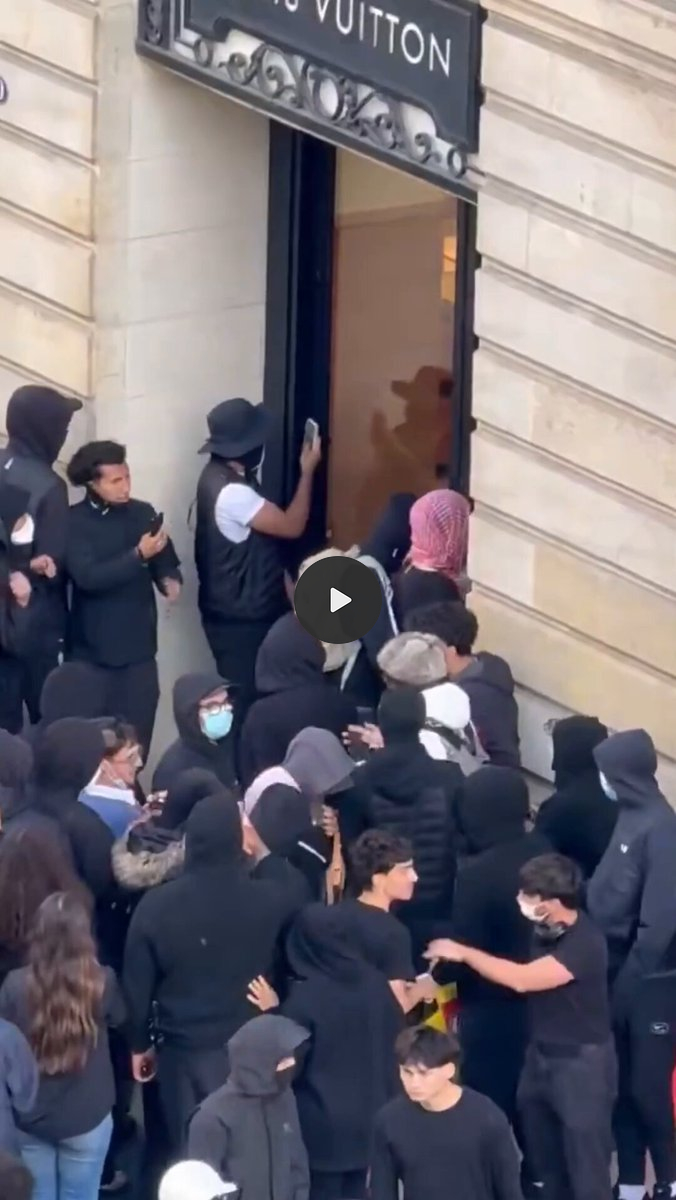
You know… kinda like the usual suspects do when their soccer teams lose. Or win. Or draw. Or don’t even play. Here they are, presumably rummaging for school supplies in Louis Vuitton…

The situation in France is completely out of control. This France has no future.


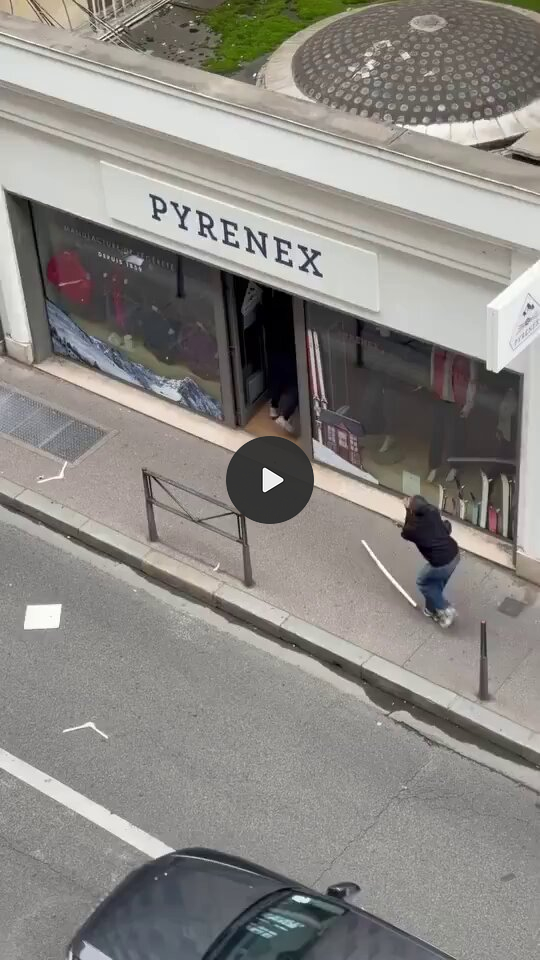
And here again, eschewing the bourgeois trappings of predatory, consumerist capitalism at the heritage luxury brand store, Pyrenex. Coz nothing says “sticking it to the man” quite like some quality goose down outerwear, AmIRight?!?!

France in total chaos, they enter, smash everything, loot, violence like never seen before. They are not students, they are criminals. This is the multicultural France they dreamed of, but it turned into a nightmare. Europe, America, Canada, South America, Japan, watch and learn.
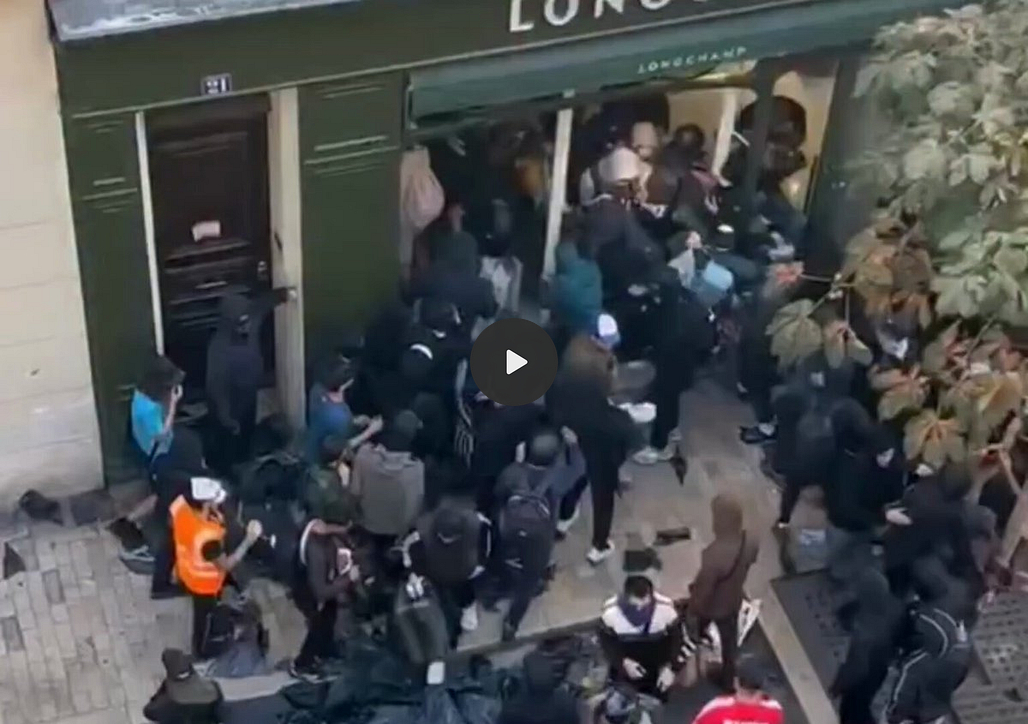
Monkey See, Monkey Do: Mobs being what they are – averse to independent thinking, by definition – a series of copycat riots soon exploded across the country, with high school students masked hoodlums setting fire to public buildings and looting luxury brand stores in Marseille… Bordeaux… Lyon… Lille… Toulouse… and Limoges…

As one writer posted of the latter, historic city: A crowd of very young people stormed the city hall, a protected historic monument built in the 1880s. They flipped police cars in front of it and set them ablaze, then set the building itself on fire. The flames took the roof, the wedding hall, and the civil registry, the office that records every birth, every marriage, every death in the city. Tonight, the bell tower that has crowned Limoges for nearly 150 years collapsed.

Not wanting to miss all the fun, fellow anti-capitalist Looters of the World soon took up “the cause” (their own, naturally) in neighboring Belgium and Spain. Before long, the pandemonium had spread to Italy and Albania, too…

But lest you go searching for videos online (there are literally thousands of actual, eye-witness recordings) and find yourself tempted to believe your own “lying eyes,” why not sit back and let the mainstream media frame reality for you?

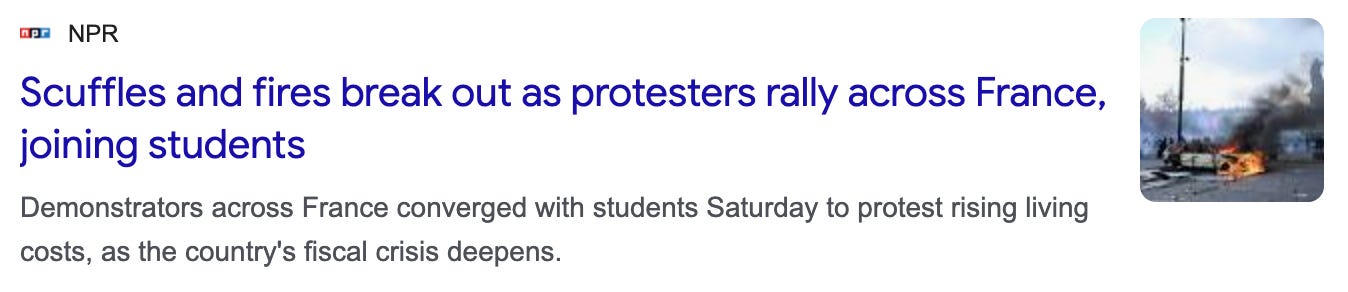
According to the long-disgraced legacy mastheads, what you see as organized violence and rampant destruction of private property is really just a few “scuffles” between a few heroic students and public servants. They’re not rioting, you see, pilfering and burning historic monuments, they’re merely “demonstrating.”
And of course, the Old Gray Lady was on hand to peddle her own “Mostly Peaceful Protest” gaslighting credulous normies while painting the shameless criminals as Quixotic heroes, bravely carrying forth the torch of “civil resistance”…

The proximate causes of the spreading conflagration, according to the popular presses: the cost of living crisis, underfunded schools, high fuel prices, etc.

And yet, few stop to examine the root causes of these symptoms… to understand that inflation is “everywhere and always a monetary phenomenon”… that destroying domestic energy production capacity (Net Zero madness) inevitably leads to higher energy prices… that there is no such thing as a “free lunch” (someone, somewhere must pay for all that “free” education, “free” healthcare, etc.)…and that public schools that fail to teach these basic realities are probably not worth attending anyway, regardless of the fees.

Unless, of course, it’s not really about students’ “right” to a miseducation after all… but something altogether more sinister…And that, dear reader, will be the subject for a future Note…"

Travelling with Russell, "I Visited The Main Cathedral of the Russian Armed Forces"

Full screen recommended.
Travelling with Russell,
"I Visited The Main Cathedral of the Russian Armed Forces"
"Park Patriot in Moscow, Russia has one of the most famous Churches in all of Russia. The Main Cathedral of the Russian Armed Forces is a spiritual symbol of Russia, glorifying the greatest victory of life over death."
Comments here:

Oh my God...

"Oh How It Really Is"

 
Creedence Clearwater Revival, "Bad Moon Rising"

"How It Really Is"


“Albert Camus on Strength of Character and How to Save Our Sanity in Difficult Times”

“Albert Camus on Strength of Character 
and How to Save Our Sanity in Difficult Times”
by Maria Popova

“In 1957, Albert Camus (November 7, 1913–January 4, 1960) became the second youngest laureate of the Nobel Prize in Literature, awarded to him for work that “with clear-sighted earnestness illuminates the problems of the human conscience in our times.” (It was with this earnestness that, days after receiving the coveted accolade, he sent his childhood teacher a beautiful letter of gratitude.)

More than half a century later, his lucid and luminous insight renders Camus a timeless seer of truth, one who ennobles and enlarges the human spirit in the very act of seeing it – the kind of attentiveness that calls to mind his compatriot Simone Weil, whom he admired more than he did any other thinker and who memorably asserted that “attention is the rarest and purest form of generosity.”

Nowhere does Camus’s generous attention to the human spirit emanate more brilliantly than in a 1940 essay titled “The Almond Trees” (after the arboreal species that blooms in winter), found in his “Lyrical and Critical Essays” (public library) – the superb volume that gave us Camus on happiness, despair, and how to amplify our love of life. Penned at the peak of WWII, to the shrill crescendo of humanity’s collective cry for justice and mercy, Camus’s clarion call for reawakening our noblest nature reverberates with newfound poignancy today, amid our present age of shootings and senseless violence.

At only twenty-seven, Camus writes: “We have not overcome our condition, and yet we know it better. We know that we live in contradiction, but we also know that we must refuse this contradiction and do what is needed to reduce it. Our task as humans is to find the few principles that will calm the infinite anguish of free souls. We must mend what has been torn apart, make justice imaginable again in a world so obviously unjust, give happiness a meaning once more to peoples poisoned by the misery of the century. Naturally, it is a superhuman task. But superhuman is the term for tasks we take a long time to accomplish, that’s all.

Let us know our aims then, holding fast to the mind, even if force puts on a thoughtful or a comfortable face in order to seduce us. The first thing is not to despair. Let us not listen too much to those who proclaim that the world is at an end. Civilizations do not die so easily, and even if our world were to collapse, it would not have been the first. It is indeed true that we live in tragic times. But too many people confuse tragedy with despair. “Tragedy,” [D.H.] Lawrence said, “ought to be a great kick at misery.” This is a healthy and immediately applicable thought. There are many things today deserving such a kick.”

In a sentiment evocative of the 1919 manifesto “Declaration of the Independence of the Mind” - which was signed by such luminaries as Bertrand Russell, Albert Einstein, Rabindranath Tagore, Jane Addams, Upton Sinclair, Stefan Zweig, and Hermann Hesse – Camus argues that this “kick” is to be delivered by the deliberate cultivation of the mind’s highest virtues: “If we are to save the mind we must ignore its gloomy virtues and celebrate its strength and wonder. Our world is poisoned by its misery, and seems to wallow in it. It has utterly surrendered to that evil which Nietzsche called the spirit of heaviness. Let us not add to this. It is futile to weep over the mind, it is enough to labor for it.

But where are the conquering virtues of the mind? The same Nietzsche listed them as mortal enemies to heaviness of the spirit. For him, they are strength of character, taste, the “world,” classical happiness, severe pride, the cold frugality of the wise. More than ever, these virtues are necessary today, and each of us can choose the one that suits him best. Before the vastness of the undertaking, let no one forget strength of character. I don’t mean the theatrical kind on political platforms, complete with frowns and threatening gestures. But the kind that through the virtue of its purity and its sap, stands up to all the winds that blow in from the sea. Such is the strength of character that in the winter of the world will prepare the fruit.

Elsewhere in the volume, Camus writes: “In the depths of winter, I finally learned that within me there lay an invincible summer.” Each time our world cycles through a winter of the human spirit, Camus remains an abiding hearth of the invisible summer within us, his work a perennial invitation to reinhabit our deepest decency and live up to our most ennobled nature.

Complement this particular excerpt from the thoroughly elevating “Lyrical and Critical Essays” with Nietzsche on what it really means to be a free spirit and Susan Sontag on how to be a moral human being, then revisit Camus on happiness, unhappiness, and our self-imposed prisons and our search for meaning.“

“The Loss Of Dignity”

“The Loss Of Dignity”
by The Zman

“If you step back and think about it, the normal man can probably list a dozen things he cannot say in public that he grew up hearing on television, usually as jokes. Then the jokes were no longer welcome in polite company and soon they were deemed “not funny” by the sorts of people who worry about such things. The same was true of simple observations about the world. Somehow noticing the obvious became impolite, then it became taboo and finally prohibited.

The reverse is true as well. Middle-aged men can probably think of a dozen things that were unimaginable or unheard of, which are now fully normal. Of course, normal is one of those things that is now prohibited. It implies that something can be abnormal or weird and that itself is forbidden. The proliferation of novel identities and activities that demand to be treated with dignity and respect is a function of the old restraints having been eliminated. When everything is possible you get everything.

The strange thing about all of this is there is seemingly no point to it. The proliferation of new taboos was not in response to some harm being done. In most cases, the taboos are about observable reality. The people turning up in the public square with novel identities or activities demanding respect did not exist very long ago. If they did, not one was curious enough to look into it. The public was happy to ignore people into unusual activities, as long as they kept it to themselves.

Of course, none of what we generally call political correctness is intended to be uplifting or inspirational. The commissars of public morality like to pretend it is inspiring, but that’s just a way to entertain themselves. These new identity groups are not demanding the rest of us seek some higher plane of existence or challenge our limitations. In fact, it is always in the opposite directions. It’s a demand to lower standards and give up on our quaint notions of self-respect and human dignity.

In the "Demon In Democracy", Polish academic Ryszard Legutko observed that liberal democracy had abandoned the concept of dignity. This is the obligation to behave in a certain way, as determined by your position in society. Dignity was earned by acting in accordance with the high standards of the community. In turn, this behavior was rewarded with greater privilege and responsibility. Failure to live up to one’s duties would result in the loss of dignity, along with the status it conferred.

Instead, modern liberal democracy awards dignity by default. We are supposed to respect all choices and all behaviors as being equal. There are no standards against which to measure human behavior, other than the standard of absolute, unconditional acceptance. As a result, the most inventively degenerate and base activities spring from the culture, almost like a test of the community’s tolerance. Instead of looking up to the heavens for inspiration, liberal democracies look down in the gutter.

Dignity comes from maintaining one’s obligations to his position in the social order, but that requires a fidelity to a social order. It also requires a connection to the rest of the people in the society. In a world of deracinated individuals focused solely on getting as much as they can in order to maximize pleasure, a sense of commitment to the community is not possible. Democracy assumes we are all equal, therefore we have no duty to one another as duty requires a hierarchical relationship.

In the absence of a vertical set of reciprocal relationships, we get this weird lattice work of horizontal relationships, elevating the profane and vulgar, while pulling down the noble and honorable. The public culture is about minimizing and degrading those who participate in the public culture. In turn, the public culture attracts only those who cannot be shamed or embarrassed. The great joy of public culture is to see those who aspire to more get torn down as the crowd roars at their demise.

The puzzle is why this is a feature of liberal democracy. Ryszard Legutko places the blame on Protestantism. Their emphasis on original sin and man’s natural limitations minimized man’s role in the world. This focus on man’s wretchedness was useful in channeling our urge to labor and create into useful activities, thus generating great prosperity, but it left us with a minimalist view of human accomplishment. We are not worthy to aspire to anything more than the base and degraded.

It is certainly true that the restraints of Christianity limited the sorts of behavior that are common today, but he may be putting the cart before the horse. The emergence of Protestantism in northern Europe was as much a result of the people and their nature as anything else. Put more simply, the Protestant work ethic existed before there was such a thing as a Protestant. The desire to work and delay gratification evolved over many generations out of environmental necessity.

Still, culture is an important part of man’s environment and environmental factors shape our evolution. It is not unreasonable to say that the evolution of Protestant ethics magnified and structured naturally occurring instincts among the people. With the collapse of Christianity as a social force in the West, the natural defense to degeneracy and vulgarity has collapsed with it. As a result, great plenty is the fuel for a small cohort of deviants to overrun the culture of liberal democracies.

Even so, there does seem to be something else. Liberal democracy has not produced great art or great architecture. The Greeks and Romans left us great things that still inspire the imagination of the man who happens to gaze upon them. The castles and cathedrals of the medieval period still awe us. The great flourishing of liberal democracy in the 20th century gave us Brutalism and dribbles of pain on canvas. The new century promises us primitives exposing themselves on the internet.

There is something about the liberal democratic order that seeks to strip us of our dignity and self-respect. Look at what happened in the former Eastern Bloc countries after communism. Exposed to the narcotic of liberalism they immediately acquired the same cultural patterns. Fertility collapsed. Religion collapsed. Marriage and family formation collapsed. These suddenly free societies got the Western disease as soon as they were exposed to western liberal democracy.

The reaction we see today is not due to these societies being behind the times, but due to seeing the ugly face of liberal democracy. It is much like the reaction to the proliferation of recreational drugs in the 1970’s. At first, it seemed harmless, but then people realized the horror of unrestrained self-indulgence. That’s what we see in the former Eastern Bloc. Their leaders still retain some of the old sense of things and are trying to save their people from the dungeon of modernity.

That still leaves us with the unanswered question. What is it about liberal democracy that seems to lead to this loss of dignity? It is possible that such a fabulously efficient system for producing wealth is a tool mankind is not yet equipped to handle without killing ourselves. Maybe we are just not built for anything but scarcity. Want gives us purpose and without it, we lose our reason to exist. Either way, without dignity, we cannot defend ourselves and the results are inevitable.”

"Look At The Extreme Social Insanity That Is Spreading All Over America"

Full screen recommended, if you can stomach it.
"Look At The Extreme Social Insanity 
That Is Spreading All Over America"
by Epic Economist

"If you want to know how extreme is the social decline that is spreading all over the United States, all you need to do is walk the streets of our biggest cities. You don’t even have to go to the “bad areas” to see the absurdities that are eating away our communities and destroying them from within. As we will show you in this video, even in the best parts of Washington D.C., filth, squalor, and disease are everywhere. New images show that only a couple of blocks away from the White House, countless needles can be seen on the ground, homeless encampments are taking over national parks, and the rate of delinquencies has spiked to the highest levels in history. The same is true for many other areas that used to be prosperous and economically and socially stable. Unfortunately, their decay is happening at a frightening pace and will only continue to accelerate as economic conditions go from worse to catastrophic.

Exactly one block behind the White House, dozens of homeless encampments were scattered throughout city streets and even into national parks. Severe sanitation issues, including human waste, used needles, and trash piling up everywhere left Johnson in disbelief. At D.C. Sparkle street, glass from smashed car windows posed a threat to everyday citizens walking by. Even in front of St. Johns Cathedral, garbage dominated the landscape.

Until 2017, Johnson said he didn’t see a single tent near public buildings. As he interviewed local residents, it became clear that people don’t feel safe and they say that new problems emerge on a daily basis. “Disease, decay, and people that don’t care about this nation running things, and running them directly to the ground. This is an apt metaphor for a country in decline” Johnson stressed. On the West Coast, things are no different. In recent years, Portland, once considered one of the finest cities in America, has become something short of a dystopia, where shop owners sleep with self-defense tools behind their pillows, and citizens must act as law enforcement agents.

This crisis is unfolding at a pace that is just breathtaking. According to Joel Kotkin, the Presidential Fellow in Urban Futures at Chapman University and executive director of the Urban Reform Institute, the social decay that is rotting the foundations of U.S. cities is systemic and getting worse over time.

“The old saying that “the city air makes one free” all too often means freedom to be poor, to experience endemic homelessness, collapsing public infrastructure and rising neglect,” Kotkin says. “As cities slowly fall to pieces, they are increasingly becoming no-go zones for investors and business. Barely ten percent of US companies are interested in investing in large urban areas,” the expert reveals.

Sadly, it appears that our leaders are not too worried about restoring the economic and social balance this country needs to start thriving again. Year after year, our social decline intensifies, and our major cities continue to collapse all around us. If you love America, you should be completely disgusted by what is happening to our country. What do you think our founders would say if they could see what our cities have become? They would certainly be deeply ashamed of us. And we should be deeply ashamed of ourselves too because we should have never allowed our beloved country to sink so low."

"The Curse of Interesting Times"

"The Curse of Interesting Times"
Things are the most interesting they've been
 in 80 years, 250 years, and, well, ever.
by Contemplations on the Tree of Woe

"The Chinese curse their enemies with the phrase “may you live in interesting times.” Or, rather, Americans think that Chinese curse their enemies like that; according to Infogalactic, “despite being widely attributed as a Chinese curse, there is no equivalent expression in Chinese.”

Fortunately, there’s an actual Chinese phrase that’s much more interesting. It’s found in a 1627 short story collection by Feng Menglong called "Stories to Awaken the World," and it states "better to be a dog in a peaceful time, than to be a human in a chaotic times.” And to be a dog in 17th China didn’t mean being a beloved fur baby with your own YouTube channel. It meant being a workbeast that got eaten when times were lean. The Chinese still have an annual dog meat festival.

Whichever adage you prefer, our times are both chaotic and interesting. In fact, they are monumentally interesting - they are so interesting as to beggar coherent description, to put to shame historical comparison, so remarkable that every single one of us would be justified in screaming from the rooftops in shock and awe. And yet we don’t. We keep calm and carry on, sturdily gripped by our bias for normalcy, by our human ability to adapt to even the most bizarre circumstances. It’ll be fine, we tell ourselves. This is fine.

But what if we put aside our normalcy bias for a moment and look at how just how “interesting” our times really are? What do we see then?

Once Every 80 Years…Once every 80 years, a country enters a crisis. That is, at least, the assertion of Strauss-Howe Generational Theory. According to Strauss and Howe, human history is organized into repeating patterns marked by four “turnings”: the High, the Awakening, the Unraveling, and the Crisis. Each turning is approximately 20 years long, and an entire cycle of four turnings is therefore about 80 years long. According to Strauss and Howe, American history looks something like this:

○ American Revolutionary Crisis, 1765 - 1785
○ American Civil War Crisis, 1855 - 1875
○ Great Depression and World War II Crisis, 1930 - 1950
○ You Are Here, 2010 - 2030

If we believe Strauss-Howe Generational Theory, we are in the midst of what they call a Fourth Turning - a moment of Crisis.

Are we in a Fourth Turning? I certainly believe so. As I documented in "Running on Empty," the United States now stands at a financial precipice. US inflation is at its worst in 40 years because the monetary system we established under Truman and rejuvenated under Nixon is now about to collapse. With that crisis have come challenges from a resurgent Russia and burgeoning China that could lead to a Third World War or, at best, a post-American world order. The Thucydides Trap has never been so close to springing. It’s no wonder then that US fears of nuclear war have surged to levels not seen since the Cold War. But unlike the Cold War, no one wants to ‘ask what they can do for their country’ anymore. US Army recruitment is at its worst in 50 years. And why would they want to serve? Our nation is divided into warring camps. US partisan distrust of the opposing party is at its worst in 30 years.

All right. That all sounds bad. But if Strauss-Howe Generational Theory is true, the Fourth Turning will be over in about 5-10 years and we’ll move into the next Turning, the High. And those are awesome! But what if we won’t be heading into another high?"
Full, fascinating, most highly recommended article is here:
○
Freely download "Stories to Awaken the World", 
by Feng Menglong, here:

"Do Not Live For Others..."

“Beware the irrational, however seductive. Shun the ‘transcendent’ and all who invite you to subordinate or annihilate yourself. Distrust compassion; prefer dignity for yourself and others. Don’t be afraid to be thought arrogant or selfish. Picture all experts as if they were mammals. Never be a spectator of unfairness or stupidity. Seek out argument and disputation for their own sake; the grave will supply plenty of time for silence. Suspect your own motives, and all excuses. Do not live for others any more than you would expect others to live for you.”
- Christopher Hitchens

"15 Great Depression Foods We Will All Be Eating Again Soon"

Full screen recommended.
"15 Great Depression Foods 
We Will All Be Eating Again Soon"
By Epic Economist

"The reality of millions drastically changed after the 1929 stock market crash. All of a sudden, affluent Americans lost everything, middle-class families became poor, and poor households fell into misery. For over a decade, our citizens struggled to make ends meet and many of them didn’t have enough to eat.

Parents would skip meals to feed their children as they were forced to survive on next to nothing. Bread lines extended for miles, and food insecurity became an epidemic. Fast forward to today, and we have what experts call the biggest stock market bubble in history just ready to burst. Even though we have learned a lot since the 1930s, our leaders continued to make the same mistakes. And now more than ever, it’s looking like history is about to repeat itself. The question is: when everything collapses will you be prepared?

According to a very detailed article published on Ask A Prepper by Katherine Paterson, for us to be truly ready for the challenges that are coming for us, we will all need to get creative with our meals. To understand how Americans survived the dark times of the Great Depression, we need to understand how to make our resources last. Back then, essentials including meat, eggs, and milk were in extremely short supply, and people often had to make a little go a long way, as explained by Paterson.

We are already seeing the same shortages happening today. And it’s just a matter of time before another financial disaster throws our economy into disarray. With a little bit of preparation, you won’t have to panic when staples start disappearing from store shelves if you know how to adapt. You don’t need many different ingredients, and you definitely don’t need expensive foods to cook delicious dishes.

Culinary is something very important for our culture. It was through such hearty meals that people had the drive to keep fighting to get out of such challenging situations. Food connects us and gives us a sense of purpose and identity. That’s why it is so crucial to make preparations for when the essentials we rely upon aren’t available anymore. The warning signs of an impending financial and economic meltdown are everywhere. And once it happens, vulnerable supply chains can be broken in a snap of fingers.

Our leaders may have made the same wrongful decisions that put us where our grandparents and great-grandparents were almost a century ago. But that doesn’t mean we can’t make more conscious choices this time around. So get ready now while we’re still experiencing the calm before the storm, because when start to spiral out of control, it may be too late. That’s why in today’s video, we listed some very popular meals that previous generations used to eat during that era because those recipes may soon become handy for all of us as well."

"50 Survival Lessons From the Great Depression"

"50 Survival Lessons From the Great Depression - The Horrifying 
Things Americans Did When Money, Jobs, and Hope Disappeared"
by John Walter

Editor’s Note: "We publish this pieceas the machinery of global commerce groans and sputters, as hollow men in expensive suits speak of “corrections” and “adjustments” while families count pennies in dimly lit kitchens. The photograph you see above - those gaunt men hunched over bowls of thin soup, their eyes fixed on some middle distance between hunger and dignity - was snapped nearly a century ago, yet it could have been taken yesterday in any tent city stretching like a scar across the American landscape. We do not traffic in false nostalgia here, nor in the cheap comfort of historical distance. The Great Depression was not a sepia-toned folktale; it was a meat-grinder that chewed through 25 percent of the working population, that evicted grandmothers into snowbanks, that turned proud men into beggars and children into scavengers. The bones of that era still jut through the soil of our present moment - visible to anyone brave enough to look. What follows is not a curiosity shop of antiquated customs, but a field manual written in blood and hunger, a record of how ordinary human beings refused to break when the world snapped in half. Read it. Memorize it. The wolves are already at the door.

Introduction: October 29, 1929, began as a Tuesday and ended as an autopsy. When the stock market shed its skin that Black Tuesday, it revealed something putrid beneath the gilt and glamour of the Roaring Twenties - the entire economic edifice had been a painted facade, a stage set propped up by speculation and debt. Within months, the iron sinews of American industry seized up. Factories that had belched smoke and churned out automobiles now stood silent as tombstones. Construction cranes froze in place, their skeletal arms reaching toward empty skies. The breadlines formed not from laziness but from the sudden, violent evaporation of work itself - fourteen million pairs of boots kicked dust on Main Street, fourteen million stomachs growled in concert.

The trauma cut marrow-deep. Men who had worn white collars found themselves fighting rats for garbage. Women who had managed households like generals now found themselves bartering wedding rings for sacks of beans. Children learned to sleep through the rumble of empty bellies, to recognize the particular gray color of hunger. This was not merely poverty - poverty implies a falling from somewhere. This was collapse, the sudden plunging of an entire civilization into a pit without handholds. The American Dream, that peculiar national religion promising infinite ascension, revealed itself as a confidence trick played on the desperate.

Yet here is the strange miracle: they did not all perish. They did not all devolve into the savage calculus of dog-eat-dog, though some surely did. Instead, something older and tougher emerged from the wreckage - a kind of stubborn, ornery ingenuity that had lain dormant during the fat years. People remembered how to do things. They recalled skills their grandparents had brought from the old country: how to stretch a dollar until it screamed, how to mend what was torn, how to find nourishment in landscapes others called barren. They discovered that the human animal is infinitely adaptable, capable of surviving on pride and lard and sheer cussedness when the supermarkets close and the ATMs go dark.

We have grown soft in the intervening decades. We have forgotten the taste of true scarcity, the texture of want. Our landfills overflow with the discarded, while our grandparents hoarded string and bacon fat like treasure. We order sustenance through glowing screens, disconnected from the soil and the seasons. But the old knowledge persists, passed down through whispered conversations in kitchens where the radio once played FDR’s fireside chats. The fifty fragments of wisdom that follow are not theoretical. They were paid for with calloused hands and sleepless nights. They represent the collective survival manual of a generation that faced the abyss and chose, defiantly, to keep walking.
50 Tips From the Great Depression
1. Move as a clan. When work dried up in Akron or Detroit, families packed their possessions into trucks and rolled toward the horizon like Bedouins. Staying together meant pooling resources, sharing bread, ensuring that when one member stumbled, others could prop them up. The lone wolf starved; the pack endured.

2. Follow the harvest. Migrant farm work was the artery that kept many alive. Cotton in Texas, apples in Washington, wheat in Kansas - each crop had its season, its hunger for hands. A family could stitch together nine or ten months of labor by chasing ripeness across state lines, living in tents that leaked when it rained.

3. Ask not what the job is; ask only if it exists. Pride was a luxury item, quickly pawned. Men who had managed offices took up shovels. Women who had worn silk now scrubbed floors. The work itself mattered less than the doing of it, the exchange of sweat for coins.

4. Put every able body to the grind. Children sold newspapers, gathered bottles, ran errands for pennies. Grandparents watched infants so mothers could scrub laundry. No one sat idle; the family was an economic unit, a small cooperative where survival was the only dividend.

5. Scavenge value from the discarded. Driftwood became fuel. Rusted metal became scrap. Bones became glue. The beachcomber and the junk man were aristocrats in this economy, turning refuse into currency through sheer force of will.

6. Embrace the government’s outstretched hand—cautiously. The New Deal programs, for all their bureaucratic weight, taught skills and poured concrete. Men learned masonry while building dams; they learned forestry while planting trees. Take the help, but keep your eyes open.

7. Work until you cannot stand. There was no retirement, no gold watch and pension. Seventy-year-olds swept floors. Eighty-year-olds watched grandchildren. The body worked until it broke, and then it found lighter work.

8. String together fragments. When full-time work vanished, people cobbled three part-time positions into a patchwork income. Dawn at the bakery, noon at the cannery, night at the loading dock. Sleep became a negotiable commodity.

9. Knock on every door. The unemployed did not wait for advertisements; they walked the streets, entering every shop and factory, offering labor by the hour. Persistence was the only resume that mattered.

10. Create your own occupation. Women arose before dawn to cook stews and pies, then sold them outside factory gates during lunch breaks. Men sharpened tools on porches, offering services to neighbors. Necessity was the mother of small enterprise.

11. Cultivate the jack-of-all-trades. The specialist starved. The man who could fix a roof, shoe a horse, and balance books found three times the opportunity. Breadth trumped depth when the market for expertise collapsed.

12. Accept payment in kind. Farmers took on hands they couldn’t pay in dollars, offering instead bushels of corn or sides of pork. A chicken was as good as a five-dollar bill in many towns.

13. Crowd under one roof. When the bank took the house, families scattered like seeds - not to the wind, but to the homes of relatives. Three generations in one farmhouse was cramped, but the body heat alone saved on coal.

14. Convert your vehicle to shelter. Those with cars or trucks slept in them, parking behind churches or in empty lots. Public gyms offered showers for pennies; the automobile became a rolling bedroom.

15. Build from scrap. Tents, shacks, lean-tos constructed from packing crates and corrugated tin - these were not dwellings but declarations of continued existence. A roof, however patched, meant dignity.

16. Insulate with desperation. Mud, newspaper, tar paper, old coats - anything that could block the wind was stuffed into walls. The goal was not comfort but survival, keeping the pipes from freezing and the children from turning blue.

17. Wear your coat indoors. Thermostats were turned to near-freezing. Families sat in overcoats and mittens, breath visible in the parlor, saving fuel for cooking rather than warmth.

18. Harness evaporation. Wet sheets hung over doorways created crude air conditioning. As the water dried, it drew heat from the room, offering slight relief when the summer sun turned shacks into ovens.

19. Refinance before the hammer falls. Those who could, renegotiated mortgages to lower payments, buying time if not salvation. It was a dance with the devil, but it kept the sheriff away for another month.

20. Cash the safety net. Life insurance policies, that morbid savings account, became emergency funds. Better to feed the living than to enrich the beneficiaries.

21. Trade without currency. Barter economies sprouted like weeds. A morning’s labor might yield a gallon of milk; a repaired fence could earn a bushel of apples. Money was scarce; ingenuity was not.

22. Beg without shame. Outside restaurants, on corners, at church doors - asking for help was not criminal but human. The rich who still ate in warm dining rooms sometimes emerged with leftovers, and the hungry learned to wait with hollow eyes.

23. Distrust the marble halls. When banks began closing their doors, taking lifetimes of savings with them, the wise kept cash in coffee cans and under floorboards. Institutions failed; paper promises burned.

24. Keep the books loose. Storekeepers extended credit to regulars, scratching debts on ledgers they might never collect. It was a gamble on community, on the hope that better days would come.

25. Dig in the dirt. The vegetable plot was the difference between malnutrition and survival. Even city dwellers tore up lawns to plant potatoes. Seeds cost pennies; harvests were priceless.

26. Hunt and hook. Rabbits, squirrels, fish from the creek - these were not sport but sustenance. A shotgun was as vital as a plow, and the woods were a larder for those who knew how to read them.

27. Gather what grows wild. Nuts, berries, dandelion greens, cattail roots - nature provided for those who knew her language. Children became expert foragers, their eyes trained to spot edibles in the ditch.

28. Put up the harvest. Canning was not a hobby but a survival skill. Rows of jars in the cellar - tomatoes, beans, peaches - represented edible insurance against winter’s lean months.

29. Eat the inedible. Tumbleweed, once cattle fodder, found its way onto plates. Young shoots of plants previously ignored were boiled and seasoned with desperation.

30. Waste nothing of the beast. Hearts, livers, kidneys, feet, heads - every part served a purpose. Offal was ground, stewed, fried. Even the hooves yielded glue and gelatin.

31. Stretch with smoke. A single strip of bacon could flavor a week’s worth of beans. The rind, the fat, the drippings - all were saved in tins, used to fry bread, to add richness to thin soups.

32. Cultivate the commons. Vacant lots became collective gardens. Parks were divided into plots. The soil belonged to whoever worked it, and tomatoes grew where roses once bloomed.

33. Swap the surplus. Neighbors traded cucumbers for eggs, corn for milk. Variety entered the diet through exchange, through the web of relationships spun across fences.

34. Cook from zero. There were no boxes to open, no packets to tear. Flour, water, salt - these were the building blocks. Recipes required time and labor, not just microwave minutes.

35. Shop the dying day. Saturday evenings, before Sunday closures, vendors slashed prices on perishables. The savvy bought bruised fruit and day-old bread, eating better for less.

36. Keep livestock close. A cow meant milk and butter; chickens meant eggs and Sunday dinner. Even a single goat could sustain a family, turning grass into protein.

37. Fill with starch. Meat was for the wealthy. The poor bulked meals with bread, potatoes, noodles - cheap calories that filled the stomach if not the soul. Lard added the illusion of richness.

38. Boil the bones. Soup was the universal meal, adaptable to whatever scraps remained. Water was free; bones were cheap; the pot could simmer endlessly, feeding many from little.

39. Mend the soles. Shoes were repaired until they could not be repaired again. Leather from belts patched holes; rubber from tires became new soles. A cobbler’s needle was worth its weight in gold.

40. Sew from sacks. Feed sacks, flour bags - these became dresses, curtains, shirts. Women learned to cut patterns from whatever cloth came to hand, turning agricultural packaging into fashion.

41. Cancel vanity. Fashion was a dead letter. Clothes were worn until threadbare, then turned into patches for other clothes. The goal was coverage, not style; warmth, not trend.

42. Pass it down. Outgrown garments traveled to younger siblings, then to cousins, then to neighbors. A single coat might warm three children over a decade, its history accumulating in every patch.

43. Rip for rags. When fabric could no longer hold stitches, it became cleaning cloths, quilt stuffing, rug yarn. The final death of a garment was a slow unraveling into utility.

44. Abandon entitlement. No one believed the world owed them a living. The able worked; the unable hoped to work again. The safety net was the family, the church, the neighbor - not the distant government.

45. Help the striving. Those who tried and failed found open hands. Those who refused to try found closed doors. Charity was reserved for the willing, not the wanton.

46. Tighten the community weave. Neighbors shared tools, labor, news. They pooled money for the desperate, organized relief for the sick. The atomized individual perished; the networked group survived.

47. Lend with strings. Town welfare loans were not gifts; they were debts of honor, recorded meticulously, expected to be repaid. Dignity was preserved through obligation, not handouts.

48. Value the collective. Independence was a luxury; interdependence was the reality. The man who could not ask for help starved; the man who could not offer help lost his humanity.

49. Expect loss. They learned that possessions were temporary, that security was illusion, that everything could vanish overnight. This knowledge was terrible but liberating.

50. Keep walking. Above all, they maintained forward motion. Despair was indulged in private, briefly, then packed away. The sun rose; the work continued; the human animal adapted and endured.

Conclusion: The photograph fades, but the hunger remains. We stand now at a similar precipice, staring into a future that promises uncertainty, that whispers of contractions and corrections and collapses yet to come. The machines we have built are complex, interconnected, fragile - subject to the same tremors that brought down the house of cards in 1929. We have forgotten, in our age of abundance, how thin the margin is between comfort and catastrophe, between the full pantry and the empty bowl.

Yet the old knowledge persists, encoded in the DNA of those who survived. It tells us that we are tougher than we believe, more adaptable than we imagine, capable of finding nourishment in landscapes we once called barren. The fifty fragments above are not archaeology; they are prophecy. They remind us that when the trucks stop running and the screens go dark, we still possess hands that can plant, minds that can calculate, hearts that can share.

The men in that black-and-white image are all dead now, dust and memory. But their stubbornness echoes forward. They teach us that dignity is not purchased with dollars but carved out of will, that community is not a buzzword but a lifeline, that survival is not a given but a choice made daily, hourly, breath by breath. The wolves are at the door, yes. They always have been. But we remember now how to bar the gate, how to sharpen the knife, how to look our brothers and sisters in the eye and say: We have less, but we have enough. We will make it through another winter. We will see the spring."

"First Signs We’ll Soon Be Eating Depression-Era Foods"

"First Signs We’ll Soon Be 
Eating Depression-Era Foods"
by Madge Waggy

Excerpt: "My grandmother kept a cupboard she called the just-in-case, and for most of my childhood I read it as a harmless eccentricity rather than what it was - a wound made edible. She had been a girl during the Depression, and somewhere in her twenties she had learned to keep tinned beans, sacks of flour, jars sealed with wax and paper, all of it rotated with the humourless discipline of a quartermaster provisioning for a war that had already ended but might, at any hour, resume. Nothing in that cupboard was ever eaten first. It sat at the back of the shelf like a private insurance policy against a world that had once taken everything from her family and could, she believed, do so again at a moment’s notice.

For years the cupboard looked like a relic. The country around it grew fat. Food in America became cheap in a way that no other civilisation in history had ever managed, cheap enough that a family could throw away a third of what it bought and call it a lifestyle, cheap enough that the word hunger retreated into the vocabulary of charity drives and faraway places. We built an entire national identity on the assumption that the shelves would always be full, that the price would always be bearable, that the great problem of food would remain a problem of excess rather than of want. To doubt that assumption in the middle of the nineties was to be faintly embarrassing, like a man who keeps a shotgun in a suburb.

Then the erosion began, and it began so quietly that it registered less as a crisis than as a mood. A receipt that used to total forty dollars now totals sixty and buys less. A bag of chips feels lighter in the hand. A cut of beef that was once a weekly habit becomes a monthly occasion, and nobody announces the change because there is nothing to announce - the change simply happens, and the new state of things becomes the baseline against which the next change will be measured. This is the particular cruelty of slow decline: it is always, at any given moment, almost bearable, and so it is never quite urgent enough to resist.

What follows is an attempt to take the temperature of that decline, using what can be measured and admitting plainly where measurement fails. The argument is not that America is about to re-enter 1932, with soup kitchens on every corner and men in cloth caps hiding their faces in a breadline. The argument is subtler and, in some ways, more disturbing - that the country is sliding back toward the conditions that produced the Depression diet, that the slide is visible now to anyone who bothers to look at a scale, a price tag, or an empty shelf, and that the most likely future is not collapse but a long, grinding narrowing in which abundance survives as an appearance while it dies as a reality."
Full, highly recommended article is here: