StatCounter

Friday, May 8, 2026

Joel Bowman, "Love Taps and Reckless Attacks"

"Love Taps and Reckless Attacks"
by Joel Bowman

"Already long ago, from when we sold our vote to no man, the People have abdicated our duties; for the People who once upon a time handed out military command, high civil office, legions - everything, now restrains itself and anxiously hopes for just two things: bread and circuses." ~ Juvenal, "Satires X"

Buenos Aires, Argentina - "First up, the same olds...From Reuters: "Trump says ceasefire still holds after fighting between the US and Iran flares." From the New York Times: "Tehran Accuses U.S. of “Reckless Attack” in Strait as Trump Insists Ceasefire Holds." And from Fox News: "Trump calls US strikes on Iran a ‘love tap’ after destroyers targeted in Strait of Hormuz." And there you have it, dear reader. Clean as an oil spill. Now, is the situation improving… or deteriorating? Are attacks flaring… or the ceasefire holding? Are we talking reckless attacks… or love taps? Hmm...

Death by Democracy: As we’ve seen in these Notes many times before, modern man can be made to go along with just about anything. Given the right circumstances… some narrative framing… and enough time for it all to marinate in his soft, mammalian brain… there is almost nothing Homo Credulus will not learn to embrace.

Just take a look at the historical record; you’ll soon wonder how we even got this far. Sure, you’ll discover gizmos and flying contraptions… art and agriculture… music and mathematics. You’ll witness spectacular scientific breakthroughs, the number “0” and a man’s footprint on the moon. But you’ll also scratch your head. Perhaps you’ll even weep. And if you reckon hard enough, you’ll put a few assumptions in the firing line…

The Divine Right of Kings? Strongman rule? Modern democracy? How has mankind survived such crude contrivances? Self inflicted, no less! And why, moreover, does he rush so earnestly to repeat and replay his own worst mistakes? Ah, let us not be too hard on our fellow creatures. After all, repetition is nothing new…

You’ll recall that it was the Greeks who first gave the world democracy – from the Greek, dēmokratía, literally “Rule by ‘People’”. (And yes, as an astute reader reminded us recently, it was those very same Greeks who put their own beloved Socrates to death… by a majority vote of 361-140.)

Today, democracy is a cherished tenet of “the West.” It is woven into the civic religion, sewn into the social fabric, and inked on our hallowed mastheads. Men march off eagerly to fight for it, to proselytize it… and to die in forgotten ditches defending it. At least, that’s what they believe they’re doing. As usual, the devil is in the details. Herewith, a little historical context…

The Father of Propaganda: The phrase “Making the world safe for democracy” was actually a marketing slogan, coined back in the 1910s, as a way to sell “The Great War” to America. Weary from their own grueling Civil War just a few decades earlier, in which hundreds of thousands of young men gave up the ghost, Americans were mostly inward looking at the time. That is to say, they wanted little to do with what they largely saw as a “European affair.”

Polls might have indicated no appetite for battle, but the nation’s politicians were nonetheless starved for military misadventure. They sensed big profits abroad, both in manufacturing armaments and making onerous loans to foreign powers. Sure, “the nation” would have to fill “tank and trench” with warm young bodies, but very few soldiers would carry senatorial surnames along with their rifles. And so, after a public relations campaign of truly epic proportions, America’s sons marched off to war… wrapped in the delusion they had freshly been sold.

Eddie Bernays, the man who coined the phrase and, thus, peddled the war to his nation, made a personal fortune for his efforts. He was even invited by Woodrow Wilson to attend the ill-fated Paris Peace Conference, in 1919, as a show of gratitude for his services. There, Bernays learned the full impact of his “democracy” slogan. An obviously bright fellow, the surreal experience caused him to think… If people would be willing to kill one another under the influence of a mere marketing campaign, surely they could be convinced to do, say and buy just about anything!

Bernays was right. In fact, he wrote a series of books, detailing his insights. They included "Crystallizing Public Opinion" (1923), "A Public Relations Counsel" (1927) and a neat little number titled "Propaganda" (1928), in which the author laid out the blueprint for mass social and psychological manipulation. The collected works went on to become a huge success and a favorite of none other than Joseph Goebbles, Reich Minister for Propaganda in Nazi Germany between 1933-45.

Bernays himself, writing in his 1965 autobiography, recalls a dinner at home in 1933 where…Karl von Wiegand, foreign correspondent of the Hearst newspapers, an old hand at interpreting Europe and just returned from Germany, was telling us about Goebbels and his propaganda plans to consolidate Nazi power. Goebbels had shown Wiegand his propaganda library, the best Wiegand had ever seen. Goebbels, said Wiegand, was using my book Crystallizing Public Opinion as a basis for his destructive campaign against the Jews of Germany. This shocked me. [...] Obviously the attack on the Jews of Germany was no emotional outburst of the Nazis, but a deliberate, planned campaign. It is indeed chilling to think of such a heinous undertaking as being engineered, blueprinted, premeditated and carried out according to some kind of script. And yet, there it is… in Bernays’ own words, the “Father of Propaganda.”

The Show Must Go On: Having acquired somewhat of a tainted reputation-by-association, propaganda, itself, underwent a “strategic rebranding” after WWII. Needless to say, the very same métier thrives to this day, under the more socially palatable designation, “Public Relations.” Still, a ruse by any other name…

“Could we be so stupid again?” wonders the gentle reader. “Might the mob still be swayed by what Charles Mackay termed ‘extraordinary popular delusions and the madness of crowds?’” Why, of course! Such is the nature of the mob! Whether in love, literature, politics or any other matter, man is wont to be convinced, assured, persuaded, often against his own best interests. Few are the absurdities in which he will not take refuge, invest his finite time or squander his morality. All he needs is a good story, something to arrest his imagination and cauterize his capacity for reason. A distraction from his lonely, quotidian existence, and a few crumbs to pass his lips.

The Roman poet, Juvenal, recognized as much when he mocked the panem et circenses (bread and circuses) stratagem almost two millennia ago. In his "Satire X", he referred to the annona (a kind of grain dole) and the famous circus games, held in the Colosseum and elsewhere, as designed to keep the unthinking population fed and happy. And lo!

So many moons later, a quarter century into the new millennium, we’ve got trending headlines and streaming infotainment, the pretense of safety and a surrender of liberty, soaring national debt at home foreign entanglements abroad, mindless TV debates and partisan hack electioneering. Now, as then, the show goes on!"

"How It Really Is"


Adventures With Danno, "Stocking Up At Aldi Before Price Increases"

Full screen recommended.
Adventures With Danno, 5/8/26
"Stocking Up At Aldi Before Price Increases"
Comments here:

Chris Hedges, "America’s Suicide Pact"

"America’s Suicide Pact"
by Chris Hedges

"Civilizations, as the historian Arnold J. Toynbee famously argued, “die from suicide, not by murder.” They collapse from within. They fall prey to moral, social and spiritual decay. They are seized by a parasitic ruling class. Democratic institutions seize up. The citizenry is immiserated, wealth is funneled upwards to the ruling class and coercion is the principle form of control.

Our suicidal march began long before Donald Trump and his bizarre court of buffoons, sycophants, grifters and Christian fascists took power. It began when the ruling class, especially under the Reagan and Clinton administrations, set out to harvest the country and empire for personal profit.

There is a word for these people. Traitors. These traitors, ensconced in the leadership of the two ruling parties, stripped us of assets and power slowly. They used subterfuge, lies and legalized bribery. They pretended to honor electoral politics, checks and balances, a free press and the rule of law while subverting all of these democratic pillars. That old system, however flawed, was hollowed out. It was turned over to the amoral and the idiotic - look at the Supreme Court or Congress - those willing to do the bidding of the billionaire class.

Armed with billions by the mortal enemy of the demos - the oligarchs and corporations - the political elites, Republicans and Democrats, destroyed the careers of those politicians who resisted. They crushed labor unions. They blacklisted honest journalists and consolidated the press into the hands of a handful of corporations and oligarchs. They slashed regulations that constrained unfettered greed and protected the population from predatory corporations and environmental toxins. They passed legislation that created a de facto tax boycott for the rich - Trump famously paid no federal income taxes in 10 of the 15 years prior to his presidency - while stripping the country of its industry and throwing some 30 million people out of work. Wealth is no longer created by producing or manufacturing. It is created by manipulating the prices of stocks and commodities and imposing a crippling debt peonage on the public.

These parasites cut or abolished social programs, militarized the police, built the largest prison system in the world and pumped funds into a bloated and out-of-control war industry. German socialist and politician Karl Liebknecht, on the eve of the suicidal folly of World War I, called German imperialists “the enemy at home.” Our rulers, our enemies at home, mounted a series of futile wars that degraded the empire’s global hegemony and poured trillions of dollars of taxpayer money into their bank accounts. Iran is the most recent example.

Trump is not an outlier. He is the naked, stripped-down expression of this suicidal pact. He does not pretend the system he inherited works. He lies with less finesse. He crassly enriches himself and his family. He speaks in crude vulgarities. He dismantles any government agency dedicated to the common good, including the Environmental Protection Agency, the Department of Education and the U.S. Postal Service. But he embodies what came before him, albeit without the liberal façade.

“Trump is not an anomaly,” I wrote in “America: The Farewell Tour” He is the grotesque visage of a collapsed democracy. Trump and his coterie of billionaires, generals, half-wits, Christian fascists, criminals, racists, and moral deviants play the role of the Snopes clan in some of William Faulkner’s novels. The Snopeses filled the power vacuum of the decayed South and ruthlessly seized control from the degenerated, former slaveholding aristocratic elites. Flem Snopes and his extended family - which includes a killer, a pedophile, a bigamist, an arsonist, a mentally disabled man who copulates with a cow, and a relative who sells tickets to witness the bestiality - are fictional representations of the scum now elevated to the highest level of the federal government. They embody the moral rot unleashed by unfettered capitalism.

The Epstein files, a window into the degeneracy of our ruling class, included not only Trump, but former U.S. president Bill Clinton - who allegedly took a trip to Thailand with Epstein - Prince Andrew, Microsoft founder and billionaire Bill Gates, hedge fund billionaire Glenn Dubin, the former New Mexico governor Bill Richardson, former secretary of the treasury and former president of Harvard University Larry Summers, cognitive psychologist and author Stephen Pinker, Epstein’s lawyer and arch Zionist Alan Dershowitz, billionaire and Victoria’s Secret CEO Leslie Wexner, the former Barclays banker Jes Staley, former Israel prime minister Ehud Barak, magician David Copperfield, actor Kevin Spacey, former CIA director William Burns, real estate mogul Mort Zuckerman, former Maine senator George Mitchell and disgraced Hollywood producer and convicted rapist Harvey Weinstein. They all orbited Epstein’s perpetual Bacchanalia.

Anand Giridharadas, who wrote “Winners Take All: The Elite Charade of Changing the World,” notes that the circle of powerful men, and a handful of women who surrounded Epstein, are emblematic of a privileged caste that lack empathy in the suffering and abuse of others, whether that is sexual abuse, including that of children, financial meltdowns they orchestrate, wars they back, addictions and overdose they enable, the monopolies they defend, the inequality they turbocharge, the housing crisis they milk and the intrusive technologies they refuse to protect people against:

People are right to sense that as the emails lay bare, there is a highly private merito-aristocracy at the intersection of government and business, lobbying, philanthropy, start-ups, academia, science, high finance and media, that all too often takes care of its own more than the common good. They are right to resent that there are infinite second chances for members of this group even as so many Americans are deprived of first chances. They are right that their pleas often go unheard, whether they are being evicted, gouged, foreclosed on, A.I.-obsolesced - or, yes, raped.

“The Epstein emails, in my view,” Giridharadas writes, “together sketch a devastating epistolary portrait of how our social order functions, and for whom. Saying that isn’t extreme. The way this elite operates is.” “If this neoliberal-era power elite remains poorly understood,” he continues, “it may be because it is not just a financial elite or an educated elite, a noblesse-oblige elite, a political elite or a narrative-making elite; it straddles all of these, lucratively and persuaded of its own good intentions.”

“These people are,” Giridharadas reminds us, “on the same team. On air, they might clash. They promote opposite policies. Some in the network profess anguish over what others in the network are doing. But the emails depict a group whose highest commitment is to their own permanence in the class that decides things. When principles conflict with staying in the network, the network wins.” You can see my interview with Giridharadas here.

The entire system is rotten. It will not reform itself. The Democratic Party has hit on the novel campaign issue of reducing taxes to win this year’s midterm elections. It will, no doubt, anoint another vapid, issue-less and genocide-supporting presidential nominee. Democratic donors pumped a staggering $1.5 billion into Kamala Harris’s abridged 15-week celebrity-fueled presidential campaign. She became the first Democratic presidential candidate to lose the national popular vote in two decades and be defeated in every battleground state.

The Democratic Party is not a functioning political party. It is a corporate mirage. Its members can, at best, select preapproved candidates and act as props in choreographed conventions and rallies. Party members have zero influence on party politics.

The more the diminishing power of the empire becomes apparent, evidenced in Trump’s debacle with Iran, the more a confused population retreats into a fantasy world, a world where hard and unpleasant facts do not intrude.

In the final days of a civilization, a population wallows in self-delusional hubris and trumpets false virtues. It looks for scapegoats to explain its failures - Muslims, undocumented workers, Mexicans, African-Americans, feminists, intellectuals, artists and dissidents. Magical thinking and the myth of American exceptionalism dominate public discourse and are taught in schools. Art and culture are degraded to nationalist kitsch. Science is dismissed, even in the midst of the environmental crisis. Cultural and intellectual disciplines that allow us to see the world from the perspective of the other, that foster empathy, understanding and compassion, are replaced by a grotesque and cruel hypermasculinity and hypermilitarism. Trump is perfectly tailored for these death throes. He is not a freak or an anomaly. He is the naked visage of our pathological sickness."

"The Day Civilization Runs Out Of Bread Will Not Feel Like Fiction"

"The Day Civilization Runs Out Of 
Bread Will Not Feel Like Fiction"
by Madge Waggy

"For nearly three decades, much of the modern world behaved as though the nuclear age had quietly expired sometime in the early 1990s. The collapse of the Soviet Union created the comforting illusion that humanity had stepped away from the edge permanently, as if the terrifying balance that defined the Cold War had dissolved together with old political maps. Younger generations grew up hearing about nuclear drills, fallout shelters, and atomic panic the same way they heard about trench warfare or medieval plagues: as distant historical experiences disconnected from ordinary life. Governments gradually shifted public attention toward terrorism, economic globalization, artificial intelligence, and climate policy, while nuclear annihilation faded into the background of public consciousness.

Yet history has a dangerous habit of returning precisely when societies become convinced they have outgrown it. Throughout 2025 and the opening months of 2026, the international system entered one of its most unstable periods since the twentieth century. Military analysts began warning openly about simultaneous geopolitical flashpoints involving several nuclear powers at once. Russian officials intensified references to strategic deterrence during ongoing confrontations connected to Eastern Europe, while NATO expanded military exercises across regions Moscow considers existentially sensitive. At the same time, China accelerated modernization of its nuclear arsenal and long-range missile systems at a pace that alarmed Western intelligence agencies. North Korea continued demonstrating increasingly advanced delivery capabilities, and tensions surrounding Taiwan, cyber warfare, and contested maritime territories pushed diplomatic relations into progressively uncertain territory.

Most citizens observed these developments from a psychological distance shaped by modern media exhaustion. Continuous exposure to crisis has transformed public attention into something fragmented and temporary. Economic anxiety, inflation, political polarization, housing instability, technological disruption, and endless digital noise have conditioned people to process existential threats as short-lived headlines rather than historical warnings. This emotional fatigue may partially explain why recent discussions surrounding nuclear risk have failed to produce widespread public alarm despite the seriousness of the underlying situation.

What many people still fail to understand is that contemporary fears surrounding nuclear war extend far beyond the immediate destruction caused by the weapons themselves. The dominant concern among climate scientists, food security experts, and strategic analysts is no longer limited to blast zones or radiation exposure. The larger fear involves what happens afterward, when the environmental consequences of large-scale firestorms begin altering the planet’s atmosphere and destabilizing the systems that sustain modern civilization.
Civilization Does Not Collapse In One Afternoon: During the Cold War, researchers studying atmospheric science reached conclusions that many policymakers initially struggled to accept. Their models suggested that nuclear detonations targeting cities and industrial infrastructure would ignite massive firestorms capable of releasing extraordinary amounts of soot and smoke into the upper atmosphere. Unlike ordinary pollution, these particles could remain suspended in the stratosphere for extended periods, blocking significant portions of sunlight from reaching the Earth’s surface. The phenomenon eventually became known as “nuclear winter,” though the phrase itself almost sounds too simple for the scale of devastation being described.

The consequences outlined in scientific simulations were extraordinary. Temperatures across major agricultural regions could fall dramatically within weeks. Growing seasons would shorten or disappear entirely in some parts of the world. Rainfall patterns could become severely disrupted, while frost conditions might appear during periods traditionally associated with crop growth. Wheat, corn, rice, and soy production would decline simultaneously across multiple continents, creating a synchronized collapse unlike anything modern economies were designed to survive.

What makes this possibility especially catastrophic in 2026 is the structure of contemporary civilization itself. Modern societies are built upon tightly interconnected supply chains operating with remarkable efficiency but very little redundancy. Large urban populations depend on continuous transportation networks, imported food, fuel distribution systems, refrigeration infrastructure, and stable international trade routes to maintain ordinary daily life. The abundance visible inside supermarkets creates the illusion of permanent security, yet many cities possess only limited food reserves capable of supporting their populations for short periods without resupply.

Once agricultural output begins failing internationally, governments would almost certainly prioritize domestic survival over global cooperation. Export restrictions would emerge rapidly. Shipping routes could become militarized or inaccessible. Financial systems would destabilize under panic conditions, while fuel shortages would further damage transportation and farming operations. Nations heavily dependent on food imports would face immediate humanitarian crises, but even agricultural powers would struggle once climate disruption and supply chain fragmentation intensified simultaneously.

Several modern studies examining nuclear famine scenarios estimate that billions of people could face starvation following a large-scale nuclear exchange. Some projections, revisited in light of newer climate data and current population levels, suggest mortality rates so extreme that they challenge the imagination. This is partly why historical American government assessments discussing potential death tolls approaching ninety percent of humanity continue attracting renewed attention today. The figure sounds almost impossible to comprehend until one begins analyzing how dependent modern civilization truly is on environmental stability and uninterrupted agricultural production.

There is also a psychological dimension to these discussions that experts rarely address publicly in direct terms. Human beings often assume technological sophistication automatically guarantees resilience. The modern world appears powerful because it possesses satellites, artificial intelligence, advanced medicine, digital communication, and industrial automation. However, none of those systems can function normally without stable energy networks, functioning governments, predictable climates, and access to food. Civilization may appear technologically invincible while remaining biologically fragile underneath.

Historical examples repeatedly demonstrate that famine destabilizes societies faster than almost any other force. Political institutions that appear permanent during periods of abundance can deteriorate with astonishing speed once populations begin competing for survival. Social trust erodes rapidly under conditions of scarcity, and governments facing mass hunger frequently resort to emergency powers, censorship, militarized distribution systems, or violent repression in attempts to preserve order. The concern among researchers is not merely that people would suffer physically after a nuclear conflict, but that the organizational foundations of civilization itself could begin disintegrating under sustained environmental pressure.
The Most Dangerous Illusion Of The Twenty-First Century: Perhaps the most unsettling aspect of the modern nuclear dilemma is the persistence of a belief that rational actors will always prevent ultimate catastrophe. Nuclear deterrence theory has long depended upon the assumption that political leaders understand the unacceptable consequences of escalation. For decades, this logic arguably prevented direct conflict between major powers. However, contemporary geopolitical conditions have introduced forms of instability far more unpredictable than those defining much of the Cold War.

Cyberattacks, artificial intelligence-assisted military systems, disinformation campaigns, autonomous weapons development, regional proxy wars, and instantaneous digital propaganda have dramatically accelerated the speed at which crises evolve. Decision-making environments have become saturated with uncertainty, misinformation, and political pressure. Under such conditions, the possibility of miscalculation increases substantially. Many historical catastrophes did not emerge because leaders consciously desired apocalypse; they unfolded because governments believed escalation remained controllable until events moved beyond anyone’s ability to contain them.

This fear now shapes many contemporary security discussions behind closed doors. Analysts increasingly worry less about intentional world-ending war and more about uncontrolled escalation arising from regional conflict, technological failure, accidental launch detection, or political desperation during moments of extreme instability. The existence of thousands of nuclear warheads means humanity continues living inside a system where a relatively small number of decisions made within minutes could alter the trajectory of civilization permanently.

The deeper tragedy is that modern society possesses enough scientific knowledge to understand these risks with remarkable clarity while simultaneously lacking the political unity necessary to eliminate them completely. Humanity has mapped the environmental consequences, modeled agricultural collapse scenarios, studied historical famines, and analyzed strategic escalation pathways extensively. The danger is not hidden ignorance. The danger is collective normalization.

For years, nuclear weapons survived in public imagination mostly as symbols rather than active threats. In 2026, that perception has begun changing again. What once felt theoretical now appears uncomfortably plausible to many researchers observing the deterioration of international stability. The silence surrounding these fears should not be mistaken for safety. In many ways, silence may simply reflect how accustomed humanity has become to living beside mechanisms capable of ending the modern world.

The Hunger That Would Rewrite Human History: For most people living in industrialized nations, hunger exists as an abstract concept rather than an immediate fear. Supermarkets remain illuminated throughout the night, delivery systems function with mechanical precision, and food arrives so consistently that modern consumers rarely consider the extraordinary infrastructure required to sustain this daily normality. Entire generations have grown up inside societies where scarcity feels temporary and manageable, something associated with distant humanitarian crises rather than a condition capable of consuming advanced civilizations. This psychological distance from famine may explain why discussions surrounding nuclear conflict still focus overwhelmingly on explosions instead of agriculture.

Yet among climate scientists and food security researchers, the central nightmare has increasingly shifted away from the battlefield itself. The deeper fear concerns the months and years following the initial detonations, when collapsing harvests begin interacting with fragile political systems and overstretched global supply chains. In this scenario, the bombs become only the beginning of the disaster rather than its conclusion.
A Planet Running Out Of Sunlight: Recent studies examining large-scale nuclear conflict suggest that the atmospheric consequences could emerge faster than most populations would expect. Massive firestorms generated by burning urban centers, oil facilities, industrial complexes, and transportation infrastructure would inject soot into the upper atmosphere on a scale modern civilization has never experienced directly. Once suspended in the stratosphere, these particles could reduce the amount of sunlight reaching agricultural regions across the planet for extended periods of time.

Even relatively small temperature declines can devastate food production when they occur globally and simultaneously. Agriculture depends upon stability more than abundance. Crops evolve around predictable seasonal rhythms, specific rainfall patterns, and narrow temperature windows that determine germination, growth, and harvest cycles. Sudden climatic disruption affecting multiple breadbasket regions at once would trigger cascading failures impossible to offset through ordinary trade mechanisms.

Wheat production in North America, rice cultivation across Asia, corn yields in major exporting nations, and soybean harvests supporting livestock industries could all experience severe declines within the same agricultural cycle. Fisheries might collapse as ocean ecosystems react to cooling temperatures and contamination, while livestock production would suffer from both feed shortages and infrastructure breakdown. Nations that currently import large portions of their food supplies would face immediate humanitarian emergencies, but even countries traditionally considered agricultural powers would struggle to maintain internal stability under prolonged climate disruption.

One of the most disturbing conclusions emerging from famine modeling is that modern civilization possesses remarkably little resilience once synchronized global shortages begin appearing. International trade networks function efficiently during normal conditions precisely because they rely on predictability. Under extreme pressure, however, governments tend to abandon cooperative frameworks rapidly in favor of domestic preservation. Export bans would likely emerge within days of confirmed agricultural collapse. Strategic grain reserves would become politically weaponized. Transportation systems already strained by fuel shortages and economic panic could deteriorate rapidly, preventing aid distribution even when supplies remain technically available.

History offers numerous examples of societies destabilized by food insecurity, but the modern world has never experienced simultaneous scarcity affecting billions of people across multiple continents. During previous famines, unaffected regions could still provide assistance or maintain economic stability. A nuclear-induced agricultural collapse would remove that possibility almost entirely because every major nation would confront variations of the same crisis at once.

The social consequences become difficult to calculate precisely because they extend beyond starvation itself. Large urban populations dependent on uninterrupted food deliveries would likely experience panic within weeks of sustained shortages. Financial systems could freeze as governments impose emergency controls. Mass migration, civil unrest, organized violence, and authoritarian crackdowns would become increasingly probable as political institutions struggle to preserve order. Under such conditions, mortality would rise not only from hunger but from disease outbreaks, collapsing medical systems, infrastructure failures, exposure during extreme winters, and violent conflict over remaining resources.
Why The Twenty-First Century Could Be Less Prepared Than The Cold War: There is an uncomfortable irony hidden within modern discussions about civilization and progress. Technologically, humanity has never appeared more advanced. Artificial intelligence systems can process extraordinary quantities of information, satellites monitor climate activity in real time, and global communication networks connect billions of people instantly. Yet beneath this technological sophistication lies a level of systemic dependency that may actually increase vulnerability during extreme crises.

Cold War societies, despite living under constant nuclear anxiety, often possessed stronger local manufacturing capabilities, larger strategic reserves, and populations more psychologically familiar with rationing or national emergency planning. In contrast, contemporary economies operate through highly optimized global supply chains designed for efficiency rather than resilience. Many industries maintain minimal redundancy because uninterrupted trade and stable geopolitical conditions became normalized assumptions after decades of globalization.

This efficiency creates enormous fragility. A disruption affecting fuel, transportation, fertilizer production, semiconductor manufacturing, or energy infrastructure can rapidly spread through multiple sectors simultaneously. Agriculture itself has become deeply industrialized and dependent on advanced logistics systems. Modern farming requires machinery, synthetic fertilizers, pesticides, refrigeration networks, digital coordination systems, and stable access to fuel. Once several of these components begin failing together, food production declines far more dramatically than many people assume.

Another factor rarely discussed publicly involves population density. The global population now exceeds eight billion people, with massive concentrations living inside urban environments unable to sustain themselves independently for extended periods. Cities function because surrounding systems continuously move food inward and waste outward. Remove those systems long enough and urban civilization becomes extraordinarily difficult to maintain peacefully.

Researchers studying nuclear famine scenarios increasingly emphasize that the world entering such a crisis would already be politically and environmentally strained beforehand. Climate change has intensified droughts, floods, heatwaves, and agricultural unpredictability across several continents. Economic inequality has deepened social tensions within many nations, while migration pressures and regional conflicts continue destabilizing vulnerable areas. In this context, a large-scale nuclear exchange would not strike a healthy and stable international order. It would strike a world already showing signs of exhaustion.

Perhaps this is why certain historical government assessments produced mortality estimates that appear almost surreal to ordinary readers. The projections were not based solely on blast casualties. They reflected broader systemic collapse involving food insecurity, governance failure, economic fragmentation, environmental destabilization, and prolonged humanitarian breakdown. Once those variables interact globally, the number of potential deaths rises with terrifying speed.

The greatest misconception surrounding nuclear war may therefore be the belief that survival depends primarily on avoiding the initial explosions. In reality, the long-term environmental and societal consequences could determine humanity’s future far more decisively than the first hours of destruction. The bombs themselves would last minutes. The famine afterward could reshape civilization for generations."
Hat tip to The Burning Platform for this material!

"You Don’t Realize How Many Americans Have Already Fallen Off The Edge"

Full screen recommended.
Across The States, 5/8/26
"You Don’t Realize How Many Americans 
Have Already Fallen Off The Edge"
"Americans can’t afford to live anymore, and the signs are getting harder to ignore. The American Dream used to mean that steady work could pay the bills, keep a roof overhead, and leave a little breathing room. But for millions of people, that deal feels broken. Rent, groceries, insurance, debt, and basic expenses keep rising while paychecks don’t stretch far enough. Here’s the thing: this isn’t only about people without jobs. A lot of working Americans are falling behind quietly, using credit cards to survive, skipping bills, moving in with family, or living one emergency away from losing everything. This video looks at the warning signs behind America’s cost of living crisis, why the middle class feels squeezed, and how the dream is collapsing in plain sight."
Comments here:

Dan, I Allegedly, "Consumers Have Finally Run Out of Money"

Full screen recommended.
Dan, I Allegedly, 5/8/26
"Consumers Have Finally Run Out of Money"
"Consumers are running out of money before the end of the month, and now major CEOs are openly admitting it. In today’s i Allegedly update, we break down the warning signs hitting the economy right now: rising prices, layoffs at Coinbase and Verizon, Whirlpool price hikes, expensive groceries, shrinking consumer spending, and why even Kraft Heinz says Americans are financially tapped out. From inflation to debt to the cost of everyday life, the pressure on working families continues to grow. We also discuss the shocking rise in dating costs, Starbucks defending $9 coffee, gas discounts becoming major events, and new passport crackdowns tied to unpaid child support. Businesses across every sector are sounding the alarm as consumers cut spending and struggle to keep up with inflation and the cost of living. Is this the beginning of a deeper economic slowdown? Share your thoughts below."
Comments here:

"The Gulf Separating the US and Iran is Too Wide to Bridge"

"The Gulf Separating the US and 
Iran is Too Wide to Bridge"
by Larry C. Johnson

"As I pointed out in my last article, someone in the Trump administration who has been briefed on Trump’s upcoming statements about the war in Iran made a financial killing yesterday. This is part of a continuing pattern of deliberate deception by Trump, i.e., pretending there is great progress with talks with Iran, which in turn produces a boost in the US stock market and a decline in the futures price of oil. Here is the reality: There will be no negotiated end to the war with Iran in the next six months because the US narrative and the Iranian narrative cannot be reconciled.

Let’s start with the US position or narrative… Iran is an irredeemable Islamic terrorist state that is teetering on the edge of collapse. Iran’s political and military leaders are deeply divided. Iran’s economy has no way to recover as long as the war goes on. Iran’s military capabilities have been decimated. Iran must cease enriching uranium and must allow complete, unhindered inspections of its nuclear facilities. This is what the overwhelming majority of Trump advisors and US political pundits believe.

Iranian leaders are equally firm… Iran will only agree to a negotiated settlement to end the blockade of the Strait of Hormuz if Israel agrees to a complete ceasefire in Lebanon and Gaza. The Strait of Hormuz will remain under Iran’s control and that they would never relinquish control of the SOH. On May 5, 2026, Iran launched a new body called the Persian Gulf Strait Authority (PGSA), requiring all ships wishing to cross the Strait of Hormuz to register, fill out forms, and pay a toll before receiving a transit permit. Iran will never give up its supply of enriched uranium and, as a sovereign nation and signatory to the NPT, will exercise its right to enrich uranium for peaceful purposes. Iran will continue to support the Palestinian people and their quest for freedom and self-rule and will continue to provide assistance to Hezbollah. Finally, Iran will not compromise on its right to build ballistic missiles.

This, boys and girls, is called an impasse. The US position rests on a number of false assumptions. First, Iran is not the leading sponsor of terrorism and has not been engaged in plots to destabilize it Gulf Arab neighbors. Second, there is no rift between the political leaders of Iran and the IRGC… the President, the Foreign Minister, the Head of the Iranian legislature and the Ayatollah all fought and served with the IRGC during the war with Iraq. Third, Iran’s economy is beginning to revive thanks to support from Russia, China and Pakistan and from the high price of oil. Fourth, notwithstanding Trump’s claims to the contrary, the Iranian navy, air force and ballistic missile, cruise missile and drones are intact and able to continue exchanging blows with the US and Israel.

Donald Trump faces several dilemmas… The US economy is beginning to falter with growing public anger over the surging price of gasoline. There are no viable military options to effect a regime change in Iran or to compel Iran to agree to US demands. The US supplies of critical weapons systems will be further depleted if the US renews its aerial and missile attacks on Iran, and Iranian retaliation on US and Israeli targets will inflict significant damage. As long as the US continues to attack Iran, its relations with Russia and China will deteriorate.

The real threat to the US is not military, it is economic. The continued blockade of the Strait of Hormuz by Iran confronts the world with an unprecedented economic threat. US attempts to block this will only worsen what will become a global economic catastrophe.
Click image for larger size.
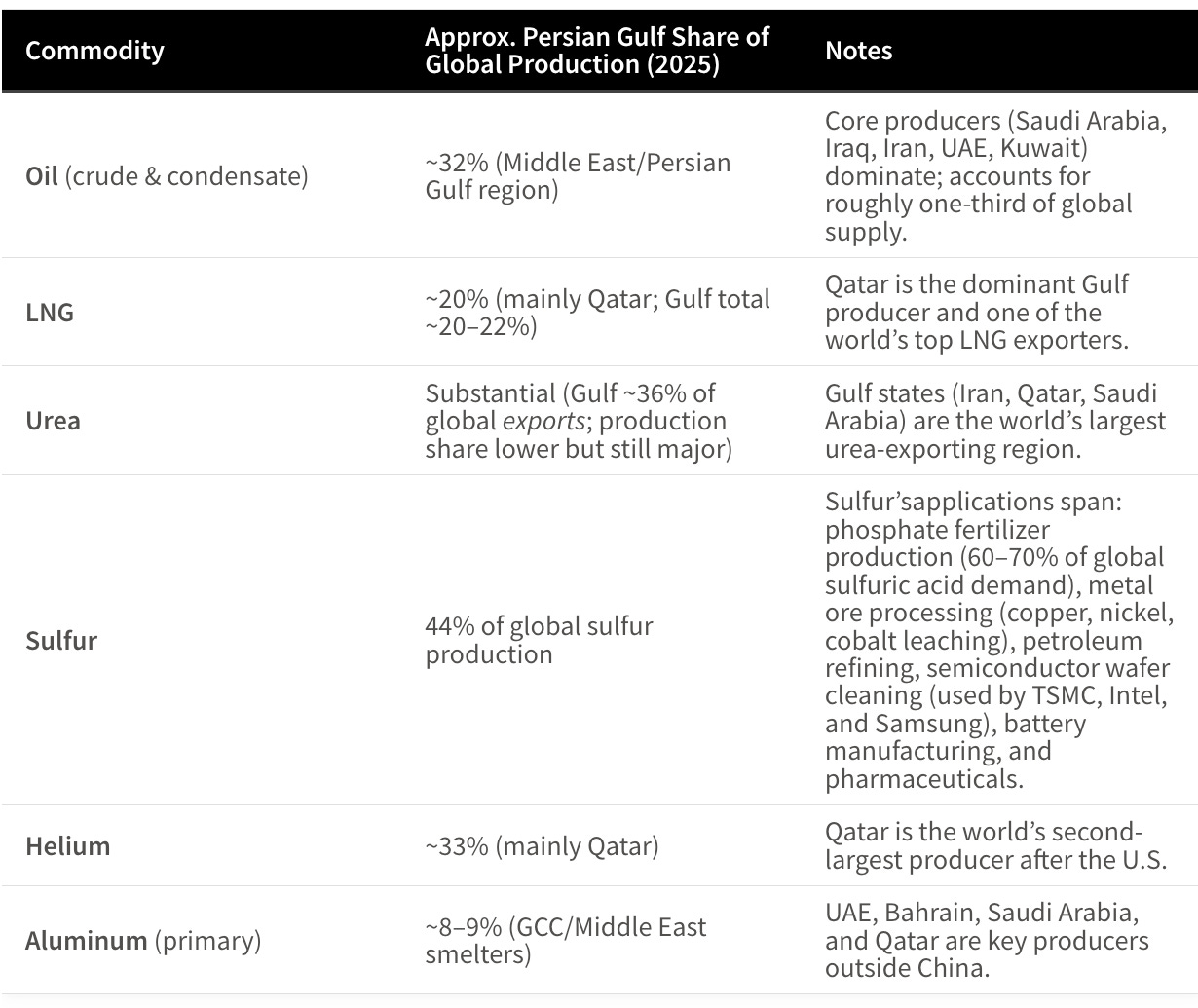
Iran is pursuing diplomatic contacts with Saudi Arabia, Qatar and Kuwait to restore the export of these commodities to the world under Iran’s PGSA. If Qatar and Saudi Arabia cut a deal with Iran, the US influence in the region will be castrated. If there is a global financial crisis accompanied by a major recession, if not depression, then the US will be under enormous pressure to make a deal with Iran that will restore international trade and shipments from the Persian Gulf. Iran holds the ultimate trump card… Trump holds none."

Thursday, May 7, 2026

"Iran Fires 1,200 Missiles at IDF, 50 Bases Erased, 300,000 Troops Stranded Without Ammo"

Col. Douglas Macgregor, 5/7/26
"Iran Fires 1,200 Missiles at IDF, 50 Bases Erased, 
300,000 Troops Stranded Without Ammo"
Comments here:

"Col. Macgregor: 'We Only Have Weeks Left' Until Economic Disaster Hits The US"

Full screen recommended.
Redacted, 5/7/16
"Col. Macgregor: 'We Only Have Weeks Left' 
Until Economic Disaster Hits The US"
"Financial experts like Citadel's Ken Griffin and Carlyle Group's Jeff Currie are issuing stark warnings of a global recession driven by an escalating energy crisis. Currie highlights that the U.S. is already in an oil deficit and will face devastating shortages once inventories, which he compares to the shark fin in 'Jaws', hit 'tank bottoms' by mid-summer. Col. Douglas MacGregor elaborates, linking the crisis to conflict in the Persian Gulf and explaining the cascading effects like soaring jet fuel prices and broken supply chains for diesel. I had a fascinating conversation with Kevin DeMeritt, Founder of Lear Capital, about gold, silver, and what investors should be paying attention to right now. If you’re curious about protecting your wealth and learning where the market is headed, you won’t want to miss this discussion."
Comments here:

Gerald Celente, "Main Street Suffers As Wall Street Prospers"

Strong language alert!
Gerald Celente, 5/7/26
"Main Street Suffers As Wall Street Prospers"
"The Trends Journal is a weekly magazine analyzing global current events forming future trends. Our mission is to present Facts and Truth over fear and propaganda to help subscribers prepare for What's Next in these increasingly turbulent times."
Comments here:

"Warning: Stagflation is Here To Stay, Households Are Now In Recession"

Jeremiah Babe, 2/7/26
"Warning: Stagflation is Here To Stay,
 Households Are Now In Recession"
Comments here:

Musical Interlude: Liquid Mind VI, "Spirit"

Full screen recommended.
Liquid Mind VI, "Spirit"

"A Look to the Heavens"

“Far beyond the local group of galaxies lies NGC 3621, some 22 million light-years away. Found in the multi-headed southern constellation Hydra, the winding spiral arms of this gorgeous island universe are loaded with luminous young star clusters and dark dust lanes. Still, for earthbound astronomers NGC 3621 is not just another pretty face-on spiral galaxy. Some of its brighter stars have been used as standard candles to establish important estimates of extragalactic distances and the scale of the Universe.
This beautiful image of NGC 3621 traces the loose spiral arms far from the galaxy's brighter central regions that span some 100,000 light-years. Spiky foreground stars in our own Milky Way Galaxy and even more distant background galaxies are scattered across the colorful skyscape.”

"Acceptance..."

"Acceptance is a crucial step forward for those who prefer the idea of living this life over simply existing within it. Accept all that you've said and what you've done, because you cannot change your past. Accept the idea of the unknown, because the future is the unknown waiting patiently to reveal itself. Accept the person you have become thus far in your journey, because you are the only person who will be there with you when you finish it. Do all of this so that you may never find yourself having to accept regret that haunts you at two a.m., leaving you sweaty and broken hearted. All you have is this minute; not this hour, or this day, or this year. Live in this minute so that you won't get stuck simply existing with your guilty past, or with nothing but anxiety for the future."
- Margaret E. Rise

"America's Rental Collapse Has Begun - No One Can Get Approved"

Full screen recommended.
Epic Economist, 5/7/26
"America's Rental Collapse Has Begun - 
No One Can Get Approved"
"America's rental collapse has begun. And in 2026, the average working American can't even get approved for an apartment they could pay rent on. Application fees they don't get back. Credit floors they can't hit. A math rule from 1985 that locks out half of working America. A $1.3 billion tenant screening industry running silent on every renter - and one eviction filing flags you for seven years. Even if it was dismissed. Failures are recorded. Successes are not. By design. This is what 17 working tenants describe in their own words. They paid the fees. They had jobs. They had clean records. The wall went up anyway. Listen to how they describe it."
Comments here:

The Poet: Neil Gaiman, "What You Need To Be Warm "

"What You Need To Be Warm" 

 "A baked potato of a winters night to wrap
your hands around or burn your mouth.
A blanket knitted by your mother's cunning fingers. 
Or your grandmother's.

A smile, a touch, trust, as you walk in from the snow
or return to it, the tips of your ears pricked pink and frozen.
The tink tink tink of iron radiators waking in an old house.

To surface from dreams in a bed, 
burrowed beneath blankets and comforters,
the change of state from cold to warm is all that matters, and you think
just one more minute snuggled here before you face the chill. Just one.

Places we slept as children: they warm us in the memory.
We travel to an inside from the outside. 
To the orange flames of the fireplace
or the wood burning in the stove. 

Breath-ice on the inside of windows,
to be scratched off with a fingernail, melted with a whole hand.
Frost on the ground that stays in the shadows, waiting for us.

Wear a scarf. Wear a coat. Wear a sweater. 
Wear socks. Wear thick gloves.

An infant as she sleeps between us. A tumble of dogs,
a kindle of cats and kittens. 
Come inside. You're safe now.
A kettle boiling at the stove. Your family or friends are there. 
They smile.
Cocoa or chocolate, tea or coffee, 
soup or toddy, what you know you need.
A heat exchange, they give it to you, you take the mug
and start to thaw.

While outside, for some of us, the journey began
as we walked away from our grandparentshouses
away from the places we knew as children: 
changes of state and state and state,
to stumble across a stony desert, or to brave the deep waters,
while food and friends, home, a bed, even a blanket become just memories.

Sometimes it only takes a stranger, in a dark place,
to hold out a badly-knitted scarf, to offer a kind word,
 to say we have the right to be here, 
to make us warm in the coldest season.
You have the right to be here. "

- Neil Gaiman
o
Neil Gaiman reads "What You Need To Be Warm"

Dan, I Allegedly, "Ferrari’s and Food Stamps"

Full screen recommended.
Dan, I Allegedly, 5/7/26
"Ferrari’s and Food Stamps"
"The shocking truth about food stamp fraud is starting to come out, and it’s worse than most people think. In this video, we break down how individuals with luxury assets - including Ferraris, Lamborghinis, and high-end lifestyles - are still qualifying for SNAP benefits due to loopholes in the system. While millions of struggling Americans rely on food assistance to survive, others are allegedly exploiting the program, costing taxpayers millions every single day. We also dive into the broader economic impact, including stricter SNAP enforcement, millions being removed from the program, and the growing frustration over government oversight and accountability. From California’s massive daily losses to nationwide fraud concerns, this is a story about waste, policy failure, and who ultimately pays the price. If you care about the economy, government spending, and financial fairness, this is a must-watch."
Comments here:

The Daily "Near You?"

Hamilton, Waikato, New Zealand. Thanks for stopping by!

"Not Such An Easy Business..."

“Over the years you get to see what a struggle life is for most people, how tough it is, how easy it is to be judgmental and criticize and stand outside of situations and impart your wisdom and judgment. But over the decades I've got more tolerant of people's flaws and mistakes. Everybody makes a lot of them. When you're younger you feel: "Hey, this person is evil" or "This person is a jerk" or stupid or "What's wrong with them?" Then you go through life and you think: "Well, it's not so easy." There's a lot of mystery and suffering and complication. Everybody's out there trying to do the best they can. And it's not such an easy business.”
- Woody Allen

"Bamboozled..."

"One of the saddest lessons of history is this: If we've been bamboozled long enough, we tend to reject any evidence of the bamboozle. We're no longer interested in finding out the truth. The bamboozle has captured us. It's simply too painful to acknowledge, even to ourselves, that we've been taken. Once you give a charlatan power over you, you almost never get it back."
- Carl Sagan

"Why Can’t We Thrive Like 1905?"

"Why Can’t We Thrive Like 1905?"
by Paul Rosenberg

"When writing historical things, I try to include perspective from people who actually lived through the events. And for money issues in the US, I’m able to do that back to about 1905. So, do you think life was nasty, brutish, and short in 1905? That there were poor and starving people falling dead on every street corner? Hardly.

The Wright brothers were flying for 30 minutes at a crack; Einstein was upgrading the laws of physics; telephones and electric lights were being installed all across America; Henry Ford was getting the final pieces in place for his moving assembly line and Model T; radio was being developed; art was flourishing; and the world was more or less at peace.

Sure, we have far more tech and better medicine now, but mostly because the people of earlier times (like the 1905 era) gifted it to us. People in 1905 lived in heated homes, refrigerated their food, had access to professional physicians, traveled the world (mostly on trains and ships), read daily newspapers (there were many more of them in those days), watched early movies, and ate just about the same foods we eat.

So, was it really that bad a time? No, it wasn’t. In fact, it was better in important ways, and one in particular: It was moving rapidly forward.

Money In The USA: Facts: Consider this: The working person of 1905 kept his or her money. They ended up saving somewhere between a quarter and a half of everything they made – after living expenses. It’s hard to be completely precise when reconstructing the budgets of average people in 1905 (records are hard to find), but we do have enough for a good, close guess. Here’s how finance worked for a working family man of 1905:

Annual income: $700.00
Annual expenses: ($350.00)
Annual savings: $350.00

If you’re thinking that I’m taking liberties with these numbers, let me assure you that I’m not – I’m being conservative. For example:The income figure should probably be higher. I’ve found figures of well over $800 for construction workers. As for expenses, I rounded up from a New York Times article, dated 29 September, 1907. It specified $325 per year. Added to that is the fact that many people grew their own food during that time, which would skew the figures further.

As noted initially, I compared these numbers with stories I heard from relatives who lived through the time. My uncle Dave, for example, used to tell me how he got a job paying $390 per year sweeping floors, as an unskilled immigrant who spoke almost no English, in 1903.

The next time you drive through an old part of town and see the grand old houses, remember that people were able to build and buy them because their paychecks weren’t stripped bare. There were no income taxes in 1905, no sales taxes, no state taxes, and not much in the way of property taxes. There was also no such thing as a military-industrial complex in those days, and – miracle of miracles – the rest of the world survived!

And Now… As you know, today’s situation is much different. The average working family pays about half their income in combined taxes: income taxes (to the state and the Feds), payroll taxes, property taxes, gas taxes, utility bill taxes, sales tax, local taxes, and on and on. So, figuring an average income of just over $50,000 (that’s a 2011 figure). And combined taxes of about $25,000, the average American family is left to pay bills like these:

Mortgage $11,000
Car payments $6,000
Gas, repairs, etc. $2,500
Property taxes $2,500
Food $3,000
Total $25,000

That leaves people zeroed-out. And again, I’m being conservative: I haven’t included a number of smaller expenses, and that huge numbers of people are deeply in debt.

If Great Grandpa Could Do It… Our great grandfathers faced very few of the taxes that we face. (The government survived on tariffs.) There was no social security either, and – believe it or not – the streets were never full of starving old people. Families were able to take care of their own – it’s not that hard when you’re saving half of your income! We have forgotten that it was once possible for an average person to accumulate money. The truth is that productive people should be comfortable. Well-off, as they used to say. So, why can’t we thrive like it’s 1905? You might want to hold that question in mind."

"How It Really Is"