StatCounter

Friday, May 8, 2026

"The Day Civilization Runs Out Of Bread Will Not Feel Like Fiction"

"The Day Civilization Runs Out Of 
Bread Will Not Feel Like Fiction"
by Madge Waggy

"For nearly three decades, much of the modern world behaved as though the nuclear age had quietly expired sometime in the early 1990s. The collapse of the Soviet Union created the comforting illusion that humanity had stepped away from the edge permanently, as if the terrifying balance that defined the Cold War had dissolved together with old political maps. Younger generations grew up hearing about nuclear drills, fallout shelters, and atomic panic the same way they heard about trench warfare or medieval plagues: as distant historical experiences disconnected from ordinary life. Governments gradually shifted public attention toward terrorism, economic globalization, artificial intelligence, and climate policy, while nuclear annihilation faded into the background of public consciousness.

Yet history has a dangerous habit of returning precisely when societies become convinced they have outgrown it. Throughout 2025 and the opening months of 2026, the international system entered one of its most unstable periods since the twentieth century. Military analysts began warning openly about simultaneous geopolitical flashpoints involving several nuclear powers at once. Russian officials intensified references to strategic deterrence during ongoing confrontations connected to Eastern Europe, while NATO expanded military exercises across regions Moscow considers existentially sensitive. At the same time, China accelerated modernization of its nuclear arsenal and long-range missile systems at a pace that alarmed Western intelligence agencies. North Korea continued demonstrating increasingly advanced delivery capabilities, and tensions surrounding Taiwan, cyber warfare, and contested maritime territories pushed diplomatic relations into progressively uncertain territory.

Most citizens observed these developments from a psychological distance shaped by modern media exhaustion. Continuous exposure to crisis has transformed public attention into something fragmented and temporary. Economic anxiety, inflation, political polarization, housing instability, technological disruption, and endless digital noise have conditioned people to process existential threats as short-lived headlines rather than historical warnings. This emotional fatigue may partially explain why recent discussions surrounding nuclear risk have failed to produce widespread public alarm despite the seriousness of the underlying situation.

What many people still fail to understand is that contemporary fears surrounding nuclear war extend far beyond the immediate destruction caused by the weapons themselves. The dominant concern among climate scientists, food security experts, and strategic analysts is no longer limited to blast zones or radiation exposure. The larger fear involves what happens afterward, when the environmental consequences of large-scale firestorms begin altering the planet’s atmosphere and destabilizing the systems that sustain modern civilization.
Civilization Does Not Collapse In One Afternoon: During the Cold War, researchers studying atmospheric science reached conclusions that many policymakers initially struggled to accept. Their models suggested that nuclear detonations targeting cities and industrial infrastructure would ignite massive firestorms capable of releasing extraordinary amounts of soot and smoke into the upper atmosphere. Unlike ordinary pollution, these particles could remain suspended in the stratosphere for extended periods, blocking significant portions of sunlight from reaching the Earth’s surface. The phenomenon eventually became known as “nuclear winter,” though the phrase itself almost sounds too simple for the scale of devastation being described.

The consequences outlined in scientific simulations were extraordinary. Temperatures across major agricultural regions could fall dramatically within weeks. Growing seasons would shorten or disappear entirely in some parts of the world. Rainfall patterns could become severely disrupted, while frost conditions might appear during periods traditionally associated with crop growth. Wheat, corn, rice, and soy production would decline simultaneously across multiple continents, creating a synchronized collapse unlike anything modern economies were designed to survive.

What makes this possibility especially catastrophic in 2026 is the structure of contemporary civilization itself. Modern societies are built upon tightly interconnected supply chains operating with remarkable efficiency but very little redundancy. Large urban populations depend on continuous transportation networks, imported food, fuel distribution systems, refrigeration infrastructure, and stable international trade routes to maintain ordinary daily life. The abundance visible inside supermarkets creates the illusion of permanent security, yet many cities possess only limited food reserves capable of supporting their populations for short periods without resupply.

Once agricultural output begins failing internationally, governments would almost certainly prioritize domestic survival over global cooperation. Export restrictions would emerge rapidly. Shipping routes could become militarized or inaccessible. Financial systems would destabilize under panic conditions, while fuel shortages would further damage transportation and farming operations. Nations heavily dependent on food imports would face immediate humanitarian crises, but even agricultural powers would struggle once climate disruption and supply chain fragmentation intensified simultaneously.

Several modern studies examining nuclear famine scenarios estimate that billions of people could face starvation following a large-scale nuclear exchange. Some projections, revisited in light of newer climate data and current population levels, suggest mortality rates so extreme that they challenge the imagination. This is partly why historical American government assessments discussing potential death tolls approaching ninety percent of humanity continue attracting renewed attention today. The figure sounds almost impossible to comprehend until one begins analyzing how dependent modern civilization truly is on environmental stability and uninterrupted agricultural production.

There is also a psychological dimension to these discussions that experts rarely address publicly in direct terms. Human beings often assume technological sophistication automatically guarantees resilience. The modern world appears powerful because it possesses satellites, artificial intelligence, advanced medicine, digital communication, and industrial automation. However, none of those systems can function normally without stable energy networks, functioning governments, predictable climates, and access to food. Civilization may appear technologically invincible while remaining biologically fragile underneath.

Historical examples repeatedly demonstrate that famine destabilizes societies faster than almost any other force. Political institutions that appear permanent during periods of abundance can deteriorate with astonishing speed once populations begin competing for survival. Social trust erodes rapidly under conditions of scarcity, and governments facing mass hunger frequently resort to emergency powers, censorship, militarized distribution systems, or violent repression in attempts to preserve order. The concern among researchers is not merely that people would suffer physically after a nuclear conflict, but that the organizational foundations of civilization itself could begin disintegrating under sustained environmental pressure.
The Most Dangerous Illusion Of The Twenty-First Century: Perhaps the most unsettling aspect of the modern nuclear dilemma is the persistence of a belief that rational actors will always prevent ultimate catastrophe. Nuclear deterrence theory has long depended upon the assumption that political leaders understand the unacceptable consequences of escalation. For decades, this logic arguably prevented direct conflict between major powers. However, contemporary geopolitical conditions have introduced forms of instability far more unpredictable than those defining much of the Cold War.

Cyberattacks, artificial intelligence-assisted military systems, disinformation campaigns, autonomous weapons development, regional proxy wars, and instantaneous digital propaganda have dramatically accelerated the speed at which crises evolve. Decision-making environments have become saturated with uncertainty, misinformation, and political pressure. Under such conditions, the possibility of miscalculation increases substantially. Many historical catastrophes did not emerge because leaders consciously desired apocalypse; they unfolded because governments believed escalation remained controllable until events moved beyond anyone’s ability to contain them.

This fear now shapes many contemporary security discussions behind closed doors. Analysts increasingly worry less about intentional world-ending war and more about uncontrolled escalation arising from regional conflict, technological failure, accidental launch detection, or political desperation during moments of extreme instability. The existence of thousands of nuclear warheads means humanity continues living inside a system where a relatively small number of decisions made within minutes could alter the trajectory of civilization permanently.

The deeper tragedy is that modern society possesses enough scientific knowledge to understand these risks with remarkable clarity while simultaneously lacking the political unity necessary to eliminate them completely. Humanity has mapped the environmental consequences, modeled agricultural collapse scenarios, studied historical famines, and analyzed strategic escalation pathways extensively. The danger is not hidden ignorance. The danger is collective normalization.

For years, nuclear weapons survived in public imagination mostly as symbols rather than active threats. In 2026, that perception has begun changing again. What once felt theoretical now appears uncomfortably plausible to many researchers observing the deterioration of international stability. The silence surrounding these fears should not be mistaken for safety. In many ways, silence may simply reflect how accustomed humanity has become to living beside mechanisms capable of ending the modern world.

The Hunger That Would Rewrite Human History: For most people living in industrialized nations, hunger exists as an abstract concept rather than an immediate fear. Supermarkets remain illuminated throughout the night, delivery systems function with mechanical precision, and food arrives so consistently that modern consumers rarely consider the extraordinary infrastructure required to sustain this daily normality. Entire generations have grown up inside societies where scarcity feels temporary and manageable, something associated with distant humanitarian crises rather than a condition capable of consuming advanced civilizations. This psychological distance from famine may explain why discussions surrounding nuclear conflict still focus overwhelmingly on explosions instead of agriculture.

Yet among climate scientists and food security researchers, the central nightmare has increasingly shifted away from the battlefield itself. The deeper fear concerns the months and years following the initial detonations, when collapsing harvests begin interacting with fragile political systems and overstretched global supply chains. In this scenario, the bombs become only the beginning of the disaster rather than its conclusion.
A Planet Running Out Of Sunlight: Recent studies examining large-scale nuclear conflict suggest that the atmospheric consequences could emerge faster than most populations would expect. Massive firestorms generated by burning urban centers, oil facilities, industrial complexes, and transportation infrastructure would inject soot into the upper atmosphere on a scale modern civilization has never experienced directly. Once suspended in the stratosphere, these particles could reduce the amount of sunlight reaching agricultural regions across the planet for extended periods of time.

Even relatively small temperature declines can devastate food production when they occur globally and simultaneously. Agriculture depends upon stability more than abundance. Crops evolve around predictable seasonal rhythms, specific rainfall patterns, and narrow temperature windows that determine germination, growth, and harvest cycles. Sudden climatic disruption affecting multiple breadbasket regions at once would trigger cascading failures impossible to offset through ordinary trade mechanisms.

Wheat production in North America, rice cultivation across Asia, corn yields in major exporting nations, and soybean harvests supporting livestock industries could all experience severe declines within the same agricultural cycle. Fisheries might collapse as ocean ecosystems react to cooling temperatures and contamination, while livestock production would suffer from both feed shortages and infrastructure breakdown. Nations that currently import large portions of their food supplies would face immediate humanitarian emergencies, but even countries traditionally considered agricultural powers would struggle to maintain internal stability under prolonged climate disruption.

One of the most disturbing conclusions emerging from famine modeling is that modern civilization possesses remarkably little resilience once synchronized global shortages begin appearing. International trade networks function efficiently during normal conditions precisely because they rely on predictability. Under extreme pressure, however, governments tend to abandon cooperative frameworks rapidly in favor of domestic preservation. Export bans would likely emerge within days of confirmed agricultural collapse. Strategic grain reserves would become politically weaponized. Transportation systems already strained by fuel shortages and economic panic could deteriorate rapidly, preventing aid distribution even when supplies remain technically available.

History offers numerous examples of societies destabilized by food insecurity, but the modern world has never experienced simultaneous scarcity affecting billions of people across multiple continents. During previous famines, unaffected regions could still provide assistance or maintain economic stability. A nuclear-induced agricultural collapse would remove that possibility almost entirely because every major nation would confront variations of the same crisis at once.

The social consequences become difficult to calculate precisely because they extend beyond starvation itself. Large urban populations dependent on uninterrupted food deliveries would likely experience panic within weeks of sustained shortages. Financial systems could freeze as governments impose emergency controls. Mass migration, civil unrest, organized violence, and authoritarian crackdowns would become increasingly probable as political institutions struggle to preserve order. Under such conditions, mortality would rise not only from hunger but from disease outbreaks, collapsing medical systems, infrastructure failures, exposure during extreme winters, and violent conflict over remaining resources.
Why The Twenty-First Century Could Be Less Prepared Than The Cold War: There is an uncomfortable irony hidden within modern discussions about civilization and progress. Technologically, humanity has never appeared more advanced. Artificial intelligence systems can process extraordinary quantities of information, satellites monitor climate activity in real time, and global communication networks connect billions of people instantly. Yet beneath this technological sophistication lies a level of systemic dependency that may actually increase vulnerability during extreme crises.

Cold War societies, despite living under constant nuclear anxiety, often possessed stronger local manufacturing capabilities, larger strategic reserves, and populations more psychologically familiar with rationing or national emergency planning. In contrast, contemporary economies operate through highly optimized global supply chains designed for efficiency rather than resilience. Many industries maintain minimal redundancy because uninterrupted trade and stable geopolitical conditions became normalized assumptions after decades of globalization.

This efficiency creates enormous fragility. A disruption affecting fuel, transportation, fertilizer production, semiconductor manufacturing, or energy infrastructure can rapidly spread through multiple sectors simultaneously. Agriculture itself has become deeply industrialized and dependent on advanced logistics systems. Modern farming requires machinery, synthetic fertilizers, pesticides, refrigeration networks, digital coordination systems, and stable access to fuel. Once several of these components begin failing together, food production declines far more dramatically than many people assume.

Another factor rarely discussed publicly involves population density. The global population now exceeds eight billion people, with massive concentrations living inside urban environments unable to sustain themselves independently for extended periods. Cities function because surrounding systems continuously move food inward and waste outward. Remove those systems long enough and urban civilization becomes extraordinarily difficult to maintain peacefully.

Researchers studying nuclear famine scenarios increasingly emphasize that the world entering such a crisis would already be politically and environmentally strained beforehand. Climate change has intensified droughts, floods, heatwaves, and agricultural unpredictability across several continents. Economic inequality has deepened social tensions within many nations, while migration pressures and regional conflicts continue destabilizing vulnerable areas. In this context, a large-scale nuclear exchange would not strike a healthy and stable international order. It would strike a world already showing signs of exhaustion.

Perhaps this is why certain historical government assessments produced mortality estimates that appear almost surreal to ordinary readers. The projections were not based solely on blast casualties. They reflected broader systemic collapse involving food insecurity, governance failure, economic fragmentation, environmental destabilization, and prolonged humanitarian breakdown. Once those variables interact globally, the number of potential deaths rises with terrifying speed.

The greatest misconception surrounding nuclear war may therefore be the belief that survival depends primarily on avoiding the initial explosions. In reality, the long-term environmental and societal consequences could determine humanity’s future far more decisively than the first hours of destruction. The bombs themselves would last minutes. The famine afterward could reshape civilization for generations."
Hat tip to The Burning Platform for this material!

"You Don’t Realize How Many Americans Have Already Fallen Off The Edge"

Full screen recommended.
Across The States, 5/8/26
"You Don’t Realize How Many Americans 
Have Already Fallen Off The Edge"
"Americans can’t afford to live anymore, and the signs are getting harder to ignore. The American Dream used to mean that steady work could pay the bills, keep a roof overhead, and leave a little breathing room. But for millions of people, that deal feels broken. Rent, groceries, insurance, debt, and basic expenses keep rising while paychecks don’t stretch far enough. Here’s the thing: this isn’t only about people without jobs. A lot of working Americans are falling behind quietly, using credit cards to survive, skipping bills, moving in with family, or living one emergency away from losing everything. This video looks at the warning signs behind America’s cost of living crisis, why the middle class feels squeezed, and how the dream is collapsing in plain sight."
Comments here:

Dan, I Allegedly, "Consumers Have Finally Run Out of Money"

Full screen recommended.
Dan, I Allegedly, 5/8/26
"Consumers Have Finally Run Out of Money"
"Consumers are running out of money before the end of the month, and now major CEOs are openly admitting it. In today’s i Allegedly update, we break down the warning signs hitting the economy right now: rising prices, layoffs at Coinbase and Verizon, Whirlpool price hikes, expensive groceries, shrinking consumer spending, and why even Kraft Heinz says Americans are financially tapped out. From inflation to debt to the cost of everyday life, the pressure on working families continues to grow. We also discuss the shocking rise in dating costs, Starbucks defending $9 coffee, gas discounts becoming major events, and new passport crackdowns tied to unpaid child support. Businesses across every sector are sounding the alarm as consumers cut spending and struggle to keep up with inflation and the cost of living. Is this the beginning of a deeper economic slowdown? Share your thoughts below."
Comments here:

"The Gulf Separating the US and Iran is Too Wide to Bridge"

"The Gulf Separating the US and 
Iran is Too Wide to Bridge"
by Larry C. Johnson

"As I pointed out in my last article, someone in the Trump administration who has been briefed on Trump’s upcoming statements about the war in Iran made a financial killing yesterday. This is part of a continuing pattern of deliberate deception by Trump, i.e., pretending there is great progress with talks with Iran, which in turn produces a boost in the US stock market and a decline in the futures price of oil. Here is the reality: There will be no negotiated end to the war with Iran in the next six months because the US narrative and the Iranian narrative cannot be reconciled.

Let’s start with the US position or narrative… Iran is an irredeemable Islamic terrorist state that is teetering on the edge of collapse. Iran’s political and military leaders are deeply divided. Iran’s economy has no way to recover as long as the war goes on. Iran’s military capabilities have been decimated. Iran must cease enriching uranium and must allow complete, unhindered inspections of its nuclear facilities. This is what the overwhelming majority of Trump advisors and US political pundits believe.

Iranian leaders are equally firm… Iran will only agree to a negotiated settlement to end the blockade of the Strait of Hormuz if Israel agrees to a complete ceasefire in Lebanon and Gaza. The Strait of Hormuz will remain under Iran’s control and that they would never relinquish control of the SOH. On May 5, 2026, Iran launched a new body called the Persian Gulf Strait Authority (PGSA), requiring all ships wishing to cross the Strait of Hormuz to register, fill out forms, and pay a toll before receiving a transit permit. Iran will never give up its supply of enriched uranium and, as a sovereign nation and signatory to the NPT, will exercise its right to enrich uranium for peaceful purposes. Iran will continue to support the Palestinian people and their quest for freedom and self-rule and will continue to provide assistance to Hezbollah. Finally, Iran will not compromise on its right to build ballistic missiles.

This, boys and girls, is called an impasse. The US position rests on a number of false assumptions. First, Iran is not the leading sponsor of terrorism and has not been engaged in plots to destabilize it Gulf Arab neighbors. Second, there is no rift between the political leaders of Iran and the IRGC… the President, the Foreign Minister, the Head of the Iranian legislature and the Ayatollah all fought and served with the IRGC during the war with Iraq. Third, Iran’s economy is beginning to revive thanks to support from Russia, China and Pakistan and from the high price of oil. Fourth, notwithstanding Trump’s claims to the contrary, the Iranian navy, air force and ballistic missile, cruise missile and drones are intact and able to continue exchanging blows with the US and Israel.

Donald Trump faces several dilemmas… The US economy is beginning to falter with growing public anger over the surging price of gasoline. There are no viable military options to effect a regime change in Iran or to compel Iran to agree to US demands. The US supplies of critical weapons systems will be further depleted if the US renews its aerial and missile attacks on Iran, and Iranian retaliation on US and Israeli targets will inflict significant damage. As long as the US continues to attack Iran, its relations with Russia and China will deteriorate.

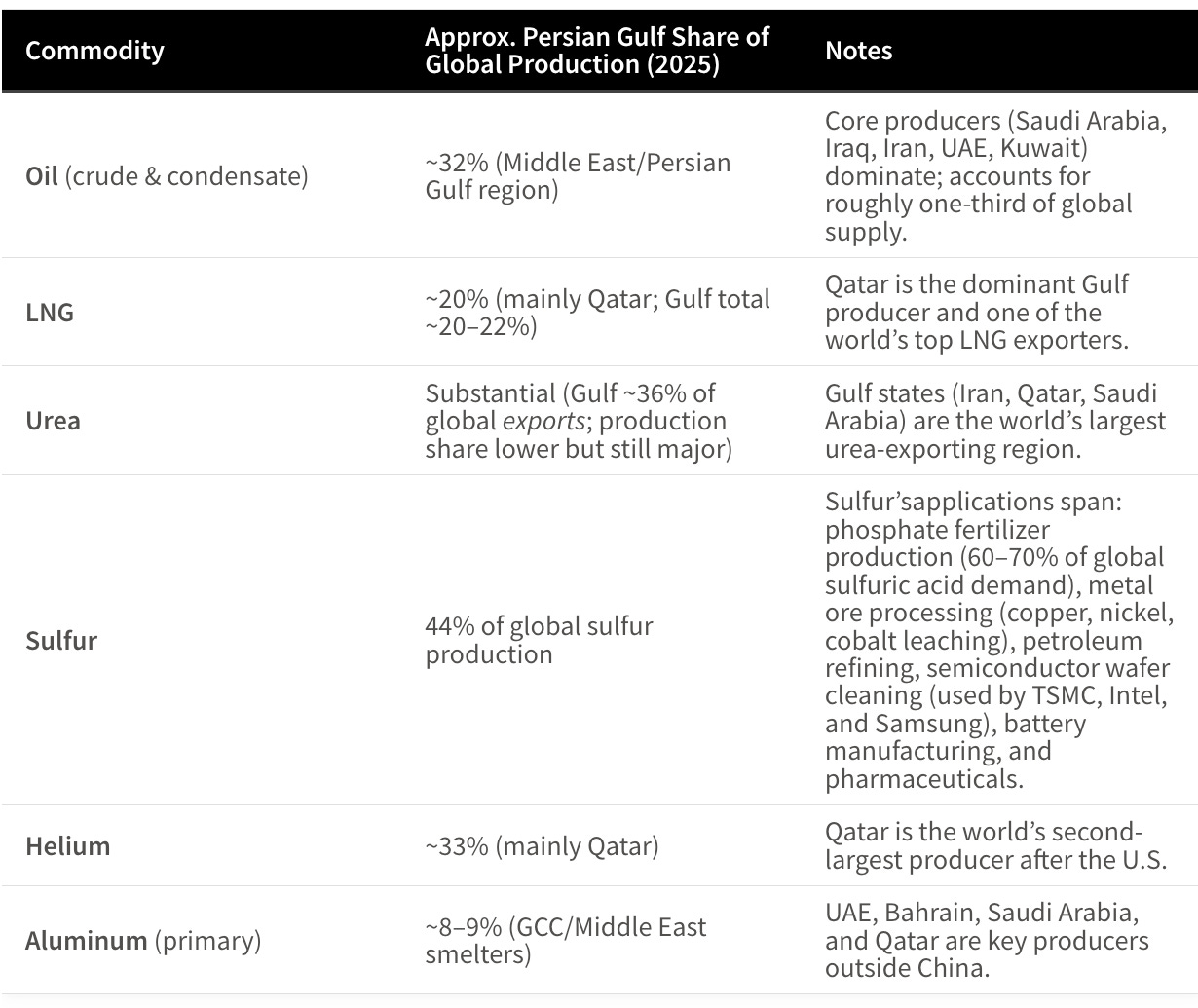
The real threat to the US is not military, it is economic. The continued blockade of the Strait of Hormuz by Iran confronts the world with an unprecedented economic threat. US attempts to block this will only worsen what will become a global economic catastrophe.
Click image for larger size.
Iran is pursuing diplomatic contacts with Saudi Arabia, Qatar and Kuwait to restore the export of these commodities to the world under Iran’s PGSA. If Qatar and Saudi Arabia cut a deal with Iran, the US influence in the region will be castrated. If there is a global financial crisis accompanied by a major recession, if not depression, then the US will be under enormous pressure to make a deal with Iran that will restore international trade and shipments from the Persian Gulf. Iran holds the ultimate trump card… Trump holds none."

Thursday, May 7, 2026

"Iran Fires 1,200 Missiles at IDF, 50 Bases Erased, 300,000 Troops Stranded Without Ammo"

Col. Douglas Macgregor, 5/7/26
"Iran Fires 1,200 Missiles at IDF, 50 Bases Erased, 
300,000 Troops Stranded Without Ammo"
Comments here:

"Col. Macgregor: 'We Only Have Weeks Left' Until Economic Disaster Hits The US"

Full screen recommended.
Redacted, 5/7/16
"Col. Macgregor: 'We Only Have Weeks Left' 
Until Economic Disaster Hits The US"
"Financial experts like Citadel's Ken Griffin and Carlyle Group's Jeff Currie are issuing stark warnings of a global recession driven by an escalating energy crisis. Currie highlights that the U.S. is already in an oil deficit and will face devastating shortages once inventories, which he compares to the shark fin in 'Jaws', hit 'tank bottoms' by mid-summer. Col. Douglas MacGregor elaborates, linking the crisis to conflict in the Persian Gulf and explaining the cascading effects like soaring jet fuel prices and broken supply chains for diesel. I had a fascinating conversation with Kevin DeMeritt, Founder of Lear Capital, about gold, silver, and what investors should be paying attention to right now. If you’re curious about protecting your wealth and learning where the market is headed, you won’t want to miss this discussion."
Comments here:

Gerald Celente, "Main Street Suffers As Wall Street Prospers"

Strong language alert!
Gerald Celente, 5/7/26
"Main Street Suffers As Wall Street Prospers"
"The Trends Journal is a weekly magazine analyzing global current events forming future trends. Our mission is to present Facts and Truth over fear and propaganda to help subscribers prepare for What's Next in these increasingly turbulent times."
Comments here:

"Warning: Stagflation is Here To Stay, Households Are Now In Recession"

Jeremiah Babe, 2/7/26
"Warning: Stagflation is Here To Stay,
 Households Are Now In Recession"
Comments here:

Musical Interlude: Liquid Mind VI, "Spirit"

Full screen recommended.
Liquid Mind VI, "Spirit"

"A Look to the Heavens"

“Far beyond the local group of galaxies lies NGC 3621, some 22 million light-years away. Found in the multi-headed southern constellation Hydra, the winding spiral arms of this gorgeous island universe are loaded with luminous young star clusters and dark dust lanes. Still, for earthbound astronomers NGC 3621 is not just another pretty face-on spiral galaxy. Some of its brighter stars have been used as standard candles to establish important estimates of extragalactic distances and the scale of the Universe.
This beautiful image of NGC 3621 traces the loose spiral arms far from the galaxy's brighter central regions that span some 100,000 light-years. Spiky foreground stars in our own Milky Way Galaxy and even more distant background galaxies are scattered across the colorful skyscape.”

"Acceptance..."

"Acceptance is a crucial step forward for those who prefer the idea of living this life over simply existing within it. Accept all that you've said and what you've done, because you cannot change your past. Accept the idea of the unknown, because the future is the unknown waiting patiently to reveal itself. Accept the person you have become thus far in your journey, because you are the only person who will be there with you when you finish it. Do all of this so that you may never find yourself having to accept regret that haunts you at two a.m., leaving you sweaty and broken hearted. All you have is this minute; not this hour, or this day, or this year. Live in this minute so that you won't get stuck simply existing with your guilty past, or with nothing but anxiety for the future."
- Margaret E. Rise

"America's Rental Collapse Has Begun - No One Can Get Approved"

Full screen recommended.
Epic Economist, 5/7/26
"America's Rental Collapse Has Begun - 
No One Can Get Approved"
"America's rental collapse has begun. And in 2026, the average working American can't even get approved for an apartment they could pay rent on. Application fees they don't get back. Credit floors they can't hit. A math rule from 1985 that locks out half of working America. A $1.3 billion tenant screening industry running silent on every renter - and one eviction filing flags you for seven years. Even if it was dismissed. Failures are recorded. Successes are not. By design. This is what 17 working tenants describe in their own words. They paid the fees. They had jobs. They had clean records. The wall went up anyway. Listen to how they describe it."
Comments here:

The Poet: Neil Gaiman, "What You Need To Be Warm "

"What You Need To Be Warm" 

 "A baked potato of a winters night to wrap
your hands around or burn your mouth.
A blanket knitted by your mother's cunning fingers. 
Or your grandmother's.

A smile, a touch, trust, as you walk in from the snow
or return to it, the tips of your ears pricked pink and frozen.
The tink tink tink of iron radiators waking in an old house.

To surface from dreams in a bed, 
burrowed beneath blankets and comforters,
the change of state from cold to warm is all that matters, and you think
just one more minute snuggled here before you face the chill. Just one.

Places we slept as children: they warm us in the memory.
We travel to an inside from the outside. 
To the orange flames of the fireplace
or the wood burning in the stove. 

Breath-ice on the inside of windows,
to be scratched off with a fingernail, melted with a whole hand.
Frost on the ground that stays in the shadows, waiting for us.

Wear a scarf. Wear a coat. Wear a sweater. 
Wear socks. Wear thick gloves.

An infant as she sleeps between us. A tumble of dogs,
a kindle of cats and kittens. 
Come inside. You're safe now.
A kettle boiling at the stove. Your family or friends are there. 
They smile.
Cocoa or chocolate, tea or coffee, 
soup or toddy, what you know you need.
A heat exchange, they give it to you, you take the mug
and start to thaw.

While outside, for some of us, the journey began
as we walked away from our grandparentshouses
away from the places we knew as children: 
changes of state and state and state,
to stumble across a stony desert, or to brave the deep waters,
while food and friends, home, a bed, even a blanket become just memories.

Sometimes it only takes a stranger, in a dark place,
to hold out a badly-knitted scarf, to offer a kind word,
 to say we have the right to be here, 
to make us warm in the coldest season.
You have the right to be here. "

- Neil Gaiman
o
Neil Gaiman reads "What You Need To Be Warm"

Dan, I Allegedly, "Ferrari’s and Food Stamps"

Full screen recommended.
Dan, I Allegedly, 5/7/26
"Ferrari’s and Food Stamps"
"The shocking truth about food stamp fraud is starting to come out, and it’s worse than most people think. In this video, we break down how individuals with luxury assets - including Ferraris, Lamborghinis, and high-end lifestyles - are still qualifying for SNAP benefits due to loopholes in the system. While millions of struggling Americans rely on food assistance to survive, others are allegedly exploiting the program, costing taxpayers millions every single day. We also dive into the broader economic impact, including stricter SNAP enforcement, millions being removed from the program, and the growing frustration over government oversight and accountability. From California’s massive daily losses to nationwide fraud concerns, this is a story about waste, policy failure, and who ultimately pays the price. If you care about the economy, government spending, and financial fairness, this is a must-watch."
Comments here:

The Daily "Near You?"

Hamilton, Waikato, New Zealand. Thanks for stopping by!

"Not Such An Easy Business..."

“Over the years you get to see what a struggle life is for most people, how tough it is, how easy it is to be judgmental and criticize and stand outside of situations and impart your wisdom and judgment. But over the decades I've got more tolerant of people's flaws and mistakes. Everybody makes a lot of them. When you're younger you feel: "Hey, this person is evil" or "This person is a jerk" or stupid or "What's wrong with them?" Then you go through life and you think: "Well, it's not so easy." There's a lot of mystery and suffering and complication. Everybody's out there trying to do the best they can. And it's not such an easy business.”
- Woody Allen

"Bamboozled..."

"One of the saddest lessons of history is this: If we've been bamboozled long enough, we tend to reject any evidence of the bamboozle. We're no longer interested in finding out the truth. The bamboozle has captured us. It's simply too painful to acknowledge, even to ourselves, that we've been taken. Once you give a charlatan power over you, you almost never get it back."
- Carl Sagan

"Why Can’t We Thrive Like 1905?"

"Why Can’t We Thrive Like 1905?"
by Paul Rosenberg

"When writing historical things, I try to include perspective from people who actually lived through the events. And for money issues in the US, I’m able to do that back to about 1905. So, do you think life was nasty, brutish, and short in 1905? That there were poor and starving people falling dead on every street corner? Hardly.

The Wright brothers were flying for 30 minutes at a crack; Einstein was upgrading the laws of physics; telephones and electric lights were being installed all across America; Henry Ford was getting the final pieces in place for his moving assembly line and Model T; radio was being developed; art was flourishing; and the world was more or less at peace.

Sure, we have far more tech and better medicine now, but mostly because the people of earlier times (like the 1905 era) gifted it to us. People in 1905 lived in heated homes, refrigerated their food, had access to professional physicians, traveled the world (mostly on trains and ships), read daily newspapers (there were many more of them in those days), watched early movies, and ate just about the same foods we eat.

So, was it really that bad a time? No, it wasn’t. In fact, it was better in important ways, and one in particular: It was moving rapidly forward.

Money In The USA: Facts: Consider this: The working person of 1905 kept his or her money. They ended up saving somewhere between a quarter and a half of everything they made – after living expenses. It’s hard to be completely precise when reconstructing the budgets of average people in 1905 (records are hard to find), but we do have enough for a good, close guess. Here’s how finance worked for a working family man of 1905:

Annual income: $700.00
Annual expenses: ($350.00)
Annual savings: $350.00

If you’re thinking that I’m taking liberties with these numbers, let me assure you that I’m not – I’m being conservative. For example:The income figure should probably be higher. I’ve found figures of well over $800 for construction workers. As for expenses, I rounded up from a New York Times article, dated 29 September, 1907. It specified $325 per year. Added to that is the fact that many people grew their own food during that time, which would skew the figures further.

As noted initially, I compared these numbers with stories I heard from relatives who lived through the time. My uncle Dave, for example, used to tell me how he got a job paying $390 per year sweeping floors, as an unskilled immigrant who spoke almost no English, in 1903.

The next time you drive through an old part of town and see the grand old houses, remember that people were able to build and buy them because their paychecks weren’t stripped bare. There were no income taxes in 1905, no sales taxes, no state taxes, and not much in the way of property taxes. There was also no such thing as a military-industrial complex in those days, and – miracle of miracles – the rest of the world survived!

And Now… As you know, today’s situation is much different. The average working family pays about half their income in combined taxes: income taxes (to the state and the Feds), payroll taxes, property taxes, gas taxes, utility bill taxes, sales tax, local taxes, and on and on. So, figuring an average income of just over $50,000 (that’s a 2011 figure). And combined taxes of about $25,000, the average American family is left to pay bills like these:

Mortgage $11,000
Car payments $6,000
Gas, repairs, etc. $2,500
Property taxes $2,500
Food $3,000
Total $25,000

That leaves people zeroed-out. And again, I’m being conservative: I haven’t included a number of smaller expenses, and that huge numbers of people are deeply in debt.

If Great Grandpa Could Do It… Our great grandfathers faced very few of the taxes that we face. (The government survived on tariffs.) There was no social security either, and – believe it or not – the streets were never full of starving old people. Families were able to take care of their own – it’s not that hard when you’re saving half of your income! We have forgotten that it was once possible for an average person to accumulate money. The truth is that productive people should be comfortable. Well-off, as they used to say. So, why can’t we thrive like it’s 1905? You might want to hold that question in mind."

"How It Really Is"


"Trump’s War on Iran Is Destroying America"

"Trump’s War on Iran Is Destroying America"

"The very first story on the Drudge Report on both April 23 and 24 was headlined with a quote from Bernard Arnault saying if the Iran war was not quickly settled, it could be a “world catastrophe.” I apparently do not keep up with world business as much as I should, because I did not know that Arnault is one the three richest men in the world along with Elon Musk and Jeff Bezos. They trade first, second and third depending on fluctuating stock prices.

Arnault heads a French conglomerate, LVMH, which specializes in luxury brands like Louis Vuitton and many others. He bought a struggling Christian Dior in 1984 for $15 million and Tiffany & Co. in 2021 for over $15 billion.

Arnault told the annual meeting of his Company: “Either it (the Iran War) will be a world catastrophe with very serious and very negative economic impacts – in which case, who can say how 2026 will unfold – or it will be resolved more rapidly in some shape or form that we all hope for – even if it doesn’t seem easy – in which case businesses will recover and resume their normal course.”

Newt Gingrich, the former Speaker of the House, almost always tries to speak in a positive way about Republican chances in elections. But he told the New York Times on April 28 that if the elections were in May, Republicans would lose. He said: “The war, the sense of affordability, and gasoline – some of that has to be cleared up in order to win. If it doesn’t change, I’ll start tearing my hair out.”

President Trump is in an almost impossible situation. He is in between possibly the greatest rock and hard place in history. I think Trump realizes that both the U.S. economy and the world economy will be greatly damaged and possibly go in to a major recession if the war is not ended very soon. JP Morgan Chase CEO Jamie Dimon said it “will be worse than people think.” The President seems to be trying very hard to reach an agreement, but he knows Israel wants to go in the other direction and escalate the war even further. And he knows the Israel Lobby has almost total control of the Congress and will go along with Netanyahu no matter what.

John Mearsheimer is a West Point graduate, Air Force veteran, and longtime professor at the University of Chicago. He is one of the most well-respected foreign policy experts in this Country. In an interview on April 27, he said “The world economy is teetering, and the longer this war goes on the worse the damage… and if we go up the escalation ladder, it will be another hammer blow to the world economy.” He added: “Israel wants to continue the war. They want us to continue hammering away at Iran to try to beat them into submission and if we can’t beat them into submission, well we’ll just destroy them and do what we did in Gaza to Iran.”

Jeffrey Sachs is another foreign policy expert and economist who has been called upon for advice for many countries around the world. He is a longtime professor at Columbia University in New York City. He has in the past described Netanyahu as “the main cheerleader for the war in Iraq.” He said on Judge Napolitano’s podcast on April 27 the Israeli leader is “trying to achieve the unachievable” and that it is impossible for “the United States and Israel to run Iran.”

He said Netanyahu has”conned Trump into endless wars on behalf of Israel” and that if they continue this war “they will destroy the U.S. economy.” He added that Netanyahu “wants the U.S. to spend not just the hundreds of billions we will spend” but the seven trillion we have spent over the last 30 years in seven wars for Israel.

The main cheerleaders for this war have been Netanyahu, Sen. Lindsay Graham, and Mark levin. And while I agree with Fox News on almost everything, I do not agree with Fox being a propaganda network for a neocon foreign policy that is the exact opposite of an America First foreign policy.

I am a conservative Presbyterian, and I agree with Christian fundamentalists on most things. Christians can bless the Country of Israel without agreeing with everything the current Israeli government does, the same as I can pray for God to bless the USA without agreeing with everything our government does(especially when it is controlled by those on the left).

As I write this column, oil is at $114.60. It was at $60 and the Strait of Hormuz was open the day before this war was started. Socialism has destroyed the economy of most nations around the world, and probably half of their people are trying to flee. Most want to come here.

Unfortunately, the Democrats in this Country have become a party of socialists. If we let this war continue much longer, socialists will take control of our government and economy and do very long term damage to this Nation."

A Video From Iran: "Peace is Our Only Choice: Bridging the Gap for Iranians & Americans"

Full screen recommended.
A Video From Iran:
"Peace is Our Only Choice:
 Bridging the Gap for Iranians & Americans"

Dan, I Allegedly, "Foreclosures Are Exploding!"

Full screen recommended.
Dan, I Allegedly, 5/7/26
"Foreclosures Are Exploding!"
"Foreclosures are surging across America and this could be just the beginning of a massive housing market correction. In this video, Dan from i Allegedly breaks down why foreclosure filings are exploding, why commercial real estate is collapsing, and how rising interest rates, property taxes, HOA fees, insurance costs, and unaffordable mortgages are crushing homeowners nationwide. Banks are tightening lending standards, short sales are returning, and foreclosure auctions are seeing activity not witnessed since before the pandemic housing boom. Dan also explains how the end of mortgage forbearance programs and COVID-era protections has completely changed the real estate market. Investors, homeowners, and first-time buyers are now facing a dangerous combination of falling home prices, upside-down mortgages, commercial loan defaults, and increasing monthly housing expenses. If you want to understand the future of the housing market, foreclosure investing, real estate crashes, bank-owned properties, and where the economy may be heading next, this is a must-watch breakdown from iAllegedly."
Comments here:

"2026 Weather Warning: Super El Niño Could Bring Historic Extremes"

Full screen recommended.
Snyder Reports, 5/7/26
"2026 Weather Warning: 
Super El Niño Could Bring Historic Extremes"
Comments here:

"Megadrought: We Just Experienced The Driest First Three Months Of A Year In U.S. History"

by Michael Snyder

"January, February and March were insanely dry. In fact, in all of U.S. history conditions have never been so dry during the first three months of the year. Just think about that for a moment. Not even during the Dust Bowl days of the 1930s were conditions this dry. Many were hoping that 2026 would be the year when our multi-year drought would finally break. Needless to say, that hasn’t happened. Scientists are telling us that the southwestern U.S. is in the midst of the worst multi-year drought in at least 1,200 years. We really are experiencing a “megadrought”, and this is something that experts such as Steve Quayle and Dane Wigington have been talking about for a long time. Unfortunately, it appears that our seemingly endless “megadrought” has gone to an entirely new level in 2026.

If it simply doesn’t rain, there is not much that farmers and ranchers can do. Right now approximately 63 percent of the continental United States is experiencing at least some level of drought, and the first quarter of this year was one for the record books…Winter wheat is dying in Kansas fields that should be green by now. Ranchers in New Mexico are selling cattle they cannot afford to feed. Reservoir levels along the Colorado River system are dropping weeks ahead of the season when mountain snowmelt is supposed to refill them. Across roughly 63% of the contiguous United States, drought rated moderate to exceptional on the federal scale has taken hold, and the first three months of 2026 were the driest the nation has recorded in 131 years of continuous measurement.

This isn’t just a crisis. This is catastrophic. It appears that the winter wheat crop in the U.S. is going to be a disaster. At this stage, more than 81 percent of the Southern Plains is experiencing drought…Heading into the harvesting season for the key winter wheat crop, much of the western side of the U.S. Plains are locked in drought. Over 81% of Southern Plains is experiencing some form of drought, according to the latest data from the U.S. Drought Monitor. Nearly 20% of the region is experiencing either “extreme” or “exceptional” drought.

Only 30% of U.S. winter wheat is in either good or excellent condition as of the start of this week, according to the most recent weekly Crop Progress report from the Department of Agriculture. By comparison, 49% of the crop was good-or-excellent at this point last year.

The situation is particularly dire in the state of Oklahoma. Last year, the state produced 101.1 million bushels of red winter wheat. Thanks to the drought, it is being projected that the state will produce less than half of that total this year… At the 2026 Oklahoma Grain and Feed Association meeting, crop scouts, extension specialists, and grain elevator representatives painted a sobering picture of this year’s hard red winter wheat crop. Their estimates say the 2026 crop is roughly half the size of the previous two years, with production projected at 48.9 million bushels compared to 101.1 million bushels in 2025. The outlook is based on an average yield of 23.93 bushels per acre across an expected 2.043 million harvested acres, highlighting the significant downturn facing Oklahoma wheat producers.

When there is a lot less wheat to go around, prices will go up. It is simply a matter of supply and demand. One farmer that grows winter wheat in Kansas is saying that his farm has only had a quarter of an inch of precipitation since last fall… Southwest Kansas farmer Gary Millershaski says his area has only received a quarter-of-an-inch of precipitation since last fall. “For us to get a 30-bushel crop, you’ve really got to be optimistic and believe in prayer. That’s a fact.” He has done everything right, but the sky has been silent. What is he supposed to do?

So far in 2026, Chicago wheat futures are up about 30 percent…Chicago wheat futures have gained nearly 30% since the start of the year - the biggest gain among row crop futures - due to the combination of U.S. drought, global fertilizer shortages and a looming El Niño.

If this crisis in the Middle East is not resolved, this will only be just the beginning. Once upon a time, the U.S. was absolutely swimming in wheat, but now we are moving into a time when it will be considered a “luxury grain”. Of course beef is already considered to be a “luxury meat”. When I was growing up, my mother would feed us beef constantly because it was so inexpensive. But now beef prices have skyrocketed, and some of the prices that we are seeing at the meat counters in our grocery stores are absolutely absurd

I never thought that I would see beef prices get this high. But this is the reality that we are living in now. And it appears that beef prices will continue to remain elevated because the size of the U.S. cattle herd is the smallest that it has been since 1951The US cattle herd remained the smallest since 1951 at the start of the year, in the latest signal that consumer beef prices will remain near records. There were about 86.2 million cattle and calves in the US as of Jan. 1, the US Department of Agriculture said in a Friday report. The tally is nearly unchanged from 2025, providing no relief to the ongoing cattle shortage.

The lack of improvement comes as ranchers keep selling animals to slaughter amid high beef demand, rather than retaining the animals to grow their herds. The downsizing - which began years prior when ranchers shrunk their herds due to high production costs and droughts - has sent consumer beef prices to all-time highs.

It is really hard to feed cattle when conditions are bone dry. Sadly, they could get even drier in the months ahead… Meanwhile, there’s a 62% chance of the world’s climate shifting from neutral to El Niño between June and August, according to NOAA’s Climate Prediction Center forecast. The European Center for Medium-Range Weather Forecasts said that this El Niño could be the strongest on record, with peak intensity hitting in October.

El Niño typically results in hot and dry weather in many growing areas, including the U.S. Corn Belt and in Australia. With fertilizer supplies thin, this may further compound production losses for world wheat. We are being told that we could soon be experiencing a “super El Niño”, and meteorologist Ryan Maue is warning that the long-term forecast for the second half of this year is “off the charts”
I have been repeatedly warning my readers that global weather patterns are going nuts, and I was not exaggerating one bit. We really are facing a historic long-term crisis with no end in sight. As I discussed last week, for the upcoming season U.S. farmers are planting the fewest acres of wheat that we have seen since records began in 1919.

In 1919, there were 104 million people living in the United States. Today, there are 341 million people living in the United States. It doesn’t take a genius to figure out that we have a major problem on our hands. Many of us have been warning about this crisis for years, and now we really have reached a breaking point."

Adventures With Danno, "Massive Price Increases At Kroger!"

Full screen recommended.
Adventures With Danno, 5/7/26
"Massive Price Increases At Kroger!"
Comments here:

Wednesday, May 6, 2026

"Alert! Iran Rejects Trump Claims! All Lies! Hantavirus Spreading?! China Says F#$K Your Sanctions!"

Full screen recommended.
Canadian Prepper, 5/6/26
"Alert! Iran Rejects Trump Claims! All Lies!
 Hantavirus Spreading?! China Says F#$K Your Sanctions!"
Comments here:

"What Happened To Truckers? Mystery Of The Freight Crisis"

Full screen recommended.
Epic Economist, 5/6/26
"What Happened To Truckers? 
Mystery Of The Freight Crisis"
"Something is happening on America's highways and most people don't see it yet. American truck drivers are walking off the job - and it's not just a few. Across the country, more drivers are leaving the cab for good, parking their rigs, and posting their last loads on TikTok. The trucks that keep this country moving are starting to sit still. But why? From the rate collapse to broker chains, lease-purchase traps, and a system that grinds drivers down for years before spitting them out, the job isn't what it used to be. In this video, we break down what's really happening, why truckers are walking away, and what this could mean for anyone who depends on the freight that gets moved every day in this country. Because when the people who move everything start disappearing it becomes everyone's problem. Why truckers are quitting What's broken in the freight industry The frustration drivers are sounding off about What this means for the country moving forward This is one of those shifts you don't notice - until it shows up on your shelves."
Comments here:

"War In The Middle East, 5/6/26"

Dialogue Works, 5/6/26
"Scott Ritter: Iran Unlashes Missiles!
 Trump Caves, UAE And Israel Panic!"
Comments here:
o
Col. Douglas Macgregor, 5/6/26
"Netanyahu Declares Emergency As 
Iran Attack Cripples All Israel Defenses"
Comments here:
o
Scott Ritter, 5/6/26
"Iran Wipes Out 50,000 Tons Ammunition IDF Arsenal - 
Israel Army Collapses in 72 Hours"
Comments here:

Musical Interlude: Gnomusy (David Caballero), "Shadows In The Wood"; "Footprints On The Sea"


Gnomusy (David Caballero), "Shadows In The Wood"

Gnomusy (David Caballero), "Footprints On The Sea" 

"A Look to the Heavens"

“Stars are sometimes born in the midst of chaos. About 3 million years ago in the nearby galaxy M33, a large cloud of gas spawned dense internal knots which gravitationally collapsed to form stars. NGC 604 was so large, however, it could form enough stars to make a globular cluster.


Many young stars from this cloud are visible in the above image from the Hubble Space Telescope, along with what is left of the initial gas cloud. Some stars were so massive they have already evolved and exploded in a supernova. The brightest stars that are left emit light so energetic that they create one of the largest clouds of ionized hydrogen gas known, comparable to the Tarantula Nebula in our Milky Way's close neighbor, the Large Magellanic Cloud."