StatCounter

Wednesday, April 8, 2026

Dan, I Allegedly, "Nobody Can Afford Food Anymore"

Full screen recommended.
Dan, I Allegedly, 4/8/26
"Nobody Can Afford Food Anymore"
"Americans are hitting a financial breaking point, and it’s now showing up in places no one expected - fast food and snack aisles. In this video, we break down the shocking bankruptcy of a major Carl’s Jr. franchise operator with over 50 locations, driven by collapsing customer traffic as $18 combo meals push everyday consumers out of the market. At the same time, PepsiCo’s Frito-Lay division is facing serious backlash as $7 bags of chips sit unsold on store shelves, forcing price cuts, shrinking packages, and emergency strategy changes. These are not isolated events - they are warning signs of a much deeper economic problem.

The reality is simple: the average American is out of money. Rising costs, debt, and inflation have crushed discretionary spending, and now major corporations are paying the price. From declining fast food sales to falling snack demand and layoffs across the supply chain, this video connects the dots between corporate pricing strategies and consumer collapse. If people can’t afford basic food items like burgers and chips, what does that say about the economy? This is a real-time look at how financial pressure on households is triggering bankruptcies, lost jobs, and a rapidly shifting economic landscape."
Comments here:

Tuesday, April 7, 2026

An Incredible Musical Interlude Repost: Michael Bennett, “After I Pass Away”

Full screen recommended.
Michael Bennett, “After I Pass Away”
"Simon Cowell in tears experiencing a truly unforgettable performance by Michael Bennett on America’s Got Talent. In this moving rendition of “After I Pass Away”, Michael pours his heart and soul into every note, leaving the judges, audience, and viewers around the world in tears. From the first note to the final chord, the emotional depth of this song touches every heart. You will witness the raw power of music as it evokes deep emotions, creating a moment where everyone in the room, including the judges and audience members, is completely overwhelmed by the beauty and sorrow of this heartfelt performance. This video captures the intensity of a performance that proves why Michael Bennett is a truly extraordinary talent. Sit back, watch, and feel every emotion in this breathtaking performance."
Oh my God... feel that...
o
Tears And Talent, 4/7/26
"His Wife Died. He Has Cancer. 
Michael Bennett's Last Song Made Everyone Cry"
"Michael Bennett, a 70-year-old man from a small town in Kansas, took the stage for what he believes will be the last time. Six months ago, he was diagnosed with Stage 4 pancreatic cancer. But Michael didn't come here to talk about dying. He came here to sing for the love of his life, Margaret. After 42 years of marriage, Michael lost Margaret to Alzheimer's three years ago. He spent every day by her side, singing the hymns she could no longer remember, holding her hand until her very last breath. Her final words to him were, "Don't you dare stop singing." He hasn't stopped since. This is Michael's last song. A song written in honor of Margaret, faith, and the hope that somewhere on the other side, she’s still humming."
o
Full screen recommended.
"What Happened to Michael Bennett’s Son? 
The Story That Broke the Room"
"After losing his 17-year-old son Ethan in a tragic car accident, Michael nearly gave up on music forever. But a message his son left behind changed everything - and led him to step onto the AGT stage to keep a promise no father ever wants to make. This touching story is resonating deeply with viewers who understand grief, love, and the courage it takes to move forward after loss. If you enjoy emotional talent show moments, inspirational stories, and powerful music journeys, this is a video you won’t forget."

"Ceasefire Deal or More Trump Bullshit? Time Will Tell"

Strong language alert!
Gerald Celente, 4/7/26
"Ceasefire Deal or More Trump Bullshit? 
Time Will Tell"
"The Trends Journal is a weekly magazine analyzing global current events forming future trends. Our mission is to present Facts and Truth over fear and propaganda to help subscribers prepare for What's Next in these increasingly turbulent times."
Comments here:

"Back From The Brink, At Least For Now?"

"Back From The Brink, At Least For Now?"
by Leo Hohmann

"What a roller coaster day this has been. At approximately 7 p.m., one hour before Donald Trump’s 8 p.m. EST deadline for Iran to capitulate to his demands, it looks like Trump may have agreed to the bulk of Iran’s demands. But this is only a ceasefire. Nothing permanent has been agreed to. But if the final deal is anything similar to what Trump has agreed to temporarily, then Iran is going to be much more powerful than it was before this war started.

One of the 10 points Iran demanded and apparently has been granted, is that Iran will no longer be threatened with anymore aggression from the U.S., which would mean the U.S. abandons all or most of its bases in the Middle East.
o Iran also will be given control over the Strait of Hormuz, as long as it keeps it open.
o Iran will be allowed to continue enriching its uranium.
o All economic sanctions will be lifted against Iran.
o All UN security council resolutions against Iran will be rescinded.
o Payments for everything destroyed in Iran over the last 38 days will have to come from somewhere, apparently the United States.
oYou can read more about Iran’s 10-point plan here.

President Trump said Iran sent the U.S. a 10-point peace plan that is a “workable basis on which to negotiate.” A day earlier, Iran rejected a 15-point proposal offered by American negotiators and Trump had earlier rejected Iran’s 10-point plan. “Almost all of the various points of past contention have been agreed to between the United States and Iran, but a two week period will allow the Agreement to be finalized and consummated,” Trump wrote in his post to Truth Social.

This does not sound like a win for Trump. But if that’s how Trump wants to spin it, then I’m good with that. I am just glad we are not going to nuclear war over a country in the Middle East that never presented an existential threat to the United States. At least not now.

On the other hand, I do not believe this ceasefire deal will hold permanently, precisely because it sounds too weighted in favor of Iran. I believe Trump will use this ceasefire to rearm and reorganize to fight another day. Israel has also reportedly agreed to the ceasefire, but I cannot imagine the Israelis will ever agree to this deal as currently framed with all of Iran’s 10 points. There is also the possibility that we wake up tomorrow or the next day and find out the deal is completely off and Trump is landing troops on Iranian soil. Nothing is guaranteed in the current insane environment.

But the immediate crisis appears to have been averted and I can’t help but think our prayers had something to do with that. Prayers and perhaps calls flooding into Congressional offices from thousands of very upset Americans.

Another point of pressure on Trump, and this may have been the biggest one, was the Gulf state Sunni Muslim countries allied with America. The UAE and particularly the Saudis, have invested heavily in Trump’s Operation Stargate AI data centers being built across America, which will form the basis for the coming global control grid. The Saudis likely threatened to pull that money if Trump didn’t back off of his threats to annihilate Iran’s civilian infrastructure, because Iran vowed to strike back at similar targets in Saudi Arabia, UAE, Kuwait, Bahrain and possibly Qatar.

In the end, Trump had threatened more than he could deliver, the Iranians called his bluff, and came out the big winners. Trump will spin a narrative that makes it sound like he is the winner and the world’s best dealmaker, but the facts, at least in the interim, speak otherwise."
o
Canadian Prepper, 4/7/26
"Alert! Ceasefire? 
This Is Very Suspicious, Something Has Changed"
Comments here:

Musical Interlude: Prelude, "After The Gold Rush"

Prelude, "After The Gold Rush", Studio version.

Prelude, "After The Gold Rush", Live

"A Look to the Heavens"

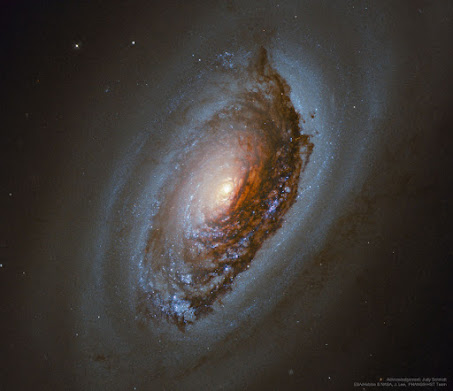
"Who knows what evil lurks in the eyes of galaxies? The Hubble knows -- or in the case of spiral galaxy M64 - is helping to find out. Messier 64, also known as the Evil Eye or Sleeping Beauty Galaxy, may seem to have evil in its eye because all of its stars rotate in the same direction as the interstellar gas in the galaxy's central region, but in the opposite direction in the outer regions. Captured here in great detail by the Earth-orbiting Hubble Space Telescope, enormous dust clouds obscure the near-side of M64's central region, which are laced with the telltale reddish glow of hydrogen associated with star formation. 
M64 lies about 17 million light years away, meaning that the light we see from it today left when the last common ancestor between humans and chimpanzees roamed the Earth. The dusty eye and bizarre rotation are likely the result of a billion-year-old merger of two different galaxies."

"If The Earth..."

"If the earth were only a few feet in diameter, floating a few feet above a field somewhere, people would come from everywhere to marvel at it. People would walk around it marveling at its big pools of water, its little pools, and the water flowing between the pools. People would marvel at the bumps on it, and the holes in it, and they would marvel at the very thin layer of gas surrounding it and the water suspended in the gas. The people would marvel at all the creatures walking around the surface of the ball and at the creatures in the water. The people would declare it sacred because it was the only one, and they would protect it so that it would not be hurt. The ball would be the greatest wonder known, and people would come to pray to it, to be healed, to gain knowledge, to know beauty, and to wonder how it could be. People would love it and defend it with their lives because they would somehow know that their lives, their own roundness, could be nothing without it. If the Earth were only a few feet in diameter..."
- Joe Miller

The Poet: Robinson Jeffers, "Love That, Not Man Apart From That"

"Love That, Not Man Apart From That"

"Then what is the answer? Not to be deluded by dreams.
To know that great civilizations have broken down into violence,
and their tyrants come, many times before.
When open violence appears, to avoid it with honor or choose
the least ugly faction; these evils are essential.
To keep one’s own integrity, be merciful and uncorrupted
and not wish for evil; and not be duped
By dreams of universal justice or happiness.
These dreams will not be fulfilled.
To know this, and know that however ugly the parts appear
the whole remains beautiful. A severed hand
Is an ugly thing and man dissevered from the earth and stars
and his history... for contemplation or in fact...
Often appears atrociously ugly.
Integrity is wholeness, the greatest beauty is
Organic wholeness, the wholeness of life and things,
the divine beauty of the universe.
Love that, not man apart from that,
or else you will share man’s pitiful confusions,
or drown in despair when his days darken."

- Robinson Jeffers

"Sometimes I Wonder..."

"Sometimes I wonder if the world is being run by smart people 
who are putting us on or by imbeciles who really mean it."
-  Laurence Peter

The Daily "Near You?"

Scottsboro, Alabama. USA. Thanks for stopping by!

"The Very Idea..."

"In the last few years, the very idea of telling the truth, the whole truth,
and nothing but the truth is dredged up only as a final resort when the
alternative options of deception, threat and bribery have all been exhausted."
- Michael Musto

"Our Alaric Moment"

"Our Alaric Moment"
by The ZMan

"If you were living in the Western Roman Empire in the fourth century you probably knew that things were not going well. This assumes that you were prosperous enough to have time to think about these things. You could see that the infrastructure was failing and that the empire was struggling to maintain order. On the other hand, the decline had been happening for a long time so things may have seemed normal. Without some way to compare the present to the past, you only have instinct.

Today we have mountains of facts and figures to tell us how things are doing in the Global American Empire. There was a time not so long ago when these facts and figures made up the bulk of news coverage. Economists became court wizards, explaining the latest unemployment figures or trade numbers. They were also called upon to bless whatever polices were being debated in Congress. In the Obama years, economic data was the way we measured the glories of the empire.

That has all changed now. One reason is no one in their right mind takes anything the government says at face value. People had grown used to the way the media biased the numbers depending upon who was in office, but the mortgage crisis cratered the public’s confidence in the numbers themselves. If all of the court wizards explaining the numbers could not see the mortgage fiasco coming, then why should anyone believe them about unemployment or inflation?

Then you have the general lying that has become a feature of government. The lying about Covid not only disgraced the medical profession, but it finished off whatever trust people had in the official numbers. If the government lies about how many people are dying from Covid just to move more product for the drug makers, the government will lie about how many people are working or the inflation numbers. No one trusts the numbers because no one trusts the people issuing the numbers.

The point here is we cannot trust the numbers if the numbers have no relationship to anything we have experienced. When the end of the world has the same numbers as what most consider to be a golden era for the empire, those numbers cease to have any meaning to us. Throw in the fact that most people do not feel like they are richer than their ancestors and those inflated stock figures carry even less weight. We are left to rely on our instincts to judge things.

Of course, our sense of things, that gut feeling, is the result of a many small things that we experience every day. Three-quarters of Americans think the country is going in the wrong direction because they go to the grocery store every week. They see that despite the crowing about inflation coming down, food remains expensive. Granted, no one is starving in America yet due to a lack of affordable food, but it is that thing they see every day that gives people a sense of things.

Think about something simple like a pint of premium ice cream. A few years ago, a pint was sixteen ounces. “A pint is a pint the world around” was true from peak of the British empire until just a few years ago. Now a pint is fourteen ounces. The price for the new pint is not the same as the old pint. The price is more than the old pint. A few years ago, the old pint of ice cream was five dollars. That is about 31¢ per ounce. Today the new pint is over seven dollars or 51¢ per ounce.

That is a seventy percent change in the price. This is one example and probably not a representative one, given that butterfat prices drive dairy prices. Even so, this is something people see all over the marketplace. Shrinkflation is a word because it is a thing that exists. People notice that the containers are getting smaller, or they are getting less full in the case of things like snacks. Meanwhile, prices go up. This subtly tells people that something is going wrong.

This brings us back to where we started. There were those in the Roman Empire who sensed the true state of affairs. No doubt some of them lived and died expecting things to fall apart, only to stagger on long past their time. Then there were others who internalized this reality and just accepted that no matter how grim things might appear, the empire was a permanent feature of life. The people probably just tried to make the best of things, even as they noticed the decline.

All of that changed on August 24, 410 AD when Alaric led the Visigoths into the eternal city, sacking Rome and setting off the collapse of the Western empire. The empire staggered on for a bit longer, but it was over at that point. All of those bad signs people had sensed probably seemed obvious in retrospect. Even so, the sack of Rome by the Visigoths was a shock to the world. The signs seemed obvious, but people still thought that the imperial order was permanent.

This is most likely the fate of the American empire. There are lots of signs that things are going poorly for the empire. Getting whipped by a collection of bronze age goatherds in the graveyard of empires should have been a wakeup call, but the empire is now at war with Iran and picking fights with Russia and China. Meanwhile things deteriorate domestically, both economically and culturally. Yet, we stagger on, but somewhere out there is an Alaric moment just waiting to happen."
o

"Nuclear Response Threatened!"

"Nuclear Response Threatened!"
by David Haggith

Now on to the extra headlines to track the big events of this afternoon:
ͦ Iran Missile Command Gives Strike Orders, Removing ALL Targeting Restrictions: “We will strike infrastructure in a manner that will deprive the United States and regional countries of oil and gas resources for years to come. Orders have been transmitted to local missile bases, and operations will begin immediately.”

US Markets Remain Stupid and Greedy: Oil little changed after Trump makes ominous threat against Iran ahead of deadline to open Strait of HormuzJust listen to the naive rationale used: “No one – including Iran – benefits from a permanent closure there, he said.” Is he really dumb enough to think closing the strait requires Iran to launch missiles and drones at its own ships??? Iran will allow all Iranian tankers to ship Iranian oil even if the strait remains closed. Iran will benefit greatly from the vastly higher price for its oil as the ONLY oil that ships out. Iran’s ships will also know where all the mines are. Sometimes seemingly smart analysts are really dumb."

o
Related, highly recommended:

"When Civilizations Die"

"When Civilizations Die"
by Joel Bowman

“Carthago delenda est.” (Carthage must be destroyed.)
~ Cato the Elder (234-149 BC)

Buenos Aires, Argentina - "Comes word from the Commander-in-Chief of the Armed Forces of the United States of America… via Truth Social: “A whole civilization will die tonight, never to be brought back again. I don’t want that to happen, but it probably will.” According to Mr. Trump’s ultimatum, the Iranians have until tonight to reopen the Strait of Hormuz. (8 p.m. ET is the official “deadline.”)

What must it feel like, we shudder, to lay waste to a “whole civilization”... to witness the fear and trembling of your fellow primates... to see them bow down before you, as a god among men, bringer of death and destruction? According to Polybius’s account, when the great Roman general, Scipio Aemilianus, saw the ancient city of Carthage reduced to ashes at his feet, he is said to have wept openly for his enemies. After a sombre pause, he quoted from Homer: “A day will come when sacred Troy shall perish, and Priam and his people shall be slain.” And when one amongst the crowd asked him what he meant, he turned and reflected: “I feel a terror and dread, lest someone should one day give the same order about my own city.”

We wonder what gives Mr. Trump pause... what demons visit him in the quiet of the night... plaguing his conscience, stealing his breath away, inspiring “terror and dread” for the fate of his own empire? Or does he sleep the sleep of the pure... the angelic... the imbecilic? Hmm...

Prizes, Pomp and Parity: When we left you last week, we were tracing the parallels between Pax Americana and its ancient namesake, Pax Romana. In both eras, while those within the imperial gates enjoyed long stretches of relative peace (with notable exceptions), the god of Mars reigned supreme beyond them. Fought for trade, for treasure, and for glory, Rome’s military campaigns sometimes brought great bounties - as in the Dacian Wars, where the vast gold mines of modern-day Romania were emptied into the empire’s coffers.

More often, they were a drain on the imperial purse and on public morale, tearing at the fabric of the Republic itself. Skirmishes across the Arabian desert, seemingly endless battles with Germanic “barbarians,” and campaigns as far north as Hadrian’s Wall in Britain all cost the empire dearly… but none so much as the clashes with its great power rival in the east, centered in what some readers will recognize as modern day Iran.

Rome’s contest with the Parthian Empire predates the so-called Pax Romana by several decades... and runs straight through it, like a heavy pilum cast across the centuries. By the time Rome turned in earnest toward Parthia, nearly a century after the destruction of Carthage in the Third Punic War, the great existential struggle of the Republic was over.

Yet even as Augustus declared peace, Rome was already entangled in a rivalry it could neither decisively win nor easily abandon...one that would endure for nearly three centuries, and slowly, almost imperceptibly, wear the empire down. And yet, the warning signs were there from the very outset. Indeed, the first clues were open to witness during the disastrous Battle of Carrhae, in 53BC.

Spearheading the Attack: Wealthy, ambitious and ruthless, Marcus Licinius Crassus was the third tenor in Rome’s First Triumvirate, along with Julius Caesar and Pompey. The lesser known of the three statesmen, it might be said that Crassus invaded Parthia seeking prizes, pomp and parity. Of these spoils, he was to win none.

Ignoring advice to advance carefully and methodically along the winding Euphrates River (where supply and support could be maintained), Crassus instead set out to chase a swift and spectacular victory. Cutting inland into open, arid terrain, he soon found himself drawn deep into enemy territory, where his Roman infantry were greeted by the mighty Parthian cavalry.

Suddenly exposed, Crassus’s men assumed a defensive “hollow square” formation, a sound enough strategy against opposing infantry... but disastrous against mounted archers and armored cataphracts. With camel trains providing them an endless supply of arrows, the Parthian cavalry circled the Roman defenses with near impunity, raining arrows on their heads under the scorching noonday sun.

At one point, Crassus’s own son, Publius Crassus, led a cavalry charge to break the siege. When he returned sometime later, his head was borne aloft on a Parthian spear, which was displayed on horseback along the frontlines for all the Roman soldiers to see.

Writing 150 years after the blood had dried, Plutarch relayed the event as a classic triumph of hubris over prudence: “[Crassus] paid no attention to those who advised him well, but was led on by his own hopes.” Added Cassius Dio: “Crassus showed neither foresight in planning nor safety in execution [...] He was ignorant of the country and the enemy, yet he advanced as if against a weak foe.”

Heart of Darkness: By the end of the first day, 20,000 Romans had been slaughtered… another 10,000 captured. The hollow square closing in on him, and the possibility of retreat fast fading with the sun, Crassus tried desperately to negotiate a withdrawal. Alas, the meeting quickly turned violent, and Crassus soon met his maker. Stories (likely apocryphal) describe the Parthians rewarding their attacker’s lust for wealth and glory by giving him his Midas fill. Again, from Cassius Dio: “The Parthians, mocking his love of wealth, poured molten gold into his mouth.”

So began, at the very edge of the Parthian Empire, what would become nearly three centuries of intermittent struggle between two great powers. Rome would, in time, push further east - capturing cities, even sacking capitals - but each advance only drew them deeper, until they reached the beating heart of Parthia… and the very limits of their power."

"Stay tuned for more Notes From the End of the World..."

"How It Really Is"

"Every Empire That Attacked Iran Died There - America Is Next"

Full screen recommended.
Prof. Jiang Xueqin, 4/7/26
"Every Empire That Attacked Iran Died There - 
America Is Next"
"Throughout history, powerful empires have engaged with Persia (modern-day Iran) in ways that shaped entire regions. In this lecture, Professor Jiang Xueqin explores these historical encounters using structural history and game theory, highlighting recurring patterns from ancient times to the present."
Comments here:

"Judge Napolitano - Judging Freedom, 4/7/26"

Judge Napolitano - Judging Freedom, 4/7/26
"Prof. John Mearsheimer:
 What Will a Panicked Trump Do Now?"
Comments here:
o
Judge Napolitano - Judging Freedom, 4/7/26
"AMB Chas Freeman: 
Will Iran Get What It Wants?"
Comments here:
o
Judge Napolitano - Judging Freedom, 4/7/26
"CPT. Matt Hoh: 
Will US Troops Bomb Civilian Sites?"
Comments here:

"Are You Prepared for Your World to Be Totally Different Tomorrow Morning? Trump Says it Will Be... Forever!"

"Are You Prepared for Your World to Be Totally Different 
Tomorrow Morning? Trump Says it Will Be... Forever!"
by David Haggith

"I’m going to publish the headlines early today because they are so massively important. Of course, Trump Always Chickens Out (TACO Trump), so I wouldn’t be surprised if he finds some last-minute argument for why he’s not going to follow through with his newly amplified threats, but for now he has intensified them even above his expletive-laden rants of Easter weekend.

He now says that, if Iran does not open the strait, which he just said a couple of days ago he doesn’t even care about anymore, by this evening, ITS CIVILIZATION WILL CEASE TO EXIST! He says he will bomb every major bridge and every electrical power plant in the nation in a four-hour period tonight! Here was his post on Truth Social: "A whole civilization will die tonight, never to be brought back again. I don’t want that to happen, but it probably will. However, now that we have Complete and Total Regime Change, where different, smarter, and less radicalized minds prevail, maybe something revolutionarily wonderful can happen, WHO KNOWS? We will find out tonight, one of the most important moments in the long and complex history of the World. 47 years of extortion, corruption, and death, will finally end. God Bless the Great People of Iran!" Iran responded (I paraphrase), “No ceasefire, and, if you do that, we’ll do the same thing to all the nations around us that are allied with Israel and the US.” 

Think this is just a bluff by Trump? Maybe. He does the TACO dance a lot, BUT consider this: Israel just told all the Iranian people to stay away from their railroads today, and then it started bombing railroad stations! Israel is targeting civilian infrastructure today to make travel in and out of Iran much more difficult so they cannot escape what is about to rain down upon them even as refugees.

Now, think of what this means. Israel appears to be taking out railroads. Trump says he will take out all the bridges. Iran is a modern society just like ours with high-rises that depend on HVAC just to survive inside them. That is not just for cooling, but to get enough airflow to breathe. Without electricity, many buildings in this desert climate will become unlivable. Elevators won’t function to get people up 20-50 stories to their apartments. There will be no refrigeration. Water stops moving through all the pipes all over the nation. Bridges and railroads are taken out all over the nation. That means food cannot be moved in; neither can water. How long can you survive in a desert without water? With mass-transit being wiped out and major bridges, it now becomes almost impossible to escape the cities. Million of civilians will die. Mass genocide on a scale that would put Hitler to shame! From the US. From Israel!

Unless, of course, TACO. But you cannot bet on TACO, especially from a man who either is insane or wants to convince his enemy that he’s insane so they fear him. Unless we are going to bank the entire world on TACO or insanity, his cabinet members and VP need to exercise the 25th Amendment TODAY! Even his former supporters are begging for that action TODAY! Because, after today, it becomes too late … unless TACO. You gonna bet the world on a TACO?

Maybe former pro-Trumper Tuckered Carlson can get through to rational conservatives and the remaining irrational MAGA members, who still support Trump even after their best voices have left him, what I cannot and have not succeeded in conveying to any more than a minuscule handful of readers here since many in MAGA have listened to Carlson for a long time.

I never thought Carlson would be waging the arguments I’ve been waging since Trump entered politics and I called him a Trojan horse for conservatives. But, in this video he even goes after Trump’s high priestess of the White House, Paula White-Cain, whom I came out strongly against in my weekend Deeper Dive: “The President’s Prophet and the Pentagon’s High Priest Predict ARMAGEDDON!” Here is a strong attack from a former Trumper for the first 20-30 minutes of the video:
If you thought my Armageddon title was too strong this last weekend, look at what things have ratcheted up to in the two days since! Yet, my reward for that warning about the cult driving Trump and the US military intentionally and outspokenly toward Armageddon was just that I lost two more paying subscribers. (Maybe that was why, maybe not. They didn’t say.) If you want to keep a spotlight shining into this darkness, I could certainly use some replacement supporters because taking this stand has cost me ever time! (But I promised you I would not stop, even if it cost me everything I make on this tiny publication.)

Meanwhile, look also at the inflation that is now piling in below in the headlines, but especially look at the war headlines. You better hope this is just another insane TACO move because, IF IT IS NOT, you will be living in a vastly different world tomorrow morning because of these kooks unless the 25th Amendment happens tonight! Even at home, your inflation WILL GO THROUGH THE STINKING ROOF!

Still think I’ve been too rough on the president or his self-appointed prophets of profits? Tune in tomorrow morning if the maniac isn’t just bluffing about mass genocide with conventional weapons, and you’ll see where tolerating and defending a narcissistic megalomaniac gets you.

“Trump threatens four-hour obliteration of Iran on Tuesday night with every bridge and power plant destroyed” That’s the headline of headlines.  BETTER HOPE IT IS A BLUFF BECAUSE IRAN DIDN’T BACK DOWN! It already said, “No way! We’ll do everything to you that you do to us.” Better hope Trump is kidding.

Your world will never be the same; neither will mine because a move like this will up the amperage in Iran to an electrifying war in the Middle East even if the power goes off, resulting in the deaths of millions… IF the maniac does what he says. If he doesn’t, Iran may act preemptively anyway because he is almost forcing them to by telling them their entire civilization will cease to exist tonight. Their military requires electricity and may be much less functional even with backup generators if it waits for his attack to happen first. They may even interpret his existential threat as a nuclear threat. If they take him at his word that they will cease to exist as a civilization, now that they have flat-out rejected his demands, then they will act while they can. The possibility of preemptive Iranian action against civilian infrastructure all over the Middle East is another risk Trump just created with his words.

Is someone who takes these big gambles the kind of screwball you want running the US military - the biggest military in history? Then you had better hope the military does as some generals got fired for already and refuses to obey orders from the president and Hegseth! That is the constitutional crisis we enter tonight if Trump carries through and gives the command he has promised."

"This Is Bad - Home Depot Confirms What We Feared About the Economy"

Full screen recommended.
Dan, I Allegedly, 4/7/26
"This Is Bad - Home Depot Confirms 
What We Feared About the Economy"
"Home Depot has just issued a major economic warning, and it could signal that a recession is closer than many people think. In this video, we break down the latest data showing a sharp decline in consumer spending, especially in big-ticket home improvement projects like appliances, flooring, and remodels. Instead, Americans are cutting back and only spending on essential repairs - a trend historically seen before economic downturns like the 2008 financial crisis. If consumers are pulling back this aggressively, it raises serious concerns about discretionary income, inflation, and the overall health of the U.S. economy.

We also dive into rising HOA fees, increasing utility costs, and how financial pressure is impacting everyday Americans across the country. From declining retail traffic to shifts in housing, real estate, and even corporate layoffs, this is a full breakdown of the warning signs you need to know right now. If you’re watching the economy, worried about inflation, or preparing for a potential recession, this video connects the dots and explains what’s really happening behind the headlines."
Comments here:

Bill Bonner, "Knock Out Punch"

Ali and Foreman fight in Zaire in 1974
"Knock Out Punch"
by Bill Bonner

‘Hey...maybe there’s more to war than just blowing things up.’
- A thought bubble finally appears over Pete Hegseth’s head.

Baltimore, Maryland - "Our strategic objectives in the war, such as they were, have already been accomplished: We went. We saw. We kicked butt. We are now just inflicting gratuitous violence. And, if some analysts are correct, we will soon pay ‘reparations’ to fix what we have broken.

As of this morning, despite the 32,000 bombs dropped on Iran - the mullahs have not cried ‘uncle.’ The Strait of Hormuz is still under Iranian control...countries who want to use it will now have to negotiate with the mullahs - and pay. Nobody seems to think it can be liberated by pounding the Iranians harder.

Whether this outcome is a victory or a defeat depends on who you talk to. But it could be worse. And now emerging, like spring flowers, is a pullulating industry of early ‘post-war’ analysis and forecasting. Of course, no ‘final,’ apocalyptic battle has yet taken place. No Appomattox Courthouse. No surrender on the USS Missouri. Trump has not put a gun to his head. So, the reckonings thus far are purely speculative...incomplete...and subject to change without notice. Nevertheless, some useful insights are emerging.

Trump fans, of course, see nothing not to like in the way the war has gone so far. The stock market has not crashed. Gasoline is still under $5 a gallon. If kicking butt is an end in itself, the results are acceptable. And since no other war aim was clearly identified, this appears to be a coherent way to look at it. But the trouble with kicking butt as a strategy is that it rarely leads to a felicitous outcome. It makes the kicker feel better about himself. More in control. Stronger. More resolute and manly. But it leaves the kickee hoping to return the favor, and looking for a steel-toed boot. And maybe it is no victory at all.

Several analysts are already claiming that Donald Trump was “befooled by Iran’s grand strategy.” That strategy was hardly ever hidden. A variant of the old ‘rope-a-dope’ technique used by another famous Muslim - Mohammed Ali - against George Foreman in the ‘Rumble in the Jungle,’ 1974, it allows the heavy hitter to pound away, exhausting himself. Then, the lighter opponent goes on the attack.

In the Iran theatre, the mullahs had no chance of matching US/Israeli muscle. All they could do was to hunker down...and make the Strait of Hormuz dangerous to transit. And while the warfighters can still bomb at will, the people grow weary. Trips to the gas station are painful.

America’s allies saw the problem early on...and refused to join in. Now, they approach Iran to negotiate terms of passage. But Iran demands ‘reparations.’ And here is where it gets interesting. The reparations machinery seems to be already in place. Iran will insist on a ‘toll’ to pass through the Strait, paid by the shippers and ultimately passed along to consumers. The money will be used to rebuild the schools, bridges, and military installations that have been destroyed. The worldwide price of oil will have to rise – and stay up – to cover the tolls. Thus, in theory, US consumers will pay for both sides of the conflict – at the pump.

This is such a remarkably favorable outcome for Iran, some see a new dawn for the once-benighted country. Solidarity.co.nz: "Professor Robert Pape, a top US expert on warfare, based at the University of Chicago, says Iran will likely emerge from this terrible war as a super-power. Many analysts, such as Colonel Daniel Davis, Mark Sleboda, Annelle Sheline, and John Mearsheimer, now see an Iranian victory as likely. Pape himself has run simulations of US-Iran wars for decades and is clear: “Trump made a huge mistake”.

"For the moment, the Americans and Israelis are enjoying success after success: killing leaders and school girls, blowing stuff up and so on. “That can be mesmerizing, and cause this illusion of precision control but it is not the same thing as a strategic victory. Iran before the war controlled 4% of the world’s oil. Twenty-six days later they control 20% of the world’s oil.”

As Trita Parsi of the Quincy Institute pointed out this week Denmark charged transit fees for 400 years for vessels to pass through the Øresund Strait into and out of the Baltic. Panama, Egypt and Turkey all charge transit fees. Of course, none of this will matter very much if Iran is actually ‘obliterated.’ Trump has not only threatened to target civilian infrastructure but to ‘take out the whole country.’ What that means, exactly, is hard to say. A higher oil price most likely. Stay tuned."

"The Mongols, Drones, and the Future of War"

"The Mongols, Drones, and the Future of War"
The $500 Weapon That Changes Everything
by Jay Martin

"In under 70 years, an unknown confederation of nomadic tribes built the largest land empire in human history. At its peak, it covered everything from the Pacific coast of China to the borders of Poland, and from Siberia down to the Persian Gulf. That was East Asia, Central Asia, the Middle East, and Eastern Europe. It was five times larger than the Roman Empire at its peak. And it all happened in the span of one lifetime. “God alone knows who they are and from where they came.”, a Russian chronicler describing the Mongols’ arrival.

The Mongol armies arrived so swiftly and conquered so decisively that the civilized world had no framework for what was happening to it. They swept out of the steppe like a weather system - by the time you understood that something was coming, it had already arrived. What is so notable is that the Mongols did not conquer a collection of disorganized, defenceless people. They overthrew the wealthiest empires the world had ever known. And they did it quickly. The scale of what they conquered is difficult to overstate.

The Khwarezmian Empire, stretching across modern-day Iran, Uzbekistan, and Turkmenistan, had taken over 150 years to build. There were over two million people, wealthy trading cities, and standing armies. The Mongols dismantled it all in two years.

The Abbasid Caliphate in Baghdad - seat of Islamic civilization for five hundred years, home to over a million people and the largest library in the world - fell in thirteen days.

The Song dynasty in China - three hundred and nineteen years old. A hundred and twenty million people and an economy that produced a third of the world’s GDP - three times the output of all of medieval Europe combined. A civilization that had invented gunpowder, movable type, and paper money. In 1279, all of China fell to the Mongols.

A Minor Adjustment: How? How does a collection of nomadic tribes from the barren steppe dismantle the wealthiest civilizations on earth? Most historians point to a minor adjustment in military technology. The stirrup.

Stirrups existed before Genghis Khan. But the Mongols weaponized them in a way no army had done before. With both feet planted firmly in iron stirrups and mounted on hardy steppe horses, Mongol warriors could fire arrows at full gallop with devastating accuracy. They could stand, pivot, and even ride backwards while loosing volleys into a pursuing enemy. They could cover distances that no infantry-based army could match, arriving at the walls of cities before scouts had time to deliver a warning. The stirrup didn’t just improve cavalry. It created an entirely new kind of warfare - one that made the existing military paradigm obsolete overnight.

Erik Prince - the founder of Blackwater, the most elite private military force ever assembled - made an observation recently that stopped me in my tracks. He said, reflecting on the current conflict in Iran, that the introduction of drone warfare onto the modern battlefield represents “the greatest swing in the pendulum, since Genghis Khan put stirrups on horses.”

Now, when most people hear “drone warfare,” they think of a Predator or a Reaper - a $28 million aircraft operated by the U.S. military from a facility in Nevada. That is not what Prince is talking about. He is talking about a $500 commercial quadcopter fitted with a 3D-printed munition that can be assembled in a garage and destroy a $3 million tank. He is talking about Iran’s Shahed drones - which cost somewhere between $20,000 and $40,000 to produce - being shot down by $5 million Patriot interceptor missiles. He is talking about the U.S. Navy spending over a billion dollars in munitions to defend against Houthi drones that cost less than a used car. This is what Prince means by stirrups.

The empires the Mongols conquered had operated for centuries under a simple assumption: more wealth meant larger armies, stronger weapons, and military dominance. Genghis Khan wiped that assumption out with a piece of bent iron that cost almost nothing and fit in the palm of your hand. The stirrup didn’t give the Mongols a bigger army. It gave a smaller, poorer force the ability to defeat a richer, more established one. Prince argues that is exactly what drones are doing today. The battlefield no longer belongs to the nation that spends the most. It belongs to the nation that adapts the fastest. If he is right, we need to think very carefully about what comes next.

Winning by Not Losing: Here is a question most people never consider. What is the difference between winning a battle and winning a war? The Americans have the most powerful military the world has ever seen. This is not a matter of opinion. In terms of technology, firepower, logistics, training, and the ability to project force anywhere on the planet, the United States military is without peer.

And yet. The American military won every significant battle in Vietnam, Iraq and Afganistan… but lost all three wars. The lesson is as old as warfare itself. When a smaller, weaker force is attacked by a superpower, it does not need to win. It needs to not lose. Survival is victory. If you are still standing when the great power loses its appetite for the fight - when the cost in blood and treasure exceeds the political will to continue - you have won. Not by defeating your enemy, but by refusing to be defeated.

Iran cannot defeat the American military. No honest assessment of the balance of forces suggests otherwise. But Iran does not need to defeat the American military. Iran needs to endure it. Every day the conflict continues without a decisive American victory, Iran’s strategic position improves. Every day the Strait of Hormuz remains contested, the cost to America - economic, political, and reputational - compounds. And that brings us to a curious parallel in modern geopolitics…

America’s Suez Moment? Most people assume that the transition from the British pound to the U.S. dollar as the world’s reserve currency happened at the end of World War II. It seems logical. Britain was shattered. America was ascendant. The Bretton Woods agreement in 1944 appeared to settle the question. But if you look at the actual balance sheets of central banks in 1945, you will not find a sudden pivot. Despite being battered - infrastructure destroyed, resources depleted, debts staggering - Britain had won the war. And after a century and a half of trusting the pound sterling, the world’s central banks did not have sufficient incentive to go looking for an alternative. Until 1956.

In 1956, Egypt’s President Gamal Abdel Nasser made a calculation. He assessed that the United Kingdom - once the most powerful empire in human history - was too weak to defend and maintain its occupation of the Suez Canal. The Suez Canal was not an ordinary waterway. It was the artery through which two-thirds of Europe’s oil supply travelled. It connected Britain to what remained of its trade interests in the Middle East, the Indian Ocean, and Asia. Whoever controlled the Suez Canal controlled the flow of energy to the Western world.

President Nasser nationalized it. The United Kingdom, unwilling to accept this humiliation, mobilized what had once been the most powerful navy on the planet and moved toward the canal alongside France and Israel. But this was 1956, not 1856. The Royal Navy was short of resources. Without American manufacturing support - the same support that had sustained Britain through two world wars - they lacked the firepower for a sustained campaign. So Britain did what it had done throughout World War II. It appealed to the Americans for help.

President Eisenhower, however, saw the situation differently. He worried that Britain attacking Egypt would push the entire Arab world toward the Soviet Union in the middle of the Cold War. This was against the US interests. Frustrated with the careless nature of Britain's military pursuits, he responded strategically and sent a message to the rest of the world. He blocked $561 million in IMF standby credit that Britain desperately needed. He froze $600 million in Export-Import Bank loans. And he ordered the US Treasury to prepare to dump America’s holdings of British sterling bonds - a move that would have collapsed the pound overnight.

Britain’s Chancellor warned the Prime Minister that without American financial support, the country would be unable to import sufficient food and fuel within weeks. The message was simple. Withdraw from the Suez Canal, or we will destroy your currency. The British Navy retreated home. Tail between their legs. With the rest of the world watching.

This - not Bretton Woods, not the end of the war - was the moment that central banks around the world truly pivoted from the pound sterling to the American dollar. They watched the previous world superpower, which had dominated the globe for all of recent memory, become neutered. Unable to act without the permission and support of the new greater power.

The Strait: That is why analysts are calling the Strait of Hormuz America’s potential Suez moment. The Americans have indicated a willingness to withdraw from Iran before the Strait of Hormuz is reopened to international shipping. If that happens - if an unsuccessful military adventure in Iran results in the Americans going home having lost control of the situation, having forfeited control of the Strait to their adversary - it does not matter under what pretense the narrative is spun domestically. The rest of the world will see what actually happened. And central banks will do what central banks have always done when they witness that kind of moment. They will adjust.

The Promoter: But here is something else I am thinking about. The American military is dependent on manufacturing inputs from China. This is well documented. From rare earth minerals to electronic components, the supply chain that sustains American military capability runs through Chinese factories. Iran is also dependent on China.

Although the Strait of Hormuz is theoretically closed to Western-bound oil tankers, ships have been travelling through it - with Iranian permission. Not just Iranian crude heading out to China, but Chinese cargo ships heading into Iran. Since the war began on February 28th, Iran has shipped at least 12 million barrels of crude oil through the Strait, all of it to China. Meanwhile, China-linked cargo vessels have been transiting in the opposite direction.

There has been much speculation in the United States about whether Iran will run out of missiles. My question is different. What is on those Chinese cargo ships arriving in Iran? Reports have surfaced of Chinese-supplied air defense systems, kamikaze drones, anti-ship cruise missiles, and even precursor chemicals for solid rocket fuel being shipped to Iranian ports. Is any of this finding its way onto the battlefield? And if so - what exactly are we looking at here? I’ll tell you what it looks like to me.

In the 1970s, a boxing promoter out of Cleveland perfected something that would make him the most famous man in the sport - and the most controversial. He put on some of the biggest fights in boxing history - Muhammad Ali versus George Foreman and Ali versus Joe Frazier. He managed Mike Tyson’s rise to undisputed heavyweight champion, against foes like Buster Douglas and Larry Holmes. He dominated the sport through the 1970’s, 80’s and 90’s.

The promoter’s name was Don King. And he is the most famous boxing promoter who ever lived. King understood something very simple: if you hold the promotion contract on both fighters, you don’t need to pick a winner. You just need the fight to happen. Why is that controversial? A boxing promoter’s job is to protect his fighter - to negotiate the best purse, to select the right opponent at the right time, to make sure the terms of the fight favor his man. It’s a negotiation, and by definition, that means negotiating against the interests of the opponent.

But when one promoter holds both contracts, the negotiation shifts from promoter-on-promoter to promoter-on-fighter. And that’s a fight the promoter wins every time. (This is probably why Don King has been sued over 12 times by fighters.)

If you are not a boxing fan, think of it this way - the parallel would be hiring the same lawyer to represent both sides of a lawsuit. The only person guaranteed to walk away richer is the one collecting fees from both. But here was King’s real leverage - his contracts required any fighter to agree that if they won, King would promote their future fights too - so he always retained the winning fighter under contract. It didn’t matter who won. He had already locked up whoever walked out of the ring with the belt.

Is China the Don King of the Persian Gulf? If the Strait reopens on American terms and Western commerce resumes, China will remain America’s indispensable manufacturing partner. The supply chains don’t change. The rare earth dependencies don’t change. America still can’t build the next generation of weapons systems without Chinese inputs. China keeps the contract.

If Iran wins - if the Americans withdraw and Iran maintains sovereign control of the Strait - China stays Iran’s primary weapons supplier, its largest oil customer, and its most important trading partner. Iranian crude flows to Chinese refineries at a discount. Chinese cargo flows into Iranian ports unopposed. China keeps the contract.

Show me a conflict where one country supplies both sides, and I’ll show you the country that’s actually “winning”. The question the world should be asking is not whether America can defeat Iran. The question is whether America can afford to fight a war in which its primary economic competitor is bankrolling both corners of the ring. Honest question - let me know in the comments: what am I missing?"

Musical Interlude: Michael Bennett, “After I Pass Away”

Full screen recommended.
Michael Bennett, “After I Pass Away”
"Simon Cowell in tears experiencing a truly unforgettable performance by Michael Bennett on America’s Got Talent. In this moving rendition of “After I Pass Away”, Michael pours his heart and soul into every note, leaving the judges, audience, and viewers around the world in tears. From the first note to the final chord, the emotional depth of this song touches every heart. You will witness the raw power of music as it evokes deep emotions, creating a moment where everyone in the room, including the judges and audience members, is completely overwhelmed by the beauty and sorrow of this heartfelt performance. This video captures the intensity of a performance that proves why Michael Bennett is a truly extraordinary talent. Sit back, watch, and feel every emotion in this breathtaking performance."
Oh my God... feel that...
o
Tears And Talent, 4/7/26
"His Wife Died. He Has Cancer. 
Michael Bennett's Last Song Made Everyone Cry"
"Michael Bennett, a 70-year-old man from a small town in Kansas, took the stage for what he believes will be the last time. Six months ago, he was diagnosed with Stage 4 pancreatic cancer. But Michael didn't come here to talk about dying. He came here to sing for the love of his life, Margaret. After 42 years of marriage, Michael lost Margaret to Alzheimer's three years ago. He spent every day by her side, singing the hymns she could no longer remember, holding her hand until her very last breath. Her final words to him were, "Don't you dare stop singing." He hasn't stopped since. This is Michael's last song. A song written in honor of Margaret, faith, and the hope that somewhere on the other side, she’s still humming."
o
Full screen recommended.
"What Happened to Michael Bennett’s Son? 
The Story That Broke the Room"
"After losing his 17-year-old son Ethan in a tragic car accident, Michael nearly gave up on music forever. But a message his son left behind changed everything - and led him to step onto the AGT stage to keep a promise no father ever wants to make. This touching story is resonating deeply with viewers who understand grief, love, and the courage it takes to move forward after loss. If you enjoy emotional talent show moments, inspirational stories, and powerful music journeys, this is a video you won’t forget."

Monday, April 6, 2026

"A Look to the Heavens"

“Few butterflies have a wingspan this big. The bright clusters and nebulae of planet Earth's night sky are often named for flowers or insects, and NGC 6302 is no exception. With an estimated surface temperature of about 250,000 degrees C, the central star of this particular planetary nebula is exceptionally hot though - shining brightly in ultraviolet light but hidden from direct view by a dense torus of dust. 
 Click image for larger size.
This dramatically detailed close-up of the dying star's nebula was recorded by the Hubble Space Telescope soon after it was upgraded in 2009. Cutting across a bright cavity of ionized gas, the dust torus surrounding the central star is near the center of this view, almost edge-on to the line-of-sight. Molecular hydrogen has been detected in the hot star's dusty cosmic shroud. NGC 6302 lies about 4,000 light-years away in the arachnologically correct constellation of the Scorpion (Scorpius).”