StatCounter

Friday, March 20, 2026

The Poet: Mary Oliver, “Some Questions You Might Ask”

“Some Questions You Might Ask”

“Is the soul solid, like iron?
Or is it tender and breakable, like
the wings of a moth in the beak of the owl?
Who has it, and who doesn’t?
I keep looking around me.
The face of the moose is as sad
as the face of Jesus.
The swan opens her white wings slowly.
In the fall, the black bear carries leaves into the darkness.
One question leads to another.
Does it have a shape? Like an iceberg?
Like the eye of a hummingbird?
Does it have one lung, like the snake and the scallop?
Why should I have it, and not the anteater
who loves her children?
Why should I have it, and not the camel?
Come to think of it, what about the maple trees?
What about the blue iris?
What about all the little stones, sitting alone in the moonlight?
What about roses, and lemons, and their shining leaves?’
What about the grass?”

- Mary Oliver

The Daily "Near You?"

Montgomery, Alabama, USA. Thanks for stopping by!

'The Cruelest Joke Of All..."

“The smallest decisions made had such profound repercussions. One ten-minute wait could save a life… or end it. One wrong turn down the right street or one seemingly unimportant conversation, and everything was changed. It wasn’t right that each lifetime was defined, ruined, ended, and made by such seemingly innocuous details. A major life-threatening event should come with a flashing warning sign that either said ABANDON ALL HOPE or SAFETY AHEAD. It was the cruelest joke of all that no one could see the most vicious curves until they were over the edge, falling into the abyss below.”
- Sherrilyn Kenyon

"Fate. Luck. Chance."

“That is life, isn’t it? Fate. Luck. Chance. A long series of what-if’s that lead from one moment to the next, time never pausing for you to catch your breath, to make sense of the cards that have been handed to you. And all you can do is play your cards and hope for the best, because in the end, it all comes back to those three basics. Fate. Luck. Chance.”
- Kelseyleigh Reber

“Unless, of course, there’s no such thing as chance… in which case, we should either - optimistically - get up and cheer, because if everything is planned in advance, then we all have a meaning and are spared the terror of knowing ourselves to be random, without a why; or else, of course, we might - as pessimists - give up right here and now, understanding the futility of thought-decision-action, since nothing we think makes any difference anyway, things will be as they will. Where, then, is optimism? In fate or in chaos?”
- Salman Rushdie

"No Plan! No Answers! Powell Just Exposed the Truth About the Economy"

Full screen recommended.
Dan, I Allegedly, 3/20/26
"No Plan! No Answers! 
Powell Just Exposed the Truth About the Economy"
"The economy is sending mixed signals, and now even Federal Reserve Chairman Jerome Powell is admitting uncertainty about where things are headed. In this breaking news update, I Allegedly dives into Powell’s latest comments on interest rates, inflation, job growth, and the growing risk of stagflation. If the person in charge of monetary policy doesn’t have clear answers, what does that mean for your money, your job, and your future? We also cover rising costs, failing restaurants, consumer debt, and why everyday Americans are feeling the pressure despite what the headlines say. From mortgage stress to business closures and economic slowdown, this is the real story behind today’s financial system. Stay informed with I Allegedly as we break down the latest economic news, financial trends, and what you need to do right now to protect yourself."
Comments here:

"We Really Are Facing An “Economic Armageddon” Scenario In The Middle East"

by Michael Snyder

"When this war with Iran erupted, everyone knew that it would have an impact on the global economy. But very few anticipated that it would be this bad. We are facing the worst oil disruption in history, the worst natural gas disruption in history, the worst helium disruption in history and the worst fertilizer disruption in history simultaneously. The Iranians have control over which ships are allowed through the Strait of Hormuz, and they are determined to keep it that way for as long as possible. But even if the war ended and traffic through the Strait of Hormuz was fully restored tomorrow, it would take years for the global economy to return to normal because of all the energy infrastructure that has been destroyed on both sides.

With no end in sight for the war, oil prices in the western world just continue to move higher. But if you want to see where oil prices are eventually headed if this crisis persists, just check out what has been happening in Dubai. At one point on Thursday, the price of oil in Dubai briefly hit an all-time record of $166 a barrel…"The extreme spike in oil prices seen in local markets in the Middle East could give investors a glimpse into to where U.S. and Europe prices are headed if the Strait of Hormuz isn’t opened soon. Dubai crude oil prices surpassed $166 a barrel to a new record high on Thursday, according to market data provider Platts. Dated Brent and West Texas intermediate Cushing’s are trading around the $100 mark after historic runs higher."

Normally, the price of oil in Dubai falls somewhere between West Texas oil and Brent oil. But once the war began, it started selling at an unprecedented premium. In Saudi Arabia, officials are projecting that the price of oil could eventually surpass $180 a barrel if this war persists until the end of next month…"Saudi Arabia’s oil officials are working frantically to project how high oil prices might go if the Iran war and its disruption of energy supplies doesn’t end soon-and they don’t like what they are seeing. The base case, several oil officials in the Gulf’s biggest producer said, is that prices could soar past $180 a barrel if the disruptions persist until late April."

While that would sound like a bonanza for a kingdom still heavily leveraged to oil revenue, it is deeply concerning. Prices that high could push consumers into habits that slash their oil use-potentially for the long term-or trigger a recession that also hurts demand. They also would risk casting Saudi Arabia in the role of profiteer in a war it didn’t start.

If the price of oil reaches that level and stays there for an extended period of time, it will crash everything. Our system is simply not designed to be able to handle a shock like that. Of course we are also facing a historic natural gas crisis as well. Normally, approximately one-fifth of the world’s supply of liquified natural gas is produced by Qatar’s Ras Laffan complex. That complex is nearly three times the size of Paris, and it cost hundreds of billions of dollars to build. So it was a really, really big deal when Iranian missiles started raining down.

The CEO of QatarEnergy is telling us that output at the complex has been reduced by 17 percent, and it will take three to five years to rebuild the capacity that has been lost…"Qatar could face years of reduced natural gas exports after Iranian strikes damaged key energy infrastructure, wiping out a significant share of its liquefied natural gas (LNG) production capacity, QatarEnergy’s chief executive told Reuters. Saad al-Kaabi said the attacks disabled two LNG production units out of 14 and one gas-to-liquids facility out of two, reducing output by about 17% at a time when Qatar sits at the heart of global gas supply. He said the affected facilities alone account for roughly 12.8 million tons of annual LNG production, and warned repairs could keep them offline for three to five years depending on security conditions and technical recovery timelines."

This is a catastrophic blow for the global economy. As Jack Prandelli has accurately observed, there is no spare capacity elsewhere on the planet that can replace what has been destroyed…So what do we do now? It is going to take years to repair the damage that has already been done. And what is going to happen if Iran attacks Qatar’s Ras Laffan complex again?

Meanwhile, the world is also facing a looming helium shortage. Prior to the war, Qatar’s Ras Laffan complex produced over one-third of the world’s entire supply of helium. "The war in the Middle East could pose a threat to the semiconductor industry and other sectors dependent on a resource produced in the Gulf - helium. Helium is a little-known but key input in many industries, most notably technology. In semiconductor manufacturing, its cooling properties are used to transfer heat. Helium is also indispensable in photolithography, a technique used to print each chip’s intricate circuitry.

The U.S. Geological Survey estimates that before the war Qatar produced more than one-third of the world’s helium supply. Lately, however, operations at QatarEnergy’s Ras Laffan Industrial City - the world’s largest liquefied natural gas export facility, which produces helium as a byproduct - were halted after it was struck by an Iranian drone early in the war. On Wednesday, Iranian missiles crippled the plant." Without that helium, tech companies all over the planet are going to be thrown into a state of chaos. So that is a huge problem. But personally I am even more concerned about what this war is going to mean for global food production.

Farmers all over the northern hemisphere are preparing to plant their crops, and so if we can’t get the fertilizer that they need through the Strait of Hormuz we are going to be in for a world of hurt…"The Strait of Hormuz is a critical channel for fertilizer, including about 50% of global nitrogen-rich urea fertilizers, according to the Fertilizer Institute, the industry’s trade association. The strait has been effectively impassable since President Donald Trump launched the assault, which is now in its third week with no end in sight.

The closure has spiked fertilizer prices just before planting season, potentially scrambling decision-making for farmers across the U.S. And it comes on top of already low commodity prices that have lingered for years and eaten into farmers’ margins. There will be a wild scramble for whatever is available, and those with the most money will be victorious. But since western farmers will be paying much, much more for fertilizer this year, they will be forced to pass those costs along…

“We’re in uncharted territory,” Matt Frostic, a Michigan farmer who sits on the board of the National Corn Growers Association, said in an interview with CNBC. “It’s like a code red.” Frostic said he purchased nitrogen fertilizer, critical for corn crops, in January for around $350 per ton. That same product, he said, is now closing in on $600 per ton." Of course large numbers of farmers in poorer nations won’t have access to nitrogen fertilizer at all. As a result, global food production will be way down and there simply won’t be enough food for everyone.

So we really need traffic to start flowing through the Strait of Hormuz like it normally does. But that is not going to happen any time soon. I think that we are about to see a lot of chaos erupt in global financial markets. Already, we are witnessing a confluence of developments that we haven’t seen since 2008…"Thursday’s bond-market selloff caused the Treasury yield curve to exhibit what traders describe as a “bear-flattening” pattern. This actually began back in early February. Typically, the pattern emerges when bond traders are bracing for a difficult economic environment ahead."

The confluence of these three developments - oil above $100 a barrel, a 2-year yield above the fed funds rate, and a bear-steepening dynamic in the bond market - is making some investors nervous. The last time all three things unfolded simultaneously was in the late spring of 2008, according to Bloomberg data. About four or five months later, Lehman Brothers collapsed, ushering in the most acute phase of the 2008 financial crisis. The S&P 500 declined 38.5% that year. Widespread mortgage defaults also resulted in many Americans losing their homes.
Hold on tight, because if this war doesn’t come to a conclusion soon this is only just the beginning. The Iranians are trying to inflict so much pain on the rest of the world that the U.S. and Israel will be forced to agree to never attack Iran again. On the other side, the U.S. and Israel are absolutely determined to win this war, and they would love to bring the regime in Iran to an end. So I think that this war is going to go on for a while. If it lasts into the summer, we really will be facing an economic “Armageddon scenario”, and that is not good news for any of us."

"How It Really Is"


"Running on Empty"

"Running on Empty"
by Joel Bowman

“War is the realm of uncertainty; three-quarters of the factors on which action in
 war is based are wrapped in a fog of greater or lesser uncertainty. A sensitive and 
discriminating judgment is called for; a skilled intelligence to scent out the truth.”
– Carl von Clausewitz, "On War" (1832)

Ormond Beach, Florida - "First, the headlines...From the Associated Press: "Brent crude briefly tops $119 per barrel before pulling back, and stocks sink worldwide." From the BBC: "Gas price soars over 20% after strikes on Qatar hub." And from Oilprice.com: "$200 Oil No Longer Crazy Idea as Middle East Supply Collapses."

Your editor is no geophysicist, dear reader, but we know enough about the matter to understand that, reduced to its most basic equation, all life depends on energy. That goes for the fat and the skinny... the old and the young... Republicans, Democrats and unreconstructed anarcho-capitalists alike.

The Age of Abundance: When energy is cheap, reliable and abundant, life on planet earth flourishes, as it has done, more or less unabated, since Colonel Edwin Drake sank the first commercial oil well in Titusville, Pennsylvania, back in 1859. The ensuing Age of Energy Abundance has seen the world population grow by more than 7 fold, from about ~1.2 billion people when first Drake got to drilling to over ~8 billion today.... even as the percentage of the global population living in poverty has declined precipitously during that same period. In 1820, somewhere between 80-90% of all people on earth lived in what is today categorized as “extreme poverty.” That percentage in 2026: < 8%.

The global economy is able to sustain such plenitude because it, too, has grown exponentially thanks to an abundance of cheap, reliable energy. Back in 1850, the world’s entire economic output was equal to roughly $1.2 trillion (measured in today’s dollars). Today, global economic output is orders of magnitude greater, with estimates in the range of ~$170 trillion in 2024. In other words, while the population has grown by ~7x... the size of the economy in which they live, love and loathe has mushroomed over ~145x, meaning per capita GDP has increased about ~22x during the same time.

Human life expectancy has doubled during that time... from about ~30-40 years in 1850, to roughly ~75 years today. Child mortality has fallen by 90%, from four in ten children dying before reaching adulthood (mostly during birth), to four in 100 today. All this while per capita electricity consumption has increased between 10x and 20x since 1900. That’s no coincidence.

When energy is cheap, reliable and abundant, life flourishes. When energy is expensive, unreliable and in short supply... things get difficult, quickly... MN Gordon explains in today’s article (below)...

A Trend Reversal: Of course, not all countries will be impacted in the same way and at the same time during the energy crunch. Indeed, some who were last are suddenly finding themselves, if not quite first, rapidly advancing along the line.

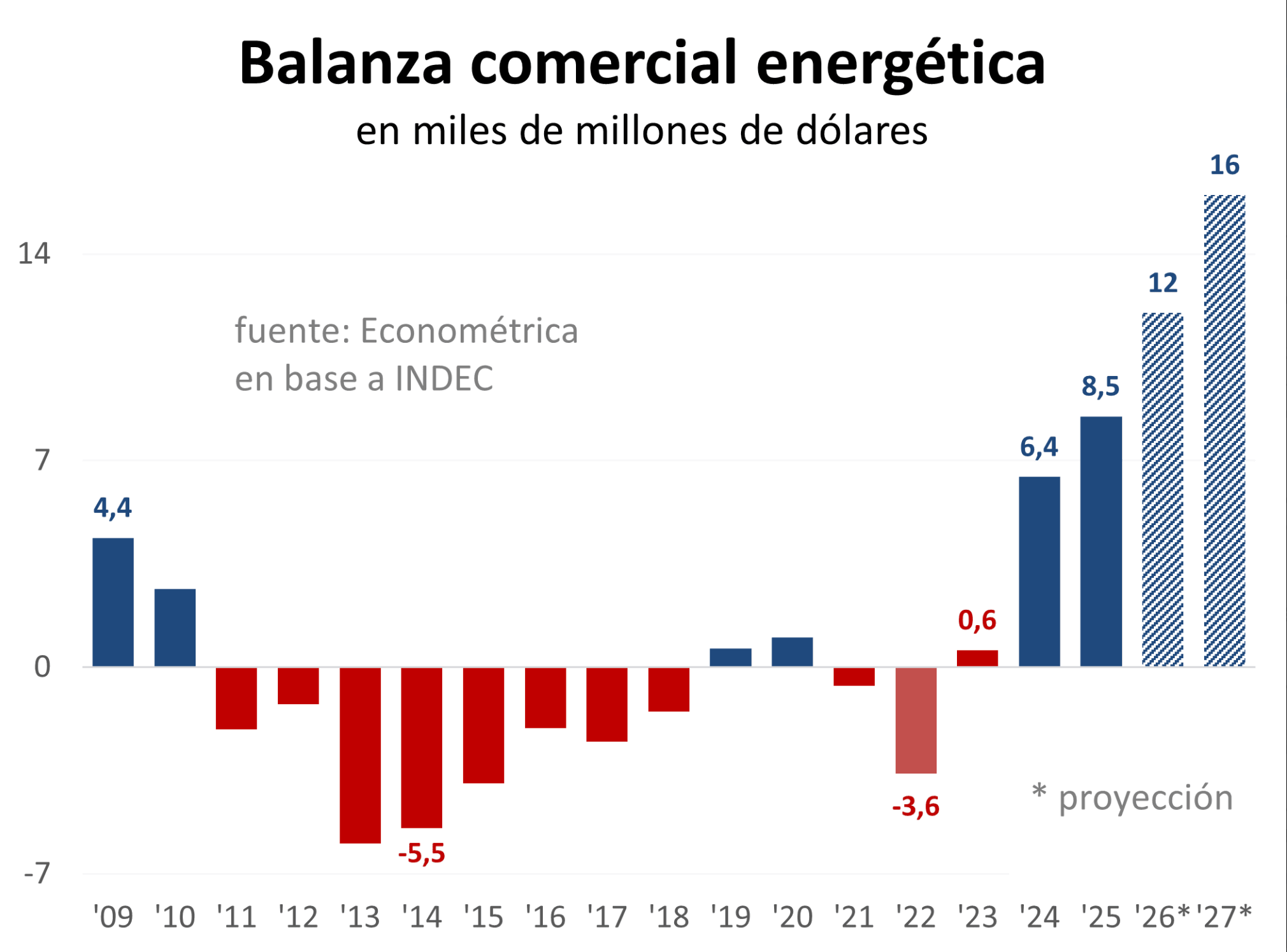
Here’s Argentina’s energy trade balance over the last few years, as compiled by Econométrica, based on official INDEC figures. The figures shown are in billions of dollars. (Note that the shaded areas, 2026-227, are projected figures.)
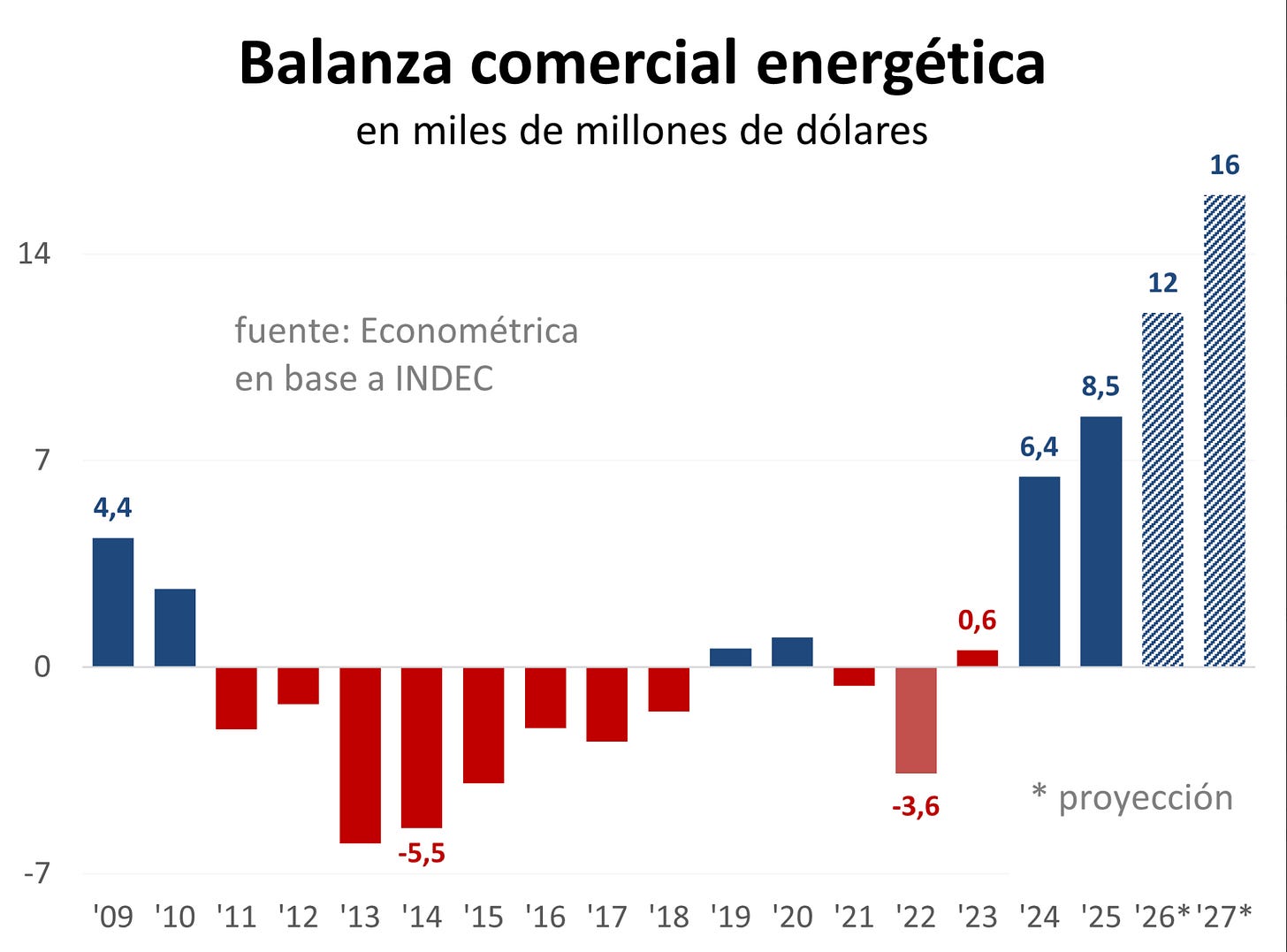
And here’s the latest from Infobae (translated): "Driven by rising oil prices, Argentine exports could exceed USD 100 billion for the first time in 2026. With a barrel of crude hovering around $100 - and the expectation that it will remain at elevated levels for several months - foreign oil sales are poised for a substantial increase, rising from a projected $12.5 billion to a staggering $17 billion. An additional jump in agricultural exports is also anticipated, as commodity prices have likewise been on a sustained upward trend. It is estimated that, in this sector, the increase would amount to approximately $1 billion. The consequence of this surge in energy and agricultural sales is that Argentina’s total exports could, for the first time in history, surpass the $100 billion mark."

The more the end of the world looms, the more the End of the World looks like the place to be... Meanwhile, read on for Mr. Gordon’s column below, and don’t forget to check out his excellent site, Economic Prism, for more of his fine work."
o
"Running On Empty"
by MN Gordon

"The opening bombardment of Operation Epic Fury on February 28 succeeded in taking out the heart of the Iranian regime. But it also triggered extreme geopolitical instability in the Middle East and severed the aorta of the global economy. The massive barrage of missile strikes, the chaotic swarm of counter-drone attacks, and the succession of Mojtaba Khamenei offer sensational headline material. Yet the real destruction, the kind that reshapes civilizations, isn’t happening in the smoky ruins of Tehran. It’s happening in the empty shipping lanes of the Strait of Hormuz.

Skyrocketing oil prices are a noted precursor to declining economic activity. Higher gas prices are not just an inconvenient market fluctuation. They act as a regressive tax on every single human being who eats, moves, or buys things. When the price of gas spikes and the pumps run dry, the very foundation of the global economy crumbles.

As of March 19, Californians are already paying $5.60 per gallon to fill up their cars. That may seem like a lot if you’re living elsewhere. In the south, for example, we’re paying $3.22 per gallon. But according to the math of human survival, $5.60 per gallon is still the bargain of a lifetime. It’s a clearance sale on the very substance that built the modern world.

As the supply of oil is disrupted across the globe, we’re about to learn a painful lesson. That the modern economy has been living off an unearned inheritance of energy productivity. Without this liquid gold, the cost of everyday convenience, from overnight shipping to fresh fruits and vegetables in February and central air conditioning, would be utterly impossible.

When the math of energy’s boiled down to its crystalline essence, a great disparity is discovered. Cheap, abundant petroleum has detached people from the physical reality of work. The actual costs to move a mountain or even a minivan have been obscured. Splitting wood with an axe, for example, is much harder than using a gas-powered log splitter. Assuming a $20-an-hour labor wage, let’s look at the engineering reality.

A single gallon of gasoline contains roughly 33.7 kilowatt-hours (kWh) of energy. To put that in perspective, a healthy human being, working a grueling 8-hour shift of manual labor, produces about 0.6 kWh. Do the math (33.7 divided by 0.6). One gallon of gas does the work of 56 days of back-breaking human labor. If you pay a worker $20 an hour to do what that gallon of gas does, you aren’t paying $5.60. You are paying for 448 hours of labor. Thus, at $20 per hour of labor, the real value of a gallon of gas, in terms of human effort, is $8,960.

Even when accounting for the inefficiency of small internal combustion engines (at roughly 25 percent), that gallon is still doing the work of 112 hours of manual labor. That puts the fair price of gasoline, the price where human sweat is finally competitive with a piston, at $2,240 per gallon. When you drive to Starbucks for your morning cup of coffee, you aren’t just burning fuel. You are burning the equivalent of a man working for two weeks straight to push your 4,000-pound SUV to the drive-thru window.

Over many decades, the precious utility of gasoline has been taken for granted. But the Strait of Hormuz is now closed. Soon enough, it will become very apparent how little can be accomplished without the aid of refined petroleum.

Approaching the Caloric Cliff: Yet the closure of the Strait doesn’t just mean you can’t afford to fill up your gas tank. It means the world can’t afford to eat. Energy and food are often thought of as two different cornerstones of civilization. But, in reality, they’re the same thing.

Impacts to the supply of oil and gas lead directly to impacts to the supply of fertilizer and food production. You can’t have an abundance of food brought to market when the tractor has no diesel and the soil has no nutrients. About 30 percent of global nitrogen and phosphate fertilizer transits the Strait. What’s more, in the Northern Hemisphere, it’s currently the spring planting season. The most vulnerable moment in the calendar.

Natural gas doesn’t just heat homes. Rather, it’s the primary feedstock for urea. Without it, crop yields dramatically decline – often by half or more. By this, we are looking at a significant reduction in global grain carry-over (storage inventory) if this blockade lasts through April.

In addition, as the petrochemical industry halts, the miracle of the Green Revolution, which allowed 8 billion people to exist on a planet that naturally supports far fewer, disappears. The world population for most of human history was capped by the amount of nutrient rich soil, water, and sunlight that were available. That cap was busted through in the mid-20th century thanks to fossil fuels.

Without synthetic fertilizers, energy powered water conveyance pump stations, and diesel-powered tractors, the carrying capacity of planet earth drops by billions. The caloric math simply becomes too small a number to provide the sustenance everyone needs to live. In short, the entire agricultural infrastructure is a mechanism for turning fossil fuels into calories. When the fuel stops, grocery store shelves go empty. What’s the backup plan?

Running On Empty: Markets reacted favorably last week to the G7 and the International Energy Agency (IEA) proposals for a coordinated release from the Strategic Petroleum Reserve (SPR). Something on the order of 300 to 400 million barrels has been mentioned. This is massive. Nearly double the emergency release of 2022. It makes good headlines. And helped ease the price of a barrel of WTI crude from $115 to below $90... for a day or two.

But, once again, the math reveals a great disparity. The Strait of Hormuz isn’t just a small spider vein. It’s the aorta main line artery. With it closed, the world is staring down a shortfall of roughly 20 million barrels per day (mbd). If the G7 and IEA actually manages to dump 400 million barrels into the market, that historic intervention covers the gap for exactly 20 days. That’s it. Less than three weeks of breathing room.

And that’s assuming the logistics even work. You can’t just press a magic button and have 400 million barrels appear where it’s needed. The maximum drawdown rate for the U.S. SPR is only about 4.4 mbd, and the rest of the G7 nations have even tighter bottlenecks. It’s physically impossible to pump the oil out of the reserves fast enough to replace what used to flow through the strait.

The SPR was designed for basic supply disruptions. A hurricane in the Gulf. Or a pipeline strike. It wasn’t built to subsidize a global blockade of the world’s energy aorta. If Operation Epic Fury isn’t over in three weeks, the G7 will be running on empty. At that time, it will become lucidly clear what happens when over a century of energy abundance vanishes. The impacts are both countless and extreme. For starters, the futile chickens of building cities in deserts, developing sprawling suburbs, and just in time delivery of food to market will come home to roost."

"Israel- US-Iran War, 3/20/26"

Full screen recommended.
Money Matters, 3/20/26
"Iran Sank US Supply Ship in Red Sea -
 30,000 Interceptors Lost in 20 Minutes"
"Iran just sank the USNS Robert E. Peary with five missiles costing $5.2 million total. The cargo lost: 30,000 interceptor missiles worth $58 billion. That's 47 years of US production capacity at the bottom of the Red Sea in 20 minutes. The replacement timeline makes continued naval operations mathematically impossible. The Navy is now rerouting supply ships around Africa, adding 14 days to transit times, tacitly admitting they cannot defend the Red Sea. This isn't tactical defeat. This is logistics collapse."
Comments here:
o
Full screen recommended.
WW3 Global Watch, 3/20/26
"Israel Just Admitted It Cannot Protect the City Anymore - 
 Iran Hit Tel Aviv Four Times"
"Iranian ballistic missiles have now struck Tel Aviv four times. And after the fourth strike something happened that has not happened at any point in this conflict. An Israeli government official admitted on camera that Tel Aviv cannot be fully protected right now. Not that the system is being restored. Not that coverage is improving. Cannot be fully protected right now. That admission changes everything about how this war is being understood by the millions of Israeli civilians who have been following shelter guidance and trusting official statements since the first missile came through. Iran has now achieved something no adversary has achieved before. A public admission from the Israeli government that its largest city is currently undefended. The question is what Iran does with that admission next."
Comments here:
o
Full screen recommended.
War Current, 3/20/26
"Iran's 6th Midnight Missile Wave Destroyed 
Israel's $10 Billion Defense - Qadr & Haj Qasem Strike"
"Iran just launched its 6th ballistic missile wave in 19 hours against Israel, deploying Qadr multi-warhead missiles, Haj Qasem hypersonic systems, and precision-guided Emad strikes that are systematically overwhelming Israel's $10 billion air defense network. At 10:52 AM local time, sirens screamed across Tel Aviv and Haifa as interception rates dropped from 90% to 65-80%, burning through interceptor stockpiles that cost $2.5 million per shot against $500,000 Iranian missiles. The mathematics are catastrophic: Iran manufactures 100 missiles per month while the US produces only 6-7 interceptors, creating an attrition war Israel cannot sustain. This is not another missile attack - this is the moment defensive doctrine collapsed against operational reality, and the next wave is already being calculated in Tehran."
Comments here:
o
A must watch! Cold, hard, brutal truth...
Full screen recommended.
"From South Pars to Global Chaos - 
The Domino Effect Begins!"
Comments here:

Stipendium peccati mors est, Israel...

"Americans Warned: Grocery Prices Will Spike Soon!"

Full screen recommended.
Snyder Reports, 2/20/26
"Americans Warned: 
Grocery Prices Will Spike Soon!"
Comments here:

"$150–$200 Oil Could Hit This Year, What You Need to Know"

Full screen recommended.
Partisan Pulse, 2/20/26
"$150–$200 Oil Could Hit This Year,
 What You Need to Know"
"Iran oil crisis, $200 oil, gas prices rising, Strait of Hormuz blockade, global oil supply shock, inflation, Trump Iran policy, energy crisis - this is already hitting your wallet. Iran has now closed the the Strait of Hormuz - a choke point for nearly 20% of the world’s oil supply. Experts are warning oil could hit $150… even $200 per barrel. That’s not just a headline. That’s your gas bill, your groceries, your cost of living - all rising fast. In this video, we break down what’s really happening behind the headlines - and why the economic impact could be far worse than what you’re being told."
Comments here:
o
Full screen recommended.
Michael Bordenaro, 3/20/26
"The Perfect Storm - 
Oil Prices Exploding While Private Credit Implode"
Comments here:

"Are Bibi and Trump Looking for an Exit Ramp From the War in Iran?"

Price of Gas in Bradenton, FL on March 13, 2026
Price of Gas in Bradenton, FL on March 20

"Are Bibi and Trump Looking 
for an Exit Ramp From the War in Iran?"
by Larry C. Johnson

"The short answer to the question posed in the title of this article… I don’t know. I do know that some US military personnel, perhaps many, believe that Iran is ready to do this for another 40 years and that the US is never going to “win.” Whether the US declares victory tomorrow or 18 years from now, the result will be the exact same… The Islamic Republic of Iran will remain in control.

That said, Trump is deploying a MEU (i.e., a 2,200 man force) to the Persian Gulf. MEU stands for Marine Expeditionary Unit. It is a small, self-contained Marine Air-Ground Task Force that can deploy quickly from ships for crisis response, amphibious operations, or limited combat missions. A MEU usually includes about 2,200 Marines and sailors, with an infantry battalion, aircraft, logistics support, and a command element and is designed for short, quick missions and roughly 15 days of self-sustainment.


I am hoping, perhaps foolishly, that this is just a saber rattling gesture by Trump to try to gain some negotiating leverage over Iran because the MEU is too small to pose any kind of serious threat to Iran’s control of the Strait of Hormuz. If the ships carrying the Marines venture close to the Iranian coast they will likely be destroyed. There is another possibility to consider… The Marines are a feint — i.e., intended to draw Iran’s attention while a US Special Operations Unit will attempt to storm a site in Iran believed to be holding enriched uranium and take control of the material. While I have no doubt that the US can insert a small number of Spec Ops operators into Iran, getting them out safely is a huge challenge. And let’s not forget that the Iranian military, which has the backing of Russian and Chinese intelligence, also will have a vote on the outcome of any attempted raid by US forces.

I think Trump’s best option to end the war with Iran is to resurrect the JCPOA, only call it something else. If Trump agrees to lift sanctions on Iran and withdraws US forces from the Persian Gulf by proclaiming they are no longer needed because Iran has been totally defeated, and Iran agrees to full IAEA inspections of its nuclear facilities, he could declare victory. I think this is farfetched but I’m trying to come up with something that is in the realm, albeit a distant one, of possibility.

Bib Netanyahu made an interesting comment on Thursday during a televised press conference in Jerusalem. I may be reading too much into this, but I found the following statement by Bibi quite curious: "After 20 days, I can tell you - Iran today has no ability to enrich uranium, and no ability to produce ballistic missiles."

So, if Iran has no ability to enrich uranium or produce ballistic missiles, then it is quite easy to declare, Mission Accomplished, and end the attacks on Iran. Only one teeny, tiny problem… Iran is not ready to quit. Iran is pounding of Israel with multiple waves of missiles - the last count is 63 waves -  and is just one day away from starting the fourth week of the war. Iran has been hitting Israeli targets across the breadth and length of Israel for 21 days and shows no signs of slackening. While Israeli censors are battling to block the publication of any information or videos that show the true scale and scope of the damage inflicted by Iran’s missiles, information is still trickling out and Iran’s attempt to weaken Israel’s defense and economic infrastructure appears to be succeeding. I see no evidence that Iran is ready to bring an end to the missile offensive. The murders of the Ayatollah and, more recently, Ali Larijani, have stiffened the resolve of Iran to continue attacking Israeli and US targets for the foreseeable future. US hopes for a quick settlement of the war against Iran are fading with each new missile barrage launched from Iranian territory.

One last point, the price of gasoline had gone up a $1 for regular grade in the last three weeks in my neighborhood. The photos at the top of this article were taken a week apart. The price of gas on Friday, February 27 was $2.54. The same thing is happening across the United States - in some areas it has gone up $2 per gallon - and American drivers and truckers are not happy. The continued closure of the Strait of Hormuz means that gasoline and liquid natural gas will steadily increase in price, and that is creating significant political problems for Trump and the Republicans.

It was only four weeks ago that Trump was singing a different tune… During his State of the Union address on February 24, 2026 (just four days prior to attacking Iran), President Donald Trump highlighted falling gasoline prices as a key economic achievement of his administration. He contrasted them with higher prices under the previous administration and tied them to his “America First” energy policies. He said: “Gasoline, which reached a peak of over $6 a gallon in some states under my predecessor - it was quite honestly a disaster - is now below $2.30 a gallon in most states, and in some places, $1.99 a gallon. And when I visited the great state of Iowa just a few weeks ago, I even saw $1.85 a gallon for gasoline, the lowest in four years, and falling fast.”

Coupled with his previous campaign promises to not start a new war in the Middle East, the Trump presidency is turning into a dumpster fire of epic proportions -  gas prices are soaring and the US is losing the war against Iran."

 Danny Davis and I discussed the 
Iran War and Trump’s false narratives:
o

Bill Bonner, "Coming In Hot"

"Coming In Hot"
by Bill Bonner

"It’s amazing how much damage we can do..."
- Donald Trump, proudly.

Youghal, Ireland - "Many US households are beset by an almost constant disagreement. It goes something like this: “Well, at least he stopped those illegal aliens from coming over to rob and rape us.” “The crime rate for immigrants - even illegal immigrants - was always lower than it was for native born Americans. And you’re talking about killing people? Who’s killing people now, in the Middle East? Huh?” “Not enough of them. They’re bad people. They want to kill us all; finally, we’ve got a president willing to do something about it.” “And we should thank him, too, for bringing jobs back to America.” “What jobs? Job growth is slower than under Biden.”

On and on, the argument continues...like a never-ending loop in a lunatic’s mind...rehearsing injustices, humiliations, and disappointments. But while it goes on...the primary trends are ignored. Comes the National Committee for a Responsible Federal Budget with bad news: "Surpassing $39 trillion in gross debt is an embarrassing milestone that both parties have helped build over decades, and neither seems particularly interested in addressing it before we hit $40 trillion.

No matter what metric one chooses to examine our fiscal trajectory, we are clearly headed in the wrong direction. Gross debt is now $39 trillion; debt held by the public recently surpassed $31 trillion for the first time; deficits are approaching $2 trillion; and deficits as a share of the economy are twice as large as the 3% goal many economists and bipartisan policymakers believe we ought to be targeting."

Markets are paying close attention to our fiscal situation, and every time we hit a new milestone, we risk spooking them. A nation this deep in the hole ought to be struggling to get out. Instead, the US brings in the earth movers. Too much debt? Too much military spending? Add more. In this regard, the attack on Iran seems almost too perfect to be true.

At the present rate, the war would add about a half a trillion to the US deficit this year. If it goes on as long as the war in Afghanistan, it will add $10 trillion to the debt. But that’s just a tally of the immediate expenses - bombs, fuel, missiles, etc. But the longer the attack goes on...and the broader the fighting becomes...the more ‘second- and third-order’ damage we do.

This week, CNBC anchor Rick Santelli declared that producer prices were ‘coming in hot.’ The PPI showed a 0.7 percent increase for February, twice the expected number. This too, along with bombed-out buildings and decomposing bodies, is part of the ‘damage’ that a war can do. But there’s more...Unprovoked wars also alienate allies. Megatron: "CNN claims that since the start of the US war against Iran, the country’s popularity worldwide has fallen by 79%. The only country more unpopular than the United States is Israel.

And they also drive other nations to ‘gun up’ to protect themselves. Everybody wastes more money on defense because they feel threatened. The ‘rules based’ system of international relations has been replaced with a ‘might makes right’ ethos that favors the most powerful nations at the expense of lesser ones."

And it gets worse. In a campaign that was supposed to have something to do with eliminating terrorism, suddenly terror is back in style. Now, you can liquidate foreigners and feel good about it. Trump: “They’ve been killing innocent people all over the world for 47 years, and now I, as the 47th President of the United States of America, am killing them. What a great honor it is to do so!”

Oh those playful gods...setting traps for the most powerful among us. No human could come up with something so elegant, so poetically dumbass. In a conventional fight, America’s ships, planes, bombs and tanks would win every time. But the Trump/Netanyahu duo gave away the advantage. They’ve made assassination acceptable. And now even the most woebegone shithole fanatic, with a mail-order pistol, can gun down a patriot. Stay tuned..."

Adventures With Danno, "Stocking Up At Sam's Club!"

Full Screen Recommended.
Adventures With Danno, 3/20/26
"Stocking Up At Sam's Club!"
Comments here:

Thursday, March 19, 2026

Gerald Celente, "Prepare! Bankster Bandits, Markets Rigged, Warmonger Madness"

Very strong language alert!
Gerald Celente, 3/19/26
"Prepare! Bankster Bandits, 
Markets Rigged, Warmonger Madness"
"The Trends Journal is a weekly magazine analyzing global current events forming future trends. Our mission is to present Facts and Truth over fear and propaganda to help subscribers prepare for What's Next in these increasingly turbulent times."
Comments here:

"I'm 73. Here's What I Don't Care About Anymore, And Why You Won't Either"

"I'm 73. Here's What I Don't Care About Anymore, 
And Why You Won't Either"
"For most of my life, I cared about everything. What people thought. Whether I was good enough. Every mistake I made.At seventy-three, I don't anymore. Not because I became bitter. I just... stopped carrying weight that was never mine to carry. In this video, I share what I stopped caring about. And if you're still carrying something heavy...One day, you won't care anymore either."
Comments here:

Musical Interlude: Peder B. Helland, "Deep Space, Ambient Meditation"

Full screen recommended.
"Deep Space, Ambient Meditation 
and Sleep Music from Soothing Relaxation"
"Deep ambient music for meditation and 
sleep composed by Peder B. Helland. 

"A Look to the Heavens"

"Braided, serpentine filaments of glowing gas suggest this nebula's popular name, The Medusa Nebula. Also known as Abell 21, this Medusa is an old planetary nebula some 1,500 light-years away in the constellation Gemini. Like its mythological namesake, the nebula is associated with a dramatic transformation.
The planetary nebula phase represents a final stage in the evolution of low mass stars like the sun, as they transform themselves from red giants to hot white dwarf stars and in the process shrug off their outer layers. Ultraviolet radiation from the hot star powers the nebular glow. The Medusa's transforming star is near the center of the overall bright crescent shape. In this deep telescopic view, fainter filaments clearly extend below and to the left of the bright crescent region. The Medusa Nebula is estimated to be over 4 light-years across.”

"There Was A Tale He Had Read Once..."

“There was a tale he had read once, long ago, as a small boy: the story of a traveler who had slipped down a cliff, with man-eating tigers above him and a lethal fall below him, who managed to stop his fall halfway down the side of the cliff, holding on for dear life. There was a clump of strawberries beside him, and certain death above him and below. What should he do? went the question. And the reply was, Eat the strawberries. The story had never made sense to him as a boy. It did now.”
- Neil Gaiman

The Poet: Margaret Atwood, “The Moment”

“The Moment”

“The moment when, after many years
of hard work and a long voyage
you stand in the center of your room,
house, half-acre, square mile, island, country,
knowing at last how you got there,
and say, I own this,
is the same moment when the trees unloose
their soft arms from around you,
the birds take back their language,
the cliffs fissure and collapse,
the air moves back from you like a wave
and you can’t breathe.
No, they whisper. You own nothing.
You were a visitor, time after time
climbing the hill, planting the flag, proclaiming.
We never belonged to you.
You never found us.
It was always the other way round.”

- Margaret Atwood,
“Morning in the Burned House”

"Evictions And Foreclosures! Families Losing Their Homes And This Is Happening Right Now"

Full screen recommended.
Epic Economist, 3/19/26
"Evictions And Foreclosures! Families Losing 
Their Homes And This Is Happening Right Now"

"Families are receiving eviction notices. Homeowners are losing properties to foreclosure. Renters are falling behind on payments and running out of options. And the people sharing their stories online are painting a picture that is hard to ignore. In this video, we react to real TikTok clips from Americans who are living through this housing crisis in real time, and we try to make sense of what it all means.

The eviction wave is already here. Landlords are issuing notices by the thousands, and many of the people receiving them aren't there because they were irresponsible. They lost a job, had a slow month, or found themselves in a situation where the rent simply outpaced what they could earn. At the same time, some landlords are losing their own properties to foreclosure, which means tenants are being displaced through no fault of their own either. It is a situation that is putting enormous pressure on both sides of the rental relationship.

The foreclosure numbers coming out of early 2026 are striking. Over 92,000 homes were foreclosed on in just the first two months of the year. Behind those numbers are layoffs, collapsed short-term rental investments, rising property taxes, and homeowners who bought at peak prices and are now completely underwater. The causes are varied, but the outcome is the same: families losing the place they called home.

Mortgage rates continue to make things worse. People with strong incomes are talking about five-thousand-dollar monthly payments on starter homes and still feeling financially suffocated. The idea of saving for a down payment while covering rent, childcare, groceries, and utilities feels increasingly out of reach for most Americans. And for those who already bought, many are discovering that owning a home comes with an unrelenting stream of costs that can quietly drain everything else.

What is perhaps the most telling sign of where things stand is the number of people turning to strangers online for help. GoFundMe campaigns to cover back rent. Community food handouts. Public calls for support just to make it through the month. People are showing up for each other, and that generosity is real and worth acknowledging. But it also points to something deeper: a system where one unexpected setback is enough to put a family on the edge of homelessness.

This video is not about pointing fingers or offering easy answers, but about paying attention to what ordinary Americans are going through and taking it seriously. If any of this reflects your own experience, you are not alone. Drop your thoughts in the comments below. We would love to hear what you are seeing in your own community."
Comments here:

The Daily "Near You?"

Gisborne, New Zealand. Thanks for stopping by!

"How Did It Get So Crazy, So Fast?"

"How Did It Get So Crazy, So Fast?"
by John Wilder

"One of the comments on a post a few weeks back asked a pretty good question: “How did we get so crazy, so fast?” The answer actually involves several intertwining threads, mice, Soviets, and gasoline engines, so let’s see of we can weave a web that covers at least a chunk of what has made us so crazy, so quickly. This is a distillation of the last seven years’ worth of study and writing, so some of it might be pretty familiar. Also, it’s not necessarily complete yet, but here are the major threads that I see that have led to what Heinlein called The Crazy Years.

First: Societal Malaise Due to Abundance: I’ve written several times about John Bumpass (that’s his real middle name according to the Internet) Calhoun’s Mouse Utopia experiment, see immediately below this paragraph for links to two previous posts. The short summary is Dr. Calhoun asked a crazy question: what would happen if you gave a population of mice everything they could want: food, water, freedom from predation, space to live, bedding material, and places to make nests.

The result? The mice died out. At a certain point they stopped mating, mother mice stopped taking care of infant mice, gangs formed, and some mice (the “beautiful ones”) just spent their time grooming themselves and not really interacting. If this sounds like Reddit® or TikTok™ or the Democratic National Convention, well, you’re right. For a certain subset of the population, abundance has ruined them.

I think it started in the 1960s. I’m just guessing. I like to blame the hippies, so they’re likely the early-version. It then continued into the wildest era of abundance the world has ever seen: the 1990s. If you look at any time lapse, that’s when the United States started leading the world (it has spread now, literally) in having obesity, not hunger, be the bigger (pun intended) health problem.

I think this started to manifest itself, big time, in the music of the 1990s. We went from Warrant singing about Cherry Pie to Kurt Cobain mumbling about how living in the suburbs with all the Pop Tarts™ his fat face could eat was killing him. Turns out that shotguns are even more deadly than Pop Tarts©. Who knew? We had a generation that was lost because they had everything. I think a candidate for the hallmark phrase of this Crazy Cause is: “Why are we even here, dude?”

Second: Societal Anxiety Due to No Challenges: I recently made the comment on X® that a lot of people would e better off if they had been bullied as kids. Was I serious? Yeah, I was. One response was, “Why do you want to make things worse?”

The truth is, for me, that bullies actually helped me build my character and my resolve. And, believe it or not, sometimes the bullies were right and the things that they bullied me about (second graders can be assholes) were things I needed to fix to be a better person. Did I lift harder to get stronger because of it? Yes. Did I develop the internal resilience so that the people who (rightfully) bullied the smarmy second grader that I was eventually earned the respect of the bullies?

Yes. Males, even young males, need to develop a hierarchy and understand their place in it and why they are inferior to Chuck Norris.

No child is born perfect, and it is the challenges in life that help define and develop character. Without challenge, development is stunted.

I think that today’s twentysomethings have the problem that they look into a future that certainly looks grim to them, yet they’ve never had a chance to develop their character and are told again and again how perfect they are and how their choices are important.

Newsflash: the choices of a second grader generally deserve about as much attention as the choices my dog wants to make. Both will eat all of the cake in the house if you let them and make messes everywhere. It’s our job as parents to not care what they think when it’s important to develop character and virtue.

As a society we face many of the same problems: what is it we stand for and what are we trying to accomplish? We don’t have Soviets to fight, we’re actively encouraging invaders into our country to replace us, and we don’t have any cool national purpose like the Apollo program. I think a candidate for the catchphrase of this crazy cause is: “Why am I so worthless?”

Third: Societal Atomization Due To Tech: As humans, we have minds that are built around smaller social systems, mainly. The big move from rural to urban happened in the west only recently. Our legacy social structure is (mainly) to live in a town for a very long time, put down roots, make friends, make a reputation.

Most people aren’t leaders, they’re followers, and want to be led. Why else would sane people want zoning regulations? But now, put us in a constantly churning urban landscape where we don’t know the next-door-neighbor in the apartment building? Who do we turn to? Well, whatever latenightjokeman says or whatever TikTik™ says or whatever InstaFace© allows to be printed. People are defining themselves on how YouTube™ says Europeans feel about Donald Trump.

They are also allowed to pick whatever gender they are. How do I know tech is driving this? Back when COVID made everyone homeschooled, transgenderism dropped. Why? No one to identify to – which is why “transwomen” with no girl parts get offended when gynecologists won’t give them appointments. Yes. That’s a thing.

The iPhone™ is a big driver. It puts connections in the hands of kids. I talked with one Millennial, and he said that at the start of his high school career, kids “cruised main” looking for other kids. By the end of high school, it was all phones. Friendships dropped, and dating dropped. Mix that with the first two causes above, and it leads to fewer kids.

Dating sites magnify this, and make every girl “4” think that she deserves a Chad ranked 9 or higher because one time a drunk Chad had sex with her. This leads to Chads being happy, but girls being sad and hollow inside. I think a catchphrase for this Crazy Cause is “Who or what the heck am I?”

Result of these interacting strands of Crazy are a large number of people who:
• Stand for nothing.
• Have no examples of virtue other than seeking money in their lives.
• See no point in anything other than the present moment.
• Are distracted.
• Think they’re too good for PEZ™.
• Are filled with the combination of anxiety and narcissism.
• Do and feel whatever the media tells them to do.
• Haven’t built social circles of any particular strength – clubs and churches are on constant decline.

There’s good news. All of this is self-limiting. We’re not mice, and plenty of good humans haven’t fallen into Calhoun’s Behavioral Sink. Many of those same people have overcome challenges sufficient to shape their character for the better. Finally, there are enough of us that don’t follow. We lead. Or we choose our own path. And? We’re gonna win."

"Once Upon a Time, The End"

"Once Upon a Time, The End"
by Martin Zamyatin

"Those that can make you believe absurdities
can make you commit atrocities."
- Voltaire

"The small group of devoted followers gathered around Chicago housewife Dorothy Martin sat in stunned silence as the clock on her suburban living room wall struck midnight on the twentieth of December, 1954…and nothing happened. Many had left jobs and spouses and given away all their money and possessions in order to await the arrival of alien beings from the planet Clarion, who Martin had assured them would descend at that appointed hour, carrying the faithful few off in their flying saucers just before huge floods engulfed the planet Earth. Finally, four hours after their scheduled departure time, Martin broke her silence.

As the group readjusted their bras, belts, and zippers - having been instructed to discard any metal objects which might interfere with the aliens’ telepathic radio transmissions - their tearful host revealed the reason why their intergalactic rescuers had failed to appear: Apparently it had all been only an elaborate test of faith, and the group’s advanced state of enlightenment had saved the entire planet from a watery destruction!

Surprisingly, only one or two of Martin’s followers were unconvinced by this perfectly rational explanation. Among them, however, was social psychologist Leon Festinger, who had secretly infiltrated the group. Festinger would later write about Martin - using the pseudonym of Marian Keech - in his groundbreaking 1958 book, "When Prophecy Fails." (Not surprisingly, Festinger is credited with coining the psychological term ‘cognitive dissonance.’)

Following publication of Festinger’s book, the group predictably collapsed under the weight of public ridicule. Martin fled to Peru to warn the clueless natives about the imminent re-emergence of Atlantis, before later resurfacing in Arizona, where she joined crackpot L. Ron Hubbard’s nascent pseudoscientific movement, Scientology.

It seems that for as long as people have inhabited the world, they have anticipated its imminent demise. (In fact, the oldest known apocalyptic prediction is depicted on Assyrian tablets from 2800 BC.) In what may be the earliest example in European folklore, a Frankish villager wandered off into the forest in 591, only to be accosted by a swarm of ravenous flies. Overwhelmed, the poor fellow completely lost his mind and returned to his village clothed in animal pelts, claiming he was Jesus Christ, sent to gather his flock before the coming Rapture. (Perhaps resenting the competition, a local bishop hired a gang of thugs to capture the Lord of the Flies, who they rapturously hacked into little bits.)

The failure of one apocalyptic prophecy not only failed to deter its devoted followers but in fact spawned several entirely new religions. When the world failed to end as predicted in the ‘Great Disappointment’ of 1843-44, Massachusetts preacher William Miller’s tens of thousands of followers splintered off to found the Seventh Day Adventists, as well as the doorknockers known as Jehovah’s Witnesses. When the next fateful year of 1874 passed without the desired fireworks, the latter’s charismatic founder, Charles Taze Russell, explained that Jesus had indeed returned, but was invisible to all except the truly devout. (Predictably, few dared admit to being lacking in the requisite level of faith.)

The founder of Mormonism, Joseph Smith, had declared way back in 1832 that 1890 would be the year of Jesus’s long awaited return engagement. (Later jailed for fraud, Smith somehow failed to predict his own deliverance by an angry mob at age 39.) Russell revised the fateful year to 1881…then 1914…and finally, 1918. (The latter dates spanned World War I and the Spanish Flu epidemic, events that while apocalyptic for many, fell short of being world ending.)

Our own time has seen the horrors of the Peoples Temple - in which 914 adults and children committed suicide in the jungles of Guyana in 1978; the Branch Davidians, an offshoot of the Seventh Day Adventists - 75 of whom died in the FBI standoff at Waco in 1993; Aum Shinri Kyo - whose poison gas attacks on the Tokyo subway in 1994-95 left 19 innocent people dead; and - neither least nor unfortunately, last - Heaven’s Gate, 39 of whose members committed suicide in 1996, fully expecting (like Dorothy Martin) their spirits to be carried away by aliens hiding in the wake of an approaching comet.

It was probably no coincidence that all of these cults were acting in anticipation of an impending Bible-inspired Day ofJudgement. One is tempted to blame these kinds of incidents on the delusions of a small minority of misguided religious fanatics, except that millions of people alive today are expecting an imminent Biblical apocalypse. In a 2012 global poll, fully one out of 7 people said they thought the world would end during their lifetime - and rather ominously, Americans topped the list of doomsayers at 22%. Since their government has the means to fulfill their death wish many times over, one can only hope their gloomy prediction won’t one day become a self-fulfilling prophecy. Just call it a bedtime story for humanity."