"As the chaos and destruction of the war in Iran escalates by the day, a lesser known element of the conflict remains ensconced in the shadows of statespeak and bureaucracy. Max Blumenthal, editor-in-chief of The Grayzone, joins Chris Hedges to explain how an Israeli psychological warfare campaign worked to exploit Donald Trump’s imbecilic intelligence and increasing paranoia with the ultimate goal of luring the President into a war with Iran.
Blumenthal says the Israelis and their allies convinced President Trump that Iran was trying to assassinate him – a fear first stoked when Trump began a vicious cycle of violence with the regime after he assassinated Iranian General Qasem Soleimani during his first term.
The FBI played an active role in this covert lobbying effort, utilizing War- on- Terror-esque sting operations to manufacture threats in order to justify foreign policy measures. “Trump is an enigmatic figure,” Blumenthal points out, “less stable and predictable than a Bill Clinton or even a Barack Obama. However, he offers a massive opportunity because he’s totally transactional and entered politics essentially to make a profit.”
As the war drags on and thousands of lives are claimed in the process, the grim reality that cynical actors likely played a role in manipulating American leadership into the interests of the Zionist lobby casts an embarrassing light on any propagandistic narrative about combatting “terror” in the region. “Do you think [fear of assassination] was the primary motivation behind Trump’s support of the war?” Hedges asks Blumenthal. “I think Trump has to answer for that.”
"I thought I was more intense in yesterday’s editorial about Trump’s deconstruction than other conservative writers would likely be in their assessments, but it turns out I was not. I even thought I might lose one of the conservative publications that carries a lot of my writings; but, instead, they actually carried the article, rather than tossing me out on my head. It turns out that yesterday became a turning point or, at least, a climax for a number of conservative or alternative-press writers who have clearly had enough.
For all of the writers I came across who covered the collapse of Donald Trump and MAGA, it was not just Trump’s flip-flopping in his relationship with NATO or his tirade against NATO members that jarred them. It was not even just the Iran war, though that was certainly the catalyst. It was the raft of imperial, Quixotic, militaristic, and bombastic betrayals of anything and everything the MAGA folk thought they were getting in Trump.
This week, Trump entered what appears suddenly to be the twilight of his popularity, as the lights suddenly came on everywhere for nearly everyone. Even Nick Fuentes, one of his former supporters, whom Trump wined and dined at Mar-a-Lago, called for his impeachment yesterday:
He’s the problem. The buck stops with him. He’s the president. He’s the movement. And if there ever were principles or promises, he’s betrayed all of them….
He needs to go. Like, I really believe that he needs to be impeached under the Democrats. And I don’t even want him to be removed from office because I don’t want Vance to become president either. I want Vance to burn down with all of it. But it just needs to be shut down. This guy is totally insane.
Many people who had been big supporters of Trump started seeing who he is with clarity yesterday and writing about it. Others, who have been critical but balanced, took off their restraints. Still, Trump is far from finished. He has three years left unless Fuentes gets his kind-of wish, and he seems to become more deranged by the month; but I guess that is how those kinds of things go.
I’ve decide to briefly review two particularly excellent articles from the headlines below. I’m not saying these writers just now came to their realizations because I’m sure from what they’ve written, they’ve seen the light for some time. However, this past week became a climax for them in the same way it did for me, and they really laid it on the line.
A couple of other writers (who come right after these two in the headlines section that follows) also merit a look. I’m going to share all the headlines with everyone today in order to showcase and help advance these astute observations about how Trump has revealed his vacant inner core, hoping I can send some traffic their way; so, I hope you will read them:
John Whitehead (The Rutherford Institute): Whitehead begins with a couple of quotes by Trump, past and present, that should have clued everyone in about his character, which Whitehead points out was easy to discern all along:
“When you’re a star, they let you do it. You can do anything... Grab ‘em by the pussy. You can do anything.”— Donald J. Trump on seizing women, Access Hollywood (2005)
“I think I can do anything I want with it. Whether I free it, take it, I think I can do anything I want with it.”—Donald Trump on seizing Cuba (2026)
From there, Whitehead goes on to say, "Despite the Access Hollywood recording - and everything it revealed about his character - Trump was elected to the White House twice. And ever since, he has governed exactly as he promised: as a man who believes he is unaccountable, entitled, and free to act without limits….
He can be accused of sexually assaulting young girls, and he won’t lose any voters. He can, as commander-in-chief, sanction the bombing of a girls’ school in Iran - killing young girls, their mothers and teachers - and he won’t lose any voters. He can torpedo a thriving economy, sending inflation and gas prices soaring, and he won’t lose any voters. He can dismantle a government structure that has been in place for over 200 years, and he won’t lose any voters. He can be a walking - talking - living contradiction of everything Christians claim to stand for, and he won’t lose any voters. He can send Americans servicemen and women to die in wars that the U.S. had no business starting, and he won’t lose any voters."
77,000,000 Americans made Trump president of America, and millions of MAGA supporters empowered Trump to emerge over the course of 2025 as the worst version of himself; yet, somehow he manages to keep hitting new lows in behavior that reveal more and more truth about how base his character, is as Whitehead describes: "Trump’s acts of aggression against other nations—Venezuela. Iran. Greenland. Canada. Now Cuba - are expansions of the same worldview, only this time backed by the full force of the U.S. military and funded by American taxpayers."
It is the logic of the schoolyard bully: Take what you want. Dare others to stop you. Punish anyone who resists. As a strong writer about constitutional issues and the writings and beliefs of our nation’s founding fathers, Whitehead says, "Trump wanted Venezuela’s oil, so he used the military to get it - and then bullied the country’s leaders into letting him keep it and its profits. The tactics - swaggering, arrogant, and always prepared to browbeat and mow over anyone and anything in his way - have become all too familiar."
All exactly the opposite of any characteristics of Christ, whom Trump and his prophets claim appointed Trump to Make America Great Again. Trump wants a new ballroom? Tear down the old one and build another. Trump wants to be in charge of global peace? Seize the U.S. Institute of Peace and rename it. Trump wants to prove his economic prowess? Levy tariffs against any nations who refuse to fall in line. Trump wants to be seen as the one who solved Iran? Launch a preemptive war that kills civilians, destabilizes regions, and threatens the global economy - then turn to the same allies he once disparaged to bail him out.
The pattern is unmistakable: Power without restraint. Action without accountability. Force without principle. And when the law stands in the way, it is bent - or ignored. Justice is weaponized. Congress is sidelined. The courts are defied, their rulings delayed or disregarded when inconvenient. Due process becomes conditional - a privilege for the favored few, optional for the disfavored.
This is not constitutional governance. Whitehead has a lot to say quite lucidly about Trump’s character. I encourage you to think deeply about his article. That is why I led off with it.
Phil Butler (Writing on the pro-Trump Zero Hedge site): Phil Butler, the former publisher at Russia Insider, analyst for Russia Today, and a contributor to the Huffington Post, The Epoch Times and Japan Today, writes another erudite article about the deep flaws that have broken out into the open as Donald Trump cracks:
I’ve written through enough upheaval to know when the ground has actually shifted beneath us. Today’s chaos isn’t the usual turbulence we’ve learned to absorb - the predictable cycles of crisis and recovery, or the familiar rhythms of things getting worse before they get better. Something structural has given way. We all feel it, even if we can’t quite name it, even if we’re still performing the motions of normalcy while the framework quietly collapses around us. I didn’t think I’d be writing this kind of story either….
On September 5, 2025, President Trump signed Executive Order 14347, authorizing the Department of Defense to use “Department of War” as a secondary title. Plaques at the Pentagon were quietly replaced. Secretary Pete Hegseth began appearing at press conferences as the Secretary of War. The White House framed it as “restoring the institution to its founding-era roots” and a signal of “peace through strength.” Critics sugar-coated it, calling it simply performative saber-rattling. However, the symbolic shift was deliberate: from defense to war as the default posture. Hegseth, a man with zero qualifications to hold the job, struts like a barnyard rooster crowing about the “No Quarter” Directive….
As a point of fact, Common Article 3 of the Geneva Conventions and the U.S. Law of War Manual explicitly prohibit “no quarter” declarations. They are considered war crimes because they remove the incentive for surrender and command the killing of those who can no longer fight…
President Trump is an even bigger barnyard caricature strutting and donkey honking about how “he’s” already won the war with Iraq [sic.], and how American fliers and sailors are blowing up shit just for fun. Meanwhile, Iran is anything but defeated."
Butler lays out the path from the precursors to chaos during Trump 1.0, through the swamp of Biden, and into the war-torn wasteland of Trump 2.0. He spells out how we got to a government over the United States that is unrecognizable, just as one of Trump’s longtime female fans, whom I quoted yesterday, said about the nation’s leader she once adored, claiming she no longer recognizes the man she sees. Then Butler uses apocalyptic language very similar to what I used in my editorial about the deconstruction of Trump:
"For many, the world is not sliding toward Armageddon because one man is uniquely evil. Donald Trump has gone from being a last chance for millions to being a dictatorial madman of a pariah state. Our nation is being redefined by the world at the moment, the presidency is remade. It’s important to note that almost no one is talking about the Epstein Files anymore. How could we focus on that societal carnage with the world coming to an end in front of our eyes?"
Butler’s comments on the inevitable success of Iran’s embargo on oil going out of the Persian Gulf match my own at the start of the war when Trump was foolishly talking about US military escorts for tankers and US-government-provided insurance and later about tankers finding the guts to go through the strait on their own, encouraging them off to their own peril in order test Iran’s resolve.
All useless ideas, though some mainstream financial writers took up Trump’s lightheaded notions as if they might have some merit for consideration, which they certainly did not because the real truth about the simplicity of Iran’s blockade without a blockade is picked up by Butler in much the same way I described it on day one because the truth, looking past all of Trump’s bluster, was glaringly simple:
"The world’s most vital energy artery has become a “Dead Zone.” No amount of “Peace through Strength” rhetoric can move a single tanker through a sea of asymmetric mines and autonomous drones that the 1% refused to acknowledge until the lights began to flicker in the West."
As one of the videos below lays out, Iran has deployed simple measures that are comparatively cheap to build, and with those cheap tricks has stalled the US navy from doing anything to prevent closure of the gulf. David’s little stone has struck Goliath between the eyes (not that I think of Iran as being in any way, the good guy here like the legendary David, but neither is tyrannical Trump. I’m just speaking of scale), and now Trump is collapsing into the withering void of his own soul: "Donald Trump at first requested help, then demanded it, threatened allies for it, and subsequently told the world that America does not need its former allies. It is the final, lonely posture of a Hegemony that has lost its connection to the Substrate and is now shouting into the void." Strongly said.
Trump’s latest demand that the news media shift to reporting only the administration’s view of Trump’s War is a step back into much darker ages than many people alive today have known in their lifetimes: "This isn’t just a presidential tantrum; it is the institutionalization of silence. FCC Chairman Brendan Carr, following a meeting at Mar-a-Lago, has openly threatened to revoke the broadcast licenses of networks that air “news distortions,” effectively auditioning a state-mandated script for the American public. Secretary Hegseth has even provided the headlines he expects a “Patriotic Press” to run: “Iran Increasingly Desperate” instead of “Mideast War Intensifies.”
We are being prodded into a state where seeing the world as it actually exists - observing the smoke from the Saudi bases or the retreat of the Lincoln - is legally redefined as an act of betrayal. This pincer movement between the White House and the regulatory bodies is designed to pave over the “Substrate” of truth with a layer of digital concrete so thick that the actual human and hardware costs of the war become invisible. This kind of robust censorship reeks of Nazism and Soviet Russia and Red China.
With these kinds of acts Trump has become the president of a pariah state, cast off by allies and increasingly hated by most of the world. Relationships with other nations will never be the same. Again, I encourage you to read the article so that it can fully make its own points.
John Rubino: You might also want to read John Rubino’s brief encapsulation of the mega MAGA meltdown. Relations between the major [MAGA] players have taken a darker turn. The MAGA (Make America Great Again) movement has descended into a civil war over its central issues, with old allies becoming, in some cases, mortal enemies…This isn’t a frivolous debate. The differences between original MAGA and ascendant neoCons are stark, and what happens next - starting with the upcoming mid-term elections - will shape global politics and finance for years to come.
Man o’ wars: With all of Trump’s chaotic, warring moves, it is not surprising that the equally ludicrous stock market plummeted over 700 points on the Dow today to plumb out a new low for the year. It was easily foreseeable that crude oil raced back up to $111/bbl as Israel destroyed a major Iranian gas site. Both markets have become as manic as the president.
Oil soared because Israel launched a devastating attack on the biggest gas enterprise in Iran, and Iran immediately promised to mete out much broader retaliation in the oil fields in retaliation for that attack, stating, ““The enemy committed suicide, we have moved to a full economic war.” Then it started down the long road of carrying that threat out. It is not surprising that gasoline also soared to over $5/gal. in Washington State and California.
As I stated a few days ago, this oil crisis will last much longer than the one in the 70s because, oil is not simply under an embargo, but the ability to produce it and load it for shipment is being destroyed. By the time the ships can move again, there will be a lot less oil to ship out of that region for quite some time.
This war will bring a rise in inflation that keeps inflating for a long time. We won’t just be paying for the war by restocking all of our weapons. We’ll be paying for the inflation that comes from devastation in one of the world’s most oil-rich regions. Not that it is all gone by any means so far, but it has been hit badly, and we have no idea how much further that will go, while restoring production will take, at least, a couple of years after the bombing stops … whenever that day comes.
And that is only looking at the costs that come from oil and gas. We have no idea what new kinds of losses will come in the days ahead from things like cyberwar; but, so far, the hits have been enormous. That is why Trump wants to censor all reporting about them.
Apocalypse looming: Every day this war is widening as it spirals out of the Don’s control and as he spirals down, himself. This is what a nation gets when a major party covers for a supremely arrogant leader with no moral core values whose dementia is clearly as bad as Biden’s while the madman’s select courts give him immunity over every official act he makes, even as his party in congress and all the sycophants who drown him with praise in his cabinet meetings do nothing to rein in him (as if they could).
I would barely prefer the demented old fool the Dem’s covered for, who shook hands with curtains and talked to the dead and did faceplants on stages and fell off his bicycle because he should have been on a tricycle. I would prefer all of that clownishness to this loose cannon banging all over the world, creating what may, yet, turn into the most epic war of our time.
Don’t mistake me. It is not that I liked anything about Biden. I did not. His Covid policies did me a world of financial harm, and he took our nation into the pages of 1984 with his draconian enforcement of those policies, which was an absolutely horrible shift in our society. He also was divisive like Trump. Going from Donald McRonald 1.0 to Biden, we went from bad to worse; but now, in 2.0, we’ve gone to worst.
We are roaring into scenes that look like they are straight from The Apocalypse, otherwise known as the Book of Revelation, and the damage done to the world may be much worse than the damage recked by Trump’s vaccines, which he endlessly praised himself for (and which were forced on everyone by Biden because neither half of the uniparty serves the common man or woman).
We are definitely entering some kind of twilight epoch for Earth from which the world will never be anything like what any of us grew up in. Old alliances are shattered now. Trade partners have divorced from each other. The economy is rapidly sinking now. War is spreading like fire, and chaos is engulfing us like the smoke and debris of war. Disillusioned people are fleeing their floundering, ill-guided champion and tearing at each other’s flesh with their words. And I think that, because of the increase of wickedness, the love of many is growing cold. The world is a fiercer place."
"Ali Larijani was killed in his daughter’s home on a Tuesday morning. His son alongside him. A residential area in the outskirts of eastern Tehran levelled in the strike. Iranian state TV confirmed it before sunrise. He was, by most accounts, the last senior Iranian official who could pick up a phone to a European foreign minister and be taken seriously. Parliament Speaker for twelve years. Chief nuclear negotiator. PhD in Western philosophy. Wrote books on Kant. No one's left anymore to negotiate…
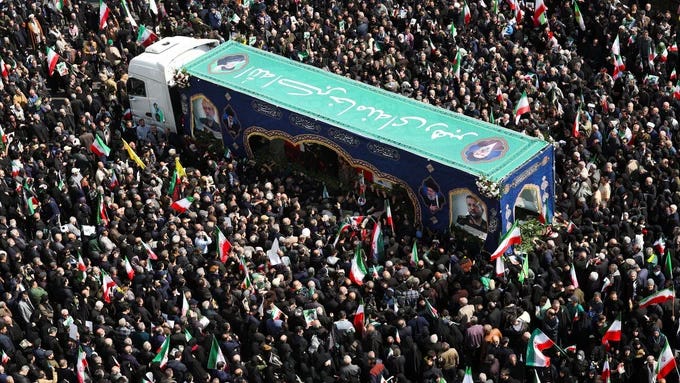
Thousands filled Revolution Square for Larijani’s funeral the same night.
This war was completely preventable on several occasions. But Israel, in its infinite wisdom, chose otherwise:
July 31, 2024. Hamas’s chief ceasefire negotiator Ismail Haniyeh was killed in an IRGC guesthouse in Tehran. He was there attending a presidential inauguration. Tracked on Iranian sovereign soil, during a diplomatic event, and killed. Ceasefire talks collapsed immediately.
June 13, 2025. Israel launched what became known as the Twelve-Day War while the sixth round of US-Iran nuclear talks was scheduled for that Sunday in Oman. Ali Shamkhani, the official running those talks, was among the targets. He’d told NBC the month before: “If the Americans act as they say, for sure we can have better relations”. The talks didn’t happen on Sunday. They didn’t happen at all.
September 9, 2025. The Hamas negotiating team was mid-meeting in Doha, discussing Trump’s own ceasefire proposal, when Israeli jets struck the office of their lead negotiator Khalil al-Hayya. Six killed, including al-Hayya’s son. Qatar – a US ally, host of the largest American air base in the region – called it “state terrorism”. Hamas called it “the assassination of the entire negotiation process”. Trump said he was “not thrilled”. The Times of Israel reported he’d given the green light in advance.
February 27, 2026. Oman’s Foreign Minister stood up and announced Iran had agreed to full IAEA verification. Agreed to never stockpile enriched uranium. Agreed to downgrade its current stockpiles to the lowest possible level. “Peace is within reach”, he said. Talks scheduled to resume March 2. The bombs fell February 28. And then Larijani, a few days ago, in his daughter’s home.
The Oman FM published an op-ed this week. He said that the United States has “lost control of its foreign policy” to Israel. He was in the room for the February breakthrough. He confirmed the deal was real. Britain’s national security adviser Jonathan Powell confirmed the Geneva sessions were producing genuine progress. “We regarded Witkoff and Kushner as Israeli assets that dragged a president into a war he wants to get out of”, a UK diplomat told the Guardian.
The people who could have stopped this have all been eliminated, one by one, on a nine-month schedule. Haniyeh. Shamkhani. The Doha negotiation team. The Oman breakthrough. Larijani now. What you’re watching is not a war that diplomacy failed to prevent. It is a war that was repeatedly kept alive by killing the diplomats.
There’s no one left. The IRGC commanders who fill the vacuum don’t take calls from Geneva. They have standing orders and they follow them. Araghchi said it as plainly as it can be said: “The presence or absence of one person doesn’t affect this structure”. He’s right. And that’s the problem. The structure continues. On autopilot. Without moderates. Without off-ramps.
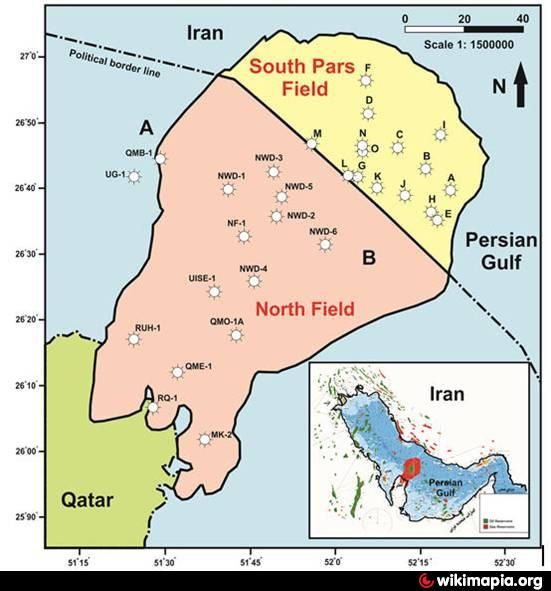
Things Go Haywire as Israeli Escalation Throws Iran Conflict into Dangerous New Phase: Things really hit the fan earlier today after Iran’s largest natural gas field, the South Pars, was struck by Israel. This field reportedly accounts for 75% of Iran’s natural gas production and 80-85% of its electric grid… Simplicius put it concisely enough that I’ll just quote the frame: Israel’s strategy is running on two tracks simultaneously. Kill the moderates to guarantee that only hardliners remain. Strike Iran’s most sensitive sites to guarantee that Iran retaliates against Gulf infrastructure, dragging the whole region into a fire large enough to force the world to “finish Iran off”. The South Pars strike this week – on the facility that powers 75-80% of Iran’s electricity grid – and the immediate Iranian retaliation against Qatar’s Ras Laffan LNG hub, were not accidents. They were that strategy, executing.
South Pars. Ras Laffan. These names occupy the headlines, but what do they actually mean? And what’s at stake here?
South Pars and Qatar’s North Field are essentially the same geological reservoir. One reservoir, with a border running right through the middle. Iran calls its half South Pars. Qatar its North Field. They share the same rock. The same methane. When Israel struck South Pars phases, it struck the geological twin of the installation that supplies 20% of global LNG exports and keeps European households from freezing. Qatar called it “dangerous and irresponsible”. Qatar – which, according to Reuters, has privately been pressing Washington to “finish the job” on Iran – is now watching its own gas facility burn as a direct consequence of the escalation it was encouraging.
Simplicius’s description of Ras Laffan: “Worlds most sophisticated gas processing plant, took 14 years to build.” Some engineers are saying the damage may be irreparable. I don’t know if that’s true yet. But even partial damage to Ras Laffan on top of the production suspension since March 2 is not a problem you fix with a maintenance crew and three weeks. You fix it – if you even can – in years…
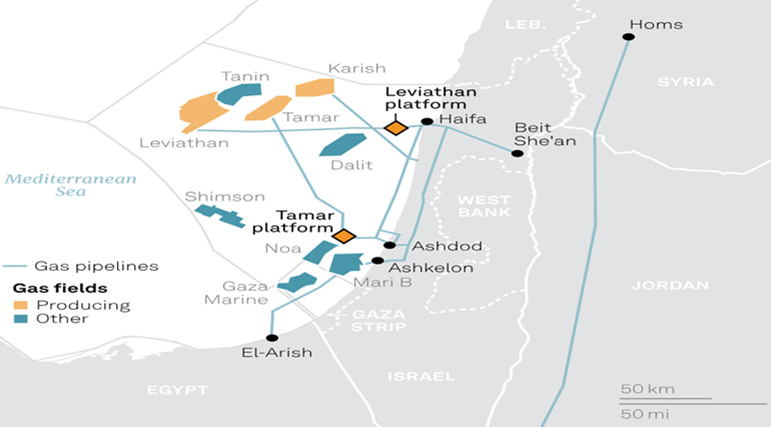
Iran published its retaliation list: Leviathan, Tamar, Karish, Tanin, Dalit, Heletz, Haifa port. Those are Israel’s gas fields and its main industrial port. They haven’t been struck yet, though by the time you’re reading this, that may have changed.
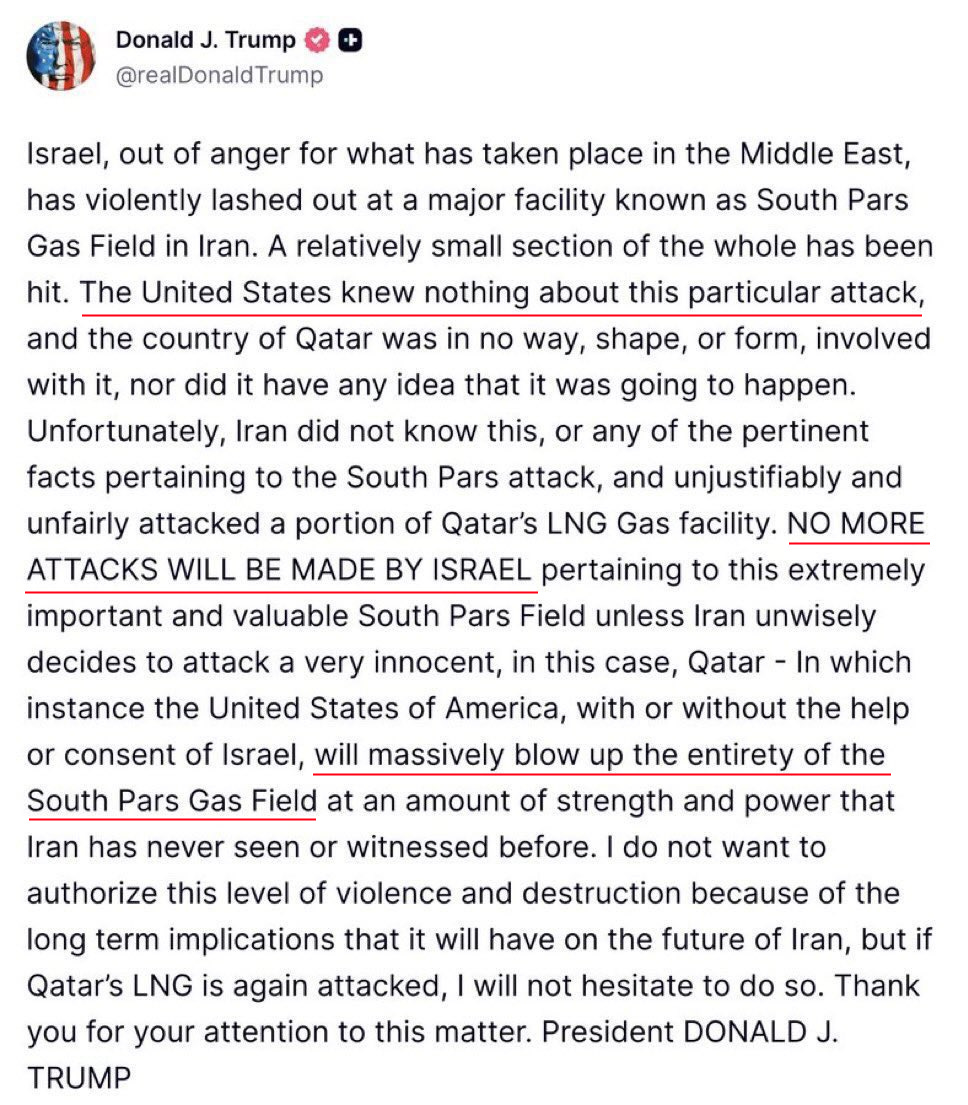
Trump’s response on Truth Social was to simultaneously claim the US knew nothing about the South Pars strike, blame Israel for striking it, and then threaten to “blow up the entire South Pars” if Iran retaliates against Qatar again.
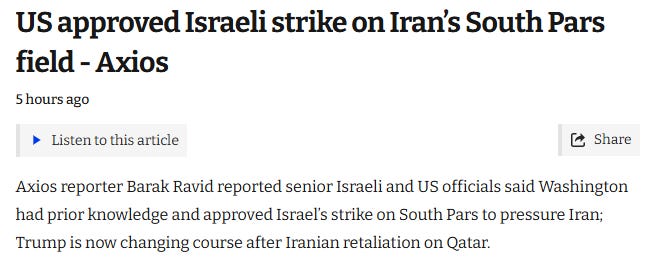
Axios’s Barak Ravid reported within hours that the US had given Israel the green light. Both things can’t be true, and neither is reassuring. Either the US has zero control over its ally, or it’s lying about having zero control. The distinction doesn’t help anyone.
The immediate structural damage is already historic. Oman crude hit $154 a barrel. Dubai crude $130. Brent $102. WTI $93. That $61 gap between Oman and US prices – 65% – is not a rounding error. It’s two oil markets. One for countries that can get physical delivery from the Gulf under Iranian transit permission. And another one for everyone else buying paper at discounted prices that don’t reflect physical scarcity. (silver enters the chat) The London Metal Exchange halted all contracts on March 16. First time ever. The insurance market for marine war risk has been functionally closed since the first week. That’s the short term. High but legible. A spike.
The medium term is where it gets structural. A third of global seaborne fertilizer trade transits the Strait of Hormuz. China halted NPK fertilizer exports and extended its phosphate suspension through August. India requested emergency urea from China – denied. The nitrogen and phosphate that was supposed to go into the soil across the northern hemisphere’s planting season is not going in. Not this spring. The biological window for spring application in most of Europe and North America runs through May. It’s March 19. The war has no end in sight.
Case in point: Sri Lanka… One season of synthetic fertilizer ban in 2021. Rice production dropped 40%. Prices surged. The government fell. That was one country, one policy decision, reversed within months. What’s happening now is that that same constraint is applied simultaneously to the global seaborne supply, with no reversal in sight, across the single most important planting window of the year.
Another underreported supply chain that is running off the same cliff is the pharmaceutical one. Paracetamol. Ibuprofen. Metformin – the world’s most prescribed diabetes drug. All are 80~100% petrochemical-derived. The naphtha feedstock that Asian pharmaceutical plants need is stuck behind the blockade. Nobody has a strategic reserve for pharmaceutical feedstocks. Nobody ever thought to build one.
The long term? Oh boy… People think 1970s… Let me tell you where this will break down in both directions. In October 1973, OPEC cut production and the world entered a period of stagflation that redefined the decade. It was devastating. But the crucial difference is that in 1973, you could turn the tap back on. The infrastructure existed. The question was just political will, not physical capability.
What’s happening now is completely different. No switch was flipped. The switch was bombed! The Shah gas field in the UAE – the world’s largest ultra-sour gas operation – is offline. South Pars phases are burning. Habshan and the Bab field in the UAE shut down. Kuwait is at half oil production. UAE at just over half. Saudi Aramco has suspended all 54 of its jackup drilling rigs. When the politics eventually resolve, you don’t flick that switch. You have to rebuild it. Counted in years.
Debt/GDP in the 1970s was at around 35%. We could absorb it. You could run deficits through the stagflation and come out the other side. But now? The US national debt crossed $39 trillion just a few days ago. Debt-to-GDP? North of 120%. And everything is going so smoothly that the Pentagon just has to ask Congress for a neat supplement of a mere $200 billion. The FPRI calculated that the first 4 days costed $10-16 billion in munitions alone… Yep. Everything’s fine. Repeat after me: everything’s fine. Exhale. Keep repeating it until you believe it.
The Federal Reserve held rates this week – second consecutive hold – and Powell described the energy shock as “generally transitory”. “Transitory”. I think I heard this somewhere before. Very reassuring. But you’ll forgive me if I don’t pull out the party balloons just yet. When Powell said “transitory” about the pandemic inflation in 2021, he was describing a demand shock in a system with intact supply chains. And we all know how that turned out. “Transitory.”
This oil and gas shock is a supply shock, in a system with physically destroyed infrastructure, financed by a country with trillions in debt that cannot even afford the rates required to fight inflation. Let alone a war. The Fed is trapped. Raise rates into a war-driven recession, or hold rates and watch inflation embed. There are no good options left.
As I already mentioned: in the first 96 hours of the war, the coalition expended 5,197 .. 8 .. 9 .. 5,200 .. munitions across ~35 types. Replacement bill: $10-16 billion. For just the first 4 days. We’re 3 weeks in now. And they’re asking for $200B. This is definitely going to end next week.
Warning times in Israel have collapsed from fifteen minutes on day one to three minutes now, with some strikes arriving with none. The interceptor inventory is effectively gone – I wrote about that over two weeks ago and it’s now confirmed not by my napkin but by the lived reality of cluster munitions landing at Savidor Central Station and private jets burning at Ben Gurion.
Iran deployed its Haj Qassem ballistic missile this week for the first time in this conflict. A missile specifically designed to defeat the defenses Israel no longer has. It wasn’t held back for weeks because Iran was saving its best. It was held back because you don’t use a key-defeating missile until the lock is broken. The lock has been bombed, hammered, irrevocably and completely crushed into dust. It IS broken. Iran’s launch rate hasn’t declined. It’s stable, and in the past week, increasing.
The coalition has lost 10% of its entire MQ-9 Reaper drone fleet. The US has zero combat vessels actively present in the Persian Gulf – the Littoral Combat Ships based in Bahrain, whose entire purpose is to engage IRGC speedboats and sweep mines, were spotted in Malaysia three days ago. I have been told the beaches are lovely this time of year.
Iran has thirty-plus speedboats patrolling the strait, boarding vessels, forcing unauthorised transits to turn back. “The Persian Gulf is now an Iranian lake”, as one analyst put it. That’s no exaggeration. It’s the geography, stupid.
Iran’s declared terms are: reparations, closure of all US bases in the GCC, guarantees against future aggression. The US’s declared goal is: regime change, denuclearisation, dismantlement of the “Iranian terror regime”. Neither side has moved an inch. The only people who might have found a middle lane are either dead or sidelined.
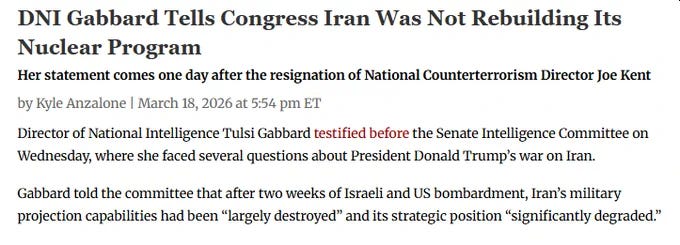
Tulsi Gabbard testified to Congress that the nuclear program “was obliterated and Iran was NOT rebuilding it”. No12 days. Internal cracks… Initial step building towards impeachment?
Joe Kent, who ran the National Counterterrorism Center until his resignation Monday, said there was no imminent threat and that Israel drove the decision. The casus belli is dissolving in public, on the record, while the war continues anyway.
The Gulf states who privately demanded escalation are now burning. Qatar expelled Iranian diplomats after Ras Laffan was struck. Qatar – which mediated between Iran and the West for years, which Iran supplied during the 2017 GCC isolation, which shares a gas field with Iran – is now in direct military confrontation with the country next door. The belt of states from Kuwait to Oman spent two weeks cheering the war on from behind their firewalls. Iran’s retaliation list was always going to include their infrastructure. They knew that. They did it anyway.
The Belgian Prime Minister – who runs the country hosting NATO headquarters – told the Financial Times this week that Europe must normalize relations with Russia. “In private”, he said, “European leaders agree with me. But nobody dares say it out loud”. The coalition that refused to send ships to Hormuz is now starting to say the quiet parts in public.
There’s only one scenario I see where this ends in weeks. A massive Iranian domestic collapse that produces a negotiated transition. Hasn’t happened. Doubtful it will now. Every other scenario involves months if not years.
The energy infrastructure damage is already partly irreversible. The fertilizer window is basically over. The yuan transit system is being institutionalized wave by wave, port call by port call. The petrodollar is fracturing in the way I described in my Bretton Whoops piece (link).
The US seems to be settling its trade deficit already in gold for three of the last four months. The Fed is trapped. And $200B in new debt will be added on top of the $39T current debt on top of a global energy shock. And the last moderate is dead in his daughter’s living room. God help us all.
"Breaking: Netanyahu Killed In Strike On Tel Aviv Convoy -
Regional War Fears Escalate"
"In this video, we break down the dramatic developments after reports confirmed that Israeli Prime Minister Benjamin Netanyahu was killed in a targeted strike on his convoy in central Tel Aviv. The attack, which reportedly penetrated multiple layers of Israeli security, has triggered immediate shockwaves across the region and raised fears of a major escalation in the Middle East.
Israeli officials say the strike involved a precision-guided munition and required advanced intelligence and coordination, suggesting the possibility of state-level involvement. Early forensic analysis reportedly pointed to missile fragments linked to Iranian-manufactured systems, though Israeli authorities have stopped short of making a direct attribution. In response, Israel declared a state of emergency, elevated its military readiness to the highest level, and warned that the assassination of its prime minister would be treated as an act of war.
However, Iranian officials have strongly denied any involvement in the attack, calling the accusations politically motivated and warning against escalation based on unverified claims. U.S. intelligence sources say the situation remains unclear, with multiple possible actors under investigation, including regional militant groups and non-state networks capable of accessing advanced weapon systems."
"The food you eat every day is banned in 160 countries. We're talking about what's in your bread, your candy, your kids' cereal right now. Potassium bromate in your bread. Azodicarbonamide, the same chemical used to make yoga mats, baked into your sandwich rolls. Titanium dioxide, the white pigment used in paint, sitting in your candy and gum. Red 40 in almost everything your kids eat, while European labels warn parents about it and American labels say nothing.
In this video we look at real people who left America and watched their health change. French teachers who gain fifteen pounds every school year in America and lose it every summer back home. People who lived abroad for years with zero stomach problems and came back to the US and felt sick within days. A two year old who grew up eating in France and came to America and spit the food out. Just people describing what happened to their own bodies.
Then we get into the actual ingredients sitting in your pantry right now. Banned in the EU, Canada, China, Brazil. Some of them banned for thirty years. The science has been there for years. Researchers have been publishing it. And American grocery store shelves look exactly the same.
So how is any of this still legal. The answer goes back to 1997, when the FDA handed food companies the legal right to decide for themselves what is safe to put in your food. No independent review. No oversight. The companies decide. Publicly traded corporations that answer to shareholders."
"Today an expert on Middle East politics stopped by to break down the events of the last 24 hours and beyond. Brandon J. Weichert is the Senior National Security Editor at 19FortyFive.com"
"Harry Dent, Founder of HS Dent, warns a historic market crash worse than 1929 is coming as the 17-year stimulus-fueled bubble bursts, with stocks falling 90% and Treasury bonds the only safe investment."
"Nördlingen, in Bavaria, Germany, looks like a fairytale town, with its perfectly preserved medieval walls and its eye-catching circular shape. But what makes it truly unique isn't apparent at first glance: the entire town is literally built on a geological treasure, a legacy of a catastrophic event 15 million years ago. The stone blocks that make up the houses, towers, and churches contain approximately 72,000 tons of tiny diamonds, a detail no one had ever suspected until the 20th century.
For generations, the residents of Nördlingen believed that the large crater in which the town sits was the result of an ancient volcanic eruption. Only in the 1960s, when two American geologists, Eugene Shoemaker and Edward Chao, visited the area, did the truth finally come to light. As soon as they entered the church of San Giorgio and noticed the presence of microdiamonds in the walls, they realized that this place was not created by the fire of a volcano, but by the devastating impact of a kilometer-wide asteroid. The pressure and heat generated by the collision were so intense that they transformed the carbon present in the rock into a shower of microscopic diamonds, trapped forever in the suevite stone that today constitutes most of the city's buildings.
The 26-kilometer-wide Nördlinger Ries crater is one of the most spectacular examples of a meteorite impact on Earth, so realistic that it was chosen by the astronauts of the Apollo 14 and 16 missions as a training site for identifying lunar rocks. According to geologist Stefan Hölzl, no other place in the world has such a massive amount of impact material used to build an entire town. The Church of St. George alone is said to contain approximately 5,000 carats of diamonds, an impressive number that, however, has no economic value: the gems are too small to be mined or used in jewelry.
So, as visitors stroll through the medieval streets of Nördlingen, perhaps unaware of their surroundings, they are actually walking through a gigantic open-air geological museum, a place where human and cosmic history intertwine in surprising ways. The diamonds may not make the residents rich, but they do give the city an aura like no other: that of being built, literally, on the sparks of a collision from space."
"I am a composer from Norway and I started this channel with a simple vision: to create a place that you can visit whenever you want to sit down and relax. I compose music that can be labeled as for example: sleep music, calm music, yoga music, study music, peaceful music, beautiful music and relaxing music. I love to compose music and I put a lot of work into it. Thank you very much for listening and for leaving feedback. Every single day I am completely astonished by all your warm support and it really inspires me to work even harder on my music. If you enjoy my work, I would be very happy if you decided to subscribe and join our community. Have a wonderful day or evening!"
- Peder B. Helland, composer for Soothing Relaxation
“Sculpted by stellar winds and radiation, a magnificent interstellar dust cloud by chance has assumed this recognizable shape. Fittingly named the Horsehead Nebula, it is some 1,500 light-years distant, embedded in the vast Orion cloud complex.
About five light-years "tall", the dark cloud is cataloged as Barnard 33 and is visible only because its obscuring dust is silhouetted against the glowing red emission nebula IC 434. Stars are forming within the dark cloud. Contrasting blue reflection nebula NGC 2023, surrounding a hot, young star, is at the lower left. The gorgeous color image combines both narrowband and broadband images recorded using three different telescopes.”
"Whatever your fate is, whatever the hell happens, you say, “This is what I need.” It may look like a wreck, but go at it as though it were an opportunity, a challenge. If you bring love to that moment- not discouragement- you will find the strength there. Any disaster you can survive is an improvement in your character, your stature, and your life. What a privilege! This is when the spontaneity of your own nature will have a chance to flow. Then, when looking back at your life, you will see that the moments which seemed to be great failures, followed by wreckage, were the incidents that shaped the life you have now. You’ll see this is really true. Nothing can happen to you that is not positive. Even though it looks and feels at the moment like a negative crisis, it is not. The crisis throws you back, and when you are required to exhibit strength, it comes."
"We all know that something is eternal. And it ain't houses and it ain't names, and it ain't earth, and it ain't even the stars... everybody knows in their bones that something is eternal, and that something has to do with human beings. All the greatest people ever lived have been telling us that for five thousand years and yet you'd be surprised how people are always losing hold of it. There's something way down deep that's eternal about every human being."
"The Real Causes of The American War of Secession"
by Doug Casey
"I wish to disabuse you of something you’ve probably believed since you were ten years old. Only a third of you have been subjected to the American public school version of history, but that version has permeated throughout the world. After all, the winners get to write the history books. What Americans are taught about their so-called "Civil War" is, in good measure, a fairy tale.
Let’s start by getting the terminology right. It wasn’t a "civil war." A civil war is a conflict in which two or more factions fight for control of the same government. That’s not what happened. The South wasn’t trying to take over the North. Their sole objective was to leave the Union. That made it a war of secession. Calling it a civil war is propaganda - framing Southerners as rebels and insurgents rather than people who simply wanted to go their own way. Some call it the War of Northern Aggression, a name which might have stuck if the Confederacy had won. I prefer to be neutral, so I will call it the War Between the States.
The standard narrative holds that the noble North, led by the saintly Abraham Lincoln, fought the evil South to free the slaves. Full stop. Now, more than any time in the past, that’s the whole story as far as most Americans are concerned. It’s on a par with believing that Spain blew up the battleship Maine to start the Spanish-American War, or that World War I was fought to "make the world safe for democracy." I’ll reserve comment on more recent wars. But good propaganda always contains a kernel of truth, even while truth is always the first casualty in a war.
So, what were the causes of the War Between the States, which started April 12, 1861, with the bombardment of Ft. Sumter in Charleston harbor, and ended April 9, 1865, with the surrender of Lee at Appomattox? Slavery was certainly a major element of the conflict. But reducing the bloodiest war in American history - 700,000 dead, which in per-capita terms would be about seven million today - to a single cause is not just intellectually lazy and dishonest. It’s dangerous.
So let me walk you through what happened. I think you’ll find it’s far more interesting than the storybook version - because it involves economics, power politics, exploitation of one part of a country by another part, and international intrigue.
In the country’s earlier days, Americans saw themselves as citizens of a state, not the US. Even so, by 1860, the United States was no longer one country in any meaningful economic sense. It was two countries with diametrically opposed economic interests that happened to share a flag and a constitution.
The North had industrialized, with about ten times as many factories as the South, and a growing urban working class fed by massive immigration from Ireland and Germany - people who would work for next to nothing. Northern industrialists were accumulating enormous wealth and, more importantly, enormous political power. They wanted protection from foreign competition. They wanted high tariffs to keep cheap British-manufactured goods out of the American market.
The South was the opposite. It was an agricultural export economy. Cotton was the big commodity - by the 1860s, cotton alone accounted for almost 60% of all US exports. The fiber mainly went to Britain’s mills in Manchester. The South was plugged into the global economy in a way that the North was not, and Southern planters wanted what any export economy wants: free trade. Low tariffs, open ports, and the ability to buy manufactured goods from whoever offered the best price, which was usually Britain.
Half of the country wanted protectionism, and the other half wanted free trade. This wasn’t a minor policy disagreement, but a fundamental conflict of interest that had been building for decades. Alexander Hamilton versus Thomas Jefferson. Industrial mercantilism and protectionism versus agrarian free markets. Like philosophical arguments here in Argentina.
Tariffs: How the North Looted the South: In 1828, Congress passed what Southerners called the Tariff of Abominations, with duties as high as 50 percent on imported manufactured goods. Southerners could no longer buy British tools or cloth at the world market price. You’re forced to buy inferior Northern-made versions at an inflated price. Meanwhile, your cotton exports are damaged, since Britain now has less income with which to buy them. Worse, Britain considers counter-tariffs on cotton imports. Worse yet, Britain sees it should diversify the sources of its imported cotton, destroying your market, which is exactly what happened during the war. You’re being taxed to subsidize your economic competitor. It’s a transfer of wealth from South to North, administered by the federal government.
South Carolina nearly seceded over this in 1832 - thirty years before Fort Sumter. Vice President John C. Calhoun developed the doctrine of nullification, arguing that a state could refuse to enforce a federal law that it considered unconstitutional. President Andrew Jackson - who was a Southerner himself - threatened military force. They worked out a compromise, but the fundamental issue was never resolved. And the principle Calhoun articulated - that the federal government could become an instrument of sectional plunder - became the intellectual foundation for secession.
Now here’s the detail that most historians conveniently skip over. December 20, 1860, and June 8, 1861, following Abraham Lincoln's election, South Carolina was the first to secede, followed by six other Deep South states by February 1861. After the attack on Fort Sumter in April 1861, four more states joined, totaling 11 states in the Confederacy. In March 1861 - before the war started, before anybody fired a shot - Congress passed the Morrill Tariff. This raised duties back to their highest levels since the Tariff of Abominations. It passed because Southern representatives of seven states had already left Congress following their secession. Think about the timing. The South walks out, and the very first thing the North does is jack up tariffs to benefit Northern industry. If you’re a Southerner, that tells you that the moment you lose your political voice, the Northern majority will use the federal government to loot you. Which is, of course, exactly what Calhoun had warned about thirty years earlier.
The Morrill Tariff also shaped how the rest of the world saw the conflict. Many British observers - and remember, the British were passionate free-traders at this point - looked at the American war and saw not a moral crusade against slavery but a trade war. The protectionist North was trying to force the free-trading South back into an economic arrangement that served Northern interests. We’ll come back to the British angle, because it’s crucial.
It Wasn’t Only Tariffs: Tariffs were the most visible grievance, but they were far from the only one. The federal government had become, in effect, a machine for transferring wealth and power from the South to the North. And I use the word "transferring" deliberately, because this was not an accident. It was policy. Since there were 23 million citizens of 23 Northern states, and only 9 million (including 3.5 million slaves) in the South, there was no question about which region future legislation would favor.
Federal spending on internal improvements - roads, canals, harbors, railroads - went overwhelmingly to the North. Southern tax revenue, collected largely through those tariffs on imported goods that Southerners consumed, was building infrastructure in Northern states. When the transcontinental railroad was authorized, it followed a northern route. Federal land grants went to Northern settlers and Northern railroad corporations. The Homestead Act, which Republicans championed, was designed to populate the western territories with small free-soil farmers aligned with Northern political interests - not with large-scale agricultural operations that might complement the Southern system of plantations.
The banking system was controlled by Northern financial interests. Southern planters were perpetually at the mercy of New York bankers and cotton factors who set the terms of trade. If you were a Southern cotton grower, you shipped your product through Northern ports, insured it with Northern companies, financed it through Northern banks, and bought your manufactured goods from Northern factories at tariff-inflated prices. The wealth extraction was systematic.
Consider this from the perspective of someone sitting in Charleston or Richmond in 1860. You’re looking at a federal government that spends your tax money on somebody else’s infrastructure, gives away the western lands to people aligned against your interests, and runs a banking system designed to extract your wealth. Many Southern writers explicitly compared their situation to the American colonies under British rule. The structural dynamics were remarkably similar. The South was being treated as an economic colony of the North.
I know some of us here tonight have done business in countries where the central government exists primarily to serve the interests of one region or one class at the expense of everyone else. You know what that looks like. You know how it feels. And you know that people don’t tolerate it forever.
The Lincoln Myth: What He Actually Said and Believed: Now we come to Abraham Lincoln, who may be the most successfully mythologized political figure in American history. And I say that as someone who considers most political figures to have feet of clay. The popular version of Lincoln is the Great Emancipator—a man who went to war to free the slaves because it was the right thing to do. The actual historical record tells a very different story. I’m not going to give you my interpretation here. I’m going to give you Lincoln’s own words, because they’re rather devastating to the myth.
Look at his First Inaugural Address, March 1861, with seven states already out of the Union: "I have no purpose, directly or indirectly, to interfere with the institution of slavery in the States where it exists. I believe I have no lawful right to do so, and I have no inclination to do so." That’s not exactly "free at last" rhetoric.
During the famous Lincoln-Douglas debates of 1858, Lincoln said explicitly that he was not in favor of social and political equality between white and black people. He opposed blacks serving as voters, jurors, or officeholders. He supported colonization - shipping freed blacks to Africa or Central America. He continued to explore colonization schemes well into his presidency. By modern standards, Lincoln’s racial views were appalling. But they were mainstream for a Northern politician of his era, or the typical man in the street, which tells you something about how "anti-slavery" the North actually was in practical terms. Slavery was a subject of moral debate in both the North and the South. Harriet Beecher Stowe’s "Uncle Tom’s Cabin" was published in 1851 and was a runaway Best Seller, with 300,000 copies sold in the US and a million in Britain just during its first year. It became the largest-selling novel of the 19th C. The fanatical abolitionist John Brown, then featured in the "Battle Hymn of the Republic", also served to give a psychological boost to the importance of slavery.
Lincoln was not an abolitionist. He was a moderate Republican whose income came from railroads and banks, whose philosophy was that of Hamilton, and whose primary commitment was preventing the expansion of slavery into new territories - not ending it where it existed. His reasons were as much economic as moral. Free-Soil Republicans didn’t want slavery in the territories primarily because they didn’t want to compete with slave labor. They wanted the West reserved for white free laborers. It was an economic program wrapped in moral language.
The South could see that slavery was uneconomic and on its way out. Fighting a bloody civil war to maintain slavery never made sense, and no other country fought a war to abolish slavery. It would have died of its own dead weight. Brazil was the last major country to abolish it, peacefully, in 1888.
Note the date of the Emancipation Proclamation. January 1, 1863. With only 87 words, it’s well-crafted and seen as a great moral thunderbolt. But it should be read carefully. It freed enslaved people only in states that were in rebellion. It did not apply to slaves in Washington, D.C., border states that stayed loyal to the Union, or parts of Confederate states already under Union control. The Proclamation was a military measure, not a moral one. Lincoln said so himself. His letter to Horace Greeley in August 1862 is the Rosetta Stone of Lincoln’s priorities: "My paramount object in this struggle is to save the Union, and is not either to save or to destroy slavery. If I could save the Union without freeing any slave, I would do it."
Lincoln acted as a veritable dictator during the war. He suspended Habeas Corpus, he imposed an income tax, instituted a draft, and suppressed free speech, arresting many thousands and shutting down 300 papers for things like criticizing the war effort. His priority was preserving the Union and the federal government’s power - not liberating enslaved people, nor preserving citizens’ liberties. Which brings us to what I think is the most fascinating part of the whole story.
Britain - An Underrated Element: This is the part they definitely don’t teach in American schools, and it may be the most important part of the whole story. Perhaps for the same reason that the importance of the French Army and Navy aren't recognized in winning the Revolutionary War.
Great Britain in 1861 was the world’s superpower. The Royal Navy controlled the seas. The British Empire spanned the globe. And the British textile industry - the engine of the world’s largest economy - ran on Southern cotton. About 80 percent of the cotton feeding British mills came from the American South. When the Union Navy blockaded Southern ports, it was like cutting off Britain’s oxygen supply. Hundreds of thousands of British textile workers faced unemployment. The economic pressure on the British government to do something was enormous.
But it wasn’t just about cotton. The British had excellent strategic reasons to want the United States broken in two. Think about it from London’s perspective. The Americans had been getting increasingly uppity - the Monroe Doctrine, expansionism, challenging British influence in Latin America and the Caribbean. The United States was becoming a serious rival. Better to have two weaker nations, one of which - the Confederacy - would be dependent on British trade and goodwill. From a pure realpolitik standpoint, British interests pointed strongly toward supporting Southern independence.
And they came very close. In November 1861, a Union warship stopped the British mail steamer Trent and seized two Confederate diplomats. Britain was furious. Troops were dispatched to Canada. The Royal Navy mobilized. Britain and the United States came within inches of war. Lincoln backed down and released the diplomats, but the episode showed just how eager elements of the British establishment were to intervene.
Now here’s the problem the British government faced. Britain had abolished slavery in 1833, and the British public - especially the middle and working classes - took enormous pride in that fact. Anti-slavery sentiment was a powerful political force in Britain. So while the government had every economic and strategic reason to support the Confederacy, doing so openly would mean allying with a slave power. That was politically toxic.
But - and this is the key - as long as Lincoln said the war was about preserving the Union and not about slavery, the British could frame potential intervention as supporting Southern self-determination. The Times of London took exactly this line throughout 1861 and into 1862. The South was fighting for independence, just as the Americans had fought against Britain in 1776. It was about self-government, not slavery. Unless Lincoln made the narrative about slavery, the British had political cover to intervene.
The Emancipation Proclamation destroyed that possibility. The moment Lincoln made abolition an explicit war aim, any British government that supported the Confederacy would be supporting slavery against freedom. And no British politician could survive that. The British working class, despite the devastating unemployment caused by the cotton shortage, rallied to the Union cause. There was a famous meeting at the Free Trade Hall in Manchester - textile workers who were literally starving because of the cotton blockade voted to support Lincoln and emancipation. It was one of the most remarkable moments in British labor history.
Think about what actually happened here. Lincoln played the slavery card not primarily because of moral conviction, though he had serious moral objections to slavery. He played it because it was his single most effective weapon to prevent British intervention. Without the Emancipation Proclamation, it’s possible that Britain would have recognized the Confederacy, broken the blockade, and changed the outcome of the war. Britain’s interests pointed directly toward supporting the South. The breakup of America would have served British strategic interests beautifully. Cotton supply secured. A rival power permanently divided. The only thing that prevented it was the moral weight of the slavery question, which Lincoln exploited with extraordinary political skill. The Proclamation was a geopolitical masterstroke disguised as a moral declaration.
States Rights: Now Just a Euphemism: In polite American society today, the phrase "states’ rights" is treated as code for racism. It was certainly used that way during the civil rights era. But the constitutional questions at the heart of secession were real, and dismissing them as mere cover for slavery is intellectually dishonest.
The United States was founded as a federation of sovereign states. The Constitution was ratified by state conventions, not by a national vote. The Tenth Amendment (now effectively a dead letter) reserved all undelegated powers to the states. For most of American history, the dominant constitutional theory - not just in the South, but across the country - was that the Union was a voluntary compact. States had joined voluntarily, and they could leave voluntarily.
New England Federalists discussed secession during the Hartford Convention of 1814. William Lloyd Garrison, the most famous abolitionist in America, advocated for the North to secede from the South, calling the Constitution a "covenant with death." The idea that secession was constitutionally permissible was a mainstream position with adherents in every region of the country. The Constitution says nothing about secession one way or the other. It was an open question.
The war settled that question - by force, not by argument. The Union won, and the victors wrote the legal and historical narrative. But secessionists were not wrong as a matter of law. It’s not unlikely the war might have never broken out, ending as a Mexican standoff, if the Confederates hadn’t foolishly fired the first shot at Ft. Sumter. At that point, Lincoln raised 75,000 men for a three-month enlistment and felt it necessary to use them, which he did at First Bull Run on July 21.
"The question of whether a political subunit has the right to withdraw from a larger entity is never simple. Most countries are artificial constructs, with artificial borders, mashing together different tribes, religions, and cultures. That’s true of every country in Africa, highlighted by secession movements in Nigeria, Congo, and Sudan. Every country in the Middle East and Western Asia is an unstable multicultural domestic empire; most will break apart. It’s true that many places in this continent, such as Brazil and Bolivia, have this problem. It wasn’t simple in the America of 1861, and it isn’t simple now. Ask the Scots, the Catalans, the Quebecois, and most recently the Albertans. It's an open question whether the United States will have secession movements or a civil war in the years to come. What are the chances that young Chicanos in Los Angeles will want to pay 20% of their income in Social Security to support old white women in Massachusetts? These are legitimate political and economic questions. Quashing them with shouts of "racism" doesn’t make them go away.
Putting It All Together: So what actually caused the War Between the States? Everything I’ve described is operating simultaneously and reinforcing each other. That’s the honest answer, and it’s a lot more interesting than the fairy tale that it was a crusade to end slavery.
The economic divergence between North and South created fundamentally incompatible interests on tariffs, trade, banking, infrastructure, and western expansion. The war would likely have happened even in a world where slavery didn’t exist. The tariff question convinced Southerners that the federal government had become a tool of Northern economic exploitation. The passage of the Morrill Tariff in 1861, the instant Southern representatives left Congress, was the confirmation of everything they’d feared.
Lincoln’s actual position on slavery was pragmatic and politically calculated. He was willing to tolerate slavery where it existed to preserve the Union, and he adopted emancipation as a war aim primarily for strategic reasons - above all, to prevent British intervention. Britain’s role was far more significant than the standard narrative acknowledges. The threat of British recognition of the Confederacy was one of the most powerful forces shaping the war’s moral framing. The Emancipation Proclamation was a diplomatic weapon as much as a moral declaration.
Slavery sat at the center of all of this - but in far more complex ways than the simple story suggests. Slavery was the foundation of the Southern economy that generated the tariff disputes. Slavery was the most prominent states’ rights issue, though not the only one. Slavery was the lever Lincoln used to reshape the war’s international dimensions. And slavery was the moral question that prevented Britain from tipping the balance.
Why Any of This Matters: Let me wrap up by telling you why I think this matters - and not just as a historical curiosity. Simplistic narratives produce simplistic thinking. And simplistic thinking about why nations go to war yields more wars. Oddly, the War Between the States has become more controversial than ever in recent years. The atmosphere in the U.S. has become increasingly racially charged, and the war is now seen as a "good guys versus bad guys" situation. Monuments to Southern soldiers have been taken down, and displaying the Stars and Bars is considered "hate speech".
Fault lines are developing in the US. Economic divergence between regions and classes is different from that of the 1850s but is arguably much more severe. The federal government was a relatively trivial influence when it controlled only a few percent of the GDP, but now it controls about 40%, in addition to creating currency and credit at will, complex laws, and massive regulations. It’s become a self-perpetuating machine for transferring wealth to the politically connected. Constitutional questions about the limits of federal power are more urgent than they were in the 1850’s.
I’m not predicting another war of secession with conventional armies; the country is way too integrated, and battle lines aren’t drawn on state lines so much as by who controls individual cities. But the US increasingly seems on the cusp of a genuine civil war - different factions fighting for control of the same government, violence over who gets to wield power. That’s far uglier than secession, and the underlying forces are not relics of the past. They’re permanent features of political life, and they’re very much in play right now. Red people and Blue people can’t even have a civil conversation about more than the weather and the state of the roads. And not even about the weather…
That’s one reason for international diversification. It’s an insurance policy against political instability, including in the American government. The men who founded the United States understood that governments are dangerous. They tried to craft a Constitution with enough checks and balances to constrain that danger. Things broke down in 1861. Since governments always grow, accumulate power, and always serve the interests of those who control them at the expense of everyone else, it’s not unlikely the US will experience another period of severe unpleasantness.
The War Between the States is actually just Exhibit B; it wasn’t America’s first experience with overt war between citizens. Exhibit A is the Revolutionary War of 1775-83. It was both a War of Secession (Americans from Britain) and a civil war, because everyone was legally British. But about 1/3rd of them wanted to take over the government and change it, and a different 1/3rd saw that third as treasonous rebels and wanted to maintain the status quo. That war was neighbor against neighbor, much more brutal and far-reaching than just some battles between Red Coats and Continentals.
The 700,000 men who died in the unpleasantness of 1861-65 fought for many different reasons, but very few did it to preserve slavery; 50% of Southern whites owned no slaves. Some fought for abstract principles of union or self-government. But most were simply caught up in forces beyond their control, which is what happens to ordinary people when governments go to war. Understanding the full truth about why they died is the least we owe them. And it’s the best protection we have against repeating similar catastrophic mistakes."
"A soldier's heartfelt words to his spouse, penned days before the Battle of Bull Run, express profound love and patriotism. The video uses historical images to enhance the emotional impact of this powerful message. Sarah was only 24 years old when Sullivan was killed at Bull Run. She never remarried. She lived to 87. When she died, she was buried next to Sullivan."