StatCounter

Wednesday, March 18, 2026

"The Real Causes of The American War of Secession"

"Ashokan Farewell"
"The Real Causes of The American War of Secession"
by Doug Casey

"I wish to disabuse you of something you’ve probably believed since you were ten years old. Only a third of you have been subjected to the American public school version of history, but that version has permeated throughout the world. After all, the winners get to write the history books. What Americans are taught about their so-called "Civil War" is, in good measure, a fairy tale.

Let’s start by getting the terminology right. It wasn’t a "civil war." A civil war is a conflict in which two or more factions fight for control of the same government. That’s not what happened. The South wasn’t trying to take over the North. Their sole objective was to leave the Union. That made it a war of secession. Calling it a civil war is propaganda - framing Southerners as rebels and insurgents rather than people who simply wanted to go their own way. Some call it the War of Northern Aggression, a name which might have stuck if the Confederacy had won. I prefer to be neutral, so I will call it the War Between the States.

The standard narrative holds that the noble North, led by the saintly Abraham Lincoln, fought the evil South to free the slaves. Full stop. Now, more than any time in the past, that’s the whole story as far as most Americans are concerned. It’s on a par with believing that Spain blew up the battleship Maine to start the Spanish-American War, or that World War I was fought to "make the world safe for democracy." I’ll reserve comment on more recent wars. But good propaganda always contains a kernel of truth, even while truth is always the first casualty in a war.

So, what were the causes of the War Between the States, which started April 12, 1861, with the bombardment of Ft. Sumter in Charleston harbor, and ended April 9, 1865, with the surrender of Lee at Appomattox? Slavery was certainly a major element of the conflict. But reducing the bloodiest war in American history - 700,000 dead, which in per-capita terms would be about seven million today - to a single cause is not just intellectually lazy and dishonest. It’s dangerous.

So let me walk you through what happened. I think you’ll find it’s far more interesting than the storybook version - because it involves economics, power politics, exploitation of one part of a country by another part, and international intrigue.

In the country’s earlier days, Americans saw themselves as citizens of a state, not the US. Even so, by 1860, the United States was no longer one country in any meaningful economic sense. It was two countries with diametrically opposed economic interests that happened to share a flag and a constitution.

The North had industrialized, with about ten times as many factories as the South, and a growing urban working class fed by massive immigration from Ireland and Germany - people who would work for next to nothing. Northern industrialists were accumulating enormous wealth and, more importantly, enormous political power. They wanted protection from foreign competition. They wanted high tariffs to keep cheap British-manufactured goods out of the American market.

The South was the opposite. It was an agricultural export economy. Cotton was the big commodity - by the 1860s, cotton alone accounted for almost 60% of all US exports. The fiber mainly went to Britain’s mills in Manchester. The South was plugged into the global economy in a way that the North was not, and Southern planters wanted what any export economy wants: free trade. Low tariffs, open ports, and the ability to buy manufactured goods from whoever offered the best price, which was usually Britain.

Half of the country wanted protectionism, and the other half wanted free trade. This wasn’t a minor policy disagreement, but a fundamental conflict of interest that had been building for decades. Alexander Hamilton versus Thomas Jefferson. Industrial mercantilism and protectionism versus agrarian free markets. Like philosophical arguments here in Argentina.

Tariffs: How the North Looted the South: In 1828, Congress passed what Southerners called the Tariff of Abominations, with duties as high as 50 percent on imported manufactured goods. Southerners could no longer buy British tools or cloth at the world market price. You’re forced to buy inferior Northern-made versions at an inflated price. Meanwhile, your cotton exports are damaged, since Britain now has less income with which to buy them. Worse, Britain considers counter-tariffs on cotton imports. Worse yet, Britain sees it should diversify the sources of its imported cotton, destroying your market, which is exactly what happened during the war. You’re being taxed to subsidize your economic competitor. It’s a transfer of wealth from South to North, administered by the federal government.

South Carolina nearly seceded over this in 1832 - thirty years before Fort Sumter. Vice President John C. Calhoun developed the doctrine of nullification, arguing that a state could refuse to enforce a federal law that it considered unconstitutional. President Andrew Jackson - who was a Southerner himself - threatened military force. They worked out a compromise, but the fundamental issue was never resolved. And the principle Calhoun articulated - that the federal government could become an instrument of sectional plunder - became the intellectual foundation for secession.

Now here’s the detail that most historians conveniently skip over. December 20, 1860, and June 8, 1861, following Abraham Lincoln's election, South Carolina was the first to secede, followed by six other Deep South states by February 1861. After the attack on Fort Sumter in April 1861, four more states joined, totaling 11 states in the Confederacy. In March 1861 - before the war started, before anybody fired a shot - Congress passed the Morrill Tariff. This raised duties back to their highest levels since the Tariff of Abominations. It passed because Southern representatives of seven states had already left Congress following their secession. Think about the timing. The South walks out, and the very first thing the North does is jack up tariffs to benefit Northern industry. If you’re a Southerner, that tells you that the moment you lose your political voice, the Northern majority will use the federal government to loot you. Which is, of course, exactly what Calhoun had warned about thirty years earlier.

The Morrill Tariff also shaped how the rest of the world saw the conflict. Many British observers - and remember, the British were passionate free-traders at this point - looked at the American war and saw not a moral crusade against slavery but a trade war. The protectionist North was trying to force the free-trading South back into an economic arrangement that served Northern interests. We’ll come back to the British angle, because it’s crucial.

It Wasn’t Only Tariffs: Tariffs were the most visible grievance, but they were far from the only one. The federal government had become, in effect, a machine for transferring wealth and power from the South to the North. And I use the word "transferring" deliberately, because this was not an accident. It was policy. Since there were 23 million citizens of 23 Northern states, and only 9 million (including 3.5 million slaves) in the South, there was no question about which region future legislation would favor.

Federal spending on internal improvements - roads, canals, harbors, railroads - went overwhelmingly to the North. Southern tax revenue, collected largely through those tariffs on imported goods that Southerners consumed, was building infrastructure in Northern states. When the transcontinental railroad was authorized, it followed a northern route. Federal land grants went to Northern settlers and Northern railroad corporations. The Homestead Act, which Republicans championed, was designed to populate the western territories with small free-soil farmers aligned with Northern political interests - not with large-scale agricultural operations that might complement the Southern system of plantations.

The banking system was controlled by Northern financial interests. Southern planters were perpetually at the mercy of New York bankers and cotton factors who set the terms of trade. If you were a Southern cotton grower, you shipped your product through Northern ports, insured it with Northern companies, financed it through Northern banks, and bought your manufactured goods from Northern factories at tariff-inflated prices. The wealth extraction was systematic.

Consider this from the perspective of someone sitting in Charleston or Richmond in 1860. You’re looking at a federal government that spends your tax money on somebody else’s infrastructure, gives away the western lands to people aligned against your interests, and runs a banking system designed to extract your wealth. Many Southern writers explicitly compared their situation to the American colonies under British rule. The structural dynamics were remarkably similar. The South was being treated as an economic colony of the North.

I know some of us here tonight have done business in countries where the central government exists primarily to serve the interests of one region or one class at the expense of everyone else. You know what that looks like. You know how it feels. And you know that people don’t tolerate it forever.

The Lincoln Myth: What He Actually Said and Believed: Now we come to Abraham Lincoln, who may be the most successfully mythologized political figure in American history. And I say that as someone who considers most political figures to have feet of clay. The popular version of Lincoln is the Great Emancipator—a man who went to war to free the slaves because it was the right thing to do. The actual historical record tells a very different story. I’m not going to give you my interpretation here. I’m going to give you Lincoln’s own words, because they’re rather devastating to the myth.

Look at his First Inaugural Address, March 1861, with seven states already out of the Union: "I have no purpose, directly or indirectly, to interfere with the institution of slavery in the States where it exists. I believe I have no lawful right to do so, and I have no inclination to do so." That’s not exactly "free at last" rhetoric.

During the famous Lincoln-Douglas debates of 1858, Lincoln said explicitly that he was not in favor of social and political equality between white and black people. He opposed blacks serving as voters, jurors, or officeholders. He supported colonization - shipping freed blacks to Africa or Central America. He continued to explore colonization schemes well into his presidency. By modern standards, Lincoln’s racial views were appalling. But they were mainstream for a Northern politician of his era, or the typical man in the street, which tells you something about how "anti-slavery" the North actually was in practical terms. Slavery was a subject of moral debate in both the North and the South. Harriet Beecher Stowe’s "Uncle Tom’s Cabin" was published in 1851 and was a runaway Best Seller, with 300,000 copies sold in the US and a million in Britain just during its first year. It became the largest-selling novel of the 19th C. The fanatical abolitionist John Brown, then featured in the "Battle Hymn of the Republic", also served to give a psychological boost to the importance of slavery.

Lincoln was not an abolitionist. He was a moderate Republican whose income came from railroads and banks, whose philosophy was that of Hamilton, and whose primary commitment was preventing the expansion of slavery into new territories - not ending it where it existed. His reasons were as much economic as moral. Free-Soil Republicans didn’t want slavery in the territories primarily because they didn’t want to compete with slave labor. They wanted the West reserved for white free laborers. It was an economic program wrapped in moral language.

The South could see that slavery was uneconomic and on its way out. Fighting a bloody civil war to maintain slavery never made sense, and no other country fought a war to abolish slavery. It would have died of its own dead weight. Brazil was the last major country to abolish it, peacefully, in 1888.

Note the date of the Emancipation Proclamation. January 1, 1863. With only 87 words, it’s well-crafted and seen as a great moral thunderbolt. But it should be read carefully. It freed enslaved people only in states that were in rebellion. It did not apply to slaves in Washington, D.C., border states that stayed loyal to the Union, or parts of Confederate states already under Union control. The Proclamation was a military measure, not a moral one. Lincoln said so himself. His letter to Horace Greeley in August 1862 is the Rosetta Stone of Lincoln’s priorities: "My paramount object in this struggle is to save the Union, and is not either to save or to destroy slavery. If I could save the Union without freeing any slave, I would do it."

Lincoln acted as a veritable dictator during the war. He suspended Habeas Corpus, he imposed an income tax, instituted a draft, and suppressed free speech, arresting many thousands and shutting down 300 papers for things like criticizing the war effort. His priority was preserving the Union and the federal government’s power - not liberating enslaved people, nor preserving citizens’ liberties. Which brings us to what I think is the most fascinating part of the whole story.

Britain - An Underrated Element: This is the part they definitely don’t teach in American schools, and it may be the most important part of the whole story. Perhaps for the same reason that the importance of the French Army and Navy aren't recognized in winning the Revolutionary War.

Great Britain in 1861 was the world’s superpower. The Royal Navy controlled the seas. The British Empire spanned the globe. And the British textile industry - the engine of the world’s largest economy - ran on Southern cotton. About 80 percent of the cotton feeding British mills came from the American South. When the Union Navy blockaded Southern ports, it was like cutting off Britain’s oxygen supply. Hundreds of thousands of British textile workers faced unemployment. The economic pressure on the British government to do something was enormous.

But it wasn’t just about cotton. The British had excellent strategic reasons to want the United States broken in two. Think about it from London’s perspective. The Americans had been getting increasingly uppity - the Monroe Doctrine, expansionism, challenging British influence in Latin America and the Caribbean. The United States was becoming a serious rival. Better to have two weaker nations, one of which - the Confederacy - would be dependent on British trade and goodwill. From a pure realpolitik standpoint, British interests pointed strongly toward supporting Southern independence.

And they came very close. In November 1861, a Union warship stopped the British mail steamer Trent and seized two Confederate diplomats. Britain was furious. Troops were dispatched to Canada. The Royal Navy mobilized. Britain and the United States came within inches of war. Lincoln backed down and released the diplomats, but the episode showed just how eager elements of the British establishment were to intervene.

Now here’s the problem the British government faced. Britain had abolished slavery in 1833, and the British public - especially the middle and working classes - took enormous pride in that fact. Anti-slavery sentiment was a powerful political force in Britain. So while the government had every economic and strategic reason to support the Confederacy, doing so openly would mean allying with a slave power. That was politically toxic.

But - and this is the key - as long as Lincoln said the war was about preserving the Union and not about slavery, the British could frame potential intervention as supporting Southern self-determination. The Times of London took exactly this line throughout 1861 and into 1862. The South was fighting for independence, just as the Americans had fought against Britain in 1776. It was about self-government, not slavery. Unless Lincoln made the narrative about slavery, the British had political cover to intervene.

The Emancipation Proclamation destroyed that possibility. The moment Lincoln made abolition an explicit war aim, any British government that supported the Confederacy would be supporting slavery against freedom. And no British politician could survive that. The British working class, despite the devastating unemployment caused by the cotton shortage, rallied to the Union cause. There was a famous meeting at the Free Trade Hall in Manchester - textile workers who were literally starving because of the cotton blockade voted to support Lincoln and emancipation. It was one of the most remarkable moments in British labor history.

Think about what actually happened here. Lincoln played the slavery card not primarily because of moral conviction, though he had serious moral objections to slavery. He played it because it was his single most effective weapon to prevent British intervention. Without the Emancipation Proclamation, it’s possible that Britain would have recognized the Confederacy, broken the blockade, and changed the outcome of the war. Britain’s interests pointed directly toward supporting the South. The breakup of America would have served British strategic interests beautifully. Cotton supply secured. A rival power permanently divided. The only thing that prevented it was the moral weight of the slavery question, which Lincoln exploited with extraordinary political skill. The Proclamation was a geopolitical masterstroke disguised as a moral declaration.

States Rights: Now Just a Euphemism: In polite American society today, the phrase "states’ rights" is treated as code for racism. It was certainly used that way during the civil rights era. But the constitutional questions at the heart of secession were real, and dismissing them as mere cover for slavery is intellectually dishonest.

The United States was founded as a federation of sovereign states. The Constitution was ratified by state conventions, not by a national vote. The Tenth Amendment (now effectively a dead letter) reserved all undelegated powers to the states. For most of American history, the dominant constitutional theory - not just in the South, but across the country - was that the Union was a voluntary compact. States had joined voluntarily, and they could leave voluntarily.

New England Federalists discussed secession during the Hartford Convention of 1814. William Lloyd Garrison, the most famous abolitionist in America, advocated for the North to secede from the South, calling the Constitution a "covenant with death." The idea that secession was constitutionally permissible was a mainstream position with adherents in every region of the country. The Constitution says nothing about secession one way or the other. It was an open question.

The war settled that question - by force, not by argument. The Union won, and the victors wrote the legal and historical narrative. But secessionists were not wrong as a matter of law. It’s not unlikely the war might have never broken out, ending as a Mexican standoff, if the Confederates hadn’t foolishly fired the first shot at Ft. Sumter. At that point, Lincoln raised 75,000 men for a three-month enlistment and felt it necessary to use them, which he did at First Bull Run on July 21.

"The question of whether a political subunit has the right to withdraw from a larger entity is never simple. Most countries are artificial constructs, with artificial borders, mashing together different tribes, religions, and cultures. That’s true of every country in Africa, highlighted by secession movements in Nigeria, Congo, and Sudan. Every country in the Middle East and Western Asia is an unstable multicultural domestic empire; most will break apart. It’s true that many places in this continent, such as Brazil and Bolivia, have this problem. It wasn’t simple in the America of 1861, and it isn’t simple now. Ask the Scots, the Catalans, the Quebecois, and most recently the Albertans. It's an open question whether the United States will have secession movements or a civil war in the years to come. What are the chances that young Chicanos in Los Angeles will want to pay 20% of their income in Social Security to support old white women in Massachusetts? These are legitimate political and economic questions. Quashing them with shouts of "racism" doesn’t make them go away.

Putting It All Together: So what actually caused the War Between the States? Everything I’ve described is operating simultaneously and reinforcing each other. That’s the honest answer, and it’s a lot more interesting than the fairy tale that it was a crusade to end slavery.

The economic divergence between North and South created fundamentally incompatible interests on tariffs, trade, banking, infrastructure, and western expansion. The war would likely have happened even in a world where slavery didn’t exist. The tariff question convinced Southerners that the federal government had become a tool of Northern economic exploitation. The passage of the Morrill Tariff in 1861, the instant Southern representatives left Congress, was the confirmation of everything they’d feared.

Lincoln’s actual position on slavery was pragmatic and politically calculated. He was willing to tolerate slavery where it existed to preserve the Union, and he adopted emancipation as a war aim primarily for strategic reasons - above all, to prevent British intervention. Britain’s role was far more significant than the standard narrative acknowledges. The threat of British recognition of the Confederacy was one of the most powerful forces shaping the war’s moral framing. The Emancipation Proclamation was a diplomatic weapon as much as a moral declaration.

Slavery sat at the center of all of this - but in far more complex ways than the simple story suggests. Slavery was the foundation of the Southern economy that generated the tariff disputes. Slavery was the most prominent states’ rights issue, though not the only one. Slavery was the lever Lincoln used to reshape the war’s international dimensions. And slavery was the moral question that prevented Britain from tipping the balance.

Why Any of This Matters: Let me wrap up by telling you why I think this matters - and not just as a historical curiosity. Simplistic narratives produce simplistic thinking. And simplistic thinking about why nations go to war yields more wars. Oddly, the War Between the States has become more controversial than ever in recent years. The atmosphere in the U.S. has become increasingly racially charged, and the war is now seen as a "good guys versus bad guys" situation. Monuments to Southern soldiers have been taken down, and displaying the Stars and Bars is considered "hate speech".

Fault lines are developing in the US. Economic divergence between regions and classes is different from that of the 1850s but is arguably much more severe. The federal government was a relatively trivial influence when it controlled only a few percent of the GDP, but now it controls about 40%, in addition to creating currency and credit at will, complex laws, and massive regulations. It’s become a self-perpetuating machine for transferring wealth to the politically connected. Constitutional questions about the limits of federal power are more urgent than they were in the 1850’s.

I’m not predicting another war of secession with conventional armies; the country is way too integrated, and battle lines aren’t drawn on state lines so much as by who controls individual cities. But the US increasingly seems on the cusp of a genuine civil war - different factions fighting for control of the same government, violence over who gets to wield power. That’s far uglier than secession, and the underlying forces are not relics of the past. They’re permanent features of political life, and they’re very much in play right now. Red people and Blue people can’t even have a civil conversation about more than the weather and the state of the roads. And not even about the weather…

That’s one reason for international diversification. It’s an insurance policy against political instability, including in the American government. The men who founded the United States understood that governments are dangerous. They tried to craft a Constitution with enough checks and balances to constrain that danger. Things broke down in 1861. Since governments always grow, accumulate power, and always serve the interests of those who control them at the expense of everyone else, it’s not unlikely the US will experience another period of severe unpleasantness.

The War Between the States is actually just Exhibit B; it wasn’t America’s first experience with overt war between citizens. Exhibit A is the Revolutionary War of 1775-83. It was both a War of Secession (Americans from Britain) and a civil war, because everyone was legally British. But about 1/3rd of them wanted to take over the government and change it, and a different 1/3rd saw that third as treasonous rebels and wanted to maintain the status quo. That war was neighbor against neighbor, much more brutal and far-reaching than just some battles between Red Coats and Continentals.

The 700,000 men who died in the unpleasantness of 1861-65 fought for many different reasons, but very few did it to preserve slavery; 50% of Southern whites owned no slaves. Some fought for abstract principles of union or self-government. But most were simply caught up in forces beyond their control, which is what happens to ordinary people when governments go to war. Understanding the full truth about why they died is the least we owe them. And it’s the best protection we have against repeating similar catastrophic mistakes."
o
Full screen recommended.
"'My Very Dear Wife' - 
The Last Letter of Major Sullivan Ballou"
"A soldier's heartfelt words to his spouse, penned days before the Battle of Bull Run, express profound love and patriotism. The video uses historical images to enhance the emotional impact of this powerful message. Sarah was only 24 years old when Sullivan was killed at Bull Run. She never remarried. She lived to 87. When she died, she was buried next to Sullivan."

The Daily "Near You?"

Grande Prairie, Alberta, Canada. Thanks for stopping by!

"Something Big Is Happening Now, Global Panic Sets In"

Full screen recommended.
Snyder Reports, 3/18/26
"Something Big Is Happening Now, 
Global Panic Sets In"
Comments here:

"Peso by Peso"

"Peso by Peso"
by Joel Bowman

“Not only is the capitalist system a more efficient one, it is 
also a just one. It is the only system that brings prosperity to the world.”
~ Javier Milei, March 2026

Daytona Beach, Florida - "First up, an item you don’t usually find reported in the popular press. From Investing.com: Argentina recorded a fiscal surplus of 1.41 trillion pesos (US$1.01 billion) in February, Economy Minister Luis Caputo announced on X on Monday. The February surplus follows a similar positive fiscal result in January, marking two consecutive months of surplus for the Latin American nation [this year].

Readers will recall that balanced budgets are a “no negotiation” platform of Javier Milei’s economic policy. The first year of his presidency, 2024, marked the country’s first annual balanced surplus in 14 years. 2025 was the second consecutive year.

Meanwhile, per Sr. Caputo’s original post: "Total primary spending fell 8.8% y.o.y. in real terms, while resources allocated to contributory pensions and the Universal Child Allowance grew 1.8% and 11.3%, respectively. Likewise, the laws on the Presumption of Fiscal Innocence and Labor Reform will contribute to the formalization of the economy, which, together with economic growth and strict control of public spending, will enable the continued reduction of taxes. It is worth recalling that between 2024 and 2025, the cumulative tax reduction amounted to 2.5% of GDP."

Back in Black: In related – and equally unusual – news, the IMF has projected that Argentina will be the sole country in the entire Americas running a fiscal surplus in 2026. Read that one again. The only country to run a surplus this year. Not Canada... not Mexico or Brazil or Colombia... and certainly not Los Estados Unidos (according to the Congressional Budget Office, the US is projected to run a ~$1.9 trillion deficit for the fiscal year, equivalent to roughly 5.8% of GDP)...but perennial economic basket case, Argentina.

How many economists had that on their bingo card for 2026? Surely none of the 100+ “public intellectuals” who penned an open letter ahead of Javier Milei’s election back in 2023, when they were busily mongering their doomsday predictions and chicken little prognostications. You remember the grave warnings, dear reader, in which Thomas Piketty et al characterized Milei’s laissez-faire economics as “fraught with risks that make them potentially very harmful for the Argentine economy and the Argentine people.”

The open letter’s authors predicted that “a major reduction in government spending would increase already high levels of poverty and inequality, and could result in significantly increased social tensions and conflict.” “Javier Milei’s [...] fiscal austerity proposals overlook the complexities of modern economies, ignore lessons from historical crises, and open the door for accentuating already severe inequalities,” they whined, tossing their toysies out of their collectivist crib.

The Pretense of Knowledge: Ah yes, the “complexities of modern economies,” over which the griping elites alone claim special and exclusive knowledge - a pretense against which Hayek warned us to remain on guard. And yet, poverty is down (waaay down, in fact)... economic growth is up (waaay up, in fact)... and the president enjoys a higher approval rating today than when he came to office, even after his reckless “libertarian” policies dared cut inflation by 90%, from ~300% annually to ~30%.

It’s almost as though the libertarian’s whacky free market experiment is working, as though people prefer free trade to state coercion, private investments to public catastrophe, their own money to the promises of thieving politicians. Here’s Milei himself, in a heated exchange with Argentine lawmakers in congreso: “You can’t applaud because your hands stray into other people’s pockets.”

Mercifully, your humble editor is not weighed down by the academic gravity of a Thomas Piketty or a Joseph Stiglitz or a Jayati Ghosh, thus we are uneducated enough to know that budget surpluses, “strict control of public spending,” and less government meddling in the market are preferable to deficit spending, fiscal insanity and gangs of elitist world improvers claiming to know better than private individuals what’s in their own interest.

And while bloviating academics and blowhard journalists go out of their way to ignore the real story here – whether through willful ignorance or something more sinister, we leave it to the reader to decide – investors are awakening to the myriad opportunities down on the Pampas.

Paso a Paso: Less than 24 hours after Caputo’s post, above, he was obliged to take to X again to announce that, following a series of meetings in New York City last week, ride sharing giant Uber pledged to invest another $500 million in Argentina... topping off a week in which $16+ billion worth of investments were announced in a country that, until Milei came to power a couple of years ago, had not two pesos to rub together. As the president remarked at the Madrid Economic Forum earlier this month: “I’m not here to throw slogans. Everything I say today, I’m backing it up with facts achieved by Argentina, which we are making great again!” Paso a paso... peso a peso... the greatest political experiment of our age continues apace. Stay tuned for more Notes From the End of the World..."

Dan, I Allegedly, "Debt Is Replacing Income…And It’s Getting Worse"

Full screen recommended.
Dan, I Allegedly, 3/18/26
"Debt Is Replacing Income…
 And It’s Getting Worse"
"Right now, Americans are facing a financial breaking point as debt is replacing income across the entire economy. In this video, I break down how more people are taking hardship withdrawals from their 401(k) and IRA accounts just to pay everyday bills, while small businesses are turning to dangerous merchant cash advances to stay afloat. This isn’t financial growth - it’s a warning sign that people are being forced to borrow against their future just to survive today.

We also cover the surge in gas prices, the potential for airfare to double due to rising jet fuel costs, and how everyday expenses are crushing the middle class. On top of that, I expose some of the most out-of-touch policies and decisions happening right now, from new fines on businesses to shocking labor practices tied to major institutions. This is a must-watch breakdown of what’s really happening in the economy and why things are getting worse."
Comments here:

"How It Really Is"


US-Israel-Iran War, 3/18/26"

Full screen recommended.
Douglas Macgregor, 3/18/26
"Iran's Attack Was So Terrifying That Trump 
Panicked And Ordered The Attack To Stop"
Comments here:
o
Full screen recommended.
Danny Haiphong, 3/18/26
"Alastair Crooke: Iran's Missiles Avenge Larijani, 
Tel Aviv Burns as Trump Panics"
"Former UK Diplomat and Middle East expert Alastair Crooke joins to discuss Iran's massive retaliation for the decapitation strike that took out Ali Larijani head of the National Security Council, and a full break down of the Iran war."
Comments here:
o
Full screen recommended.
Dialogue Works, 3/18/26
"Scott Ritter: Iran Unleashes Missiles 
on Tel Aviv & US Bases"
Comments here:
o
World Conflict Analysis, 3/18/26
John Mearsheimer, 3/18/26
"Brace Yourself for the Horror That’s Coming! 
America Stuck in Iran’s Deadly Trap"
"Renowned realist scholar John Mearsheimer warns that the confrontation between the United States and Iran may have already crossed into a dangerous strategic trap with no easy exit. Mearsheimer argues that the original expectation of a quick, controlled conflict has collapsed. Instead, the war is increasingly shifting toward a prolonged struggle, where time may actually favor Iran rather than the U.S.

A key part of what he calls the “trap” is structural: The U.S. cannot easily win decisively. It cannot withdraw without losing credibility. And continued escalation only deepens the conflict He emphasizes that Iran doesn’t need outright victory. Its strategy is simpler: survive, retaliate, and raise the cost - especially by threatening global energy routes like the Strait of Hormuz, which could disrupt oil flows and pressure the global economy.

Mearsheimer also draws historical parallels, warning that this situation risks becoming another long war similar to Vietnam or Afghanistan, where tactical successes fail to translate into strategic victory. Another major concern is escalation dynamics. Once both sides move up the escalation ladder, neither can easily step back without appearing weak - making the conflict self-perpetuating and increasingly dangerous.

His core message is chilling: what began as a strategic move may have evolved into a no-win scenario, where every available option carries serious costs - and the longer it continues, the worse those costs become."
Comments here:

"Iran Just Set Israel's Secret Bunker Filled With Officials On Fire; Shocking Footage"

Full screen recommended.
OPTM, 3/18/26
"Iran Just Set Israel's Secret Bunker Filled 
With Officials On Fire; Shocking Footage"
Comments here:

"Al Jazeera: Netanyahu Killed On CCTV?"

Full screen recommended.
"Al Jazeera: Netanyahu Killed On CCTV?"
Comments here:

"Everything, Everywhere, All at Once"

"Everything’s fine. Truly. Nothing to see here."
"Everything, Everywhere, All at Once"
by NO1

"The war had absorbed me completely. I make no apologies for that – it’s THE biggest thing happening on the planet, and pretending otherwise would be dishonest. But I do feel it’s coming to some kind of focal point. Not an end, necessarily. More a kind of crystallisation. The kind of inflection point where the consequences of the last two weeks start showing up in places that have nothing to do with Iran.

The Stoics had a word for it. Sympatheia – the idea that all things are mutually woven together, that a tremor in one corner of the cosmos moves through everything else. They meant it cosmologically. I believe in this with my whole heart, mind and soul. Everything is connected.

And maybe that’s why I write these things down. Rupert Sheldrake once observed that crossword puzzles get easier to solve as the day goes on – not because the puzzles change, but because more minds have worked through them. The solutions accumulate somewhere. Call it the Aether, call it morphic resonance, call it whatever you like. The more people who see clearly what’s happening, the more that clarity spreads to people who haven’t looked yet. So. Consider this my contribution to the Aether.
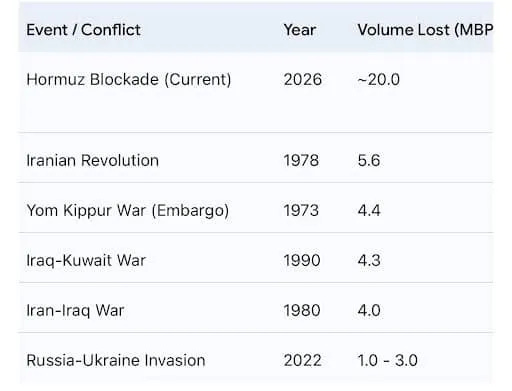
Let me start with a number. In 1980, when the Iran-Iraq war disrupted global oil supply, the volume lost was around 4 million barrels per day. Painful. The world went into recession. Volcker raised rates to 20% to kill inflation. It nearly killed the economy in the process. We called it a crisis and we meant it. The current Hormuz blockade is running at roughly 20 million barrels per day. The futures market, in its infinite wisdom, is pricing a quick resolution. Trump says the war is “basically over”. His Defense Secretary says it’s “only just the beginning”. One of them presumably has read the intelligence reports. The other has a golf course booked. That’s the pin. But that’s not the bubble.

Even in the most optimistic scenario – ceasefire tomorrow, everybody shakes hands – the Maersk CEO noted it takes at least ten days after a ceasefire for tanker insurance to clear. Then mine-clearing: Iran has been laying mines in the Strait, and removing them will take weeks to months. Then tankers reposition, loads getting secured, and finally the flow resumes. The oil futures curve is pricing step five as if it follows step one with a 48-hour lag. It cannot physically happen on that timeline.

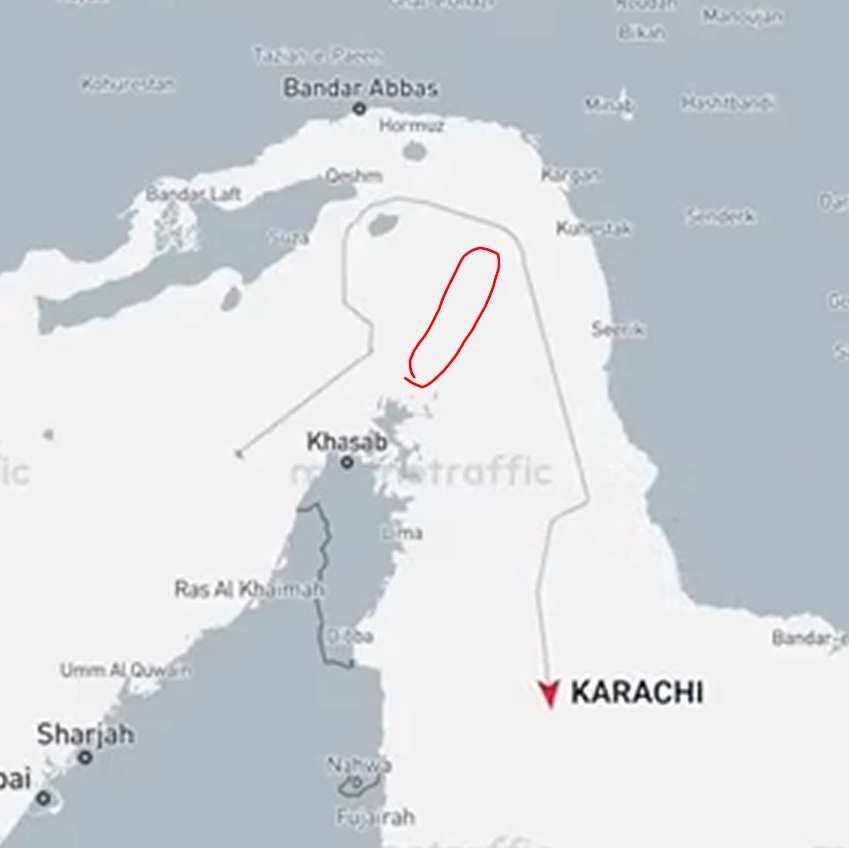
And Iran isn’t just shooting wildly at targets. Yesterday, Fujairah – the world-class bunkering hub sitting outside the Strait, the bypass everyone assumed would soften the blow – has been deliberately targeted. Tehran isn’t just closing Hormuz. It’s also closing the workarounds. One by one. Iran got fed up and decided to take down the imposed sanctions one way or another. And USrael just gave them the ultimate excuse.

If you’ve been reading my silver papers, you know there is a gap. A gap I call “PvP”… No not the gaming term. The Paper vs Physical. And oh boy. Is it screaming!! Brent futures in New York closed Friday at $104. Elevated but ok-ish. Dubai crude – you know, the real physical oil, real barrels, real buyers – was trading around $127-140. Normally Brent commands a premium over Dubai. Now Dubai is $37 above the paper. And that’s just crude. Bunker fuel in Singapore hit $140 per barrel this week. In Fujairah, $160. High-grade marine fuel, $175. Ships burning fuel right now are paying those prices regardless of what the futures strip says in New York. Silver at a $12 premium to Shanghai? pffff Silver… Amateur hour compared to oil!

If you’ve read Strait to Brrrrr, none of this is surprising. Paper price is massaged. The New York futures desk is clearly on something the physical buyers aren’t. However this started, this isn’t a military confrontation anymore. I’m even starting to doubt it ever was. The Strait stays closed, oil stays elevated. Oil stays elevated, inflation stays elevated. Inflation stays elevated, the Fed cannot cut. The Fed cannot cut, and $38 trillion in federal debt – already costing $880 billion a year in interest before the war added a billion dollars a day to the tab – gets rolled over at rates that make it progressively less serviceable. The dollar weakens under that strain. A weaker dollar makes the next barrel of imported oil more expensive in dollar terms. Which feeds back into inflation. Which keeps the Fed pinned.

It’s a loop. Iran just needs to keep the strait closed long enough for it to complete a few rotations. The bond market has noticed. Treasury yields are rising in the middle of a geopolitical crisis – not falling. Capital isn’t fleeing to bonds. It’s fleeing to gold. That is a verdict on the US fiscal position.

Trump knows the physical reality, which is why last week he called Putin. The country America has been sanctioning for four years. The one it branded an aggressor, a pariah, an enemy of the liberal world order. He called to ask for help. Then he went further and lifted Russian oil sanctions outright. A Democratic Senator responded with perhaps the best summary of the year: “Looks like we fought Iran and Russia won”.

What else? The IEA approved a record 400 million barrel reserve release. Bessent telegraphed futures market intervention to cap prices. Russian sanctions lifted. Each one a gesture. On my feed someone quoted: “The oil market is massively short of supply. The other options the administration has, other than ending the war, are actually pretty limited”. Woops.

That’s the pin. But actually, the pin in itself doesn’t matter. Really truly doesn’t matter. What does matter greatly however, is WHAT it pricked…
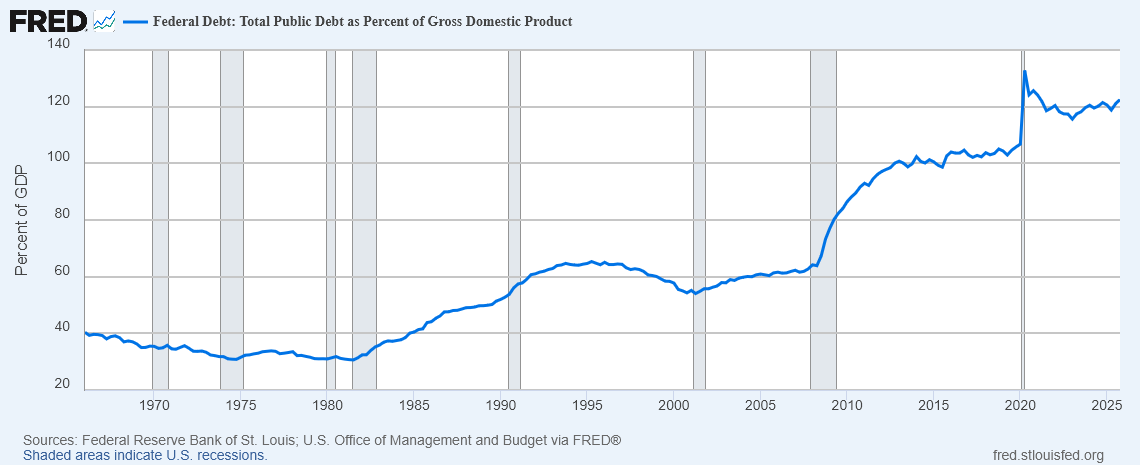
In 1980, US federal debt stood at 26% of GDP. Today it’s 120%. That’s the difference between the same shock hitting a healthy patient and hitting someone already on oxygen. The Volcker treatment that worked then is structurally unavailable now. But don’t worry! These are the same people who called inflation transitory. I’m sure they’ve got it. This time.

The interest bill on existing debt is already $880 billion a year, more than defence, more than Medicare. Rates at 20% on $37 trillion would cost more than the entire federal budget in interest payments alone. That lever doesn’t exist anymore.
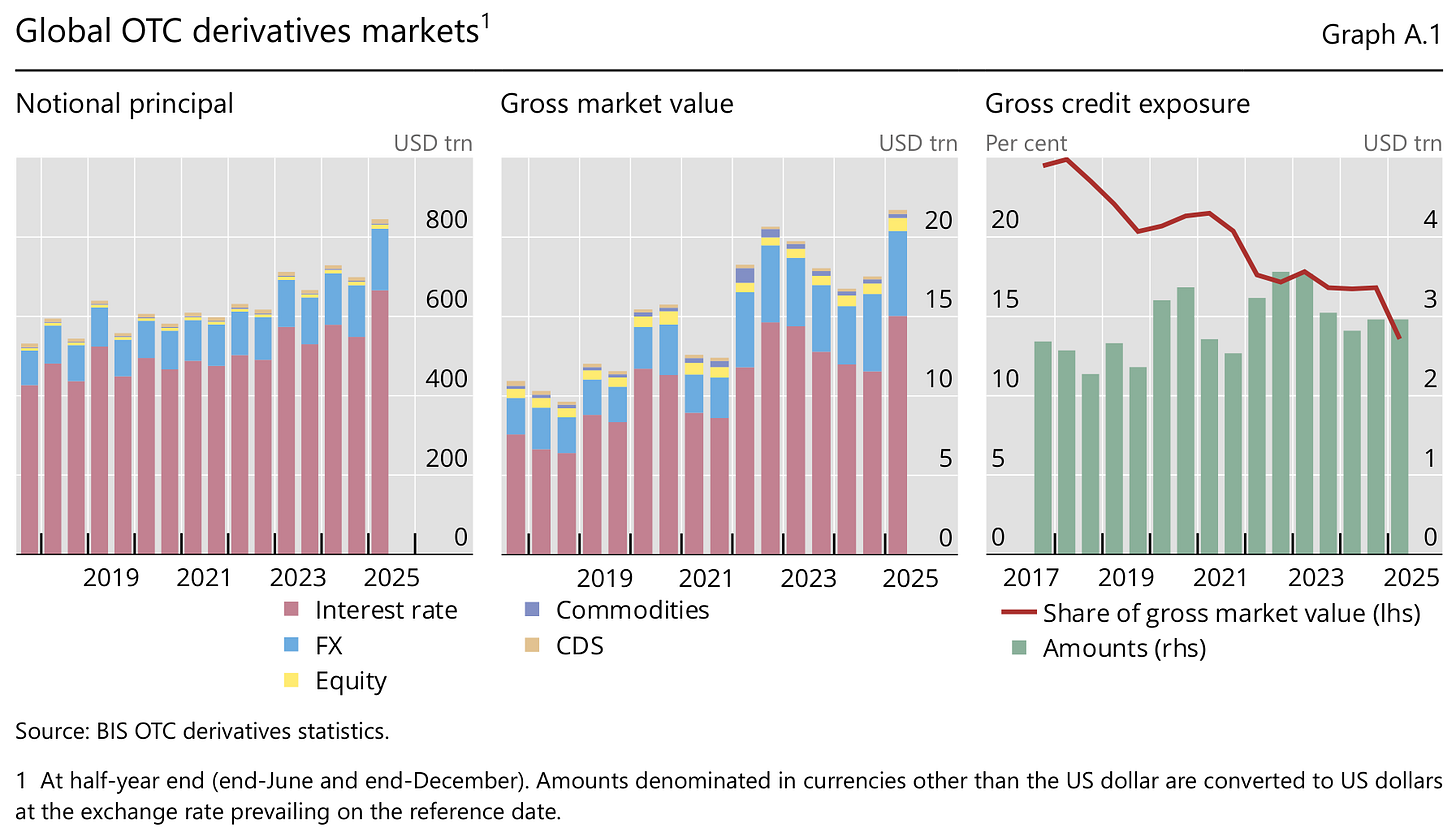
What exists instead is $846 trillion in notional OTC derivatives. Up from $108 trillion in 2000. An eightfold expansion in 25 years, and mid ‘24 → ’25 was the largest growth rate at 16% since 2008.

To put that number in some kind of human context: $846 trillion is roughly eight times the entire global GDP. With 1% of it you could buy every company in the S&P 500 twice over. With 0.01% you could buy Warren Buffett. With a rounding error – 0.0001% – a superyacht, a sports franchise, and a small Caribbean island, and you’d still have 99.9999% left. Nobody has this money, of course. Nobody owns $846 trillion. It’s the notional value of bets stacked on top of bets – leverage and hedges and derivatives daisy-chained to other derivatives. It nets out in normal conditions. In abnormal conditions, “nets out” becomes “finds out”.

Buffett called them ‘weapons of mass financial destruction’ in 2003. The book was $85 trillion then. The bulk of the current book – around $548 trillion – is interest rate derivatives. All of it priced on a world where oil is $70 and rates are roughly stable. Guess what just happened? Oil exploding (quite literally at times) make counterparties not being able to meet margin calls (guess why gold and silver are trembling so much) and that failure cascades through the chain.

The private credit system was already the weakest link before the war. I covered the gating wave in my previous article so I’m not going to repeat it here, but the language from people who are in the know got pretty alarming. Mohamed El-Erian reached for Bear Stearns 2007 as his reference point. Dimon started talking about cockroaches. Dimon… Talking about cockroaches… The Treasury Secretary himself said he was ‘concerned’ about private credit. When the man responsible for placing a trillion dollars per quarter in new debt publicly expresses concern about the credit system he depends on to function, well… I’ll leave it at that.

Think the gating’s bad? Let me reassure you *evil grin*. One in five companies in the Russell 3000 cannot service their debt from current income. Over half of all investment grade paper is a single downgrade from junk. $5 trillion in corporate debt rolls over in the next four years at current rates, into a war-driven inflationary environment the Fed cannot cut its way out of. The losses are in there. Just not visible yet. When they surface, the institutions holding private credit will face redemption pressure at exactly the moment public markets are offering their best entry points since 2022 /s. Nah, just kidding. They dump whatever they can. Anything, just about anything unrelated with their illiquid portfolio will be hit. You’ve seen this movie before. Gold fell when Iran struck. Silver fell. Same mechanics, a tad larger. Think ‘08 or ‘00 on steroids.

Now picture what happens when the equity markets start to move. The S&P 500 closed up 1% on Sunday night. The Dow gained 388 points. Meanwhile, fertiliser benchmarks are up 25-44% in seventeen days. Think food. Helium has doubled. Think chips – not the edible ones. Pharmaceutical feedstock pipelines are depleting. The wall between the financial “economy” and the real one is still holding. Walls do that, right until they don’t.
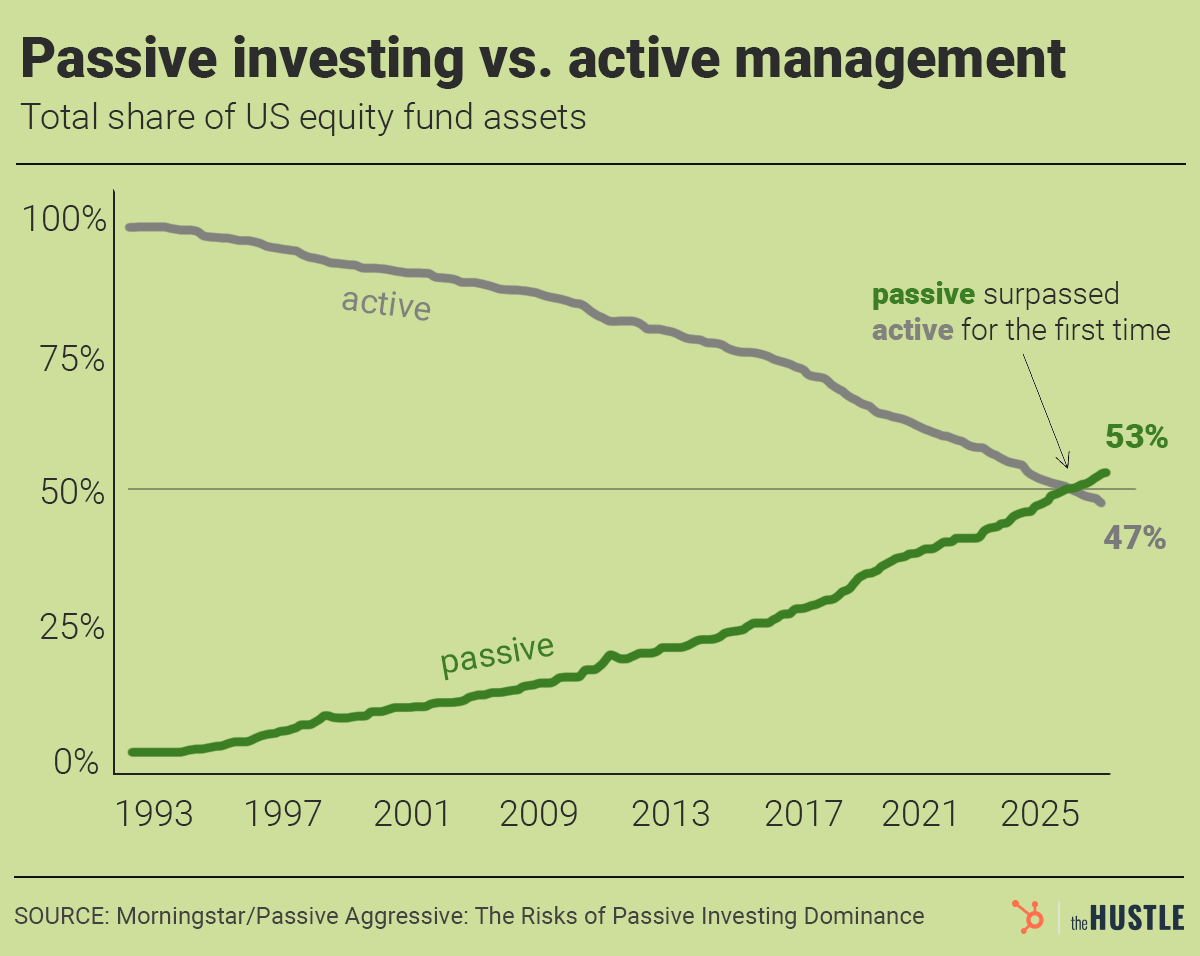
When people need cash fast, they sell what’s liquid. ETFs are the most liquid thing in the world. They sell indiscriminately – tech, gold miners, silver, and just about anything else. You don’t sell what you want to sell. You sell what has a bid. And passive investment? Volume wise, ETFs are like 60% of US equity markets (2024). In 1996 that was only 6%. Which means that when selling starts it’s mechanical. No analysis. No discrimination. Every ETF holder hitting the same exit through the same small door at the same time.

Think of “Liberation Day” as a test run. First-ever simultaneous crash in stocks, bonds, and the dollar – the thing that was supposed to go up when everything else went down. Tie into that the 401k withdrawals that hit a record high this week. The passive investment machine is leaking from the bottom while demographics drain it from the top. Feeling comfortable yet? *super evil grin*
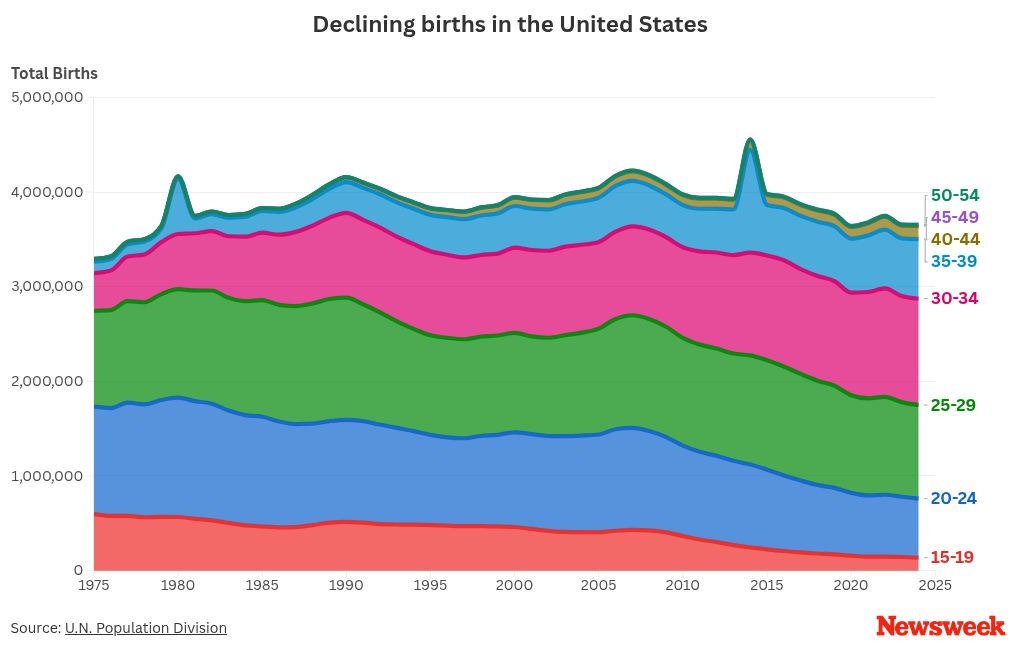
Underneath all of this, slower than any war and more permanent than any crisis, is something the financial press doesn’t really mention: People aren’t having any children. US fertility hit an all-time low in 2024. The general fertility rate is still falling. IMPLAN puts 1.4 million fewer Americans contributing to housing demand, retail spending, and service consumption in 2025 than trends would have predicted. To put that in numbers: $104 billion in GDP. Not exactly gone, not really disappeared. It just never existed in the first place.

It’s a vicious circle: housing is too expensive, so young people delay children. Fewer children means less future housing demand. Which should eventually reduce prices, except the lag is 20-30 years, and in the meantime housing stays expensive, so the people who couldn’t afford a house still can’t, still don’t have children, and the loop tightens at its own pace regardless of what the Fed does or what happens somewhere in the narrow waterways in exotic places.

Added: the boomers are saying bye sayonara. The generation that inflated every asset class for 40 years through automatic 401k contributions is, somewhere around now, flipping from net buyers to net sellers. Of course it’s impossible to say like “March, 17: boomers start to cash out their 401ks”… Nope, the tide just turns. The same passive machine that provided an inexorable, automatic bid for equities and bonds and real estate – every payday, every year, for four decades – begins to redeem. Quietly. Continuously. For the next twenty-some years. Every asset they inflated on the way up faces a headwind on the way out. Not a crash. A long, grinding, demographically-inevitable ratchet.

Another angle I want to cover is the petrodollar. I covered this already in “The Bretton Whoops”. But the short version is: oil was priced in dollars, dollars were recycled into Treasuries, and the US military keeps the Gulf safe. It required two things – a reliable dollar and a credible security guarantee. The dollar’s reliability cracked in 2022 when Washington froze Russia’s reserves. The security guarantee cracked when the US started a war they cannot finish.
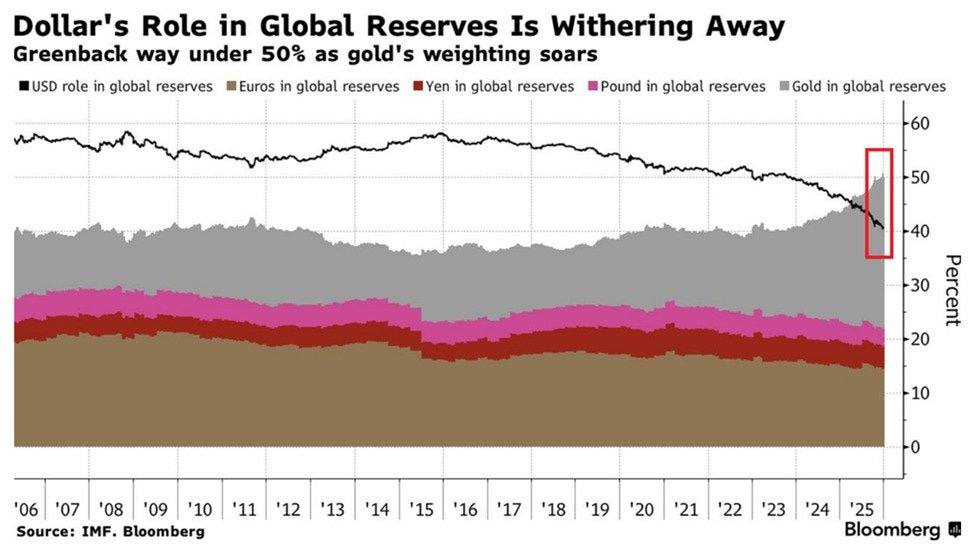
The dollar’s share of global FX reserves has since fallen to around 45%, the lowest since the 1990s. Gold’s share has quadrupled in twelve years. Gulf states are reportedly discussing pulling investment commitments from the US.

And now Iran has done something structurally interesting. It didn’t just close the Strait – it converted it into a tollgate. The toll isn’t money – yet. It’s alignment. Ten countries have been offered safe passage: China, India, Pakistan, Turkey, and others. The US isn’t on the list. This isn’t a military tactic. It’s economical.

Lots of people have the wrong framing. They think “petrodollar is dead, long live the yuandollar”. Right? Wrong frame entirely. China doesn’t want a reserve status. Couldn’t stomach it if it tried. Because a reserve currency means running a permanent trade deficits to pump your currency into the global system – America has been doing this for 50 years and the reward is a rust belt, a $37 trillion debt tab, and a bond market that needs foreigners to keep showing up or the whole thing seizes. China watched that happen and said: 不用了,谢谢. And opening the capital account enough to make yuan genuinely reserve-worthy would mean letting money flow freely across the border – ending the CCP’s ability to direct credit and control the financial system on Beijing’s terms. They’d sooner eat the wallpaper.

What the yuan-for-oil arrangement being implemented actually is, is an industrial policy dressed as currency diplomacy. You sell your oil into the permitted lane. You receive yuan. Now you’re sitting on yuan in a system with capital controls – you can’t just convert it and park it wherever you like. Your options are: buy Chinese goods, buy Chinese infrastructure contracts, invest in Chinese assets. That flow cycles straight back into Chinese factories and Chinese employment. China doesn’t have to stimulate its domestic consumption anymore. It exports the demand problem onto its trading partners and invoices it as a geopolitical arrangement. Three hundred million jobs – and unlike the US – no helicopter money required.

Those dollars that used to flow into Treasuries don’t just suddenly rush home. They just stop showing up at the next auction. Treasury needs to place roughly a trillion dollars every hundred days. Fewer buyers means higher yields. Higher yields mean the Fed is cornered. A cornered Fed means the printer runs. Same mechanism as demographics, same mechanism as the derivatives book, same direction.
My long-running conviction – and I’ve been saying this long enough that it stopped sounding contrarian and started sounding obvious – is that the world ends up back on a gold standard. Not the romanticised version where you rattle coins in your pocket. Though honestly, with modern payment rails, a gold-backed account is functionally identical to a dollar account. You’d never touch the metal. You’d just change the ticker from USD to XAU and carry on. The technology exists right now. The obstacle isn’t infrastructure. It’s that the people running the current system would rather light themselves on fire.

What happens first, before any grand declaration, is narrower: gold becomes the settlement layer between sovereigns who no longer trust each other’s paper. The US is apparently net-settling its trade deficit with China in gold – if that data holds up. In three of the last four months it seems that gold is flowing East. No Bretton Woods conference. No announcement. Just two countries quietly deciding that when the paper gets complicated, the metal clears the table. That’s how monetary systems actually change – not by proclamation but by practice, one bilateral settlement at a time, until enough of them are doing it that someone calls a conference to ratify what’s already happened. The Bretton Woods conference didn’t create the dollar system. It formalized what the war had already decided. The next conference is coming. It just hasn’t been scheduled yet.

Silver. Because I can’t write a piece about systemic fragility without it, and because this week’s data is worth your attention even if the price chart isn’t. The paper price looks terrible. Miners are trading like silver is heading back to $40. Silver Santa – one of the accounts I follow on Twitter (yeah, I’m old) – moved 40% to cash, describing “a strong pre-COVID feeling”. The technical picture is ugly. But the crucial part: the physical reality didn’t get that memo.

The COMEX “run rate to zero” ticked down to 89 days as of Friday, from 93 days on Thursday. Four days burned in one. The SGE briefly stopped publishing silver inventory data mid-week, then quietly resumed. Shanghai is still paying a 13-17% premium over London. The same paper/physical divergence playing out in oil is running in silver at a slower pace with a much longer fuse.

But what does a draining vault have to do with your savings account? More than most people think. The COMEX sets the global silver price. But if the COMEX increasingly doesn’t have the physical metal – and the run rate suggests it won’t for long – then the price it sets is a fiction. An unallocated silver account at your bank is a claim on that fiction. An ETF share is a claim on that fiction. When the fiction and the physical reality eventually converge, it won’t be because the paper comes up to meet the physical. It’ll be because the paper can no longer pretend. Same mechanism as Dubai crude. Same mechanism as the derivatives book. Just a slower fuse.

When $68 trillion in US equity markets eventually moves – and it will – and the indiscriminate ETF selling hits everything, and the margin calls cascade through a derivatives book built on assumptions that no longer hold, and zombie companies start defaulting, and the boomer redemptions add their steady mechanical pressure, and 401k hardship withdrawals accelerate – the question of where capital goes becomes very concrete. Bonds? Already struggling to absorb a trillion per quarter. Cash? In which currency? Real estate? In a demographically challenged market with rising yields?

Gold has a structural bid from central banks who drew their conclusions in 2022 and have been buying ever since. Silver has vaults on an 89-day countdown and a paper price that hasn’t caught up yet. I’m buying the dips. Have been. Will continue.

None of this is hidden. None of it requires a security clearance or even a Bloomberg terminal. It’s all there, in the vault data, the yield curves, the fertility statistics, the derivatives book, the bunker fuel prices. The information exists. The pattern is legible. The question was never whether this would happen. The question was always who would be holding paper when it did.

Tomorrow, Powell walks to the podium. He’ll probably have a new acronym handy. They always do. TALF, TARP, BTFP, BTFD, YOLO, CTRLP. Each crisis gets a fresh name but the same printer. Maybe a new suggestion: EEAO."

Bill Bonner, "The Fuse is Lit"

"The Fuse is Lit"
by Bill Bonner

What message are we sending? We’re sending a message
that we’re a bunch of fools - that we started a war we can’t win.’
- John Mearsheimer, Professor, U. of Chicago

Youghal, Ireland - "Our point of departure today is Tom’s insight...that oil is to the real economy what credit is to Wall Street. In preview, they work together. Amid so many explosions, it’s hard to keep our eyes on the real prize - that is, on the Primary Trend. Prices can go up and down, day to day, month to month. People can think whatever they want. But it’s the long-term trend that will make you either rich...or poor. Are we in a bull market...or a bear market? Are we getting richer...or poorer? Are we headed for peace...or war; for freedom...or slavery? Should we stay in oil and gold...or is it time to move on?

So far, our emphasis on gold has paid off well. When the century began, we were able to trade 40 ounces of gold for the Dow stocks. Now we can get all 30 of them for just ten ounces. Could that trend continue for another 25 years? Maybe. But there are no guarantees. Remember, there are two key ways to ruin an empire: debt and war. The Trump team, bless its heart, is eagerly advancing on both fronts, doing the gods’ dirty work.

This just in, Fortune: "America’s $38 trillion debt crisis is already here. The reckoning comes next." The US has over $38 trillion of national debt. We now spend more annually on interest than on the military. The primary trust funds for Social Security and Medicare are also projected to become insolvent within the next seven years, requiring an automatic benefit cut or even more deficit spending to backfill these programs. These pressures will intensify as the population ages, health care costs rise, and economic growth slows.

And the current war with Iran just makes everything worse. First, because it costs $11 billion per week. And second, because it threatens to wreak havoc on the entire world economy. In this respect, the Trump Team may have a hidden ‘fourth- or fifth- order effects’ agenda. Or it may be remarkably benighted. After the Iranians closed the Strait of Hormuz, Trump commented that “...nobody expected that. We were shocked. They fought back.” Yes, it was a real curve ball...out of left field...like dawn or bankruptcy, nobody would have seen that coming. Nobody. But now that it is here, what effect will it have?

We’ve seen what a sharp, sudden spike in interest rates (the availability of credit) does; businesses tighten up, employees are let go, spending goes down and GDP rates go from positive to negative - a recession, in other words...one that can easily become a depression if the credit tap is turned off for a prolonged period. This is not necessarily a bad thing. Excess credit - not backed by real savings - has to go away somehow. Typically, it disappears in higher prices for consumers...and booms and busts for investors.

Does oil work the same way? Not exactly. Too much (fake) credit is as bad or worse than not enough. Easy money invites sloppy spending. And while fake credit can be created out of thin air...the resources it commands are not. They’re real. Oil, skilled labor, and raw materials take time, capital, and discipline to put together. And once used, they are gone forever. A guy puts in a day’s work; day gone by can never be recovered. That’s how fake credit destroys real wealth. On Main Street, it is wasted on projects that don’t make economic sense. On Wall Street it is gambled away - on cryptos...tokens...Nvidia....AI...and other things unlikely to pay off.

Fake credit is the secret to how the feds can waste so many trillions of dollars. They borrow savings that were never earned, never saved, and never taxed...and use them to fund pointless bureaucracy and corrupt giveaways as well as unnecessary wars. In that regard, the war in Iran is just another way fake credit destroys real wealth.

Yes, the attack on Iran lights the fuse on both ends of the dynamite. It undermines the empire’s wealth while engaging it in nonsense wars at the same time. And it is funded by fake credit. But there’s no such thing as fake oil. And therein lie the ‘short hairs’ by which the mullahs seem to have taken hold of the world economy. The US fake money system can create all the credit you might want - and more! - but it can’t readily add to the world’s supply of oil. Where this will lead, exactly, we don’t know. But we are happy to stay in Maximum Safety Mode until the dust settles. Stay tuned."
o

"Swinging Wildly Toward Armageddon, the Wrecking Ball Gets Wrecked"

"Swinging Wildly Toward Armageddon,
the Wrecking Ball Gets Wrecked"
by David Haggith

"It was not a good day for President Trump. He disgraced himself worse than he ever has by turning to NATO to beg for help with the war he started - Trump’s War. He humiliated himself by pursuing their aid after having already told them he doesn’t need them and having boasted to Iran he doesn’t need anyone.

To a country, all NATO members told the wildly swinging pendulum of a president, in various words, “You shook your finger at all of us all of last year, publicly ridiculing us over how useless we are in your opinion. You tried to take over some of our countries, even threatening the possible use of your military. You tore up old tariff deals that you had made and even boasted about during your first term and then slapped higher tariffs all over us, thereby damaging all of our economies. You changed the terms of your tariffs, and then did it all over again.

“Then you told us, when we didn’t immediately agree to your world-imperiling war with Iran right from the start, much less to helping out in it, that you didn’t need us anyway! AND NOW YOU’RE COMING TO US WITH YOUR HAND OUT FOR HELP??? Now you’re asking again for us to risk the lives of our sons and daughters to join you in a conflict we didn’t want and still don’t agree with, after having said you don't need our permission for this war because you can do anything you want??? Now you’re pushing for us to spend our own treasure from what is left of the economies you damaged to help out in your war????”

As could easily be imagined, Trump’s approach of provoke, punish, then pursue didn’t sell. One has to wonder in what world that approach would ever bring former friends to the rescue. What kind of derangement would make anyone think he could turn to people, even entire nations, he had treated with total disrespect (even though they might deserve it) and then expect them to step in and help him in a war of his own making?

Admittedly, while they used a good number of those words, they didn’t say all of them; but it is without a doubt the sweep of arguments that were banging around inside their splitting heads when Trump approached them actually demanding help, not even asking nicely. You can only slap other world leaders all over the place for so many months before they don’t really feel like your allies anymore; and, if they are smart enough to stay out of a Middle Eastern war in order to avoid escalating it into all-out World War III by throwing all their nations into the fighting mix, then you make yourself look like a completely unhinged, totally out-of-touch fool for turning to those you treated like enemies with your hand now out for help.

You make yourself look like you have no concept whatsoever of how other people think or how they feel about your constant barrage of hostile words and actions … toward them personally, toward their national sovereignty over their own borders and toward you raining down destruction upon their economies. They spent a whole year using up an inordinate amount of their time trying to negotiate through all the chaos you threw at them, only to find out, in the end, you never had the authority to do 9/10ths of what you did!

NATO is a defensive alliance (though it has not always been used that way). There is no provision in its charter that requires NATO members to support attacks made against other non-nations by a member nation when the nation being attacked did not attack the member nation! Worse still, Trump has even talked about attacking other NATO members! So, it is only a wonder that he did not get ripped to shreds even more than he did today. (You can read all about it in the many stories below.)

Russia, China and even a former fangirl turned on Trump: The “Peace President,” as he liked to define himself, is being taken down for all of his warring ways, but especially for the war he started with Iran. Besides the incredulous looks he got from all over Europe as he began disparaging European leaders for not helping him attack Iran, several Russian newspapers commented that his disgraced begging, after bragging that he didn’t need help from anyone, shows that, as one put it, “Iran has Trump by the throat.”

Russian Editor Steven Rosenberg translated the Kommersant article as: “He messed up, and destroyed everything around him, but he wants someone else to clear the rubble and create a new structure. This is, of course, all about him, Donald Trump. The US president pinned Iran to the wall and practically forced it, for its own survival, to block such a key global transport artery as the Strait of Hormuz.”

After doing what the paper calls a “strange political flipflop”, it now says that Trump demands that other countries such as the UK, Germany and China engage in solving in the problem in the form of an assault on Iran. “Such a formulation of the question is, of course, phenomenal cheek” … a “permanent political characteristic” of Trump.

The paper suggested that Trump had finally met his match in Iran, saying he had tried to “strangle” the authorities in Tehran but instead ended up “tightening the noose around his own neck” - and even around countries that had no involvement in the US attack on Iran.

The Russians also took great satisfaction in the fact that Trump’s War has significantly weakened his hand for helping Ukraine. Even the normally restrained Chinese mocked Trump relentlessly. Memes went viral all over the internet about Trump holding out his hand like a beggar to the very people whose purses he has been draining all year.

But the coup de grâce of rebukes came from a former beauty queen in Trump’s own USA pageant, who is now a conservative influencer and who was formerly an adoring supporter of Trump and proud member of MAGA. She disgraced him by saying that, because of him, “MAGA is deader than dead.” Carrie Prejean Boller, once a staunch Trump supporter and a beauty pageant queen, is criticizing the Trump administration for what she calls an abandonment of the campaign’s “America First” mentality. In an alarming statement, she disavowed the president from the conservative movement.

“I’ve been a loyal supporter of the president for almost 20 years,” she told broadcaster Piers Morgan. “This goes back to when I was 21 years old, and I was Miss California at the Miss USA pageant. And I’ve known him - I consider him a dear friend - and I will tell you right now, I do not recognize our president… “And MAGA, let me tell you right now, MAGA is dead. It is deader than dead. And Americans are furious,” Prejean Boller said. “We do not recognize President Donald J Trump anymore.”

The center no longer holds: Do you think the wannabe emperor, Trump the Great, might have gone just a little bat-excrement crazy? So crazy that his strongest and most adoring supporters say they no longer even recognize the man? As I said yesterday, don’t take it from me. Take it from them - from those closest to Trump: ‘We clearly just kicked [Iran’s] a** in the field, but, to a large extent, they hold the cards now,’ a source close to the White House told Politico. ‘They decide how long we’re involved, and they decide if we put boots on the ground. And it doesn’t seem to me that there’s a way around that, if we want to save face.’

Some allies fear Trump risks being dragged into an open-ended conflict just as the midterm elections approach, with the escalating war threatening to drive up the cost of living for voters already furious about affordability. ‘The terms have changed,’ said a second person familiar with the military operation. ‘The off-ramps don’t work anymore because Iran is driving the asymmetric action.’

The war has also caused a schism between top allies within Trump’s MAGA movement, including Tucker Carlson and Megyn Kelly, as the President has argued for years against regime-change wars in the Middle East.

The center is no longer holding. The MAGA wall of power Trump erected around himself out of his supporters is falling apart because the center is falling apart. Trump is a man who has no center other than himself. Trump is falling apart. And when the center doesn’t hold, nothing built around it holds.

Trump is the center of his own universe; so, as he said again today, “I can do whatever I want.” He has the hubris of a demigod - someone who has come so thoroughly to believe and wrap himself in the fawning of everyone around him to where he now thinks of himself as a champion who no longer even needs those he wrapped around himself to build his wall of power. He no longer even attempts to be true them and all that he promised them. He has cast that all off as a distraction from his ambitions.

Yesterday, he started referring again to his next plans (because Iran is not enough) - his plans to take Cuba - to do, as he said, whatever he wants with it. There is never enough for the man with too much. President Donald Trump said he believes he will have “the honor of taking Cuba” and “could do anything” he wants with the Caribbean island nation… He talks like Cuba is his toy to do with as he pleases - again like a demigod - an incredible level of human pride.

So, away we go on another scatter-shot mission to take over another nation. Probably a war for next Sunday when Trump needs a distraction from his ongoing failure to bring the Iranian regime to its knees as he promised. He needs a quick victory, as he already claimed he had in Iran, to restore his image as the strongman - to show his supporters, who are rapidly falling away, that his imperial quest can succeed in order to galvanize their support and praise back around him. He needs a quick victory, and Cuba is starting to look like it.

Unfortunately for Trump, it is not likely to play out that way. As we have already seen with Iran, saw with Afghanistan and with Iraq and Syria, these things get messier than the Neocons and newly conned ever believe they will. It will only make him look all the more like the crazy man - stark raving crazy - as he tries to take on nation after nation to seize their land and is not even shy about stating their land or their oil is his aim.

Just this week, Trump said he’s going to seize for the US a strategic Iranian island named “Kharg” in the middle of the Strait of Hormuz because it is the hub of their oil shipping. It appears yesterday and today with his bombing and his moving of 5,000 marines, he has already begun the assault. Looking for land to grab from former European allies who have turned away from him. Looking to grab all of Canada. Seizing control of Venezuelan oil and maybe of its government (we shall see). For the man with too much, it is never enough.

Trump is a wrecking ball, swinging madly all over the planet, hitting any place that strikes his fancy. If he is, as his White House prophets have proclaimed, “God’s anointed” or “appointed,” then he must, as I’ve said, be God’s wrecking ball, intended to destroy the whole world because, so far, that seems to be what is happening. All nations are starting to turn away from the US and from Israel to leave the two to bring on Armageddon. I’m not predicting that is where all of this will go … but his Secretary of War is! I’m just stating an observation that it certainly appears hellbent in that direction. In the process, the president is cracking up and so is all the support around him.

While his departing supporters may be starting to see hints of the narcissism that was always obvious through the emerging cracks in his head, I now see something that goes even deeper. What we witnessed today was a president who is the sole center of his own universe, as is true of any narcissist, caving into his own megalomania. The star is collapsing into his own black hole, pulled in by the gravitas of his own thoughts about himself, and dragging all the light into the collapse."

Tuesday, March 17, 2026

Jeremiah Babe, "Why Did We Really Bomb Iran? We Aren't Going Back To Normal Times"

Jeremiah Babe, 3/17/26
"Why Did We Really Bomb Iran?
 We Aren't Going Back To Normal Times"
Comments here:

Gerald Celente, "The Greatest Depression"

Strong language alert!
Gerald Celente, 3/17/26
"The Greatest Depression: America's 
Uniparty Crime Syndicate Is Destroying The Nation"
"The Trends Journal is a weekly magazine analyzing global current events forming future trends. Our mission is to present Facts and Truth over fear and propaganda to help subscribers prepare for What's Next in these increasingly turbulent times."
Comments here:

Musical Interlude: 2002, "Return to Freedom"

Full screen recommended.
2002, "Return to Freedom"

"A Look to the Heavens"

“You may have heard of the Seven Sisters in the sky, but have you heard about the Seven Strong Men on the ground? Located just west of the Ural Mountains, the unusual Manpupuner rock formations are one of the Seven Wonders of Russia. How these ancient 40-meter high pillars formed is yet unknown.
The persistent photographer of this featured image battled rough terrain and uncooperative weather to capture these rugged stone towers in winter at night, being finally successful in February of last year. Utilizing the camera's time delay feature, the photographer holds a flashlight in the foreground near one of the snow-covered pillars. High above, millions of stars shine down, while the band of our Milky Way Galaxy crosses diagonally down from the upper left.”

"I Was a Strong Man for 83 Years. It Was a Terrible Mistake"

Full screen recommended.
by Life After Sixty and Before It’s Too Late
"I Was a Strong Man for 83 Years. It Was a Terrible Mistake"
"This channel brings you raw, thoughtful conversations inspired by people over sixty - sharing the mistakes they wish they’d avoided, the regrets that stayed with them, and the lessons that truly mattered in the end. These stories are shaped by time, reflection, and hard-earned clarity."
Comments here:

"How To Recover When The World Breaks You"

"How To Recover When The World Breaks You"
by Ryan Holiday

"There is a line attributed to Ernest Hemingway - that the first draft of everything is sh*t - which, of all the beautiful things Hemingway has written, applies most powerfully to the ending of "A Farewell to Arms." There are no fewer than 47 alternate endings to the book. Each one is a window into how much he struggled to get it right. The pages, which now sit in the Hemingway Collection at the John F. Kennedy Library in Boston, show Hemingway writing the same passages over and over. Sometimes the wording was nearly identical, sometimes whole sections were cut out. He would, at one moment of desperation, even send pages to his rival, F. Scott Fitzgerald, for notes.

One passage clearly challenged Hemingway more than the others. It comes at the end of the book when Catherine has died after delivering their stillborn son and Frederic is struggling to make sense of the tragedy that has just befallen him. “The world breaks everyone,” he wrote, “and afterward many are strong at the broken places. But those that will not break it kills.”

In different drafts, he would experiment with shorter and longer versions. In the handwritten draft he worked on with F. Scott Fitzgerald, for instance, Hemingway begins instead with “You learn a few things as you go along…” before beginning with his observation about how the world breaks us. In two typed manuscript pages, Hemingway moved the part about what you learn elsewhere and instead added something that would make the final book - “If people bring so much courage to this world the world has to kill them to break them, so of course it kills them.”

My point in showing this part of Hemingway’s process isn’t just to definitively disprove the myth - partly of Hemingway’s own making - that great writing is something that flows intuitively from the brain of a genius (no, great writing is a slow, painstaking process, even for geniuses). My point is to give some perspective on one of Hemingway’s most profound insights, one that he, considering his tragic suicide some 32 years later, struggled to fully integrate into his life.

The world is a cruel and harsh place. One that, for at least 4.5 billion years, is undefeated. From entire species of apex predators to Hercules to Hemingway himself, it has been home to incredibly strong and powerful creatures. And where are they now? Gone. Dust. As the Bible verse, which Hemingway opens another one of his books with (and which inspired its title) goes: “One generation passeth away, and another generation cometh: but the earth abideth forever…The sun also ariseth, and the sun goeth down, and hasteth to the place where he arose…”

The world is undefeated. So really then, for all of us, life is not a matter of “winning” but of surviving as best we can - of breaking and enduring rather than bending the world to our will the way we sometimes suspect we can when we are young and arrogant.

I write about Stoicism, a philosophy of self-discipline and strength. Stoicism promises to help you build an “inner citadel,” a fortress of power and resilience that prepares you for the difficulties of the world. But many people misread this, and assume that Stoicism is a philosophy designed to make you superhuman - to help you eliminate pesky emotions and attachments, and become invincible.

This is wrong. Yes, Stoicism is partly about making it so you don’t break as easily - so you are not so fragile that the slightest change in fortune wrecks you. At the same time, it’s not about filling you with so much courage and hubris that you think you are unbreakable. Only the proud and the stupid think that is even possible. Instead, the Stoic seeks to develop the skills - the true strength - required to deal with a cruel world.

So much of what happens is out of our control: We lose people we love. We are financially ruined by someone we trusted. We put ourselves out there, put every bit of our effort into something, and are crushed when it fails. We are drafted to fight in wars, to bear huge taxes or familial burdens. We are passed over for the thing we wanted so badly. This can knock us down and hurt us. Yes.

Stoicism is there to help you recover when the world breaks you and, in the recovering, to make you stronger at a much, much deeper level. The Stoic heals themselves by focusing on what they can control: Their response. The repairing. The learning of the lessons. Preparing for the future.

This is not an idea exclusive to the West. There is a form of Japanese art called Kintsugi, which dates back to the 15th century. In it, masters repair broken plates and cups and bowls, but instead of simply fixing them back to their original state, they make them better. The broken pieces are not glued together, but instead fused with a special lacquer mixed with gold or silver. The legend is that the art form was created after a broken tea bowl was sent to China for repairs. But the returned bowl was ugly - the same bowl as before, but cracked. Kintsugi was invented as a way to turn the scars of a break into something beautiful.

You can see in this tea bowl, which dates to the Edo period and is now in the Freer Gallery, how the gold seams take an ordinary bowl and add to it what look like roots, or even blood vessels. This plate, also from the Edo period, was clearly a work of art in its original form. Now it has subtle gold filling on the edges where it was clearly chipped and broken by use. This dark tea bowl, now in the Smithsonian, is accented with what look like intensely real lightning bolts of gold. The bowl below it shows that more than just precious metals can improve a broken dish, as the artist clearly inserted shards of an entirely different bowl to replace the original’s missing pieces.

In Zen culture, impermanence is a constant theme. They would have agreed with Hemingway that the world tries to break the rigid and the strong. We are like cups - the second we are made we are simply waiting to be shattered - by accident, by malice, by stupidity or bad luck. The Zen solution to this perilous situation is to embrace it, to be okay with the shattering, perhaps even to seek it out. The idea of wabi-sabi is precisely that. Coming to terms with our imperfections and weaknesses and finding beauty in that.

So both East and West - Stoicism and Buddhism - arrive at similar insights. We’re fragile, they both realize. But out of this fragility, one of the philosophies realizes there is the opportunity for beauty. Hemingway’s prose rediscovers these insights and fuses them into something both tragic and breathtaking, empowering and humbling. The world will break us. It breaks everyone. It always has and always will.

Yet…The author will struggle with the ending of their book and want to quit. The recognition we sought will not come. The insurance settlement we so desperately needed will be rejected. The presentation we practiced for will begin poorly and be beset by technical difficulties. The friend we cherished will betray us. The haunting scene in "A Farewell to Arms" can happen, a child stillborn and a wife lost in labor - and still tragically happens far too often, even in the developed world.

The question is, as always, what will we do with this? How will we respond? Because that’s all there is. The response. his is not to dismiss the immense difficulty of any of these ordeals. It is rather, to first, be prepared for them - humble and aware that they can happen. Next, it is the question: Will we resist breaking? Or will we accept the will of the universe and seek instead to become stronger where we were broken?

Death or Kintsugi? Fragile or, to use that wonderful phrase from Nassim Taleb, 'Antifragile?' Not unbreakable. Not resistant. Because those that cannot break, cannot learn, and cannot be made stronger for what happened. Those that will not break are the ones who the world kills. Not unbreakable. Instead, unruinable."
Freely download "A Farewell To Arms", by Ernest Hemingway, here: