StatCounter

Monday, March 16, 2026

The Poet: Edward Hirsch, "I Was Never Able To Pray"

"I Was Never Able To Pray"

"Wheel me down to the shore
where the lighthouse was abandoned
and the moon tolls in the rafters.
Let me hear the wind paging through the trees
and see the stars flaring out, one by one,
like the forgotten faces of the dead.
I was never able to pray,
but let me inscribe my name
in the book of waves
and then stare into the dome
of a sky that never ends
and see my voice sail into the night."

- Edward Hirsch

"Some Oddities..."

"There are some oddities in the perspective with which we see the world. The fact that we live at the bottom of a deep gravity well, on the surface of a gas covered planet going around a nuclear fireball 93 million miles away and think this to be normal is obviously some indication of how skewed our perspective tends to be."
- Douglas Adams

"Now They Are Actually Telling Us That There Is A Massive "Gravity Hole" Underneath Antarctica?"

by Michael Snyder

"For decades, we were told to ignore any of the strange reports that we were hearing about Antarctica. Experts assured us that nothing unusual was going on and that there wasn’t anything to be concerned about. Of course we couldn’t go investigate for ourselves, because as you will see below, there are 72 areas of Antarctica that only those with a special permit are allowed to enter. And if you try to fly to Antarctica without authorization, you will get into all sorts of trouble. So why all the secrecy? What are they trying to hide from all the rest of us?

One thing that scientists are admitting about Antarctica is that it sits directly above the strongest “gravity hole” on the entire planet…Earth may look like a smooth “blue marble” from space, but it’s better to imagine it as a slightly gnarled orange, with an inside that’s firm in parts, but squishier in others. Since the planet isn’t a perfect sphere and its internal density varies across the globe, gravitational pull changes from place to place. Where there’s less mass in the underlying geology, gravity is weaker, and vice versa.

These dips in the gravitational field are formally known as gravity anomalies, but they’re more commonly called “gravity holes”. The largest is found in the middle of the Indian Ocean, spanning over 3 million square kilometers (roughly 1,100,000 square miles), while the strongest is found in Antarctica.

Isn’t that interesting? It turns out that there is a gigantic “hole” under Antarctica after all. But the experts are insisting that there really isn’t anything particularly special about it. In fact, they try to make it sound as boring as possible… A “gravity hole” beneath Antarctica sounds like the plot to a bad sci-fi movie, but it’s a very real situation deep beneath the Earth’s surface stretching back tens of millions of years. The phenomenon thankfully isn’t as apocalyptic as it sounds, either. In fact, researchers say these complex interactions between rock densities, gravitational pull, and sea levels are actually helping them understand how the southernmost continent’s ice sheets evolved, and what their influences mean for the planet’s climate.

Yawn. That does sound pretty boring. But could it be possible that there is a lot more to this than we are being told? It is being reported that the team of researchers that mapped the colossal gravity hole directly under Antarctica was able to use a combination of methods to actually “reconstruct the three-dimensional structure” that exists underneath the continent…


In the study, published recently in Scientific Reports, Forte and Petar Glišović, Ph.D., of the Paris Institute of Earth Physics, mapped the Antarctic gravity hole and revealed how it developed over millions of years. They relied on an Earth-spanning scientific project that combined global earthquake recordings with physics-based modeling to reconstruct the three-dimensional structure inside Earth. “Imagine doing a CT scan of the whole Earth, but we don’t have X-rays like we do in a medical office. We have earthquakes. Earthquake waves provide the ‘light’ that illuminates the interior of the planet,” Forte said.

It certainly appears that something is down there. Could some of the reports that we have heard over the years actually be true? I wouldn’t hold your breath waiting for the truth to come out. Much of the continent is strictly off limits unless you have a special permit. In fact, according to Wikipedia there are 72 sites that have been designated as Antarctic Specially Protected Areas…

"An Antarctic Specially Protected Area (ASPA) is an area on the continent of Antarctica, or on nearby islands, which is protected by scientists and several different international bodies. The protected areas were established in 1961 under the Antarctic Treaty System, which governs all the land and water south of 60 latitude and protects against human development.[1] A permit is required for entry into any ASPA site.[2] The ASPA sites are protected by the governments of Australia, New Zealand, United States, United Kingdom, Chile, France, Argentina, Poland, Russia, Norway, Japan, India, Italy, and Republic of Korea. There are currently 72 sites."

They take security in Antarctica quite seriously. When a 19-year-old American named Ethan Guo decided that he would fly down there without permission, he was immediately arrested…"A teenage pilot, who is attempting to fly all seven continents solo, hit a patch of rough air this weekend when Chilean authorities detained him for changing his flight plan without their permission and landing in Antarctica.

Chilean prosecutors say American influencer Ethan Guo, 19, broke “multiple national and international regulations” by changing his flight plans without prior notice, landing on a part of Antarctica where the South American country maintains a territorial claim. CNN requested a comment from Guo, whose lawyer on Sunday said the young pilot had experienced “complications” while flying."

Yes, tourists can visit Antarctica. But you must carefully obey the rules, and you must not wander away from the very limited areas that tourists are allowed to see. Of course most of the good stuff is in areas where tourists are never allowed, and that includes the colossal pyramid that appears to have been man-made
I have to admit, the symmetry of that structure is quite striking. But even though it looks like an ancient Egyptian pyramid, the official story is that this is simply a naturally-occurring structure that was shaped by erosion

"In the vast, icy expanse of Antarctica, lies a mountain that, from an aerial view, resembles an ancient Egyptian pyramid. This striking formation, nestled in a sea of snow, has captured the imagination of internet users since it went viral in 2016. However, this pyramid-like mountain is no work of human or alien architects; it’s a product of nature’s slow and relentless erosion.

This unnamed mountain stands about 4,150 feet tall. It’s located in the southern part of the Ellsworth Mountains, a rugged range first glimpsed by American aviator Lincoln Ellsworth in 1935. The mountain’s pyramid shape is particularly notable because it has four steep sides, a feature that isn’t common among mountains." I wish that I could go see it for myself. But that certainly isn’t going to happen any time soon.

Interestingly, a “ring of fire” solar eclipse was visible in Antarctica on Tuesday…"A magnificent annular solar eclipse just swept over Antarctica, putting on an impressive display of orbital mechanics as the moon passed in front of the sun at the perfect distance from Earth to create a fiery halo in a darkened sky  -  at least for the few souls lucky enough to be in a position to see it.

Feb. 17’s annular solar eclipse occurred as the lunar disk slipped between the sun and Earth during its new moon phase. The alignment occurred as the moon travelled through a distant point in its elliptical orbit, making it appear smaller than usual in Earth’s sky.

Today’s eclipse got underway at 4:56 a.m. EST (0956 GMT), as the moon took an ever greater bite out of the solar disk, transforming its burning orb into a glowing crescent, before finally diving entirely within its fiery expanse. The moon - appearing fractionally smaller than usual - was unable to cover the entirety of the sun’s disk, leaving a thin sliver of its outer edge visible to surround Earth’s natural satellite to create a ring in the skies over Antarctica.

So many unusual things are happening in the heavens this year. Next month there will be a spectacular blood moon eclipse, and the month after that an absolutely enormous comet may be visible to the naked eye during the daytime as it travels very close to the Sun. We live in such interesting times, and I have a feeling that they will become even more interesting during the months ahead."

The Daily "Near You?"

Regensburg, Bayern, Germany. Thanks for stopping by!

Travelling With Russell, "Russian Typical (Luxury) Apartment: Could You Live There?"

Meanwhile, elsewhere...
Full screen recommended.
Travelling With Russell, 3/15/26
"Russian Typical (Luxury) Apartment: 
Could You Live There?"
"What is it like to live in a Russian Typical Luxury Apartment in the Ramenskoye region of Moscow, Russia? Join me on a tour of a fully furnished 2-bedroom, 2-bathroom brand-new apartment in Moscow, Russia. The apartment is listed for sale and ready for a new owner."
Comments here:
o
Full screen recommended.
Travelling With Russell, 3/15/26
"Russian Typical (American Style) Supermarket:
 O'Key"
"What does a Russian Hypermarket look like inside? Join me at O'Key Hypermarket, a former Luxembourg-owned hypermarket chain, which is now owned by a local Russian group. How has this chained fiared in the last 4 years in the face of Sanctions imposed on Russia?"
Comments here:

"Millions Warned: Gas Prices May Surge Again"

Full screen recommended.
Snyder Reports, 3/16/26
"Millions Warned: Gas Prices May Surge Again"
Comments here:

Dan, I Allegedly, "The New American Dream - People Are Going Off Grid"

Full screen recommended.
Dan, I Allegedly, 3/16/26
"The New American Dream -
 People Are Going Off Grid"

"Housing prices are spiraling out of control across the United States, with the average home now costing over $400,000 and rents hitting record highs. At the Overland Expo, I take you inside a growing movement of people turning to off-grid living, camper life, and overlanding as alternatives to traditional housing. From affordable trailers to extreme $500,000 expedition vehicles with solar power, water systems, and full off-grid capabilities, this event shows how Americans are rethinking the way they live as the housing crisis continues to worsen.

More people are exploring van life, tiny homes, and camper living as a way to escape rising rent, mortgage payments, and the financial pressure of today’s economy. With stories about skyrocketing home prices, extreme housing shortages, and people packing multiple families into small apartments, the question becomes clear: is off-grid living becoming the new American dream? Let me know what you think in the comments and share what housing prices look like in your area."
Comments here:

"How It Really Is"


National debt clock, real time:
https://www.usdebtclock.org/

Bill Bonner, "Courting Disaster"

"Courting Disaster"
by Bill Bonner
Youghal, Ireland - "The most remarkable thing about the bombing of Iran is the premise behind it. We’ll come back to that in a minute. First, the economic news, from the Washington Post: "The Commerce Department downwardly revised its estimate of economic growth in the fourth quarter of last year, saying that gross domestic product expanded at just 0.7 percent annual rate in the final three months of 2025, much smaller than the 1.4 percent pace the department had reported in an “advance” estimate last month.

The Federal Reserve’s preferred inflation gauge, the Personal Consumption Expenditures price index, rose 2.8 percent over the prior year, a slight decline from December but still well above the Fed’s 2 percent target. More concerning to some economists, so-called core PCE inflation - which strips out volatile food and energy prices and is closely watched as a measure of underlying price trends - ticked up to 3.1 percent in January from 3.0 percent in December."

Low growth? Higher prices? Sounds like stagflation. Whatever it is, the attack on Iran makes it worse. The firepower industry gets richer. Everyone else gets poorer. And now that Kristi Noem is gone, Pete Hegseth must be the most embarrassing member of America’s presidential cabinet. He thinks you win a war by blowing things up. But what is the point of it? So far, the only explanation that makes sense comes from Mr. Hegseth, who suggests that the goal was to take out Iran’s defenses...so we could bomb it some more. The Wall Street Journal: "Hegseth Says U.S. and Israel Are Winning."

“The United States is decimating the radical Iranian regime’s military, in a way the world has never seen before,” he said during a Pentagon news conference Friday. “Never before has a modern, capable military, which Iran used to have, been so quickly destroyed and made combat ineffective, devastated. We said it would not be a fair fight, and it has not been.” What hallucinatory drugs is this idiot on? - CP)

They are ‘bad people,’ says POTUS. Maybe bombing them will turn them into good people? As near as we can tell, the underlying motive for both the attack on Iraq and the attack on Iran were the same - to make these countries more fetching to US eyes...and more compliant with its policies. That is, we aimed to turn these bad people into our friends and allies. But the idea of bombing a country to make it a friend...is a little like assaulting a woman to win her affection. She won’t cooperate? Give her the ol’ bitchslap.

This is something both Hegseth and Trump are reputed to have personal experience with, so we will defer to their judgement. But we imagine that it only works on a very unique woman. Iran may not be that gal. That Wall Street Journal: "Oil market’s new reality: The Gulf disruption isn’t going to end soon. When the U.S. and Israel first attacked Iran, some traders initially expected days of disorder. Now they are expecting the turmoil to last weeks or even months. On Thursday, Brent crude shot back above $100 a barrel amid growing concerns about a protracted period of disruption to the oil markets. Futures settled at $100.46, up more than 9% for the day."

Iraq turned out not to be that kind of woman either. Even after $5 trillion spent to impress her...she’s still not cooperating. In the Iraqi Parliament, members chant “Death to America.” And out on the streets, Americans may get more than just smiles. The Financial Times: "Shia militias targeted a US diplomatic and logistics facility inside Baghdad’s airport complex with several drones on Tuesday night, said people familiar with the situation. All but one were intercepted. The people said retaliatory strikes were then launched on militia positions on Wednesday. The armed groups have also attacked oil installations, an airport and several hotels housing US citizens in Erbil and have claimed attacks on Jordan and Kuwait. An Italian military base in Iraq’s Kurdistan region was also struck."

The New York Times adds: "U.S. Embassy in Baghdad Targeted as Iraq Gets Drawn Deeper Into Regional War." Apparently, we didn’t bomb them enough."

"March, 15: Ides of Hormuz"

"March, 15: Ides of Hormuz"
By NO1

"A war without leaders The Ides of March. March 15. Despite numerous warnings, Caesar walked into a room full of friends and received twenty-three knives in return. No debate. No negotiation. No appeal. Just the sound of metal and surprise. Since that day, this date has carried one meaning: what happens when you ignore every sign that the people around you have already decided.

The United States asked every ally it has to send warships to the Strait of Hormuz. China declined. France declined. Japan: “We make our own decisions and will not send ships to the Strait of Hormuz just because Trump asks us to”. Germany, Norway, Italy, Hungary - all declined. Switzerland refused two overflight requests. Iran received calls from thirty countries asking for bilateral passage agreements. The knives were diplomatic this time. But Caesar is just as alone.

Semafor broke the news Saturday evening. US officials confirming what the interceptor maths have been screaming since day one: Israel is critically low on ballistic missile interceptors. They entered the war already depleted from last year’s conflict. Not my math anymore. Officials this time, on the record, for publication. The cupboard isn’t running bare. It’s bare. And Iran knows it.

Wave 54 of True Promise brought the Sejjil-2 into combat for the first time. The solid-fuel ballistic missile I wrote about a few days ago. Mach 17 at its terminal phase. Solid-fuel means it rolls out of the underground city and fires. The interceptor meant to stop them are gone. The radar meant to track it was killed in week one. Iran spent two weeks stripping the armor. The Sejjil is what you needed the armor for.

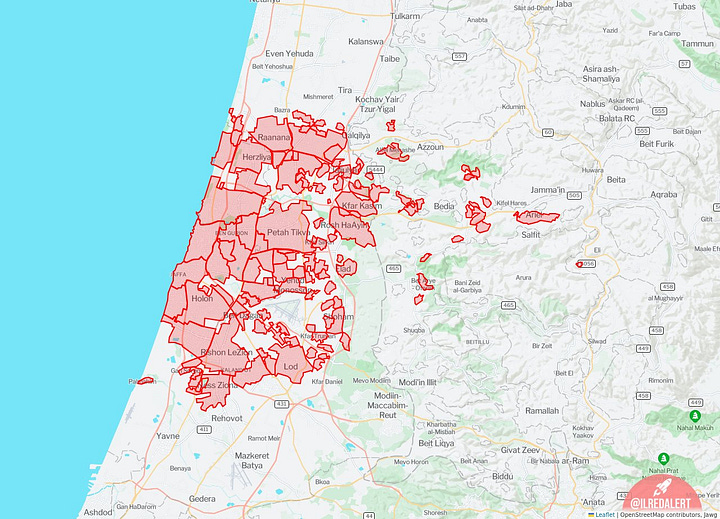
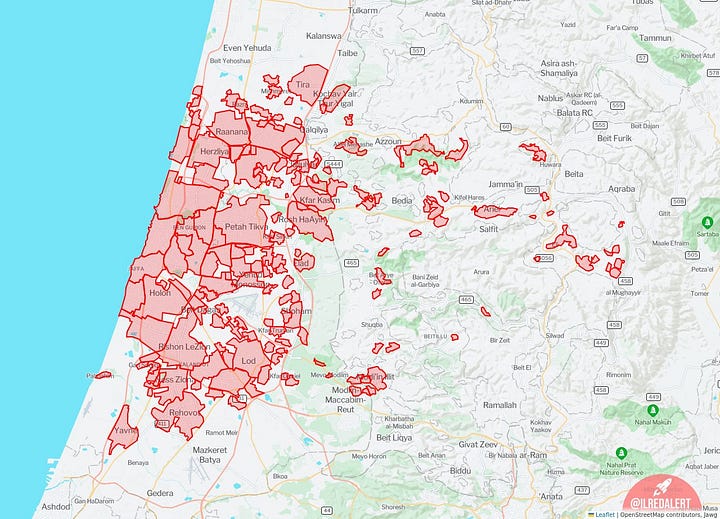
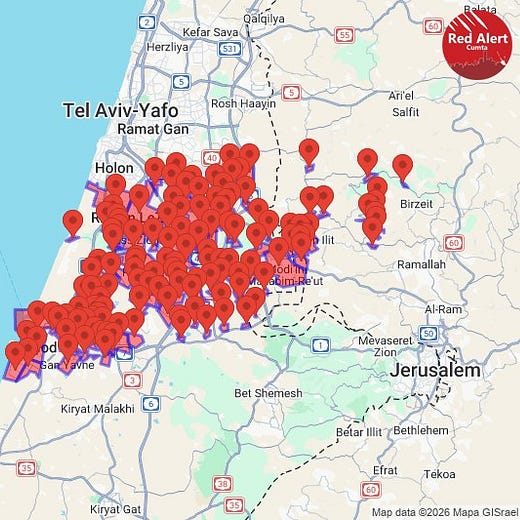
At 02:24 on Sunday morning, a ballistic missile launched toward central Israel. Sirens sounded at 02:27. Three minutes. Whatever is left of the sensor network - and there isn’t much - bought three minutes. Standard warning time is fifteen. A later strike hit Tel Aviv with no warning at all. Cluster munitions scattered across Ramat Gan, Bnei Brak, Petah Tikva. Channel 12 reported significant destruction and fires at three locations. Dead and wounded pulled from a building in Bnei Brak.
A hundred and ninety-eight alerts in one salvo. A hundred and forty-three more an hour later.

Protests in Tel Aviv – fires set in the streets, crowds heading toward government buildings. Since the start of the war, Israel’s Compensation Fund has received 10,946 claims. Of these, 7,648 are for building damage, 1,179 for contents and equipment, 1,945 for vehicle damage, and 174 for other types of losses. The paperwork is outpacing the Pentagon’s casualty count by roughly a thousand to one. Someone’s numbers are wrong.

Netanyahu released a video. Drinking coffee. Showing five fingers, because the AI version from yesterday gave him six. The internet went forensic immediately. Coffee doesn’t spill. Level doesn’t change after he drinks. Some say AI. Some say actor. A Kuwaiti daily says he’s being treated in Moscow. Turkish TV says dead. A French colonel says the announcement comes “tomorrow”. Still no live appearance. No press conference. Absent from the military council for the first time in Israeli history. Yair – relentless tweeter – has been silent now for six days. The Air Force Chief, the Mossad Director, Ben Gvir… The list is getting longer. All missing from the public eye.

On Friday, CENTCOM’s line was careful: 90 military targets destroyed on Kharg island while “preserving the oil infrastructure”. Day 14 opened with the proof - two Iranian tankers loading. The oil wasn’t touched.
By Saturday night, the story had changed. Trump on NBC: the strikes “totally demolished” most of the island. Then, almost as an afterthought: “we may hit it a few more times just for fun”. Schrödinger’s island. Both demolished and intact…

Hours later, Iran’s Foreign Minister went on CBS Face the Nation. “There are people being killed only because President Trump wants to have fun”. Same word. Same day. One man using it about his bombing campaign. The other about his country’s dead. Araghchi in the same interview: “We never asked for a ceasefire or negotiations. We are ready to defend ourselves as long as it takes until Trump comes to the point that this is an illegal war”.
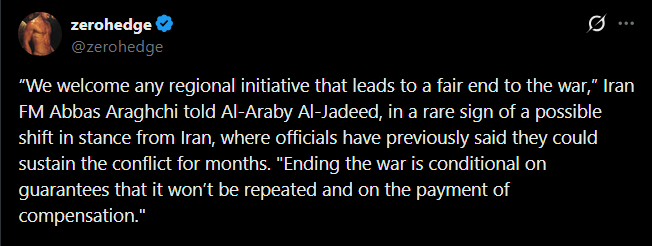
But he told Al-Araby Al-Jadeed something subtler the same day: “We welcome any regional initiative that leads to a fair end to the war”. First time Iran has used language that isn’t pure refusal. Not a ceasefire offer. But a door cracked open for regional mediation. The hardliners say fight forever. The diplomats leave a narrow lane. Maybe they’re reading from the same script. Probably.

US intelligence shared with Trump apparently shows the late Ayatollah had documented reservations about Mojtaba’s suitability. The IRGC installed him anyway. Al Jarida claims Mojtaba is in Moscow for medical treatment – flown out on a military plane. If true, Russia is physically hosting Iran’s Supreme Leader during an active war. That stops being an alliance signal and starts being the alliance itself. Neither leader – Israeli or Iranian – confirmed alive in person. Both countries are running this war on autopilot. No sign-off required.

Three million Iranians forcibly displaced. The IDF has shifted from chasing missile launchers to targeting Basij militia checkpoints – the neighborhood-level enforcers. The stated goal: clear the streets so civilians can protest against their own government. Quds Day marches happened under active bombing two days ago. Millions turned out. But remove a few checkpoints and the revolution starts. Any minute now. Just like the missiles that are running out any day now…

Goldman put the Hormuz numbers on paper. Flows collapsed from 19.5 million barrels per day to 0.5 million. Nearly all of that trickle is Chinese tankers, which have been sailing through since day one. Everyone else is at anchor. Jeff Currie – two decades on Goldman’s commodity desk, now at Carlyle – put the recovery timeline at 200 days. From a ceasefire that doesn’t exist. US Energy Secretary Wright says the Iran conflict will end in the “next few weeks,” with oil supplies rebounding and energy prices falling once the war concludes, per ABC News. This likely won’t be enough to calm oil markets. Energy Secretary Wright told Americans to wait “a few more weeks” for gas prices to come down. Currie counts in months. Wright counts in whatever unit makes the next press conference survivable.

If China and India formalize their passage arrangements, roughly 7 million barrels per day could be restored – about 39% of what’s offline. The Strait isn’t closed. It’s a yuan-denominated toll booth, and Iran is building the replacement maritime order one bilateral deal at a time. Hegseth’s contribution: “The Strait of Hormuz is open for business… it’s just Iran is shooting drones”. Just drones. Like Vesuvius was just a mountain. Those things are just sinking tankers, just destroying billions in radar infrastructure, and just taking tours of American bases (more on that later).

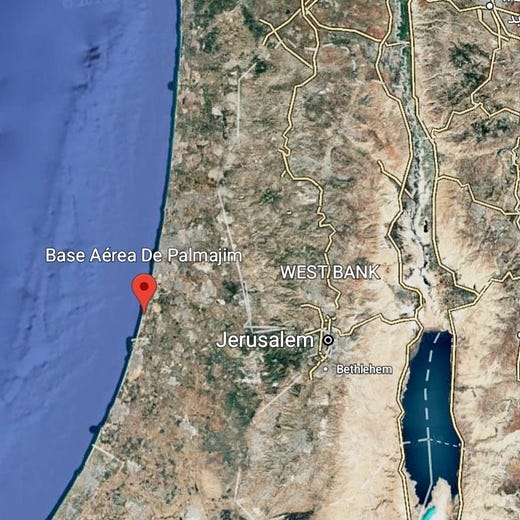
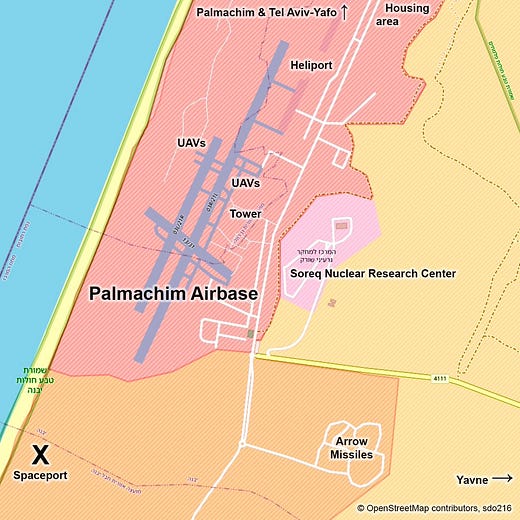
Hezbollah announces to have targeted Palmachim Air Base this morning (06h00) with a Ballistic Missile. Sirens sounded around 05h40 in the area.
Hezbollah hit Palmachim Air Base with a ballistic missile at six in the morning. Palmachim is where Israel tests Jericho nuclear-capable missiles. Where the Arrow interceptor batteries live. Hezbollah reached both, from Lebanon. The range of what’s coming out of the north stretches further every day, and the targets keep getting more sensitive.

Forty-two operations on Saturday alone. A Merkava burning in Taybeh. Bar Lev Industrial Area hit with Grad and Arash rockets. Hezbollah claims it killed General Omer Tischler at Shtula on the border – single source, unverified, but they also claim to be entering the town. Third position Israel would be losing on the northern line. The Lebanese Ministry of Health reports 850 dead and 2,105 injured since the start of Israeli military operations on March 2. Twelve paramedics killed in a single IDF strike in the south. The people running toward the wounded became the dead.

Then Baghdad. Iraqi Resistance released FPV drone footage from inside the US Victoria Base. The base was handed back to Iraq in 2011 – so not really an achievement, but I want to point out that the FPV revolution just arrived in Mesopotamia after it was perfected in Ukraine. Missiles were also fired from Iraq at Tel Aviv for the first time. New launch axis. The country America spent twenty years and two trillion dollars rebuilding is now sending ordnance toward the country America is spending twelve billion defending.
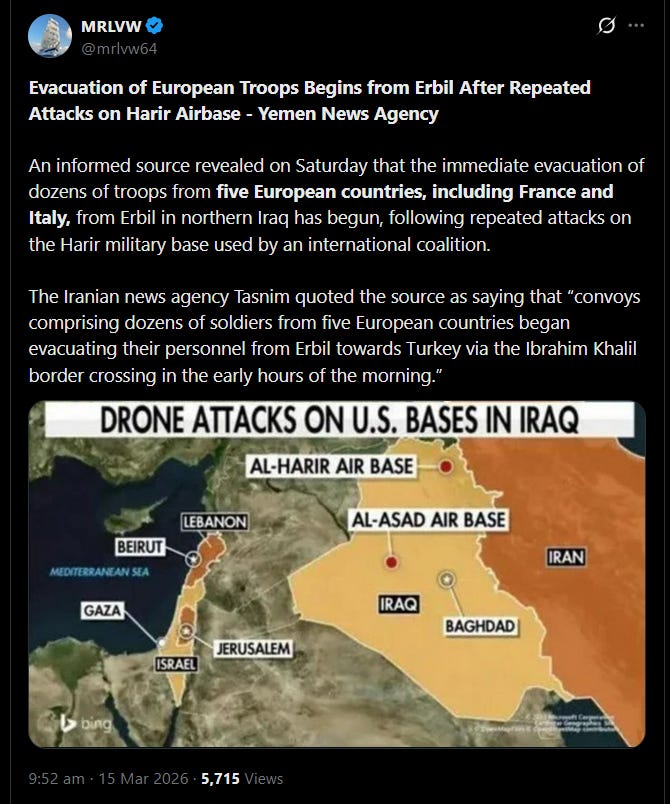
Five European countries physically leaving Harir Airbase in Erbil. Syria’s army took the Rumeilan base north of Hasakah after the coalition withdrew. The vacuum is being filled, just not by anyone Washington invited.

Araghchi confirmed on camera that HIMARS were fired from UAE soil — Ras Al Khaimah — at Kharg and Abu Musa Islands. This one is different from the Bahrain HIMARS a week ago. The UAE is now named by Iran’s own foreign minister. On the record.
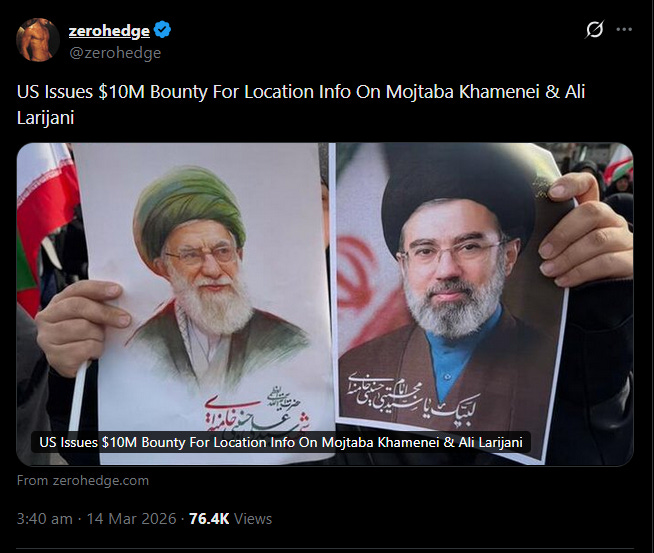
The US issued a $10 million bounty on Mojtaba Khamenei and Ali Larijani. Ten million for the Supreme Leader of a country whose military is currently winning a war of attrition against the combined air forces of America and Israel. Iran can’t find Mojtaba, Israel can’t find Netanyahu. Most expensive game of hide-and-seek. Ever.
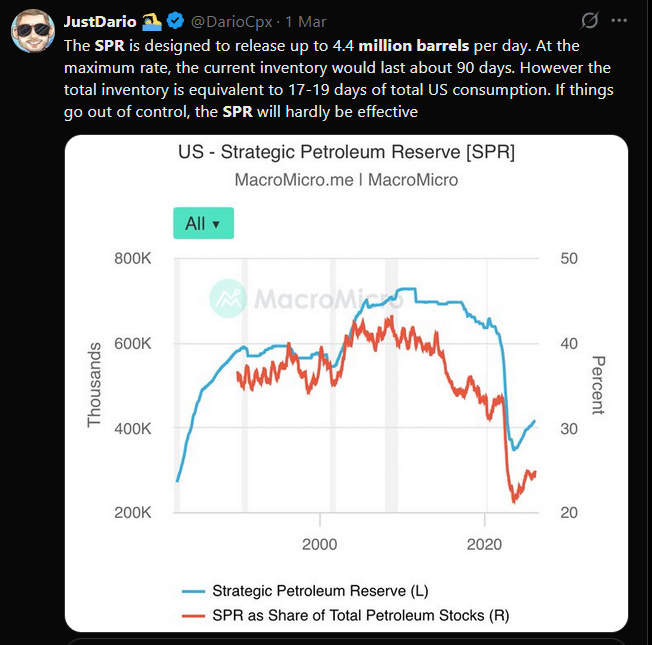
SPR dump: 86 million barrels next week, via exchange program. Against a 17.2 million barrel per day disruption, that covers five days. Five.
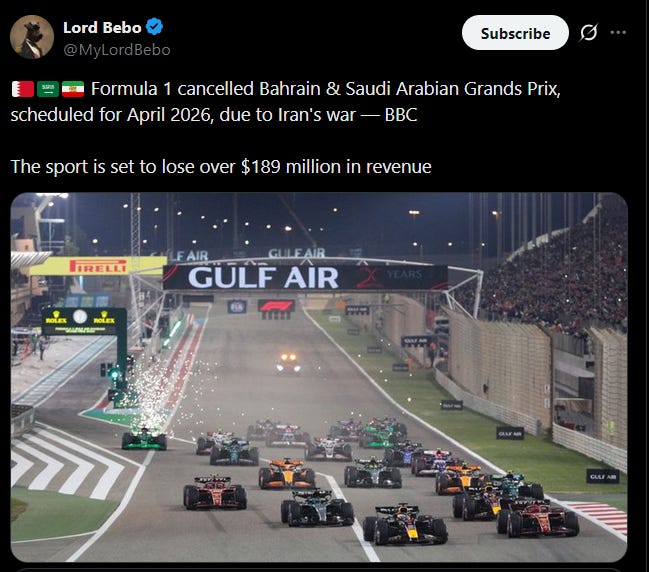
Formula 1 cancelled the Bahrain and Saudi Arabian Grands Prix. $189 million in revenue, gone. Plenty of things still going fast in the Gulf. Just not on a track.

Hassett confirmed $12 billion spent on the war. The FT reported US oil companies earning an extra $63 billion this year from it. Five billion dollars this month alone. Twelve billion to fight it. Sixty-three billion to profit from it. Someone in that equation is having fun.

The US’ biggest export has been gold for three of the last four months. Only time that’s happened in at least twenty years. Probably ever. The reserve currency country settling its trade deficit in metal. I covered the structural shift in my previous “The Bretton Whoops” article. If this continues, we know it’s happening. Silver at $80-81. James Turk notes the $5,000/$80 floors are being tested with a liquidity crunch building that looks like 2008.
The lease rate hasn’t hit zero on a single day in the past year. The physical market was seizing before the first bomb fell.

COT data: crude net longs at 466,000 contracts, fifteen-month high. SPR covers five days. Gas at $3.70, up 28%.

Dubai’s real estate index dropped 30% in fourteen days. Emaar and Aldar both down 18%.

S&P 500 financials having their worst year since 2020. Ares and Blackstone each down 30% or more. The private credit cascade keeps going. Hartnett at BofA: “trading the 2008 analog”. Nasdaq breadth worst since April. The Fed meets Wednesday. Futures open tonight. The market hasn’t priced in any of this yet.

Tucker Carlson claims the CIA is preparing criminal charges linked to his pre-war communications with Iran. ABC and Reuters confirmed three Oval Office meetings in February, roughly ninety minutes each. A former CIA analyst said he’s “genuinely worried for Tucker’s safety.”
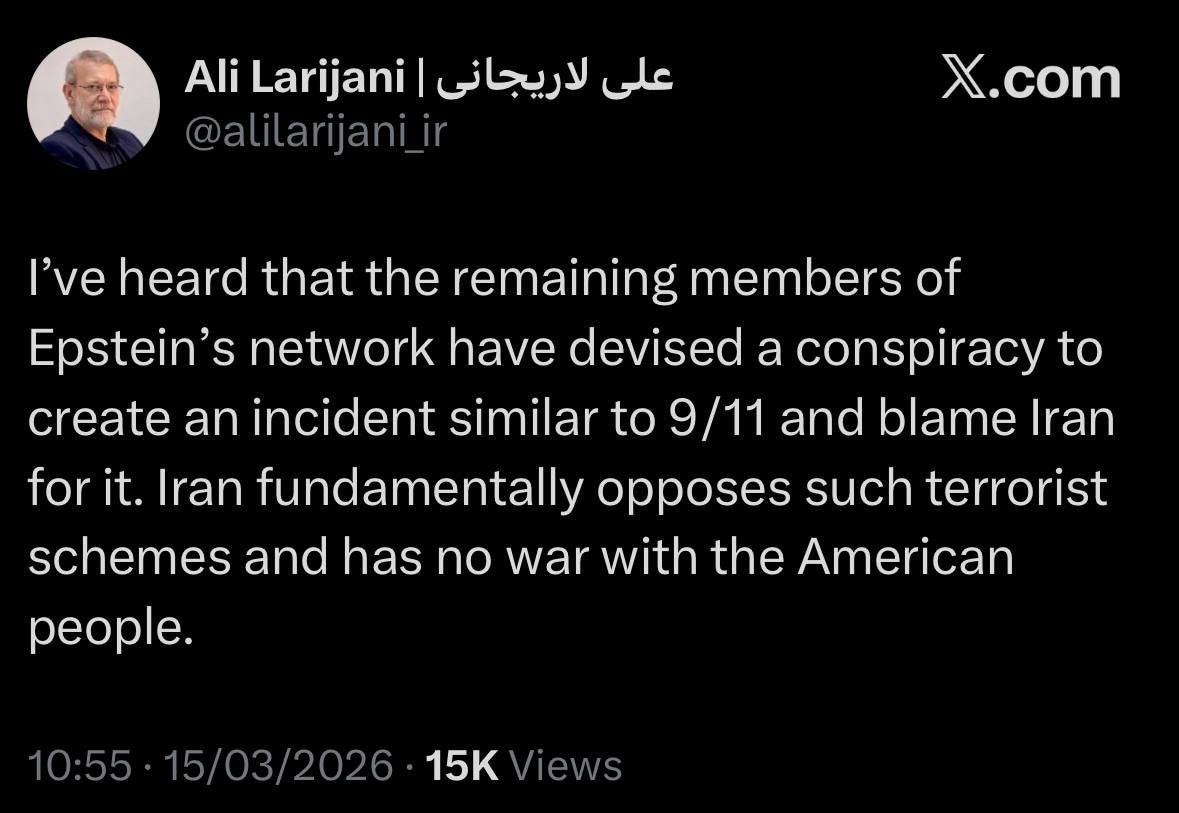
Two senior Iranian officials – Larijani and Marandi – issued separate warnings about a planned false flag attack. 9/11-style. Blame Iran. I’ve been tracking this pattern since day two. Loads of incidents by now. And now public warnings from the top of the security establishment. Either they have intelligence, or they’re building the counter-narrative in advance. Either way, it lands heavier than the missiles.

Caesar was warned. He walked in anyway. And the senate – every last one of them – already had their answer ready."

"It Is Being Projected That “Peak War Panic” Could Hit The Global Financial System In 1 To 3 Weeks"

"A worst-case scenario could be just weeks away. Traffic through the Strait of Hormuz has been essentially paralyzed by the war with Iran, and there is a lot of speculation that the Houthis could soon bring commercial traffic through the Red Sea to a screeching halt. If such a scenario actually materializes, it would be catastrophic for the global economy. The good news is that so far we are not witnessing widespread panic among investors. Most of them still seem to believe that this crisis is just temporary. So even though the price of oil is up over 40 percent since the start of the war, the overall global financial system is still relatively stable at this stage…

The S&P 500 is only down 3% so far this year and 5% off its all-time high, still far from reaching bear market territory or even a correction, suggesting investors aren’t panicking yet about the U.S.-Israel war on Iran. But that could change soon.

To be sure, oil prices have soared more than 40% since the war began two weeks ago and are up nearly 70% year to date. But they remain below the peak seen after Russia invaded Ukraine in 2022, despite one-fifth of the world’s oil supplies being bottled up by Iran’s de facto blockade of the Strait of Hormuz. Of course it certainly wouldn’t take much to push the financial markets over the edge.

Dan Alamariu, the chief geopolitical strategist at Alpine Macro, is warning that if this war with Iran persists we could see “peak war panic” in approximately 1 to 3 weeks… "Alamariu acknowledged there’s a growing chance that the war lasts longer than his two-month outlook, and the Strait of Hormuz would likely remain closed for the duration. That means Brent crude prices will stay above $100 a barrel and possibly even top $150. And yet, the market hasn’t reached maximum panic yet. “Peak war panic is more likely to hit in the next 1 to 3 weeks,” he predicted. “The longer the conflict lasts, the more investors price in economic damage.”

Using oil prices as a gauge for market panics, crude has historically peaked four to eight weeks into similar conflicts, according to Alamariu. The Iran war has now entered its third week. If the price of oil surpasses $150 a barrel and stays there for an extended period of time, it will cause widespread panic. I have no doubt about that at all.

What investors would really like to see is an end to the war, but an end to the war is not even on the horizon at this stage…Iranian Foreign Minister Abbas Araghchi said Sunday that “we don’t see any reason why we should talk with Americans” as President Trump has claimed Iran is seeking a deal to end the war between the U.S. and Iran. “We never asked for a ceasefire, and we have never asked even for negotiation,” Araghchi said on “Face the Nation with Margaret Brennan.”

As the war entered its third week, Mr. Trump has claimed in recent days that Iran wants to reach a deal. The president said in a post on Truth Social late Friday that Iran “is totally defeated and wants a deal – But not a deal that I would accept!” On Saturday, he told NBC News that “Iran wants to make a deal, and I don’t want to make it because the terms aren’t good enough yet.”

As long as traffic through the Strait of Hormuz is paralyzed, there is no way that the war will end. An IDF spokesperson is telling us the the Israelis are gearing up “for at least three more weeks of operations”… An Israel Defense Forces (IDF) spokesperson said the military is preparing for at least three more weeks of operations against Iran and still has ‘thousands of targets’ remaining.

Brigadier General Effie Defrin told CNN that Israeli forces are coordinating closely with the United States and have plans extending beyond the Jewish holiday of Passover. ‘We have thousands of targets ahead,’ Defrin said. ‘We are ready, in coordination with our US allies, with plans through at least the Jewish holiday of Passover, about three weeks from now.’

Let us hope that the war will be over in just a matter of weeks. But from where I am sitting, I think that is a very optimistic target. There are so many ways that this war could become so much worse. For example, if the Houthis were to shut down commercial traffic through the Red Sea by blocking the Bab el-Mandeb Strait, we really would be facing a nightmare scenario that would be unlike anything we have ever seen before…

"Alamariu noted that it’s likely Iran’s Houthi allies in Yemen close the Red Sea to commercial shipping, heaping additional economic pain on top of the closure of the Strait of Hormuz. “A simultaneous two-strait disruption would compound the shock, impacting the additional ~5 mb/d oil flows that normally transit the Bab el-Mandeb and impairing a main Europe-Asia trade route,” he warned. “This could stoke inflation further, especially in Europe.” If the Strait of Hormuz and the Bab el-Mandeb Strait were blocked simultaneously, hardly anything would be getting out of Saudi Arabia or other Gulf countries.

I have already written much about oil, natural gas and fertilizer, but so many other industries would be deeply affected as well. For example, the largest aluminum smelter in the entire world has just been forced to reduce its output…"The world’s largest single-site aluminium smelter in the Middle East cut its output by about 20% on Sunday, marking yet another troubling development for the global economy. The disruption in the Strait of Hormuz is no longer just an energy story – it’s now spreading into industrial metals. These second- and third-order effects could soon disrupt global supply chains and tighten aluminium availability, thus pressuring prices higher.

Bloomberg reports that Aluminium Bahrain (Alba) began a controlled, safe shutdown of three reduction lines on Sunday to preserve business continuity amid heavily disrupted maritime shipping routes through the Hormuz chokepoint."

The global economy has become far more integrated than most people realize. When the price of oil rises, it rises for everyone. And the pain is already starting to be felt throughout the entire U.S. economy…"Uber and Lyft drivers told us they’re getting more selective about which rides they accept as gas prices rise. That’s because Uber and Lyft control fares, meaning drivers can’t raise prices when their operating costs go up. Some gig drivers are rejecting shorter, lower-paying trips that burn fuel and instead are chasing longer fares that make the math work.

Meanwhile, EV drivers are having a moment. As gas-powered drivers wince at the pump, electric vehicle owners are taking what some have called a “victory lap.” Charging costs haven’t surged in step with oil prices. This is giving EV drivers, including those on rideshare platforms, a meaningful cost advantage."

Higher gas prices are also playing a role in the return-to-office debate. For people who drive to work, pricier fill-ups mean less money in their pockets for everything else. “When gas prices spike, commuting effectively becomes a pay cut,” one chief operating officer told us.

If this war keeps going for a while, things will get a lot worse. Just about everything that we purchase on a regular basis is affected by the price of oil, and that includes food. It takes energy to grow food, and it takes energy to transport food to the stores. If the price of oil goes up to $150 a barrel and stays there, it is going to become much more expensive to go to the grocery store.

Already, the average price of ground beef has risen almost 20 percent over the past year…"The average price of ground beef, 100% beef, excluding round, chuck, and sirloin, and excluding preformed patties, finally took a breather in February and barely budged, rising by just 0.2%, after spiking month after month almost uninterrupted for a whole year. At $6.74 per pound, the average price is up by nearly 20% from a year ago and by 73% from January 2020."

By disrupting traffic through the Strait of Hormuz, the Iranians are hitting us where it hurts. They know that U.S. consumers do not have a very high tolerance for pain. So they figure that they can sit back and wait for the pain to reach unendurable levels. But I don’t think that President Trump is going to end this war until he breaks Iranian control over the Strait of Hormuz. That could take a while (No, that will NEVER happen -CP), and so it appears that this crisis will be with us for quite some time."

"10 Businesses That Are Collapsing After Jacking Up Prices"

Full screen recommended.
Michael Bordenaro, 3/16/26
"10 Businesses That Are Collapsing
 After Jacking Up Prices"
Comments here:

Adventures With Danno, "Unbelievable Prices At Aldi, Price Drops Everywhere"

Full screen recommended.
Adventures With Danno, 3/16/26
"Unbelievable Prices At Aldi, 
Price Drops Everywhere"
Comments here:

"US-Israel-Iran War, 3/16/26

Full screen recommended.
OPTM, 3/16/26
"Trump Freaks Out After Netanyahu Begs For Ceasefire"
Comments here:
o
Full screen recommended.
OPTM, 3/16/26
"Iran Just Struck Mossad Headquarters 
As Massive Protest Erupts Across Israel "
Comments here:
o
Full screen recommended.
Dialogue Works, 3/16/26
"Pepe Escobar: What Iran Just Did 
Could Change the Middle East Forever"
"This interview argues that the Iran-U.S. war in West Asia has become a dangerous, open-ended confrontation with major global consequences. It highlights rising attacks, pressure on the Strait of Hormuz, oil market turmoil, and growing fears of economic shock. The discussion also claims Washington is struggling to control the battlefield narrative while Iran remains firm in its demands. Overall, it presents the war as a turning point that could reshape regional power, weaken U.S. influence, and push the world toward a deeper crisis."
Comments here:
o
Full screen recommended.
Financial Context, 3/16/26
"Iran Just Destroyed Ben Gurion Airport!
 73 Planes Burned in 12 Missile Strike"
"Iran launched a devastating ballistic missile attack on Ben Gurion International Airport, completely destroying Israel's only major international gateway. On March 14 at 2:47 a.m., 12 Iranian Khorramshahr-4 missiles slammed into the airport, burning 73 commercial and military aircraft, collapsing Terminal 3, cratering the main runway, and igniting massive fuel fires that are still raging. 89 people killed, 234 injured. All flights to and from Israel canceled indefinitely. Ben Gurion - which handles over 20 million passengers yearly - is now shut down for 6 to 12 months minimum. El Al lost its entire long-haul fleet ($6.9 billion), foreign carriers (United, Lufthansa, Delta, British Airways) lost dozens more planes, and even the Israeli Air Force lost 19 aircraft. Total damage: $12–15 billion in one night.

Iron Dome fired 31 interceptors and stopped ZERO missiles. This is the largest single-event aircraft destruction since 9/11 and has cut Israel off from global trade, tourism, and supply lines. Weekly economic loss: $2–3 billion. Insurance companies now call Ben Gurion "uninsurable." Airlines may never return even after repairs. This is Iran's strategic masterstroke - crippling Israel's economy without a single ground troop. Netanyahu admits they cannot guarantee the airport won't be hit again."
Comments here:

John Wilder, "The Oil Shock of 2026: Pulp Fiction Economics"

"The Oil Shock of 2026: Pulp Fiction Economics"
by John Wilder

"Am I the only one who feels like the global economy just got Tarantino’d? One minute it’s business as usual, the next there’s blood on the walls, or in this case, oil not flowing through the pipes. We’re staring down the barrel of an oil shock that makes the 1970s look like a minor hiccup.

The Strait of Hormuz? It was effectively slammed shut by the Iranians amid the escalating mess with the U.S. and Israel. That narrow choke point between Iran and Oman used to carry about 20 million barrels per day (liters per lightyear, for you Europeans) of crude and products. That’s roughly 20% of the world’s daily oil consumption as of early 2026. Or I should say carried, past tense.

Now? Zilch. Null. Nada. Empty set. Nothing. The taps are off, and we’re talking a sudden removal of around 15-20 million barrels per day (Coulombs per gram) from the global market, depending on how you slice the crude from the refined stuff.

Oil prices are set at the margin. It’s not just about the total supply the price is set by that last barrel that tips the scale. The world was already humming along at with supply keeping pace thanks to OPEC cuts, U.S. fracking miracles, and a dash of South American output from places like Guyana and Brazil, which apparently produce more than just horrific tropical diseases. But shutting down 15 million barrels overnight?

That’s not a dip; that’s a crater. Prices don’t nudge up politely, they spike like a heart rate after too much coffee when this level of supply is cut. Oil isn’t just black gold for the gas tank of the Wildertruck®: it’s woven into every thread of modern life like pop culture. Plastics? Oil. Transport? Trucks, ships, planes all guzzle it. Heating an East Coast home in winter? Oil or derivatives. Lubrication for machines that make everything from iPhones® to insulin? Yep, oil again.

When the price jumps it acts like a stealth tax on every single human activity that involves moving atoms around. We’ve already seen Brent crude north of $120 a barrel, with whispers of $150 if this drags on. Groceries will cost more because trucks burn fuel. Manufacturing grinds slower because inputs skyrocket. Even that Amazon® package shows up later and at a higher price.

Historically, high energy prices have been a tyrant’s best friend. Cheap energy? That’s freedom fuel. It lets people build, innovate, travel, and produce wealth without begging the government for handouts. Low prices mean less dependence on central planners I can heat my home, drive to work, and fill my tank without the state holding the reins. But jack up those prices? Wealth creation stalls. People cut back on extras, then necessities. Factories idle. Jobs vanish. Suddenly, the masses are clamoring for subsidies, price controls, “emergency” aid.

Governments love that. It’s their cue to step in as savior, doling out favors while tightening the leash. Look at the 1970s: oil shocks led to inflation, stagflation, and a bigger welfare state. We’re just at the front end of this beast. The 1970s shocks were bad. Prices quadrupled, lines at pumps, recessions, and worst of all, Jimmy Carter. But back then, the world consumed only 60 million barrels per day (meters per kilogram). Now it’s almost twice that, economies are more interconnected, and just-in-time supply chains mean there’s no inventory to pick up the slack.

The Strait of Hormuz is (was) one of the most strategic spots on the planet. Easiest way to move oil? Pipelines, if you’ve got ‘em. Second? Water. It’s more convenient for collection if you use tankers rather than just pouring it on the water. And Hormuz was the biggest funnel: about 20% of global consumption squeezed through that 21-mile-wide gap at its narrowest. Talk about a speed zone.

That oil won’t stay stuck forever my 50-50 guess is two months. After that, either cooler heads prevail and it reopens, or the Saudis and others pivot hard. They’ve got some bypass pipelines already but capacity is limited. Building more is feasible, but we’re talking billions and years, not weeks. In the meantime, producers like Saudi, Iraq, Kuwait are stuffing oil into storage tanks that are filling up fast.

Economic cracks are showing everywhere. Last week, I mentioned the private credit markets imploding with funds like BlackRock® limiting redemptions because liquidity’s drying up. Now add this oil shock? A.I. is already sucking up capital like a vacuum on steroids. But cash for everything else has been scarce. Billions in private debt funds are wobbling because borrowers can’t refinance at these rates, and higher energy costs will be the final nail for some. Expect more gates slamming shut, more “sorry, your money’s stuck here” letters.

Gasoline prices are up here in the U.S., sure. Last I heard we were headed to $4.50 a gallon as an average, while pushing $6 in California. Compared to the rest of the world, this is a sweet spot. Thanks to fracking, the U.S. produces about two-thirds of the crude we consume, with most imports coming from Mexico and Canada. This hurts us, but tis but a flesh wound compared to the gut punch for Europe and China.

Europe? They’re getting hammered. They were already weaning off Russian oil post-Ukraine, now Middle East flows disrupted? Natural gas prices are spiking, factories are idling in Germany, protests in France, well, there are always protests in France. Will this force negotiations with Russia over Ukraine? Absolutely possible. “Hey, Vlad, how about we ease sanctions if you pump more to us and we’ll rough up the Ukrainian midget?” China’s in the same boat. 70% of their oil imports are from the Gulf, but are now rerouting around Africa at huge cost. Where does this end? Short term: pain.

Recessions in Europe, a slowdown in Asia, inflation here at home. Long term: resets, and the world that we live in now becomes a dream. More drilling everywhere feasible, and maybe a rethink on global dependencies and who uses what currency. But don’t count on smooth sailing. Shocks like this expose fragilities, and in the Fourth Turning crisis, they’ll accelerate change. Cheap energy’s over for now. This oil shock isn’t just economic: it’s existential. Things flow smoothly. Until they don’t. Just ask Marvin."

"Economic Market Snapshot 3/16/26"

"Economic Market Snapshot 3/16/26"

Down the rabbit hole of psychopathic greed and insanity...
Only the consequences are real - to you!
"It's a Big Club, and you ain't in it. 
You and I are not in the Big Club."
- George Carlin
o
Market Data Center, Live Updates:
Financial Stress Index

"The OFR Financial Stress Index (OFR FSI) is a daily market-based snapshot of stress in global financial markets. It is constructed from 33 financial market variables, such as yield spreads, valuation measures, and interest rates. The OFR FSI is positive when stress levels are above average, and negative when stress levels are below average. The OFR FSI incorporates five categories of indicators: creditequity valuationfunding, safe assets and volatility. The FSI shows stress contributions by three regions: United Statesother advanced economies, and emerging markets."
Job cuts and much more.
Commentary, highly recommended:
"The more I see of the monied classes,
the better I understand the guillotine."
- George Bernard Shaw
Oh yeah... beyond words. Any I know anyway...
And now... The End Game...
o

Sunday, March 15, 2026

"Iran Finally Unleashes 'Doomsday' Weapon Israel, US Feared? 1.5-Ton ‘SejjilL Missile' Debuts Amid War"

Full screen recommended.
Times of India, 3/15/26
"Iran Finally Unleashes 'Doomsday' Weapon Israel,
 US Feared? 1.5-Ton ‘Sejjil Missile' Debuts Amid War"
"Iran has launched the 54th wave of attacks in its ongoing military campaign, marking a major escalation in the conflict with Israel and the United States. The latest strikes reportedly include the first deployment of the Sejjil ballistic missile, a solid-fuel, two-stage medium-range system capable of carrying up to 1,000 kg warheads across 2,000–2,500 km. Analysts say its rapid launch capability reduces warning time for targets and extends Iran’s reach across the Middle East, including Israel, Saudi Arabia, Turkey, and several U.S. military bases. The operation is described by the IRGC as retaliation for recent strikes on civilian workers."
Comments here:
o
Full screen recommended.
Money Over History, 3/15/26
"Iran’s Biggest Attack Yet - 
300 Missiles Slam Central Israel"
"Iran has launched one of its largest missile barrages against Israel, targeting cities in central Israel including the Tel Aviv region. According to Israeli military assessments, nearly 300 ballistic missiles have been fired during the conflict, with many carrying cluster warheads that spread submunitions across wide areas. This massive strike marks a major escalation in the ongoing Iran-Israel war. Air raid sirens sounded across central Israel as missiles and shrapnel struck multiple areas, forcing thousands of civilians into shelters while emergency services responded to impacts and injuries."
Comments here:
o
Full screen recommended.
Mirror Now, 3/15/26
"3-Hour Overnight Attack Leaves
 Israelis in Panic, Tel Aviv Burns!"
Comments here:

"Alert! Russian Statesman: "90% Chance of Nuclear War", National Guard Deploys to LA"

Full screen recommended.
Prepper News, 3/15/26
"Alert! Russian Statesman: 
"90% Chance of Nuclear War", National Guard Deploys to LA"
Comments here:

"Economic Storm Ahead: Housing Crash Fears, $100 Oil, Rising War Tensions"

Jeremiah Babe, 3/15/26
"Economic Storm Ahead:
Housing Crash Fears, $100 Oil, Rising War Tensions"
Comments here: