StatCounter

Friday, March 13, 2026

The Poet: James Broughton, "Having Come This Far"

"Having Come This Far"

"I've been through what my through was to be,
I did what I could and couldn't.
I was never sure how I would get there.
I nourished an ardor for thresholds,
for stepping stones and for ladders,
I discovered detour and ditch.
I swam in the high tides of greed,
I built sandcastles to house my dreams.
I survived the sunburns of love.

No longer do I hunt for targets.
I've climbed all the summits I need to,
and I've eaten my share of lotus.
Now I give praise and thanks
for what could not be avoided,
and for every foolhardy choice.
I cherish my wounds and their cures,
and the sweet enervations of bliss.
My book is an open life.

I wave goodbye to the absolutes,
and send my regards to infinity.
I'd rather be blithe than correct.
Until something transcendent turns up,
I splash in my poetry puddle,
and try to keep God amused."

- James Broughton

"We Like To Think..."

“We like to think that we are rational beings; humane, conscientious, civilized, thoughtful. But when things fall apart, even just a little, it becomes clear we are not better than animals. We have opposable thumbs, we think, we walk erect, we speak, we dream, but deep down we are still routing around in the primordial ooze; biting, clawing, scratching out an existence in the cold, dark world like the rest of the tree-toads and sloths.”
- “Grey’s Anatomy”

"A Farewell"

"A Farewell"
by Fred Reed

"I have been writing this column, off and on, mostly on, for–dear God, can it be nearly thirty years? Yet nothing lasts forever, neither columns nor columnists, and "Fred on Everything," for unexpected reasons with which i will not bore the reader, has reached its end.

Columnizing is a curious trade. I suppose that from time to time most in it ask themselves, why am I doing this? It is not from vanity or the desire to see one’s name in print. At the age of twenty, a new writer thinks that if only he can be published in the next most important outlet, he will be happy and fulfilled. At thirty, he thinks, oh hell, its deadline, what can I write and how can I make it seem fresh and interesting when almost every subject has been written about thousands of times by thousands of writers also on deadline?

I suspect that few columnists think that their output will accomplish anything. People seldom change their minds. Most likely we are just bellowing at the universe to behave itself. It doesn’t.

Unlike many in our ashen trade, I have been fortunate in not having an editor to tell me what to write and not being constrained to specialize. “Fred on Everything” may sound pompous but it is not restrictive. Thus i could write about anything from the military-industrial complex to being a barefoot-and-BB gun-toting Tom Sawyer simulacrum in small-town Alabama to robots and the realities of Mexico. This has been fun for me and, apparently, for a certain kind of reader.

But not to most. What most readers want is to be told over and over what they already believe, preferably in combative prose. Most columnists and websites do exactly this. I could never do it, perhaps because of some psychic defect. Or maybe I am just bull-headed. The result has been that readers have been few by internet standards but, at least in my judgement, a superior and versatile sort who can disagree without huffing-and-deleting. I regard them–you– as fellow conspirators against the expected, the tedious, and the ordinary. It has been fun. I thank you for the years."
Ciao,
Fred

A Comments: Thank you, Fred, for the many excellent commentaries over the years, it's been an honor and a privilege to share them with readers of this blog. This "Farewell" resonates so powerfully within me, too, as I look back at the past 16 years of this blog, 100,016 posts I found interesting and informative, and have often wondered, as you say, "Why am I doing this? It is not from vanity or the desire to see one’s name in print." No, not from vanity, it was never about me, and I've never shared details of my personal life or fully written opinions, which I could have done so easily many, many times, preferring to post the writings of far better minds than mine. And it was certainly never about the money, I never sold anything, never allowed ads, or made a single penny, ever. As Fred said, "Maybe I am just bull-headed. The result has been that readers have been few by internet standards but, at least in my judgement, a superior and versatile sort who can disagree without huffing-and-deleting. I regard them–you–as fellow conspirators against the expected, the tedious, and the ordinary." That's how I've always viewed readers of this blog, and I, too, want to thank you the readers for the years we've spent together. If it made even one person's life a little better it was all worth it. It's not yet my time to say goodbye, but wanted to express how deeply what Fred wrote struck me personally. God speed, Fred...
- CP

"Never, Ever Forget..."

"Never, ever forget that nothing in this life is free. Life demands payment in some form for your "right" to express yourself, to condemn and abuse the evil surrounding us. Expect to pay... it will come for you, they will come for you, regardless. Knowing that, give them Hell itself every chance you can. Expect no mercy, and give none. That's how life works. Be ready to pay for what you do, or be a coward, pretend you don't see, don't know, and cry bitter tears over how terrible things are, over how you let them become."
- Ernest Hemingway, "For Whom the Bell Tolls "

Judge Napolitano, "INTEL Roundtable W/Johnson & McGovern - Weekly Rap 13-March"

Full screen recommended.
Judge Napolitano - Judging Freedom, 3/13/26
"INTEL Roundtable W/Johnson & McGovern -
Weekly Rap 13-March"
Comments here:

"How It Really Is"


"Back when I taught at UCLA, I was constantly amazed at how little so many students knew. Finally, I could no longer restrain myself from asking a student the question that had long puzzled me: ''What were you doing for the last 12 years before you got here?''
- Thomas Sowell
"The problem isn't that Johnny can't read. The problem isn't even that Johnny can't think.
 The problem is that Johnny doesn't know what thinking is; he confuses it with feeling."
- Thomas Sowell
"The trouble with most people is that they think with 
their hopes or fears or wishes rather than with their minds." 
- Will Durant
"It takes considerable knowledge just to realize the extent of your own ignorance."
- Thomas Sowell

Dan, I Allegedly, "Jobs Down! Spending Down!"

Full screen recommended.
Dan, I Allegedly, 2/13/26
"Jobs Down! Spending Down!"
"The U.S. economy is showing serious warning signs as jobs decline, consumer spending slows, and businesses struggle to stay afloat. Across the country we’re seeing layoffs, rising bankruptcies, and fewer people willing to spend money on everyday purchases. The cracks are appearing everywhere - from restaurants and retail to real estate and tourism. At the same time, the auto market is facing a massive disruption as nearly 300,000 electric vehicles from lease turnbacks - including Tesla Model 3, Hyundai Ioniq 5, and Audi e-tron - are expected to flood the used car market in the coming months, potentially driving prices down and exposing the real demand for EVs.

Meanwhile, commercial real estate is collapsing in some cities, with major hotels and office buildings selling for tens of millions less than they were worth just a few years ago. Investors are walking away and banks are quietly absorbing the losses. In California, the stress is becoming even more visible as Riverside County prepares to auction off roughly 800 properties due to unpaid taxes, ranging from land to homes and commercial buildings. When jobs fall, spending drops, businesses fail, and governments start selling assets - these are the exact warning signals that economists watch when an economy begins to break."
Comments here:

"US-Israel-Iran War, 3/13/26"

Full screen recommended.
Danny Haiphong, 3/13/26
"Jiang Xueqin: Iran War Trap Ends
 U.S. Empire, New World Order is Here"
Prof. Jiang Xueqin argues that a deep dive into game theory & history can accurately predict future events. Prof. Jiang gives his shocking predictions for the US-Iran War, economic collapse, the new world order, and the future of Israel in this wide-ranging discussion. Prof. Jiang is the host of the popular educational channel Predictive History
Comments here:
Jiang Xueqin's Substack: 
o
Waael FSN, 2/13/26
Col. Doug Macgregor,
"Things Just Got Extremely Complicated!"
"Global tensions are rising, and according to former U.S. Army Colonel Doug Macgregor, the current geopolitical situation has become far more complicated than many expected. In this video, we examine Macgregor’s perspective on recent developments and why he believes the strategic environment is becoming increasingly difficult for global powers to navigate. Col Doug Macgregor is widely known for his commentary on military strategy, U.S. foreign policy, and international security. His analysis often focuses on how geopolitical decisions, shifting alliances, and evolving conflicts can rapidly change the balance of power between nations.

In this video, we break down the key points behind Macgregor’s analysis and explore what these developments could mean for global stability, international relations, and the future of geopolitical competition. Watch the full video to understand why many analysts believe the current situation could have serious implications for the world in the coming years."
Comments here:
o
Full screen recommended.
Scott Ritter, 2/13/26
"The Truth About the Minab Strike:176 Children Killed"
Comments here:

Bill Bonner, "The Nuclear Option"

"The Nuclear Option"
by Bill Bonner
Youghal, Ireland - "It looks as though the ‘terms of this war’ may not be in US hands after all. Barrons: "Oil prices top $100 today. The Iran war looks like it’ll last longer than expected."

Associated Press: "Iran’s unrelenting attacks on Mideast shipping and energy infrastructure send oil prices soaring. Unrelenting Iranian attacks on shipping traffic and energy infrastructure pushed oil above $100 a barrel Thursday, as American and Israeli strikes pounded the Islamic Republic with no sign of an end to the war in sight."

Since the United States and Israel started the war with a Feb. 28 attack on Iran, Tehran has focused on inflicting enough global economic pain to pressure them to halt their attacks. U.S. President Donald Trump suggested that was not imminent, however, promising to “finish the job” even though he claimed Iran is “virtually destroyed.” Nobody knows what ‘job’ POTUS is talking about. In the meantime, the world still runs on oil. And Iran has its hands on the main valve.

Dear Readers certainly shouldn’t put too much faith in our geo-political insights. But we will give them to you anyway. And more and more, the attack on Iran is looking like a food fight in a lunatic asylum; neither side gains anything but it makes one helluva mess.

The US war strategy is still cloaked in confusion. But we think we know what Iran had up its sleeve. With only a tiny military…the country had no way to protect itself – except by using its own ‘nuclear option.’ No, the country had no nukes. Not even close. Under attack, the Iranians figured they would cut off the world’s oil until the attacks stopped. Simple. Easy. That is what the Iranians are hoping to do now. So, who’s winning?

On Wednesday, we advised the Iranians to give it up; with the US and Israel in control of the air above their heads, they’re going to get pounded. But the US may not be able to win either, not unless inflicting pain is its only real objective. The disgraced ex-CIA director, David Petraeus, seems to think so. The headline from Real Clear Politics: "Petraeus: We’re quite far along in accomplishing our objectives in Iran, “We’re very well along in this”

Petraeus is looking at the ‘first order’ effects…and finds them impressive: ‘We’ve largely taken down their air and ballistic missile defense, we can now fly really at will with our non-stealthy aircraft, not just the stealth B-2 and F-35, but the B-52, the B-1, other fighter bombers. We’ve had considerable success against their Navy. Needless to say, we’ve taken down probably at least 70 percent of the missile launchers and a substantial amount of the stockpile.’

And maybe unrestricted firepower will inflict so much pain on the Iranians that they will wave the white flag and do as they are told. If so, it will be a rare moment in military history.

In ancient times, an attackers would approach a city and use catapults, slings, and bows and arrows to send projectiles upon it. They were also known to throw the bodies of those who died from infectious disease over the walls to cause a plague within the city. The ‘incoming’ was surely disagreeable, but rarely decisive. Typically, the bombardments were accompanied by a siege - starving the population into submission.

Airplanes, missiles and artillery brought attacks from the air to a new level. They added more firepower, but not necessarily more success. Our old friend Richard Russell had some personal experience of this. He had been a bombardier in WWII. In 1943, his plane had been outfitted with the newly developed Norden bombsight. It was considered so precious that Russell was instructed that in case he was shot down, he was to destroy the bombsight (and himself if necessary) rather than let it fall into German hands.

The allies were confident that, armed with this new sighting device, they could destroy Germany’s war industries, and force the Nazis to capitulate. Later studies found that the device was not nearly as good as they thought. While it improved the precision of some bombardiers, its overall impact was marginal. Massive bombing raids killed 600,000 civilians; they didn’t bring the war any closer to an end.

Nor did the US campaign to bomb Hanoi ‘back to the stone age’ force the Vietminh to give up. Bombing excursions into Laos and Cambodia had similarly poor results. The NATO bombing of Belgrade in 1999 didn’t bring peace. Nor did even the almost total destruction of Gaza, 2023-2025.

Our advice to the Trump high command: Give it up. Bombing Iran may increase the price of oil. It probably won’t cause Iran to surrender. Stay tuned."

"March, 12: FAFO"

"March, 12: FAFO"
by NO1

"The cardboard cutout spoke. The Strait of Hormuz will remain closed. All US bases in the region must be shut down immediately. Iran demands reparations, or property belonging to the aggressors will be seized or destroyed. Studies have been conducted on opening additional fronts “where the enemy has minimal experience and would be highly vulnerable”. And vengeance for Minab will not be forgiven.

While these words were being read, the IRGC launched Wave 42 of True Promise 4. Simultaneously. Codenamed “At Your Service, O Khamenei” – the first military operation formally dedicated to the new Supreme Leader. Emad and Qhadr multi-warhead missiles at Tel Aviv, Jerusalem, and US bases. 750kg payload fireworks.

Trump, the same day, told reporters the war had “already been won”. That the straits were “in very good shape”. That America had “knocked out most of their boats”.
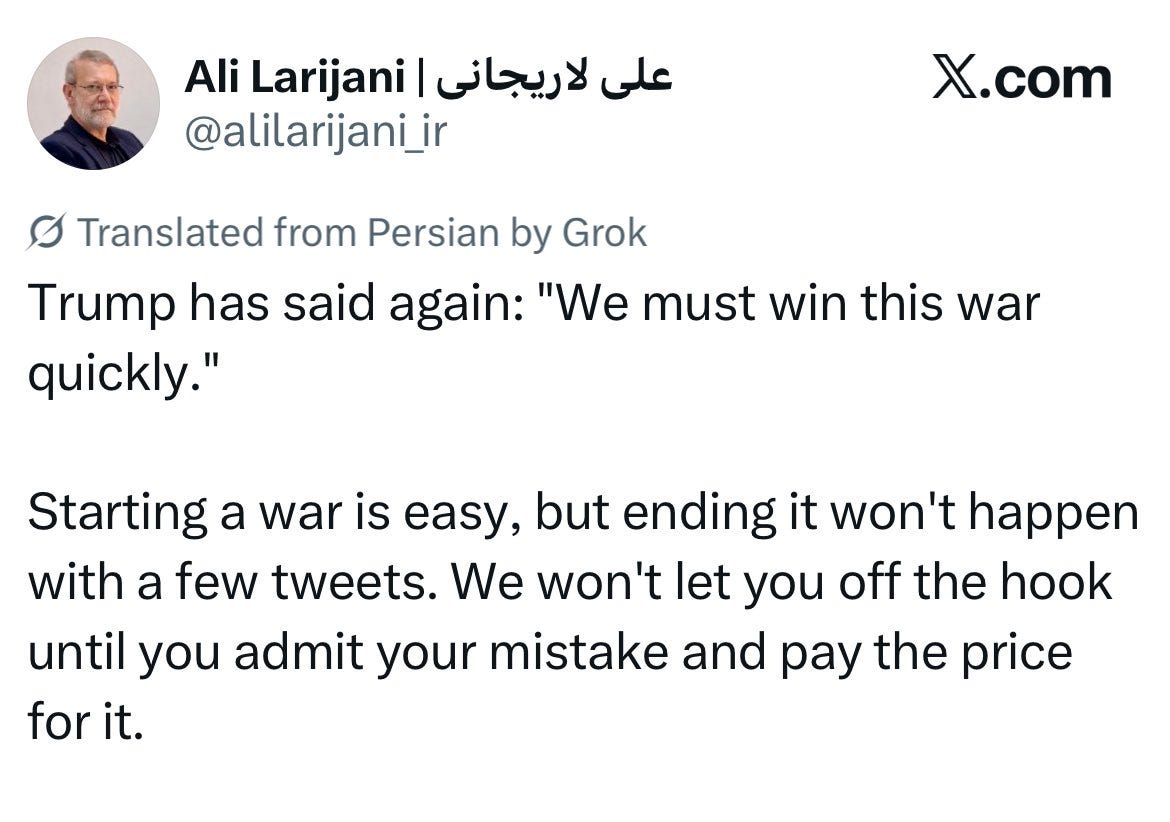
Larijani’s response: “Wars cannot be won with a few tweets, Trump”.

Tehran is being carpet-bombed. That is not hyperbole.
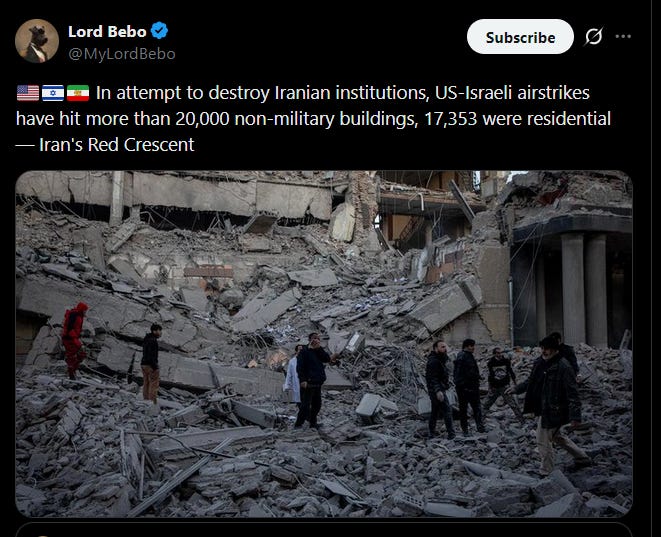
Iran’s Red Crescent put numbers on it: over 20,000 non-military buildings hit since day one. Of those, 17,353 were residential. The rest: hospitals, schools, commercial buildings, infrastructure.

CENTCOM released strike footage of transport aircraft – a C-130 Hercules, a P-3F Orion, an Il-76. Real planes this time. Not paintings.
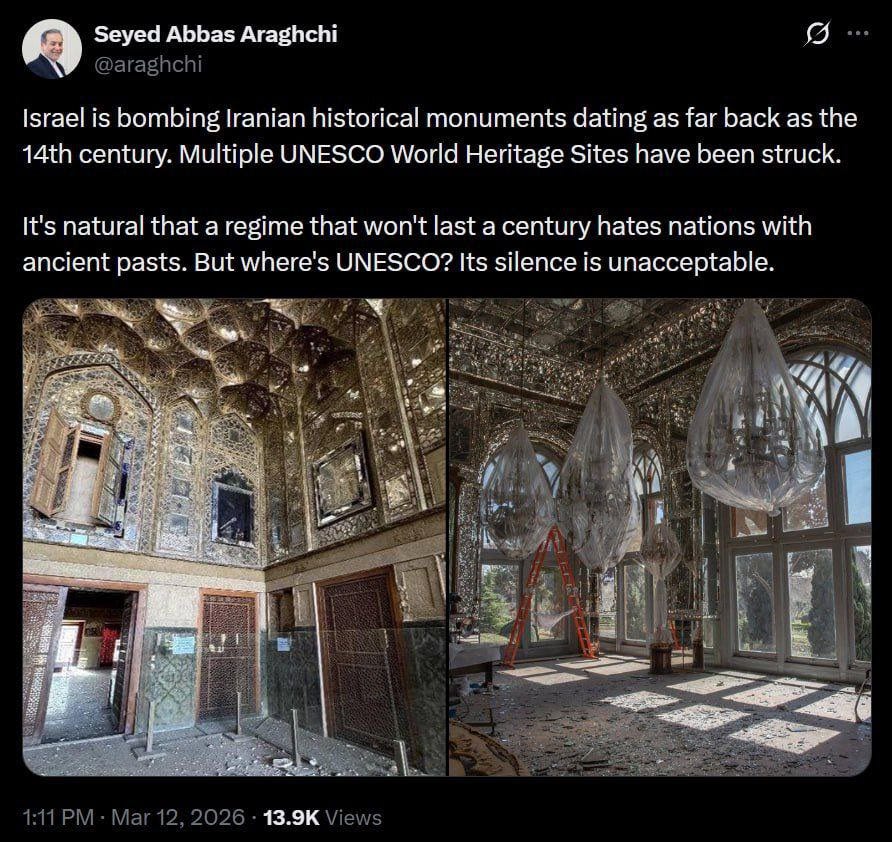
Iran’s Foreign Minister went further: “Israel is bombing Iranian historical monuments dating as far back as the 14th century. Multiple UNESCO World Heritage Sites have been struck”. His line was surgical: “It’s natural that a regime that won’t last a century hates nations with ancient pasts. But where’s UNESCO?” Good question. Silence, apparently, is UNESCO’s mother tongue.
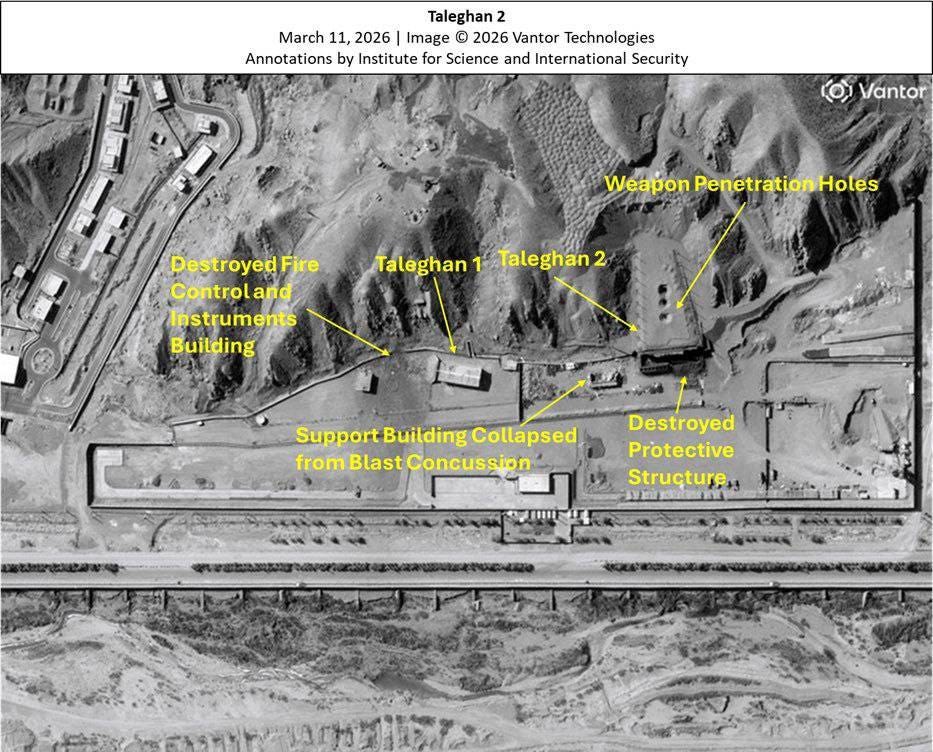
And then there’s Parchin. Satellite imagery from Maxar and Planet Labs shows significant damage at the Taleghan-2 facility inside Iran’s Parchin military complex. The weapon used is said to be the GBU-57 Massive Ordnance Penetrator – the largest non-nuclear bomb in America’s inventory. Whether it reached anything important under 80 metres of rock is a different question. The enriched uranium moved long ago. Even JD Vance admitted it.

Over Israel, 717 Home Front Command alerts triggered by midday – and that’s without counting the previous night’s barrage. Alerts, not impacts. But 717 sirens in half a day tells you everything about the state of what’s left of the early warning network.

Iranian cluster munitions reportedly struck outside Jerusalem’s Old City, near Al-Aqsa Mosque and the Church of the Holy Sepulchre. The three holiest sites of three religions, give or take, in one blast radius. Symbolism aside, the targeting accuracy on display is the story. These aren’t random launches hoping to land somewhere useful. They’re arriving precisely where someone chose to put them.
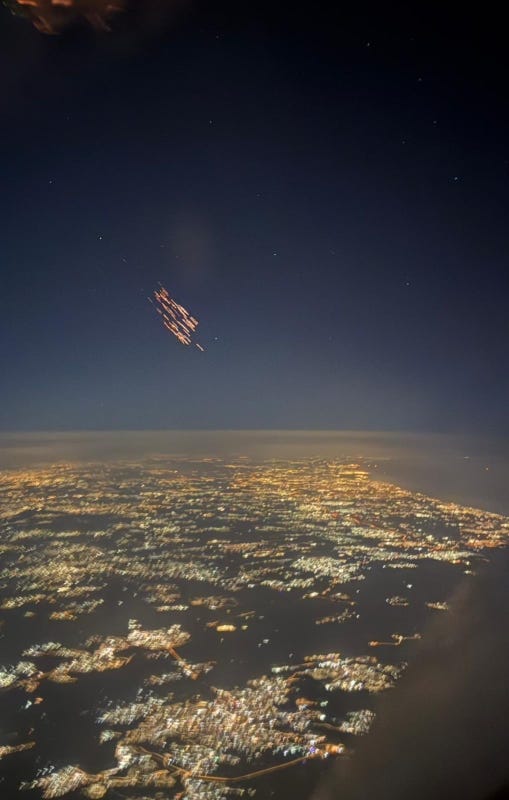
The censorship remains absolute. I can barely find footage of any of it. An Israeli Air Force pilot filmed ballistic missiles raining down on Israel at night. Mesmerising footage, if you can ignore what it means. But that’s about all that leaked. The BBC’s own reporter called the blackout “unprecedented” last week. It hasn’t improved.

Thirteen Israeli dead. Officially. Day fourteen of continuous bombardment from two axes. Thirteen. The absence of data is itself data.

Beirut is being Gazified. Al Jazeera captured the moment the IDF struck a building in Bachoura, central Beirut. Live. On air. The southern suburbs took another overnight pounding. Dahiyeh, the Hezbollah heartland, where command centres share walls with bakeries.

Hezbollah launched a named campaign for the first time in this war: “Operation Severe Storm”. Forty-three operations in a single day. A hundred-plus rockets in one barrage at Haifa, Galilee, and the Golan. Israeli Channel 14 admitted Hezbollah had “shifted from defence to offence, carrying out preemptive strikes with tremendous firepower”. When a military organisation names its operations, it’s not defending anymore. It’s advertising.

Then Ramlet al-Bayda. A drone double-tap on displaced families sleeping in tents on Beirut’s seafront. “Targeting a very specific person”, the IDF claimed. What they hit were displaced children sleeping on the sand. They picked up pieces of their bodies.
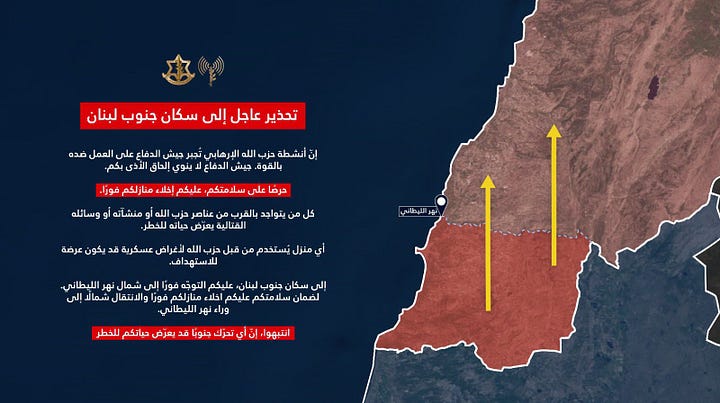
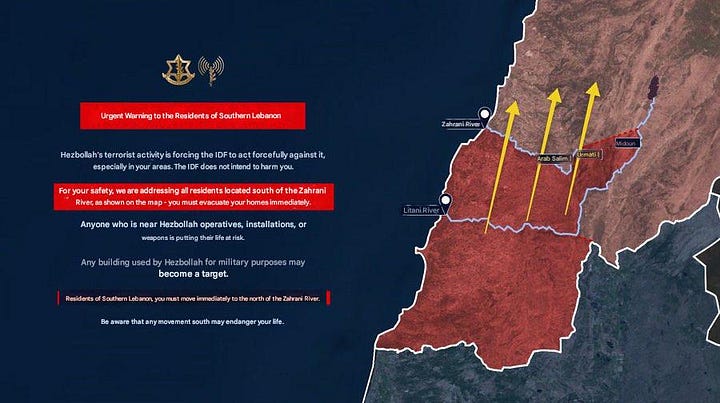
Israel’s Defense Minister Katz ordered the IDF to “prepare to expand the activity in Lebanon and restore peace to northern communities”. The expansion is already underway. Displacement orders now extend north of the Litani River to the Zahrani River – pushing the evacuation zone deeper than anything seen since 2006.

Hezbollah answered by hitting Unit 8200’s headquarters at the Glilot base, suburban Tel Aviv. 110 kilometres from the Lebanese border. Guided rockets. Plus salvos at the Misgav base, Yodfat military industries, Haifa naval base, and Tirat Carmel. The range of what’s coming out of Lebanon keeps stretching.

The Strait of Hormuz is apparently mined. Or so says the Wall Street Journal, citing US officials and “the Institute for the Study of War”. Ten mines, allegedly. The UK’s Healey added that “evidence mounts”. Iran’s deputy foreign minister denied it. No mines. I believe Iran on this one.

Mines don’t check passports. A naval mine detonates on magnetic signature, pressure change, or acoustic detection. It does not care whose flag flies above the hull. Chinese tankers are transiting freely every single day, confirmed on MarineTraffic. If the strait were mined, they’d be hitting those too. So why float the story?

Because “we can’t escort tankers through a mined strait” sounds considerably better than “we can’t escort tankers because we’d get hit”. The world’s most powerful navy has been unable to open a 33-kilometre waterway for two weeks. That’s embarrassing. Mines provide a technical excuse that avoids the simpler, more damaging explanation: Iran’s coastal defences work, and the US Navy doesn’t want to test them. The mines are cover. For impotence.
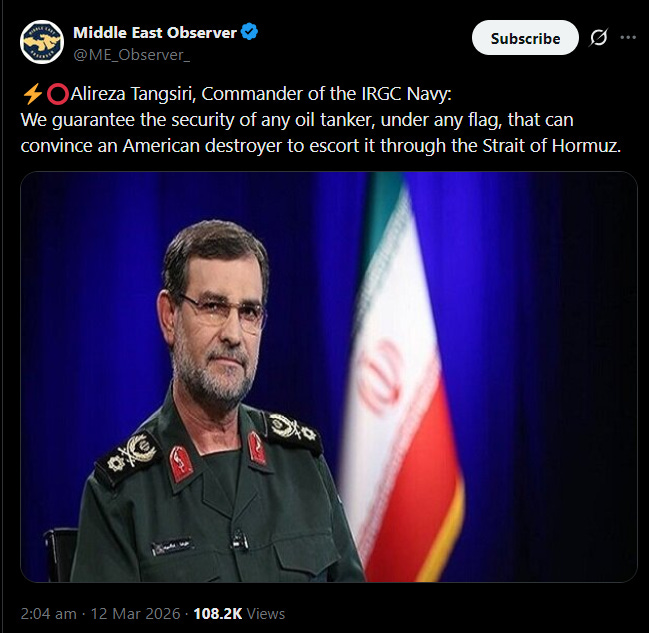
The IRGC Navy commander Tangsiri: “We guarantee the security of any oil tanker, under any flag, that can convince an American destroyer to escort it through the Strait of Hormuz”. What isn’t fiction is the tollbooth. India’s Foreign Minister called Iran’s Foreign Minister and asked permission to transit an international waterway. The world’s fifth-largest economy, nuclear-armed, with the fourth most powerful military on Earth, called Tehran and requested a waiver. And got one. The tanker Shenlong arrived in Mumbai loaded with Saudi crude, having sailed straight through Hormuz. Two more Indian tankers – the Pushpak and Parimal – also passed.
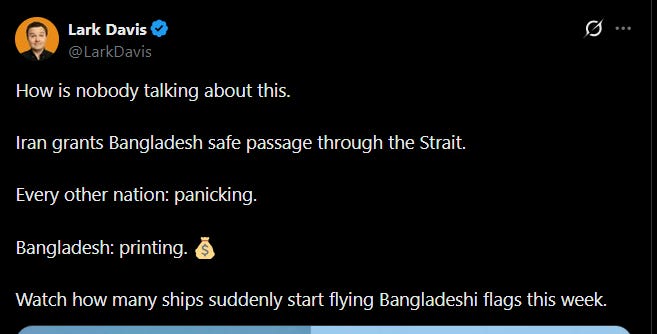
Bangladesh secured the same deal. China already had it. The strait isn’t closed. It’s a members-only club. And the membership criteria is: not being allied with the people who started the war. Although India?? Note to self: worth keeping an eye on that. For more economical background: Strait to Brrrr

The Safe Sia was not very safe at sea (sorry, couldn’t help myself). It was struck in the northern Persian Gulf near Basra. Marshall Islands-flagged, US-owned. One Indian crew member killed. Thirty-eight rescued. First confirmed fatality among tanker crews in this war.

Two more fuel tankers were attacked in Iraqi waters overnight. Explosive-laden Iranian boats. Reuters confirmed both were set ablaze. That brings the total to at least eighteen commercial vessels struck since day one. Brent nearly touched $100 again before settling near $98.5. The IEA, in a moment of unusual candour, called this “the largest supply disruption in the history of the global oil market”. 7.5% of global crude supply offline. Eight million barrels a day lost in March alone.

The Energy Secretary said $200 a barrel is “unlikely”. The IRGC said “not a single litre of oil”. One of these statements will age better than the other. Trump, asked about oil prices: “We make a lot of money when oil prices go up”. Making money while schoolgirls get massacred. Another great statement from the President of the United States.

The USS Gerald R. Ford – the most expensive warship ever built, $13.3 billion – caught fire. In the laundry. While operating in the Red Sea off the Saudi coast. CENTCOM says: not combat-related, contained, two sailors treated for non-life-threatening injuries. The previous night, an E-2D early warning aircraft from the Ford squawked 7700 emergency and diverted to an Israeli airbase. A laundry fire on a $13.3 billion aircraft carrier during an active war. The same ship that was -for lack of a better term- full of shit not too long ago. They make it way too easy for me.

The FBI distributed an intelligence bulletin to California police departments warning that Iran “aspired to conduct a drone attack from an unidentified vessel off the US West Coast”. Same week, the Army announced a reward for four military drones stolen from Fort Campbell – reportedly taken months ago, but publicised now. Convenient timing for a missing-drones story to surface alongside a missing-threat story. If something happens in California, the narrative is pre-built.

Iraq is burning again. As if it ever stopped. US A-10s struck PMF positions in Mosul. A-10 Warthogs it seems. On the way out, I thought. Apparently they got the call back like the rest of the Cold War inventory. Airstrikes hit three sites belonging to the 19th Brigade of the Popular Mobilisation Forces in the Akashat area of Anbar province – the medical headquarters, a battalion headquarters, and a support base. Reportedly thirty dead, fifty wounded. Iraqi Resistance launched Shahed drones at US bases in Erbil and Victory Camp in Baghdad.
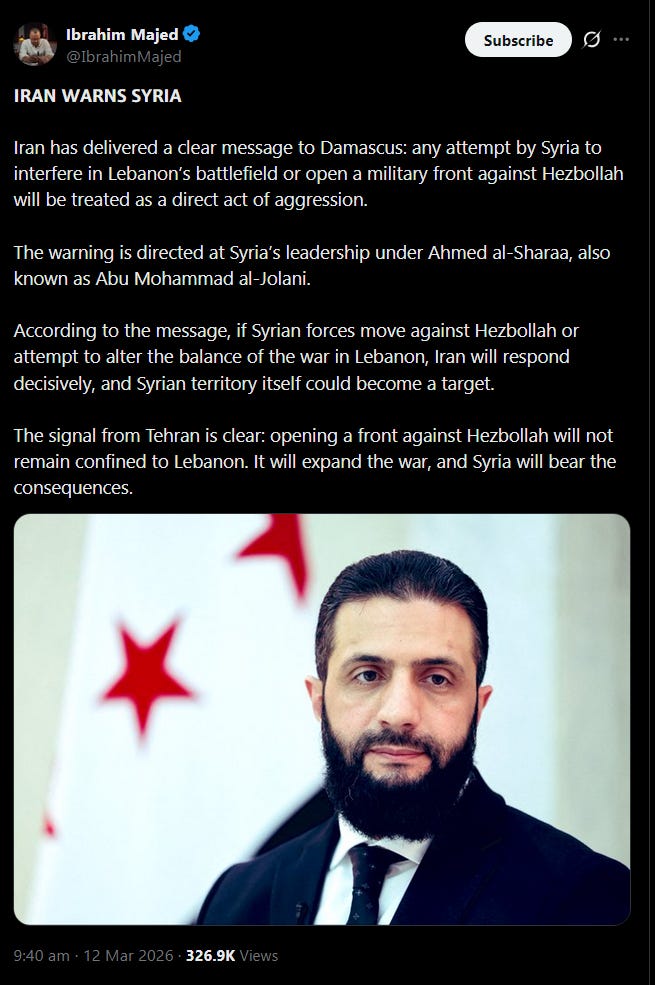
Iran warned Syria directly: any attempt to interfere in Lebanon’s battlefield will be treated as a direct act of aggression. The Iraqi Resistance Coordination issued the same warning to al-Julani: if he wants to relive his glory days chopping heads in Lebanon, the entire Axis of Resistance treats it as a declaration of war. The Syria front that everybody thought was settled is being reactivated.
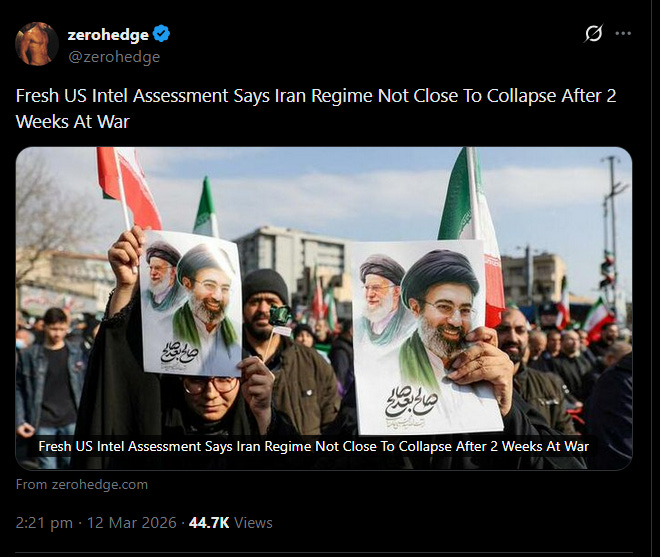
A US intelligence assessment – not from Twitter, not from Iranian state media, but from the intelligence community’s own reports shared with Reuters – concluded that Iran’s leadership “remains largely intact” and is “not at risk of collapse any time soon”. The regime “retains control of the Iranian public”. Israeli officials in closed discussions acknowledged there is “no certainty” the war will lead to the government’s downfall.

On day one, the stated objective was regime change. On day fourteen, the regime is intact, has a new Supreme Leader who hasn’t even shown his face and is already launching offensives named after himself, and America’s own intelligence says it isn’t working.

The war costs $11.3 billion for the first six days of operations alone. Not counting munitions. Pentagon briefed a closed Senate session with the number. The NYT and NBC both confirmed it. That’s before interceptors, before infrastructure repair, before the long-term costs that haven’t even started accruing. At a billion-plus per day on top of a $3 trillion annual deficit, this is the most expensive failure of real estate due diligence in human history.
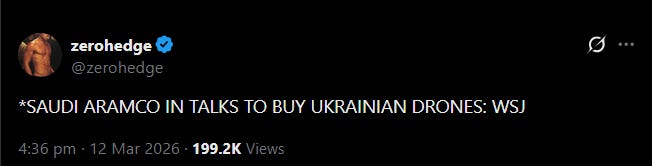
Saudi Aramco is negotiating to buy drone interceptors from Ukraine. That sentence is the 21st century in a single transaction. The world’s largest oil company buying weapons from the country Russia has been bombing for four years, to defend against the country America has been bombing for two weeks. The WSJ reported that a Saudi intermediary is in advanced talks with Ukrainian manufacturers SkyFall and Wild Hornets. I need a murderboard to track who’s selling weapons to whom.

The United Nations Security Council passed a resolution condemning Iran. Russia and China abstained. Both delivered rebukes. Russia’s Zakharova said Iran has “the right to self-defence”. China condemned the US-Israeli strikes within hours of day one. Thirteen days later, Beijing has not once named Iran as the attacker of any Gulf state. Not the UAE. Not Bahrain. Not Kuwait. Not Qatar. Not Oman. Not Saudi Arabia. Read that silence carefully. It’s the most expensive non-statement in geopolitics.
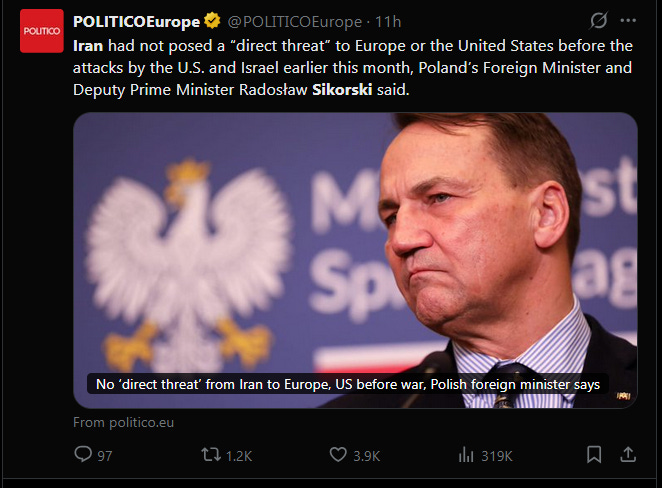
Poland’s Prime Minister stated plainly: “Polish and American interests overlap significantly, but they are not entirely identical”. That’s diplomatic speak for “you’re on your own, mate”. Italy’s public agrees. New polling: 69.5% of Italians want to follow Spain’s lead and deny US military bases. Only 15.9% disagree. NATO’s southern tier is turning.
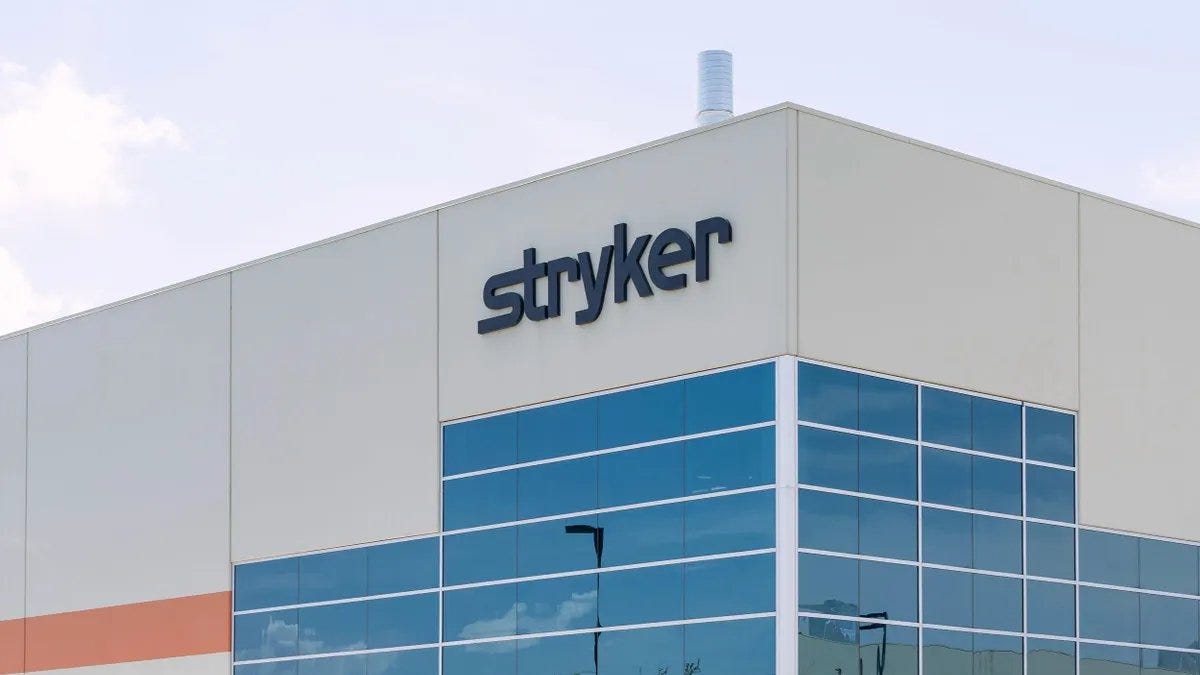
An Iran-linked hacker group called Handala claimed responsibility for a cyberattack on Stryker Corporation – the American medical technology company whose surgical robots and joint replacements operate in hospitals across 79 countries. Claimed 200,000 systems wiped and 50 terabytes extracted. WSJ and ABC confirmed the attack. The war just entered the operating room.

The cyber front has a symmetry to it. USrael struck Bank Sepah’s data infrastructure. Iran’s proxies hit a surgical equipment manufacturer used by hospitals globally. An eye for an eye. A server for a server.

South Korea lost all six THAAD launcher vehicles to redeployment in the Gulf. The radar and fire-control units are “expected to follow”. Expected. Not confirmed. Without the radar, the launchers are spectacularly expensive lawn ornaments. Seoul, which also has very little LNG left and a stock market that triggers circuit breakers every day that ends in a y, is left with either incomplete missile defence or none at all.
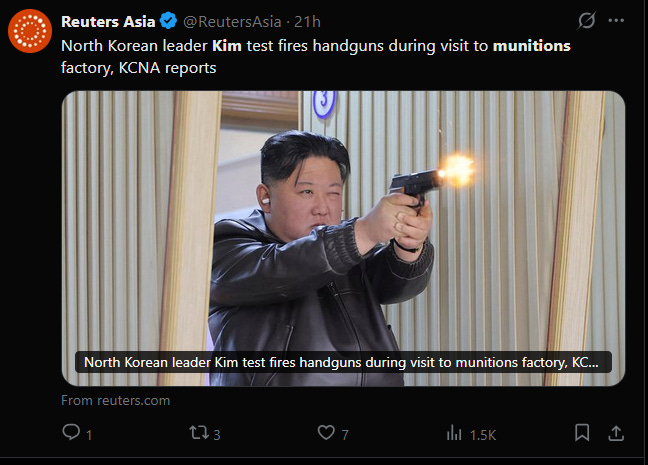
Kim Jong Un visited a munitions factory with his daughter the same day. Test-fired some guns together. More bonding.

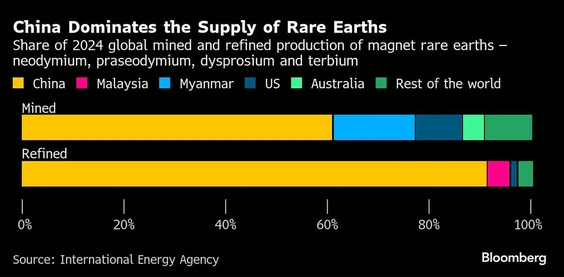
The US has two months of rare earth materials remaining. Two months. The radars being destroyed across the Gulf require yttrium. China holds 98% of global production and banned exports (link). The destruction is, in practical terms, permanent.
And a detail that’s buried in the supply chain news: Qatar’s LNG shutdown has also taken out roughly a third of global helium supply. Helium is irreplaceable in chip fabrication. No alternative exists at Qatar’s volume. The AI boom that was supposed to save the economy needs chips that need helium that comes from a country currently telling its entire population to stay indoors.

The Houthis went off-grid. No launches. No statements. I noted it yesterday. Today: still nothing. Whatever they’re preparing, the planning phase involves radio silence.

And Israel’s casualty count remains thirteen. After fourteen days. Two simultaneous fronts of continuous bombardment. 717 alert activations in a single half-day. Cluster munitions over Tel Aviv. Ballistic missiles arriving without sirens. Thirteen dead. The Israeli military censorship that the BBC called unprecedented is doing its job perfectly. What I can’t see, I can’t verify. What I can’t verify, officially didn’t happen. The absence of data is doing more to foment speculation than I ever could.

Iran’s air force, meanwhile, still hasn’t shown itself. The jets that were hidden underground before day one – the ones I’ve been asking about since the paintings were being bombed instead of planes – remain invisible. I didn’t notice that anyone had engaged an Iranian fighter since the Yak-130 training jet on day five. The real aircraft are somewhere. Waiting for something. Or they’re gone and nobody wants to admit it. Either way, it’s a question mark that keeps getting larger.
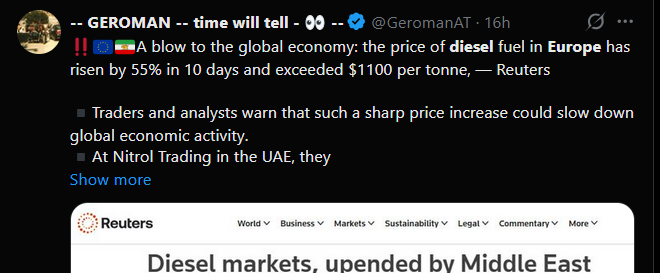
Diesel in Europe has surged 55% in ten days, past $1,100 per ton. Base fuel for freight, agriculture, and mining.

The cardboard spoke today. The cardboard said FAFO. Still devolving…"

"The Truth..."

"How It Really Is"


"Iran – the Latest Victim of the Jewish Master Race Mentality"

"Iran – the Latest Victim of
 the Jewish Master Race Mentality"
by Povl H. Riis-Knudsen

"It is disheartening to see the reaction of the so-called right wing to Israel’s (and its American vassals’) unprovoked war of aggression against Iran. One can seriously doubt whether there is sufficient intelligent life on the nationalist wing at all. There are many aspects to this issue – I cannot promise that we can cover them all within this framework, but let us at least try to touch on the most important ones.

1: Very few Westerners have any idea about Iran and Iranian affairs – and certainly not about Iranian history. However, this knowledge is a prerequisite for having any opinion at all about this criminal attack. If you don’t know anything about Iran, you should keep off your keyboard.[1]

2: The Iranians who, unfortunately, find themselves in this country came here mainly because they were fleeing military service during America’s (i.e., Israel’s) war against Iran in the 1980s - because that is what it was. Iraq was only America’s henchman – and the thanks Saddam Hussein got for his efforts clearly shows that it is literally deadly to be a friend of the US – Saddam Hussein simply knew too much. From the beginning, these Iranians belonged to the segment of the population that supported the Shah’s bloody dictatorship against the majority of the Iranian people. Their opinion on this matter is quite irrelevant. They have been traitors to their people from day one. They do not represent the Iranian people, but only a small minority.

3: Iran is not an Arab country, but an Indo-European country. Its culture goes back thousands of years and extends far beyond the Muslim conquest. The Iranian language is an Indo-European language like Danish and English. The Iranians are our brothers – or at least our cousins. However, history has made it so that there are many minorities within Iran’s borders, such as Azeris, Kurds, Arabs, and many others. This is a weakness to which we will return.

4: Iran is a Muslim country. There are two very different forms of Islam: Sunni and Shia. Iran is Shia Muslim. There are Shia Muslims in most countries in the Middle East, but in the Arab countries the leadership is mostly Sunni Muslim. An understanding of Iran requires a basic understanding of Shia Islam. However, there is extensive religious freedom in Iran. There are several Christian denominations, Sunni Islam, Zoroastrians (worshippers of fire, an ancient Persian religion). Missionary work for religions other than Islam is prohibited, as in other Muslim countries.

5: Iran’s strength, size and population (93 million) have made it Israel’s main enemy, as Iran also supports the Palestinian struggle for freedom. It is the last country on Israel’s laundry list to the US of Middle Eastern countries that must be destroyed. All the others have been destroyed: Syria, Lebanon, Iraq, Libya, Sudan. The other Arab countries are merely Israeli vassal states. In all cases, the villain is the US – humanity’s enemy No. 2. No. 1 is Israel. If the world is ever to have peace, these two states must disappear from the map in their current form.

6: Iran is an immensely rich country. A significant part of its wealth comes from oil. This has also proved to be one of Iran’s curses, because it has always attracted foreign interests.

7: Iran had actually established a democratic government until England and the US jointly overthrew Mohammad Mosaddegh’s democratic government in 1953 because Mosaddegh had committed the mortal sin of nationalizing the country’s own oil industry. When the US talks about wanting to “democratize” Iran, it therefore sounds more than hollow. Instead of Mosaddegh, Mohammad Reza Pahlavi was installed as governor, for this was what he was, even though he later assumed the title of shah. Pahlavi did not represent the Iranian people, but the US, and he initiated a harsh and forced westernization of the country. This means that in Europe and the US, there is a tendency to view the Pahlavi dictatorship as a golden age and the Shah as a man of progress – because, from our perspective, we are naturally far more developed and civilized than everyone else. The Shah did his best to make the country resemble America, but these efforts meant that he was inevitably mobilizing the population against him, because the population was and is Muslim and wanted to live as Muslims even then.

The Muslim resistance movement was fought with harsh measures. Imprisonment, widespread use of torture, random executions, etc. were part of the daily disorder. The Muslim leader Ruhollah Khomeini was forced into exile in Paris, from where he led the resistance movement. Despite massive American support for the dictatorship, Pahlavi’s regime collapsed, and Khomeini was able to return and was welcomed as a hero by the Iranian people—there are still a few of us who remember the television images from that time. The current regime is precisely the result of a popular uprising. The American embassy was stormed and exposed for what it really was: a spy center – and the home of Iran’s actual secret government. The majority of the Iranian people hate America for what America has done to Iran (not least during the eight-year proxy war with Iraq).

8: Iran has a Muslim government with the Council of Guardians and the Supreme Leader as guarantors that the country’s government does not pursue policies that deviate from Islam. But there are elections that determine who is president and who sits in parliament. Candidates must be approved – which is not a bad idea. This protects against the election of complete idiots, as we know from the average Western parliament and the average Western government. In Iran, the qualifications of Danish Prime Minister Mette Frederiksen would just be sufficient for her to clean a public toilet. As Westerners, we may like this system or not. It is none of our business. It is an internal Iranian matter, and no outsider has any right to interfere in it. We can probably agree that we do not want that system here, but then again, we do not have it, and Iran in no way poses any threat to either the US or Europe.

9: Donald Trump also knows nothing about Iran, as he has clearly demonstrated. Overall, Donald Trump has been a big disappointment. He has consistently done the opposite of what he promised during the election campaign: namely, to keep the US out of foolish wars. However, he has done nothing but embroil the US in wars and conflicts – and the war against Iran may well be his downfall. It is illegal – both under international law and under the US Constitution – but Trump has openly declared that he does not recognize any law – only his own conscience. However, it is doubtful whether he has one. This is not Trump’s war, however; it is Netanyahu’s war. 

But why is Trump waging this war – which threatens his position as president and will cause him to lose the midterm elections in November, leaving him paralyzed for the rest of his presidential term, if he is not impeached before then? Why get involved in this war at all? We know that Israel controls the US. Rich Jews control the capital, the entertainment industry, the media, and almost all institutions of higher education - and through their wealth, they determine who can be elected to Congress - and as president. Trump’s election campaign was paid for with Jewish money - and his daughter is married to a Jew and has converted to Judaism. When he lets Jared Kushner, his Jewish son-in-law – who has no role whatsoever in the US government – and his likewise Jewish golf buddy Steve Wittkoff – who also has no official role to play, but like Kushner is merely a speculator – travel around the world as negotiators, including on relations with Iran, it is a mockery of professional diplomats in general and of the Iranians in particular.

But Trump is not up for re-election, and the midterm elections are unlikely to be won at this point anyway, so why is he doing this? It is hardly a stretch of the imagination to assume that Netanyahu is in possession of all of the Epstein files. Could it be that Netanyahu has damning evidence against Trump? In any case, this war is a wonderful distraction from the Epstein scandal, which suddenly no one is talking about anymore…

But probably Trump has also been misinformed about the actual situation in Iran on purpose! He believed that regime change could be achieved by killing the country’s leader. How naive. Trump may have believed that the entire country would then welcome the Americans (and the Jews?) as liberators. This only testifies to his ignorance of Iran and its history and the country. The Iranians still hate the US. Since that strategy failed, we have heard countless other reasons why this barbaric attack was necessary:To prevent Iran from developing nuclear weapons; indeed, they were only a week away from having a nuclear bomb. Well, that has been said for the last 40 years – and they still haven’t developed one. And besides, Trump claims that he completely destroyed their nuclear program in the 12-day war six months ago. 

How does that add up? Furthermore, the recently assassinated supreme leader had issued a fatwah against the development of nuclear weapons – a religiously motivated ban. Trump assassinated what was probably the most moderate figure in Iran’s leadership. I should think that his successors will reconsider this fatwah. The reason Iran is in its current situation is precisely because it has not developed nuclear weapons, cf. North Korea, which is left in peace precisely because it does have nuclear weapons. Incidentally, does anyone remember the legend of Saddam Hussein’s non-existent weapons of mass destruction?

Because Iran allegedly controls all the world’s terrorist movements. Another claim that has been plucked out of thin air. Iran supports the Palestinian people and defends southern Lebanon against Israeli aggression. It is a reaction to Israeli terror.[2]

To prevent further executions of rebels. How touching. What about the nearly 100,000 Palestinians murdered in Gaza? How about preventing that? It would be easy. But oh no, they were just Palestinians. In Iran we were talking about CIA and Mossad agents who had been smuggled in. It was the master race, or at least its servants. Because Iran threatened the US. It takes a lot of imagination to picture that!

Among the more bizarre explanations is War Minister Hegseth’s explanation that Trump has been anointed by God to initiate Armageddon, which is a prerequisite for the return of Jesus. He really said so. And it is people like him who want to rule the world. God help us all!

The fact is that Trump’s ideas about Iran had no basis in reality. He is a stupid man and, like most Americans, he is uninformed about the world he wants to rule as his own personal property. This is precisely what makes him and the US dangerous.

By killing Khamenei, he did not just kill Iran’s supreme political leader. He killed the supreme religious leader of the vast majority of Iranians – the second most important leader of all Shia Muslims. He turned him into a martyr – and martyrdom has a special place in Shia Islam. With this killing, Trump did the worst thing he could possibly do if his goal was to overthrow the regime.

There is much speculation as to why all these people were gathered in Ali Khamenei’s official residence at this time – and not in a bunker. One explanation is that Khamenei deliberately sought martyrdom. He may have sought martyrdom for himself, but hardly for his closest associates, let alone his children and grandchildren. It is believed that he had received an American peace offer that needed to be discussed and responded to. As the Mossad’s motto goes: “By means of deception!”

10: This war could change the world. The Gulf states have seen that it is dangerous to be America’s friends. American bases are being bombed, economic life is being hit, and tourists are being scared away. A blockade of the Strait of Hormuz could triple the price of oil within a few days. Europe has cut itself off from cheap and reliable Russian energy. Russia can supply China with whatever it may lack from the Gulf states. Europe is going bankrupt.

11: Israel’s goal is to create an Israel from the Mediterranean to the Euphrates River by expelling the indigenous Arab population, who will flood Europe (and other European-populated countries) as refugees. This will contribute to the breakdown of Europe (and other white countries) and will create further hatred towards Muslims and implicitly greater love for the Jewish criminal state in the Middle East, who is the origin of the disaster. It is satanic – but well thought out. The Jews are intelligent people – and the Europeans and white Americans are stupid. Iran’s support for the Palestinians stands in the way of these plans.

12: The CIA is arming the Kurds, of whom there are also large numbers in Iran, in order to incite them to rise up against the Iranians. As a reward, they have been promised their own state – a dream the Kurds have had for centuries. This may incite other minorities in Iran to try to get their own state, so that Iran is split into atoms, but it will inevitably force Turkey into the war on Iran’s side. Turkey will never voluntarily accept a Kurdish state, and neither will Iraq and Syria, but Israel has already castrated these two states. Turkey, however, is a powerful military force. What right do the Americans have to interfere in such matters?

13: The great unknown. Will China and Russia accept an Iranian defeat? I don’t think so – and that would mean World War III, which would inevitably end in nuclear war. After that, further concerns are superfluous.

14: Israel is a terrorist state – and the US is Israel’s extended arm. The imperialist ambitions of the US and Israel are the greatest threat to world peace, mankind, and the existence of the planet. We cannot have a world order where one country – the US – can set the agenda everywhere on the planet. An international court must be established to judge all these warmongers and criminals against humanity. German officers and politicians were hanged in Nuremberg for far less!

15: One can debate whether it is the US that directs and facilitates Israel – or vice versa. The fact is that the two are joined at the hip. Israel is the little brother, but it is the little brother who calls the shots, because it is the little brother who holds the economic power in the US. Remember the movie “Wag the Dog!” – that is the situation we are facing. It is the tail that is wagging the dog. In this context, Epstein plays a very important part. Israel has incriminating evidence against a vast part of the US and European elites!

16: Is democracy even a desirable form of government? Just take a look at the governments this way of organizing states has created. America and Europe are hardly examples to follow! As they say: Gold sinks to the bottom – shit floats on top!"
The author on a city walk in Isfahan, Iran. The streets are clean, there is no street crime, no homeless people begging for money. In Teheran, the metro is clean and safe…… and a tank full of gas cost less than a liter in Europe.

"Thinking About the Unthinkable"

"Thinking About the Unthinkable"
by Michael Hudson

Excerpt: "Iran and Donald Trump have each explained why failure to fight the current war to the end would simply lead to a new set of mutual attacks. Trump announced on March 6 that “There will be no deal with Iran except unconditional surrender,” and announced that he must have a voice in naming or at least approving Iran’s new leader, as he has just done in Venezuela. “If the U.S. military must utterly defeat it and bring about a regime change, or else “you go through this, and then in five years you realize you put somebody in who’s no better.’”[1] It will take at least that long for America to replace the weaponry that has been depleted, rebuild its radar and related installations and mount a new war.

Iranian officials likewise recognize that U.S. attacks will keep being repeated until the United States is driven out of the Middle East. Having agreed to a ceasefire last June instead of pressing its advantage when Israeli and regional U.S. anti-missile defenses were depleted, Iran realized that war will be resumed as soon as the United States is able to re-arm its allies and military bases to renew what both sides recognize is to be a fight to some kind of final solution.

The war that began on February 28 can realistically be deemed to be the formal opening of World War III because what is at issue are the terms on which the entire world will be able to buy oil and gas. Can they buy this energy from exporters in currencies other than the dollar, headed by Russia and Iran (and until recently, Venezuela)? Will the present U.S. demand to control of the international oil trade require oil-exporting countries to price it in dollars, and indeed to recycle their export earnings and national savings into investments in U.S. government securities, bonds and stocks?

That recycling of petrodollars has been the basis of America’s financialization and weaponization of the world’s oil trade, and its imperial strategy of isolating countries that resist adherence to the U.S. ruler-based order (no real rules, but simply U.S. ad hoc demands). So what is at issue is not only the U.S. military presence in the Middle East – along with its two proxy armies, Israel and ISIS/al Qaeda jihadists. And the U.S. and Israeli pretense that it is about Iran having atomic weapons of mass destruction is as fictitious an accusation as that levied against Iraq in 2003. What is at issue is ending the Middle East’s economic alliances with the United States and whether its oil-export earnings will continue to be accumulated in dollars as the buttress of the U.S. balance of payments to help pay for its military bases throughout the world.

Iran has announced that it will fight until it achieves three aims to prevent future wars. First and foremost, the United States must withdraw from al its military bases in the Middle East. Iran already has destroyed the backbone of radar warning systems and anti-aircraft and missile defense sites in Jordan, Qatar, the United Arab Emirates (UAE) and Bahrain, preventing them from guiding U.S. or Israeli missile attacks or attacking Iran. Arab countries have bases or U.S. installations will be bombed if they are not abandoned.

The next two Iranian demands seem to far-reaching that they seem unthinkable to the West. Arab OPEC countries must end their close economic ties to the United States, starting with the U.S. data centers operated by Amazon, Microsoft and Google. And they not only must stop pricing their oil and gas in U.S. dollars, but disinvest in their existing petrodollars holdings of the U.S. investments that have been subsidizing the U.S. balance of payments since the 1974 agreements that made to gain U.S. permission to quadruple their oil-export prices.

These three demands would end U.S. economic power over OPEC countries, and thus the world oil trade. The result would be to dedollarize the world’s oil trade and re-orient it toward Asia and Global Majority countries. And Iran’s plan involves not only a military and economic defeat for the United States, but an end to the political character of the Near Eastern client monarchies and their relations with their Shi’ite citizens."
Complete, highly recommended article is here:

"Thanks To The War In Iran, A Moment Of Reckoning Has Arrived For The Entire Global Economy"

by Michael Snyder

"Global financial markets are starting to shake, and it is because of what is happening in the Middle East. At this stage, every day is a rollercoaster ride for investors, and that is not likely to change any time soon. The Iranians have paralyzed traffic through the Strait of Hormuz, and trying to reopen it by force is going to be exceptionally difficult to do. As you will see below, this is going to have enormous implications for every nation on the entire planet. We are in the early chapters of a major global crisis, and a tremendous amount of pain is ahead.

On Thursday, Mojtaba Khamenei issued a statement in which he boldly declared that the Strait of Hormuz must remain closed in order to “pressure the enemy”…"Iran’s new supreme leader, Mojtaba Khamenei, said Thursday that the closure of the Strait of Hormuz maritime passage should be continued as a “tool to pressure the enemy,” in his first public statement since being appointed. Khamenei also said all U.S. military bases in the Middle East should close immediately and “those bases will be attacked,” in televised comments translated by Reuters."

Oil prices extended gains following the statement, read out by a state TV broadcaster. The shipping of oil through the Strait of Hormuz has effectively stopped since the war began, causing global oil prices to soar. Iran warned on Wednesday that the price per barrel could climb to $200.

Needless to say, the Iranians are fully capable of carrying out Khamenei’s threats. Several more vessels have been attacked within the past 48 hours, and that includes a U.S.-owned oil tanker that was completely destroyed…"Iran’s semi-official Tasnim news agency also released a dramatic video apparently showing a missile strike on a U.S.-owned tanker in the Persian Gulf. The video shows a massive explosion on a vessel that is then engulfed in flames as people aboard what appears to be an IRGC attack boat celebrate. CBS News Confirmed identified the vessel as the Safesea Vishnu, a crude oil tanker sailing under a Marshall Islands flag, but owned by the New Jersey-based company Safesea Group LLC."

Now that Iran has officially closed the Strait of Hormuz, it will be up to the U.S. military to try to reopen it. This will not be an easy task. In fact, some military experts are warning that it could take months to accomplish that goal…Unblocking the Strait of Hormuz is shaping up as a remarkably complex and time-consuming task. The fate of the global oil markets - and the global economy - rests on whether ships can traverse the 22-mile-wide waterway from the Persian Gulf to the Gulf of Oman. More than 10 days after the U.S. and Israel attacked Iran, there is no clear plan for reopening it. Military experts say the effort is so daunting it could take months to achieve, absent a fast and full cease-fire.

So exactly why will it be so difficult to reopen the Strait of Hormuz? As one expert has aptly noted, the Iranians are able to block traffic through the Strait in a multitude of different ways The problem is that the strait can’t be cleared solely through a bombing campaign, or an attack by destroyers. Iran’s navy has been severely depleted by the U.S., but the country doesn’t need large attack ships to scare commercial vessels away. Its weapons include mines, fast attack boats, missiles and drones. Layered on top of each other, they become exceptionally difficult to remove. “They’ve created an integrated, vertical stack of threats that can cover the strait from undersea all the way to above the surface,” said Jonathan Schroden, chief research officer at the Center for Naval Analyses, a federally funded nonprofit that does research for the Navy.

If you take out all of their missiles, they would still have thousands of drones. If you could somehow locate and eliminate all of the drones, they would still have their fast attack boats. And even if you could eliminate all of their fast attack boats, they would still have thousands of naval mines. My point is that this crisis is not going to be resolved easily. And that is really, really bad news for the global economy.

Right now, approximately half of the available global fleet of liquified natural gas carriers is trapped in the Persian Gulf…"According to the WSJ, at least 20 LNG carriers about half the available global fleet – are trapped in the Persian Gulf, with daily freight costs soaring as demand from Asia surges, according to ship brokers."

This is a nightmare. Liquified natural gas prices have already soared in Europe and in Asia, and this is probably only just the beginning…"Ship brokers said the 20 ships trapped in the Persian Gulf make up nearly half of all LNG ships currently available for charter, with daily rates rising to more than $200,000 from less than $98,000 before the start of the Iran hostilities. Energy traders expect LNG prices to rise by early next week, adding to this week’s 40% rise in Asia and Europe. “The effect on LNG shipping will outlast the conflict for a few months,” Karathanos said."

Amid the scramble to procure LNG, more shipments bound for Europe are diverting to Asia. At least nine cargoes initially headed to Europe have changed course to Asia since the start of the fighting, according to ship-tracking data compiled by Bloomberg, with the trend accelerating in recent days. A buffer of spare supply is quickly drying up, threatening more competition and higher prices for both regions.

Meanwhile, a very large percentage of the nitrogen fertilizer that famers in the northern hemisphere are counting on is also stuck in the Persian Gulf region…"Nearly half the world’s traded urea - the most widely used nitrogen fertilizer - comes from the Gulf region, with Qatar accounting for one-tenth of the global supply, according to Bloomberg Intelligence. When QatarEnergy last week halted production after Iranian strikes on Ras Laffan, the world’s biggest LNG and fertilizer hub, hundreds of thousands of tons of key fertilizer nutrients and precursors were sidelined."

The compounding effects of the Iran war threaten the third major risk to global food security in six years, after the COVID-19 pandemic and Moscow’s seizure of farmland and ports used to export Ukrainian grain at the start of Russia’s war in Ukraine in 2022. If we can’t get that fertilizer into the hands of the farmers that need it, we are going to have a massive problem on our hands.

Approximately half of the entire population of the world eats food that is grown using nitrogen fertilizer… "About 4 billion people on the planet eat food grown with synthetic nitrogen fertilizers. Roughly half of the global population, in other words, is alive because of these chemicals converted into nutrients for plants, said Lorenzo Rosa, who researches sustainable energy, water, and food systems at the Carnegie Institution for Science at Stanford University." If this war persists for an extended period of time, famine will become a major global theme.

Of course the war with Iran has also caused the greatest oil supply disruption in human history…"The war in the Middle East is creating the largest supply disruption in the history of the global oil market, the International Energy Agency said in a report on Thursday slashing its annual supply outlook, shortly after the group announced its biggest-ever oil stock release.

It is now being projected that the price of oil could soon hit $150 a barrel, and that would absolutely crush the global economy…"If it remains fully closed for weeks, analysts see oil prices climbing to $150—a level that could send the U.S. and other economies into recession. Countries are going to great lengths - from emptying their strategic oil stockpiles to rerouting supplies through underutilized pipelines - to find other ways to replace the shortage. None of those ideas will come close to replacing all the lost supplies."

Meanwhile, trouble is brewing in the financial markets. In fact, George Noble is warning that a major crisis is emerging in the private credit market…"George Noble, a longtime Fidelity fund manager and Wall Street veteran, sees big problems brewing in the booming private credit market. The former director of Fidelity Overseas Fund recently wrote that he sees the makings of a financial crisis in the sector, echoing others who have worried about a spate of negative headlines in recent months."

So what is it specifically that has him so spooked? Well, it is the fact that so many big players are starting to block investors from withdrawing their money… “We’re watching a financial crisis unfold in real time,” he said in a post on X. “The last time funds started blocking investors from getting their money back, Bear Stearns collapsed six months later.”

The collapse of the investment bank is often seen as one of the first dominoes of the 2008 financial crisis. Noble pointed to recent news of redemptions at major firms, including BlackRock, Blackstone, and Blue Owl. Noble is right. We haven’t seen anything like this since 2008.

And now we can add Morgan Stanley to the list…"Morgan Stanley’s investment management arm became the latest asset manager to cap withdrawals from a private credit fund, telling investors in a letter Wednesday evening that it saw a wave of redemption requests this quarter. The company’s North Haven Private Income Fund, which has $7.6 billion in total investments, received investor requests to buy back around 10.9% of outstanding shares in its quarterly tender offer. The fund capped repurchases at 5%, its previously disclosed threshold. “By maintaining appropriate limits on the quarterly repurchase offer, the [fund] seeks to avoid asset sales during periods of market dislocation and provide for conservative capital structure management through evolving market conditions,” the letter said."

This is it guys. What we have been waiting for has officially begun. I hope that you are ready for what is coming next, because the months ahead are going to be absolutely filled with chaos."
o