StatCounter

Wednesday, March 4, 2026

“A Life of One’s Own"

“If the sun is shining, stand in it – yes, yes, yes. Happy times are great, but happy times pass – they have to – because time passes. The pursuit of happiness is more elusive; it is life-long, and it is not goal-centered. What you are pursuing is meaning – a meaningful life… There are times when it will go so wrong that you will be barely alive, and times when you realize that being barely alive, on your own terms, is better than living a bloated half-life on someone else’s terms.” - Jeanette Winterson
“‘A Life of One’s Own’: A Penetrating 1930s Field Guide to Self-Possession, 
Mindful Perception, and the Art of Knowing What You Really Want”
by Maria Popova

“One must know what one wants to be,” the eighteenth-century French mathematician Émilie du Châtelet wrote in weighing the nature of genius. “In the latter endeavors irresolution produces false steps, and in the life of the mind confused ideas.” And yet that inner knowing is the work of a lifetime, for our confusions are ample and our missteps constant amid a world that is constantly telling us who we are and who we ought to be – a world which, in the sobering words of E.E. Cummings, “is doing its best, night and day, to make you everybody else.” Try as we might not to be blinded by society’s prescriptions for happiness, we are still social creatures porous to the values of our peers – creatures surprisingly and often maddeningly myopic about the things we believe furnish our completeness as human beings, habitually aspiring to the wrong things for the wrong reasons.

In 1926, more than a decade before a team of Harvard psychologists commenced history’s longest and most revelatory study of human happiness and half a century before the humanistic philosopher Erich Fromm penned his classic on the art of living, the British psychoanalyst and writer Marion Milner (February 1, 1900–May 29, 1998) undertook a seven-year experiment in living, aimed at unpeeling the existential rind of all we chronically mistake for fulfillment – prestige, pleasure, popularity – to reveal the succulent, pulsating core of what makes for genuine happiness. Along her journey of “doubts, delays, and expeditions on false trails,” which she chronicled in a diary with a field scientist’s rigor of observation, Milner ultimately discovered that we are beings profoundly different from what we imagine ourselves to be – that the things we pursue most frantically are the least likely to give us lasting joy and contentment, but there are other, truer things that we can train ourselves to attend to in the elusive pursuit of happiness.

In 1934, under the pen name Joanna Field, Milner released the results of her inquiry in “A Life of One’s Own” – a small, enormously insightful book, beloved by W.H. Auden and titled in homage to Virginia Woolf’s “A Room of One’s Own,” published three years after Milner began her existential experiment. Milner would go on to fill her ninety-eight years with life of uncommon contentment, informed by her learnings from this intensive seven-year self-examination.

In the preface to the original edition, Milner admonishes: “Let no one think it is an easy way because it is concerned with moments of happiness rather than with stern duty or high moral endeavour. For what is really easy, as I found, is to blind one’s eyes to what one really likes, to drift into accepting one’s wants ready-made from other people, and to evade the continual day to day sifting of values. And finally, let no one undertake such an experiment who is not prepared to find himself more of a fool than he thought.”

This disorienting yet illuminating task of turning the mind’s eye inward requires a practice of recalibrating our conditioned perception. Drawing on Descartes’s tenets of critical thinking, she set out to doubt her most fundamental assumptions about what made her happy, trying to learn not from reason alone but from the life of the senses. Half a century before Annie Dillard offered her beautiful lens on the two ways of seeing, Milner writes: “As soon as I began to study my perception, to look at my own experience, I found that there were different ways of perceiving and that the different ways provided me with different facts. There was a narrow focus which meant seeing life as if from blinkers and with the centre of awareness in my head; and there was a wide focus which meant knowing with the whole of my body, a way of looking which quite altered my perception of whatever I saw. And I found that the narrow focus way was the way of reason. If one was in the habit of arguing about life it was very difficult not to approach sensation with the same concentrated attention and so shut out its width and depth and height. But it was the wide focus way that made me happy.”

She reflects on the sense of extreme alienation and the terror of missing out she felt at the outset of the experiment, at twenty-six: “Although I could not have told about it at the time, I can now remember the feeling of being cut off from other people, separate, shut away from whatever might be real in living. I was so dependent on other people’s opinion of me that I lived in a constant dread of offending, and if it occurred to me that something I had done was not approved of I was full of uneasiness until I had put it right. I always seemed to be looking for something, always a little distracted because there was something more important to be attended to just ahead of the moment.”

Throughout the book, Milner illustrates the trajectory of her growth with the living record that led to her insights, punctuating her narrative with passages from her diary penned during the seven years. One, evocative of eighteen-year-old Sylvia Plath’s journal, captures the disquieting restlessness she felt: “I want to feel myself part of things, of the great drift and swirl: not cut off, missing things, like being sent to bed early as a child, the blinds being drawn while the sun and cheerful voices came through the chink from the garden.”

In another, she distills the interior experience of that achingly longed-for sense of belonging to with world: “I want… the patterns and colorings on the vase on my table took on a new and intense vitality – I want to be so harmonious in myself that I can think of others and share their experiences.”

Looking back on the young self who penned those journal entires at the outset of the experiment, Milner reflects: “I had felt my life to be of a dull dead-level mediocrity, with the sense of real and vital things going on round the corner, out in the streets, in other people’s lives. For I had taken the surface ripples for all there was, when actually happenings of vital importance to me had been going on, not somewhere away from me, but just underneath the calm surface of my own mind. Though some of these discoveries were not entirely pleasant, bringing with them echoes of terror and despair, at least they gave me a sense of being alive.”

Much of that aliveness, she notes, came from the very act of chronicling the process of self-examination, for attention is what confers interest and vitality upon life. Joining the ranks of celebrated authors who championed the benefits of keeping a diary, Milner writes: “Not only did I find that trying to describe my experience enhanced the quality of it, but also this effort to describe had made me more observant of the small movements of the mind. So now I began to discover that there were a multitude of ways of perceiving, ways that were controllable by what I can only describe as an internal gesture of the mind. It was as if one’s self-awareness had a central point of interest being, the very core of one’s I-ness. And this core of being could, I now discovered, be moved about at will; but to explain just how it is done to someone who has never felt it for himself is like trying to explain how to move one’s ears.”

This inarticulable internal gesture, Milner found, was a matter of recalibrating her habits of perceiving, looking not directly at an object of attention but taking in a fuller picture with a diffuse awareness that is “more like a spreading of invisible sentient feelers, as a sea anemone spreads wide its feathery fingers.” One morning, she found herself in the forest, mesmerized by the play of sunlight and shadow through the glistening leaves of the trees, which left her awash in “wave after wave of delight” – an experience not cerebral but sensorial, animating every cell of her body. Wondering whether such full-body surrender to dimensional delight could provide an antidote to her feelings of anger and self-pity, she considers the trap of busyness by which we so often flee from the living reality of our being: “If just looking could be so satisfying, why was I always striving to have things or to get things done? Certainly I had never suspected that the key to my private reality might lie in so apparently simple a skill as the ability to let the senses roam unfettered by purposes. I began to wonder whether eyes and ears might not have a wisdom of their own.”

That tuning into one’s most elemental being, she came to realize, was the mightiest conduit to inhabiting one’s own life with truthfulness and integrity undiluted by borrowed standards of self-actualization. Nearly half a century before the poet Robert Penn Warren contemplated the trouble with “finding yourself,” Milner writes: “I had been continually exhorted to define my purpose in life, but I was now beginning to doubt whether life might not be too complex a thing to be kept within the bounds of a single formulated purpose, whether it would not burst its way out, or if the purpose were too strong, perhaps grow distorted like an oak whose trunk has been encircled with an iron band. I began to guess that my self’s need was for an equilibrium, for sun, but not too much, for rain, but not always… So I began to have an idea of my life, not as the slow shaping of achievement to fit my preconceived purposes, but as the gradual discovery and growth of a purpose which I did not know. I wrote: “It will mean walking in a fog for a bit, but it’s the only way which is not a presumption, forcing the self into a theory.”

Distilling the essence of this reorientation of being, she adds: “I did not know that I could only get the most out of life by giving myself up to it.”

Several decades later, Jeanette Winterson would write beautifully of “the paradox of active surrender” essential to our experience of art. As in art, so in life – Milner writes: “Here then was a deadlock. I wanted to get the most out of life, but the more I tried to grasp, the more I felt that I was ever outside, missing things. At that time I could not understand at all that my real purpose might be to learn to have no purposes.”

Half a century after Nietzsche proclaimed that “no one can build you the bridge on which you, and only you, must cross the river of life,” Milner considers the difficulty – and the triumph – of recognizing that you are crossing life on someone else’s bridge: ”I had at least begun to guess that my greatest need might be to let go and be free from the drive after achievement – if only I dared. I had also guessed that perhaps when I had let these go, then I might be free to become aware of some other purpose that was more fundamental, not self-imposed private ambitions but some thing which grew out of the essence of one’s own nature. People said: ‘Oh, be yourself at all costs’. But I had found that it was not so easy to know just what one’s self was. It was far easier to want what other people seemed to want and then imagine that the choice was one’s own.”

“One can’t write directly about the soul,” Virginia Woolf wrote in her own diary in the same era. “Looked at, it vanishes.” Happiness, Milner found, was similarly elusive to direct pursuit. Rather, its attainment required a wide-open attentiveness to reality, a benevolent curiosity about all that life has to offer, and a commitment not to argue with its offerings but to accept them as they come, congruous or incongruous as they may be with our desires.

Looking back on the diary entires from the final stretch of her seven-year experiment, she reflects on the hard-earned mastery of this unarguing surrender: “It struck me as odd that it had taken me so long to reach a feeling of sureness that there was something in me that would get on with the job of living without my continual tampering. I suppose I did not really reach it until I had discovered how to sink down beneath the level of chattering thoughts and simply feel what it meant to be alive.”

Freely download “A Life Of Ones Own”, by Marion Milner, here:

The Daily "Near You?"

South Jordan, Utah, USA. Thanks for stopping by!

"There Is Always The Hope..."

“What happens to people living in a society where everyone in power is lying, stealing, cheating and killing, and in our hearts we all know this, but the consequences of facing all these lies are so monstrous, we keep on hoping that maybe the corporate government administration and media are on the level with us this time. Americans remind me of survivors of domestic abuse. This is always the hope that this is the very, very, very last time one’s ribs get re-broken again.”
- Inga Muscio

"You Think..."

"That's why crazy people are so dangerous.
You think they're nice until they're chaining you up in the garage."
- Michael Buckley

"When We Can No Longer Tell the Truth "

"When We Can No Longer Tell the Truth"
by Charles Hugh Smith

"When we can no longer tell the truth because the truth will bring the whole rotten, fragile status quo down in a heap of broken promises and lies, we've reached the perfection of dysfunction. You know the one essential guideline to leadership in a doomed dysfunctional system: when it gets serious, you have to lie. In other words, the status quo's secular goddess is TINA - there is no alternative to lying, because the truth will bring the whole corrupt structure tumbling down.

This core dynamic of dysfunction is scale-invariant, meaning that hiding the truth is the core dynamic in dysfunctional relationships, households, communities, enterprises, cities, corporations, states, alliances, nations and empires: when the truth cannot be told because it threatens the power structure of the status quo, that status quo is doomed.

Lies, half-truths and cover-ups are all manifestations of fatal weakness. What lies, half-truths and cover-ups communicate is: we can no longer fix our real problems, and rather than let this truth out, we must mask it behind lies and phony reassurances.

Truth is power, lies are weakness. All we get now are lies, statistics designed to mislead and phony reassurances that the status quo is stable and permanent. The truth is powerful because it is the core dynamic of solving problems. Lies, gamed statistics and false reassurances are fatal because they doom any sincere efforts to fix what's broken before the system reaches the point of no return.

We are already past the point of no return. The expediency of lies has already doomed us.

Honest accounts of hugely successful corporations that implode share one key trait: in every case, managers were pressured to hide the truth from top management, which then hid the truth from investors and clients. is the key dynamic in failed oligarchies as well: if telling the truth gets you sent to Siberia (or worse), then nobody with any instinct for self-preservation will tell the truth. If obscuring the truth saves one's job, then that's what people do. That this dooms the organization is secondary to immediate self-preservation.

A distorted sense of loyalty to the family, community, company, institution, agency or nation furthers lying as the  solution to unsavory problems. Daddy a drunk? Hide the bottle. Church a hotbed of adultery and thieving? Maintain the facade of holiness at all costs. Company products are failing? Put some lipstick on the pig. The statistical truth doesn't support the party's happy story? Distort the stats until they do what's needed. The agency failed to fulfill its prime directive? Blame the managerial failure on a scapegoat.

Pathological liars and cheats rely on self-preservation and misplaced loyalty to mask their own failure and corruption. A hint here, a comment there, and voila, a culture of lying is created and incentivized.

Obscuring the truth is the ultimate short-term expediency. Now that it's serious, we have to lie. We'll start telling the truth later, we say, after everything's stabilized, we hope. But lying insures nothing can ever be truly stabilized, so there will never be a point at which the system is strong enough and stable enough to survive the truth.

We are now an empire of lies. The status quo,politically, socially and economically, depends on lies, half-truths, scapegoats and cover-ups for its very survival. Any truth that escapes the prison of lies endangers the entire rotten edifice.

In an empire of lies, leaders say what people want to hear. This wins the support of the masses, who would rather hear false reassurances that require no sacrifices, no difficult trade-offs, no hard choices, no discipline. The empire of lies is doomed. Lies are weakness, and they prohibit any real solutions. Truth is power, but we can no longer tolerate the truth because it frightens us. Our weakness is systemic and fatal."

"How It Tragically, Really Is"

 
Never in the history of the world has there been such a totally kind, compassionate, caring people as you, Good Americans! $359 billion for the neoNazis in Ukraine, God knows how many secret billions to the psychopathically degenerate genocidal Israeli monsters, US debt at $38.7 trillion to pay for the literally insane policies of the Left, all while our economy's being destroyed right in front of our eyes! Stores and restaurants closing everywhere; massive layoffs everywhere, millions jobless and homeless after losing their homes; 700,000 homeless people living in tents everywhere; 60,000 homeless veterans, 22 of whom kill themselves every single day; 150,000 drug overdose deaths last year; violent crime exploding everywhere; inflation out of control and about to explode higher; elderly can't afford life saving medications; rents sky high; city and state governments bankrupt; food banks desperately getting empty and your kids are hungry; gas prices about to explode much higher; $1.5 TRILLION a year, at least, for the military and its 800 bases around the world to spread "democracy" to the suffering masses everywhere; Wall St. thieves stealing TRILLIONS of dollars, including from the pension funds you foolishly believed you'd receive, and won't, and nobody's ever charged or goes to jail; and you go broke desperately trying to pay the electric bill. And yet, despite all this, Americans find it in their loving hearts to relieve other's suffering without complaining! No mass protests! My heart bursts, it bursts I tell you, with pride and admiration! Well, not exactly, but if I put here what I really feel about all this they'd instantly delete this blog...as they did the first one. - CP

"Preemptive War, Permanent Emergency: The Real Cost of Trump’s Iran Strike"

"Preemptive War, Permanent Emergency: 
The Real Cost of Trump’s Iran Strike"
by John & Nisha Whitehead

“From the least to the greatest, all are greedy for gain; prophets and priests alike, all practice deceit. They dress the wound of my people as though it were not serious. ‘Peace, peace,’ they say, when there is no peace.” -Jeremiah 6:13–14

“This is insane. Regime change will result in a bloody civil war... Resist this!” - Charlie Kirk (2025)

"The military-industrial complex and the American police state have joined forces. War abroad and war at home are no longer separate enterprises. They have fused. This did not happen overnight. Every modern president has stretched the limits of war-making power. Some have shredded those limits altogether. Each time that boundary is breached, the Constitution recedes a little further. This is one of those moments.

In a complete about-face from his claims to being a peace president, Donald Trump has authorized yet another preemptive strike - this time against Iran - without a declaration of war from Congress, without meaningful public debate, and without constitutional clarity. The gravity of that decision cannot be overstated.

While American troops were being ordered into harm’s way, Trump was hosting a $1 million-a-ticket fundraiser for himself at Mar-a-Lago, trotting out his signature dance moves between curtained war briefings. That spectacle tells you everything you need to know.

That is how we arrived at Operation Epic Fury.

With its Orwellian proclamations of “peace through strength,” Operation Epic Fury is less strategy than spectacle—an egotistical, muscle-flexing distraction by the Trump administration and an overarching attempt to normalize the use of unilateral force by the executive branch without congressional input or authorization.

This was never about peace. It was always about power.

And the Constitution is clear about how this is supposed to work, even if the White House is not.


And the Constitution is clear about how this is supposed to work, even if the White House is not. Permanent war places empire first.

And as usual, “we the people” will be forced pay for another unpopular forever war—financially, constitutionally, and domestically - and for the presidential hubris and the greed of the military-industrial complex and Deep State undergirding it all. Congress anticipated this danger. The War Powers Act was meant to rein in presidents who bypass Congress. But laws are only as strong as the institutions willing to enforce them. Without congressional authorization, without meaningful debate, without constitutional clarity, the executive branch claims the unilateral authority to wage war.

This is how dictatorships arise and republics erode. It happens when a president is allowed to treat constitutional limits as inconveniences rather than restraints. Trump routinely dismisses unfavorable polls, ignores the courts, sidesteps Congress, shows contempt for the will of the American people, and ignorance about the fact that he works for “we the people.” He behaves not as a public servant but as a potentate.

As John Jay warned in The Federalist No. 4: “Absolute monarchs will often make war when their nations are to get nothing by it, but for the purposes and objects merely personal, such as thirst for military glory, revenge for personal affronts, ambition, or private compacts to aggrandize or support their particular families or partisans. These and a variety of other motives, which affect only the mind of the sovereign, often lead him to engage in wars not sanctified by justice or the voice and interests of his people.”

If this were merely a constitutional dispute, it would be grave enough. But it is not merely constitutional. The consequences are immediate, political, and profoundly destabilizing. Trump has a tendency to bulldoze through constitutional and legal restraints, creating a spectacle or a crisis, and then leaving others to clean up the fallout - whether it is a gutted ballroom, an eviscerated federal agency, a chaotic immigration crackdown, or now a widening war in the Middle East. Long after the headlines move on, the wreckage remains.

And when the crisis involves war, the consequences are not merely bureaucratic or political - they are measured in lives and liberties 
War, in particular, has always been the most convenient tool of presidents facing troubles at home. When approval ratings slide, when economic policy falters, when scandal threatens to consume the headlines, foreign conflict has a way of shifting the narrative.

Trump’s Iran escalation- a deadly, costly, immoral, unpopular distraction from missteps of Trump’s own making - comes amid dismal polling, a faltering economy, escalating immigration crackdowns, eroding constitutional protections, and renewed scrutiny tied to the Epstein files. Six out of ten Americans disapprove of Trump’s military action against Iran. And while there is little to defend about Iran - it is a brutal regime - no nation has the right to declare itself judge, jury and executioner of another without lawful authority. To suggest otherwise is the language of strongmen.

Moreover, what happens abroad does not stay abroad. The same government that claims unilateral authority to bomb foreign nations claims expanded authority to surveil, detain and silence domestically. The military-industrial complex and the police state operate in tandem. At home, we are being subjected to many of the same tactics and technologies deployed overseas. This is how America becomes a battlefield.

The pattern is not new. George W. Bush expanded warrantless surveillance. Obama normalized drone warfare. Presidents of both parties have stretched executive power. Trump inherited the imperial presidency - and leaned into it. He boasts of his authority, derides the courts, dismisses Congress, and treats constitutional limits as inconveniences rather than guardrails. He governs as though Article II were a royal charter. Defense contractors may prosper in such a climate. The Constitution does not.

History teaches that war abroad produces blowback at home. Twenty-five years ago, 9/11 was itself blowback - the consequence of decades of military intervention and occupation in the Middle East. Blowback justifies emergency powers. Emergency powers justify a police state. A police state justifies a permanent national security state. The “war on terror” did not end terrorism. It institutionalized emergency. And permanent emergency makes constitutional government fragile.

James Madison warned that “the means of defense against foreign danger have been always the instruments of tyranny at home.” We have seen it unfold over the past quarter century: the militarization of police, battlefield tactics in American neighborhoods, expansive surveillance justified by counterterrorism. The same tactics and rationale deployed abroad eventually get used against the American people here at home. War abroad justifies control at home. That is the pattern.

As legal scholar Aziz Huq, professor of law at the University of Chicago, warns, the same national-security powers used to justify bombing foreign nations can be turned inward- against domestic opponents and even against the electoral process itself. That is the long game being played right now.

This unprovoked attack on Iran is turning the Middle East into a war zone, in turn laying the groundwork for Trump to act on the fantasies he has long entertained about cancelling the mid-term elections. It is not far-fetched to imagine he might attempt it. He has repeatedly hinted about it and has already demonstrated how far he is willing to go to overturn an election.

On the very day bombs began falling on Tehran, Huq notes that the White House was reportedly considering a unilateral executive order asserting the power to control how and when Americans vote in the upcoming midterm elections - citing “national security” and alleged foreign meddling as justification. As Huq explains, the presidency is especially weakly bound by law when “national security” is invoked. The absence of legal authority did not prevent the strikes on Iran - strikes that are unlawful under the Constitution, which assigns Congress alone the power to initiate war.

If national security can be invoked to bypass Congress abroad, it can be invoked to bypass constitutional limits at home. In other words, if a president can launch a war without congressional authorization, he can claim similar emergency authority to restrict voting, suppress dissent, or silence opposition. This is not republican governance. It is rule by force.

Even some of Trump’s former allies sense the instability. As Marjorie Taylor Greene bluntly put it, “I think it’s time for America to rip the Band-Aid off and we need to have a serious conversation about what the f— is happening in this country and who in the hell are these decisions being made for and who is making these decisions.”

America’s founders understood this danger. They structured the Constitution to prevent any one man from dragging the nation into war. In making the case that decisions about war should never be left to one man, legal scholar David French quotes then-Congressman Abraham Lincoln at the close of the Mexican-American War in 1948: “Kings had always been involving and impoverishing their people in wars, pretending generally, if not always, that the good of the people was the object. This, our convention understood to be the most oppressive of all kingly oppressions and they resolved to so frame the Constitution that no one man should hold the power of bringing this oppression upon us.” Concludes French: “Those words were true then, and they’re true now. No matter what he thinks, Trump is not a king. But by taking America to war all on his own, he is acting like one.”

If we are to preserve any semblance of constitutional government, Congress must reclaim its war powers. The War Powers Resolution must be enforced. Emergency powers must be narrowed, sunsetted and restrained. Surveillance must be reined in. Domestic military deployment must be limited to the most narrow, exceptional circumstances. But structural reform alone will not save a republic that has grown comfortable with permanent war. Because once war abroad and war at home fully merge, the Constitution becomes little more than words on paper.

War is not peace. Preemptive war is not strength. And an imperial presidency - no matter how loudly it wraps itself in flags - is not constitutional government. The Founders understood that the gravest threat to liberty would not come from foreign enemies alone, but from the concentration of power in the hands of one man who believed himself indispensable.

A president who can send bombs abroad without consent can silence opposition at home without hesitation. A government that governs by the rule of emergency eventually ceases to govern by the rule of law. And a nation that trades liberty for spectacle will wake up to find that it has neither. History is a relentless teacher: military empires may rise on the back of war, but they fall just as quickly from being spread too thin. Already, days after the start of this debacle of a war on Iran, U.S. forces are being used to combat drug trafficking in Ecuador.

The question is no longer whether America can police the globe. The question is whether our Republic can survive the weight of the Empire it has become. We are at the point where we must choose: the spectacle of permanent war, or the survival of the American experiment in freedom. We cannot have both."

Bill Bonner, "The Dots That Matter"

"The Dots That Matter"
by Bill Bonner

Youghal, Ireland - "We connect the dots. Sometimes right. Sometimes wrong. And always in doubt. Mr. Trump’s policies often appear contradictory, fickle, or incoherent. The Washington Post has trouble keeping up with them: "White House offers shifting rationales for war with Iran."

MAGA fans have been forced to explain the confusion by saying in effect that like God, Trump works in mysterious ways. He plays ‘4-dimensional chess,’ they claim. He’s looking at ‘third order effects,’ they believe.The latest big dot – war with Iran -- is easy to connect, but only when you see it as a part of his larger purpose in life (of which he is unaware)...to run the US empire onto the rocks. Just look at the alternative explanations for Trump’s major policy initiatives...

...that he was trying to restore ‘conservatism’ to the US government. But there has been nothing ‘conservative’ about America’s Supreme Leader...and two of the last ‘conservatives’ left in Congress, Rand Paul and Tom Massie, along with Tucker Carlson and ex-rep Marjorie Taylor Green, have become his arch-enemies.

...that he would rein in the Deep State and the Washington Establishment. But now the federal government - deep and shallow - has more power than ever.

...that he was a financial genius, who would make us all rich. He promises big ‘dividend’ checks...but will have to ‘print’ the money; US debt – a burden we all share -- increased $8 trillion during his first term....and another $2.2 trillion last year.

...that he was going to bring peace to the world. He’s bombed more countries than any previous president.

...that he was only using the presidency as a way to get personally richer...and more powerful. Well, yes...that may his conscious motive; but History may be using it for her own ends.

The only explanation that works is that he is doing the gods’ dirty work, helping to reduce the outsize power of the USA. Let’s look at the most recent dots. In a sky crowded with explosions and mass murder, some barely twinkle. Still, they fit more or less neatly into our (hypothetical) big picture.

CNN: "Trump administration drops suits against law firms with ties to Democrats and other Trump foes." The cases had been some of the most shocking attempts at retribution by Trump for his own past legal issues, with Trump aiming at large and well-known firms with prominent lawyers who had ties to Democratic administrations and the party.

The Big Man favors confrontation over cooperation. In the news item above, POTUS has had to abandon his attack on the law firms. But it is still a success...even the most prestigious law firms in the country know that they are not immune to the president’s wrath. They must now be looking for ways to curb presidential power.

Here’s another little dot that should fit the same story line, bringing more arbitrary power to the executive branch. Daily Beast: "Trump goon threatens airline industry over wife’s flight delay. White House Deputy Chief of Staff James Blair has been complaining online about delays he and his wife have experienced this week while flying American Airlines. “Today, American Airlines delays me 2.5 hours because someone failed to notice empty hydraulic fluid before it was time to go down the runway. Yesterday, they apparently forgot to BOOK A PILOT for my wife’s flight,” he alleged. “I’m going to take a new interest in the airline industry,” he continued.

Uh oh. The airline industry must be looking to jettison arbitrary federal oversight too. Another one. The Big Man doesn’t like dissent. He decrees that the US no longer work with the best companies, but with those who give him no independent opinions. CBS News: "President Trump announced Friday that he is ordering all federal agencies to “immediately” stop using Anthropic’s artificial intelligence technology, as the company neared a Pentagon deadline to drop its push for guardrails over the military’s use of its AI.

“I am directing EVERY Federal Agency in the United States Government to IMMEDIATELY CEASE all use of Anthropic’s technology,” Mr. Trump wrote on Truth Social. “We don’t need it, we don’t want it, and will not do business with them again!”

And here’s a more ominous dot that fits the pattern. The Guardian: "Trump’s Iran strikes accelerate the world’s drift from dollar dominance. The trade-weighted dollar, measured against a basket of global currencies, has lost 7% of its value over the past year...As Francisco Quintana, of Edinburgh Law School, puts it: “...t’s becoming more and more clear that it may not be the best thing to have such a huge dependence on the US, which is becoming less and less reliable.”

We squint...we strain our eyes...the dot matrix is evolving...still unclear...still imperfect... Like everyone else, we wait for the picture to take shape."

Dan, I Allegedly, "I Smell a Financial Crisis"

Full screen recommended.
Dan, I Allegedly, 3/4/26
"I Smell a Financial Crisis"
"Former Goldman Sachs CEO Lloyd Blankfein says he “smells another financial crisis” - and when someone who led Wall Street through 2008 says that, we should all be paying attention. In this episode of i Allegedly, Dan breaks down the growing warning signs: exploding consumer debt nearing $19 trillion, rising credit card delinquencies, commercial real estate collapsing, private lending cracks, insider stock selling, and Jamie Dimon’s warning that people are starting to do “dumb stuff” again. Are we watching the same reckless behavior that led to the last crash? From empty office buildings in California to struggling retailers, slowing GDP growth, multiple job holders, and Americans borrowing just to survive - the official “strong economy” narrative doesn’t match reality. This video connects the dots between Wall Street warnings, rising defaults, government deficit spending, inflation pressures, and everyday financial stress. You’re not crazy. Something feels off - and today we break down why."
Comments here:

"US-Israel-Iran War, Day 6"

Full screen recommended.
Judge Napolitano, Scott Ritter, 3/4/26
"'This Is Worse Than You Think', 
This Could Reshape U.S. Power for Decades"
Comments here:
o
Mohammad Marandi & Pepe Escobar, 3/4/26
"Has Trump Lost the War?
Iran Strikes CIA, Destroys THADD"
"Mohammad Marandi joins from Iran alongside Pepe Escobar to break down the latest developments in Iran's historic retaliation to US and Israeli aggression, and what the latest hits on both side mean for the future of the war."
Comments here:
o
Judge Napolitano - Judging Freedom, 3/4/26
"Col. Douglas Macgregor:
 Trump’s War: A Mess of His Own Making"
Comments here:
o
Full screen recommended.
Money Over History, 3/4/26
"Iran Hits the U.S. Navy Command Center in Bahrain"
"Iran has launched a major strike targeting the U.S. Navy’s Fifth Fleet command center in Bahrain, marking one of the most serious escalations in the ongoing Middle East conflict. Smoke was seen rising over the Juffair district in Manama, where the United States Navy has operated its Fifth Fleet headquarters for decades. The base serves as the command hub for U.S. naval operations across the Arabian Gulf, Red Sea, Gulf of Oman, and parts of the Indian Ocean, covering nearly 2.5 million square miles of strategic waters.

In this video we break down what really happened during the attack on the U.S. Navy command center, how Iran targeted multiple American military bases across the region, and what this means for global shipping routes, Gulf security, and the wider Iran-U.S. conflict. We also analyze the strategic importance of the Fifth Fleet headquarters in Bahrain, the potential impact on international trade routes such as the Strait of Hormuz and the Bab-el-Mandeb, and how this strike could reshape the balance of power in the region."
Comments here:

Tuesday, March 3, 2026

"Alert! 'Armageddon War': 50,000 Troops, 10 Ships Hit"

Full screen recommended.
Prepper News, 3/3/26
"Alert! 'Armageddon War': 
50,000 Troops, 10 Ships Hit"
Comments here:

"Iran Just Destroyed THAAD - The U.S. Has No Defense Left"

Full screen recommended.
Money Over History, 3/3/26
"Iran Just Destroyed THAAD - 
The U.S. Has No Defense Left"
"Iran has reportedly destroyed a U.S. THAAD missile defense system - one of America’s most advanced and expensive air defense platforms. If confirmed, this is not just another strike. It represents a direct hit on America’s layered missile shield architecture in the Gulf. THAAD (Terminal High Altitude Area Defense) is designed to intercept ballistic missiles at extreme speeds. Each interceptor costs millions. The entire system takes years to replace. And now, one battery may be out of action. In this video, we break down:

• How THAAD works
• Why destroying it is strategically massive.
• The real cost exchange ratio in this war.
• What this means for U.S. defense capability.
• Why China and global powers are watching closely.
• Whether America can replenish its missile stocks in time.

This could mark a turning point in the conflict."
Comments here:
o
Full screen recommended.
Money Over History, 3/3/26
"How 12 Missiles Broke a $2 Trillion Defense Shield - 
America Shocked"
"At 03:47 local time, Iran launched 350 drones and ballistic missiles across the Persian Gulf. America’s layered missile defense system - built on Patriot PAC-3 batteries, THAAD interceptors, and Aegis warships - stopped 338 of them. The official success rate: 96.6%. But twelve got through.

Those twelve missiles struck the Ghawar oil stabilization complex in a blast so intense it erased satellite imagery in seconds. Forty-seven people were killed. The world’s largest oil facility was set ablaze. And a $2 trillion defense architecture, long described as “impenetrable,” faced a question it was never designed to answer: not why most threats were stopped - but how any made it through at all. This video breaks down the four-layer method behind the breach: precision electronic warfare, radar saturation and ghost targets, logistics software manipulation, and human hesitation under corrupted data. This was not a lucky strike. It was a calibrated audit of America’s shield.

Within hours, global oil markets surged. The USS Gerald R. Ford repositioned. Intelligence agencies scrambled to connect dots that had been logged for days. Twelve missiles changed the operational calculus for America, Israel, and every military watching. The shield wasn’t shattered by force. It was dissected by design."
Comments here:

Gerald Celente, Danger Ahead: Prepare For False Flag Event And Market Crash"

Strong language alert!
Gerald Celente, 3/3/26
"Danger Ahead: Prepare For False 
Flag Event And Market Crash"
"The Trends Journal is a weekly magazine analyzing global current events forming future trends. Our mission is to present Facts and Truth over fear and propaganda to help subscribers prepare for What’s Next in these increasingly turbulent times."
Comments here:

"March 3, No One Left To Call"

"March 3, No One Left To Call"
by No1

"Yesterday I ended with “four days became four weeks”. I may have been optimistic.
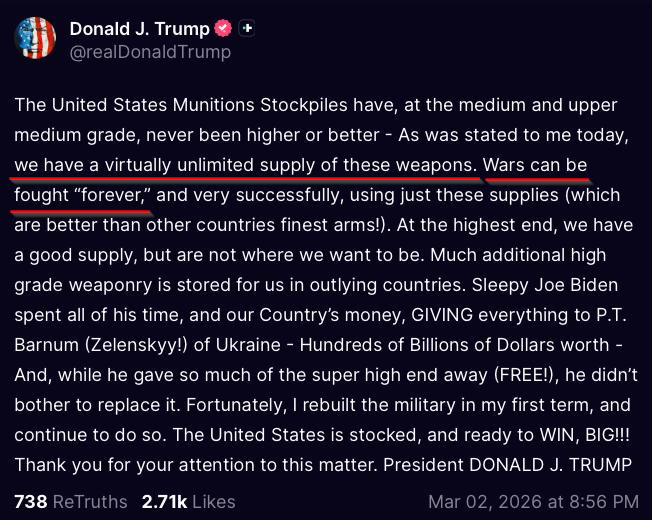
Trump’s now telling reporters wars can be fought “forever” using American stockpiles with a “virtually unlimited” supply of weapons. He posted it on Truth Social, so it should be the Truth, right? Sure, there are plenty of Cold War-era JDAMs - converted MK-84 dumb bombs with a GPS kit strapped on. But Patriots? THAADs? The things actually keeping people alive? Those don’t grow on Truth Social posts. Those take two years per missile to manufacture. And most of the existing ones were gifted to Ukraine. No refunds. Six American soldiers are dead. Eighteen seriously wounded. The war is four days old. Remember when this was supposed to be a four-day special military operation to Tehran?

The story of the day isn’t the F-15s from yesterday, or the oil markets, or even the ground invasion of Lebanon - although we’ll get to all of those. The story of the day is what Israel did to the Assembly of Experts in Qom. The Assembly of Experts is the 88-member clerical body constitutionally responsible for selecting Iran’s supreme leader. After killing Khamenei on Saturday, the logical next step in any “regime change” playbook would be to let the succession process collapse under its own contradictions. Let the factions fight. Let the moderates and hardliners tear each other apart. Classic divide and conquer. Instead, Israel bombed the building while they were counting the votes. “We wanted to prevent them from picking a new supreme leader”. - Israeli defense official to Axios

They struck the assembly in Qom while the body was in session. Iranian state media confirmed the building was flattened. Reports of many members killed or wounded. Iran’s Mehr news agency tried to play it down, calling the building “an old, secondary structure” no longer in use - which directly contradicts the Israeli claim that it was struck mid-vote. Both versions can not be true. The Assembly’s compound in Tehran - the former parliament building - had already been hit overnight. Both locations, in sequence.

Now think about what this means strategically. Yesterday I wrote that Trump had killed his own “very good choices” for Iran’s next leader in the opening strikes, and that Iran’s military units were operating mostly without central command. Today, Israel deliberately destroyed the constitutional mechanism for selecting a replacement. You killed the leader. You killed the people you wanted to replace him with. And now you bombed the room where the country’s legal process for choosing a successor was literally in session. Who exactly are you planning to negotiate with?
This is either the most incompetent war strategy since... well, since Iraq. Or it’s deliberate. And if it’s deliberate, the implication is that the goal was never negotiation. The goal is permanent decapitation. Keep killing anyone who might consolidate power until there’s no coherent state left to resist. The problem is that Iran pre-authorized decentralized command specifically to survive this scenario. You’re not preventing resistance... 

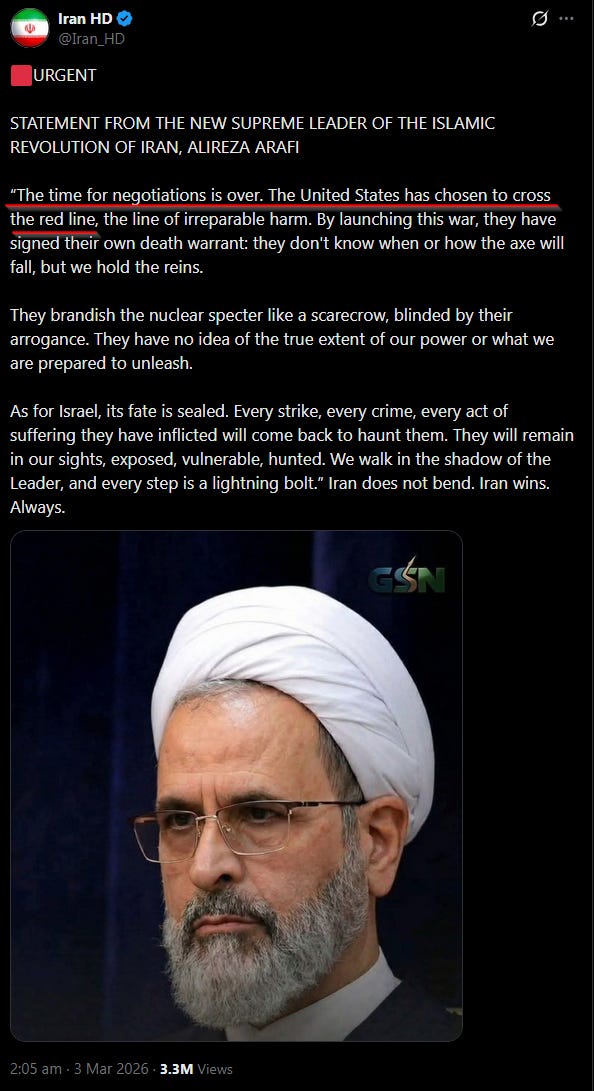
Iran named a new supreme leader anyway. Alireza Arafi. His opening statement was not what you’d call an olive branch: “The time for negotiations is over”. So the bombing achieved precisely nothing except turning a succession process into another martyrdom narrative. Again. Really nailed that one.

Israel invaded Lebanon today. The 91st Division deployed ground forces across the border, capturing positions along the frontier. Clashes with Hezbollah near Kfarkela. Artillery and airstrikes across the south. The cabinet reportedly approved the incursion with 100,000 troops on the border. Hezbollah responded by firing missiles into central Israel for the first time in this conflict. Sirens in the Tel Aviv metropolitan area. A new escalation corridor that did not exist yesterday morning.

The Lebanese army, under reported US pressure, pulled back from border positions. Literally cleared the road. A senior Hezbollah official said “our patience has run out”. Hezbollah also struck the Ramat David Airbase near Haifa and the Meron surveillance base with cruise missiles. Israel responded by ordering evacuations in Sidon - deep inside Lebanon, well north of the Litani River.

So on day four of a war that was supposed to last four days, we now have a second front. Third if you count the Houthis. Fourth if you count Iraq, where resistance groups have claimed 67 separate operations against US targets in three days. The stated objective was to destroy Iran’s missile capability. Instead we now have missiles flying from Iran, Lebanon, Iraq, and Yemen simultaneously. Task failed successfully.

Now for the diplomatic masterpiece. Trump, sitting in the Oval Office with German Chancellor Merz, decided this was the perfect moment to threaten a NATO ally with total economic war. Spain had the audacity to say no. Foreign Minister Albares told the US that its bases on Spanish soil - Rota and Morón - could not be used for strikes that weren’t covered by the UN charter. Something about international law. Quaint concept. Fifteen US aircraft were relocated, including refuelling tankers.

Trump’s response was to order Treasury Secretary Bessent to “cut off all trade with Spain”. Then, the part that should give every European capital a sleepless night: “We could use their base if we want. We could just fly in and use it. Nobody’s gonna tell us not to use it”. The President of the United States just openly suggested he could violate a NATO ally’s sovereignty and use their military bases by force. On camera. While sitting next to the German Chancellor. Merz’s contribution? He agreed that Spain should pay more for NATO…

Belgium called the entire operation illegal under international law. Spain’s Sánchez called it “unjustifiable”. These are NATO members, publicly breaking with Washington four days into a war that NATO Secretary General Rutte had enthusiastically endorsed. The cracks aren’t showing. The cracks are structural. Trump also went after the UK for refusing him use of Diego Garcia. “This is not the age of Churchill”, he complained. No, sir. It is not.

The drone war over Iran is evolving in a way that deserves more attention than it’s getting. The IRGC shot down three Israeli drones today - two Elbit Hermes 900s and an IAI Heron. These are not disposable surveillance toys. The Hermes 900 runs about $30 million per unit. The Heron is Israel’s primary SIGINT platform. Iran is learning to hunt them.

US and Israeli strike planning relies on persistent drone coverage loitering over Iran to find and track mobile missile launchers. If Iran can systematically degrade that coverage, targeting quality drops. “Precision” becomes less precise. The “surgical strikes” get sloppier. CENTCOM released footage today of strikes on “ballistic missile launchers in Iran”, apparently expecting applause. As if Iran wouldn’t fill the landscape with cheap decoy trucks. Without persistent ISR to tell real launchers from plywood props, you’re playing whack-a-mole blindfolded. Shooting down the drones is the airborne equivalent of blinding the FPS-132 radar on day one. Same logic, different domain. Remove the eyes, then move freely.

The markets. Oh, the markets. Global stocks cratered. South Korea down 8%. Japan 6%. Germany 5%. Nasdaq futures off 200 points. The S&P 500, gold, silver, bitcoin, bonds - all down together, which is your classic “everything sell-off” when institutional money panics and runs for the exits. Except oil. Oil remembered what planet it was on.

Brent surged past $85. WTI hit $77, erasing every single penny of decline since Trump’s inauguration. The entire “Trump energy renaissance” narrative, gone. Four days. Iraq shut down Rumaila - the world’s second-largest oil field, 1.5 million barrels per day - amid escalating military activity. Iran hit Fujairah in the UAE, the Middle East’s largest bunkering terminal and a key crude loading point. Not a military target. An economic one. The message: no oil leaves without permission.
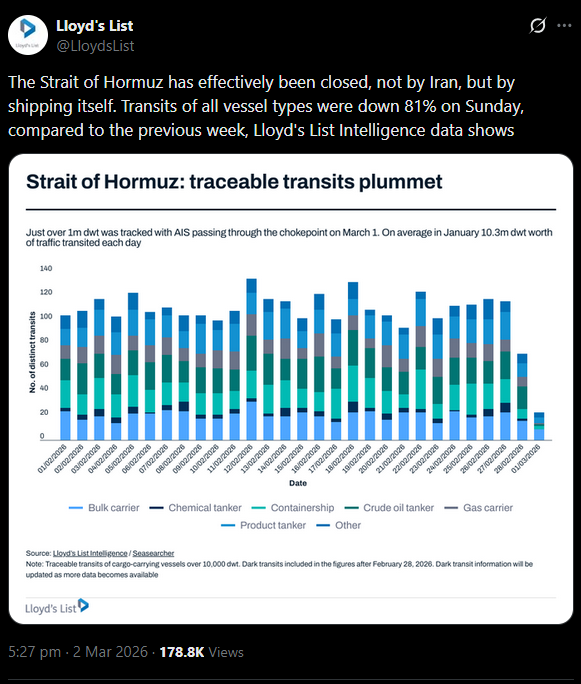
Click image for larger size.
The IRGC reiterated Hormuz is closed and oil will hit $200. Shipping through the strait is down 81%. As Lloyd’s List said: “the Strait was closed not by Iran, but by shipping itself”. The insurers won’t cover it. The tanker captains won’t transit. Iran doesn’t need to physically blockade anything.

Trump’s solution? He ordered the Development Finance Corporation to provide insurance for ships transiting the Gulf, and floated the idea of US Navy escorts through Hormuz. Didn’t we try that with the Houthis already? How’d that go?

Silver bounced between $90 and $77 today. Wild swings. Lease rates keep creeping higher, the swap keeps turning more negative. Don’t get distracted by registered inventory rising on COMEX - eligible is falling faster, total stock is still declining. The physical shortage is extreme and nobody seems to have figured out yet that you need a lot of silver to build the very weapons currently being expended at record pace. War is bullish for silver in a way that most traders haven’t even begun to price in. But COMEX gonna COMEX.

Gold touched $5,380 before being walked back. When 30% of global oil supply is offline and your safe haven asset drops like a stone, you’re not watching a market. Someone desperately needs the dials to read “everything is fine” while missiles hit hotels on the Palm.

Something that got almost no coverage but matters more than most of today’s headlines: US military commanders across more than 30 installations told their troops this war is part of “God’s plan” and linked it to Armageddon. A commander reportedly said Trump had been “anointed by Jesus to light the signal fire in Iran to cause Armageddon and mark his return to Earth”. This was not one rogue officer at one remote base. The Military Religious Freedom Foundation says it received hundreds of complaints. Every branch of the military. Coordinated messaging.

If the people executing this war believe they’re fulfilling biblical prophecy, there is no off-ramp. You can not negotiate the end of Armageddon. There is no ceasefire clause in the Book of Revelation. This is the ideological backdrop against which American 20-year-olds are being told to fight and die in a country most of them couldn’t find on a map last week. Raise your hand if you had this on your New Year’s Bingo card!

Bahrain is coming apart. Riots across the country. The majority Shia population is in the streets demanding the government expel US forces. Saudi Arabia sent security forces across the King Fahd Causeway - the only bridge connecting Saudi to Bahrain - to help the monarchy contain the protests. Exactly what they did in 2011 during the Arab Spring. Iran’s response was elegant: they droned the bridge. Cut the troop pipeline with one strike.

There is now a regional war providing cover for something the Bahraini monarchy has feared for decades. Bahrainis were outside cheering as Iranian missiles hit US facilities. The US 5th Fleet is headquartered in Bahrain. If the popular uprising succeeds - or even gets close - the entire US naval command structure in the Gulf becomes untenable. Iran doesn’t need to sink the 5th Fleet. It needs the country hosting the 5th Fleet to ask them to leave. The regime change is happening. Just not in the country they planned it for.
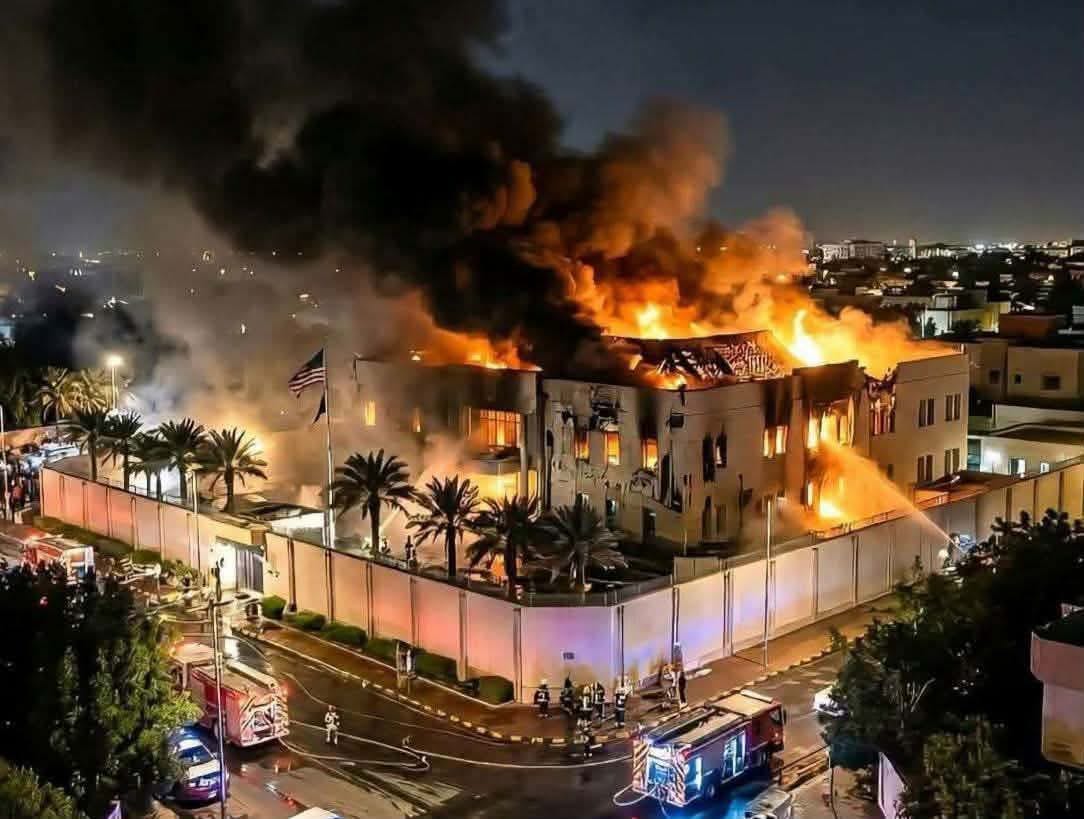
The US Embassy in Riyadh was hit by Iranian drones. Part of the main building’s roof collapsed. Embassy in Beirut: closed. Kuwait: closed. Three US embassies shuttered, several more on limited operations. The State Department told Americans to immediately leave Bahrain, Egypt, Iran, Iraq, Israel, the West Bank, Gaza, Jordan, Kuwait, Lebanon, Oman, Qatar, Saudi Arabia, Syria, the UAE, and Yemen. Leave immediately. Breaking news. Emphasis on breaking. Not on news.

One more thing. A Russian-made Kometa-M anti-jamming unit was found in the wreckage of an Iranian Shahed drone that hit RAF Akrotiri in Cyprus. The reverse Shahed pipeline is real. Russia received the original drone design from Iran, improved it through two years of combat in Ukraine, and is now feeding the upgrades back. The Geran-2 variants flying over Ukraine are several generations ahead of the original Shahed-136. Now those improvements are showing up in Iranian drones hitting NATO territory. Full circle.

Meanwhile, Chinese military cargo planes have reportedly been flying into Iran for days. One Chinese factory alone produces 30,000 drone engines per day. The production capacity behind Iran’s drone war isn’t Iranian. It’s Chinese. And it is, for all practical purposes, unlimited. Trump’s “virtually unlimited” munitions versus China’s actually unlimited manufacturing capacity…

The White House released Operation Epic Fury’s official objectives. Demilitarization. Regime elimination. Homeland protection. Putin’s speechwriter must be flattered. Trump told reporters: “They want to talk. I said ‘too late!’” Iran doesn’t want to talk. Iran rejected the ceasefire on day one because they believe the June 2025 ceasefire was a strategic error. And now Trump is pretending to refuse negotiations that aren’t being offered, while simultaneously begging Italy to back-channel a way out of this war. Four days became four weeks. Four weeks will become “whatever it takes”. And nobody, on any side, has a plausible theory of how this ends. Still devolving..."

"Iran 'Activates' Missile Cities? Inside Tehran's Mountain Fortress"

Full screen recommended.
Times Of India,3/3/26
"Iran 'Activates' Missile Cities?
 Inside Tehran's Mountain Fortress"
"Deep beneath Iran’s mountains and deserts lies one of the most secretive and hardened military infrastructures in the Middle East: the so-called missile cities - vast underground networks of tunnels and bunkers housing thousands of ballistic and cruise missiles. Built by the Islamic Revolutionary Guard Corps (IRGC) and designed to be virtually invisible to satellites and airstrikes, these facilities store, transport, fuel, and prepare missiles that Tehran says serve as its ultimate deterrent. Recent unveilings by Iranian media show hardened complexes with precision-guided weapons such as Emad, Sejjil, Qadr and Haj Qassem missiles buried hundreds of meters underground. Iranian military officials say this subterranean doctrine ensures that if Iran is hit first, its response will still be swift and overwhelming - a strategy designed to keep adversaries guessing and deter escalation."
Comments here:

"Orders From The Grave: You Won’t Believe What Khamenei Did Before His Death"

Full screen recommended.
Money Over History, 3/3/26
"Orders From The Grave: You Won’t 
Believe What Khamenei Did Before His Death"

"What if the man America believed would end Iran’s war strategy… actually ensured it would continue even after his death? In this video we reveal the shocking truth behind Ayatollah Khamenei’s final move - a strategic blueprint he set in motion long before he died that is now driving the conflict forward and leaving diplomats around the world scrambling. This isn’t a rumor. It’s based on how Iran’s military has executed its campaign with precision without central command - using pre-authorized orders that continue to fire missiles and drones across the Gulf. You’ll learn:
• How Khamenei designed a war system that survives his death.
• Why America cannot simply end the conflict by killing leadership.
• How Iran’s decentralized militarized strategy works.
• Why every ceasefire attempt has failed.
• What this means for global security, defense systems, and future wars.
Watch closely - this changes everything you thought you knew about this war."
Comments here:

Judge Napolitano, "Scott Ritter: How’s the War Going, Mr. President?"

Full screen recommended.
Judge Napolitano - Judging Freedom, 3/3/26
"Scott Ritter: How’s the War Going, Mr. President?"
Comments here:

"The Middle East: The Decisive Battleground of WW3"

"The Middle East: 
The Decisive Battleground of WW3"
by Nick Giambruno

"It’s important to recognize that "world orders" are nothing new. World orders have long been the frameworks through which major global powers set the rules of the game. They define the structure of international political relations. Thinking in terms of world orders requires zooming out entirely - taking the geopolitical view from 40,000 feet. On a smaller scale, it’s similar to how the most powerful criminal organizations in a city - such as mafias and street gangs - form agreements to divide their activities and territories among themselves. Eventually, though, these arrangements always break down, leading to violent power struggles until a new agreement is reached, reflecting the shifting balance of power.

A similar dynamic is at play with the most powerful countries, world orders, and world wars. You can think of world orders as epochs - distinct historical periods marked by evolving global power structures.

Peace of Westphalia (1648 to 1803): This agreement ended the Thirty Years’ War and established a framework for European international relations for over two centuries by maintaining a balance of power among major European states. It involved the Holy Roman Empire, Spain, France, Sweden, the Dutch Republic, and various German territories. This world order persisted until the Napoleonic Wars disrupted the balance, necessitating a new international arrangement.

Congress of Vienna (1814 to 1914): The military defeat of Napoleon I led to this world order, which cemented Britain as the dominant global power. The Congress of Vienna set the foundation for European politics until the onset of World War 1 in 1914.

Treaty of Versailles (1919 to 1939): The victors of World War 1 established this world order, introducing institutions like the League of Nations. However, it collapsed when Germany, Italy, and Japan sought to overturn it and impose their own world order during World War 2.

The Current US-Led World Order (1945 to Today): The victors of World War 2 created the current world order with the US as its leader. This system includes institutions like the United Nations, the World Bank, and the International Monetary Fund - all headquartered in the US. This world order has largely been unipolar, with the US exerting significant influence over international policies and decision-making.

World War 3: While many don’t realize it, World War 3 is already underway. Let me explain…Total war between the world’s largest powers that reshuffled the international order defined the previous world wars. However, with the advent of nuclear weapons, total war between the largest powers today - Russia, China, and the US - means a nuclear Armageddon where there are no winners and only losers. That could still happen despite nobody wanting it, but it’s not the most likely outcome.

World War 3 is unlikely to be a total war between the world’s largest powers, like the previous world wars. Instead, the conflict is playing out on different levels - proxy wars, economic wars, financial wars, cyber wars, biological warfare, deniable sabotage, and information warfare. In that sense, World War 3 is already well underway, though most fail to recognize it.

Russia, China, and their allies are seeking to reshape the US-led world order that has been in place since the end of World War 2. While they resent US dominance, both Russia and China hold a position - albeit a subordinate one - within the current system. They have permanent seats on the UN Security Council and are members of key international institutions like the IMF, World Bank, and WTO.

Unlike Germany and Japan in World War 2, Russia and China do not appear intent on completely overturning the current world order. Doing so could invite nuclear Armageddon. Instead, they aim to shift the balance away from US dominance to a multipolar world where they wield greater influence. The conflict is playing out just below the threshold of direct military conflict. Nevertheless, it is a high-stakes struggle among the world's major powers to determine the future world order, just as in previous world wars.

This is World War 3. It’s happening right now and unfolding rapidly. In fact, World War 3 has been ongoing for over a decade. While WW3 lacks an official starting date, two pivotal events in 2013 and 2014 signaled the beginning of this global struggle between Russia, China, and the US to reshape the world order.

The first was the rise of Xi Jinping in March 2013. It quickly became evident that China was no longer content with being a junior member of the US-led system. Instead, Beijing sought a role commensurate with its power - at minimum, equal to the US, if not the world’s dominant force.

The second was the US-backed coup in Kiev in February 2014, which led to the violent overthrow of Ukraine’s pro-Russian government and its replacement by a pro-US administration. Ukraine is Russia’s most vital neighbor - both culturally and strategically. Slavic nations, including Russia, trace their heritage to the Kievan Rus’, a federation of tribes centered in present-day Ukraine that existed from the late 800s to the early 1200s.

Ukraine is also of immense geopolitical value. For years, US strategists have pursued the idea of integrating Ukraine into NATO, a move that would significantly weaken Russia’s military position and further isolate Moscow - an appealing prospect for those favoring a unipolar world. After the 2014 coup, Moscow became convinced that the US was determined to bring Russia under its control. In response, Russia saw no choice but to push back - primarily by aligning with China and other nations to shift the world order from unipolar to multipolar.

I believe these two events marked the beginning of a global struggle among the most powerful nations to reshape the international order - World War 3. Since then, the conflict has only escalated and may soon reach a tipping point that changes everything.

The graphic below (click to enlarge) maps out the timeline of recent world orders and world wars, offering a clearer perspective on their evolution - and where we may be headed next.


The US-led world order has undergone several distinct phases since the end of World War 2. From 1945 to 1991, it was defined by the Cold War - a global struggle between the US and the Soviet Union. After the Soviet Union collapsed in 1991, the post-WW2 world order experienced a massive shift, with the US emerging as the undisputed global superpower. This era, often called the "unipolar moment," lasted from 1991 until 2025. Though it endured for over 34 years, the notion that the US could maintain a unipolar world order indefinitely was never realistic. We are now in a volatile adjustment period as the unipolar world order gives way to a multipolar one.

There is still much to be determined - most crucially, the boundaries of the US, Russia, and China’s spheres of influence in this emerging multipolar world. With the war in Ukraine all but lost and the prospect of victory in Taiwan shrinking by the day, the US government appears to have accepted that the complete subjugation of Russia and China under its unipolar dominance is no longer an achievable goal, at least in the immediate future. Rather than total victory, the US is now focused on maximizing its power within the new multipolar landscape - while limiting the influence of its most formidable rivals: Russia and China.

While the US seems to be moving away from the unipolar model and begrudgingly acknowledging the existence of rival powers (Russia and China), it still seeks to be the dominant force in a multipolar world. The boundaries of the US, Russia, and China’s spheres of influence in this emerging multipolar world have yet to be defined, and the situation remains volatile and dangerous. Whether this transition can occur without descending into greater conflict remains an open question.

On a smaller scale, this mirrors how powerful criminal organizations - such as mafias and street gangs - operate within a city. Ideally, a gang or mafia would eliminate all rivals. However, when certain rivals prove too strong to destroy, the conflict shifts toward defining boundaries until a formal arrangement is reached that divides territories. The same dynamic is now unfolding on a global scale between the US, Russia, and China as World War 3 plays out. Each side is maneuvering to expand its power and influence until a new arrangement is reached that defines the balance of the multipolar world.

Determining the precise boundaries of various spheres of influence in a multipolar world - and formalizing them into an agreement - will be a complex and prolonged process. It won’t happen overnight. Until a formal agreement is reached among the world’s major powers -much like the Congress of Vienna after the Napoleonic Wars, the Treaty of Versailles following World War 1, and the Yalta Conference at the close of World War 2 - World War 3 will continue.

Iran: The Decisive Battle of WW3: The Middle East presents one of the greatest uncertainties in the emerging multipolar world. I believe the region will be pivotal. If the US and its allies prevail there, it could open the door to containing Russian and Chinese influence within a multipolar world. But if Russia and China gain the upper hand in this strategic region, the US will suffer a major geopolitical downgrade, much like the British Empire after World Wars 1 and 2. The region is further complicated by the presence of powerful regional players like Turkey, nuclear-armed Israel, and Iran, all of whom have their own interests.

The US, Russia, and China will not only need to define their boundaries in the Middle East, but so will these regional actors. There's no sign of a resolution anytime soon. The region remains volatile, and the potential for a regional conflict escalating into a global confrontation remains a real possibility.

A key question is Iran’s role in the multipolar world order. If the Middle East is pivotal to the global balance of power in a multipolar world, then Iran is pivotal to the balance of power within the Middle East. Control of Iran would give the US even greater leverage over the Middle East’s hydrocarbon resources. A US-aligned government in Tehran could help block China’s Belt and Road Initiative from pushing further west and potentially cut off 14% of China’s oil imports. It would also hinder Russian trade through the Caspian Sea and serve as a launchpad to destabilize Russia from its southern flank.

In short, bringing Iran under US influence would open the door to further undermining both Russia and China. For them, Iran is strategic depth. Russia and China cannot afford to let Iran fall - and the US and Israel cannot afford to let it stand. The question is: who will prevail? It's doubtful that the US and its allies can win the war in Ukraine against Russia or a potential war over Taiwan against China. Their best shot at rolling back Russian and Chinese influence in a multipolar world is through striking Iran, which is exactly what they have just done. Whether they’ll succeed is another question entirely.

As Iran becomes the decisive flashpoint in this accelerating great-power struggle, the fallout won’t be confined to missiles and maps - it can ripple straight into money. A widening war can spike energy costs, strain supply chains, blow out government deficits, and force emergency measures from central banks. In other words, the war with Iran could be the catalyst for a full-blown monetary reset - sudden, disruptive, and brutal for anyone caught positioned the wrong way."