StatCounter

Tuesday, March 3, 2026

Musical Interlude: Soothing Relaxation, "Relaxing Piano Music & Rain Sounds"

Full screen recommended.
Soothing Relaxation,
"Relaxing Piano Music & Rain Sounds"

"A Look to the Heavens"

“Massive stars, abrasive winds, mountains of dust, and energetic light sculpt one of the largest and most picturesque regions of star formation in the Local Group of Galaxies. Known as N11, the region is visible on the upper right of many images of its home galaxy, the Milky Way neighbor known as the Large Magellanic Clouds (LMC).
The above image was taken for scientific purposes by the Hubble Space Telescope and reprocessed for artistry by an amateur to win the Hubble's Hidden Treasures competition. Although the section imaged above is known as NGC 1763, the entire N11 emission nebula is second in LMC size only to 30 Doradus. Studying the stars in N11 has shown that it actually houses three successive generations of star formation. Compact globules of dark dust housing emerging young stars are also visible around the image.”

"We Are Prometheus"

"We Are Prometheus"
by The Findings

"If you could go back in time a thousand years, you’d find people who were eerily similar to your present companions. The same is true for people who will live a thousand years from now: some of them will be nearly identical to the people you now love, and you would care deeply about those people, the same as you do their present-day counterparts.

Please understand this: The men, women and children we would love in the future can advance only in the same way we have, by the benefaction of their predecessors.

Can you imagine how long it took for ignorant men and women to learn metallurgy? Or crop rotation? Or a hundred other things we can barely imagine being without? Our lives are advanced only because they created new ways of living and passed them down to us. Hundreds of generations of people just like us lived through dark times, fighting toward whatever bits of light they could find, opposed by others most of the way, to bring us where we are now.

Someday our generation will also be gone, and we will have played – whether we’ve understood it or not – the crucial role of transmitting civilization to following generations. What do we want them to be like? How do we want them to live? Numberless men and women have struggled toward the future and spent all they had to bring us here. We owe them something. It may be that they no longer care, but their gifts to us will cease to exist unless we pass them along. We make them matter, and they deserve to matter.

We stand now at the threshold of the stars, but we’ve been restrained by self-serving structures designed to control every human and reap from their every action. We must get past them to continue forward. Foolishness and fear bid us to forget the future, to chase status instead of goodness, consumption rather than production, and stasis rather than expansion. A thousand self-serving voices call us aside, grasping at our minds and emotions. We must turn away from it all.

We owe this to the people of the past. We owe it to the people of the future. We owe it to ourselves. What happens next is up to you. It’s not up to leaders or bosses. It’s up to you. The consequences of your failures are inescapable, and the consequences of your good deeds are inescapable. Whether or not you acknowledge them, our descendants will live or die by them. What you are and what you do matter a very great deal.

Engage your will. Act. Awake."

“I Can’t Wait For the Day When Life Finally Makes Sense”

“I Can’t Wait For the Day 
When Life Finally Makes Sense”
by Rania Naim

“I can’t wait for the day when life finally makes sense, when we find the silver lining in every tragedy, when we learn the lesson from each mistake and when we understand why our hearts needed to get broken a few times to let love in.

I can’t wait for the day that we understand why we met the right people at the wrong time or the wrong people at the right time and why our lives didn’t align to bring us together. I wonder if it’s because they’re the wrong ones for us or because we still have a lot of growing up to do and we’re meant to be with someone who understand who we’re becoming not who we were.

I can’t wait for the day that we understand the lesson behind every struggle. Why we struggled to be successful, why we struggled to find love, why we struggled to reach our dreams and why we lost people who meant the world to us. I wonder if we needed these lessons to learn how to appreciate life and feel the pain of others or we just needed to learn that there is no living without suffering.

I can’t wait for the day that we understand why we had to hate ourselves to love ourselves, why we had to destroy ourselves to build ourselves up again and why we had to start over just before we got to the finish line. I wonder who saved us or who inspired us to save ourselves.

I wonder if we are meant to be reborn a few times so we can learn how to truly live. I want to know what triggered us to change and how we can no longer recognize who we used to be.

I can’t wait for the day that we understand why we keep falling for the wrong ones over and over again, why we can’t forget those who hurt us and why we sometimes can still forgive them and take them back. I want to understand how our hearts operate, how they function, how they move us to do things we would never do and lead us to places that we know we shouldn’t go to. I’m curious to know why we listen to it, why we follow it blindly like it never got us lost before, why we trust it even though it left us broken and why do we always go back to it for questions when it keeps giving us the wrong answers. I wonder if there will come a day when we stop listening to it and if we’ll ever be truly alive without it.

They say everything happens for a reason and I truly believe that, but I also want to know what this reason is and why it chose us. Why some reasons keep recurring and why some reasons leave us even more perplexed. I want to understand why we go through certain things, what’s the message behind it and what if we never respond to this message, what if we just ignore it and keep living, what will happen then? Will our lives get lost in translation?

I can’t wait for the day that life makes sense – some days I understand why certain things happened and others I’m not so sure, but all I know is that somehow we’ll connect the dots and someday we’ll complete the puzzle, until then, we have to learn how to live our lives without trying to understand it and we have to learn how to be comfortable with the irony and uncertainty of life; otherwise we’ll lose our common sense trying to make sense of the life we’re living.”

"Hang In There..."

“Using time, pressure and patience, the universe gradually changes caterpillars into butterflies, sand into pearls, and coal into diamonds. You’re being worked on too, so hang in there. Just because something isn’t apparent right now, doesn’t mean it isn’t happening. It’s not until the end do you realize, sometimes your biggest blessings were disguised by pain and suffering. They were not placed there to break you, but to make you.”
- “The Angel Affect”

“What the caterpillar calls the end of the world the master calls a butterfly.”
- Richard Bach

“More To Come…”

“More To Come…”
By Jeff Thomas

“Years ago, when visiting the US, I’d often watch late night television. Just prior to each interval, in order to ensure that viewers would sit through the adverts, the show would run a panel that said, “More to Come.” This, of course, was effective, as the viewer would be anticipating that the best part of the program would come in a later segment and would be more likely to continue watching.

Today, we’re looking at the reverse of that situation. The program we’re watching is The Decline and Fall of the American Empire and those who recognize the decline are viewing with ever-increasing trepidation, the developments that are unfolding there. Even those of us who are not American and don’t live there are glued to our screens, as we’re aware that were viewing the early stages of a collapse that promises to be the greatest social, political and economic event that we’re likely to see in our lifetimes.

Following World War Two, the US was in a boom beyond anything the world had ever seen. The Americans came to the war late, after having built up their manufacturing capacity for war dramatically, at the expense of the Allied powers in Europe. And they did this, essentially for free. It was paid for with the gold from the vaults of the European allies. After the war, Europe was trashed and it would take decades for them to get on their feet again. Meanwhile, the US had been going flat out in production, had first-rate modern factories and, most important, held the majority of the world’s gold.

The 1944 Bretton Woods Agreement ensured that the US dollar would become the world’s default currency and, later, become the petrodollar, ensuring American hegemony over much of the rest of the world. There can be no doubt that, in the first decades after the war, the US had an amazing run and was, arguably, one of the best places to live in the world.

But, unfortunately, as so often happens, American political and industry leaders became full of themselves and couldn’t resist going out on limb to gain even more for themselves. In so doing, they turned the US from the world’s foremost creditor nation into the world’s foremost debtor nation. Worse, when they reached this unprecedented point, they opted to just keep going.

Worse still, it would appear that today’s leaders are aware that the mother of all bubbles that they’ve created is going to pop sometime in the near future, as they’re preparing themselves for the mother of all pushbacks from the populace when the crashes come.

The FBI, CIA, NSA, and a host of other authorities have either been created or expanded, allowing the creation of the world’s foremost police state. And, beginning in 2001 with the Patriot Act, have created a host of laws to assign authority to any of those bodies to exert ever-increasing control over the population. Capital controls, migration controls, higher taxes, confiscation of deposits in banks and quite a bit more have been passed in legislation, including the ability to declare the US in its entirely to be a “battle zone,” through which habeas corpus and the court system can be suspended nationally.

Yipes. (Or, blimey, depending on where you’re from.) At this point, any American who’s paying attention could be forgiven if he’s genuinely frightened at where his government is going with all this.

And so, we come back to the title of this essay – “More to Come.” A regular flow of proposed laws is now coming down the pipeline that would have been considered the stuff of a bad movie a few decades ago, but is now only too real and threatening to the freedoms of the average citizen. Instead of “more to come” meaning that the best is still on the way, the opposite would appear to be the case, and the worst is here, now.

But, how can this be, we ask ourselves. Surely those in power – the politicians, the industrialists, the central bankers, etc., must have seen this coming and, if that’s so, surely they’d have done something to stop it. Well, historically, that’s never been the case. Those in the greatest positions of power have never suddenly reversed an empire when it was about to self-destruct. What they tend to do instead is to guard against becoming casualties of the disaster they’ve created.

So, is that what’s happening this time around? In a word, yes. The Bernie Madoffs of the world go to jail. However, those who commit the same fraudulent acts from within the system never go to jail. For example, if the heads of a bank commit massive fraud, the bank pays an enormous fine. The fine is then paid by the stockholders. And should the fine be large enough to crash the bank, the bankers can appeal to the government to bail them out, as they’re “too big to fail.” Thus, the taxpayers pick up the bill.

At this point, what we’re witnessing is an era in which laws are regularly being passed to ensure that the creators of the bubble will get a “Get Out of Jail Free” card and others will sustain the losses.

This is the very essence of what happens in an endgame run. Just as a hitman who places a bomb in a building makes his exit before the bomb can go off, the creators of bubbles safeguard themselves before the economic bomb can go off. They have no intention of being around to live with the resultant devastation that they’ve put into play.

Pete Townshend wrote prophetically, “Won’t Get Fooled Again,” in 1971, in which he hopes that the latest gang of leaders will be better than the last. In the final line of the song, he grimly announces, “Meet the new boss – same as the old boss.”

And, in fact, this is the usual outcome. Perhaps the reason why empires collapse much in the same way, time and again, and their citizens consistently fail to see it coming, is that empires general last a long time before collapsing. The Venetian Republic lasted 200 years. The Spanish Empire lasted just over 120 years. Holland lasted 130 years, Russia – 200, the UK, just under 120. And it’s been much the same for the others. In every case, they last longer than a single lifetime, so it’s rare that any individual sees more than one empire collapse in his own lifetime and doesn’t understand that empires don’t end with a whimper. They end with a crescendo, not unlike the Who’s “Won’t Get Fooled Again.”

We are witnessing the collapse of the world’s foremost empire. This is not mere conjecture. The US has all the symptoms that we’re now coming close to the final stages. And, if history plays out yet again, as it has repeatedly, we can expect that, in the lead-up to the collapse, the controls by governments will become increasingly draconian. As we consider, “more to come,” we should be braced for the likelihood that the worst controls are yet to be revealed.”

The Daily "Near You?"

Metamora, Michigan, USA. Thanks for stopping by!

John Wilder, "One Page At A Time"

"One Page At A Time"
by John Wilder

"It’s cold outside. I can see that in how crisp and clear the air is. The big picture window in the cabin up on Wilder Mountain lets my young eyes see a mile, looking for the headlights on a dim winter morning. The bus rounds the corner, and I head off. Burt, the driver, is rarely off on time by more than a minute or two. I’m the farthest kid out, and he starts rounding up the school kids with me. “Hi Burt!” “Morning, John.”

Since I’m in middle school, and I’m the first on, I tromp my winter boots all way to the back of the bus. That’s where the cool kids sit. I remember the first day I decided to sit back here. Since I was the first on, there was no one to stop me, so I decided to break the norm of the past few years and just sit there. I was in sixth grade, and the high school freshman started to object when he got on. He didn’t finish the sentence. If he would have asked me to move, my answer would have been short. “Make me.” I didn’t have to. Even in sixth grade, I was bigger than him. But I lived so far out that most of the time, I had the entire back of the bus to myself.

So instead of a long, boring bus ride, I decided I’d do something else. Like take a trip to Mordor. Or fight bugs with Johnny Rico. Or figure the best way to ambush a troop of Sardaukar. Or take a trip to Boulder after Captain Trips paid a visit.

The bus isn’t a ride, it’s a journey through the past that never was and the future that never will be. It was, metaphorically, my campfire, and these books were the ways that storytellers of my people could share the legends that shape humanity. In part, these are the legends that shape me, just like our ancestors learned valor and cowardice from tales told under starlit skies in long-ago Sparta and Denmark and Scotland and Rome.

Stories aren’t just entertainment. They are the code that programmed humanity and fueled the creation of Western Civilization. Warriors heard of Achilles’ courage and the hubris of Icarus, learning to strive for glory and wear a parachute if they were going to fly too close to the Sun. Kids grew up on fables of clever foxes and lazy hares, etching lessons of wit and work into their bones. These weren’t bedtime stories: they were survival guides and cultural norms, showcasing the best of what we could be and the worst that we should avoid at all costs. Both lessons are useful.

My bus ride was no different. Tolkien’s Christian valor, never naming Christ but screaming His Truths three different ways through Frodo, Aragorn, and Gandalf lit a fire in me. Heinlein’s musings on duty versus freedom made me question what I owed my community, and what it owed me. Those pages were my elders, whispering truths no teacher could match, even though they were sometimes quite contradictory.

Stories aren’t just ink on paper, they’re the software that nourishes our souls. Throughout history, they’ve been the mirror showing us who we are, who we could be, who we should avoid being, and what the journeys of the hero really meant. The Greeks had Odysseus, outsmarting cyclopes to get home to his family valor in action, and the aforementioned Icarus, flying too high and crashing, a warning against arrogance. Norse kids heard of Thor’s hammer, inspiring strength, but also Loki’s betrayal, a caution against deceit. But you should ignore that, because I’ve heard from the news media that there is no white culture.

These archetypes stuck because they’re shades of the universal Truth: every boy wants to grow up to be the man who is a hero, not the coward who folds. My bus ride library was no campfire, but it did the same job. Tolkien taught me sacrifice, Frodo carrying the One Ring, knowing it’d break him, but doing it anyway. Heinlein’s Starship Troopers hit me with duty: you don’t get a vote unless you’re willing to bleed for it because sooner or later someone will. Harsh? Sure. But it made me think, heroes sometimes falter, freedom isn’t free, and communities aren’t built by loners. Even Dune’s Paul Atreides, wrestling with destiny and betrayal, showed me the weight of leadership. These weren’t just stories; they were blueprints for being a man, not a drone.

The GloboLeft hates this. They want stories that flatten everything into DEI dogma. No heroes, no villains, just victims and oppressors, any woman being equal in combat to the strongest man. They’d rewrite Tolkien so Frodo’s a non-binary climate activist, and Heinlein’s troopers would be whining about microaggressions and wanting to use Zoom™ instead of a dropship. You can see it in the box office: their stories don’t inspire; they control exist as humiliation exercises. Look at modern Hollywood: every film is a lecture, not a legend. No wonder kids scroll InstaChat® instead of reading. They’re starved for tales that stir the soul, not the HR manual and they haven’t even been given the words to tell us this – the video game is as close as they come to the myths that make a culture.

Stories work because they show us the extremes, the valor to chase, the cowardice to shun. Take Beowulf: he faced Grendel head-on, no excuses. I read that one in high school, and loved it. I thought, “This is amazing. Our ancestors were heavy metal badasses two thousand years before electric guitars were a thing.” Beowulf is the guy you want to be, not the prol cowering in the mead hall. My bus ride heroes were no different. Tolkien’s Aragorn didn’t negotiate with orcs. He killed them.

Heinlein’s Johnnie Rico in Starship Troopers learned civic duty the hard way, bugs don’t care about your feelings, and when they kill your mother, well, they’ve sent a message that you simply must respond to. Stand up, protect your own, don’t bend.

From what I’ve seen, GenZ didn’t take too many bus rides with Tolkien, they’ve got TikGram™. Schools push “diversity” over duty, “equity” over excellence. The campfire’s gone, replaced by screens spewing shadows, not legends.

To be clear, the GloboLeft wants it that way. But stories still matter, and, I think, you can see Gen Z starting to rise, especially among the boys. And that’s important: they’re how we pass on the code. Tell the kids stories. Real stories, not Modern Disney©. Make them read 1984, and Tolkien. And Beowulf. Every tale’s a seed, planting valor and weeding out cowardice, because at some point every man needs to be able to say the two most important words a man can say: “Make me.”
o
"Back when I taught at UCLA, I was constantly amazed at how little so many students knew. Finally, I could no longer restrain myself from asking a student the question that had long puzzled me: ''What were you doing for the last 12 years before you got here?''
- Thomas Sowell
"The problem isn't that Johnny can't read. The problem isn't even that Johnny can't think.
 The problem is that Johnny doesn't know what thinking is; he confuses it with feeling."
- Thomas Sowell
"The trouble with most people is that they think with 
their hopes or fears or wishes rather than with their minds." 
- Will Durant
"It takes considerable knowledge just to realize the extent of your own ignorance."
- Thomas Sowell

The Poet: William Stafford, "The Gift"

"The Gift"

"Time wants to show you a different country. It's the one
that your life conceals, the one waiting outside
when curtains are drawn, the one Grandmother hinted at
in her crochet design, the one almost found
over at the edge of the music, after the sermon.

It's the way life is, and you have it, a few years given.
You get killed now and then, violated
in various ways. (And sometimes it's turn about.)
You get tired of that. Long-suffering, you wait
and pray, and maybe good things come - maybe
the hurt slackens and you hardly feel it any more.
You have a breath without pain. It is called happiness.

It's a balance, the taking and passing along,
the composting of where you've been and how people
and weather treated you. It's a country where
you already are, bringing where you have been.
Time offers this gift in its millions of ways,
turning the world, moving the air, calling,
every morning, "Here, take it, it's yours."

- William Stafford 

“It is never too late to be what you might have been.”
 – George Eliot

"Something You Already Know..."

Full screen recommended.
“Let me tell you something you already know. The world ain't all sunshine and rainbows. It's a very mean and nasty place and I don't care how tough you are it will beat you to your knees and keep you there permanently if you let it. You, me, or nobody is gonna hit as hard as life. But it ain't about how hard ya hit. It's about how hard you can get it and keep moving forward. How much you can take and keep moving forward. That's how winning is done! Now if you know what you're worth then go out and get what you're worth. But ya gotta be willing to take the hits, and not pointing fingers saying you ain't where you wanna be because of him, or her, or anybody! Cowards do that and that ain't you! You're better than that!” 
- Rocky Balboa

"An Astonishing, Incredible 'Get Away From It All' Musical Interlude: "White Rabbit"

Full screen a must!
"White Rabbit",
 Trippy Video Of Fractal Deepdream Hallucinations
"You don't need to take psychedelic drugs like LSD to experience trippy, vivid hallucinations. Since Google released their #deepdream-algorithm, you can let your computer do the job. This is the first "guided" deepdream-zoom into the depth of a dreaming neural network."

"How It Really Is"

"We do not rest satisfied with the present. We anticipate the future as too slow in coming, as if in order to hasten its course; or we recall the past, to stop its too rapid flight. So imprudent are we that we wander in the times which are not ours, and do not think of the only one which belongs to us; and so idle are we that we dream of those times which are no more, and thoughtlessly overlook that which alone exists. For the present is generally painful to us. We conceal it from our sight, because it troubles us; and if it be delightful to us, we regret to see it pass away. We try to sustain it by the future, and think of arranging matters which are not in our power, for a time which we have no certainty of reaching. Let each one examine his thoughts, and he will find them all occupied with the past and the future. We scarcely ever think of the present; and if we think of it, it is only to take light from it to arrange the future. The present is never our end. The past and the present are our means; the future alone is our end. So we never live, but we hope to live; and, as we are always preparing to be happy, it is inevitable we should never be so."
- Blaise Pascal

Adventures With Danno, "Sam's Club Had Me Smiling"

Full screen recommended.
Adventures With Danno, 3/3/26
"Sam's Club Had Me Smiling"
Comments here:
o
Full screen recommended.
Travelling With Russell, 3/2/26
"Russian Typical Supermarket After 4 Years of Sanctions"
"What does the newest supermarket in Russia look like inside? Join me on a tour of a brand-new Russian supermarket that opened in 2026. Dixy Supermarket is located 50km from Moscow in the regional town of Aprelevka."
Comments here:

"You’re Not Crazy - This Economy Feels Different"

Full screen recommended.
Dan, I Allegedly, 3/3/26
"You’re Not Crazy -
 This Economy Feels Different"
"In today’s episode of iAllegedly, we break down the real economic pressure hitting everyday Americans and small business owners. Oil prices are rising, manufacturing costs are climbing, AI layoffs are accelerating, and jobless claims are ticking higher - yet we’re told everything is “fine.” If you’ve felt like groceries, gas, insurance, housing, and everyday expenses are stretching your budget thinner than ever, you’re not crazy."
Comments here:
- https://www.youtube.com/

"US-Israel-Iran War"

Glenn Diesen, 3/3/26
"Seyed M. Marandi: 
Iran's Military Strategy & U.S. Miscalculations"
"Seyed Mohammad Marandi is a professor at Tehran University and a former advisor to Iran's Nuclear Negotiation Team. Prof. Marandi outlines Iran's objectives and strategy in the war, and explains how and why the U.S. miscalculated."
Comments here:
o
Full screen recommended.
Money Over History, 3/3/26
"$2.6 Billion Burned - 
The U.S. Just Abandoned the Gulf"
Comments here:
o
Full screen recommended.
Prime news 24, 3/3/26
"Iron Dome Collapses? Iran’s Largest 
Missile Wave Slams Tel Aviv & Bnei Brak"

"New developments indicate what may be the largest missile wave of the entire conflict so far, with simultaneous strikes reported across Tel Aviv and Bnei Brak. Footage circulating online appears to show sustained impacts, fires across multiple districts, and continuous emergency response activity, raising urgent questions about the resilience of Israel’s air defense architecture under prolonged high-intensity pressure.

In this in-depth analysis, we examine how repeated waves of missile exchanges may have shifted the operational balance. Beyond immediate damage, analysts are closely assessing the attrition dynamic that large-scale salvos can impose on layered defense systems - including interceptor stockpiles, radar capacity, and response tempo. Particular attention is being given to Iran’s claimed use of advanced systems such as the Fattah missile and whether high-speed terminal phases could complicate interception windows for platforms like Israel’s Iron Dome and broader U.S.-supported missile defense networks.

We also explore the strategic significance of simultaneous targeting across major urban centers, the psychological and political impact of sustained missile pressure, and the implications for U.S. involvement in the conflict. How do prolonged saturation tactics influence deterrence theory? What does visible strain on defensive systems mean for alliance credibility and regional power calculations? And how might continued escalation affect diplomatic channels currently operating behind the scenes?

This video provides geopolitical context, military analysis, and verified background information designed to help viewers understand rapidly evolving developments. Our objective is to present structured, fact-focused analysis that explains complex defense dynamics and international security considerations in a clear and responsible manner."
Comments here:
o
Full screen recommended.
Times Now, 3/3/26
"Haifa Explodes On Cam As Iran Hammers Israel,
 IRGC Launches ‘Wave 17’"
Comments here:

"Iran Defiantly Declares That There Will Be No Negotiations And Trump Is Refusing To Rule Out U.S. Boots On The Ground"

by Michael Snyder

"It appears that both sides are settling in for a long conflict. The Iranians are making it clear that there will be no negotiations and no surrender. By now, the leaders of the regime are almost certainly holed up in very deep bunkers underneath hospitals, schools and other very sensitive targets in highly populated areas. They probably figure that if they can just weather the bombing for a few weeks they can emerge victorious at the end of the conflict and declare victory. The protesters in Iran are no match for the heavily-armed IRGC, and so it is unlikely that regime change will occur unless foreign troops enter the country. Iranian leaders are likely convinced that President Trump will never pull the trigger on such a move, but now Trump has publicly stated that he is refusing to rule out U.S. boots on the ground.

Even when Ayatollah Khamenei was still alive, Ali Larijani was essentially running things in Iran. Now that Khamenei is gone, Larijani is very much in control, and he is defiantly declaring that there will be no negotiations with the United States…"Iran’s security chief Ali Larijani said that Tehran has no plans to engage in negotiations with the United States. “We will not negotiate with the United States,” the former adviser to the late supreme leader said in a post on X, dismissing reports that it is seeking to restart negotiations with Washington."

Anyone that was hoping for a quick end to the war is going to be disappointed. Larijani is accusing the U.S. and Israel of attempting to “plunder and disintegrate” Iran…"Ali Larijani, a close ally of Ayatollah Ali Khamenei, delivered the blunt message on Sunday after announcing the formation of a provisional governing structure within hours of the airstrike that killed the supreme leader. Larijani accused the United States and Israel of seeking to ‘plunder and disintegrate’ Iran and warned so-called ‘secessionist groups’ within his country. He delivered a direct rebuke to President Donald Trump and warned: ‘We will not negotiate.’ ‘Trump plunged the region into chaos with his “delusional fantasies” and now fears more American troop casualties,’ Larijani wrote on X."

It is true that the U.S. and Israel want to bring an end to the Islamic Republic. Anything short of that will be a defeat for the U.S. and Israel. So Larijani’s main goal is survival.If he can keep the government together and the IRGC in control of the major cities until the end of the war, he wins. And he fully understands that.

Interestingly, there are rumors that Larijani is attempting to install his own brother as the new supreme leader…

These people are going to do whatever it takes to make it through this. In a desperate attempt to gain leverage with the rest of the world, the Iranians have decided to close down the Strait of Hormuz and they are vowing that they “will not allow a single drop of oil to leave the region”…"A senior Revolutionary Guards commander warned Tehran would target shipping through the Strait of Hormuz and strike oil infrastructure in the Middle East to prevent exports.“Any ship that seeks to pass through the Strait of Hormuz we will set on fire,” Brigadier General Ebrahim Jabbari said in remarks carried by Iranian media on Monday. “We will also attack oil pipelines and will not allow a single drop of oil to leave the region,” he said, adding that “oil prices will reach $200 in the coming days.” I think that it is likely that they will be able to force the price of oil above $100 a barrel, but crossing the $200 threshold is probably a pipe dream. We shall see what happens.

In the days ahead, there will almost certainly be a lot more attacks on oil infrastructure. Earlier today, we learned that the Ras Tanura refinery in Saudi Arabia was shut down after an attack by Iranian drones…"Saudi Arabia’s state oil giant Aramco shut its Ras Tanura refinery following a drone strike, an industry source said on Monday, after Tehran launched strikes across the region in response to the US-Israeli attack on Iran.

The Ras Tanura complex, on the kingdom’s Gulf coast, houses one of the Middle East’s largest refineries with a capacity of 550,000 barrels per day (bpd) and serves as a critical export terminal for Saudi crude oil. Ras Tanura was shut as a precautionary measure, and the situation is under control, the source said. Two drones were intercepted at the facility, with debris causing a limited fire, the Saudi defense ministry’s spokesperson said on Al Arabiya TV, adding there were no injuries."

The Iranians are probably calculating that if they can put enough pressure on the global supply of oil that it will force the United States and Israel to cease their attacks. But I don’t think that the U.S. and Israel are going to turn back now.

After months of planning, President Trump gave the order to go ahead with Operation Epic Fury at 3:38 PM on February 27th…"The U.S. war in Iran began Saturday, Feb. 28, with a “massive, overwhelming” strike that involved thousands of American servicemembers, hundreds of planes and two aircraft carriers, and hit more than a thousand targets across the country, the Pentagon’s top general told reporters.

The military received its “final go order” from President Donald Trump a day earlier on Feb. 27 at 3:38 p.m., Gen. Dan Caine, the chairman of the Joint Chiefs of Staff, said at a news conference March 2. Trump’s message to troops: “Operation Epic Fury is approved. No aborts. Good luck,” Caine said, using the Pentagon’s operational name for the attack. Trump knows that if the regime in Iran is still standing at the end of this war, it will be a major defeat for him. So he is keeping his options open.

On Monday, he steadfastly refused to rule out sending U.S. troops into Iran during an interview with the New York Post…"President Trump told The Post Monday that he’s not ruling out sending US ground troops into Iran “if they were necessary” - adding that Operation Epic Fury was “way ahead of schedule” after taking out dozens of Tehran’s top officials. “I don’t have the yips with respect to boots on the ground - like every president says, ‘There will be no boots on the ground.’ I don’t say it,” Trump said after launching strikes Saturday to decapitate Iran’s military and political leadership. “I say ‘probably don’t need them,’ [or] ‘if they were necessary.’” Secretary of War Pete Hegseth said at a Monday morning Pentagon press conference that no American troops are currently inside Iran, though he also did not rule out the possibility.

President Trump is not stupid. He knows that regime change in Iran is not going to be easy. In an interview with CNN’s Jake Tapper, Trump ominously stated that we “haven’t even started hitting them hard” and he warned that the “big one is coming soon”

"I asked the president how long he thought this military operation or war might last. He said, quote, “I don’t want to see it go on too long. I always thought it would be four weeks and we’re a little ahead of schedule.” I asked a president if the U.S. was doing more than these military strikes to help the Iranian people regain control of Iran against the regime, to seize the country from the Iranian regime, and he said, yes, the president said, “Yes, we are indeed. But right now we want everyone staying inside. It’s not safe out there.” And then the president said, it’s about to get even less safe. He said, quote, “We haven’t even started hitting them hard. The big wave hasn’t even happened. The big one is coming soon.”

What does Trump mean by that? Perhaps we will soon find out. Trump keeps telling us that he expects the war to last for four to five weeks, but he is fully prepared for it to go much longer than that if necessary…"President Donald Trump says the US has the capability to continue Iran strikes far longer than the five-week projection. “From the beginning, we projected four to five weeks, but we have capability to go far longer than that, we’ll do it. Whatever somebody said today, they said, Oh, well, President wants to do it really quickly. After that, he’ll get bored. I don’t get bored.”

It is easy to take out stationary military targets that are above ground. At this stage, U.S. Central Command is telling us that over 1,000 targets have already been destroyed…"While U.S. Central Command said more than 1,000 targets have already been wiped out and the White House has boasted of destroying most of the country’s top leadership, Iran has still managed to unleash a huge number of retaliatory attacks, reportedly alarming military officials."

Without a doubt, all of this bombing has made a big difference. But as long as the IRGC has 125,000 heavily-armed members in control of the major cities, the regime will remain in power. So yes, the United States and Israel are successfully bombing targets all over Iran right now. However, the truth is that this “final showdown” with Iran is far from over. The Iranian regime is still very much alive, and they are going to do whatever they feel is necessary to survive."

"Alert! In The Next 24 Hours Things Will Spiral Out Of Control"

Prepper News, 3/3/26
"Alert! In The Next 24 Hours 
Things Will Spiral Out Of Control"
Comments here:

"Iran Is Obliterating The U.S."

"Scott Ritter, 3/3/26
"Iran Is Obliterating The U.S."
Comments here:

"Iran Just Hit Saudi Arabia's Biggest Oil Refinery - Your Gas Prices Start Rising Tomorrow"

Full screen recommended.
Prime John AG, 3/3/26
"Iran Just Hit Saudi Arabia's Biggest Oil Refinery - 
Your Gas Prices Start Rising Tomorrow"
Comments here:

"Peace President Lights the World on Fire"

The self-proclaimed “Peace President” just started his
 seventh war, this time lighting the whole Middle East on fire.
"Peace President Lights the World on Fire"
(And maybe himself with it.)
by David Haggith

"Clearly the war in Iraq, while it is not ostensibly about oil, is all about oil. It’s all about oil in the sense that the oil market blew up today. While the spike in oil prices reached an extreme 13% launch in the price of Brent crude in one day, settling back to about 10%, it was, according to one chart in the headlines below, only the 38th highest spike since 1990.

We saw worse prior to that from the OPEC oil embargo that gave the United States some of the worst inflation in its history. However, the first spikes back in 1990 and prior were smaller than the initial spike today, and it only took a few days for them to go above today’s level. We are currently only at Day One of this crisis because this was the first day US markets were opened since the president and Israel started the war on Saturday. So, there may be larger spikes soon to come.

While the president has not said anything about this war being a grab for oil, as he did quite overtly with his brief war to topple the regime in Venezuela, the impact on oil was massive for a couple of reasons. 

1) the president said today that the war will last, at least, a month, while Venezuela was over as soon as it started.

2) The new Supreme Leader of Iran - a card-carrying, longterm member of the old Iranian regime - announced today that Iran is closing the Persian Gulf completely. That means Iran has laid siege to all oil coming out of the Persian Gulf, as the new dictator-in-chief swore that not one drop of oil will pass through the Strait of Hormuz. He warned that any vessel that tries to pass through with oil will be immediately incinerated. The strait doesn’t have to be closed by a blockade in order to be fully closed. Terror will suffice.

Just as there is a major difference from Trump’s regime-change attack in his Venezuela oil grab, there is also difference between this Iranian war and his and Netanyahu’s war with Iran last summer when he attacked Fordow and other Iranian nuclear sites. That the nuclear attack was scheduled to be a short-term, surgical strike and was also begun and done in a day.

This is nothing like either of those earlier Trump-initiated wars. It is intended to reach broad and deep and to last a month at minimum in order to take out as much of Iran’s military power as possible and to leave the old guard in Iran with a mouthful of broken fangs. It is intended to keep damaging the regime until it topples forever. Whether Trump, Hegseth and others running the US military now succeed is a different question, but their stated intention assures a long timeframe because the longstanding Shiite regime knows it either does all the damage now that it has ever promised to do to the West and to Israel or forever forfeits the opportunity.

The siege on oil became fully effective immediately today, even though it is not clear Iran has the capacity to hit every ship that comes through because it doesn’t matter whether they can hit every one. That is a point some of the less astute writers are missing. The fact that Iran can certainly hit a good number of them was enough to stop all merchant-marine traffic through the strait because insurance prices shot up like an Iranian missile, and no one wants to get their ship and all of its oil incinerated. So, the threat, backed by action that has already put, at least, one tanker up in smoke, is enough to completely stop traffic, and Iran sounds like its siege will be effective for as long as this war goes on.

When mainstream financial media writes things like the following, they reveal how surprisingly thin their thinking capacity is: Analysts have also noted the logistical difficulties Iran would face in ordering and maintaining a closure of the strait, including U.S. naval superiority in the region and the risks the regime would run of losing allies by cutting off energy supply. The threat of closure also isn’t new for the Islamic Republic, which has threatened to close the strait multiple times in the past, but never fully followed through.

First, it doesn’t take a blockade. All it takes is enough effectiveness in decimating ships trying to traverse the gulf to make all ships decide it is not worth the risk. Literal decimation (a loss of one in ten) is more than enough to make sure no one moves. What captain or company wants to bank an entire Supertanker and all the oil inside and the crew and the captain’s own life on those odds? Every bomb and missile doesn’t have to make it through. A few hits that light the cargo on fire will suffice.

Second, the concern of losing allies becomes meaningless as soon as you know the crisis is existential because your enemy has promised you will all be dead and gone before the war ends and has the fire power to likely do that. So, we have a classic case of analysts paid far more than I make who can’t even think in basic terms.

JP Morgan said that, if the war is sustained, the price of oil could reach $120/bbl. It is not just Iranian oil that is being cut out of production, but all oil that ships through Hormuz. Plus, while Iranian oil is under tight sanctions, it has still been selling a lot of crude at discount to China. China will now have to look elsewhere, and that move of major demand will raise the price of oil elsewhere.

Approximately 20% of the world’s liquid petroleum, passes through the strait, which is less than 30 miles across at its narrowest point. In a moment of regional instability, the seafaring passageway can quickly turn into a strategic chokepoint, and its effects are already rippling out on a global scale.

Before assuming OPEC was worse than this could be, consider that something much bigger and longterm is at play that did not happen at all during the OPEC embargo: Oil refineries are being attacked and knocked out of production: The largest oil refinery in Saudi Arabia has already been shutdown as a precaution because of being hit by the flying debris of a knocked-down Iranian missile. Qatar’s massive liquid natural gas production was also shut down today for the same kind of precautionary reason, throwing the entire global LNG market into shock.

That's just day one. Imagine how many more refineries in the region may get struck by Iran sufficiently to cause them to shut down for precautionary reasons or even hit hard enough on purpose to knock them out of production for a few years.

From the refiner’s perspective it is better to have everything stored in tanks, than to have cracking towers full of petroleum that be turned into giant bombs that can blow up the entire production facility, taking the refinery offline for a couple of years. Iran has long promised a scorched-earth policy, and this regime now knows it has nothing to lose by going there because its death has already been guaranteed by President Trump.

The OPEC-caused recession of the seventies and eighties was deep and multi-decadal. This one has the potential to be just as large from the war alone, and worse if refineries are taken out to cause long-term damage; but it will be happening on top of a global economy that was already sinking into collapse and built over the greatest caverns of debt ever known to mankind. As I pointed out a week ago, we are already sitting on top of a debt-to-GDP ratio not equalled since WWII, but that was at the end of WWII. That end point is our starting point, if we should go into WWIII.

Other market mayhem: It is reasonable to think that, before things get that bad, both sides will find or make up reasons to de-escalate, except that this is Israels one chance and the United States one chance to finally end the Iranian problem for good … in their minds. Even if they decide to find an offramp, they are operating on an already fragile economic foundation that may suffer damages they cannot even anticipate much sooner than they could ever expect.

The chaos is already multi-market: Oil, gold and Treasury markets all exploded today due to the war in Iraq. Stocks did not. Stocks took the war in stride, but I had noted over the weekend that the stock market had already somewhat priced the likelihood of this war in, which, might, I said, somewhat mitigate the impact on stocks.

For gold it turns out this war is almost as uplifting for prices as it is for oil prices. That’s because a large volume of gold ships by air over this region, particularly between India, parts of the Middle East and Europe, and air traffic is shut down. So, that effective shutdown is creating a choke point for yellow gold, just as the war is doing for black gold.

For Treasuries, the war created a lot of volatility. First, Treasury yields were down (prices up) because the US economy was sinking in the most recent economic reports, such as GDP, which meant the Fed might be cutting rates. Then, Treasuries shot back up and took back the whole safe-haven drop in yields in one day as the latest producer price gauges showed that inflation at the producer level is surging, and bonds critically price in inflation. Then the new Iranian oil embargo hit, and yields soared again because closure of the Persian Gulf means oil prices will rise a lot more, and that means all prices will rise a lot more DEPENDING on how long the war lasts because oil is involved in everything.

So, far the war is only widening. Hezbollah leaped into the fray, but then the Lebanese government ordered them to stop, as the government does not want to be in the conflict. However, the Lebanese government has never been very effective at keeping Hezbollah from doing whatever it wants to do.

With the gulf grinding to a complete halt for shipping today, and the war likely to continue for, at least, a month, according to the president of the United States, and with Iran’s leader saying he will not negotiate, we face a strong likelihood of a huge upsurge in inflation pressures on top of those that were already slowly rising. There is no slack in the system to absorb more costs without passing all of them along to consumers, and this kind of event gives businesses the excuse they have been looking for to pass along all the producer-side inflation they have already experienced. “We can’t help it; it’s the war.”
The “Peace President” strikes again.
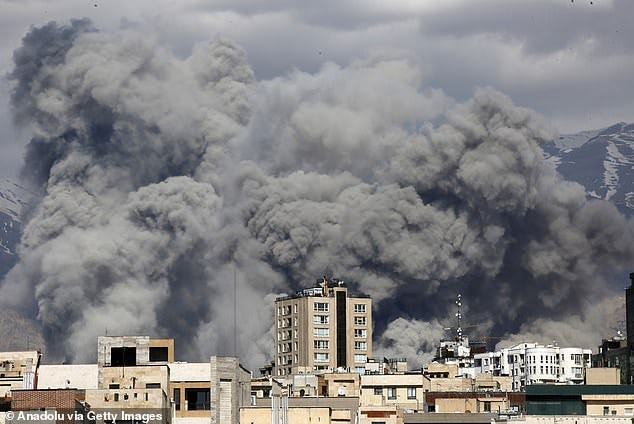
Smoke rises from Tehran
For the Peace President, his new war is already a unique achievement even before it is won. The president seems to have stopped talking about regime change as the primary objective because that was backfiring at home due to having promised during his campaign no more regime-change wars. He has also stopped talking, for the moment, about this war being about denuclearization because people kept reminding him that he already told all of us that Iran’s nuclear capabilities were completely “obliterated” by him last summer, so talk of doing that again was calling into question the success of his earlier war.

This war, however, gives Trump a record that may bring a different award than the Nobel Peace Prize he so desperately craved. He may be due for the No-bells, No-Peace Prize because President Trump has now gotten the United States into more wars in barely over a year than Biden got us involved in during four years. In fact … Wannabe Nobel Laureate Donald Trump has now ordered more attacks against a greater number of countries than any other president in modern U.S. history.

That earth-scorching new record of getting the US involved in seven wars in barely over a year is not selling any better with the MAGA crowd than his great accomplishment in bringing about new experimental vaccines in record time with less testing than any vaccine prior, though they were tested on the entire world all at once. That was a record in testing. MAGA expressly elected him to do the exact opposite of starting seven wars, so stalwart sycophants like Tuckered Carlson are already berating Trump’s new war as “abhorrent” and “evil.”

Trump likes to brag that he has stopped eight wars already, though no one has figured out what wars those were, especially since the war in Gaza continues. The number of wars Trump claims he has stopped is now only one war more than the number Trump has started. However, this new war has just re-ignited last year’s war with Iran at a far bigger scale than the one he started and subsequently stopped with Iran last year. (It would seem, in fact, that many of the wars he stopped are wars he started.) Since this war is restarting the war he stopped, that should negate one war from the list of wars he stopped, given that the one he solved last year with Iran “for good” is now bigger and hotter than anything ever seen with Iran before. That would leave him equal for wars stopped and wars started.

President Trump has said “peace, peace,” more than any president I can recall either in my life time or reading back in history; yet he has started more conflicts for the US than any president in modern history. He has ordered strikes against targets across no less than seven nations - Iran, Nigeria, Venezuela, Iraq, Somalia, Syria and Yemen - at a rate that has already outstripped the total sanctioned by Joe Biden throughout the Democratic president’s four years at the White House….

The first three of the countries targeted by Trump have never before come under attack by the U.S. His assault on Iran, which has plunged the Middle East into chaos as shockwaves ripple across the global economy, has claimed at least four U.S. service members’ lives since it began on Saturday….

Trump’s latest assault flies directly in the face of his promises to voters on the campaign trail. “I’m not going to start a war. I’m going to stop wars,” he told the nation in his 2024 election night victory speech.

This is his biggest war to date, and has all the possibilities of going a lot bigger still. It could even become the most embroiled war the US has been in since Vietnam, maybe even since WWII. I’m not saying it will be, but Trump is dropping bombs in the world’s hottest tinder box at the epicenter of religious wars and oil wars and millennia-old feuds. So, all the combustible ingredients are there. In fact, President Trump told Jake Tapper today that the “big one” is yet to come. The worst attack on Iran is yet to come. This is just the preliminary action, according to Trump: Then the president said, it’s about to get even less safe. He said, quote, “We haven’t even started hitting them hard. The big wave hasn’t even happened. The big one is coming soon.”

So, look out! It’s about to get really exciting. Trump has had an easy time of selling the lie that he has stopped eight wars to his supporters, but I suspect the wars he has started are beginning to look to many of his supporters like they may outweigh the skirmishes he stopped, especially since he started some of the ones he stopped - or, at least, US involvement in them - before he stopped them."