StatCounter

Wednesday, February 4, 2026

“The Science of Stress and How Our Emotions Affect Our Susceptibility to Burnout and Disease”

“The Science of Stress and How Our Emotions
Affect Our Susceptibility to Burnout and Disease
by Maria Popova

"I had lived thirty good years before enduring my first food poisoning - odds quite fortunate in the grand scheme of things, but miserably unfortunate in the immediate experience of it. I found myself completely incapacitated to erect the pillars of my daily life - too cognitively foggy to read and write, too physically weak to work out or even meditate. The temporary disability soon elevated the assault on my mind and body to a new height of anguish: an intense experience of stress. Even as I consoled myself with Nabokov’s exceptionally florid account of food poisoning, I couldn’t shake the overwhelming malaise that had engulfed me - somehow, a physical illness had completely colored my psychoemotional reality.

This experience, of course, is far from uncommon. Long before scientists began shedding light on how our minds and bodies actually affect one another, an intuitive understanding of this dialogue between the body and the emotions, or feelings, emerged and permeated our very language: We use “feeling sick” as a grab-bag term for both the sensory symptoms - fever, fatigue, nausea - and the psychological malaise, woven of emotions like sadness and apathy.

Pre-modern medicine, in fact, has recognized this link between disease and emotion for millennia. Ancient Greek, Roman, and Indian Ayurvedic physicians all enlisted the theory of the four humors - blood, yellow bile, black bile, and phlegm - in their healing practices, believing that imbalances in these four visible secretions of the body caused disease and were themselves often caused by the emotions. These beliefs are fossilized in our present language - melancholy comes from the Latin words for “black” (melan) and “bitter bile” (choler), and we think of a melancholic person as gloomy or embittered; a phlegmatic person is languid and impassive, for phlegm makes one lethargic.

And then French philosopher and mathematician René Descartes came along in the seventeenth century, taking it upon himself to eradicate the superstitions that fueled the religious wars of the era by planting the seed of rationalism. But the very tenets that laid the foundation of modern science - the idea that truth comes only from what can be visibly ascertained and proven beyond doubt - severed this link between the physical body and the emotions; those mysterious and fleeting forces, the biological basis of which the tools of modern neuroscience are only just beginning to understand, seemed to exist entirely outside the realm of what could be examined with the tools of rationalism.

For nearly three centuries, the idea that our emotions could impact our physical health remained scientific taboo - setting out to fight one type of dogma, Descartes had inadvertently created another, which we’re only just beginning to shake off. It was only in the 1950s that Austrian-Canadian physician and physiologist Hans Selye pioneered the notion of stress as we now know it today, drawing the scientific community’s attention to the effects of stress on physical health and popularizing the concept around the world. (In addition to his scientific dedication, Selye also understood the branding component of any successful movement and worked tirelessly to include the word itself in dictionaries around the world; today, “stress” is perhaps the word pronounced most similarly in the greatest number of major languages.)

But no researcher has done more to illuminate the invisible threads that weave mind and body together than Dr. Esther Sternberg. Her groundbreaking work on the link between the central nervous system and the immune system, exploring how immune molecules made in the blood can trigger brain function that profoundly affects our emotions, has revolutionized our understanding of the integrated being we call a human self. In the immeasurably revelatory "The Balance Within: The Science Connecting Health and Emotions" (public library), Sternberg examines the interplay of our emotions and our physical health, mediated by that seemingly nebulous yet, it turns out, remarkably concrete experience called stress.

With an eye to modern medicine’s advances in cellular and molecular biology, which have made it possible to measure how our nervous system and our hormones affect our susceptibility to diseases as varied as depression, arthritis, AIDS, and chronic fatigue syndrome, Sternberg writes: "By parsing these chemical intermediaries, we can begin to understand the biological underpinnings of how emotions affect diseases… The same parts of the brain that control the stress response play an important role in susceptibility and resistance to inflammatory diseases such as arthritis. And since it is these parts of the brain that also play a role in depression, we can begin to understand why it is that many patients with inflammatory diseases may also experience depression at different times in their lives.

Rather than seeing the psyche as the source of such illnesses, we are discovering that while feelings don’t directly cause or cure disease, the biological mechanisms underlying them may cause or contribute to disease. Thus, many of the nerve pathways and molecules underlying both psychological responses and inflammatory disease are the same, making predisposition to one set of illnesses likely to go along with predisposition to the other. The questions need to be rephrased, therefore, to ask which of the many components that work together to create emotions also affect that other constellation of biological events, immune responses, which come together to fight or to cause disease. Rather than asking if depressing thoughts can cause an illness of the body, we need to ask what the molecules and nerve pathways are that cause depressing thoughts. And then we need to ask whether these affect the cells and molecules that cause disease.

We are even beginning to sort out how emotional memories reach the parts of the brain that control the hormonal stress response, and how such emotions can ultimately affect the workings of the immune system and thus affect illnesses as disparate as arthritis and cancer. We are also beginning to piece together how signals from the immune system can affect the brain and the emotional and physical responses it controls: the molecular basis of feeling sick. In all this, the boundaries between mind and body are beginning to blur."

Indeed, the relationship between memory, emotion, and stress is perhaps the most fascinating aspect of Sternberg’s work. She considers how we deal with the constant swirl of inputs and outputs as we move through the world, barraged by a stream of stimuli and sensations: "Every minute of the day and night we feel thousands of sensations that might trigger a positive emotion such as happiness, or a negative emotion such as sadness, or no emotion at all: a trace of perfume, a light touch, a fleeting shadow, a strain of music. And there are thousands of physiological responses, such as palpitations or sweating, that can equally accompany positive emotions such as love, or negative emotions such as fear, or can happen without any emotional tinge at all. What makes these sensory inputs and physiological outputs emotions is the charge that gets added to them somehow, somewhere in our brains. Emotions in their fullest sense comprise all of these components. Each can lead into the black box and produce an emotional experience, or something in the black box can lead out to an emotional response that seems to come from nowhere."

Memory, it turns out, is one of the major factors mediating the dialogue between sensation and emotional experience. Our memories of past experience become encoded into triggers that act as switchers on the rail of psychoemotional response, directing the incoming train of present experience in the direction of one emotional destination or another.

Sternberg writes: "Mood is not homogeneous like cream soup. It is more like Swiss cheese, filled with holes. The triggers are highly specific, tripped by sudden trails of memory: a faint fragrance, a few bars of a tune, a vague silhouette that tapped into a sad memory buried deep, but not completely erased. These sensory inputs from the moment float through layers of time in the parts of the brain that control memory, and they pull out with them not only reminders of sense but also trails of the emotions that were first connected to the memory. These memories become connected to emotions, which are processed in other parts of the brain: the amygdala for fear, the nucleus accumbens for pleasure - those same parts that the anatomists had named for their shapes. And these emotional brain centers are linked by nerve pathways to the sensory parts of the brain and to the frontal lobe and hippocampus - the coordinating centers of thought and memory."

The same sensory input can trigger a negative emotion or a positive one, depending on the memories associated with it. This is where stress comes in - much like memory mediates how we interpret and respond to various experiences, a complex set of biological and psychological factors determine how we respond to stress. Some types of stress can be stimulating and invigorating, mobilizing us into action and creative potency; others can be draining and incapacitating, leaving us frustrated and hopeless. This dichotomy of good vs. bad stress, Sternberg notes, is determined by the biology undergirding our feelings - by the dose and duration of the stress hormones secreted by the body in response to the stressful stimulus. She explains the neurobiological machinery behind this response:

"As soon as the stressful event occurs, it triggers the release of the cascade of hypothalamic, pituitary, and adrenal hormones - the brain’s stress response. It also triggers the adrenal glands to release epinephrine, or adrenaline, and the sympathetic nerves to squirt out the adrenaline-like chemical norepinephrine all over the body: nerves that wire the heart, and gut, and skin. So, the heart is driven to beat faster, the fine hairs of your skin stand up, you sweat, you may feel nausea or the urge to defecate. But your attention is focused, your vision becomes crystal clear, a surge of power helps you run - these same chemicals released from nerves make blood flow to your muscles, preparing you to sprint.

All this occurs quickly. If you were to measure the stress hormones in your blood or saliva, they would already be increased within three minutes of the event. In experimental psychology tests, playing a fast-paced video game will make salivary cortisol increase and norepinephrine spill over into venous blood almost as soon as the virtual battle begins. But if you prolong the stress, by being unable to control it or by making it too potent or long-lived, and these hormones and chemicals still continue to pump out from nerves and glands, then the same molecules that mobilized you for the short haul now debilitate you."

These effects of stress exist on a bell curve - that is, some is good, but too much becomes bad: As the nervous system secretes more and more stress hormones, performance increases, but up to a point; after that tipping point, performance begins to suffer as the hormones continue to flow. What makes stress “bad” - that is, what makes it render us more pervious to disease - is the disparity between the nervous system and immune system’s respective pace. 

Sternberg explains: "The nervous system and the hormonal stress response react to a stimulus in milliseconds, seconds, or minutes. The immune system takes parts of hours or days. It takes much longer than two minutes for immune cells to mobilize and respond to an invader, so it is unlikely that a single, even powerful, short-lived stress on the order of moments could have much of an effect on immune responses. However, when the stress turns chronic, immune defenses begin to be impaired. As the stressful stimulus hammers on, stress hormones and chemicals continue to pump out. Immune cells floating in this milieu in blood, or passing through the spleen, or growing up in thymic nurseries never have a chance to recover from the unabated rush of cortisol. Since cortisol shuts down immune cells’ responses, shifting them to a muted form, less able to react to foreign triggers, in the context of continued stress we are less able to defend and fight when faced with new invaders. And so, if you are exposed to, say, a flu or common cold virus when you are chronically stressed out, your immune system is less able to react and you become more susceptible to that infection."

Extended exposure to stress, especially to a variety of stressors at the same time - any combination from the vast existential menu of life-events like moving, divorce, a demanding job, the loss of a loved one, and even ongoing childcare - adds up a state of extreme exhaustion that leads to what we call burnout.

Sternberg writes: "Members of certain professions are more prone to burnout than others - nurses and teachers, for example, are among those at highest risk. These professionals are faced daily with caregiving situations in their work lives, often with inadequate pay, inadequate help in their jobs, and with too many patients or students in their charge. Some studies are beginning to show that burnt-out patients may have not only psychological burnout, but also physiological burnout: a flattened cortisol response and inability to respond to any stress with even a slight burst of cortisol. In other words, chronic unrelenting stress can change the stress response itself. And it can change other hormone systems in the body as well."

One of the most profound such changes affects the reproductive system - extended periods of stress can shut down the secretion of reproductive hormones in both men and women, resulting in lower fertility. But the effects are especially perilous for women - recurring and extended episodes of depression result in permanent changes in bone structure, increasing the risk of osteoporosis. In other words, we register stress literally in our bones.

But stress isn’t a direct causal function of the circumstances we’re in - what either amplifies or ameliorates our experience of stress is, once again, memory. Sternberg writes: Our perception of stress, and therefore our response to it, is an ever-changing thing that depends a great deal on the circumstances and settings in which we find ourselves. It depends on previous experience and knowledge, as well as on the actual event that has occurred. And it depends on memory, too.

The most acute manifestation of how memory modulates stress is post-traumatic stress disorder, or PTSD. For striking evidence of how memory encodes past experience into triggers, which then catalyze present experience, Sternberg points to research by psychologist Rachel Yehuda, who found both Holocaust survivors and their first-degree relatives - that is, children and siblings - exhibited a similar hormonal stress response.

This, Sternberg points out, could be a combination of nature and nurture - the survivors, as young parents for whom the trauma was still fresh, may well have subconsciously taught their children a common style of stress-responsiveness; but it’s also possible that these automatic hormonal stress responses permanently changed the parents’ biology and were transmitted via DNA to their children. Once again, memory encodes stress into our very bodies. Sternberg considers the broader implications: "Stress need not be on the order of war, rape, or the Holocaust to trigger at least some elements of PTSD. Common stresses that we all experience can trigger the emotional memory of a stressful circumstance - and all its accompanying physiological responses. Prolonged stress - such as divorce, a hostile workplace, the end of a relationship, or the death of a loved one - can all trigger elements of PTSD."

Among the major stressors - which include life-events expected to be on the list, such as divorce and the death of a loved one - is also one somewhat unexpected situation, at least to those who haven’t undergone it: moving. Sternberg considers the commonalities between something as devastating as death and something as mundane as moving: One is certainly loss - the loss of someone or something familiar. Another is novelty - finding oneself in a new and unfamiliar place because of the loss. Together these amount to change: moving away from something one knows and toward something one doesn’t. An unfamiliar environment is a universal stressor to nearly all species, no matter how developed or undeveloped.

In the remainder of the thoroughly illuminating "The Balance Within", Sternberg goes on to explore the role of interpersonal relationships in both contributing to stress and shielding us from it, how the immune system changes our moods, and what we can do to harness these neurobiological insights in alleviating our experience of the stressors with which every human life is strewn.”
Related:
"Neuroscience Says Listening to This Song 
Reduces Anxiety by Up to 65 Percent"
By Melanie Curtin
Full screen recommended.
"Everyone knows they need to manage their stress. When things get difficult at work, school, or in your personal life, you can use as many tips, tricks, and techniques as you can get to calm your nerves. So here's a science-backed one: make a playlist of the 10 songs found to be the most relaxing on earth. Sound therapies have long been popular as a way of relaxing and restoring one's health. For centuries, indigenous cultures have used music to enhance well-being and improve health conditions.

Now, neuroscientists out of the UK have specified which tunes give you the most bang for your musical buck. The study was conducted on participants who attempted to solve difficult puzzles as quickly as possible while connected to sensors. The puzzles induced a certain level of stress, and participants listened to different songs while researchers measured brain activity as well as physiological states that included heart rate, blood pressure, and rate of breathing.

According to Dr. David Lewis-Hodgson of Mindlab International, which conducted the research, the top song produced a greater state of relaxation than any other music tested to date. In fact, listening to that one song- "Weightless"- resulted in a striking 65 percent reduction in participants' overall anxiety, and a 35 percent reduction in their usual physiological resting rates. That is remarkable.

Equally remarkable is the fact the song was actually constructed to do so. The group that created "Weightless", Marconi Union, did so in collaboration with sound therapists. Its carefully arranged harmonies, rhythms, and bass lines help slow a listener's heart rate, reduce blood pressure and lower levels of the stress hormone cortisol.

When it comes to lowering anxiety, the stakes couldn't be higher. Stress either exacerbates or increases the risk of health issues like heart disease, obesity, depression, gastrointestinal problems, asthma, and more. More troubling still, a recent paper out of Harvard and Stanford found health issues from job stress alone cause more deaths than diabetes, Alzheimer's, or influenza.

In this age of constant bombardment, the science is clear: if you want your mind and body to last, you've got to prioritize giving them a rest. Music is an easy way to take some of the pressure off of all the pings, dings, apps, tags, texts, emails, appointments, meetings, and deadlines that can easily spike your stress level and leave you feeling drained and anxious.

Of the top track, Dr. David Lewis-Hodgson said, "'Weightless' was so effective, many women became drowsy and I would advise against driving while listening to the song because it could be dangerous." So don't drive while listening to these, but do take advantage of them:

10. "We Can Fly," by Rue du Soleil (Café Del Mar)
8. "Someone Like You," by Adele
7. "Pure Shores," by All Saints
6. "Please Don't Go," by Barcelona
5. "Strawberry Swing," by Coldplay
4. "Watermark," by Enya
2. "Electra," by Airstream
1. "Weightless," by Marconi Union

I made a public playlist of all of them on Spotify that runs about 50 minutes (it's also downloadable)."

"All The Money You Make..."

Full screen recommended.
Steve Cutts, "Happiness"
“All the money you make will never buy back your soul. ”
- Bob Dylan

The Psyche, "Why Good People Become Monsters"

Full screen recommended.
The Psyche, "Why Good People Become Monsters"

"How It Really Is"


"The Whole Problem..."


"The Solar Storm Racing to Earth May Surprise Us"

Full screen recommended.
Stefan Burns, 2/4/26
"The Solar Storm Racing to Earth May Surprise Us"
"Geophysicist Stefan Burns reports on the extreme solar activity that is currently ongoing - the new 4.1 x-flare and the coronal mass ejection inbound - as well as the magnitude 6.1 earthquake that struck north of New Zealand, the strongest earthquake in more than 7 days."
Comments here:
o
Full screen recommended.
EarthSky, 2/4/26
"Solar Storm Alert: AR4366 Unleashes 10 X-Flares"
"Sunspot AR4366 has erupted this week with an astonishing 9 X-class flares and dozens of M-class flares. Some of these flares have released CMEs, great burps of solar materials and magnetic fields. And the first CME is expected to brush Earth on February 5. EarthSky's Deborah Byrd is here with sun images from the week, and to explain what the CMEs mean for skywatchers and space weather."
Comments here:

"We Are Bankrupt As a Nation: The Truth About 2026"

Full screen recommended.
Jhone AG, 2/4/26
"We Are Bankrupt As a Nation: 
The Truth About 2026"
Comments here:

"No More Free Rent - The Free Ride Is Ending for Thousands"

Full screen recommended.
Dan, I Allegedly 2/4/26
"No More Free Rent - 
The Free Ride Is Ending for Thousands"
"Hundreds of thousands of people are getting their rent paid for free - and many were never supposed to qualify in the first place. In today’s episode of I Allegedly, I break down what’s really happening inside the HUD housing system and why officials are suddenly forcing mass re-qualification across the country. This isn’t about helping the elderly or people on fixed incomes - those programs matter. This is about abuse, oversight failures, and how the system has been quietly exploited for decades."
Comments here:

"The Great Divide"

"The Great Divide"
by Joel Bowman

“Politics is the art of looking for trouble, finding it everywhere, 
diagnosing it incorrectly, and applying the wrong remedies.”
~ Groucho Marx (1890-1977)

Buenos Aires, Argentina - "Today, we continue our rumination on the futility of attempting to make sense of the world through the distorting lens of politics (and why market signals offer a far clearer alternative). But first...

Newsflash for dear readers: Winter still cold, summer still hot. No joke! At least, that’s according to the intrepid journalisming from our brave colleagues in the popular press, who never met a molehill that didn’t identify as a mountain...

From AccuWeather: "Polar vortex to keep frigid pattern locked over eastern US through much of February."

The BBC: "Bomb cyclone winter storm set to bring another round of snow to eastern US."

And, as always, one from the astute headline hunters over at The Guardian: "How to dress in cold weather: 10 stylish and cosy updates for winter."

Seen and Not Heard: Many headlines ago, when your editor was a young(er) man, it was considered impolite to bring up religion or politics at the dinner table. Such talk could get one a “clip behind the ear” if one were not careful. Today, now that the civic religion is politics, nothing escapes its all-encompassing, thought-corrupting purview.

Don’t believe us? Thumb through your morning paper and witness the ink bleeding over from the politics section into every nook and cranny of “all the news worth printing” (and plenty more that is not). From Business and Finance... Sports and Entertainment... Science and Technology... even the funny pages are not immune from tribal invectives.

What used to be a story about a company’s earnings, market share, profit and loss, annual growth etc. ... has become a narrative about Fed policy, about taxes and tariffs, about ESG, DEI and the so-called “gender pay gap,” such that there ends up being more noise than actual signal.

A piece on which team won the Big Game over the weekend has morphed into a polemic about the racial make-up of the players, which athlete took a knee and for what cause, and whether the 6 foot 4 inch “person with a penis” has a right to beat-up on high-school girls... and towel off in their changing rooms afterward.

Indeed, topics as formerly bland and banal as the weather have become battlegrounds for hyper-partisan cage-fighting, with “wrongthink” punishable by banishment from the sacred in-group, excommunication from “consensus.”

Hard Cold Facts: Just to press a point, here’s a little-known fact, often misreported... if it is reported at all: Many, many more people die as a result of extreme cold weather than perish from extreme warm weather. We write “many” as in an order-of-magnitude many. It’s true.

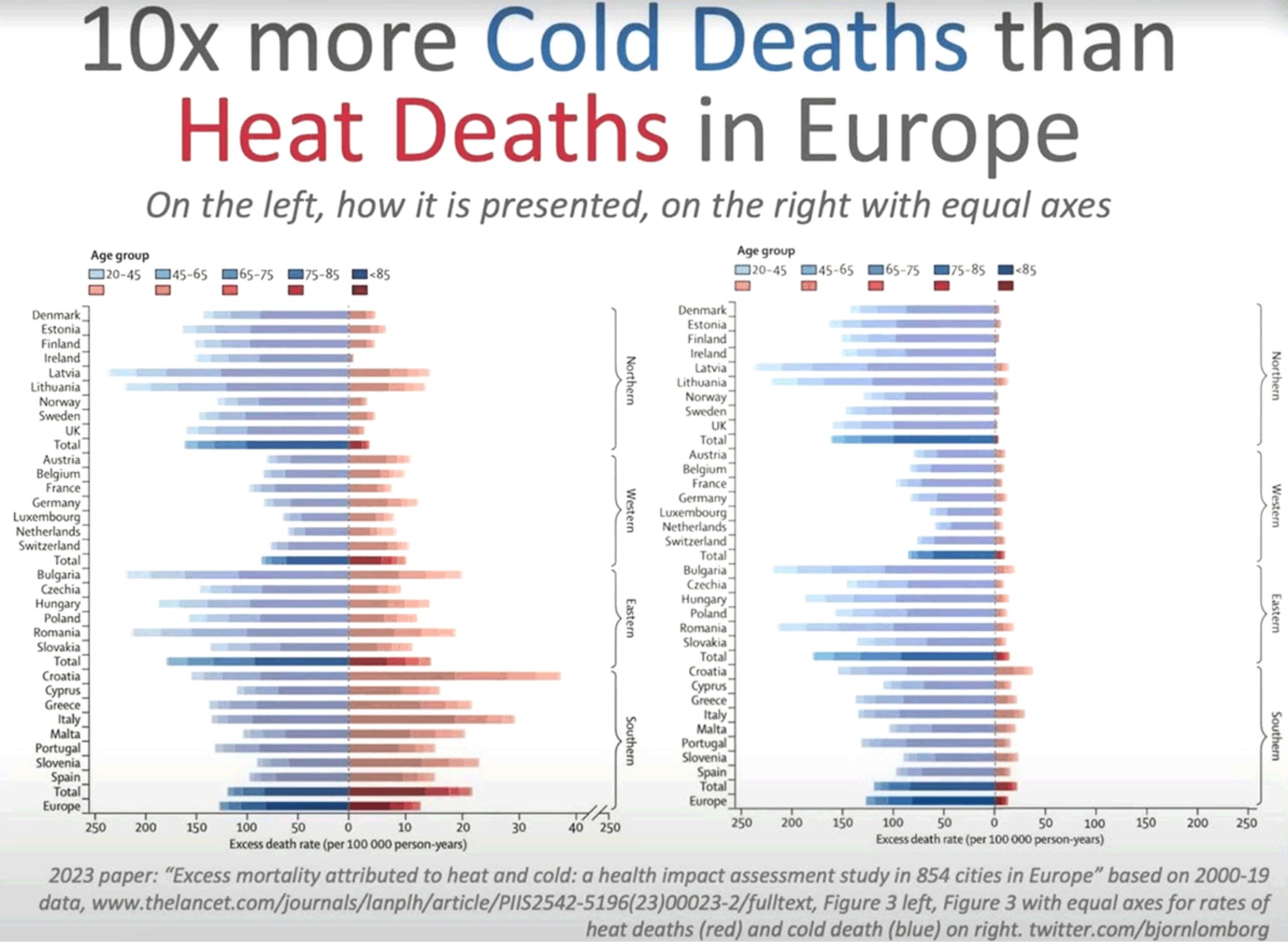
A few years ago, The Lancet published a dubious graph in which they attempted to equalize the impact of fat tail events at either weather extreme. And they might have gotten away with it, too, were it not for… people who can read graphs. These pedantic nit-pickers – with their stubborn facts and whatnot – pointed out that the x-axis was skewed in such a way as to make it appear as though both hot and cold deaths were similar in size. Not so.

Bjorn Lomborg, the former director of the Danish government’s Environmental Assessment Institute (EAI) and a self-described “skeptical environmentalist,” showed the graphs both “before and after” correcting for the wild x-axis discrepancy, here:
Click image for larger size.
In reality, something in the order of 10x more people die of extreme cold in Europe each year than do of extreme heat. Why distort that fact? Because it doesn’t agree with the publisher’s politics, of course, in which global warming is a far greater threat than global cooling (which, after all, hasn’t been en vogue among the planet’s managerial class since the ‘70s.) In other words, the graph on the left is a politically motivated distortion. The graph on the right is corrected for that distortion.

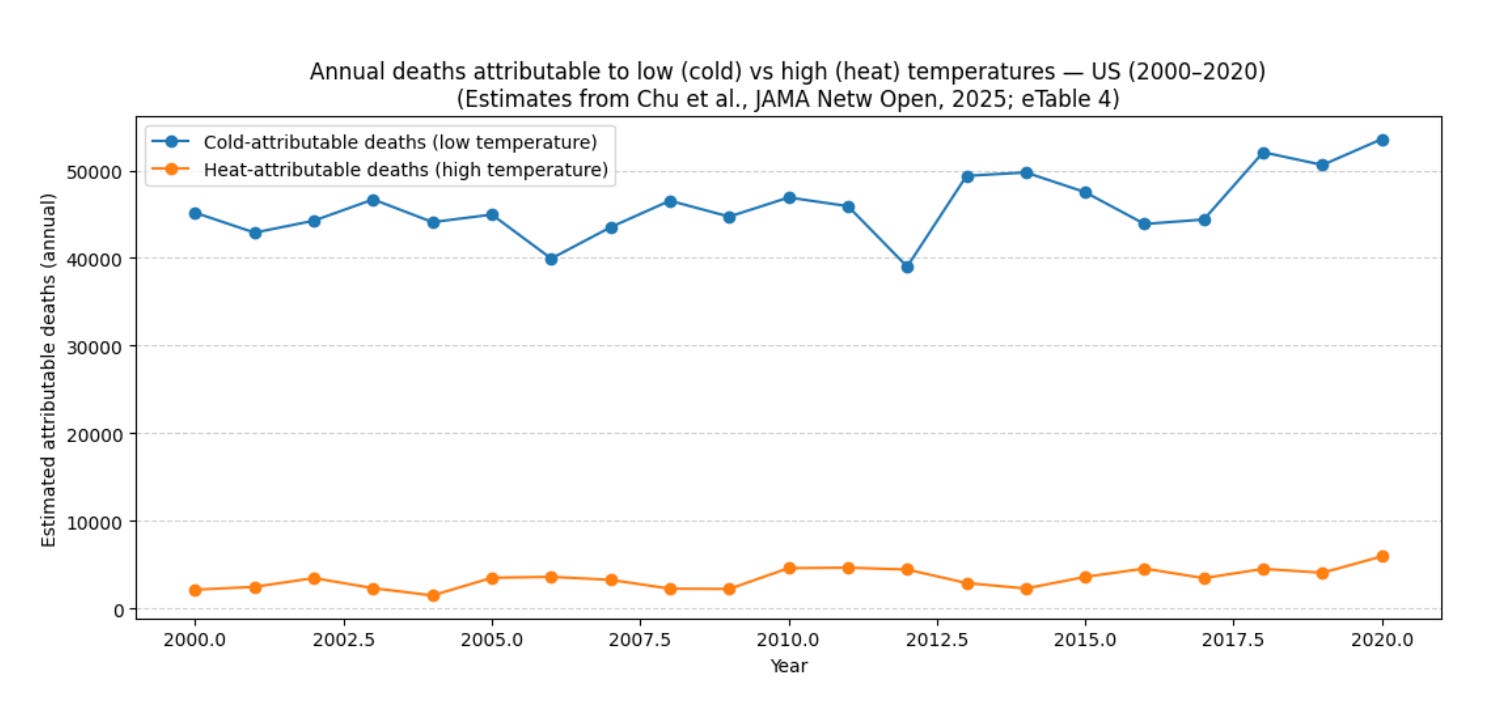
The same phenomenon is true elsewhere, too, including in the United States. Using official data from the Center for Disease Control (CDC) and the Environmental Protection Agency (EPA), which apparently keep tabs on such things, we asked our underpaid (AI) interns to construct a graph of annual heat- and cold-related deaths in the US since the turn of the century.

Over a 20-year period, there were on average 3,414 deaths per year resulting from extreme heat... while the average number of fatalities due to extreme cold was 45,992... about 13.5x higher, or roughly what they are in Europe.
Click image for larger size.
(NB: If one is tempted to read anything into the slight upticks in both lines, consider that the US added some 60 million people to its population in the first two decades of the century, more than enough to account for any variability shown here.)

The Great Political Divide: We chose this “ordinary” subject not to make a point about the climate per se, but to underscore how a subject that used to be spectacularly apolitical, so much so that “the weather” was considered an island of refuge for the conversationally conflict-averse, has over time been infected with rabid bias and partisan politics. We could just as easily have chosen mask mandates… woman’s soccer/football… the Grammys… the price of uni in Japan… or a hundred other subjects to make the very same point, so ubiquitous has the blinding division become.

In 2026, political labels have become so defining, so central to one’s sense of self, that precious few will not answer when their party name is called. Indeed, parading one’s political affiliation, once seen as a rather tawdry affair, has gone from being a mere virtue signal to something of a mating call, with the number of single men and women willing to date across party lines in steady decline... along with the birthrate.

And the divide is only getting wider. A study by the Kinsey Institute showed that 30% of respondents “have never and would never date a partner with opposing political views.” And while older generations (Millennials, Gen X, Boomers) were found to be generally less inclined to make politics a primary deal-breaker, the same cannot be said of the next wave of parents-to-be (or not-to-be, as the case may be). The same polling showed, for instance, that 37% of Gen Z women entirely ruled out dating someone with different political beliefs.

No doubt legacy media has played its part in driving a wedge between its readers... just as anti-social media has amplified the effects by siloing us into our own little epistemic enclaves, all the better to pipe the outrage trash in through our appropriately named feeds.

All of which did not spring forth by accident, of course. As George Orwell wrote in his famous essay, Politics and the English Language, (1946): “Political language is designed to make lies sound truthful and murder respectable, and to give an appearance of solidity to pure wind.” Where do we turn, dear reader, when every facet of human life is subsumed under the dark domain of politics, when public life drives out private life, and politics itself becomes totalitarian? To the antithesis of politics, of course, which we shall unpack Friday. Stay tuned for more Notes From the End of the World..."

Bill Bonner, "Here Passes the Buck"

"Here Passes the Buck"
by Bill Bonner

"Nobody goes there anymore. It’s too crowded."
- Yogi Berra

Rancho Santana, Nicaragua - "Good lord...dios mio...The empire really is in decline. Futurism.com reports: "Trump Is Causing the United States’ First-Ever Population Decline." According to Bloomberg, one well-regarded population estimate warns that 2026 is primed to be the year of the first real population decline in the 250 year history of the United States. One of the main reasons, Census officials say, is the Trump administration’s incredibly aggressive deportation campaign.

From July 2024 to July 2025, US Census data released this week shows the total US population only grew by around 0.5 percent, or 1.8 million people - a rate that seems all but certain to slip into the negative.

Things aren’t about to get any better, either. According to data released by the Congressional Budget Office, the US birth surplus - the number of births over deaths - is expected to completely collapse by 2030. When that happens, the US will be totally dependent on immigration to sustain population growth. This is good news for us. We introverts don’t like crowded restaurants...long lines...or waiting rooms. We don’t take readily to people we don’t know...and some of us even cross the street to avoid people we do know.

But it’s a view few share. Newsthink: "Elon Musk warns that falling birth rates could threaten civilization itself. Global population growth has already slowed dramatically, and many countries sit below the replacement rate of 2.1 children per woman. That means each generation is smaller than the last. The UN expects growth to nearly stop by 2100, and some experts think it will reverse sooner. The risk isn’t overcrowding - it’s decline."

Cause or effect, we don’t know, but Baltimore has been bleeding people for the last 75 years and the results are not attractive. There were almost a million people in the city the year we were born. The town bustled with activity - an active port...the smell of McCormick spices in the harbor...autos coming off the GM assembly lines down in Canton…and steel hot from the furnaces of Sparrows Point.

There were rows and rows of washed marble doorsteps...and neighborhood bars on every corner ready to quaff the thirst of stevedores, steelworkers, pipe fitters, dockhands, factory girls...clerks, cops, and “hedgerow whores” (as Jefferson indelicately described the women who worked on “The Block.”).

Most amazing, Baltimore had one of the most highly developed, upscale social scenes in the US. In the 1950s, one of our distant cousins, from England, even came to Baltimore for her ‘coming out.’ It was a real town, in other words, with real industries and real jobs, and real people who paid taxes to support it.

Today, it is a pale shell of itself with barely half as many people. The city is full of abandoned houses, trash, ambulance chasers, dusty museums and busy emergency wards. In the place of money-making industries are non-profit institutions. And in the houses that once held honest wage earners, are welfare recipients and NGO beneficiaries.

From an economic standpoint, a population decline - at least in a modern, societies with debts they can’t pay - is thought to be catastrophic. More people equal more output...more demand...more houses...more roads...more GDP...more tax receipts...more activity. Take away the people and the result is grim.

Total debt in the US is about $110 trillion...or about a million per household. Not included are the costs of delivering Social Security and Medicare benefits to an aging population, said to be about $73 trillion more. Larger, richer populations may afford to take on the debts of their parents. Shrinking, poorer populations cannot.

An age-old idea is that each generation should try to add a little wealth to the next. A society is said to grow richer as its old people plant trees whose shade they will never enjoy themselves. What the next generation doesn’t want, however, is infrastructure it can’t afford to maintain, transfer programs it can’t afford to continue and debts it can’t afford to pay. And even before Trump stymied population growth, the next generations were feeling pinched. 

CNN: "Even though the US economy is growing - not everyone is prospering. Millennials are on track to be the first generation not to exceed their parents in terms of job status or income, studies show. Among Americans born in the late 1980s, only 44% were in jobs with higher socioeconomic status than their parents when both were age 30, while 49% had positions of lower status..."

If the US wanted to treat its young people decently, it would trim its budget and avoid spending more than its current taxpayers are willing to pay for. Instead, the deficits come hot and heavy...passing the buck on today’s overspending to people who have never shaved, never voted...many of whom haven’t even been born. MSN: "Treasury reports $1 trillion debt surge in under three months." This is not planting new trees. This is cutting down the old ones, grinding down the stumps and putting Round-Up on the roots."

"A Burst of Snow Exploding Into a Monster - 80 Cities Forecast"

Full screen recommended.
USA Weather Pulse, 2/4/26
"A Burst of Snow Exploding Into a Monster - 80 Cities Forecast"
"A burst of snow is exploding into a monster storm as a deadly bomb cyclone barrels through North Carolina with historic snowfall. We're tracking the latest winter storm forecast for 80 cities in the direct path of this beast. From Charlotte buried under nearly a foot of snow to James City recording a jaw-dropping 18 inches, this nor'easter is absolutely hammering the Carolinas. Blizzard conditions, sub-zero wind chills, and whiteout conditions are making travel nearly impossible. Don't get caught off guard - find your city in the full 80-city breakdown!"
Comments here:

Tuesday, February 3, 2026

"Carrington Event: Here's Why Scientists Are Terrified Of It - And Why It Could Happen Again"

Full screen recommended.
The Quiet Archivist, 2/3/26
"Carrington Event: Here's Why Scientists Are Terrified Of It - 
And Why It Could Happen Again"
"In 1859, a solar storm set telegraph wires on fire. If it happened today, it wouldn’t just knock out your Wi-Fi - it could unravel the systems that hold modern civilization together. This video dives into the forgotten terror of the Carrington Event, a geomagnetic superstorm so powerful it electrified equipment, shocked operators, and lit the skies far beyond the poles. Back then, the world survived because it was simple. Today, everything depends on satellites, high-voltage power grids, GPS timing, and fragile digital networks. And now, the Sun is sending warning shots. The AR4366 sunspot region has erupted into a full-blown solar flare factory, producing massive X-class flares that raise uncomfortable questions scientists can’t fully answer yet. Is this just noise at the peak of Solar Cycle 25 - or the early phase of something much bigger? This is a deep-dive into real data, historical clues, modern vulnerabilities, and the unsettling possibility that the next Carrington-level storm won’t announce itself until it’s already too late."
Comments here:
Correction: The narrator says "2025" instead of 2026.
o
Food for thought... "Knowing"
God help us.

"This Sunspot Could Fry Our Power Grid"

Full screen recommended.
Space-news, 2/3/26
"This Sunspot Could Fry Our Power Grid"
"A monster sunspot that didn't exist 3 days ago just unleashed 21 solar flares in 24 hours, including an X8.3 eruption - the most powerful solar flare of 2026. Sunspot AR4366 is now half the size of the one that caused the 1859 Carrington Event. In this video, we break down what NASA and NOAA are tracking, why scientists are calling this region a "solar flare factory," and what a direct hit could mean for Earth's power grids, GPS systems, and satellites. Plus: could we see northern lights in the US this week?"
Comments here:
o
Full screen recommended.
The Sleepy Explorer
"The Monster Sunspot Is Growing - 
And Now It's Entering the Strike Zone"
"For nearly a month, we’ve been following a trail of events that refuse to resolve cleanly. Five investigations in, the pattern hasn’t broken - it’s tightened. It began with a solar storm strong enough to destabilize the polar vortex, then escalated into a global seismic burst timed to a rare planetary alignment, followed by a shattered winter system, a historic bomb cyclone, and finally the largest solar flare in eight years. When the X8.1 flare fired and the CME turned out to be weak, the headlines moved on and the world was told the danger had passed. But that’s not what the data shows. What makes this moment different is what didn’t happen: the sunspot didn’t vent its energy - it pulled it back in. In the days since, it has grown larger, denser, and more magnetically unstable, and now it’s rotating into the exact position where any major eruption would be aimed directly at Earth. This documentary picks up where the coverage stopped, connecting the dots between solar physics, Earth’s increasingly sensitive systems, and a window of time that may be far more consequential than anyone wants to admit. The X8.1 wasn’t the ending. It may have been the opening signal."
Comments here:
o

"100,000 People Have Been Laid Off From Amazon And 30,000 UPS Jobs Have Just Disappeared"

Full screen recommended.
Epic Economist, 2/3/26
"100,000 People Have Been Laid Off From Amazon 
And 30,000 UPS Jobs Have Just Disappeared"
"Something unprecedented is happening in the American job market, and most people don't realize how fast it's moving. We're not just talking about typical recession layoffs, entire job categories are vanishing permanently as companies completely restructure around AI and automation. In this video, I'm breaking down what I'm seeing across multiple industries. From UPS cutting 30,000 positions to Amazon eliminating over 100,000 human jobs while adding 750,000 robots, the scale of this shift is staggering. And it's hitting every sector, tech, healthcare, retail, you name it.

What's really concerning is how this is affecting Gen Z. An entire generation followed the traditional path, college, student loans, degrees, only to find there aren't any good-paying middle class jobs waiting for them. The career ladder their parents climbed? It's just not there anymore. I'm also looking at what experts are predicting for the next few years. Some are warning that up to 83 million jobs could disappear by 2027, with AI already capable of replacing about half of all current roles. The speed of this change is unlike anything we've seen before.

But here's what gets me, most people aren't prepared for this reality. Companies are quietly implementing AI systems that can do the work of entire departments, and millions of workers have no idea their jobs are about to be automated away. What are you seeing in your industry? Are these changes affecting your area yet? Drop a comment below and let me know your thoughts."
Comments here:
o
Full screen recommended.
Snyder Reports, 2/3/26
"The US Job Market Just Got Worse, 
Millions Stuck With Unlivable Wage"
Comments here:

Gerald Celente, "Death Of The Dollar"

Strong language alert!
Gerald Celente, 2/3/26
"Death Of The Dollar"
"The Trends Journal is a weekly magazine analyzing global current events forming future trends. Our mission is to present Facts and Truth over fear and propaganda to help subscribers prepare for What’s Next in these increasingly turbulent times."
Comments here:
o
Glenn Diesen, 2/3/26
"Peter Schiff:
 Economic Meltdown & Dollar Collapse"
"Peter Schiff is the CEO of Euro Pacific Asset Management and the host of the Peter Schiff Show. Schiff explains why gold passed 5000 dollars and silver 100 dollars. The US has reached the end of the road."
Comments here:

Visit Peter Schiff's Euro Pacific Asset Management: https://europac.com/

Musical Interlude: Dan Fogelberg, "Nether Lands"

Full screen recommended.
Dan Fogelberg, "Nether Lands"

"A Look to the Heavens"

"Colorful NGC 1579 resembles the better known Trifid Nebula, but lies much farther north in planet Earth's sky, in the heroic constellation Perseus. About 2,100 light-years away and 3 light-years across, NGC 1579 is, like the Trifid, a study in contrasting blue and red colors, with dark dust lanes prominent in the nebula's central regions.
In both, dust reflects starlight to produce beautiful blue reflection nebulae. But unlike the Trifid, in NGC 1579 the reddish glow is not emission from clouds of glowing hydrogen gas excited by ultraviolet light from a nearby hot star. Instead, the dust in NGC 1579 drastically diminishes, reddens, and scatters the light from an embedded, extremely young, massive star, itself a strong emitter of the characteristic red hydrogen alpha light."

The Poet: Czeslaw Milosz, "Hope"

"Hope"

"Hope is with you when you believe
The earth is not a dream but living flesh,
That sight, touch, and hearing do not lie,
That all things you have ever seen here
Are like a garden looked at from a gate.
You cannot enter. But you're sure it's there.
Could we but look more clearly and wisely
We might discover somewhere in the garden
A strange new flower and an unnamed star.

Some people say we should not trust our eyes,
That there is nothing, just a seeming,
These are the ones who have no hope.
They think that the moment we turn away,
The world, behind our backs, ceases to exist,
As if snatched up by the hands of thieves."

- Czeslaw Milosz,
"Hope", from "The World"

"The Bloodbath Is Far from Over - 8,432 Store Closures, Layoffs, AI Takeovers"

Full screen recommended.
Dan, I Allegedly, 2/3/26
"The Bloodbath Is Far from Over - 
8,432 Store Closures, Layoffs, AI Takeovers"
Comments here:

"Once Upon a Time, The End"

"Once Upon a Time, The End"
by Martin Zamyatin

"Those that can make you believe absurdities
can make you commit atrocities."
- Voltaire

"The small group of devoted followers gathered around Chicago housewife Dorothy Martin sat in stunned silence as the clock on her suburban living room wall struck midnight on the twentieth of December, 1954…and nothing happened. Many had left jobs and spouses and given away all their money and possessions in order to await the arrival of alien beings from the planet Clarion, who Martin had assured them would descend at that appointed hour, carrying the faithful few off in their flying saucers just before huge floods engulfed the planet Earth. Finally, four hours after their scheduled departure time, Martin broke her silence.

As the group readjusted their bras, belts, and zippers - having been instructed to discard any metal objects which might interfere with the aliens’ telepathic radio transmissions - their tearful host revealed the reason why their intergalactic rescuers had failed to appear: Apparently it had all been only an elaborate test of faith, and the group’s advanced state of enlightenment had saved the entire planet from a watery destruction!

Surprisingly, only one or two of Martin’s followers were unconvinced by this perfectly rational explanation. Among them, however, was social psychologist Leon Festinger, who had secretly infiltrated the group. Festinger would later write about Martin - using the pseudonym of Marian Keech - in his groundbreaking 1958 book, "When Prophecy Fails." (Not surprisingly, Festinger is credited with coining the psychological term ‘cognitive dissonance.’)

Following publication of Festinger’s book, the group predictably collapsed under the weight of public ridicule. Martin fled to Peru to warn the clueless natives about the imminent re-emergence of Atlantis, before later resurfacing in Arizona, where she joined crackpot L. Ron Hubbard’s nascent pseudoscientific movement, Scientology.

It seems that for as long as people have inhabited the world, they have anticipated its imminent demise. (In fact, the oldest known apocalyptic prediction is depicted on Assyrian tablets from 2800 BC.) In what may be the earliest example in European folklore, a Frankish villager wandered off into the forest in 591, only to be accosted by a swarm of ravenous flies. Overwhelmed, the poor fellow completely lost his mind and returned to his village clothed in animal pelts, claiming he was Jesus Christ, sent to gather his flock before the coming Rapture. (Perhaps resenting the competition, a local bishop hired a gang of thugs to capture the Lord of the Flies, who they rapturously hacked into little bits.)

The failure of one apocalyptic prophecy not only failed to deter its devoted followers but in fact spawned several entirely new religions. When the world failed to end as predicted in the ‘Great Disappointment’ of 1843-44, Massachusetts preacher William Miller’s tens of thousands of followers splintered off to found the Seventh Day Adventists, as well as the obnoxious doorknockers known as Jehovah’s Witnesses. When the next fateful year of 1874 passed without the desired fireworks, the latter’s charismatic founder, Charles Taze Russell, explained that Jesus had indeed returned, but was invisible to all except the truly devout. (Predictably, few dared admit to being lacking in the requisite level of faith.)

The founder of Mormonism, Joseph Smith, had declared way back in 1832 that 1890 would be the year of Jesus’s long awaited return engagement. (Later jailed for fraud, Smith somehow failed to predict his own deliverance by an angry mob at age 39.) Russell revised the fateful year to 1881…then 1914…and finally, 1918. (The latter dates spanned World War I and the Spanish Flu epidemic, events that while apocalyptic for many, fell short of being world ending.)

Our own time has seen the horrors of the Peoples Temple - in which 914 adults and children committed suicide in the jungles of Guyana in 1978; the Branch Davidians, an offshoot of the Seventh Day Adventists - 75 of whom died in the FBI standoff at Waco in 1993; Aum Shinri Kyo -whose poison gas attacks on the Tokyo subway in 1994-95 left 19 innocent people dead; and -neither least nor unfortunately, last - Heaven’s Gate, 39 of whose members committed suicide in 1996, fully expecting (like Dorothy Martin) their spirits to be carried away by aliens hiding in the wake of an approaching comet.

It was probably no coincidence that all of these cults were acting in anticipation of an impending Bible-inspired Day ofJudgement. One is tempted to blame these kinds of incidents on the delusions of a small minority of misguided religious fanatics, except that millions of people alive today are expecting an imminent Biblical apocalypse. In a 2012 global poll, fully one out of 7 people said they thought the world would end during their lifetime - and rather ominously, Americans topped the list of doomsayers at 22%. Since their government has the means to fulfil their death wish many times over, one can only hope their gloomy prediction won’t one day become a self-fulfilling prophecy. Just call it a bedtime story for humanity."

The Daily "Near You?"

Frisco, Texas, USA. Thanks for stopping by!

"We Live In Radical Times..."

"We live in radical times surrounded by tasks that seem impossible. It has become our collective fate to be alive in a time of great tragedies, to live in a period of overwhelming disasters and to stand at the edge of sweeping changes. The river of life is flooding before us, and a tide of poisons affect the air we breathe and the waters we drink and even tarnish the dreams of those who are young and as yet innocent. The snake-bitten condition has already spread throughout the collective body.

However, it is in troubled times that it becomes most important to remember that the wonder of life places the medicine of the self near where the poison dwells. The gifts always lie near the wounds, the remedies are often made from poisonous substances, and love often appears where deep losses become acknowledged. Along the arc of healing the wounds and the poisons of life are created the exact opportunities for bringing out all the medicines and making things whole again."
- Michael Meade, "Fate And Destiny"

"It’s Time To Accept That Civil War 2.0 Has Already Started"

"It’s Time To Accept That Civil War 2.0 Has Already Started"
by Brandon Smith

"In July of 1917 as the fires of WWI raged across Europe, the Russian city of Petrograd was facing its own special turmoil in the form of a large scale Bolshevik insurgency. Up to 500,000 protesters, agitators and provocateurs had entered the city from across the country, many of them armed. They took over large swaths of the metropolis, hijacked private vehicles and confiscated private buildings.

Some soviet leaders including Vladimir Lenin called the event “premature” and did not publicly endorse it, which may have been a calculated attempt to avoid direct blowback. The official historical explanation is that the insurrection had taken on a life of its own, but the stage had been set and the communist agitators got exactly what they wanted, what their strategy demanded: Human sacrifice.

Clashes with government authorities led to hundreds of protester deaths and a handful of police casualties. The Russian government surged military forces into the region to arrest Bolshevik captains and the movement had to pull back. In the end, though, the primary goal of the insurgents had been achieved. Whether spontaneous or planned, the point of the communist methodology is always to trigger government violence which can then be used to create public sympathy and bolster the revolution.

The majority of “normies” don’t need to join the revolution, they just have to be convinced to stay out of the way. And that’s largely what happened a few months later in October of 1917 when the Red Terror began. What followed was five years of civil war.

The communists, who had long claimed to be innocent victims of the Tsarist “imperialism”, went on a murder spree as soon as they solidified their political power. Their ideological opponents were systematically rounded up and eliminated. There are no exact numbers on how many killings occurred because records were destroyed, but estimates suggest the revolutionaries and secret police arrested and executed around 1 million political dissidents in the first few years of communist rule.

This genocide, though, would pale in comparison to the 10 million deaths caused by the Russian Civil War. Not to mention the imprisonment and mass murder of millions of Christians by the atheist regime over the course of the next couple decades.

History rarely “repeats” but our modern political dynamic rings rather familiar. Many of the tactics used by the leftists in Russia in the early 20th Century are being used today in the US. In fact, I would argue they are almost exactly the same and that a Bolshevik-style revolution is happening right now.

Interestingly, the Bolsheviks were a tiny minority within the Russian population. At their peak in 1917 they had only 400,000 “official” members. They were supported politically by an estimated 23% of the population, but that is still a small movement compared to the 150 million Russian citizens trying to live their lives from day to day.

Had Russian conservatives (nationalists, Christians and defenders of private property rights) stood up and acted en masse to stop the Bolsheviks early in 1917, their society could have avoided the full scale murder that would befall them from 1918 onward. They might not have aligned perfectly with their existing government, but the communist alternative was so much worse.

Instead, the conservatives waited until agents of the Cheka were at their doorstep, and by that time it was too late to effectively fight back. As Aleksandr Solzhenitsyn depressingly noted in his book “The Gulag Archipelago”, the majority of Russians stood against Soviet rule but they did not have the courage to take up arms when it mattered most. And so, a minority of militant communists were able to dominate a nation of hundreds of millions. As Solzhenitsyn warned: “We didn’t love freedom enough. And even more – we had no awareness of the real situation…We purely and simply deserved everything that happened afterward.”

The communists, of course, did not achieve such success alone. As scholar Antony Sutton outlined with ample evidence in his book “Wall Street And The Bolshevik Revolution”, they enjoyed the financial and logistical backing of various global elites (from the Rockefellers to the Morgans to the Harrimans) through the course of the revolution and after their rise to power.

The purpose? To create the model for an atheist and relativistic authoritarian state. A system that the globalists intend to one day use to take over the entire world. Their plan relies heavily on a lack of action by patriots. It could be a weakness, but the leftists have good reason to feel emboldened lately.

Civil War 2.0 has, in fact, already kicked off in the form of a well funded far-left insurrection much like what happened in 1917 Russia. The lack of conservative organization in response has been less than impressive, and I’m here to give a warning: We are approaching the point of no return.

Activists are funded by a massive shell game of NGOs hidden behind other NGOs. They are coordinated by hidden online discord servers. They receive their orders and share information in the field through encrypted Signal chats. They are trained in agitation and disruption by anonymous online meet-ups run by covert activist coordinators. They have engaged in violent attacks on ICE agents on hundreds if not thousands of occasions and few of them are ever prosecuted. This is not the behavior of a grassroots protest movement, this is the behavior of an army of covert operatives with special protections.

It’s important to understand that the “protests” are actually a highly coordinated guerrilla campaign – these are not sincere citizens exercising their civil rights. For now their stated motivation is to stop deportations of illegal migrants, but this is just an excuse for their insurgency. If ICE stopped operations tomorrow, the paid activists would simply fabricate another rationale for tearing the country apart. Placating them will accomplish nothing. They are hostile combatants trying to assert dominance and grow their numbers through posturing. Their goal is the destruction of the western world. This cannot be allowed.

The clear solution would be for the government to shut down hostile NGOs, however, these institutions are protected by corporate personhood and have the same constitutional rights as individual citizens. The process of investigating them and prosecuting them takes time – time we don’t have.

Even if Trump utilized the Insurrection Act and deployed the military, there are not enough troops to lock down more than a handful of US cities. Those people hoping that martial law will resolve the issue are kidding themselves. By extension, leftists stand to gain greater support: Martial law would represent proof to the rest of the world that the administration is indeed “fascist.”

The course of the war will not depend on government intervention, so don’t hold your breath waiting for effective enforcement. The reality is, most activist arrests end with them right back out on the street anyway. Their support apparatus has to be permanently removed, or THEY have to be permanently removed from the equation.

Everything will be decided by regular conservatives. If they organize in large numbers, if they create a funding apparatus to move people and supplies around the country quickly, and if they form proper leadership and training guidelines, then there might be a chance for peace simply by presenting a formidable deterrent. If not, at least the means to put down the insurgency will be available.

If conservatives stay at home and refuse to protect any piece of territory beyond their front gate, they will lose everything. It’s inevitable. The side that wants to win will always have an edge over the side that “just wants to be left alone.”

Protests will continue to spread to other cities using the same model we have seen recently in Minneapolis. NGOs will try to provoke more activist deaths at the hands of federal agents. The more the activists go unchecked by the general public the more emboldened they will become and the more their numbers will grow in the assumption that they are the majority.

In the event that the protests are stalled but the organizations are not crushed, activists will revert to assassinations and Weather Underground-style terror attacks until they demoralize the populace and gather strength again. The bottom line? If the political left is not made to truly FEAR consequences, they will not stop until they get their own Red Terror purge.

The end result is not going to be “balkanization.” That idea might have worked during the pandemic, but at this stage it’s far too late for a national divorce. The leftists will never allow conservatives to live in peace in red states. Letting blue cities rule over entire states of mostly red counties would only legitimize progressive extremists and hurt the conservative cause. This fight is for the entire country, not pieces of it.

It’s also not going to be a war of “factions”. This is prepper SHTF theory nonsense. The lines could not be more defined. The “false left/right paradigm” is a dead remnant of the Ron Paul era. It no longer exists, at least not where the bottom of the pyramid is concerned. The vast majority of progressives and Democrats are onboard with woke extremism. They’re onboard with the purge. They are loyal soldiers of globalism. Unity with them means enslavement.

Leftists, globalists and their allies are not going to discern between MAGA, libertarians and centrists. They will ultimately treat everyone as an enemy worthy of elimination. They’re also not going to divide and in-fight the way some conservatives predict, at least not until they’ve gotten rid of us first.

In the end, the fate of the US and western civilization stands on the precarious shoulders of a conservative movement that has the means to fight, but not necessarily the will. They are forever waiting for the perfect Hollywood scenario in which they can defend themselves in good conscience in a fair fight where they are the clear and undeniable “good guy.” They are forever waiting for the perfect moment to rise up – A moment that will never come.

Patriots have also planned and trained for decades under the pretenses that conservatives would be the insurgents, not the counter-insurgency. Counter-insurgency is much more difficult and requires far more resources. But guess what? You don’t always get to choose the wars you fight. Sometimes the war chooses you and you have to adapt.

There are certainly individuals who will do what they can. I will be among them as will many of the people I know. But the great question, the great unknown, the unpredictable factor is whether or not average Americans will step off their porches in large numbers and send a clear message that they will no longer tolerate the chaos."