StatCounter

Monday, October 13, 2025

Adventures with Danno, "Grocery Price Increases & Shortages"

Adventures with Danno, 10/13/25
"Grocery Price Increases & Shortages"
Comments here:

"Credit Markets Are Breaking - Banks Are Next!"

Full screen recommended.
Steven Van Metre, 10/13/25
"Credit Markets Are Breaking - Banks Are Next!"
Comments here:

"Bank Accounts Wiped Out In Seconds As Financial Scam Crisis Erupts In America"

Full screen recommended.
Epic Economist, 10/13/25
"Bank Accounts Wiped Out In Seconds 
As Financial Scam Crisis Erupts In America"
"Financial scams in America are exploding right now and regular people are getting wiped out completely. Bank account scams, investment fraud schemes, phishing attacks, and identity theft crimes are stealing thousands from families who can't afford to lose a single dollar. Scammers in 2025 are using new tactics every single day—fake job offers, romance scams, crypto fraud, tax scams, and government impersonation schemes that are getting more sophisticated and harder to spot. People are losing their life savings to these criminals while nobody warns them what's actually happening. In this video, I'm exposing the biggest scams hitting Americans right now, showing you real examples of how people lost everything, breaking down why scam protection is almost impossible with current systems, and teaching you exactly how to protect your money before these thieves target you next. If you think you're too smart to fall for scams or your money is safe in your account, you're wrong, this is your wake-up call before it's too late. Financial fraud is at all-time highs, consumer protection is failing, and scam awareness is the only thing standing between you and total financial ruin in 2025."
Comments here:

Musical Interlude: Deuter, "Sea and Silence"

Deuter, "Sea and Silence"

"A Look to the Heavens With Chet Raymo"

“Reaching For The Stars”
by Chet Raymo
“Here is a spectacular detail of the Eagle Nebula, a gassy star-forming region of the Milky Way Galaxy, about 7,000 light-years away. This particular spire of gas and dust was recently featured on APOD (Astronomy Picture of the Day). The Eagle lies in the equatorial constellation Serpens. If you went out tonight and looked at this part of the sky - more or less midway between Arcturus and Antares - you might see nothing at all. The brightest star in Serpens is of the third magnitude, perhaps invisible in an urban environment. No part of the Eagle Nebula is available to unaided human vision. How big is the nebula in the sky? Hold a pinhead at arm's length and it would just about cover the spire. I like to think about things not mentioned in the APOD descriptions.

If the Sun were at the bottom of the spire, Alpha centauri, our nearest stellar neighbor, would be about halfway up the column. Sirius, the brightest star in Earth's sky, would be near the top. Let's say you sent out a spacecraft from the bottom of the spire that travelled at the speed of the two Voyager craft that are now traversing the outer reaches of the Solar System. It would take more than 200,000 years to reach the top of the spire.

The Hubble Space Telescope cost a lot of money to build, deploy, and operate. It has done a lot of good science. But perhaps the biggest return on the investment is to turn on ordinary folks like you and me to the scale and complexity of the universe. The human brain evolved, biologically and culturally, in a universe conceived on the human scale. We resided at its center. The stars were just up there on the dome of night. The Sun and Moon attended our desires. "All the world's a stage," wrote Shakespeare, and he meant it literally; the cosmos was designed by a benevolent creator as a stage for the human drama. All of that has gone by the board. Now we can travel in our imagination for 200,000 years along a spire of glowing, star-birthing gas that is only the tiniest fragment of a nebula that is only the tiniest fragment of a galaxy that is but one of hundreds of billions of galaxies we can potentially see with our telescopes.

Most of us still live psychologically in the universe of Dante and Shakespeare. The biggest intellectual challenge of our times is how to bring our brains up to speed. How to shake our imaginations out of the slumber of centuries. How to learn to live purposefully in a universe that is apparently indifferent to the human drama. How to stretch the human story to match the light-years.”

"Mind Music - Anxiety And Panic Attack Relief Music"

Full screen recommended.
"Mind Music - Anxiety And Panic Attack Relief Music"
Jason Lewis - Mind Amend

"A relaxing mix (Urban Haze) combined with alpha wave isochronic tones (8-8.6Hz) + a 528Hz solfeggio tone. Designed to help reduce symptoms of anxiety or a panic attack.

How does it work? This track is designed to lower your brainwave activity to a more relaxed mental state in the low alpha range. The isochronic tones in this session cycle begin at 8.6Hz, which is in the low alpha frequency range. They gradually ramp down over 5 minutes to 8Hz, where they ramp back up to 8.6Hz over the next 5 minutes. This cycle is then repeated for the rest of the track. You can listen to it for as long as you need, but I recommend listening for a minimum of 10 minutes to give it a chance to start working and influencing your brainwave activity.

528Hz Solfeggio: There's also a continuous 528Hz Solfeggio tone playing throughout the track. I've added some 3D sound effects to the tone, so it appears to come in and out of volume. This helps to make it more pleasant to listen to. The 528Hz frequency has been linked to positive vibes and energy. It's also referred to as the miracle tone or healing frequency and is one of the nine main frequencies on the ancient Solfeggio scale. According to Dr Leonard Horowitz, the 528Hz frequency can heal damaged DNA.

How Brainwave Entrainment and Isochronic Tones Work: This is a brainwave entrainment audio session using isochronic tones combined with music. The isochronic tones are the repetitive beats you can hear on top of the music throughout the track. If brainwave entrainment and isochronic tones are new concepts, here is some information about them and how they work: 

Amplitude Entrainment Effects: Amplitude modulation effects have been applied to the music to add further power to the stimulation. The modulations produce soothing vibrations that are synced with the isochronic tones. More info on how these mind music effects work is here: - https://www.mindamend.com/brainwave-entrainment/mind-music/

Headphones are NOT required for this video.

How should you listen to this? Ideally, listen to this in a calm and quiet environment and in a comfortable upright position. Although you may find it very relaxing, it's not specifically designed to make you fall asleep. So I recommend listening to it during the daytime. Although headphones are not required, using them will usually help to block out distracting external noises.

How loud should the volume be? Adjust the volume to a level you feel comfortable with. It shouldn't be so loud that it hurts your ears or becomes too distracting."
Comments here:

"Unbelievable Moscow Fall Colors, Real Russia 2025!"

Full screen recommended.
Window To Moscow, 10/13/25
"Unbelievable Moscow Fall Colors,
 Real Russia 2025!"
"Today we will take a walk through the city center in the beautiful 
autumn season. No talk - just real street ambience and footsteps."
Comments here:

"Israel in Chaos: Massive Protests Demand Netanyahu’s Resignation"

Full screen recommended.
Iron Sentinel Media, 10/13/25
"Israel in Chaos: 
Massive Protests Demand Netanyahu’s Resignation"
Comments here:

"Where Not to Be In A Crisis"; “Nine Meals from Anarchy”

"Where Not to Be In A Crisis"
by Jeff Thomas

"For many years, there have been those who have been prognosticating an economic crisis – not just a recession lasting a year or two, but a full-blown Greater Depression that would eclipse any major event we’ve seen in our lifetimes. That may appear to be an overstatement, but historically, it’s the norm for a time of major upheaval to occur every eighty years or so. And although some of us began analyzing and commenting on the Greater Depression many years ago, it’s clear to all of us that we’ve now entered the leading edge of the crisis.

All of the traditional warning signs are present, and although technology has changed considerably over the millennia, human behaviour has not. We are witnessing the same symptoms that were present in major collapses of the past, going back at least as far as the Roman Empire.

We are therefore seeing not only the initial stages of an economic collapse but the concurrent events, such as an almost total corruption of the political structure, a move toward totalitarian rule, the destruction of currencies, and a loss of faith in leadership across the board. Along the way, we’re also experiencing a decline in logic and morality and an eroding sense of humanity.
That’s quite a lot to take in, yet, sorry to say; we’re only in the first stages of collapse. It will get quite a bit worse before it gets better.

As the economy begins its collapse in earnest, what we shall witness will be a population that will be unable to adapt quickly to the symptoms of the crisis as they increase in frequency and magnitude. The reaction to each will be, first, shock (an inability to comprehend that the impossible has occurred), then fear (a state of confusion and inability to adjust to rapidly-changing conditions), and finally, anger.

This last development should give pause to us all, as it’s the stage when those who have been most strongly impacted realise that there’s precious little that they can do to regain normalcy. When they find that they can’t get their hands around the necks of those who actually are to blame, they’ll take out their anger on whomever is in their proximity – each other.

So, the questions arise: Where will these problems be most prevalent? Where will the situations exist that should be avoided as much as possible, in order to minimize the likelihood that we’ll become collateral damage of the crisis? Having studied previous similar historical periods, I can attest that this is a question that, unfortunately, requires an extensive and complex answer. However, as a rough guide, there are three considerations that will be overarching. Regardless of any other concerns that may affect the reader individually, all persons would do well to stay clear (as much as possible) from the following:

First World Countries: Since 1945, the First World countries (the US, UK, EU, Japan, Canada, Australia, and New Zealand) have led the world in both prosperity and power. Under the driving force of the US, they’ve created not only the advances of the last eighty years but also the rot that has led to the current crisis. As such, these countries are not only the countries where we’re seeing the most dramatic oppression of people; they will also experience the most precipitous fall economically, politically, and sociologically.

Although these countries have, until recently, seemed to be the most attractive locations in which to live, that condition has now begun a reversal, and in the coming years, they’ll represent the very nexus of decline. As such, they’ll become the most unpredictable and even the most dangerous places to be.

Conversely, the choicest countries in which to live will be those countries where change will be minimal. Those countries where the populations and governments have been relatively unambitious over the last half century or more, will be the locations that are the least likely to change dramatically during the crisis. That one fact speaks loudly to the reader’s economic, political, and social well-being in this period.

Cold Climates: The colder a location is, the less hospitable it will be in a crisis. When governments collapse economically and seemingly basic amenities can no longer be paid for, politicians will look after their own needs before those of the people they are meant to represent. Simple services such as snow ploughing may be dropped from city budgets that must experience cutbacks. More importantly, during an energy crunch, you’re likely to experience periods in which heat cannot be attained. This doesn’t mean that you will necessarily freeze to death, but it does mean that life will be much harder. In addition, produce cannot be grown in colder climates, which eliminates even the possibility of a kitchen garden in colder months.

Cities: By far, this is the riskiest of the three concerns. The more concentrated the population is the greater the risk. The larger your building, the less control you have over utilities. If the water, electricity, or heat is shut off due to energy shortages, you will have little or no recourse.

But, by far, the greatest risk in a city will be the inherent depersonalization that exists even in the best of times. Even if you live in a very nice apartment building in a nice neighborhood, you’re likely to be socially isolated from others. (You may not even know the people in the apartment across the hall.) People in cities tend not to help each other much at the best of times, but in a crisis, those around you can become a threat to your very existence.

Most importantly, food supplies are likely to be interrupted for indeterminate periods and, as Isaac Asimov stated, "After nine missed meals, a man will kill for food." Even if you’re able to obtain a loaf of bread at a neighborhood store, you may not be able to walk home with it without being waylaid. Even brief periods of interruption of food delivery to a population center may result in a simple loaf of bread being worth killing for. And even for those who live in prosperous neighborhoods where the neighbors tend to be civil, poorer neighborhoods are not so far away that their residents, if desperate, will not make the short trip to where they think others have the essentials.

Such breakdowns, as described above, tend to occur slowly, then suddenly. Those of us who have lived through city riots understand that tension builds as people attempt to maintain normal decorum, then some small event sparks off rioting. A citywide riot can go off like popcorn spontaneously. In good times, police can quell a riot in a few days or weeks, but when rioting is citywide, and the cause cannot be quickly remedied, riots can last for extended periods, potentially turning formerly-safe city streets into the equivalent of a war zone.

Of course, there’s the tendency to say, "Don’t be ridiculous – it can’t get that bad." However, history tells us that whenever a major crisis period occurs, the above conditions almost always occur.

The reader may wish to assess his exposure to the three conditions above. Ideally, he’ll find a location to sit out the crisis – a country that’s likely to be less affected by the events that are now unfolding. He may choose a location that’s warm year-round, where food is plentiful even in harder times. And he may try to locate himself in a community of lower population density, where neighbors habitually help each other. But regardless of what the reader chooses to do, he should be aware that the future of his well-being and that of his family may hinge on the choices he makes in the very near future."
o
“Nine Meals from Anarchy”
by Jeff Thomas

“In 1906, Alfred Henry Lewis stated, “There are only nine meals between mankind and anarchy.” Since then, his observation has been echoed by people as disparate as Robert Heinlein and Leon Trotsky. The key here is that, unlike all other commodities, food is the one essential that cannot be postponed. If there were a shortage of, say, shoes, we could make do for months or even years. A shortage of gasoline would be worse, but we could survive it, through mass transport, or even walking, if necessary.

But food is different. If there were an interruption in the supply of food, fear would set in immediately. And, if the resumption of the food supply were uncertain, the fear would become pronounced. After only nine missed meals, it’s not unlikely that we’d panic and be prepared to commit a crime to acquire food. If we were to see our neighbor with a loaf of bread, and we owned a gun, we might well say, “I’m sorry, you’re a good neighbor and we’ve been friends for years, but my children haven’t eaten today – I have to have that bread – even if I have to shoot you.”

So, let’s have a closer look at the actual food distribution industry, compare it to the present direction of the economy and see whether there might be reason for concern.

The food industry typically operates on very small margins – often below 2%. Traditionally wholesalers and retailers have relied on a two-week turnaround of supply and anywhere up to a 30-day payment plan. But an increasing tightening of the economic system for the last eight years has resulted in a turnaround time of just three days for both supply and payment for many in the industry. This is a system that’s already under sever pressure, and has no further wiggle room should it take significant further hits.

If there were a month where significant inflation took place (say, 3%), all profits would be lost for the month, for both suppliers and retailers, but goods could still be replaced and sold for a higher price next month. But, if there were three or more consecutive months of inflation, the industry would be unable to bridge the gap, even if better conditions were expected to develop in future months. A failure to pay in full for several months would mean smaller orders by those who could not pay. That would mean fewer goods on the shelves. The longer the inflationary trend continued, the more quickly prices would rise to hopefully offset the inflation. And ever-fewer items on the shelves.

From Germany in 1922, to Argentina in 2000, to Venezuela in 2016, this has been the pattern, whenever inflation has become systemic, rather than sporadic. Each month, some stores close, beginning with those that are the most poorly-capitalized. In good economic times, this would mean more business for those stores that were still solvent, but, in an inflationary situation, they would be in no position to take on more unprofitable business. The result is that the volume of food on offer at retailers would decrease at a pace with the severity of the inflation.

However, the demand for food would not decrease by a single loaf of bread. Store closings would be felt most immediately in inner cities, when one closing would send customers to the next neighborhood, seeking food. The real danger would come when that store had also closed and both neighborhoods descended on a third store in yet another neighborhood. That’s when one loaf of bread for every three potential purchasers would become worth killing over. Virtually no one would long tolerate seeing his children go without food because others had “invaded” his local supermarket.

In addition to retailers, the entire industry would be impacted and, as retailers disappeared, so would suppliers, and so on, up the food chain. This would not occur in an orderly fashion, or in one specific area. The problem would be a national one. Closures would be all over the map, seemingly at random, affecting all areas. Food riots would take place, first in the inner cities, then spread to other communities. Buyers, fearful of shortages, would clean out the shelves.

Importantly, it’s the very unpredictability of food delivery that increases fear, creating panic and violence. And, again, none of the above is speculation; it’s an historical pattern – a reaction based upon human nature whenever systemic inflation occurs.

Then… unfortunately… the cavalry arrives. At that point it would be very likely that the central government would step in and issue controls to the food industry that served political needs, rather than business needs, greatly exacerbating the problem. Suppliers would be ordered to deliver to those neighborhoods where the riots were the worst, even if those retailers were unable to pay. This would increase the number of closings of suppliers. Along the way, truckers would begin to refuse to enter troubled neighborhoods and the military might well be brought in to force deliveries to take place.

So what would it take for the above to occur? Well, historically, it has always begun with excessive debt. We know that the debt level is now the highest it has ever been in world history. In addition, the stock and bond markets are in bubbles of historic proportions. They are most certainly popping.

With a crash in the markets, deflation always follows, as people try to unload assets to cover for their losses. The Federal Reserve (and other central banks) has stated that it will unquestionably print as much money as it takes to counter deflation. Unfortunately, inflation has a far greater effect on the price of commodities than assets. Therefore, the prices of commodities will rise dramatically, further squeezing the purchasing power of the consumer, thereby decreasing the likelihood that he will buy assets, even if they’re bargain-priced. Therefore, asset-holders will drop their prices repeatedly, as they become more desperate. The Fed then prints more to counter the deeper deflation and we enter a period when deflation and inflation are increasing concurrently.

Historically, when this point has been reached, no government has ever done the right thing. They have, instead, done the very opposite – keep printing. Food still exists, but retailers shut down because they cannot pay for goods. Suppliers shut down because they’re not receiving payments from retailers. Producers cut production because sales are plummeting.

In every country that has passed through such a period, the government has eventually gotten out of the way, and the free market has prevailed, re-energizing the industry and creating a return to normal. The question is not whether civilization will come to an end. (It will not.) The question is the liveability of a society that is experiencing a food crisis, as even the best of people are likely to panic and become a potential threat to anyone who is known to store a case of soup in his cellar.

Fear of starvation is fundamentally different from other fears of shortages. Even good people panic. In such times, it’s advantageous to be living in a rural setting, as far from the centre of panic as possible. It’s also advantageous to store food in advance that will last for several months, if necessary. However, even these measures are no guarantee, as, today, modern highways and efficient cars make it easy for anyone to travel quickly to where the goods are. The ideal is to be prepared to sit out the crisis in a country that will be less likely to be impacted by dramatic inflation – where the likelihood of a food crisis is low and basic safety is more assured.”

"Scott Ritter: Trump 'Peace' Plan Seals Israel's Defeat, Netanyahu is Done"

Full screen recommended.
Danny Haiphong, 10/13/25
"Scott Ritter: Trump 'Peace' Plan 
Seals Israel's Defeat, Netanyahu is Done"
"Underneath the flowery words about the Gaza ceasefire is a fundamental truth: Netanyahu is in deep trouble and Israel's defeat has come says analyst Scott Ritter. This video breaks down alongside Garland Nixon and Ray McGovern the realities of Trump's "peace" plan and what led to Israel agreeing to lay down its arms in Gaza, for now."
Comments here:

The Daily "Near You?"

Port Dover, Ontario, Canada. Thanks for stopping by!

"Hanging by a Thread"

"Hanging by a Thread"
by Todd Hayen

"It is quite amazing how close people are to serious mental illness. What is serious mental illness? Suicidal depression, psychosis, anxiety that requires hospitalization, and frankly anything that keeps a person from living a functional life, a life with its share of sadness, trauma and suffering, but also with moments of happiness, fulfillment, love and laughter.

That’s serious mental illness. What about “not so serious” mental illness? Well, we’ve got a lot more of that than one could even imagine. And then twice that many hanging by the thread, just about ready to drop into depression, anxiety, personality disorders of a dizzying variety, sadness, emotional dysfunction, relational wackiness, on and on. It is a pandemic, and yes, a real one that isn’t a hoax.

In my opinion, nearly every human alive suffers from some sort of emotional/mental anomaly. Maybe not everyone but a lot (and if you find one who doesn’t - maybe some young couple dressed in loincloths riding horses on the beach of some idyllic island somewhere in the South Pacific - let me know about them, I would love to meet them).

I see a lot of people in my practice, and I can unequivocally say that they all have issues. Well, that stands to reason, of course. That’s like a dentist saying everyone who comes into his or her office has some issue with his or her teeth. But I also hear about my client’s friends and family, I also interface with people in the grocery store, on the streets, and in my own friend circle, and all of these people have emotional issues, or are hanging by a thread - me included, of course (although my thread broke long ago and I have been swimming in psychological muck for most, if not all, of my life).

Isn’t this the normal “human condition?” Well, I used to think so, but not anymore. There is, of course, a “normal” human condition concerning mental and emotional regulation. Everyone gets depressed and sad once in a while, everyone gets anxious and has emotional flare-ups. We can describe a “normal” mental state which includes a lot of ups and downs. What I am describing is more than that, it is what comes across as abnormal, intense, devoid of much reason, out of regulation, and bordering on crazy. We are all, for the most part, whacked.

Ok, ok, not all of us are whacked. I know I am; you might not be. You may fall into this narrow band of a “normally wiggy” person psychologically, and if you do, congratulations. I am not convinced, however, that there are very many of you who can completely escape the screwed-up environment we all live in (yes, some may be more adept at processing this shite show than others). I would venture to say that you more than likely have been bitten, in some way, by the agenda if you live on this particular planet. Even if only through being around people who are truly crazy - that’s enough to make you fit into this category.

But I am not really commenting on fringe stuff here. I am commenting on those of us who are very close to being certifiably “off” - close to an actual diagnosis. Whether it be run-of-the-mill depression or anxiety, or more exotic personality disorders such as Borderline, Narcissistic, Histrionic, or even any one of the array of psychotic maladies such as Schizophrenia, Bipolar with Psychosis, or Paranoia.

Let’s look at some numbers. Almost 3 million people have been diagnosed with depression in 2020 in the USA, 66 million with anxiety over the past year. In the same year almost 5 million were diagnosed Borderline Personality Disorder, about 5 million with Narcissist Personality Disorder, and almost 2 million with Schizophrenia.

About 10 million will suffer from some form of psychosis in their lifetime, almost 10 million have been diagnosed with BiPolar disorder over the past year, 15 million adults suffer from ADHD, and nearly 35 million children were diagnosed with this particular malady over the same year.

And these statistics only apply to people who have complained enough about their mental condition to their doctor, psychiatrist, or certified psychologist, to be actually diagnosed and put on the docket as having these mental disorders. No telling how many are suffering from mental illness and have not shared their condition with someone who is qualified to render an official diagnosis (psychotherapists, in Canada, are not allowed to diagnose).

Yep, it’s a big problem. And then there is the medication. It is estimated that approximately 76 million people in the US, of all ages, have been prescribed, and are consuming, some form of psychiatric drug (I would venture to say it is more than this). That’s a lot of folks, folks.

Do I put a lot of weight on official diagnoses and labelling? Not really. But regardless of what you think of diagnosis standards and criteria, people are suffering from something - even if you refrain from putting a name to it. This is easy to see without doing much digging. People seem to have lost a lot of their mental capacity to think, to think critically, and to function within the expected “norms” of society (whatever that is). People, in general, seem to have a very difficult time making any sort of rational decisions about everyday challenges in everyday life.

That’s a big statement, I know. And maybe this has always been true, but my gut tells me this is all due to the social pathology the agenda has brought upon us. And no, it isn’t all due to an intentional agenda to pulverize us into flesh-eating zombies, but by golly most of it is.

If you think about how far away humans are from living a natural life, it isn’t much of a stretch to believe we are all suffering from some sort of mental and emotional dysfunction. Although this has been slowly going on since humans stopped living in caves, we have been relatively skilled at staving off the pandemic of mental illness we now seem to be suffering.

Sure, humans have always been a bit kooky. But wouldn’t you say today it appears to be much worse than it was 100 years ago? 200 hundred years ago? The disintegration of moral values, character development, a misunderstanding of “right and wrong,” the dissolution of family, community, spirituality, gender, and even the sanctity of the human body has all had its toll on healthy emotional and mental processing. When we no longer can process properly, we lose psychic homeostasis, and disease sets in."
o
"Don't wonder why people go crazy. Wonder why they don't.
In the face of what we can lose in a day, in an instant,
wonder what the hell it is that makes us hold it together."
- "Grey's Anatomy"
o
"The worst part is wondering how you'll find the strength tomorrow to go on doing what you did today and have been doing for much too long, where you'll find the strength for all that stupid running around, those projects that come to nothing, those attempts to escape from crushing necessity, which always founder and serve only to convince you one more time that destiny is implacable, that every night will find you down and out, crushed by the dread of more and more sordid and insecure tomorrows. And maybe it's treacherous old age coming on, threatening the worst. Not much music left inside us for life to dance to. Our youth has gone to the ends of the earth to die in the silence of the truth. And where, I ask you, can a man escape to, when he hasn't enough madness left inside him? The truth is an endless death agony. The truth is death. You have to choose: death or lies. I've never been able to kill myself."
- Louis-Ferdinand Celineo
o
"Life is an end in itself, and the only question as to whether
 it is worth living is whether you have had enough of it." 
- Oliver Wendell Holmes, Jr.

A Break From It All Musical Interlude: Elton John, "Funeral For A Friend, Love Lies Bleeding"

Elton John, 
"Funeral For A Friend, Love Lies Bleeding"

"The Three Elements of the Good Life"

"The Three Elements of the Good Life"
by Maria Popova

"To be a true person is to be entirely oneself in every circumstance, with all the courage and vulnerability this requires. And yet because a person is a confederacy of parts often at odds and sometimes at war with each other, being true is not a pledge to be a paragon of cohesion, predictable and perfectly self-consistent - the impossibility of that is the price of our complex consciousness - but a promise to own every part of yourself, even those that challenge your preferred self-image and falsify the story you tell yourself about who you are.

There is a peace that comes from this, solid as bedrock and soft as owl down, which renders life truer and therefore more alive. Such authenticity of aliveness, such fidelity to the tessellated wholeness of your personhood, may be the crux of what we call “the good life.”

That is what the pioneering psychologist Carl R. Rogers (January 8, 1902–February 4, 1987) explores in a chapter of his 1961 classic "On Becoming a Person" (public library), anchored in his insistence that “the basic nature of the human being, when functioning freely, is constructive and trustworthy” - a bold defiance of the religious model of original sin and a cornerstone of the entire field of humanistic psychology that Rogers pioneered, lush with insight into the essence of personal growth and creativity.

Drawing on a lifetime of working with patients - the work of guiding people along the trajectory from suffering to flourishing - he writes: "The good life… is the process of movement in a direction which the human organism selects when it is inwardly free to move in any direction, and the general qualities of this selected direction appear to have a certain universality."

He identifies three pillars of this process: In the first place, the process seems to involve an increasing openness to experience… the polar opposite of defensiveness. Defensiveness [is] the organism’s response to experiences which are perceived or anticipated as threatening, as incongruent with the individual’s existing picture of himself, or of himself in relationship to the world. These threatening experiences are temporarily rendered harmless by being distorted in awareness, or being denied to awareness. I quite literally cannot see, with accuracy, those experiences, feelings, reactions in myself which are significantly at variance with the picture of myself which I already possess.

The necessary illusions Oliver Sacks wrote of are a form of that defensiveness - they help us bear the disillusionments difficult to bear: that we are invulnerable, immortal, congruent with our self-image - and yet they render us captives of the dream of ourselves, unfree to live the reality of our own complexity. Rogers writes:

"If a person could be fully open to his experience, however, every stimulus - whether originating within the organism or in the environment - would be freely relayed through the nervous system without being distorted by any defensive mechanism. There would be no need of the mechanism of “subception” whereby the organism is forewarned of any experience threatening to the self. On the contrary, whether the stimulus was the impact of a configuration of form, color, or sound in the environment on the sensory nerves, or a memory trace from the past, or a visceral sensation of fear or pleasure or disgust, the person would be “living” it, would have it completely available to awareness."

The reward of this willingness to be fully aware is profound self-trust: "The individual is becoming more able to listen to himself, to experience what is going on within himself. He is more open to his feelings of fear and discouragement and pain. He is also more open to his feelings of courage, and tenderness, and awe. He is free to live his feelings subjectively, as they exist in him, and also free to be aware of these feelings. He is more able fully to live the experiences of his organism rather than shutting them out of awareness.

Out of this “movement away from the pole of defensiveness toward the pole of openness to experience” arises the second element of the good life: “an increasing tendency to live fully in each moment” and discover the nature of experience in the process of living the experience rather than in your predictive models, which are only ever based on the past. When you are fully open to your experience, Rogers observes, each moment is entirely new - a “complex configuration of inner and outer stimuli” that has never before existed and will never again exist in that exact form, which means that who you will be in the next moment will also be entirely new and cannot be predicted by you or anyone else - that lovely freedom of breaking the template of yourself and the prison of your story."

 Rogers writes: "One way of expressing the fluidity which is present in such existential living is to say that the self and personality emerge from experience, rather than experience being translated or twisted to fit preconceived self-structure. It means that one becomes a participant in and an observer of the ongoing process of organismic experience, rather than being in control of it. Such living in the moment means an absence of rigidity, of tight organization, of the imposition of structure on experience. It means instead a maximum of adaptability, a discovery of structure in experience, a flowing, changing organization of self and personality.
[…]
Most of us, on the other hand, bring a preformed structure and evaluation to our experience and never relinquish it, but cram and twist the experience to fit our preconceptions, annoyed at the fluid qualities which make it so unruly in fitting our carefully constructed pigeonholes."

By discovering experience in the process of living it, we arrive at the third element of the good life - a growing ability to trust ourselves to discover the right course of action in any situation. Most of us, Rogers observes, consciously or unconsciously rely on external guiding principles in navigating life - a code of conduct laid down by our culture, our parents, our peers, our own past choices. He writes:

"The person who is fully open to his experience would have access to all of the available data in the situation, on which to base his behavior; the social demands, his own complex and possibly conflicting needs, his memories of similar situations, his perception of the uniqueness of this situation, etc., etc. The data would be very complex indeed. But he could permit his total organism, his consciousness participating, to consider each stimulus, need, and demand, its relative intensity and importance, and out of this complex weighing and balancing, discover that course of action which would come closest to satisfying all his needs in the situation."

What makes this process most vulnerable to error is our continual tendency to lens the present through the past: "The defects which in most of us make this process untrustworthy are the inclusion of information which does not belong to this present situation, or the exclusion of information which does. It is when memories and previous learnings are fed into the computations as if they were this reality, and not memories and learnings, that erroneous behavioral answers arise."

Rogers paints a portrait of the person who has braided these three strands of the good life: "The person who is psychologically free… is more able to live fully in and with each and all of his feelings and reactions. He makes increasing use of all his organic equipment to sense, as accurately as possible, the existential situation within and without. He makes use of all of the information his nervous system can thus supply, using it in awareness, but recognizing that his total organism may be, and often is, wiser than his awareness. He is more able to permit his total organism to function freely in all its complexity in selecting, from the multitude of possibilities, that behavior which in this moment of time will be most generally and genuinely satisfying. He is able to put more trust in his organism in this functioning, not because it is infallible, but because he can be fully open to the consequences of each of his actions and correct them if they prove to be less than satisfying.

He is more able to experience all of his feelings, and is less afraid of any of his feelings; he is his own sifter of evidence, and is more open to evidence from all sources; he is completely engaged in the process of being and becoming himself."

"On Becoming a Person" is a revelatory read in its entirety. Complement this fragment with E.E. Cummings, writing from a wholly different yet complementary perspective, on the courage to be yourself and Fernando Pessoa on unselfing into who you really are."

"Some Things..."


"You Are Not What Happened to You"

"You Are Not What Happened to You"
By Thomas

"In psychology, learned helplessness is a common affliction that we all experience occasionally. It refers to the inability to take control over external events and a tendency to accept one’s fate as inevitable. When something bad happens to us (a failure, rejection, loss), we tend to assume that it is beyond our control and that we are powerless against it.

The thought process usually goes like this: “What did I do wrong? Why does this keep happening to me? There must be something about me that makes people not want to be around me or associate with me”. And if we are surrounded by people who constantly reinforce these ideas and make us feel even more miserable about ourselves, then things can spiral out of control quickly, and we may very well develop full-blown depression.

The stories we tell ourselves can do more harm than good. So many people feel stuck or dissatisfied with their current life because they can’t derail their negative perceptions of themselves. The people in your life may pull at you and cause some pain, but they can’t hold you back if you don’t let them. You are not what happened to you; you are what you choose to become.
“The world will ask you who you are, 
and if you don’t know, the world will tell you.” 
- Carl Jung

In the words of Carl Gustav Jung, a psychiatrist and psychoanalyst who founded analytical psychology, “I am not what happened to me, I am what I choose to become.” According to Jung, our past experiences, whether good or bad, can influence us in many ways, including shaping our personality, values, and beliefs. However, he believed that it is not the experiences themselves that define us, but rather our response to them. In other words, we are not defined by what happens to us but by how we choose to respond to those events.

People are shaped by their personal experiences but also possess the power to shape their own lives. Jung thought people have a unique capacity to overcome their past experiences and transform their lives in meaningful ways. He observed people are not passive victims of circumstances or events, but active agents who can make choices and exercise their free will to create their own futures.

Jung emphasizes the importance of personal agency and the ability to choose your own path in life rather than being defined by past experiences or external circumstances. We all have the power to transform ourselves by confronting our deepest fears, desires, and conflicts. The courage to face our past or personal struggles can help us gain a greater understanding of ourselves.

“The most terrifying thing is to accept oneself completely. Your visions will become clear only when you can look into your own heart. Who looks outside, dreams; who looks inside, awakes,” argues Carl Jung. When you view your life as a series of experiences and opportunities rather than as something that happened to you, you are much more likely to find the silver lining in any dark cloud that might be hanging over your head.

You are the sum of the choices you make and the actions you take today. No matter what life throws your way, you have the power to choose how you respond and choose who you want to become. Your path in life is determined by the decisions you make, the goals you strive for, and the life you create for yourself. You are in control of the direction your life takes. The choices you make today can shape the person you will be tomorrow.

Get comfortable with your truth. “The privilege of a lifetime is to become who you truly are,” Jung said. The self-awareness journey requires us to ask ourselves tough questions and to open up to the possibility of change. It asks us to confront our fears and embrace our true self’s beauty. It is a privilege to peel away the layers of our identity and become the person we were born to be.

Navigating the self-discovery process can be daunting; many people never try to know themselves deep enough. However, there is a tremendous sense of satisfaction that comes from understanding and exploring who you are and what makes you special. It is a privilege to pursue this journey and gain a greater understanding of yourself and your place in the world. It is a chance to live a life of purpose and clarity and to gain a greater sense of self-awareness.

According to Jung, “people will do anything, no matter how absurd, to avoid facing their own souls.” He believed that true personal growth requires a willingness to face one’s own shadow and integrate the unconscious aspects of the self into consciousness. Living your truth requires total acceptance. That means confronting your unconscious mind and the shadow aspects of your personality. The shadow refers to the aspects of our personality that we repress or deny, such as negative emotions, impulses, and desires.

By acknowledging and integrating these aspects of ourselves, we can achieve greater wholeness and self-awareness. You can develop greater empathy and understanding of others by exploring your own unconscious biases and prejudices. When you explore your emotions and motivations, you will better understand your reactions to situations and develop greater emotional awareness and regulation. By turning your attention inward and exploring your own inner world, you can awaken to your unique potential and sense of purpose in life."

"The Forbidden Thought"

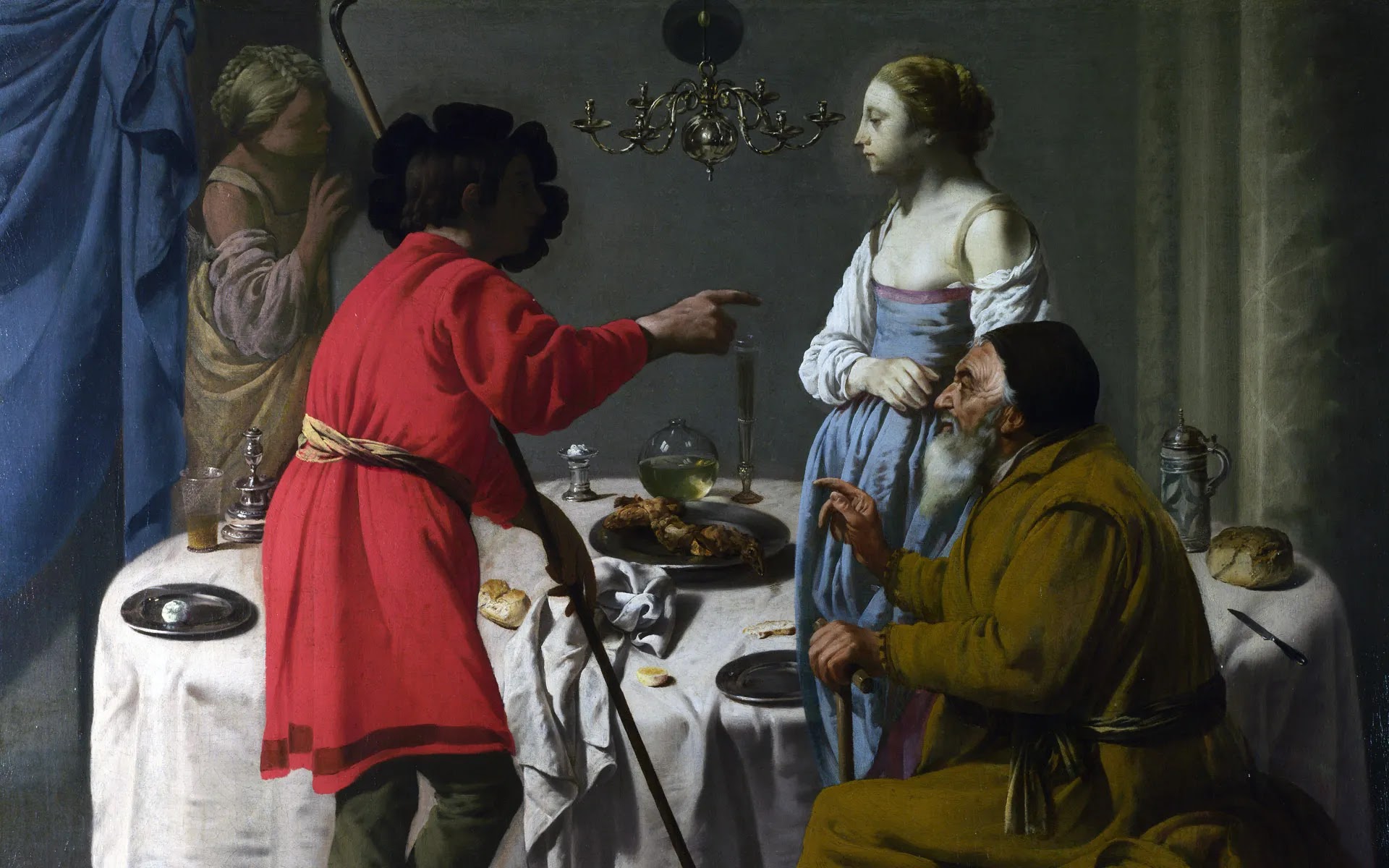
Hendrick ter Brugghen, "Jacob Reproaching Laban"
"The Forbidden Thought"
by Paul Rosenberg

"The dominating systems of our world require us to feel weak, afraid, and insufficient. They couldn’t continue if most of us didn’t feel that way. And so the friends and operators of these systems must suppress the opposite thought: that we are not inadequate. I’ve watched popular culture for a lot of years, and I can tell you that since the 1970s, one concept, above all, has been forbidden in intellectual circles: Man as a glorious creature.

If you’d like to prove that to yourself, say a few things like these at a cocktail party:
• Western civilization has accomplished so many good things that it’s mind-blowing.
• Most people are basically decent and don’t need to be controlled.
• I see so much goodness in humanity.
 • Humanity is ascending toward the gods (or heaven, or whatever).

Then, if you’d really like to see a reaction:
• The human race is magnificent.

The responses you get should be educational.

Why This Thought Is Hated: One reason why people respond so violently to this idea is simply self-defense: At this point, nearly every adult has built his or her world around the belief that people are bad: They’ve taught it to their children, showed their enlightenment by stating such things at parties and so on. To admit the opposite wouldn’t just be to admit they were wrong; it would tear down their infrastructure of meaning and status. Few people have the courage for such things.

Another reason is simply that they fear being shamed. People who say such heretical things are quickly ridiculed by holders of status. That’s tyrannical, of course, but it’s all too easy to stay inside the conspiracy of compliance. It’s dangerous, even if heroic, to defy powerful people.

Buckminster Fuller described the institutional necessity of inadequacy back in 1981: "There’s a built-in resistance to letting humanity be a success. Each one claims that their system is the best one for coping with inadequacy." In other words, the dominance hierarchies running things all claim that theirs is the right way to fix human inadequacy. So, if you claim that humans are adequate, you’re also saying that those systems aren’t necessary… and ruling systems don’t like to be called unnecessary.

Promoting Darkness Is a Big Business: It’s also the case that the promotion of darkness is a huge business. News channels are little more than fear delivery systems, but they are a major business. Social media is considerably worse. And, obviously, advertisers need you to feel insecure. Ads that don’t make you feel insecure, inadequate or guilty don’t pull nearly as well as those which do.

It can be interesting to see how all of this appears to outsiders. Back in the 1950s, the new president of Indonesia, Sukarno, visited the US and had this to say: "I find only one fault with Americans. They’re too full of fear. Afraid of B.O. Afraid of bad breath. They’re haunted by the fear that they’ll never get rid of dandruff. This state of mind I cannot understand."

And we shouldn’t understand it either. We are magnificent creatures… the only creatures in the known universe who create willfully and seemingly without limit. We’ve eradicated diseases, learned to feed billions of people, created machines that move us across the ground tremendous distances safely and reliably, created machines that fly us around the world and at incredible speed; we’ve harnessed the information stores of humanity and made them available to anyone, almost for free and almost anywhere. None of that is arguable, and yet we still think we’re just a step above refuse.

Take An Honest Look: Turn off the TV, turn off your cell phone. Walk through a park for a while to let the stream of negativity subside a bit. Then take a fresh look around. Yes, some dark things can still be found, but you’ll see most people simply going about their business: working, cooking, shopping, tending to children, driving their cars. They do these things well, or at least well enough, nearly all the time. Shouldn’t they get credit for that?

We are improving, unfolding, evolving creatures. Much improvement remains, but we are moving in that direction. And consider this, please: The sea of negativity that surrounds us is an anti-evolutionary poison. It serves stasis and sacrifice-collecting; it does not serve progress.

I’ll close with another quote (slightly edited) from Bucky Fuller: "I decided man was operating on a fundamental fallacy: that he was supposed to be a failure. I decided that man was, in fact, designed to be an extraordinary success. His characteristics were magnificent. We are not inadequate, we’ve just been made to think so."

"How It Really Is"


"Top 6 Moscow Metro Stations Ahead of the Future!"

Full screen recommended.
Window To Moscow, 10/13/25
"Top 6 Moscow Metro Stations Ahead of the Future!"
"Step into Moscow’s metro of tomorrow - six futuristic 
stations in crisp 4K. No talk, just immersive train ambience."
Comments here:

Judge Napolitano - Judging Freedom, "Scott Ritter, A Palestinian Victory!"

Full screen recommended.
Judge Napolitano - Judging Freedom, 10/13/25
"Scott Ritter, A Palestinian Victory!"
Comments here:
o
Judge Napolitano - Judging Freedom, 10/13/25
"Max Blumenthal: How Soon Will IDF Attack Gaza?"
Comments here:

Dan, I Allegedly, "It’s 1929 All Over Again - Protect Yourself Now!"

Full screen recommended.
Dan, I Allegedly, 10/13/25
"It’s 1929 All Over Again - 
Protect Yourself Now!"
"Could this crash really be WORSE than 1929? In today’s video, I break down the alarming parallels between today’s financial landscape and the events leading up to the Great Depression. From the skyrocketing margin debt and troubling corporate leverage to the cascading issues in real estate and retail sectors, we’re facing a potential storm of economic instability. I also dive into troubling trends like the trucking industry’s depression, auto market scams, and how unsold inventory is piling up. Plus, what is the mysterious black swan event that could trigger it all? Watch as I connect the dots and discuss how to prepare, protect your portfolio, and navigate these uncertain times."
Comments here:

Jim Kunstler, "The Matrix Abides"

Jolly Antifas on Parade
"The Matrix Abides"
by Jim Kunstler

"Somebody once observed that so much of leftism is 
pretending not to understand things that everyone understands." 
- Kurt Schlichter on "X"

"Of the 251 hostages seized in the Oct 7, 2023, Hamas raid on Southern Israel, 20 came out alive today. World opinion has not processed this in the heat of this moment, with the Gaza War ostensibly resolved, for now... or so we’ll see. Soon, the captives’ stories will be told.

Of course, world opinion is not what it used to be even a few years ago. These days, it oscillates around the poles of sane/insane. The Lefty-Woke wine-ladies of the Boston suburbs and their nose-ring Ivy League daughters must have the blues today over the implicit surrender of their heroes, Hamas. The keffiyeh is headed out as a fashion accessory. Who will be their next pet oppressed minority? (The Eskimos? The New York Times will put out a whole cooking section on blubber.) Note to the men (so-called) in their orbits: the gals will be loading up on Paxil and Klonopin, on top of all that Chardonnay. Consider hiding the car keys.

Meanwhile, over at Conflict Central, the action shifts to Sharm el-Sheikh, Egypt, today for a “peace summit” among the various parties involved in a war settlement, many of them Arab nations of the region, plus key Euroland players. Somebody will have to police the joint, probably some combo of Gulf State soldiers and American troops. The UK, France, and Germany will have to content themselves with pretending to participate, as they have their hands full just now pretending to ignite a war with Russia. Turkey could be in the mix, too, though the odor of pre-1918 Ottoman subjugation lingers on in that corner of the world. Don’t expect a whole lot to be sorted out quickly.

Donald Trump will take a few brief victory laps and, by Tuesday, all that nasty business might be behind him, at least for a while... maybe. Mr. Trump has a whole lot of fish to fry back here. He is fixing to disassemble the entire armature of Democratic Party sedition by wrecking the armature of NGOs that feed it - and you should not be surprised to learn that billions of the dollars sloshing through that colossal money-laundry originate in US government tax receipts.

For instance, the diligent “X” account known as “DataRepublican (small r)” reports that the National Endowment for Democracy (NED) with gross receipts of $363,001,576 received $362,047,237 from taxpayers, mainly through the State Department (including pre-Trump 2.0 USAID). The org, initially founded by Reagan Republicans, is now controlled by Democrats and their Neocon cronies bent on “nation-building” and color revolutions. Wherever there is turmoil in the world - Ukraine, Sudan, Pakistan, Myanmar - the NED has a piece of the action.

Stanford University, with an endowment of $23,780, 883,880, received $1,518,836,616 in taxpayer funds (those are billions), used to sponsor its Stanford Internet Observatory (SIO), which spun off the Election Integrity Project (EIP) and the Virality Project. The former was dedicated, under “Joe Biden,” to assist Christopher Wray’s FBI and the State Department’s Global Engagement Center, in censoring social media on matters such as the Hunter Biden Laptop .

The Election Integrity Project ran a parallel op under “Joe Biden” tracing 2020 election “disinformation” - i.e., anybody who reported ballot fraud - and the EIP worked to censor such content across platforms like Twitter, Facebook, and YouTube with help from Homeland Security’s Cybersecurity and Infrastructure Security Agency (CISA) and the Global Engagement Center (GEC). The Virality Project likewise dedicated itself to Covid-19 speech suppression. A lot of this money was funneled through subsidiary NGOs such as the National Science Foundation, the Hewlett Foundation, and the Omidyar network (the eBay fortune).

You see what I mean by armature? (And that was a mere schematic sketch of a small part of it.) This is a vast edifice of funny-money. The Democratic Party had captured all of it, and has been using it largely to maintain its power, which is to say, to keep the colossal money-laundry operating, because the salaries of all the people employed in these supposedly beneficent endeavors support a huge managerial cohort of officers who circulate in and out of government and comprise much of what’s called the “Swamp,” the “blob” or the “Deep State.”

This matrix is the same source of funding for Antifa and other Lefty-Woke outfits seeking to sow chaos through our country. The next big event on the agenda is another national “No Kings” protest, scheduled for Saturday, October 18, in over 2,000 US towns and cities. It’s organized by the umbrella NGO, Indivisible, with cash from George and Alex Soros’s Open Society Foundation, the Berger Action Fund (the philanthropic vehicle of Swiss billionaire Hansjörg Wyss), the Tides Foundation, and the Act Blue donation platform (currently under DOJ investigation for campaign contribution fraud). These outfits supply placards, transportation, and protesters’ stipends for what amounts to an “astroturf” (fake grassroots) spectacle.

Things should heat up and get spicy this week as that great day approaches. Antifa is not done trolling the ICE buildings in Portland, Chicago, and the Boston field office in Burlington, Mass. Former National Security Advisor John Bolton will likely get indicted in the days ahead for possessing classified documents he was not entitled to keep (boo hoo). And don’t be surprised if tremors rock the financial markets. Gold (nearing $4100) and silver (nearing $50) are sending ominous signals."