StatCounter

Monday, September 22, 2025

"Number 1 Indicator Home Prices Are About To Crash"

Full screen recommended.
Michael Bordenaro, 9/22/25
"Number 1 Indicator Home Prices Are About To Crash"
Comments here:
o
Full screen recommended.
Orlando Miner, 9/22/25
"Realtors Are Lying About Rates, Don’t Fall for It"
Comments here:
o
"The Vanishing American Dream: Why Young 
Adults Can't Afford Homes, Families, or Stability"
by Lau Vegys

"The American Dream has become prohibitively expensive, with home affordability at historic lows and the traditional middle-class lifestyle now out of reach for most ordinary people. But no demographic has taken it more on the chin than young Americans.

You can see it in stark terms in this week’s chart below. Since the postwar era, the share of 30-year-olds in America with both a family and a home has plummeted - from about 52% in 1950 to just 13% in 2025. That’s a staggering 75% decline over 75 years.
Let that sink in. In 1950, more than half of 30-year-olds had achieved what most would consider the basic markers of adult stability: marriage and homeownership. Today, it's barely one in eight. If you look closer, the graph shows two distinct phases of decline. From 1950 to 1990, there was a steady but manageable erosion - the share of 30-year-olds with both a family and a home dropped from 52% to about 43% over those 40 years.

That represented the gradual social changes we're all familiar with: more women entering the workforce, people marrying later, changing cultural attitudes toward marriage. Then something dramatic happened around 2000. The decline went into freefall. Between 1990 and 2025, the rate collapsed from 43% to 13% - a 70% drop in just over three decades. What explains it?

We could, of course, blame this on changing cultural preferences - young people choosing career over family, prioritizing experiences over stability. That’s certainly part of the story. Young people today do have very different priorities than those more than half a century ago. But there’s another side to this: the economics of young adulthood have become impossible. Keep in mind, today’s families would need the combined income of three households just to match the home affordability levels of a single family in 1959.

The situation gets worse when you factor in the debt burden crushing young adults. The very institution supposedly preparing young people for economic success - college - has become a wealth destroyer. Average student debt more than doubled from $17,297 to $37,850 between 2006 and 2024 alone (with total outstanding student debt exploding from $500 billion to $1.8 trillion).

Think about the brutal math facing today's 30-year-olds. They graduate with an average of $38,000 in student debt - though plenty are actually walking away with $60,000, $80,000, or even six-figure debt loads. They need $130,000+ in annual income to afford the average home, and compete in a job market where wages haven't kept pace with housing costs. In other words, they’re entering their peak family-formation years already financially crippled. No wonder marriage and homeownership rates have collapsed.

The cruel irony is that we - scratch that, America’s political class - has created a system where the very credentials supposedly required for middle-class success have priced young people out of middle-class life."

"The Job Market Collapse Has Begun"

Full screen recommended.
Epic Economist, 9/22/25
"The Job Market Collapse Has Begun"

"It's not time to panic. Everything is still fine. At least that's what all the economists are trying to make you believe right now after we just got yet another horrible jobs report. But let me tell you what's really going on here, because the numbers don't lie - even if the politicians do. In August 2025, employers only added 22,000 jobs. Twenty-two thousand. For a country of 340 million people, that's absolutely nothing. And the unemployment rate ticked up to 4.3% - and that's before any revisions come in. And trust me, those revisions are always negative. They hardly ever get revised up.

Look, we've now had four months in a row of significantly lower job growth, and all you keep hearing from the Fed is "oh, the economy is great, the job market is still strong." But guys, we are far from fine. The job market is at a complete standstill and showing no signs of improving anytime soon. For the first time in years, there are more people looking for jobs than job openings available. Supply exceeds demand, so wages fall and opportunities disappear. Basic economics, but applied to human lives. The Fed is about to cut interest rates to "stimulate" the economy, but that's just going to create inflation while doing nothing about AI-eliminated jobs. We're in a death spiral where every solution creates bigger problems down the road.

The only jobs being created are in healthcare and hospitality - service jobs that can't be automated yet. So if you want work right now, that's literally what's left of the American economy. Here's my advice, and I'm being completely serious: if you have any job right now, keep it. Any job. Don't quit looking for something better because "better" might not exist anymore. Start learning skills that can't be automated - plumbing, electrical work, anything that requires physical presence and human judgment.

But more importantly, understand what you're witnessing. This isn't a temporary downturn or a normal recession. This is the systematic dismantling of middle-class employment by technologies that benefit capital at the expense of labor. The job market collapse isn't coming - it's here, it's accelerating, and the people in power have no intention of fixing it because they're profiting from it. The question isn't whether this system is sustainable - it obviously isn't. The question is how long working Americans will tolerate being systematically destroyed by institutions that are supposed to serve them.

We're not just watching job reports decline. We're watching the collapse of the social contract that said if you work hard and follow the rules, you'll be able to build a life. That contract is void, and until we acknowledge that reality, we'll keep pretending everything is fine while people's lives disintegrate. The collapse is here. The question is: what are you going to do about it?"
Comments here:

Critical Repost: "9 Hidden Objects Discovered Escorting 3I/ATLAS Through Our Solar System!"

Full screen recommended.
Uncovered X, 9/21/25
"9 Hidden Objects Discovered Escorting 
3I/ATLAS Through Our Solar System!"

"At first, astronomers thought 3I/ATLAS was just another interstellar comet. But in September, everything changed. Amateur astronomers and then the James Webb, Hubble, Keck, and the Very Large Telescope all confirmed the same shocking sight: nine smaller glowing objects traveling in perfect formation with I3/ATLAS, each one radiating 10 to 20 gigawatts of energy within a 100 meter area, more power than everything on Earth.

Spectroscopy revealed nickel, cobalt, and alloys unknown in natural comets. Some scientists tried to explain it as fragments. But Harvard’s Avi Loeb called it what it looked like - a mothership shedding probes. And now, to make it stranger, another interstellar visitor - SWAN R2 - is arriving from the opposite direction, a hundred times larger and blazing with a tail bigger than the Moon. Both will swing past the Sun in October 2025. Are they colliding? Meeting? Or here for something in our Solar System?

Governments are staying silent, but leaked reports hint at emergency defense talks, repurposed rockets, and even nuclear readiness. For the first time in history, humanity may be staring at a fleet of machines from another star system. Is I3/ATLAS just a comet - or the mothership humanity was never ready to meet?"
Comments here:
o
Full screen recommended.
Hidden Headlines, 9/21/25
"100x Bigger Than 3I/ATLAS - 
New Interstellar Object C/2025 R2 (SWAN) Stuns the World!"
Comments here:

They've now discovered 9 larger objects coming in on the same exact vector as I3/Atlas, which may be a scout ship for a larger fleet arriving in strength. Another, the enormous C/2025 R2 (SWAN) is 100 times the size of I3/ATLAS, and is generating 10,000 gigawatts of energy. (Earth's total global nuclear power capacity totaled 396 gigawatts, with 439 reactors operating across over 30 countries as of July 2024.) As the astronomer/physicist Avi Loeb states, if I3/ATLAS is the "scout" ship SWAN is the "fortress." Their purpose unknown, all conjecture at this point, but data verified. What does all this mean for Humanity, for you and me? If Humanity has a future... We shall see... - C

"How It Really Is"


Dan, I Allegedly, "Year End Spending Crashes in 2025 - Here's Proof"

Full screen recommended.
Dan, I Allegedly, 9/22/25
"Year End Spending Crashes in 2025 - Here's Proof"
"Christmas spending is taking a massive hit in 2025, and the numbers don’t lie. In this video, I dive into how families are pulling back on holiday budgets, with average spending dropping significantly compared to last year. From skyrocketing credit card debt (over $1 trillion!) to foreclosures climbing for the ninth straight month, it’s clear the economy is struggling. We’re also seeing big changes in the housing market, with homebuilders like Lenar Homes rethinking their strategies and families scrambling to adjust to rising costs.

Santa even dropped by during the filming of this video to remind us all to “stay on the nice list” and spread kindness this holiday season. But with Gen Z and Gen X cutting back drastically on spending and families feeling the squeeze, how are we supposed to navigate these tough times? I also share stories about the rising cost of living, shady practices in debt collection, and even a wedding trend that left me speechless – credit card terminals for honeymoon donations!"
Comments here:
o
Full screen recommended.
Snyder Reports, 9/22/25
"Households Fight For Discount Meals As Bills Pile Up"
Comments here:

"Dirty Wars and Endless Lies: Scott Horton’s Shattering History of America’s War on Terror" (Excerpt)

"Dirty Wars and Endless Lies: 
Scott Horton’s Shattering History of America’s War on Terror"
by Michael Holmes

Excerpt: "Scott Horton’s masterpiece “Enough Already” shows how the U.S. and its allies spread devastation through Iraq, Afghanistan, Syria, Yemen, Libya, Somalia, and Pakistan, propping up despots and arming extremists along the way. The final balance sheet: two million dead, thirty-seven million displaced, and a world made more dangerous than before.

Scott Horton – editor-in-chief of Antiwar.com and host of the legendary Scott Horton Show with over 6,000 interviews – is one of the most profound critics of US foreign policy since 9/11. His fact-filled and compelling 2021 book “Enough Already: Time to End the War on Terror” is one of the most comprehensive accounts of the so-called War on Terror: In a precise chronology, Horton shows how, after the attacks of September 11, the US and its allies unleashed a global spiral of intervention that not only claimed millions of victims but often spawned “wars for terror” itself – through support for radical Islamists in Syria and elsewhere. From the Iraq wars to Afghanistan, Libya, Somalia, and the genocide in Yemen, Horton’s work offers an unflinching overview of the American wars of the 21st century. 

Anyone who wants to understand why Washington systematically launched wars that strengthened its own enemies after 9/11 cannot ignore this book. It’s an indictment of relentless moral force that reads like an evidence brief for the prosecution. Horton’s central claim is both simple and devastating: the dirty wars in Iraq, Afghanistan, Pakistan, Syria, Yemen, Libya and Somalia increased the terrorist threat that was then used as an excuse for further intervention. Horton’s achievement is to bring into one narrative the scattered fragments of this bloody history: the covert deals, the proxy wars, the torture programs, the sanctions regimes, and the bombings whose scale Western publics still grossly underestimate. He makes clear that the real continuity in U.S. policy was not democracy or human rights, but partnership with Israel’s occupation, brutal dictatorships in Saudi Arabia and the other Gulf states, Egypt, Jordan, Turkey and Pakistan, with warlords and militias whose crimes rivalled those of our official enemies. The result was a cycle of violence that bred more enemies than it destroyed. Nowhere is this more visible than in Iraq and Syria, where one war bled into another, and where American power not only failed to defeat terrorism but midwifed its most monstrous incarnation in ISIS.

Horton also shows that the War on Terror was just as often a War for Terror. Again and again, the United States and its allies armed, financed, and legitimized the very extremist factions and dictatorships whose crimes were then cited as justification for the next war. With an almost grim consistency, regimes or groups that Washington demonized in one decade had been cultivated as clients or proxies in another. This, Horton argues, was not a series of mistakes or accidents – it was the logic of empire applied to the Muslim world, with catastrophic results."
Full article is here:

Judge Napolitano, "Alastair Crooke: Israel's War of the Jungle"

Judge Napolitano - Judging Freedom, 9/22/25
"Alastair Crooke: Israel's War of the Jungle"
Comments here:
o
Full screen recommended.
Fair News Now, 9/22/25
"Blockade Falls: 
Gaza Rejoices as Aid Ships Break Siege"
"In this powerful 35-minute political analysis, Professor Richard Wolff examines the dramatic fall of the Gaza blockade and the historic moment as aid ships successfully break through. He explains the global reactions, shifting power balances in the Middle East, and the broader implications for U.S. foreign policy, Israel’s strategy, and international solidarity. From economic consequences to humanitarian relief, this talk dives deep into the unfolding reality that could reshape regional and global politics. If you want to understand the significance of this event, how it connects to global struggles, and why the future of U.S. influence is at stake - this is a must-watch."
Comments here:

”The 5 Stages of Economic Collapse”

”The 5 Stages of Economic Collapse” 
by Dmitry Orlov

“Elizabeth Kübler-Ross defined the five stages of coming to terms with grief and tragedy as denial, anger, bargaining, depression, and acceptance, and applied it quite successfully to various forms of catastrophic personal loss, such as death of a loved one, sudden end to one’s career, and so forth. Several thinkers, notably James Howard Kunstler and, more recently John Michael Greer, have pointed out that the Kübler-Ross model is also quite terrifyingly accurate in reflecting the process by which society as a whole (or at least the informed and thinking parts of it) is reconciling itself to the inevitability of a discontinuous future, with our institutions and life support systems undermined by a combination of resource depletion, catastrophic climate change, and political impotence.

But so far, little has been said specifically about the finer structure of these discontinuities. Instead, there is to be found continuum of subjective judgments, ranging from “a severe and prolonged recession” (the prediction we most often read in the financial press), to Kunstler’s evocative but unscientific-sounding “clusterf**k,” to the ever-popular “Collapse of Western Civilization,” painted with an ever-wider brush-stroke.

For those of us who have already gone through all of the emotional stages of reconciling ourselves to the prospect of social and economic upheaval, it might be helpful to have a more precise terminology that goes beyond such emotionally charged phrases. Defining a taxonomy of collapses might prove to be more than just an intellectual exercise: based on our abilities and circumstances, some of us may be able to specifically plan for a certain stage of collapse as a temporary, or even permanent, stopping point.

Even if society at the current stage of socioeconomic complexity will no longer be possible, and even if, as Tainter points in his “Collapse of Complex Societies,” there are circumstances in which collapse happens to be the correct adaptive response, it need not automatically cause a population crash, with the survivors disbanding into solitary, feral humans dispersed in the wilderness and subsisting miserably. Collapse can be conceived of as an orderly, organized retreat rather than a rout.

For instance, the collapse of the Soviet Union – our most recent and my personal favorite example of an imperial collapse – did not reach the point of political disintegration of the republics that made it up, although some of them (Georgia, Moldova) did lose some territory to separatist movements. And although most of the economy shut down for a time, many institutions, including the military, public utilities, and public transportation, continued to function throughout. And although there was much social dislocation and suffering, society as a whole did not collapse, because most of the population did not lose access to food, housing, medicine, or any of the other survival necessities. The command-and-control structure of the Soviet economy largely decoupled the necessities of daily life from any element of market psychology, associating them instead with physical flows of energy and physical access to resources. Thus situation, as I argue in my forthcoming book, Reinventing Collapse, allowed the Soviet population to inadvertently achieve a greater level of collapse-preparedness than is currently possible in the United States.

Having given a lot of thought to both the differences and the similarities between the two superpowers – the one that has collapsed already, and the one that is collapsing as I write this – I feel ready to attempt a bold conjecture, and define five stages of collapse, to serve as mental milestones as we gauge our own collapse-preparedness and see what can be done to improve it.

Rather than tying each phase to a particular emotion, as in the Kübler-Ross model, the proposed taxonomy ties each of the five collapse stages to the breaching of a specific level of trust, or faith, in the status quo. Although each stage causes physical, observable changes in the environment, these can be gradual, while the mental flip is generally quite swift. It is something of a cultural universal that nobody (but a real fool) wants to be the last fool to believe in a lie.

Stages of Collapse:

Stage 1: Financial collapse. Faith in “business as usual” is lost. The future is no longer assumed resemble the past in any way that allows risk to be assessed and financial assets to be guaranteed. Financial institutions become insolvent; savings are wiped out, and access to capital is lost.

Stage 2: Commercial collapse. Faith that “the market shall provide” is lost. Money is devalued and/or becomes scarce, commodities are hoarded, import and retail chains break down, and widespread shortages of survival necessities become the norm.

Stage 3: Political collapse. Faith that “the government will take care of you” is lost. As official attempts to mitigate widespread loss of access to commercial sources of survival necessities fail to make a difference, the political establishment loses legitimacy and relevance.

Stage 4: Social collapse. Faith that “your people will take care of you” is lost. As local social institutions, be they charities, community leaders, or other groups that rush in to fill the power vacuum, run out of resources or fail through internal conflict.

Stage 5: Cultural collapse. Faith in the goodness of humanity is lost. People lose their capacity for “kindness, generosity, consideration, affection, honesty, hospitality, compassion, charity” (Turnbull, "The Mountain People"). Families disband and compete as individuals for scarce resources. The new motto becomes “May you die today so that I die tomorrow” (Solzhenitsyn, "The Gulag Archipelago"). There may even be some cannibalism.

Although many people imagine collapse to be a sort of elevator that goes to the sub-basement (our Stage 5) no matter which button you push, no such automatic mechanism can be discerned. Rather, driving us all to Stage 5 will require that a concerted effort be made at each of the intervening stages. That all the players seem poised to make just such an effort may give this collapse the form a classical tragedy – a conscious but inexorable march to perdition – rather than a farce (“Oops! Ah, here we are, Stage 5.” – “So, whom do we eat first?” – “Me! I am delicious!”) Let us sketch out this process.

Financial collapse, as we are are currently observing it, consists of two parts. One is that a part of the general population is forced to move, no longer able to afford the house they bought based on inflated assessments, forged income numbers, and foolish expectations of endless asset inflation. Since, technically, they should never have been allowed to buy these houses, and were only able to do so because of financial and political malfeasance, this is actually a healthy development. The second part consists of men in expensive suits tossing bundles of suddenly worthless paper up in the air, ripping out their remaining hair, and (some of us might uncharitably hope) setting themselves on fire on the steps of the Federal Reserve. They, to express it in their own vernacular, “f**ked up,” and so this is also just as it should be.

The government response to this could be to offer some helpful homilies about “the wages of sin” and to open a few soup kitchens and flop houses in a variety of locations including Wall Street. The message would be: “You former debt addicts and gamblers, as you say, ‘f****d up,’ and so this will really hurt for a long time. We will never let you anywhere near big money again. Get yourselves over to the soup kitchen, and bring your own bowl, because we don’t do dishes.” This would result in a stable Stage 1 collapse – the Second Great Depression.

However, this is unlikely, because in the US the government happens to be debt addict and gambler number one. As individuals, we may have been as virtuous as we wished, but the government will have still run up exorbitant debts on our behalf. Every level of government, from local municipalities and authorities, which need the financial markets to finance their public works and public services, to the federal government, which relies on foreign investment to finance its endless wars, is addicted to public debt. They know they cannot stop borrowing, and so they will do anything they can to keep the game going for as long as possible.

About the only thing the government currently seems it fit to do is extend further credit to those in trouble, by setting interest rates at far below inflation, by accepting worthless bits of paper as collateral and by pumping money into insolvent financial institutions. This has the effect of diluting the dollar, further undermining its value, and will, in due course, lead to hyperinflation, which is bad enough in any economy, but is especially serious for one dominated by imports. As imports dry up and the associated parts of the economy shut down, we pass Stage 2: Commercial Collapse.

As businesses shut down, storefronts are boarded up and the population is left largely penniless and dependent on FEMA and charity for survival, the government may consider what to do next. It could, for example, repatriate all foreign troops and set them to work on public works projects designed to directly help the population. It could promote local economic self-sufficiency, by establishing community-supported agriculture programs, erecting renewable energy systems, and organizing and training local self-defense forces to maintain law and order. The Army Corps of Engineers could be ordered to bulldoze buildings erected on former farmland around city centers, return the land to cultivation, and to construct high-density solar-heated housing in urban centers to resettle those who are displaced. In the interim, it could reduce homelessness by imposing a steep tax on vacant residential properties and funneling the proceeds into rent subsidies for the indigent. With plenty of luck, such measures may be able to reverse the trend, eventually providing for a restoration of pre-Stage 2 conditions.

This may or may not be a good plan, but in any case it is rather unrealistic, because the United States, being so deeply in debt, will be forced to accede to the wishes of its foreign creditors, who own a lot of national assets (land, buildings, and businesses) and who would rather see a dependent American population slaving away working off their debt than a self-sufficient one, conveniently forgetting that they have mortgaged their children’s futures to pay for military fiascos, big houses, big cars, and flat-screen television sets. Thus, a much more likely scenario is that the federal government (knowing who butters their bread) will remain subservient to foreign financial interests. It will impose austerity conditions, maintain law and order through draconian means, and aid in the construction of foreign-owned factory towns and plantations. As people start to think that having a government may not be such a good idea, conditions become ripe for Stage 3.

If Stage 1 collapse can be observed by watching television, observing Stage 2 might require a hike or a bicycle ride to the nearest population center, while Stage 3 collapse is more than likely to be visible directly through one’s own living-room window, which may or may not still have glass in it. After a significant amount of bloodletting, much of the country becomes a no-go zone for the remaining authorities. Foreign creditors decide that their debts might not be repaid after all, cut their losses and depart in haste. The rest of the world decides to act as if there is no such place as The United States – because “nobody goes there any more.” So as not to lose out on the entertainment value, the foreign press still prints sporadic fables about Americans who eat their young, much as they did about Russia following the Soviet collapse. A few brave American expatriates who still come back to visit bring back amazing stories of a different kind, but everyone considers them eccentric and perhaps a little bit crazy.

Stage 3 collapse can sometimes be avoided by the timely introduction of international peacekeepers and through the efforts of international humanitarian NGOs. In the aftermath of a Stage 2 collapse, domestic authorities are highly unlikely to have either the resources or the legitimacy, or even the will, to arrest the collapse the dynamic and reconstitute themselves in a way that the population would accept.

As stage 3 collapse runs its course, the power vacuum left by the now defunct federal, state and local government is filled by a variety of new power structures. Remnants of former law enforcement and military, urban gangs, ethnic mafias, religious cults and wealthy property owners all attempt to build their little empires on the ruins of the big one, fighting each other over territory and access to resources. This is the age of Big Men: charismatic leaders, rabble-rousers, ruthless Macchiavelian princes and war lords. In the luckier places, they find it to their common advantage to pool their resources and amalgamate into some sort of legitimate local government, while in the rest their jostling for power leads to a spiral of conflict and open war.

Stage 4 collapse occurs when society becomes so disordered and impoverished that it can no longer support the Big Men, who become smaller and smaller, and eventually fade from view. Society fragments into extended families and small tribes of a dozen or so families, who find it advantageous to band together for mutual support and defense. This is the form of society that has existed over some 98.5% of humanity’s existence as a biological species, and can be said to be the bedrock of human existence. Humans can exist at this level of organization for thousands, perhaps millions of years. Most mammalian species go extinct after just a few million years, but, for all we know, Homo Sapiens still have a million or two left.

If pre-collapse society is too atomized, alienated and individualistic to form cohesive extended families and tribes, or if its physical environment becomes so disordered and impoverished that hunger and starvation become widespread, then Stage 5 collapse becomes likely. At this stage, a simpler biological imperative takes over, to preserve the life of the breeding couples. Families disband, the old are abandoned to their own devices, and children are only cared for up to age 3. All social unity is destroyed, and even the couples may disband for a time, preferring to forage on their own and refusing to share food. This is the state of society described by the anthropologist Colin Turnbull in his book “The Mountain People.” If society prior to Stage 5 collapse can be said to be the historical norm for humans, Stage 5 collapse brings humanity to the verge of physical extinction.

As we can easily imagine, the default is cascaded failure: each stage of collapse can easily lead to the next, perhaps even overlapping it. In Russia, the process was arrested just past Stage 3: there was considerable trouble with ethnic mafias and even some warlordism, but government authority won out in the end. In my other writings, I go into a lot of detail in describing the exact conditions that inadvertently made Russian society relatively collapse-proof. Here, I will simply say that these ingredients are not currently present in the United States.

While attempting to arrest collapse at Stage 1 and Stage 2 would probably be a dangerous waste of energy, it is probably worth everyone’s while to dig in their heels at Stage 3, definitely at Stage 4, and it is quite simply a matter of physical survival to avoid Stage 5. In certain localities – those with high population densities, as well as those that contain dangerous nuclear and industrial installations – avoiding Stage 3 collapse is rather important, to the point of inviting foreign troops and governments in to maintain order and avoid disasters. Other localities may be able to prosper indefinitely at Stage 3, and even the most impoverished environments may be able to support a sparse population subsisting indefinitely at Stage 4.

Although it is possible to prepare directly for surviving Stage 5, this seems like an altogether demoralizing thing to attempt. Preparing to survive Stages 3 and 4 may seem somewhat more reasonable, while explicitly aiming for Stage 3 may be reasonable if you plan to become one of the Big Men. Be that as it may, I must leave such preparations as an exercise for the reader. My hope is that these definitions of specific stages of collapse will enable a more specific and fruitful discussion than the one currently dominated by such vague and ultimately nonsensical terms as “the collapse of Western civilization.”
o
Download "The Collapse of Complex Societies", 
by Joseph A. Tainter, here:

Jim Kunstler, "Personal Note"

"Personal Note"
by Jim Kunstler

"I’ve never talked to a Democrat who ever wanted to listen.
 They start to glitch out if you try.” 
- Sasha Stone

"This past summer, I tried to open a line of communication with a West Coast relative. We exchanged a few letters. I tactically steered the conversation away from the political. Here was the closer salvo from my relative:

"Jimmy, on a completely personal level, and in different times, I think we could have been very good friends. At this point in our history, I find what you say in your blogs and Kunstlercast to be outrageous, deceptive, and ugly. I disagree with almost everything you hold dear politically, and even if, for instance, we agree about the horrors of Big Pharma, your worship of Kennedy makes me ill. Your language falls right into all the clichés of the far right ideologies I loathe.Maybe someday things will change. For now, this is the last you'll be hearing from me."

Frankly, what stung most keenly was the accusation that my language fell “into all the clichés of the far right ideologies...” I like to think that I am allergic to clichés, though it’s possible that I am deluded about that. If anything, the dynamic collective thought disorders of our time present themselves in astonishingly fresh ways - for instance, a Supreme Court nominee who can’t define what a woman is. (Makes you kind of wonder how such a mind could parse Article Two of the Constitution.)

Mostly, I would have liked to know what those “far right ideologies” are, exactly, but it looks like I will never find out now. Maybe it is being opposed to censorship...or against Ukraine’s entry into NATO...or wanting coherent procedure for foreigners seeking to enter the USA...or keeping biological men out of the women’s swim lanes...or saying that ivermectin is a safe and effective anti-viral med...or supposing that people charged with felonies should not be released to the streets without significant cash bail. Stuff like that.

As it happened, we were not discussing these matters in our brief correspondence, but I was at something of a disadvantage since I am a professional writer who posts his opinion for public scrutiny and my relative is not. Of course, I describe what is a pandemic of broken family relations in our country. And social relations. I have been cancelled by most of my old friends, too, and I’m quite sure that I am not a special case. I am mystified by what these relatives and old friends actually believe these days. When we were hippies back in the day, they were very much opposed to war, turned-off by attempts at censorship, and deeply averse to the dark operations of the CIA and FBI. Now, they seem avid for intel ops and hoaxes, eager for war, and all-in for censoring ideas that make them feel “unsafe.”

There are various useful theories for this state-of-affairs, all pretty cross-compatible. Strauss and Howe’s Fourth Turning template of generational cycles explains a lot. Elizabeth Nickson has some fine insights about the extreme discontents of women these days leading them to summon political demons. Mattias Desmet, the Belgian psych professor has his Mass Formation theory, which states that societal anxieties provoke aligned “radical intolerance” among a populace. I recommend Wendy Williamson’s recent blog discussion of The Law of Reversal. Joseph Tainter’s classic, "The Collapse of Complex Societies" lays out the pitfalls of our “over-investments in complexity.” I wrote a book in 2005 titled "The Long Emergency" which describes the drawn-out collapse of our techno-industrial economy — the widespread apprehension of which helps define the societal anxieties described by Dr. Desmet that bring on his “Mass Formation Psychosis.”

All these theories tend to imply an inflection point where our assumptions about human progress get undermined, provoking an intense loss of faith in institutions and authorities, resulting in epochal socio-political disorder. Wouldn’t you agree we are seeing exactly that now? That the net effect of all this is of a society driven insane. Surely, the craziness is amplified by the novel connectivities of the Internet and exacerbated by many other high-tech innovations from ubiquitous camera surveillance to cryptocurrency to drone warfare.

In our country these days, all of this has apparently produced two camps at war psychologically, now verging on something like a hot civil war. One camp calling itself “progressive” insists on a roster of ideas, policies, and practices that look patently absurd, abusive of the public interest, and hostile to the values of Western Civ. The other camp styles itself as “conservative” seeking to preserve Western Civ and the advancement of our so-called way of life - an ever growth-seeking high-tech economy.

Personally, I doubt that the latter is possible. I believe we’re due for a pretty serious time-out from the sort of economic “growth” we enjoyed the past two-hundred years. That high-tech mega-fiesta has thrown off a lot of entropy, which is now working hard to slow things down and make us stop a lot of what we are doing. It manifests in many ways, but most vividly by flinging us into social disorder, turning what had been communication and correspondence into a rising babel that is driving us crazy. That is exactly why it is so hard to talk to our relatives and old friends. But mark this: there is a time coming when we will get tired of being crazy, and then things will go differently for us. We’ll start talking again."

"Can You Guess The Number One Challenge That Americans Believe They Are Facing In 2025?"

"Can You Guess The Number One Challenge 
That Americans Believe They Are Facing In 2025?"
by Michael Snyder

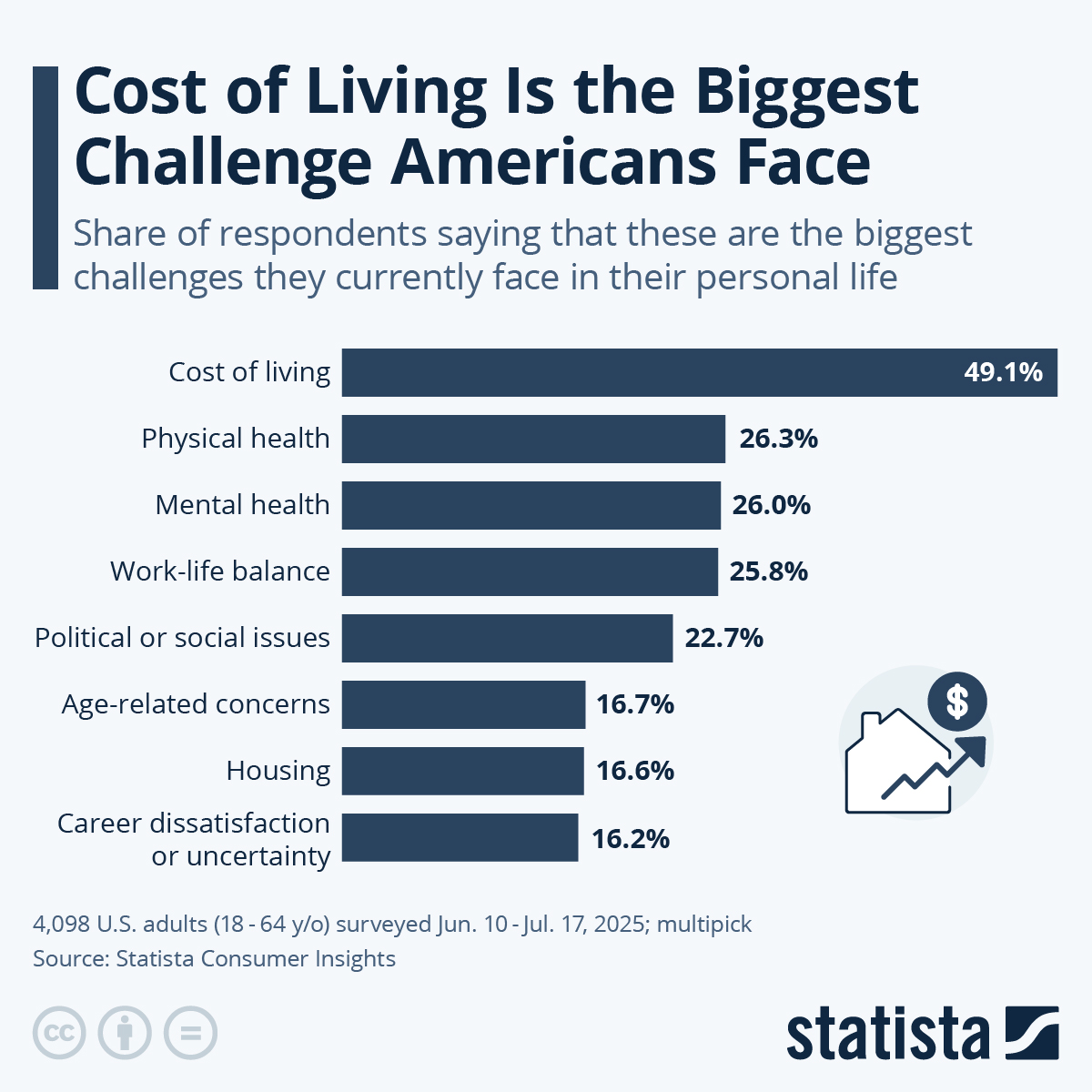
"We sure have seen a lot of really crazy things happen so far this year. But in the minds of most Americans, there is one crisis that far outweighs everything else. As I have been documenting for years, our standard of living has been collapsing as the cost of living has risen must faster than our incomes have. As a result, 67 percent of U.S. workers are now living paycheck to paycheck. We are in the midst of the worst cost of living crisis in modern history, and Statista has found that Americans consider it to be the biggest challenge that they are facing by a very large margin
                             
Those results are stunning. The cost of living won this survey in a blowout, but that shouldn’t be a surprise to any of us. There are countless videos on social media where ordinary Americans are complaining about how oppressive the cost of living has become. Zac Rios has compiled some of the most poignant videos that have been posted lately, and when you watch them back to back it really is heartbreaking
Cost of Living Crisis is Worse Than You Think in 2025
This is what life is like in America in 2025. And as economic conditions continue to deteriorate, it is going to get even worse. Are you ready for that? Many Americans are going deep into debt in a desperate attempt to stay afloat, and one recent survey found that nearly half of all Americans now worry about debt every single day

"Debt weighed heavily on daily life for many participants. Just under half (46.5%) said they worry about debt every day. Half admitted to avoiding their bank statements, a behavior that could worsen financial problems by delaying action. Shame was another theme. More than half of respondents (54.6%) said they felt embarrassed about their debt, even though nearly everyone surveyed (98%) reported owing money.

When asked about specific concerns, the most common answers included falling behind on payments (53.7%), not having enough for retirement (53.7%), discovering higher balances than expected (53.5%), losing homes or belongings (53.3%), and leaving little to children (51.8%)."

It is easy to tell people that they should get out of debt. But for the two-thirds of the country that is living paycheck to paycheck, there is never an opportunity to get ahead of the game. And a lot of people that are living on the financial edge are now losing their jobs.

During the second quarter of this year, a whopping 17 trucking and logistics companies went bankrupt…"At least 17 trucking and logistics companies filed for bankruptcy in the second quarter of 2025 alone, Equipment Finance News reported. While dry van truckload contract rates were flat in the first half of 2025 from the same period a year ago, as FreightWaves reported, trucking spot rates, which shippers pay carriers for a one-time shipment, however, finished the first half below year-over-year levels. Long-haul truckload demand reportedly plummeted by 25% in the first half of 2025, with trucking becoming more of a short-haul delivery method for the final leg of freight movement. At this moment, we are in a trucking recession. If the economy was moving in the right direction, that would not be happening."

The retail industry is experiencing a tremendous amount of pain as well. This may be difficult to believe, but the largest shopping mall in San Francisco is now 93 percent empty… "The largest shopping mall in San Francisco is now reportedly 93% vacant and has seen its value plunge by 25% over the past year, as high rents and retail crime continue to batter the Northern California city.

A new appraisal has slashed the value of San Francisco Centre, located at 865 Market Street, to $195 million, which is a 25% decrease since August 2024 and more than $1 billion below its valuation in 2016, the San Francisco Chronicle reported, citing research from Morningstar. The 1.4 million-square-foot mall has become largely deserted, with 93% of its property now empty, according to the San Francisco Chronicle."

I haven’t written about it for a while, but our rapidly growing commercial real estate crisis is reaching a crescendo. As large numbers of commercial mortgages go bad, many of our financial institutions suddenly find themselves in very hot water. Meanwhile, a residential real estate crisis is quickly developing. In some of the markets that were once the hottest, condo prices have begun to crash…"Condo prices in Killeen, TX, a little over an hour north of Austin, have collapsed by 40% since the peak in mid-2022 and have given up the entire 52% spike from mid-2020 to mid-2022, plus some. The spike had been driven by FOMO-madness and the Fed’s Free Money policies. This is one of the fastest-growing cities around; its population has surged by 35% in the past 15 years to 160,000 in 2024." But Killeen and other cities like this with condo markets in free-fall don’t qualify for our list here because they’re too small.

Several additional cities made it onto this list because the August price drop brought the total price drop from the peak to 12%, including Phoenix, AZ, and Orlando, FL. In so many ways, it is starting to feel like 2008 all over again.

Of course it isn’t just the U.S. that is experiencing significant economic pain. Earlier today, I came across an article that was posted on Zero Hedge that warned that “the collapse of the German economy continues unabated”…"The collapse of the German economy continues unabated. The German Engineering Federation (VDMA) now expects a dramatic decline in production this year and lashes out at the federal government.

A rebound in the German economy this autumn has failed to materialize. Just a week ago, the Federal Statistical Office revised the country’s GDP decline for Q2 2025 from –0.1% to –0.3%. Now, the German machinery association follows suit with its forecast for the full year, confirming the ongoing downward trend in production: “We had previously expected a decline of 2 percent, now we anticipate minus 5 percent for 2025,” says VDMA President Bertram Kawlath, who expects production to grow by just 1 percent in 2026. Was 2025 really the trough?"

I have been watching Germany for quite some time. This is not a good sign at all. I will probably have much more to say about the deteriorating situation in Europe in future articles. At this stage, the entire global economy has reached a critical tipping point. It certainly wouldn’t take much to push us into a worldwide economic nightmare, and I am expecting so much chaos in the months ahead

A lot of people out there seem to think that they have no need to prepare for what is coming. They are wrong. Yes, things are bad now, but what is on the horizon is going to be much worse. So I would encourage you to do what you can to get prepared, because the collapse of our standard of living is only going to escalate."

"Economic Market Snapshot 9/22/25"

"Economic Market Snapshot 9/22/25"
Down the rabbit hole of psychopathic greed and insanity...
Only the consequences are real - to you!
"It's a Big Club, and you ain't in it. 
You and I are not in the Big Club."
- George Carlin
o
Market Data Center, Live Updates:
Financial Stress Index

"The OFR Financial Stress Index (OFR FSI) is a daily market-based snapshot of stress in global financial markets. It is constructed from 33 financial market variables, such as yield spreads, valuation measures, and interest rates. The OFR FSI is positive when stress levels are above average, and negative when stress levels are below average. The OFR FSI incorporates five categories of indicators: creditequity valuationfunding, safe assets and volatility. The FSI shows stress contributions by three regions: United Statesother advanced economies, and emerging markets."
Job cuts and much more.
Commentary, highly recommended:
"The more I see of the monied classes,
the better I understand the guillotine."
- George Bernard Shaw
Oh yeah... beyond words. Any I know anyway...
And now... The End Game...
o

Sunday, September 21, 2025

"9 Hidden Objects Discovered Escorting 3I/ATLAS Through Our Solar System!"

Full screen recommended.
Uncovered X, 9/21/25
"9 Hidden Objects Discovered Escorting 
3I/ATLAS Through Our Solar System!"

"At first, astronomers thought 3I/ATLAS was just another interstellar comet. But in September, everything changed. Amateur astronomers and then the James Webb, Hubble, Keck, and the Very Large Telescope all confirmed the same shocking sight: nine smaller glowing objects traveling in perfect formation with I3/ATLAS, each one radiating 10 to 20 gigawatts of energy within a 100 meter area, more power than everything on Earth.

Spectroscopy revealed nickel, cobalt, and alloys unknown in natural comets. Some scientists tried to explain it as fragments. But Harvard’s Avi Loeb called it what it looked like - a mothership shedding probes. And now, to make it stranger, another interstellar visitor - SWAN R2 - is arriving from the opposite direction, a hundred times larger and blazing with a tail bigger than the Moon. Both will swing past the Sun in October 2025. Are they colliding? Meeting? Or here for something in our Solar System?

Governments are staying silent, but leaked reports hint at emergency defense talks, repurposed rockets, and even nuclear readiness. For the first time in history, humanity may be staring at a fleet of machines from another star system. Is I3/ATLAS just a comet - or the mothership humanity was never ready to meet?"
Comments here:
o
Full screen recommended.
Hidden Headlines, 9/21/25
"100x Bigger Than 3I/ATLAS - 
New Interstellar Object C/2025 R2 (SWAN) Stuns the World!"
Comments here:

They've now discovered 9 larger objects coming in on the same exact vector as I3/Atlas, which may be a scout ship for a larger fleet arriving in strength. Another, the enormous C/2025 R2 (SWAN) is 100 times the size of I3/ATLAS, and is generating 10,000 gigawatts of energy. (Earth's total global nuclear power capacity totaled 396 gigawatts, with 439 reactors operating across over 30 countries as of July 2024.) As the astronomer/physicist Avi Loeb states, if I3/ATLAS is the "scout" ship SWAN is the "fortress." Their purpose unknown, all conjecture at this point, but data verified. What does all this mean for Humanity, for you and me? If Humanity has a future... We shall see... - C

Musical Interlude: Josh Groban, "You Are Loved (Don't Give Up)"; "Remember When It Rained"

Full screen recommended.
Josh Groban, "You Are Loved (Don't Give Up)"
o
Full screen recommended.
Josh Groban, "Remember When It Rained"

"A Look to the Heavens"

"Messier's famous catalog, but definitely not one of the least. About 170,000 light-years across, this galaxy is enormous, almost twice the size of our own Milky Way. M101 was also one of the original spiral nebulae observed by Lord Rosse's large 19th century telescope, the Leviathan of Parsontown. Assembled from 51 exposures recorded by the Hubble Space Telescope in the 20th and 21st centuries, with additional data from ground based telescopes, this mosaic spans about 40,000 light-years across the central region of M101 in one of the highest definition spiral galaxy portraits ever released from Hubble. 
The sharp image shows stunning features of the galaxy's face-on disk of stars and dust along with background galaxies, some visible right through M101 itself. Also known as the Pinwheel Galaxy, M101 lies within the boundaries of the northern constellation Ursa Major, about 25 million light-years away.”

"Of Course..."

“Of course, we doubt if many public prescriptions are really intended to solve problems. People certainly believe they are when they propose them. But, like so much of what goes on in a public spectacle, its favorite slogans, too, are delusional – more in the nature of placebos than propositions. People repeat them like Hail Marys because it makes them feel better. Most of our beliefs about the economy – and everything else – are of this nature. They are forms of self medication, superstitious lip service we pay to the powers of the dark, like touching wood...or throwing salt over your shoulder. “Stocks for the long run,” “Globalization is good.” We repeat slogans to ourselves, because everyone else does. It is not so much bad luck we want to avoid as being on our own. Why it is that losing your life savings should be less painful if you have lost it in the company of one million other losers, we don’t know. But mankind is first of all a herd animal and fears nothing more than not being part of the herd.”
- Bill Bonner