StatCounter

Tuesday, September 9, 2025

"Are There Any Questions?"

"Are There Any Questions?"
by Robert Fulghum

"Are there any questions?" An offer that comes at the end of college lectures and long meetings. Said when an audience is not only overdosed with information, but when there is no time left anyhow. At times like that you sure do have questions. Like, "Can we leave now?" and "What the hell was this meeting for?" and "Where can I get a drink?"

The gesture is supposed to indicate openness on the part of the speaker, I suppose, but if in fact you do ask a question, both the speaker and the audience will give you drop-dead looks. And some fool - some earnest idiot - always asks. And the speaker always answers. By repeating most of what he has already said. But if there is a little time left and there is a little silence left in response to the invitation, I usually ask the most important question of all: "What is the Meaning of Life?" You never know, somebody may have the answer, and I'd really hate to miss it because I was too socially inhibited to ask. But when I ask, it is usually taken as a kind of absurdist move - people laugh and nod and gather up their stuff and the meeting is dismissed on that ridiculous note. Once, and only once, I asked that question and got a serious answer…

Papaderos rose from his chair at the back of the room and walked to the front, where he stood in the bright Greek sunlight of an open window and looked out… he turned. And made the ritual gesture: "Are there any questions?" Quiet quilted the room. These two weeks had generated enough questions for a lifetime, but for now there was only silence.

"No questions?" Papaderos swept the room with his eyes.
So. I asked.
"Dr. Papaderos, what is the meaning of life?"

The usual laughter followed, and people stirred to go. Papaderos held up his hand and stilled the room and looked at me for a long time, asking with his eyes if I was serious and seeing from my eyes that I was.

"I will answer your question."

Taking his wallet out of his hip pocket, he fished into a leather billfold and brought out a very small round mirror, about the size of a quarter. And what he said went like this: "When I was a small child, during the war, we were very poor and we lived in a remote village. One day, on the road, I found the broken pieces of a mirror. A German motorcycle had been wrecked in that place. I tried to find all the pieces and put them together, but it was not possible, so I kept only the largest piece. This one. And by scratching it on a stone I made it round. I began to play with it as a toy and became fascinated by the fact that I could reflect light into dark places where the sun would never shine - in deep holes and crevices and dark closets. It became a game for me to get light into the most inaccessible places I could find.

I kept the little mirror, and as I went about my growing up, I would take it out in idle moments and continue the challenge of the game. As I became a man, I grew to understand that this was not just a child's game but a metaphor for what I might do with my life. I came to understand that I am not the light or the source of light. But light - truth, understanding, knowledge - is there, and it will only shine in many dark places if I reflect it. I am a fragment of a mirror whose design and shape I do not know. Nevertheless, with what I have I can reflect light into the dark places of this world - into the black places in the hearts of men - and change some things in some people. Perhaps others may see and do likewise. This is what I am about. This is the meaning of my life."

And then he took his small mirror and, holding it carefully, caught the bright rays of daylight streaming through the window and reflected them onto my face and onto my hands folded on the desk."
- Robert Fulghum, 
"It Was On Fire When I Lay Down On It"

The Poet: Rainer Maria Rilke, "And Yet"

"And Yet"

"And yet, though we strain
against the deadening grip
of daily necessity,
I sense there is this mystery:
All life is being lived.
Who is living it then?
Is it the things themselves,
or something waiting inside them,
like an unplayed melody in a flute?
Is it the winds blowing over the waters?
Is it the branches that signal to each other?
Is it flowers
interweaving their fragrances
or streets, as they wind through time?"

~ Rainer Maria Rilke

"The Brutal Truth About Violence When The SHTF"

"The Brutal Truth About Violence When The SHTF"
Selco interviewed by Daisy Luther

"Are you prepared for the extreme violence that is likely to come your way if the SHTF? No matter what your plan is, it’s entirely probable that at some point, you’ll be the victim of violence or have to perpetrate violence to survive. As always, Selco is our go-to guy on SHTF reality checks and this thought-provoking interview will shake you to your core.

If you don’t know Selco, he’s from Bosnia and he lived through a year in a city that was blockaded with no utilities, no deliveries of supplies, and no services. In his interviews, he shares what the scenarios the rest of us theorize about were REALLY like. He mentioned to me recently that most folks aren’t prepared for the violence that is part and parcel of a collapse, which brings us to today’s interview.

How prevalent was violence when the SHTF in Bosnia? It was wartime and chaos, from all conflicts in those years in the Balkan region Bosnian conflict was most brutal because of multiple reasons, historical, political and other. To simplify the explanation why violence was common and very brutal, you need to picture a situation where you are “bombarded” with huge amount of information (propaganda) which instills in you very strong feelings of fear and hate. Out of fear and hate, violence grows easy and fast, and over the very short period of time you see how people around you (including you) do things that you could not imagine before.

I can say that violence was almost an everyday thing in the whole spectrum of different activities because it was a fight for survival. Again, whenever (and wherever) you put people in a region without enough resources, you can expect violence.

We were living a normal life, and then suddenly we were thrown in a way of living where if you could not “negotiate” something with someone, you solve the problem by launching a rocket from an RPG through the window of his living room. Hate stripped down the layers of humanity and suddenly it was “normal” to level an apartment building with people inside with shells from a tank or form private prisons with imprisoned civilians for slave work or sex slaves.

Nothing that I saw or read before could have prepared me for the level of violence and blindness to it, for the lives of kids, elders, civilians, and the innocent. Again, the thing that is important for readers is that we were a modern society one day, and then in few weeks it turned into carnage. Do not make the mistake of saying “it cannot happen here” because I made that mistake too. Do not underestimate power of propaganda, fear, hate, and the lowest human instincts, no matter how modern and good your society is right now and how deeply you believe that “it can not happen here”.

I’ve mentioned warlords and gangs in several of my articles. Were they responsible for the majority of the violence or was it hungry families? Fighting of the armies through the whole period of war brings violence in terms of constant shelling from a distance from different kind of weapons. For example a few multiple rocket launchers (VBR) could bring in 30 seconds the destruction in an area of 3-4 apartment buildings, and being there in that moment and surviving it gives you a completely new view on life. Snipers were a constant threat and over time you simply grow a way of living that you constant scan area in front of you where your next steps gonna be. Are you gonna be visible and from where? Etc.

Most brutal violence was actually lawlessness and complete lack of order between different factions and militias, so in some periods there were militias or gangs who simply ruled the cities or part of the city where they were absolutely masters of everything in terms of deciding of taking someone’s life. In lawlessness, you as one person could be really small and not interesting, or join some bigger group of people to be stronger, some family or militia or gang.

An example of a gang would be group of people of some 300 or 500 people who “officially” were a unit or militia and operate for some faction, but in reality they operate mostly for themselves. That included owning part of the black market, having prison (for forced labor or ransom), attacking people and houses for resources, smuggling people from dangerous areas. Violence from those kinds of group was the most immediate violence, the most visible in terms of SHTF talking. If those people came on your door you could obey, fight, or negotiate, but mostly you could not not ask for help from any kind of authority, because there was no real authority.

In any society, no matter where you are living, there are a great number of people who are waiting for the SHTF to go out and do violent things. Small time criminals or simply violent persons who are not openly violent because system is there to punish them for that. It is like that. Some gang leaders that I knew were actually completely sick people with a strange type of charisma that makes people follow them, weird situations that can happen only in a real collapse. They are people who just waited for their time to rise. Those kinds of people together with criminal organization that are already there in any city in the world will be the backbone of SHTF gangs.

Who were the most likely victims? A very simple answer would be that the most likely victims were people who had interesting things without enough defense. But it was not always that simple. For example one of the first houses that got raided in my neighborhood, right at the beginning of collapse while there was still some kind of order, was a rich family’s home. They had a nice house with bars on the windows, a pretty good setup for defense, and they had enough people inside so they could give pretty good resistance to the mob. But they got raided simply because they were known that they are rich, so they were attacked with enough force to be overwhelmed.

It was not only about how much manpower you had and how well-organized defense of your home was, it was also about how juicy a target you were. If you are faced with 150 angry people attacking your home because they are sure you have good stuff inside your chances are low, no matter how good and tough you are. People who were alone were a pretty easy target and old people without support of family or friends.

It was not always about killing someone or violence. For example, if you were alone and without resources but you had something else valuable like some kind of skill or knowledge you could easily be “recruited” for some faction or group, not by your will of course.

What were some ways to prevent yourself from becoming a victim of violence? How do you recommend that people prepare themselves for the possibility of violence? It can be done in steps, or in layers:

• Do not be interesting (or attract attention) when the SHTF. This means a lot of things, for this article I can give a few examples with shortened explanations because it is a huge topic:

• Do not look like a prepper (before or after SHTF). There is no sense in announcing that you are prepping for EMP, civil collapse, apocalypse, or whatever. With that you are risking the probability that when the SHTF, people will remember that you have interesting things in your home. Your home should look ordinary. For example, if you are living in the city on a street where all houses look similar, there is not much sense in making your home look like a fortress. You’ll just attract attention.

Your defense should be based on more subtle means. Some examples are having means to reinforce doors and windows quickly when you need it, or to reinforce them from inside. Make changes in your yard to funnel possible attackers where you want them to be (trees, fence, bush…). You can make your home look abandoned or already looted.

• Think about what survival is! Survival is about staying alive, it is not about being comfortable at the expense of losing your life. I have seen many times people lose their lives simply because they were too attached to their belongings (house, car, land, goods…) so they simply did not want to leave something and run in a particular moment.

 Everything can be earned and bought again except life. Forget about statements like “I will defend it with my life” or “over my dead body” or similar because the real SHTF is usually not heroic or noble. It is hard and brutal. When you are gone you are gone and there might be nobody to take care of your family just because you have been stubborn or trusted in movies when it came to violence. To rephrase it: Be ready to leave your home in a split second if that means you and your family will survive, no matter how many good things you have stored there.

• Be mentally ready for violence: In a way, it is impossible to be ready for violence, especially widespread violence when the SHTF, but you can minimize shock when that happens with some things. If you are not familiar with what violence is, you can try to get yourself close” to it today (in normal times). It can be done, for example, by doing some voluntary work for example in a local hospital, ER or similar… or simply by working with homeless people. Sounds maybe strange but activities like this can get you a bit of a feeling of what it is all about, not to mention that you can learn some practical and useful skills for SHTF.

• Have means and skills (physically) to defend – or to do violence: No matter how old or young you are, your gender or religion I assure you that you are capable of doing violence. It is only a matter of the situation and how far you are going to be pushed. It is not just “some people are capable of violence.” Everybody is capable. Not everybody enjoys doing it or is willing to do it so easily.

In today (normal times) you can learn some violence skills and you should do it, again no matter if you are a woman or old or young. You should own a weapon and know how to use it. You should practice with it, or have at least some basic knowledge about hand-to-hand combat. The worst case scenario is to have a weapon that you try for the first time when SHTF. Be familiar with your means for defense, let your family members know what they need to do in case of attack of your home, have plan, and go through it. Only through practice will you minimize chances for mistakes.

• Use common sense: I know lot of survivalists almost dream about how they are going to use weapons against bad guys when SHTF, and that they will be something like super heroes from movies, saving innocents and killing villains. Truth is that in a real collapse, a lot of things are kind of blurred and you are not sure who the bad guys are. Good guys turn out to be lunatic gang members who want to bring food to their kids. There are no super heroes when SHTF, and if some of them show up they end up dead quickly.

There is only you and your skills and mindset and what you prepared. Use violence as a last resort because of the simple fact that by using violence you are risking of getting killed or hurt. Remember when SHTF there is maybe no doctor or hospital to take care of your wound. It is a time when even a small cut can eventually kill you through infection and lack of proper care.

Reader questions:
"I’m a single mom with a household full of girls. In an SHTF situation, what would our best strategies be to remain safe?" Just like I have mentioned before, strategy is always same for any part of survival, and shooting from the rifle is pretty similar no matter are you man or woman. Being single mom with household full of girls on first look make you as a ideal target in some situations, but we are talking here in prepper terms so there is no reason not to be perfectly well prepared as a single mom with girls.

But yes I admit it is not perfect situation, even if you are prepared well, some things are sure, you need to connect with other people even more. House with couple of girls will always look like easy prey for some people. It is like that.

"Were people in the city safer than people in the country? Can you tell us more about rural living during this time?" In my case definitely no. In the essence it always come to the resources and people. City meant more people less resources, country (rural) meant less people more resources, and because that level of violence simply was lower. That was most important reason.

There are few more reasons why it was much better in the country. People in the country (rural settings) were much more “connected to ground” they were more tough if you like, they grew their own food, had cattle, lived more simple life prior SHTF and when everything collapsed they had less problems getting use to it. Yes they also did not have electricity and phones, running water or connection to other places but they adapted easier to the new life because they had more useful skills then people in the city. Life was harder for them too than prior to the collapse, but they had means to get resources: land, woods, river…

Another thing is that people in small rural communities “in the country” were more connected to each other, people knew their neighborhood and some things were easier to organize, like community security watch, help in case of diseases and similar.

"What types of weapons did people have for self-defense?" It was different political system prior the collapse where it was not so usual to own a weapon legally. And to own one illegally could mean a lot of troubles. Right prior to SHTF, it became possible to buy different weapons on the black market but still, a majority of people did not own weapons. When it all collapsed, it was possible to get a weapon through trade.

Because of the military doctrine here prior to the collapse, we used “East Bloc” weapons. A favorite was AK-47 in all different kind of editions, or older weapons like M-48 rifle, SKS rifle, 22 and similar. People used what they had, so in one period you would be lucky if you had any kind of pistol and knife. Later through the different channels weapon become more available so people had them more. A lot of that was actually junk that some warlords somehow “imported”. Weapons 50-60 years old without proper ammunition, or not in operating condition. A lot of people simply did not have a clue how to use any kind of weapon so a lot of accidental deaths happened.

I remember people storming abandoned army barracks that was mostly looted, but they found in one building a lot of RPGs while other part of the same building was burning. Two guys were trying to figure out a single-use RPG, and while they were messing with it clearly not knowing how that thing worked, they accidentally armed it and launched a rocket that flew through the crowd, not hurting anyone and exploding in wall 100 meters from where they stood. They were smiling, clearly happy because they thought they figured out how that thing worked.

"What weapons do you suggest to have for SHTF?" It is a never-ending discussion and a favorite prepper topic, and I must say that whole discussion is overrated. I have used them in a real situation, and tried and tested lot of different kind of weapons and what works for me may simply not work for you. For example, here for me good choice is AK-47 rifle, maybe for you wherever you are it is very bad choice.

Good advice is: you need to have a weapon that most people have around you because of multiple reasons: spare parts, repairing, ammunition availability, possibility that you can pick that rifle from other people and you know how to use it. What caliber and similar is a matter of discussion again. I am talking from the point of owning a rifle. Another thing is that you need to know how that weapon works. Luckily, most of my readers live in an area where gun laws are great comparing to region where I am. You have much more choices when it comes to owning a weapon and practicing with it. Use that.

And do not forget that using a weapon in a real life situation is not like shooting at beer bottles with your friends after a barbecue. In real life you might be in a situation to use a weapon while you are tired, dirty, and hungry and while someone is screaming next to you. It is going to be maybe when you are not ready to do that, maybe in pitch dark, maybe after you have been awake for 48 hours. At least think about that.

"When should you use violence?" Contrary to some popular beliefs in the prepper community, the point is to use violence only as a last solution. The reason is as I mentioned already, the risk that you can be hurt or killed too, but also once you do violence you change your own rules, or push it more forward, and it is easy to get lost in violence. There are consequences to that, and you are not going to be the same person ever again.

Violence is a tool, not a toy. You need to know how to use it as best as possible, but also to avoid using it when it is not necessary. It is a good idea to set up a clear set of rules (mentally too) when you are gonna use violence and to try to stick to it. For example you will use weapon if someone tries to break your home and attack you, and you need to be ready to do that without hesitation.

"What else should we know about post-collapse violence?" Think with your head and research. One thing that is absolutely important when it comes to understanding how violent it is going to be and what can you expect in your own case of SHTF, is to understand how much media can influence people in making their decisions about violence.

In my case, the media built up situation where people feared so much from other people that they actually hated them. They hated them so much that they actually strip them down from humanity. In a real-life example, it works in a way that people killed other people, including kids and women, because they hated them so much because media told them.

It may look ridiculous and not possible to you, and you might again think “that can not happen here” but please trust your own resources, look for independent information, not mainstream media, in order to get the right information about what is really happening in the beginning of collapse. Do not be pulled into “popular opinion” just because the “man from TV” (whoever he might be) told you so. It is easier today. Because of the internet, you have much more choices for correct information than in my time. But still be careful, you might find yourself rioting together with 500 people just because you trusted some media."

"More information about Selco: Selco survived the Balkan war of the 90s in a city under siege, without electricity, running water, or food distribution. In his online works, he gives an inside view of the reality of survival under the harshest conditions. He reviews what works and what doesn’t, tells you the hard lessons he learned, and shares how he prepares today. He never stopped learning about survival and preparedness since the war. Regardless what happens, chances are you will never experience extreme situations like Selco did. But you have the chance to learn from him and how he faced death for months. Real survival is not romantic or idealistic. It is brutal, hard and unfair. Let Selco take you into that world."
Read more of Selco’s articles here: 

The Daily "Near You?"

Commerce City, Colorado, USA. Thanks for stopping by!

"It's Just... Life"

“Bad things don’t happen to people because they deserve for them to happen. It just doesn’t work that way. It’s just… life. And no matter who we are, we have to take the hand we’re dealt, crappy though it may be, and try our very best to move forward anyway, to love anyway, to have hope anyway… to have faith that there’s a purpose to the journey we’re on.”
- Mia Sheridan

"15 Great Depression Foods We Will All Be Eating Again Soon"

Full screen recommended.
"15 Great Depression Foods 
We Will All Be Eating Again Soon"
By Epic Economist

"The reality of millions drastically changed after the 1929 stock market crash. All of a sudden, affluent Americans lost everything, middle-class families became poor, and poor households fell into misery. For over a decade, our citizens struggled to make ends meet and many of them didn’t have enough to eat.

Parents would skip meals to feed their children as they were forced to survive on next to nothing. Bread lines extended for miles, and food insecurity became an epidemic. Fast forward to today, and we have what experts call the biggest stock market bubble in history just ready to burst. Even though we have learned a lot since the 1930s, our leaders continued to make the same mistakes. And now more than ever, it’s looking like history is about to repeat itself. The question is: when everything collapses will you be prepared?

According to a very detailed article published on Ask A Prepper by Katherine Paterson, for us to be truly ready for the challenges that are coming for us, we will all need to get creative with our meals. To understand how Americans survived the dark times of the Great Depression, we need to understand how to make our resources last. Back then, essentials including meat, eggs, and milk were in extremely short supply, and people often had to make a little go a long way, as explained by Paterson.

We are already seeing the same shortages happening today. And it’s just a matter of time before another financial disaster throws our economy into disarray. With a little bit of preparation, you won’t have to panic when staples start disappearing from store shelves if you know how to adapt. You don’t need many different ingredients, and you definitely don’t need expensive foods to cook delicious dishes.

Culinary is something very important for our culture. It was through such hearty meals that people had the drive to keep fighting to get out of such challenging situations. Food connects us and gives us a sense of purpose and identity. That’s why it is so crucial to make preparations for when the essentials we rely upon aren’t available anymore. The warning signs of an impending financial and economic meltdown are everywhere. And once it happens, vulnerable supply chains can be broken in a snap of fingers.

Our leaders may have made the same wrongful decisions that put us where our grandparents and great-grandparents were almost a century ago. But that doesn’t mean we can’t make more conscious choices this time around. So get ready now while we’re still experiencing the calm before the storm, because when start to spiral out of control, it may be too late. That’s why in today’s video, we listed some very popular meals that previous generations used to eat during that era because those recipes may soon become handy for all of us as well."

"100 Survival Food Items At The Grocery Store To Prepare For The Imminent Economic Collapse"

Full screen recommended.
Epic Economist, 9/9/25
"100 Survival Food Items At The Grocery Store
 To Prepare For The Imminent Economic Collapse"

"The simple message is the economy is doing well... but this is all lies! The warning signs of looming economic collapse are everywhere. But most people just ignore what's right in front of them. Truth be told, hardly anyone has enough survival food to last them through the month. In the past few years, we've had a pandemic, an economic recession, social unrest unlike anything our country has seen since the 1960s, and most of us know where things are headed. We are in a big fat ugly bubble and the US economy will collapse soon!

That's exactly why when the economic collapse happens, millions of people will rush the grocery stores and supermarkets. You're gonna end up being one of those people if you don't start preparing right now. So I'll tell you exactly what foods you need to get for survival. I'll also show you how to store these items properly so they don't spoil. When you're buying food for survival, there are four main things to focus on:

Calories: Here's the rule: you need at least two thousand calories per adult person per day. That's your baseline because it makes sure everyone gets enough food and energy.

Cost: If you're on a budget, just buy a little at a time and build it up slowly. Keep some emergency cash at home that you can use for last-minute preps if you need to.

Nutrition: The best way to get proper nutrition is to get lots of different foods. Don't just get beans and rice like some websites tell you. Get beans, rice, fruits, vegetables, meats and proteins. Your body needs all the vitamins and nutrients it can get.

How Long It Lasts: Think hard about how long your food will last. Some foods last forever, but most only last a few years or even just a few months. You need to know how long each food lasts and rotate them when necessary.

So here are the 100 best survival foods you can find at any grocery store - foods that will keep you alive when the system fails completely."
Comments here:

"911,000 Less Jobs, Worst Report Ever As US Economy Weakens"

Full screen recommended.
Snyder Reports, 9/9/25
"911,000 Less Jobs, 
Worst Report Ever As US Economy Weakens"
Comments here:

"Life in America Feels Like We’re Being Set Up to Fail"

"Life in America Feels Like We’re Being Set Up to Fail"
A Homestead Journey, 9/9/25

"Life in America feels more overwhelming by the day. Families are being crushed under the rising costs of utilities, skyrocketing insurance premiums, and the never-ending cost of living crisis. From record-high electricity bills to unaffordable health and car insurance, millions of Americans are realizing that no matter how hard they work, it’s getting harder to keep up. And now, there’s another hidden factor driving these rising costs - the explosion of data centers being built across America. These massive facilities demand enormous amounts of energy, straining power grids and contributing to the surge in household electricity bills. While tech giants benefit, everyday Americans are left footing the bill.

This isn’t just about inflation anymore - it’s about a system that feels like it’s setting us up to fail. Utility companies continue to raise rates, insurance providers jack up premiums year after year, and households are stretched to the limit. The middle class is shrinking, financial stress is skyrocketing, and for many families, life in America is becoming unaffordable. In this video, we’ll break down why utilities and insurance premiums keep climbing, the role data centers play in driving energy costs, and what this all means for the future of America. If you’ve felt like you’re working harder but falling further behind, you’re not alone - this is the reality millions of us are living in."
Comments here:

"Russian Google Sells Food? And It Is Wild"

Full screen recommended.
Lisa With Love, 9/9/25
"Russian Google Sells Food? And It Is Wild"
"Trying Russian food from Yandex Lavka in their first 
offline supermarket in Moscow and trying Russian Robot!"
Comments here:

"People Want Free Lunch - Stimulus, Handouts and No Work!"

Full screen recommended.
Dan, I Allegedly, 9/9/25
"People Want Free Lunch - 
Stimulus, Handouts and No Work!"
"In this video, I’m breaking down “The Myth of Free Lunch” and why this idea just doesn’t work. As the economy faces strain, many are chasing the concept of “something for nothing,” and socialism is gaining traction. But let’s talk about the reality behind free programs, rising costs, and the challenges of sustaining these systems. From New York City’s ambitious plans to the struggles of small businesses and homebuilders, I’m covering it all. Plus, we’ll dive into key economic trends like falling lumber prices, shifting capitalism support, and how these changes impact everyone. Are these programs truly sustainable, or are we chasing an illusion?"
Comments here:

"How It Really Is"


"Avi Loeb: 'The New 3I/ATLAS Images Show Something That Shouldn’t Be Possible!'"

Full screen recommended.
The Hidden Abyss, 9/9/25
"Avi Loeb: 'The New 3I/ATLAS Images 
Show Something That Shouldn’t Be Possible!'"
"Ten gigawatts of power. That’s the energy signature coming from the mysterious object 3I/ATLAS, and it shouldn’t be possible. This interstellar traveler was supposed to be a simple comet, a dirty snowball reflecting the sun's rays. But the latest, high-resolution images show something else entirely. Instead of a classic tail, it has a strange, glowing cocoon facing towards the sun. Its light profile is too steep, its fading too abrupt. According to Harvard’s Avi Loeb, we are not looking at nature. We're looking at an object that appears to have an engine, and it's flying a very deliberate path through our celestial backyard."
Comments here:

Bill Bonner, "Thou Shalt Not Tariff"

Charlton Heston as Moses in 
"The Ten Commandments," 1956
"Thou Shalt Not Tariff"
by Bill Bonner

"I don't give a s**t what you call it."
- Vice President JD Vance, 
after learning that killing civilians was murder.

Paris, France - "Poor Donald. There are two major parts to his program: tariffs and deportations. Both are in trouble with the law. The New York Post: "Federal judge blocks Trump from swiftly deporting illegal immigrants." CBS News: "US may have to refund billions in tariffs, federal judge rules."

The legality of Trump’s program is still in doubt. Time: "Supreme Court Allows Trump to Resume Sweeping L.A. Raids." Where the courts will end up, we don’t know. But many of the Trump Team’s moves have been either arguably unconstitutional or clearly over the line. Tariffs are fundamentally a tax on US consumers. But taxation is not up to POTUS; it is one of the things Congress is supposed to take care of.

Some of Mr. Trump’s tariffs are so peculiar, it’s not clear where they fit into the constitutional structure. They are used as sanctions, punishments, bargaining chips and foreign policy weapons. His 50% tariff on India, for example, is meant to punish India (by forcing US consumers to pay more for Indian-made goods) because India didn’t go along with his sanctions on Russia. Is it foreign policy (which is up to the president)...or revenue raising (up to Congress)?

And what about tariffs that are said to fight drug trafficking? Cryptopolitan: "Trump reimposes tariffs on Mexico and Canada, blames drug trafficking." What’s that? Tax policy? Foreign policy? Drug policy?

Then there are the deportations. We are a nation of immigrants. Are we all subject to deportation? Trump said of Rosie O’Donnell, who was born in New York, that her citizenship should be revoked: "She is a Threat to Humanity, and should remain in the wonderful Country of Ireland, if they want her. GOD BLESS AMERICA!"

And what about all those illegal aliens? The US legal system is adversarial. If you accuse someone of doing something wrong, you need to give him a chance to prove you wrong. You can’t normally just pick up people at a Home Depot and ship them off.

Apart from the legalities, Trump has another problem. His policies don’t work. US manufacturing jobs have been disappearing for at least a half a century. The US dollar made it relatively cheaper and easier to buy products from abroad, rather than make them at home. And in what was left, productivity increases reduced the need for human labor. Tariffs - especially those that might be struck down by the courts or changed in the next administration - are not going to cause manufacturing to return to the US. Making things in Vietnam, for example, saves an employer more than 90% of his labor costs. Tariffs will cut into US GDP growth and reduce manufacturing employment even further.
Deportations, meanwhile, get rid of surplus labor. But the US, with full employment, has no surplus labor. Removing employees will raise the cost of labor even further and widen the gap between the cost of production in the US as opposed to making things in other countries. It will also hasten the insolvency of Social Security...and bring forward the day (perhaps already past) when, as German Chancellor Merz put it, ‘The welfare state can no longer be financed with what we produce in the economy.’

All of this is well known...and in line with the historical pattern. An aging empire fails financially and militarily. So it was no surprise that Prime Minister Modi, of India, after learning of America’s 50% tariffs, got on the first plane to Beijing. And now, Russia, India, and China form a colossus of land-based power in the Eurasian heartland. Just the kind of enemies America needs, of course...if she is to be knocked from her gold-leafed pedestal.

But even History herself must have been shocked last week. Mr. Trump crossed a brighter, redder line. Donald Trump says he ordered the killing of the entire crew of a boat that may or may not have been headed to the US, that may or may not have been carrying drugs, that may or may not have been illegal in the US, that may or may not have done harm to the US citizens who may or may not take them. This is the word JD Vance doesn’t care about. It’s in commandment number six.

In 1919, a constitutional amendment made drinking illegal. Cartels of liquor runners (including one allegedly involving JFK’s father) snuck the demon rum across the border. The Coast Guard was set to work stopping the flow of illegal booze. Smugglers were arrested. But none was summarily executed. And we know of no case where a bartender was gunned down by federal agents for serving a gin and tonic. This is something different. Does it mark a big step towards a bad place? Stay tuned."
o
Judge Napolitano - Judging Freedom, 9/9/25
"AMB. Chas Freeman:
 Can the President Kill Outside of War?"
Comments here:

"The Key To Happiness"

"The Key To Happiness"
Expect the worst and you'll never be disappointed.
by Radio Far Side

“O, that this too too solid flesh would melt,
Thaw, and resolve itself into a dew!
Or that the Everlasting had not fix’d
His canon ’gainst self-slaughter!”
- "Hamlet," Act I, Scene 2, Shakespeare

"As we widen our scope and look at things like seven members of the AfD in a single state in Germany have all died within weeks of each other, Trump is blowing speed boats out of the (international) water with no apparent evidence, Israel is blatantly committing genocide in Gaza and West Bank and no one will stop them (remember the Great Appeasement and the Holocaust?), and that’s just the top level fun.

The global economic system is crumbling, in part by design but also because the laws of physics don’t allow you to defy gravity without a balancing force in the equation. The insiders are clearly emptying the coffers into their pockets before the masses suddenly catch on to the game. The world, which is typically 50 shades of gray, is clearly deconstructing into hard-edged black-and-white camps. And the thing is, there’s no good guys.

One of my favorite TV series of all time is "I, Claudius," based on the novels by Robert Graves. In the course of 13 brilliantly written and performed hours, we witness generations of Roman leadership collapse into its own intrigue and filth. Another example is Shakespeare’s masterful Macbeth. Everyone is corrupt; no one is sympathetic, and the foundations of empire are disintegrated as we watch.

There is literally no social or public institution that can be trusted. Governments exist only to denude their populations of their wealth and property. Religious institutions have become predatory, preying on the weak and frightened. Corporations create greed and scarcity to generate obscene profits. Health care institutions create illness to generate revenues. Financial institutions serve the rich at the expense of everyone else, by controlling access to wealth.

Even entertainment has been turned into mind-bending propaganda machines, generating conformity over celebrating humanity. The arts have been perverted into hideous celebrations of degradation and filth. Life itself is a commodity, exploited and hoarded for the benefit of a few. There is precious little left that can be trusted and depended on. Our world is founded on contradiction, where debt is wealth, slavery is freedom, deception is reality, and perfidy is truth. The president of peace now has a Department of War.

There is only one way forward, as it always has been. Civilization must collapse in order to be renewed. As Chauncy the gardener noted in "Being There," the world is like a garden that has its seasons. There can be no explosion of life in spring, without the wholesale death of winter. History is full of examples: Sumer, Babylon, Rome, the Mongols Perhaps the only difference is scale, but that doesn’t change the inevitable cycle of death and renewal.

Perhaps those of us trying to drive time backward, to restore dimly remembered days of vino et veritas, we should instead do everything possible to hurry along the collapse. Attempting to hold back the inevitable and postpone reality is a futile endeavor. Just because we refuse to harvest or collect firewood doesn’t mean fall and winter will halt in their tracks, or even reverse into eternal spring and winter.

We cannot return to real wealth until the vast systemic debt has been destroyed. Our institutions cannot be repaired and reformed because society itself is corrupted. Replacing old rotted timbers with new rotted timbers is not an improvement. Rather creating a bonfire with the old will provide essential minerals to spur the growth of the new.

One of my favorite if not most bizarre of Edgar Allan Poe’s works is “The Facts in the Case of M. Valdemar”. In it, a man dying of tuberculosis is hypnotized at the moment of death, where he remains in a middle state - not dead, not alive. After a year of begging to be released, he is finally “awakened,” whereupon the body begins to rot and putrefy before the witnesses’ horrified eyes.

This is essentially what has happened with our social, religious and financial institutions—they are clearly dead, but we refuse to let them die. It’s time to release their soulless husks so that we can all move on. The longer they linger, the more of our lives and treasure they will consume, until there is nothing left but corpses."

"The Cost Of Living The American Dream For A Lifetime Has Reached A Whopping 5 Million Dollars"

"The Cost Of Living The American Dream For 
A Lifetime Has Reached A Whopping 5 Million Dollars"
by Michael Snyder

"What in the world has happened to us? When I was growing up, it was assumed that pretty much everyone in my generation would be able to achieve the American Dream. But today most of the U.S. population is not living the American Dream, and more people are falling out of the middle class every day. As I have detailed in previous articles, this is particularly true for Millennials and those in Generation Z. The collective prosperity of the middle class has been declining for an extended period of time, and now that long-term decline threatens to become a full-blown avalanche.

Borrowing money always creates pain, and since 2009 our leaders in Washington have borrowed and spent 27 trillion dollars that we did not have. Pumping all of that extra money into the system has had very serious consequences, because now the purchasing power of our dollars has been greatly diminished. In fact, Newsweek is reporting that the cost of living the American Dream for a lifetime has now reached 5 million dollars…

"The American Dream has long symbolized the promise of opportunity, prosperity, and upward mobility. Coined in 1931 by writer James Truslow Adams in "The Epic of America," the term described “that dream of a land in which life should be better and richer and fuller for everyone, with opportunity for each according to ability or achievement.”

But nearly a century later, achieving that vision is more expensive than ever. According to new research published by Investopedia, the lifetime cost of attaining the traditional American Dream - including homeownership, retirement, raising children, a wedding, new cars, healthcare, pets, and annual vacations - now totals roughly $5 million. These calculations assume a college-educated, dual-income household capable of sustaining these ambitions over a lifetime.

Is your household going to bring in 5 million dollars over the course of your lifetime? Sadly, most U.S. households don’t have a prayer of getting anywhere even close to that. But if you want to live the American Dream for an entire lifetime, that is what it is going to take.

We live at a time when virtually everything is steadily becoming more expensive. In a previous article, I explained that each month an average family of four spends $996 on groceries, $1,437 on health insurance, $745 on a vehicle payment and $2,259 on a mortgage payment.

Once upon a time, it was quite common for Americans to have large families. But in our time raising children has become so expensive. In fact, it is being estimated that the cost of raising two children all the way through college will cost you $876,092…Raising two children from infancy through college remains one of the costliest undertakings. Using Economic Policy Institute data, Investopedia calculates $650,000 to cover childcare, transportation, meals, and other expenses, with college costs exceeding $230,000 for two children. “College is more expensive than ever, and many students take on a lot of debt, only to find that their paychecks don’t grow fast enough to pay it off quickly,” Battin said. According to the Education Data Initiative, the average cost of college is $38,270 per student per year, including books, supplies, and daily living expenses.

This is one of the reasons why our society values money so much at this stage. The truth is that it takes a giant pile of money each month just to live a normal life. Older Americans are far more likely to be living a middle class lifestyle right now because they control most of the wealth…"As young buyers scrape together down payments, boomers are sitting on $82 trillion in wealth - more than twice what Gen X has and four times as much as millennials. New research shows the wealth gap has only widened since the 1980s, as older generations saw bigger gains in homeownership and stocks while younger people took on faster-growing mortgage debt. With boomers holding on to large homes and aging in place, younger buyers are struggling to break into a shrinking market."

I know lots of Americans that are over the age of 50 that are successfully living middle class lifestyles in 2025. But I know of very few Americans that are under the age of 40 that are successfully living middle class lifestyles in 2025. Over the past several decades, homeownership among young adults has absolutely collapsed. I shared the following chart that was posted by Nathan Halberstadt on Twitter in a previous article, but I felt that I should share it again in order to illustrate this point…


Just look at that chart. That is what a long-term economic collapse looks like. And I don’t think that anybody is even going to attempt to argue that I am wrong about that. The middle class is being systematically eviscerated. As older middle class Americans die off, they are not being replaced in sufficient numbers by young adults that are entering the middle class. In 2025, most of the population is just barely scraping by from month to month.

Debt levels have risen to extremely alarming levels, and so have delinquency rates. This week, I was deeply saddened to learn that the delinquency rate on subprime auto loans has soared to the highest level ever recorded…"The auto loan landscape is teetering on the edge of chaos as delinquency rates climb to unprecedented heights. Data from the Federal Reserve and Goldman Sachs reveal that subprime auto loan delinquencies have rocketed past 5%, a stark milestone that surpasses the worst days of the 2008 financial crisis.

According to Experian, 30-day-plus delinquencies over the past year have risen 40% among consumers with the lowest credit scores, signaling growing distress among high-risk borrowers. Skyrocketing car prices, coupled with elevated interest rates and mounting economic pressures, are stretching household finances to the breaking point, leading to a surge in missed payments."

Prime auto loan delinquencies, while reaching a 15-year high, but short of the crisis-era peak, suggest a more limited ripple effect among borrowers with better credit. It is starting to look a lot like 2008 all over again. And that includes mass layoffs. Large employers have been eliminating good paying jobs all over the nation, and in many cases these layoffs are being driven by the AI revolution

"The list of companies laying off companies is growing following two years of significant job cuts in tech, media, finance, manufacturing, retail, and energy. According to Business Insider, a World Economic Forum survey found that some 41% of companies worldwide expect to reduce their workforces over the next five years because of the rise of artificial intelligence.

Big companies such as Oracle, CNN, Dropbox, and Block have all previously announced layoffs linked to AI. While Amazon has not reported any job cuts this year, CEO Andy Jassy warned employees in June that the company will likely require “fewer people doing some of the jobs that are being done today” in the coming years as it increases its adoption of generative AI and AI agents."

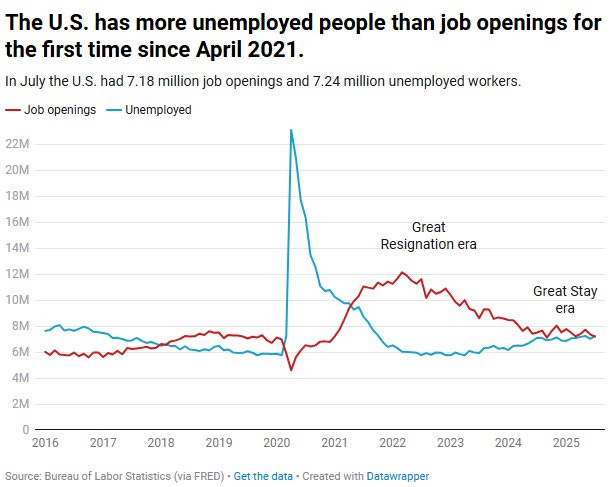
If things are this bad now, what will happen once AI can do almost all of our jobs less expensively and more efficiently than humans can? Of course AI is not the only reason why so many Americans are losing their jobs right now. As I discussed yesterday, this is the toughest job market that we have seen in ages. But don’t just take my word for it. According to the New York Fed, “confidence in the ability to move from one job to another has hit a record low”

"In the latest sign of trouble for the U.S. labor market, confidence in the ability to move from one job to another has hit a record low, according to a New York Federal Reserve survey released Monday. Respondents to the central bank’s monthly Survey of Consumer Expectations for August indicated a 44.9% probability of finding another job after losing their current one. The reading tumbled 5.8 percentage points from the prior month and is the lowest in the survey’s history dating back to June 2013."

The economy is a mess. That is very clear. And it is also very clear that we are moving into an extremely challenging future. But that doesn’t mean that you should curl up into a fetal position and cry about it. You were born for such a time as this. It is when times are the darkest that the greatest lights are needed.

Living the American Dream does not determine whether you are a “success” or not. You are living at one of the most important moments in all of human history, and you have been given a purpose that only you can fulfill. Yes, all of the crazy stuff that is happening all around us can be frightening at times, but don’t let all of that noise prevent you from becoming everything that you were created to be."

Monday, September 8, 2025

"WW3 News: Russian Doomsday Radio Sounds Alarm, US Rally Troops for New War"

Full screen recommended.
Prepper News, 9/8/25
"WW3 News: Russian Doomsday Radio Sounds Alarm,
 US Rally Troops for New War"
Comments here:

Musical Interlude: 2002, "Wait For Me"

Full screen recommended.
2002, "Wait For Me"

"A Look to the Heavens"

“Over 400,000 light years across NGC 6872 is an enormous spiral galaxy, at least 4 times the size of our own very large Milky Way. About 200 million light-years distant, toward the southern constellation Pavo, the Peacock, the remarkable galaxy’s stretched out shape is due to its ongoing gravitational interaction, likely leading to an eventual merger, with the nearby smaller galaxy IC 4970. IC 4970 is seen just below and right of the giant galaxy’s core in this cosmic color portrait from the 8 meter Gemini South telescope in Chile.
The idea to image this titanic galaxy collision comes from a winning contest essay submitted to the Gemini Observatory by the Sydney Girls High School Astronomy Club. In addition to inspirational aspects and aesthetics, club members argued that a color image would be more than just a pretty picture. In their winning essay they noted that “If enough color data is obtained in the image it may reveal easily accessible information about the different populations of stars, star formation, relative rate of star formation due to the interaction, and the extent of dust and gas present in these galaxies.”
o
Full screen recommended.
Hidden Headlines, 9/8/25
"James Webb Telescope Just Detected 
Artificial Lights in 3I/ATLAS"
Comments here:
o
Full screen recommended.
The Unknown, 9/8/25
"Elon Musk: "Grok AI Was Asked About 3I/ATLAS, 
Here's What It Replied"
"When NASA spotted the mysterious interstellar visitor 3I/ATLAS, the world turned to telescopes. But someone asked Elon Musk’s Grok AI what it thought—and the reply stunned everyone. Was it science, speculation, or something stranger? This wasn’t just data. It was a glimpse into how machines interpret the cosmos."
Comments here:
https://www.youtube.com/

"A Dangerous Place..."

"If I were to remain silent, I'd be guilty of complicity."
- Albert Einstein

"Wrong is wrong, even if everyone is doing it.
Right is right even if only you are doing it."
- Author Unknown