StatCounter

Monday, September 8, 2025

Jim Kunstler, "Days of Thunder"

"Days of Thunder"
by Jim Kunstler

"If we hadn’t won this election we would have all been vaxxed 
to death and censored so no one could hear our dying screams" 
- Mike Benz on "X"
"
That reckoning you’ve heard about lo these many years? It’s here now. We’re in it. You just can’t see all the moving parts, and if you did, you might not understand how or where they are moving, and what they are fixing to do next. Aside from certain US senators playing their pre-scripted mad scenes for the cameras, a disquieting quiet blankets the swamp like a miasma. It feels like a long, still moment before some shaking of the earth. Everyone senses it and the guilty must feel it most keenly.

That’s why they are laying low and keeping their traps shut. Every criminal defense lawyer inside the beltway is burning the midnight oil (and racking up the billable hours, ka-ching). Meanwhile, where are their clients? No longer peddling alibis on MSNBC (MSNOW), at least. I doubt that John Brennan is even in the country. My guess would be he’s cooling his heels in Abu Dhabi, where the extradition protocols with the USA remain comfortably squishy to his advantage. (He reportedly became a Muslim while running the CIA station in Riyadh between 1996-99, just in time for 9-11...hmmmm...)

Hillary Clinton has been keeping her pie-hole closed for weeks now while rattling around that big house in Chappaqua, NY, like a BB in a packing crate. Is anyone counting the wine-boxes coming and going from the place? It must be maddening to be HRC - but that new extra edge of prosecution terror would just be larding the lily, considering what Vlad Putin learned about her mental state way back in 2016: deeply unstable...diabetic...on tranqs....often plastered... bursts of rage...

Comey and Clapper? No more cute pranks on the beach for Big Jim, 86 on the menacing messages in seashells and putting out Taylor Swift fan-boy Tik-toks. Was that some attempt to not be taken seriously? Like you’re some kind of overgrown, harmless child?

James Clapper, of course, would be voted most likely to flip on his compadres, if such a canvass were taken on Coup island. He was the first to publicly announce his lawyering-up in the Russia collusion affair. He never expected it would come to this, this ordeal of interrogation... his “good soldier” self plopped ignominiously in the witness chair... the odor of his own fear....the proffer (just tell us what really happened)... the US attorneys appearing to leer at him, his house mortgaged to pay the attorney’s fees... what’s a poor boy to do...?

Adam Schiff has gone radio silent. A miracle! Alas, the autopen pardon granted for his J-6 Committee doings apparently does not apply to matters such as mortgage fraud and wire fraud. He realizes with chills and sighs of despair that this ain’t no foolin’ around. People go to jail for these things...  gulp! His attorney absolutely forbids any televised appeals to his fan-base, as if the glamorati of Rodeo Drive could do anything to stop what’s coming. Too bad Ed Buck and his magic checkbook are no longer around.

Even the seeming untouchables, Blinken, Jake Sullivan, Lisa Monaco, Norm Eisen, Mary McCord, Anrew Weissmann, Marc Elias must be listening hard for shoes to drop. They thought they had it made in the shade after 2020. They had the USA on a string, they thought. Home free. The trouble with the smarty-pants way of life is sometimes you out-smart yourself and your pants fall down. But all they can do in this late hour is induce a bunch of federal judges — recently imported from countries where justice means casting goat neckbones across the dusty floor of a mud hut — to gum up every executive action coming out of the White House with a poorly-argued TRO. They might as well be on a U-haul box truck throwing furniture off the back at a fleet of pursuing cop cars.

Mr. Trump is having sport with them now. Their crimes spanning the decade past are being bundled into one big coup case against the country, a color revolution on their own citizens and against “the democracy” that they never stop pretending to tout. If I am perceiving all this correctly, the days and weeks ahead will be as consequential a train of events as ever rolled down the tracks into Union Station, DC.

Looks like it will start this week with Robert F Kennedy, Jr., announcing the suspected culprits in the great autism question. That will rock the pharma industry to the very hairs on its roots. They have been trying since the 1980s to bury that idea that autism comes from anything they do. Next, the nation will have to ask: why did it take Mr. Kennedy only seven months to arrive at a plausible answer to the decades’ long autism mystery? Maybe because it was not such a difficult mystery to solve. Just that nobody wanted to collate and assemble the information. The answer was too ugly. So, they buried it on-purpose.

That set of revelations will segue soon enough into the reveal of facts, data, studies retrieved from the thought-to-be hidden files of the CDC, FDA, and NIH as to just how damaging the Covid-19 vaccinations really were. . . which will lead to answers as to how the various agencies under HHS (and likely the Pentagon, too) conspired to materialize the Covid virus in the first place, and that means the names and titles of actual persons whop did it: the deputy secretaries of this and that, higher-ups, folks in dark NGOs. . . and all that will combine with new information about the supremely messed-up election of 2020, and so on down the long line of the many related, serial coup operations.

It’s one thing to reveal all that information, with its criminal overtone. And it’s another thing to get around to prosecuting it. I doubt you will be disappointed, though. Like I said. We’re in it. It’s happening. It’s roiling under the surface."

"Grocery Prices Soaring, Shrinkflation, and Shortages for Fall 2025"

Full screen recommended.
Adventures With Danno, AM 9/8/25
"Grocery Prices Soaring, Shrinkflation,
 and Shortages for Fall 2025"
Comments here:

"It Is 'The Toughest Time In Years' To Be Looking For A Job"

"It Is 'The Toughest Time In Years' To Be Looking For A 
Job In The U.S. – One 64-Year-Old Man Has Been Waking
 Up At 3 AM To Search For Work And Can’t Find Anything"
by Michael Snyder

"Are we defined by what we do? For so many of us, our identities are tied to our occupations. For example, when I worked in the legal field many years ago so many of my colleagues took great pride in being able to say “I’m a lawyer” when they were asked about their lives. Unfortunately, we live in a society where our personal worth is largely determined by what kind of jobs we have or how much money we make. I wish that our society did not look at people this way, but that is the reality of the world that we live in now. Unfortunately, large numbers of Americans are now losing the jobs that they value so much, and competition for any good jobs that do happen to be available has become extremely fierce. In fact, I am going to share a story with you in this article that is so extreme that you may not believe it, but it is actually true.

When someone is unemployed for an extended period of time, it can be absolutely soul crushing. If you have been there, you know exactly what I am talking about. You don’t want anyone to ask you what you do, because it can make you feel worthless. Without a job, your status in society is greatly diminished, and many will look on you with pity. And with each passing day, the bills just keep on piling up.

A few years ago, it was relatively easy to find work, but now conditions have changed dramatically. The following comes from a Washington Post article entitled “Why it’s the toughest time to be searching for work in America in years”…

"It’s the toughest time in years to be searching for work in America. New data last week showed a fourth month of tepid job growth and propelled joblessness to its highest level since late 2021, when the economy was still recovering from the effects of the covid-19 pandemic. Now, as companies wrestle with inflation, economic uncertainty and trade policy whiplash, many are shredding payrolls and shifting tasks to artificial intelligence while pulling in higher profits. And some executives are pointedly broadcasting sizable layoffs as wins, a sign they’re making workforces leaner and more efficient.

There are so many people out there that are searching for work right now. At the same time, postings for available jobs are rapidly drying up…"Meanwhile, job postings fell across nearly every sector compared with a year ago, with the steepest declines recorded in child care, community and social service, scientific research, retail, and hospitality, according to the employment website Indeed. Administrative roles such as human resources and accounting also posted double-digit declines."

If you find yourself unemployed at this moment, I feel so badly for you. The job market is so rough, but you can’t give up, because the market is only going to get even tighter as the weeks roll along.

Earlier today, I came across a story about a 64-year-old unemployed man that is absolutely heartbreaking. He has a very hard time sleeping because he doesn’t have a job, and so he often gets up around 3 AM to search for work…"I often wake up around 3 a.m. with my mind racing — thinking about which roles to apply to or what job search strategy to try next. Instead of trying to fall back asleep, I usually get up and start working on my job search, which includes sending out applications or post-interview thank you letters. Around 6 a.m., I typically might make breakfast, shower, and then start planning out what I want to accomplish that day. It’s become a sort of routine."

His name is Matthew English and he has decades of experience in accounting. But even though he has applied for hundreds of jobs, he has been out of work since last October…"I’ve been looking for a full-time job since October 2024, after a decades long career in accounting. Submitting hundreds of applications and spending countless hours on my job search have led to several interviews, but I haven’t been able to secure an offer. I’ve applied for jobs related to my accounting background, but I’ve also expanded my search to any part-time or full-time job I feel I could perform - including entry-level, non-skilled positions. I even applied to be the Chick-fil-A cow mascot at a Birmingham location.

That last sentence really hit me hard. He is so desperate to find something that he is even willing to put on a cow costume and be a mascot at a Chick-fil-A location. But he was not hired for that either.

Meanwhile, large employers continue to conduct mass layoffs all over the nation…"In the past eight months, Kroger - the nation’s largest supermarket chain - has overseen three rounds of layoffs. The latest, announced last month, included 1,000 corporate staff and mainly affected its technology and digital team, according to LinkedIn posts from former employees.

Nike, which has reported softening sales and an estimated $1 billion a year hit from tariffs, said this week it would lay off nearly 1 percent of its corporate staff while the sporting gear maker undergoes a “realignment.” Estée Lauder, which expects a $100 million tariff bill this fiscal year, cut 7,000 jobs in February, about 11 percent of its staff."

I have been warning for months that this was going to happen. Now we are here. According to economist Mark Zandi, quite a few U.S. states are already experiencing recessionary conditions…"Leading economist Mark Zandi has warned that a third of the US is already in or at high risk of going into a recession. Zandi, chief economist at Moody’s Analytics, revealed that states making up nearly a third of America’s GDP – including Virginia, Connecticut and Delaware – are in dangerous territory. ‘States experiencing recessions are spread across the country, but the broader DC area stands out due to government job cuts,’ Zandi wrote on X."

Of course many would argue that it feels like the entire country has already plunged into a recession. I think that it would be very difficult to refute that. But what we are experiencing now is not even worth comparing to what is coming.

Individually, we can’t change the circumstances in which we currently find ourselves. But we can change how we respond to them. Don’t you dare give up. Your past does not have to define your future.

No matter what your circumstances may be at this moment, the best chapters of your life can still be ahead of you. Do not allow yourself to be defined by your employment status of by how much money you have. We were all put here for a reason, and times of transition can be a perfect opportunity to explore your reason for being here. Life is about so much more than jobs and money. Once you discover that, everything changes."

"How And Why I Live In The 1970's"

"How And Why I Live In The 1970's"
by Paul Rosenberg

"With just a few exceptions, my daily life could fit seamlessly into in the 1970s. In fact, I fight to keep it this way: not for nostalgia, but for health, happiness and efficiency. It comes down to the fact that I like thinking my own thoughts; that I’ve found them far more satisfying and useful than thoughts implanted in me by others. Said another way, I pursue simplicity, for the sake of my innate creativity and the satisfactions that come from it.

One thing I’ve learned along the way is that the best and most satisfying of our choices and actions come from within us; they are self- generated. The things we’ll be happy about in our old age will not be acts of compliance; they’ll be things we self-generated. I live in the 1970s because it was a better environment for self-generation.

I happen to be the right age to remember the 1970s. I remember the 1960s pretty well too, but over the course of the 1970s I came to see the world as an adult rather than as a child. And so the era of roughly 1968-1978 was foundational to me. The 1970s also make a good reference because we had all the necessities of life, minus the technology that was twisted into today’s “grab every ounce of human attention” economy.

I don’t live entirely in the 1970s, of course; I use computers, the Internet and when necessary cell phones (though not smart phones), but I avoid the rest. And I really, really like it this way; it keeps me uncluttered and effective internally.

How I Do This: Before I specify how I keep my life simple, I’d like to expand just a bit on simplicity: By keeping my life simple, I also make the world comprehensible. The great advantage of life before World War I was that it was comprehensible, and there is a critical difference between the person who sees the world as comprehensible and the person who does not: Understanding the world, we tend to make plans to accomplish our goals, and then pursue them, confident that we can (or at least are likely to) reach those goals.

Feeling overcome by a world we cannot understand or rely upon, we hunker down, pull back our horizons, hold on to whatever we do have and refuse to let go. By getting rid of the daily noise we really can comprehend the world. We won’t see every detail of course (that was never possible), but we’ll evade the pollution and still see the things which matter, and that’s quite enough. Here’s what I do:

• I receive no alerts at all. (And haven’t yet been run-over by a tornado.)
• I’m not on social media at all. (We all know why.)
• I don’t watch TV, and certainly not TV news. I do watch DVDs.
• I keep news of the world locked out and check it once per week, and not for more than an hour or two. (I make the occasional exception for work-related or very significant events.)
• I don’t use AI. If I was a programmer I’d use it to eliminate grunt work, but I wouldn’t use it to supplant my innate creativity. My creativity is something I want to cultivate, not to bypass.
• I evade apps. I’m not interested in the app way of life. On rare occasion I’ll use one that’s unavoidable (for which I keep a separate device that remains on a shelf), but I avoid them like • I avoid communicable diseases.
• I evade voice mail and notifications. I rely on email, because it doesn’t interrupt me. Interruptions are my enemy.
• I turn down all the deals that will cost me a few minutes every month to manage. I guard my brain cycles.
•I turn away from advertising, and hard. Most of those ads are the fingers of others grasping at my mind. I want to think my own thoughts and to be uninterrupted while doing so.
• I strongly avoid products whose ads intrude upon me. Those companies are not my partners in thriving, they are rather abusers. In the old days there were things that “a gentleman would not do,” and I see a lot of modern advertising that way.
• I am careful not to compare my stuff with anyone else’s. I learned, back in the 1970s (a great story for some other time) that possessions are for utility, not for contentment… and certainly not for bragging rights.

This is how I structure my life to support my inner operations, sacrificing the expectations of the loud, demanding and grasping world. The trade is eminently worth it."

An Incredible Musical Interlude: Joe Bonamassa & Tina Guo, "Woke Up Dreaming"

Full screen recommended.
Joe Bonamassa & Tina Guo, "Woke Up Dreaming"

Sunday, September 7, 2025

"The Job Market Collapse Is Here"

Full screen recommended.
Michael Bordenaro, 9/7/25
"The Job Market Collapse Is Here"
Comments here:

Jeremiah Babe, "What Happens When The Internet Goes Down?"

Jeremiah Babe, 9/7/25
"What Happens When The Internet Goes Down?"
Comments here:

"New Data Confirms 3I/ATLAS Is Moving Toward Earth, Scientists Are Terrified"

Full screen recommended.
The Hidden Abyss, 9/7/25
"New Data Confirms 3I/ATLAS Is
 Moving Toward Earth, Scientists Are Terrified"
"The alert came from a deep space observatory in Chile, a string of code that made no sense. An object designated 3I/ATLAS, an interstellar visitor thought to be on a predictable path, had just performed an impossible maneuver. It defied the laws of gravity. Now, every major telescope on the planet is turning to track it, and a horrifying new trajectory has been calculated. The data confirms our worst fears. The Manhattan-sized object is no longer a scientific curiosity; it’s an incoming threat, and the scientists who discovered its new path are now terrified."
Comments here:
o
Full screen recommended.
Hidden Headlines, 9/7/25
"3I/ATLAS’s Terrifying Image 
Just Stopped The World"
Comments here:
o
Full screen recommended.
Spacialize, 9/7/25
"3I/ATLAS Just Shifted Orbit Against Gravity -
 Gas Alone Can’t Explain It"
Comments here:

Musical Interlude: Medwyn Goodall, “Eyes of Heaven”

Full screen mode recommended.
Medwyn Goodall, “Eyes of Heaven”

“Neuroscience Says Listening to This Song Reduces Anxiety by Up to 65 Percent”

Full screen recommended.
“Neuroscience Says Listening to This Song 
Reduces Anxiety by Up to 65 Percent”
By Melanie Curtin

“Everyone knows they need to manage their stress. When things get difficult at work, school, or in your personal life, you can use as many tips, tricks, and techniques as you can get to calm your nerves. So here’s a science-backed one: make a playlist of the 10 songs found to be the most relaxing on earth. Sound therapies have long been popular as a way of relaxing and restoring one’s health. For centuries, indigenous cultures have used music to enhance well-being and improve health conditions.

Now, neuroscientists out of the UK have specified which tunes give you the most bang for your musical buck. The study was conducted on participants who attempted to solve difficult puzzles as quickly as possible while connected to sensors. The puzzles induced a certain level of stress, and participants listened to different songs while researchers measured brain activity as well as physiological states that included heart rate, blood pressure, and rate of breathing.

According to Dr. David Lewis-Hodgson of Mindlab International, which conducted the research, the top song produced a greater state of relaxation than any other music tested to date. In fact, listening to that one song- “Weightless”- resulted in a striking 65 percent reduction in participants’ overall anxiety, and a 35 percent reduction in their usual physiological resting rates. That is remarkable.

Equally remarkable is the fact the song was actually constructed to do so. The group that created “Weightless”, Marconi Union, did so in collaboration with sound therapists. Its carefully arranged harmonies, rhythms, and bass lines help slow a listener’s heart rate, reduce blood pressure and lower levels of the stress hormone cortisol.

When it comes to lowering anxiety, the stakes couldn’t be higher. Stress either exacerbates or increases the risk of health issues like heart disease, obesity, depression, gastrointestinal problems, asthma, and more. More troubling still, a recent paper out of Harvard and Stanford found health issues from job stress alone cause more deaths than diabetes, Alzheimer’s, or influenza.

In this age of constant bombardment, the science is clear: if you want your mind and body to last, you’ve got to prioritize giving them a rest. Music is an easy way to take some of the pressure off of all the pings, dings, apps, tags, texts, emails, appointments, meetings, and deadlines that can easily spike your stress level and leave you feeling drained and anxious.

Of the top track, Dr. David Lewis-Hodgson said, “‘Weightless’ was so effective, many women became drowsy and I would advise against driving while listening to the song because it could be dangerous.” So don’t drive while listening to these, but do take advantage of them:

10. “We Can Fly,” by Rue du Soleil (Café Del Mar)
7. “Pure Shores,” by All Saints
4. “Watermark,” by Enya
2. “Electra,” by Airstream
1. “Weightless,” by Marconi Union
I made a public playlist of all of them on Spotify that runs about 50 minutes (it’s also downloadable).”

" A Look to the Heavens"

"Big, beautiful spiral galaxy NGC 1055 is a dominant member of a small galaxy group a mere 60 million light-years away toward the aquatically intimidating constellation Cetus. Seen edge-on, the island universe spans over 100,000 light-years, a little larger than our own Milky Way galaxy. The colorful, spiky stars decorating this cosmic portrait of NGC 1055 are in the foreground, well within the Milky Way. But the telltale pinkish star forming regions are scattered through winding dust lanes along the distant galaxy's thin disk.
With a smattering of even more distant background galaxies, the deep image also reveals a boxy halo that extends far above and below the central bulge and disk of NGC 1055. The halo itself is laced with faint, narrow structures, and could represent the mixed and spread out debris from a satellite galaxy disrupted by the larger spiral some 10 billion years ago."

"What The World Needs Now"

"In this difficult day, in this difficult time for the United States, it is perhaps well to ask what kind of a nation we are and what direction we want to move in. You can be filled with bitterness, with hatred, and a desire for revenge. We can move in that direction as a country, in great polarization and filled with hatred toward one another. Or we can make an effort to understand and to comprehend, and to replace that violence, that stain of bloodshed that has spread across our land, with an effort to understand with compassion and love. What we need in the United States is not division; what we need in the United States is not hatred; what we need in the United States is not violence or lawlessness; but love and wisdom, and compassion toward one another, and a feeling of justice toward those who still suffer within our country, whether they be white or they be black."
- Robert F. Kennedy, on the assassination of Martin Luther King, Jr.
"What The World Needs Now"
by Tom Clay
"Detroit DJ brought this out early in 1973 and it was seen as 
a celebration of the message behind that spread
by John F. Kennedy, Martin Luther King Jr. and Bobby Kennedy."

"I Must Not Fear..."

"I must not fear. Fear is the mind-killer.
Fear is the little-death that brings total obliteration.
I will face my fear. I will permit it to pass over me and through me.
And when it has gone past I will turn the inner eye to see its path.
Where the fear has gone there will be nothing.
Only I will remain."
- Frank Herbert,

"Dune", "Litany Against Fear"

The Poet: Margaret Atwood, "The Moment"

"The Moment"

"The moment when, after many years
of hard work and a long voyage
you stand in the center of your room,
house, half-acre, square mile, island, country,
knowing at last how you got there,
and say, I own this,
is the same moment when the trees unloose
their soft arms from around you,
the birds take back their language,
the cliffs fissure and collapse,
the air moves back from you like a wave
and you can't breathe.
No, they whisper. You own nothing.
You were a visitor, time after time
climbing the hill, planting the flag, proclaiming.
We never belonged to you.
You never found us.
It was always the other way round."

- Margaret Atwood
"Morning in the Burned House"

The Daily "Near You?"

Mesa, Arizona, USA. Thanks for stopping by!

"The Truth?"

I've always believed you can handle the truth, given the chance...It may not be what you want to hear, but it is the truth to the best of my ability to determine. What if anything you do with it is of course up to you... - CP

"Lessons From The Unraveling Of The Roman Empire: Simplification, Localization"

"Lessons From The Unraveling Of The Roman Empire:
 Simplification, Localization"
The fragmentation, simplification and localization of the 
post-Imperial era offers us lessons we ignore at our peril.
by Charles Hugh Smith

"There is an entire industry devoted to "why the Roman Empire collapsed," but the post-collapse era may offer us higher value lessons. The post-collapse era, long written off as The Dark Ages, is better understood as a period of adaptation to changing conditions, specifically, the relocalization and simplification of the economy and governance.

As historian Chris Wickham has explained in his books "Medieval Europe" and "The Inheritance of Rome: Illuminating the Dark Ages 400-1000," the medieval era is best understood as a complex process of social, political and economic natural selection: while the Western Roman Empire unraveled, the Eastern Roman Empire (Byzantium) continued on for almost 1,000 years after the fall of the Western Roman Empire, and the social and political structures of the Western Roman Empire influenced Europe for hundreds of years.

In broad-brush, the Roman Empire was a highly centralized, tightly bound system that was remarkably adaptive despite its enormous size and the slow pace of transport and communication. Roman society was both highly hierarchical--the elites claimed superiority and worked hard to master the necessary tools of authority-- slaves were integral to the building and maintenance of Rome's vast infrastructure--and open to meritocracy, as the Roman Army and other classes were open to advancement by anyone in the sprawling empire: every free person became a Roman Citizen once their territory was absorbed into the Empire.

When the Empire fell apart, the model of centralized control/power continued on in the reigns of the so-called Barbarian kingdoms (Goths, Vandals, etc.) and Charlemagne (768-814), over 300 years after the fall of Rome. (When the Ottomans finally conquered Constantinople in 1453, they also adopted many of the bureaucratic structures of the Byzantine Empire.)

Over time, however, the feudal model of localized fiefdoms nominally loyal to a weak central monarchy replaced the centralized model of governance. This adaptation fit the highly fragmented nature of European societies in this era.

But centralized influence never went away. The Christian churches based in Rome and Constantinople continued to exert centralized influence in politically fragmented regions, and monarchies continued to exist, in various states of strength and weakness. The Holy Roman Empire--as Voltaire is reputed to have observed, "neither Holy, Roman or an Empire"--had an enormously complex history in Germany and the rest of Europe. The monarchies in England and France remained in place, and the city-states of northern Italy wielded influence via trade and shifting alliances.

In other words, the Medieval era was ultimately a complex competition between overlapping models of governance and sharing resources, a competition between centralized and localized (what Wickham calls "cellular") nodes of power and the various ways that rulers and those they ruled dealt with each other.

Throughout the era, the legitimacy of rulers ultimately flowed from public assemblies, a tradition inherited from Rome that manifested in aristocratic courts and the church's leadership (bishops, etc.) and eventually, in parliaments. This tension played out in the sharing of costs and resources and the general direction of the state.

As a general rule, when monarchs consolidated too much power, they engaged in catastrophically costly and doomed wars (The Hundred Years War) because they were able to override or ignore the cautious counsel of elite assemblies. Understood as a selective process of adapting to changing circumstances, this history offers us valuable lessons and templates for our future.

Once the centralized power of Rome fragmented, economic, social and political power simplified and relocalized. Trade volume shrank and trade routes vanished. Once the bureaucratic and military structures dictated by Rome collapsed, regions and localities were on their own.

Elites naturally sought out the best means to consolidate and expand their power, and residents (as a general rule, the peasantry and town-dwellers) sought to improve their own lives by reducing costs and securing access to resources.

The immense geographic, cultural, social and economic diversity of Europe was in effect freed to play out. This diversity is still evident; the European Union may have unified the European financial system, but cultural and social divisions have not dissolved.

Wickham distinguishes between two primary sources of income and wealth accessible to elites and governments: land and taxes. Collecting taxes requires an immense bureaucracy to identify and assess property owners, tenant farmers, merchants, collect duties on trade flows, etc. Taxes are the only reliable way to fund professional armies and the stupendous bureaucracy required to manage a complex centralized empire. The Byzantine Empire survived multiple rivals, invasions, etc. largely due to its competent tax collection bureaucracy, and European monarchies could only fund long, costly wars once they established tax collection bureaucracies.

Wealth from land--surplus skimmed from the labor of peasants--was adequate to fund highly localized nobility (many of which had one or two castles and a small fiefdom), but it wasn't reliable enough or large enough to support professional armies or vast centralized states.

How does this history offer a template for the next 20 years? I have long held that the dominant global forces binding the global economy are globalization and financialization. Both have greatly increased the income and wealth that nation-states can tax to fund their vast structures: military, social welfare, and bureaucracies of management, regulation and control.

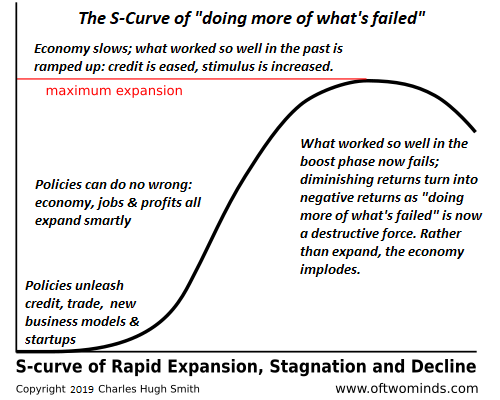
I have also held that globalization and financialization became hyper-structures prone to over-extension and the diminishing returns of the S-Curve. (see chart below) Both have reversed and are now in decline, a decline that I anticipate will accelerate unpredictably and rapidly as each dynamic is centralized and tightly bound, meaning each subsystem is highly interconnected with other subsystems. Should one break, the entire system unravels.
Globalization may appear to be decentralized, but the vast majority of global trade and capital flows through a few centralized nodes, and many aspects of trade depend on a very small number of routes and suppliers. This makes global trade exquisitely sensitive to disruption should any critical supplier or node fail.

Financialization is equally centralized and tightly bound, to the absurd degree that obscure financial structures (reverse repos, etc.) can trigger cascading crises in the real-world economy.

I anticipate a global simplification of trade and finance as fragile hyper-structures collapse as the failure of subsystems cascade through the entire system. These systems have greatly accelerated extremes of wealth-income inequality by their very nature, and these vast distortions and imbalances are unsustainable. Also unsustainable is the immense expansion of the plundering of the planet's remaining resources via globalization and financialization. These dynamics will collapse under their own weight.

What will be left? Once the income and wealth that supported enormously costly nation-state governments contracts, central governments will no longer be able to fund their gargantuan systems. (States that attempt to fund their activities by printing money will only speed the collapse of their finances and thus their coherence.)

As in the post-Roman era, central authority may well continue, but its actual power and influence will be greatly reduced. Without expanding income and wealth to tax, the central state may attempt to extract most of the nation's surplus, but this stripmining of elites and commoners alike will trigger pushback and revolt.

A more sustainable response would be to offload most of the central government's financial burdens onto states, provinces, counties, etc., in effect pushing the impossible task of maintaining entitlements and promised spending on local entities.

Given the diversity of cultures, social values and economic dynamics in large nations and regions, we can anticipate a flowering of adaptations to these greatly reduced means. Some localities will favor increasing authoritarian controls, others will favor reducing authoritarian controls and ceding authority to the smallest units of public assembly.

Locales (shall we call them fiefdoms?) will divide naturally along geographic boundaries, just as fiefdoms in medieval Europe fell into natural boundaries shaped by rivers, valleys, mountain ranges, etc., and along economic and cultural borders.

This relocalization may manifest in the well-known forecasts of the US breaking into multiple regional states, or it might manifest as I suggest in a much-weakened but still influential central government ceding power to local political structures which may themselves fragment or form alliances with nearby entities with whom they share cultural and economic ties.

In other words, a churn of evolutionary adaptations can be expected. Just as there was no one post-Roman adaptation that worked equally well everywhere, we can expect there to be some adaptations of roughly equal success and many that are unsuccessful.

As individuals and households, we want to be located in successful adaptations that share our values and offer us agency, i.e. a say in public assemblies and the freedom to move and work as we see fit.

As I have outlined many times in the blog and in my books, locales that are highly dependent on long global supply chains and distant capital for their essentials will fare very poorly once those supply chains break and the capital dries up. Regions and locales that generate their own essentials (food, energy, metals, concrete, electronics, etc.), talent and capital are much more likely to generate enough resources to satisfy both local elites and the public.

As I explain in my book "Self-Reliance," we who have lived in the past 75 years of expanding production and consumption of Everything have lost touch with both the natural world that sustains us and the social and practical skills needed to endure and prosper in an era in which the engines of centralized power and wealth (globalization and financialization) decay and collapse.

Some locales will choose to foster relocalization and individual agency. Others will cling on to failing models of authoritarian control and globalization/financialization. Ironically, perhaps, the most successful regions will be prone to indulging in hubris and denial, just as the Roman elites, basking in their centuries of dominance, dismissed the "Barbarians" and clung to their delusions of grandeur even as their world fragmented around them. Those locales left behind by globalization and financialization may well offer much better opportunities for successful adaptation, relocalization and individual/household agency.

It is human nature to find reasons to dismiss the storm clouds on the horizon. We look around and find solace in the apparent strength of our institutions and economy, while ignoring their sobering dependence on unsustainable hyper-globalization and hyper-financialization.

The fragmentation, simplification and localization of the post-Imperial era offers us lessons we ignore at our peril. It's important to view these lessons not just as an academic abstraction but as a guide to your own decisions about what places are most conducive to your security and well-being. Not every locale will do equally well, and the culture of many places may not be a great match for your own values and goals. If you decide to move, sooner is better than later."

"Even With Good People..."

"Cause even with good people, even with people that 
you can kinda trust, if the truth is inconvenient,
and if the truth doesn't, like, fit, they don't believe it."
- Marie Adler

"Message From the Future: Your Acceptance of Evil Has Condemned Us All"

"Message From the Future:
Your Acceptance of Evil Has Condemned Us All"
by Chris Floyd

"Sometime in December 2016, a strange transmission began bleeding through, ghost-like, on various computers around the world. It would suddenly appear for a few flickering moments while people watched movies or shopped on-line or looked at social media, then it would fade away. It purported to be a message from the future and showed an aged man who claimed he was a chrono-quantum technician whose work had been banned by the authorities to prevent me from doing exactly what I am doing now, at long last - sending a warning to our ancestors. The message was brief, but it was usually badly garbled by visual and aural static; it took weeks to compile, through crowd-sourcing, the full text. For what it's worth, the message - minus the brief intro - is presented below.

"You are taking a path into darkness. It began years ago, with your acceptance of crimes and inhuman practices on a vast scale. In the late 20th century, your leaders once confessed on national television that they had killed 500,000 innocent children with death-dealing sanctions - then declared this atrocious massacre was worth it. Yet there was no outcry, no outrage, no uprising, not even a peep of protest. Indeed, the leader who carried out this massive slaughter of innocent children ended his reign at new heights of popularity and forever after was considered a beloved elder statesman. Your next leader lied brazenly to start a war that killed a million innocent people and led directly to decades of murderous instability in numerous countries. He too ended his days in wealth and comfort and public regard. Your next leader refused to prosecute the crimes of aggression and torture openly committed by his predecessor; instead, he continued his practices, enshrining many of the heinous practices into settled law, waging undeclared war in more than half a dozen countries and personally signing off on extrajudicial murders every week of his reign.

By this time, the moral degradation of the people was so complete - they had countenanced, cheered or ignored so many crimes and so much corruption on so many levels - that they easily fell prey to a voracious, half-crazed demagogue and the forces of fascism, feudalism and lawless rule that he brought into power. This was the nominal end of your democracy, but it was already deeply rotted from within - rotted by your years of turning a blind eye to monstrous crimes committed in your name by both factions in your power structure.

Because of your shameful acquiescence, your shallow understanding of the forces that ruled you and used you and manipulated you, your bedazzlement by public image, your astonishing credulity at the transparent lies and hollow, sinister pieties you were fed, we, your descendants, have lived in squalor, rancor, violence and despair all our lives, for generations. There is no hope for us unless you abandon your slavish ignorance, your adherence to partisan fantasies about the factions of the power structure that rules you and rise up to overthrow it. Instead bring fearless clarity to bear on the reality of what you have accepted. The murder of 500,000 children. The millions murdered in the wars you started and the wars bred by your wars. Assassination. Torture. Dehumanization and demonization of your fellow human beings, both at home and abroad.

It is your acceptance of these things that has brought you to the final turning point. Now there is nothing left for you to do but resist: resist with all your might, with every means at your disposal - but always, always, with the full knowledge of how you came to this place, and your own connivance and collusion in this descent. Keep this in mind as you fight, so that it doesn't happen again. You are not exceptional, you are not plucked out by God for special favor: you are human beings like all the rest, and like so many human beings in so many societies down through the ages, you have failed to look your own evil in the eye, you have failed to confront and condemn acts that make you shudder with horror when you hear of them committed by other nations.

Own this knowledge - this terrible, tragic knowledge - and let it guide as you fight the putrescence that past crimes have now brought gushing forth, and as you build something better in the aftermath. Otherwise, you are lost, and we are lost, the world itself is lost."

"How It Really Is"

"Americans Can’t Keep Up With the Cost of Living Anymore"

Full screen recommended.
A Homestead Journey, 9/7/25
"Americans Can’t Keep Up With 
the Cost of Living Anymore"

"Americans are being crushed under the cost of living crisis in 2025. From skyrocketing grocery prices and soaring food costs to record-high rent, housing, and utility bills, families across America are realizing they simply can’t keep up anymore. Inflation may be slowing on paper, but in reality, everyday people are paying more than ever for basic necessities like food, housing, healthcare, gas, and insurance. This video dives into how the rising cost of living in America is pushing millions to the breaking point. With inflation eating away at paychecks, households are being forced to cut back, take on debt, or even go without. The dream of stability is slipping further out of reach as wages stagnate while prices climb higher every month.

If you’ve been feeling the pinch every time you step into the grocery store, pay your rent, or fill up your gas tank, you’re not alone. This is the reality of America’s growing economic collapse, where financial struggles are becoming the new normal for middle-class and working families alike. Stay tuned as we explore why so many Americans can’t afford life in 2025 - and what it means for our future."
Comments here:
o
JJ Buckner, 9/7/25
"The Collapse of Daily Life in America Has Begun"
Comments here:

Dan I Allegedly, "Buy a Texas Ranch for $6.75? Is it Shenanigans?"

Full screen recommended.
Dan I Allegedly, 9/7/25
"Buy a Texas Ranch for $6.75?
 Is it Shenanigans?"

"Imagine owning 76 acres of beautiful Texas ranch land for just $6.75 - or taking home $300,000 in cash instead! In today's video, I break down the fascinating story of Jason and Katie Bullard, two attorneys who turned their dream ranch into a unique raffle opportunity. Located in Mason, Texas, their 76-acre ranch is now up for grabs in this unconventional sale. I’ll explain how the raffle works, the role of Raffle (the company ensuring transparency), and why this method might be the future of property sales. What do you think - would you buy a ticket for a shot at this incredible prize?

We also dive into the current real estate challenges, including plummeting condo prices in Florida and rising costs tied to aging homes. Plus, we discuss why gold could skyrocket to $5,000 an ounce and why silver is in high demand with EVs and solar energy. With so many changes in the housing market and the economy, now’s the time to stay informed - whether you're considering property raffles or precious metals investments"
Comments here:

"Inside a Brand New Russian Children's Hospital"

Full screen recommended.
Travelling with Russell , 9/7/25
"Inside a Brand New Russian Children's Hospital"
"What does a Russian children's hospital look like inside? Join me on a tour of the brand new Children's Hospital in Moscow, Russia. St. Vladimir's Children's City Clinical Hospital of Moscow is the newest and most technologically advanced Hospital in all of Russia."
Comments here:

Adventures with Danno, "Amazing Sales at Kroger!"

Full screen recommended.
Adventures with Danno, 9/7/25
"Amazing Sales at Kroger!"
Comments here:

"The Obedience Cult"

"The Obedience Cult"
by Paul Rosenberg

"Not too many years back, warnings of Peak Oil circulated widely, and they made me consider something a good deal more dangerous: Peak Obedience. If that concept strikes you as odd, there’s a reason: We’ve all been living inside an obedience cult.

In our typical “scary cult” stories, we find people who have given up their own functions of choice and do crazy things because they are told to by some authority. But so long as people are within the cult, none of it appears crazy. So, inside a cult of obedience, obedience would seem righteous, and more than anything else it would seem normal. And I think that very well describes the Western status quo.

Obedience, however, should not seem normal to us. Obedience holds our minds in a child state, and that is not fitting for any healthy person past their first years of life. It also presupposes that the people we obey have complete and final knowledge; and in fact, they do not: politicians, central bankers, and the other lords of the age have been wrong – obviously and publicly wrong – over and over. So, obedience is not a logical position to take. Nonetheless, the mass of humanity believes that something horrible will happen if they don’t obey. After that, they merely need to be supplied with a defensible reason to comply.

But all of that, even though true, isn’t what I’d like you to take away from this discussion. My primary point is this: When we obey, we make ourselves less conscious; we make ourselves less alive.

Why Obedience Is Peaking: Over the past two centuries, authority has benefited from a perfect storm of influences. There was never such a time previously, and there probably will never be another. Briefly, here’s what happened:

Morality was broken: For better or worse, Western civilization had a consistent set of moral standards from about the 10th century through the 17th or 18th century. Then, through the 20th century, those standards were broken. Note that I did not say morality was changed. The cultural morality of the West was not replaced, but broken. The West has endured a moral void ever since. Previously, people routinely compared authority’s decrees to a separate standard (most often the Bible), to see if they held up. But with Western morals broken, authority was freed from examination, and thus from restraint.

Economies of scale: Factories made it much cheaper to produce large numbers of goods than the old way, in individual workshops. Economists call this an economy of scale. Thus a cult of size began, making “obedience to the large” seem normal.

Fiat currency: Fiat currency has allowed governments to spend money without consequences. It allowed politicians to wage war and to provide free food, free education, and free medicine… all without overtly raising taxes. Fiat currency made it seem that politics was magical.

Mass conditioning: Built on the factory model, massive government institutions undertook the education of the populace. And more important than their overt curriculum (math, reading, etc.) was their invisible curriculum of obedience to authority. Here, to illustrate, is a quote from the esteemed Bertrand Russell, who is himself quoting Johann Gottlieb Fichte, a founding father of public schooling: "Education should aim at destroying free will so that after pupils are thus schooled they will be incapable throughout the rest of their lives of thinking or acting otherwise than as their school masters would have wished."

Mass media: Mass media turbocharged authority and obedience in the 20th century, followed by the free account vultures of Facebook, Google and others. All of this went beyond authority’s grandest dreams. These things created an unnatural peak for authority. But now, this perfect storm is thinning.

Peak Obedience Is Brittle: Through the 20th century, the people of the West built up a very high compliance inertia. They complied with the demands of authority and taught their children to do the same, until it became automatic. People obeyed simply because they had obeyed in the past. Authority quickly became addicted to this situation, basing their plans on receiving every benefit of the doubt.

Automatic obedience, however, is a brittle thing. Economies of scale are failing, the money cartel has been exposed, government schools have lost respect, mass media is fading away and everyone knows that Facebook is an addiction. The game continues because the populace is distracted and afraid, but that won’t last forever.

And Then? It has long been understood that complex systems breed more complexity, and eventually break themselves. As central authorities try to solve each problem they face, they inevitably create others. Eventually the system becomes so complex, and its costs become so great, that new challenges cannot be solved. Then the system and its authority fail, as they did in the Soviet Union.

But again, that’s not my primary point. Rather, it’s this: Obedience disengages our best parts. Obedience degrades our creativity; it undercuts our effectiveness and especially our sense of satisfaction. Don’t sign away your life, no matter how many others do."
For more, please see "The Twilight of Authority."