StatCounter

Sunday, September 7, 2025

"How It Really Is"

"Americans Can’t Keep Up With the Cost of Living Anymore"

Full screen recommended.
A Homestead Journey, 9/7/25
"Americans Can’t Keep Up With 
the Cost of Living Anymore"

"Americans are being crushed under the cost of living crisis in 2025. From skyrocketing grocery prices and soaring food costs to record-high rent, housing, and utility bills, families across America are realizing they simply can’t keep up anymore. Inflation may be slowing on paper, but in reality, everyday people are paying more than ever for basic necessities like food, housing, healthcare, gas, and insurance. This video dives into how the rising cost of living in America is pushing millions to the breaking point. With inflation eating away at paychecks, households are being forced to cut back, take on debt, or even go without. The dream of stability is slipping further out of reach as wages stagnate while prices climb higher every month.

If you’ve been feeling the pinch every time you step into the grocery store, pay your rent, or fill up your gas tank, you’re not alone. This is the reality of America’s growing economic collapse, where financial struggles are becoming the new normal for middle-class and working families alike. Stay tuned as we explore why so many Americans can’t afford life in 2025 - and what it means for our future."
Comments here:
o
JJ Buckner, 9/7/25
"The Collapse of Daily Life in America Has Begun"
Comments here:

Dan I Allegedly, "Buy a Texas Ranch for $6.75? Is it Shenanigans?"

Full screen recommended.
Dan I Allegedly, 9/7/25
"Buy a Texas Ranch for $6.75?
 Is it Shenanigans?"

"Imagine owning 76 acres of beautiful Texas ranch land for just $6.75 - or taking home $300,000 in cash instead! In today's video, I break down the fascinating story of Jason and Katie Bullard, two attorneys who turned their dream ranch into a unique raffle opportunity. Located in Mason, Texas, their 76-acre ranch is now up for grabs in this unconventional sale. I’ll explain how the raffle works, the role of Raffle (the company ensuring transparency), and why this method might be the future of property sales. What do you think - would you buy a ticket for a shot at this incredible prize?

We also dive into the current real estate challenges, including plummeting condo prices in Florida and rising costs tied to aging homes. Plus, we discuss why gold could skyrocket to $5,000 an ounce and why silver is in high demand with EVs and solar energy. With so many changes in the housing market and the economy, now’s the time to stay informed - whether you're considering property raffles or precious metals investments"
Comments here:

"Inside a Brand New Russian Children's Hospital"

Full screen recommended.
Travelling with Russell , 9/7/25
"Inside a Brand New Russian Children's Hospital"
"What does a Russian children's hospital look like inside? Join me on a tour of the brand new Children's Hospital in Moscow, Russia. St. Vladimir's Children's City Clinical Hospital of Moscow is the newest and most technologically advanced Hospital in all of Russia."
Comments here:

Adventures with Danno, "Amazing Sales at Kroger!"

Full screen recommended.
Adventures with Danno, 9/7/25
"Amazing Sales at Kroger!"
Comments here:

"The Obedience Cult"

"The Obedience Cult"
by Paul Rosenberg

"Not too many years back, warnings of Peak Oil circulated widely, and they made me consider something a good deal more dangerous: Peak Obedience. If that concept strikes you as odd, there’s a reason: We’ve all been living inside an obedience cult.

In our typical “scary cult” stories, we find people who have given up their own functions of choice and do crazy things because they are told to by some authority. But so long as people are within the cult, none of it appears crazy. So, inside a cult of obedience, obedience would seem righteous, and more than anything else it would seem normal. And I think that very well describes the Western status quo.

Obedience, however, should not seem normal to us. Obedience holds our minds in a child state, and that is not fitting for any healthy person past their first years of life. It also presupposes that the people we obey have complete and final knowledge; and in fact, they do not: politicians, central bankers, and the other lords of the age have been wrong – obviously and publicly wrong – over and over. So, obedience is not a logical position to take. Nonetheless, the mass of humanity believes that something horrible will happen if they don’t obey. After that, they merely need to be supplied with a defensible reason to comply.

But all of that, even though true, isn’t what I’d like you to take away from this discussion. My primary point is this: When we obey, we make ourselves less conscious; we make ourselves less alive.

Why Obedience Is Peaking: Over the past two centuries, authority has benefited from a perfect storm of influences. There was never such a time previously, and there probably will never be another. Briefly, here’s what happened:

Morality was broken: For better or worse, Western civilization had a consistent set of moral standards from about the 10th century through the 17th or 18th century. Then, through the 20th century, those standards were broken. Note that I did not say morality was changed. The cultural morality of the West was not replaced, but broken. The West has endured a moral void ever since. Previously, people routinely compared authority’s decrees to a separate standard (most often the Bible), to see if they held up. But with Western morals broken, authority was freed from examination, and thus from restraint.

Economies of scale: Factories made it much cheaper to produce large numbers of goods than the old way, in individual workshops. Economists call this an economy of scale. Thus a cult of size began, making “obedience to the large” seem normal.

Fiat currency: Fiat currency has allowed governments to spend money without consequences. It allowed politicians to wage war and to provide free food, free education, and free medicine… all without overtly raising taxes. Fiat currency made it seem that politics was magical.

Mass conditioning: Built on the factory model, massive government institutions undertook the education of the populace. And more important than their overt curriculum (math, reading, etc.) was their invisible curriculum of obedience to authority. Here, to illustrate, is a quote from the esteemed Bertrand Russell, who is himself quoting Johann Gottlieb Fichte, a founding father of public schooling: "Education should aim at destroying free will so that after pupils are thus schooled they will be incapable throughout the rest of their lives of thinking or acting otherwise than as their school masters would have wished."

Mass media: Mass media turbocharged authority and obedience in the 20th century, followed by the free account vultures of Facebook, Google and others. All of this went beyond authority’s grandest dreams. These things created an unnatural peak for authority. But now, this perfect storm is thinning.

Peak Obedience Is Brittle: Through the 20th century, the people of the West built up a very high compliance inertia. They complied with the demands of authority and taught their children to do the same, until it became automatic. People obeyed simply because they had obeyed in the past. Authority quickly became addicted to this situation, basing their plans on receiving every benefit of the doubt.

Automatic obedience, however, is a brittle thing. Economies of scale are failing, the money cartel has been exposed, government schools have lost respect, mass media is fading away and everyone knows that Facebook is an addiction. The game continues because the populace is distracted and afraid, but that won’t last forever.

And Then? It has long been understood that complex systems breed more complexity, and eventually break themselves. As central authorities try to solve each problem they face, they inevitably create others. Eventually the system becomes so complex, and its costs become so great, that new challenges cannot be solved. Then the system and its authority fail, as they did in the Soviet Union.

But again, that’s not my primary point. Rather, it’s this: Obedience disengages our best parts. Obedience degrades our creativity; it undercuts our effectiveness and especially our sense of satisfaction. Don’t sign away your life, no matter how many others do."
For more, please see "The Twilight of Authority."

Saturday, September 6, 2025

Musical Interlude: The Civil Wars, "Kingdom Come"

Full screen recommended.
The Civil Wars, "Kingdom Come"

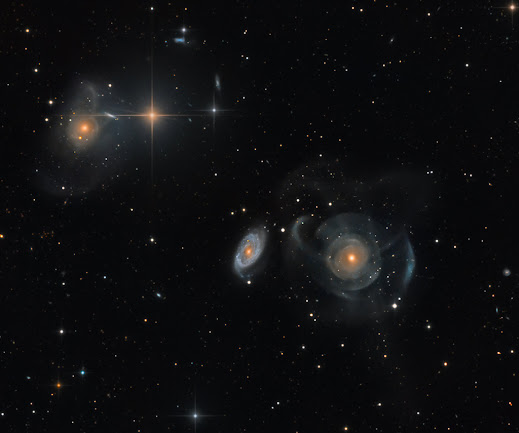
"A Look to the Heavens"

"This intergalactic skyscape features a peculiar system of galaxies cataloged as Arp 227 some 100 million light-years distant. Swimming within the boundaries of the constellation Pisces, Arp 227 consists of the two galaxies prominent right of center, the curious shell galaxy NGC 474 and its blue, spiral-armed neighbor NGC 470. 
The faint, wide arcs or shells of NGC 474 could have been formed by a gravitational encounter with neighbor NGC 470. Alternately the shells could be caused by a merger with a smaller galaxy producing an effect analogous to ripples across the surface of a pond. The large galaxy on the top lefthand side of the deep image, NGC 467, appears to be surrounded by faint shells too, evidence of another interacting galaxy system. Intriguing background galaxies are scattered around the field that also includes spiky foreground stars. Of course, those stars lie well within our own Milky Way Galaxy. The field of view spans 25 arc minutes or about 1/2 degree on the sky."

The Poet: Theodore Roethke, "In a Dark Time"

"In a Dark Time"

"In a dark time, the eye begins to see,
I meet my shadow in the deepening shade;
I hear my echo in the echoing wood-
A lord of nature weeping to a tree.
I live between the heron and the wren,
Beasts of the hill and serpents of the den.

What’s madness but nobility of soul
At odds with circumstance? The day’s on fire!
I know the purity of pure despair,
My shadow pinned against a sweating wall.
That place among the rocks- is it a cave,
Or winding path? The edge is what I have.

A steady storm of correspondences!
A night flowing with birds, a ragged moon,
And in broad day the midnight come again!
A man goes far to find out what he is-
Death of the self in a long, tearless night,
All natural shapes blazing unnatural light.

Dark, dark my light, and darker my desire.
My soul, like some heat-maddened summer fly,
Keeps buzzing at the sill. Which I is I?
A fallen man, I climb out of my fear.
The mind enters itself, and God the mind,
And one is One, free in the tearing wind."

- Theodore Roethke

"The Donkey and the Meaning of Eternity: Nobel-Winning Spanish Poet Juan Ramón Jiménez’s Love Letter to Life"

"The Donkey and the Meaning of Eternity: Nobel-Winning
 Spanish Poet Juan Ramón Jiménez’s Love Letter to Life"
by Maria Popova

Excerpt: "Beneath our anxious quickenings, beneath our fanged fears, beneath the rusted armors of conviction, tenderness is what we long for - tenderness to salve our bruising contact with reality, to warm us awake from the frozen stupor of near-living. Tenderness is what permeates Platero and I (public library) by the Nobel-winning Spanish poet Juan Ramón Jiménez (December 23, 1881–May 29, 1958) - part love letter to his beloved donkey, part journal of ecstatic delight in nature and humanity, part fairy tale for the lonely.

Living in his birthplace of Moguer - a small town in rural Andalusia - Jiménez began composing this uncommon posy of prose poems in 1907. Although it spans less than a year in his life with Platero, it took him a decade to publish it. At its heart is a simple truth: What and whom we love is a lens to focus our love of life itself.

The tenderness with which Jiménez regards Platero - whom he addresses by name over and over, like an incantation of love - is the tenderness of living with wonder and fragility. He celebrates Platero’s “big gleaming eyes, of a gentle firmness, in which the sun shines”; he reverences him as “friend to the old man and the child, to the stream and the butterfly, to the sun and the dog, to the flower and the moon, patient and pensive, melancholy and lovable, the Marcus Aurelius of the meadows.” He beckons him: “Come with me. I’ll teach you the flowers and the stars.”

And so he does: "Look, Platero, so many roses are falling everywhere: blue, pink, white, colorless roses… You’d think the sky was crumbling into roses… You’d think that from the seven galleries of Paradise roses were being thrown onto the earth… Platero, it seems, while the Angelus is ringing, that this life of ours is losing its everyday strength, and that a different strength from within, loftier, more constant, and purer, is causing everything, as if in fountain jets of grace… Your eyes, which you can’t see, Platero, and which you are mildly raising skyward, are two beautiful roses."

Together, poet and donkey traverse the Andalusian countryside in a state of rapturous harmony with each other and the living world: "Through the low-lying roads of summer, draped with tender honeysuckle, how sweetly we go! I read, or sing, or recite poetry to the sky. Platero nibbles the sparse grass of the shady banks, the dusty blossoms of the mallows, the yellow sorrel. He halts more than he walks. I let him.
[…]
Every so often Platero stops eating and looks at me. Every so often I stop reading and look at Platero."

There are echoes of Whitman in Jiménez’s exultations: "Before us are the fields, already green. Facing the immense, clear sky, of a blazing indigo, my eyes - so far from my ears! - open nobly, welcoming in its calm that indescribable placidity, that harmonious, divine serenity which dwells in the limitlessness of the horizon."

This longing for the infinite accompanies the young man and the old donkey as they cross the hills and valleys on their daily pilgrimages: "The evening extends beyond its normal limits, and the hour, infected with eternity, is infinite, peaceful, unfathomable."

Again and again, Platero’s presence magnifies the poet’s relishing of beauty, deepens his contact with the eternal: "I remain in ecstasy before the twilight. Platero, his black eyes scarlet with sunset, walks gently to a puddle of crimson, pink, and violet waters; he softly immerses his lips into the mirrors, which seem to liquefy as he touches them."

Punctuating these ecstasies are the inevitable spells of melancholy stemming from the fact that the price of being awake to life is being also awake to mortality. Aware that this enchanted life with his beloved Platero is only for the time being, Jiménez reaches into the sorrow of the future to consecrate it with joy: "Platero. I shall bury you at the foot of the large, round pine in the orchard at La Piña, which you like so much. You will remain alongside cheerful, serene life. The little boys will play and the little girls will sew beside you on their little low chairs. You will get to hear the verses that the solitude will inspire in me. You’ll hear the older girls singing when they wash clothes in the orange grove, and the sound of the waterwheel will be a joy and a solace to your eternal peace. And all year long the goldfinches, greenfinches, and vireos, in the perennial freshness of the treetop, will create for you a small musical ceiling between your tranquil slumber and Moguer’s infinite, ever-blue sky."
Full, wonderful article is here:

The Daily "Near You?"

Pretoria, South Africa. Thanks for stopping by!

"Winter Is Coming"

"Winter Is Coming"
by John Wilder

"The last few years have seen more change than the last twenty years, combined. This is to be expected, especially if you give Strauss and Howe’s "The Fourth Turning" idea any credence. A short version of The Fourth Turning (also known as Kondratieff Wave Theory) is that there is a roughly 80-year cycle of human affairs. Let me use the life of my Dad, Pa Wilder, to describe it:

When Pa Wilder was young he spent most of his childhood in Winter, the first defining experience of his life was the Great Depression. Back then, they had printed versions of the Internet that they would get delivered to their house every day, called newspapers. They also had cell phones that never needed charging, and that you could never lose because they were in the living room and conveniently connected by a cord to the wall.

I’m sure all of the kids on the playground talked with Pa about how obvious it was that the Federal Reserve’s® monetary policy, combined with bankers lending to anyone with a pulse led to near financial collapse. Oh, and how their parents couldn’t afford shoes. Thankfully, Pa lived in a farming community, and every little house in town had a very large garden out back. Food from the grocery store?

Why would you spend money on food when you had to pay for the mortgage? That’s the sort of lesson that bored itself into Pa Wilder’s mind. As a kid, he saw people lose houses, he saw people lose fortunes. He saw a nation nearing collapse.
Click image for larger size.
Economic collapse led to the second thing that defined Pa Wilder’s youth: World War II. Not long after Japanese planes attacked Pearl Harbor he was in boot camp in Ft. Sill and before long was a 2nd lieutenant in the Army. The next four years he spent on an all-expenses-paid European vacation

The end of the war was the end of Kondratieff Winter. What followed was Spring. In post-war United States, growth and unrivaled prosperity followed from 1945-1965. Pa Wilder, like the rest of the G.I. generation, came back and built families and factories and farms. They looked out at a world that was shattered, and they made fortunes rebuilding it. They even found Dean Martin’s favorite eel. Don’t remember that? It’s a moray.

Spring was characterized by extreme faith in government institutions – sure the government had fumbled the ball in the Great Depression, but it had unified the country for World War II. It stayed back enough to allow growth, and Eisenhower’s America got out of North Korea and planted the seeds for the Super Science® projects that would provide unmatched weapons systems and the seeds of space exploration.

Spring gives over to Summer. Around 1965, the spiritual awakening was followed in 1975 by the “Me” decade. In Summer, the economy is humming along, the weather is great, and the first questioning of the previous ideas that led to the success of the country begins. It’s probably no coincidence that the disastrous Immigration Act of 1965, the arguably unconstitutional Civil Rights Act of 1964, and Lyndon Johnson’s voter-plantation Great Society acts (1964 and 1965) took place at the start of Summer when Americans were questioning their values, questioning the things that made America great.

Pa Wilder was an established businessman, working as the president of a very conservative farm bank. You could get a loan, but only if you had collateral and a good income stream. Pa Wilder told more people “no” than “yes” for loans. That bothered him, with the exception of the fact that he told me, “I’ve never had to foreclose on a house, son.” To him, it was a moral duty. Thankfully Pa never served in the paratroopers, otherwise, they would have called him “debt from above.”

In society, however, the big splits had started in 1965. The subversion of colleges started and would be nearly complete by the 1980s. Religious decline started, and Nixon got tired of hiding the fiscal shenanigans of the country that gold was exposing. His solution? Get rid of gold.

But Summer was still a good time. Autumn, however, is harvest. Pa Wilder was pretty close to retirement at this point, and the real economic power had moved to the Boomers. Pa’s natural fiscal conservatism led to a strong and stable business. The people that took over from him, however, would “give a loan to anyone with a pickup and a backhoe.” They even loaned out money on haunted houses, places they were sure were going to be repossessed.

Inertia is important in an economic system. But in 1985 the financial systems of the United States began to be harvested. “Greed is good” became the motto, and systems were run entirely for near-term economic benefit. Everyone from Pa Wilder’s generation was dead or retired – the new people in charge had no living memory of the national crisis brought on by The Great Depression.

The end of Autumn is the first chill of Winter, and the end result was the Great Recession (right on time!) in 2007-2008. In the Winter, things fall apart. I’ve been really quite amazed that things have held together so well since that first cold snap. Obama was, well, a disappointment. Trump seemed (in many ways) overwhelmed by the system and couldn’t figure out how to move the levers of power in any significant and lasting ways – which makes sense on a failing system.

That was the starter’s gun on the crisis, the date Winter began. We should have been a long way through it by now, but this Winter is different: The United States had a uniquely dominant position at the start of Winter, having both complete military dominance as well as a strong economic dominance of the world. The Federal Reserve© decided to just print all the money that it could to spend its way into continued prosperity.

Sure, sometimes government wants to stop a crisis so that the citizens can have a stable country. Sometimes. But other times, governments are waiting for the crisis, looking forward to it. Planning on it. In one article titled Sometimes the world needs a crisis: Turning challenges into opportunities, the Brookings Institute lists the things they love about crises. I admit that some of them are positive, but here are a few that I think are a bit more ominous – these descriptions are directly from Brookings:

Systemic Change: Global crises that crush existing orders and overturn long-held norms, especially extended, large-scale wars, can pave the way for new systems, structures, and values to emerge and take hold. Without such devastation to existing systems and practices, leaders and populations are generally resistant to major changes and to giving up some of their sovereignty to new organizations or rules.

Dramatic Policy Shifts: Sometimes the fear generated from a crisis and corresponding public outcry enables and even forces leaders to make bold and often difficult policy moves, even in countries not involved in or affected by the crisis.

COVID-19 was the big crisis they were waiting for.  As the economic systems unwinded under the unsustainable debt the ‘Rona was the perfect opportunity. Imagine the tapestry of that you see was planned. What end was being sought? Well, they told us already. Systemic Change. Changes to virtually every system in the United States. Want to have a nice, neat, prosperous, and orderly community? Too bad. That’s not a thing that’s going to happen. The police will be neutered. How badly will communities suffer? Here’s how bad it was:

● Leftist controlled Chicago: arrests/stops were down 53 percent, murders are up 65 percent.
●Leftist controlled New York City: arrests/stops were down 38 percent, murders are up 58 percent.
●Leftist controlled Louisville: arrests/stops were down 35 percent, murders are up 87 (not a typo) percent.
●Leftist controlled Minneapolis: arrests/stops were down 42 percent, murders are up 64 percent.
●Leftist controlled Los Angeles: arrests/stops were down 33 percent, murders are up 51 percent.
● Leftist controlled St. Louis: in 2020, the murder rate hit “a 50-year high, with 87 out of every 100,000 residents being murdered.”

When there is murder and mayhem there is control. This is their plan. This is the crisis. Remove police – replace with ideological commissars that aren’t bound by law. Now, if they see a “crime” that they feel is wrong, they can punish it however they see fit. Most commonly, this will just be by removing the protection of the law and letting the mob do the rest. The biggest crimes? The crimes against the Left. That’s just the first of the planned Systemic Changes. There are more planned.

● Universal basic income.
● Boards to approve hiring at private companies.
● Equity everywhere.
●More rules than you can imagine. All of them will be based on some fear – guns in rural areas will be restricted because people in the city can’t stop killing each other.
● Climate change lunacy: to meet climate goals, Americans would be restricted to four pounds (344 milliliters) of meat a year. This will be walked back.
● And your ideas: they probably won’t be as bad as the real plans.

To be clear: Winter is here. The Left has an endless list of Leftist goals to accomplish during the crisis to come. The Winter will be dark. Where are our goals? The Right cannot just have the goals of “what the Left wants, but less,” or, “the opposite of what those guys want."After that? Organization. And leadership. And longjohns. Winter is here."

"Wars And Rumors Of War: The Middle East"

Col. Douglas Macgregor, 9/6/25
"What They’re Hiding About 
Israel Will Make You Angry!"
Comments here:
o
"Honey Badgers"
Scott Ritter has humorously described the Yemeni Houthis as "the honey badgers of the Middle East, absolutely fearless and relentlessly ferocious." They just simply don't care. They've declared war on Israel while all the other Muslim states just talk, and daily send missiles and drones to attack Israel. They totally control the 12 mile wide Bab-el-Mandab ("Gate of Grief") strait connecting the Red Sea and the Arabian Sea, which transits 40% of the world's oil. Closing that would have catastrophic consequences on global economies, and the Houthis know it. And so it is...
"Honey Badger Takes Savagery to a Whole New Level"
"Honey badgers are the Italian mafia of the animal kingdom. No one, and I mean no one, wants to mess with these savages. They literally woke up and chose violence on the daily. They are regarded as the most fearless animal in the wild and they back that up every day, all while looking like a ferret on steroids.

Honey badgers woke up and chose violence. They'll combat anything from lions, leopards, hyenas and even cobras and pythons. But how did they become so fearless? How do these compact sized danger-weasels take on the deadliest predators like it was a regular Sunday’s brunch with the girls? These are moments of honey badgers being straight up savages. Let's get into it."
Comments here:

"How It Really Is"


"Hyundai Caught in Illegal Workforce Scandal! The Dark Truth"

Full screen recommended.
Dan, I Allegedly, 9/6/25
"Hyundai Caught in Illegal 
Workforce Scandal! The Dark Truth"
"Hyundai is in hot water after an immigration raid at their electric car and battery plant south of Savannah, Georgia uncovered 475 illegal workers! In this video, I break down the shocking details of this scandal: unsafe working conditions, expired visas, and how these undocumented workers were paid under the table. This isn’t just about Hyundai - it’s about the rules we all follow while corporations bend them. Do you think heads will roll for this? We also discuss other eye-opening stories, like rising beef prices, food truck robberies across the country, and the latest updates on the housing market and mortgage rates. Things are tough, and the headlines keep piling up. From declining job numbers to major brands like Lululemon and PBS facing financial struggles, it’s clear - we’re navigating a time of big changes."
Comments here:

"Millions Of Homeowners Are Losing Money Now"

Full screen recommended.
Michael Bordenaro, 9/6/25
"Millions Of Homeowners Are Losing Money Now"
"Mortgage rate buy downs were the preferred method of home builders to offer incentives and discounts on properties over the past few years to get them sold without actually lowering the price. However, fast-forward to today, not only are home builders offering mortgage rate buy downs, but they're also offering price reductions and people who bought at peak prices are now starting to see their mortgage payments spike to much higher levels and now that the buy downs are expiring, many of these people are now losing money on the sale of their home."
Comments here:

Jeremiah Babe, "Two Bubbles Are About To Burst, Labor Market Nightmare"

Jeremiah Babe, 9/6/25
"Two Bubbles Are About To Burst, 
Labor Market Nightmare"
Comments here:

"The Employment Numbers Are Screaming That We Have A Major Crisis On Our Hands"

"The Employment Numbers Are Screaming 
That We Have A Major Crisis On Our Hands"
by Michael Snyder

"The employment numbers for the month of August were just released, and they are horrible. Sadly, they have now been horrible for several months in a row, and many economists are warning that conditions will get even worse during the months ahead. Other than during the early days of the pandemic in 2020, we haven’t seen anything like this since the Great Recession. If you have a job that you value, hold on to it very tightly, and if you are currently looking for work try to find something as soon as you can before competition for jobs becomes even more intense.

Each month, the U.S. economy must add about 150,000 new jobs just to keep up with population growth. According to the BLS, the U.S. economy only added 22,000 new jobs during the month of August… U.S. job growth continued to slow down in August, with just 22,000 new jobs—a sign that the labor market is deteriorating markedly. Friday’s report adds to a summer of slow hiring and points to a stagnant job market that has lengthened job searches, shut young people out of employment and increased unemployment for Black workers. This number was much worse than most analysts were projecting.

After the report was released, one prominent economist stated that it looks like the U.S. economy is “heading into turbulence without the soft landing achieved”… “The job market is stalling short of the runway,” said Daniel Zhao, chief economist at jobs site Glassdoor. “The labor market is losing lift, and August’s report, along with downward revisions, suggests we’re heading into turbulence without the soft landing achieved.”

Just like we have seen so many times before, the figure for the month of August will probably end up much lower once it is revised. So by the time it is all said and done, I expect that the final number for the month of August will actually be negative.

Interestingly, the number for the month of June was just revised down into negative territory…"On Friday, the BLS revised the prior two months’ data, showing that employers shed 13,000 jobs in June, revising the month’s hiring downward by 27,000 fewer jobs. That marks the first monthly decline in hiring since December 2020, when the U.S. was in the midst of an economic crisis caused by the pandemic." Please read that last sentence again.

Thanks to the birth-death model, it is very difficult for the BLS to actually produce a negative number. The last time it happened there were lockdowns all over the nation due to the pandemic. But now the number for June is negative.

That is a huge red flag, and Mark Zandi is suggesting that the U.S. economy may have already entered the next recession… “It’s clear the job market is struggling,” Mark Zandi, chief economist at Moody’s Analytics, told Fortune. “The economy is on the edge of recession: In fact, we may already be in one. As more revisions come in, it will probably show that employment is declining in a consistent way.”

Overall, during the first eight months of this year the U.S. economy has added the fewest jobs that we have seen since 2009.

Do you remember 2009? The Great Recession was a very difficult time. Would our country be able to handle another downturn of that magnitude? Personally, I think that it is a really bad sign that our economy continues to bleed manufacturing jobs…"The United States lost 12,000 manufacturing jobs for the month, continuing a downward trend since its most recent peak in February 2023, according to the federal Bureau of Labor Statistics."

This wasn’t supposed to happen. But it is happening. As I discussed yesterday, the numbers that we are getting are confirming over and over again that the U.S. economy is heading in the wrong direction. Unfortunately, we are being warned that our problems could soon accelerate even more. One economist is telling us that “the labor market has headed off a cliff-edge”… “August’s employment report confirmed that the labor market has headed off a cliff-edge,” Bradley Saunders, North America economist at Capital Economics, said in a Friday research report."

That doesn’t sound good at all. If you want to look for a silver lining, the good news is that it looks like the Federal Reserve will probably give us a rate cut next month. One economist is urging the Fed to give us rate cuts in October and December too…“The Federal Reserve needs to cut interest rates in September and probably October and December, too. The ‘no hiring’ economy is turning to a layoff economy and if that worsens, it will lead to a recession. This needs to be stopped,” Heather Long, chief economist at Navy Federal Credit Union, said in an email."

Hopefully those rate cuts will actually happen, because we desperately need them. But cutting rates will not reverse our economic momentum. And the government numbers are not giving us the full picture. As I have documented in previous articles, government economic numbers almost always make things look better than they actually are.

I believe that the numbers that we get from private sources are much more accurate. According to a new report that was just released by Challenger, Gray & Christmas, the number of announced job cuts in August was 39 percent higher than it was in July…"U.S.-based employers announced 85,979 job cuts in August, up 39% from the 62,075 announced in July. It is up 13% from the 75,891 announced in the same month last year, according to a report released Thursday from global outplacement and business and executive coaching firm Challenger, Gray & Christmas."

August’s total was the highest for the month since 2020 when 115,762 job cuts were recorded. After 2020, it is the highest August total since the thick of the Great Recession in 2008, when 88,736 cuts were announced. August marks the sixth time this year that the job cut total surpassed that of the corresponding month one year prior. Can anyone out there think of a way to make those numbers look good? Because I can’t.

Overall, the number of announced job cuts in the United States is up 66 percent compared to last year…So far this year, companies have announced 892,362 job cuts, the highest YTD since 2020 when 1,963,458 were announced. It is up 66% from the 536,421 job cuts announced through the first eight months of last year and is up 17% from the 2024 full year total of 761,358. That last number totally blew me away. We still have four months left to go in 2025, and we have already beat last year’s grand total by 17 percent.

Let’s be very honest with ourselves. We have a major crisis on our hands. And as bad as things are now, the truth is that they will soon get even worse. The consequences of decades of incredibly bad decisions are starting to catch up with us in a major way. Brace yourselves and your families for what is coming next, because the months ahead are not going to be pretty."

Friday, September 5, 2025

Musical Interlude: 2002, “Deep Still Blue”

Full screen recommended.
2002, “Deep Still Blue”

"A Look to the Heavens"

"Is this one galaxy or two? The jumble of stars, gas, and dust that is NGC 520 is now thought to incorporate the remains of two separate disk galaxies. A defining component of NGC 520 - as seen in great detail in the featured image from the Hubble Space Telescope - is its band of intricately interlaced dust running vertically down the spine of the colliding galaxies. A similar looking collision might be expected in a few billion years when our disk Milky Way Galaxy to collides with our large-disk galactic neighbor Andromeda (M31). 
The collision that defines NGC 520 started about 300 million years ago. Also known as Arp 157, NGC 520 lies about 100 million light years distant, spans about 100 thousand light years, and can be seen with a small telescope toward the constellation of the Fish (Pisces). Although the speeds of stars in NGC 520 are fast, the distances are so vast that the battling pair will surely not change its shape noticeably during our lifetimes."

The Poet: Mary Oliver, "Mysteries, Yes"

"Mysteries, Yes"

"Truly, we live with mysteries too marvelous
to be understood.
How grass can be nourishing in the
mouths of the lambs.
How rivers and stones are forever
in allegiance with gravity
while we ourselves dream of rising.
How two hands touch and the bonds
will never be broken.
How people come, from delight or the
scars of damage,
to the comfort of a poem.
Let me keep my distance, always, from those
who think they have the answers.
Let me keep company always with those who say
"Look!" and laugh in astonishment,
and bow their heads."

~ Mary Oliver

"Reality Avoidance"

"Reality Avoidance"
by Morris Berman

"It’s quite amazing how the news is endlessly about filler, which is what I call it. Very little of this has anything to do with reality, which the Mainstream Media and the American people avoid like the plague. What then is real?

1. The empire is in decline; every day, life here gets a little bit worse; all our institutions are corrupt to varying degrees; and there is no turning this situation around.

2. A crucial factor in this decline and irreversibility is the low level of intelligence of the American people. Americans are not only dumb; they are positively antagonistic toward the life of the mind.

3. Relations of power and money determine practically everything. The 3 wealthiest Americans own as much as the bottom 50% of the population, and this tendency will get worse over time.

4. The value system of the country, and its citizens, is fundamentally wrong-headed. It amounts to little more than hustling, selfishness, narcissism, and a blatant disregard for anyone but oneself. There is a kind of cruelty, or violence, deep in the American soul; many foreign observers and writers have commented on this. Americans are bitter, depressed, and angry, and the country offers very little by way of community or empathy.

5. Along with this is the support of meaningless wars and imperial adventures on the part of most of the population. That we drone-murder unarmed civilians on a weekly basis is barely on the radar screen of the American mind. In essence, the nation has evolved into a genocidal war machine run by a plutocracy and cheered on by mindless millions.

Most Americans hide from these depressing, even horrific, realities by what passes for ‘the news’, but also by means of alcohol, opioids, TV, cellphones, suicide, prescription drugs, workaholism, and spectator sports, to name but a few. This stuffing of the Void is probably our primary activity. In a word, we are eating ourselves alive, and only a tiny fraction of the population recognizes this."

"The Cost Of Raising Kids Is Completely Out Of Control!"

Full screen recommended.
Michael Bordenaro, 9/5/25
"The Cost Of Raising Kids 
Is Completely Out Of Control!"
Comments here:

"This Proves Everything: Don't Say I Didn't Warn You!"

Full screen recommended.
Steven Van Metre, 9/5/25
"This Proves Everything: 
Don't Say I Didn't Warn You!"
Comments here:

The Daily "Near You?"

Oklahoma City, Oklahoma, USA. Thanks for stopping by!

"I Went to Most Popular Park in Moscow: VDNKh"

Full screen recommended.
Travelling With Russell, 9/5/25
"I Went to Most Popular Park in Moscow: VDNKh"
"On the last day of Summer, what do you do in Russia? Take a walk around the World Famous VDNKh Park in Moscow, Russia. First opened in 1935, VDNKh serves to highlight the Exhibition of Achievements of the National Economy. The Soviet name VDNKh is an acronym meaning 'the Exhibition of the Achievements of the National Economy.'"
Comments here:

"The Worst Part..."

"People cry not because they are weak.
It's because they've been strong for too long."
 - Johnny Depp

"Col. Douglas Macgregor, 'America: A Dangerous Time On The Brink Of Annihilation'"

Gerald Celente, 9/5/25
"Col. Douglas Macgregor, 'America: 
A Dangerous Time On The Brink Of Annihilation'"
"The Trends Journal is a weekly magazine analyzing global current events forming future trends. Our mission is to present Facts and Truth over fear and propaganda to help subscribers prepare for What’s Next in these increasingly turbulent times."
Comments here:

Judge Napolitano, "INTEL Roundtable w/Johnson & McGovern: Weekly Wrap 5-September"

Judge Napolitano - Judging Freedom, 9/5/25
"INTEL Roundtable w/Johnson & McGovern: 
Weekly Wrap 5-September"
Comments here:

"How It Really Is"


Adventures With Danno, "A Very Disappointing Trip To Meijer"

Adventures With Danno, AM 9/5/25
"A Very Disappointing Trip To Meijer"
Comments here:

"Publishers Clearing House - The Checks Just Stopped!"

Full screen recommended.
Dan, I Allegedly, AM 9/5/25
"Publishers Clearing House - 
The Checks Just Stopped!"
"Publishers Clearing House has stopped their famous prize checks, leaving winners in a tough financial spot. In today’s video, I explain how this shocking situation unfolded and why it’s a powerful reminder to always choose the lump sum when offered payments. From lawsuits and bankruptcy to financial advice about annuities and settlements, this story has it all. Plus, I share insights into other financial news, including Spirit Airlines' bankruptcy and lessons from Bobby Bonilla's legendary annuity deal."
Comments here:

"The FED Is About To Make Things Much Worse, Careful What You Wish For"

Jeremiah Babe, 9/5/25
"The FED Is About To Make Things Much Worse, 
Careful What You Wish For"
Comments here:

Bill Bonner, "All Aboard"

"All Aboard"
by Bill Bonner

Paris, France - "The train keeps rumbling and trundling down the tracks. Out the window, the most exciting financial trend we’ve seen so far this year? Al Jazeera: "The gold market is booming as investors seek a safe haven for their investments amid global economic uncertainty. The price of gold has risen by nearly a third over the past year, surpassing $3,550 per ounce on Wednesday to hit an all-time high." And the biggest worry? Bloomberg: "Global Bond Selloff Deepens with Longer Debt Leading Losses."

What are these news stories telling us? We don’t know for sure, but we think this train is headed for a place that begins with an ‘s.’ “The real problem is the money…the dollar,” we explained to French friends last night.

“When the Nixon administration switched to a pure-paper currency, it falsified our money and skewed everything. Foreigners were able to make things cheaper…partly because they are just lower-cost competitors…but also because the US was pumping up labor rates, along with everything else.”

Today, the ‘labor cost’ part of making a product in China, for example, is only about 1/5th of what it is in the US. In Vietnam, it’s only 1/16th as much as the US. This labor cost gap widened after the phony dollar was put into service. As the fountainhead of worldwide money-printing, US manufacturing costs increased faster than those of other countries - making the US less and less attractive as a place to make things. That’s why so many things are no longer ‘Made in America.’

“It had nothing to do with the lack of tariffs…or with foreigners taking advantage of us,” we continued. “Last year, trillions in trade changed hands, at low tariff taxes…with less than 1% average difference between what we had to pay in tariffs and what others paid us. Tariffs were never the problem. And raising them now won’t solve anything. It will just raise costs by creating new barriers to trade.”

That little discourse seemed to do the trick. Our friends changed the subject. We’d like to change the subject too. But our subject is money. And the new tariff regime is going to ‘play Hell’ with it.

Tariffs are essentially a sales tax. And a sales tax - averaging maybe 15% - is going to reduce consumer purchasing power…and cut into sales and profits. That is, it will be downer.Fewer goods and services will trade hands. GDP growth will slow. Sales and profits will fall. A real slowdown, in other words. And look, we strain our eyes…we can now make out the first four letters of the sign ahead - s, t, a, and g….

The tariffs may be struck down next month, along with many other features of the Big Man’s rule. Not knowing what comes next also contributes to a slowdown. No one wants to make a major financial decision while so many balls are up in the air. They might come down on our heads.

Rising bond yields (falling prices for bonds) tell much the same story. It will be more expensive to borrow money tomorrow than it was yesterday. Projects that might have made sense in May or June are looking less attractive in September. Because the cost of finance has gone up.

But of course…there’s always more to the story, isn’t there? And the more to this story is on the signpost ahead -- f, l, a, t, i, o, n. That’s the part the gold market is probably talking about.

Tariffs will drive up prices. So will uncertainty itself. Producers will be reluctant to ramp up output. They will want to see sustained price increases before they make further investments. Supplies will go down; prices will go up. And the job market will soften. A report out yesterday told us that the feds are about to announce a big revision in the unemployment numbers – in which almost a million jobs will disappear. And then, the Fed, whose job is to make sure we have full employment, will have to lower interest rates…and ‘print’ more money. Next stop. Stagflation."