StatCounter

Thursday, August 28, 2025

“Get Up Off Your Knees!”

“Get Up Off Your Knees!”
On your knees you may live to see another day, 
but you’ll never live to see better days.
by Robert Gore 

“Zoos are among the saddest places on earth: magnificent but confined creatures on display for gawking crowds, prevented from living out their biological destinies, fed their daily rations, and domesticated beyond where they could ever return to the wild. You have to feel pity and sorrow for these innocent prisoners; they’d flee in a heartbeat if they could.

Humans have made themselves inmates – whether of a zoo, prison, or asylum is hard to say, likely a combination of all three. Animals earn our admiration because they resist losing their freedom. Humans occasionally do too, but usually surrender theirs for promises and trifles. The promises are broken and the trifles grow more trifling as humanity for the most part gives up. Keep people amused and make sure the rations don’t stop and no outrage rousts them to try to reclaim their birthright. When they visit the zoo, the animals stare back at them with contempt.

In this country, we sing, “Sweet land of liberty,” and, “The land of the free, and the home of the brave.” We incant “freedom” and “liberty” during election seasons, but anything beyond that is considered embarrassing, bad form. A legislator denouncing a proposed law as an infringement of freedom would be regarded as a lunatic. Millions of pages of federal, state, and local laws and regulations already infringe freedom. The denouncer might be irrefutably right, but his denunciation would be irrelevant.

While wildlife should be free in the wild, coping with the risks to the best of their capabilities, humans are supposedly unsuited for freedom. Free humans might develop their own talents and capabilities, produce, exchange, exercise their rights, and engage in voluntary association and social intercourse, all unsupervised. You can argue that such activities are generally beneficial. However, there is a special class who are permitted to supervise and coerce the rest of us, to curtail our freedom. This special class ensures fairness or equality or some such thing. Who knows what might happen without them. Think of the dangers!

Just consider the concept of people deciding what’s in their own best interest. A hyphenated word lurks: self-interest. The special people are motivated by everything but self-interest, or so they say. Indeed, nobility of motive justifies their power and the destruction of your liberty. The desire to better your life is selfish, unlike the impulses supposedly animating those holding the guns to your head. After widespread surrender, few champion their right to their own lives, which is selfish after all, or challenge the special people’s moral superiority, which confers their right to hold the guns.

It might mitigate moral condemnation for liberty’s surrender if it had produced some benefit for those waving the white flag. An old bromide has it that liberty is irrelevant when people are starving. Nothing is further from the truth; it’s freedom that feeds people, creates wealth, and advances humanity. The historical record offers ample proof. It’s the absence of liberty that produces starvation, poverty, decay, destruction, genocide, and war. Here too the historical record is clear, one need go no farther back than the last century. During this ascendancy of the special people, humanity fought its two deadliest wars and over a hundred million were murdered, victims of special plans for a better world.

But somehow it’s liberty that’s dangerous. Fortunately the special people still rule, to make sure it doesn’t break out somewhere. Their reign assures that this century will challenge the last for the title: Century of Slaughter. They see their subjects are domesticated draft animals, just smart enough to keep economies running, not smart enough to challenge domestication. However, it’s been free minds and free markets, not draft animals, that have produced the wonders that make modern life modern. Welfare states are halfway houses to totalitarianism. As they grow, liberty shrinks and progress slows, stops, and reverses, the deterioration culminating in either anarchy or tyranny.

Judging from the prevalence of terms like “secular stagnation” and the “end of growth,” we are in the stop phase and reversal is nigh. People have seen their freedom shrink and have borne the consequences, although most don’t make the connection between the two. Incomes have stagnated, opportunities have diminished, life grows ever coarser, and fear of a looming apocalypse pervades the popular consciousness. Many are preparing for a future in which modernity is no longer modern, where access to necessities and conveniences cannot be taken for granted. Guns and gold are at the top of checklists, for a day when the inevitable failure of the special people leads to the inevitable tyranny or anarchy.

The discontent sweeping the planet is recognition that things are wrong on multiple fronts, although recognition of the root cause is rare. The idea that changing the hands on the levers offers solutions is magical thinking. The problems stem from granting the special people the levers in the first place. They may be replaced, but once the replacements have their hands on the levers, they’ll feel special, too. Power assuredly corrupts.

We’re closer to the real solution in the lament: “Why can’t they just leave us alone?” They – the special people – must leave us alone, it’s our moral right. Those who think the collapse will never come, or that freedom can be reclaimed without a fight, delude themselves. The craven adage: It’s better to live on one’s knees than die on one’s feet, offers a false choice. On your knees you may live to see another day, but you’ll never live to see better days. You may die on your feet, but liberty offers the only hope for better days. It’s worth fighting for. It’s worth dying for.”

“Why Albert Einstein Thought We Were All Insane”

“Why Albert Einstein Thought We Were All Insane”
by Simon Black

“In the early summer of 1914, Albert Einstein was about to start a prestigious new job as Director of the Kaiser Wilhelm Institute for Physics. The position was a big deal for the 35-year old Einstein – confirmation that he was one of the leading scientific minds in the world. And he was excited about what he would be able to achieve there. But within weeks of Einstein’s arrival, the German government canceled plans for the Institute; World War I had broken out, and all of Europe was gearing up for one of the bloodiest conflicts in human history.

The impact of the Great War was immeasurable. It cost the lives of 10 million people. It bankrupted entire nations. The war ripped two major European powers off the map – the Austro Hungarian Empire, and the Ottoman Empire – and deposited them in the garbage can of history. Austria-Hungary in particular boasted the second largest land mass in Europe, the third highest population, and one of the biggest economies. Plus it was a leading manufacturer of high-tech machinery. Yet by the end of the war it would no longer exist.

World War I also played a major role in the emergence of communism in Russia through the 1917 Bolshevik revolution. Plus it was also a critical factor in the astonishing rise of the Nazi party in Germany. Without the Great War, Adolf Hitler would have been an obscure Austrian vagabond, and our world would be an entirely different place.

One of the most bizarre things about World War I was how predictable it was. Tensions had been building in Europe for years, and the threat of war was deemed so likely that most major governments invested heavily in detailed war plans. The most famous was Germany’s “Schlieffen Plan”, a military offensive strategy named after its architect, Count Alfred von Schlieffen. To describe the Schlieffen Plan as “comprehensive” is a massive understatement.

As AJP describes in his book "War by Timetable", the Schlieffen Plan called for rapidly moving hundreds of thousands of soldiers to the front lines, plus food, equipment, horses, munitions, and other critical supplies, all in a matter of DAYS. Tens of thousands of trains were criss-crossing Europe during the mobilization, and as you can imagine, all the trains had to run precisely on time. A train that was even a minute early or a minute late would cause a chain reaction to the rest of the plan, affecting the time tables of other trains and other troop movements. In short, there was no room for error.

In many respects the Schlieffen Plan is still with us to this day – not with regards to war, but for monetary policy. Like the German General Staff more than a century ago, modern central bankers concoct the most complicated, elaborate plans to engineer economic victory. Their success depends on being able to precisely control the [sometimes irrational] behavior of hundreds of millions of consumers, millions of businesses, dozens of foreign nations, and trillions of dollars of capital. And just like the obtusely complex war plans from 1914, central bank policy requires that all the trains run on time. There is no room for error.

This is nuts. Economies are comprised of billions of moving pieces that are beyond anyone’s control and often have competing interests. A government that’s $37 trillion in debt requires cheap money (i.e. low interest rates) to stay afloat. Yet low interest rates are severely punishing for savers, retirees, and pension funds (including Social Security) because they’re unable to generate a sufficient rate of return to meet their needs.

Low interest rates are great for capital intensive businesses that need to borrow money. But they also create dangerous asset bubbles and can eventually cause a painful rise in inflation. Raise interest rates too high, however, and it could bankrupt debtors and throw the economy into a tailspin. Like I said, there’s no room for error – they have to find the perfect balance between growth and inflation.

Several years ago hedge fund billionaire Ray Dalio summed it up perfectly when he said, “It becomes more and more difficult to balance those things as time goes on. It may not be a problem in the next year or two, but the risk of not getting it right increases with time.” The risk of them getting it wrong is clearly growing. I truly hope they don’t get it wrong. But if they ever do, people may finally look back and wonder how we could have been so foolish to hand total control of our economy over to an unelected committee of bureaucrats with a mediocre track record… and then expect them to get it right forever. It’s pretty insane when you think about it.

As Einstein quipped at the height of World War I in 1917, “What a pity we don’t live on Mars so that we could observe the futile activities of human beings only through a telescope…”

"Reflect On What Happens..."

“Reflect on what happens when a terrible winter blizzard strikes. You hear the weather warning but probably fail to act on it. The sky darkens. Then the storm hits with full fury, and the air is a howling whiteness. One by one, your links to the machine age breakdown. Electricity flickers out, cutting off the TV. Batteries fade, cutting off the radio. Phones go dead. Roads become impassible, and cars get stuck. Food supplies dwindle. Day to day vestiges of modern civilization – bank machines, mutual funds, mass retailers, computers, satellites, airplanes, governments – all recede into irrelevance. Picture yourself and your loved ones in the midst of a howling blizzard that lasts several years. Think about what you would need, who could help you, and why your fate might matter to anybody other than yourself. That is how to plan for a secular winter. Don’t think you can escape the Fourth Turning. History warns that a Crisis will reshape the basic social and economic environment that you now take for granted.”
– Strauss and Howe, “The Fourth Turning”

The Daily "Near You?"

Lafayette, Louisiana, USA. Thanks for stopping by!

"The Trick..."

“The trick is in what one emphasizes. We either make ourselves miserable,
or we make ourselves happy. The amount of work is the same.”
- Carlos Castaneda

"Daily Life Of A Russian Girl In Moscow"

Full screen recommended
Lisa With Love, 8/28/25
"Daily Life Of A Russian Girl In Moscow"
Comments here:
o
Full screen recommended.
Travelling with Russell, 8/28/25
"What Does a Russian (State Run) 
High School Look Like?"
"What does a Russian High School look like inside? Join me on a tour of a newly renovated Russian High School that is set to open on September 1st 2025. Shkola No. 1596 in Novoperedelkino recently underwent a full renovation in time for the new school year."
Comments here:

Gerald Celente, "The Whole System Will Collapse"

Strong language alert!
Gerald Celente, 8/28/25
"The Whole System Will Collapse"
"Gerald Celente, Founder & Director of the Trends Research Institute and Publisher of the weekly Trends Journal magazine, In this video Gerald talked about gold, silver, debt, financial markets going forward, geopolitical events shaping the world today and tomorrow as well as real-estate market and banking sector."
Comments here:

"How It Really Is"


"The Mass Shooting In Minneapolis Followed A Pattern That Is Becoming Very Familiar"

"The Mass Shooting In Minneapolis Followed 
A Pattern That Is Becoming Very Familiar"
by Michael Snyder

"We have seen this happen way too many times before. Over and over again, mass shootings are being committed by deranged individuals that hate conservatives and hate Christians. More often than not, the shooters are deeply involved in an alternative sexual lifestyle, and so they view conservatives and Christians as their “oppressors”. Frequently, the shooters have some sort of a personal connection to the particular target that has been chosen. Of course in so many of these cases the mainstream media will completely ignore the real reason why a mass shooting has taken place. But the American people are not stupid. We can all see what is happening, and it is time for the mainstream media to start admitting the truth.

The mass shooting that just occurred in Minneapolis should be a major wake up call for all of us. At 8:30 in the morning, the shooter showed up at the Annunciation Catholic Church dressed in all black and opened fire on children as they sat in the pews…"Minneapolis Police Chief Brian O’Hara said law enforcement responded to the shooting around 8:30 a.m. Wednesday morning. O’Hara said the shooter fired a rifle through church windows and was also armed with a shotgun and a pistol. A government official briefed on the investigation and a law enforcement source told CBS News that the shooter was wearing all black clothing. An 8-year-old and a 10-year-old were killed while they sat in the pews. The parents of the children have been notified, O’Hara said. Seventeen others, including 14 children, were injured."

Any church or school that does not have armed security in this environment is not being wise. The world that we live in is completely different than it was 40 or 50 years ago. When I was growing up, I never imagined for one second that some nut with a gun would come in to my school and start shooting. But now our society is literally teeming with dangerous lunatics.

In this instance, the shooter blocked the church doors so that the children could not escape before he began shooting through the church windows…"Police said at least two of the church doors appeared to have been blocked by two by fours before the shooting, suggesting Westman wanted to trap the people inside. ‘During the mass, the gunman approached on the outside, on the side of the building, and began firing a rifle through the church windows towards the children sitting in the pews at the mass,’ O’Hara said. ‘Shooting through the windows, he struck children and worshipers that were inside the building.’

I don’t like to write about things like this, and I am sure that many of you don’t like to read about things like this. But this is our world now, and sticking our heads in the sand isn’t going to do anyone any good.

FBI Director Kash Patel has announced that this mass shooting will be investigated as a hate crime…"FBI Director Kash Patel said the FBI is investigating the shooting at a Minneapolis Catholic school mass as an act of domestic terrorism and hate crime in a post on X. “The FBI is investigating this shooting as an act of domestic terrorism and hate crime targeting Catholics,” Patel wrote."

Of course it was a hate crime. Christians were specifically targeted for what they believe. The shooter has been identified as Robin Westman. It has been confirmed that Westman’s name was officially changed in 2020…"Three law enforcement sources told CBS News the shooter was Robin Westman, 23, from suburban Minneapolis. Westman’s name was officially changed from Robert Westman to Robin Westman in 2020, documents show."

We have also learned that Westman was a former student of the school, and Westman’s mother previously worked there…"A law enforcement official told the New York Times that Westman is believed to have been a former student at the school. They also told the outlet the suspect’s mother previously worked at the campus."

There is the personal connection. We see it in so many of these cases. After adopting a new lifestyle, Westman apparently developed an intense hatred for Christians. But instead of shooting adults, Westman came up with a plan to slaughter children. I think that the term “demonic” accurately describes what Westman had become.

The first page of his very sick manifesto is currently circulating on social media. It clearly shows that he planned all of this well in advance.


Westman also posted a video on YouTube shortly before the mass shooting. The video has been taken down, but it is being reported that the video revealed Westman’s “twisted obsession with other school shooters, dislike of Trump and mockery of the church”… However, a chilling video shared on a now-deleted YouTube account appears to reveal the killer’s sick manifesto. In the 20-minute-long video, the 23-year-old showed off her kill kit of ammunition, magazines and firearms and revealed her twisted obsession with other school shooters, dislike of Trump and mockery of the church.

I want to stress that this was not an isolated incident. We have seen so many other similar mass shootings, and there are countless others out there that could strike at any time. In our society today, we have such a problem with mental illness. Others would call it something else. But whatever you want to call it, there is no denying that something was very, very wrong with Robin Westman…"In the video, titled “So long and thanks for all the fish,” Westman slowly turns the pages of the red notebook, which is laid out on top of what appears to be schematic gun diagrams, one of them reading “Ruger Mark IV.” As she flips the pages, an occasional plume of smoke is seen from the bottom of the screen, punctuated by coughs, disjointed cursing and maniacal giggles.

Each page is filled with inscrutable handwritten doggerel, much of it in Cyrillic, which includes violent ramblings such as “I have had thoughts about mass murder for a long time. I am very conflicted with writing this journal,” the text, translated by The Post, reads in part.

We are also being told that in the video Westman expressed admiration for other prominent mass shooters…"The unhinged shooter also expressed deep admiration for mass shooters — including Sandy Hook killer Adam Lanza. “I have a deep fascination with one man in particular: Adam Lanza,” she wrote in the journal on May 23 in reference to the 20-year-old perpetrator of the worst elementary school shooting in US history, which left 20 first-grade students and six adults dead. “Sandy Hook was my favorite, I think, exposure of school shootings.”

When one incident like this happens, it inspires others to do the same thing. So please watch over those you love very carefully in the days ahead. Because lunatics like Westman are literally everywhere. And they are increasingly beginning to network with one another using the Internet. The New York Post just published an article about the rise of ultra-violent leftist groups, and I believe that what we have witnessed so far is just the beginning.

I have never seen more hatred in our society than I am seeing right now. It is just a matter of time before all of this hatred explodes in wild and unpredictable ways, and that is why all of us need to start taking security more seriously than ever before."

"Peter Schiff: The Economic Collapse Is Accelerating"

Glenn Diesen, 8/28/25
"Peter Schiff: The Economic Collapse Is Accelerating"
Comments here:
o
Cozy, 8/28/25
"Western Economies Collapsing as 
10 African Nations Ban Raw Exports!"
"Africa is no longer playing by the old rules. Ten African nations, including Ghana, Uganda, Gabon, Niger, and Namibia, have imposed historic bans on raw exports - from gold and uranium to lithium and cocoa. This bold move is shaking up global trade and exposing the West’s deep reliance on Africa’s resources. For decades, Western economies thrived on cheap African raw materials, refining them abroad and selling them back at massive profits. But now, the tide has turned. African nations are keeping more value at home, building industries, creating jobs, and reclaiming economic power."
Comments here:

Dan, I Allegedly, "Your Password Can Be Hacked in 1 Minute - Hackers Know It All!"

Full screen recommended.
Dan, I Allegedly, AM 8/28/25
"Your Password Can Be Hacked in 1 Minute - 
Hackers Know It All!"
"Google is sounding the alarm: a massive hack has compromised 2.6 billion accounts! In today’s video, we’re diving into how hackers are bypassing two-factor authentication, stealing personal data, and even exploiting AI to breach accounts faster than ever. From weak passwords like "123456" to shocking government system shutdowns and growing financial struggles, we’ve got a lot to unpack. Stay vigilant, update your passwords, and protect yourself from these cyber threats!"
Comments here:

Adventures With Danno, "Great Items To Stock Up On At Kroger Right Now!"

Full screen recommended.
Adventures With Danno, AM 8/28/25
"Great Items To Stock Up On At Kroger Right Now!"
Comments here:
o
Tommybites Homestead, AM 8/28/25
"Happening Now - 
Kroger Is Shutting Down Multiple Locations"
Comments here:

Wednesday, August 27, 2025

"Alert! NATO Hunts Nuke Sub! NORAD 4th Intercept!"

Full screen recommended.
Prepper News, 8/27/25
"Alert! NATO Hunts Nuke Sub! NORAD 4th Intercept!"
Comments here:

Jeremiah Babe, "Americans Are Done With Guilt Tripping"

Jeremiah Babe, 8/27/25
"Americans Are Done With Guilt Tripping;
 Radioactive Barrels Flood The Atlantic; Mass Layoffs"
Comments here:

Michael Bordenaro, "More Home Buyers Than Ever Are Cancelling Contracts"

Full screen recommended.
Michael Bordenaro, 8/27/25
"More Home Buyers Than Ever 
Are Cancelling Contracts"
Comments here:

"Domino's Can't Even Sell Pizzas... Something is VERY Wrong!"

Full screen recommended.
Steven Van Metre, 8/27/25
"Domino's Can't Even Sell Pizzas...
 Something is VERY Wrong!"
Comments here:

Musical Interlude: Marvin Gaye, "Inner City Blues"

Marvin Gaye, "Inner City Blues" 
("Make Me Wanna Holler")

"A Look to the Heavens"

“Far beyond the local group of galaxies lies NGC 3621, some 22 million light-years away. Found in the multi-headed southern constellation Hydra, the winding spiral arms of this gorgeous island universe are loaded with luminous young star clusters and dark dust lanes. Still, for earthbound astronomers NGC 3621 is not just another pretty face-on spiral galaxy. Some of its brighter stars have been used as standard candles to establish important estimates of extragalactic distances and the scale of the Universe.
This beautiful image of NGC 3621 traces the loose spiral arms far from the galaxy's brighter central regions that span some 100,000 light-years. Spiky foreground stars in our own Milky Way Galaxy and even more distant background galaxies are scattered across the colorful skyscape.”

“More to Come…”

“More to Come…”
By Jeff Thomas

“Years ago, when visiting the US, I’d often watch late night television. Just prior to each interval, in order to ensure that viewers would sit through the adverts, the show would run a panel that said, “More to Come.” This, of course, was effective, as the viewer would be anticipating that the best part of the program would come in a later segment and would be more likely to continue watching.

Today, we’re looking at the reverse of that situation. The program we’re watching is The Decline and Fall of the American Empire and those who recognize the decline are viewing with ever-increasing trepidation, the developments that are unfolding there. Even those of us who are not American and don’t live there are glued to our screens, as we’re aware that were viewing the early stages of a collapse that promises to be the greatest social, political and economic event that we’re likely to see in our lifetimes.

Following World War Two, the US was in a boom beyond anything the world had ever seen. The Americans came to the war late, after having built up their manufacturing capacity for war dramatically, at the expense of the Allied powers in Europe. And they did this, essentially for free. It was paid for with the gold from the vaults of the European allies. After the war, Europe was trashed and it would take decades for them to get on their feet again. Meanwhile, the US had been going flat out in production, had first-rate modern factories and, most important, held the majority of the world’s gold.

The 1944 Bretton Woods Agreement ensured that the US dollar would become the world’s default currency and, later, become the petrodollar, ensuring American hegemony over much of the rest of the world. There can be no doubt that, in the first decades after the war, the US had an amazing run and was, arguably, one of the best places to live in the world.

But, unfortunately, as so often happens, American political and industry leaders became full of themselves and couldn’t resist going out on limb to gain even more for themselves. In so doing, they turned the US from the world’s foremost creditor nation into the world’s foremost debtor nation. Worse, when they reached this unprecedented point, they opted to just keep going.

Worse still, it would appear that today’s leaders are aware that the mother of all bubbles that they’ve created is going to pop sometime in the near future, as they’re preparing themselves for the mother of all pushbacks from the populace when the crashes come.

The FBI, CIA, NSA, and a host of other authorities have either been created or expanded, allowing the creation of the world’s foremost police state. And, beginning in 2001 with the Patriot Act, have created a host of laws to assign authority to any of those bodies to exert ever-increasing control over the population. Capital controls, migration controls, higher taxes, confiscation of deposits in banks and quite a bit more have been passed in legislation, including the ability to declare the US in its entirely to be a “battle zone,” through which habeas corpus and the court system can be suspended nationally.

Yipes. (Or, blimey, depending on where you’re from.) At this point, any American who’s paying attention could be forgiven if he’s genuinely frightened at where his government is going with all this.

And so, we come back to the title of this essay – “More to Come.” A regular flow of proposed laws is now coming down the pipeline that would have been considered the stuff of a bad movie a few decades ago, but is now only too real and threatening to the freedoms of the average citizen. Instead of “more to come” meaning that the best is still on the way, the opposite would appear to be the case, and the worst is here, now.

But, how can this be, we ask ourselves. Surely those in power – the politicians, the industrialists, the central bankers, etc., must have seen this coming and, if that’s so, surely they’d have done something to stop it. Well, historically, that’s never been the case. Those in the greatest positions of power have never suddenly reversed an empire when it was about to self-destruct. What they tend to do instead is to guard against becoming casualties of the disaster they’ve created.

So, is that what’s happening this time around? In a word, yes. The Bernie Madoffs of the world go to jail. However, those who commit the same fraudulent acts from within the system never go to jail. For example, if the heads of a bank commit massive fraud, the bank pays an enormous fine. The fine is then paid by the stockholders. And should the fine be large enough to crash the bank, the bankers can appeal to the government to bail them out, as they’re “too big to fail.” Thus, the taxpayers pick up the bill.

At this point, what we’re witnessing is an era in which laws are regularly being passed to ensure that the creators of the bubble will get a “Get Out of Jail Free” card and others will sustain the losses.

This is the very essence of what happens in an endgame run. Just as a hitman who places a bomb in a building makes his exit before the bomb can go off, the creators of bubbles safeguard themselves before the economic bomb can go off. They have no intention of being around to live with the resultant devastation that they’ve put into play.

Pete Townshend wrote prophetically, “Won’t Get Fooled Again,” in 1971, in which he hopes that the latest gang of leaders will be better than the last. In the final line of the song, he grimly announces, “Meet the new boss – same as the old boss.”

And, in fact, this is the usual outcome. Perhaps the reason why empires collapse much in the same way, time and again, and their citizens consistently fail to see it coming, is that empires general last a long time before collapsing. The Venetian Republic lasted 200 years. The Spanish Empire lasted just over 120 years. Holland lasted 130 years, Russia – 200, the UK, just under 120. And it’s been much the same for the others. In every case, they last longer than a single lifetime, so it’s rare that any individual sees more than one empire collapse in his own lifetime and doesn’t understand that empires don’t end with a whimper. They end with a crescendo, not unlike the Who’s “Won’t Get Fooled Again.”

We are witnessing the collapse of the world’s foremost empire. This is not mere conjecture. The US has all the symptoms that we’re now coming close to the final stages. And, if history plays out yet again, as it has repeatedly, we can expect that, in the lead-up to the collapse, the controls by governments will become increasingly draconian. As we consider, “more to come,” we should be braced for the likelihood that the worst controls are yet to be revealed.”

"If You Want To Know..."


"The 21st Century Addictions"

"The 21st Century Addictions"
by Paul Rosenberg

"In any negotiation, the one with power is the one who can walk away. If you can’t walk, you have no power and you won’t get what you want. I bring this up because a couple of billion people have entered relationships in which they have no power at all, and who are being intentionally used. More than that, this relationship carries a chemical component, making it an addiction.

Any addiction has some pleasant element to it, of course: Cocaine makes you feel powerful, heroin makes your troubles go away, gambling gives you the expectation of victory. All, however, place you as the subordinate. The addiction, to use plain language, owns you. And it will degrade you over time. This addiction lives at your expense, and until you walk away it will feed upon you: It’s a parasite and you’re its host. I’m not saying that addictions are almighty, of course: we are humans, and we have the ability to fix such things. Nonetheless, lots of people remain in a till-death-do-us-part relationship with their abuser.

Addiction In The 21st Century: Addiction has a long history in the human race, and while I’m talking about these things very bluntly, I’m not trying to condemn. We’ve all been touched by addictions, whether in ourselves or those near to us; this is an old problem. I’m endeavoring to be honest about things, not to cast stones. We are, after all, still dealing with the addictions of the 20th century. Smoking is fading in many places, but it became huge in the 20th century, having been turned into a symbol of liberation, among other things.

Television was also something of an addiction. Entertainment, by itself, is fine, and television needn’t be more than a medium for delivering it. But as we know, people became hooked and couldn’t let go. As a consequence, people who didn’t watch TV were seen as weird and a bit sinister. So, before continuing: If you couldn’t get rid of your TV, you really should. You’re not going to die from it.

Recently, however, technological addictions have arrived. TV wasn’t intended to be an addiction, but became one. Facebook, however, was abusive from the beginning (before the thing was off the ground, Zuckerberg was calling his users “stupid f—s”), and its addictive properties have been steadily improved since. At this point, nearly everyone understands that Facebook monetizes the attention they give it, and they know the whole exercise is addictive. They just can’t walk away.

This applies to many other social media operations, of course. It definitely applies to smart phones, which became symbols of status and belonging. Pecking away at them marked you as part of something. Not every smart phone owner is addicted, but a significant number are emotionally unable to give theirs up.

These new addictions, taken together, are creating a specific set of conditions: conditions that could not exist without them. Here’s my short list:They atomized people. For a while, you could see young people tapping away at their screens while sitting at a dinner table. This seems to have pulled back a bit, which is promising, but it made a perfect image for what these addictions have done to us. The neurotic suspicion spawned by 9/11 fed directly into this, as did the monetization of fear in general.  People have lost the “us” of their neighborhood or town. Instead they look to “them” for safety and comfort. It’s “them,” not “us” that they turn to in distress. This is a larger issue than it may appear. 

Mobs: In the early days of the Internet, we worried about the fact that once together in a room, the opinion of like-minded people moves invariably to the extreme. From there, of course, it’s a short step into a mob. At first we didn’t notice much of a problem, but then came Facebook, and now there are thousands of standing mobs.

Hate. These things were noticed and pounced upon by political types. And so the mobs, which were easily outraged, were turned into weapons and used for hateful acts like “cancelling.” And so, the stoking and reaping of outrage has become the path to power. That’s deeply dangerous. This process has left billions of people living in clouds of dark imaginations and outrage.

I’m ignoring some nuance, but what I’m describing is not untrue. Having seen people publicly wishing for the suffering and even the death of their neighbors, based upon what would previously have been personal choice, it’s clear that we have a problem. And that problem revolves around the novel addictions of the 21st century. I’ll say no more except this: If you can’t unplug and walk away, the algorithm owns you, and it will abuse you for as long as it does."

The Daily "Near You?"

Tillsonburg, Ontario, Canada. Thanks for stopping by!

"A Refining Process..."

“Life is a refining process. Our response to it determines whether we’ll be ground down or polished up. On a piano, one person sits down and plays sonatas, while another merely bangs away at “Chopsticks.” The piano is not responsible. It’s how you touch the keys that makes the difference. It’s how you play what life gives you that determines your joy and shine.”
- Barbara Johnson

“Sigmund Wollman’s Reality Test”


by 
Robert Fulghum

“In the summer of 1959, at the Feather River Inn near the town of Blairsden in the Sierra Nevada Mountains of northern California. A resort environment. And I, just out of college, have a job that combines being the night desk clerk in the lodge and helping out with the horse-wrangling at the stables. The owner/manager is Italian-Swiss, with European notions about conditions of employment. He and I do not get along. I think he’s a fascist who wants pleasant employees who know their place, and he thinks I’m a good example of how democracy can be carried too far.

I’m twenty-two and pretty free with my opinions, and he’s fifty-two and has a few opinions of his own. One week the employees had been served the same thing for lunch every single day. Two wieners, a mound of sauerkraut, and stale rolls. To compound insult with injury, the cost of meals was deducted from our check. I was outraged.

 On Friday night of that awful week, I was at my desk job around 11:00 P.M., and the night auditor had just come on duty. I went into the kitchen to get a bite to eat and saw notes to the chef to the effect that wieners and sauerkraut are on the employee menu for two more days.

That tears it. I quit! For lack of a better audience, I unloaded on the night auditor, Sigmund Wollman.

I declared that I have had it up to here; that I am going to get a plate of wieners and sauerkraut and go and wake up the owner and throw it on him. I am sick and tired of this crap and insulted and nobody is going to make me eat wieners and sauerkraut for a whole week and make me pay for it and who does he think he is anyhow and how can life be sustained on wieners and sauerkraut and this is un-American and I don’t like wieners and sauerkraut enough to eat it one day for God’s sake and the whole hotel stinks anyhow and the horses are all nags and the guests are all idiots and I’m packing my bags and heading for Montana where they never even heard of wieners and sauerkraut and wouldn’t feed that stuff to the pigs. Something like that. I’m still mad about it.

I raved on this way for twenty minutes, and needn’t repeat it all here. You get the drift. My monologue was delivered at the top of my lungs, punctuated by blows on the front desk with a fly-swatter, the kicking of chairs, and much profanity. A call to arms, freedom, unions, uprisings, and the breaking of chains for the working masses.

As I pitched my fit, Sigmund Wollman, the night auditor, sat quietly on his stool, smoking a cigarette, watching me with sorrowful eyes. Put a bloodhound in a suit and tie and you have Sigmund Wollman. He’s got good reason to look sorrowful. Survivor of Auschwitz. Three years. German Jew. Thin, coughed a lot. He liked being alone at the night job – gave him intellectual space, gave him peace and quiet, and, even more, he could go into the kitchen and have a snack whenever he wanted to – all the wieners and sauerkraut he wanted. To him, a feast. More than that, there’s nobody around at night to tell him what to do. In Auschwitz he dreamed of such a time. The only person he sees at work is me, the nightly disturber of his dream. Our shifts overlap for an hour. And here I am again. A one-man war party at full cry.

“Fulchum, are you finished?”
“No. Why?”
"Lissen, Fulchum. Lissen me, lissen me. You know what’s wrong with you? It’s not wieners and kraut and it’s not the boss and it’s not the chef and it’s not this job.”
“So what’s wrong with me?”
“Fulchum, you think you know everything, but you don’t know the difference between an inconvenience and a problem. If you break your neck, if you have nothing to eat, if your house is on fire – then you got a problem. Everything else is inconvenience. Life is inconvenient. Life is lumpy. Learn to separate the inconveniences from the real problems. You will live longer. And will not annoy people like me so much. Good night.” In a gesture combining dismissal and blessing, he waved me off to bed.

Seldom in my life have I been hit between the eyes with a truth so hard. Years later I heard a Japanese Zen Buddhist priest describe what the moment of enlightenment was like and I knew exactly what he meant. There in that late-night darkness of the Feather River Inn, Sigmund Wollman simultaneously kicked my butt and opened a window in my mind.

For thirty years now, in times of stress and strain, when something has me backed against the wall and I’m ready to do something really stupid with my anger, a sorrowful face appears in my mind and asks: “Fulchum. Problem or inconvenience?” I think of this as the Wollman Test of Reality. Life is lumpy. And a lump in the oatmeal, a lump in the throat, and a lump in the breast are not the same lump. One should learn the difference. Good night, Sig.”

"None So Blind..."

"There are none so blind as those who will not see. The most deluded
people are those who choose to ignore what they already know.”
- John Heywood, 1546

“A Life Worth Living: Albert Camus on Our Search for Meaning and Why Happiness Is Our Moral Obligation”

“A Life Worth Living: Albert Camus on Our Search for
Meaning and Why Happiness Is Our Moral Obligation”
by Maria Popova

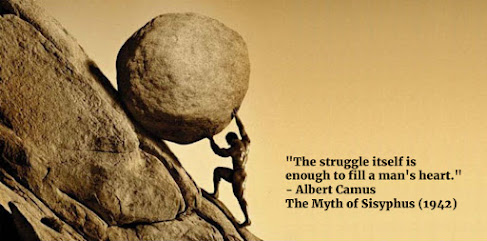
“To decide whether life is worth living is to answer the fundamental question of philosophy,” Albert Camus (November 7, 1913–January 4, 1960) wrote in his 119-page philosophical essay “The Myth of Sisyphus” in 1942. “There is but one truly serious philosophical problem, and that is suicide. Judging whether life is or is not worth living amounts to answering the fundamental question of philosophy. All the rest – whether or not the world has three dimensions, whether the mind has nine or twelve categories – comes afterwards. These are games; one must first answer. And if it is true, as Nietzsche claims, that a philosopher, to deserve our respect, must preach by example, you can appreciate the importance of that reply, for it will precede the definitive act. These are facts the heart can feel; yet they call for careful study before they become clear to the intellect. Everything else… is child’s play; we must first of all answer the question.” 

One of the most famous opening lines of the twentieth century captures one of humanity’s most enduring philosophical challenges – the impulse at the heart of Seneca’s meditations on life and Montaigne’s timeless essays and Maya Angelou’s reflections, and a wealth of human inquiry in between. But Camus, the second-youngest recipient of the Nobel Prize in Literature after Rudyard Kipling, addressed it with unparalleled courage of conviction and insight into the irreconcilable longings of the human spirit.

In the beautifully titled and beautifully written “A Life Worth Living: Albert Camus and the Quest for Meaning” (public library), historian Robert Zaretsky considers Camus’s lifelong quest to shed light on the absurd condition, his “yearning for a meaning or a unity to our lives,” and its timeless yet increasingly timely legacy: If the question abides, it is because it is more than a matter of historical or biographical interest. Our pursuit of meaning, and the consequences should we come up empty-handed, are matters of eternal immediacy.

Camus pursues the perennial prey of philosophy – the questions of who we are, where and whether we can find meaning, and what we can truly know about ourselves and the world – less with the intention of capturing them than continuing the chase.”

Reflecting on the parallels between Camus and Montaigne, Zaretsky finds in this ongoing chase one crucial difference of dispositions: “Camus achieves with the Myth what the philosopher Maurice Merleau-Ponty claimed for Montaigne’s Essays: it places “a consciousness astonished at itself at the core of human existence.”

For Camus, however, this astonishment results from our confrontation with a world that refuses to surrender meaning. It occurs when our need for meaning shatters against the indifference, immovable and absolute, of the world. As a result, absurdity is not an autonomous state; it does not exist in the world, but is instead exhaled from the abyss that divides us from a mute world.”

Camus himself captured this with extraordinary elegance when he wrote in “The Myth of Sisyphus”: “This world in itself is not reasonable, that is all that can be said. But what is absurd is the confrontation of this irrational and wild longing for clarity whose call echoes in the human heart. The absurd depends as much on man as on the world. For the moment it is all that links them together.”

To discern these echoes amid the silence of the world, Zaretsky suggests, was at the heart of Camus’s tussle with the absurd: “We must not cease in our exploration, Camus affirms, if only to hear more sharply the silence of the world. In effect, silence sounds out when human beings enter the equation. If “silences must make themselves heard,” it is because those who can hear inevitably demand it. And if the silence persists, where are we to find meaning?”

This search for meaning was not only the lens through which Camus examined every dimension of life, from the existential to the immediate, but also what he saw as our greatest source of agency. In one particularly prescient diary entry from November of 1940, as WWII was gathering momentum, he writes: “Understand this: we can despair of the meaning of life in general, but not of the particular forms that it takes; we can despair of existence, for we have no power over it, but not of history, where the individual can do everything. It is individuals who are killing us today. Why should not individuals manage to give the world peace? We must simply begin without thinking of such grandiose aims.”

For Camus, the question of meaning was closely related to that of happiness - something he explored with great insight in his notebooks. Zaretsky writes: “Camus observed that absurdity might ambush us on a street corner or a sun-blasted beach. But so, too, do beauty and the happiness that attends it. All too often, we know we are happy only when we no longer are.”

Perhaps most importantly, Camus issued a clarion call of dissent in a culture that often conflates happiness with laziness and championed the idea that happiness is nothing less than a moral obligation. A few months before his death, Camus appeared on the TV show Gros Plan. Dressed in a trench coat, he flashed his mischievous boyish smile and proclaimed into the camera: “Today, happiness has become an eccentric activity. The proof is that we tend to hide from others when we practice it. As far as I’m concerned, I tend to think that one needs to be strong and happy in order to help those who are unfortunate.”

This wasn’t a case of Camus arriving at some mythic epiphany in his old age – the cultivation of happiness and the eradication of its obstacles was his most persistent lens on meaning. More than two decades earlier, he had contemplated “the demand for happiness and the patient quest for it” in his journal, capturing with elegant simplicity the essence of the meaningful life – an ability to live with presence despite the knowledge that we are impermanent: ”We must” be happy with our friends, in harmony with the world, and earn our happiness by following a path which nevertheless leads to death.”

But his most piercing point integrates the questions of happiness and meaning into the eternal quest to find ourselves and live our truth: ”It is not so easy to become what one is, to rediscover one’s deepest measure.”
Freely download “The Myth of Sisyphus,” by  Albert Camus, here: