StatCounter

Monday, August 4, 2025

"Economic Market Snapshot 8/4/25"

"Economic Market Snapshot 8/4/25"
Down the rabbit hole of psychopathic greed and insanity...
Only the consequences are real - to you!
"It's a Big Club, and you ain't in it. 
You and I are not in the Big Club."
- George Carlin
o
Market Data Center, Live Updates:
Financial Stress Index

"The OFR Financial Stress Index (OFR FSI) is a daily market-based snapshot of stress in global financial markets. It is constructed from 33 financial market variables, such as yield spreads, valuation measures, and interest rates. The OFR FSI is positive when stress levels are above average, and negative when stress levels are below average. The OFR FSI incorporates five categories of indicators: creditequity valuationfunding, safe assets and volatility. The FSI shows stress contributions by three regions: United Statesother advanced economies, and emerging markets."
Job cuts and much more.
Commentary, highly recommended:
"The more I see of the monied classes,
the better I understand the guillotine."
- George Bernard Shaw
Oh yeah... beyond words. Any I know anyway...
And now... The End Game...
o

Sunday, August 3, 2025

Adventures With Danno, "Big Problem At Sam's Club!"

Adventures With Danno, PM 8/3/25
"Big Problem At Sam's Club!"
Comments here:

"Packing Up And Moving Out Of Third World California; Nuclear Annihilation Warning"

Jeremiah Babe, 8/3/25
"Packing Up And Moving Out Of Third World California;
 Nuclear Annihilation Warning"
Comments here:

"America's Richest Man"

"America's Richest Man"
by Joel Bowman

“I was early taught to work as well as play,
My life has been one long, happy holiday;
Full of work and full of play—
I dropped the worry on the way—
And God was good to me everyday.”
~ J.D. Rockefeller, summing up his life at age 86. 
He died two years later, in 1937.

Ormond Beach, Florida- "When it comes to the richest people in America’s history, one man stands head and shoulders above the rest. At the peak of his personal wealth, J.D. Rockefeller’s pile was calculated to be worth roughly $900 million, the vast majority of which came from the Standard Oil empire he founded and built. Adjusted for inflation, that’s about $21-25 billion in today’s dollars. Not poor, in other words. But even that number tells only part of the story…

As a percentage of the nation’s GDP, which in 1913 stood at $39 billion, the oil tycoon’s wealth represented a staggering 2.3% of the entire US economy, a higher percentage of the nation’s total wealth than held by any other person in any other age. An equal portion today, measured against America’s $30 trillion economy, would weigh in at ~$690 billion.

For comparison, Rockefeller’s closest competitors are…Cornelius Vanderbilt, whose shipping and railroad businesses helped him amass a fortune of roughly ~$105 million; a lot of money back in the 1870s. At that time, “The Commodore,” as he was known, controlled wealth roughly equivalent to ~1.1–1.5% of America’s GDP.

A generation later, Andrew Carnegie created his fortune building and dominating the American steel industry. A poor immigrant, who had arrived from Scotland in 1848, Carnegie started working at age 13 as a bobbin boy in a textile mill. He went on to work at the local telegraph office and then for the Pennsylvania Railroad, where he learned about business, management and, eventually, investing… for which he evidently had considerable talent. By the beginning of the 20th Century, Carnegie’s wealth stood at an eye-watering $480 million, a sum equal to roughly ~1.5–2.0% of the nation’s GDP.

Today, more than a century later, Jeff Bezos’s ~$215 billion Amazon fortune represents “just” 0.7% of America’s giant economy. Mark Zuckerberg’s anti-social media stash, somewhere in the vicinity of $220-240 billion, ranks similarly.

Messrs. Ellison, (~$229–236 billion, Oracle Corporation), Gates (~$176–179 billion, Microsoft), Balmer (~$161–172  billion, Microsoft), Buffett (~$150–154 billion, Berkshire Hathaway), Brin (~$138–150 billion, Google) and Page (~$144–156 billion, Google), all Americans, round out nine of the world’s top ten richest super billionaires. (Bernard Arnault & family, which built their ~$146–178 billion fortune selling LVMH luxury products, are the only non-Americans in the top ten.)

Even the richest man in the world today – the shy and retiring Elon Musk, whose $400 billion personal fortune dwarfs his contemporaries – has wealth equal to “only” 1.2% of America’s total economy… about half the size of Rockefeller’s empire, relative to the America he helped build.

Mo’ Money: Hating on the rich is, of course, nothing new… and certainly, Rockefeller had his share of detractors and sworn enemies along the way, perhaps none more so than Theodore “Teddy” Roosevelt. The so-called “trust buster,” Roosevelt was deeply suspicious of what he saw as “bad trust monopolies,” viewing Rockefeller’s businesses as abusive and predatory, and the man himself as the archetypal robber baron. “No man should have such power as Rockefeller has,” he once decreed, “without being held accountable to the people.”

Indeed, it was the Roosevelt administration that laid much of the ideological and legal groundwork for vigorously enforcing antitrust laws which, in 1911, under President William Taft, eventually resulted in Standard Oil being broken into smaller, state-sized pieces…

Standard Oil of New Jersey later became Exxon… Standard Oil of New York became Mobil (then the two became ExxonMobil)…Standard Oil of California became Chevron…Standard Oil of Indiana became Amoco… The Ohio Oil Company became Marathon Oil…Continental Oil Company became ConocoPhillips…and so on. That most of the Standard Oil companies have now merged and coagulated into the Big Oil blob we see today is but one irony.

The grand irony, however, is that, as Rockefeller’s shares in the various spin-off companies increased in value over time, the original Standard Oilman grew ever richer. Indeed, Rockefeller would go on to become America’s very first billionaire, prefiguring Bernie Sanders’ worst nightmare decades before the Grumpy Colonel was even born and proving that, if nothing else, the unwieldily federal government is an expert in one thing above all others: creating unintended consequences.

And yet, not everyone viewed Rockefeller as Roosevelt and his meddlesome ilk did. Here’s biographer, Allan Nevins, answering some of the man’s detractors…"The rise of the Standard Oil men to great wealth was not from poverty. It was not meteor-like, but accomplished over a quarter of a century by courageous venturing in a field so risky that most large capitalists avoided it, by arduous labors, and by more sagacious and farsighted planning than had been applied to any other American industry. The oil fortunes of 1894 were not larger than steel fortunes, banking fortunes, and railroad fortunes made in similar periods. But it is the assertion that the Standard magnates gained their wealth by appropriating "the property of others" that most challenges our attention. We have abundant evidence that Rockefeller's consistent policy was to offer fair terms to competitors and to buy them out, for cash, stock, or both, at fair appraisals; we have the statement of one impartial historian that Rockefeller was decidedly “more humane toward competitors” than Carnegie; we have the conclusion of another that his wealth was “the least tainted of all the great fortunes of his day.”

Top of the Rock: The pic above, taken from the observation deck during your editor’s brief sojourn in New York City last week, showcases one of Rockefeller’s most iconic legacies: The Rockefeller Center. Construction began on the ambitious project, the brainchild of Rockefeller himself, right as American was plunged into the depths of the Great Depression. At the time (1931) it was among the largest private construction projects ever undertaken, one that brought 40,000 jobs to the city itself and which provided a shining light to lift the national spirit.

Renowned for its Art Deco designs, it is perhaps no coincidence that one of the most emblematic statues in the Center depicts the Greek god Atlas, who famously carried the weight of the world on his broad shoulders…"

Musical Interlude: Jason Mraz, "I Won't Give Up"

Full screen recommended.
Jason Mraz, "I Won't Give Up"

"A Look to the Heavens"

"NGC 6888, also known as the Crescent Nebula, is a about 25 light-years across blown by winds from its central, bright, massive star. A triumvirate of astroimagers ( Joe, Glenn, Russell) created this sharp portrait of the cosmic bubble. Their telescopic collaboration collected over 30 hours of narrow band image data isolating light from hydrogen and oxygen atoms. The oxygen atoms produce the blue-green hue that seems to enshroud the detailed folds and filaments. Visible within the nebula, NGC 6888's central star is classified as a Wolf-Rayet star (WR 136). The star is shedding its outer envelope in a strong stellar wind, ejecting the equivalent of the Sun's mass every 10,000 years. 
The nebula's complex structures are likely the result of this strong wind interacting with material ejected in an earlier phase. Burning fuel at a prodigious rate and near the end of its stellar life this star should ultimately go out with a bang in a spectacular supernova explosion. Found in the nebula rich constellation Cygnus, NGC 6888 is about 5,000 light-years away."

The Poet: Theodore Roethke, “The Return”

“The Return”

“Suddenly the window will open
and Mother will call,
it's time to come in.
The wall will part,
I will enter heaven in muddy shoes.
I will come to the table
and answer questions rudely.
I am all right, leave me
alone. Head in hand I
sit and sit. How can I tell them
about that long
and tangled way?
Here in heaven mothers
knit green scarves;
flies buzz.
Father dozes by the stove
after six days' labor.
No - surely I can't tell them
that people are at each
other's throats.”

- Theodore Roethke
"What if when you die they ask, "How was Heaven?"
~ Author Unknown

A truly terrifying thought...

Chet Raymo, “Take My Arm”

“Take My Arm”
by Chet Raymo

“I’m sure I have referenced here before the poems of Grace Schulman, she who inhabits that sweet melancholy place between “the necessity and impossibility of belief.” Between, too, the necessity and impossibility of love.

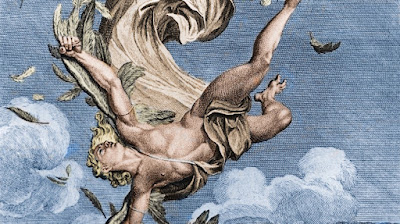
Belief and love. They have so much in common, yet are as distinct as self and other. How strange that two people can hitch their lives together, on a whim, say, or wild intuition, knowing little if nothing about the other’s hiddenness, about things that even the other does not fully understand and couldn’t articulate even if he did. Blind, deaf, dumb, they leap into the future, hoping to fly, and, for a moment, soaring, like Icarus, sunward. The necessity of wax. The impossibility of wax. We “fall” in love, they say. Schulman: “We slog. We tramp the road of possibility. Give me your arm.”

"Immortality in Passing"

"Immortality in Passing: Poet Lisel Mueller, Who Lived to 96,
On What Gives Meaning to Our Ephemeral Lives"
by Maria Popova

“When you realize you are mortal you also realize the tremendousness of the future. You fall in love with a Time you will never perceive,” the poet, painter, and philosopher Etel Adnan observed as she beheld impermanence and transcendence at the foot of a mountain. “By the grace of random chance, funneled through nature’s laws,” the poetic physicist Brian Greene wrote in his beautiful meditation on our search for meaning in a cold cosmos, “we are here.” And then we are not.

We die. All of us - atoms to atoms, stardust to stardust, the mountain to the sea - you and I. The dual awareness of our improbable life and our inevitable death is what allows us to animate the interlude with love and beauty, with poems and fairy tales and poems, with general relativity and Nina Simone. It is what puts into perspective just how fleeting and vacant and self-embittering all of our angers and blames and resentments are in the end - what beckons us, instead, to “leave something of sweetness and substance in the mouth of the world.”

That is what the late, great Lisel Mueller (February 8, 1924–February 21, 2020) - one of the most original, deepest-seeing poets of our time - explores with great subtlety and profundity disguised as levity in the poem “Immortality” from her final poetry collection, the Pulitzer-winning masterpiece "Alive Together" (public library).

"Immortality"

"In Sleeping Beauty’s castle
the clock strikes one hundred years
and the girl in the tower returns to the world.
So do the servants in the kitchen,
who don’t even rub their eyes.
The cook’s right hand, lifted
an exact century ago,
completes its downward arc
to the kitchen boy’s left ear;
the boy’s tensed vocal cords
finally let go
the trapped, enduring whimper,
and the fly, arrested mid-plunge
above the strawberry pie,
fulfills its abiding mission
and dives into the sweet, red glaze.

As a child I had a book
with a picture of that scene.
I was too young to notice
how fear persists, and how
the anger that causes fear persists,
that its trajectory can’t be changed
or broken, only interrupted.
My attention was on the fly;
that this slight body
with its transparent wings 
and lifespan of one human day
still craved its particular share
of sweetness, a century later.

- Lisel Mueller

“Immortality” by Lisel Mueller (read by Maria Popova) 

(Two centuries earlier, William Blake explored the same eternal subject though the same creature in his short existentialist poem “The Fly.”)

In the front matter of this altogether miraculous book, where an epigraph would ordinarily appear, Mueller offers a short poem that becomes a kind of chorus line for the entire collection, but emerges as an especially harmonizing counterpart to “Immortality” in particular:


Complement these fragments of the wholly transcendent Alive Together with physicist Alan Lightman on our yearning for immortality in a universe governed by decay, Pico Iyer on finding beauty in impermanence, and Marcus Aurelius on mortality as the key to living fully, then revisit Barbara Ras’s bittersweet, buoyant, perspective-calibrating poem “You Can’t Have It All” and Marilyn Nelson’s magnificent ode to how we fill our impermanence with importance, “Faster Than Light.”
"The Backdoor to Immortality: Marguerite Duras 
on What Makes Life Worth Living in the Face of Death"

“What exists, exists so that it can be lost and become precious,” Lisel Mueller wrote as she weighed what gives meaning to our mortal lives in a stunning poem - one of the hundreds that outlived her as she returned her borrowed stardust to the universe at ninety-six. And yet, by some felicitous deviation from logic - perhaps an adaptive imbecility essential for our mental and emotional survival, one of the touching incongruences that make us human - the moment something becomes precious to us, we quarantine the prospect of its loss in some chamber of the mind we choose not to enter. On some deep level beyond the reach of reason, we come to believe that the people we love are - must be, for the alternative is a fathomless terror - immortal.

And so, when a loved one dies, this deepest part of us grows wild with rage at the universe - a rage skinned of sensemaking, irrational and raw, unsalved by our knowledge that the entropic destiny of everything alive is to die and of everything that exists to eventually not, even the universe itself; unsalved by the the immense cosmic poetry hidden in this fact; unsalved by the luckiness of having lived at all against the staggering cosmic odds otherwise; unsalved by remembering that only because ancient archaebacteria were capable of dying, as was every organism that evolved in their wake, we and the people we love and the people we lose came to exist at all."
- Maria Popova

The Daily "Near You?"

Sheboygan, Wisconsin, USA. Thanks for stopping by!

"Still Sometimes..."

“The early bird catches the worm. A stitch in time saves nine. He who hesitates is lost. We can’t pretend we haven’t been told. We’ve all heard the proverbs, heard the philosophers, heard our grandparents warning us about wasted time, heard the damn poets urging us to seize the day. Still, sometimes, we have to see for ourselves. We have to make our own mistakes. We have to learn our own lessons. We have to sweep today’s possibility under tomorrow’s rug, until we can’t anymore, until we finally understand for ourselves what Benjamin Franklin meant: That knowing is better than wondering. That waking is better than sleeping. And that even the biggest failure, even the worst, most intractable mistake, beats the hell out of never trying.”
- “Meredith”, “Grey’s Anatomy”

"Our Lives Begin To End..."


"Israel No Longer Has a Right to Exist"

"Israel No Longer Has a Right to Exist"
by Ted Rall

"In certain traditional societies, troublesome individuals who were perceived as threats to communal harmony were labeled as “witches.” To restore calm, accused witches were sometimes reintegrated into society via a ceremony of ritual cleansing. Other problematic people, particularly those whose socially unacceptable behavior persisted, were banished or killed. As a political entity, Israel is a witch. Its conduct is incompatible with 21st-century civilization. To whatever extent it ever had one, Israel no longer has a right to exist.

The Netanyahu government’s cynical exploitation of Hamas’ Oct. 7, 2023, raid is the last straw. With gleeful bloodlust that appears to have no limits, Israel has intentionally slaughtered hundreds of thousands of innocent Palestinians. It has reduced a bustling territory filled with high-rises and seaside resorts to rubble. It has cruelly imposed a blockade of fuel, water and food that has resulted in outbreaks of long-vanquished diseases like polio and meningitis. It has created a manmade famine a few miles away from where Israelis gather at LGBTQ-friendly restaurants to eat rich meals and drink sweet wine fermented from grapes cultivated on the soil of occupied land.

The argument that Israel, or any other nation-state, enjoys an inherent “right to exist” has always been absurd. From ancient empires like Parthia to 20th-century constructs like Czechoslovakia, countries exist so long as they are able to establish and defend their borders. When they cannot, they vanish.

Sometimes a country becomes so troublesome to its neighbors that the global community determines that it, like an alleged witch, must be excised to achieve calm. Imperial Japan and Nazi Germany’s voracious expansionism was so disruptive that rivals with economic and political systems that were diametrically opposed to the point of recently having clashed militarily, including the U.S. and the USSR, formed alliances in order to destroy them. The Napoleonic Wars united powers with conflicting interests, such as Britain (a constitutional monarchy), Russia (an autocratic empire), Austria and Prussia because the defeat of Napoleon was seen as essential to curb France’s disruptive dominance and restore regional order.

Governments often act without their people’s blessing. That is true of the stateless noncitizens of Gaza. Hamas’ last election was before most Gazans were alive.

If the government of Israel did not represent the will of its people, Israel the country could be forgiven. Israel, however, is a democracy. Netanyahu, a right-wing extremist, has been prime minister for 17-plus years over multiple terms, making him Israel’s longest-serving leader. His brutal treatment of the Palestinians in Israeli-occupied Gaza and the West Bank is popular with voters. A June 2025 poll found that 76.5% of Israeli Jews “think that Israel should not take the civilian population’s suffering into account at all, or should only do so to a fairly small extent” in military planning. “Despite the desperate humanitarian crisis, a survey conducted in May by the Institute for National Security Studies at Tel Aviv University found that 64.5 percent of the Israeli public was not at all, or not very, concerned about the humanitarian situation in Gaza,” reports The New York Times.

Considering that the Israeli public supports the genocide in Gaza, the fact that Israel Defense Forces spokesmen dismiss media photos of starving, skeletal Palestinian children as “fake” is cause for a kind of optimism. When Netanyahu says “there is no starvation in Gaza,” at least he’s aware enough of international opinion that he feels compelled to lie.

You hear about demonstrations in Tel Aviv against Netanyahu. But those protests do not agitate against the genocide of Palestinians. Israel’s few leftists, who march against Netanyahu and the war, focus on the 20 or so remaining hostages held by Hamas, and the suffering of Israeli soldiers.

It is easy for culturally isolated Israelis, whose official language of Hebrew is spoken nowhere else on earth, to ignore their country’s war crimes. “The mainstream domestic news media has rarely provided vivid coverage of the humanitarian crisis in Gaza,” notes the Times. The last surviving relic of British imperialism, Israel is an apartheid state that repeatedly ignores resolutions passed by the United Nations, which it uniquely owes for its creation, and brushes off negative public opinion in the United States, upon which it is dependent for its economic, military and diplomatic survival. Like Germany in the 1930s and ’40s, it has normalized lawlessness, dehumanized and murdered people to steal their land, and committed itself to aggressive military expansion with no end in sight.

Israel is a terminally ill society. It is cruel. It is heartless.

Unlike Germany, which was decimated at the end of World War II, accepted defeat and cleansed itself via decades of atonement for Nazism, Israel is unlikely to be militarily crushed or spiritually reborn. It has little prospect of rehabilitation.

Israel is dangerous. In the last few months alone, Israel has bombed Iran, bombed and carried out the indiscriminate pager bombings in Lebanon, further emboldened murders of Palestinian civilians by fascist “settlers” in the West Bank, and overthrown the government of Syria, where it inexplicably installed a radical ex-al-Qaeda jihadi to replace a secular leader — and then bombed Syria again. Even by the standards of the Middle East, no other player is as destabilizing or violent as Israel. How long will it be before Netanyahu or his successor uses one of Israel’s illicit nuclear weapons?

The state of Israel is a troublesome witch. It has to go. Let’s be clear. Abolishing Israel - ensuring that, from the river to the sea, Palestine is free - does not imply or necessitate the removal of any of its residents. Jews, Arabs, Christians and other groups lived peacefully side by side in Ottoman-era Palestine. The German people survived the end of Hitler and are thriving today. The Soviet people survived the 1991 collapse. So it will be for the people of the nation-state that ought to become the former State of Israel sooner rather than later."
o
Redacted, 8/2/25
"The Truth About October 7 
That Israel Doesn’t Want You to See"
Comments here:

"How It Really Is"


"As Americans..."

''As Americans, we must ask ourselves: Are we really so different? Must we stereotype those who disagree with us? Do we truly believe that ALL red-state residents are ignorant racist fascist knuckle-dragging NASCAR-obsessed cousin-marrying roadkill-eating tobacco juice-dribbling gun-fondling religious fanatic rednecks; or that ALL blue-state residents are godless unpatriotic pierced-nose Volvo-driving France-loving left-wing communist latte-sucking tofu-chomping holistic-wacko neurotic vegan weenie perverts?''
- Dave Barry

"Civilization Comes From Us"

"Civilization Comes From Us"
by Paul Rosenberg

"Civilization is produced by us, not by dominance hierarchies. Rulership survives on human vulnerabilities. Civilization survives on human virtues. No matter how much publicity equates rulership with civilization, they are fundamentally opposed.

The Fundamentals: As I noted recently, there are two primary models for attaining a civilized, humane, high-trust way of life:

• Cultivate civilization within people.
• Enforce civilization upon people.

In the best of the old days, governments contented themselves to deal with exterior threats, leaving any number of religions and philosophies free to cultivate civilization within the populace. Since the the 1970s, however, we’ve seen a hostile takeover of society by the state… the enforcement of moral norms by the state. Under this model, the state must enforce proper speech and personal choices; it must save us from one new terror after another. And we are expected to believe that by eliminating threat after threat, rulership is leading us to a promised land. Do you believe that? I certainly don’t, because I’ve watched it for more than half a century.

What, Then, Shall We Do? Our job is to teach the next generation what is good and right. The enforcement complex will not do this; they’ll portray themselves as the ultimate agent of goodness, as they have for the aforementioned half century. Our job, then, is to teach the things that actually build civilization: the golden rule, freedom of speech, tolerance, kindness and cooperation. Now, moving on to particular things to do:

Homeschooling excels as a way to teach civilization, simultaneously keeping children from the toxic dogmas being pumped through government schools. In the US, where the war on homeschooling remains at a fairly low level, more than 11 percent of American children are now said to be homeschooled. And so the fruits of this, while already visible, will be increasing Homeschooling works, and if one in nine of parents can do it, many more can do it as well.

Past all of this, we have Bitcoin. This is money with civilization encoded within it. Bitcoin is super-tolerant, in that censorship is very, very difficult and no one can be cut off because of their religion or anything else. More than that, Bitcoin has drawn to itself many of the most serious and morally-minded people.

What we need to do with Bitcoin is use it profligately. Bitcoin’s Lightning overlay (and dozens of Lightning-able wallets are available) accommodates any number of small purchases for trivial fees. We need to get this thing going. It’s money that supports civilization, rather than subverting it… and money is important. Silver and gold could be used similarly, of course.

And So… And so we have plenty to do. (And I haven’t mentioned things we should be doing on a daily basis, like talking to neighbors and coworkers.) As adults, we need to accept that we’re now on our own… as perhaps we’ve always been. So pick a spot and start."

"AI for Dummies: AI Turns Us Into Dummies"

"AI for Dummies: AI Turns Us Into Dummies"
by Charles Hugh Smith

EDITOR's NOTE: "I just got called out by a programmer who uses AI who was furious and wrote "students cheat, always have, tell us something we don't already know". I responded: "did you read the MIT paper or the other link?" Of course he didn't: TL/DR, which proves my point. Even the programmer admitted he has to check AI's work.

The point here is *those who received real educations can use AI because they know enough to double-check it, but the kids using AI as a substitute for real learning will never develop this capacity.* Those who actually have mastery can use AI and not realize the point I'm making isn't that AI is useless, the point is it fatally undermines real learning and thinking. The MIT paper is 206 pages long, the last section being the stats of the research, but the points it makes are truly important. So is the other article linked below."

"That AI is turning those who use it into dummies is not only self-evident, it's irrefutable. ChatGPT May Be Eroding Critical Thinking Skills, According to a New MIT Study "Of the three groups, ChatGPT users had the lowest brain engagement and 'consistently underperformed at neural, linguistic, and behavioral levels.' Over the course of several months, ChatGPT users got lazier with each subsequent essay, often resorting to copy-and-paste by the end of the study. The task was executed, and you could say that it was efficient and convenient," Kosmyna says. "But as we show in the paper, you basically didn't integrate any of it into your memory networks."

AI breaks the connection between learning and completing an academic task. With AI, students can check the box - task completed, paper written and submitted - without learning anything. And by learning we don't mean remember a factoid, we mean learning how to learn and learning how to think. As Substack writer maalvika explains in her viral essay compression culture is making you stupid and uninteresting, digital technologies have compressed our attention spans via what I would term "rewarding distraction" so we can no longer read anything longer than a few sentences without wanting a summary, highlights video or sound-bite.

In other words, very few people will actually read the MIT paper: TL/DR. Here's the precis: "Your Brain on ChatGPT" (mit.edu). Here's the full paper. "Your Brain on ChatGPT: Accumulation of Cognitive Debt when Using an AI Assistant for Essay Writing Task."

To understand the context - and indeed, the ultimate point of the research - we must start by understanding the structure of learning and thinking which is a complex set of processes. Cognitive Load Theory (CLT) is a framework that parses out some of these processes.

Cognitive Load Theory (CLT), developed by John Sweller, provides a framework for understanding the mental effort required during learning and problem-solving. It identifies three categories of cognitive load: intrinsic cognitive load (ICL), which is tied to the complexity of the material being learned and the learner's prior knowledge; extraneous cognitive load (ECL), which refers to the mental effort imposed by presentation of information; and germane cognitive load (GCL), which is the mental effort dedicated to constructing and automating schemas that support learning.

Checking the box "task completed" teaches us nothing. Actual learning and thinking require doing all the cognitive work that AI claims to do for us: reading the source materials, following the links between these sources, finding wormholes between various universes of knowledge, and thinking through claims and assumptions as an independent critical thinker.

When AI slaps together a bunch of claims and assumptions as authoritative, we don't gain a superficial knowledge - we learn nothing. AI summarizes but without any ability to weed out questionable claims and assumptions because it has no tacit knowledge of contexts. So AI spews out material without any actual cognitive value and the student slaps this into a paper without learning any actual cognitive skills. This cognitive debt can never be "paid back," for the cognitive deficit lasts a lifetime.

Even AI's vaunted ability to summarize robs us of the need to develop core cognitive abilities. As this researcher explains, "drudgery" is how we learn and learn to think deeply as opposed to a superficial grasp of material to pass an exam.

"In Defense of Drudgery: AI is making good on its promise to liberate people from drudgery. But sometimes, exorcising drudgery can stifle innovation." "Unfortunately, this innovation stifles innovation. When humans do the drudgery of literature search, citation validation, and due research diligence - the things OpenAI claims for Deep Research - they serendipitously see things they weren't looking for. They build on the ideas of others that they hadn't considered before and are inspired to form altogether new ideas. They also learn cognitive skills including the ability to filter information efficiently and recognize discrepancies in meaning.

I have seen in my field of systems analysis where decades of researchers have cited information that was incorrect - and expanded it into its own self-perpetuating world view. Critical thinking leads the researcher to not accept the work that others took as foundational and to spot the error. Tools such as Deep Research are incapable of spotting the core truth and so will perpetuate misdirection in research. That's the opposite of good innovation."

In summary: given that AI is fundamentally incapable of performing the tasks required for authentic innovation, we're de-learning how to innovate. What we're "learning" is to substitute a superficially clever simulation of innovation for authentic innovation, and in doing so, we're losing the core cognitive skills needed to innovate. In following the easy, convenient path of AI's simulations of innovation, we are indeed "carefully falling into the cliff." But since this is all TL/DR, and there's no summary, highlights video or sound-bite, we don't even see it. So here's the TL/DR "dummies" summary of AI: AI is turning us into dummies."

"The Car Market Collapse Is Already Upon Us As They’re Skipping Car Payments"

Full screen recommended.
Epic Economist, 8/3/25
"The Car Market Collapse Is Already Upon Us 
As They’re Skipping Car Payments"
"Americans are skipping car payments and the auto market collapse is accelerating fast. With $847 billion in unsold cars rotting on lots, 45% of dealerships are closing permanently. Auto loan delinquencies just hit 15-year highs as average car payments reach $750/month. The used car bubble has burst, leaving millions with underwater auto loans. Car prices are dropping but nobody can afford them anyway. US car sales are crashing, repossessions are surging. This car market crisis is just getting started. Here's what's really happening in 2025."
Comments here:

Dan, I Allegedly, "We Have Zero Privacy - All Your Secrets Exposed!"

Full screen recommended.
Dan, I Allegedly, 8/3/25
"We Have Zero Privacy - All Your Secrets Exposed!"
"AI is changing everything - and it’s exposing your secrets online! In this video, I break down how AI, from OpenAI’s ChatGPT to industry-specific bots, is impacting privacy, interviewing, and even your everyday life. Did you know that some AI queries containing personal details are being indexed on Google? Wild, right?! I also share insights on industries thriving with AI, like cybersecurity and health tech, while discussing the potential dangers of data misuse and even lawsuits stemming from AI's integration. From driverless cars to corporate interviews run by AI, we’re living in a rapidly evolving world."
Comments here:

Greg Hunter, "Gold Signals War – Martin Armstrong"

"Gold Signals War – Martin Armstrong"
By Greg Hunter’s USAWatchdog.com

"Less than two weeks ago, legendary financial and geopolitical cycle analyst Martin Armstrong warned his “Socrates” predictive computer program showed a “100% Chance of Nuclear War.” Since then, a war of words has flared up between President Trump and Russia, and he said Russia “has entered very dangerous territory.” President Trump then, “Orders US nuclear subs repositioned over statements from ex-Russian leader Medvedev.” “After Trump sends nuclear subs near Russia, Putin responds with hypersonic threat - what Oreshnik missiles can do.” If this is not enough to confirm some sort of nuclear exchange is coming soon, add what Secretary of State Marco Rubio just warned this past week. Rubio said, “In case of war with the US, Russia will rely on tactical nuclear weapons due to the weakness of its army.” A top Russian official also “Issues nuclear annihilation warning” and said Russia would “hit back with a devastating blow.” Keep in mind, all this happened in the last few days.

 On Friday, “gold signaled war” by exploding up $73 an ounce, up more than 2% in a matter of hours. Is the gold market seeing this nuke war talk and responding? Armstrong says, “Oh, yeah! You look at gold, and you see what is happening. Oil is pointing more towards September. Gold keeps trying to get through the highs. This is not the major high. Hate to tell you, it’s not. Gold is showing, Up. Every market I look at, it’s the same thing. We have a panic cycle, and it’s not just for war in 2026. Go to our site and look at the euro, and there is a panic cycle for 2026. It’s everywhere. Why the computer has been correct is you cannot forecast any market in isolation. You can’t. It’s all connected.”

Armstrong says you won’t have to wait until 2026 for his “Panic Cycle” to begin. His computer has long pointed to August 18, 2025, and that is about two short weeks away. Armstrong says, “Honestly, this is turning into a grade school fight. I don’t know what Trump expects. He’s hurling insult after insult, and there is no possibility of peace anymore. It’s one thing to do tariffs and sanctions against Russia. Now, he is saying we are going to put sanctions on anybody that even deals with Russia. This is economic war. It’s as simple as that. We don’t even have anyone to negotiate on behalf of the West. It’s dead, completely dead.”

Armstrong thinks neocons have built a wall around President Trump so nobody with different advice regarding NOT starting a nuke war can get through. Is Martin Armstrong being blocked by the neocons surrounding President Trump now? Armstrong says, “I believe so. I even wrote to AG Pam Bondi, and I did not get a response. I have written to presidents and heads of state, and I get responses. Not this time. This is escalating, and he (Trump) is not in a good position. I don’t know what the hell he is doing. He seems to have crossed to the other side.” There is much more in the 48-minute interview.
Join Greg Hunter on Rumble as he goes One-on-One with Martin Armstrong
who is still giving a red alert for a very destructive nuclear war coming soon.

Saturday, August 2, 2025

Jeremiah Babe, "Bank Account Empty, Cash Withdrawal Denied"

Full screen recommended.
Jeremiah Babe, 8/2/25
"Bank Account Empty, Cash Withdrawal Denied
The Biggest Industry In America Is Collapsing"
Comments here:

"Alert! Russia Threatens To Destroy Entire US Nuclear Fleet"

Prepper News, 8/2/25
"Alert! Russia Threatens To Destroy Entire US Nuclear Fleet"
"Russian Duma claims they're tracking US nuclear submarines."
Comments here:

Musical Interlude: Yanni, “To the One Who Knows”

Full screen recommended.
Yanni, “To the One Who Knows”

"A Look to the Heavens"

“The beautiful Trifid Nebula, also known as Messier 20, is easy to find with a small telescope in the nebula rich constellation Sagittarius. About 5,000 light-years away, the colorful study in cosmic contrasts shares this well-composed, nearly 1 degree wide field with open star cluster Messier 21 (top right).
Trisected by dust lanes the Trifid itself is about 40 light-years across and a mere 300,000 years old. That makes it one of the youngest star forming regions in our sky, with newborn and embryonic stars embedded in its natal dust and gas clouds. Estimates of the distance to open star cluster M21 are similar to M20's, but though they share this gorgeous telescopic skyscape there is no apparent connection between the two. In fact, M21's stars are much older, about 8 million years old.”

"Lady In Red Coffee Hour"

"Lady In Red Coffee Hour"
Rarely, very rarely, do you stumble upon something so exquisitely well done, so astonishingly beautiful you can't believe what you're seeing. This is one of those times. Be kind to yourself, take a break from it all, view the many short works and savor this exquisitely beautiful website. Sound on for the music. Incredibly wonderful...