StatCounter

Wednesday, May 28, 2025

"A Look to the Heavens"

"These are galaxies of the Hercules Cluster, an archipelago of island universes a mere 500 million light-years away. Also known as Abell 2151, this cluster is loaded with gas and dust rich, star-forming spiral galaxies but has relatively few elliptical galaxies, which lack gas and dust and the associated newborn stars. The colors in this remarkably deep composite image clearly show the star forming galaxies with a blue tint and galaxies with older stellar populations with a yellowish cast. 
Click image for larger size.
The sharp picture spans about 3/4 degree across the cluster center, corresponding to over 6 million light-years at the cluster's estimated distance. Diffraction spikes around brighter foreground stars in our own Milky Way galaxy are produced by the imaging telescope's mirror support vanes. In the cosmic vista many galaxies seem to be colliding or merging while others seem distorted - clear evidence that cluster galaxies commonly interact. In fact, the Hercules Cluster itself may be seen as the result of ongoing mergers of smaller galaxy clusters and is thought to be similar to young galaxy clusters in the much more distant, early Universe."

"The Minds Of Men..."

"The minds of men were gradually reduced to the same level, the fire of genius was extinguished. The name of Poet was almost forgotten; that of Orator was usurped by the sophists. A cloud of critics, of compilers, of commentators, darkened the face of learning, and the decline of genius was soon followed by the corruption of taste. This diminutive stature of mankind was daily sinking below the old standard." 
- Edward Gibbon, 
"The Decline And Fall of The Roman Empire"

"The American Empire at Sunset"

"The American Empire at Sunset"
by Brian Maher

"The year is 1991… Contrary to Mr. Khrushchev’s boast decades prior, the United States had buried the Soviet Union. Its forces had just trounced the world’s fourth-largest army - Iraq’s - within weeks. America bestrode the world like a new colossus… and put all potential rivals in its shade. Its armies bossed the four corners of the globe. Its fleets commanded the Seven Seas. Declared India’s former Army Chief of Staff: “The lesson of Desert Storm is, don’t fight with the United States without a nuclear weapon.” It was the Pax Americana… the “end of history.”

American capitalism, American democracy represented civilization’s apex, its zenith, its perfection. Yet the gods are a jealous lot. They are hot to put down any mortal who has outgrown its britches. Hubris they will not abide...

The Worst Thing the Russians Ever Did To America: Perhaps Russian political scientist Georgi Arbatov divined their wicked intentions at the end of Soviet rule… As he sneered - with a sort of purring relish - “We are going to do the worst thing we can do to you.” Which was what precisely? “We are going to take your enemy away from you.”

We fear he was correct. A superpower needs an enemy as the policeman needs criminals… as the psychiatrist needs madmen… as the Church needs the devil. Absent an enemy it loses its direction. Its vigor. Its éllan vital. It flounders, adrift, aimless and rudderless. Between world wars, berserker Winston Churchill lamented "the bland skies of peace" that stretched above Earth. Those same bland skies of peace overhung Earth at the Cold War’s conclusion.

Now jump ahead 34 years… after heavy weather has rolled on through… after the gods have worked their mischievous will…

A Changed World: America has had another go at Iraq - to liberate it from its own ruler and introduce it to Thomas Jefferson. The result may represent its greatest foreign policy blunder yet - greater even than Vietnam.

And if Afghanistan is the graveyard of empires… the flags had come down to half-mast… and the pallbearers loaded America’s empire into the hearse. “You Americans have the watches,” said the Taliban. “But we have the time.” And they did have the time.

Americans are a restless, fitful people. We are eternally on the jump, forever hunting the next opportunity, perpetually peeking over the next hill. That is, Americans are poor imperialists. We simply lack the requisite patience. We have the watches, yes. But not the time. The American founders studied their history… and knew the pitfalls of empire…

Destroying Monsters Abroad: America “goes not abroad in search of monsters to destroy,” said Adams (John Quincy). But the once modest American Republic took up the hunt at the end of the 20th century. It found its first monster in fiendish Spain… Americans remembered the Maine. And forgot their Adams. They have been forgetting their Adams ever since...

America has gone buccaneering around the globe, chasing down monsters during WWI, WWII, Korea, Vietnam, Iraq (twice) and Afghanistan. For every one it scotched, another rose in its place. Hitler took over from the Kaiser. Stalin from Hitler. Osama bin Laden from Stalin. Perhaps Chairman Xi will take over from Osama bin Laden?
 
We do not know. But if not him, we hazard another monster will. There is always another. And another. What of American democracy and capitalism - the world’s envy three decades prior?

The Glory of American Democracy: The high glories of American democracy are presently displayed before a watching world… Americans are at each other’s throats, red-state America and blue-state America. American cities have been scenes of riot, of mayhem, of chaos. Statues of old heroes are down. The nation’s founding myths are called into contempt and ridicule. Millions and millions believe the elections are rigged and thieved, fraudulent and illegitimate. Are they right? Are they wrong? We refuse to wade into the bog. We take no official stance. Yet if masses of American voters no longer trust the electoral process… what does it speak for American democracy?

Is this the alabaster city shining on the hill, glistening in the mists? Is this the model the world would mimic? Is this the cause American soldiers have killed and died for? As an American patriot in whose veins course the reddest blood, we hope it is not. Yet we begin to harbor grave doubts. China has ventured so far as to label American democracy a “joke.” But few appreciate the jest.

The Long, Withdrawing Roar of American Capitalism: Covid reduced American capitalism to a sad, sad caricature. But scroll the calendar backward, before the pandemic. The economy appeared healthy enough on the surface. But if you scratched the paint… and looked deeper… you would find: Gutted industries, stagnating growth, flat wages and a stock market that is captive of the central bank. The entire system, meantime, is rotten through with unpayable debt. It is not sustainable.

When did the American economy go wrong? And why? Our own Charles Hugh Smith gives his answer: "In broad-brush, the post-World War II era ended around 1970. The legitimate prosperity of 1946-1970 was based on cheap oil controlled by the U.S. and the hegemony of the U.S. dollar. Everything else was merely decoration.

The Original Sin to hard-money advocates was America's abandonment of the gold standard in 1971, but this was the only way to maintain hegemony. Maintaining the reserve currency is tricky, as the nation issuing the reserve currency has to supply the global economy with enough of the currency to grease commerce and stock central bank reserves around the world.

As the global economy expanded, the only way the U.S. could send enough dollars overseas was to run trade deficits, which in a gold standard meant the gold reserves would go to zero as trading partners holding dollars would exchange the currency for gold.

So the choice was: give up the reserve currency and the hegemony of the U.S. dollar by jacking up the dollar's value so high that imports would collapse, or accept that hegemony was no longer compatible with the gold standard. It wasn't a difficult decision: who would give up global hegemony, and for what?

The elites have cannibalized the system so thoroughly that there's nothing left to steal, exploit or cannibalize. The hyper-centralized global money control has run out of rope as the cheap oil is gone, debts have ballooned to the point there is no way they'll ever be paid down, and the only thing staving off collapse is money-printing, which holds the seeds of its own demise."

Charles tells a woeful tale. Yet we believe there is good, hard sense in it. It is a competent autopsy. “Empires have a logic of their own,” Bill Bonner and our intrepid leader Addison Wiggin wrote in "Empire of Debt", concluding: “That they will end in grief is a foregone conclusion.” It seems so. But if the American empire is ending in grief, we hope for a quiet grief, a whimpering grief - not a banging grief. Meantime, the gods watch the unfolding spectacle... munching popcorn… as the will of Zeus moves toward its ultimate end."

The Poet: Mary Oliver, "Coming Home"

"Coming Home"

"When we are driving in the dark,
on the long road to Provincetown,
when we are weary,
when the buildings and the scrub pines lose their familiar look,
I imagine us rising from the speeding car.
I imagine us seeing everything from another place -
the top of one of the pale dunes, or the deep and nameless
fields of the sea.
And what we see is a world that cannot cherish us,
but which we cherish.
And what we see is our life moving like that
along the dark edges of everything,
headlights sweeping the blackness,
believing in a thousand fragile and unprovable things.
Looking out for sorrow,
slowing down for happiness,
making all the right turns
right down to the thumping barriers to the sea,
the swirling waves,
the narrow streets, the houses,
the past, the future,
the doorway that belongs
to you and me."

- Mary Oliver

The Daily "Near You?"

Kannapolis, North Carolina, USA. Thanks for stopping by!

“Too Much Rain Will Kill Ya”

“Too Much Rain Will Kill Ya”
by Bruce Krasting

"My first week on Wall Street was in August of 1973. I was newbie to NYC. My office was on the south side of 100 Wall, on the second floor, looking out over Front Street. There was a tremendous thunderstorm one afternoon. I looked out the window as the street filled with water. The flood poured into a street gutter and overwhelmed it. With the gutter flooded, the rats were drowning. They came out of every hole. In twenty minutes, 500 came out of the one gutter I was watching. The rain stopped and the flooding abated. The rats on the street followed the receding water back into their holes. A memorable first impression of life in the financial district."

Judge Napolitano, "Phil Giraldi: Free Palestine!"

 - Judging Freedom, 5/28/25
"Phil Giraldi: Free Palestine!"
Comments here:

Canadian Prepper, "My Last Alert Video"

Canadian Prepper, 5/28/25
"My Last Alert Video"
I'm no longer posting WW3 updates to this channel. 
Subscribe to this new channel for the the daily intel briefs: 

"Revisionist History and How the 'Good Guys' Don't Always Win"

"Revisionist History and How the 
'Good Guys' Don't Always Win"
by International Man

"International Man: Revisionist history refers to the re-examination and reinterpretation of historical events, which can be done to correct inaccuracies, update understanding, or challenge prevailing narratives. This just sounds like applying critical thinking to history. What's your take?

Doug Casey: The essence of critical thinking is to question every proposition and then investigating the answers for accuracy and logic. It's important to pursue answers to their root causes and never accept things at face value. The problem with history, certainly as it's taught in schools, is that its many versions are presented as fact with no nuance. Looking at history is very much like examining an elephant, where one person feels a leg and thinks it's a tree trunk, and another feels the elephant's trunk and thinks it's a snake.

It's said that the CIA made up the term "revisionist history" during the 60s as an aid to debunking interpretations they didn't like. The powers that be, the establishment, don't like revisionism for at least two reasons.

Number one, a thorough investigation of history requires detailed and well-explained answers. That might uncover crimes involving powerful people. They might be imprisoned, bankrupted, or seriously embarrassed. Revisionist history can overthrow the ruling order, therefore rulers always oppose it.

Number two, it can overturn myth. Myth is a double-edged sword. It's often a good thing because it can be a tie that binds a people together, even if it's not true. However, reality and truth are usually better than myth in the long run. So, we shouldn't be afraid of overturning myths, even if they're useful.

In any event, much of standard history contains crimes that should be recognized. As Gibbon said, "History is indeed little more than a catalog of the crimes, follies, and misfortunes of mankind."

International Man: Why is there so much controversy and negative stigma associated with challenging widely accepted contemporary or historical events? In a free society, shouldn't that be considered healthy and necessary?

Doug Casey: Yes. But it's never in the interests of the Establishment to uncover crimes or overturn favorable myths. Every country romances its history to present itself in the best light possible. The average guy just accepts what he's told. As Sam Cooke's song, "Wonderful World", says: "Don' know much about the Middle Ages, jus' look at the pictures, and turn the pages."

For instance, take the Revolutionary War. It wasn't just a revolutionary war. It could be described as a war of secession, but people don't like to describe it that way because that makes it comparable to the War Between the States, which was another war of secession.

Revisionist history shows that the Revolutionary War was also a civil war in which perhaps a third of the country's population was on the side of the Crown. Only a third were rebels, and the other third were neutral. The Indians and many black slaves fought for the British. But that revelation compromises the nature of our national myth, and some people who hate the idea of America like to emphasize the negatives. I, for one, like our founding myths. But I also like truth and accuracy.

The same kind of problems arise to an even greater extent in the War Between the States - which itself is a Revisionist name for the Civil War. The myth is that it was fought to free the slaves. But that's totally untrue. The slaves weren't freed until the middle of the war, and then only in the southern states, not in the northern states. The main basis of the war was about taxation. And secondarily, about whether new territories could be admitted to the union as slave states.

The US government's main source of income was import duties. But the South was paying the lion's share of those import duties, which were raised significantly to protect northern manufacturers. That was the major reason for the South seceding, not slavery. Slavery was highly controversial in both the North and South, but it wasn't the reason for the war itself. Few talk about that because it seems more noble to have the victor be the good guy fighting to free slaves, as opposed to maintaining economic advantage.

You can't maintain a free society unless you can debate about factual matters and what's right and what's wrong. However, teachers just repeat what the government says. And the narrative can change radically. Even as we speak, historic myths are being replaced by recently minted propaganda. We're on the edge of seeing the statues of Washington and Jefferson replaced by those of George Floyd.

We're not as bad by any means as China or the USSR, where the whole society was based on a lie, and it couldn't even be questioned. But we're moving in that direction with current views of political correctness and wokism.

International Man: The comedian Norm Macdonald once joked: "It says here in this history book that, luckily, the good guys have won every single time. What are the odds?" What are some historical examples of when the so-called "good guys" didn't win?

Doug Casey: We all know the old aphorism, "I'm a freedom fighter. You are a rebel. He's a terrorist." It's often a matter of perception. And the fact is that everyone thinks he's a good guy. Even the worst mass murderers like Alexander, Genghis Kahn, Stalin, Hitler, and Mao - all thought what they were doing was both good and necessary.

It's a question of deciding who the good guys really are. Look at the battles between the Hatfields and the McCoys. They both thought they were on the right side of the issue. Or the wars between the Europeans and the Native Americans. Both sides had excellent arguments for killing each other. It's like the battle of the Alamo. Yes, the Americans were brave and fighting for something they believed in. But at the same time, the Mexican army was quite correct in trying to kick out invaders that were violating their territorial rights.

There are many examples like that. My own view is that the "good guys" are on the side of individual liberty and have a preference for non-violence.

International Man: Most people would agree with the phrase "the winners write the history books." However, when it comes to certain historical events, the same people would likely accuse you of being a dangerous extremist promoting hate crimes. What do you make of this amazing display of cognitive dissonance?

Doug Casey: Well, it's part and parcel of the study of history. Emotions get higher the closer we are to events. Especially where those who were involved are still alive. Major players in history are rarely saints; they usually have Machiavellian or Kissingerian morals. They're inclined to cover up crimes or bad intentions. You're not allowed to hold some views. If you do, you're a heretic. And heretics are often burned at the stake.

Pearl Harbor is a good example. It's now obvious that Roosevelt provoked the Japanese and was looking to force their hand and get them to attack. He was aware the attack was coming but was willing to sacrifice Pearl in order to make Americans righteously angry.

Yes, the Japanese were the aggressors. But at that point, they were being backed into a corner as the US cut off their oil and steel. People don't want to believe that because they want to believe that the US is always in the right - we're always the good guys. I'm sympathetic to that view, if only because the US is unique in having been founded on overtly libertarian principles. But that doesn't mean its government always, or even usually, acts according to its principles.

The Kennedy assassination in 1963 is another example. I have no doubt that Oswald was a patsy. Who did it? I don't know, but I suspect it was the CIA that Kennedy wanted to disband. It amounted to a coup d'etat. But, whatever the real facts are, they'll never come out because it would make the US look like a banana republic, reveal criminals, and destroy more of our founding myth.

We really don't know exactly who's responsible for 9/11. All we know is the accepted narrative. There are all kinds of unanswered but obvious questions, like what actually happened to building number 7. Looking for the truth, even in the most intellectually honest matter, will get you accused of being a conspiracy theorist.

International Man: Given everything we've discussed today, what are the implications as the world is headed for its most chaotic period since WW2? What can the average person do to protect himself and even profit?

Doug Casey: There are at least three major disasters unfolding before our very eyes:  Ukraine, Gaza, and potentially Taiwan. And I'm afraid that the US government is on the wrong side of all of them.

The Russians were pushed into attacking the Ukraine much the way the Japanese were pushed into attacking Pearl Harbor. It's a border war between Kiev and Moscow that has been blown way out of proportion. The US thinks it's clever to sacrifice Ukrainian manpower to hurt Russia.

Gaza amounts to another type of border war, albeit one that's been going on for about 3000 years. Who really owns Palestine, the Jews or the Arabs? Why is that a concern of the US?

As for Taiwan, I suspect historians will see a lot of similarities to what happened in Vietnam and Korea. In all three, the US gets involved in a conflict on the other side of the world in completely alien cultures, millions die, and there's a huge amount of destruction.

In all these cases, Americans are writing history at the moment. But the US, which has transformed into a degenerate empire, is now on the wrong side of history. A hundred years from now, other powers will be writing the standard version of history - not us. But that doesn't augur well for Americans in the here and now, that's for sure."

"How It Really Is"


John Wilder, "Robot Brains And Breakouts"

"Robot Brains And Breakouts"
by John Wilder

"Well, it’s time to talk about Artificial Intelligence once again. When I started out writing about this subject, my articles were few and far between. That’s because progress was slow at that point, and an article every year or so made sense. It was something to watch, not fret about like Kamala choosing between straight vodka and some other vodka that tasted vaguely of some sort of berry.

The development of A.I., however, is no longer slow. My posts of even a few months ago are now entering obsolescence. A.I. is evolving rapidly: remember the silly A.I. drawings where, like me, A.I. couldn’t draw hands very well? A.I. has got that covered now, and draws hands better than a USAID employee draws a paycheck.

A.I. is developing along the trajectory that I had (more or less) anticipated recently: it’s horrible innovating in meatspace (for now), but it’s rapidly replacing those tasks that require thinking. There are those of you who have noted in the past that what the A.I. does isn’t really thinking as humans would normally describe it, but yet is still more human than a DMV employee.

A.I. however, even on those terms, probably “thinks” better and more completely than at least 50% of humanity. It doesn’t matter if it “thinks” like a human thinks – it’s the results that matter.

The fact that A.I. is that good really should scare you more than it probably does. What that implies is that a lot of jobs are going away, rapidly. It’s not just nerd talk, it’s a pink slip tsunami. Tim Cook of Apple™ fame thinks that within a year, most programming will be done by computer. All those jobs that coders used to get big bucks for?

They will be gone, probably back to India to pull rickshaws since the Indian scammers will be replaced by A.I. any day as well. Microsoft© just announced it was giving 6,000 programmers the boot. Since programmers make a lot of money compared to the general population, that will save Microsoft® over a billion bucks. That’s not too shabby if you’re Microsoft™, but if you were a former Microserf©, well, good intentions won’t pay the mortgage.

Computer Science majors now have the highest unemployment rates of recent grads. English poetry majors have better job prospects. I guess “learn to code” can be replaced with “learn to think about an ode”. Not that the kids are doing any homework in college, anyway:
These are far from the first jobs that A.I. has eliminated. A.I. can write a sports story as well as a that former college linebacker with a degree in communications just based off the box score data. So, we don’t need him. He can go sell cars, I guess.

But jobs aren’t the only casualty. I cannot begin tell you about the number of websites now that consist of nothing but pure, poorly written, 1st generation A.I. swill. You’ve seen the articles. First they give a cursory overview of the subject to pad out the length to make them more optimized for search engines. This is about 500 words of random word salad that really doesn’t answer your question. The final paragraphs, if you’re lucky, might have an answer that you were looking for.

To top it off, now Google™ and Microsoft© A.I.s are scraping websites for content and presenting a summary without those websites getting a visit. Now, A.I. can take content straight from A.I. That’s certainly not a recipe for disaster as A.I. begins to recommend medium-rare chicken.

Going back to 2014, translators were the first to be hit with this. Google™ translate killed the need for translators even when it was awful. Why? Because it was free. Free always beats “costs $75 an hour”. Sure, some very, very high-level translators were still required, but most of them are no longer needed.

And artists? A.I. can only copy art, but for most people that’s enough. The variations of existing art raises the floor, and it’s free. A corporation can buy soulless corporate art for a few bucks from an artist, or it can get it for free from A.I. Again, competing with free is very, very hard.

A.I. is coming for Hollywood™, too. This is the last generation where actual people will be stars. And, it’s the few years before Hollywood™ is overrun with content that is to similar levels of quality to the current product produced for a few thousand dollars. Don’t believe me?

This parody ad was done by one guy (PJ Ace (@PJaccetturo) / X) in an afternoon. How much would this have cost if it required people and cameras? Don’t know, but it’s certainly more than the $500 he spent on A.I. time. A feature length movie is now doable for less than $100,000, and I’ll bet by next year it’ll be less than $10,000.

2027 is going to be when content explodes, and the value of Disney’s® movie division drops to zero unless they’re smart and start charging license fees to people to make actual good content again. But it’s not just good content – it’s reality that will melt. My brother, John Wilder (our parents weren’t that creative when it came to names) got a bunch of Donald Duck™ comics when he was a kid, and they were passed on to me. In one of them, Scrooge McDuck® leads a wacky adventure into the desert. He says to Huey, Dewey, and Louie, “Believe none of what you hear, and only half of what you see.”

I’ve been skeptical of everything coming out of the media for decades, but now, A.I. scripted and created content meant to manipulate public opinion will become the norm. Think of a thousand dead illegal alien infants on beaches, or dozens of George Floyd clips circulating to enflame the masses. That’s where we’re headed.

Talk radio? We’re close to having an A.I. host, trained on Rush Limbaugh, take to the airwaves and answer like Rush would have. Or, like people would want you to think Rush would have. A.I. has now shown to be more persuasive than actual people, as an A.I. wrote more convincing arguments than other users in the “Change My Mind” forum on Reddit™. Yes. A.I. is already more persuasive than the average Redditor™.

Imagine: A.I. that is the most persuasive thing on the planet, armed with videos crafted entirely to manipulate emotions to change minds. It would be one thing if there was some sort of sober assessment and measured, thoughtful of A.I. progress. I assure you, there isn’t. Both the United States and China, for instance, are certain that the destiny of their country will be set by which country gets the best A.I., soonest. That gets chilling, because the ultimate goal would be Artificial Superintelligence.

What’s that? A machine that’s not just smarter than a human, but smarter than all humans put together. It doesn’t matter if it thinks like we do. It doesn’t matter if it doesn’t have a soul. What matters are the impacts. And, the race Artificial Superintelligence will know no barriers. Recently, the Chinese created a robot brain made from human stem cells, and, let’s face it: China will use an endless amount of human embryos for A.I. research because...no one will call them on it.
The endgame of all of this is potentially terrifying – a race to the bottom that portion of humanity that became middle class during the last 200 years, but a resulting serfdom that’s actually worse than today – a serfdom that doesn’t need 90%+ of humanity as those functions are replaced by A.I.  It’s not like it will start disobeying us, right?
Click image for larger size.
But the finish line could be even worse, because Artificial Superintelligence might decide it doesn’t need us at all.  But, hey, there are like seventeen flavors of vodka I’ve never tried, so I’ve got that going for me."
o
Current AI has some clever, and very real life applications...
o

Adventures With Danno, "Pantry Filling Items at Dollar Tree, What's New Spring 2025?"

Full screen recommended.
Adventures With Danno AM 5/28/25
"Pantry Filling Items at Dollar Tree, 
What's New Spring 2025?"
Comments here:
o
Full screen recommended.
Lisa with Love, 5/28/25
"Trying New Russian KFC,
Communist Fried Chicken Is Real?"
"In my new vlog from Russia let's try a new rebranded KFC
 and learn the story about what happened to the original brand."
Comments here:

Dan, I Allegedly, "1 in 4 are Unemployed"

Full screen recommended.
Dan, I Allegedly, AM 5/28/25
"1 in 4 are Unemployed"
"One in four people are functionally unemployed - and no one is talking about it. In this video, I break down the staggering numbers behind the workforce crisis and what it means for individuals and families struggling to make ends meet. From job cuts at major companies like Volvo to challenges faced by businesses like BJ's Wholesale and Carl's Jr., you'll hear the truth about the economy that other outlets are ignoring. Are you working full-time? Can you live on your current wage? These are the questions we need to ask.

We also dive into real estate cancellations, solar panel nightmares, and the hidden costs of electric cars like Tesla - plus, why Spirit Halloween is cancelling their big events this year. It's all connected, and I'll explain how. Whether you're dealing with reduced hours, rising costs, or difficulty finding a job, you're not alone. Let's talk about what this means for the future."
Comments here:
o
One Rental at a Time, 5/28/25
"True Unemployment Is 24.3%!"
Comments here:

Bill Bonner, "Epitath For Trump II, Part III"

"Epitath For Trump II, Part III"
by Bill Bonner
German General Heinz Guderian, on top of a tank, 1941
"The Russians already learned a few things."
- General Heinz Guderian, upon seeing shells
 from his Panzer tanks bounce off the Russian T-34’s armor.

Amsterdam - "No responsible historian would endanger his tenure by rushing into an obituary for the second Trump administration. It has barely begun. Historians typically wait at least fifty years before trying to understand a major event. By then, people have forgotten what it was really like…and are ready to listen to a good story. So, they create a ‘narrative’ - a plot line - that appears to make sense of it. Then, over time, new narratives appear, each one in line with the intellectual currents of the day.

And yes…even this early, it does look as though the white lines of Trump II are already drying on the highway. Some lead to charming back roads - largely circumscribing the worst ‘woke’ tendencies of the last administration. Some lead to nasty back alleys where old scores are settled…and some to strange and exotic new places. Annex Canada? Develop Gaza? Tell Apple where to make its phones?

The major thoroughfares are marked out pretty well, too. We’ve seen two of them already. One ran into a brick wall - when it became obvious that Elon Musk was no match for the entrenched federal bureaucracy. He could send them scurrying for cover…but without Congressional backing, the campaign went nowhere.

Another, which we saw yesterday, was like the Wehrmacht’s attack on Stalingrad. It was a sideshow…full of sturm und drang, and it swallowed up an entire army…but it was pointless and ultimately suicidal. So too was Trump’s ‘Trade War’ expensive — both to consumers, who will have to pay higher prices…and to the president, who squandered his precious time and political capital on an unworthy objective.

By July, 1941, the Wehrmacht had advanced at lightning speed across Western Soviet Union…capturing millions of prisoners and destroying most of the Soviets’ aircraft on the ground, along with much of their fighting capacity.

Thereupon, the Germans made a fateful mistake, dividing their forces to strike in three different directions. In the North, they ran into the aforementioned brick walls of Leningrad. In the South, Stalingrad was a one-way street; you could get in, but not out. The Wehrmacht’s third prong was the only one that made much strategic sense. If they could take Moscow, they might have a fair chance of dictating peace terms. Even this was unlikely, but not impossible. (Germans knew only too well that they couldn’t afford a long, drawn-out war.)

In four months, von Brauchitsch’s army was supposed to be in Moscow. But the attack had been delayed until September. And it was deprived of the tanks, guns, planes and soldiers that had been split off to the North and the South. On October 7th came the first snowfall. The roads turned to mud. Later, according to General Fedor von Bock, the temperature fell to MINUS 49 degrees, the coldest winter of the century. And the shivering, exhausted Germans, with the domes of the Kremlin in sight, could go no further.

This failure meant that the whole war effort was doomed. The Soviets had more men, more fuel, more tanks, more rifles. They were disorganized and ill-equipped in the early days, but as Heinz Guderian observed, they soon ‘learned a few things.’ After the Wehrmacht squandered its ‘first 100 days’, it was just a matter of time before Soviet soldiers were in Berlin.

Donald Trump seemed unaware of it, but he had only a few days to accomplish something too. And he faced one critical objective: to stop the federal government’s perennial deficits. As long as those deficits continued to exceed the rate of GDP growth, the US financial crisis would become more serious and more imminent.

Bringing spending under control had to be Donald Trump’s number one objective. And yet, he made it almost impossible to achieve. First, he assured voters that he wouldn’t touch Social Security. Then, he actually increased the military budget. And finally, as the House of Representatives wrangled with soaring Medicaid costs, he told Republicans not to “f*** around with Medicaid.”

But if you can’t cut these big programs…what can you cut? What’s left? In order to reach a balanced budget, Trump needed to cut $2 trillion of expenses. He ended up cutting nothing at all. The ‘big, beautiful budget bill’ turned into a highway to nowhere.

“While I love many things in the bill,” wrote Rep. Warren Davidson, “promising someone else will cut spending in the future does not cut spending. Deficits do matter and this bill grows them now.” But Davidson and the very few other conservative Republicans were overpowered by Trump and their go-along, get-along colleagues.

And so, at the end of the first 120 days, the promise of the Trump administration was effectively shattered. Elon Musk is now out of the picture; his efforts to cut waste and inefficiency produced trivial results. The ‘Trade War’ was called off only a week after Liberation Day. And the Republicans’ Big, Beautiful Budget Bill conceded that spending - and the build-up of debt - will continue much as before.

The budget is still running two trillion dollars in the hole each year. The debt is still scheduled to grow to $60 trillion… maybe $70 trillion…over the next ten years. Interest payments are headed to $1,500 per citizen per year. And interest rates are going up. Trump II has shot its wad. We will leave it to future historians to fill in the details."
Full screen recommended.
Al Stewart, "Roads To Moscow"

Tuesday, May 27, 2025

"Alert! Trump Issues Nuclear Threat To Russia! Russia Responds! Last WW3 Video On This Channel"

Canadian Prepper, PM 5/27/25
"Alert! Trump Issues Nuclear Threat To Russia! 
Russia Responds! Last WW3 Video On This Channel"
These updates will stop in 24hrs. Go here: 

"This Is Getting Worse - Salmonella Affecting Walmart, Publix & Many Others"

Adventures with Danno, PM 5/27/25
"This Is Getting Worse - 
 Salmonella Affecting Walmart, Publix & Many Others"
Comments here:

Gerald Celente, "Like WW1 And WW2? Germany Ramping Up Defense For WW3"

Strong language alert!
Gerald Celente, 5/27/25
"Like WW1 And WW2? 
Germany Ramping Up Defense For WW3"
"The Trends Journal is a weekly magazine analyzing global current events forming future trends. Our mission is to present facts and truth over fear and propaganda to help subscribers prepare for what’s next in these increasingly turbulent times.
Comments here:

"Fake Tariffs Fuel The Market Meltup; Playing With Fire Peace Deal Is Dead, WW3 Is Now Reality"

Jeremiah Babe, 5/27/25
"Fake Tariffs Fuel The Market Meltup; 
Playing With Fire Peace Deal Is Dead, WW3 Is Now Reality"
Comments here:

"Trump Faces Unexpected Crisis as This Just Crashed -51%, It’s Bad"

Full screen recommended.
Steven Van Metre, 5/27/25
"Trump Faces Unexpected Crisis
 as This Just Crashed -51%, It’s Bad"
"A brutal -51% crash just hit, signaling trouble for the U.S. labor market, while political elites are scrambling as a new banking crisis looms, and today’s stock rally? It’s a mirage - I'll show you why it’s set to fade fast."
Comments here:

Musical Interlude: Deuter, "Sound of Invisible Waters"

"A Look to the Heavens"

"Where do the dark streams of dust in the Orion Nebula originate? This part of the Orion Molecular Cloud Complex, M43, is the often imaged but rarely mentioned neighbor of the more famous M42. M42, seen in part to the upper right, includes many bright stars from the Trapezium star cluster.
M43 is itself a star forming region that displays intricately-laced streams of dark dust - although it is really composed mostly of glowing hydrogen gas. The entire Orion field is located about 1600 light years away. Opaque to visible light, the picturesque dark dust is created in the outer atmosphere of massive cool stars and expelled by strong outer winds of protons and electrons."
"The eternal silence of infinite spaces frightens me. Why now rather than then? Who has put me here? By whose order and direction have this place and time have been ascribed to me? We travel in a vast sphere, always drifting in the uncertain, pulled from one side to another. Whenever we find a fixed point to attach and to fasten ourselves, it shifts and leaves us; and if we follow it, it eludes our grasp, slips past us, and vanishes for ever. Nothing stays for us. This is our natural condition, most contrary to our inclination; we burn with desires to find solid ground and an ultimate and solid foundation for building a tower reaching to the Infinite. But always these bases crack, and the earth obstinately opens up into abysses. We are infinitely removed from comprehending the extremes, since the end of things and their beginning are hopelessly hidden from us in an encapsulated secret; we are equally incapable of seeing the Nothing from which we were made, and the Infinite in which we are swallowed up."
- Blaise Pascal

"Believe Them..."

"When people tell you who they are, Maya Angelou famously advised, believe them. Just as important, however, when people try to tell you who you are, don’t believe them. You are the only custodian of your own integrity, and the assumptions made by those that misunderstand who you are and what you stand for reveal a great deal about them and absolutely nothing about you." - Maria Popova

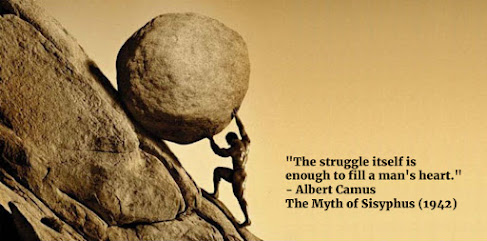
“A Life Worth Living: Albert Camus on Our Search for Meaning and Why Happiness Is Our Moral Obligation”

“A Life Worth Living: Albert Camus on Our Search for
Meaning and Why Happiness Is Our Moral Obligation”
by Maria Popova

“To decide whether life is worth living is to answer the fundamental question of philosophy,” Albert Camus (November 7, 1913–January 4, 1960) wrote in his 119-page philosophical essay “The Myth of Sisyphus” in 1942. “There is but one truly serious philosophical problem, and that is suicide. Judging whether life is or is not worth living amounts to answering the fundamental question of philosophy. All the rest – whether or not the world has three dimensions, whether the mind has nine or twelve categories – comes afterwards. These are games; one must first answer. And if it is true, as Nietzsche claims, that a philosopher, to deserve our respect, must preach by example, you can appreciate the importance of that reply, for it will precede the definitive act. These are facts the heart can feel; yet they call for careful study before they become clear to the intellect. Everything else… is child’s play; we must first of all answer the question.” 

One of the most famous opening lines of the twentieth century captures one of humanity’s most enduring philosophical challenges – the impulse at the heart of Seneca’s meditations on life and Montaigne’s timeless essays and Maya Angelou’s reflections, and a wealth of human inquiry in between. But Camus, the second-youngest recipient of the Nobel Prize in Literature after Rudyard Kipling, addressed it with unparalleled courage of conviction and insight into the irreconcilable longings of the human spirit.

In the beautifully titled and beautifully written “A Life Worth Living: Albert Camus and the Quest for Meaning” (public library), historian Robert Zaretsky considers Camus’s lifelong quest to shed light on the absurd condition, his “yearning for a meaning or a unity to our lives,” and its timeless yet increasingly timely legacy: If the question abides, it is because it is more than a matter of historical or biographical interest. Our pursuit of meaning, and the consequences should we come up empty-handed, are matters of eternal immediacy.

Camus pursues the perennial prey of philosophy – the questions of who we are, where and whether we can find meaning, and what we can truly know about ourselves and the world – less with the intention of capturing them than continuing the chase.”

Reflecting on the parallels between Camus and Montaigne, Zaretsky finds in this ongoing chase one crucial difference of dispositions: “Camus achieves with the Myth what the philosopher Maurice Merleau-Ponty claimed for Montaigne’s Essays: it places “a consciousness astonished at itself at the core of human existence.”

For Camus, however, this astonishment results from our confrontation with a world that refuses to surrender meaning. It occurs when our need for meaning shatters against the indifference, immovable and absolute, of the world. As a result, absurdity is not an autonomous state; it does not exist in the world, but is instead exhaled from the abyss that divides us from a mute world.”

Camus himself captured this with extraordinary elegance when he wrote in “The Myth of Sisyphus”: “This world in itself is not reasonable, that is all that can be said. But what is absurd is the confrontation of this irrational and wild longing for clarity whose call echoes in the human heart. The absurd depends as much on man as on the world. For the moment it is all that links them together.”

To discern these echoes amid the silence of the world, Zaretsky suggests, was at the heart of Camus’s tussle with the absurd: “We must not cease in our exploration, Camus affirms, if only to hear more sharply the silence of the world. In effect, silence sounds out when human beings enter the equation. If “silences must make themselves heard,” it is because those who can hear inevitably demand it. And if the silence persists, where are we to find meaning?”

This search for meaning was not only the lens through which Camus examined every dimension of life, from the existential to the immediate, but also what he saw as our greatest source of agency. In one particularly prescient diary entry from November of 1940, as WWII was gathering momentum, he writes: “Understand this: we can despair of the meaning of life in general, but not of the particular forms that it takes; we can despair of existence, for we have no power over it, but not of history, where the individual can do everything. It is individuals who are killing us today. Why should not individuals manage to give the world peace? We must simply begin without thinking of such grandiose aims.”

For Camus, the question of meaning was closely related to that of happiness - something he explored with great insight in his notebooks. Zaretsky writes: “Camus observed that absurdity might ambush us on a street corner or a sun-blasted beach. But so, too, do beauty and the happiness that attends it. All too often, we know we are happy only when we no longer are.”

Perhaps most importantly, Camus issued a clarion call of dissent in a culture that often conflates happiness with laziness and championed the idea that happiness is nothing less than a moral obligation. A few months before his death, Camus appeared on the TV show Gros Plan. Dressed in a trench coat, he flashed his mischievous boyish smile and proclaimed into the camera: “Today, happiness has become an eccentric activity. The proof is that we tend to hide from others when we practice it. As far as I’m concerned, I tend to think that one needs to be strong and happy in order to help those who are unfortunate.”

This wasn’t a case of Camus arriving at some mythic epiphany in his old age – the cultivation of happiness and the eradication of its obstacles was his most persistent lens on meaning. More than two decades earlier, he had contemplated “the demand for happiness and the patient quest for it” in his journal, capturing with elegant simplicity the essence of the meaningful life – an ability to live with presence despite the knowledge that we are impermanent: ”We must” be happy with our friends, in harmony with the world, and earn our happiness by following a path which nevertheless leads to death.”

But his most piercing point integrates the questions of happiness and meaning into the eternal quest to find ourselves and live our truth: ”It is not so easy to become what one is, to rediscover one’s deepest measure.”
Freely download “The Myth of Sisyphus,” by  Albert Camus, here: